Archive for the ‘U.S. Congress’ category

Benghazi Commission: Obama Admin Gun-Running Scheme Armed Islamic State

December 1, 2015

Benghazi Commission: Obama Admin Gun-Running Scheme Armed Islamic State, BreitbartEdwin Mora, November 30, 2015

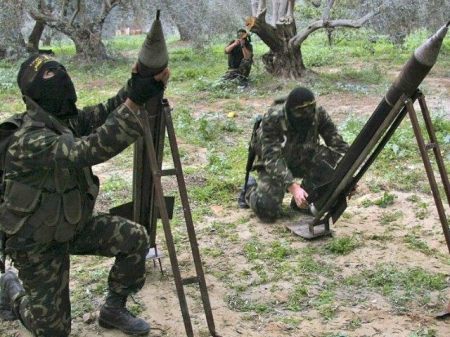
ISIS-fires-rockets-FlickrAmir-Farshad-Ebraham-640x480

To avoid having the funds tracked back to the Obama administration, the arms flow to Libya was financed thru the United Arab Emirates, while Qatar served as the logistical and shipping hub, she noted.

****************************

The Obama administration pursued a policy in Libya back in 2011 that ultimately allowed guns to walk into the hands of jihadists linked to the Islamic State (ISIS/ISIL) and al-Qaeda (AQ) in Syria, according to a former CIA officer who co-authored a report on behalf of the Citizen’s Commission on Benghazi (CCB), detailing the gun running scheme.

In Congress, the then-bipartisan group known as the “Gang of Eight,” at a minimum, knew of the operation to aid and abet America’s jihadist enemies by providing them with material support. So says Clare Lopez, a former CIA officer and the primary author of CCB’s interim report, titled How America Switched Sides in the War on Terror, speaking with Breitbart News.

The ripple effects of the illegal policy to arm America’s enemies continue to be felt as the U.S. military is currently leading a war against ISIS and AQ terrorists in Iraq and Syria, according to Lopez.

In late October, Defense Secretary Ash Carter said that the U.S. would begin “direct action on the ground” against ISIS terrorists in Iraq and Syria who may have reaped the benefits from the gun-running scheme that started in Libya.

“The Obama administration effectively switched sides in what used to be called the Global War on Terror [GWOT] when it decided to overthrow the sovereign government of our Libyan ally, Muammar Qaddafi, who’d been helping in the fight against al-Qaeda, by actually teaming up with and facilitating gun-running to Libyan al-Qaeda and Muslim Brotherhood [MB] elements there in 2011,” explained Lopez. “This U.S. gun-running policy in 2011 during the Libyan revolution was directed by [then] Secretary of State Hillary Clinton and [the late Libya Ambassador] Christopher Stevens, who was her official envoy to the Libyan AQ rebels.”

To avoid having the funds tracked back to the Obama administration, the arms flow to Libya was financed thru the United Arab Emirates, while Qatar served as the logistical and shipping hub, she noted.

“In 2012, the gun-running into Libya turned around and began to flow outward, from Benghazi to the AQ-and-MB-dominated rebels in Syria,” Lopez added. “This time, it was the CIA Base of Operations that was in charge of collecting up and shipping out [surface-to-air missiles] SAMs from Libya on Libyan ships to Turkey for overland delivery to a variety of jihadist militias, some of whose members later coalesced into groups like Jabhat al-Nusra and ISIS [also known as IS].”

Jabhat al-Nusra is al-Qaeda’s Syrian affiliate.

“The downstream consequences of Obama White House decisions in the Syrian conflict are still playing out, but certainly the U.S. – and particularly CIA – support of identifiable jihadist groups associated with the Muslim Brotherhood, Jabhat al-Nusra, Ahrar al-Sham, the Islamic State and other [jihadists] has only exacerbated what was already a devastating situation,” declared Lopez.

Some of the other weapons that eventually ended up in Syria included thousands of MAN-Portable-Air-Defense-System (MANPADS) missile units, such as shoulder-launched SAMs, from late dictator Muammar Qaddafi’s extensive arms stockpiles that pose a threat to low-flying aircraft, especially helicopters.

“It’s been reported that President Obama signed an Executive Order on Syria in early 2012 [just as he had done for Libya in early 2011], that legally covered the CIA and other U.S. agencies that otherwise would have been in violation of aiding and abetting the enemy in time of war and providing material support to terrorism,” notes Lopez. “Still, such blatant disregard for U.S. national security can only be described as deeply corrosive of core American principles.”

Libya Amb. Stevens was killed by jihadists in Benghazi on September 11, 2012, along with three other Americans.

Echoing a Benghazi resident who provided a first-hand account of the incident, retired U.S. Air Force Lt. Col. Dennis Haney, a CCB member, suggested to Breitbart News that Hillary Clinton’s State Department armed some of the al-Qaeda linked jihadists who may have killed the four Americans in Benghazi.

“The reason the U.S. government was operating in Libya is absolutely critical to this debacle because it reflects where America went off the tracks and literally switched sides in the GWOT,” points out Lopez. “This is about who we are as a country, as a people — where we are going with this Republic of ours.”

“There can be no greater treason than aiding and abetting the jihadist enemy in time of war – or providing material – weapons, funding, intel, NATO bombing – support to terrorism,” she continued. “The reason Benghazi is not the burning issue it ought to be is because so many at top levels of U.S. government were implicated in wrong-doing: White House, Pentagon, Intel Community-CIA, Gang of Eight, at a minimum, in Congress, the Department of State, etc.”

The State Department and the CIA did not respond to Breitbart News’ requests for comment.

Clinton was asked about the gun running operation when testifying before the House Select Committee on Benghazi in October.

The Democratic presidential frontrunner claimed she was not aware of any U.S. government efforts to arm jihadists in Libya and Syria.

Clinton did admit to being open to the idea of using private security experts to arm the Qaddafi opposition, which included al-Qaeda elements, but added that it was “not considered seriously.”

Members of the 2011 “Gang of Eight” mentioned in this report included: then-House Speaker Rep. John Boehner (R-OH), House Minority Leader Rep. Nancy Pelosi (D-CA), then-Rep. Mike Rogers (R-AL), (R-MI), Rep. Dutch Ruppersberger (D-MD), then-Sen. Majority Leader Sen. Harry Reid (D-NV), then-Sen. Minority Leader Sen. Mitch McConnell (R-KY), Sen. Dianne Feinstein (D-CA), and Sen. Saxby Chambliss (R-GA).

Obama Admin’s Iran Point Man Promotes Anti-Israel Conspiracy Theories

October 8, 2015

Obama Admin’s Iran Point Man Promotes Anti-Israel Conspiracy Theories, Washington Free Beacon, October 8, 2015

(Surprising? Nope. — DM)

eyrestate__2_Alan Eyre / Twitter

A State Department official closely involved in the Obama administration’s Iran push has been promoting publications from anti-Semitic conspiracy sites and other radical websites that demonize American Jewish groups and Israel, according to sources and documents obtained by the Washington Free Beacon.

Alan Eyre, the State Department’s Persian-language spokesman and a member of the negotiating delegation that struck a nuclear deal with Iran earlier this year, has in recent months disseminated articles that linked American-Jewish skeptics of the deal to shadowy financial networks, sought to soften the image of Iranian terrorists with American blood on their hands, and linked deal criticism to a vast “neoconservative worldview.”

Eyre described the one article, penned by the anti-Israel conspiracy theorist Stephen Walt, as having an “interesting thesis.”

Insiders who spoke to the Free Beacon about Eyre’s private postings pointed to a pattern of partisanship and called it a sign that key officials at the State Department are biased against the state of Israel. Such criticism has dogged the team Obama since the early days of the administration.

Eyre regularly briefed U.S. officials at the negotiating table and was responsible for proofreading draft texts of the recent Iranian nuclear agreement.

While Eyre has a public Facebook page officially sponsored by the State Department, screenshots taken from his private personal account obtained by the Free Beacon include content that insiders described as concerning.

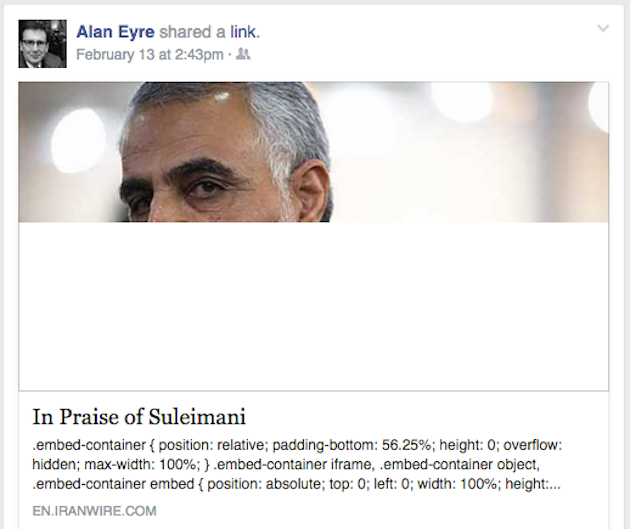
In one Feb. 13 posting, when Iran talks were at a critical stage, Eyre disseminated a link to an article praising Iranian Quds Force Chief Ghassem Suleimani, who is directly responsible for the deaths of Americans abroad.

Image-1

Suleimani, who is listed as a terrorist by the U.S. State Department, will have international sanctions against him waived under the parameters of the nuclear accord.

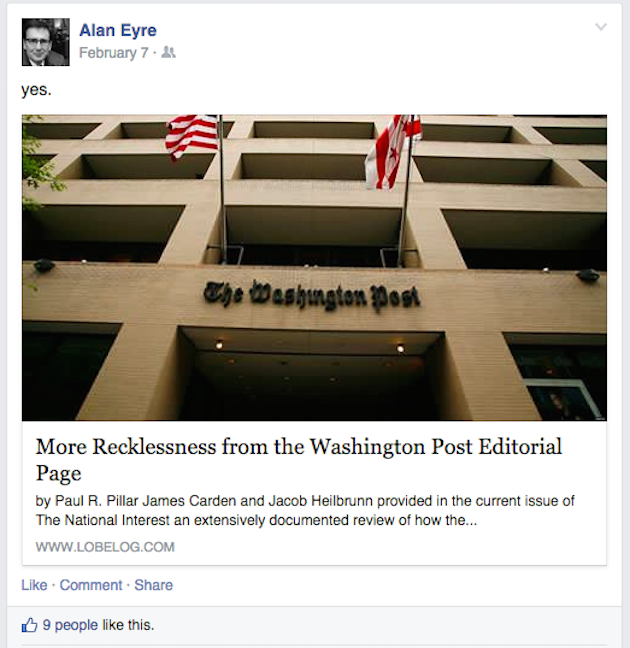
In another posting from Feb. 5, Eyre links to the website LobeBlog, which is viewed by critics as anti-Israel and regularly attacks neoconservative pundits.”

The article Eyre links to, “Who Are the Billionaires Attacking Obama’s Iran Diplomacy,” attacks opponents of the Iranian deal and insinuates that wealthy Jewish donors are behind this push.

The article puts particular emphasis on the Israel Project (TIP), a non-profit advocacy organization run by Josh Block, a longtime Democrat, and claimed that wealthy Jewish individuals were behind a stealth campaign to kill the deal. TIP is portrayed as playing a crucial role in discrediting the deal and convincing lawmakers to take a stance against it.

The article was penned by a former ThinkProgress blogger, Eli Clifton, who was forced out of the Center for American Progress-backed blog following a scandal in which several writers accused Iran deal critics of being “Israel firsters.”

Image-2

In another posting, Eyre links to an article by Stephen Walt, co-author of the book The Israel Lobby, which has been branded by the Anti-Defamation League (ADL) as an “anti-Jewish screed.”

Walt lashes out in the piece at neoconservative critics of the Iran deal, writing that “no one should listen to their advice today.”

Eyre linked to the piece with the comment, “interesting thesis.” He then quoted Walt at length, according to a screenshot:

The real problem is that the neoconservative worldview — one that still informs the thinking of many of the groups and individuals who are most vocal in opposing the Iran deal — is fundamentally flawed. Getting Iraq wrong wasn’t just an unfortunate miscalculation, it happened because their theories of world politics were dubious and their understanding of how the world works was goofy.

Image-3

Eyre also appeared to express disappointment online in March, when Sen. Tom Cotton and 46 other Republican lawmakers penned an open letter to Iran opposing the nuclear talks.

Eyre links to a March 9 Washington Post article by Paul Pillar, an Israel critic who backs boycotts of the Jewish state, titled ‘The misguided, condescending letter from Republican senators to Iran.’ He then opined in the post, “Seriously. Can someone write them a letter telling them that the most fundamental duty of Congress is to pass a budget?”

Image-4

At least one of Eyre’s Facebook friends has quibbled with his postings.

When Eyre linked to a Talking Points Memo article claiming that “49 percent of Republicans don’t believe in evolution,” one critic commented: “This post is total crap. Some 300 people were polled, and the polling criteria were, of course, not specified. This outfit has a deserved reputation as a left-leaning, professionally anti-Republican Flak Tank.”

Eyre dismissed that criticism, responding, “If you are going to fact check every incendiary posting I put up, it is going to detract from the sum total of my facebook-derived frivolity.”

In addition to his postings, Eyre has appeared as a keynote speaker at the National Iranian American Council’s Washington, D.C., conference.

The council, which has been accused as serving as a pro-Tehran lobbying shop, has helped the Obama administration disseminate pro-Iran talking points and champion the deal in the public sphere. Its top officials also have insinuatedthat Jewish lawmakers who oppose the deal have more loyalty to Israel than America.

One senior official at a Washington, D.C., pro-Israel organization expressed disappointment but not surprise at Eyre’s posting.

“The easiest way to explain the State Department’s behavior toward the Middle East is to assume that they don’t like the Israelis very much and they have this romantic fascination with Iran,” the source said. “That’s what you’re seeing here.”

“Of course they can’t admit that out loud, because the American people believe exactly the opposite, so they do it through passive-aggressive Facebook posts and occasional slips of the tongue about how moderate and sophisticated the Iranians are,” the source added.

A State Department spokesman declined to comment on Eyre’s personal postings when contacted by the Free Beacon.

“Alan Eyre is the Department’s Persian Language Spokesperson,” the official said. “In that capacity, he maintains his official page on Facebook here,” the spokesman continued, providing a link to the page.

The Facebook page in question, however, is separate from Eyre’s public-facing personal page referenced by the State Department, which said it had no knowledge of the second page.

“We’re not aware of any such content that you refer to posted on that account,” the official said.

The official did not respond to follow-up requests asking for comment from Eyre on the postings.

AN ARMY OF MCCLELLANS — The Syria Mess and the Pentagon’s Serial Failures

October 6, 2015

AN ARMY OF MCCLELLANS — The Syria Mess and the Pentagon’s Serial Failures, The American Interest, October 5, 2015

When Robert Gates was Secretary of Defense, he found that the Pentagon was ruled by a culture of bureaucratic delay and careerism. This culture affected even such vital issues as getting effective armor to military vehicles, leading to many unnecessary deaths and mutilations by IEDs. In the middle of war, that is, the Pentagon was still in a peacetime military mode, a mode in which buck-passers, bureaucrats, and time-servers push paper, and award one another certificates of merit. One hand washes the other as everybody gets trophies, medals, and promotions at the end of the year.

The pathetic failure of the Pentagon’s efforts in Syria indicate that if anything, this culture of self-congratulation and failure is getting more entrenched. An extensive autopsy of the now-infamous Syria training program in the Wall Street Journal today has plenty of damning details about the White House’s lack of decisiveness and micromanagement. But it also details numerous lapses from the military leaders tasked with carrying out the training, all of which culminated in this farce:

“We, who are directly in contact with the Pentagon, I swear to God, we have no clue what is going on. It is very complicated,” [U.S.-trained rebel commander] Abu Iskandar said in late August as his group was falling apart.

Pentagon-trained fighters said they stopped wearing military uniforms provided by the Americans, fearful of being attacked. On Sept. 19, Col. Daher withdrew from Division 30, citing a lack of American support and coordination.Col. Patrick Ryder, a U.S. Central Command spokesman, said nine of 54 members of the first class were still operating with the U.S. in Syria. Abu Iskandar said all but three fighters remain.

This isn’t the Pentagon’s only embarrassing, dangerous, and costly failure of late. Think of the collapse of the Iraqi army in the face of ISIS, or the Afghan military. After 14 years of U.S. force building efforts in Afghanistan, we seem to have created a force that is better at raping boys than at fighting the Taliban. The failures in that country show that we have a military culture in which the greatest sin is rocking the boat. It’s apparently far better to let corrupt Afghan soldiers chain slave boys to their beds than to create some kind of public disturbance. This is a strategy of “hearts and minds” that will win popular support against the Taliban?

The U.S. is running a vast, multi-country war effort that has become unhinged from any serious strategic vision, and we have a military system in which the commanders who see the futility and try to do something about it (and there are plenty) are sidelined. Go along to get along is the way things work in Obama’s Pentagon, and both the White House and the Congress are more interested in making the military look pretty on the parade ground than making it perform effectively in the combat zone.

The President and the political overseers in Congress have made their priorities clear: You can persist with strategies that don’t work for years and still get steadily promoted up the ladder as long as you jump through hoops about integrating women and gays into more military roles. There’s nothing wrong with those goals. Integrating the armed services racially was once attacked by traditionalists as a step that would destroy military cohesion, but it’s made both the U.S. and our armed services much stronger over time. But the essence of military leadership (and effective civilian oversight) is to get the combat missions done with the lowest possible cost and loss of life.

Perhaps choosing between successful military operations and reshaping the makeup of the military doesn’t have to be either/or, but under President Obama we have opted for the latter and tanked the former. The Pentagon has failed at its major military objectives in the Middle East. It has not built up the Iraqi Army into an independent force that can defend against ISIS and sectarian militias. It has not made the Afghan army the core of a state that can hold territory and retain the loyalty of its people and so prevent the Taliban’s resurgence. And it has not created an effective rebel force in Syria as a third way between Assad and ISIS. Perhaps these objectives were always unrealistic and the missions should never have been launched, or perhaps they needed more focused and proactive civilian leadership. But in any case, the brass on the Pentagon office doors has been polished to a high shine during the Obama years even as the missions in the field have serially failed.

Failures of military leadership are ultimately failures of civilian oversight. Abraham Lincoln fired General McClellan and promoted General Grant because, while McClellan dressed well, handled himself well in social situations, and polished his army to perfection on the parade ground, he didn’t win battles. General Grant was occasionally drunk, almost always slovenly, and didn’t always say the right things to the press. He did, however, win battles. Right now our political leadership seems to prefer an army of McClellans to an army of Grants, and the consequences are visible across the Middle East.

The Iran Nuclear Deal: What the Next President Should Do

October 2, 2015

The Iran Nuclear Deal: What the Next President Should Do, Heritage Foundation, October 2, 2015

(But please see, The Elephant In The Room. — DM)

The failure of Congress to halt the implementation of the Obama Administration’s nuclear agreement with Tehran means that the U.S. is stuck with a bad deal on Iran’s nuclear program at least for now. Iran’s radical Islamist regime will now benefit from the suspension of international sanctions without dismantling its nuclear infrastructure, which will remain basically intact. Iran’s path to a nuclear weapon is unlikely to be blocked by the Administration’s flawed deal, any more than North Korea was blocked by the Clinton Administration’s 1994 Agreed Framework.

The next President should not passively accept Obama’s risky deal with Tehran as a fait accompli. Instead, he or she should immediately cite any violations of the agreement by Iran, its continued support for terrorism, or other hostile policies as reason to abrogate the agreement. The Bush Administration, faced with bad deals negotiated by the Clinton Administration, eventually withdrew from both the Agreed Framework and the Kyoto Protocol.

Rather than endorsing a dangerous agreement that bolsters Iran’s economy, facilitates its military buildup, and paves the way for an eventual Iranian nuclear breakout, the next Administration must accelerate efforts to deter, contain, and roll back the influence of Iran’s theocratic dictatorship, which continues to call for “death to America.”

How the Next President Should Deal with Iran

Upon entering office, the next Administration should immediately review Iran’s compliance with the existing deal, as well as its behavior in sponsoring terrorism, subverting nearby governments, and attacking U.S. allies. Any evidence that Iran is cheating on the agreement (which is likely given Iran’s past behavior) or continuing hostile acts against the U.S. and its allies should be used to justify nullification of the agreement.

Regrettably, Tehran already will have pocketed up to $100 billion in sanctions relief by the time the next Administration comes to office because of the frontloading of sanctions relief in the early months of the misconceived deal. Continuing to fork over billions of dollars that Tehran can use to finance further terrorism, subversion, and military and nuclear expansion will only worsen the situation.

In place of the flawed nuclear agreement, which would boost Iran’s long-term military and nuclear threat potential, strengthen Iran’s regional influence, strain ties with U.S. allies, and diminish U.S. influence in the region, the new Administration should:

1. Expand sanctions on Iran. The new Administration should immediately reinstate all U.S. sanctions on Iran suspended under the Vienna Agreement and work with Congress to expand sanctions, focusing on Iran’s nuclear program; support of terrorism; ballistic missile program; interventions in Syria, Iraq, and Yemen; human rights violations; and holding of four American hostages (Washington Post reporter Jason Rezaian, Christian pastor Saeed Abedini, former U.S. Marine Amir Hekmati, and former FBI agent Robert Levinson, who has been covertly held hostage by Iran since 2007).

The new Administration should designate Iran’s Islamic Revolutionary Guard Corps (IRGC) as a foreign terrorist organization and apply sanctions to any non-Iranian companies that do business with the IRGC’s extensive economic empire. This measure would help reduce the IRGC’s ability to exploit sanctions relief for its own hostile purposes.

Washington should also cite Iranian violations of the accord as reason for reimposing U.N. sanctions on Iran, thus enhancing international pressure on Tehran and discouraging foreign investment and trade that could boost Iran’s military and nuclear programs. It is critical that U.S. allies and Iran’s trading partners understand that investing or trading with Iran will subject them to U.S. sanctions even if some countries refuse to enforce U.N. sanctions.

2. Strengthen U.S. military forces to provide greater deterrence against an Iranian nuclear breakout.Ultimately, no piece of paper will block an Iranian nuclear breakout. The chief deterrent to Iran’s attaining a nuclear capability is the prospect of a U.S. preventive military attack. It is no coincidence that Iran halted many aspects of its nuclear weapons program in 2003 after the U.S. invasion of and overthrow of hostile regimes in Afghanistan and Iraq. Libyan dictator Muammar Qadhafi, motivated by a similar apprehension about the Bush Administration, also chose to give up his chemical and nuclear weapons programs.

To strengthen this deterrence, it is necessary to rebuild U.S. military strength, which has been sapped in recent years by devastating budget cuts. The Obama Administration’s failure to provide for the national defense will shortly result in the absence of U.S. aircraft carriers from the Persian Gulf region for the first time since 2007. Such signs of declining U.S. military capabilities will exacerbate the risks posed by the nuclear deal.

3. Strengthen U.S. alliances, especially with Israel. The nuclear agreement has had a corrosive effect on bilateral relationships with important U.S. allies in the Middle East, particularly those countries that are most threatened by Iran, such as Israel and Saudi Arabia. Rather than sacrificing the interests of allies in a rush to embrace Iran as the Obama Administration has done, the next Administration should give priority to safeguarding the vital security interests of the U.S. and its allies by maintaining a favorable balance of power in the region to deter and contain Iran. Washington should help rebuild security ties by boosting arms sales to Israel, Saudi Arabia, and other members of the Gulf Cooperation Council (GCC) that are threatened by Tehran, taking care that arms sales to Arab states do not threaten Israel’s qualitative military edge in the event of a flare-up in Arab–Israeli fighting.

To enhance deterrence against an Iranian nuclear breakout, Washington also should transfer to Israel capabilities that could be used to destroy hardened targets such as the Fordow uranium enrichment facility, which is built hundreds of feet beneath a mountain. The only non-nuclear weapon capable of destroying such a target is the Massive Ordnance Penetrator (MOP), a precision-guided, 30,000-pound “bunker buster” bomb. Giving Israel these weapons and the aircraft to deliver them would make Tehran think twice about risking a nuclear breakout.

The U.S. and its European allies also should strengthen military, intelligence, and security cooperation with Israel and the members of the GCC, an alliance of Bahrain, Kuwait, Oman, Qatar, Saudi Arabia, and the United Arab Emirates, founded in 1981 to provide collective security for Arab states threatened by Iran. Such a coalition could help both to contain the expansion of Iranian power and to facilitate military action (if necessary) against Iran.

4. Put a high priority on missile defense. Iran’s ballistic missile force, the largest in the Middle East, poses a growing threat to its neighbors. Washington should help Israel to strengthen its missile defenses and help the GCC countries to build an integrated and layered missile defense architecture to blunt the Iranian missile threat. The U.S. Navy should be prepared to deploy warships equipped with Aegis ballistic missile defense systems to appropriate locations to help defend Israel and the GCC allies against potential Iranian missile attacks as circumstances demand. This will require coordinating missile defense activities among the various U.S. and allied missile defense systems through a joint communications system. The U.S. should also field missile defense interceptors in space for intercepting Iranian missiles in the boost phase, which would add a valuable additional layer to missile defenses.

5. Deter nuclear proliferation. For more than five decades, Washington has opposed the spread of sensitive nuclear technologies such as uranium enrichment, even for its allies. By unwisely making an exception for Iran, the Obama Administration in effect conceded the acceptability of an illicit uranium enrichment program in a rogue state. In fact, the Administration granted Iran’s Islamist dictatorship better terms on uranium enrichment than the Ford and Carter Administrations offered to the Shah of Iran, a U.S. ally back in the 1970s.

The Obama Administration’s shortsighted deal with Iran is likely to spur a cascade of nuclear proliferation among threatened states such as Saudi Arabia, Turkey, Egypt, and the United Arab Emirates. Such a multipolar nuclear Middle East, on hair-trigger alert because of the lack of a survivable second-strike capability, would introduce a new level of instability into an already volatile region. To prevent such an outcome, the next Administration must reassure these countries that it will take military action to prevent Iran from gaining a nuclear capability as well as to deter Iranian military threats to their interests.

6. Expand domestic oil and gas production and lift the ban on U.S. oil exports to put downward pressure on world prices. In addition to sanctions, Iran’s economy has been hurt by falling world oil prices. Its oil export earnings, which constitute more than 80 percent of the regime’s revenue, have been significantly reduced. By removing unnecessary restrictions on oil exploration and drilling in potentially rich offshore and Alaskan oil regions, Washington could help to maximize downward pressure on long-term global oil prices. Lifting the ban on U.S. oil exports, an obsolete legacy of the 1973–1974 energy crisis spawned by the Arab oil embargo, would amplify the benefits of increased oil and gas production. Permitting U.S. oil exports not only would benefit the U.S. economy and balance of trade, but also would marginally lower world oil prices and Iranian oil export revenues, thereby reducing the regime’s ability to finance terrorism, subversion, and military expansion.

7. Negotiate a better deal with Iran. The Obama Administration played a strong hand weakly in its negotiations with Iran. It made it clear that it wanted a nuclear agreement more than Tehran appeared to want one. That gave the Iranians bargaining leverage that they used shrewdly. The Administration made a bad situation worse by downplaying the military option and front-loading sanctions relief early in the interim agreement, which reduced Iran’s incentives to make concessions.

The next Administration should seek an agreement that would permanently bar Iran from acquiring nuclear weapons. At a minimum, this would require:

  • Banning Iran from uranium enrichment activities;
  • Dismantling substantial portions of Iran’s nuclear infrastructure, particularly the Fordow and Natanz uranium enrichment facilities and Arak heavy water reactor;
  • Performing robust inspections on an “anytime anywhere” basis and real-time monitoring of Iranian nuclear facilities;
  • Linking sanctions relief to Iranian compliance;
  • Ensuring that Iran comes clean on its past weaponization efforts; and
  • Determining a clear and rapid process for reimposing all sanctions if Iran is caught cheating.

The Bottom Line

The nuclear deal already has weakened relationships between the U.S. and important allies, undermined the perceived reliability of the U.S. as an ally, and helped Iran to reinvigorate its economy and expand its regional influence. After oil sanctions are lifted, Iran will gain enhanced resources to finance escalating threats to the U.S. and its allies. The next Administration must help put Iran’s nuclear genie back in the bottle by taking a much tougher and more realistic approach to deterring and preventing an Iranian nuclear breakout.

The Elephant In The Room

October 2, 2015

The Elephant In The Room, Middle East Media Research Institute (MEMRI), Yigal Carmon*, October 2, 2015

(Please see also, Iran wants to renegotiate parts of the nuke “deal.” That may be good. Have opponents of the “deal” given up? If so, why? — DM)

It may be that these opponents believe that the agreement is a done deal that cannot be stopped and that the current U.S. administration will follow through with it no matter what. This approach reflects not realism but ignorance. Obviously the administration wants to follow through with the deal. But the deal is no longer in it hands. It is Khamenei who is throwing a spanner in the works, declaring that he will not implement the agreement that the West believed it concluded on July 14.

In order to get Iran to implement the agreement, the language of the JCPOA will have to be changed and a new Security Council resolution will have to be passed. While in theory this would not be impossible, it would require a new process, entailing, at the very least, a public political debate in the West – one that would reveal Iran’s unreliability as a partner and would cost valuable time. And time is not on the side of the U.S. administration.

*****************

On September 3, 2015, not two months after the July 14 announcement of the Joint Comprehensive Plan of Action at Vienna and its celebration at the White House and in Europe, Iranian Supreme Leader Ali Khamenei dropped a bombshell.

In a speech to the Iranian Assembly of Experts, he backtracked from the agreement, demanding a new concession: that the sanctions be “lifted,” not merely “suspended.”[1] If that term is not changed, said Khamenei, there is no agreement. If the West only “suspends” the sanctions, he added, Iran will merely “suspend” its obligations. Giving further credence to his threat, he announced that it is the Iranian Majlis that must discuss and approve the agreement (or not), because it represents the people – when it is well known that the majority of its members oppose it, and Iranian President Hassan Rohani made every effort to prevent such a discussion in the Majlis from taking place.

Adding insult to injury, Ali Akbar Velayati, senior advisor to Khamenei and head of Iran’s Center for Strategic Research, said on September 19 that the negotiations, concluded and celebrated less than two months previously on July 14, are actually “not over yet.”[2]

Khamenei’s demand to replace “suspension” with “lifting” is not just semantic. It is a fundamental change, because the snapback of sanctions – the major security mechanism for the entire agreement – cannot take place with “lifting,” but only with “suspension.”

Ever since Khamenei dropped this bombshell, the Western media has maintained total silence, as if this were a trivial matter not worthy of mention, let alone analysis.

One might understand this reaction on the part of those who support the deal. Perhaps they are shocked, at a loss, and therefore hope that if they pretend they don’t see it, it doesn’t exist. Indeed, this is the futile policy regularly adopted by ostriches.

However, one cannot but be astounded by the silence on the part of the opponents of the deal, including – oddly enough – Israel and the U.S. Republicans. One would expect these opponents to pounce on Khamenei’s statement and raise hell over Iran’s infanticide of the two-month-old agreement. One would expect them to bring it to the forefront of a new debate over the deal in any possible forum – in the U.S., the U.N., and the E.U.

But – nothing.

It may be that these opponents believe that the agreement is a done deal that cannot be stopped and that the current U.S. administration will follow through with it no matter what. This approach reflects not realism but ignorance. Obviously the administration wants to follow through with the deal. But the deal is no longer in it hands. It is Khamenei who is throwing a spanner in the works, declaring that he will not implement the agreement that the West believed it concluded on July 14.

In order to get Iran to implement the agreement, the language of the JCPOA will have to be changed and a new Security Council resolution will have to be passed. While in theory this would not be impossible, it would require a new process, entailing, at the very least, a public political debate in the West – one that would reveal Iran’s unreliability as a partner and would cost valuable time. And time is not on the side of the U.S. administration.

Right now, Iran is exposed almost daily as the ally of Russia against the U.S. Three months after the “historic” agreement declared by the White House, Iran continues to seek “Death to America,” and the Iranian foreign minister, the “hero” of the agreement, needs to apologize in Iran for “accidentally” shaking hands with the U.S. president. The truth of the agreement is emerging, and it is not certain that what Iran is now demanding will pass.

Interestingly enough, the White House’s first reaction was to brush off Khamenei’s demand. Iran, said Josh Earnest, should just do what it what it had undertaken to do in the agreement, and stop roiling the waters.[3]

A more sober response followed. There was hope that the meeting set for September 28 between the P5+1 and Iranian foreign ministers, on the margins of the 70th session of the U.N. General Assembly, would produce a solution, but this hope was in vain. Iranian President Rohani fled back to Iran, on the pretext of the hajj tragedy in Mecca, and no one in the West knows how to proceed.

The Western media, for its part, is perpetuating its total blackout on the issue, hoping perhaps for a miracle in the secret U.S.-Iran talks, which this administration has been conducting for years. But even a secret U.S. concession will be no solution. Even if it were to offer a secret commitment to remove the sanctions altogether, Khamenei will not be satisfied. He openly challenged the U.S., and he needs its public capitulation. He will celebrate publicly any secret concession. Moreover, any new U.S. concession will prompt Khamenei to make ever more demands.

The most recent developments, and the emergence of Russia as a new-old contender for power vis-à-vis the U.S. in the world, particularly in the Middle East, will only encourage Khamenei to cling to his tried and true ally, Russia. Indeed, this administration has no objection to Russia’s resurgence in the Middle East, but Russia’s blatant anti-U.S. stance in every venue except in the private, honeyed Putin-Obama talks will ultimately lead even the blindest of Democrats to realize that Iran is indeed an enemy of the U.S. – as Iran plainly declares – and that any further concessions to it make no sense.

It seems that the worst nightmare of the supporters of the deal – that Iran will do away with the July 14 agreement – is about to come to pass.

*Y. Carmon is president and founder of MEMRI.

Endnotes:

[3] Earnest said: “What we have indicated all along is that once an agreement was reached, as it was back in mid-July, that we would be focused on Iran’s actions and not their words, and that we will be able to tell if Iran follows through on the commitments that they made in the context of these negotiations. And that is what will determine our path forward here. We’ve been crystal clear about the fact that Iran will have to take a variety of serious steps to significantly roll back their nuclear program before any sanctions relief is offered – and this is everything from reducing their nuclear uranium stockpile by 98 percent, disconnecting thousands of centrifuges, essentially gutting the core of their heavy-water reactor at Arak, giving the IAEA the information and access they need in order to complete their report about the potential military dimensions of Iran’s nuclear program. And then we need to see Iran begin to comply with the inspections regime that the IAEA will put in place to verify their compliance with the agreement. And only after those steps and several others have been effectively completed, will Iran begin to receive sanctions relief.  The good news is all of this is codified in the agreement that was reached between Iran and the rest of the international community. And that’s what we will be focused on, is their compliance with the agreement.” Whitehouse.gov, September 4, 2015.

12 Hair-Raising Facts from Congressional Terror Report

September 30, 2015

12 Hair-Raising Facts from Congressional Terror Report, Clarion ProjectRyan Mauro, September 30, 2015

Islamic-State-Victory-Parade-HPAn Islamic State victory parade

Yesterday, the House Homeland Security Committee released the final report of its Task Force on Combating Terrorist and Foreign Fighter Travel and its conclusions weren’t pretty. The following are a dozen hair-raising facts from the bipartisan report:

“Today, we are witnessing the largest global convergence of jihadists in history.”

If you consider how the jihad in Afghanistan against the Soviets impacted the terrorist threat to the West, then we’re in for a heap of trouble due to the jihad in Syria, Iraq and elsewhere.

About 10,000 foreign fighters joined the jihad against the Soviets over roughly a 10-year period, with only 3-4,000 fighter joining at once. Today, over 25,000 foreign fighters are currently in Syria and the civil war is only four years old. When it started in 2011, the number of foreign fighters was a mere 1,000.

“We have largely failed to stop Americans from traveling overseas to join jihadists … Several dozen also managed to make it back into America.”

This stunning conclusion will add ammunition to efforts to revoke the passports of Americans who are believed to have joined jihadists overseas. Aside from constitutional objections, one rebuttal has been if the government has the evidence to show an American has joined terrorists, then it can simply arrest them if they try to re-enter. The report shows that these American traitors have been able to evade detection and come back home to potentially carry out attacks and/or radicalize others.

“The U.S. government lacks a national strategy for combating terrorist travel and has not produced one in nearly a decade.”

This statement, unfortunately, speaks for itself.

“The unprecedented speed at which Americans are being radicalized by violent extremists is straining federal law enforcement’s ability to monitor and intercept suspects.”

Over 250 Americans have joined or tried to join the jihadist groups in Iraq and Syria, including around 30 females. They come from 19 states, with 26% coming from Minnesota, 12% from California and 12% from New York/New Jersey.

“There have now been twice as many ISIS-inspired terror plots against the West in 2015 than there were in all of 2014.”

This conclusion is unsettling—and charitable. A review by terrorism expert Patrick Poole found that the number of Islamist terrorism cases in the U.S. this year was double that of the previous two years combined. And that was as of about four months ago.

“[ISIS] is believed to have inspired or directed nearly 60 terrorist plots or attacks against Western countries, including 15 in the United States.”

“Military officials estimate airstrikes have killed over 10,000 [ISIS] extremists, but new foreign fighters replace them almost as quickly as they are killed.”

This substantiates the admission that the U.S. fight with ISIS was at a “stalemate.” Our analysis of the numbers led to thesame conclusion back in May. If you look at ISIS’ membership and territorial expansion, the U.S. is barely making a dent.

Additionally, optimistic claims of success exempt ISIS’ growth outside of Iraq and Syria. The Committee mentions reports that there are “hundreds, if not thousands” of ISIS members in Afghanistan now and the Libyan government believes it is dealing with 5,000 of its own jihadist foreign fighters now.

“Gaping security weaknesses overseas—especially in Europe—are putting the U.S. homeland in danger…”

The report raises several warnings about European security procedures, a pressing issue considering that about 1,550 fighters from France, 700 from Germany and 700 from the United Kingdom have joined the jihad in Syria and Iraq. The Committee found that counter-terrorism checks at European borders and airports are insufficient.

One-third of the international community does not issue fraud-resistant E-Passports or utilize the INTERPOL databases that contain the names of terrorists.

“In short, information about foreign fighters is crossing borders less quickly than the extremists themselves.”

The report emphasizes that intelligence-sharing remains a severe problem. There isn’t even an international comprehensive database of foreign fighter names.

“The federal government has failed to develop clear early intervention strategies—or ‘off-ramps’- to radicalization—to prevent suspects already on law enforcement’s radar from leaving to join extremists.”

Someone who is actively trying to join a group like ISIS or Al-Qaeda is probably too far gone to be rescued, unless they get a brutal wakeup call when they see the caliphate first-hand. The report states that 80% of foreign fighters download extremist propaganda and/or engage a jihadist online. It is critical that we target the ideology that precedes the violent act.

“Few initiatives exist nationwide to raise community awareness about foreign fighter recruitment and to assist communities with spotting warning signs.”

The report says that 75% of foreign fighter arrests in the U.S. happen due to the involvement of a confidential informant who is close enough to the suspect to provide the critical evidence. Presumably, this would be a Muslim in most cases. This is why Islamist propaganda that demonizes the FBI and its informants must be rebutted, such as when the Council on American-Islamic Relations (CAIR) claims that the War on Terror is “made up” by the FBI and its informants are paid to frame innocent Muslims.

“The Administration has launched programs to counter-message terrorist propaganda abroad, but little is being done here at home.”
The report isn’t exactly kind to our ideological strategy abroad, either. It says the U.S. government has not exploited the opportunity presented by “jaded jihadists”— Islamist terrorists who join the caliphate, realize it wasn’t all it was cracked up to be and flee. For example, a State Department video featuring such testimonies had only 500 views over two months.


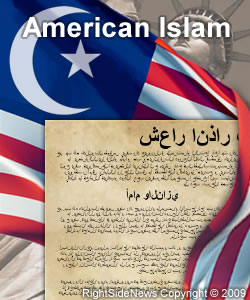
Satire? | Election 2048 – Under the peace of Islam

September 30, 2015

Election 2048 – Under the peace of Islam, Sultan Knish Blog, Daniel Greenfield, September 30, 2015

Election Coverage 2048 – Al-CNN

As the election of 2048 approaches, the candidates from both parties continue to exchange strong views on the issues that affect the lives of Americans. The Party of Democracy and Justice (Hezb-Al-Dimukratie-Wa’al Adalah) continues to maintain that the election will come down to social justice issues.

crescent&stripes.jpeg

“With 34 percent unemployment and the price of goat so far out of range of most working families that they have been forced to switch to chicken, it is time that our opponents stopped dodging the issues and took a serious look at the economic consequences of their policies,” Bashar Mohammed Hussein Al-Hamdani, said during a campaign stop at a HalalBurger in Peoria, Illinois.

However the ruling Freedom and Religion Party (Hezb Al-Hurriyah Wa’al Allah) denounced this as class warfare. Still preoccupied with the ongoing occupation of the Netherlands and Greece, the party has taken criticism for ignoring the economic problems of the United States while being preoccupied with waging foreign wars in the name of Islam.

Nevertheless President Mohammed Al-Thani, fresh off a pilgrimage from Mecca, vigorously defended his record while conducting a photo op at a San Diego Madrassa. “The Freedom and Religion Party believes in creating opportunities, rather than offering hand outs. Our subjugation of infidel nations has opened up new territories to be dominated by the believers and our vigorous drive for national morality has revived the family unit as an economic force. Our program of heavily fining women who go out with their naked hair exposed and raising the Jizya tax on the People of the Book has also raised billions of dollars that will go toward repaying the nation 93 trillion dollar debt.”

The high Jizya tax has provoked outrage in some parts of the United States, but the continuing decline of the nation’s non-Muslim population has made the Christian vote much less of a factor in the election. Hamdani has promised to cut the Jizya tax by 20 percent if elected, but it is unclear whether conservative elements in his own party will allow him to do it. National surveys show that since making the proposal, Hamdani’s ratings have gone down 9 points in Illinois and 14 points in California.

President Al-Thani’s advisors view the 2 million conversions to Islam since the Jizya tax was tripled as a major benefit to the party which lost its Christian support during the Great Transition. Since then the Freedom and Justice Party has picked up a Christian and Jewish bloc vote, but the value of that bloc has not held up well over the last two elections.

Christian rights activists attribute the decline of American Christians to the Jizya tax which has made it impossible for many Christian families to earn a living. They also blame the bloody 2045 Riots which marked the end of the Christian presence in former strongholds such as Nashville and Cedar Rapids, as well as rumors about the kidnapping and forced conversion of Christian girls.

However popular talk show host and pundit, Abdul Greene countered that the decrease was best explained by the large scale immigration of Christians out of the country. “The Christians are too bigoted to live in the same country with us, just like their parents and grandparents. If they can’t control the country, they refuse to live here and accept our laws.”

Christian rights activists have accused Greene of playing a major role in stirring up the 2045 Riots which torched Christian areas in major cities across the United States after a Christian man was accused of having an intimate encounter with a Muslim woman. Greene however insists that the Christians are the ones to blame. Greene’s support of the Freedom and Religion Party has been controversial, but President Al-Thani has refused to disavow him.

The latest round of attacks by Greek guerrillas on liberation forces in Athens led to smaller attacks on Christian businesses in New York, Chicago and Los Angeles last month. They also accentuated the debate over the continuing occupation of Greece which began in 2031 when the United States government intervened to protect the territorial claims of the Turkish Republic of Cyprus. Much as in the Netherlands, the intervention to protect a Muslim community turned into a full blown occupation and a war against an insurgency that is believed to be backed and supplied by rogue states such as the breakaway Arctic Republic and the Zionist Entity.

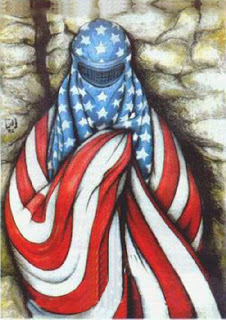
BurkaRedWhitandBlue-vi

The Freedom and Religion Party under President Al-Thani continues to take the position that American prosperity is closely linked to the welfare of the rest of the Muslim world. In the State of the Union address the president stated that, “We cannot repeat the folly of the Americans of the pagan period who believed that they could have material wealth without religion. Our prosperity comes from Allah and it is only by spreading the way of Allah and conducting our Jihad in the way of Allah on behalf of our endangered brothers and sisters in Europe and Asia that we will be deserving of Allah’s bounty.”

Hoping to exploit the widespread economic dissatisfaction, Hamdani, a former Wisconsin governor, has promised to withdraw troops from Greece within two years and the Netherlands within five years with the majority of remaining liberation forces being drawn from other Muslim countries. “We can best aid our fellow believers in the Muslim world by being a model of stability and a beacon of tolerance.”

Yusuf Al-Amiriki, a member of Hamdini’s foreign policy defense team and a first generation convert descended from two American presidents, courted controversy with a proposal to set up a coalition government of Muslim and moderate Christian groups in the Netherlands. Such governments had been tried in Europe before during the 2030’s, but invariably fell apart. Leading Senators from the Freedom and Justice Party accused Hamdani of selling out Muslim interests in order to court the Christian vote. Hamdani’s spokeswoman, Aisha Zubedi, has refused to comment on the Amiriki proposal except to say that Hamdani was open to any solution that would restore peace to the people of the Netherlands and protect the rights of European Muslims.

Hamdani courted further controversy by appearing at the funeral of former President Bob Thompson. Thompson had served two terms and while his administration had worked hard on outreach to the Muslim world, he also engaged in the targeted murder of Muslim religious leaders and provided aid to the Zionist entity. For these reasons, President Al-Thani chose not to appear at his funeral even though President Thompson had been a member of the pre-transition Freedom and Religion Party, which was then known as the Republican Party.

Despite the official disapproval, Thompson was viewed positively by many in the Muslim community. Tens of millions of Pakistani-Americans remember how after the India-Pakistan war, the Thompson Administration generously opened its borders to victims of the nuclear fallout in Pakistan. Without that step it might have taken decades more before America achieved a Muslim majority.

During the beginning of his second term, Thompson became the first president to take the oath of office on both a Bible and a Koran declaring that he wanted to make no separation between the books of god. At the Thompson funeral, Hamdani appeared to promise that he would repeat that gesture, but his spokeswoman quickly disavowed any notion that he would ever take an oath on a text that was not the Koran.

“No American president has taken an oath on a bible in over a decade, all that the governor meant was that he would keep both Christians and Muslims in mind as the people of Allah when he takes his oath to protect and defend the Sharia,” Aisha Zubedi said.

While the Democracy and Justice Party has often appealed to the poor, its missteps have raised concerns in traditional Muslim communities that Hamdani is going too far in pandering to non-Muslims. “Next thing you know he’ll say we should let the Jews come back to America,” Congressman Mohammed Mogabe declared. “If Hamdani wants votes out of Cleveland then he is going to show he will fight for us, not for the enemies of the prophets.”

Hamdani has hurriedly scheduled an upcoming visit to the Ground Zero Mosque, but it may not be enough to improve his image in the eyes those who have accused him of flirting with apostasy. While the Mosque is a traditional stop for presidential candidates, Hamdani is unlikely to pay tribute to the souls of the 19 martyrs as Al-Thani did during the previous election.

Hoping to refocus attention on his economic program, Hamdani called for higher corporate taxes and accused some corporations of abusing Islamic banking, in particular Hibah payments, to avoid paying taxes. Such charges are not new, but particularly galling at a time when over half the country is out of work and tycoons like Ahmed Shalafi and Sheikh Johnson have used their connections with the Al-Thani government to become billionaires.

To counter Hamdani, Al-Thani’s economic advisers have offered up a stimulus plan that raises the Jizya tax on infidels for the second time in a year and vowed to cut spending even further without affecting subsidies to Islamic schools or military preparedness for the Global Jihad. Though the election is still some time away, the Al-Thani campaign has also rolled out a series of ads targeting poor communities which accuse Hamdani of plotting with Jewish and Christian tycoons to subvert the Islamic system of finance through freemasonry and Communist class warfare tactics.

americanislam

Adding further drama to the election is the possibility of a third party campaign. Andrew McMillan who has been running as an independent in elections for almost twenty years without appealing to anyone but the same racist groups who have been disavowed even by most Christians and Jews, but there is talk that McMillan’s America Party might consider replacing the eccentric millionaire with sports star Ted March. As leading goalscorer who helped the United States win the 2042 World Cup, March is one of the most admired non-Muslims in the country. With him on the ticket, the America Party might be able to adopt a new moderate image that is no longer associated with bigotry and intolerance. But frustrating his own party members, the septuagenarian McMillan appeared to an event commemorating the 2045 riots and gave a rousing speech which hit on many of the same old themes. “For thirty-six years I’ve been involved in politics and the only thing that I can tell you about politics is that it’s all bunk. We weren’t talking about the things that mattered thirty-six years ago and we aren’t talking about them now.”

Iran Openly Declares That It Intends To Violate UNSCR 2231 That Endorses The JCPOA

September 23, 2015

Iran Openly Declares That It Intends To Violate UNSCR 2231 That Endorses The JCPOA, Middle East Media Research Institute, September 22, 2015

(Please see also, Iran wants to renegotiate parts of the nuke “deal.” That may be good. Iran’s declaration that it intends to violate UNSCR 2231, dealing with missile development and related sanctions, should further prompt the U.S. Congress to repudiate the “deal.”– DM)

When the Americans moved the sanctions on the missile program to UNSCR 2231, Iran did not object, as, according to their statements above, they can violate Security Council resolutions, as they have done in the past, and this will not be regarded as a violation of the JCPOA.

**************************

In statements, three Iranian leaders – President Hassan Rohani, Foreign Minister Zarif, and Deputy Foreign Minister and senior negotiator Abbas Araghchi – emphasized that Iran has no intention of abiding by UNSRC 2231, which includes the JCPOA and another element; rather, that they will abide only by the original JCPOA.

The Iran nuclear deal consists of the following:

A.   A set of understandings between Iran and the P5+1 powers (as well as the remaining disagreements) all in a single package called the JCPOA. It is not a contract between Iran and the P5+1 countries as a group or any single one of them, and hence no document was signed.

B.   This set of mutual understandings (as well as disagreements) packaged in the JCPOA was transferred, following the conclusion of negotiations in Vienna on July 14, 2015, to the UN Security Council, for endorsement as a UN Security Council resolution. The resolution, UNSCR 2231, was passed on July 25, 2015 and it includes, in addition to the JCPOA, another element (Annex B) with further stipulations regarding Iran. For example, it addresses the sanctions on Iran’s missile development project.

To understand why UNSCR 2231 is structured in this way, we can look at statements by top Iranian negotiators about the process that led up to it:

In a July 20, 2015 interview on Iranian Channel 2, Iranian Deputy Foreign Minister and senior negotiator Abbas Araghchi said that there had been tough bargaining between the Iranian and American delegations over the issue of the arms embargo on Iran and the sanctions related to Iran’s missile development project. “The Americans sought their inclusion in the JCPOA, claiming that otherwise they could not face criticism from Arab countries in the region. When they said that they could not lift the sanctions altogether, we told them explicitly that in that case there is no agreement. We told them that the national security issues are non-negotiable and that we will not accept an agreement which continues the embargo on weapons and the sanctions on missile development. In the end, the Americans said, We will put the issue of the embargo and the missiles in the UN Security Council Resolution separate from the agreement.”

In the same interview, Araghchi was asked whether Iran could refrain from carrying out UNSCR 2231; he replied: “Yes we can; just as we refrained from complying with UN Security Council resolutions, we can do so with regards to 2231.”

Araghchi also referred to the Iranian Foreign Ministry statement issued following the passage of UNSCR 2231: “The Iranian Foreign Ministry statement explicitly noted that Iran does not attach legitimacy to any restriction and any threat. If UNSCR 2231 will be violated by Iran, it will be a violation of the Security Council resolution and not of the JCPOA, similar to what happened 10 years ago when we violated Security Council resolutions and nothing happened. The text of the JCPOA notes the fact that the content of the JCPOA and of the UN Security Council resolution are two separate things.”[1]

Foreign Minister Zarif, in an August 9, 2015 media interview, reiterated the Iranian position regarding the difference between the JCPOA and UNSCR 2231, with a focus on the consequences of possible violation of the two by Iran. He said: “There is a difference between the JCPOA and UNSCR 2231. Violating the JCPOA has consequences, while violating UNSCR 2231 has no consequences.”[2]

Indeed, the restrictions regarding missiles are mentioned only in UNSCR 2231, and not in the JCPOA.

On August 29, 2015, Iranian President Hassan Rohani said: “There is nothing about the topic of missiles, defense, and weapons in the JCPOA.  Whatever we have about it is in Resolution [UNSCR] 2231… Moreover, we have formally announced that we are not committed to all the sections that appear in the resolution [2231], and we specified in the JCPOA that violation of the resolution [2231] does not mean violation of the JCPOA…[3]

The meaning of all this is that in everything related to the issue of missile development, Iran will disregard UNSCR 2231. Already during the negotiations, it insisted on no imposition of sanctions on Iran regarding its missile development (and no sanctions at all). When the Americans moved the sanctions on the missile program to UNSCR 2231, Iran did not object, as, according to their statements above, they can violate Security Council resolutions, as they have done in the past, and this will not be regarded as a violation of the JCPOA.

Endnotes:

[1] ISNA.ir/fa/news/94042915462/%D9%85%D9%85%D9%86%D9%88%D8%B9%DB%8C%D8%AA-%D9%87%D8%A7%DB%8C-%D8%AA%D8%B3%D9%84%DB%8C%D8%AD%D8%A7%D8%AA%DB%8C-%D9%88-%D9%85%D9%88%D8%B4%DA%A9%DB%8C-%D8%A8%D9%87- .

[2] Foreign Minister Javad Zarif said this at an August 9, 2015 conference sponsored by the Iranian daily Ittil’atwith other senior negotiators in attendance. See text in Farsi here.

[3] President.ir/fa/89047, August 30, 2015.

Iran wants to renegotiate parts of the nuke “deal.” That may be good.

September 22, 2015

Iran wants to renegotiate parts of the nuke “deal.” That may be good. Dan Miller’s Blog, September 22, 2015

(The views expressed in this article are mine and do not necessarily reflect those of Warsclerotic or those of its other editors. — DM)


Iran wants sanctions relief to be lifted, immediately, and not merely suspended. Iran should not get that. If it doesn’t, it may well terminate the “deal” unilaterally. If Iran gets what it wants, the Senate should review the “deal” as a treaty and reject it. Either outcome would be a substantial improvement over the current “deal” and the morass in which it is embedded.

This post is based on a September 21st article at Middle East Media Research Institute (MEMRI) titled “Expected September 28 NY Meeting Between P5+1 Foreign Ministers And Iran Could Signify Reopening Of Nuclear Negotiations To Address Khamenei’s September 3 Threat That If Sanctions Are Not Lifted, But Merely Suspended, There Will Be No Agreement.”

The MEMRI article cites statements by Supreme Leader Khamenei and one of his senior advisers, Ali Akbar Velayat. The latter said, on September 19th,  “the nuclear negotiations are not over yet.” Khamenei has said much the same thing.

Khamenei said, in a September 3, 2015 speech to the Assembly of Experts, that he did not accept the terms of the agreement and demanded that the sanctions be immediately lifted rather than merely suspended; otherwise, he said, there would either be no agreement, or Iran too would merely suspend its execution of its obligations under the JCPOA.

. . . .

“Freezing or suspension [of the sanctions] is unacceptable to me… If they suspend [the sanctions], we too will suspend [what is incumbent upon us]. If we are to implement what [is required of us], the sanctions must be [actually] cancelled.

Iran has thus made clear that it will not abide by the nuke “deal” as written; unless it gets the changes it now demands, it will either terminate the deal or violate it. If, as seems likely for the reasons cited in the MEMRI article, the September 28th meeting involves discussion of the deal, it will either be renegotiated or it won’t be.

If the “deal” is not renegotiated, or is renegotiated and Iran does not get what it demands, it may very well terminate the deal. Iran has already received substantial sanctions relief, is already open for business and is already doing lots of it with many more nations than previously. Termination would be a rebuff to the “Great Satan,” would not damage Iran much economically and it could proceed with its “peaceful” nuke program without even farcical nuke self-inspections.

If The Obama administration and others cave and Iran gets what it demands or enough to satisfy it, the “deal” will be very different from what was previously presented to the Congress under the Corker legislation. That legislation purported to eliminate the constitutional requirement of approval of the “deal” by a two-thirds Senate majority before going into effect and permitted it to go into effect unless rejected by half of the membership of both houses; Obama promised to veto such a rejection and put the “deal” into effect. The House has disapproved the “deal” but the Senate has not acted because of Democrat fillibusters, urged by the White House. Under the new “deal,” the ability of the United States to “snap back” sanctions would be vitiated; a possible but very difficult if not impossible to accomplish, “snap back” had been among the reasons cited by many of those who favored the “deal” (often despite its many other flaws) for supporting it.

If a deal eliminating the “snap back” is struck, Obama, et al, may well claim that it’s none of the business of the Congress since, by virtue of the Corker legislation, it has already eliminated its constitutional authority to deal with the JCPOA as a treaty, regardless of any “minor” change.

I hope, but am less than confident, that both houses of the Congress will reject this contention vigorously and repeal the Corker legislation. Whatever benefits or other legitimacy the Corker legislation may once have been thought to have it no longer has. Repeal will probably require use of the “nuclear option” to invoke cloture to end a Democrat filibuster in the Senate. If — as seems likely — Obama vetoes the rejection, the Congress should state that it no longer considers itself bound by the Corker legislation. Next, the Senate should treat the renegotiated “deal” as a treaty, regardless of whether Obama agrees to send it to the Senate, and reject it. It should do so even if, as also seems likely, that requires use of the “nuclear option” to invoke cloture.

Obama has precipitated what may well become a constitutional crisis. If the Congress does its job, Obama will be the loser and America will be the winner — even if it becomes necessary to take out Iran’s nukes militarily.

Iran appears to wants changes in the JCPOA

September 22, 2015

Expected September 28 NY Meeting Between P5+1 Foreign Ministers And Iran Could Signify Reopening Of Nuclear Negotiations To Address Khamenei’s September 3 Threat That If Sanctions Are Not Lifted, But Merely Suspended, There Will Be No Agreement, MEMRI, September 21, 2015

(If the JCPOA is renegotiated, in any respect, will Congress get another opportunity to challenge it? If so, will a way be found to deal with it as a treaty? The answer to both questions should be yes. — DM)

The expected meeting between the P5+1 foreign ministers and Iranian Foreign Minister Zarif may be evidence of a shift in the White House position and also evidence that it intends to discuss the Iranian demand for further concessions from the superpowers.

****************

Recent reports indicate that the foreign ministers of the P5+1 are set to meet with Iranian Foreign Minister Javad Zarif in New York on September 28, 2015, on the margins of the UN General Assembly, to “examine the recent developments of the JCPOA.”[1]

On September 20, 2015, U.S. Secretary of State John Kerry said, at a joint press conference in Berlin with his German counterpart Frank-Walter Steinmeier, that he would meet Zarif in New York to discuss “Iran and other matters.”[2]

Additionally, Ali Akbar Velayati, a senior advisor to Iranian Supreme Leader Ali Khamenei and the head of Iran’s Center for Strategic Research, said on September 19, 2015 that “the nuclear negotiations are not over yet.”[3]

As will be recalled, Khamenei said, in a September 3, 2015 speech to the Assembly of Experts, that he did not accept the terms of the agreement and demanded that the sanctions be immediately lifted rather than merely suspended; otherwise, he said, there would either be no agreement, or Iran too would merely suspend its execution of its obligations under the JCPOA. He said: “We negotiated [with the Americans] in order to have the sanctions lifted, and the sanctions will be lifted. Now, if we are supposed to uphold this framework… this completely contradicts the reason for Iran’s participation in the talks to begin with. Otherwise, what was the point of our participation in the talks? We would have continued to do what we were doing [prior to the talks]… The fact that we sat down and held talks and made concessions on certain issues was mainly in order to have the sanctions lifted. If the sanctions are not going to be lifted, there will be no agreement… [Our] officials [i.e. Rohani’s government and his Ministry of Foreign Affairs] should make this clear…

“Freezing or suspension [of the sanctions] is unacceptable to me… If they suspend [the sanctions], we too will suspend [what is incumbent upon us]. If we are to implement what [is required of us], the sanctions must be [actually] cancelled. True, the other side says that some of the sanctions are not [up to them entirely] to be lifted. We say in response that [with regard to those sanctions] we will use our legal rights to freeze them. But regarding [the sanctions that are] in the hands of the American and European governments – those must be totally lifted.”[4]

The apparent meaning of all the above is that the nuclear negotiations, which Iran considers unfinished, will be reopened, with the aim of achieving the complete lifting of sanctions – instead of a mere suspension of them as was agreed in the JCPOA and adopted in UN Security Council Resolution 2231.

It will also be recalled that following Khamenei’s September 3 demands, on September 4 the White House responded; spokesman Josh Earnest said that Iran was charged with meeting its obligations under the JCPOA: “What we have indicated all along is that once an agreement was reached, as it was back in mid-July, that we would be focused on Iran’s actions and not their words, and that we will be able to tell if Iran follows through on the commitments that they made in the context of these negotiations. And that is what will determine our path forward here.

“We’ve been crystal clear about the fact that Iran will have to take a variety of serious steps to significantly roll back their nuclear program before any sanctions relief is offered – and this is everything from reducing their nuclear uranium stockpile by 98 percent, disconnecting thousands of centrifuges, essentially gutting the core of their heavy-water reactor at Arak, giving the IAEA the information and access they need in order to complete their report about the potential military dimensions of Iran’s nuclear program. And then we need to see Iran begin to comply with the inspections regime that the IAEA will put in place to verify their compliance with the agreement.

“And only after those steps and several others have been effectively completed, will Iran begin to receive sanctions relief.  The good news is all of this is codified in the agreement that was reached between Iran and the rest of the international community. And that’s what we will be focused on, is their compliance with the agreement.”[5]

The expected meeting between the P5+1 foreign ministers and Iranian Foreign Minister Zarif may be evidence of a shift in the White House position and also evidence that it intends to discuss the Iranian demand for further concessions from the superpowers.

It should be clarified that agreement on the part of the U.S. to lifting the sanctions would constitute a fundamental change to the JCPOA. This is because lifting the sanctions, rather than suspending them, will render impossible a snapback in case of Iranian violations, and the guarantee of a snapback is one of the central justifications for the JCPOA, according to President Obama and Secretary of State Kerry.

Endnotes:

[1] Fars (Iran), September 21, 2015.

[2] State.gov, September 20, 2015.

[3] Fars (Iran), September 19, 2015. It should be mentioned that Majlis member Hamid Rasaei said that the language of the agreement signed by Abbas Araghchi that was delivered to Majlis committees was “a partial document with many translating errors and omissions.” He added that the government must present the agreement to the Majlis in the form of a draft law and that a Majlis committee is currently “examining a version that is neither a proposal nor a draft law.” Tasnim (Iran), September 20, 2015.

[5] Whitehouse.gov, September 4, 2015.