Archive for the ‘Two state solution’ category

Column One: Managing Obama’s war against Israel

March 27, 2015

Column One: Managing Obama’s war against Israel, Jerusalem Post, Caroline Glick, March 26, 2015

ShowImageUS President Barack Obama meets with Prime Minister Benjamin Netanyahu at the White House, October 1, 2014. (photo credit:REUTERS)

As Max Boot explained Wednesday in The Wall Street Journal, the administration’s animosity toward Israel is a function of Obama’s twin strategic aims, both evident since he entered office: realigning US policy in the Middle East toward Iran and away from its traditional allies Israel and the Sunni Arab states, and ending the US’s strategic alliance with Israel.

Obama has reached a point in his presidency where he is prepared to give full expression to his plan to end the US’s strategic alliance with Israel.

He thinks that doing so is both an end to itself and a means of succeeding in his bid to achieve a rapprochement with Iran.

*********************

On Wednesday the Jerusalem Municipality announced it is shelving plans to build 1,500 apartments in the Har Homa neighborhood. Officials gave no explanation for its sudden move. But none was needed.

Obviously the construction of apartments for Jews in Jerusalem was blocked in the hopes of appeasing US President Barack Obama.

But is there any reason to believe he can be appeased? Today the White House is issuing condemnations of Israel faster than the UN.

To determine how to handle what is happening, we need to understand the nature of what is happening.

First we need to understand that the administration’s hostility has little to do with Israel’s actions.

As Max Boot explained Wednesday in The Wall Street Journal, the administration’s animosity toward Israel is a function of Obama’s twin strategic aims, both evident since he entered office: realigning US policy in the Middle East toward Iran and away from its traditional allies Israel and the Sunni Arab states, and ending the US’s strategic alliance with Israel.

Over the past six years we have seen how Obama has consistently, but gradually, taken steps to advance these two goals. Toward Iran, he has demonstrated an unflappable determination to accommodate the terrorism supporting, nuclear proliferating, human rights repressing and empire building mullahs.

Beginning last November, as the deadline for nuclear talks between the US and its partners and Tehran approached, Obama’s attempts to accommodate Tehran escalated steeply.

Obama has thrown caution to the winds in a last-ditch effort to convince Iranian dictator Ali Khamenei to sign a deal with him. Last month the administration published a top secret report on Israel’s nuclear installations. Last week, Obama’s director of national intelligence James Clapper published an annual terrorism threat assessment that failed to mention either Iran or Hezbollah as threats.

And this week, the administration accused Israel of spying on its talks with Iran in order to tell members of Congress the details of the nuclear deal that Obama and his advisers have been trying to hide from them.

In the regional context, the administration has had nothing to say in the face of Iran’s takeover of the Bab el-Mandeb Strait and the Gulf of Aden this week. With its Houthi-proxy now in charge of the strategic waterway, and with its own control over the Straits of Hormuz, Iran is poised to exercise naval control over the two choke points of access to Arab oil.

The administration is assisting Iranian Shi’ite proxies in their battle to defeat Islamic State forces in the Iraqi city of Tikrit. It has said nothing about the Shi’ite massacres of Sunnis that come under their control.

Parallel to its endless patience for Tehran, the Obama administration has been treating Israel with bristling and ever-escalating hostility. This hostility has been manifested among other things through strategic leaks of highly classified information, implementing an arms embargo on weapons exports to Israel in time of war, ending a 40-year agreement to provide Israel with fuel in times of emergency, blaming Israel for the absence of peace, expressing tolerance and understanding for Palestinian terrorism, providing indirect support for Europe’s economic war against Israel, and providing indirect support for the BDS movement by constantly accusing Israel of ill intentions and dishonesty.

Then there is the UN. Since he first entered office, Obama has been threatening to withhold support for Israel at the UN. To date, the administration has vetoed one anti-Israel resolution at the UN Security Council and convinced the Palestinians not to submit another one for a vote.

In the months that preceded these actions, the administration exploited Israel’s vulnerability to extort massive concessions to the Palestinians.

Obama forced Benjamin Netanyahu to announce his support for Palestinian statehood in September 2009. He used the UN threat to coerce Netanyahu to agree to negotiations based on the 1949 armistice lines, to deny Jews their property rights in Jerusalem, Judea and Samaria, and to release scores of terrorist murderers from prison.

Following the nationalist camp’s victory in last week’s election, Obama brought to a head the crisis in relations he instigated. He has done so for two reasons.

First, next week is the deadline for signing a nuclear agreement with Iran. Obama views Netanyahu as the prospective deal’s most articulate and effective opponent.

As Obama sees it, Netanyahu threatens his nuclear diplomacy with Iran because he has a unique ability to communicate his concerns about the deal to US lawmakers and the American people, and mobilize them to join him in opposing Obama’s actions. The letters sent by 47 senators to the Iranian regime explaining the constitutional limitations on presidential power to conclude treaties without Senate approval, like the letter to Obama from 367 House members expressing grave and urgent concerns about the substance of the deal he seeks to conclude, are evidence of Netanyahu’s success.

The second reason Obama has gone to war against Israel is because he views the results of last week’s election as an opportunity to market his anti-Israel and pro-Iranian positions to the American public.

If Netanyahu can convince Americans to oppose Obama on Iran, Obama believes that by accusing Netanyahu of destroying chances for peace and calling him a racist, Obama will be able to win sufficient public support for his anti-Israel policies to intimidate pro-Israel Democratic lawmakers into accepting his pro-Iranian policies.

To this end, Obama has announced that the threat that he will abandon Israel at the UN has now become a certainty. There is no peace process, Obama says, because Netanyahu had the temerity to point out that there is no way for Israel to risk the transformation of Judea and Samaria into a new terror base. As a consequence, he has all but made it official that he is abandoning the peace process and joining the anti-Israel bandwagon at the UN.

Given Obama’s decision to abandon support for a negotiated peace between Israel and the Palestinians, modes of appeasement aimed at showing Israel’s good faith, such as Jewish building freezes, are no longer relevant. Scrapping plans to build apartments in Jewish neighborhoods like Har Homa will make no difference.

Obama has reached a point in his presidency where he is prepared to give full expression to his plan to end the US’s strategic alliance with Israel.

He thinks that doing so is both an end to itself and a means of succeeding in his bid to achieve a rapprochement with Iran.

Given this dismal reality, Israel needs to develop ways to minimize the damage Obama can cause.

Israel needs to oppose Obama’s policies while preserving its relations with its US supporters, including its Democratic supporters. Doing so will ensure that it is in a position to renew its alliance with the US immediately after Obama leaves office.

With regards to Iran, such a policy requires Israel to act with the US’s spurned Arab allies to check Iran’s expansionism and nuclear progress. It also requires Israel to galvanize strong opposition to Obama’s goal of replacing Israel with Iran as America’s chief ally in the Middle East and enabling it to develop nuclear weapons.

As for the Palestinians, Israel needs to view Obama’s abandonment of the peace process as an opportunity to improve our diplomatic position by resetting our relations with the Palestinians. Since 1993, Israel has been entrapped by the chimerical promise of a “two-state solution.”

By late 2000, the majority of Israelis had recognized that there is no way to achieve the two-state solution. There is no way to make peace with the PLO. But due to successive governments’ aversion to risking a crisis in relations with Washington, no one dared abandon the failed two-state strategy.

Now, with Obama himself declaring the peace process dead and replacing it with a policy of pure hostility toward Israel, Israel has nothing to gain from upholding a policy that blames it for the absence of peace.

No matter how loudly Netanyahu declares his allegiance to the establishment of a Palestinian state in Israel’s heartland, Obama will keep castigating him and Israel as the destroyer of peace.

The prevailing, 23-year-old view among our leadership posits that if we abandon the two-state model, we will lose American support, particularly liberal American support. But the truth is more complicated.

Inspired by the White House and the Israeli Left, pro-Israel Democrats now have difficulty believing Netanyahu’s statements of support for the establishment of a Palestinians state. But those who truly uphold liberal values of human rights can be convinced of the rightness of Israel’s conviction that peace is currently impossible and as a consequence, the two-state model must be put on the back burner.

We can maintain support among Republicans and Democrats alike if we present an alternative policy that makes sense in the absence of an option for the two-state model.

Such a policy is the Israeli sovereignty model. If the government adopts a policy of applying Israeli sovereignty over Judea and Samaria in whole – as I recommend in my book The Israeli Solution: A One- State Plan for Peace in the Middle East, or in part, in Area C, as Economy Minister Naftali Bennett recommends, our leaders will be able to defend their actions before the American people, including pro-Israel Democrats.

Israel must base its policy of sovereignty on two principles. First, this is a liberal policy that will ensure the civil rights of Palestinians and Israelis alike, and improve the Palestinians’ standard of living.

Second, such a policy is not necessarily a longterm or permanent “solution,” but it is a stable equilibrium for now.

Just as Israel’s decision to apply its laws to united Jerusalem and the Golan Heights in the past didn’t prevent it from conducting negotiations regarding the possible transfer of control over the areas to the Palestinians and Syrians, respectively, so an administrative decision to apply Israeli law to all or parts of Judea and Samaria will not block the path for negotiations with the Palestinians when regional and internal Palestinian conditions render them practicable.

The sovereignty policy is both liberal and strategically viable. If the government adopts it, the move will rebuild Israel’s credibility and preserve Israel’s standing on both sides of the aisle in Washington.

Never before has Israel had to deal with such an openly hostile US administration. Indeed, until 2009, the very notion that a day would come when an American president would prefer an alliance with Khamenei’s Iran to its traditional alliances with Israel and the Sunni Arab states was never even considered. But here we are.

Our current situation is unpleasant. But it isn’t the end of the world. We aren’t helpless. If we act wisely, we can stem Iran’s nuclear and regional advance. If we act boldly, we can preserve our alliance with the US while adopting a policy toward the Palestinians that for the first time in decades will advance our interests and our liberal values on the world stage.

For Obama, Bibi’s words matter while Iran’s don’t

March 22, 2015

For Obama, Bibi’s words matter while Iran’s don’t, Times of IsraelShmuley Boteach, March 22, 2015

(Please see also, Iranians Chant “Death to America” While Negotiations Continue. — DM)

President Obama says that Bibi’s words matter when it comes to a Palestinian state. “We take him at his word when he said that it wouldn’t happen during his prime ministership,” he told The Huffington Post. The President used Netanyahu’s statement as cause for a “reassessment” of American ties with Israel.

White House spokesman Josh Earnest echoed the sentiment in last Thursday’s White House briefing that the Prime Minister’s words could bring punishment. “Words matter,” he said. There could be “consequences” for Netanyahu’s statements. “Everybody who’s in a position to speak on behalf of their government understands that that’s the case, and particularly when we’re talking about a matter as serious as this one.”

So let’s get this straight. When foreign leaders speak, it matters. What they say is consequential. Bibi’s going to have to pay for his remarks.

But I have one question. Why doesn’t any of this apply to Iran? Why, on Saturday Ayatollah Ali Khameini uttered the words “Death to America” even as John Kerry was expressing optimism the very same day that the United States would come to a nuclear accord with Iran!

Suddenly, Iran’s words don’t matter?

Taking this further, the most hair-raising aspect about the growing American rapprochement with Iran is that it has all happened while Iran has continued to repeatedly threaten the annihilation of the Jewish people. Ayatollah Khameini has called Jews dogs and tweeted as recently as this past November that “there is no cure for Israel other than annihilation.”

Now, if words matter, how can the United States continue to speak to his government while they are openly threatening a second holocaust? Why did President Obama and John Kerry not establish a repudiation of these genocidal words and threats as a precondition for any talks?

The hypocrisy is startling. And it leads to a more important point.

By now it’s clear to all that President Obama positively loathes Prime Minister Netanyahu more any other world leader. His hostility to the Prime Minister has become so pronounced that the President can no longer disguise or control it.

Am I the only one that finds it just a touch unseemly for the leader of the free world to hate the leader of the only free country in the Middle East?

The President has a good relationship with Erdogan, the tyrant of Turkey, who has destroyed his nation’s democracy and allows fighters to pass through his nation to join ISIS. President Obama traveled to Saudi Arabia to pay his personal condolences upon the passing of arch-misogynist King Abdullah of Saudi Arabia, a man who wouldn’t even allow women to drive a car. And he utters not an unkind word about Ayatollah Khameini, the world’s foremost terrorist.

But he hates Netanyahu. Go figure.

For years we Americans have heard that our President is cerebral and unflappable. That he famously remains cool under the most challenging circumstances. It turns out that this is true for every world leader except one, Benjamin Netanyahu, who makes the President’s blood boil.

Don’t we deserve to know why?

If the two leaders merely had bad personal chemistry, I could understand. They’re not the best of friends. Fine. But for Obama the hatred of Netanyahu has become positively visceral, personal, and irrepressible.

My own belief is this. President Obama is desperate for some foreign policy victories. There’s a year-and-a-half left to his Presidency and the world is on fire. From Iran to Boko Haram to ISIS to Putin to Hezbollah to Al Qaida and Hamas, bad guys are running amok under this president. American Foreign policy is a shambles.

The only ally President Obama can truly expert pressure on for a deal that would give him the lasting foreign policy legacy he needs and craves is Israel. And in the past Israeli Prime Ministers have proven so utterly malleable. American Presidents have squeezed them like lemons.

But Bibi refuses to be squeezed. He won’t play ball. He won’t withdraw from Judea and Samaria and allow “Hamastan” on his eastern border the way it is in Gaza. He won’t shut up about America’s capitulation to the Iranian mullahs that would leave them with a military-grade nuclear program. He won’t go quietly into the nuclear night while America appeases one of the most violent and vile regimes on earth.

This darned Bibi guy just won’t bend.

And our President finds the intransigence so utterly frustrating.

He prayed and hoped that someone else might win the Israeli election. And some of the President’s top political operatives went and worked for Herzog. But, huff and puff as he might, the President could not blow Bibi’s house down.

So now he’s stuck with him. A stick-necked Prime Minister, getting in the way of the President’s peace deals with Iran and the Palestinians.

And with no way of getting rid of the Israeli nuisance, all the President can do is continue to give interviews that express his dislike and frustration, not realizing that we’re reaching a point where the President is beginning to look positively un-Presidential and where is enmity is becoming unbecoming.

It’s called democracy, Mr. President. Bibi won. And it’s time for the world’s foremost democracy, the United States of America, to live with it and work with the man who has the mandate of the Israeli people, just as you have the mandate of the American people.


Pres Obama Dismisses Questions About Netanyahu’s Election Win – Cavuto

March 20, 2015

Pres Obama Dismisses Questions About Netanyahu’s Election Win – Cavuto, via You Tube, March 19. 2015


A Statement on the Crisis in the U.S.—Israel Relationship

March 19, 2015

A Statement on the Crisis in the U.S.—Israel Relationship, Commentary Magazine, The Editors, March 19, 2015

(A lengthy but excellent summary, putting the relationship between the U.S. and Israel in perspective. — DM)

After six weeks of madness, Benjamin Netanyahu stood before Congress and delivered a speech about the nuclear threat posed by Iran. It was a terrific speech. It was not a remarkable speech, because nothing the Israeli prime minister said came as news to anyone who has been paying attention to the issue for the past decade.

What made his speech and its occasion of particular note were the atmospherics. It has been years since an address by a politician in the United States had been so hotly anticipated, and it wasn’t even to be delivered by an American. The anticipation was due entirely to Barack Obama’s incendiary response to the speaking invitation extended to Netanyahu in January by the Republican House leader, John Boehner.

The president’s displeasure and rage continued to grow, to the point that a few days before the speech, no less a personage than National Security Adviser Susan Rice said it would be “destructive of the fabric of the relationship” between the United States and Israel. On the day of the speech, the Democratic Middle East operative Martin Indyk declared on CNN that it was “the saddest and most tragic day” for the relationship in all his 35 years as a water-carrier.

In this case, we fear, the wish is father to the threat. Susan Rice and Martin Indyk see the relationship between Israel and the United States on a downward spiral because they and their boss want it so. Obama does not like the special status Israel seems to enjoy in the United States—not only because its particularistic and nationalist claim offends him ideologically, but because Israel’s popularity with the American people limits his freedom of action.

The relationship between the United States and Israel is in jeopardy because, from the moment his administration began, Barack Obama has consciously, deliberately, and with malice aforethought sought to jeopardize it. He did so in part because he is committed to the idea that Israel must retreat to its 1967 borders, dismantle its settlements, and will a Palestinian state into existence. He views Israel’s inability or unwillingness to do these things as a moral stain.

But the depth of Obama’s anger toward Israel and Netanyahu suggests that there is far more to it than that. Israel stands in the way of what the president hopes might be his crowning foreign-policy achievement: a new order in the Middle East represented by a new entente with Iran. Netanyahu’s testimony on behalf of his country and his people is this: A nuclear Iran will possess the means to visit a second Holocaust on the Jews in a single day. His testimony on behalf of everyone else is this: A nuclear Iran will set off an arms race in the Middle East that will threaten world order, the world’s financial stability, and the lives of untold millions. Simply put, Obama finds the witness Israel is bearing to the threat posed by Iran unbearable.

Elliott Abrams has called the speech kerfuffle a “manufactured crisis.” He is right, and the assembly line has been rolling without letup for six years.

Barack Obama came into office determined to put daylight between the United States and Israel. A few months after his inauguration, he met with Jewish leaders to discuss growing concerns about the bilateral relationship. One leader, Malcolm Hoenlein, told the president: “If you want Israel to take risks, then its leaders must know that the United States is right next to them.” Obama responded thus: “Look at the past eight years. During those eight years, there was no space between us and Israel, and what did we get from that? When there is no daylight, Israel just sits on the sidelines, and that erodes our credibility with the Arab states.”

Obama sought to make “daylight” almost immediately by picking fights with the new government of Benjamin Netanyahu, who came into office only weeks after Obama’s inauguration. The administration made no secret of its hopes that Netanyahu’s government would fall and be replaced by the supposedly more pliant opposition leader Tzipi Livni.

While the White House and the State Department have consistently portrayed Netanyahu as a man bent on obstructing Obama’s policies, the record shows otherwise. From the start, Netanyahu has sought to accommodate the Obama administration’s wishes as much as possible without jeopardizing Israel’s security.

In May 2009, Obama met with Netanyahu and told him bluntly that “settlements [on the West Bank] have to be stopped in order for us to move forward.” Israel complied; Netanyahu announced a 10-month settlement freeze, which was supposed to trigger a new round of U.S.-led peace talks. But for nine months Palestinian Authority President Mahmoud Abbas refused all invitations to negotiate. In the 10th month, Abbas sat through exactly two talks before abandoning negotiations once again. Yet Obama offered this assessment in a January 2010 interview with Time: “Although the Israelis, I think, after a lot of time showed a willingness to make some modifications in their policies, they still found it very hard to move with any bold gestures.”

Like all its predecessors, the Obama administration is a stern critic of Israel’s West Bank settlements and sees them as an obstacle to peace. But the administration’s particular obsession was not Jews sitting on remote hilltops or in areas many if not most Israelis saw as expendable—but rather the Jewish presence throughout unified Jerusalem. Though no American government had ever recognized Israeli sovereignty over the capital, the Obama administration was the first to consider normal growth in Jerusalem’s 40-year-old Jewish neighborhoods (in parts of the city that had been illegally occupied by Jordan, from 1949 to 1967) as a deliberate and outrageous provocation.

This came to a head in the spring of 2010 when a routine announcement of a housing project in one of those Jerusalem neighborhoods (which had specifically been exempted from the freeze) coincided with a visit to Israel by Vice President Joe Biden. Netanyahu found himself on the receiving end of a 43-minute telephone tirade from then-Secretary of State Hillary Clinton. She accused Netanyahu of sending a “deeply negative signal” that had “harmed the bilateral relationship.” Such condemnations were repeatedly echoed in the press from multiple administration figures.

The administration clearly hoped its expressions of rage could be leveraged to force Israel to agree to end such construction—and encourage the Palestinians to realize that the United States would back them in negotiations. But rather than isolate Netanyahu, the U.S. attack on Jewish Jerusalem strengthened him, because defending the unity of the city remains one of the few issues on which there is consensus in Israeli politics.

Even as relations continued to deteriorate—Israel’s then-ambassador to the United States, Michael Oren, told a group of Israeli diplomats in 2010 that U.S.–Israel relations were at their lowest point since 1975—Netanyahu moderated construction in settlements. By the first half of 2014, Israel was building at its slowest rate since the 2010 freeze. (Indeed, according to Israeli historian and archivist Yaacov Lozowick, no new settlements have been built since 2003.)

In May 2011, President Obama gave a major address responding to the Arab Spring protests, in which he chose to devote the last third to a plan for a new round of Israeli–Palestinian talks—a non sequitur if ever there has been one. The plan was to set the 1967 lines as the starting point for future negotiations. The speech was timed to be delivered the day before Netanyahu was to arrive in the United States for talks. Obama was attempting to force a fait accompli.

Netanyahu earned applause at home and in the U.S. for pushing back against Obama’s idea, which he rightly saw as an attempt to undermine Israel’s negotiating position. Days later, Netanyahu spoke to a joint session of Congress where both Republicans and Democrats cheered him as if he were the second coming of Winston Churchill, a spectacle that was rightly seen as a rebuke to Obama’s slap at the Israelis. (That episode is crucial to understanding the White House’s bitterness about Netanyahu’s recent speech to Congress.) And like the previous arguments with Israel, this one would yield no benefits to the United States, since not even this tilting of the diplomatic playing field toward the Palestinians would be enough to nudge them to make peace.

The general antipathy toward the Israeli prime minister led Washington Postcolumnist Jackson Diehl to ask, in November 2011, “Why do Sarkozy and Obama hate Netanyahu?” Diehl was writing on the revelation that Obama and then-French President Nicolas Sarkozy had made comments, picked up on a live microphone, about their dislike of the Israeli leader. Diehl pointed out that Obama’s problem with Netanyahu was obviously personal: “Netanyahu has been an occasionally difficult but ultimately cooperative partner. He can be accused of moving too slowly and offering too little, but not of failing to heed American initiatives.”

After this incident, the administration put its campaign against Israel on hold for the duration of the 2012 presidential election campaign. It ceased sparring with Netanyahu and even moved toward Israel on the subject of Iran.

Obama had always stated his opposition to an Iranian bomb, but he had also consistently demonstrated his desire for a rapprochement with Tehran. He was both slow and reluctant to embrace sanctions against the regime. Throughout this period, the administration seemed more anxious about preventing an Israeli strike against Iran’s nuclear facilities than it was about the nuclear threat itself. But in 2012, the president told the American Israel Public Affairs Committee that he would never be willing to merely “contain” a nuclear Iran. And during his foreign-policy debate with Mitt Romney, he pledged that any possible deal with Iran would require it to give up its nuclear program.

Once reelected, Obama reverted. He unleashed John Kerry, his new secretary of state, to pursue yet another futile quest for peace with the Palestinians. Despite

successful American pressure on Israel to agree to a framework that accepted most of the Palestinians’ demands throughout 2013, Abbas wouldn’t take yes for an answer. He eventually blew up the talks. The Obama administration responded by placing the blame for Kerry’s failure on Israel, arguing speciously that the problem was construction in Jerusalem and in the settlement blocs that would be retained by Israel in any peace deal.

This administration’s willingness to blame the Jewish state under virtually any circumstances was on display again, in the summer of 2014, after rocket barrages on Israeli cities prompted Israel to launch a counterattack on Hamas bases in Gaza. Though the chairman of the Joint Chiefs of Staff would later cite Israeli efforts to avoid civilian casualties in the fighting as a model for American troops, the White House and the State Department criticized Israel for the deaths of Palestinians—who were being used as human shields by Hamas. But far worse, and far more suggestive of Obama’s true feelings, was the White House’s decision to try and use arms supplies as a pressure point against Israel.

Throughout the Obama presidency, the president’s defenders (and Netanyahu, in his 2015 address to Congress) have spoken of the strengthening of the so-called strategic relationship with Israel as proof of Obama’s sincere support for the alliance. It is true that Obama continued funding for the Iron Dome missile-defense system initiated under the Bush administration and did not obstruct the fostering of close ties between the two countries’ defense and intelligence establishments. But the Gaza war revealed the president’s discomfort with that closeness. When he realized that the Pentagon, without his express permission, was resupplying Israel with ammunition needed for fighting Hamas, he called a halt to it—supposedly to send a signal he did not think Israel was being surgical enough with its surgical strikes. He denied Israel bullets in the middle of a shooting war.

Meanwhile, the administration’s secret negotiating track with Iran was making progress. And this brings us to the nub of the issue.

The true beating heart of the crisis between Israel and Obama is Iran. The Islamic Republic does not merely harbor genocidal fantasies about annihilating Israel; it boasts of them. The country was founded in 1979 on the theocratic vision of Ruhollah Khomeini, who made the destruction of Israel a defining national objective. More than three decades later, Iran’s leaders remain obsessed with the idea. It is, to their thinking, an unshakable Islamic obligation. As recently as last November, Supreme Leader Ali Khamenei publicly outlined a nine-point plan for eradicating the Jewish state.

More important than Tehran’s declarations are its actions. In 2002, an Iranian dissident revealed two secret Iranian nuclear sites, confirming—for those with eyes to see—the mullahs’ pursuit of a nuclear weapon. In 2010, the International Atomic Energy Agency (IAEA) declared that Iran had worked on, or is working on, the construction of a nuclear warhead and has experimented with detonation methods. IAEA inspectors have also found evidence that the Iranians have clandestinely enriched uranium to levels that exceed those needed for civilian energy and approach those required for a nuclear bomb.

Iran’s religious hatred of the Jewish state combined with its apparent pursuit of a nuclear weapon make it Israel’s chief security concern. The overused term “existential threat” is the only one that applies. As ISIS’s recent establishment of an Islamic caliphate shows, the nightmares of committed Muslim radicals can come true.

Obama came to office declaring he would not permit Iran to build a nuclear weapon and that “all options are on the table” for stopping it. Repeating this assurance, he succeeded in getting Israel to refrain from striking Iran on its own. Obama’s record, however, has discredited the suggestion that he would take military action if necessary. He has demonstrated an unyielding faith in diplomacy and seems to regard the use of force as almost necessarily reckless. What’s more, he hoped—and hopes—to use diplomacy to make the Shia theocracy “a responsible member of the international community,” in Susan Rice’s words. This fanciful goal seems to have become Obama’s priority. As his foreign-policy spokesman, Ben Rhodes, said: “This is probably the biggest thing President Obama will do in his second term on foreign policy. This is health care for us, just to put it in context.”

During his first term, Obama reached out to Tehran repeatedly. He went through several third parties to offer Iran access to civilian-grade nuclear energy. The mullahs rejected every overture. Despite Iran’s obstinacy, Obama began his second term covertly imploring the Iranians to sit down for direct talks with the United States. In 2013, Iran elected President Hassan Rouhani, a regime hardliner who had enjoyed a public-relations makeover as a “moderate.” The administration soon announced direct talks between Washington and Tehran, talks that had been planned behind Israel’s back. Netanyahu has been left to look on while the Obama administration chases a dangerous nuclear deal with Iran.1

As Washington crafted its deal, Obama administration officials took the opportunity to taunt Netanyahu for having complied with the president’s request not to strike Iran. “The thing about Bibi is, he’s a chickenshit,” an administration official told the Atlantic’s Jeffrey Goldberg. “The good thing about Netanyahu is that he’s scared to launch wars. It’s too late for him to do anything. Two, three years ago, this was a possibility. But ultimately he couldn’t bring himself to pull the trigger. It was a combination of our pressure and his own unwillingness to do anything dramatic. Now it’s too late.”

Israel’s prospects for a strike on Iran’s nuclear program have grown dim indeed. First, it’s a technically formidable undertaking. During these past few years, Iran’s nuclear sites have become more diffuse and entrenched. It may well be that the United States alone has the sufficient resources and weaponry to disable Iran’s air defenses and do meaningful damage to its various fortified facilities.

If Israel launches a strike that falls short of disabling the Iranian nuclear program, Israelis would face the same Iranian threat along with grave new problems. In addition to launching direct retaliatory strikes on Israel, Iran might respond by blocking the straits of Hormuz and driving up oil prices. Without the help of the United States, Israel would bear the global outrage (and perhaps punishment) for the resulting destabilization. And although Arab leaders would privately celebrate any blow dealt their Iranian enemy, they too would publicly admonish the Jewish state. This would inevitably further inflame the anti-Semitic and anti-Israel violence that now consumes the Muslim world.

And if the United States has explicitly recognized Iran’s right to enrich uranium, Israel would ostensibly be attacking a “legitimate” nuclear-power state against America’s wishes. With the American–Israeli alliance already at such a precarious point, this final act of Israeli disobedience could tear open an almost unthinkable breach in the bilateral relationship.

The fraying of the relationship has only served Obama’s larger purpose vis-à-vis Iran. As his effort to get Democratic members of the House and Senate to boycott Netanyahu’s speech demonstrates, Obama has spent six years implicitly setting up a loyalty test: Democrats will be showing their disloyalty to him if they show support for Israel as it does whatever it can to prevent Iran from getting the bomb.

The breach with the Obama administration illustrates a basic problem within the pro-Israel coalition inside the United States. During the 2012 campaign, Jewish Democrats were able to say that he had strengthened security cooperation between the two countries. Their argument was shaken during the Gaza war in 2014, when Obama cancelled the ammunition resupply.

Even so, the administration succeeded in the first months of 2015 in distracting many Jewish supporters of Israel from the looming bad deal with Iran by focusing their attention on the supposed breach of protocol represented by Netanyahu’s acceptance of Boehner’s invitation. Since most liberal Jews view Boehner and the GOP Congressional majorities with almost as much disdain as they do Israel’s enemies, and since many are not especially supportive of Netanyahu, they were disinclined to back him against the president.

Netanyahu was accused by the administration of injecting partisanship into the U.S.–Israel relationship, but the true culprit here was Obama. He was playing off the fact that his party’s members are far less supportive of Israel than Republicans are.

According to Gallup, support for Israel among Democrats is currently at almost exactly the same level it was in 1988. Now, as was true a quarter century ago, 47 percent of Democrats sympathize with Israel. That was before Israel signed the Oslo Accords, was subjected to an ongoing terror campaign, withdrew from the Gaza Strip and parts of the West Bank unilaterally, publicly declared support for the establishment of a Palestinian state, and made three separate final-status offers that would have given the Palestinians a state with its capital in Jerusalem. And before Iran began developing the bomb.

Republicans noticed. In 1988, their sympathy for Israel vis-à-vis the Palestinians was at about the same level as the Democrats’; today it’s at 83 percent. Independents noticed as well. In 1988, 42 percent of independents sympathized with Israel; today that number has jumped 17 points to 59.

Israel’s good-faith negotiations and sacrifices for peace in the face of unrelenting terror and incitement won over Republicans and independents. Democrats remain unmoved. That consistency, and the partisan gap it is creating in support for Israel, is far from reassuring.

During the war with Hamas last summer, the Israel Defense Forces uncovered some 30-plus tunnels running from Gaza into population centers in Israel to be used for mass terror attacks against Israeli civilians. The war itself was touched off by steady rocket fire from Gaza into southern Israel. Israel’s goal was to stop the rocket fire and neutralize the tunnels, not to overthrow Hamas or retake the Gaza Strip. When those objectives were reached, Israel withdrew.

Yet a CNN poll found that only 45 percent of Democrats considered Israel’s counteroffensive justified, compared with 56 percent of independents and 73 percent of Republicans. According to Gallup, only 31 percent of Democrats considered Israel’s
actions justified. Astoundingly, a Pew poll recorded that Democrats were evenly divided on whether Israel or Hamas was to blame for the war.

Pro-Israel Democrats don’t simply have an ‘Obama problem.’ The president did not create Israel’s status as a wedge issue for his party. He has only exploited it.

Certainly, the supportive voting record of Democratic members of Congress acts as an important check on the rougher treatment Israel would receive from an unfiltered expression of the party’s activist base. But it also masks the anti-Zionist populism so prevalent on college campuses and among leftist political pressure groups, and the anti-Israel sentiments expressed by many black and Latino activists as well.

That filter can’t catch everything, even in this age of scripted politics. During the 2012 Democratic National Convention, it was revealed that references to God and to Jerusalem as the undivided capital of Israel had been removed from the Democratic Party’s platform. Party officials moved to add the language back in, which required a voice vote from the Democratic Party delegates in the hall. The motion to restore the references was soundly defeated.

Los Angeles Mayor Antonio Villaraigosa, who was emceeing the proceedings, was visibly shocked. He asked for a re-vote. The motion lost again, with the crowd growing more agitated. Villaraigosa looked off stage for direction. He turned back to the audience, held one more vote, and, amid a hail of boos, declared the motion passed—despite its obvious and raucous defeat for the third time in a row.

The incident was important not only because it showed that the party’s delegates were opposed to traditional pro-Israel language in the party’s platform, but also because that language had been removed in the first place either at the behest or approval of the Obama campaign. Obama’s two presidential campaigns have been notable for their ability to tap into the zeitgeist of the party’s core supporters.

“Obviously, this is much bigger than two men,” CNN’s Dana Bash said on March 1, two days before Netanyahu’s address to Congress. Indeed it is. And it puts American Jews in a bind. American Jews still care deeply about Israel—and still vote overwhelmingly Democratic. Recent polls show a subtle rightward shift, but it is far too early to tell if that shift will stay in place in 2016 and beyond. (Jimmy Carter hemorrhaged Jewish votes in 1980; in 1984, Walter Mondale won most of them back.) Nonetheless, the Democrats are expected to nominate Hillary Clinton, who served as Obama’s secretary of state and has had her own share of dustups with Netanyahu. And veterans of the Obama administration will no doubt staff future Democratic White Houses. Is this, then, the shape of things to come? If the answer is to be no, Jewish Democrats are going to have to do more than find presidential nominees who paper over this internal divide with platitudes.

They will have to address the growing conflict between American Zionism and American liberalism. They will need not happy talk but confrontation of hard truths. That will require recognizing that the momentum is with the Occupy Wall Street protesters’ adopting the Palestinian cause as their own, with the American professoriate shaping higher-education curricula along with the minds and worldviews of their students, and with the progressive activists who fill the arena at presidential nominating conventions and seek to remake the Democratic Party platform in their image.

It means American Jewish organizations are going to have to recognize that it will become more and more difficult to square the circle. AIPAC tried just that in 2014, when it acquiesced to Democratic pressure and did not send out its 10,000-strong team of citizen activists to lobby members of Congress to support new sanctions.

AIPAC was caught between a rock and a hard place, but its leaders surely know they made a terrible error in 2014—and have changed their tune this year. Seen from one perspective, the failure to push sanctions decreased the administration’s leverage at the negotiating table; from the other, it gave Obama the freedom to acquiesce to Iran’s own demands.

On Capitol Hill, opposition to a nuclear Iran has always been as bipartisan as support for Israel. Obama is making every effort to turn it into a partisan issue so that he can peel off enough Democrats to sustain a veto of legislation that would block a bad deal. Netanyahu’s triumph before Congress made his job harder. Israel’s prime minister did what he set out to do—to lay before Congress and the American people the nature of the threat and the danger of such a deal.

Americans who care about Israel, and American Jews who care not only about the Jewish state but also the condition of the Jewish soul in the United States, must now follow his example. We cannot relent in our efforts to fight against those who seek to drive a wedge between Israel and America—on campuses, in the media, within elite institutions, and within both the Democratic and Republican parties. The impending end of Obama’s political career should make it easier for Israel’s government to make its case against appeasement in both 2015 and 2016 as well as shore up wavering American Jewish support. The manufactured crisis Barack Obama began in 2009 is not yet a full-bore crisis either within the Democratic Party or within the American body politic. But it will become one—if this existential threat, this spiritual existential threat to American Jewry, is not dismantled.


Footnotes

1 The salient facts are these: First, the Obama administration agreed to Tehran’s demand that the United States ease sanctions on Iran in advance of any confirmed nuclear agreement. Second, the administration recognized Iran’s right to enrich uranium to 5 percent despite the fact that all Iranian enrichment is prohibited by the United Nations Security Council. Third, Iran has ignored negotiation deadlines to win reported concessions that would render the deal pointless. These include the right to 5,000–6,000 working centrifuges, enough to fuel a nuclear bomb within a year. The administration has also reportedly included a “sunset clause,” which could free the Iranians from the strictures of a deal within 10 years.

White House pushing Israel to recall ambassador?

March 5, 2015

White House pushing Israel to recall ambassador? Hot Air, Ed Morrissey, March 5, 2015

Yesterday, the Washington Post and former Obama adviser and Middle East envoy Dennis Ross urged Barack Obama to provide a serious response to the “strong case” presented by Benjamin Netanyahu to a joint session of Congress against the administration’s Iran deal. The left-leaning Israeli paper Ha’aretz reports that the “serious response” has been to treat Israeli ambassador Ron Dermer as an unwelcome guest to the party. Dermer created the embarrassment of Barack Obama this week, as Ha’aretz reports the White House’s thinking, and Dermer has to go if Netanyahu wants to do business over the next two years:

“We are not the ones who created this crisis,” said a senior administration official. “President Obama has another two years in office and we wish to go back to a reality where you can work together despite the differences. The prime minister of Israel is the one who needs to find a way to fix this.”

Although White House officials don’t say so explicitly, they seem to imply that one way to repair the relations between Netanyahu and Obama would be to replace Israel’s ambassador to Washington, Ron Dermer. The latter is seen as an instigator who concocted Netanyahu’s Congress speech behind Obama’s back with John Boehner, the Republican speaker of the House of Representatives.

In his speech to AIPAC, Netanyahu praised Dermer for standing firm and taking the heat in Washington. If Netanyahu wins the election and continues to back Dermer, the ambassador will find himself isolated in the American capital. As long as Obama is in the White House, nobody in the administration will work with him.

Ha’aretz reporter Barak Ravid reports this in a matter-of-fact manner, which misses the irony in this passage:

Over the past six years, there have been more than a few ups and downs in the Netanyahu-Obama relationship – tensions, crises, public recriminations and wrangling before the cameras. Senior U.S. officials say that to date, ongoing relations between the two countries continue to function despite these strains. But this time, they stressed, there was the feeling that Netanyahu was using these differences – in fact, highlighting and intensifying them – for his own political needs.

“Historians can probably find examples of times when there were similar crises in the U.S.-Israel relations in the past,” said a senior U.S. official. “In the last six years we had big differences over the peace process and on other issues, but the situation now is extremely difficult and feels more politically charged than ever before.”

Ahem. When Hamas opened fire on Israel last summer, which country went to Qatar to legitimize the terrorist group in negotiations in order to push Israel into recognizing them? That came just after the Bowe Bergdahl swap sent five high-ranking Taliban commanders to Doha, and the Obama administration needed to show that Qatar could be trusted, and to allow Qatar to curry favor in the region. It took Egypt Abdel Fatah al-Sisi to bigfoot John Kerry out of that particular folly.

Don’t think for a moment that the Obama administration hasn’t been playing politics with Iran all along, too. Which country in this equation has a foreign-policy track record so poor that it has desperately glommed onto the idea of a rapprochement with the largest state sponsor of terrorism in the world? For this White House to accuse another government, especially an ally as beleaguered as Israel, of playing politics with foreign policy and alliances is the height of hypocrisy. Obama’s entire policy in the region has been predicated on playing footsie with Iran since he first took office, either in a sham “containment” relationship or a fully endorsed policy of regional hegemony.

As for Dermer, he’s clearly not the problem. However, as one former US ambassador to Israel says, ambassadors are “an expendable lot,” and Netanyahu may need to find another envoy if he wins another term as Prime Minister. That won’t change the trajectory of this administration’s folly on Iran, though, nor the chronic ineptitude of Obama’s State Department on Israel and the region.

Update on the Update below: That story was from last year, actually, as Gabriel Malor pointed out later on Twitter. We both missed that. I’ve changed the headline to remove the red headline and wanted to post this above the link. My apologies for the confusion, even though it’s still a pretty good reminder of the threat Iran poses to Israel and the region.

Update: Here’s a timely reminder that Netanyahu accurately warned that Iranian support for terrorism was a direct threat to Israel (via Gabriel Malor):

The Israel Navy intercepted a ship early on Wednesday that Iran was using to smuggle dozens of long-range rockets to Gaza.

The IDF’s “Operation Discovery” took place in the Red Sea, 1,500 kilometers away from Israel and some 160 kilometers from Port Sudan. IDF Chief of Staff Lt.-Gen. Benny Gantz oversaw the raid.

Missile ships and navy commandos from the Flotilla 13 unit, backed by the air force, raided the Klos-C cargo ship, which was carrying Syrian- manufactured M-302 rockets.

The ship’s crew is in Israeli custody, and the navy is towing the vessel to Eilat, where it is expected to arrive in the coming days.

The rockets originated in Syria, according to Military Intelligence assessments. Iran reportedly flew the rockets from Syria to an Iranian airfield, trucked them to the seaport of Bander Abbas, and shipped them to Iraq, where they were hidden in cement sacks. The ship then set sail for Port Sudan, near the Sudanese-Eritrean border, on a journey that was expected to last some 10 days.

Hey, but I’m sure the Tehran mullahcracy will be totally trustworthy with those thousands of uranium centrifuges!


Humor: Obama to preempt all programming to address Climate change: March 3

February 28, 2015

Obama to preempt all programming to address Climate change: March 3, Dan Miller’s Blog, The Most Reverend Mohamed Allah-scimitar, February 28, 2015

(The views expressed in this article are mine and those of my (imaginary) guest author, the Most Reverend Mohamed Allah-Scimitar. They do not necessarily reflect the views of Warsclerotic or any of its other editors.– DM)

This is a guest post by my (imaginary) guest author, the Most Reverend Mohamed Allah-scimitar, President Obama’s chief adviser on Islamic relations with Christians and Jews.

The Most Revereddd Mohamed Allah-scimitar

The Most Revereddd Mohamed Allah-scimitar

**********************
The worst crisis ever to face The Obama Nation — man-caused global warming climate change — continues to immobilize the country. It does so  contemptuously despite the decades-long warming trend recognized by all reputable scientists. Therefore, President Obama will use the emergency broadcast system to preempt all other programming, including the internet, to address the nation on March 3.

Hell Niagara Falls freezes over

Hell Niagara Falls freezes over

climate-heresy

Violent right-wing Christian and Jewish extremist Islamophobes have contended that, by virtue of its timing, President Obama’s address is intended to preempt media coverage of Israeli Prime Minister Netanyahu’s remarks to the Congress on the alleged “existential threat” of a nuclear deal with Iran.

However, White House press secretary Josh Earnest vigorously denied their racist and therefore specious claims. He pointed out that Obama is extraordinarily busy fulfilling His duties as the President of all of His people. He has, therefore, made — and continues to make — historic efforts to help potential non-Islamic Islamic State recruits find jobs and hence to feel good about themselves. Do we want more of this non-Islamic violence? No? Then you should not watch Netanyahu’s address, even if you could.

Islamic-State-21-Coptic-Christians-Kidnapped-IP

President Obama also owes it to His people to continue His Herculean efforts to prevent the Republican Congress from destroying His country by passing legislation which He has to waste time vetoing, thereby attempting to impede His noble efforts to give His people — American citizens and American citizens in waiting — everything they need and want by executive decree action.

Unfortunately, the only time He has available coincides, unexpectedly, with PM Netanyahu’s frivolous speech — which nobody in his right mind would watch anyway because Netanyahu is an untrustworthy nattering nabob of negativism and a war criminal to boot.

Netanyahu war criminal

Moreover, as explained by Robert Kagan in a February 27th Washington Post article, there is no need for anyone to hear Netanyahu’s meddlesome nonsense:

Do we really need the Israeli prime minister to appear before Congress to explain the dangers and pitfalls of certain prospective deals on Iran’s nuclear weapons programs? Would we not know otherwise? Have the U.S. critics of those prospective deals lost their voice? Are they shy about expressing their concerns? Are they inarticulate or incompetent? Do they lack the wherewithal to get their message out?

Not exactly. Every day a new report or analysis warns of the consequences of various concessions that the Obama administration may or may not be making. Some think tanks in Washington devote themselves almost entirely to the subject of Iran’s nuclear program. Congress has held numerous hearings on the subject. Every week, perhaps every day, high-ranking members of the House and Senate, from both parties, lay out the dangers they see. The Post, the New York Times, the Wall Street Journal and others publish countless stories on the talks in which experts weigh in to express their doubts. If all the articles, statements and analyses produced in the United States on this subject could be traded for centrifuges, the Iranian nuclear program would be eliminated in a week.

. . . .

Given all this, can it really be the case that the American people will not know what to think about any prospective Iran deal until one man, and only one man, gets up to speak in one venue, and only one venue, and does so in the first week of March, and only in that week? That is what those who insist it is vital that Israeli Prime Minister Benjamin Netanyahu speak before a joint meeting of Congress next week would have us believe. [Emphasis added.]

President Obama is greatly, and perfectly understandably, distressed that Netanyahu will offer nothing new in support of His legacy achievement of world peace in His time and that his address will therefore force Him to create insuperable problems for Israel. Indeed, He has already asked Iran, under the auspices of the United Nations, to mediate a binding peace agreement among Israel, the Palestinian Authority and Hamas. President Obama did not want to do it, because He loves Israel just as He would His only begotten son if He had one. However, in the circumstances Netanyahu has created, He has has no alternative. Only a vile Islamophobic Jew-hater like Netanyahu would destroy his own country by opposing President Obama’s grand plan for world peace.

As the world’s second greatest authority — second only to Obama — on Islam and its profoundly helpful relations with Jews and Christians everywhere, I call upon everyone in Israel and elsewhere to ignore whatever nonsense the soon-to-be-former Prime Minister of that insignificant beautiful little country may try to spew.

*************

Editor’s comment:

All citizens of the World with half a brain — and even less — should pay heed to The Most Reverend Mohamed Allah-scimitar’s profound words and trust only Dear Leader Obama. He, and only He, can and will do all that needs to be done to keep them warm, safe and content. Should they place unwarranted trust elsewhere, their Dear Leader may well be unable to achieve world peace whirled peas in His time.

obama_chamberlain_charlie_hebdo_1-11-15-1

Islamic State Deepens Grip in Future Palestine

January 23, 2015

Islamic State Deepens Grip in Future Palestine, The Gatestone InstituteKhaled Abu Toameh, January 23, 2015

According to Israeli security forces, dozens of Hamas and Islamic Jihad members in the West Bank have defected to the Islamic State in recent months. Their main goal, according to sources, is to topple the Palestinian Authority and launch terror attacks on Israel.

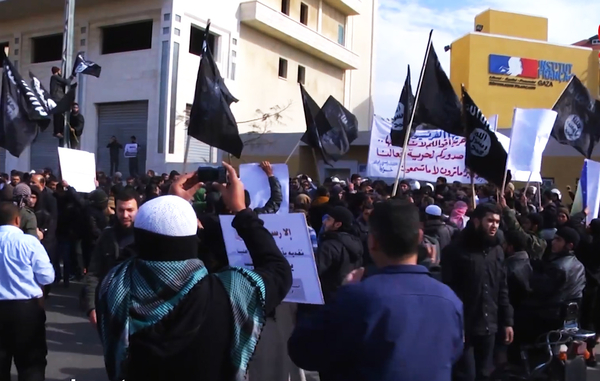
Some 200 supporters of the Islamic State, who held up Islamic State flags, took to the streets of Gaza City to protest the latest cartoons published by the French satirical magazine, Charlie Hebdo. They also chanted slogans that called for slaughtering French nationals, and burned French flags. Attempts by Hamas to impose a news blackout on the protest failed, as photos and videos found their way to social media.

The glorification of terrorists and jihadists by the Palestinian Authority, and the ongoing anti-Israel incitement by both Hamas and the Palestinian Authority, is driving many Palestinians into the open arms of the Islamic State.

Hamas and other Palestinian groups are continuing to deny the obvious, namely that the Islamic State terror group has managed to set up bases of power in the West Bank and Gaza Strip.

The Palestinians do not feel comfortable talking about the fact that Islamic State is working hard to recruit Palestinians to its ranks.

The presence of Islamic State in the West Bank and Gaza Strip is an embarrassing development for both Hamas and the Palestinian Authority.

For Hamas, the fact that Islamic State has long been operating in the Gaza Strip is something that it does not want the world to know about.

Hamas cannot afford a situation where another Islamist terror group poses a challenge to its exclusive control over the Gaza Strip. Since it seized control over the Gaza Strip in 2007, Hamas has successfully suppressed the emergence of rival forces, first and foremost the secular Fatah faction headed by Mahmoud Abbas.

But if until recently it was Fatah that posed a challenge and threat to Hamas’s rule, now it is the Islamic State and its supporters in the Gaza Strip are openly defying the Islamist movement’s regime.

When the first reports about Islamic State’s presence in the Gaza Strip emerged last year, Hamas and other Palestinians were quick to dismiss them as “false.”

Salah Bardaweel, a senior Hamas official, said in February 2014 that the Islamic State “does not exist” in the Gaza Strip.

This week, however, it became evident that Hamas was lying when it denied the presence of Islamic State in the Gaza Strip.

Some 200 supporters of the Islamic State, who held up Islamic State flags, took to the streets of Gaza City to protest the latest cartoons published by the French satirical magazine, Charlie Hebdo.

The protesters tried to storm the offices of the French Cultural Center in Gaza City. They also chanted slogans that called for slaughtering French nationals, and burned the French flag.

899Palestinians waving Islamic State flags attempt to storm the French Cultural Center in Gaza City. Some in the crowd carried posters glorifying the terrorists who carried out this month’s attacks in Paris. (Image source: ehna tv YouTube screenshot)

The protest apparently caught Hamas by surprise. Hamas security forces that were rushed to the scene dispersed the protesters and arrested seven Islamic State supporters.

Attempts by Hamas to impose a news blackout on the Islamic State protest failed, as photos and videos of the demonstration found their way to social media. Needless to say, Hamas-affiliated media outlets ignored the protest. They were hoping that the world would also not see the Islamic State demonstrators on the streets of Gaza City.

Hamas’s biggest fear is that scenes of Islamic State supporters marching in the heart of Gaza City will scare international donors and dissuade them from providing badly needed funds for the reconstruction of the Gaza Strip. Hamas is also afraid that Western officials working with the United Nations and relief agencies will stop visiting the Gaza Strip after watching the footage of Islamic State supporters.

In recent weeks, it has also become evident that Islamic State has some kind of a presence in the West Bank — a fact that poses a serious threat to Abbas’s Palestinian Authority [PA].

Just last week, Israel announced arrests of members of an Islamic State terror cell in the West Bank city of Hebron. The three Palestinian members of the cell confessed during interrogation that had planned to launch a series of terror attacks against Israel. The three suspects were identified as Waddah Shehadeh, 22, Fayyad al-Zaru, 21 and Qusai Maswaddeh, 23.

Until recently, Hamas was considered the number one threat to the Palestinian Authority in the West Bank. Now, however, it has become evident that Islamic State is also trying to set up bases of power in the West Bank. According to Israeli security sources, dozens of Hamas and Islamic Jihad members in the West Bank have defected to Islamic State in recent months. Their main goal, the sources, said, is to topple the PA and launch terror attacks on Israel.

Abbas is lucky that the Israeli security forces are still operating in the West Bank, including inside cities and towns controlled by the Palestinian Authority. Were it not for the IDF and various branches of the Israeli security establishment, Hamas, Islamic Jihad and Islamic State would have toppled the Palestinian Authority and beheaded Abbas and his officials a long time ago.

Still, Abbas does not feel comfortable acknowledging the fact that a growing number of Palestinians in the West Bank are joining Islamic State. Abbas fears is that if he admits that Islamic State is already operating in the West Bank, this could dissuade many Western countries from supporting his effort to persuade the world to support the creation of an independent Palestinian state. Like Hamas, Abbas also fears that Westerners would stop visiting Ramallah and other West Bank Palestinian cities once they learn about Islamic State’s presence in these areas.

Although Hamas and the Palestinian Authority are continuing to bury their heads in the sand and deny what is there, they cannot avoid responsibility for the emergence of Islamic State in the Gaza Strip and West Bank. The glorification of terrorists and jihadists by the PA and the ongoing anti-Israel incitement by both the PA and Hamas, are driving many Palestinians into the open arms of the Islamic State.

This is something that the UN Security Council members will have to consider the next time they are asked to vote in favor of the establishment of a Palestinian state. Otherwise, they will be voting for the creation of an Islamic, and not a Palestinian, state.

The West Bank Army of the “State of Palestine,” Thanks to the United States

January 21, 2015

The West Bank Army of the “State of Palestine,” Thanks to the United States, The Gatestone InstituteShoshana Bryen, January 21, 2015

(????????????? — DM)

The U.S. Consulate’s determination to provide the trappings of Palestinian statehood to the Palestinian Authority outside the negotiating process should come under scrutiny.

What plan do we have if the Palestinian army attacks the IDF in the future — instead of its presumed enemy, Hamas?

It is revealing that the U.S. appears determined to provide the Palestinian Authority with an army while it is still at war with our ally, Israel.

Last week, officials from the U.S. Consulate in East Jerusalem attended a Palestinian protest over Israel’s removal of olive trees illegally planted in the West Bank. Coordinated with the Palestinian Authority [PA] but not Israel, the Consulate personnel ended up clashing with Israelis living nearby. It was, perhaps, the quietest international almost-incident you never heard of.

This week, with the focus off Paris, the Middle East Quartet (the U.S., EU, Russia & the UN) plans to meet. The U.S. Consulate’s determination to provide the trappings of Palestinian statehood to the PA outside the negotiating process should come under scrutiny.

The olive tree incident prompted an article in the Israeli press about the Consulate, including the use of Palestinian security, rather than IDF combat veterans as required by a 2011 agreement. Some IDF guards were fired, according to the article. Others resigned, blaming the appointment of a new consulate security officer, who they said, established a Palestinian armed militia. “He is training them with weapons, combat and tactical exercises. There is a lack of responsibility here – who ensures that such weapons, once given over to Palestinian guards, won’t make their way to terror groups?”

The change in personnel from IDF veterans to a Palestinian Security Force [PSF] is part of a long series of steps to transform the Palestinian body politic into a state. If the U.S. Consulate becomes the U.S. Embassy to Palestine — a function it already observes — it is understandable that the PA would not want “occupying Israeli soldiers” to guard the symbol of America from Palestinian citizens in “its capital, Jerusalem.” The Consulate, with its mission to the PA, would agree.

Palestinian security forces have been in existence since 1994 and have steadily changed mandates. They have gone from a “police force” under the Oslo formulation of “dismantling the terrorist infrastructure” so Israel could have confidence in security after withdrawing from territory, to a protection force for Mahmoud Abbas so he would continue negotiations under U.S. auspices — but now to an army for the nascent state.

The Clinton Administration signed on to the police phase, but asked how Arafat could be expected to defeat “terrorists” without weapons. Unmentioned were a) Arafat was the prime funder and organizer of the terrorist organizations in question, and b) the PLO had already proven perfectly capable of killing its enemies.

The first funds for equipment and training came in 1994 from international donors including the U.S. Arafat, having a reasonable sized arsenal of his own, wanted arms, but settled for nonlethal items.

In 1996, Western trained Palestinian “police” attacked IDF personnel with weapons, killing 15 soldiers and border guards, after the opening of an exit from an ancient Hasmonean tunnel in Jerusalem, near the Western Wall in the Old City.

Despite these attacks, according to Jeffrey Boutwell, Director
 of the Pugwash Conferences on Science and World Affairs, the 1997 Hebron Protocol “provided for a Palestinian police force of some 30,000 personnel, equipped with 15,000 automatic rifles and pistols, 240 heavy machine guns, 45 armored vehicles, lightly armed shore patrol vessels, and associated communications and transportation equipment.” An Israeli-Palestinian Joint Security Coordination and Cooperation Committee [JSC] was formed to oversee “arrangements for entry of the Palestinian Police and the introduction of police arms, ammunition, and equipment.”

Between the onset of Western arms deliveries and a thriving black market, the PA “police” had all the lethal equipment they could handle.

Training stopped during the 2001-2004 so-called “second intifada” with the (unsurprising) revelation that the PA “police” found their Western assets invaluable in attacking Israelis. In 2005, however, history began again and the U.S. decided that the Palestinians should have a new security service. LTG William Ward USA (Deputy Commanding General, U.S. Army Europe, and Chief of Staff, U.S. Seventh Army) was the point man. In the words of then-Secretary of State Condoleezza Rice, his mission was:

  • “To make sure the parties understand each other and we understand what the parties are doing, so we can raise it at the appropriate level” if action is required.
  • “To provide a focal point for training, equipping, helping the Palestinians to build their security forces and also for monitoring, and if necessary, to help the parties on security matters.”

The missions were incompatible and inappropriate. The first involved “translating for the parties” with an eye toward U.S. intervention, a political job that should not have been done by a military officer. Further, having part of the mission directed toward a Palestinian force gave the General a stake in the success of the Palestinians over the concerns of Israel.

And so it happened. The Ward mission, the sole conduit for U.S. aid to the new Palestinian Security Force, resulted only in better-trained terrorists.

LTG Keith Dayton (Director of Strategy, Plans and Policy, Office of the Deputy Chief of Staff, G-3, U.S. Army), well respected and liked by Israel and the IDF, succeeded LTG Ward. His job, however, was complicated by the deterioration relations Hamas-Fatah in Gaza. According to acontemporaneous Ha’aretz story, Dayton was to arm and train “the Presidential Guard of PA Chairman Mahmoud Abbas to prepare it for a potential violent confrontation with Hamas forces in Gaza. Palestinian sources say the training of 400 Force 17 troops… started [in November 2006] in Jericho under the guidance of an American military instructor.” Force 17 had been Arafat’s Praetorian Guard, attacking recalcitrant Palestinians as well as Israelis. Abbas had inherited it.

Throwing American support to one Palestinian faction over another was a political decision to side with what our government assumed was “better” or more “moderate” Palestinians, hoping it would use our help to put down Hamas rather than using it to kill ever more Israelis.

What it did was legitimize the creeping movement of the Palestinians toward a full-fledged army.

This new mission needed IDF participation — which Israel approved in part because of its relations with LTG Dayton, and because it allowed Israel to operate in West Bank territory with a relatively free hand to arrest both Hamas operatives and Fatah bad guys. It also made Abbas beholden to Israel for his personal security and that of his kleptocracy. That part worked, and even now, PA figures have admitted publicly that without IDF cooperation, the PA would fall.

Dayton’s successors, LTG Michael Moeller, USAF and ADM Paul Bushong, USN, have quietly continued and upgraded both training and weapons.

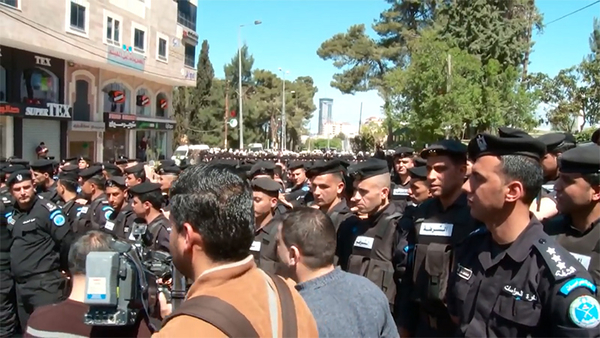
893Hundreds of troops from the Palestinian Security Force line a street in Ramallah, in order to block anti-American protestors, during President Obama’s 2013 visit to the city.

The question always was twofold: What constitutes “appropriate” weapons for the PSF, and how does the U.S. justify training security forces the ultimate loyalty of whom will be a government that we cannot foresee and may become something — or already is something — we don’t like? The corollary is: What plan do we have if the Palestinian Army attacks IDF forces in the future — instead of its presumed enemy, Hamas?

To raise the questions is to understand that there are no sound answers from either the Consulate or the State Department. In their absence, concern over the choice of security guards by the U.S. Consulate in Jerusalem is appropriate, but insufficient. It is revealing that the U.S. appears determined to provide the PA with an army while it is still at war with our ally, Israel.

What Were Armed US Consulate Staff Doing near Adei Ad?

January 4, 2015

What Were Armed US Consulate Staff Doing near Adei Ad? Israel National News,  Ari Soffer, January 4, 2015

(Please see also ‘Deport US Consulate Staff Who Threatened Jews’ and related update links in my parenthetical comment there. This is a further update.– DM)

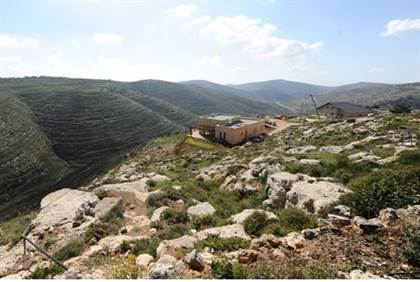
img557200Adei Ad is located in the Shiloh bloc north of JerusalemMendy Hechtman/Flash 90

Security source says ‘no question’ US Consulate staff pointed their weapons during Friday confrontation. Planned provocation or blunder?

****************

The full details of Friday’s clash between residents of the Jewish village of Adei Ad in Samaria and a delegation from the US Consulate in Jerusalem – which very nearly escalated into a fully-fledged shootout between the sides – are still emerging.

But those details which have emerged so far paint a worrying picture regarding the conduct of Consulate staff – who either willingly took part in a planned provocation, or else, in a staggering show of irresponsibility and unprofessionalism, recklessly blundered into a volatile and potentially deadly situation without the slightest idea of what they were doing.

Roughly two hours before the start of Shabbat, a group from the Consulate, escorted by armed (apparently American) guards and several residents of the Arab village of Turmus Ayya, descended en-masse and unannounced on an area within 50 meters of Adei Ad’s southwestern edge. Neither the IDF nor local residents were informed of the visit beforehand.

The Consulate delegation had apparently been “invited” by Palestinian Arabs from Turmus Ayya, many of whom hold US citizenship, ostensibly to see the site of what Arabs claim was an “attack” by Adei Ad residents on an olive orchard. That incident was originally reported Thursday night by the PA’s Bethlehem-based Maan News, which claimed that Jewish “settlers” had uprooted 5,000 olive trees – a rather incredible number to those familiar with quite what such a mammoth task would entail. Subsequent reports later revised the number down to 500, although no independent verification or evidence of the alleged damage has surfaced as yet.

Adei Ad residents, alarmed at the unannounced arrival of a large groupfrom a Palestinian village within meters of their community, rushed out to confront them. A brief verbal altercation ensued which quickly escalated, with youths from Adei Ad hurling rocks at the delegation, causing some damage to a Consulate vehicle.

At this point the accounts vary; witnesses from Adei Ad say Consulate staff drew their weapons – an M-16 and a handgun – following which residents called for backup from Adei Ad’s own security team. The Consulate, for its part, has denied any weapons were drawn at all. Either way, the American delegation beat a hasty retreat.

Notably, at no point during the confrontation was the IDF alerted by the Consulate team; only after leaving the scene did the Americans call the army, who quickly responded and launched an investigation, which is still ongoing.

img73901Damage to US Consulate vehicle Rabbis for Human Rights

Whatever the case, Jewish residents of Adei Ad and surrounding communities in the Shiloh bloc, located in the Binyamin region to the north of Jerusalem, are demanding answers. Angry residents say the incident was clearly a planned provocation, and have expressed their astonishment at the fact that an armed entourage from the US Consulate would arrive at a contested spot without coordinating their visit with the IDF in advance.

Indeed, regardless of the intent behind the visit, one Adei Ad resident pointed out that it was a clear recipe for disaster.

Apart from being the location of a protest in December 10th in which senior PA official Ziad Abu Ein died of a heart attack, the site of Friday’s confrontation is also the precise spot where a group of Palestinians attempted to infiltrate Adei Ad just two weeks ago.

“Two weeks ago at that exact place a horse was stolen,” said the resident, who asked to remain anonymous. “At 10 p.m. that same night dozens of Arabs from a nearby village came up to Adei Ad at the same spot, and residents came out to keep them away.”

Recounting Friday’s incident, he said residents had no idea Consulate staff were present at all. All they saw, he said, was “Arabs approaching, accompanied by what looked like a group of Europeans – we didn’t know who they were exactly. Often foreign anarchists join the Arabs in carrying out violence or provocation.”

Due to the tense relations between Jews and Arabs in the area, Arab farmers must contact the IDF before working land that abuts Adei Ad in order to avoid any confrontations. For their part, Adei Ad residents have long complained that they have been regularly targeted by Arab thieves and vandals.

“About two years ago a group of Arabs actually came right up to my house, right into the enter of Adei Ad, and stole a whole herd of sheep. In the past they’ve stolen horses, they stole a tractor, building equipment,” the resident recounted.

“The Arabs know that if they want to come that close to Adei Ad to do agricultural work they need to let the army know first to escort them. So any time Arabs approach without army supervision – particularly in that place where two weeks ago there was an incident – that’s a sign that they are coming to cause trouble… to attack or damage property,” he added.

He said locals had long given up on the prospect of receiving help from police, who he accused of totally avoiding their responsibilities and only agreeing to investigate Palestinian accusations against them.

“We receive no backing from the police,” he lamented. “Every time there is an incident of robbery by the Arabs the military refuses to deal with it because they don’t look at it as life-threatening; and the police… they tell us that it’s out of their jurisdiction.

“On the other hand, every time the Arabs steal something or cause trouble they then go and report us to the police – that’s how they work – so it’s always a one-sided investigation, because the police claim they have no jurisdiction over the Arab villages, only over us! No one has ever been charged, no property has ever been returned.”

He emphasized that despite the negative characterization of Adei Ad and surrounding Jewish communities in the area by some media outlets, residents are not interested in trouble and just want to get on with their daily lives in peace.

“We have much better things to do with our lives – we have our children and families, and we have jobs,” he said. “We don’t enjoy going out and having rock-throwing fights… no one seems to realize… but we feel we are under threat and that if we don’t do it the next step is a terrorist attack.”

Responding to American denials that Consulate staff pointed their guns at residents, a local security source said there was “no question” they hadindeed drawn their weapons, based on the individual testimony of numerous witnesses.

The security source, who also asked to remain anonymous, said one American “with ginger hair” was seen pointing his pistol at residents, who were unarmed, from inside of his car after rolling down the window. The other armed man then did the same with an M-16 rifle.

It was then that the situation threatened to get out of control.

“News spread that some people had approached the town with weapons, and they called for help,” prompting armed members of the local civilianfirst-response team to rush to the site, he recounted.

Luckily, “at that point it seems like the Americans thought it would be a good time to leave… and after that there was a brief confrontation between the Arabs and (Jewish) residents until the army arrived.”

He said that although an investigation was still ongoing, the conduct of the Consulate delegation was “suspicious.”

“Why didn’t they call anyone while the confrontation was going on?” he asked.

He also described the “strange” behavior of the Consulate guards when they were finally met by IDF forces and first-responders, describing them as looking sheepish and, unprompted, immediately insisting they hadn’t drawn their weapons.

Marc Prowisor, a resident of the nearby town of Shiloh, said the latest confrontation posed some “difficult questions.”

“Were members of the American Consulate knowingly taking part in a larger provocation – which is against the law?” asked Prowisor who, as Director of the One Israel Fund charity which helps secure local communities, is in regular contact with local security forces.

A Sad State of Affairs: The Kerry Record

January 2, 2015

A Sad State of Affairs: The Kerry Record, World Affairs JournalJoshua Muravchik, November/December, 2014

(Kerry likely agrees with Obama as to his quite foreign foreign policies and, equally likely, we are stuck with both at least until Obama leaves the White House.

Kerry I'm an idiot

The most bothersome current aspects of Obama-Kerry foreign policies are the extent to which they trust Iran and how they deal with it and the P5+1 negotiating group. — DM)

John_Kerry_and_Benjamin_Netanyahu_July_2014 (1)

Although Kerry’s anti-American ideology has moderated to some degree from his fiery days as an antiwar leader, he has misrepresented but never repudiated his past. Especially consistent has been his inclination to see the best in America’s enemies, from Madame Binh to Comandante Ortega to Bashar Assad. Israelis were shocked this summer that Kerry came up with a plan molded by Turkey and Qatar to fit the interests of Hamas at their own expense. Had they known him and his record better, they might not have been.

***************

The Gaza war of July and August 2014 occasioned the sharpest frictions in memory between the United States and Israel, highlighted by a cease-fire proposal offered by Secretary of State John Kerry that Israel’s security cabinet rejected unanimously. Kerry’s plan envisioned a seven-day cease-fire, during which the parties would negotiate “arrangements” to meet each of Hamas’s demands about the free flow of people and goods into Gaza and the payment of salaries of Hamas’s tens of thousands of employees. As for Israel’s demands about destruction of tunnels and rockets and the demilitarization of Gaza, these were not mentioned at all, except in the add-on phrase that the talks would also “address all security issues.”

The document cited the important role to be played by “the United Nations, the Arab League, the European Union, the United States, Turkey, [and] Qatar.” Conspicuous by their absence from this list were Israel, Egypt, and the Palestinian Authority. These three had also not been invited to the Paris meetings where Kerry worked on his ideas with leaders of the countries and bodies mentioned.

Barak Ravid, diplomatic correspondent for the liberal Israeli newspaper Haaretz, wrote that the proposal “might as well have been penned by Khaled Meshal [head of Hamas]. It was everything Hamas could have hoped for.” The centrist Times of Israel’s characteristically circumspect editor, David Horovitz, branded Kerry’s initiative “a betrayal.” And left-leaning author Ari Shavit commented that “Kerry ruined everything. [He] put wind in the sails of Hamas’ political leader Khaled Meshal, allowed the Hamas extremists to overcome the Hamas moderates, and gave renewed life to the weakened regional alliance of the Muslim Brotherhood.”

Turkey and Qatar are the mainstays of that alliance and were chosen by Kerry as his principal interlocutors because they are Hamas’s main backers. This brought protests from the Palestinian Authority, led by President Mahmoud Abbas’s movement, Fatah, the secularist rival to Hamas. That group declared that “whoever wants Qatar and Turkey to represent them can emigrate and go live there. Our only legitimate representative is the PLO.”

The shock of Palestinian and Israeli leaders would have been less, however, if they had been more familiar with the record of John Kerry. Spurning America’s friends in pursuit of deals with their nemeses was perfectly in character for the secretary of state. The hallmark of his career has been to denigrate America itself, while supporting the claims of its enemies.

That career began in 1969, when, months after returning from a tour of duty in Vietnam, Kerry sought and received a military discharge so that he might run for Congress. His campaign as a peace candidate sputtered, but his authenticity as a Vietnam vet established him as a presence in the burgeoning antiwar movement. In May 1970, he traveled to Paris for an unpublicized meeting with Viet Cong representatives, and, perhaps at their suggestion, he joined up upon his return with Vietnam Veterans Against the War. VVAW was headed by Al Hubbard, a former Black Panther. Kerry was instantly given a top role, twinning with Hubbard as the public face of the organization.

At a VVAW protest in Washington, DC, in April 1971, Kerry joined other veterans in throwing away their military medals in front of news cameras. The entire demonstration was punctuated by Kerry’s appearance before the Senate Foreign Relations Committee, where he offered dramatic testimony about American atrocities in Vietnam based on accounts heard at a VVAW inquest a few months earlier. He spoke of veterans who said:

They had personally raped, cut off ears, cut off heads, taped wires from portable telephones to human genitals and turned up the power, cut off limbs, blown up bodies, randomly shot at civilians, razed villages . . . poisoned food stocks, and generally ravaged the countryside.

These acts, Kerry emphasized, “were not isolated incidents but crimes committed on a day-to-day basis with the full awareness of officers at all levels of command.”

When, at the behest of aghast senators, the Naval Criminal Investigative Service conducted a formal inquiry into the stories presented at the VVAW inquest, it reported that many of the VVAW witnesses cited by Kerry refused to cooperate, although promised immunity. Others were clearly crackpots, and several swore, and provided witness corroboration, that they had not participated at the inquest at all and had no idea who had appeared in their names. The entire exercise had been inspired and largely engineered by Mark Lane, whose book on the same subject earlier that year had been panned by New York Times columnist James Reston Jr. as “a hodgepodge of hearsay,” while that paper’s book reviewer, Neil Sheehan, who had reported from Vietnam and would soon break the Pentagon Papers, revealed that some of Lane’s “witnesses” had not served in Vietnam. (The political scientist Guenter Lewy documents these events in his 1978 book America in Vietnam.)

In August 1971, four months after his Senate appearance, Kerry made another trip to Paris, to meet with Madame Nguyen Thi Binh, foreign minister of the Viet Cong, this time in full view, for his first exercise in international diplomacy. He returned touting the “peace plan” of the Viet Cong, explaining: “If the United States were to set a date for withdrawal, the prisoners of war would be returned.” Although he frequently accused American leaders of lying, he took the Communist leaders’ statements at face value, asserting that their peace plan “negates very clearly the argument of the president [Nixon] that we have to maintain a presence in Vietnam to use as a negotiating [chip] for the return of those prisoners.”

Kerry’s dismissal of the statements of US leaders as lies and his credulity toward those of the Vietnamese Communists reflected a broader difference in attitude toward the two sides to the conflict. Ho Chi Minh, who had spent long years as a henchman of Stalin’s, serving the Comintern in several countries, was in Kerry’s admiring eyes “the George Washington of Vietnam” who aimed only “to install the same provisions into the government of Vietnam” that appeared in the American Constitution. America, in contrast, had itself strayed so far from those principles that it needed a “revolution” to restore them.

Kerry’s colleagues in VVAW undoubtedly shared this sentiment, and in November 1971, at a conference of its leadership in Kansas, the group considered just how far down the path of revolution it was willing to go. It debated, although ultimately rejected, a proposal to commence a campaign of terrorist violence and assassination of pro-war US senators. When he ran for president in 2004, Kerry denied he had been present at this conclave, but when FBI files secured by the Los Angeles Times under the Freedom of Information Act placed him there, he retracted that denial in favor of the statement that he had “no personal recollection” of it.

Is this plausible? Gerald Nicosia, author of a highly sympathetic history of the antiwar movement, reported, in May 2004, that “several people at the Kansas City meeting recently said to me or to mutual friends that they had been told by the Kerry campaign not to speak about those events without permission.” Why the urgency to cover up? And how would the campaign know who was there, that is, whose silence to seek, if Kerry had no recollection of the meeting? One of Nicosia’s interviewees, John Musgrave, said “he was asked by Kerry’s veterans coordinator to ‘refresh his memory’ after he told the press Kerry was in Kansas City. Not only is Musgrave outraged that ‘they were trying to make me look like a liar,’ but he also says ‘there’s no way Kerry could have forgotten that meeting—there was too much going on.’”

This puts it mildly: the event was memorably raucous, with debates over the proposals for violence and for napalming the national Christmas tree, furious factional fighting, the discovery of eavesdropping bugs in the building leading to a quick move to another location, and above all an angry showdown between Kerry and Hubbard over revelations that the latter had never been in Vietnam. This particular contretemps was punctuated by Hubbard’s dramatically pulling down his pants to show scars he claimed he sustained in Vietnam. The mayhem culminated in Kerry’s announcing his resignation from the group’s executive. And Kerry had “no personal recollection” of being there?

Although Kerry appeared as a speaker for VVAW for about a year following this resignation, he then faded from national view for a decade, climbing the ladder of local and state politics in Massachusetts before winning election to the US Senate in 1984. The Senate, he later said, “was the right place for me in terms of . . . my passions. The issue of war and peace was on the table again.” What put it on the table were the anti-communist policies of President Ronald Reagan, which Kerry deeply opposed. A year earlier, Reagan had ordered the invasion of Grenada, which Kerry scorned as “a bully’s show of force [that] only served to heighten world tensions and further strain brittle US-Soviet and North-South relations.”

In contrast, Kerry ran on a platform of the Nuclear Freeze, a popular movement opposing US plans to counterbalance a large Soviet nuclear buildup over the previous decade. Kerry made sure to score one hundred percent on a test of candidates’ positions presented by a group called Freeze Voter ’84, and he proposed to cut the defense budget by nearly twenty percent, including “cancellation of twenty-seven weapons systems” and “reductions in eighteen other[s],” according to the Boston Globe. He cited his own work with VVAW as a counterpoint: “We were criticized when we stood up on Vietnam. . . . But we’ve been borne out. We were correct. Sometimes you just have to stand and hold your ground.”

In the Senate, he secured a coveted seat on the Foreign Affairs Committee and turned his attention to the fraught issue of policy toward Central America, a small region that had assumed inordinate geopolitical importance by becoming one of the front lines in the Cold War. A Marxist-Leninist party, the Sandinista National Liberation Front, had seized power in Nicaragua and was aiding likeminded movements in El Salvador and other nearby states while the Reagan administration supported anti-Communist guerrillas inside Nicaragua, the so-called “Contras.”

Kerry lent his name to Medical Aid for El Salvador, which gave non-lethal aid to the Communist side in that civil war. On February 16, 1982, an Associated Press story quoted actor Ed Asner, leader of a Hollywood group that raised much of the funding for this project, as explaining that “medical supplies are to be purchased in Mexico and shipped clandestinely to the Democratic Revolutionary Front in El Salvador.” However, the issue of US aid to El Salvador’s anti-Communist government became overshadowed by debate about aid to the Nicaraguan “Contras.”

As the Senate neared a decisive vote, Kerry and Senator Tom Harkin undertook a dramatic maneuver to try to head off approval of the Reagan administration’s request for Contra funding. They flew to Managua, the Nicaraguan capital, for their own summit meeting with the country’s strongman, “Comandante” Daniel Ortega. The results resembled those of his 1971 meeting with Madame Binh. Ortega handed Kerry a “peace plan” according to which the US would first end all aid to the Contras, and the Sandinistas would then initiate a cease-fire and restore civil liberties. Kerry justified undercutting the US government in this way by faulting Reagan’s failure “to create a climate of trust” with the Sandinistas. He, in contrast, offered them trust in abundance, calling Ortega’s plan “a wonderful opening.” He took to the Senate floor to say, “Here, in writing, is a guarantee of the security interest of the United States.”

A year later, in 1986, in another Senate debate on Contra aid, Kerry voiced one of the odder claims about his Vietnam experience. Warning against the slippery slope of military involvement and against the duplicity of our own government, Kerry delivered a floor speech containing this assertion:

I remember Christmas of 1968, sitting on a gunboat in Cambodia. I remember what it was like to be shot at by Vietnamese and Khmer Rouge and Cambodians, and have the president of the United States telling the American people that I was not there; the troops were not in Cambodia. I have that memory which is seared—seared—in me.

The “seared” part was a nice touch, especially in view of the fact that the whole thing had not happened (although Kerry had been repeating the story since as early as 1979). In the course of Kerry’s 2004 presidential campaign, the Swift Boat Veterans for Truth, former crewmen on the type of vessel on which Kerry served who were angered by his antiwar activities, attacked this claim among other aspects of Kerry’s military history. In this case, however, unlike in response to some points raised by Kerry’s detractors, no shipmate of Kerry’s could be found to corroborate his version. Soon, his spokesmen began to hedge. One aide explained that Kerry’s boat had been “between” Vietnam and Cambodia. But the two countries are contiguous: there is no “between,” so another spokesman backed down further, explaining that Kerry had merely been “near” Cambodia.

Then, Douglas Brinkley, who authored a laudatory history of Kerry’s military service, issued another explanation, apparently at the behest of the campaign. On Christmas 1968, the moment of Kerry’s “seared” memory, he was fifty miles from Cambodia, said Brinkley, but his boat “went into Cambodia waters three or four times in January and February 1969.” Oddly, however, Brinkley’s book, which covered those two months in painstaking detail at a length of nearly one hundred pages, even to the extent of locating the sites of battles, made no mention of Kerry’s having crossed into Cambodia. And the campaign soon pulled the rug from under Brinkley by issuing a new claim, namely, that Kerry’s boat had “on one occasion crossed into Cambodia.” Three of Kerry’s shipmates, two of whom were supporting his campaign, categorically denied even this minimized claim.

In that, they are supported by no less a source than Kerry himself, in the form of a journal he kept while on duty. Substantial passages of it are reproduced in Brinkley’s book, and one of them reads:

The banks of the [Rach Giang Thanh River] whistled by as we churned out mile after mile at full speed. On my left were occasional open fields that allowed us a clear view into Cambodia. At some points, the border was only fifty yards away and it then would meander out to several hundred or even as much as a thousand yards away, always making one wonder what lay on the other side.

He was never to learn the answer because this diary entry was from his final mission.

Kerry was of course right to link Central America to Southeast Asia. They were both nodes in the Cold War, the epic struggle that defined international politics for forty years, including the first two decades of Kerry’s political engagement, from the time he returned from Vietnam in 1969 until the Berlin Wall came down in 1989. Whatever the rights and wrongs of America’s entry into Vietnam, or its actions in Central America or elsewhere, Kerry perverted the basic issue of the Cold War, always viewing America’s actions as bellicose and malign, while casting those of the Communists, like “George Washington” Ho Chi Minh, in the most favorable light.

To many, the Cold War’s benign denouement—the fall of the Wall and the USSR’s disappearance into the ash bin of history—vindicated Reagan’s approach, but Kerry appears to have entertained no second thoughts despite these outcomes. When it came to addressing post–Cold War issues, he remained reflexively averse to the exercise of American power. Kerry had lamented as “not proportional” Reagan’s 1986 bombing of Libyan dictator Muammar el-Qaddafi’s residence in response to a Libyan terror attack on US servicemen in Germany. The Middle East was also the scene of the first military showdown after the Cold War, when Saddam Hussein’s Iraq swallowed whole the neighboring state of Kuwait, in 1990. At the time, Kerry opposed the Bush administration’s request for authorization of military action, saying that those “of the Vietnam generation . . . come to this debate with a measure of distrust [and] a resolve . . . not [to be] misled again.” He concluded his Senate speech by reading a passage from an antiwar novel by the American Communist Dalton Trumbo.

With the Cold War’s end, and America’s demonstration of will and strength in driving Hussein’s forces from Kuwait, the defining issue of the 1990s became the wars of Yugoslavia’s dissolution. Here, the prime issue was whether or not to lift an international arms embargo that rendered Bosnia’s Muslims naked before their predators, the well-armed Serbs. As public opinion reacted to news accounts of the grisly results of this imbalance, the Senate voted to lift the embargo, over the objections of Kerry, who helped to lead the opposition.

With the terrorist attacks of September 11, 2001, the American public was awakened from its post–Cold War indifference toward foreign affairs. A fierce patriotism burst forth, and with it a determination to take down those who had attacked us. Thus, preparing for a 2004 presidential bid, Kerry moved to reconfigure his image. The antiwar veteran was suddenly replaced by the military hero, and the Democratic nominating convention was replete with uniforms and military gestures, highlighted by Kerry’s sharp salute to the assemblage while uttering the words, “reporting for duty.” Already, his rejected service medals had miraculously reappeared mounted and framed on his Senate office wall. Asked how that was possible, as he had been photographed throwing them away, Kerry explained that the medals he tossed were not his own but actually belonged to another veteran.

The dramatic reincarnation did not quite come off, as Kerry was dogged by Vietnam veterans, led by fellow Swift Boat crewmen, still furious at how he had blackened their names. And the awkwardness of his transformation was symbolized by his much-ridiculed explanation of his stance on funding the 2003 US invasion of Iraq: “I actually did vote for the $87 billion before I voted against it.”

In his later years in the Senate, Kerry made the issue of Syria his own. He took several trips to Damascus where, according to a June 2011 account in the Wall Street Journal, he “established something approaching a friendship with [Syrian dictator Bashar] Assad.” When Barack Obama came to office, he made Kerry his point man in efforts to improve US-Syrian relations. Kerry put his endorsement on diplomatic proposals he received in Damascus, including an offer by Assad to engineer a Palestinian unity government embracing Fatah and Hamas. The benefits to the US, not to mention Israel, of such unity were not self-evident, but in any event, talks between the two Palestinian factions were already under way, mediated by Egypt, which was closer to Fatah. Why it would be advantageous to switch the sponsorship to Syria, the ally of Hamas, was hard to grasp. Nonetheless, Kerry saw in Assad’s proposal the prospect of “a major step forward in terms of how you reignite discussions for the two-state solution . . . . Syria indicated to me a willingness to be helpful in that respect.” In all, as the Journal put it, “Kerry . . . became . . . Assad’s champion in the US, urging lawmakers and policymakers to embrace the Syrian leader as a partner in stabilizing the Mideast.”

In sum, although Kerry’s anti-American ideology has moderated to some degree from his fiery days as an antiwar leader, he has misrepresented but never repudiated his past. Especially consistent has been his inclination to see the best in America’s enemies, from Madame Binh to Comandante Ortega to Bashar Assad. Israelis were shocked this summer that Kerry came up with a plan molded by Turkey and Qatar to fit the interests of Hamas at their own expense. Had they known him and his record better, they might not have been.