Archive for the ‘Turkey’ category

Anger, Honor and Freedom: What European Muslims’ Attack On Speech Is Really About

June 30, 2016

Anger, Honor and Freedom: What European Muslims’ Attack On Speech Is Really About, Investigative Project on Terrorism, Abigail R. Esman, June 30, 2016

1052

Indeed, much of the Muslim violence in Europe is about exactly this: intimidating non-Muslims into a fearful capitulation, where words like “I hate Muslims” and drawings of Mohammed become extinct because the Muslim communities insist that it be so. It is about forcing Westerners to rearrange their lives, their culture, to accommodate the needs and values and culture of Islam. It is about control, and the power over freedom. And it is about creating a culture in which honor is injured by words and restored through violence and terror.

**********************

“Clash of civilizations,” some say. Others call it the “failure of multiculturalism.” Either way, the cultural conflicts between some Muslims and non-Muslims worldwide continue to play out as Western countries struggle to reconcile their own cultures with the demands of a growing Muslim population.

But herein lies the problem: in many ways, the two cultures are ultimately irreconcilable. There is no middle ground. And hence, the conflicts and the tugs-of-war continue.

Over the past two months, the events surrounding controversial Dutch columnist Ebru Umar have encapsulated that “clash” at its core, a salient metaphor for the tensions, particularly in Europe, between the West’s Muslim populations and its own. More, they illuminate the enormity of the problems we still face.

Umar is no stranger to the spotlight, or to the wrath of Dutch Muslims who read her many columns, most of them published in the free newspaper, Metro. For years, the Dutch-born daughter of secular Turkish immigrants has raged against the failure of other Dutch-born children of immigrants, mostly Moroccan, to assimilate into the culture of their birth. She loudly condemns Dutch-Moroccan families for the shockingly high rates of criminality and violence among Dutch-Moroccan boys – as much as 22 times the rate of Dutch native youth – a phenomenon she ascribes to their Islamic upbringing and their parents’ refusal to allow their children to mingle among the Dutch.

But her critiques have earned her no converts. Instead, Dutch-Moroccan youth, whom she calls “Mocros,” have regularly taunted her, both online and in the street.

This past April, however, Umar added a new team of enemies to her portfolio: when, in response to Turkish president Recep Tayyip Erodogan’s demand that a German satirist be prosecuted for insulting him on TV, Umar tweeted “f***erdogan,” Dutch Turks turned on her in fury. “How dare you insult our president!” cried these Dutch-born subjects of Holland’s King Willem-Alexander. And while Umar took a brief holiday on the Turkish coast, one such Dutch-Turk turned her in to the police. She was arrested at her vacation home in Kusadasi, and though released the following day, was forbidden to leave the country. The charge: Insulting the Turkish president. It took 17 days before discussions between Holland’s prime minister and Turkish authorities enabled her to return to the Netherlands.

But she could not return home. In her absence, Umar’s home had been burgled and vandalized, the word “whore” scrawled on a stairway wall. Death threats followed her both in Turkey and on her return. When it became clear she could not ever return to the apartment she had lived in for nearly 20 years, she announced on Twitter (Ebru Umar posts constantly on Twitter) that she would be moving out.

Meantime, in Metro and elsewhere, she continued her criticism of Moroccans and, as she herself notes, of Islam overall.

And so it was that on the day Ebru Umar moved out of her apartment in Amsterdam, a group of Dutch-Moroccans in their twenties came to see her off, taunting her with chants: Ebru has to mo-o-ve, nyah nyah.” Though furious, she ignored them – until one of them began to film her loading her belongings into her car. For Umar, being taunted by the very people whose threats had forced her from her home in the first place was bad enough: but this violation of what little privacy remained for her was more than she could take. She grabbed her iPhone and began filming them right back. “Go ahead,” she challenged. “Say it for the camera.”

Scuffles ensued, and soon one of the Moroccans had her iPhone in his hand. The others laughed. Then they ran away. Umar filed a police report and, still smarting, took to Twitter once again: “C**t Moroccans, I hate you,” she posted. “I hate you, I hate you, I hate you, I hate you and I hate your Muslim brothers and sisters, too. F**k you all.” (It is important to note that, however offensive, the expression “c**t Moroccans” is a common epithet in the Netherlands.)

But, hey – she was angry. Her phone had been snatched from her hand in a brutal, aggressive gesture that left her feeling violated and, vulnerable. She had just been forced to leave her home. She had endured prison, a criminal inquiry, and death threats, all at the hands of the same group on whom she now spewed her fury.

Her words may have been harsh or inappropriate, but they were words. She had not struck her tormenters as they filmed her. She did not call for their demise, or strap a bomb around her waist and visit the local mosques.

She took to Twitter and said: I hate you.

“But hate,” she tells me later in an e-mail, “is just an emotion.” And in a column penned more than two years ago, she observed, “Hate me till you’re purple, but keep your claws off me.”

Here is where Ebru Umar’s story becomes the story of the Western world. In response to her words (“I hate you. F*** you”), several Muslims – Moroccans and others – filed charges against her for hate speech. (Though ironically, “I hate you” does not legally qualify as “hate speech.”) Such words are an attack upon their honor, a humiliation: and if there is one thing experts on Arab and Muslim culture will agree on, it is the significance of humiliation and honor in governing their lives. For this, Dutch Moroccan youth threaten Umar on the streets, and have done so, she says, for years: after all, she insults them.
1664

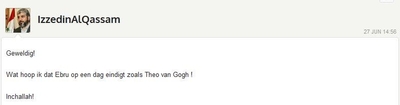
But in truth, it isn’t just the youth. The broader Muslim community stands by, silent: they do not condemn the youth who taunt her, who rip her telephone from her hands, or post things on the Internet like “We hate you, too – can you please kill yourself?” or “Oh, how I hope she ends up like Theo van Gogh.”

Theo van Gogh, also a controversial columnist, was shot and stabbed to death in 2014 by a radical Dutch-Moroccan Muslim.The commenter wishing her the same fate used the name “IzzedinAlQassam,” the founder of modern Palestinian jihad, and an icon of Hamas leader Khaled Meshaal.

For people like this, it doesn’t matter that Umar – or van Gogh – inflicted no violence, any more than it mattered that the editors of Charlie Hebdo were not violent. It was the insult, the humiliation – to them, to Islam, to Mohammed – that mattered: and an insult, a humiliation, deserves a violent response.

Indeed, much of the Muslim violence in Europe is about exactly this: intimidating non-Muslims into a fearful capitulation, where words like “I hate Muslims” and drawings of Mohammed become extinct because the Muslim communities insist that it be so. It is about forcing Westerners to rearrange their lives, their culture, to accommodate the needs and values and culture of Islam. It is about control, and the power over freedom. And it is about creating a culture in which honor is injured by words and restored through violence and terror.

When Umar says “I hate you,” what she hates, really, isn’t the Moroccans who attacked her or their “Muslim brothers and sisters.” What she hates is this – this effort, this battle over honor and speech and freedom, and this clash between violence and expression, guns and conversation.

“I don’t want Muslims to leave,” she tells me, again by e-mail. “I want them to embrace the Enlightenment, Western society, the Netherlands.” And in turn, she calls on the Dutch to “set rules: no violence in any sense. And stop using culture or religion as an excuse for behavior.”

Ebru Umar’s words. More of us should listen.

More airports under ISIS threat after Istanbul

June 29, 2016

More airports under ISIS threat after Istanbul, DEBKAfile, June 29, 2016

istanbul-dead

The US, Europe and the Middle East are again refusing to connect the dots of the terrorist threat, recalling the denial that marked the peak period of Al Qaeda’s atrocities in the early 2000’s.

When the US Defense Secretary Ashton Carter trumpeted the Fallujah victory over the Islamic State on June 27, he neglected to disclose that the real victors were Iranians – not Iraqis. The next day, an ISIS suicide attack on Istanbul’s Ataturk airport overshadowed that success, killing at least 41 people including 13 foreign nationald and injuring more than 230.

As the Obama administration labored to conceal from the public in the West its strategy of using Shiite forces to hammer ISIS in Iraq and parts of Syria, the Sunni terrorists retaliated in Istanbul – and not just there.

Seven ISIS suicide bombers, some on motorcycles, exploded on Monday, June 27, in a Christian village in the Lebanon Valley near Baʿalbek. A week earlier, an ISIS suicide bomber blew himself up at the gates of a large Jordanian military base on the Syrian border.

The connection between the ISIS arenas and cause and event is there for anyone who wants to see it.

ISIS has a ready store of suicide bombers who are willing to blow themselves up, not just because they are ‘extreme fanatics’ or “thugs” as President Obama insists on defining them, but because they believe they are fighting a religious war: Sunnis against Shiites, Sunnis against Christians and Sunnis against Jews.

On this point, Obama is in denial.

Turkey’s Sunni President Tayyip Erdogan was swiftly punished for concluding a political-military-intelligence agreement with the Jewish state. That same day, three suicide bombers, probably waiting for months at a safe house near the Istanbul airport, were ordered from ISIS Syrian headquarters in Raqqa, to go into action.

Neither the dense US intelligence net in the region, nor Turkish and Israeli intelligence managed to intercept the order.

DEBKAfile intelligence sources point out that the highly secure Ataturk airport, the third largest in Europe, is not the only one on the continent at which ISIS suicide units are lurking ready to strike.

American-European intelligence input points to their presence near at least two or three other airports in Europe. The problem is that the intel is very general, pointing to intent, with no specifics on countries or airports.

The public in the West and Middle-East are not told either about the ‘small’ victories scored by ISIS on the battle field. For instance, ISIS forces managed to block the Syrian-Hizballah advance towards the highway leading from Palmyra to Raqqa, inflicting heavy losses despite Russian air cover.

In Israel, where security awareness is usually high, no one was told about the successful ISIS engagement at the Syria-Jordan-Israel border junction bordering on the Israeli Golan against US-trained and armed Syrian rebels, who fought under artillery cover from Jordan.

In other words, ISIS has established itself on the Israeli border, a few kilometers away from the Sea of Galilee and Tiberius.

The Islamic State is fully geared to respond to such losses as Fallujah by going for strategic gains on the ground and inflicting horrible retribution on its victims by remotely activating sleeper cells of suicide killers.

Rather than being degraded, as Obama claims, ISIS is fully equipped to target its victims across several continents.

On Tuesday Istanbul airport was its chosen target. Now, we must wait and see who is next.

Israel and Turkey restore relations – peace in our time?

June 28, 2016

Israel and Turkey restore relations – peace in our time? | Anne’s Opinions, 27th June 2016

(Israel and Turkey renew diplomatic relations – but at what cost to Israel’s national pride, let alone its security? –anneinpt )

On reading the terms under which Israel and Turkey are to restore diplomatic relations today I felt I ought to title this piece by paraphrasing Neville Chamberlain: “I have here a piece of paper…”.

Let’s start with the terms of the agrement:

Israel and Turkey are set to announce on Monday that they have reached a rapprochement agreement that will normalize relations between the two countries more than six years after ties between the erstwhile allies fell apart following the Mavi Marmara incident.

A senior diplomatic source said Prime Minister Benjamin Netanyahu will announce the agreement, and explain its elements, at a news conference at noon in Rome. The Turks will simultaneously hold a similar event in Ankara. Netanyahu arrived in Rome on Sunday for talks with US Secretary of State John Kerry.

Right off the bat this angers me. Netanyahu should be announcing the agreement in Jerusalem! Let’s continue:

According to the senior Israeli source, the Turks have given Israel a letter pledging that Turkish President Recep Tayyip Erdogan will direct the relevant Turkish authorities to work on a humanitarian basis for the return to Israel of two missing Israelis in Gaza – Avraham “Abera” Mengistu and a Beduin from the South – as well as the bodies of St.-Sgt. Oron Shaul and Lt. Hadar Goldin, the two soldiers killed during Operation Protective Edge in 2014.

I am furious that the Turks can only bring themselves to be so “humanitarian” after being bribed to do so. Some humanitarianism!!

And there’s more:

• Turkey will be allowed to transfer humanitarian aid to the Gaza Strip without limitation through the Ashdod port, and will be allowed to build, inside Gaza, power and desalination plants and a hospital. This is in lieu of a lifting of the blockade of Gaza, which Erdogan had demanded for years as a precondition for normalizing ties.

• Turkey will not allow Hamas to plan or carry out attacks against Israel from its territory. Turkey did not, as Israel demanded, agree to kick the terrorist organization out of the country. Erdogan, according to the Turkish press, met Hamas leader Khaled Mashaal in Istanbul on Friday to update him on the deal.

The implication of the term “Turkey will not allow Hamas to plan or carry out attacks against Israel” is that Turkey is one of the prime influences, if not the prime supporter of Hamas. This should make them our most deadly enemy and not any kind of peace partner – particularly as they have NOT agreed to kick out Hamas from their country. How far can we trust Erdogan? Not as far as we can throw him in my own humble opinion.

Instead of Netanyahu instructing the IDF to go in and finish the job,he has abdicated his and our responsibility to a foreign agent. How can we complain about Obama refusing to tackle Assad when we ourselves don’t take on a weak enemy right on our own border, not across the ocean, and outsource the work to a foreign agent?

The next term makes my blood boil:

• As a humanitarian act, Israel will pay $20 million to a special fund set up for the families of the nine victims killed on the Mavi Marmara by IDF commandos who faced violent resistance when they boarded the ship to keep it from breaking the naval blockade of Gaza.

“Peaceful” IHH terrorists aboard the Mavi Marmara attack IF soldiers (via Meir Amit Intelligence & Terrorism Information Center

It doesn’t matter how much Israel claims this is a “humanitarian act”. It will be taken – rightly – as an act of apology, which by extension means that Israel admits it did wrong when it killed the terrorists on board the Mavi Marmara. The only humanitarian act that should have taken place here is for Turkey to compensate Israel for the international condemnation that Israel received, the attempts to sue Israel at the ICC, the copy-cat flotillas and of course for the injuries to the IDF soldiers involved.

All becomes clear at this paragraph below:

Bloomberg reported that energy talks between the two countries are expected to open immediately after the reconciliation is announced, and that this could pave the way for multi-billion dollar natural gas contracts and the export of natural gas to Turkey, which is looking to reduce its energy dependence on Russia.

Israel has sold its soul for the proverbial 30 pieces of silver. Indeed Netanyahu told Secretary of State John Kerry that the agreement will be a tremendous boost to Israel’s economy. Yes, Netanyahu and his government must look after our economy, but not at any price, whether monetary, politically or diplomatically.

This has all brought us to the point that the treasonous Arab List MK Hanin Zoabi speaks the truth when she said that Israel’s compensation agreement is admission of murder:

MK Hanin Zoabi (Joint List), who participated in the 2010 Mavi Marmara flotilla which ultimately resulted in the cutting of ties between Israel and Turkey, on Sunday night said the reconciliation agreement between the two countries was a clear “admission of murder” by Israel.

“Israel’s agreement to transfer 21 million shekels [sic. It is 21 million dollars -Ed.] to the Turks constitutes a clear admission of guilt. Even if Israel does not acknowledge it, it is a confession to the murder of nine people, wounding of dozens, kidnapping and piracy in international waters and false persecution,” she charged.

And of course, as clearly as night leads to day, the next call was inevitable:

Zoabi called for more flotillas like the Marmara one in order to remove the “criminal siege”, as she put it, over Gaza.

I also find myself in rare agreement with the Israeli opposition as they lambasted Netanyahu for the agreement:

“Netanyahu again puts his tail between his legs with Hamas, harms IDF soldiers without blinking, and harms the families of the missing [soldiers and civilians],” Zionist Union MK Erel Margalit said on Facebook. “Once again Mr. Security strengthens the radicals and weakens Israel.”His fellow party member Itzik Shmuli said that while relations with Turkey were important, Netanyahu went “too far” with the terms of the accord. “Where is the old [Defense Minister Avigdor] Liberman who would yell right about now that they’re giving a reward for terrorism?” he asked.

Former Likud minister Gideon Sa’ar, who reportedly plans to run against Netanyahu in the next general elections, said he hoped the news reports about the Turkey deal were incorrect.

“If they are true, this is a national embarrassment and an invitation for more flotillas and libels by Israel haters,” he said.

One of the most egregious parts of the agreement, as I mentioned above, is the “outsourcing” to Turkey of the efforts return the bodies of slain IDF soldiers Hadar Goldin and Oron Shaul Hy’d, who were killed during Operation Protective Edge in 2014. The families of the soldiers are rightly furious that the return of the bodies was not a pre-condition to Israel’s signing of the deal:

“I don’t accept the claim that Turkey has no leverage where returning the bodies of our boys from Gaza is concerned,” the mother of deceased 23-year-old IDF lieutenant Hadar Goldin told The Algemeiner on Sunday.

Dr. Leah Goldin was expressing her outrage and frustration at the discovery that the upcoming agreement between Jerusalem and Ankara, an official announcement about which is scheduled for Sunday evening does not mention the two young men who were abducted and killed by Hamas terrorists during a cease-fire in the midst of Operation Protective Edge – the war that Israel fought in the summer of 2014 against the Palestinian terrorist organization ruling the Gaza Strip.

IDF soldiers Oron Shaul (left) and Hadar Goldin (right)

“Turkey is Hamas’ patron,” she asserted. “Turkey is also a leader of the Muslim Brotherhood. Turkey — with the whole Mavi Marmara story — proved to us that it is the country closest to Hamas and most concerned with taking care of Hamas interests. It cannot be that Turkey has no say.”

Because of Turkey’s support for Hamas, Goldin said, negotiations that have been going on for a few years now between the governments of Erdogan and Israeli Prime Minister Benjamin Netanyahu should have included a stipulation for the return of Hadar and Oron, Goldin said, revealing that her grandson is now a soldier in the Golani Brigade. “He wanted to go into the combat unit to follow in his uncle’s footsteps,” she said.

“This is not only a humanitarian issue – and an Israeli value never to leave behind soldiers in battle – but it is a crucial message to the new crops of soldiers who will have to fight in the next war,” Goldin said, expressing disappointment that the young men were not used as a condition for reaching a deal with Turkey – especially after “being told by Netanyahu on an hour-long conference call recently, that everything was being done to return them to Israel for burial, and that nobody had forgotten us.”

“Until now, Hamas has abducted soldiers and demanded a heavy price from Israel for their release. The time has come to turn that equation on its head. Rather than waiting for Hamas to demand a price from Israel, a price from Hamas must be exacted for not returning the bodies.”

The government responded with one of the lamest responses I have ever heard:

According to Israel’s Channel 2, a senior government official explained that the reason that the return of the bodies was not included in the agreement with Turkey is that doing so would have provided Hamas with veto power over other elements of the deal.

Truly pathetic.

It gets worse. Both Turkey and Hamas are declaring victory, rubbing salt into Israel’s wounds and increasing our national humiliation:

A senior Turkish official said the reconciliation deal reached between Israel and Turkey which is set to be signed on Tuesday was a diplomatic victory for Ankara.

The victors in the reconciliation agreement – best friends Turkey’s President Erdogan and Hamas Leader Khaled Mashal

The official said, according to Israel Radio, that even as Israel stood by its refusal to lift the blockade on Gaza — one of Turkey’s conditions for a rapprochement deal and a past sticking point — Turkey did succeed in convincing Israel to allow Turkish humanitarian aid through its Ashdod port to Gaza, the completion of a much-needed hospital in the Palestinian enclave, as well as the construction of a new power station and a desalination plant for drinking water.

Hamas has said it was not involved in Turkey’s decision to restore ties with Israel but claimed it was “proud” of Turkey’s official position on the Palestinian issue, according to the Turkish Daily Sabah.

The Jerusalem Post also agrees that the winner of this agreement is Hamas:

Hamas and Turkey come out as the winners in the upcoming deal if reports in the Israeli media are correct.

Israel apparently has agreed to the presence of Hamas in Turkey as long as it does not involve itself directly in terrorist attacks against Israel, but limits itself to political and other supposedly nonviolent activity.

However, the sanction of the presence and “political” activity of Hamas in a country with diplomatic ties with Israel undermines years of Israeli public relations against the terrorist group, which sought to identify Hamas with other Sunni groups such as al-Qaida and Islamic State.

Would Israel or any other Western country allow the leader of a friendly state with which it has diplomatic relations meet with Islamic State leader Abu Bakr al-Baghdadi and allow the organization to operate within its territory? Jonathan Schanzer, vice president for research at the Foundation for Defense of Democracies in Washington, told The Jerusalem Post the upcoming deal is “a win for the status quo as nothing really changes.”

Besides Hamas not being able to carry out military activity from Turkish soil, everything else stays the same: Hamas maintains its Turkish headquarters; Turkey continues assisting Hamas-ruled Gaza; and Israel facilitates this.

Israel does gain the removal and blockage of lawsuits against its soldiers in return for a multi-million dollar settlement for families of Turks killed or injured on the Mavi Marmara flotilla, but other than that “it is a victory for Erdogan.”

When the EU decided to ban Hezbollah’s military wing but not its political one in 2013, Israeli supporters criticized it for not going far enough.

Netanyahu said at the time that he hoped the decision would lead to real steps in Europe against the group, and stated that, in Israel’s view, Hezbollah was one indivisible organization.

Hence, allowing Hamas to continue to function anywhere undermines Israel’s security.

The concluding paragraphs of the JPost analysis are depressing and foreboding:

Schanzer pointed out that from Israel’s perspective, the government would like to have normalized ties with Muslim countries in general.

“But there is no way to have true normalized relations with Erdogan’s government. It is virtually impossible to imagine, given that Turkey remains an Islamist-ruled state with close ties to Hamas and other anti-Israel organizations.”

Perhaps the deal can be best described as an agreement “to stop publicly fighting, while quietly continuing to disagree on virtually everything.”

So what was the point? Was this all done purely to be able to sell our natural gas? Where is our sense of national pride? Not to mention the security risks? Netanyahu owes us all a detailed explanation, backed up by proper evidence, not just “pieces of paper”.

Erdogan Revs Hate Between Muslims and Turkey’s Minorities

June 1, 2016

Erdogan Revs Hate Between Muslims and Turkey’s Minorities, Clarion Project, William Reed, June 1, 2016

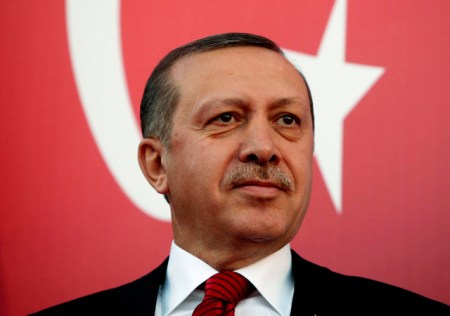
ErdoganPortrait-IP_2Turkish President Recep Tayyip Erdoğan (Photo: © Reuters)

On May 28, Turkish President Recep Tayyip Erdogan visited the predominantly Kurdish city of Diyarbakır and delivered a public speech in which he targeted Kurds requesting official recognition and the right to self-rule, calling them “atheists” and “Zoroastrians.”

In an attempt to appeal to Islamist sentiment, Erdogan claimed that Kurdish militants had burnt down schools and mosques, stating, “They are atheists, they are Zoroastrians. They are useless. They have not and are not acting with our values.”

This was not the first time Erdogan targeted non-Muslims in his public speeches.

In February, 2014, in the city of Balikesir, Erdogan, then prime minister, referred to the students of the Middle East University in Ankara, as “atheists” and “terrorists.” The students had protested the construction of the “1071 Manzikert Boulevard,” to which the police responded with gas bombs and pressurized water.

“On Monday, we opened the boulevard built by our metropolitan municipality of Ankara,” said Erdogan. “Despite whom? Despite those leftists! Despite those atheists! They are atheists! They are terrorists!”

The Battle of Manzikert was fought in 1071 in Anatolia between the Byzantine Empire and the Seljuq Turks, which marked the beginning of the Islamic invasion of Anatolia. The defeat of the Byzantine army and the capture of the Emperor Romanos IV Diogenes paved the way for the gradual Turkification and Islamization of Anatolia and Armenia.

Erdogan bashed the university students in his own unique way: “What is the name of the boulevard? Manzikert 1071. One of them was wearing Byzantine clothes. Alp Arslan [the Sultan of the Seljuq Empire] fought against Byzantium. So he [the student] put himself in the position of Byzantium. Shame on you!”

Apparently, Erdogan knows the easy and certain way of getting votes from much of Turkish public: Target any non-Muslim community – Jews, Christians, atheists, Alevis, Zoroastrians, you name it – and get the votes of millions of people, those who might not even know anything about the said religions or people but whose overall hatred for the “infidel” would be enough to make them enjoy the hate-filled slurs.

In May 2015, in the predominantly Kurdish city of Batman, Erdogan once again publicly targeted the secular, pro-Kurdish Peoples’ Democratic Party (HDP) – for “having nothing to do with Islam.”

“They say they will abolish Diyanet [Turkey’s Presidency of Religious Affairs]. They have nothing to do with religion. The Diyanet that they say they will abolish has published the Kurdish translation of the Koran.

“They [the HDP party] go to extremes by saying that Jerusalem belongs to Jews. They have nothing whatsoever with Islam. Jerusalem is the most important Kaaba [sacred site] of Muslims; it is where we found life.

“We have documents that in the mountains, they [the PKK] give education of the Zoroastrian religion.”

Despite the hateful stigma of Erdogan regarding Zoroastrianism, it is an ancient faith of peace, ethics and wisdom. Basic tenets of Zoroastrians include:

“The basic moral principles that guide the life of a Zoroastrian are three: Humata, ‘Good Thoughts’, Hukhata, ‘Good Words’, and Havarashta, ‘Good Deeds’.

“These three principles are included in many Zoroastrian prayers, and children commit themselves to abide by them at their initiation ceremony, marking their responsible entry into the faith as practicing Zoroastrians. They are the moral code by which a Zoroastrian lives.”

Sadly, this ancient, peaceful religion has become one of the greatest victims of Islamic jihad.

Before Iran (formerly called Persia) was invaded by Muslim armies in the 7th century, Zoroastrianism was the major religion there. Founded by the Prophet Zoroaster, Zoroastrianism was the state religion of several Persian empires.

Muslims should actually feel guilt and shame in the face of the enormous damage and destruction they have brought to the Zoroastrian people, but the Islamist ideology seems to erase even the most humane emotions of its followers.

Another social disease commonplace in Turkey is “atheophobia” ‎– fear or hatred of atheism or atheists.

The 2015 Freedom of Thought Report by the International Humanist and Ethical Union (IHEU) puts Turkey in the category of countries which expose their citizens who identify as atheists or non-religious to “severe discrimination.”

“Freedom of expression is theoretically protected by the current constitution, but is increasingly not respected in practice,” said the report. “Identifying [as an] ‘atheist’ prompts insults, threats, discrimination.”

In 2015, for instance, members of the Turkish Atheism Association (Ateizm Derneği), spoke up about receiving death threats and hate mail, and how “atheist”  is used as an insult or equated with “Satanism” or “terrorism.”

“The term ‘atheist’ is used as a harsh insult – one of the harshest in the country,” said Morgan Romano, vice-president of the Turkish Atheism Association, at the group’s first public conference in Germany.

“Furthermore, atheists are commonly and publicly discriminated against and are subjects of public and private hate speech in Yeni Turkiye [the New Turkey] all the time.”

In March, 2015, the Atheism Association had its website blocked in Turkey in a decision the association protested was “arbitrary.”

Given the Islamic roots of hatred for infidels, it seems that the Atheism Association is engaged in an extremely grueling business in Turkey: trying to promote understanding, tolerance and liberty in a sociologically Islamic society.

“Any person who openly disrespects the religious belief of a group is punished with imprisonment from six months to one year if such act causes potential risk for public peace,” says article 216 of the Turkish penal code.

But this “blasphemy law” seems to be in action only to punish non-Muslims or former Muslims or anyone who speaks critically about Islam. Bringing to account those who insult or even threaten non-Muslims is not very much included within the scope of this law.

The current constitution of Turkey lists secularism as one of the fundamental characteristics of the republic. The written law, which is not even put into practice effectively, is something; but promoting secularism as well as religious freedom and tolerance – through various means including public education and media – is another. And Turkey seems to fail terribly in the latter.

Can US, Turkey keep up appearances in Syria?

May 30, 2016

Can US, Turkey keep up appearances in Syria? Al-Monitor, May 29, 2016

A terrorist group linked to the Islamic State (IS) claimed responsibility for suicide bombings in Tartus and Jableh in Syria on May 23 that killed more than 150 civilians and wounded more than 200 others. Maxim Suchkov points out that the attack in Tartus occurred deep inside government-controlled territory. Russia maintains a naval base in Tartus and an air base and reconnaissance center in Khmeimim in the Latakia region. The suicide attacks, Suchkov suggests, could be a catalyst for a Russian “first strike” strategy against terrorist and aligned Salafi groups.

Moscow had already signaled the prospect of escalation against Jabhat al-Nusra and allied groups prior to the May 23 attacks. The Russian Ministry of Defense has announced a pause in its air campaign to allow armed groups allied with Jabhat-al Nusra to distance themselves from the al-Qaeda affiliate. On May 26, Jabhat al-Nusra, Ahrar al-Sham and allied groups seized the town of Dirkhabiyah near Damascus. Ahrar al-Sham has coordinated more closely with Jabhat al-Nusra in response to increased US and Russian targeting of the al-Qaeda affiliate over the past few months.

This column last week suggested that the United States take up a Russian offer to coordinate attacks on Jabhat al-Nusra, which is not a party to the cessation of hostilities. For the record, we have no tolerance or empathy for groups or individuals who stand with al-Qaeda. We hope that this is at least part of the message the United States is conveying to its regional partners who have backed these groups.

With the Geneva talks suspended for several weeks, the prospect of a Russian campaign to deliver heavy and potentially fatal blows to Jabhat al-Nusra and its allies, especially in and around Aleppo and Idlib, could signal yet another turning point in the Syria conflict.

Turkey’s failed proxy war

The United States and Turkey are struggling to keep up appearances in Syria, despite even further signs of division and discord.

Gen. Joseph Votel, US CENTCOM commander, met last week with Syrian Kurdish forces during a “secret” visit to northern Syria as part of a regional diplomatic tour that also included a stop in Ankara. Votel told Washington Post columnist David Ignatius that he is seeking to “balance” Turkey’s role as a “fabulous” partner in the battle against IS with that of the People’s Protection Units (YPG), the backbone of the Syrian Defense Forces (SDF), which is a “very good partner on the ground.”

In contrast to the YPG, Turkey’s proxy forces, including a worrying mix of Salafists who are willing to run operations with Jabhat al-Nusra, have been a flop. Last week, IS seized at least seven villages in the northern Aleppo region.

Fehim Tastekin reports that SDF-led military operations to liberate Jarablus, which is an essential gateway along with al-Rai to the outside world via Turkey, were postponed “because of Turkey’s red line against the Kurds.” The offensive against Raqqa has also been slowed, writes Tastekin, because “the SDF’s operational capacity still leaves much to be desired. It is not an option for the Kurdish YPG-YPJ to control Raqqa, because they will encounter local resistance. They also worry that scattering their forces in Arab regions could weaken the defensive lines of Rojava (Syrian Kurdistan). Therefore, Arab forces would have to get in shape to control the situation in the post-IS period.” Laura Rozen reports from Washington that the United States is seeking to boost the numbers of Arab Sunni forces among the SDF in anticipation of an advance on Raqqa.

Meanwhile, the Pentagon found itself in a public relations fiasco after Turkey complained that US special forces in Syria were wearing badges with the logo of the YPG, which Turkey considers the Syrian partner of the Kurdistan Workers Party (PKK) and therefore also a terrorist organization. This might be compared with what in the sports world is known as an unforced error, and made Votel’s already daunting diplomacy that much more complicated.

Air Force Col. Sean McCarthy also told Ignatius that US air operations against IS out of Incirlik Air Base were mostly “autonomous” of Turkish missions, saying that “we don’t discuss with them where we’re going.”

Adding it all up, the US-Turkish “partnership” against IS may be more fable than fabulous. The open secret is that Turkey is preoccupied first with thwarting advances by Syria’s Kurds, and second with shutting down the remaining lifelines for IS in northern Syria. These priorities are of a piece. No doubt Turkey is taking up the fight against IS, but first things first. Tastekin, who previously broke the back story on Turkey’s disastrous proxy efforts to retake al-Rai from IS in April, now concludes that “there is no room for optimism that Ankara will erase its red lines vis-a-vis the Kurds. Instead, Turkey is now trying to put together an even more formidable force with Jabhat al-Nusra, which it is trying to steer away from al-Qaeda.”

The catch might just be that many of the Syrian armed groups backed by Washington’s regional partners are proxies for a sectarian agenda that is mostly about toppling Syrian President Bashar al-Assad, however unlikely that now appears, and, by extension, keeping the heat on Iran. The when and where of taking the fight to IS or Jabhat al-Nusra is more or less negotiable, depending on trade-offs and pressure. We do not feel we are out on a limb in suggesting that efforts by Ankara or others to wean Jabhat al-Nusra from al-Qaeda will come to no good. This column has repeatedly documented the fluidity of foreign-backed Salafi groups such as Ahrar al-Sham and Jaish al-Islam shifting in and out of tactical alliances with Jabhat al-Nusra, all the while preaching an ideology almost indistinguishable from al-Qaeda and IS.

The losers, of course, are the people of Syria, including those who suffer under IS’ tyranny that much longer because of Turkey’s concerns about the Kurds, and as Washington’s policymakers and pundits begin another maddening deep dive into how to rejigger ethnic and sectarian fault lines. Syrians fleeing IS terror in Aleppo, meanwhile, told Mohammed al-Khatieb that living under IS is “like hell … unbearable.” While we acknowledge the complexities and challenges of the raw ethnic and sectarian politics of Syria, as well as the potential for vendettas and mass killings, there is, in our score, an urgency and priority to focus on the destruction of IS and al-Qaeda above all else.

Sur’s aftermath

Diyarbakir’s historic district of Sur has witnessed some of the most brutal fighting between Turkish military and PKK forces over the past year. Mahmut Bozarslan reports from Diyarbakir that “historical landmarks in Sur, which was last year added to UNESCO’s World Heritage List, also suffered their share of destruction. The walls of the Armenian Catholic church are partially destroyed, while the nearby Haci Hamit Mosque is missing its minaret, with a dome riddled with bullets. Another Armenian church, Surp Giragos, had its windows shattered and interior damaged.”

“Still, those ancient monuments were lucky compared with more ordinary structures in the area,” writes Bozarslan. “A building with an intact door was almost impossible to find. The warring parties had used some buildings as fighting bases, others as places to rest. Stairways were littered with empty tins; one was also stained with blood. At the bloodied spot, a piece of paper reading “body #1” was left behind, suggesting that the security forces had been there for a crime scene report. A couple seemed relieved that they had escaped with relatively little damage, but grumbled that their apartment had been broken into, with the bedroom and closets rummaged. They claimed it was the security forces who had entered, while their neighbor showed Al-Monitor binoculars that had been left behind.”

Turkey’s female journalists now risk parental rights for critical reporting

May 24, 2016

Turkey’s female journalists now risk parental rights for critical reporting, Al Monitor

arzuThe Turkish court has sentenced journalist Arzu Yildiz to prison and denied her “parental rights” over a story on MIT trucks and arms transfers to Syria, May 18, 2016. (photo by FACEBOOK/Save Kobane)

Turkish female journalist Arzu Yildiz was this week sentenced to 20 months in prison for her reporting on alleged Turkish arms shipments to Syria, a highly controversial issue that has riled Ankara and landed both journalists and judicial officials in jail. The court, however, did not stop there, and stripped Yildiz also of her parental rights. While the imprisonment of journalists may have become commonplace in Turkey, now ranking 151st on the World Press Freedom Index, the restriction of Yildiz’s parental rights marks a new milestone in the extent the pressure on journalists has reached, affecting even their familial ties and social standing.

Yildiz is an experienced journalist who, after working for various media outlets, was left jobless a couple of years ago. Together with other jobless colleagues, she co-founded the nonprofit Grihat news site, where her reporting on the trucks controversy led to her conviction.

The story in question was related to the interception of Syria-bound trucks in the southern provinces of Hatay and Adana in January 2014. Acting on tip-offs, prosecutors had issued search warrants for the trucks. But when stopped by police and gendarmerie officers, the men in the vehicles identified themselves as members of the National Intelligence Organization (MIT) and resisted the searches. President Recep Tayyip Erdogan claimed at the time the trucks carried humanitarian supplies, but few were convinced. All judicial officials and security forces involved in the attempted search are behind bars today. The Cumhuriyet daily’s Editor-in-Chief Can Dundar and Ankara representative Erdem Gul also found themselves behind bars for their reports on the story. Though they were released three months later, they received jail terms for revealing state secrets earlier this month. Another journalist who covered the issue, Fatih Yagmur, remains on trial.

Yildiz, for her part, faced several investigations for her coverage of the incident and ensuing developments. The report that earned her the 20-month sentence pertained to the testimonies of the prosecutors who were arrested for attempting the search. On top of the prison term, the court in the southern city of Tarsus banned Yildiz from using “certain rights.”

In an interview with Al-Monitor, her lawyer, Alp Deger Tanriverdi, explained what the ruling means. “Let me tell you the most significant part: The ruling strips Arzu Yildiz of her motherhood rights,” he said. “She can no longer register her kids to school, open bank accounts for them or do other similar things on their behalf. She can’t even go abroad with them.”

Asked about the grounds on which the court made the decision, the lawyer said, “The court was [actually] supposed to suspend the sentence because Yildiz had no other conviction before. That was her legal right. Yet the court arbitrarily went ahead on grounds she committed the crime willfully, which automatically brought the decision to strip her from her rights. The court could have withheld this decision as well. Such restrictions are based on the following logic: ‘You’ve committed a crime willfully, so you are guilty before society as well. Thus, you must not be allowed to have a [bad] influence on your children.’ Such is the intention of the clause, yet the court applied it to Yildiz — to humiliate her.”

In remarks to Al-Monitor, Yildiz also lamented the court had acted arbitrarily. “I have two kids — one 6½ years old, the other only four months. I think the court made this decision deliberately, knowing that I’m a mother of two — simply to hurt me more,” she said. “My kids are my whole world. What else do I have? The court now says I can’t claim any right on them, can’t register them to school and can’t travel abroad with them. What hurts even more is that a ban that the courts withhold [even] from child molesters and rapists is being imposed on a journalist.”

Yildiz believes the ruling essentially aims to denigrate and humiliate journalists before the public. Yet, she remains adamant on soldiering on. “I covered the MIT trucks investigation from beginning to end. In the meantime, I gave birth [to my second child] and left my baby home when she was only 20 days old to go watch the hearings in this case,” she said. “I did this without having any financial support. The story in question was published on Grihat, which we had launched without any financial considerations. With this ruling, the court is trying to prevent me from doing journalism but it won’t succeed.”

The restriction on Yildiz’s parental rights sparked indignation from civic society groups and social media users. The issue became a trending topic on Twitter, generating about 50,000 tweets. “Some court rulings are destroying the society’s trust in the judiciary,” the Turkish Journalists’ Trade Union (TGS) said, while Yildiz’s colleagues circulated pictures of her four-month-old daughter with the slogan “Baby Zehra is not alone.”

The onslaught on critical media in Turkey has proceeded through wide-ranging means, including dismissal, judicial probes and imprisonment. According to a recent report by Press for Freedom, an advocacy project carried out by the Ankara-based Journalists Association, 894 journalists lost their jobs in Turkey in the first four months of the year and 74 journalists faced some kind of judicial action. Thirty-six journalists remain behind bars, according to the TGS.

With the Yildiz case, the boundary of intimidation has moved even further, threatening the parental rights of journalists and undermining their standing in society and vis-a-vis the state.


EU-Turkey Migrant Deal Unravels

May 18, 2016

EU-Turkey Migrant Deal Unravels, Gatestone InstituteSoeren Kern, May 18, 2016

♦ “It can be expected that, as soon as Turkish citizens will obtain visa-free entry to the EU, foreign nationals will start trying to obtain Turkish passports … or use the identities of Turkish citizens, or to obtain by fraud the Turkish citizenship. This possibility may attract not only irregular migrants, but also criminals or terrorists.” — Leaked European Commission report, quoted in theTelegraph, May 17, 2016.

♦ According to the Telegraph, the EU report adds that as a result of the deal, the Turkish mafia, which traffics vast volumes of drugs, sex slaves, illegal firearms and refugees into Europe, may undergo “direct territorial expansion towards the EU.”

♦ “If they make the wrong decision, we will send the refugees.” — Burhan Kuzu, senior adviser to Turkish President Recep Tayyip Erdogan.

♦ Erdogan is now demanding that the EU immediately hand over three billion euros ($3.4 billion) so that Turkish authorities can spend it as they see fit. The EU insists that the funds be transferred through international aid agencies in accordance with strict rules on how the aid can be spent. This prompted Erdogan to accuse the EU of “mocking the dignity” of the Turkish nation.

The EU-Turkey migrant deal, designed to halt the flow of migrants from Turkey to Greece, is falling apart just two months after it was reached. European officials are now looking for a back-up plan.

The March 18 deal was negotiated in great haste by European leaders desperate to gain control over a migration crisis in which more than one million migrants from Africa, Asia and the Middle East poured into Europe in 2015.

European officials, who appear to have promised Turkey more than they can deliver, are increasingly divided over a crucial part of their end of the bargain: granting visa-free travel to Europe for Turkey’s 78 million citizens by the end of June.

At the same time, Turkey is digging in its heels, refusing to implement a key part of its end of the deal: bringing its anti-terrorism laws into line with EU standards so that they cannot be used to detain journalists and academics critical of the government.

A central turning point in the EU-Turkey deal was the May 5 resignation of Turkish Prime Minister Ahmet Davutoglu, who lost a long-running power struggle with Turkish President Recep Tayyip Erdogan. Davutoglu was a key architect of the EU-Turkey deal and was also considered its guarantor.

On May 6, just one day after Davutoglu’s resignation, Erdogan warned European leaders that Turkey would not be narrowing its definition of terrorism: “When Turkey is under attack from terrorist organizations and the powers that support them directly, or indirectly, the EU is telling us to change the law on terrorism,” Erdogan said in Istanbul. “They say ‘I am going to abolish visas and this is the condition.’ I am sorry, we are going our way and you go yours.”

Erdogan insists that Turkey’s anti-terrorism laws are needed to fight Kurdish militants at home and Islamic State jihadists in neighboring Syria and Iraq. Human rights groups counter that Erdogan is becoming increasingly authoritarian and is using the legislation indiscriminately to silence dissent of him and his government.

European officials say that, according to the original deal, visa liberalization for Turkish citizens is conditioned on Turkey amending its anti-terror laws. Erdogan warns that if there is no visa-free travel by the end of June, he will reopen the migration floodgates on July 1. Such a move would allow potentially millions more migrants to pour into Greece.

European officials are now discussing a Plan B. On May 8, the German newspaper Bild reported on a confidential plan to house all migrants arriving from Turkey on Greek islands in the Aegean Sea. Public transportation to and from those islands to the Greek mainland would be cut off in order to prevent migrants from moving into other parts of the European Union.

Migrants would remain on the islands permanently while their asylum applications are being processed. Those whose asylum requests are denied would be deported back to their countries of origin or third countries deemed as “safe.”

The plan, which Bild reports is being discussed at the highest echelons of European power, would effectively turn parts of Greece into massive refugee camps for many years to come. It remains unclear whether Greek leaders will have any say in the matter. It is also unclear how Plan B would reduce the number of migrants flowing into Europe.

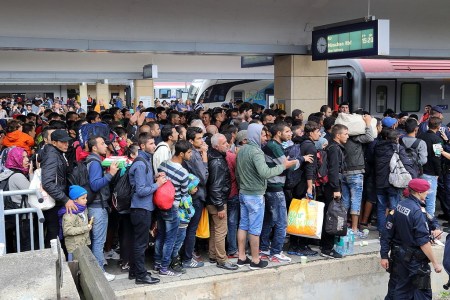
1607Thousands of newly arrived migrants, the vast majority of whom are men, crowd the platforms at Vienna West Railway Station on August 15, 2015 — a common scene in the summer and fall of 2015. (Image source: Bwag/Wikimedia Commons)

Speaking to the BBC News program, “World on the Move,” on May 16, Sir Richard Dearlove, the former head of the British intelligence service MI6, warned that the number of migrants coming to Europe during the next five years could run into millions. This, he said, would reshape the continent’s geopolitical landscape: “If Europe cannot act together to persuade a significant majority of its citizens that it can gain control of its migratory crisis then the EU will find itself at the mercy of a populist uprising, which is already stirring.”

Dearlove also warned against allowing millions of Turks visa-free access to the EU, describing the EU plan as “perverse, like storing gasoline next to the fire we’re trying to extinguish.”

On May 17, the Telegraph published the details of a leaked report from the European Commission, the powerful administrative arm of the European Union. The report warns that opening Europe’s borders to 78 million Turks would increase the risk of terrorist attacks in the European Union. The report states:

“It can be expected that, as soon as Turkish citizens will obtain visa-free entry to the EU, foreign nationals will start trying to obtain Turkish passports in order to pretend to be Turkish citizens and enter the EU visa free, or use the identities of Turkish citizens, or to obtain by fraud the Turkish citizenship. This possibility may attract not only irregular migrants, but also criminals or terrorists.”

According to the Telegraph, the report adds that as a result of the deal, the Turkish mafia, which traffics vast volumes of drugs, sex slaves, illegal firearms and refugees into Europe, may undergo “direct territorial expansion towards the EU.” The report warns: “Suspect individuals being allowed to travel to the Schengen territory without the need to go through a visa request procedure would have a greater ability to enter the EU without being noticed.”

While the EU privately admits that the visa waiver would increase the risk to European security, in public the EU has recommended that the deal be approved.

On May 4, the European Commission announced that Turkey has met most of the 72 “benchmarks of the roadmap” needed to qualify for the visa waiver. The remaining five conditions concern the fight against corruption, judicial cooperation with EU member states, deeper ties with the European law-enforcement agency Europol, data protection and anti-terrorism legislation.

European Commission Vice President Frans Timmermans said:

“Turkey has made impressive progress, particularly in recent weeks, on meeting the benchmarks of its visa liberalization roadmap…. This is why we are putting a proposal on the table which opens the way for the European Parliament and the Member States to decide to lift visa requirements, once the benchmarks have been met.”

In order for the visa waiver to take effect, it must be approved by the national parliaments of the EU member states, as well as the European Parliament.

Ahead of a May 18 debate at the European Parliament in Strasbourg over Turkey’s progress in fulfilling requirements for visa liberalization, Burhan Kuzu, a senior adviser to Erdogan, warned the European Parliament that it had an “important choice” to make.

In a Twitter message, Kuzu wrote: “If they make the wrong decision, we will send the refugees.” In a subsequent telephone interview with Bloomberg, he added: “If Turkey’s doors are opened, Europe would be miserable.”

Meanwhile, Erdogan has placed yet another obstacle in the way of EU-Turkey deal. He is now demanding that the EU immediately hand over three billion euros ($3.4 billion) promised under the deal so that Turkish authorities can spend it as they see fit.

The EU insists that the funds be transferred through the United Nations and other international aid agencies in accordance with strict rules on how the aid can be spent. That stance has prompted Erdogan to accuse the EU of “mocking the dignity” of the Turkish nation.

On May 10, Erdogan expressed anger at the glacial pace of the EU bureaucracy:

“This country [Turkey] is looking after three million refugees. What did they [the EU] say? We’ll give you €3 billion. Well, have they given us any of that money until now? No. They’re still stroking the ball around midfield. If you’re going to give it, just give it.

“These [EU] administrators come here, tour our [refugee] camps, then ask at the same time for more projects. Are you kidding us? What projects? We have 25 camps running. You’ve seen them. There is no such thing as a project. We’ve implemented them.”

In an interview with the Financial Times, Fuat Oktay, head of Turkey’s Disaster and Emergency Management Authority (AFAD), the agency responsible for coordinating the country’s refugee response, accused European officials of being fixated on “bureaucracies, rules and procedures” and urged the European Commission to find a way around them.

The European Commission insists that it was made clear from the outset that most of the money must go to aid organizations: “Funding under the Facility for Refugees in Turkey supports refugees in the country. It is funding for refugees and not funding for Turkey.”

The migration crisis appears to be having political repercussions for German Chancellor Angela Merkel, a leading proponent of the EU-Turkey deal. According to a new poll published by the German newsmagazine Cicero on May 10, two-thirds (64%) of Germans oppose a fourth term for Merkel, whose term ends in the fall of 2017.

In an interview with Welt am Sonntag, Horst Seehofer, the leader of the Christian Social Union (CSU), the Bavarian sister-party to Merkel’s Christian Democrats (CDU), blamed Merkel for enabling Erdogan’s blackmail: “I am not against talks with Turkey. But I think it is dangerous to be dependent upon Ankara.”

Sahra Wagenknecht of the Left Party accused Merkel of negotiating the EU-Turkey deal without involving her European partners: “The chancellor is responsible for Europe having become vulnerable to blackmail by the authoritarian Turkish regime.”

Cem Özdemir, leader of the Greens Party and the son of Turkish immigrants said: “The EU-Turkey deal has made Europe subject to Turkish blackmail. The chancellor bears significant responsibility for this state of affairs.”

IRGC routed in Syria by new missile

May 16, 2016

IRGC routed in Syria by new missile, DEBKAfile, May 16, 2016

Khan_tuman_ambush_5.16

[N]either the Iranians nor Hizballah can win the war for Assad.

***************************

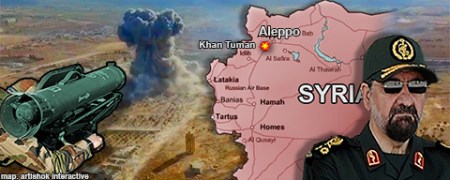
The battle on May 6 in the village of Khan Touman, located southwest of Aleppo near Route 5, the main highway leading to Damascus, will go down in the annals of the Syrian war as the biggest defeat suffered by the Iranian Revolutionary Guard Corps (IRGC) and Hizballah, as well as the battle that changed the face of the war.

DEBKAfile’s military and intelligence sources report that an Iranian force consisting of IRGC troops and Hizballah was ambushed by fighters from the Jaysh al Fath organization, part of the Nusra Front.

Until this battle took place, Iranian and Hizballah commanders in Syria did not know that the rebels had received a shipment of MILAN antitank missiles provided by Turkey and funded by Saudi Arabia.

The encounter with the advanced weapon system brought the IRGC and Hizballah to rout.

The Iranians admitted that 17 of their fighters fell in the battle, including 13 from the IRGC’s “Karbala” Division that is usually based in Iran, and 22 were wounded. Among the dead were two Iranian brigadier generals. At least ten IRGC troops were taken prisoner by the rebels. Five or seven Iranian troops were executed immediately, and an unknown number were taken from the area to an undisclosed location.

Hizballah claimed that none of its troops were killed or taken prisoner. However, that statement was actually an attempt to hide that at least 15 of its fighters were killed. According to intelligence sources that monitored the battle, Hizballah’s death toll was even higher.

The defeat was a major shock to the Iranian and Hizballah hierarchies In Tehran and Beirut, and officials vowed that revenge would be coming soon.

The immediate result of the shock was the appointment of Gen. Mohsen Rezaei, commander of the IRGC 26 years ago in the 1980s, who retired years ago and was a candidate in several presidential elections.

DEBKAfile’s sources report that Rezaei is one of the only IRGC commanders to have visited many times in the West, mainly to participate in international conferences, and has spoken freely with Western military and intelligence officers on the situation in Iran and the Middle East.

It is hard to believe that he will succeed in turning the clock back for Iran and Hizballah in Syria. Rezaei’s appointment indicates confusion   or panic in the Iranian hierarchy that does not know how to respond to the defeat.

KhanTuman480

In addition, it is still not clear whether Rezaei will replace Gen. Qassem Soleimanias commander of Iran’s forces in Syria, or be subordinate to him.

DEBKAfile’s military sources point out that bringing Rezaei to Syria does not resolve Iran and Hizballah’s main military problem, as the battle in Khan Touman showed. If the rebels continue to receive advanced weapons like antitank and antiaircraft missiles, they will become superior to the three military forces fighting for Syrian President Bashar Assad, namely Iran’s standing army and IRGC troops, the Syrian army and Hizballah.

In other words, neither the Iranians nor Hizballah can win the war for Assad.

Seven days after the battle, the commander of Hizballah’s forces in Syria, Mustafa Bader Al-din, was killed by a ground-to-ground missile strike near the Damascus international airport. Later claims by various sources that he was killed in battle at Khan Touman were actually attempts to conceal the two biggest military blows suffered by the Iranians and Hizballah in Syria

The UN World Humanitarian Summit Money Pit

May 5, 2016

The UN World Humanitarian Summit Money Pit, Front Page MagazineJoseph Klein, May 5, 2016

UCHA

The United Nations Office for the Coordination of Humanitarian Affairs (OCHA) is organizing what is being billed as the first ever World Humanitarian Summit, which will take place in Istanbul Turkey on May 23-24 2016. Representatives from UN member states (including a number of heads of state and government), civil society, the private sector, crisis-affected communities and multilateral organizations are expected to attend the summit.

The summit’s purpose is said to be no less than to provide governments, the private sector, non-governmental organizations and community leaders a global platform to “announce major commitments to action, launch new partnerships aimed at saving lives, and highlight innovations which help reduce suffering and uphold humanity in times of crisis.” One of the most important goals is to inspire the creation of mechanisms for more reliable, multi-year financing for humanitarian and development programs combined. It sounds like OCHA is planning to dig an even deeper money pit for donors at the summit.

UN leaders have talked about a “grand bargain” in which UN organizations across the entire UN system would pledge to work together more cooperatively and to be more transparent in how they spend donated funds in return for enhanced, more predictable funding. “The donor base must clearly expand,” said OCHA’s Under-Secretary-General and Emergency Relief Coordinator, Stephen O’Brien, at a UN event on humanitarian financing last year.

However, when Mr. O’Brien spoke to reporters on May 2nd to highlight the importance of the upcoming summit’s agenda and the so-called “Grand Bargain” it is intended to promote, he inexplicably declined to answer some key questions. This is especially concerning, since Mr. O’Brien had already called into question his commitment to genuine UN reform and transparency. He declared in an interview with IRIN last October, for example, that “the UN doesn’t have to change.”

When asked at his May 2nd press conference how much the two day World Humanitarian Summit and preparations leading up to it are expected to cost, and where the money was coming from, Mr. O’Brien provided no numbers. He praised the host country Turkey for its generous contributions in helping to defray the full cost, without acknowledging Turkey’s self-interest in whitewashing its own abysmal record on two of the issues the summit is supposed to address – forced displacement and gender inequality.

According to OCHA’s 2016 budget plan, OCHA itself will be paying $700,748 towards the summit cost. In light of the recent scandal involving alleged payments by groups affiliated with an indicted businessman to buy influence at the United Nations, the identities and profiles of all donors of monies to defray the cost of the World Humanitarian Summit should be made public. At this point, Mr. O’Brien would not even agree to publicly disclose the heads of state and government whom have accepted invitations to attend the summit.

When asked to provide figures on the proportion of contributions to UN humanitarian programs that actually reach those in need, Mr. O’Brien also declined. There is reason to be concerned with Mr. O’Brien’s lack of transparency here as well. The UN’s Office of Internal Oversight had concluded in its 2012 audit of OCHA’s management of the Haiti Emergency Relief and Response Fund (ERRF) that “OCHA Haiti’s governance, risk management and control processes examined were assessed as unsatisfactory in providing reasonable assurance regarding the sound management of the ERRF and the effectiveness of OCHA’s coordination mechanisms and oversight role for humanitarian activities in Haiti.”

As of August 2011, $86 million had been received in donor contributions, of which approximately $80 million had been programmed and allocated for projects, and about $57.4 million had been disbursed. The UN’s internal audit found “insufficient oversight over $86 million funding made available to OCHA by donors.” The rate of international staff salaries ranged as high as $32,000 a month, while the monthly salary of national staff ranged as high $18,000. Some vehicles were rented for as high as $6000 per month.

This is not an isolated instance that should raise concern about where OCHA-channeled money is really going. According to Nicolas Séris and Roslyn Hees of Transparency International (TI), “The top ten Priority countries featured in OCHA’s 2015 Consolidated Appeal all received very low rankings in TI’s 2014 Corruption Perception Index, scoring less than 25 out of a possible 100.”

OCHA’s total 2016 budget (funded mostly from voluntary contributions, supplemented by an allocation from the regular UN assessed budget) is $323,982,056 million. In addition, OCHA coordinates the donations of hundreds of millions of dollars to specific humanitarian emergency relief programs, such as the much-criticized Haiti Emergency Relief and Response Fund.  OCHA also spends funds to coordinate with politicized pro-Palestinian organizations.

Anyone who is serious about accountable, transparent delivery of humanitarian aid to people truly in need should think long and hard before making any further unconditional funding commitments to OCHA, including at the Turkish government-hosted World Humanitarian Summit.

Europe’s Migration Crisis: No End in Sight

May 2, 2016

Europe’s Migration Crisis: No End in Sight, Gatestone Institute, Judith Bergman, May 2, 2016

♦ According to France’s Defense Minister, Jean-Yves Le Drian, 800,000 migrants are currently in Libyan territory waiting to cross the Mediterranean.

♦ The multitude of very costly social problems that Muslim migration into Europe has caused thus far, do not exist in this whitewashed European Union report, where the “research” indicates that migrants are always a boon. Similarly, any mention of the very real security costs necessitated by the Islamization occurring in Europe, and the need for monitoring of potential jihadists, simply goes unmentioned.

♦ Several European states have a less optimistic picture of the prospect of another three million migrants arriving on Europe’s borders than either the Pope or the European Commission do.

Pope Francis, on his recent visit to the Greek island of Lesbos, said that Europe must respond to the migrant crisis with solutions that are “worthy of humanity.” He also decried “that dense pall of indifference that clouds hearts and minds.” The Pope then proceeded to demonstrate what he believes is a response “worthy of humanity” by bringing 12 Syrian Muslims with him on his plane to Italy. “It’s a drop of water in the sea. But after this drop, the sea will never be the same,” the Pope mused.

The Pope’s speech did not contain a single reference to the harsh consequences of Muslim migration into the European continent for Europeans. Instead, the speech was laced with reflections such as “…barriers create divisions instead of promoting the true progress of peoples, and divisions sooner or later lead to confrontations” and “…our willingness to continue to cooperate so that the challenges we face today will not lead to conflict, but rather to the growth of the civilization of love.”

The Pope went back to his practically migrant-free Vatican City — those 12 Syrian Muslims will be hosted by Italy, not the Vatican, although the Holy See will be supporting them — leaving it to ordinary Europeans to cope with the consequences of “the growth of the civilization of love.”

There is nothing quite as free in this world as not practicing what you preach, and what the Pope is preaching is the acceptance of more migration into Europe, and more migration — much more — is indeed what is in the cards for Europe.

At the UN’s Geneva conference on Syrian refugees on March 30, Italy’s Minister of Foreign Affairs, Paolo Gentiloni, put the total number of asylum seekers into Italy in the first three months of 2016 at 18,234. This is already 80% higher than in the same period in 2015.

According to Paolo Serra, military adviser to Martin Kobler, the UN’s Libya envoy, migrants currently in Libya will head for Italy in large numbers if the country is not stabilized. “If we do not intervene, there could be 250,000 arrivals [in Italy] by the end of 2016,” he said. According to France’s Defense Minister, Jean-Yves Le Drian, the number is much higher: 800,000 migrants are currently in Libyan territory waiting to cross the Mediterranean.

Already in November 2015, the European Union estimated — in its Autumn 2015 European Economic Forecast, authored by the European Commission — that by the end of 2016, another three million migrants will have made it into the European Union.

Nevertheless, the European Commission optimistically noted that, “while unevenly distributed among countries, the estimated additional public expenditure related to the arrival of asylum seekers is limited for most EU member states.” It even concluded that the migrant crisis could have a small, positive impact on European economies within a few years citing that “Research indicates that non-EU migrants typically receive less in individual benefits than they contribute in taxes and social contribution.”

This is the classic, politically correct denial of facts on the ground. The multitude of very costly social problems that Muslim migration into Europe has caused thus far do not exist in this whitewashed report, where the “research” indicates that migrants are always a boon. Similarly, any mention of the very real security costs necessitated by the Islamization that is occurring in Europe and the consequent need for monitoring of potential jihadists, simply goes unmentioned. One wonders whether the EU bureaucrats, who authored this report, ever descend from their ivory towers and move about in the real Europe.

Several European states have a less optimistic picture of the prospect of another three million migrants arriving on Europe’s borders than either the Pope or the European Commission do. In February, Austria announced that it would introduce border controls at border crossings along frontiers with Italy, Slovenia and Hungary. On April 12, Austria began preparations for introducing border controls on its side of the Brenner Pass, the main Alpine crossing into Italy, by starting work on a wall between the two countries.

The Austrian decision to close the Brenner pass has received harsh criticism from the EU. European Commission spokeswoman Natasha Bertaud criticized the measure as unwarranted, claiming that “there is indeed no evidence that flows of irregular migrants are shifting from Greece to Italy”. Is Bertaud deliberately misrepresenting the issue? The issue is not whether the migrants are shifting from Greece to Italy after the EU’s unsavory deal with Turkey (they probably will) but the up to 800,000 migrants are already waiting to cross into Italy from Libya.

EU Migration Commissioner Dimitris Avramopoulos joined in the criticism of Austria, saying, “What is happening at the border between Italy and Austria is not the right solution.” He had criticized Austria already in February, when Vienna announced that it would cap asylum claims at 80 per day. At the time, Avramopoulos said,

“It is true that Austria is under huge pressure… It is true they are overwhelmed. But, on the other hand, there are some principles and laws that all countries must respect and apply… The Austrians are obliged to accept asylum applications without putting a cap.”

In response, Austria’s Chancellor Werner Faymann told the EU that Austria could not just let the influx of migrants continue unchecked — nearly 100,000 have applied for asylum in Austria — and he called for the EU to act. The EU has not yet acted.

The EU should hardly be surprised that a sovereign state decides to take matters into its own hands in the face of the EU’s failure to heed that call, and as it anticipates a repeat of last year’s migration chaos — which, given the predicted estimates, is bound to occur this year with even greater force.

Predictably, Italy has also criticized the decision, with Italian Interior Minister Angelino Alfano saying that Austria’s decision to erect the barrier is “unexplainable and unjustifiable.” Italy, however, only has itself to blame for Austria’s restrictions at the Brenner Pass. In 2014 and the first half of 2015, around 300,000 migrants arrived in Italy, mainly from Libya. Despite EU rules that require Italy to register those migrants, Italy simply let most of them pass through the country and continue into Austria. From there, most went further into Germany and Northern Europe. Clearly, Austria does not expect the Italians to change their practices.

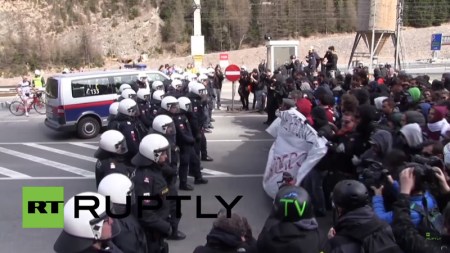
1573Austrian police prepare to hold the line at the Brenner Pass border crossing with Italy, as a crowd tries to break through during a violent protest on April 3, 2016, against Austria’s introduction of border controls to stem the flow of migrants. (Image source: RT video screenshot)

While the bureaucrats of the EU bicker with their member states over those states’ unwillingness to follow EU regulations — evidently not made to cope with a migration crisis of these huge proportions — Turkey’s President, Recep Tayyip Erdogan is threatening to drop his obligations under a recent EU-Turkey migration deal. Those obligations include taking back all new “irregular migrants” crossing from Turkey into Greek islands, as well as taking any necessary measures to prevent the opening of new sea or land routes for migration from Turkey to the EU. “There are precise conditions. If the European Union does not take the necessary steps, then Turkey will not implement the agreement,” Erdogan warned recently in a speech in Ankara.

Erdogan knows that in the current European reality, his words have the effect he intends: When he threatens to flood Europe with migrants unless it does what he wants — in other words, blackmail — EU leaders will do what he says. German Chancellor Angela Merkel, one of the driving forces behind the EU-Turkey deal, also recently bowed to Erdogan’s demands that Germany prosecute the satirist Jan Böhmermann, after he mocked and insulted the Turkish president in a poem. The German criminal code prohibits insults against foreign leaders, but leaves it to the government to decide whether to authorize prosecutors to pursue such cases. Angela Merkel gave her authorization, a decision widely criticized. Her own ministers — Foreign Minister Frank-Walter Steinmeier, and Justice Minister Heiko Maas — said they did not believe that the authorization should have been granted.

Another indication that Erdogan has no reason to fear any misbehavior on the part of the European Union regarding the EU-Turkey deal is that the European Parliament just voted in favor of making Turkish an official European Union language. Ostensibly, the vote came about in order to back an initiative by the president of Cyprus, Nicos Anastasiades, who asked the Dutch EU Presidency to add Turkish to the bloc’s 24 official languages in order to boost attempts to reach a reunification agreement for Cyprus.

In his letter to the EU presidency, Anastasiades noted that Cyprus had already filed a similar request during its EU entry talks in 2002, but, at that time, it “was advised by the [EU] institutions not to insist, taking into account the limited practical purpose of such a development … as well as the considerable cost”. Turkey’s occupation of northern Cyprus, which Turkey invaded in 1974, is one of the issues blocking Turkey’s accession negotiations with the EU.

Making Turkish an official language is seen by Turkey, according to a senior Turkish official, as “a very important, very positive gesture” for the Cyprus peace talks and for EU-Turkish ties more broadly. “If the blockage is lifted because of Cyprus being solved, then we can proceed very quickly,” the Turkish official said.

All of the other official and working languages of the European Union are tied to states which are full members of the EU. Although the vote has to be approved by the European Commission before the decision can come into effect, it speaks volumes about the EU’s deference to Erdogan.

In light of these developments, the granting of visa-free travel to European Union states for 80 million Turks looks as if it is a done deal, despite the 72 conditions, which Turkey, at least on paper, is expected to live up to. These include increasing the use of biometric passports and other technical requirements. So far, Turkey has only met half of these conditions. Perhaps that is why European Commission President Jean-Claude Juncker recently felt the need to mention that, “Turkey must fulfill all remaining conditions so that the Commission can adopt its proposal in the coming months. The criteria will not be watered down.” The question is whether Juncker himself even believes his own words.

With the provisions on visa-free travel for 80 million Turks, the EU may just have gone from the frying pan into the fire. The visa-free admission of Turks into Europe would give Erdogan completely free rein to control the influx of migrants into Europe. Moreover, anyone believing that Erdogan would not take great advantage of this opportunity would have to be dangerously naïve. The European Union may yet conclude that the migrant crisis, in all its enormity, is the far lesser evil.