Archive for the ‘Taliban’ category

Embedded in Northern Afghanistan: The Resurgence of the Taliban

November 6, 2015

Embedded in Northern Afghanistan: The Resurgence of the Taliban, VICE News, November 6, 2015


According to the blurb following the video,

In late September, the Taliban launched an offensive against Kunduz, a provincial capital in northern Afghanistan, capturing key buildings and freeing hundreds of prisoners from the city’s jail.

The offensive sparked a fierce battle between the militants and government forces, supported by US airstrikes. After several days of fighting, Afghan troops recaptured the city, and took down the Taliban’s flag from the central square.

American planes targeted Taliban positions, but at the beginning of October, a hospital run by medical charity Doctors Without Borders (Médecins Sans Frontières) was hit, killing 22 hospital staff and patients, with many seriously injured. The Pentagon later admitted that the strike was a mistake.

Gaining exclusive access to the Taliban, VICE News filmmaker Nagieb Khaja spoke to fighters that briefly took control of Kunduz — the first major city to fall to the group since it was ousted from power in 2001.

Al Qaeda operates in southern Helmand province

October 24, 2015

Al Qaeda operates in southern Helmand province, Long War Journal, October 24, 2015

Foreign jihadists, including members of al Qaeda in the Indian Subcontinent (AQIS), are training at facilities in southern Helmand province in Afghanistan. The camps are used to prepare fighters to conduct attacks throughout Southeast Asia, according to reports reviewed by The Long War Journal. The discovery of the training centers in Baramcha, a town in southern Helmand province, indicates that al Qaeda and affiliated groups are training in multiple regions of Afghanistan.

Earlier this month, the US military raided two significant al Qaeda camps in the neighboring province of Kandahar. One of the facilities was approximately 30 square miles in size, according to a US military spokesman. [See LWJ report, US military strikes large al Qaeda training camps in southern Afghanistan.]

But reporting in the Indian and Pakistani press indicates that the camps in Kandahar are not the only ones where al Qaeda is training inside Afghanistan. These same reports indicate that al Qaeda-linked groups, such as the Indian Muhajideen and Laskhar-e-Jhangvi, are also training in the district of Dishu in Baramcha.

The training facilities in Baramcha are likely tied to al Qaeda’s relocation from northern Pakistan into Afghanistan.

AQIS, which was established in September 2014, is the newest regional branch of al Qaeda. It is led by Asim Umar, who was groomed by al Qaeda to assume a leadership position, and includes jihadists from several established groups in the region. The earliest plots conceived by AQIS focused on the Pakistani military and other security forces, as well as American and Indian interests.

Since the beginning of the year, Pakistani authorities have carried out multiple raids against the group. However, according to Pakistani officials, AQIS has relocated a significant portion of its operations into Helmand. The move by AQIS was made in anticipation of the Pakistani military’s Operation Zarb-e-Azb, an offensive that began in June 2014. The offensive has targeted al Qaeda and affiliated jihadist groups, including several from Central Asia. Some of these same organizations have helped fuel the Taliban’s advances in Afghanistan this year.

In April, Pakistani officials announced that they had broken up an AQIS cell in Karachi. However, a senior Pakistani counterterrorism official, Mohammed Arif Hanif, said that the jihadist group was using Helmand as a hub for its operations. “AQIS terrorists are provided assistance in Helmand from where they travel to Chaman, Quetta, Shikarpur and Karachi,” Hanif said, according to Dawn. A young Bengali suicide bomber who had targeted Pakistani Rangers had been traced back to Helmand, according to Pakistani officials. They added that AQIS had “relocated from Waziristan to Helmand province.”

In August, Dawn again reported that the Taliban was “sheltering” al Qaeda in Helmand. “The bond between us and our Taliban brothers is a solid ideological bond. They opted to lose their government and family members just to protect us,” Qari Abu Bakr, who works for As Sahab, al Qaeda’s propaganda arm, was quoted as saying. “There is no question of us moving apart now after going through this war together. Our common enemy does not know what is coming its way,” he added.

Al Qaeda has announced its relocation out of northern Pakistan. Earlier this month, an audio message featuring Hossam Abdul Raouf, a veteran al Qaeda leader who is close to Ayman al Zawahiri, was released online. Al Qaeda has “almost completely vacated Waziristan and Pakistan,” Raouf said in the recording. He explained that the “weight” of al Qaeda has been shifted to Syria and Yemen, because that is where al Qaeda’s efforts are most needed. But it is clear that al Qaeda has relocated senior leaders, including perhaps Raouf himself, to Afghanistan as well.

In July, the US killed Abu Khalil al Sudani, one of Osama bin Laden’s and Ayman al Zawahiri’s closest compatriots, in an airstrike in Paktika province. In October 2014, another veteran al Qaeda commander, Abu Bara al Kuwaiti, perished in a US airstrike in Nangarhar province.

The training facilities in Baramcha are, therefore, almost certainly part of al Qaeda’s broader effort over the past few years to entrench its operations inside Afghanistan once again.

Taliban control Dishu, training camps established

The conditions are ripe for al Qaeda and affiliated groups to train at camps in Baramcha. The Afghan government admitted that the wider Dishu district is under the control of the Taliban, The New York Times reported in June.

In 2014, Pajhwok Afghan News reported, citing Afghan police officials, that Taliban “training camps and hideouts of drug smugglers were operational in [the] Dishu and Khanishin districts” in Helmand.

“[T]he rebels had established training centers in the Baramcha area of Dishu district,” the Afghan news agency said in February of that year.

The Taliban and al Qaeda have used Baramcha to host training facilities because the town is located in the remote southern district and borders Pakistan’s Baluchistan province. The Afghan military and police find it difficult to project power in the area, and jihadists can quickly cross the border into Pakistan if threatened. The town is across the border from the Gerdi Jangal refugee camp, where one of the Taliban’s four regional military shuras is based.

The US military noted in October 2010 that Baramcha was a key node for the Taliban and “foreign fighters,” a term the US military often uses to mean al Qaeda.

“The area is a Taliban command and control area that consists of narcotics trafficking, weapons and ammunition storage, improvised explosive device factories, and foreign fighter training areas,” the now-defunct International Security Assistance Force noted in a press release announcing an operation to clear the Taliban and allied jihadists from the town.

US Marines and Afghan troops ultimately cleared Baramcha, but after US forces withdrew from the area in 2012, it quickly slipped back under the Taliban’s control, and the jihadists’ camps were back in operation.

Jihadists train in Baramcha

The Pakistani and Indian press have identified several jihadists who have passed through Baramcha for training over the past several years.

On Oct. 7, the Islamabad-based Daily Express reported that police captured Saeedullah, “an important member of Al Qaeda in the Indian Subcontinent.” According to police, Saeedullah (AKA Rizwan Mullah, Choti Dunya), who was arrested in Karachi, “confessed that he had received training from Amir Jawad in Baramcha city of Afghanistan.”

In April 2014, The Indian Express reported that two Pakistanis from Karachi, Abdul Waleed Rind and Fahim, were recruited by Riyaz Bhatkal, who was identified as the founder of the Indian Muhajideen. The two Pakistani jihadists, who were captured inside India in March 2014 before they could attack Indian soldiers, attended separate training camps in Baramcha.

“The training routine for Fahim and Waleed, even though they went separately to different camps, was quite similar – a 15-21 day capsule with three days dedicated to assembling and disassembling the AK-47, three days to do the same with 9 mm pistols, two days on grenades and ways to throw them,” The Indian Express reported. “The remaining days were used for physical training and endurance.”

And in August 2015, The Friday Times, a Lahore-based publication, reported that Abdul Kabeer Shakir, a leader in Ahle Sunnat Wal Jamaat (ASWJ), is “providing financial and other assistance” to “assassins” that are targeting Pakistani Shiites. ASWJ is the new name for the radical anti-Shiite Sipah-e-Sahaba Pakistan (SSP), which is closely allied with Lashkar-e-Jhangvi and other Pakistani terrorist groups.

“A source in law enforcement said the people involved in sectarian killings usually received training at a bordering village named Baramcha,” The Friday Times reported.
Islamic State grows in Afghanistan, encroaches on Kabul as U.S. remains ‘passive observer’

October 12, 2015

Islamic State grows in Afghanistan, encroaches on Kabul as U.S. remains ‘passive observer’ Washington TimesRowan Scarborough, October 11, 2015

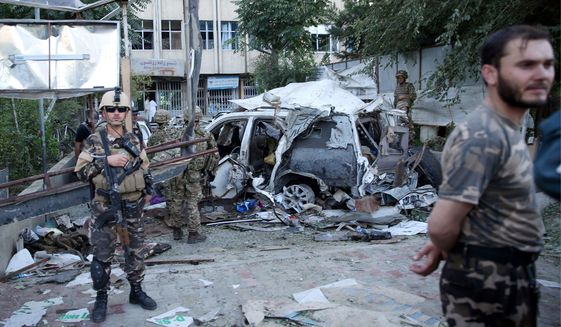
10112015_afghan8201_c0-275-5060-3224_s561x327Photo by: Massoud Hossaini  Afghan security forces and British soldiers inspect the site of a suicide attack in the heart of Kabul, Afghanistan. Loyalists of the Islamic State group are making inroads into Afghanistan, with homegrown militants claiming allegiance to the Islamic State as it controls territory in some parts of the country. (Associated Press)

Afghanistan’s 3,000-member ISIL army is about one-tenth the size of the Afghan Taliban’s forces. But NATO says the Islamic State has reached the next stage of being an emerging threat. If its growth in other regions, such as North Africa, is a gauge, its Afghan component will only expand further as young Muslims are drawn by social media to its ultraviolent ways and Sunni orthodoxy.

************************

The Islamic State is growing at an alarming rate in Afghanistan, within striking distance of the capital, and there does not seem to be a concerted U.S. effort to strike the terrorist army as there is in the Syria-Iraq war theater.

An independent think tank has concluded that the allies are “reacting disjointedly and ineffectively” to the group in Afghanistan and other places outside those two countries.

The Islamic State’s numbers now may reach as high as 3,000 in Afghanistan, mostly in Nangarhar province, less than 50 miles east of Kabul. The emergence presents the NATO-backed elected government there with a fifth deadly enemy in addition to the Taliban, al Qaeda, the Haqqani network and elements of the Pakistani intelligence service.

Globally, the Islamic State, also called ISIL and ISIS, has affiliates in nearly 20 countries.

“It’s like a metastasizing cancer spreading throughout certain parts of the Islamic world,” said James Russell, a former Pentagon official and an instructor at the Naval Postgraduate School in Monterey, California. “We have to hope that the antibodies in these societies can ward off the death, misery and destruction that will come raining down upon them if ISIS takes hold in their communities.”

ISIS_s220x241

Afghanistan’s 3,000-member ISIL army is about one-tenth the size of the Afghan Taliban’s forces. But NATO says the Islamic State has reached the next stage of being an emerging threat. If its growth in other regions, such as North Africa, is a gauge, its Afghan component will only expand further as young Muslims are drawn by social media to its ultraviolent ways and Sunni orthodoxy.

Yet unlike in Syria and Iraq, where a U.S.-led coalition conducts a series of daily airstrikes against the Islamic State, there appears to be no such strategy in Afghanistan, where Afghan government forces now have the lead in all combat operations and request NATO air power on an ad hoc basis.

“What concerns me most is the fact that the United States has become a passive observer rather than the driver of the policy,” said Larry Johnson, a former counterterrorism official at the State Department, commenting on the overall U.S. effort against the Islamic State.

U.S. military spokesmen had no immediate comment on the question of American policy toward the Afghan Islamic State. Army Gen. John Campbell, the allied commander in-country, was asked at congressional hearings last week what triggers action against Islamic State. He answered that the criterion is “force protection.”

After the Syria-Iraq war theater, Islamic State’s emergence near Kabul could be the most troublesome for the U.S., whose troop levels have dropped to less than 10,000, and only a small portion of those forces are dedicated to assist in counterterrorism. The Islamic State has shown it can execute brutal attacks and deploy vehicle bombs to take territory and hold it.

Gen. Campbell said Afghanistan’s security forces lack the leadership and troop numbers to respond to every trouble spot.

Meanwhile, the Islamic State is beginning to flex its terrorism muscle in Afghanistan.

Islamic militant competition

The Institute for the Study of War (ISW) in Washington is tracking the Islamic State’s violent ways in Afghanistan and other countries. It said the Islamic State launched attacks in mid-September against a UNICEF convoy, Afghan government forces, the Afghan Taliban and Shiite civilians. In late September the Islamic State “launched coordinated attacks on multiple Afghan security positions” in Nangarhar, the think tank said.

“The group reportedly also shut down several schools in eastern Afghanistan amid other efforts to assert social control,” the institute said. “ISIS has established robust ground campaigns in Libya, Egypt and Afghanistan.”

The ISW said in the special report “ISIS Global Strategy: A Wargame,” written by counterterrorism analyst Harleen Gambhir, that the Islamic State’s expansion stems from its ability to attract local jihadis.

“The coalition is focused on Iraq and Syria, and it is reacting disjointedly and ineffectively to ISIS’s activities in Libya, Egypt, Afghanistan, and other places,” Ms. Gambhir writes. “ISW’s war game demonstrated how this failure enables ISIS to strategically outpace the U.S. and its allies.”

U.S. intelligence agencies are still trying to digest the meaning of Islamic State setting up shop in South Asia.

Nicholas Rasmussen, director of the National Counterterrorism Center, speaks of an “increasing competition between extremist actors” in the Afghanistan-Pakistan region involving al Qaeda, the Taliban and the Islamic State.

“So that’s an additional factor that we’re still trying to understand,” Mr. Rasmussen told the Combating Terrorism Center at West Point in remarks published last month. He characterized the burgeoning competition as an “interesting feature of the South Asia landscape.”

Gen. Campbell, the U.S. commander closest to Islamic State terrorism in Afghanistan, said foreign fighters are arriving to join the Islamic State as they “try to bring in some sort of funding stream to build a place in Nangarhar.”

He said the emergence of Islamic State “has further complicated the theater landscape and potentially expanded the conflict.”

Mr. Johnson, the former counterterrorism official, said the leaders of Middle East and South Asia countries “concede that the U.S. has no appetite for being engaged, especially militarily in the region.”

The struggle between two radical Sunni groups, the Taliban and the Islamic State, may be sparked in part by the Taliban’s willingness to do business with Iran, a Shiite Islamic country.

“The Taliban have always been far more pragmatic in dealing with Iran, and the religious difference is not a critical factor,” Mr. Johnson said. “Not so with the ISIS crowd. For them, theology takes precedence, and Iran is an apostate state that must be destroyed.”

Taliban storm Kunduz city

September 28, 2015

Taliban storm Kunduz city, Long War Journal, September 28, 2015

[R]eports from the Afghan media, as well as Taliban fighters and residents from inside the city, indicate that parts if not all of the city are now under Taliban control.

*******************

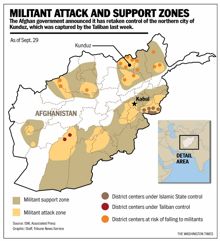
The Taliban assaulted the northern provincial capital of Kunduz from three directions and seized control of areas in the city. Unconfirmed reports from residents and Taliban fighters inside Kunduz indicate that Afghan forces have been driven out of the city and the Taliban are in full control.

According to the BBC, hundreds of Taliban fighters launched their offensive today from three districts: Imam Sahib to the north, Khanabad from the southeast, and Chardara from the southwest. All three districts are thought to be under Taliban control.

The Taliban confirmed they launched a three-pronged assault on Kunduz city. “The operations have commenced on the city center from 3 directions with Mujahideen quickly taking enemy positions and the enemy is retreating from their positions,” according to an initial statement that was posted on Voice of Jihad.

The Taliban later stated that their fighters have “reached the main city intersection, are targeting the governors [sic] compound and clearing the small remaining pockets from enemy presence.”

Afghan security officials have denied that the Taliban are in control of the city and have stated that the fighting was largely confined to the outskirts of the provincial capital.

But reports from the Afghan media, as well as Taliban fighters and residents from inside the city, indicate that parts if not all of the city are now under Taliban control.

According to TOLONews, “Taliban insurgents have taken control of Kunduz city’s provincial council building and the local High Peace Council offices.”

Ehsanullah Ehsan, a stabilization manager at the international development agency DAI who is based in Kunduz, has said that the Taliban have seized the city and Afghan National Security Forces [ANSF] have retreated.

“Kunduz city is completely with taliban ANSF are out,” Ehsan tweeted. “[T]he city is completely with taliban now, taliban walking inside streets, i am trapped at home.”

Ehsan posted photographs purportedly showing Taliban fighters walking the streets of Kunduz and prisoners who have been freed from the city’s main jail.

Kunduz province has been hotly contested since the Taliban and its allies launched an offensive to seize control of the province at the end of April. The districts of Imam Sahib, Aliabad, and Qala-i-Zal were overrun in the initial assault, while Chardara and Dasht-i-Archi fellin mid-June. It is unclear when Khanabad fell under Taliban control. The status of the six districts is unclear, but the Taliban is still thought to be in control of Imam Sahib, Aliabad, Chardara, Khanabad, and Dasht-i-Archi.

The Taliban and allied jihadist groups based in Kunduz have been flexing their muscles in the province in recent weeks. In August, hundreds of fighters from the Taliban and the allied Islamic Jihad Union massed in the open, in daylight, to swear allegiance to Mullah Akhtar Mohammad Mansour, the new emir of the Taliban. Last week, the Islamic Jihad Union claimed it controlled large areas of the border with Tajikistan and a border crossing from Kunduz into the northern Afghan neighbor.

The loss of Kunduz city, if confirmed, would be a major blow to the Afghan government and military, which have struggled to maintain security after US and NATO forces have drawn down to a token presence. Kunduz city would be the first provincial capital to fall to the Taliban.

Additionally, the fall of Kunduz would invalidate the entire US “surge” strategy from 2009 to 2012. The US military focused its efforts on the southern Afghan provinces of Helmand and Kandahar, claiming that these provinces were the key to breaking the Taliban. Little attention was given to other areas of Afghanistan, including the northern provinces, where the Taliban have expended considerable effort in fighting the military and government. Today, the Taliban are gaining ground in northern, central, eastern and southern Afghanistan, with dozens of districts falling under Taliban control over the past year.

Taliban takes another district in southern Afghanistan

August 26, 2015

Taliban takes another district in southern Afghanistan, The Long War Journal, August 26, 2015

The Taliban now control most of northern Helmand province, and will likely push its offensive towards Lashkar Gah in central Helmand, as Afghan security forces are stretched thin with an ongoing Taliban offensive in the Afghan north. This spring and summer, the Taliban have taken control of at least four of the seven districts in Kunduz province and have also seized districts in Sar-i-Pul and Badakhshan provinces.

*****************

The Taliban overran the Musa Qala district center when Afghan forces fled after several days of fighting. The fall of Musa Qala puts the Taliban in effective control of northern Helmand, and will allow it to threaten the provincial capital of Lashkar Gah.

A member of the Helmand provincial council confirmed that the Taliban seized the district center this morning. “Three Afghan security members were killed and ten others including the district governor were wounded,”ATN News reported.

Afghan defense officials have boasted that more than 60 Taliban fighters were killed, most in Coalition airstrikes, during the peak of fighting which began three days ago. “Pakistani, Arab and Chechen Taliban insurgents” are present in Musa Qala, TOLO News reported.

Afghan forces took heavy casualties during the fighting. A member of the Helmand provincial council said that45 Afghan soldiers were killed and 20 more surrendered during an assault on an outpost on Aug. 23. At least nine policemen were killed in an attack on a police station on Aug. 13.

The Taliban confirmed its forces took control of Musa Qala. In a statement released on Voice of Jihad, the Taliban’s official website, the group said “Mujahideen of Islamic Emirate have managed to overrun Musa Kala district center, HQ building, Police HQ, PRT building and all surrounding check posts in an overnight assault.” According to the Taliban, “a sizable number of arms, ammunition, APCs, vehicles and other equipment has also been seized in the operation.”

Afghan forces are “currently retreating towards Gereshk” in the neighboring district of Nahri Sarraj district, the Taliban claimed. “Mujahideen are now pursuing the convoy.”

The Taliban now control most of northern Helmand province, and will likely push its offensive towards Lashkar Gah in central Helmand, as Afghan security forces are stretched thin with an ongoing Taliban offensive in the Afghan north. This spring and summer, the Taliban have taken control of at least four of the seven districts in Kunduz province and have also seized districts in Sar-i-Pul and Badakhshan provinces.

The northern-most district of Baghran was never liberated from the Taliban during the US ‘surge’ from 2009 to 2012. Sangin district is at best contested; after two months of fighting in Sangin in the summer 2014, local Afghan officials opened peace talks with the Taliban. Kajaki district is largely under Taliban control, Afghan officials have said. In July, the Taliban released a video showing its fighters parading in Kajaki. Now Zad district fell to the Taliban at the end of July.

This year Taliban has made a push on multiple fronts to regain territory it lost during the US surge. More than 30,000 US troops were deployed to Afghanistan, primarily in the south, to retake Taliban-held areas in Helmand and Kandahar during the surge. While the Taliban suffered heavy losses and lost control of key districts, the group was not defeated militarily or politically. The Taliban regrouped in Pakistan and other provinces in Afghanistan, and began attacking Afghan security forces as US forces began their withdrawal.

The Taliban has pressed its spring offensive, called “Azm,” despite controversy over the death of its founder and emir, Mullah Omar. Afghan and Taliban officials have said that Omar died in Pakistan in 2013. The Taliban’s leadership council hid his death from the rank and file and appointed Mullah Akhtar Mohammad Mansour, who is closely tied to al Qaeda, as the new emir. After Mansour was officially named the Taliban’s new emir, one of his first acts was to publicly accept al Qaeda’s oath of allegiance. The controversy over Omar’s death does not appear to have impacted the Taliban on the battlefield.

Humor: How to deal with enemies, foreign and domestic

February 2, 2015

How to deal with enemies, foreign and domestic, Dan Miller’s Blog, Sen. Ima Librul, February 2, 2015

(The views expressed this article are mine and those of my imaginary guest author. They do not necessarily represent the views of Warsclerotic or its other editors. — DM)

Editor’s note: This is a post by my (imaginary) guest author, the Very Honorable Ima Librul, Senator from the great State of Confusion Utopia. He is a founding member of CCCEB (Climate Change Causes Everything Bad), a charter member of President Obama’s Go For it Team, a senior member of the Senate Foreign Relations Committee and Chairman of the Meretricious Relations Subcommittee. He is also justly proud of his expertise in the care and breeding of unicorns, for which his Save the Unicorns Foundation has received substantial Federal grants. We are honored to have a post of this caliber by a quintessential Librul such as the Senator. Without further delay, here is the Senator’s article.

***********************

As the anointed leader of my Librul kingdom, countless methods for dealing with “enemies” are at my disposal. I, along with my loyal Secretary of Slyness (SOS) Sir Ketchup, bring happiness to all. Many “enemies” of my kingdom have yielded to my wisdom without even knowing that they have. I owe everything to my dear leader Obama, my rock of ages in the past and hope for years to come.

Ketchup Kerry

Example One

When my kingdom was threatened by wolves and foxes, which intended to eat all of my free range chickens, I bravely sent Sir Ketchup to deal with the problem. At my direction, he immediately put half of my chickens into secure coops and invited the invaders to do as they desired with the rest. That satisfied them only briefly, so he dispatched half of my remaining chickens to be eaten. The process continued until I had only one chicken left.

Here’s why I can humbly wear the label “The Won,” along with my dear leader Obama. The invaders, stuffed pleasantly full of chicken and amazed at my brilliance, resolved not to attack my kingdom again until my chicken population had been restored and it was once again worthwhile to invade. Unfortunately for them, a single chicken cannot reproduce, so they will never again have any reason to return.

chicken

Example Two

A few weeks later, my kingdom was again invaded by “wild and vicious” packs of wolves and foxes. They divided their attentions between slaughtering each other and slaughtering and eating my sheep. I solved the problem by giving ample sheep to both packs and explaining to them that they were neither wild nor vicious, but simply misguided in attacking each other. Their mistake lay in believing that the traditions of their ancestors mandated such activities, even though it is not true. As a widely acknowledged expert on the traditions of wolves and foxes, I understand these matters far better than they do. Hence, I was able to convince them that with reality-based understanding such as I possess, they too would seek the beauties and benefits of unity permitting them to slaughter and eat my sheep peacefully and together.

Some who do not fully understand the inherent beauty and fairness of multiculturalism might contend that my actions were unfair to the sheep. They would be wrong. Sheep are gentle creatures and have been good to me; I have always ensured that they have plenty to eat and I have fleeced them only to provide for their well-being. We are as one and, to the extent that I am able, these benign practices will continue.

However, it is far more important to bring happiness and unity to creatures which have suffered for ages because of their erroneous but stereotypical characterization as evil. There is no evil and there is no good; all is relative. Who are we to declare that sheep are good and that wolves and foxes are evil? Don’t we also kill sheep and eat mutton? Wolves and foxes are neither better nor worse than human carnivores and it is prudent to act only on the basis of what is best for all.

My plan was successful. Happy with their full bellies, the wolves and foxes departed my kingdom in peace, promising to return together and in harmony only when they need my sheep. In the interim, they will devote their attentions to visiting neighboring farms in hopes that the owners will see the justice in my methods and adopt them. I promised to help my neighbors to adopt my enlightened multicultural views and to accord wolves and foxes every courtesy. As wolves and foxes come to understand the beauty and benefits of true multiculturalism, they will cease to be significant threats to anyone. That is a hope for change we can — and must — believe in.

Sheep

In fairness, I must acknowledge that my dear leader Obama demonstrated the efficacy of this solution several years ago when, with remarkable success, He persuaded diverse groups of Muslims to unite against America to force her to reject her old ways of dealing with what she wrongly characterized, not only as enemies, but even as evil enemies. Since then, we have made great progress in defeating the Non Islamic Islamic State (NIIS) and others allegedly intent upon endangering our national security. The world be a far better place now if President Roosevelt had fully accepted Nazi Germany, not as an evil enemy or even as an enemy, but as a friend and a humanitarian force for peace and enlightenment of civilization. Had my dear leader then been our President, that would have happened and there would have been no more war.

Example Three

This year, representatives of the Non-Islamic Taliban (NIT) sought to use several acres of my kingdom for an insurgent training camp. They explained that since my dear leader Obama has declared that they are not foreign terrorists, I should have no objection. On that basis, I saw no problem in dealing with them. They offered to pay me $5,000 per acre per week and I accepted, subject to the requirement that they wear Girl Scout costumes rather than their traditional attire so that none of my Islamophobic neighbors would be offended irrationally. The deal was struck.

Since they had not stated which part of my kingdom they wanted to use, I provided land on which my free range unicorns frolic. I assumed that they would not notice, and they didn’t. Only truly superior beings, like our own glorious dear leader Obama, myself and unicorns can communicate with unicorns; the NIT members couldn’t even see them.

obama-unicorn

I promptly advised my dear leader of my findings, and He stated that He will soon dispatch brigades of well trained unicorns, under the command of Brevet General Bowe Bergdahl, to do battle with both NIT insurgents and NIIS terrorists. When the unicorn brigades triumph, dear leader Obama will be able to proclaim yet another grand mission accomplished and demonstrate, once again, that we stand firmly, shoulder to shoulder, behind our gallant friends and allies who have been harmed by our dastardly non-Islamic enemies. No longer will we be viewed as impotent.

It may be true that, until now,

Nothing in all that standing together has been potent enough to stop these barbaric, brutal, heinous beheadings of American and British and Japanese citizens.

Brevet General Bergdahl and his brigades of unicorns will change that!

MissionAccomplished0067

I have many more inspiring stories to tell, but must leave immediately to chair a meeting of my Meretricious Relations Subcommittee of the Senate Foreign Relations Committee. Former President Clinton, the principal speaker on “How to lie with impunity,” will be accompanied by his lovely wife and confidant, Saint Hillarion, also a long recognized expert on that topic as well as concerning infamous right-wing conspiracy theories.

Their talents, like those of our current dear leader Obama, are much needed in dealing with our domestic enemies, evil right-wing terrorists all!

I look forward to serving under Saint Hillarion when she becomes our next dear leader, just as I have served under dear leader Obama.

Clinton1web_2831249b

******************

Editor’s comments

Senator Librul words of wisdom will be of great assistance to Obama in His war on non-Islamic terror and insurgency. Ideas such as the Senator’s are badly needed because in the aggregate they are far better, and hence far more likely to bring success, than what Obama has tried thus far.

Booze

If the spirits shine brightly and in copious quantities upon us, we may be able to believe that even before Obama’s son Trayvon II becomes our President, our enemies will have ceased to be our enemies and unicorns will again be able to frolic in peace throughout the entire world, Insha’Allah.

Defining The Taliban as the Enemy

February 1, 2015

Defining The Taliban as the Enemy, Fox News via You Tube, January 31, 2015