Archive for the ‘Syria’ category

Coup-Weary Turkey: Directionless and Insecure

August 8, 2016

Coup-Weary Turkey: Directionless and Insecure, Gatestone InstituteBurak Bekdil, August 8, 2016

♦ The more Ankara feels distant to Washington, the more it will want to feel closer to Moscow.

♦ As Western leaders call on President Erdogan to respect civil liberties and democracy, Erdogan insists he will consider reinstating the death penalty: “The people have the opinion that these terrorists [coup-plotters] should be killed. Why should I keep them and feed them in prisons for years to come?”

Turkey once boasted of having NATO’s second biggest army, equipped with state-of-the-art weapons systems. That powerful army now lacks command: After the failed coup of July 15, more than 8,500 officers and soldiers, including 157 of the 358 generals and admirals in the Turkish military’s ranks, were discharged. The top commanders who were purged had made up 44% of the entire command structure. Prime Minister Binali Yildirim said that the military’s shipyards and weapons factories will be transferred to civilian authority; military high schools and war academies have been shut; military hospitals will be transferred to health ministry; and the gendarmerie, a key force in anti-terror operations, and the coast guard will be tied to the interior ministry.

Those changes leave behind an army in deep morale shock, with political divisions and polarization. Its ranks are suffering not just trauma but also humiliation. The Turks are lucky their country was not attacked by an enemy (and they are plentiful) at a time like this. Conventional war, however, is not the only threat to Turkey’s security. The Turkish army’s worst decline in modern history came at a time when it was fighting an asymmetrical war against Kurdish insurgents inside and outside of Turkey and, as part of a U.S.-led international campaign, the Islamic State (ISIS) in neighboring Syria.

The attempted coup not only quickly discredited the Turkish military but also left the country once again directionless in foreign policy. President Recep Tayyip Erdogan has been slamming his NATO ally, the United States, almost daily. His government big guns have been implying an American hand behind the failed coup by a faction of officers they claim are linked to a U.S.-based Muslim cleric, Fethullah Gulen, once Erdogan’s best political ally. “The putschist [Gulen] is already in your country, you are looking after him. This is a known fact,” Erdogan said, addressing Washington. “You can never deceive my people. My people know who is involved in this plot, and who is the mastermind.”

The White House immediately denied Erdogan’s claim. Deputy Press Secretary Eric Schultz said the U.S. was one of the first countries to condemn the failed coup, and noted that a successful one would have put American troops serving in Turkey at risk. “It is entirely false. There is no evidence of that at all,” Schultz said. “We feel that talk and speculation along those lines is not particularly constructive.” The failed coup has become a Turkish-American dispute — with a military dimension, too.

Erdogan also criticized U.S. General Joseph Votel, who voiced concerns over “the long-term impact” of the coup on the Pentagon’s relations with the Turkish military. According to Erdogan, Votel’s remarks were evidence that the U.S. military was siding with the coup plotters. The Pentagon’s press secretary, Peter Cook, flatly denied that claim: “Any suggestion anyone in the department supported the coup in any way would be absurd.”

Erdogan probably wants to play the tough guy and is slamming Washington day after day not just to look pretty to millions of anti-American Turks but also to pressure Washington in Turkey’s quest to extradite Gulen, presently the biggest snag between the two allies.

But there is another dimension to Erdogan’s ire: He wants to mend fences with Moscow.

Turkey’s relations with Russia were frozen after Nov. 24, when Turkey, citing a brief violation of its airspace along Turkey’s border with Syria, shot down a Russian military aircraft. Russia’s President Vladimir Putting ordered punishing economic sanctions, imposed a travel ban on Russian tourists visiting Turkey and suspended all government-to-government relations. Unable to ignore the damage, a repentant Erdogan conveyed regrets to Putin; the regrets were accepted and the two leaders are scheduled to meet on August 9, when the Turks hope that relations with Russia will be entirely normalized.

Normalization, unfortunately, will not come at the price of Turkish “regrets” alone. For full normalization, Turkey will have to digest the Russian-Iranian-Syrian line in Syria’s civil war — a pact which Turkey has loudly detested ever since civil war erupted in Syria in 2011. This will be another foreign policy failure for Erdogan and an embarrassing U-turn. But the more Ankara feels distant to Washington, the more it will want to feel closer to Moscow.
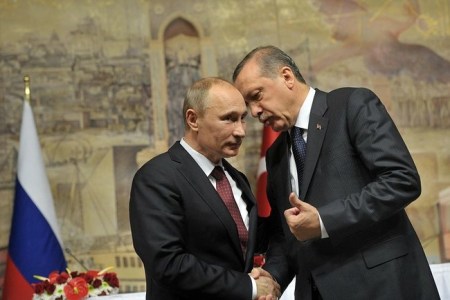
1375Turkish President Recep Tayyip Erdogan is attempting to repair badly damaged relations with Russia, even as he slams his NATO ally, the United States, almost daily, and accuses the U.S. military of supporting the coup attempt against him. Pictured: Russian President Vladimir Putin (left) with Erdogan (then Prime Minister), meeting in Istanbul on December 3, 2012. (Image source: kremlin.ru)

Meanwhile, after the coup attempt, Turkey’s troubled relations with the European Union turned even more troubled. European Commission head Jean-Claude Juncker said that the EU’s deal with Turkey on halting the flow of migrants toward the bloc may collapse. “The risk is big. The success so far of the pact is fragile. President Erdogan has already hinted several times that he wants to scrap it,” Juncker said. It is not just the migrant deal that may entirely suspend Turkey as a candidate country for the EU.

As Western leaders call on Erdogan to respect civil liberties and democracy, Erdogan insists he will consider reinstating the death penalty. “The people have the opinion that these terrorists [coup-plotters] should be killed,” Erdogan said in interview with CNN. “Why should I keep them and feed them in prisons for years to come? That’s what the people say … as the president, I will approve any decision to come out of the parliament.”

Such a move would kill Turkey’s accession process entirely. Federica Mogherini, EU’s foreign policy chief, warned that if Turkey reintroduces the death penalty, it will not be joining the European Union. “Let me be very clear on one thing,” she said; “… No country can become an EU member state if it introduces [the] death penalty.”

The attempted coup not only destabilized NATO’s second largest army and exposed it to the risk of serious operational vulnerabilities; it also left Turkey at risk of engaging in potentially dangerous liaisons with playmates of different kind — Russia and Iran & Co. — at least for now.
Assad to Netanyahu: Help Me Keep my Seat and I Guarantee You a Calm Golan

July 30, 2016

Assad to Netanyahu: Help Me Keep my Seat and I Guarantee You a Calm Golan, JNi.Medi via Jewish Press, July 30, 2016

(But what about Iran? — DM)

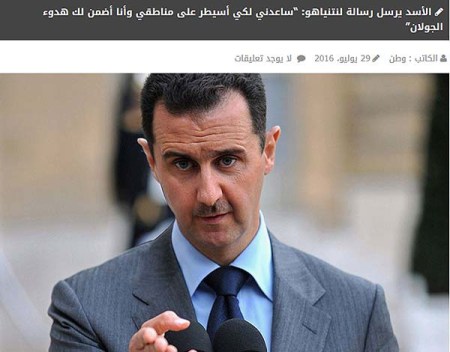
assad to Israel“Assad sends a message to Netanyahu: ‘Help me to control my region and I guarantee you a calm Golan.'”

A Kuwaiti news website on Friday cited a source saying Israeli Prime Minister Benjamin Netanyahu has received a message from Syrian President Bashar al-Assad, in which Assad vowed to keep the Golan as a demilitarized zone, and the rest of Syria committed to a cease-fire with Israel, if Netanyahu commits to not engaging Israel in an effort to topple Assad.

The source commented that Assad was saying to Netanyahu, in effect: “Help me to control my region and I guarantee calm for Israel in the Golan Heights.”

Commenting on rumors that former US ambassador to Israel Martin Indyk is slated to be President Hillary Clinton’s special envoy on the peace process between Israel and its neighbors, the source told the news website that Israel is very concerned over a report that was prepared by Indyk for President Bill Clinton about the Golan Heights. Israel is anxious to point US attention to the fact that the situation on south Syria and south Lebanon has been altered by the five-year civil war, and American notions about returning the Golan to Syria are absurd under these circumstances. Assad apparently wishes to take advantage of an opportunity to strike a deal with the Israelis to secure their neutrality in the war.

Meanwhile, Politico.eu reported Saturday that Saudi Arabia’s Foreign Minister Adel Al-Jubeir said his country is offering Russia access to the Gulf Cooperation Council Market and regional investment funds in return for pulling its support for the Assad regime.

“We are ready to give Russia a stake in the Middle East that will make Russia a force stronger than the Soviet Union, greater than China’s,” the Saudi minister said, adding, “It would be reasonable for Russia to say, that’s where our relations will advance our interests, not with Assad. We don’t disagree on the end game in Syria but on how to get there. Assad’s days are numbered,” he urged, “so make a deal while you can.”

Has the IDF hit the Basij forces commander General Naghdi?

July 30, 2016

Has the IDF hit the Basij forces commander General Naghdi? DEBKAfile, July 30, 2016

EinZivan2 (1)

Gen. Naghdi’s visit to Quneitra undoubtedly presaged some decisions in Tehran with regard to direct Hizballah-Syrian-Iranian action against Israel.

The Iranian, Syrian and Hizballah agencies accuse Israel of the attack because the say it was executed by two Nimrod anti-tank long-range missiles, manufactured by the Israeli Aerospace Industry, for use by the IDF against armored vehicles, ships, bunkers and troop concentrations.

*****************

Iranian, Syrian and Hizballah sources are intimating that the “Syrian officer” injured on July 26 in Quneitra by Israel’s double Nimrod’ missile shot was none other than Revolutionary Guards Gen. Muhammad Resa Naghdi, head of the paramilitary Organization for the Mobilization of the Oppressed, also known as the Basij, which falls under the Islamic Revolutionary Guard Corps (IRGC). The victim was earlier described officially as a Syrian officer.

If he was indeed hurt or killed by an Israeli rocket, Naghdi would become the highest-ranking IRGC general ever hit by the IDF.

On July 27, the semi-official Fars news agency reported that a top Iranian general recently visited the Israeli-Syrian border to tour Quneitra and the Golan demarcation lines between Syria and Israel – the first time the Tehran government had publicized a visit by a senior regime official to the area.

It may be presumed, DEBKAfile’s intelligence sources say, that someone at the IDF lookout posts spotted and reported on Gen. Naghdi’s arrival with an entourage in Quneitra on July 26 and saw him inspecting through binoculars the IDF defense positions. He was then quickly identified.

Any decision to go after a high-ranking Iranian would not have been left to local IDF commanders or even OC Northern Command Maj. Gen. Aviv Kohavi, but passed straight to Prime Minister Binyamin Netanyahu, Defense Minister Avigdor Lieberman and Chief of Staff Lt. Gen. Gady Eisenkot – especially in this case.

General Naghdi is not just another Iranian general. He heads the more than a million-strong Basij militia, which is a pillar of the ayatollahs regime in Tehran, and the backbone of the Iranian internal security forces which maintain the regime’s total control in every corner of the Islamic Republic.

Gen. Naghdi’s visit to Quneitra undoubtedly presaged some decisions in Tehran with regard to direct Hizballah-Syrian-Iranian action against Israel.

The IDF is holding its silence on reports of his injury, declining as usual to comment on reports by foreign publications.

The Iranian, Syrian and Hizballah agencies accuse Israel of the attack because the say it was executed by two Nimrod anti-tank long-range missiles, manufactured by the Israeli Aerospace Industry, for use by the IDF against armored vehicles, ships, bunkers and troop concentrations..

The missile has a semi-active laser guidance system, and is able to operate day and night. Its flight path can be below the clouds, while its operators far behind use a laser to guide it to target.

The launcher platform, with four missiles, can be installed on a Jeep, weapon-bearing vehicle, Abir, or armored vehicles. In addition, it is possible to send it from CH-53 ‘Yasur’ helicopter.

Israel has acted in the past against the establishment of an Iranian and/or Hizballah military presence on its Golan doorstep. On Jan. 19, 2015, an IDF air strike killed the Iranian Brig. Gen, Mohammad Ali Allahdadi and six Hizballah officers while they were on a tour of inspection near Quneitra.

Thursday, July 28, DEBKAfile ran an exclusive report on rising Israel-Russia tensions centering on southern Syria and the Golan.

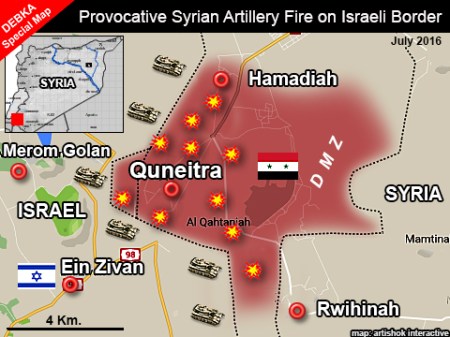
For four days since July 25, the Syrian army has been continuously firing artillery batteries – moved close to Israel’s defense lines on the Golan border – in a manner that comes dangerously close to provoking an Israeli response. This carefully orchestrated Syrian campaign goes on around the clock.

It is the first time in the six years of the Syrian war that Bashar Assad has ventured to come near to provoking Israel. But now he appears to be emboldened by his Russian ally.

The IDF is holding its fire for the moment. But Israeli military and government leaders know that the time is near for the IDF to be forced to hit back, especially since it is becoming evident that the Syrian army’s steps ae backed by Russia.

DEBKAfile’s military sources provide details of the Syrian steps:

  • The Syrian army’s 90th and 121nd battalions have been firing their artillery batteries non-stop across a 10km band along the Golan border from Hamadia, north of Quneitra, up to a point facing the Israeli village of Eyn Zivan. (See attacked map).
    This means that the Syrian army has seized the center of buffer zone between Israel and Syria and made it a firing zone.
  • This artillery fire fans out across a radius that comes a few meters short of the Israeli border and the IDF troops stationed there. It then recedes to a distance of 500 to 600 meters and sweeps across the outposts and bases of the Syrian rebel forces believed to be in touch with Israel or in receipt of Israeli medical aid.
  • The new Syrian attack appears to hold a message for Jerusalem: For six years, you supported the rebels against the Assad regime in southern Syria. That’s now over. If you continue, you will come face to face with Syrian fire.
  • Damascus is also cautioning those rebels:  For years, you fought us with Israel at your backs. But no longer. Watch us bring you under direct artillery fire, while the IDF sits on its hands.
  • On July 26, Russian media published an article revealing that Russia had delivered to the Syrian Air Force, advanced SU-24M2 front-line bombers, which is designed for attack on frontlines of battle. Israeli officials were unpleasantly taken aback by the news. Up until now, the Russians and Syrians refrained from deploying air strength in South Syria near the Israeli border. Now the Syrian air force has the means to do so.
  • DEBKAfile military sources report that the SU-24M2, following recent upgrades and modifications in Russian factories, is now capable of dropping smart bombs – ballistic bombs with a guidance system on their tails that enable them to hit targets with precision.This guidance system does not rely on US GPS satellites but rather the equivalent Russian GLONASS system which is linked to a network of 21 Russian satellites and partially encrypted for military usages.
    In addition, the SU-24M2 is equipped with a system that projects the information the pilot needs (flight details and battle details) on the plane’s windshield (head-up display) and on the pilot’s visor.
  • The Russians delivered to the Syrians two of these sophisticated airplanes this week, out of 10 that they will supply soon.

The IDF has concluded that it is only a matter of time before these planes appear in Southern Syria and so generate a new and highly combustible situation on Israel’s northern and northeastern borders.

The Russians are colluding with Damascus to inform Israel that it will no longer be allowed by either to continue backing the rebel forces in southern Syria or sustain the buffer zone which they man.

Israel may pay dear if Prime Minister Binyamin Netanyahu, Defense Minister Avigdor Lieberman, and Chief of Staff Lt. Gen. Gadi Eisenkot decide to continue to abstain from hitting back at the Syrian fire which is aimed every few hours at the vicinity of IDF posts or the impending arrival of Russian bombers. The price in store would be the weakening of the IDF’s hold on the Golan border.

IDF bulldozers with tanks enter Golan DMZ

July 13, 2016

IDF bulldozers with tanks enter Golan DMZ, DEBKAfile, July 13, 2016

GolanIsrael_Zone

Israeli military bulldozers backed by tanks have crossed into the demilitarized zone dividing the Israeli and Syrian Golan borders. They are building a line of fortifications and anti-tank trenches 300-500 meters inside the DMZ.

This is the first time in the six-year Syrian war that the IDF has openly operated on the Syrian side of the border. The force has not so far run into opposition- or indeed any word of protest – or even mention – by Assad regime officials in Damascus.

The sole reference to Israeli military movements in the DMZ has come from a small Syrian rebel group which described them.

DEBKAfile’s military sources report that the IDF operation was still going forward Wednesday, July 12, on a patch of terrain facing the Israeli Golan village of Ein Zivan, on the one hand, and the Syrian town of Quneitra, on the other.

The enclave splitting the Golan between Syria and Israel is defined in the 1974 armistice agreements as a demilitarized zone under the military control of the UN Disengagement Observer Force (UNDOF) and Syrian civilian administration. It is bounded by two strips of land around 10km deep where each side is permitted to maintain diluted military strength. No ground-to-air missiles may be deployed inside a 25km radius from the DMZ.

It was agreed that Syrian nationals forced by the October 1973 war and its aftermath to leave their homes would be able to return. Ruined Quneitra was later handed back to Syria against a commitment by its government to repopulate the town and ban terrorist activity and infiltrations of Israel from the Golan sector.

Both commitments were given orally to the US government.

However, the Syrian war as it unfolded in the last two years turned the deal on its head. The UN observers abandoned their posts, leaving behind a void that was partly filled by Syrian troops and a motley assortment of rebel groups.

But the DMZ was left mostly unoccupied as both Israel and Syria tried to preserve at least the semblance of the deal intact. However, Assad’s allies Iran and Hizballah have repeatedly attempted to plant a forward military and terrorist presence opposite Israel’s Golan defense lines – with avowed hostile intent.

The silence from Damascus on Israel’s military steps on the Golan may be no more than a respite as the Syrian ruler waits for Tehran’s endorsement of joint Syrian-Iranian-Hizballah counteraction.

Our sources add that IDF military steps on the ground were accompanied by unusual Israeli Air Force movements over Syria and Lebanon, and elevated preparedness on the 10th anniversary this week of the Lebanon war fought between Hizballah and Israel.

It was noted that Hizballah refrained from celebrating the occasion and omitted its customary boasts of a “great victory” – thereby intensifying the sense in Israeli military circles that Iran’s Lebanese proxy may be cooking up a surprise operation.

Russian anti-ISIS war from Syria to Caucasus

July 12, 2016

Russian anti-ISIS war from Syria to Caucasus, DEBKAfile, July 12, 2016

Alexander-Dvornikov-C-in-C-Russian-Syrian-Task-Force

Unimpressed by President Barack Obama’s optimistic assertions about ISIS’ loss of territory and weakening state, the Kremlin judges the counter-terror war to be just beginning. Russian intelligence has found the group to be in full fighting mode and setting up an army of suicide bombers, each team numbering some 20-15 terrorists, ready for strikes in Europe, including Russia, and the Middle East.

************************

In a supreme effort to prevent ISIS suicide units from reaching Russia from Syria, Sergei Shoigu, Russia’s
Defense Minister, has promoted the Russian commander in Syria, Colonel-General Alexander Dvornikov. to an expanded command as head of the South Russia military district. This district covers Russian forces including naval units in the Black and Caspian Seas, the Fourth Air Force Defense Army and Russian bases in Abkhazia, South Ossetia and Armenia.  Gen. Dvornikov will also command tens of ground force divisions, including paratroopers, marines and special coastal defense units.

The fact that the Russian Defense Ministry emphasizes in its announcement that “The decision about the appointment of a new commander of the Syrian operation is pending,” indicates that General Dvornikov will remain in charge of Russian forces in Syria from his new Black Sea HQ. His deputy, Gen.-Lt. Alexander Zhuravlyev, will continue to serve under him in the Syrian arena.

Moscow’s realignment of its military command is taken by DEBKAfile’s military and counter terrorism sources as a step towards becoming the first world power outside the Middle East to recognize and address the trans-frontier, global character of the Islamic peril, a lesson drawn from ISIS suicide attacks in Paris, Brussels, the US, Tunisia Egypt and Turkey

Unimpressed by President Barack Obama’s optimistic assertions about ISIS’ loss of territory and weakening state, the Kremlin judges the counter-terror war to be just beginning. Russian intelligence has found the group to be in full fighting mode and setting up an army of suicide bombers, each team numbering some 20-15 terrorists, ready for strikes in Europe, including Russia, and the Middle East.

This is borne out by the information released in Ankara by Turkish intelligence sources on July 11, showing that since the bombing in Istanbul airport, on June 28, in which 42 people were killed, ISIS has discontinued its passageway through Turkey for suicide terrorists trained in Syria to reach Europe. They are now smuggling terrorists across Azerbaijan, Georgia and Cyprus.

This Turkish announcement has serious implications:

First, that the ISIS’ use of Azerbaijan and Georgia as way stations for its suicide squads points to its presence on the Black Sea coast right up to Russia’s frontier. This region has now passed to the command of  Gen. Dvornikov..

Second, that Turkish intelligence can confirm Russian information about large squads of suicide terrorists gearing up for multiple attacks, some of which are already on-site of their targets, with back-up teams in case the first misses out.

The impending massive invasion of suicide terrorists to Europe and the Middle East was, according to DEBKAfile’s sources, an important item on the agenda of the recent meeting between Yossi Cohen, head of the Israeli Mossad, and Mikhail Yefimovich Fradkov, head of the Russian SVR, that took place on July 1, at the Russian organization’s Yasenevo HQ outside Moscow.

The Case for Kurdish Statehood

July 11, 2016

The Case for Kurdish Statehood, Investigative Project on Terrorism, Noah Beck, July 11, 2016

1691

Why has the West been so supportive of Palestinian nationalism, yet so reluctant to support the Kurds, the largest nation in the world without a state?

The Kurds have been instrumental in fighting the Islamic State (ISIS); have generously accepted millions of refugees fleeing ISIS to the Kurdistan Regional Government (KRG); and embrace Western values such as gender equality, religious freedom, and human rights. They are also an ancient people with an ethnic and linguistic identity stretching back millennia and have faced decades of brutal oppression as a minority. Yet they cannot seem to get sufficient support from the West for their political aspirations.

The Palestinians, by contrast, claimed a distinct national identity relatively recently, are less than one-third fewer in number (in 2013, the global Palestinian population was estimated by the Palestinian Authority to reach 11.6 million), control land that is less than 1/15th the size of the KRG territory, and have not developed their civil society or economy with nearly as much success as the Kurds. Yet the United Nations, the European Union, the Arab League, and other international bodies have all but ignored Kurdish statehood dreams while regularly prioritizing Palestinian ambitions over countless other global crises.

Indeed, in 2014 the UK and Sweden joined much of the rest of the world in recognizing a Palestinian state. There has been no similar global support for a Kurdish homeland. Moreover, Kurdish statehood has been hobbled by U.S. reluctance to see the Iraqi state dismantled and by regional powers like Turkey, which worries that a Kurdish state will stir up separatist feelings among Turkish Kurds.

With an estimated worldwide population of about 35 million (including about 28 million in the KRG or adjacent areas), the Kurds are the fourth-largest ethnic group in the Middle East (after the Arabs, Persians, and Turks), and have faced decades of persecution as a minority in Turkey, Iran, and Iraq.

The 1988 “Anfal” attacks, which included the use of chemical weapons, destroyed about 2,000 villages and killed at least 50,000 Kurds, according to human rights groups (Kurds put the number at nearly 200,000). Several international bodies have recognized those atrocities as a genocide.

The Kurds in Turkey have also suffered oppression dating back to Ottoman times, when the Turkish army killed tens of thousands of Kurds in the Dersim and Zilan massacres. By the mid-1990s, more than 3,000 villages had been destroyed and 378,335 Kurdish villagers had been displaced and left homeless, according to Human Rights Watch.

The drive for Kurdish rights and separatism in Iran extends back to 1918, and – during its most violent chapter – cost the lives of over 30,000 Kurds, starting with the 1979 rebellion and the consequent KDPI insurgency.

A 2007 study notes that 300,000 Kurdish lives were lost just in the 1980s and 1990s. The same study states that 51,000 Jews and Arabs were killed in the Arab-Israeli conflict from 1950 until 2007 (and, because that total includes wars with Israel’s Arab neighbors, Palestinians are a small fraction of the Arab death toll).

Perhaps because of the Kurds’ own painful history, the KRG is exceptionally tolerant towards religious minorities and refugees. The KRG has embraced its tiny community of Jews, and in 2014, the Kurds rescued about 5,000 Yazidis trapped on Mount Sinjar after fleeing attempted genocide by ISIS. Last November, the Kurds recaptured the Sinjar area from ISIS, liberating hundreds more Yazidis from vicious oppression.

The KRG absorbed 1.8 million refugees as of December, representing a population increase of about 30 percent. The KRG reportedly needs $1.4 to 2.4 billion to stabilize the internally displaced people in its territory.

“Most of the refugees [in the KRG] are Arab Sunnis and Shia, Iranians, Christians, and others,” Nahro Zagros, Soran University vice president and adviser to the KRG’s Ministry of Higher Education, told the  IPT. “Yet there is no public backlash from the Kurds. And of course, we have been helping the Yazidi, who are fellow Kurds.”

The Kurdish commitment to gender equality is yet another reason that Kurdish statehood merits Western support. There is no gender discrimination in the Kurdish army: their women fight (and get beheaded) alongside the men. Last December, Kurdistan hosted the International Conference on Women and Human Rights.

The Kurds are also the only credible ground force fighting ISIS, as has been clear since the ISIS threat first emerged in 2014. ISIS “would have totally controlled the Baji oil field and all of Kirkuk had the [Kurdish] Peshmerga not defended it,” said Jay Garner, a retired Army three-star general and former Army assistant vice chief of staff who served during “Operation Provide Comfort” in northern Iraq. “Losing Kirkuk would have changed the entire war [against ISIS], because there are billions of dollars [per] week in oil flowing through there. The Iraqi army abandoned their equipment [while the Kurds defended Kirkuk, which has historically been theirs].”

Masrour Barzani, who heads the KRG’s intelligence services, says that Kurdish independence would empower the Kurds to purchase the type of weapons they need without the delays that currently hobble their military effort against ISIS. Under the present arrangement, Kurdish weapons procurement must go through Iraq’s Shia-led central government, which is also under heavy Iranian influence.

Besides bolstering the fight against ISIS, there are other geopolitical reasons for the West to support Kurdish statehood: promoting a stable partition of Syria, containing Iran, balancing extremist forces in the Middle East, and giving the West another reliable ally in a volatile region.

Now that Syria is no longer a viable state, it could partition into more sustainable governing blocs along traditional ethnic/sectarian lines with Sunni Arabs in the heartland, Alawites in the northwest, Druze in the south, and Kurds in the northeast. KRG leader Masrour Barzani recently argued that political divisions within Iraq have become so deep that the country must transform into “either confederation or full separation.”

Southeast Turkey and northwest Iran also have sizeable Kurdish areas that are contiguous with the KRG, but those states are far from disintegrating, and would aggressively resist any attempts to connect their Kurdish areas to the future Kurdish state. However, the Kurdish areas of former Syria should be joined to Iraqi Kurdistan as a way to strengthen the fledgling Kurdish state and thereby weaken ISIS.

In a recent article, Ernie Audino, the only U.S. Army general to have previously served a year as a combat adviser embedded inside a Kurdish Peshmerga brigade in Iraq, notes that Iran currently controls the Iraqi government and Iran-backed fighters will eventually try to control Kurdistan. He also makes the point that Western support for the Kurdish opposition groups active in Iran would force the Iranian regime to concentrate more on domestic concerns, effectively weakening Iran’s ability to pursue terrorism, expansionism, and other destabilizing activities abroad.

Because the Kurds are religiously diverse moderates who prioritize their ethno-linguistic identity over religion, a Kurdish state would help to balance out the radical Mideast forces in both the Shiite and Sunni camps. The Kurds are already very pro-American, thanks to their Western-leaning values, the U.S.-backed-no-fly zone, and the 2003 toppling of Saddam Husssein that made the KRG possible.

A Kurdish state would also have excellent relations with Israel, another moderate, non-Arab, pro-Western democracy in the region. Israeli Prime Minister Benjamin Netanyahu endorsed Kurdish independence in 2014, and Syrian Kurds – after recently declaring their autonomy – expressed an interest in developing relations with Israel.

By contrast, the Palestinian Authority slanders Israel at every opportunity: Abbas recently claimed in front of the EU parliament that Israel’s rabbis are trying to poison Palestinian drinking water. The Authority raises Palestinian children to hate and kill Jews with endless anti-Israel incitement coming from schools, media, and mosques. Palestinians have also shown little economic progress in the territories that they do control, particularly in Gaza, where Palestinians destroyed the greenhouses that donors bought for them in 2006 and instead, have focused their resources on attacking Israel with tunnels and rockets.

By almost any measure, a Kurdish state deserves far more support from the West. After absorbing millions of Syrian refugees while fighting ISIS on shrinking oil revenue, the KRG is battling a deepening financial crisis. Aggravating the situation, Iraq’s central government has refused – since April 2015 – to send the KRG its share of Iraqi oil revenue. The economic crisis has cost the KRG an estimated $10 billion since 2014.

U.S. Rep. Ed Royce, R-Calif., chairman of the House Foreign Affairs Committee, introduced House Resolution 1654 “to authorize the direct provision of defense articles, defense services, and related training to” the KRG. Fifteen months later, the bill is still stuck in Congress.

Helping the Kurds should be an even bigger priority for the European Union, which absorbs countless new refugees every day that ISIS is not defeated. If the EU were to fund the KRG’s refugee relief efforts and support their military operations against ISIS, far fewer refugees would end up on their shores.


Donald Trump’s Full Speech on National Security/Hillary Clinton in Manchester, NH (6-13-16)

June 13, 2016

Donald Trump’s Full Speech on National Security/Hillary Clinton in Manchester, NH (6-13-16) via YouTube

(Trump’s remarks begin at about eleven minutes into the video. — DM)

https://www.youtube.com/watch?v=FFIVXkJWzfA

Dems Seek Quicker Admission of Syrian Refugees Despite Terrorism Concerns

May 18, 2016

Dems Seek Quicker Admission of Syrian Refugees Despite Terrorism Concerns, Washington Free Beacon, May 18, 2016

Syrian-refugee-family-in-eastern-Lebanese-town-APSyrian refugee family in eastern Lebanese town / AP

Senate Democrats sent a letter to President Obama Wednesday pressing the administration to accelerate the admission process for Syrian refugees to settle in the United States.

Obama vowed last year that the U.S. would resettle up to 10,000 individuals seeking haven from the Syrian civil before September, but according to Reuters only 1,736 refugees have been admitted.

27 senators, including the No. 2 Democrat Sen. Dick Durbin of Illinois and Sen. Bernie Sanders (I, Vt.), signed the letter urging the Obama administration to “devote the necessary resources to expeditiously and safely resettle Refugees from Syria.”

“We are deeply concerned about the slow pace of admissions for Syrian refugees in the first seven months of the fiscal year,” the senators wrote in the letter obtained by Reuters.

The letter arrived three weeks after Director of National Intelligence James Clapper said that the Islamic State terrorist group has “taken advantage” of the migrant crisis in Europe, advising E.U. nations to maintain awareness.

One of the suicide bombers who conspired in the November Paris attacks that killed 130 people entered Greece using a fake Syrian passport posing as a refugee. He then traveled the same route fleeing migrants use to make his way into Western Europe.

The revelations have ignited criticism from Republicans who contend that the president’s plan would lead to similar attacks in the U.S. without a stringent vetting process in place.

More than 30 governors have called on the U.S. to halt the refugee resettlement program and have tried implementing restrictions to prevent them from entering their states. Only one of those states was home to a Democratic governor.

The Democratic signatories demanded in their letter that the administration provide specific details as to how the nation would carry through on its vow to resettle the remaining 8,264 Syrians during the next five months.

“Other nations, including ours, can and should do much more,” the senators wrote.

The U.S. has so far resettled more than 6,000 refugees from Myanmar and more than 5,000 from Iraq.

Why Middle Eastern Leaders Are Talking to Putin, Not Obama

May 9, 2016

Why Middle Eastern Leaders Are Talking to Putin, Not Obama, Politico, Dennis Ross, May 8, 2016

John Hinderaker at Power Line writes,

Dennis Ross is a respected, if thoroughly conventional, expert on the Middle East. A Democrat, he has served in both Republican and Democratic administrations as an adviser and envoy. Ross served in the State Department as Hillary Clinton’s Special Advisor for the Persian Gulf and Southwest Asia. Subsequently, he joined President Obama’s National Security Council staff as a Special Assistant to the President and Senior Director for the Central Region, which includes the Middle East, the Persian Gulf, Afghanistan, Pakistan and South Asia. So when Ross writes, in Politico, that Obama’s foreign policy weakness is hurting American interests, we should take notice.

— DM)

Putin and Middle Eastern leaders understand the logic of coercion. It is time for us to reapply it.

*****************************

The United States has significantly more military capability in the Middle East today than Russia—America has 35,000 troops and hundreds of aircraft; the Russians roughly 2,000 troops and, perhaps, 50 aircraft—and yet Middle Eastern leaders are making pilgrimages to Moscow to see Vladimir Putin these days, not rushing to Washington. Two weeks ago, Israeli Prime Minister Benjamin Netanyahu traveled to see the Russian president, his second trip to Russia since last fall, and King Salman of Saudi Arabia is planning a trip soon. Egypt’s president and other Middle Eastern leaders have also made the trek to see Putin.

Why is this happening, and why on my trips to the region am I hearing that Arabs and Israelis have pretty much given up on President Barack Obama? Because perceptions matter more than mere power: The Russians are seen as willing to use power to affect the balance of power in the region, and we are not.

Putin’s decision to intervene militarily in Syria has secured President Bashar Assad’s position and dramatically reduced the isolation imposed on Russia after the seizure of Crimea and its continuing manipulation of the fighting in Ukraine. And Putin’s worldview is completely at odds with Obama’s. Obama believes in the use of force only in circumstances where our security and homeland might be directly threatened. His mindset justifies pre-emptive action against terrorists and doing more to fight the Islamic State. But it frames U.S. interests and the use of force to support them in very narrow terms. It reflects the president’s reading of the lessons of Iraq and Afghanistan, and helps to explain why he has been so reluctant to do more in Syria at a time when the war has produced a humanitarian catastrophe, a refugee crisis that threatens the underpinnings of the European Union, and helped to give rise to Islamic State. And, it also explains why he thinks that Putin cannot gain—and is losing—as a result of his military intervention in Syria.

But in the Middle East it is Putin’s views on the uses of coercion, including force to achieve political objectives, that appears to be the norm, not the exception—and that is true for our friends as well as adversaries. The Saudis acted in Yemen in no small part because they feared the United States would impose no limits on Iranian expansion in the area, and they felt the need to draw their own lines. In the aftermath of the nuclear deal, Iran’s behavior in the region has been more aggressive, not less so, with regular Iranian forces joining the Revolutionary Guard now deployed to Syria, wider use of Shiite militias, arms smuggling into Bahrain and the eastern province of Saudi Arabia, and ballistic missile tests.

Russia’s presence has not helped. The Russian military intervention turned the tide in Syria and, contrary to Obama’s view, has put the Russians in a stronger position without imposing any meaningful costs on them. Not only are they not being penalized for their Syrian intervention, but the president himself is now calling Vladimir Putin and seeking his help to pressure Assad—effectively recognizing who has leverage. Middle Eastern leaders recognize it as well and realize they need to be talking to the Russians if they are to safeguard their interests. No doubt, it would be better if the rest of the world defined the nature of power the way Obama does. It would be better if, internationally, Putin were seen to be losing. But he is not.

This does not mean that we are weak and Russia is strong. Objectively, Russia is declining economically and low oil prices spell increasing financial troubles—a fact that may explain, at least in part, Putin’s desire to play up Russia’s role on the world stage and his exercise of power in the Middle East. But Obama’s recent trip to Saudi Arabia did not alter the perception of American weakness and our reluctance to affect the balance of power in the region. The Arab Gulf states fear growing Iranian strength more than they fear the Islamic State—and they are convinced that the administration is ready to acquiesce in Iran’s pursuit of regional hegemony. Immediately after the president’s meeting at the Gulf Cooperation Council summit, Abdulrahman al-Rashed, a journalist very well connected to Saudi leaders, wrote: “Washington cannot open up doors to Iran allowing it to threaten regional countries … while asking the afflicted countries to settle silently.”

As I hear on my visits to the region, Arabs and Israelis alike are looking to the next administration. They know the Russians are not a force for stability; they count on the United States to play that role. Ironically, because Obama has conveyed a reluctance to exercise American power in the region, many of our traditional partners in the area realize they may have to do more themselves. That’s not necessarily a bad thing unless it drives them to act in ways that might be counterproductive. For example, had the Saudis been more confident about our readiness to counter the Iranian-backed threats in the region, would they have chosen to go to war in Yemen—a costly war that not surprisingly is very difficult to win and that has imposed a terrible price? Obama has been right to believe that the regional parties must play a larger role in fighting the Islamic State. He has, unfortunately, been wrong to believe they would do so if they thought we failed to see the bigger threat they saw and they doubted our credibility.

Indeed, so long as they question American reliability, there will be limits to how much they will expose themselves—whether in fighting the Islamic State, not responding to Russian entreaties, or even thinking about assuming a role of greater responsibility for Palestinian compromises on making peace with Israel. To take advantage of their recognition that they may need to run more risks and assume more responsibility in the region, they will want to know that America’s word is good and there will be no more “red lines” declared but unfulfilled; that we see the same threats they do; and that U.S. leaders understand that power affects the landscape in the region and will not hesitate to reassert it.

Several steps would help convey such an impression:

⧫ Toughen our declaratory policy toward Iran about the consequences of cheating on the Joint Comprehensive Plan of Action to include blunt, explicit language on employing force, not sanctions, should the Iranians violate their commitment not to pursue or acquire a nuclear weapon;

⧫ Launch contingency planning with GCC states and Israel—who themselves are now talking—to generate specific options for countering Iran’s growing use of Shiite militias to undermine regimes in the region. (A readiness to host quiet three-way discussions with Arab and Israeli military planners would signal we recognize the shared threat perceptions, the new strategic realities, and the potentially new means to counter both radical Shiite and Sunni threats.)

⧫ Be prepared to arm the Sunni tribes in Iraq if Prime Minister Haider al-Abadi continues to be blocked from doing so by the Iranians and the leading militias;

⧫ In Syria, make clear that if the Russians continue to back Assad and do not force him to accept the Vienna principles (a cease-fire, opening humanitarian corridors, negotiations and a political transition), they will leave us no choice but to work with our partners to develop safe havens with no-fly zones.

Putin and Middle Eastern leaders understand the logic of coercion. It is time for us to reapply it.


Muslim Countries Slam Israel—For Protecting them

April 28, 2016

Muslim Countries Slam Israel—For Protecting them, Front Page MagazineP. David Hornik, April 28, 2016

OIC

On Tuesday the Organization of Islamic Cooperation held an “emergency,” “extraordinary” meeting in Jeddah, Saudi Arabia.

The OIC includes violence-wracked countries and failed states like Syria, Iraq, Yemen, Libya, Afghanistan, Nigeria, and others, as well as severely poor and dysfunctional countries like Burkina Faso, Somalia, Bangladesh, and others. Not a single one of the organization’s 57 countries is a frontrunner in terms of freedom and prosperity, and most are far below that level.

But the topic of Tuesday’s “emergency meeting” was that on April 17 Israeli prime minister Benjamin Netanyahu said that: “Israel will never withdraw from the Golan Heights.”

The meeting’s final communiquéCondemns strongly Israel, the occupying power, and its macabre acts to change the legal status, demographic composition, and institutional structure of the occupied Syrian Golan.” It also “expresses unconditional support for the legitimate right of the Syrian people to restore their full sovereignty on the occupied Syrian Golan.”

The Arab League—whose 22 member states make up a sizable chunk of the OIC—had already weighed in on Netanyahu’s words on April 21, calling for a special criminal court to be set up and put Israel on trial for the transgression.

The Golan was controlled by Syria from 1948 to 1967, during which time Syrian gunners often fired at the Israeli communities below and forced their residents to sleep in bomb shelters. Israel captured the Golan from Syria in the 1967 Six Day War—and fortunately, since then, has kept it and developed it.

Today, with Syria devolved into Hobbesian war and fragmentation, the Heights are all the more strategically vital to Israel, and the idea of trading them for “peace” has—at least in the Israeli discourse—died a well-deserved death. The Golan, by the way, constitutes less than 1 percent of Syrian territory, and Syria’s loss of it almost 50 years ago is the least of its problems.

But there is further irony in the Arab League’s and the OIC’s reactions to Netanyahu’s words.

At present, Israel is engaged in tight strategic cooperation with two of its neighbors—Egypt and Jordan—against ISIS, one of the two most dangerous of the entities now fighting it out in Syria. More broadly, according to numerous reports, as well as hints dropped by Israeli and some Arab leaders, Israel and Sunni Arab states—led by Saudi Arabia—are also working together against the Iranian axis, the second of the two most threatening forces now operating in Syria.

Not only, then, do the Arab and Muslim countries as corporate bodies denounce Israel as a “macabre” criminal even as it acts as a crucial ally of not a few of these countries. They also react with outrage to the very Israeli policy—retaining the Golan—that keeps Israel strong in the face of the threats emanating from Syrian territory.

The signers of Tuesday’s communiqué in Jeddah know that there no longer exists a “Syrian people” to which sovereignty on the Golan could be restored. Some of the signers also know that a strong Israel is now one of the guarantors of their survival; and more specifically, that Israel’s presence on the Golan helps shield Jordan from imminent peril.

That Netanyahu’s words about keeping the Golan continue to spark fierce denunciations, then, reflects something deeper: an ongoing, profound antipathy to Israeli—that is, Jewish—control of any land in what is seen as, by rights, a Muslim domain. From that standpoint, even for Israel to hold onto a sliver of what used to be Syria, won in a defensive war almost half a century ago, is intolerable.

That same antipathy was on display earlier this month when seven Arab countries—including Egypt—got UNESCO to pass a particularly vicious resolution negating any Jewish connection to Judaism’s most sacred sites in Jerusalem, declaring them exclusively Muslim sites, and going so far as to accuse Israel of “planting Jewish fake graves in…Muslim cemeteries.” (Among the “yea” votes: France, Spain, and Sweden.)

These rhetorical eruptions suggest that, despite the growing behind-the-scenes collaborations, Israel remains very far from being accepted and legitimized in the region. Its best bet is to keep building its power, which gets some of its neighbors to deal with it pragmatically and rationally.

As for the Arab and Muslim countries, their continuing hang-up with the geographically tiny Jewish state, and repeated displays of ganging up on it in righteous fury, are unedifying and linked to their inability to tackle their real problems.