Archive for the ‘Syria war’ category

US & Russia to free Palmyra after Trump sworn in

January 15, 2017

US & Russia to free Palmyra after Trump sworn in, DEBKAfile, January 15, 2017

(What does the Islamic Republic of Iran think about a joint US – Russian military operation against the Islamic State in Syria? — DM)

usrussianforceseng480

Our sources report that the US and Russian armies are already in the process of exploring common ground for their “engagement” from their war-rooms outside Amman: The US Central Command (Forward) and the Russian-Jordanian command center not far away.

********************************

Some of the ambiguity and mystery surrounding the nature of President-elect Donald Trump’s relations with Russia’s Vladimir Putin may disperse after the new US president takes office Thursday, Jan. 20, because one of their first joint military actions is ready to go.

DEBKAfile’s military and intelligence sources disclose exclusively that a combined US, Russian, Syrian and Jordanian force is preparing for a major operation to liberate the Syrian heritage town of Palmyra from the Islamic State.

Its capture by this allied force would have important ramifications: It would isolate the ISIS forces dug in in northern and central Syria and disconnect them from the jihadists who control extensive areas in the east and the south, including the Euphrates Valley which runs from Syria to Iraq.

From Palmyra, the key offensive for ousting ISIS from its Syrian capital, Raqqa, would move a sep closer. The Islamic State would also be distanced from directly menacing Jordan’s borders with Syria and Iraq.

This menace came closer last week when ISIS commanders decided to make a grab for the eastern Syrian town of Deir ez-Zour, after they saw Syrian government forces leaving their bases in the town and heading north to Palmyra. Until then, ISIS had occupied part of the strategic town, while keeping the government-held part and the big Syrian air base nearby under siege for the past two years.

The allied operation to liberate Palmyra will be the first joint US-Russian military venture embarked on by the Trump administration. It will be a litmus test for the ability of the new US president and the Russian president to work together.

This was what the president-elect was referring to when he commented last Wednesday, Jan 11: “Russia can help us fight ISIS. If Putin likes Donald Trump, guess what, folks, that’s called an asset, not a liability.”

The next day, he was publicly contradicted by his nominee for Pentagon chief, Gen. James Mattis, who is no admirer of Putin. But the general went on to add: “I’m all for engagement, but we also have to recognize reality and what Russia is up to.”

Our sources report that the US and Russian armies are already in the process of exploring common ground for their “engagement” from their war-rooms outside Amman: The US Central Command (Forward) and the Russian-Jordanian command center not far away.

Syrian government army officers have arrived in Jordan for the first time since the civil war erupted in 2011, and were housed in the Russian war room. The operation to recover Palmyra is by now in advanced stage of coordination.

Read DEBKA Weekly for more exclusive coverage of US-Russian military collaboration against ISIS as it unfolds after Jan. 20. If you are not yet a DEBKA Weekly subscriber, click here to sign on and catch the coming issue out next Friday, Jan. 21.

15,479 Syrian refugees admitted to US in 2016, 606% increase over 2015; 98.8% Muslims

January 1, 2017

15,479 Syrian refugees admitted to US in 2016, 606% increase over 2015; 98.8% Muslims, Jihad Watch

(Obama’s legacy will endure — until soon after January 20th. — DM)

All of the jihadis who murdered 130 people in Paris in November 2015 had just entered Europe as refugees? Is it racism and xenophobia to recall that in February 2015, the Islamic State boasted it would soon flood Europe with as many as 500,000 refugees? Or that the Lebanese Education Minister said in September 2015 that there were 20,000 jihadis among the refugees in camps in his country?

Meanwhile, 80% of migrants who have come to Europe claiming to be fleeing the war in Syria aren’t really from Syria at all. So why are they claiming to be Syrian and streaming into Europe, and now the U.S. as well? An Islamic State operative gave the answer when he boasted in September 2015, shortly after the migrant influx began, that among the flood of refugees, 4,000 Islamic State jihadis had already entered Europe. He explained their purpose: “It’s our dream that there should be a caliphate not only in Syria but in all the world, and we will have it soon, inshallah.” These Muslims were going to Europe in the service of that caliphate: “They are going like refugees,” he said, but they were going with the plan of sowing blood and mayhem on European streets. As he told this to journalists, he smiled and said, “Just wait.”

On May 10, 2016, Patrick Calvar, the head of France’s DGSI internal intelligence agency, said that the Islamic State was using migrant routes through the Balkans to get jihadis into Europe.

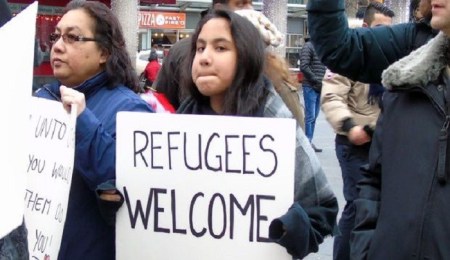
sign-refugees-welcome-photo-cijnews

“15,479 Syrian Refugees Have Been Admitted This Year – 606% More Than 2015; 98.8% Are Muslims,” by Patrick Goodenough, CNS News, December 29, 2016:

(CNSNews.com) – In its last full month in office, the Obama administration has admitted 1,307 more Syrian refugees – pushing the 2016 calendar year total to 15,479, a 606.1 percent increase from the numbers resettled in the U.S. in 2015.

Of the 15,479 Syrian refugees admitted by the end of Thursday:

–15,302 (98.8 percent) are Muslims – 15,134 Sunnis, 29 Shi’a, and 139 other Muslims

–125 (0.8 percent) are Christians – 32 Catholics, 32 Orthodox, five Protestants, four Jehovah’s Witnesses, and 52 refugees described only as “Christian” in State Department Refugee Processing Center data

–43(0.27 percent) are Yazidis

–eight are “other” religion and one is described as having “no religion”

–3,904 (25.2 percent) are males between the ages of 14 and 50

–3,521 (22.7 percent) are females aged 14-50

–7,428 (47.9 percent) are children under 14, of whom 3,824 are boys and 3,604 are girls.

Last year’s intake of Syrian refugees was considerably smaller – 2,192 in total – although the religious ratio was similarly skewed: 2,149 Muslims (98 percent) and 31 Christians (1.4 percent).

The last month of 2016 has seen 1,307 Syrian refugees arrive, of whom 1,278 (97.7 percent) were Muslims, 24 (1.8 percent) were Christians, and five (0.3 percent) were Yazidis.

The administration has determined that atrocities against Christians, Yazidis and other religious minorities by the Islamic State of Iraq and Syria (ISIS/ISIL) in areas under its control amount to genocide.

At the same time, however, it has rejected calls by Republican lawmakers and others to prioritize vulnerable religious minorities among refugee applicants. President Obama said that would amount to a “religious test.”

Sunni Muslims do account for a majority of Syria’s population – an estimated 74 percent when the civil war began in early 2011.

Even so, the proportion of Sunnis among the refugees admitted into the U.S. has been much larger than that: 97.7 percent of those resettled in 2016, and 97.15 of the total number of Syrian refugees admitted since the conflict began (17,513 out of 18,026)….

Syria: Muslim father sends his two pre-teen daughters on jihad suicide missions

December 21, 2016

Syria: Muslim father sends his two pre-teen daughters on jihad suicide missions, Jihad Watch,

“Indeed, Allah has purchased from the believers their lives and their properties, for that they will have Paradise. They fight in the cause of Allah , so they kill and are killed.” (Qur’an 9:111)

In light of that verse, this father doesn’t think he is a monster. He thinks he is doing his daughters a great favor.

https://www.youtube.com/watch?v=atqakLkrmXU

“Syrian father convinces young daughters to undergo suicide missions in sickening video,” by Bethan McKernan, Independent, December 21, 2016:

Disturbing footage of a Jabhat Fatah al-Sham (JFS) fighter in Syria convincing his two young daughters to take part in suicide missions has emerged online after being posted by rebel media sources.

It is thought that one of the girls may have been behind the suicide bomb which hit a police station in Damascus last week, although the link cannot be verified.

In two videos, the man who belongs to JFS – the newly adopted name of al-Nusra, or al-Qaeda in Syria – films his wife saying goodbye to eight-year-old Fatimah and seven-year-old Islam.

“Why are you sending your daughters?” the man asks from behind the camera. “One is seven and the other is eight, they’re young for jihad.”

“No one is too young for jihad, because jihad is a duty for every Muslim,” the woman replies, as the family praises god and the daughters hug and kiss their mother.

In the second, the two girls themselves say they will take part in suicide operations in Damascus.

“Why don’t you leave this to the men? The men who escaped on the green buses?” The child, confused, says yes, before her father asks more questions.

“You want to surrender so that you’re raped and killed by the infidels? You want to kill them, no? We’re a glorious religion, not a religion of humiliation, isn’t that so darling?”, he coaxes.

“You won’t be scared, because you’re going to God, isn’t that right?” he asks the younger girl.

The sickening footage was shared widely online on Wednesday. It is not known where the videos of the family were filmed, but the mention of ‘green buses’ suggests Aleppo, where the infamous regime buses have been transporting both rebels and civilians to neighbouring Idlib province this week after the fall of the city to government forces.

In October, the UN estimated there to be around 900 JFS fighters among the 8,000 rebels which had held onto the eastern part of the city for the last four years.

But Syrian government has also bussed surrendering rebels out of besieged areas on several other occasions, including in the southern Damascus suburb of Daraya, which agreed to an amnesty in August.

Several commentators in Syria have speculated that one of the girls could have been behind an attack in Damascus station last Friday, in which a little girl wandered into a police station in al-Midan and asked for the toilet before she either detonated a bomb on her person or it was detonated remotely….

Aleppo’s Fall Signals Rise of Emboldened Radical Shi’ite Axis

December 16, 2016

Aleppo’s Fall Signals Rise of Emboldened Radical Shi’ite Axis, Investigative Project on Terrorism, Yaakov Lappin, December 16, 2016

1918-1

Recent sweeping gains by the pro-Assad alliance in Aleppo signal the rise of an emboldened Iranian-led radical Shi’ite axis. The more this axis gains strength, territory, weapons, and influence, the more likely it is to threaten regional and global security.

Ideologues in Iran have formulated a Shi’ite jihadist vision which holds that the Iranian Islamic revolution must take control of the entire Muslim world. Losing the Assad regime to Sunni rebels, many of them backed by Tehran’s Gulf Arab state archenemies, would have represented a major setback to Iran’s agenda.

This same ideological agenda also calls for the eventual annihilation of Israel, the toppling of Sunni governments, and intimidating the West into complying with Iran’s schemes.

Supreme Leader Ayatollah Khamenei and Tehran’s military elites, in the form of the Islamic Republican Guards Corps (IRGC), use the current regional chaos to promote these goals.

In Syria, Iran has mobilized tens of thousands of Shi’ite militia fighters from all over the Middle East, as well as those from Hizballah in Lebanon, and sent them to do battle with Sunni rebel organizations to help save the Assad regime.

As the Shi’ite axis wages a sectarian war against Sunnis moderate groups and jihadists, it mobilizes and arms its proxies, and moves military assets into Syria, gaining a growing influence that can be used for bellicose purposes in the not too distant future.

The conquest of east Aleppo is a victory for the wider, transnational Iranian-led alliance, of which the Damascus regime is but one component. The Assad regime is composed and led by Syria’s minority Alawite population, which makes up just 11 percent of Syrians (Alawites are seen as an offshoot of Shia Islam).

A look at the order of battle assembled in Aleppo reveals that the war in Syria is not a civil conflict by any measure. In addition to Assad regime forces sent to fight Sunni rebels, such as the Fourth Division, Syrian army special forces, and paramilitary units, there is also the Iranian-backed Hizballah, which has transformed itself into a regional Shi’ite ground army, deployed across Syria and Lebanon.

These are joined by Shi’ite Iraqi Kataib Hizballah militia, Afghan Shi’ite militia groups, and Iranian military personnel on the ground in Syria, all of whom receive the assistance of massive Russian air power.

The large scale, indiscriminate airstrikes and shelling in places like Aleppo resulted in mass slaughter and ethnic cleansing of many Sunni civilians, producing the largest humanitarian catastrophe and refugee crisis in the 21st century. Such extreme war crimes will be sure to produce a new generation of radical recruits for ISIS and al-Qaida.

The IRGC’s Quds Force, under the command of Qassem Suleimani, orchestrates the entire ground war effort. Suleimani is very close to the Iranian supreme leader.

The Quds Force uses Syria as a transit zone to traffic advanced weapons from Iranian and Syrian arms factories to the Hizballah storehouses that pepper neighboring Lebanon.

Hizballah has amassed one of the largest surface to surface rocket and missile arsenal in the world, composed of over 100,000 projectiles, all of which are pointed at Israeli cities.

According to international media reports, Israel recently launched two strikes in the one week, targeting attempts to smuggle game-changing weapons to Lebanon.

Syrian dictator Basher Assad owes his survival to Iran and Hizballah, and their military presence in Syria should continue and expand further.

Assad regime and Hizballah representatives boast of this fact in recent statements highlighted by the Middle East Media Research Institute (MEMRI).

“The power-balances will change not only in Syria but in the entire region,” said Hizballah Executive Council Chairman Hashem Safi Al-Din.

“Syria’s steadfastness, and the support from its allies, have shifted the regional and international balance [of power], said Assad political adviser Bouthaina Sha’aban. “The recent developments in the international arena are bringing the countries of the region face to face with a new world.

If it takes western Syria with Russian air support, the Shi’ite axis victors will likely turn their sights on seizing southern Syria, near the Israeli border. To accomplish that, they will need to do battle with an array of Sunni rebels that now control that area (groups that include ISIS-affiliates). If successful, the axis could be tempted to build bases of attack throughout Syria against Israel, a development that would certainly trigger Israeli defensive action, as has reportedly occurred in the past.

The same pattern repeats itself in Iraq, where Iran-backed militias are moving in on Mosul, and could later be used to threaten Iraq’s Sunnis, and in Yemen, where Iranian-armed Houthi rebels control large swaths of the country, and are currently at war with a Saudi-led military coalition. The Houthis also threaten international oil shipping lanes and have fired on the U.S. Navy using Iranian-smuggled missiles.

In this way, the fundamentalist Iranian coalition gains a growing foothold.

Iran’s ballistic missile program, which is developing long-range strike capabilities that could place Europe in range, and its temporarily dormant nuclear program, represents investments that would make the Shi’ite axis more powerful than any Sunni Islamist camp.

Defense officials in Israel and in pragmatic Sunni states will watch for the danger that Iran will use its presence, proxies, and bases in Syria and Iraq to wage a Shi’ite jihad that extends well beyond the battlegrounds there.

The Iranian coalition can also lure armed Sunni groups into its orbit as well, as it has done in the past with the Palestinian Hamas terrorist regime in Gaza.

While the Israeli defense establishment has no desire to be dragged into Syria’s conflict, Jerusalem has indicated that it would act to remove any Iranian-Hizballah base it detects in Syria that is designed to launch attacks on Israel, and would not tolerate the trafficking of advanced weapons to Hizballah.

Few events illustrate more clearly how an ascendant Shi’ite jihadist axis is redrawing the map of the region than a recent military parade held by Hizballah in the western Syrian town of Al-Qusayr, which it conquered from the rebels in 2013.

According to an assessment by the Tel Aviv-based Meir Amit Intelligence and Terrorism Information Center, that parade featured Soviet-made tanks, American armored personnel carriers, artillery guns, anti-aircraft guns, and powerful truck-mounted rocket launchers with an estimated range of between 90 to 180 kilometers. “It is clear that state-owned capabilities, some of them advanced, were delivered to Hizballah, which is a terrorist organization,” the Intelligence and Terrorism Information Center said in its report.

Hizballah, like the Assad regime and armed groups in Iraq and Yemen, is a component of an international axis whose battles against ISIS have managed to dupe some decision makers into believing that they are stabilizing forces. In actuality, the Shi’ite jihadists are as radical as their Sunni jihadist counterparts – albeit more tactically prudent – and are far better armed and better organized.

ISIS seizes big Russian-Syrian T-4 air base

December 12, 2016

ISIS seizes big Russian-Syrian T-4 air base, DEBKAfile, December 12, 2016

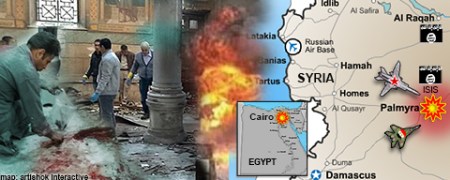
cairo_terror480

Islamic State forces pushed their assault forward to retake the central Syrian town of Palmyra Monday, Dec. 12. By evening, they had entered the big Russian-Syrian T-4 air base outside the town, carrying off substantial quantities of Russian armaments. Reporting this, DEBKAfile’s military sources add that the booty they snatched included different types of ground-to-ground missiles as well as anti-tank and anti-air rockets.

Russian forces manning the base were hurriedly evacuated from Palmyra and the T-4 base, after the worst defeat Russian armed forces had ever experienced at ISIS hands in Syria. Military circles in Moscow commented grimly that the Russian army had suffered “a major disgrace” in Palmyra.

According to our sources, long convoys of ISIS fighters backed by tanks taken booty from the Syrian army, first forced the Syrian 11th Tank Division to abandon the strategic Jhar Crossroad. After that, the way was clear for the jihadis’ column to reach the T-4 base.

DEBKAfile reported on the ISIS terrorists’ fresh momentum Sunday.

Judging from the rash of reports claiming US-Iraqi military progress in the Mosul offensive against ISIS and the extra American special operations forces personnel posted to Syria for an impending US-Kurdish operation to capture the ISIS Syrian stronghold of Raqqa, the Islamic State ought to be cowering under siege, finally defeated – or at least on the run.

But the facts tell another story. ISIS is on the offensive – so far in the Middle East. Over the weekend, Islamist terrorists accounted for dozens of deaths and injured hundreds more.

Sunday, Dec. 11, at least 25 people worshipping at the Coptic St. Peter’s and St. Paul’s church adjacent to St, Mark’s cathedral in Cairo were killed and scores injured. The Coptic pope often leads the prayers there. DEBKAfile’s counterterrorism sources reveal that the attack was carried out by Islamist terrorists from Raqqa who bided their time until they struck in the Egyptian capital. Saturday, six Egyptian troops were killed by another Islamist bomb near the Giza pyramids.

On the same day, ISIS fighters pushed back into the ancient Syrian town of Palmyra, nine months after their expulsion.

The Raqqa terrorist stronghold is clearly alive and kicking on more than one front. A number of contributing factors enable the Islamic State to unleash a fresh spate of terror.

1. The US-Iraqi-Kurdish drive has stalled without driving ISIS out of Mosul or choking off the terrorist fighters’ freedom to move between Mosul and Raqqa, their Syrian bastion.

US Defense Secretary Ashton Carter, who arrived in Baghdad Sunday, Dec. 11, was assigned by the Obama administration to make a last effort to reactivate the Mosul campaign. His chances of success are slim. The military coalition which launched the campaign two months ago has lost a vital component, the Kurdish Peshmerga, which backed out three weeks ago. The Iraqi military units which captured some of the city’s outskirts stopped short when they reached the strongest defense lines set up by the Islamic State and have been unable to break through, even with US air support.

The pro-Iranian Iraqi Shiite front which undertook to seize Tal Afar in order to sever the ISIS connecting link between Iraq and Syria are parked outside, having been warned by Turkey not to set foot in the town.

Added to these setbacks, the US CENTCOM which is running the aerial war in Iraq is at loggerheads with the Iraqi Air Force command and has practically grounded all Iraqi warplanes.

Even if Carter can wave a magic wand and resolve all these issues, the momentum and high hopes that actuated the Mosul campaign when it started have been lost and can hardly be recovered before Barack Obama leaves the White House.

At least two of the incoming president Donald Trump’s designated security advisers – Defense Secretary Gen, James Mattis and National security Adviser Gen. Michael Flynn – have criticized the operation in is current form.

2. What is happening in Raqqa doesn’t fit the designation of an offensive. At most, small Kurdish and Syrian rebel groups are mounting sporadic raids against ISIS fighters on the town’s outskirts, with the support of the Obama administration. Our military experts say that Raqqa can’t be captured from the Islamist terrorists by conventional means – mainly because it is spread over a large area of mostly empty desert. ISIS has taken advantage of this terrain to distribute knots of defenders across a vast area ranging hundreds of kilometers from northern to eastern Syria up to the winding, heavily overgrown banks of the Euphrates River.

So when Ash Carter announced Saturday that he would be sending another 200 Special Operations Forces into Syria to join the battle for Raqqa, he had no idea that he, the Russians and the Syrians were about to be caught off guard by a fresh ISIS initiative to reoccupy Palmyra, the ancient Syrian two from which they are thrown out in March.

This was a poke in the eye for Russian President Vladimir Putin who proclaimed Palmyra’s capture from ISIS as a signal coup for the Russian army in its war on Islamist terror.

3.  He might well commiserate with Egyptian President Abdel-Fatteh El-Sisi. For two years, the Egyptian armed forces have been fighting an uphill battle to crush the ISIS groups infesting the Sinai Peninsula. The jihadists constantly elude punishment with the help of supportive Bedouin tribes.

Every few months, they pose a real threat to the stability of the El-Sisi regime by striking inside Cairo, the capital, with some terrorist atrocity, for which they are aided by the Muslim Brotherhood underground and Palestinian Hamas extremists in the Gaza Strip.

The bombing of the Coptic church Saturday was unusually the work of jihadists deployed from Raqqa, Syria.  Egypt has reacted by placing extra guards at Christian sites and declaring three days of national morning for the disastrous bombing attack on Egypt’s largest minority.

The new Islamist drive is looking ominously like the onset of the Christmas-New Year holiday terror onslaught the Islamic State has threatened to unleash in the Middle East and beyond. US and European security services have been placed on high alert in the belief that returning jihadis are programmed to strike at home.

“Syrian 5th Corps” is new Shiite foreign legion

December 4, 2016

“Syrian 5th Corps” is new Shiite foreign legion, DEBKAfile, December 4, 2016

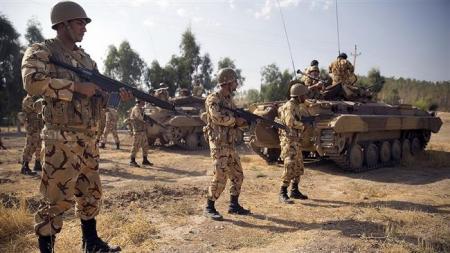
fifth_corps

The new Shiite foreign legion or international brigade presents a major headache for Syria’s neighbors, Turkey, Lebanon, Jordan and Israel. It provides a cover for Iran and Hizballah to sneak troops right up to their borders. Whenever this happened in the past, Israel and Jordan pushed back hard. But this will be more difficult once the Fifth Corps is set up as an integral part of the Syrian army.

***************************

Syria and its allies came closer than ever to taking Aleppo on Friday, Dec. 2, when they captured the Tariq al-Bab district to gain control of 60 percent of the rebel-held eastern part of the city.

Drawing on the lessons of this success, the winning forces have begun building a military outfit modeled on the format of the victorious coalition. It is designated the “Fifth Corps” of the Syrian army, but DEBKAfile’s military and intelligence sources can identity the new unit as the framework for an international Shiite brigade or foreign legion.

It is the brainchild of the Iranian Revolutionary Guards’ Gen. Qassem Soleimani, commander of Iranian Mid East operations, who is in Iraq at present, supervising the Shiite militias on the Mosul front. However, his officers are overseeing its construction of the new military legion. It is composed of the remnants of the Syrian army’s First and Second Corps, which took a bad beating in the five years of conflict, the Hizballah expeditionary force in Syria and the Shiite militias which Tehran imported from Iraq, Afghanistan and Pakistan to fight for Bashar Assad.

The new framework aims to field 50,000 to 70,000 fighting men.

Its command structure is already taking shape in a form that is new for the Syrian army and indeed any other fighting force in the region. Syrian, Hizballah and foreign Shiite officers will make up this command, but not direct their own forces, only mixed units composed of Iranian, Syrian, Shiite and Hizballah servicemen.

It will be the first Shiite army or foreign legion ever seen in the Middle East.

An oblique reference to the novel force came from a Hizballah source this week who said: “The Fifth Corps is an important turning-point for the ties between allied forces within the same axis – Syria, Iran, Russia and Hizballah.”

Russia? DEBKAfile’s sources have heard no hint of the Russians joining the new Shiite legion. But Hizballah has been spreading reports in the past fortnight about its deepening ties with Russian officers, mainly on the Aleppo front, and their supposed appreciation of the Lebanese Shiites’ fighting prowess.

The Syrian high command has meanwhile moved forward on the new scheme with a decision this week to send the entire next class of military recruits to the new Fifth Corps.

The new Shiite foreign legion or international brigade presents a major headache for Syria’s neighbors, Turkey, Lebanon, Jordan and Israel. It provides a cover for Iran and Hizballah to sneak troops right up to their borders. Whenever this happened in the past, Israel and Jordan pushed back hard. But this will be more difficult once the Fifth Corps is set up as an integral part of the Syrian army.

Western and Arab observers following the Syrian war believe that, as soon as they finish off the rebels in Aleppo, the new foreign legion’s forces will turn south to repeat the exercise there with Russian support.

The Russian bombardment of rebel concentrations outside the southern towns of Jasim and Daraa Sunday, Nov. 27, was seen a message from Moscow to Jerusalem and Amman that southern Syria is now in line for the next battle.

Humor | Syrian child disappointed she won’t get to be drone-striked by the first female president

November 13, 2016

Syrian child disappointed she won’t get to be drone-striked by the first female president, Duffel Blog, November 13, 2016

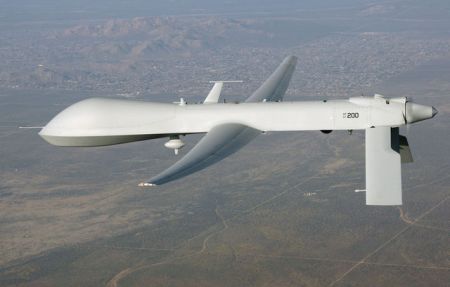
url

ALEPPO, Syria — In the midst of sectarian violence that has overtaken Syria for more than five years, nine-year-old Asil Kassab is shocked by the defeat of Democratic presidential candidate Hillary Clinton.

“I am so unhappy that a woman was not elected President,” Asil said, briefly ducking as a bomb from an American MQ-1 Predator drone leveled the hospital behind her. “Hillary Clinton is truly a role model for young girls like me. I was so hoping that she’d be the one to order the drone strike that would inevitably end my life.”

Despite Clinton’s support for regime change in Syria, leading to what is arguably one of the greatest humanitarian crises of the early century, Kassab surprisingly says she holds no ill will.

“I don’t put much stock in the misogynist agenda of American politics,” said Kassab, who, like many children, cannot remember a time before the war that has killed 400,000 people, including her family, and created over 4.7 million refugees. “People will always criticize her because she is a woman in a man’s world; One who has the audacity to run for President.”

“It is sexism that motivates her critics, plain and simple,” she added. “It is sexism, and racism, that caused her to lose the election!”

Huma Abedin, vice chairwoman of Hillary Clinton’s presidential campaign, took a moment from sobbing into a pile of shredded emails to applaud the statement made by young Asil.

“Hearing things like that from little girls on the other side of the globe makes all this worthwhile,” she said. “Secretary Clinton was truly committed to a protracted ground war in Syria. Despite losing the election, I’m sure she’ll find some way to continue being a role model to women everywhere by fighting for no-fly zones and military aggression against Russia.

At press time, Asil was already busy placing “Michelle Obama 2020!” pins on the dust covered corpses lying unburied in the street.


Iran’s Tel Afar op is in sync with Russia in Syria

October 30, 2016

Iran’s Tel Afar op is in sync with Russia in Syria, DEBKAfile, October 30, 2016

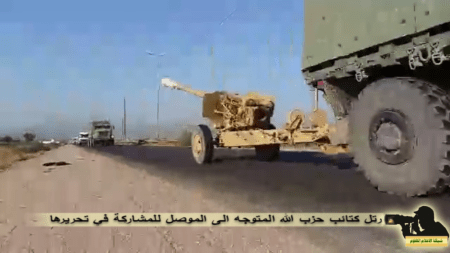
hezbollah_brigades_convoy_mosul_b_30-10-16-png

The irony of this arrangement is that, the US armed the Iraqi army, and indirectly the Shiite militias, for this offensive with top-notch Abrams M1 tanks, M1-198 Howitzers and M88 Recovery vehicles for tanks. All this s valuable hardware looks like ending up away another battlefield away from Mosul in Syria, and under a different command, Russia.

****************************

The pro-Iranian Iraqi Shiite drive to capture Tel Afar, 55 km from Mosul in western Iraq, was designed less to complete the encirclement of the Islamists in Mosul – in support of the US-led coalition – and more to forge a link in the land bridge Tehran aspires to build to give its Revolutionary Guards free passage to Hizballah and the Shiite groups fighting for Bashar Assad in Syria. This is reported by DEBKAfile’s military and intelligence sources.

The Iraqi Shiite battle for Afar is led by Iran’s Al Qods chief, Gen. Qassem Soliemani from the front lines.

US and Iraqi commanders of Operation Inherent for expelling ISIS from Mosul welcomed the Iran-led Iraqi Shiites’ initiative to take Tal Afar in order to sever ISIS’ supply lines from Syria to Mosul.

But Iran’s overriding motive in initiating this operation was laid bare by Ahmad al-Asadi, spokesman of the pro-Iranian Iraqi Hashid Shaabi Shiite groups, when he spoke to reporters Saturday, Oct. 29 in Baghdad.

After “clearing” these “terrorist gangs,” from 14,000 sq. km of Iraq including Tal Afar and the regions bordering on Syria, he said, “We are fully ready to cross the border into Syria and fight alongside President Bashar al-Assad.

According to our sources, this plan was not coordinated directly with the US-Iraqi command of the Mosul operation, but with the Russian military command center in the Syrian province of Latakia.

It is important enough for the Russian command to have just established a new center for military and intelligence interchanges. It is staffed by Russian, Turkish, Syrian, Iraqi Shiite and Iranian officers. This mechanism has been put in charge of coordinating Shiite military operations both in Syria and Iraq.

It was decided that when US military assistance or air support is deemed necessary, requests will be piped through the bureau of Iraq’s Shiite Prime Minister Haider al-Abadi and passed on to the US-Iraqi command of Operation Inherent.

Russian, Iranian and Turkish officers have thus effectively hitched on to the decision-making process for the Mosul offensive alongside American officers.

The irony of this arrangement is that, the US armed the Iraqi army, and indirectly the Shiite militias, for this offensive with top-notch Abrams M1 tanks, M1-198 Howitzers and M88 Recovery vehicles for tanks. All this s valuable hardware looks like ending up away another battlefield away from Mosul in Syria, and under a different command, Russia..

Al-Hariri’s Choice Of Hizbullah Ally Aoun For Lebanese Presidency Is Another March 14 Forces Concession To Pro-Iran Axis

October 28, 2016

Al-Hariri’s Choice Of Hizbullah Ally Aoun For Lebanese Presidency Is Another March 14 Forces Concession To Pro-Iran Axis, MEMRI, E.B. Picali and Y. Yehoshua, October 28, 2016

Introduction

On October 31, 2016, the Lebanese parliament will convene and is expected to vote in Free Patriotic Movement leader and Hizbullah ally Michel Aoun as president of Lebanon; he is Hizbullah’s sole candidate. The move follows a deal struck between Aoun and former Lebanese prime minister Sa’d Al-Hariri, leader of the Sunni Al-Mustaqbal stream, under which Aoun, if elected, will assign Al-Hariri the task of forming the next government.

This move by Al-Hariri has significant implications for the intra-Lebanese political arena and for the regional power balance. Therefore it has encountered criticism both within and outside Lebanon. This move represents a surrender by the March 14 Forces, headed by Al-Mustaqbal, to Hizbullah’s will, and reinforces the position of Hizbullah’s patron Iran at the expense of Saudi Arabia.

The following report reviews Al-Hariri’s decision, the reactions it has encountered, and what it means for Lebanon and the region.

Hizbullah Ally Aoun Expected To Be Chosen President

On October 31, 2016, the Lebanese parliament will hold its 46th presidential selection session since Michel Suleiman’s term ended two-and-a-half years ago.  That session is expected to choose Free Patriotic Movement leader Michel Aoun, who is an ally of Hizbullah, as president. Aoun’s selection will end a two-and-a-half-year presidential vacuum that resulted from disagreement over Suleiman’s successor from among the country’s opposing streams – primarily Al-Mustaqbal, led by Sa’d Al-Hariri, and Hizbullah, which together with Aoun stymied the formation of the quorum that is necessary to elect a president. The breakthrough in the talks over the selection of a president came when Al-Hariri and Aoun reached an agreement under which Al-Hariri would support Aoun’s presidential candidacy and in return Aoun would task Al-Hariri with forming the new government, which would be a national unity government as stipulated in the agreement.[1] This constitutes an Al-Hariri surrender to Hizbullah, which sought an Aoun presidency. It should be mentioned that Al-Hariri’s support for an overt Hizbullah ally is not unprecedented; a year ago, Al-Hariri announced his support for another ally of Hizbullah, and of Syrian president Bashar Al-Assad, Suleiman Frangieh, for the post of Lebanese president.[2]

Al-Hariri announced his support for Aoun in an October 20, 2016 speech, saying that by supporting him he was aiming to save Lebanon from dangerous leadership and economic crises which could, in turn, lead to a new civil war.[3]

Two days later, on October 22, Hizbullah secretary-general Hassan Nasrallah announced that his party’s MPs, who had been boycotting presidential selection sessions, as had MPs from other parties including Aoun’s own Change and Reform bloc, would be attending the October 31 session and would be choosing Aoun.  Nasrallah added that Hizbullah had no objections to Al-Hariri’s serving as prime minister in the new government.

These statements by Al-Hariri and Nasrallah pave Aoun’s path to the presidential palace, even though obstacles and uncertainty remain, both in Lebanon and in the region, in this matter.

Various Lebanese Elements Oppose Aoun’s Appointment As President

The opposition to Aoun’s appointment comes mainly from Lebanese parliamentary speaker Nabih Berri, and from Suleiman Frangieh, who is running against Aoun in the presidential race. Both Berri and Frangieh are March 8 Forces members and open Hizbullah allies. Berri even announced that he would not be part of the government that would be established under the Al-Hariri-Aoun deal, and questioned the deal’s future, saying that it had been arrived at by two sides only, without taking into account the country’s main political elements, himself among them. Druze leader and centrist bloc member Walid Jumblatt, who is another major Lebanese political figure, has not yet expressed a position on this matter, but it is thought that he will back Aoun.

On the other side as well, some in Al-Hariri’s Al-Mustaqbal party and in the March 14 Forces in general   oppose this deal. Immediately after Al-Hariri’s October 20 announcement of support for Aoun, another former prime minister, Fouad Al-Siniora, the head of the Al-Mustaqbal party, (a component of Al-Hariri’s broader Al-Mustaqbal stream) announced that he would not join Al-Hariri in backing Aoun for president. Al-Siniora was joined by other party members, including parliamentary vice president Farid Makari, MPs Ahmad Fatfat and Ammar Houri, Telecommunications Minister Boutros Harb of the March 14 Forces, and March 14 Forces secretary-general Fares Souaid.

Along with the opposition to an Aoun presidency within the Al-Mustaqbal party, other Sunni public figures also objected to the deal, among them Justice Minister Ashraf Rifi, former director-general of the Lebanese Internal Security Forces and a former Al-Hariri supporter. Last year, Rifi harshly attacked Al-Hariri for his support for Hizbullah and Syrian regime ally Suleiman Frangieh. On October 22, 2016, two days after Al-Hariri’s announcement of his support for Aoun as president, Rifi organized an anti-Aoun protest in Tripoli called “Proud Tripoli Rejects the Candidate of Iranian Patronage.” The next day, October 23, a convoy of vehicles from Akkar in the north of the country made its way to Rifi’s home in Tripoli bearing posters of him and expressing support for his position on this matter. It should be mentioned that in the past year, Rifi has gradually chipped away at overall Lebanese Sunni support for Al-Hariri, as evidenced by his party’s landslide victory over Al-Hariri’s party in the mayoral elections in Tripoli, the city with the largest Sunni concentration in the country.

Many in the Al-Mustaqbal party, the March 14 Forces, and the Sunni public who oppose the Al-Hariri-Aoun deal see Al-Hariri’s support for Aoun as yet another concession to Hizbullah and the pro-Iran axis that backs it, and to Hizbullah as an armed state within a state.[4] They accuse Al-Hariri, inter alia, of seeking to become prime minister by selling out Sunni interests and the political legacy of his father Rafiq Al-Hariri, whose 2005 assassination, when Syria was the real power in Lebanon, is thought to have been carried out by five senior Hizbullah officials.

Addressing critics of his deal, Al-Hariri explained his support for Aoun as well as his previous support for Frangieh: “I am willing to take the risks a thousand times over, just as I am willing to risk myself, my people, and my political future, to defend Lebanon and its people.”[5]

Al-Hariri’s Choice Of Aoun Is A Political Victory For Hizbullah

Al-Hariri’s move to support the Hizbullah candidate and ally Aoun has major implication for the internal Lebanese political arena. It constitutes another successful attempt by Hizbullah to impose its wishes there and a further weakening of the country’s main Sunni force, the Al-Mustaqbal party. This triumph for Hizbullah comes at a time when it is mostly preoccupied outside of Lebanon’s borders, primarily with fighting alongside the Assad regime in Syria, as well as elsewhere in the Arab world as a proxy of Iran. The organization has fortified its position within Lebanon by virtue of its network of political alliances in the country, as well as by virtue of the quantity of weapons in its possession.

Ibrahim Al-Amin, head of the board of directors of the Lebanese daily Al-Akhbar and a known Hizbullah supporter, argued that the March 14 Forces, including the Al-Mustaqbal stream, show “the symptoms of card-game addicts,” who delude themselves that they can win and are “unwilling to give up” even when it is clear that it is Hizbullah who is actually directing events on the ground.[6]

At the same time, Hizbullah’s success in pushing its own candidate through is also a result of the political weakness of its rivals, particularly the Hariri-led Al-Mustaqbal stream, who wants the premiership at nearly any cost in order to strengthen his own political status in the country and perhaps his economic status as well.

An Aoun presidency does not mean that the issues contributing to the vast schism between the sides in Lebanon will be resolved, among them the disarming of Hizbullah as demanded by the March 14 Forces – Aoun opposes the organization’s disarmament.[7] As president, Hizbullah ally Aoun would be in charge of a number of security and military portfolios, aggravating the tension between the sides and jeopardizing the army’s independence .

Additionally, the Al-Hariri-Aoun deal does not guarantee that Al-Hariri will actually succeed in forming a government, because of the opposition he faces both inside and outside Lebanon. The deal with Aoun could also harm Al-Hariri’s status among his traditional Sunni support base, thus weakening him in the upcoming spring 2017 parliamentary elections.

An Aoun Presidency: Ramifications For The Regional Power Balance – Down With Saudi Arabia, Up With Iran

Since Lebanon’s future depends on the regional political balance, with Iran, Syria, and Saudi Arabia the patrons of various local Lebanese political players, Al-Hariri’s move has regional ramifications. His surrender to Hizbullah’s wishes reflects the strengthening of Iran, which has exploited the Syrian civil war to deepen its penetration of the region and of Lebanon in particular. Electing the Hizbullah presidential candidate Aoun will definitely serve future pro-Iran interests in Lebanon at the expense of Sunni interests in Lebanon, and also at the expense of Saudi Arabia, which views itself as the protector of these interests.

Saudi Arabia has previously backed Al-Hariri’s past substantial political moves even if these moves haven’t always served Saudi political interests in Lebanon or elsewhere. It is still unclear whether his deal with Aoun has Saudi support, and the Lebanese press has published conflicting reports on the matter. As yet, there has been no official Saudi comment on this, but recent articles in the Saudi press indicate a lack of support for Al-Hariri’s deal with Aoun. However, following a lengthy Saudi silence, Saudi Gulf Affairs Minister Thamer Sabhan, who visited Beirut on October 27 said that his country would not intervene in the selection of Lebanon’s president and would support the president chosen by the Lebanese.[8]

There were also reports in the Lebanese press noting that Al-Hariri’s political status in Lebanon is declining, and that the Saudis no longer consider him the sole representative of the Sunnis in Lebanon, but only one such representative.

It should be noted that in previous years, Saudi Arabia, as the leader of the Sunni world, played a key role in the selection of Lebanese presidents, as did Syria, which together with Hizbullah’s patron Iran represented the resistance axis. Al-Hariri’s choosing Aoun for president without full Saudi backing reflects a decline in Saudi influence in Lebanon, and in Saudi Arabia’s regional status in general. In this context, a report in the Lebanese daily Al-Safir, a known supporter of the resistance axis, claims that Egypt was involved in promoting Aoun’s prospects for the presidency.[9] A possible inference from this report is that Egypt is attempting to step into Saudi Arabia’s shoes in Lebanon in an attempt to restore its status in the Arab world, and particularly in the Sunni world.

Articles in the daily Al-Akhbar, known for its pro-Hizbullah line, addressed the regional implications of Al-Hariri’s gambit and gloated that the move reflected Saudi Arabian weakness. Al-Akhbar columnist Ghassan Saoud wrote that an Aoun presidency would be a manifestation of “Hizbullah’s ability to break the international will, and the Saudi will.”[10]

However, Ibrahim Al-Amin wrote in an Al-Akbar editorial that wars in the Arab region created a reality that was forcing the March 14 Forces to see the choice of Lebanese president differently, and that they needed to realize that the Saudis can no longer help them. As he usually does, he concluded his piece with implied threats, stating: “Anyone who does not want anarchy in Lebanon has no alternative but to choose Aoun for president.”[11]


*E. B. Picali is a research fellow at MEMRI; Y. Yehoshua is Vice President for Research And Director of MEMRI Israel


Endntoes:

[1] One of the main political players pushing for an Aoun presidency is Samir Geagea, chairman of the Lebanese Forces. In January 2016, after a long period of talks, Geagea and Aoun, formerly bitter Christian political rivals, agreed that Geagea would support Aoun’s presidential bid. One of the main reasons behind Geagea’s decision to do so was Al-Hariri’s previous support for the presidential candidacy of Suleiman Frangieh – a fierce rival of Geagea who had been accused of killing several members of the Frangieh family during the country’s civil war.

[2] Similarly, in 2008, during another presidential interregnum, the March 14 Forces and Al-Hariri were forced to make concessions to Hizbullah, which was included in the newly formed Fouad Siniora government; this took place at the Doha conference. The most important concession won by the Hizbullah-led March 8 Forces, as stipulated in the government guidelines, was the legitimation of the Resistance (which allowed Hizbullah to operate as an independent armed force within Lebanon). Hizbullah also received enough cabinet seats to veto any government decision, and Hizbullah subsequently used this veto power against Al-Hariri’s government in 2011. Hizbullah obtained these concessions following the leadership vacuum, the lengthy Hizbullah siege on central Beirut, and the violent events of May 7, 2008.

[3] Al-Mustaqbal (Lebanon), October 21, 2016.

[4] See MEMRI Inquiry & Analysis Series Report No. 1092, Al-Mustaqbal Losing Ground As Representative Of Lebanese Sunnis, May 19, 2014.

[5] Al-Mustaqbal (Lebanon), October 21, 2016.

[6] Al-Akhbar (Lebanon), October 24, 2016.

[7] In an interview with Al-Akhbar, Lebanese Foreign Minister Gebran Bassil, who is Aoun’s son-in-law and heads the Change and Reform bloc founded by Aoun, said that Free Patriotic Movement, to which the Change and Reform bloc belongs, supports Hizbullah’s retention of its weapons. Al-Akhbar(Lebanon), October 22, 2016.

[8] Al-Watan (Saudi Arabia), October 28, 2016.

[9] Al-Safir (Lebanon), October 25, 2016.

[10] Al-Akhbar (Lebanon), October 27, 2016.

[11] Al-Akhbar (Lebanon), October 24, 2016.

Turkish warplanes bomb US-backed Kurdish militias in Syria

October 20, 2016

Turkish warplanes bomb US-backed Kurdish militias in Syria , DEBKAfile, October 20, 2016

Turkish warplanes carried out more than 20 sorties early Thursday morning in northern Syria, attacking positions, vehicles and convoys of US-backed Kurdish militias fighting the Islamic State organization. The targets were in a number of villages around the city of Aleppo. There were conflicting reports on the number of casualties, with the Turkish army reporting that 200 Kurdish fighters had been killed while the militias claimed that there were only about 20 fatalities. DEBKAfile‘s intelligence sources report that the Turkish attack may cause the Kurds to withdraw their forces from the US-led offensive to capture the Iraqi city of Mosul, and not help the US capture the Syrian city of Raqqa afterwards.