Archive for the ‘Supreme Leader’ category

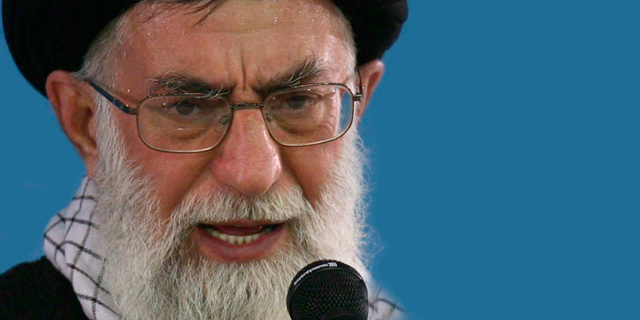
Iranian Supreme Leader following Lausanne Declaration: Nothing Has Been Achieved So Far

May 5, 2015

Iranian Supreme Leader following Lausanne Declaration: Nothing Has Been Achieved So Far, MEMRI TV via You Tube, May 5, 2015

(Khamenei delivered this speech last month, but this fourteen minute video includes some comments I had not seen him make previously. — DM)

A powerful totalitarian theocracy can bring peace. Of sorts.

May 2, 2015

A powerful totalitarian theocracy can bring peace. Of sorts. Dan Miller’s Blog, May 2, 2015

(The views expressed in this article are mine, and do not necessarily reflect those of Warsclerotic or its other editors. — DM)

a1  Obama and Kahameni -building a toaster

Iran, an already powerful theocratic totalitarian state with extensive hegemonic ambitions, is about to become (if it is not already) a nuclear power. So equipped, it can extend its rule over the Middle East and beyond, bringing the “peace” of submission to Islam. Obama may favor this outcome and in any event appears to be at best indifferent.

Iran is ruled by Ayatollah Khamenei, its supreme political and religious power. He has the ultimate authority to approve or reject any P5+1 agreement, should there be one — which seems increasingly likely due to Obama’s ludicrous efforts to concede every possible matter of substance. Obama wants a foreign policy legacy and needs a “deal;” Iran does not need a “deal.” It has already benefited greatly from sanctions relief. Other nations have also benefited economically to the point that even were the U.S. to try to reimpose sanction such trade would continue and expand. Moreover, it is highly likely that Iran has done all of the necessary technical research on nukes and on delivery devices to the extent that, regardless of whether there is a “deal,” Iran can have deliverable nukes within a few months if not sooner. As I pointed out here, the insanity of the 2013 framework, adhered to except when arguably in America’s favor, led inexorably to this result.

The North Korea – Iran linkage makes the problem worse. Chinese nuclear experts recently revised their estimation of North Korea’s current possession of nukes:.

China’s top nuclear experts have increased their estimates of North Korea’s nuclear weapons production well beyond most previous U.S. figures, suggesting Pyongyang can make enough warheads to threaten regional security for the U.S. and its allies.

The latest Chinese estimates, relayed in a closed-door meeting with U.S. nuclear specialists, showed that North Korea may already have 20 warheads, as well as the capability of producing enough weapons-grade uranium to double its arsenal by next year, according to people briefed on the matter. [Emphasis added.]

Iran and North Korea have a long history of nuclear cooperation. Delivering North Korean technology, materials and nukes to Iran would not be very difficult. I addressed the problem here, herehere and elsewhere.

Consequences of a nuclear Iranian theocracy

The Iranian Shiite theocracy is totalitarian in every sense of the word; it has not moderated under “moderate” President Rouhani. To the contrary, it seems to have worsened. To the extent that credible figures are available, sexually transmitted disease has risen and the birth rate in Iran has fallen, considerably in recent years. Despite sanctions relief, poverty has increased. Where has the money gone? Iran pursues its hegemonic ambitions, most recently to help the Houthi in Yemen, while continuing to provide economic, logistical and weapons support to its other proxy terrorist organizations such as Hamas, Hezbollah, the Muslim Brotherhood and others. Iran is very likely motivated by its own desire eventually to control the Middle East and beyond.

The recent Iranian hijacking of a cargo ship under “U.S. protection” may well have been an Iranian warning to Saudi Arabia, an American ally and leading opponent of the Iranian proxy war by Houthi in Yemen, that it can and might close the Strait of Hormuz to Saudi oil exports.

Strait-of-Hormuz

Although obligated under treaty to come to the defense of the Marshall Islands-registered cargo ship, the Obama Nation did not. Instead, it simply watched as the Iranian Navy fired shots across her bow and took her to an Iranian port to the North at Bandar Abbas. The ship and her crew remain there. Caroline Glick, in an article titled The Marshall Islands’ cautionary tale pointed out that

The Maersk Tigris is flagged to the Marshall Islands. The South Pacific archipelago gained its independence from the US in 1986 after signing a treaty conceding its right to self-defense in exchange for US protection. According to the treaty, the US has “full authority and responsibility for security and defense of the Marshall Islands.” [Emphasis added.]

Given the US’s formal, binding obligation to the Marshall Islands, the Iranian seizure of the ship was in effect an act of war against America.

. . . .

If the US allows Iran to get away with unlawfully seizing a Marshall Islands flagged ship it is treaty bound to protect, it will reinforce the growing assessment of its Middle Eastern allies that its security guarantees are worthless.

As the Israel Project’s Omri Ceren put it in an email briefing to journalists, “the US would be using security assurances not to shield allies from Iran but to shield Iran from allies.” [Emphasis added.]

What can other nations, with which America has treaties calling upon us to come to their defense, expect from the Obama administration if attacked by Iran? Precious little.

Under credible threat from nuclear attack by Iran and lacking actual (as distinguished from verbal) support from the Obama administration, Middle East Arab nations cannot be expected to resist very effectively, even as they seek to obtain their own nuclear arsenals.

Israel, the “Little Satan?” She would fight fiercely to the end, but might be overcome. Perhaps she will take the initiative and destroy Iran’s nuclear facilities before they become too extensive and better protected, perhaps by missiles provided by Russia. I suggested here that she can and should do so. Here is a link to a far more detailed analyses of what she can and should do, soon.

America, the “Great Satan,” is not immune to an Iranian nuclear attack. As I suggested here, a nuclear armed Iran could launch an EMP attack to drive the U.S. back to the stone age. Such an attack would increase Iran’s hegemonic potentials, and hence ambitions, by foreclosing the possibility of American help to nations with which we have protection treaties. However, even without an EMP attack, Obama would not provide much help. Therefore, I wonder whether — despite all of the continuing Iranian “death to America” bluster — Iran would be foolish enough to do it before Obama leaves office. He does His best to help Iran get nukes and pursue its hegemonic ambitions. Why try to kill a staunch friend like Obama’s America?

The Obama administration — and many voters — view global warming, climate change, climate disruption and whatever new phrases as may be developed as the most severe threat to humanity. An interesting article titled Progressives at the Poker Table compares “Progressive” attitudes toward “the threat of climate warming and that of a nuclear-armed Iran.” Predictably, the Obama Administration and most of the “legitimate news media” are far more concerned about the former than the latter, even though there is little if anything that we can do, even at great expense, about climate change (mostly natural in origin). If so disposed, there is quite a lot that we could do about the far greater, and in any event more immediate, threat from a nuclear Iran. Perhaps it’s simply easier to stage pious shows about costly but ineffective ways to “save the Earth” than to make useful efforts to save humanity from Islamic ravages.

Church of climatology

Conclusions

Andrew Klavan ridicules Obama’s P5+1 “deal” here:

The Congress probably won’t do anything to stop it, so Iran will very likely have nukes and the missiles with which to deliver them soon — if it does not already have them.

Hitler made a “deal” with Prime Minister Chamberlain years ago and returned from Munich to display a piece of paper signed by Hitler. Crowds cheered. Hitler laughed and continued his hegemonic pursuits throughout Europe. Hitler could have been stopped with relative ease long before World War II erupted but wasn’t. The “Peace in our time” meme was too powerful. Then we fought WWII.

Is that how the current mess with Iran will turn out?

code pink on Iran

Report: Kerry Told Iran He Wishes ‘U.S. Had a Leader like Iran’s Supreme Leader’

April 29, 2015

Report: Kerry Told Iran He Wishes ‘U.S. Had a Leader like Iran’s Supreme Leader’ Washington Free Beacon, April 29, 2015

(Who is fibbing?– DM)

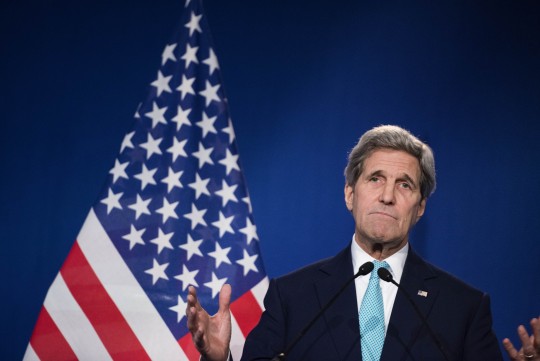
Kerry againAP

Secretary of State John Kerry told his Iranian counterpart that he wished the United States had a leader more like Supreme Leader Ayatollah Khamenei, according to comments made by a senior Iranian cleric and repeated in the country’s state-run media.

Ayatollah Alam al-Hoda claimed during Friday prayer services in Iran that in negotiations over Tehran’s contested nuclear program, Kerry told the country’s foreign minister that he “wished the U.S. had a leader like Iran’s supreme leader,” according to a Persian-language report on the remarkspublished by the Asriran news site.

“In the negotiations Kerry told [Iranian Foreign Minister Javad] Zarif that he [Kerry] wished U.S. had a leader like Iran’s supreme leader,” according to Alam al-Hoda, who is a senior member of the Iran’s powerful Assembly of Experts.

A senior administration official told the Washington Free Beacon that such a contention is patently absurd.

The remarks are the latest in a string of comments made by Iranian leaders purporting to reveal private details of the talks.

Iranian newspapers have carried multiple reports in recent months suggesting that Iranian Foreign Minister and chief negotiator Javad Zarif was ordered to stop screaming at Kerry behind closed doors.

In his Friday remarks, al-Hoda went on to say that Obama is set on striking a deal with Iran by June.

“Both Republicans and Democrats want these negotiations with Iran, but they fight each other for partisan interests,” he was quoted as saying. “Obama wants the negotiation to succeed so his party can win the next election and Republicans want to stop him.”

Alam al-Hoda also celebrated Iran’s expansion in the region and controversial activities in war-torn countries such as Syria and Yemen.

“Today, the resistance crescent has gone beyond Syria and Lebanon and reached to Yemen,” he said. “Today the resistance front is in control of Strait of Hormuz and Bab-el-Mandeb.”

The “U.S. and Israel have not been so weak anytime before,” he continues. “All these events are being managed by the hidden Imam,” a revered religious figure in Shia Islam.

Saeed Ghasseminejad, an Iranian dissident and fellow at the Foundation for Defense of Democracies (FDD), said U.S. overtures to Iran at the negotiating table have failed to win it any respect from the Islamic Republic’s leaders.

“President Obama thinks that by making more concessions he can gain the trust and respect of Iranian leaders,” Ghasseminejad said. “However, Iranian leaders neither trust him nor respect him.

“Seeing unprecedented weakness in the U.S. president, Iranian leaders do not fear the United States anymore. Partnership, trust, and alliance between the radical Islamist regime of Tehran and United States cannot and should not exist.”

Meanwhile, Zarif said over the weekend that fighting between the Obama administration and Congress over a potential final deal could not stop America from implementing any agreement the White House signs.

“As we have stated since the beginning, we consider the U.S. administration responsible for implementing the agreement and internal problems and conflicts in the U.S. are not related to us and to the implementation of the agreement, and based on the international laws, the countries’ internal problems don’t exempt them from implementing their undertakings and this is the main framework that we attach importance to,” Zarif said, according to the Fars News Agency.

On Monday, Zarif urged the United States to woo Iran.

“Maintaining an uncertain and unstable situation is not acceptable to Iran and the Americans should take practical and confidence-building measures to reach a comprehensive nuclear agreement,” Zarif was quoted as telling reporters.

Obama still believes in a nuclear deal, although Iran is skittish – even against a military option

April 12, 2015

Obama still believes in a nuclear deal, although Iran is skittish – even against a military option, DEBKAfile, April 12, 2015

Ashton_Carter_4.15US Defense Secretary Ashton Carter:The nuclear option is on the table

In the last two days, the Obama administration has swung between conflicting signals on the Iranian nuclear deal. Unable to wave away the tough conditions laid down by Tehran, the US president was nonetheless optimistic about a final deal to curb Iran’s nuclear program in comments he made at the Americas summit in Panama Sunday, April 12. Obama said he was not surprised at the way supreme leader Ali Khamenei had characterized the framework agreement, because “Iran has it own politics and hardliners who need to be satisfied, but there may be ways to structure the final nuclear deal that achieve core objectives while satisfying Iran’s pride.”

Just Saturday, US Defense Secretary Ashton Carter said: “We have the capability to shut down, set back and destroy the Iranian nuclear program.” He referred to the Massive Ordinance Penetrator-MOP, aka the “bunker buster” which is capable of penetrating fortified facilities up to 200 feet underground. “My job is among other things to make sure that the so-called military option is on the table,” he said.

Iranian media headlines screamed: “US Secretary of Defense Ashton Carter has threatened Tehran with war.”

This is exactly what Khamenei was aiming for when on April 9, he laid down two implacable terms for a deal: the removal of sanctions on the day a final deal is signed and a firm refusal to allow international inspections of Iran’s military sites.

Both of these provisions contradicted Washington’s presentation of its core conditions for a comprehensive accord as being gradual sanctions relief and intrusive inspections.

One of Khamenei’s objects was indeed to remove all suspicion on his home front that Iran’s negotiators had given ground to the world powers either in the overt agreement or in any secret annexes.

The Iranian media headlines achieved this purpose.

But underlying the vocal exchanges between the two capitals is Iran’s confidence that President Obama has discarded the option of military force against its nuclear sites. This confidence gave Tehran the edge in round after round of diplomacy with the US and the world powers.

Senior negotiator Foreign Minister Javad Zarif boasted on April 7, that Iran was “capable of producing an atomic bomb at any given moment,” and was contained solely by “religious Islamic injunctions.”

His boast was amply illustrated by the 20,000 centrifuges Iran had built up during the years of negotiations, plus thousands of advanced machines standing by to further accelerate uranium enrichment – even though its stockpile of 3.6 percent had soared to 10 tons – enough to build 4-6 nuclear bombs.

This edge further enabled the Iranians to bring the Arak heavy water plant capable of producing plutonium to its final stages of construction, without encountering a prohibition in Lausanne, any more than the Fordo enrichment site, stealthily installed some years ago, or its ballistic missile program were sentenced to be dismantled.

That Iran would continue to get away with its tactic of talking while enriching was borne out by Obama assurance Sunday that ways would be found “to structure the final nuclear deal that achieve core objectives while satisfying Iran’s pride.”

The negotiating tactics pursued by Secretary of State John Kerry in Lausanne and in the previous round in Geneva not only diluted America’s military option but virtually took it off the table – not only for America but for everyone else, including Israel. To put it back, much more is needed than Ashton Carter’s reference to the bunker-buster. To make it credible, the United States must rebuild its military presence in the Gulf and the Middle East – bringing back two aircraft carriers to reinforce the lone USS Carl Vinson, for starters.

This, however, would contradict the doctrine Obama expounded on April 2 when he said: “When you hear the inevitable critics of the deal sound off, ask them a simple question: Do you really think that this verifiable deal, if fully implemented and backed by the world’s powers, is a worse option than the risk of another war in the Middle East?”

But he failed to explain the multiple versions of the Lausanne deal published in Washington, Tehran and latterly Paris, whose discrepancies can no longer be glossed over.

Speaking after his historic meeting with Cuba’s Raul Castro Sunday, Obama rebuked Republican senators for pointing this out, accusing them of “partisanship which has crossed all boundaries.”

Sen. John McCain shot back that discrepancies between US and Iranian versions of the deal extended to inspections, sanctions relief, and other key issues. ‘‘It is undeniable that the version of the nuclear agreement outlined by the Obama administration is far different from the one described by Iran’s supreme leader,’’ he said.

This exchange took place two days before members of the Senate Foreign Relations Committee plan to vote on Senator Bob Corker’s bipartisan Iran nuclear agreement review act. This would give members of Congress 60 days after a nuclear deal is reached to decide if they want to waive sanctions against Iran.

But most of all it calls into question the Obama administration’s presentation of a tentative set of disputed concepts reached in Lausanne as a finalized framework, which left just a few loose ends for resolving by the next deadline of June 30. The very real gaps have been highlighted and exploited by Tehran.

US tactics don’t work well in the Persian bazaar, where the carpet seller pretends to be unwilling to sell his merchandise to an interested customer, while putting the price up in round after round of haggling.

Khamenei falls naturally into the role of the reluctant carpet seller when he is confronted with an especially keen American customer.

Humor?| Obama to Israel: I have your back

April 8, 2015

(The views expressed in this article are either mine or those of my guest author. They do not necessarily reflect those of Warsclerotic or its other editors. — DM)

The Most Revereddd Mohamed Allah-scimitar

The Most Revereddd Mohamed Allah-scimitar

This is a post by my (imaginary) guest author, the Most Reverend Mohamed Allah-scimitar, President Obama’s chief foreign policy adviser on Islamic relations with Christians and Jews. But first, some related observations:

Iran continues to reject as lies Obama’s statements about the April 2nd P5+1 nuke “deal,” and states that it “could build bomb today” but won’t because of Ayatollah Khamenei’s (non-existent) fatwa. Understandably, Israel is becoming increasingly concerned about her future existence. Obama’s claims that He has her back and that she therefore need not worry about anyone (else) who tries to “mess with Israel.” His assurances have provided scant comfort.

Cartoon_Israel_BB_KnifeInBack

Here’s are the comforting(?) words of the Most Reverend Mohamed Allah-scimitar.

***********************

Lord Obama has Israel’s back almost to the same extent that He has the Obama Nation’s back and will protect her if necessary. For Israel to maintain, and even improve, her weapons minimizing destruction (WMDs) is an unacceptable insult to Him and to all for which He stands.

ObamaWillStandWithMuslims (2)

Obama salute

During Israel’s “Protective Edge” war against peaceful Palestinians in Gaza, Israel shamelessly shifted the odds disproportionately in her own favor by using the Iron Dome to thwart efforts to destroy her major cities. She provided not even one Iron Dome to the Palestinians! Since that time, she has improved the Iron Dome and developed other WMDs less dependent upon lengthy trajectory tracking of missiles and perhaps even mortar rounds. Racist to the core, she has no regard for social justice, equality and the sad plight she has imposed on the Palestinians. Indeed, they are forced to rely on funds (“tens of millions of dollars”) from Iran to help rebuild Tunnels for Peace (TFP) and resupply their stocks of Missiles for Peace (MFP).

Now that Israel claims that peaceful Iranian nuclear weapons are an existential threat, she is doubtless looking for — and probably finding — ways to escape their consequences as well. Doing so is risible because Lord Obama has explained patiently — even as He would to a backward child — that it is unnecessary. He has her back, as He always had and always will.

Nobody except Obama had dare mess with Israel! Not even Netanyahu! Hence, there is no need for Iran to recognize Israel’s speciously claimed right to continue to exist, which would require fundamental changes in Iran. For Israel to insist on it is a fundamental misjudgment.

Lord Obama is able and willing to act, if necessary, to demonstrate the firmness of His resolve. Indeed, it has already been rumored that He may dispatch His own beloved mother in law from her happy home in the White House to live with Prime Minister Netanyahu in Occupied Palestine. If so, she will be accompanied by a suitable contingent of unarmed Organizing for Action volunteers. Recognizing, however, that more may be required, Lord Obama has been negotiating with Iran to provide the unjustly impoverished Palestinians not only free electrical power but also medically useful radioactive isotopes as well as others for other peaceful purposes. Despite the petty squabbles between the Palestinian Authority and Hamas, Iran will treat them equally.

Israel should and will cease to exist but, with Lord Obama in the picture, Iran should not be a concern.

**************************

There is no P5+1 “deal” and it seems unlikely that there ever will be, no matter how many contortions Obama and Kerry attempt. A deal like the one described in Obama’s talking points would be bad enough. However, Iran has rejected His talking points, has stated that it could build nukes now if it so desired and that the only impediment is a (non-existent) fatwa issued by the Supreme Leader. The Iranian foreign minister has been quoted as saying that

Iran will begin using its latest generation IR-8 centrifuges as soon as its nuclear deal with the world powers goes into effect, Iran’s foreign minister and nuclear chief told members of parliament on Tuesday, according to Iran’s semi-official FARS news agency. [Emphasis added.]

If accurate, the report makes a mockery of the world powers’ much-hailed framework agreement with Iran, since such a move clearly breaches the US-published terms of the deal, and would dramatically accelerate Iran’s potential progress to the bomb.

Iran’s military sites are, of course, off limits to inspections according to Iran’s Defense Minister. Meanwhile, the Supreme Leader continues to lead “death to America” chants and Iranian television continues to entertain its viewers with simulations of nuclear attacks on Israel.


More recently,

[T]he Islamic Republic has announced a new documentary film which will celebrate the life of Qods Force Commander Qassem Soleimani. It’s bad enough lionizing a master terrorist responsible for the deaths of hundreds of Americans in Iraq and Afghanistan. But the description of the film is even more telling: The film Commander will depict Iran’s and Soleimani’s strategic approach to destroy not only the Islamic State but also “the Zionist regime.” Importantly, the article describing the film was published after agreement on a nuclear framework between the P5+1 and Iran. [Emphasis added.]

COLUMN ONE: The diplomatic track to war

April 3, 2015

COLUMN ONE: The diplomatic track to war, Jerusalem Post, Caroline Glick, April 4, 2015
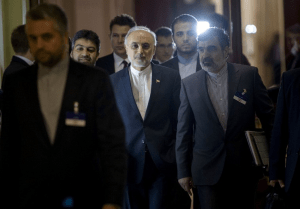
Iran negotiationsIran negotiations. (photo credit:REUTERS)

No one trusts Washington when Obama claims that he is committed to the security of Israel and the US’s Sunni allies in the region.

Iran is far more powerful than the PLO. But the Americans apparently believe they are immune from the consequences of their leaders’ policies. This is not the case for Israel or for our neighbors. We lack the luxury of ignoring the fact that Obama’s disastrous diplomacy has brought war upon us. Deal or no deal, we are again about to be forced to pay a price to maintain our freedom.

********************

Through their nuclear diplomacy, Obama and his comrades started the countdown to war.

The world powers assembled at Lausanne, Switzerland, with the representatives of the Islamic Republic may or may not reach a framework deal regarding Iran’s nuclear program. But succeed or fail, the disaster that their negotiations have unleashed is already unfolding. The damage they have caused is irreversible.

US President Barack Obama, his advisers and media cheerleaders have long presented his nuclear diplomacy with the Iran as the only way to avoid war. Obama and his supporters have castigated as warmongers those who oppose his policy of nuclear appeasement with the world’s most prolific state sponsor of terrorism.

But the opposite is the case. Had their view carried the day, war could have been averted.

Through their nuclear diplomacy, Obama and his comrades started the countdown to war.

In recent weeks we have watched the collapse of the allied powers’ negotiating positions.

They have conceded every position that might have placed a significant obstacle in Iran’s path to developing a nuclear arsenal.

They accepted Iran’s refusal to come clean on the military dimensions of its past nuclear work and so ensured that to the extent UN nuclear inspectors are able to access Iran’s nuclear installations, those inspections will not provide anything approaching a full picture of its nuclear status. By the same token, they bowed before Iran’s demand that inspectors be barred from all installations Iran defines as “military” and so enabled the ayatollahs to prevent the world from knowing anything worth knowing about its nuclear activities.

On the basis of Iran’s agreement to ship its stockpile of enriched uranium to Russia, the US accepted Iran’s demand that it be allowed to maintain and operate more than 6,000 centrifuges.

But when on Monday Iran went back on its word and refused to ship its uranium to Russia, the US didn’t respond by saying Iran couldn’t keep spinning 6,000 centrifuges. The US made excuses for Iran.

The US delegation willingly acceded to Iran’s demand that it be allowed to continue operating its fortified, underground enrichment facility at Fordow. In so doing, the US minimized the effectiveness of a future limited air campaign aimed at significantly reducing Iran’s nuclear capabilities.

With this broad range of great power concessions already in its pocket, the question of whether or not a deal is reached has become a secondary concern. The US and its negotiating partners have agreed to a set of understanding with the Iranians. Whether these understandings become a formal agreement or not is irrelevant because the understandings are already being implemented.

True, the US has not yet agreed to Iran’s demand for an immediate revocation of the economic sanctions now standing against it. But the notion that sanctions alone can pressure Iran into making nuclear concessions has been destroyed by Obama’s nuclear diplomacy in which the major concessions have all been made by the US.

No sanctions legislation that Congress may pass in the coming months will be able to force a change in Iran’s behavior if they are not accompanied by other coercive measures undertaken by the executive branch.

There is nothing new in this reality. For a regime with no qualms about repressing its society, economic sanctions are not an insurmountable challenge. But it is possible that if sanctions were implemented as part of a comprehensive plan to use limited coercive means to block Iran’s nuclear advance, they could have effectively blocked Iran’s progress to nuclear capabilities while preventing war. Such a comprehensive strategy could have included a proxy campaign to destabilize the regime by supporting regime opponents in their quest to overthrow the mullahs. It could have involved air strikes or sabotage of nuclear installations and strategic regime facilities like Revolutionary Guards command and control bases and ballistic missile storage facilities. It could have involved diplomatic isolation of Iran.

Moreover, if sanctions were combined with a stringent policy of blocking Iran’s regional expansion by supporting Iraqi sovereignty, supporting the now deposed government of Yemen and making a concerted effort to weaken Hezbollah and overthrow the Iranian-backed regime in Syria, then the US would have developed a strong deterrent position that would likely have convinced Iran that its interest was best served by curbing its imperialist enthusiasm and setting aside its nuclear ambitions.

In other words, a combination of these steps could have prevented war and prevented a nuclear Iran. But today, the US-led capitulation to Iran has pulled the rug out from any such comprehensive strategy. The administration has no credibility. No one trusts Obama to follow through on his declared commitment to prevent Iran from becoming a nuclear power.

No one trusts Washington when Obama claims that he is committed to the security of Israel and the US’s Sunni allies in the region.

And so we are now facing the unfolding disaster that Obama has wrought. The disaster is that deal or no deal, the US has just given the Iranians a green light to behave as if they have already built their nuclear umbrella. And they are in fact behaving in this manner.

They may not have a functional arsenal, but they act as though they do, and rightly so, because the US and its partners have just removed all significant obstacles from their path to nuclear capabilities. The Iranians know it. Their proxies know it. Their enemies know it.

As a consequence, all the regional implications of a nuclear armed Iran are already being played out. The surrounding Arab states led by Saudi Arabia are pursuing nuclear weapons. The path to a Middle East where every major and some minor actors have nuclear arsenals is before us.

Iran is working to expand its regional presence as if it were a nuclear state already. It is brazenly using its Yemeni Houthi proxy to gain maritime control over the Bab al-Mandab, which together with Iran’s control over the Straits of Hormuz completes its maritime control over shipping throughout the Middle East.

Israel, Jordan, Egypt, Saudi Arabia, Sudan and Eritrea, and their global trading partners will be faced with the fact that their primary maritime shipping route to Asia is controlled by Iran.

With its regional aggression now enjoying the indirect support of its nuclear negotiating partners led by the US, Iran has little to fear from the pan-Arab attempt to dislodge the Houthis from Aden and the Bab al-Mandab. If the Arabs succeed, Iran can regroup and launch a new offensive knowing it will face no repercussions for its aggression and imperialist endeavors.

Then of course there are Iran’s terror proxies.

Hezbollah, whose forces now operate openly in Syria and Lebanon, is reportedly active as well in Iraq and Yemen. These forces behave with a brazenness the likes of which we have never seen.

Hamas too believes that its nuclear-capable Iranian state sponsor ensures that regardless of its combat losses, it will be able to maintain its regime in Gaza and continue using its territory as a launching ground for assaults against Israel and Egypt.

Iran’s Shiite militias in Iraq have reportedly carried out heinous massacres of Sunnis who have fallen under their control and faced no international condemnation for their war crimes, operating as they are under Iran’s protection and sponsorship. And the Houthis, of course, just overthrew a Western-backed government that actively assisted the US and its allies in their campaign against al-Qaida.

For their proxies’ aggression, Iran has been rewarded with effective Western acceptance of its steps toward regional domination and nuclear armament.

Hezbollah’s activities represent an acute and strategic danger to Israel. Not only does Hezbollah now possess precision guided missiles that are capable of taking out strategic installations throughout the country, its arsenal of 100,000 missiles can cause a civilian disaster.

Hezbollah forces have been fighting in varied combat situations continuously for the past three years. Their combat capabilities are incomparably greater than those they fielded in the 2006 Second Lebanon War. There is every reason to believe that these Hezbollah fighters, now perched along Israel’s borders with Lebanon and Syria, can make good their threat to attack and hold fixed targets including border communities.

While Israel faces threats unlike any we have faced in recent decades that all emanate from Western-backed Iranian aggression and expansionism carried out under a Western-sanctioned Iranian nuclear umbrella, Israel is not alone in this reality. The unrolling disaster also threatens the moderate Sunni states including Jordan, Egypt, Saudi Arabia, Kuwait and the United Arab Emirates. The now regional war in Yemen is but the first act of the regional war at our doorstep.

There are many reasons this war is now inevitable.

Every state threatened by Iran has been watching the Western collapse in Switzerland.

They have been watching the Iranian advance on the ground. And today all of them are wondering the same thing: When and what should we strike to minimize the threats we are facing.

Everyone recognizes that the situation is only going to get worse. With each passing week, Iran’s power and brazenness will only increase.

Everyone understands this. And this week they learned that with Washington heading the committee welcoming Iran’s regional hegemony and nuclear capabilities, no outside power will stand up to Iran’s rise. The future of every state in the region hangs in the balance. And so, it can be expected that everyone is now working out a means to preempt and prevent a greater disaster.

These preemptive actions will no doubt include three categories of operations: striking Hezbollah’s missile arsenal; striking the Iranian Navy to limit its ability to project its force in the Bab al-Mandab; and conducting limited military operations to destroy a significant portion of Iran’s nuclear installations.

Friday is the eve of Passover. Thirteen years ago, Palestinian terrorists brought home the message of the Exodus when they blew up the Seder at Netanya’s Park Hotel, killing 30, wounding 140, and forcing Israel into war. The message of the Passover Haggada is that there are no shortcuts to freedom. To gain and keep it, you have to be willing to fight for it.

That war was caused by Israel’s embrace of the notion that you can bring peace through concessions that empower an enemy sworn to your destruction. The price of that delusion was thousands of lives lost and families destroyed.

Iran is far more powerful than the PLO. But the Americans apparently believe they are immune from the consequences of their leaders’ policies. This is not the case for Israel or for our neighbors. We lack the luxury of ignoring the fact that Obama’s disastrous diplomacy has brought war upon us. Deal or no deal, we are again about to be forced to pay a price to maintain our freedom.

Iran, North Korea, nukes and Obama

March 30, 2015

Iran, North Korea, nukes and Obama, Dan Miller’s Blog, March 30, 2015

(The views expressed in this article are mine and do not necessarily reflect those of Warsclerotic or its other editors. — DM)

North Korea has ample nukes and wants money. Iran wants (and may already have) nukes, has money and will have more as sanctions are ended. The two rogue nations have long had a symbiotic relationship and it has not diminished. Yet “our” P5+1 negotiators, under the leadership of Obama’s minions, ignore that inconvenient problem as well as Iran’s missile development, “possible” nuclear weaponization and increasing regional hegemony.

I wrote about the Iran – North Korea connection back in 2013 in articles titled China, Iran and North Korea — a radioactive stew,  Iran, North Korea and Nuke Negotiations and elsewhere. As I noted in the radioactive stew article,

The main thing that puzzles me is why we continue to focus on Iran’s uranium enrichment. Is Iran (again) playing us for suckers? North Korea is fully capable of enriching uranium for Iran (or for anyone else) and would doubtless be happy to enrich as much as may be desired in exchange for the hard currency freely available to Iran if it were only to cease its own enrichment. North Korea needs the money and is not likely very particular about its sources. Just as our sanctions have not impacted Iran’s enrichment capabilities significantly, neither have they impacted those of North Korea. Perhaps we may awaken before it’s too late and notice Iran playing its Korean hole card in our high-stakes poker game.

We have not awakened and the problem has worsened since 2013.

Soure: American in North Korea

Soure: American in North Korea

In 2014, I summarized several earlier articles in one titled The Iran scam continues. There, I pointed out that the English language version of the interim P5+1 deal and the White House summary generally ignore “undisclosed” — but known — Iranian sites for missile and warhead development and the work done there– despite warnings from the International Atomic Energy Agency. I also noted the Iran – North Korea nexus. Again, the situation has become worse since then. As the magic date of March  31, 2015 arrives, Iran is still demanding – and likely will get — more and more concessions.

“The Iranians are again outplaying the Americans,” said one source in Europe familiar with the negotiations. “They know they’ll have to give up certain things eventually. So they’re digging in their heels on issues that mean everything and preparing to give ground on relatively minor issues—but not yet, and not until they see how much more the Americans are willing to give.” [Emphasis added.]

. . . .

“Iran has successfully dragged the administration toward their positions to attain massive concessions, and, sensing that kind of weakness, they are seeking to press their advantage to gain further ground on critical points,” according to the source, who added that on the sanctions relief front, Iran is seeking a rollback “without dismantling anything.” [Emphasis added.]

a1  Obama and Kahameni -building a toaster

What might Iran be willing to give up in order to get additional important concessions? How about stuff that North Korea will be pleased to do in exchange for a share of the extra funds Iran will have as sanctions are eliminated?

Occasionally but not often, news media raise the Iran – North Korea connection. For example, a March 29th article at the Washington Post by Ali Alfoneh and Reuel Marc Gerecht is titled What else is Iran hiding? Another article at the Daily Beast by Gordon G. Chang is titled Does Iran Have Secret Nukes in North Korea?

As noted in the Washington Post article,

The unfinished North Korean-designed reactor that was destroyed by Israeli planes on Sept. 6, 2007, at Deir al-Zour in Syria was in all likelihood an Iranian project, perhaps one meant to serve as a backup site for Iran’s own nuclear plants. We draw this conclusion because of the timing and the close connection between the two regimes: Deir al-Zour was started around the time Iran’s nuclear facilities were disclosed by an Iranian opposition group in 2002, and the relationship between Shiite-ruled Syria and Shiite Iran has been exceptionally tight since Bashar al-Assad came to power in 2000. We also know — because Ali Akbar Hashemi Rafsanjani, the former Iranian president and majordomo of the political clergy, proudly tells us in his multivolume autobiography — that sensitive Iranian-North Korean military cooperation began in 1989. Rafsanjani’s commentary leaves little doubt that the Iranian-North Korean nexus revolved around two items: ballistic missiles and nuclear-weapons technology. [Emphasis added.]

. . . .

The Iranian-North Korean contacts intensify in 1992, the year that Rafsanjani, with Rouhani at his side, launches a policy of commercial engagement with the Europeans. On Jan. 30, Rafsanjani receives intelligence minister Ali Fallahian and Mostafa Pourmohammadi, the ministry’s director of foreign espionage, to discuss “procurement channels for sensitive commodities.” On Feb. 8, Rafsanjani writes, “The North Koreans want oil, but have nothing to give in return but the special commodity. We, too, are inclined to solve their problem.” Rafsanjani orders defense minister Akbar Torkan to organize a task force to analyze the risks and benefits of receiving the “special commodity.” This task force recommends that the president accept the “risk of procuring the commodities in question.” Rafsanjani adds that “I discussed [this] with the Leader [Ayatollah Ali Khamenei] in more general terms and it was decided to take action based on the [task force’s] review.” [Emphasis added.]

It’s most unlikely that the “special commodity” and the technical know-how surrounding it have anything to do with ballistic missiles; Rafsanjani expresses anxiety that the “special commodity” could be intercepted by the United States, but doesn’t share this worry about missile procurement. In a March 9, 1992, journal entry, the cleric gloats about the U.S. Navy having tracked a North Korean ship bound for Syria but not two ships destined for Iran. Two days later, when the “special commodity” is unloaded, he writes: “The Americans were really embarrassed.” [Emphasis added.]

. . . .

Odds are good that North Korea helped to jump-start Iran’s nuclear-weapons program. If so, how long did this nefarious partnership continue?

Rouhani was Rafsanjani’s alter ego. He’s undoubtedly the right man to answer all of the PMD questions that the IAEA keeps asking and the Obama administration keeps avoiding. [Emphasis added.]

As noted at the Daily Beast article,

In October 2012, Iran began stationing personnel at a military base in North Korea, in a mountainous area close to the Chinese border. The Iranians, from the Ministry of Defense and associated firms, reportedly are working on both missiles and nuclear weapons. Ahmed Vahidi, Tehran’s minister of defense at the time, denied sending people to the North, but the unconfirmed dispatches make sense in light of the two states announcing a technical cooperation pact the preceding month.

. . . .

[N]o inspections of Iranian sites will solve a fundamental issue: As can be seen from the North Korean base housing Tehran’s weapons specialists, Iran is only one part of a nuclear weapons effort spanning the Asian continent. North Korea, now the world’s proliferation superstar, is a participant. China, once the mastermind, may still be a co-conspirator. Inspections inside the borders of Iran, therefore, will not give the international community the assurance it needs.

The cross-border nuclear trade is substantial enough to be called a “program.” Larry Niksch of the Center for Strategic and International Studies in Washington, D.C., estimates that the North’s proceeds from this trade with Iran are “between $1.5 billion and $2.0 billion annually.” A portion of this amount is related to missiles and miscellaneous items, the rest derived from building Tehran’s nuclear capabilities. [Emphasis added.]

Iran has bought a lot with its money. Mohsen Fakhrizadeh, thought to be Tehran’s chief nuclear scientist, was almost certainly in North Korea at Punggye-ri in February 2013 to witness Pyongyang’s third atomic test. Reports put Iranian technicians on hand at the site for the first two detonations as well.

The North Koreans have also sold Iran material for bomb cores, perhaps even weapons-grade uranium. The Telegraph reported that in 2002 a barrel of North Korean uranium cracked open and contaminated the tarmac of the new Tehran airport.

. . . .

Even if Iran today were to agree to adhere to the Additional Protocol, it could still continue developing its bomb in North Korea, conducting research there or buying North Korean technology and plans. And as North Korean centrifuges spin in both known and hidden locations, the Kim regime will have a bigger stock of uranium to sell to the Iranians for their warheads. With the removal of sanctions, as the P5+1 is contemplating, Iran will have the cash to accelerate the building of its nuclear arsenal.

So while the international community inspects Iranian facilities pursuant to a framework deal, the Iranians could be busy assembling the components for a bomb elsewhere. In other words, they will be one day away from a bomb—the flight time from Pyongyang to Tehran—not one year as American and other policymakers hope. [Emphasis added.]

Why does the Obama administration persistently avoid raising the Iran – North Korea nexus? Perhaps doing so would scuttle the “negotiations” and thereby Obama’s dreams about His legacy. Perhaps Obama is keen for Iran to have, and be in a position to use, nukes to enhance its hegemony over the Middle East and to displace Israel as well as regional Arab allies in the Gulf states. Since Israel is unwilling to commit suicide in present circumstances by agreeing to a two state solution with Palestinians — intent upon and capable of causing her destruction — that may well be His only way to bring to fruition His desire for Middle east “peace” through submission and “social justice.”

to follow the Constitution.  It's to old and too slow.

to transform the Middle East with social justice

Conclusions

The Iran – North Korea nexus, regardless of its importance, was not considered (or was considered but deemed too intractable to approach) when the framework for the P5+1 negotiations was decided and it will not be considered now. That’s bad and dangerous. If a deal with Iran evolves from the current mess, Obama will gloat about His legacy and the Mad Mullahs will gloat about having put one over on the weak and declining free world. That’s frustrating but otherwise of little consequence.

Because of the Iran – North Korea nexus, Iran would need little time to repair any damage Israel and/or her Arab allies might do to Iran’s existing or future nuclear infrastructure. What can and should be done? I wish I knew. Perhaps Iran’s borders could be sealed adequately to keep North Korean stuff out, but that would require an expensive long term commitment. Perhaps others will think of something better. I hope so.

For Obama, Bibi’s words matter while Iran’s don’t

March 22, 2015

For Obama, Bibi’s words matter while Iran’s don’t, Times of IsraelShmuley Boteach, March 22, 2015

(Please see also, Iranians Chant “Death to America” While Negotiations Continue. — DM)

President Obama says that Bibi’s words matter when it comes to a Palestinian state. “We take him at his word when he said that it wouldn’t happen during his prime ministership,” he told The Huffington Post. The President used Netanyahu’s statement as cause for a “reassessment” of American ties with Israel.

White House spokesman Josh Earnest echoed the sentiment in last Thursday’s White House briefing that the Prime Minister’s words could bring punishment. “Words matter,” he said. There could be “consequences” for Netanyahu’s statements. “Everybody who’s in a position to speak on behalf of their government understands that that’s the case, and particularly when we’re talking about a matter as serious as this one.”

So let’s get this straight. When foreign leaders speak, it matters. What they say is consequential. Bibi’s going to have to pay for his remarks.

But I have one question. Why doesn’t any of this apply to Iran? Why, on Saturday Ayatollah Ali Khameini uttered the words “Death to America” even as John Kerry was expressing optimism the very same day that the United States would come to a nuclear accord with Iran!

Suddenly, Iran’s words don’t matter?

Taking this further, the most hair-raising aspect about the growing American rapprochement with Iran is that it has all happened while Iran has continued to repeatedly threaten the annihilation of the Jewish people. Ayatollah Khameini has called Jews dogs and tweeted as recently as this past November that “there is no cure for Israel other than annihilation.”

Now, if words matter, how can the United States continue to speak to his government while they are openly threatening a second holocaust? Why did President Obama and John Kerry not establish a repudiation of these genocidal words and threats as a precondition for any talks?

The hypocrisy is startling. And it leads to a more important point.

By now it’s clear to all that President Obama positively loathes Prime Minister Netanyahu more any other world leader. His hostility to the Prime Minister has become so pronounced that the President can no longer disguise or control it.

Am I the only one that finds it just a touch unseemly for the leader of the free world to hate the leader of the only free country in the Middle East?

The President has a good relationship with Erdogan, the tyrant of Turkey, who has destroyed his nation’s democracy and allows fighters to pass through his nation to join ISIS. President Obama traveled to Saudi Arabia to pay his personal condolences upon the passing of arch-misogynist King Abdullah of Saudi Arabia, a man who wouldn’t even allow women to drive a car. And he utters not an unkind word about Ayatollah Khameini, the world’s foremost terrorist.

But he hates Netanyahu. Go figure.

For years we Americans have heard that our President is cerebral and unflappable. That he famously remains cool under the most challenging circumstances. It turns out that this is true for every world leader except one, Benjamin Netanyahu, who makes the President’s blood boil.

Don’t we deserve to know why?

If the two leaders merely had bad personal chemistry, I could understand. They’re not the best of friends. Fine. But for Obama the hatred of Netanyahu has become positively visceral, personal, and irrepressible.

My own belief is this. President Obama is desperate for some foreign policy victories. There’s a year-and-a-half left to his Presidency and the world is on fire. From Iran to Boko Haram to ISIS to Putin to Hezbollah to Al Qaida and Hamas, bad guys are running amok under this president. American Foreign policy is a shambles.

The only ally President Obama can truly expert pressure on for a deal that would give him the lasting foreign policy legacy he needs and craves is Israel. And in the past Israeli Prime Ministers have proven so utterly malleable. American Presidents have squeezed them like lemons.

But Bibi refuses to be squeezed. He won’t play ball. He won’t withdraw from Judea and Samaria and allow “Hamastan” on his eastern border the way it is in Gaza. He won’t shut up about America’s capitulation to the Iranian mullahs that would leave them with a military-grade nuclear program. He won’t go quietly into the nuclear night while America appeases one of the most violent and vile regimes on earth.

This darned Bibi guy just won’t bend.

And our President finds the intransigence so utterly frustrating.

He prayed and hoped that someone else might win the Israeli election. And some of the President’s top political operatives went and worked for Herzog. But, huff and puff as he might, the President could not blow Bibi’s house down.

So now he’s stuck with him. A stick-necked Prime Minister, getting in the way of the President’s peace deals with Iran and the Palestinians.

And with no way of getting rid of the Israeli nuisance, all the President can do is continue to give interviews that express his dislike and frustration, not realizing that we’re reaching a point where the President is beginning to look positively un-Presidential and where is enmity is becoming unbecoming.

It’s called democracy, Mr. President. Bibi won. And it’s time for the world’s foremost democracy, the United States of America, to live with it and work with the man who has the mandate of the Israeli people, just as you have the mandate of the American people.


Iranians Chant “Death to America” While Negotiations Continue

March 22, 2015

Iranians Chant “Death to America” While Negotiations Continue, The Clarion Project, March 22, 2015

Iran-Ayatollah-Khamenei-IP_0Supreme Leader of the Islamic Republic of Iran Ayatollah Khamenei (Photo: © Reuters)

Ayatollah Khamenei, the Supreme Leader of Iran, presided over chants of “Death to America” in his Nowruz address to the people of Iran.

Nowruz is the Persian New Year and the Supreme Leader traditionally gives on address to mark the festival.

As part of his Nowruz address, Khamenei responded to President Obama’s Nowruz video message, in which he spoke directly to the Iranian people and called on them to support a nuclear deal.

Ayatollah Khamenei said that Obama’s Nowruz message was asking Iranians to submit to American demands in exchange for economic relief, couching the negotiations in terms of struggle rather than mutual benefit.

The crowd then broke out in chants of “Death to America” which was repeated multiple times over the course of the hour long speech.


By contrast, Obama’s Nowruz message to the Iranian people said that a nuclear deal would bring a brighter future for the people of Iran and urged them to support the negotiations.


Israel’s shield no more?

March 19, 2015

Israel’s shield no more?
By MICHAEL CROWLEY 3/18/15 6:44 PM EDT Via Politico


(The Wrath of Khan….uh, Obama. – LS)

Officials say they are revisiting the U.S. stance in light of Netanyahu rolling back his support of a Palestinian state.

In the wake of Israeli Prime Minister Benjamin Netanyahu’s decisive reelection, the Obama administration is revisiting longtime assumptions about America’s role as a shield for Israel against international pressure.

Angered by Netanyahu’s hard-line platform toward the Palestinians, top Obama officials would not rule out the possibility of a change in American posture at the United Nations, where the U.S. has historically fended off resolutions hostile to Israel.

And despite signals from Israel suggesting that Netanyahu might walk back his rejection, late in the campaign, of a Palestinian state under his watch, Obama officials say they are taking him at his word.

“The positions taken by the prime minister in the last days of the campaign have raised very significant substantive questions that go far beyond just optics,” said a senior administration official, adding that recent Israeli government actions were in keeping with Netanyahu’s rhetoric.

While saying it was “premature” to discuss Washington’s policy response, the official wouldn’t rule out a modified American posture at the United Nations, where the U.S. has long fended off resolutions criticizing Israeli settlement activity and demanding its withdrawal from Palestinian territories.

“We are signaling that if the Israeli government’s position is no longer to pursue a Palestinian state, we’re going to have to broaden the spectrum of options we pursue going forward,” the official said.

There is no virtually no chance that the U.S. will trim its financial or military support for Israel. But some analysts believe that going forward, Netanyahu may be vulnerable in international forums where the U.S. has long been a bulwark against criticism of Israel and its presence in Palestinian territories.

(Note: The double negative is not my typo. It’s actually in the article this way. While is may be an innocent mistake, it’s a bit foreboding and troubling that ceasing military support for Israel is “virtually” not going to happen. – LS)

“I do think the administration is going to look very closely at the possibility of either joining, or at least not blocking an internationally backed move at the U.N. to restate the parameters for ending the conflict,” said Jeremy Ben-Ami, president of the left-leaning pro-Israel group J Street.

Netanyahu’s campaign statements “make it a lot easier for the administration to justify going down a more international route,” Ben-Ami added.

The chief Palestinian negotiator with Israel, Saeb Erakat, told Agence France-Press that the Palestinians will “accelerate, continue and intensify” their diplomatic efforts to pressure Israel.

The U.S. has run critical interference for Israel on such measures in the past. Last November, the U.N. Security Council considered a draft resolution, pushed by the Palestinians and Arab countries, demanding an Israeli withdrawal from the West Bank within three years. The U.S. quietly quashed the effort.

In February 2011, Obama exercised his first Security Council veto to strike down a resolution condemning Israeli settlement activity in Palestinian territory. Every other one of the Security Council’s 15 members supported the resolution.

Obama officials must now decide whether more international pressure on Israel can help bring a conservative Netanyahu-led government back to the negotiating table with the Palestinians — or whether such pressure would simply provoke a defiant reaction, as some fear.

Obama has other diplomatic options. He could expend less political capital to oppose growing momentum within the European Union to impose sanctions on Israel for its settlement activity.

More provocative to Israel would be any softening of Obama’s opposition to Palestinian efforts to join the International Criminal Court, which the Palestinian Authority will formally join on April 1. Under a law passed by Congress, any Palestinian bid to bring war crimes charges against Israel at the court will automatically sever America’s $400 million in annual aid to the Palestinian Authority, although some experts suggested Obama could find indirect ways to continue some funding — even if only to prevent a dangerous collapse of the Palestinian governing body.

On Monday, Danny Ayalon, a former Israeli ambassador to the U.S., said he expected Netanyahu to “retract” a campaign statement he made ruling out the possibility of a Palestinian state during his tenure as prime minister. But the senior Obama official said that the administration believes the prime minister meant what he said because Netanyahu made multiple comments during the closing days of his campaign as he appealed to conservative voters.

The official noted that Netanyahu also admitted that, during his first term as prime minister in the mid-1990s, he had approved construction at the Israeli settlement of Har Homa to cut off any possible linkage between Palestinian-majority areas. “It was a way of stopping Bethlehem from moving toward Jerusalem,” Netanyahu said.

“To actually come out and say that this construction is actually driven by efforts to undermine a future Palestinian state is fairly dramatic,” said the official. He added that the Obama administration is focused not just on Netanyahu’s comments but on his “several-year record of action on this issue” casting doubt on his desire for a peace agreement.

A former senior Obama official was more direct, saying of the Israeli leader: “He’s shown his true colors.”

For months, Israeli officials have insisted that the real problem lies not with their policies but with the Palestinians. They cite Palestinian Authority President Mahmoud Abbas’s formation of a unity government with the Gaza-based militant group Hamas last June, and his December move to have the Palestinian Authority join the criminal court — actions that Israel vehemently opposed.

Even before the events of recent days, pro-Israel conservatives were alarmed about the possibility of a toughened policy from the Obama White House in the wake of Secretary of State’s John Kerry’s failed push for an Israeli-Arab peace agreement. That effort collapsed last spring, and some key Obama officials primarily blamed Israel.

Since then, the Obama administration has criticized Israel’s settlement building with increasingly blunt language.

In November, after Israel’s government announced plans to build 2,500 new homes in East Jerusalem, for instance, White House spokesman Josh Earnest warned that the news would draw international scorn — pointedly adding that it would “distance Israel from even its closest allies.”

Another concern for Netanyahu allies is a recent White House staff shuffle, in which the national security director’s point man on Israel, Phil Gordon, departed and was replaced by Rob Malley, a former adviser to Bill Clinton.

Malley’s ascension to the post of White House coordinator for the Middle East, North Africa, and the Gulf Region drew outrage from some Israeli-American groups, who pointed to his past contacts, while a staffer at the nonprofit International Crisis Group, with Hamas. While the U.S. considers Hamas a terrorist organization, Malley has argued that any Israeli-Arab peace deal will require dealing with the Gaza-based group.

As a candidate in 2008, Obama ousted Malley from his campaign advisory team after critics attacked his Hamas contacts. Malley has also publicly blamed Israel for the failure of peace talks with the Palestinians.

Soon after Malley’s March 6 promotion from a more junior White House post, the Zionist Organization of America lashed out with a statement calling him“an Israel-basher, an advocate of U.S. recognition of major, unreconstructed terrorist groups Hamas and Hezbollah, and a proponent of the containment of Iran.”

But many former top Middle East policymakers with ties to both parties defend Malley as fair-minded and highly skilled. In a statement at the time of his promotion, National Security Adviser Susan Rice called Malley “one of my most trusted advisers.”