Archive for the ‘Sharia law’ category

Does Islam Belong to Germany?

July 5, 2016

Does Islam Belong to Germany? Gatestone InstituteSoeren Kern, July 5, 2016

♦ “Former German President Christian Wulff said: ‘Islam belongs to Germany.’ That is true. This is also my opinion.” — Chancellor Angela Merkel, January 12, 2015.

♦ “Angela Merkel’s statement obscures the real problem: A growing proportion of Muslim citizens in Europe does not share the Western system of values, does not want to culturally integrate and seals itself off in parallel societies.” — Thilo Sarrazin, renowned former central banker and a member of the Social Democrats, January 20, 2015.

♦ “Islam is not a religion like Catholicism or Protestantism. Intellectually, Islam is always linked to the overthrow of the state. Therefore, the Islamization of Germany poses a threat.” — Alexander Gauland, AfD party leader for Brandenburg, April 17, 2016.

♦ “An Islam that does not respect our legal system and even fights against it and claims to be the only valid religion is incompatible with our legal system and culture. Many Muslims live according to our laws and are integrated and are accepted as valued members of our society. However, the AfD wants to prevent the emergence of Islamic parallel societies with Sharia judges.” — AfD Manifesto.

♦ “Anyone who believes Islam belongs to Germany should not hesitate to go one step further and declare: Sharia law belongs to Germany. Without Sharia law, there is no authentic Islam.” — Henryk Broder, German journalist, May 16, 2016.

Nearly two-thirds of Germans believe that Islam does not belong to Germany, according to a recent opinion poll, which also found that only 22% of Germans consider Islam to be an integral part of German society.

In a similar poll conducted in January 2015, 37% of Germans said that Islam belongs to Germany, 15% more than now. The results indicate that German attitudes toward Islam are hardening after Chancellor Angela Merkel’s decision to allow more than 1.1 million mostly Muslim migrants to enter Germany in 2015.

The poll has opened yet another chapter in the decade-long debate over the phrase, “Islam belongs to Germany.” The words were first uttered in September 2006 — at the time there were 3.5 million Muslims in Germany, compared to nearly six million today — by then Interior Minister Wolfgang Schäuble.

Speaking ahead of the first-ever German-Islam Conference, the first institutionalized dialogue between representatives of the German government and of Muslims in Germany, Schäuble said: “Islam is a part of Germany and a part of Europe. Islam is a part of our present and a part of our future. Muslims are welcome in Germany.”

The phrase was repeated in October 2010 by Germany’s then president, Christian Wulff, during a keynote speech to mark the 20th anniversary of German reunification. Wulff proclaimed that “Islam belongs to Germany” because millions of Muslims now live there:

“Christianity doubtless belongs Germany. Judaism belongs unequivocally to Germany. This is our Judeo-Christian history. But now Islam also belongs to Germany (Der Islam gehört inzwischen auch zu Deutschland).”

Wulff then quoted the German poet Johann Wolfgang von Goethe, who in his West-Eastern Diwan (West–östlicher Divan, 1819) wrote: “He who knows himself and others will understand: East and West are no longer separable.”

Since then, a debate has raged over the increasingly contentious question of Muslim immigration, integration and the role of Islam in German society. The University of Bonn launched a research project entitled, “How much Islam belongs to Germany?” The Konrad Adenauer Foundation published a paper: “Which Islam belongs to Germany?” According to the head of the Lutheran Church in Germany, Heinrich Bedford-Strohm, only “Democratic Islam” belongs to Germany.

What follows is an abridged historical review of the phrase “Islam belongs to Germany.”

March 3, 2011. In his first press conference as German Interior Minister, Hans-Peter Friedrich said that Islam does not belong to Germany: “To say that Islam belongs in Germany is not a fact supported by history at any point.” He added that Muslim immigrants should respect the “Western Christian origin of our culture.” His comments set off a firestorm of criticism from the guardians of German multiculturalism.

March 4, 2011. Wolfgang Bosbach, of the ruling Christian Democrats (CDU), defended Friedrich: “I like politicians who say what they think. Islam is part of the reality of Germany, but it is not part of German identity.”

March 5, 2011. Alexander Dobrindt, the General Secretary of the Christian Social Union (CSU), the Bavarian sister party to Angela Merkel’s CDU, said: “Of course there are Muslims in Germany. But Islam is not part of the German mainstream culture (Leitkultur).” CDU parliamentary leader Volker Kauder said: “Islam has not shaped our society in the past and it does not do so today. Therefore, Islam does not belong to Germany.”

May 31, 2012. The new German President, Joachim Gauck, distanced himself from Wulff’s comments: “The reality is that many Muslims live in our country. I would have simply said that the Muslims who live here belong to Germany.” He added: “Where has Islam shaped Europe? Did Islam experience the Enlightenment, or even a Reformation?”

January 12, 2015. Chancellor Angela Merkel, during a meeting in Berlin with Turkish Prime Minister Ahmet Davutoglu, declared: “Former German President Christian Wulff said: ‘Islam belongs to Germany.’ That is true. This is also my opinion.” She stressed the need to “strengthen the dialogue between religions because there is still too much ignorance.”

January 13, 2015. Hans-Peter Friedrich, the former interior minister, challenged Merkel’s claim that Islam belongs to Germany:

“The Muslims who live in this country, who are committed to this country, belong to Germany, no question. There is nothing to deny and nothing to relativize. But I can see nowhere that Islam belongs to Germany. Islam is not a formative, constitutive element of the identity of our country.

“The issue revolves around the question of what is constitutive, of what makes the identity of this country. And the identity of this country, developed over centuries, is not Islam but a Christian culture, based on Christian and Jewish roots.

“Islam is not a defining element of the identity of this country. Anyone who travels through Germany can see this. They can see churches and paintings, they can listen to music that comes from many centuries of ecclesial roots; they can see art and architecture which are marked by Christianity.

“Whether Islam will be a defining element of Europe or Germany in centuries from now, only time will tell.”

January 20, 2015. Thilo Sarrazin, a renowned former German central banker and a member of the Social Democrats (SPD) who has been warning Germans for years about the consequences of mass migration, criticized Merkel:

“When the Chancellor says she is of the opinion that Islam is part of Europe’s tradition and culture, she is mistaken. When Angela Merkel says that Muslims should enjoy full citizenship in Germany and will be welcome if they integrate, her statement is true, although banal.”

He said that Islam “with all its radical, violent manifestations” arrived in Germany only in the last 40 years due to “unplanned and uncontrolled mass immigration into German society.” He added: “In addition, Angela Merkel’s statement obscures the real problem: A growing proportion of Muslim citizens in Europe does not share the Western system of values, does not want to culturally integrate and seals itself off in parallel societies.”

June 30, 2015. Merkel, speaking in Berlin after an Iftar, an evening meal that breaks the daily fast during Ramadan, declared: “It is indisputably obvious that Islam now belongs to Germany.”

September 21, 2015. Edmund Stoiber, the Honorary Chairman of Christian Social Union (CSU), the Bavarian sister party to Angela Merkel’s Christian Democrats (CDU) said: “I cannot accept the phrase, ‘Islam belongs to Germany.’ Muslims belong to Germany, but Islam does not. Islam is not a core element of German culture and has not shaped our intellectual history and tradition.”

April 17, 2016. Beatrix von Storch, the Deputy Chairperson of the anti-immigration Alternative for Germany (AfD), now the third-most popular political party in Germany, said: “Many Muslims belong to Germany, but Islam does not belong to Germany. Islam is at base a political ideology that is not compatible with the German Constitution.”

Alexander Gauland, the leader of the AfD in Brandenburg, elaborated: “Islam is not a religion like Catholicism or Protestantism. Intellectually, Islam is always linked to the overthrow of the state. Therefore, the Islamization of Germany poses a threat.”

May 1, 2016. The AfD adopted a manifesto calling for curbs to migration and restrictions on Islam. The document calls for a ban on minarets, Muslim calls to prayer and full-face veils:

“Islam does not belong to Germany. The AfD views the spread of Islam and the growing number of Muslims in Germany as a great danger for our country, our society and our system of values. An Islam that does not respect our legal system and even fights against it and claims to be the only valid religion is incompatible with our legal system and culture. Many Muslims live according to our laws and are integrated and are accepted as valued members of our society. However, the AfD wants to prevent the emergence of Islamic parallel societies with sharia judges. The AfD wants to prevent Muslims from radicalizing and turning to violent Salafism and religious terrorism.”

May 5, 2016. CDU parliamentary leader Volker Kauder said that Christian Wulff’s choice of words in 2010 were “well-intentioned but imprecise.” He said that while Muslims belong to Germany, Islam certainly does not: “Germany has not been historically or culturally shaped by Islam.” According to Kauder, Islam has many manifestations, “some of which we can never accept in Germany.” He added: “For us, religion is never above the state.” He said that religious freedom is not unlimited, but is restrained by the German Constitution.

May 16, 2016. The German journalist Henryk Broder wrote:

“Anyone who believes Islam belongs to Germany should not hesitate to go one step further and declare: Sharia law belongs to Germany. Without Sharia law, there is no authentic Islam. The ‘Euro-Islam’ desired by many is a chimera, as was ‘Euro-communism’ during the Cold War.

“This would significantly facilitate peaceful coexistence on a firm foundation. It would also be the end of all debates — about the equality of men and women, marriage for all, headscarves in the civil service, the separation of power in politics, separation of church and state, caricatures and satires. We would save a lot of time and could turn to the really relevant questions. For example: Was Jesus the first Muslim?”

1680In a speech on October 22, 2014, German Chancellor Angela Merkel stated that she agreed with the statement of former German President Christian Wulff, that “Islam belongs to Germany.”


A Ramadan Piece: The “Other” Islam

July 5, 2016

A Ramadan Piece: The “Other” Islam, Gatestone InstituteSalim Mansur, July 5, 2016

(A fascinating history of the battle between political Islam and non-political Islam. The battle continues. — DM)

♦ Abrahamic monotheism as represented in Judaism, Christianity, and Islam, precedes and stands apart from politics as an ethical vision that transcends history. It was a vision which invited people to embrace their common humanity as created and gifted by one omnipotent deity, and to follow a revealed code of ethics for righteous living, holding the promise of peace with an end to interminable conflicts that divided people into warring tribes.

♦ Thoughtful Muslims, for nearly a century before the demise of the Ottoman Empire and the abolition of the Caliphate, had been writing about the need for an Islamic reform. Europe’s cultural advancement following the Reformation and Enlightenment held up a mirror for the Islamic world to follow in similar direction to similar ends. There was a consensus among Muslims that Islam was not intrinsically opposed to the modern world, and a readiness to follow in the footsteps of the West.

♦ This is the “other” Islam. This is submission to truth, whose most righteous exemplar was Abraham when his faith was tested by his Deity, according to the Hebrew Bible, to sacrifice his son. And this is the faith of Sufis who took Muhammad’s message to people in places far removed from the desert confines of Arabia. It is simply, as the Qur’an reminds (30:30), deen al-fitrah, the natural religion, or inclination, of man to know his Creator. There is no return of this “other” Islam; it never went missing.

The cover of the January 1976 issue of Commentary magazine announced its main story, “The Return of Islam,” by Bernard Lewis. The year of publication coincided with the coming end of the fourteenth century of Islam, and the anticipation of a new Islamic century beginning in 1979. Forty years later this essay by Lewis, widely recognized and respected as the most eminent scholar on the Middle East and Islam alive today, came to be celebrated as the first warning of the coming upheaval inside the world of Islam.

Lewis’s essay was a corrective to viewing the Middle East and its people, Arabs and Muslims, in terms of Western values. “Modern Western man,” wrote Lewis, “being unable for the most part to assign a dominant and central place to religion in his own affairs, found himself unable to conceive that any other peoples in any other place could have done so… [or to] admit that an entire civilization can have religion as its primary loyalty.” This meant, Lewis continued, the “inability, political, journalistic, and scholarly alike, to recognize the importance of the factor of religion in the current affairs of the Muslim world”.

Recent events have proven that Lewis was correct in pointing to this critical flaw in much of Western understanding of Islam and Muslims. But the title of the essay was unfortunate and misleading; there was no “return of Islam” for Muslims, since at no point in Islamic or Muslim history had Islam been missing, or dormant.

Instead of the “return of Islam,” it was the return of political Islam, or Islamism. Lewis’s essay was a timely review of Muslim history in terms of political Islam. But political Islam is but one facet of Islam. It is a recurring mistake to see political Islam as the defining feature of Islam that obscures Islam’s spiritual dimension, which is more vital than the coarse authoritarian features of political Islam.

In antiquity, politics was inseparable from religion. It might be said that politics was the handmaiden of religion. A ruler among people in ancient times was a chief priest, or a demigod. This feature of the ancient world in which religion and politics were bound together could be described as “theopolitics”, and Islam was as much influenced in its history by theopolitics as were Judaism and Christianity.

Lewis wrote:

“The three major Middle Eastern religions are significantly different in their relations with the state and their attitudes to political power. Judaism was associated with the state and was disentangled from it; its new encounter with the state at the present time raises problems which are still unresolved. Christianity, during the first formative centuries of its existence, was separate from and indeed antagonistic to the state with which it only later became involved. Islam from the lifetime of its founder was the state, and the identity of religion and government is indelibly stamped on the memories and awareness of the faithful from their own sacred writings, history, and experience.”

A lot of history is compressed in this passage, and so some misreading of that history is inevitable. Lewis went on to discuss Islam as being entwined with political Islam since its inception. “Islam was associated with power from the very beginning,” wrote Lewis, “from the first formative years of the Prophet and his immediate successors.” Consequently, in Islam “religion is not, as it is in Christendom, one sector or segment of life, regulating some matters while others are excluded; it is concerned with the whole of life—not a limited but a total jurisdiction.”

The problem with Lewis’s view of Islam is that he uncritically accepted the theology of political Islam. This theology was constructed during the three centuries after the Prophet Muhammad when, in the course of events between the seventh and the tenth century of the Common Era, Arabs came to rule a vast empire. It was consistent with the temper of late antiquity, and it put a stamp on Islam ever since that most Muslims have accepted without questioning.

Abrahamic monotheism as represented in Judaism, Christianity, and Islam, however, precedes and stands apart from politics as an ethical vision that transcends history. It was a vision which invited people to embrace their common humanity as created and gifted by one omnipotent deity, and to follow a revealed code of ethics for righteous living, holding the promise of peace with an end to interminable conflicts that divided people into warring tribes.

It was the resistance of pagans and polytheists to Judaism, Christianity, and Islam at their origins that compelled their early followers in the course of their respective histories to seek in politics protection for their religious beliefs. In Judaism and Islam, the founders — Moses and Muhammad — combined in their personalities the roles of prophet, warrior, and statesman. The life of Jesus, in this respect, was different.

In Moses’s case, he never entered the promised land, and it was left to his successors to eventually found a state for the Jews. In the instance of Muhammad, there is the question that has divided Muslims ever since his death: was his prophetic mission primarily to establish an Islamic state that would define, for Muslims for all times, Islam as the ideal arrangement in which religion and politics were one and indivisible?

The answer to this question was surrounded in controversy right from the moment of the Prophet’s last illness before his death. The controversy over his succession, and what such succession meant, tore apart the immediate followers of the Prophet, and incited tribal warfare, fratricide and schisms that since then have provided the backdrop to Muslims in respect to their own understanding and practice of Islam as religion and politics.

Islam as the Abrahamic vision of man’s relation with God was supplanted by the theology of political Islam. The process began in the midst of the Prophet’s last illness and accelerated with his death. The majority Sunni sect in Islam coalesced around the view that the immediate successors of the Prophet, elected or chosen, ought to be the closest companions of Muhammad, and their rulings in the formative stage of Muslim history became the standard by which subsequent generations of Muslims innovated the requirements of ruling an empire.

Those Muslims who dissented from the majority view represented by Sunni Islam were the Shi’a, or the party of Ali. Ali was a cousin of the Prophet, raised from his childhood in the Prophet’s household and, hence, the closest companion of Muhammad. Ali was also the Prophet’s son-in-law by marriage to Fatima, his only surviving child. The Shi’a Muslims believed Ali was the designated successor of the Prophet because of their familial ties, but he was forcefully denied the succession by those who usurped it immediately following the Prophet’s demise. Shi’a Islam evolved as the main minority sect with its own theopolitics within Islam.

The first Muslims were Arabs of the desert, the Bedouins, among whom Muhammad was born. Their tribalism persisted despite the Prophet’s warnings and it shaped Islam from the first hour of the post-Prophetic history. Sectarianism within Islam was the unavoidable outcome of clan and tribal conflicts among the first Muslims, and the Sunni-Shi’a divide became the main cleavage as a result, setting the template of further divisions as sects proliferated over time in the history of Islam.

Less than a century after the Prophet’s death in 632 C.E., his followers, the Bedouin Arabs, became the rulers of an empire that stretched from the Iberian Peninsula in the West to the Indus River in the East. There was nothing in the Qur’an, or in the traditions of the Prophet, to instruct these Arabs on the mechanics of administrating an empire. They took to imitating the rulers of Persia, whom they defeated, and adopted the administrative manuals of both Byzantine and Persian officialdom to rule the lands and peoples they conquered. And in order to provide legitimacy in the name of Islam to Arab rule in Damascus and later in Baghdad, the ulema(religious scholars) worked out the details of law and society, the Sharia, derived from the Qur’an and the Prophetic traditions.

The origin of Islamic culture and civilization lies in the empire that Bedouin Arabs, through the force of arms, established in a very short period. This was also the origin of political Islam, which came to represent the dominant face of Islam as theopolitics.

The fight that erupted, with the news of the Prophet’s demise, among his closest companions over succession related to temporal power that the Prophet had exercised, and not his role as a Messenger of God (Rasul Allah). This fight culminated in 680 C.E. with the defeat of the Prophet’s grandson, Husayn, killed and decapitated in the field of Kerbala, close to the banks of the Euphrates in Iraq, by the army sent out by Yazid I, the Ummayad Caliph of the rapidly expanding Islamic empire.

The event in Kerbala was a watershed in the history of Islam. Ethnic Arabs, recently converted to Islam, delivered Husayn’s cruel end. Ever since, this crime, as sordid as the crucifixion of Jesus, has stained Muslim history with the mark of Cain.

After Kerbala, it could no longer be said that Islam, as Abrahamic monotheism, guided politics ethically along the path of justice and mercy. Instead, the politics that surfaced upon the death of the Prophet hardened after the killing of Husayn, and politics henceforth came to define Islam as faith, culture, and society.
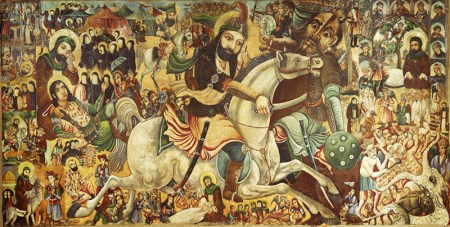
699In the Battle of Kerbala, depicted in Abbas Al-Musavi’s painting, Husayn, the son of Ali and grandson of Muhammad, was killed along with his family and all his followers by the armies of the Umayyad Caliphate. It was the most crucial moment in the split between Shi’a and Sunni Islam. (Image source: Brooklyn Museum)

The Ummayads in Damascus, the imperial capital, were the first dynastic rulers among Arabs in Islamic history. The founder of the dynasty, Muawiyyah, seized power following the murder of Ali, the fourth Caliph and the cousin and son-in-law of the Prophet. With the Ummayads the institution of the Caliphate, which was an innovation to fill the void of leadership among the Arabs in Medina following Muhammad’s death, adopted the pomp and pageantry of the Persian and Byzantine rulers. The Caliphate, from that first century of Islamic history until its abolition in 1924 by Mustafa Kemal Ataturk, the founder of modern Turkey, was the embodiment of Oriental Despotism.

Those Muslims who witnessed the tribal conflicts erupt after the Prophet’s demise and recoiled in revulsion from politics turned inward in seeking union with the divine mystery, as mentioned in the Qur’an. They sought solace in the spiritual dimension of Islam and emulated the Prophetic tradition of withdrawal from the world through prayer and meditation. They became the founders of the Sufi, or mystical, tradition in Islam. This was the “other” face of Islam, distinct from political Islam.

The physical expansion of the Islamic empire was carried forth by the armies of the Caliphs. But the spread of Islam as a faith tradition was a slow process, carried forth by Sufi missionaries belonging to various fraternal orders and independent of political rulers of the world of Islam.

There is a world of difference in conversion brought about at the point of sword of conquering armies, and conversion that results from the communion of hearts and minds among people. The latter is more genuine and transformative than the former in every religion. The Qur’an itself — verse 49:13 — warned the Prophet that the acceptance of Islam by the Arabs of the desert was one of submission in the face of defeat, and that belief had not entered their hearts. This verse might be read as forewarning of crimes Muslims would commit through history in the cause of political Islam, beginning with the killing of Husayn in Kerbala.

Political Islam from its outset was an inquisition. It began with Abu Bakr, the first Caliph, when he subverted the Islamic principle stated in the Qur’an — “there is no compulsion in religion” (2:256) — and declared war on those Arab tribes who withheld their loyalty from him following the death of the Prophet. The “Ridda Wars,” or the “Wars of Apostasy,” launched by Abu Bakr inaugurated political Islam, and since then, the precedent he set for Muslim-on-Muslim violence has plagued Islamic history into our times.

The role of the a’lem (pl. ulema; religious scholars) was instrumental in the making of political Islam. The ulema provided legitimacy to the Ummayad Caliphs in Damascus in the period of intra-tribal conflicts that had led to the killings of the three Caliphs (Umar, Uthman, and Ali) after Abu Bakr and then the massacre in the field of Kerbala.

The consensus of the ulema — accepted by those who eventually came to represent the majority Sunni Muslims (the word “Sunni” derived from Sunna, meaning following the path or tradition of the Prophet) — was that political and social order however provided and maintained was preferable to fitnah (disorder). This consensus provided doctrinal legitimacy to the Caliphs. In return, the Caliphs recognized the special function of the religious scholars and jurists in the drafting, codification, and implementation of Sharia, or Islamic laws.

As a result of this bargain between men wielding swords and men wielding pens, the foundational arrangement of political Islam was firmly established. It was an arrangement consistent with the thinking prevalent in antiquity that religion (deen in Arabic) prescribed the totality of human affairs. This meant, as it was understood by the ulema in the formative period of Islamic history, that the primary function of state and government (dawlat in Arabic) was the establishment of the rule of Sharia. As Ann K.S. Lambton in her study, State and Government in Medieval Islam(1981), observed:

“The law precedes the state and is immutable at all times and under all conditions. The state is there to carry out the law. To disobey a law or to neglect a law is not simply to infringe a rule of the social order: it is an act of religious disobedience, a sin, and as such involves a religious penalty.”

Once the bricks and mortar of political Islam were set in the making of the Islamic civilization, Islam as the official doctrine of the state and empire clearly demarcated the norm as prescribed in the Sharia and made the ulema its official guardians. The Islamic state was a nearly perfect embodiment of a closed totalitarian system designed by men towards the end of the first millennium of the Common Era, and any suggestion of change or adoption of new idea in matters of either religion or politics was condemned as bid’ah (heresy deserving punishment).

But Muslim dissidents who viewed the doctrine of political Islam, or what might also be referred to as “official” Islam, as an aberration, went underground and kept the “other” Islam free from the shackles of politics. Beneath the hardened features of political Islam, the “other” Islam of Sufis provided solace to Muslims by tending to their humanity in the light of God’s most favoured attributes of mercy and compassion.

The “other” Islam, unlike political Islam, is not bound by time and space. It is directed to man’s inner yearnings for that which is eternal. It plunges in search of the inner meaning of the Qur’an as the Word of God, and the assuredness that God’s mercy is not denied to any of His creations. The Qur’an states, “We are nearer to man than his jugular vein” (50:16), reassuring man that he is not alone and God is not some distant uncaring deity.

Whereas the defining characteristic of political Islam was religion inseparable from politics, in “other” Islam politics was the corruption of religion and the dissolution of belief. Hence, from the perspective of “other” Islam, the Sharia as the corpus of Islamic laws codified by the ulema and sanctioned by the Caliphs was a poor, even corrupt, representation of the divine Sharia (in Arabic, a “path”) imprinted in the hearts of all believers as the path to acquiring God’s infinite grace.

ii.

Political Islam and the Islamic civilization it inaugurated was time-bound as a theopolitical system constructed in a certain historical period or context. It was a construct of late antiquity and the early medieval era. Since it was a fixed and closed system, it was invariably given to decay and dissolution.

During the Middle Ages, the Islamic civilization flourished just as other civilizations had. As Abdus Salam (1926-1996) — a physicist of Indo-Pakistani origin and the first Muslim scientist awarded the Nobel Prize for Physics in 1979 — observed in one of his lectures, the world of Islam and the world of Christianity (Europe) were more or less at a similar stage of development around the middle of the seventeenth century.

The evidence of this relative equality of the two civilizations, Salam suggested, could be seen in their technological achievements represented by the two monuments, the Taj Mahal in Agra, India, and St. Paul’s Cathedral in London, England, completed about the same time. Some two decades later, Salam observed,

“there was also created — and this time only in the West — a third monument, a monument still greater in its eventual import for humanity’s future. This was Newton’s Principia, published in 1687.”

Newton’s monument had no counterpart in India, or anywhere else in the Muslim world.

The Renaissance, the Age of Enlightenment and the Scientific Revolution, led by men of astounding intellect from Leonardo da Vinci to Galileo and Newton, propelled Europe out of the medieval age into the making of the modern world. But Islamic civilization, held together by political Islam, descended into a death spiral. A century after Newton published his major work, the Ottoman Empire was turning irreversibly into a pale shadow of a civilization that once had threatened the powers of Europe at the gates of Vienna.

In the aftermath of September 11, 2001 attacks in New York and Washington by the Islamist terrorists of al Qaeda, Bernard Lewis published What Went Wrong? (2002). It was Lewis’s effort to answer why, and how, the world of Islam had failed to accommodate the imperatives of the modern world.

“In most of the arts and sciences of civilization, medieval Europe was a pupil and in a sense a dependent of the Islamic world,” wrote Lewis.

“And then, suddenly, the relationship changed. Even before the Renaissance, Europeans were beginning to make significant progress in the civilized arts. With the advent of the New Learning, they advanced by leaps and bounds, leaving the scientific and technological and eventually the cultural heritage of the Islamic world far behind them.”

The civilizational success of political Islam in late antiquity and the early medieval era ironically carried within it the seeds of its own decline and demise. World War I eventually put an end to the anachronism that the Ottoman Empire had become, and the abolition of the Caliphate was a formal effort to bury political Islam for good.

Thoughtful Muslims, for nearly a century before the demise of the Ottoman Empire and the abolition of the Caliphate, had been thinking and writing about the need for an Islamic reform. Europe’s cultural advancement following the Reformation and Enlightenment held up a mirror for the Islamic world to follow in similar direction to similar ends.

In India under British rule, for instance, there were a significant number of Muslims who painfully recognized the malaise of Islamic societies and offered remedy for their advancement into the modern world. Among them the notable were Sir Sayyid Ahmad Khan (1817-98), the founder of the Aligarh University; Syed Ameer Ali (1849-1928), jurist and historian; and Muhammad Iqbal (1877-1938), poet and philosopher.

One of the most important works was published in 1925 by Ali Abd al-Raziq (1888-1966), an Egyptian scholar and jurist at Al-Azhar University in Cairo. In his seminal work, titled al-Islam wa ‘Usul al-Hukm (Islam and the Fundamentals of Authority), al-Raziq pointed out that there was no basis in the Qur’an and the Sunnah (traditions) of the Prophet for the institution of the Caliphate.

Al-Raziq was not someone from outside the ranks of the ulema, or a lay scholar unfamiliar with the intricacies of Islamic jurisprudence and theology in the construction of Sharia. He was a student of Muhammad Abduh (1849-1905) at al-Azhar, when Abduh had been appointed the Grand Mufti of Egypt.

Al-Raziq’s main contention was based on the distinction between spiritual and temporal authority. He indicated that the confusion among Muslims in the period after the Prophet arose from their inability to distinguish between the Apostolic role of Muhammad and the authority he derived as the Messenger of God (Rasul Allah), and the Caliphate as a temporal institution. Al Raziq wrote:

“Muhammad was but an apostle, sent on behalf of a religious summons, one pertaining entirely to religion and unmarred by any taint of monarchy or of summons to a political state; and he possessed neither kingly rule nor government, and he was not charged with the task of founding a kingdom in the political sense, as this word and its synonyms are generally understood.”

Al-Raziq was denounced by his peers. He was made to appear before the Council of the Greatest Ulema of Al-Azhar to hear the judgment against him, as his license to teach and practice law was revoked. Egypt was then ruled under Britain’s supervision, which likely saved al-Raziq from even more severe punishment.

But al-Raziq had stripped away the argument of traditional Islam on the sanctity of the Caliphate, and with it went the idea of Sharia being sacred. In the half-century following the abolition of the Caliphate by Mustafa Kemal, Muslims under European rule gained their independence as new states emerged in the Middle East and elsewhere in the world of Islam.

This period in the middle decades of the last century was a period of intense expectations on the part of Muslims for progress in their living conditions. A massive effort was invested to make the transition from the world of pre-Newtonian knowledge and learning to the modern world of science, industry and democracy.

There was a consensus among the rich and the poor that Islam was not intrinsically opposed to the modern world. There was a readiness among Muslims to follow in the footsteps of the West.

This consensus was reflected in a well-known and widely circulated aphorism attributed to Muhammad Abduh. On returning to Cairo from a visit to Europe, Abduh told his students, “I travelled in the West and found Islam, but no Muslims; I have returned to the East and find Muslims, but not Islam.”

The transition into the modern world, however, proved immensely complex and difficult. Europe’s transition had required several generations and a couple of centuries to break away from the feudal age into the modern age. The resistance from those invested in the ancien arrangements of society and culture was immense, and wars that followed were fierce.

Something similar to the European experience was unavoidable for Muslims in their effort to break from the hold of their traditional culture. And not unlike the wars in Europe, wars within the world of Islam since the 1970s are symptoms of the Muslim struggle to transit into the modern world.

iii.

The abolition of the Caliphate in 1924 was the formal announcement of political Islam’s death. But it refused to die, even as it was laid to rest. Its twitching was felt in the deep dark interior of the world of Islam, in remote and unwelcome places such as Nejd inside Arabia.

Here in Nejd, the medieval theology of Ibn Taymiyyah had struck roots. It had impressed an eighteenth-century itinerant preacher in the region, Abdul Wahhab (1703-92), who turned Ibn Taymiyyah’s extremist thinking into an even more rigid and austere doctrine, hostile to all things inimical to the Bedouin tribal culture of his time and environment.

Abdul Wahhab’s version of political Islam impressed a local tribal chief, and the marriage of convenience between the preacher and the tribal leader gave birth to the first Saudi state in the interior of Arabia. But when it sent tribal warriors to raid towns inside the frontiers of the Ottoman Empire, it provoked the Caliph of Islam in Istanbul, on whose orders this nascent state of the Wahhabi ruler was destroyed.

But the eventual collapse of the Ottoman Empire provided the conditions for the rebirth of the Saudi state as a kingdom under Abdul Aziz ibn Saud in the 1920s. Fortune, in the guise of great power politics, smiled upon him. He seized the support offered by the British, in return for influence in a region of strategic importance. The discovery of oil made the Saudi kingdom a prize to be protected by the Western powers, first Britain and later the United States, with far reaching consequences for the rest of the world, and even more so for the world of Islam and Muslims.

Any modernizing revolution is hugely disruptive. The movement from one stage of social development to another is not linear; it is, instead, filled with zigzags and reversals at every stage of the process toward an uncertain future.

When a people, however, pushes back against this process of change in their midst, or seeks to abort it, this reactionary effort pins its hopes on longing for an idealized past. The Newtonian revolution and the emergence of modern Europe made political Islam anachronistic. Wahhabism, as the official doctrine of the Saudi kingdom, was much more than a return of the most extreme version of political Islam in the early decades of the last century. It was, and remains, a demented effort of the most backward people within the world of Islam to remain culturally tied to antiquity, or jahiliyya (the age of ignorance), which Islam at its origin derided and rejected.

Political Islam in whatever version — Wahhabism, Khomeinism, Ikhwanism (the Muslim Brotherhood) and their derivatives — has no answer for Muslims on how to make their historic transition into the modern world. It can continue to rage against the modern world until its civilized inhabitants, including Muslims, have had enough of its destructiveness and obliterate it.

Then that vision of Abrahamic monotheism, which Muhammad was mysteriously directed to deliver to his people, will be emancipated from political Islam.

This message Muhammad was given admonished Arabs for their lack of faith, provided them with ethics for living honorably, told them in no uncertain term that the God of Abraham made no distinction among nations and people who believe in Him, and that on the Day of Final Reckoning, they need have no fear if they strive in doing what is right.

This is the “other” Islam. This is submission to truth, whose most righteous exemplar was Abraham when his faith was tested by his Deity, according to the Hebrew Bible, to sacrifice his son. And this is the faith of Sufis who took Muhammad’s message to people in places far removed from the desert confines of Arabia. It is simply, as the Qur’an reminds (30:30), deen al-fitrah, the natural religion, or inclination, of man to know his Creator. There is no return of this “other” Islam; it never went missing.
Islamist Extremism in America: The Islamic Jurisprudence Center

July 3, 2016

Islamist Extremism in America: The Islamic Jurisprudence Center, Clarion Project, Jonathan Ruano de la Haza, July 3, 2016

Sulaiman-Anwar-640-320Sheikh Suleiman Anwar of the Islamic Jurisprudence Center. (Photo: © Screenshot from video)

In June 2015, Sheikh Suleiman Anwar founded the Islamic Jurisprudence Center (IJC) in Clarksburg, Maryland. The center’s mission was “to promote and advance the understanding of and compliance with Islamic law (Sharia) in all aspects of life.”

This mission statement might seem tame, except that Anwar’s webpage reveals a worldview that is remarkably extreme compared to that of most Muslim organizations in the West. Anwar wants total Sharia according to the Saudi model, where the hands of thieves are cut off. He rejects secular liberal democracies and pluralism within Islam.

Here we explore Anwar’s Islamist worldview and show what happened when it is implemented in Muslim countries.

Why is Suleiman Anwar important?

Anwar deserves greater scrutiny for a number of reasons. He is the microcosm of the globalization of Islamist concepts.

In 2004 and 2006 respectively, Anwar completed two master’s degrees in Islamic jurisprudence at the International Islamic University (IIU) in Islamabad, Pakistan, and the University of Sana’a in Yemen. Funded by Saudi money, IIU is an Islamist university teaching a rigid Saudi version of Islam and rejecting all other interpretations of Islam.

The atmosphere on IIU’s campus is Orwellian. IIU alumni Amna Shafqat recalls burqa clad women distributing pamphlets to IIU students, which call for the release of terrorist Afia Siddiqui and the murder of blasphemers and blaspheming cartoonists (like theCharlie Hedbo cartoonists).

Worse still, IIU is a key recruiting ground for the Jamaat-e-Islami, Tazeemi Islami, and other Islamist parties, which sometimes serve as gateways to terrorist organizations.

This was the environment in which Anwar pursued his master’s degree and his webpage and Facebook page contain Islamist ideas which mirror the beliefs swirling around IIU’s campus.

Anwar also used his position as Imam in order to promote Islamism. After completing his studies in Yemen, Anwar returned to the United States and served as Imam for the Islamic Society of Annapolis (May 2009-April 2010) and then the Tazkia Center and Masjid Umar (January 2011-October 2014). He accepted invitations to deliverJumu’a Khutbas (sermons) and lectures at fourteen Islamic organizations in Maryland, Pennsylvania, and Washington D.C. and Toronto, Canada.

Thanks to YouTube, there is a record of what Anwar said at one of these events. In September 2010, he openly endorsed the Khilafah or Islamic Caliphate along with an extreme form of Sharia: “We are not living under the Khilafah. There is a big fitna [i.e. social unrest] going on, if you haven’t noticed. – and much of the fitna is happening because we don’t have Khilafah. And then there are many people who don’t want Khilafah, because they want to continue being criminals so that their hands don’t get cut off.”

The Fatwas

In early 2016, Anwar started issuing fatwas or Islamic rulings as executive director of the IJC. Two of these fatwas merit our attention. On March 20, 2016, Anwar issued an Islamic ruling denouncing purportedly “pseudo-Islamic organizations” and “pseudo-Imams” as disbelievers for telling Muslims that “it is permissible to live by a partial Sharia (instead of its totality).”

Anwar’s support for total Sharia governance is troubling, since even implementing partial Sharia governance has negative consequences for people’s lives.

For instance, Mauritania, Nigeria, Egypt, Sudan, Somalia, Jordan, Saudi Arabia, Yemen, Oman, UAE, Qatar, Bahrain, Kuwait, Syria, Iraq, Iran, Afghanistan, and Malaysia maintain the apostasy law on their books.

This law says that Muslims will face the death penalty for leaving Islam.

Although rarely used, the apostasy law’s existence has fostered a climate of fear that forces ex-Muslims to live in the closet. It also gives extremists an implicit license to murder ex-Muslims and even secular Muslims on the grounds that they are apostates of Islam. I personally know Pakistani and Nigerian ex-Muslims who are forced by this law to conceal their innermost thoughts and feelings while in public. One of them temporarily fled his community, because he came out as an atheist. He was only welcomed back to his community after agreeing to revert to Islam.

On June 13, Anwar wrote another fatwa on the Council of American-Islamic Relations (CAIR), the Islamic Society of North America (ISNA), the Muslim American Society (MAS), and the Islamic Circle of North America (ICNA). These organizations subscribe to Islamic beliefs that range from moderate to conservative and are politically linked to the Muslim Brotherhood. Anwar, however, thought that they were not Islamic enough.

His fatwa declared that “anyone who supports CAIR, ISNA, MAS, or ICNA, or any organization affiliated with them in any way, is a kafir (disbeliever) and a traitor to Allah and His Messenger.”

He added that this fatwa was meant to prevent Muslims “from dying upon kufr (disbelief), and consequently entering hellfire.” In effect, Anwar was supporting an unelected theocracy that outlawed pluralism within Islam and quashed secular democratic sentiments. Anwar despised the “Interfaith system,” since it “promotes equality of the religions.” He also accused these Muslim organizations of betraying Islam for promoting “the secular, divisive, corrupt, and immoral democratic system of government and encouraging Muslims everywhere to believe in and implement such beliefs.”

The scary thing is that the ideas contained in Anwar’s June 13 fatwa have actually been implemented in some Muslim countries.

A principle problem in the current war in Syria and Iraq is extremists dehumanizing people from other Islamic sects for not conforming to their vision of Islam. According to this extremist perspective, these other Islamic sects are a source of fitna (i.e. social unrest) and the logical way to achieve peace is by exterminating them. Likewise, anti-secular and anti-democratic sentiments have also had harmful consequences for many Muslim-majority communities.

The secular democratic system plays a key role in representing and managing the differences of religions and cultures in a peaceful way. The rejection of this system has resulted, for instance, in the use ofPakistan’s blasphemy law in order to persecute Shia, Ahmadi, Christian, and Hindu religious minorities.

The United States’ free speech laws allow a person like Anwar to promote extremism. Yet Anwar’s fatwas should not be the final word on Islam or on how political, economic, and cultural orders should be organized. Resident Americans of different backgrounds belong to an open society where ideas are studied and judged on their merits.

When Anwar issues his fatwas and calls upon Muslims to reject religious pluralism, secularism, and democracy, and embrace a political order like Saudi Arabia’s, liberal-minded people cannot afford to stand by and do nothing.

The preservation of an open society, which protects civil liberties and embraces cultural and religious diversity within reason, depends upon good people exposing and discrediting absolutist ideas which go against the principles of a free nation.

VIDEO — Geert Wilders: Stand for Freedom!

June 30, 2016

VIDEO — Geert Wilders: Stand for Freedom! Gatestone Institute via YouTube, June 30, 2016


ISIS is a Footnote: The Real Threat is Sharia and Islamic Supremacism

June 29, 2016

ISIS is a Footnote: The Real Threat is Sharia and Islamic Supremacism, CounterjihadShireen Qudosi, June 29, 2016

Dr. Zuhdi Jasser, a top North American Muslim Reformer, sees Muslim reformers “as the most essential head of spear in the battle against Islamic theocracy.” The largest collective of Muslim Reformers are presently in the United States.

“Ideas of freedom can happen in the laboratory of America,” adds Dr. Jasser. The West offers Muslim voices for humanity a level of freedom that is unmatched in any other part of the world, making Western Muslim reformers critical in this battle against radical Islam — particularly because truthful conversations on faith are painted as persecution, courtesy of the regressive left.

**********************

The battle against radical Islam isn’t an ‘over there’ fight confined to the wastebin landscape of some forgotten town. It’s a ubiquitous problem that takes place on American soil in two forms. The first is through direct jihadi attacks as we most recently saw in Orlando; the second takes the form of political warfare.

Yesterday, the battle of ideas took place on the floor of a Senate hearing spearheaded by Senator Ted Cruz. The “Willful Blindness” hearing, attended by Dr. Zuhdi Jasser,Philip Haney, and Andrew McCarthy among others, offered testimony to better understand barriers to combating radical Islam.

Other witnesses included soft-Islamist Farhana Khera, President and Executive Director of Muslim Advocates, who refused to admit that jihad or radicalization had absolutely anything to do with radical Islam. In fact, Senator Cruz’s attempt to engage Khera in dialogue yielded a minimum of 6 instances of denial within five minutes, with Khera defaulting to a regressive left narrative that the conversation is somehow empowering ISIS.

National security consultant Chris Gaubatz debunks the myth of an all-powerful and seeing ISIS:

“The global Islamic movement is made of terrorist groups and nation states; all seeking to impose sharia.”

ISIS is a footnote at best, not the bogeyman that Islamists try to threaten free speech with. The real threat is sharia and a mindset of Islamic supremacism.

Testimony was also provided by Michael German, a fellow of the Brennan Center for Justice and a former FBI Special Agent. German sees radical Islam as a problem but not in the context we would assume is logical based on the facts and common sense. In the same line of thinking as Khera, German denounces a theological association with violent acts of terror under a political doctrine.

German’s reasoning fails. He is neither expert in nor a student of Islamic theology. Had he an objective mind and trained scholar in both academic and traditional Islam, he would see that Islam has become a highly political system that forms and orchestrates national movement. The version of radical Islam adopted by terror groups is not that different than the version of Islam adopted by Islamic states – and to go further – the version of Islam that Islamists identify with. All versions ultimately hold Islam as supreme, paving the way for what is an undeniable theological supremacy. In other words, Islamic supremacy. And that understanding of Islam is adopted by billions of adherents.

In the same vein of thought as Islamists, German believes “radical Islam” is used to smear a faith group. He further argues “collective national security [is not achieved] by undermining security of others.” For German, “Ideas cannot be killed and ideologies cannot be destroyed.” He points to Nazi ideology that while defeated, was not destroyed.

However, radical Islamic ideology can be challenged and destroyed…from within. A growing movement in partnership with allies is already underway by Muslim reformers. Reformers are the new wave of Muslim scholars appearing nearly a millennia after the original Muslim free thinkers, the Mu’tazilites. The waves of movement in Islamic critical thought from the time of the Prophet, through his passing, and till today, shows that Islam is not the monolith German and Khera try to depict.

Andrew McCarthy, a former Chief Assistant U.S. Attorney, understands Islam has seen a struggle to define itself from its earliest days. As McCarthy points out, Muslims “have not settled the question what is an authentic Islam.”

Dr. Zuhdi Jasser, a top North American Muslim Reformer, sees Muslim reformers “as the most essential head of spear in the battle against Islamic theocracy.” The largest collective of Muslim Reformers are presently in the United States.

“Ideas of freedom can happen in the laboratory of America,” adds Dr. Jasser. The West offers Muslim voices for humanity a level of freedom that is unmatched in any other part of the world, making Western Muslim reformers critical in this battle against radical Islam — particularly because truthful conversations on faith are painted as persecution, courtesy of the regressive left.

For McCarthy, the focus needs to shift to the supremacist interpretation of Islam that is fundamentally at odds with Western values. A clash of civilizations between Islam and the West is not a case of multiculturalism where room can be made for both. Islamic supremacism in its nature allows for only one ideology: its own.

So while German underscores that radical Islam is not a problem – that it is a misnomer – McCarthy points to history which shows us something entirely different. He summarizes that a struggle in Islam has been “ongoing for fourteen centuries supported by centuries of scholarship,” adding that “Islam is less a religion than a political radicalization with a religious veneer.”

McCarthy doesn’t see this as something the U.S. can fix, but it is something that we need to understand and not obscure – particularly because as Chris Gaubatz added, “We can kill every member of Al-Qaeda tomorrow, but it won’t end.”

Zuhdi Jasser added that America has “a sophisticated whack-a-mole system” of combatting terrorism. These are key assessment recognizing that ultimately we need to target the ideology and develop a system that moves beyond a fear of might trigger ISIS – a running theme for both Khera and German.

Khera along with German were both supported by Senator Dick Durbin who brought up a failed ongoing argument that needs to die: Westboro and the KKK are no more Christian than ISIS is Islamic. A cheap, tired trick, it shows a fundamental lack of knowledge about both Islam and Christianity.

Westboro and KKK are not acting in the footsteps of Jesus. However, ISIS is in many ways following the post-Medina violent warring behavior of its prophet, Muhammad. If we’re to see whether something is Islamic or Christian, we need to look at the verses and the leadership. Christianity did not have a violent Jesus and the teachings of Christ himself do not advocate violence. On the other hand, Islam has a violent version of Muhamad, which however justified in whatever context, is still violent and includes violent rhetoric that justified jihadi and supremacist agendas.

Germans builds on the back and forth highlighting Nazi Germany was defeated in part by criminalizing the ideology, something he feels can’t be done with Islam because the ideology can’t be scrubbed. I would argue we’ve already scrubbed so much: over 900 instances of references to jihad and Islam from official documents in what is a systematic purge of intelligence in a critical war.

Let’s go further still and get to the actual problem: the ideology. We need to do the same to political and violent doctrines in Islam, while supporting alternate voices found in reformers who are well on their way by outrightly challenging the theology or through grassroots efforts calling for modernized adaptations.


Mark Christian Moment: Can Any LGBT Individual Survive a Day Under Sharia Law?

June 28, 2016

Mark Christian Moment: Can Any LGBT Individual Survive a Day Under Sharia LawThe Glazov Gang via YouTube, June 27, 2016

(The speaker, now a Christian, is a former Muslim imam. — DM)

Another Terrorist Attack in Africa. Ho Hum

June 27, 2016

Another Terrorist Attack in Africa. Ho Hum, Power LineJohn Hinderaker, June 27, 2016

Yesterday afternoon, Muslim terrorists associated with al-Shabaab attacked a hotel in Mogadishu, Somalia, killing at least 35:

The assault, the latest in a series by the Islamist group targeting ­hotels and restaurants, began when a suicide bomber detonated a car laden with explosives outside the building.

Somalia terror attack

Gunmen then stormed Mogadishu’s Naasa Hablood hotel and gunfire rang out for several hours, witnesses said, before the authorit­ies declared the attack over.

The car-bomb blast came at about 4.30 pm on Saturday local time and produced a large column of smoke over the hotel, which is frequented by politicians.

A cabinet minister was among those murdered.

Gunmen fought their way ­inside, and a witness said they began shooting randomly at hotel guests.

Blood was splattered on the hotel floor. …

It is the Muslim holy month of Ramadan, when extremists often step up attacks in this volatile country in the Horn of Africa.

Likewise, Christians launch terrorist attacks during Lent. Just kidding.

“They came shouting ‘Allahu Akbar!’ and fired bullets on every side,” said a hotel staffer who ­escaped through the back door.

Of course they did. They always do, to emphasize that their murders have nothing to do with Islam.

“They are devils who merely care for death and blood.”

“Devils” is a fair, well-considered characterization. I have nothing particular to say about this attack–one of many–except that I don’t think it should pass unnoticed. al-Shabaab is devoted to establishing sharia law in Somalia. Who knows, it might succeed. Certainly it won’t fail due to any intelligent action on the part of the Obama administration or other Western powers.

mogadishu-attack-685x320

Why I Renounced Islam, Allah, and Muhammad

June 24, 2016

Why I Renounced Islam, Allah, and Muhammad, Front Page MagazineDr. Majid Rafizadeh, June 24, 2016

gh (1)

I never thought I would have the courage to publicly announce that I have left Islam. I have been hesitating to openly declare this; according to many Muslim leaders, I am now an “infidel,” the worst thing I can possibly be in their eyes. I was mostly concerned about the repercussions and risks to my family and relatives. But, in the face of the horrors that have spread throughout the world, I have finally made the decision to write my life story in “The Muslim Renegade: A Memoir of Struggle, Defiance, Enlightenment, and Hope.”

A Muslim believes that the Qur’an contains the verbatim words of Allah and should be implemented without reservation, regardless of time and geographical location. The Islamic reward for killing an unbeliever or apostate, someone who departs from Islam and renounces Allah and Muhammad, is receiving the best place in heaven, according to some Islamic teachings. The penalty for renouncing Islam is execution, legally administered in Islamic societies by governments, Islamic courts, or some religious groups and individual Muslims who desire to fulfill their duty prescribed by God (Allah), Muhammad, and the Qur’an. These Islamic and Sharia laws did create some concerns, fear and caution in me to tell my story.

If you are born into, or become a follower of Islam, abandoning it is not an easy task. A Muslim is indoctrinated from the early childhood. I believe the indoctrination evolves and transforms into deep-seated fear about questioning, let alone rejecting, Allah, Islam, and Muhammad’s rules. Deciding to be free and independent, liberating oneself from being the slave of Islam, become inconceivable and out of question. Once one becomes the slave of Islam, it kills his/her courage and will to leave it. As was also mentioned, Islam and Muslim leaders also punish abandonment of Islam, Allah, and Muhammad with death.

I grew up in a religious family in Islamic societies until a few years ago. I was one of the few who genuinely read the whole Qur’an word by word. I read it several times, and attempted to follow the rules meticulously, line by line. I didn’t just see my religion as a title; I wanted to live it as a devout Muslim. To do that, I had to be a strict follower of Islamic rules. I was the “good” Muslim according to many imams I spoke with.

But who is this “good” Muslim, according to Islamic teaching? A good Muslim follows Allah’s verses word by word. You cannot cherry pick the rules that you like or that you want to apply in certain situations. You must follow every legal, social, and spiritual rule. Not just anyone can be a good Muslim; a good Muslim feels a deep-down belief that they have been “chosen.” Only you are on the right path, and everyone else from other religions, even other Muslims, is not on this sacred path that leads to salvation. A good Muslim must also be a follower of his imam or ayatollah in addition to Allah, Muhammad and the Qur’an. Socially and legally speaking, according to Allah’s words in the Qur’an, you must accept “Allah’s rules” that a man can marry more than one wife simultaneously without asking for their permission (as my father did), that the testimony of a woman is not equal to that of a man in the court of law, that women inherit much less than men (half of what their brothers inherit), that you can have as many temporary marriages as you want, that having slaves is not an issue, that you should not be a passive Muslim, but you should be a jihadist who is willing to impose Allah’s rules in any society by following three steps: telling those who are not following Islam the correct path, if they do not listen, warn them, and if they still defy, punish them (resort to violence). A good Muslim believes in the superstitions that the Qur’an details such as the “evil eye.” A good Muslim hides some of his/her true feelings, avoids having normal fun, and views other religions as incomplete since Allah states in the Qur’an that Islam is the last religion that completes all the deficiencies of other religions, and so on.

When I came to the United States a few years ago — before the Paris, Orlando, San Bernardino, London and other recent terrorist attacks — I attempted to raise awareness and warn about the inevitable terrorist attacks that were going to happen in the name of Islam. Islam can provide a powerful language and tool to commit some of the worst crimes against humanity, while simultaneously the perpetrators of those attacks feel blessed, privileged, rewarded, and on the winning side.

Unless we gain a better understanding of the nature of Islam, its transformation and reliance on Qur’anic verses, as well as its norms, values, principles, and ideology in the modern world, we will not be capable of addressing this threat. It will only to continue to increase in intensity and spread further than most can imagine.

I am not suggesting this based solely on an academic and epistemological view of world cultures, but on my first-hand experience of growing up, studying, and working in predominantly Muslim societies for most of my life. I was born in the Islamic Republic of Iran and grew up in both Arab and Persian cultures.

It is my opinion that those who try to convert people into Islam first begin with some appealing notions from Islam. Once you sign up to the religion (by pronouncing two sentences: Ash hadu an la ilaha ill Allah wa ash hadu anna Muhammadar Rasul Allah; “I declare there is no god but Allah and I declare that Muhammad is the Messenger”), then gradually the restrictions, discriminatory rules against women, etc. will slowly follow. Without the new convert noticing, he/she becomes the slave of the Islamic ideology as well as the imam. Your freedom will be taken, and a new world, new God (Allah), and new set of rules will be created for you. Once you submit to Islam, there is no way to return, because if you leave this ideology, you are an infidel, an apostate who deserves to be killed, according to Allah’s words in the Qur’an.

In my book I share my own experiences in part because I believe deeply that as people become more interconnected, the most dire challenge to the current world order—to Western democratic values, universal human rights, the rule of law, social justice, gender equality, civilized society and all of humanity—is not nuclear bombs, chemical weapons, or other military capabilities, but it is modern Islamic ideology. For how long will the mainstream media and politicians remain “politically correct” on this issue? My intent is to raise awareness of what is happening in the very shielded and silent corners of fundamental Islam. To me it is imperative that the American people be educated about extremist Islamists who view them with such intense hatred.

Is the Islamic ideology an ideology of peace as many Muslims and imams argue? There are some verses and ideas in the Qur’an (likely plagiarized from the ideas of Christianity and Judaism) that do promote positive things.

But the violent and discriminatory rules in the Qur’an overshadow any hint of peace.

Would you consider an ideology or a leader peaceful if that leader tells you one good thing, but, at the same time, tells you that you can kill in the name of this ideology (as stated by Allah in the Qur’an)? Will you follow someone who tells you one good thing, but then tells you that women should not be considered equal to men in the legal system?

The Islamic ideology, its harsh teachings, and impossible rules, created contradictions inside me. I began soul-searching, which led to my inner transformation and revolution. I was born as a slave into this ideology, and finally I had to be free to make my own life choice (when I was in Iran few years ago) to liberate myself from the chains of this ideology. Doing so, leaving everything I had been taught for more than two decades, was not an easy task.

If you are born into a Muslim family and live in a Muslim society, where Sharia and Islamic laws are being legally implemented by the system, it is heartbreaking and dangerous. The fear of violence and death has permeated my life from the moment I was born — up to this very moment. Despite the risks, I feel I must speak my truth. The chains and cruel threats of this ideology will haunt you wherever you are. Knowing that I would become a target, along with my family and friends, knowing that I would lose everything I ever held dear (including many of my family and friends), I could have given in to my fear. Instead, I decided not to. It was a decision I had no choice but to make.

German Architect: Demolish Churches, Build Mosques

June 23, 2016

German Architect: Demolish Churches, Build Mosques, Clarion Project, June 23, 2016

Germany-Mosque-Hamburg-HPThe call to prayer at a mosque in Hamburg (Photo: Video screenshot)

Breitbart notes that Reinig remarks come “after a report this month revealed that half of Turks in Germany regard Islamic law supreme over German laws and that young people are the most devout.”

************************

A prominent German architect has argued that the key to integration of Muslim immigrants in Germany is to build mosques, while at the same time demolishing churches.

Joaquim Reinig’s remarks were published in an interview with Die Tageszeitung and reported in English by Breitbart.

Reinig said that essential to integration is that immigrants should “have no fear” that their new country is asking them “to lose their identity in this society.”

The building of mosques, particularly the “visible minaret,” he says, sends this “message to the migrants.”

Reinig believes that the mosques are a positive influence on migrants, taking on the vital role of community workers.

Speaking about the previous influx of Turkish immigrants, who came to Germany as temporary workers, Reinig said that when they came, they were “relatively secular,” but when they decided to stay, they “remembered “their religion.

“The desire to become a German citizen and the activation of their faith ran parallel,” he said.

Breitbart notes that Reinig remarks come “after a report this month revealed that half of Turks in Germany regard Islamic law supreme over German laws and that young people are the most devout.”

Although Reinig says there is plenty of room for mosques in Hamburg – “theoretically 50 locations – he recommends demolishing churches rather than converting them.

Breitbart reports that Reinig “noted that around three per cent of Christians in Germany, 23,000 people, attend church in the region compared to the 17,000 Muslims who currently attend mosques in Hamburg.”

Reinig said he does not anticipate that other faiths will have a problem with his proposals.

“Jews, Christians and Muslims, as members of Abrahamic religions, are theologically brothers and sisters,” he said. “They have many similarities so should have no fear.”

Dr. Jasser takes part in a Hannity special report Jihad In America 06.17.2016

June 20, 2016

Dr. Jasser takes part in a Hannity special report Jihad In America 06.17.2016 via YouTube, June 20, 2016

The blurb beneath the video states,

Dr. Jasser takes part in a Hannity special report Jihad in America discussing the recent Orlando massacre, Islamism, the Middle East and Muslim policies of both President Obama and the GOP presumptive nominee Donald Trump as well as the importance of properly identifying the issue within Islam that cultivates some followers to become radicalized.

Visit the American Islamic Forum for Democracy at http://www.AIFDemocracy.org

Join the conversation on Twitter @AIFDemocracy @DrZuhdiJasser