Archive for the ‘Russia’ category

That Other Side of Russia’s Syria Campaign…

November 15, 2015

That Other Side of Russia’s Syria Campaign…, Independent Strategy and Intelligence Group, November 14, 2015

(Obama’s America isn’t “winning the war” against the (non-Islamic) Islamic State. If Putin’s Russia isn’t either, who will — France? — DM)

True to form, Vlad is increasing operations and the size of his military’s footprint in Syria while lowering the bar of what constitutes “success.” In a recent piece (“Russian-Backed Offensive in Syria Begins to Stall-What Now?”) we discussed how out of all the fronts in the multi-pronged offensive the pro-regime forces are engaged in, only Aleppo has seen any gains – although those gains have been mixed. The SAA and IRGC had to divert resources from the Hama and Idlib fronts just to sustain the Aleppo offensive and achieve the gains that they did – all while sustaining heavy casualties in the process. The diverting of personnel and resources grounded the remaining forces in Hama and Idlib to halt. In some cases they’ve actually lost ground in the two fronts. The only thing that has kept them from driven out of those areas completely is the fact that al-Nusra sent a lot of their fighters to Aleppo, meaning the opposition factions don’t have the manpower to seize the initiative. And so they wait.

Russian-Backed Offensive in Syria Begins to Stall-What Now?
http://isisstudygroup.com/?p=9219

Has Assad’s New Offensive Changed Syria’s Front Lines?
http://www.syriadeeply.org/articles/2015/11/8733/assads-offensive-changed-syrias-front-lines/

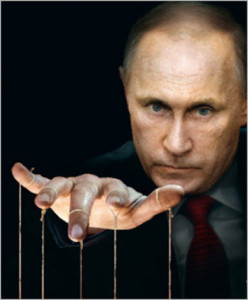
puppet-master-248x300The Puppet Master Source: Derek Bacon (Getty Images)

As of this writing the Russian military has 18 artillery pieces and 9 combat helicopters deployed west of Tadmur with a Spetsnaz unit also operating in the area. Initially these forces were focused on supporting the Assad regime’s multi-pronged offensive in the Northwest due to the major threat the opposition forces posed. Since mid to late-OCT Vlad has conducted airstrikes in Halab Province as part of the effort to disrupt the Islamic State’s (IS) push on the Aleppo supply line. Airstrikes have also been conducted on Raqqa City, Dayr az-Zawr and areas just outside of Damascus. That said, the Russian military is struggling to satisfy the fire support requests of pro-regime forces. The Russian military has 32 combat aircraft, 16 combat helicopters (with more than half in Tadmur) and a Brigade-sized element of artillery.

We’re not surprised that Vlad’s IO guys are trumpeting the recapture of a couple villages and a derelict airbase (Kweires) in Aleppo Province – especially since opposition forces operating in the Ghab Valley were blocking regime advances just a few days ago. Then there’s Jaysh al-Fatah seizing control of several villages in Hama Province. They’ve been poised to push deeper into the areas Northwest of Hama City as of 10 NOV. Regarding Kweires, the recapturing of the base has more symbolic than tactical value. Vlad is hoping the symbolic victory will galvanize the SAA (we’re not holding our breath).

Syrian Regime, Allies Boast of Breaking Aleppo Air Base Siege
http://www.wsj.com/articles/syrian-government-forces-allies-boast-of-breaking-aleppo-air-base-siege-1447265552

Vlad’s increased sense of urgency is understandable considering the current state of the SAA, not to mention the mounting losses of the Iranian military force in-country. Since OCT the IRGC has lost four senior officer to include their most senior official – BG Hossein Hamedani (Reference “Pro-Assad Forces Experience Setbacks Despite Russian Military Intervention”). Even Hezbollah has lost several senior commanders, such as Hassan al-Haj. GEN Suleimani deployed an additional 2,000 IRGC-Qods Force operators to Syria this past summer in response to combat losses. Our sources have informed us that even Ayatollah Khameini has been getting worried about the increase in casualties from the ongoing offensive, which was the driving force behind his decision to deploy additional conventional IRGC personnel (armor, artillery etc). Thing is Khameini is busy trying to keep the Iranian public from learning that things aren’t going as well as advertised. Vlad is already prepping his own domestic audience for a prolonged Russian mission in Syria.

Pro-Assad Forces Experience Setbacks Despite Russian Military Intervention
http://isisstudygroup.com/?p=8778

The Main Intelligence Directorate (GRU) is central to Vlad’s efforts to shape domestic and international opinion of the Syrian campaign – especially against the US. A great deal of the IO portion of this campaign involves messaging that highlights Russia’s humanitarian work (of course leaving out the part about indiscriminately targeting civilians) blames the US and its allies for the Syrian regional war and the rise of IS – even to the extent of claiming that Team Baghdadi is really an “American puppet” (FYI that messaging would work if the Obama administration wasn’t grossly incompetent). There’s actually been some inconsistencies with their messaging, because on one hand they’ll claim the US is “orchestrating” IS’ activities while running a parallel series of messaging highlighting American failures to combat the terror group – they may want to tighten up their shot group in that regards. Our in-country sources report the use of UAVs to distribute leaflets warning opposition fighters of their impending “annihilation” if they don’t flee the area. Another area GRU has been busy is employing the services of independent bloggers, sympathetic website admins and pro-Vlad organizations to distribute messaging. They’ve also been creating fake personas to convey IO themes and present counter-arguments to anything critical of Russia’s intervention, the Assad regime and Vlad himself. We’ve encountered a few of these personas on our Facebook and Twitter feed – they’re not hard to identify since they tried to bait us into divulging the identities of our sources (which isn’t going to happen).

In order to fully understand what’s going on, one must first understand Vlad himself. Our favorite KGB officer has gone his whole life trying to avoid the appearance of “weakness.” Also, his perception since the invasion of Crimea of being labeled a “pariah” by the West likely compels him to be aggressive on the international stage – especially when it comes to projecting power in the Middle East. His KGB service continues to drive his worldview. An example of this is time as a KGB officer in Dresden left a particular mark on his psyche as it was during the last days of the Soviet Union – which he refers to as “the most traumatic experience of his life.” So it should come as no surprise that he views himself as Russia’s lone “champion” that can stand up to defend against America. As such, he views Syria as an opportunity to replace US influence and more importantly, as a test of his reputation and Russia’s international prestige.

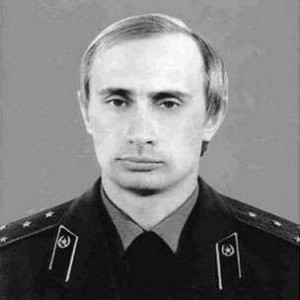
putin_Young-300x300A younger Vlad Source: PBS

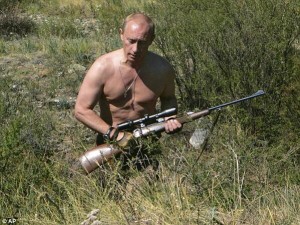
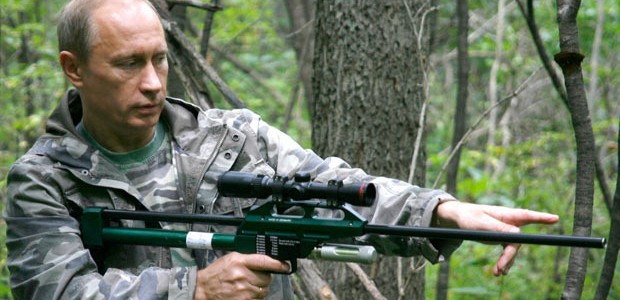
He has a constant need for recognition and validation, which is why popularity polls are so important to him and why his cult of personality was crafted. Ever wondered why he’s always posing in photos lifting weights, doing the topless horse-riding thing or shooting things? That’s why. Interestingly enough, Vlad was his parents’ only surviving child, and was considered small, weak and sickly. Before that, his parents went through a great deal of hardships during the Siege of Leningrad during WWII. In other words, nothing came easy for him – which we respect. Still, he grew up being regarded as “special” – which resulted in the special snowflake growing up thinking that he was “superior” to everybody else (this is the one thing he has in common with President Obama). As for Vlad’s childhood, he grew up in a rat-infested one-room apartment. It certainly wasn’t the privileged childhood of traveling to exotic locales that his American counterpart got to enjoy. Since he was small, fights occurred regularly – which led to his current interest in martial arts. As for his signature unemotional facial expressions, those are a product of a well-cultivated effort to project strength and guard against unwelcome emotional responses, such as sadness or fear. Acts that he views are intended to undermine or humiliate him will result in his escalating a situation in response. He will only “back off” on his own terms – such as feeling a negative response might come from the public, for instance. For instance, his response to the 2011-2012 Moscow protests is a reflection of his sensitivity to internal dissent. His actions since that time – increased public outreach and propaganda efforts – are geared towards reinforcing the narrative he made of himself as being “indispensable.” The current fight against IS (and the West) is a big part of that plan.

putin_gun-300x225He sure doesn’t seem to like wearing shirts, now does he? Source: Associated Press

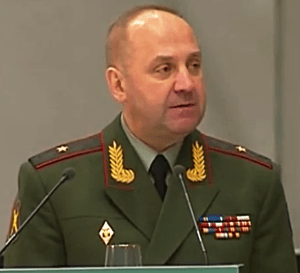
The architect of Vlad’s Middle East strategy is GRU Chief Igor Sergun, who was added to the EU’s sanctions list last year in response to his involvement of Russia’s Ukraine campaign. Specifically, he’s a member of Vlad’s “circle of trust” who holds the distinction of being one of the few people involved in the decision-making process leading up to the Crimea invasion receiving the “green light.” More recently, Sergun became a major advocate for Russia to increase its presence in the Middle East. He was the point-man involved in the negotiations that led to the establishment of the joint-intelligence coordination centers in Iraq and Syria (Check out “Russia Providing Lethal Aid to Syria, Iran and Establishment of Intel Centers in Iraq” and “Russia Poised to Increase Military Presence in Middle East in Response to Islamic State’s Strength” for additional info). Of note is that Sergun sees bilateral ties as a means of learning about Western intentions and countering them. The US is just “gaga” over this guy’s smile, but the turn is that he’s the leading figure behind the current IO campaign against the US. This guy has a plethora of experience, having joined the GRU in 1984. From 1989-1992 he served undercover under the guise of being a “military attache” in Stockholm and Tirana in 1997. As a side note, we hear that Sergun loves gardening to unwind and has a nice little dacha near Moscow (we’re working to obtain pics).

Russia’s Military Chief and deputy PM added to EU’s sanctions list
http://www.ft.com/intl/cms/s/0/4a3ff1cc-cf71-11e3-bec6-00144feabdc0.html#axzz3rZBrt6dm

Ukrainian Rebel Commander Identified As Russian GRU Military Intelligence Colonel

Ukrainian Rebel Commander Identified As Russian GRU Military Intelligence Colonel

Russia Providing Lethal Aid to Syria, Iran and Establishment of Intel Centers in Iraq
http://isisstudygroup.com/?p=8532

Russia Poised to Increase Military Presence in Middle East in Response to Islamic State’s Strength
http://isisstudygroup.com/?p=8416

igor-sergun-300x273Igor Sergun: Likes to channel his “Inner-Martha Stewart” for relaxation. Source: The ISIS Study Group

The guy Sergun hand-picked to oversee intel and IO operations in Syria is COL Pavel Vladimirovich Petrunin. His duties involve the coordinating of intel-sharing with the SAA, IRGC and other pro-regime elements, such as Hezbollah. One of the things he’s been heavily involved with is overseeing the creation of IO messaging that emphasizes Russian/Syrian “successes” no matter how minor. According to our sources, he’s also been engaged in stream-lining offensive cyber-warfare operations with the Syrian Electronic Army in the targeting of opposition social media accounts and web sites – even targeting American and allied computer systems. One of the more interesting things we’ve learned is that he was the one who recommended spinning fratricide/civilian collateral damage incidents (which are a common occurrence on the Syrian front) as “IS attacks” as a means of masking SAA ineptitude. Just as important is the direct intel support that his subordinates provide to the Spetsnaz operators conducting CT-operations in the country against opposition leadership.

Apparent Russian raids kill 11 in Syria’s Idlib: monitor
http://news.yahoo.com/10-dead-syria-regime-raids-held-town-monitor-143407847.html

This fight isn’t going to end anytime soon and because of that, the GRU’s IO campaign is going to increase in importance. Keep in mind that Vlad feels that he’s “Russia” itself, and therefore views his failure as “Russia’s failure.” As we’ve stated previously, Vlad is now at the point where he has to escalate the Russian military mission in Syria so as to continue to project that image of “strength.” This becomes even more important after the Sinai Plane Bombing and Paris attacks. That said, the current situation on the ground in Syria and Vlad’s sensitivities to internal dissent presents several exploitable opportunities for the US to launch an IO campaign of its own – whether they’ll have the testicular fortitude to actually do it is another thing altogether…

Other Related Articles:

Russia Supports New Syrian Offensive and Begins Prepping For Russian Ground OPs
http://isisstudygroup.com/?p=8669

Amplifying Details on the Sinai Plane Bombing and the Egypt-Libya Nexus
http://isisstudygroup.com/?p=9230

Sinai Plane Crash Update
http://isisstudygroup.com/?p=9184

Islamic State Claims to Have Shot-Down Russian Plane in Sinai – But Did They?
http://isisstudygroup.com/?p=9157

US to cut 40,000 troops despite Russian and Chinese Belligerence and Rapidly Expanding Islamic State
http://isisstudygroup.com/?p=7563

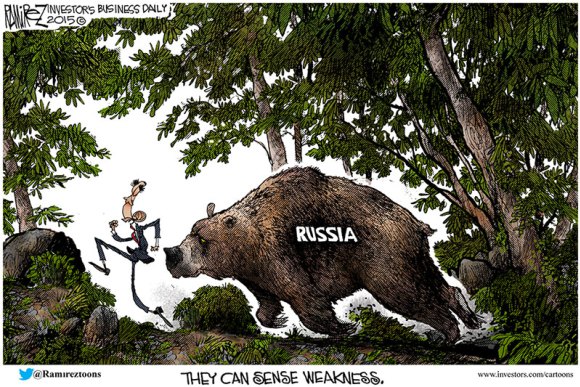
There is a bear in the woods…

October 14, 2015

There is a bear in the woods… Power LineJohn Hinderaker, October 13, 2015

Vladimir Putin thinks Barack Obama has mush for brains, but that’s not the worst of it. Michael Ramirez updates the bear in the woods theme.

cTOON1013.jpg.cms_


Op-Ed: Chaos and 2nd Cold War, Part II: Israel’s Nuclear Strategy

October 11, 2015

Op-Ed: Chaos and 2nd Cold War, Part II: Israel’s Nuclear Strategy, Israel National News, Prof. Louis René Beres, October 11, 2015

(Part I is available here. — DM)

Israel should now be calculating the exact extent or subtlety with which it should consider communicating key portions of its nuclear posture and positions. Naturally, Israel should never reveal any too-specific information about its nuclear strategy, its nuclear hardening, or even its nuclear yield-related capabilities. Still, sometimes, the duty of finely-honed intelligence services should not be to maximize strategic secrecy, but rather, to carefully “share” certain bits of pertinent information.

**********************************

How will Russia respond to any ramped up American uses of force in the Middle East, and, more plausibly, vice-versa?  One must assume that Jerusalem is already asking these key questions, and even wondering whether, in part, greater mutualities of interest could sometime exist with Moscow than with Washington.

To wit, Prime Minister Benjamin Netanyahu met with Russia’s President Vladimir Putin in September 2015. Among other things, the Israeli leader must  be calculating: 1)Will the Obama Administration’s incoherent retreat from most of the Middle East point toward a more permanent United States detachment from the region; and 2) If it does, what other major powers are apt to fill the resultant vacuum? Just as importantly, and as an obvious corollary to (2), above, the prime minister should be inquiring: “How will the still-emerging Cold War II axis of conflict impact America’s pertinent foreign policy decisions?”

There are some additional ironies yet to be noted. Almost certainly, ISIS, unless it is first crushed by U.S. and/or Russian-assisted counter-measures, will plan to march westward across Jordan, ultimately winding up at the borders of West Bank (Judea/Samaria). There, ISIS Jihadists could likely make fast work of any still-posted Hamas and Fatah forces, in effect, taking over what might once have become “Palestine.” In this now fully imaginable scenario, the most serious impediment to Palestinian statehood is not Israel, but rather a murderous band of Sunni Arab terrorists.[16]

What about the larger picture of “Cold War II?” Israeli defense planners will need to factor into their suitably nuanced calculations the dramatically changing relationship between Washington and Moscow. During “Cold War I,” much of America’s support for the Jewish State had its most fundamental origins in a perceived need to compete successfully in the Middle East with the then Soviet Union. In the progressive development of “Cold War II,” Jerusalem will need to carefully re-calculate whether a similar “bipolar” dynamic is once again underway, and whether the Russian Federation might, this time around, identify certain strategic benefits to favoring Israel in regional geo-politics.

In all such strategic matters, once Israel had systematically sorted through the probable impact of emerging “superpower” involvements in the Middle East, Jerusalem would need to reassess its historic “bomb in the basement.” Conventional wisdom, of course, has routinely pointed in a fundamentally different policy direction. Still, this “wisdom” assumes that credible nuclear deterrence is simply an automatic result of  physically holding nuclear weapons. By the logic of this too-simplistic argument, removing Israel’s nuclear bomb from the “basement” would only elicit new waves of global condemnation, and would likely do so without returning any commensurate security benefits to Jerusalem.

Scholars know, for good reason, that the conventional wisdom is often unwise. Looking ahead, the strategic issues facing Israel are not at all uncomplicated or straightforward.  Moreover, in the immutably arcane world of Israeli nuclear deterrence, it can never really be adequate that enemy states merely acknowledge the Jewish State’s nuclear status. Rather, it is also important that these states should be able to believe that Israel holds usable nuclear weapons, and that Jerusalem/Tel-Aviv would be willing to employ these usable weapons in certain clear, and situationally recognizable, circumstances.

Current instabilities in the Middle East will underscore several good reasons to doubt that Israel could ever benefit from any stubborn continuance of deliberate nuclear ambiguity. It would seem, too, from certain apparent developments already taking place within Mr. Netanyahu’s “inner cabinet,” that portions of Israel’s delegated leadership must now more fully understand the bases of any such informed skepticism.

In essence, Israel is imperiled by compounding and inter-related existential threats that justify its fundamental nuclear posture, and that require a correspondingly purposeful strategic doctrine. This basic need exists well beyond any reasonable doubt. Without such weapons and doctrine, Israel could not expectedly survive over time, especially if certain neighboring regimes, amid expanding chaos,  should soon become more adversarial, more Jihadist, and/or less risk-averse.

Incontestably, a purposeful nuclear doctrine could prove increasingly vital to coping with various more-or-less predictable strategic scenarios for Israel, that is, those believable narratives requiring preemptive action, and/or an appropriate retaliation.

Typically, military doctrine carefully describes how national forces should fight in various combat operations. The literal definition of “doctrine” derives from Middle English, from the Latin doctrina, meaning teaching, learning, andinstruction. Though generally unrecognized, the full importance of doctrine lies not only in the several ways that it can animate and unify military forces, but also in the uniquely particular fashion that it can transmit certain desired “messages.”

In other words, doctrine can serve an increasingly imperiled  state as a critical form of communication, one directed to its friends, and also to its foes.

Israel can benefit from just such broadened understandings of doctrine. The principal security risks now facing Israel are really more specific than general or generic. This is because Israel’s extant adversaries in the region will likely be joined, at some point, by: (1) a new Arab state of “Palestine;” and/or by (2) a newly-nuclear Iran. It is also because of the evidently rekindled global spark of “bipolar” or “superpower” adversity, and the somewhat corollary insertion of additional American military forces to combat certain new configurations of Jihadi terror.

For Israel, merely having nuclear weapons, even when fully recognized in broad outline by enemy states, can never automatically ensure successful deterrence. In this connection, although starkly counter-intuitive, an appropriately selective and thoughtful end to deliberate ambiguity could improve the overall credibility of Israel’s nuclear deterrent.  With this point in mind, the potential of assorted enemy attack prospects in the future could be reduced by making available certain selected information concerning the safety of  Israel’s nuclear weapon response capabilities.

This crucial information, carefully limited, yet more helpfully explicit, would center on the distinctly major and inter-penetrating issues of Israeli nuclear capability and decisional willingness.

Skeptics, no doubt, will disagree. It is, after all, seemingly sensible to assert that nuclear ambiguity has “worked” thus farWhile Israel’s current nuclear policy has done little to deter multiple conventional terrorist attacks, it has succeeded in keeping the country’s enemies, singly or in collaboration, from mounting any authentically existential aggressions. This conclusion is not readily subject to any reasonable disagreement.

But, as the nineteenth-century Prussian strategic theorist, Karl von Clausewitz, observed, in his classic essay, On War, there may come a military tipping point when “mass counts.” Israel is already coming very close to this foreseeable point of no return. Israel is very small.  Its enemies have always had an  undeniable advantage in “mass.”

More than any other imperiled state on earth, Israel needs to steer clear of such a tipping point.

This, too, is not subject to any reasonable disagreement.

Excluding non-Arab Pakistan, which is itself increasingly coup-vulnerable, none of Israel’s extant Jihadi foes has “The Bomb.”  However, acting together, and in a determined collaboration, they could still carry out potentially lethal assaults upon the Jewish State. Until now, this capability had not been possible, largely because of insistent and  persistently overriding fragmentations within the Islamic world. Looking ahead, however, these same fragmentations could sometime become a source of special danger to Israel, rather than remain a continuing source of  national safety and reassurance.

An integral part of Israel’s multi-layered security system lies in the country’s ballistic missile defenses, primarily, the Arrow or “Hetz.” Yet, even the well-regarded and successfully-tested Arrow, now augmented by the newer and shorter-range iterations of “Iron Dome,” could never achieve a sufficiently high probability of intercept to meaningfully protect Israeli civilians.[17] No system of missile defense can ever be “leak proof,” and even a single incoming nuclear missile that somehow managed to penetrate Arrow or corollary defenses could conceivably kill tens or perhaps hundreds of thousands of Israelis.[18]

In principle, at least, this fearsome reality could be rendered less prospectively catastrophic if Israel’s traditional reliance on deliberate ambiguity were suitably altered.

Why alter? The current Israeli policy of an undeclared nuclear capacity is unlikely to work indefinitely. Leaving aside a Jihadi takeover of already-nuclear Pakistan, the most obviously unacceptable “leakage” threat would come from a nuclear Iran. To be effectively deterred, a newly-nuclear Iran would require convincing assurance that Israel’s atomic weapons were both (1) invulnerable, and (2) penetration-capable.

Any Iranian judgments about Israel’s capability and willingness to retaliate with nuclear weapons would then depend largely upon some prior Iranian knowledge of these weapons, including their expected degree of protection from surprise attack, as well as Israel’s expected capacity to “punch-through” all pertinent Iranian active and passive defenses.

Jurisprudentially, at least, following JCPOA in Vienna, a  nuclear weapons-capable Iran is a fait accompli. For whatever reasons, neither the “international community” in general, nor Israel in particular, had ever managed to create sufficient credibility concerning a once-timely preemptive action. Such a critical defensive action would have required very complex operational capabilities, and could have generated Iranian/Hezbollah counter actions that might have a  very significant impact on the entire Middle East. Nevertheless, from a purely legal standpoint, such preemptive postures could still have been justified, under the authoritative criteria of anticipatory self-defense, as permitted under customary international law.

It is likely that Israel has undertaken some very impressive and original steps in cyber-defense and cyber-war, but even the most remarkable efforts in this direction will not be enough to stop Iran altogether. Earlier, the “sanctions” sequentially leveled at Tehran – although certainly better than nothing – could have had no tangible impact on effectively halting Iranian nuclearization.

Strategic assessments can sometimes borrow from a Buddhist mantra. What is, is. Ultimately, a nuclear Iran could decide to share some of its nuclear components and materials with Hezbollah, or with another kindred terrorist group. Ultimately, amid growing regional chaos, such injurious assets could find their way to such specifically U.S- targeted groups as ISIS.

Where relevant, Israeli nuclear ambiguity could be loosened by releasing certain very general information regarding the availability and survivability of appropriately destructive  nuclear weapons.

Israel should now be calculating the exact extent or subtlety with which it should consider communicating key portions of its nuclear posture and positions. Naturally, Israel should never reveal any too-specific information about its nuclear strategy, its nuclear hardening, or even its nuclear yield-related capabilities. Still, sometimes, the duty of finely-honed intelligence services should not be to maximize strategic secrecy, but rather, to carefully “share” certain bits of pertinent information.

What about irrational enemies? An Israeli move from ambiguity to disclosure would not likely help in the case of an irrational nuclear enemy. It is even possible, in this regard, that particular elements of Iranian leadership might meaningfully subscribe to certain end-times visions of a Shiite apocalypse. By definition, any such enemy would not necessarily value its own continued national survival more highly than any other national preference, or combination of preferences. By definition, any such enemy would present a genuinely unprecedented strategic challenge.

Were its leaders to become authentically irrational, or to turn in expressly non-rational directions, Iran could then effectively become a nuclear suicide-bomber in macrocosm.  Such a profoundly destabilizing strategic prospect is improbable, but it is also not inconceivable. A similarly serious prospect exists in already-nuclear Pakistan.

To protect itself against military strikes from irrational enemies, especially those attacks that could carry existential costs, Israel will need to reconsider virtually every aspect and function of its nuclear arsenal and doctrine. This is a strategic reconsideration that must be based upon a number of bewilderingly complex intellectual calculations, and not merely on ad hoc, and more-or-less presumptively expedient political judgments.

Removing the bomb from Israel’s basement could enhance Israel’s strategic deterrence to the extent that it would heighten enemy perceptions of the severe and likely risks involved. This would also bring to mind the so-called Samson Option, which, if suitably acknowledged, could allow various enemy decision-makers to note and underscore a core assumption. This is that Israel is prepared to do whatever is needed to survive. Interestingly, such preparation could be entirely permissible under governing international law, including the 1996 Advisory Opinion of the International Court of Justice.[19]

Irrespective of  its preferred level of ambiguity, Israel’s nuclear strategy must always remain oriented toward deterrence, not to actual war-fighting.[20] The Samson Option refers to a policy that would be based in part upon a more-or-less implicit threat of massive nuclear retaliation for certain anticipated enemy aggressions.  Israel’s small size means, inter alia, that any nuclear attack would threaten Israel’s very existence, and could not be tolerated. Israel’s small size also suggests a compelling need for sea-basing (submarines) at least a recognizably critical portion of its core nuclear assets,

From a credibility standpoint, a Samson Option could make sense only in “last-resort,” or “near last-resort,” circumstances. If the Samson Option is to be part of a convincing deterrent, as it should, an incremental end to Israel’s deliberate ambiguity is essential. The really tough part of this transformational process will lie in determining the proper timing for such action vis-a-vis Israel’s security requirements, and in calculating authoritative expectations (reasonable or unreasonable) of the “international community.”

The Samson Option should never be confused with Israel’s overriding security objective: To seek stable deterrence at the lowest possible levels of military conflict. As a last resort, it basically states the following warning to all potential nuclear attackers:  “We (Israel) may have to `die,` but (this time) we won’t die alone.”

There is a related observation. In our often counter-intuitive strategic world, it can sometimes be rational to pretend irrationality. The nuclear deterrence benefits of any such pretended irrationality would depend, at least in part, upon an enemy state’s awareness of Israel’s intention to apply counter-value targeting when responding to a nuclear attack. But, once again, Israeli decision-makers would need to be aptly wary of ever releasing too-great a level of specific operational information.

In the end, there are specific and valuable critical security benefits that would likely accrue to Israel as the result of a purposefully selective and incremental end to its historic policy of deliberate nuclear ambiguity.   The right time to begin such an “end”  has not yet arrived. But, at the precise moment that Iran verifiably crosses the nuclear threshold, or arguably just before this portentous moment, Israel should  promptly remove The Bomb from its “basement.”

When this critical moment arrives, Israel should already have configured (1) its presumptively optimal allocation of nuclear assets; and (2) the extent to which this preferred configuration should now be disclosed. Such strategic preparation could then enhance the credibility of Israel’s indispensable nuclear deterrence posture.

When it is time for Israel to selectively ease its nuclear ambiguity, a second-strike nuclear force should be revealed in broad outline. This robust strategic force – hardened, multiplied, and dispersed – would need to be fashioned so as to recognizably inflict a decisive retaliatory blow against major enemy cities. Iran, it follows, so long as it is led by rational decision-makers, should be made to understand that the actual costs of  any planned aggressions against Israel would always exceed any expected gains.

In the final analysis, whether or not a shift from deliberate ambiguity to some selected level of nuclear disclosure would actually succeed in enhancing Israeli nuclear deterrence would depend upon several complex and intersecting factors. These include, inter alia, the specific types of nuclear weapons involved; reciprocal assessments and calculations of pertinent enemy leaders; effects on rational decision-making processes by these enemy leaders; and effects on both Israeli and adversarial command/control/communications operations. If  bringing Israel’s bomb out of the “basement” were to result in certain new enemy pre-delegations of nuclear launch authority, and/or in new and simultaneously less stable launch-on-warning procedures, the likelihood of unauthorized and/or accidental nuclear war could then be substantially increased.

Not all adversaries may be entirely rational. To comprehensively protect itself against potentially irrational nuclear adversaries, Israel has no logical alternative to developing an always problematic conventional preemption option, and to fashion this together with a suitable plan for subsequent “escalation dominance.” Operationally, especially at this very late date, there could be no reasonable assurances of success against many multiple hardened and dispersed targets. Regarding deterrence, however, it is noteworthy that “irrational” is not the same as “crazy,” or “mad,” and that even an expectedly irrational Iranian leadership could still maintain susceptible preference orderings that are both consistent and transitive.

Even an irrational Iranian leadership could be subject to threats of deterrence that credibly threaten certain deeply held religious as well as civic values. The relevant difficulty here for Israel is to ascertain the precise nature of these core enemy values. Should it be determined that an Iranian leadership were genuinely “crazy” or “mad,” that is, without any decipherable or predictable ordering of preferences, all deterrence bets could then have to give way to preemption, and possibly even to certain plainly unwanted forms of war fighting.

Such determinations, of course, are broadly strategic, not narrowly jurisprudential. From the discrete standpoint of international law, especially in view of Iran’s expressly genocidal threats against Israel, a preemption option could still represent a permissible expression of anticipatory self-defense. Again, however, this purely legal judgment would be entirely separate from any parallel or coincident assessments of operational success. There would be no point for Israel to champion any strategy of preemption on solely legal grounds if that same strategy were not also expected to succeed in specifically military terms.

Growing chaotic instability in the Middle East plainly heightens the potential for expansive and unpredictable conflicts.[21] While lacking any obviously direct connection to Middle East chaos, Israel’s nuclear strategy must now be purposefully adapted to this perilous potential. Moreover, in making this adaptation, Jerusalem could also have to pay special attention not only to the aforementioned revival of  major “bipolar” animosities, but also, more specifically and particularly, to Russia’s own now-expanding nuclear forces.

This cautionary warning arises not because augmented and modernized Russian nuclear forces would necessarily pose any enlarged military threat to Israel directly, but rather because these strategic forces could determine much of the way in which “Cold-War II” actually evolves and takes shape. Vladimir Putin has already warned Washington of assorted “nuclear countermeasures,” and recently test launched an intercontinental nuclear missile.[22] One such exercise involved a new submarine-launched Bulava missile, a weapon that could deliver a nuclear strike with up to 100 times the force of the 1945 Hiroshima blast.

Current adversarial Russian nuclear posturing vis-à-vis the United States remains oriented toward the Ukraine, not the Middle East.[23] Nevertheless, whatever happens to U.S.-Russian relations in any one part of the world could carry over to certain other parts, either incrementally, or as distinctly sudden interventions or escalations. For Jerusalem, this means, among other things, an unceasing obligation to fashion its own developing nuclear strategy and posture with an informed view to fully worldwide power problems and configurations.

Whether looking toward Gaza, West Bank (Judea/Samaria), Iran, Lebanon, Iraq, Jordan, Egypt, or Syria, Israel will need to systematically prioritize existential threats, and, thereafter, stay carefully focused on critically intersecting and overriding factors of global and regional security. In all such meticulously careful considerations, both chaos and Cold War II should be entitled to occupy a conspicuous pride of place.

Sources:

[16] A further irony here concerns Palestinian “demilitarization,” a pre-independence condition of statehood called for by Israeli Prime Minister Benjamin Netanyahu. Should Palestinian forces (PA plus Hamas) ever actually choose to abide by any such formal legal expectation, it could makes these forces less capable of withstanding any foreseeable ISIS attacks. Realistically, however, any such antecedent compliance would be highly improbable. See, for earlier legal assessments of Palestinian demilitarization, Louis René Beres and (Ambassador) Zalman Shoval, “Why a Demilitarized Palestinian State Would Not Remain Demilitarized: A View Under International Law,” Temple International and Comparative Law Journal, Winter 1998, pp. 347-363; and Louis René Beres and Zalman Shoval, “On Demilitarizing a Palestinian `Entity’ and the Golan Heights: An International Law Perspective,” Vanderbilt Journal of Transnational Law, Vol. 28, No. 5, November 1995, pp. 959-972.

[17] There is another notable and more generic (pre-nuclear age) risk of placing too-great a reliance on defense. This is the risk that a corollary of any such reliance will be a prospectively lethal tendency to avoid taking otherwise advantageous offensive actions. Recall, in this connection, Carol von Clausewitz On War:  “Defensive warfare…does not consist of waiting idly for things to happen. We must wait only if it brings us visible and decisive advantages. That calm before the storm, when the aggressor is gathering new forces for a great blow, is most dangerous for the defender.” See: Carl von Clausewitz, Principles of War, Hans W. Gatzke, tr., New York: Dover Publications, 2003, p. 54.

[18] For early authoritative accounts, by the author, of expected consequences of a nuclear attack, see: Louis René Beres, Apocalypse: Nuclear Catastrophe in World Politics (Chicago: University of Chicago Press, 1980); Louis René Beres, Mimicking Sisyphus: America’s Countervailing Nuclear Strategy (Lexington, Mass., Lexington Books, 1983); Louis René Beres, Reason and Realpolitik: U.S. Foreign Policy and World Order (Lexington, Mass., Lexington Books, 1984); and Louis René Beres, Security or Armageddon: Israel’s Nuclear Strategy (Lexington, Mass., Lexington Books, 1986).

[19] See: “Summary of the Legality of the Threat or Use of Nuclear Weapons,” Advisory Opinion, 1996, I.C.J., 226 (Opinion of 8 July 1996). The key conclusion of this Opinion is as follows: “…in view of the current state of international law, and of the elements of fact at its disposal, the Court cannot conclude definitively whether the threat or use of nuclear weapons would be lawful or unlawful in an extreme circumstance of self-defense, in which the very survival of a State would be at stake.”

[20] This advice was a central recommendation of the Project Daniel Group’s final report,  Israel’s Strategic Future (ACPR, Israel, May 2004: “The overriding priority of Israel’s nuclear deterrent force must always be that it preserves the country’s security without ever having to be fired against any target. The primary point of Israel’s nuclear forces must always be deterrence ex ante, not revenge ex post.” (p. 11). Conceptually, the core argument of optimizing military force by not resorting to any actual use pre-dates the nuclear age. To wit, Sun-Tzu, in his ancient classic, The Art of War, counseled: “Supreme excellence consists of breaking the enemy’s resistance without fighting.”

[21] Once again, Prussian military thinker, Carl von Clausewitz, had already highlighted the generic (pre-nuclear age) dangers of unpredictability, summarizing these core hazards as matters of “friction.”

[22] ICBM test launches are legal and permissible under the terms of New START, It does appear, however,  that Russia has already developed and tested a nuclear-capable cruise missile with a range of 500-5500 KM, which would be in express violation of the Intermediate Nuclear Forces Treaty (INF). At the same time, current research into the U.S. Conventional Prompt Global Strike Program seeks to circle around INF Treaty limitations, by employing a delivery vehicle trajectory that is technically neither ballistic nor cruise.

[23] Russia, of course, is operating much more openly and substantially in Syria, but here, in the Middle East theatre, at least, Moscow’s public tone toward Washington is somewhat less confrontational or adversarial.
 

Israel is braced for Russian aerial intrusions over its Golan border

October 9, 2015

Israel is braced for Russian aerial intrusions over its Golan border, DEBKAfile, October 9, 2015

Su-25_Frogfoot_ground-attack_planes_B-Syria_10.15_1Russian Su-25 Frogfoot fighter-bombers in Syria

Uncertainty still hangs over Moscow’s precise intentions regarding its air force flights over the Golan close to Israel’s border – even after two days of discussions on coordination ended in Tel Aviv Thursday, Oct. 8 between the Russian Deputy Chief of Staff Gen. Nikolay Bogdanovsky and his Israeli counterpart Maj. Gen. Yair Golan. A coordination mechanism between the two air forces was left as unfinished business for further discussion, DEBKAfile’s military sources report. So it is still not clear to Israel what is supposed to happen if Russian fighters and bombers enter the Syrian-Israeli border district and slip over into Israeli air space.

The bilateral talks left Israel with the impression that this was a distinct possibility.

Israeli and Western aviation and intelligence experts don’t see how Israel can prevent Russia providing air cover for Syrian and Hizballah forces when the war moves close to the Israeli and Jordanian borders of southern Syria.

Last week, Russian SU-30 and Su-24 warplanes twice violated Turkish air space in the southern province of Hatay (called Alexandretta on Syrian maps). Although after the Russian defense ministry apologized for the first intrusion as accidental and lasting just a few seconds, our military sources are certain that the Russians were in fact deliberately testing Turkish air defenses.

This scenario may well repeat itself over the Golan in the very near future.

Gen. Bogdanovsky made no secret of Moscow’s intention to use its air power against rebel targets in battles taking place near the Israeli border. According to our exclusive military sources, Israel braced for this eventually Wednesday night, Oct. 7. Syrian, Hizballah and pro-Iranian Shiite forces then launched a ground offensive with Russian air cover against Syrian rebel forces in the Hama region. This was their first ground operation since the start of the Russian military buildup in late August. Intelligence was received that a second Syrian-Hizballah offensive, covered by Russian fighters and bombers, was scheduled to start at the same time in the Quneitra area, directly opposite the Israeli Golan.

For some reason, it was not launched when expected, but it is unlikely to be deferred for long. After firing Kalibr-NK-SS-27 Sizzler cruise missiles last week to soften rebel resistance to the Syrian government offensive in the Hama area, the Russians may well aim them at the Quneitra arena too in support of another Syrian operation.

Why hasn’t Sisi visited Washington yet?

October 9, 2015

Why hasn’t Sisi visited Washington yet? Al-MonitorMohamed Saied, October 8, 2014

(Obama thinks highly of the Islamist Muslim Brotherhood and rejects President Sisi because he supported the Egyptian masses who sought the overthrow of an increasingly dictatorial President Morsi. Obama’s rejection of Sisi’s Egypt pushed it into an alliance with Russia. Now Obama, et al, claim that alliance as a basis for the continuing hostility toward Sisi. Perhaps it is. Obama, et al, have also complained about Egyptian human rights violations in repressing the Muslim Brotherhood; few similar complaints have been made about far greater Saudi and Iranian human rights violations. Sisi is the only president of a Muslim nation who seeks to promote a more secular and hence moderate Islam, to which the Muslim Brotherhood is hostile. Please see also, Egypt’s secular culture minister ruffles Salafi feathers. — DM)

One of the most important issues that may hinder the return of US-Egyptian relations to their previous state is the strong relationship between Cairo and Moscow; Sisi has met his Russian counterpart Vladimir Putin four times so far, and Egypt is currently considered the most important ally of Moscow in the Middle East.

**********************

CAIRO — Ever since Egyptian President Abdel Fattah al-Sisi took office on June 8, 2014, US-Egyptian relations have been deteriorating. This has been further confirmed by the fact that Sisi has not visited Washington yet despite the shuttle visits he has made abroad.

Differences and conflicts plagued the US-Egyptian relationship during the era of President Gamal Abdel Nasser. These conflicts culminated in the 1967 Six-Day War, when diplomatic relations between the two countries were severed because of the economic and military support by the United States to Israel.

However, these relations started to take a positive turn based on the strengthening of the strategic interests shared between the two countries in the wake of the signing of the Camp David Accords with Israel — the US’ permanent ally — on Sept. 17, 1978, between Egyptian President Anwar Sadat and Israeli Prime Minister Menachem Begin, as per the State Information Service affiliated with the Presidency of the Republic.

Only one meeting was held between Presidents Sisi and Barack Obama on the sidelines of the 69th Session of the UN General Assembly in September 2014 in New York, but other than this the two presidents have been settling for phone calls to discuss the latest developments in the region.

According to The Washington Times, Obama refused to meet with Sisi on the sidelines of the 70th session of the UN General Assembly. Egyptian Foreign Minister Sameh Shoukry attributed this in a press statement on Sept. 24 to the mismatching agendas and schedules of the two presidents, which prevented them from holding individual talks.

According to the US Embassy in Egypt’s reports on the situation in the country following the revolution of June 30, 2013, Washington started a “comprehensive review” of its relations with Egypt on the background of the ouster of former Egyptian President Mohammed Morsi.

On Aug. 15, 2013, following the killing of hundreds of Muslim Brotherhood demonstrators in Al-Nahda Square and Rabia al-Adawiya Square, Obama announced the cancellation of the Bright Star maneuvers, which were launched in 1980 following the signing of the peace treaty between Egypt and Israel and consisted of a joint military exercise between the two countries.

By October 2013, the review of relations put a halt to the deal consisting of delivering arms to Egypt. Also in October 2013, the US administration suspended $260 million that was going to be directly transferred to the Egyptian government along with another $300 million in US loan guarantees.

However, in a telephone call on March 13, Obama told Sisi that the military aid amounting to $1.3 billion would continue.

Meanwhile, Dina Badawi, spokeswoman for the US State Department for the Middle East, expressed concerns in a live interview on the ONtv channel April 2 over the state of rights and freedoms in Egypt, and pointed out that aid is aimed at continuing the democratic track and the political reforms in the country.

Abdel Moneim Said, director of the Regional Centre for Strategic Studies, and Shai Feldman, the Judith and Sidney Swartz director at the Crown Center for Middle East Studies, said in a research paper titled “Resetting US-Egyptian relations,” which was published in March 2014 on the center’s website, that at the root of the downturn in the US-Egyptian relations is the huge gap between the two sides’ narratives regarding the events of June 30, 2013.

One of the most important issues that may hinder the return of US-Egyptian relations to their previous state is the strong relationship between Cairo and Moscow; Sisi has met his Russian counterpart Vladimir Putin four times so far, and Egypt is currently considered the most important ally of Moscow in the Middle East.

The dispute between Russia and the United States is in regard to several issues. Chief among these is the Syrian issue; Moscow launched airstrikes on Sept. 30, sparking criticism on the part of Obama during a press conference Oct. 2. Obama said that Moscow is acting “not out of strength, but out of weakness” in support of the losing party. The president was referring to Syrian President Bashar al-Assad, and he pointed out that Russia should help in reaching a political settlement.

Meanwhile, the Egyptian Foreign Ministry did not issue any statements condemning or supporting such strikes.

In January, spokeswoman for the US State Department Jennifer Psaki said during the daily press brief that a meeting she described as “routine” was held with a delegation of members of the former Egyptian parliament from the dissolved Muslim Brotherhood-affiliated Freedom and Justice Party, on the sidelines of their visit to Washington, which was organized and financed by Georgetown University in Washington.

This meeting raised the ire of the Egyptian political leadership, as well-informed sources told Reuters in June that the Egyptian government summoned the US ambassador in Cairo to express displeasure over visits to Washington by figures of the Muslim Brotherhood, which is banned in Egypt.

Concerning the fact that Egypt did not extend an official invitation to Obama to meet with Sisi, or vice versa, Atef el-Ghomri, former director of the office of the Egyptian Al-Ahram newspaper in Washington and a member of the Egyptian Council for Foreign Affairs, said, “There is an ongoing split within the US decision-making circles over the revolution of June 30, 2013, and the toppling of former President Mohammed Morsi, who belongs to the Muslim Brotherhood.”

Ghomri told Al-Monitor that over the past years, Egypt’s relations have been confined to its foreign relations with Washington as it only took into account its regional and international interests. This deprived Egypt of any international initiatives or insights about various issues. Also, Egypt had to give up its pivotal role in the Middle East as far as the African and Arab countries are concerned. This negatively affected Egypt over time.

“The Egyptian leadership is trying to diversify its foreign relations. It resorted to the Eastern bloc led by Russia, as well as East Asia represented by China and Singapore.” Ghomri added.

Washington is concerned about several files managed by the Egyptian leadership, mainly the human rights and political reforms issues. The United States has been expressing those concerns since the June 30 Revolution, when the Muslim Brotherhood was toppled and replaced by a military president.

Under such circumstances, Cairo had to resort to other countries, while the US-Egyptian relations are expected to witness further tension, especially with the differences in views concerning several international issues, namely Syria, Iran and Libya.


Russia Missile Attacks Embarrass Obama, Warn Israel

October 9, 2015

Russia Missile Attacks Embarrass Obama, Warn Israel, American ThinkerJonathan Keiler, October 9, 2015

Beyond heaping yet another humiliation on Obama and signaling American admirals to keep their distance, the missile attack probably also sent a very pointed message to Israel. Israel currently deploys four advanced German-made and Israeli equipped Dolphin submarines, with two more on the way.

******************************

Russia’s October 7 cruise missile bombardment of anti-Assad Syrian rebels from ships stationed nearly 1000 miles away was probably the most expensively ineffectual display of military firepower since Bill Clinton launched a similar strike against al Qaeda in 1998. Clinton’s feckless and spendthrift action was supposedly in retaliation for the embassy bombings in Tanzania and Kenya and succeeded by most accounts in wiping out a few empty tents with several tons of explosives and several million dollars’ worth of advanced ordnance.

It is unlikely that Vladimir Putin’s strike did much damage to Syrian rebels either. But unlike Clinton (and the current Democrat in the White House) Putin doesn’t use force to shirk greater national responsibilities, he uses it to pursue clear strategic objectives. In this case, the Russian decision to launch brand-new Kalibr-NK missiles from the Caspian Sea fleet was clearly intended as yet another poke in the eye to President Obama, and a demonstration of Russian firepower, from diminutive but still dangerous Russian warships.

The 26 missiles were launched by three patrol boats and a frigate (a warship smaller than a destroyer.)  Russian spokesmen claimed all landed within nine feet of their targets, a degree of accuracy probably not needed against dispersed irregular infantry, but necessary to hit opposing warships, like those flying American flags. The Syrian rebels served as live practice targets for the Russian missile crews, who got to shoot off the new and previously unproven (in combat) missile.

Beyond heaping yet another humiliation on Obama and signaling American admirals to keep their distance, the missile attack probably also sent a very pointed message to Israel. Israel currently deploys four advanced German-made and Israeli equipped Dolphin submarines, with two more on the way. Most analysts presume that these advanced boats are intended to penetrate the Persian Gulf in the event of war with Iran, and from their launch cruise missiles in support of Israeli air action.

However, several years ago, in this article I proposed that the Israeli purpose was probably otherwise. Israeli is widely presumed to have equipped the subs with Israeli Popeye turbo cruise missiles with a range similar to that of the Russian Kalibr-NK. With such a weapon, Israeli subs need not make the long and dangerous journey to the Persian Gulf, but could launch from off the coast of Syria, the missiles following a flight plan very similar to those the Russian weapons took (but in reverse) where they could strike targets across northern Iran.

If I could conceive of such a plan, so could Russian intelligence services, which have probably backed this idea with hard, but secret intelligence. The Russian attack is a clear signal to Israel, demonstrating that cruise missiles which can go from the eastern Mediterranean to Iran can go the other way too. It is unlikely that it was a message lost on the Israelis, and more evidence that Russia’s movement in to the Syrian arena is proving disastrous for America and her allies.


Russia’s endgame in Syria: Follow the Money

October 7, 2015

Russia’s endgame in Syria: Follow the Money, Center for Security Policy, John Cordero, October 6, 2015

(Is Putin engaging in a holy war against the Islamic State, an oily war or both? — DM)

3300795117

The one strategic motivation for Russia that has been widely ignored is the economic one.  Qatar, the richest country in the world per capita and also owner of the world’s largest natural gas field, proposed in 2009 to jointly construct a gas pipeline running through Saudi Arabia, Jordan, Syria, Turkey, and into Europe.  Assad, not wanting to provoke Moscow, refused to sign on.  Instead, he floated an alternative: an Iran-Iraq-Syria and possibly Lebanon pipeline, to then follow under the Mediterranean to Europe. The Qatar-Turkey pipeline would run through majority Sunni countries with the exception of Syria’s Alawite regime. Assad’s counter proposal follows the Shia crescent.

Russia, not wanting to lose its primary market in Europe, is adamantly opposed to a prospective Qatari project.  A military presence in Syria will guarantee that even if Assad is removed from power, the pipeline will not be built.  It will look on favorably to the Iranian proposal, provided Gazprom and other state-owned companies get their share of the pie.

****************************

As Vladimir Putin orders airstrikes against rebels of all stripes fighting Bashar al-Assad’s regime, there are important strategic economic goals behind Russia’s actions in Syria.  The short term goal is easy to discern: prevent Assad’s collapse as no alternative suitable to Russian interests exists, preserve Russia’s only naval base in the Middle East at Tartus, and promote Russia both at home and abroad as a world power that counterbalances American hegemony.

Much of the media has focused on Putin as a personal driver of Russian behavior.  While forays into Georgia and Ukraine have accomplished the tactical goals of preventing increased European Union presence in Russia’s sphere of influence, these have come at a high cost both politically and economically in the form of isolation and sanctions. Putin seems to have concluded that intervening in Syria in the name of fighting terrorism can only help repair Russia’s battered image.

It is important to at least try to understand Putin’s motivation without delving too much into psychoanalysis.  He is on record as lamenting the collapse of the Soviet Union as “the greatest geopolitical catastrophe of the 20th century.”  In power since 2000, the former KGB officer is an ardent Russian nationalist, a promoter of a personality cult concerned with his country’s standing and perception in the world.  With his career spent in the service of the state, he is not one to take a background role in world affairs. Putin has effectively used Russia’s alliance with Iran as an effective tool to undermine the US, both regionally in the Gulf and globally with the nuclear deal.

The current buildup at Tartus and Latakia is nothing new: since Hafez al-Assad’s rise to power in 1970, the Former Soviet Union and then Russia was and is a stalwart ally, long attempting to position Syria as a counterbalance to American and Israeli military superiority in the Middle East.

Russia’s actions are also a message to the world: unlike the US, which abandoned long-time ally Hosni Mubarak during his time of need in Egypt, Russia is prepared to intervene, militarily if necessary, to preserve a friendly regime in danger.  Therefore, it pays for autocrats to court Moscow, especially if they possess valuable resources or are in prime strategic locations.

While Vladimir Putin ostensibly espouses the acceptable goal of a global alliance against IS, the strategic context is that he has entered into a sectarian alliance with Shia Iran, Iraq, Syria, and the proxy army Hezbollah (The P4+1) against the American-backed Sunni alliance of Turkey, Saudi Arabia, Qatar, Jordan, and the UAE, all of whom insist that Assad has no future in Syria.

Through its airstrikes, Russia continues to advance the prior Syrian strategy of focusing efforts against pro-Western rebels, with the recognition that, while dangerous, the Islamic State is the one party in the conflict the West will never support.

The Islamic State will take advantage of both the respite, and the propaganda value of being the recognized number one enemy of the infidel coalition, which it uses to rally supporters simply by pointing out that its enemies are gathering to destroy the renewed Caliphate.

The one strategic motivation for Russia that has been widely ignored is the economic one.  Qatar, the richest country in the world per capita and also owner of the world’s largest natural gas field, proposed in 2009 to jointly construct a gas pipeline running through Saudi Arabia, Jordan, Syria, Turkey, and into Europe.  Assad, not wanting to provoke Moscow, refused to sign on.  Instead, he floated an alternative: an Iran-Iraq-Syria and possibly Lebanon pipeline, to then follow under the Mediterranean to Europe. The Qatar-Turkey pipeline would run through majority Sunni countries with the exception of Syria’s Alawite regime. Assad’s counter proposal follows the Shia crescent.

Russia, not wanting to lose its primary market in Europe, is adamantly opposed to a prospective Qatari project.  A military presence in Syria will guarantee that even if Assad is removed from power, the pipeline will not be built.  It will look on favorably to the Iranian proposal, provided Gazprom and other state-owned companies get their share of the pie.

Pipeline politics in the region have a long and varied history of Russian involvement.  The Baku-Tbilisi-Ceyhan oil pipeline was built only after Moscow’s demand for an alternative pipeline for Azeri oil to Russia was met.  During the 2008 Russia-Georgia war, US intelligence officials determined that an explosion on the pipeline near the Turkish-Georgian border was carried out via Russian government cyber warfare.  Days after the explosion, Russian fighter jets bombed positions in Georgia close to the pipeline. Although the BTC pipeline was built precisely to avoid Russian interference, the Kremlin has never let that stop them.

Turkey and Azerbaijan have also begun construction on a joint natural gas pipeline, theTANAP. This project’s stated goal is to reduce the EU’s dependence on Russian natural gas, a prospect that cannot please Moscow.   Both the BTC and TANAP bypass Armenia, a Russian ally and wary of its neighbors in the Caucasus.

As the endpoint for the Qatari project, Turkey is adamant in calling for Assad to step down or be removed, which dovetails with the proposed Sunni pipeline.  By clearing the way through Syria, Qatar and Saudi Arabia can receive a handsome return on their investment in backing jihadis fighting Assad.  On the other hand, Iran will not sit idly by and leave potential billions of dollars in the hands of its ideological and regional enemies.

Russian intervention in Syria is just beginning. There is every possibility that it will expand as more targets are found, perhaps those that are in the way of the proposed Iranian pipeline, directly threatening Damascus and by extension, the Russian monopoly of gas exports to Europe.  For the time being, Putin has the world’s attention.

Judge Jeanine: New world order emerging thanks to Obama

October 6, 2015

Judge Jeanine: New world order emerging thanks to Obama, Fox News via You Tube, October 4, 2015


Who Will Save Middle East Christians: Obama or Putin?

October 6, 2015

Who Will Save Middle East Christians: Obama or Putin? American ThinkerFay Voshell, October 6, 2015

(Good question. But can and will anyone? — DM)

Putin and Obama are on opposite sides of a great ideological chasm.  It isn’t too extreme to think Christians in America may properly conclude they would like to see and hear more of what Putin believes from our leaders and less of what President Obama and his elite circle of radical progressives believe and enforce at every turn.

***************************

Few Western foreign policy analysts have taken seriously Vladimir Putin’s radical reorientation of Russia from communism back to Russian Orthodox Christianity. 

Putin is perhaps uniquely qualified to discern that his nation’s identity has been for centuries within a spiritual, distinctly Christian narrative and that a violent rending of Russia’s historically religious roots led to utter disaster for the Russian peoples.

Son of a militant atheist and a pious mother, Putin lived through the collapse of the Soviet Union and the resurgence of capitalism as defined in Russian terms.  Though raised a secularist, he is now a devout Christian in the Russian Orthodox tradition and has devoted himself to the advancement of Christianity and the repudiation of what he sees as Western decadence.  While some may be dismissive of Putin’s Christian beliefs, there is no doubt that Christianity informs the way he now chooses to shape his own narrative and the story of his country.

Putin’s religious values are rooted in Russian Orthodoxy and personal religious experiences, including his wife’s car accident in 1993 and a life-threatening house fire in 1996.  Just before a diplomatic trip to Israel, his mother gave him a baptismal cross.  He said of the occasion, “I … put the cross around my neck.  I have never taken it off since.”

By his own testimony, Putin has had the personal conversion experience so often ridiculed by the communist regime in which he was embedded for so many years.  He now is putting his recently found faith to work in Russia and abroad.

Perhaps nothing more powerfully symbolizes Putin’s attempt to transition back to Russia’s religious heritage than the recent installation of a huge bronze statue of Vladimir the Great on Borovitskaya Ploshchad, right next to the Kremlin and the Cathedral of Christ the Savior.

Why is St. Vladimir suddenly important enough to warrant a place right in front of the Kremlin, a place where the nemesis of Christianity, Joseph Stalin, once reviewed Soviet might parading in front of him?  A place where Molotov, the communist zealot who gave gasoline-filled bottles his name, once posed for photographs with Nikolai Bukharin, author of the Soviet Union’s bible, The ABC of Communism?

The saint is important because he is the equivalent of Vladimir Putin’s patron saint.  The Orthodox Christianity he founded now informs Putin’s domestic and foreign policy.  The communist narrative that gripped the Soviet Union for a hundred years is being replaced, along with that narrative’s symbols.

Example: Putin, during his annual address to the country’s political elites last December, said Crimea was sacred for Russia due to St. Vladimir’s baptism there.  The president said:

The peninsula is of strategic importance for Russia as the spiritual source of the development of a multifaceted but solid Russian nation and a centralized Russian state.  It was in Crimea, in the ancient city of Chersonesus … that Grand Prince Vladimir was baptized before bringing Christianity to Rus.

Putin added that St. Vladimir’s baptism means that Crimea has “invaluable civilizational and even sacral importance for Russia, like the Temple Mount in Jerusalem for the followers of Islam and Judaism.”

While skeptics may sneer about the possibility that a former KGB agent is now a devout Christian whose faith informs policy, some in the global community welcome Putin’s change of heart as authentic, particularly when they see his defense of the faith put into action.  It is no secret that the Eastern Orthodox Church has asked him to protect Christians worldwide.  Putin evidently has agreed.

While some in the West are looking askance at Russia’s support of Assad’s regime in Syria, seeing only the realpolitik of Russian expansionism, others who are concerned about the eradication of Syria’s ancient Christian community tend to see as legitimate Putin’s concern that the Christian minority in that country will be persecuted if Assad is toppled.  The beleaguered Christians in Syria and elsewhere in the Middle East doubtless see the very recent Russian bombing of ISIS headquarters as a gift from God, and Putin as their potential deliverer from martyrdom.

Is there more to Putin’s intervention in Syria than the desire to save Christians?

Of course.  Even Putin admits that, characterizing his policies as having a heavy dose of “common sense” plus faith.  Nor should anyone discount his immersion in the deadly and murky politics of the Kremlin.

But again, Putin’s historic view is long.  For him, Moscow is the second seat of Eastern Orthodoxy, the first having been Byzantium under the rule of Emperor Justinian.  He will not have forgotten that the Byzantine Empire, which was profoundly informed by Christianity, at one time straddled two continents, Europe and Asia.  He will also will not have forgotten that the Syrian Church, marked for extinction by ISIS, has been led by the Syriac Orthodox Patriarch of Antioch – Antioch, the apostle Paul’s home base for his missionary journeys and the first place disciples of Christ were called Christians.  In other words, Putin’s view, shaped by Eastern Orthodoxy, is Eurasian, not just Russian.  Putin sees a geographic component to Christian Orthodoxy that includes the Middle East.

As a recent article in Foreign Affairs has noted, Putin owes many of his views to a Russian political and religious thinker by the name of Ivan Ilyin:

Ilyin espoused ethnic-religious neo-traditionalism, amidst much talk about a unique “Russian soul.” Germanely, he believed that Russia would recover from the Bolshevik nightmare and rediscover itself, first spiritually then politically, thereby saving the world. Putin’s admiration for Ilyin is unconcealed: he has mentioned him in several major speeches and he had his body repatriated and buried at the famous Donskoy monastery with fanfare in 2005; Putin personally paid for a new headstone. Yet despite the fact that even Kremlin outlets note the importance of Ilyin to Putin’s worldview, not many Westerners have noticed.

Putin has explained the central role of the ROC by stating that Russia’s ‘spiritual shield’ – meaning her church-grounded resistance to post-modernism – is as important to her security as her nuclear shield.”

An opponent of both Soviet communism and Western democracy, Ilyin envisioned a ‘special’ path for Russia, based on the promotion of the Orthodox Church and traditional values that would bring about a spiritual renewal of the Russian people, who at the moment he believed were under the influence of Western political and social constructs.

Putin, likewise, has spoken of the need for religious revival and the valuable role that the Orthodox Church plays. Says Putin: ‘The Russian Orthodox Church plays an enormous formative role in preserving our rich historical and cultural heritage and in reviving eternal moral values. It works tirelessly to bring unity, to strengthen family ties, and to educate the younger generation in the spirit of patriotism.’

Has anyone yet heard Barak Obama speak in similar terms about the Christian church in America?  Has anyone noted him speaking about “preserving our rich historical and cultural heritage and reviving eternal moral values?”  To ask the questions is to answer them.

Further, is it any wonder that Putinism finds consonance among America’s Christian conservatives?  His speeches, largely ignored by the anti-religious Western elite, who consider matters of faith as irrelevant or who openly despise the devout, have included the following points, many of which resonate with Christians in Europe as well:

Euro-Atlantic (the West) states have rejected their own roots, including the Christian roots which form the basis of Western civilization.  In these countries, the moral basis and any traditional identity are being denied—national, religious, cultural and even gender identities are being denied or relativized.

The excesses and exaggerations of political correctness in these countries leads to serious consideration for the legitimization of parties that promote even the propaganda of pedophilia.

People in many European states are actually ashamed of their religious affiliation and are indeed frightened to speak about them.  Meanwhile, Christian holidays and celebrations are abolished or “neutrally” renamed as if one were ashamed of those Christian holidays.  With this method one hides away the deeper moral nature of those celebrations.

Without the moral values that are rooted in Christianity and other world religions, without the rules and moral values which have been formed and developed over millennia, people will inevitably lose their human dignity and become brutes.  We think it is right and natural to defend and preserve these moral Christian values.

We must protect Russia from that which has destroyed American society.

How matters have changed since the fall of the Soviet Union in the early 1990s!  How ironic is it that Russia, once so invested in tearing down Christianity and replacing it on every level with Marxism, is now under the leadership of Vladimir Putin, who sees himself as a Christian savior of Western civilization?

In the meantime, the United States, once the defender of the Christian West, is under the current administration busily tearing down Christianity while uplifting a progressivism heavily influenced by Marxism with a large dose of the sexual revolution.

What a reversal!  It boggles the mind.  It certainly reinforces the idea that God does indeed work in mysterious ways.

Putin has found from personal experience and from observation of his and other countries’ experiences with variants of Marxism that the pitifully weak and reductionist ideology finds virtually no consonance among his or the world’s peoples, who overwhelmingly comprise people of faith.  These peoples resist the current version of Marxist ideology found in radical progressivism, a “progressivism” that has elevated sexual deviancies, destroyed families, reduced the meaning of the human being to that of genderless robots, and elevated multiculturalism as a quasi-religion, a “religion” that holds no values whatever.

Putin has publicly professed his faith in Christ and is reorienting Russia to its Christian roots.  He is defending Christians.  In contrast, Obama has stated that “We [America] are no longer a Christian nation” and openly attacks Christianity and its values at every turn.

Indeed, Vladimir Putin represents everything Obama and his elite cadre of fellow progressives hate.  As John Schindler writes:

Simply put, Vladimir Putin is the stuff of Western progressive nightmares because he’s what they thought they’d gotten past. He’s a traditional male with “outmoded” views on, well, everything: gender relations, race, sexual identity, faith, the use of violence, the whole retrograde package. Putin at some level is the Old White Guy that post-moderns fear and loathe, except this one happens to control the largest country on earth plus several thousand nuclear weapons – and he hates us.

Putin and Obama are on opposite sides of a great ideological chasm.  It isn’t too extreme to think Christians in America may properly conclude they would like to see and hear more of what Putin believes from our leaders and less of what President Obama and his elite circle of radical progressives believe and enforce at every turn.


Persia, Putin and the Pansy

October 3, 2015

Persia, Putin and the Pansy, Times of Israel, Irwin G. Blank, October 3, 2015

(Guess the name of the Pansy. But please see, The Moscow-Washington-Tehran Axis of Evil. — DM)

Putin, a product of the Soviet Communist system is well acquainted with the dictum of the father of the Bolshevik revolution that gave birth to the regime that he so faithfully served. V. I. Lenin’s famous quote-” Probe with a bayonet. If you meet steel, stop. If you meet mush, then push.”

***************************

In ancient times there was no greater empire than that of Persia. This imperial power stretched from the mountains of Afghanistan all the way to the islands of Greece and the deserts of North Africa and the Middle East. Against the Greeks of Alexander the Great, it could field armies of millions of troops arrayed with the most modern weapons of war at the time. Until the rise of the Roman Empire, no power on Earth, made nations tremble as did the rulers of Persia.

Today the fanatic Ayatollahs in Teheran, with a megalomaniacal apocalyptic dream of Islamist imperialism and world conquest under their banner of jihad are hell bent on the recreation of their ancient empire and the destruction of all they see as infidels and unbelievers. Their conception of faith is a political and social fanaticism that goes even further than the hysterical rantings and horrendous nightmare that Nazi Germany once attempted to foist on mankind. Indeed, the very Nazi terminology for its origin, the word “Aryan” is associated with the nation whose name is a derivative of that racist term-Iran.

However, other than employing proxy allies in Lebanon, Syria and Yemen, the mad mullahs knew that their military, for all its goose stepping soldiers and bombast that they would require the tools necessary to fulfill their wicked aims. Firstly, it was able to build up a nuclear industry with the aim of developing the most lethal weapons of mass destruction. Through deception, deliberate obfuscation and diligent denial, it succeeded in the implantation of this atomic framework under the blindness of the international agency whose responsibility is to curtail the spread of nuclear weapons.

Furthermore, when its nefarious production methods and its open evidence of ballistic missile technology became apparent, Iran successfully parried the efforts to curtail its march toward nuclear weaponry by undertaking a Potemkin village of diplomacy whereby even the most seemingly astute diplomatically experienced national leaders, succumbed to the meanderings and sweetheart deal that Iranian negotiators engineered. The secrets of the Ayatollahs were swept under a Persian rug.

However, in the meantime, the Persian imperialist war mongers still were in great need of the assistance of a powerful ally in order to accomplish their more conventional aims in their desire to continue their conquest throughout the Middle East. What better place to seek this help than to another former empire builder than a nation which was chomping on the bit to return to an area of the globe from which it had been so unceremoniously evicted.

The former Soviet Union, now the Russian Federation, has had dreams of installing its imperial presence in the Mediterranean Sea since the days of the Czars. Until 1972 when the late Egyptian president, Anwar Sadat, evicted ( for the most part as a political move, not a military one) most of the Soviet personnel from his country, the USSR had been ensconced throughout Egypt and the Arab world. Indeed, it was the humiliating defeat of the Egyptian and Syrian forces by the Israel Defense Forces during the Yom Kippur War that demonstrated at that time, the weakness of the Soviet response to American supported Israel which was demonstrating the vapidness of the Soviet promise to come to the aid of its Arab allies. The US response to Soviet threats to directly intervene on behalf of its Egyptian and Syrian clients, by moving the US Navy’s Sixth Fleet towards the Syrian coast and the declaration of a higher war footing by all US forces, made the Soviets back down.

The political and military supported victory of American arms and diplomacy demonstrated the resolve of that world power to face down the threat of Soviet dominance in such a strategic region of Western interests. Not only did the diplomacy of Henry Kissinger and the Nixon White House make a shambles of the massive Soviet involvement in the Arab world, but it brought about the first true demarche of Soviet (Russian) imperial chicanery since the Berlin blockade of 1948 and the Cuban Missile Crisis of 1962.

But the Russian Federation today is led by a president whose demonstration of the old Russian imperial nightmare is alive and well. Vladimir Putin, a former high official of the dreaded KGB,( Soviet Secret Service) has no qualms about restoring the dreams of the Czars and the re-entrenchment of his nation’s appearance in the Middle East. As a significant power player on the world scene and a massive supplier of sophisticated arms to anyone who opposes Western influence anywhere on the planet, the situation in the Levant and the hysterical anti-American paranoia in Teheran led the Ayatollahs to the road towards Moscow.

Sending one of their highest ranking military official to Moscow was a masterstroke of diplomatic skullduggery in presenting Putin with a challenge and an opportunity he could not ignore, For here, he was presented with a silver platter with which to serve up a poisonous dish to his arch-rivals, America and NATO. After witnessing their weakness to confront his military in the Ukraine and the Crimea, as well as his bloody campaign in Chechnya, all Putin had to do was experience orgasmic delight in sending his sea and air forces into a disintegrating Syria and pour weapons by the shipload onto the docks of Bandar Abbas in Iran. In full sight of Western intelligence and American spy satellites, crate after crate of Soviet munitions were soon trundling off the piers of the Syrian port of Latakia.

Iran was facing a significant threat to its allies in that disintegrating country and witnessing the probable demise of its Syrian puppet, Bashar al-Assad. The forces of ISIS (an Iranian rival for control of the Islamic world)  were on the march and its debilitating of the Syrian military as well as its capture of large swaths of Alawite controlled territory would put an end to the mullah’s plans for conquest. The entire northern tier of the Middle East would collapse and the Persian dream of conquering all the Sunni dominated lands of the region would go up in smoke. Iran had invested heavily in its subterfuge of the regimes of Iraq, Yemen and its military adventures in those countries. It required a strong ally and it looked to its northern neighbor with which its shares a common enmity for the West, and Putin, licked his chops and dove onto the plate presented to him.

Not only have Russian military forces seized control of the vital Syrian port of Latakia on the Mediterranean, but it has constructed revetments for air forces and ground personnel unseen in this region since the 1970s. His air forces have conducted bombing raids, not on ISIS, which was a planned political prevarication, but on US backed components of the anti-Assad coalition. Of course, Putin has no conflict with conducting airstrikes on civilians. After all, the West has been all but silent on the massive slaughter of approximately 300,000 civilians by the butcher of Damascus. Even when presented with irrefutable evidence of the use of internationally banned chemical weapons on his own countrymen, the US and NATO have been reticent (cowardly) in confronting this evil practice. Why not? The current leader of Syria’s father dropped poison gas on his own people in Homs when they revolted against his tyrannical rule and the world stood silent.

When the president of the United States declared that the Assad administration’s use of chemical weapons would cross a “red line” and force his hand – well, the red line turned into a yellow streak. The insipid and relatively weak assistance that this erstwhile leader of the world’s greatest superpower has shown to be the denigration and degradation of a once trusted and worthy ally. America’s allies no longer trust her and her enemies no longer fear her. It is not the American people who have lost their courage, it is their incompetently dangerous president and his minions that are responsible.

Not only for the rise of Russian/Iranian imperialism, but for its effect as daily demonstrated by the thousands, if not future hundreds of thousands, of men, women and children, fleeing from the murderous genocide of the Assad aided and abetted by this new Axis of evil-Islamic radicalism and Russian imperialism.

Iran seeks to conquer the Middle East and destroy the Sunni dominated Arab states of the region. With Russian assistance it will expand its imperial power behind Russian bayonets and the threat of its own nuclear umbrella to come. It is biding its time while innocents are being slaughtered and the threats against Israel, Jordan and Lebanon are unrelenting through public declarations and political oratory.

Putin, a product of the Soviet Communist system is well acquainted with the dictum of the father of the Bolshevik revolution that gave birth to the regime that he so faithfully served. V. I. Lenin’s famous quote-” Probe with a bayonet. If you meet steel, stop. If you meet mush, then push.”

The American president, who through Constitutional authority commands the most expansive and well trained military in the history of the world, who purports to be the defender of international human rights, has proven himself to be, in the face of wanton aggression and slaughter, in the abrogation of his country’s duty to defend its most vital and established interests, in his tepid response to evil and his recalcitrance to even identify the greatest threat to Western civilization since the rise of Nazi Germany, has without a doubt, at least in this writer’s estimate, become akin to an ostrich-a bird that buries its head in the sand and presents its foes with an irresistible target.

The Dictionary of American Slang has a word for such a person-a weakling and a wimp-the word is “pansy.” The pansy of the United States will bring the most terrible war upon us all-including by beloved tiny Jewish country.