Archive for the ‘Rouhani’ category

Rouhani Threatens Nuclear Breakout

July 2, 2015

Rouhani Threatens Nuclear Breakout, Commentary Magazine, July 2, 2015

Obama, Kerry, and negotiator Wendy Sherman have effectively become Iran’s lawyers. In doing so, they have applied the logic of “it depends on what the meaning of ‘is’ is” to U.S. national security. All one has to do, however, is look at the thinly veiled threats and logical somersaults of Iran’s top leaders . . . to understand just what a capability Tehran is after.

***********************

Where brinkmanship is in the blood of Iranian negotiators, careerism and obsession about legacy appears to be in the blood of their American counterparts. By playing good cop, bad cop with Ayatollah Ali Khamenei, by quibbling over every understanding previously reached, and by increasingly threatening to walk away, the Iranians appear to be wringing the Americans dry. Obama and Kerry have voided their own red lines, and prepare to normalize an Iranian path to a bomb whenever the Iranian government makes a decision to pursue that option.

Iranian President Hassan Rouhani is part and parcel of Iran’s brinkmanship. According to the Islamic Republic News Agency in Persian, he declared: “…If they do not fulfill their commitments, the government will be ready to immediately reverse the path in a more severe way than they can ever dream of.”

If Iran’s program has always been peaceful—as repeated Iranian officials have maintained—then reverting to Iran’s previous behavior would mean what exactly?  Threats from Rouhani, the supposed moderate, should get the attention of Congress.

Increasingly, Iran is tripping upon its own internal inconsistencies. First, there was Supreme Leader Ali Khamenei’s (as yet unseen) sacrosanct nuclear fatwa that forbids nuclear weaponry and yet the Iranian leadership refuses to come clean on past nuclear work for fear it would show nuclear weaponry work. There has also been Iran’s insistence that it seeks a completely indigenous program, yet it doesn’t possess enough natural uranium to fuel an expanded civilian energy program. Now, Rouhani has more or less threatened to build a nuclear bomb, the same threat made previously by Ali Akbar Hashemi Rafsanjani and a number of clerical associates of Khamenei himself. On May 29, 2005, for example, Hojjat ol-Islam Gholam Reza Hasani, the Supreme Leader’s representative in the Iranian province of West Azerbaijan, declared possession of nuclear weapons to be one of Iran’s top goals. “An atom bomb …must be produced as well,” he said.

Obama, Kerry, and negotiator Wendy Sherman have effectively become Iran’s lawyers. In doing so, they have applied the logic of “it depends on what the meaning of ‘is’ is” to U.S. national security. All one has to do, however, is look at the thinly veiled threats and logical somersaults of Iran’s top leaders, however, to understand just what a capability Tehran is after.

Cartoons of the day

July 2, 2015

H/t Joopklepzeiker

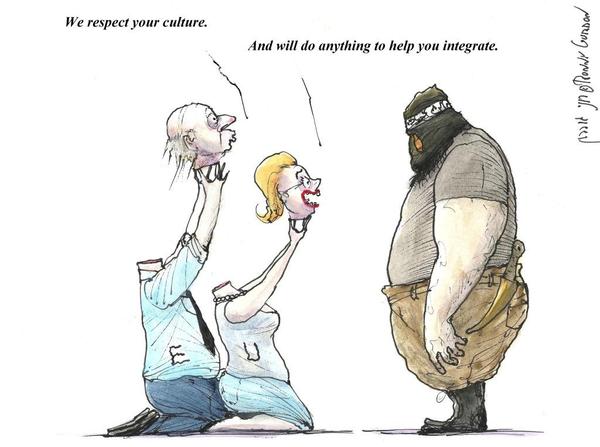
EU and Islamists

H/t Bring the heat, bring the stupid

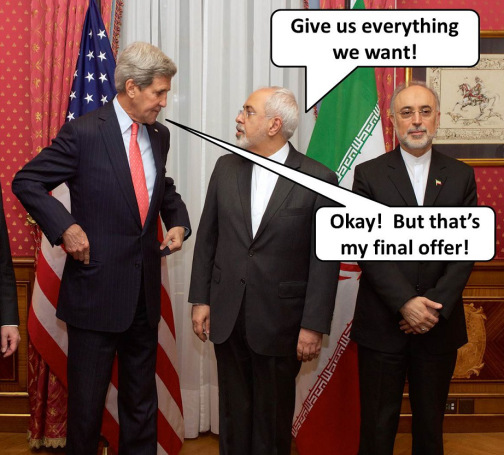
kerry-iran

Iran’s Nuclear Weapons Program and the Failure of Obama’s “Hope and Change Foreign Policy”

June 28, 2015

Iran’s Nuclear Weapons Program and the Failure of Obama’s “Hope and Change Foreign Policy,” ISIS Study Group, June 27, 2015

US Secretary of State John Kerry will be spending this weekend in Vienna in an attempt to salvage the deal the Obama administration is trying to land with the Iranian regime. The reason for his sense of urgency is that Ayatollah Khameini publicly rejected the deal and came out with some new terms just before the 30 JUN deadline. The Obama administration and the US mainstream media are trying to spin this as if the “reformers” are somehow being derailed. That would be true if there were any actual reformers in the Iranian regime. The truth is that this is all by design and that so-called “reformers” like President Rouhani are in on the joke – and the US is the punchline.

John Kerry mounts last push for Iran nuclear agreement
http://www.telegraph.co.uk/news/worldnews/middleeast/iran/11701690/John-Kerry-mounts-last-push-for-Iran-nuclear-agreement.html

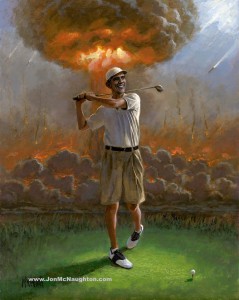
golf-obama-239x300

Source: Jon McNaughton

So what did Khameini say? He demanded the following:

1. Iran would only dismantle their program if sanctions were lifted first. In other words, we’d simply have to take them at their word.

2. Inspections and placing a freeze on research and development for 10 yrs is thrown out of the deal.

Huh. So if the key things agreed to back in APR 15 are now “null and void” (which were pretty weak to begin with), then what’s left of this deal? Absolutely nothing. And like we said earlier, this is all by design. The Iranian negotiation team is fully on the same page as Khameini – otherwise they wouldn’t be allowed to be on the team to negotiate with the US State Department (DoS).

Iran nuclear talks: Khamenei rejects key US demands
http://www.bbc.com/news/world-middle-east-33253488

Our loyal readers are fully aware of the Iranian regime’s designs for these negotiations and the Middle East in general. If you’re new to our site, then you will want to check out the following articles:

Today’s Middle East: The Burning Fuse of the 21st Century’s “Great Game”
http://isisstudygroup.com/?p=6193&

The Persian Hustle: Iran Dupes Clueless US State Dept in Nuke Talks and Moves to Dominate the Middle East
http://isisstudygroup.com/?p=5978

Mr. Netanyahu Goes to Washington
http://isisstudygroup.com/?p=5316

Inside Iran’s Middle East: The Nuclear Weapons Program
http://isisstudygroup.com/?p=2640

Inside Iran’s Middle East: The Charm Offensive
http://isisstudygroup.com/?p=2676

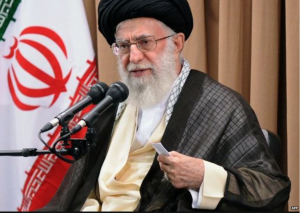
Screen-Shot-2015-06-27-at-1.15.37-PM-300x213

Khameini is large and in-charge despite his failing health – don’t ever forget that
Source: Associated Free Press

The original deal both sides agreed to back in APR didn’t allow for inspectors to have full access to key installations nor would we have had any visibility on projects that can improve Iran’s ability to produce a testable nuke. It also wouldn’t keep Iran from converting uranium hexafluoride (UF6) to metal or conducting work that enhances their metallurgy skills. As we previously stated in “Today’s Middle East: The Burning Fuse of the 21st Century’s Great Game,” if asked about it, the regime would simply say that it was for “radiation shielding” or conventional depleted uranium munitions. In fact the Obama administration doesn’t seem to be inclined to do anything about these indicators of increased proliferation. For instance, the regime’s Atomic Energy Organization of Iran (AEOI) has been in the business of supplying Iranian medical research organizations for several years now. In fact, our sources connected to the opposition have informed us that AEOI personnel known to be involved with uranium enrichment manufacturing have set up an entity called the “Persian Health Equipment and Development Company” or “PHEDCO” back in FEB 15. Apparently the company was set up to produce medical-use centrifuges. We assess that the company isn’t capable of enriching uranium itself, but we do think that it can be used to acquire certain components of nuclear suppliers group-controlled aluminum 7075 and quite possibly carbon-fiber.

Atomic Energy Organization of Iran (AEOI)
http://www.iranwatch.org/iranian-entities/atomic-energy-organization-iran-aeoi

We’re also very much aware that the regime is interested in developing uranium metal-based reactor fuels that would improve their ability to produce uranian-based nuclear weapons. These fuels are currently being used in “civilian research reactors.” So what is it, exactly? In a nuclear reactor, the uranium fuel is assembled to where a controlled fission chain reaction can be achieved. The heat created by splitting the U-235 atoms is then used to make steam, which in turn spins a turbine to drive a generator that produces electricity. The chain reaction that take place in the core of a nuclear reactor is controlled by rods which absorb neutrons, enabling the chain reaction to continue. Water, graphite and heavy water are used as moderators in different types of reactors. Due to the kind of fuel being used, if there’s a major malfunction in a reactor, the fuel may overheat and melt – but won’t explode like a bomb. The type of uranium used for bombs is different from what you’d find in a regular nuclear power plant. Military-grade uranium is highly enriched (>90% U-235, instead of up to 5%). Since the 1990s, a lot of otherwise military-grade uranium has become available for producing electricity as the result of the global disarmament effort.

What is Uranium? How Does it Work?
http://www.world-nuclear.org/info/Nuclear-Fuel-Cycle/Introduction/What-is-Uranium–How-Does-it-Work-/

We assess that the regime’s efforts will enable their nuclear technicians to gain enough experience with uranium metal production processes that could shorten the weaponization timeline. That said, we see the timeline accordingly:

1. They may master uranium metal production within the next 6 months.

2. Another 2-3 months will be needed to learn how to fabricate uranium metal components for a weapon.

3. 4-5 months will likely be required to test components and assemble a nuclear device.

This timeline has probably already been shortened due to the collaborative work taking place between Iran and the DPRK (North Korea) that the Obama administration has also failed to address during these negotiations. The two rogue nations have been engaged in a series of joint-projects in both the nuclear weapon and ballistic missile fields. Perhaps the most important part of stopping the development of an Iranian nuclear weapon is to deal with their intercontinental ballistic missile program, since that’s where the delivery system of said weapon will come from. Unfortunately, the Obama administration doesn’t seem to think that’s important. Perhaps one of the American media outlets should pose the question in the next press conference with the President or DoS? We won’t hold our breath.

How the North Korean Regime Affects the Middle East
http://isisstudygroup.com/?p=3038

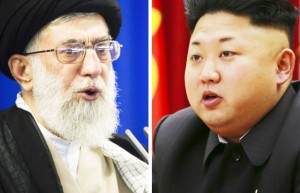
kim_iran-300x193

The two rogue nations have been able to circumvent sanctions at every turn thanks to their collaborative efforts and impotence that’s endemic throughout the UN and US government in particular
Source: The Business Insider

This brings us to another problem: The Obama administration’s failure at the issue surrounding our European allies’ refusal to actually enforce the UN sanctions already on the books. As you would guess, the regime has been in the market for procuring military-grade blast valves. What the UN, US government and several other allied nations are aware of (and hoping that the public remain ignorant to) is that one of the top sellers of those valves to the Iranians is Finnish company Temet Oy. This company is a global leader in blast protection and special ventilation technology applied in protective constructions such as civilian shelters and hardened military facilities. In addition to the nuclear and defense industries, Temet is also involved in the energy sector – which is the reason why they’re so keen to help the Iranian regime with its “peaceful” nuclear program. If you don’t believe us see for yourself:

About Temet
http://www.temetprotection.com.ar/about_temet.html

Temet Blast Valves
http://www.temetprotection.com.ar/blast_valves.html

FYI, Temet’s blast valves are specifically designed to protect facilities from munitions strikes – such as a potential Israeli Air Force Operation, for instance. The civil-grade blast valves that they’re publicly selling to the regime for its oil and gas sectors are designed to mitigate the effects of smaller explosions at industrial facilities. Despite Finland’s strong track record in the counter-proliferation arena, they’re likely fully aware of what this company has been up to for some time. If they’re not, then the government should fire all of their most senior intel officials because they’re clearly incompetent. They should be aware and continue tracking Temet’s activities after the 2012 attempt by the company to circumvent EU sanctions by shipping products to Iran and receiving payment via third parties. The problem is Temet is just one of several European companies that have been cashing in big on the poorly-enforced sanctions. Finland isn’t the only government guilty of trading in their morals to make a quick buck – the Germans are just as guilty. Here’s some other incidents over the years that put some cold water on any hopes that even sanctions can be enforced:

German firms sold sensitive equipment to Iran even during sanctions regime
http://www.haaretz.com/news/middle-east/.premium-1.562287

German firms still ship dual-use goods to Iran
http://www.jpost.com/Iranian-Threat/News/German-firms-still-ship-dual-use-goods-to-Iran

A mysterious Iranian-run factory in Germany
http://www.washingtonpost.com/world/europe/a-mysterious-iranian-run-factory-in-germany/2013/04/15/92259d7a-a29f-11e2-82bc-511538ae90a4_story.html

Germans Say 6 Companies Sold Nuclear Parts to Iran Network
http://www.nytimes.com/2006/03/29/international/europe/29germany.html?_r=0

Special Report: How foreign firms tried to sell spy gear to Iran
http://www.reuters.com/article/2012/12/05/us-huawei-iran-idUSBRE8B409820121205

As you can see, the Obama administration’s much-hyped nuclear “deal” with the Iranian regime was a failure from the get-go. Ayatollah Khameini knows the US government is weak because they’ve already caved into earlier demands – so why not raise the stakes and milk an already flaccid Obama administration for even more concessions? Iran’s true intentions for its program isn’t in doubt – its primary function is to produce a nuclear weapon. The Obama administration and the EU are fully aware of this as well – but they still won’t do anything about it. Europe lacks any real convictions and are now a shriveled corpse of what they used to be. People talk about the US in the same breath as “blood money” for oil, but the truth is the European nations are directly responsible along with China and Russia for propping up an increasingly belligerent Iranian regime who interprets “peace” as all opposing voices being silenced – by force. Their refusal to actually enforce sanctions and then turn around and circumvent them – sometimes openly – has led us to where we are. So President Obama isn’t the only one who will have a tarnished legacy.

Regarding our illustrious President, his “Hope and Change Foreign Policy” has been such a miserable failure that he’s now desperate for anything that he can claim as a “victory.” He certainly isn’t going to get that “victory” from his nonexistent strategy to combat the Islamic State (IS), so he’s forced to get a deal – any deal – signed with the Iranians, regardless of how bad it is for America and our allies in the Middle East. The saddest thing about all this is that the deal will empower the regime even more. When that happens – and it will – the biggest losers will be the average Iranian citizen who doesn’t share the regime’s militant ideology. How so? Once the regime is able to produce a nuclear weapon, they know the west won’t do anything to stop them. Period. When that occurs, they will be able to put the final nail in the coffin against the remaining opposition groups in the country. And so it goes…

If you want to know what this regime is all about, then check out the rest of our Inside Iran’s Middle East series:

Inside Iran’s Middle East: The Kurdish Insurgency
http://isisstudygroup.com/?p=4068

Inside Iran’s Middle East: The Southeastern Insurgency
http://isisstudygroup.com/?p=2689

Inside Iran’s Middle East: The “Reformers”
http://isisstudygroup.com/?p=2635

The Iran scam grows even worse – Part I, Nuke site inspections

June 15, 2015

Dan Miller’s Blog, May 15, 2015

(The views expressed in this article are mine and do not necessarily reflect those of Warsclerotic or its other editors. — DM

It is likely that the P5+1 nuke deal with Iran will be approved soon. Military and other nuke sites which Iran has not “disclosed” will not be inspected. Nor will Iran’s nuke ties with North Korea — which P5+1 member China seems to be helping, Iran’s massive support for terrorism and abysmal human rights record be considered because they are also deemed unnecessary for deal approval. Sanctions against Iran are moribund and will not be revived regardless of whether there is a “deal.” However, a bronze bust of Obama may soon be displayed prominently in Supreme Leader Khamenei’s office and one of Khamenei may soon be displayed proudly in Dear Leader Obama’s office.

Iran fenced in

Part I — Nuke site inspections

According to a June 11, 2015 article by the Middle East Research Institute (MEMRI), Iran’s Supreme Leader has said there will not even be “token” IAEA inspections.

This past week, members of Iran’s nuclear negotiating team revealed details about the Iran-U.S. nuclear negotiations. The negotiations were dealt a blow when Iranian Supreme Leader Ali Khamenei rejected an agreement reached by the two sides concerning a token inspection of military facilities and questioning of several nuclear scientists and “military personnel”; these were to be the response to the IAEA’s open dossier on possible military dimensions (PMD) of Iran’s nuclear program to which Iran has so far refused to respond.

Iranian reports on these developments show that in order to arrive at a comprehensive agreement, the U.S. is willing to forgo actual inspection of Iranian military facilities and to settle for inspection of declared nuclear facilities only, as set forth under the Additional Protocol, while the ongoing monitoring of Iran’s nuclear program will be left to intelligence elements. [Emphasis added.]

Also on June 11th, it was reported that

CIA Director John Brennan likely came to Israel last week to tell Israeli officials that a final nuclear deal with Iran does not have to include a commitment by Tehran to provide access to military bases, or Iranian consent to interview its scientists, a new report by the Middle East Media Research Institute (MEMRI) said. [Emphasis added.]

On June 12th, Iranian President Rouhani reiterated that

the country will never allow its secrets to be exposed under the Additional Protocol of the Nuclear Non-Proliferation Treaty (NPT) or any other treaty.

“Certainly, Iran will not allow its secrets to be obtained by others under the pretext of implementing the (Additional) Protocol or any other treaty,” President Rouhani said at a press conference in Tehran.

He reaffirmed that foreigners will be denied access not only to Iran’s military secrets but also to secret information in other technological fields.

Here’s a video with comments by Former DIA Director Lt. General Michael Flynn and Ambassador Robert Joseph on Iran’s ballistic missile program and other aspects of the “deal:”

Here’s the Obama administration’s most recent waffle on inspections of Iran’s nuclear sites and sanctions relief:

Although the State Department spokesman waffled, his comments were, unfortunately, at least generally consistent with the January 14, 2014 White House Summary of the framework for subsequent P5+1 negotiations. As I noted here in January of 2014, that summary failed even to mention such military sites as Parchin — even though the IAEA “had reason to think that there had been implosion testing in 2011 but was refused access to inspect” it, Iran’s development and testing of rocketry capable of delivering nuclear warheads and its development and testing of nuclear warheads.

It had been reported on November 27, 2013 that

Despite Tehran’s protestations that it has no intention of ever creating a nuclear weapon, Iran, in fact, has been developing a warhead for some 15 years. That design is now near perfect. [Emphasis added.]

It had been reported on November 28, 2013 that

A top Iranian military leader announced late Tuesday that Iran has developed “indigenous” ballistic missile technology, which could eventually allow it to fire a nuclear payload over great distances. [Emphasis added.]

Why does the White House Summary fail to mention such things? Probably because they are not within the parameters of the November 24, 2013 Joint Plan of Action.

The Joint Plan of Action, — on which the White House Summary seems to have been based — states, in a superficially comforting preamble,

The goal for these negotiations is to reach a mutually-agreed long-term comprehensive solution that would ensure Iran’s nuclear programme will be exclusively peaceful. Iran reaffirms that under no circumstances will Iran ever seek or develop any nuclear weapons. This comprehensive solution would build on these initial measures and result in a final step for a period to be agreed upon and the resolution of concerns. This comprehensive solution would enable Iran to fully enjoy its right to nuclear energy for peaceful purposes under the relevant articles of the NPT in conformity with its obligations therein. This comprehensive solution would involve a mutually defined enrichment programme with practical limits and transparency measures to ensure the peaceful nature of the programme. This comprehensive solution would constitute an integrated whole where nothing is agreed until everything is agreed. This comprehensive solution would involve a reciprocal, step-bystep process, and would produce the comprehensive lifting of all UN Security Council sanctions, as well as multilateral and national sanctions related to Iran’s nuclear programme. [Emphasis added.]

There would be additional steps in between the initial measures and the final step, including, among other things, addressing the UN Security Council resolutions, with a view toward bringing to a satisfactory conclusion the UN Security Council’s consideration of this matter. The E3+3 and Iran will be responsible for conclusion and implementation of mutual near-term measures and the comprehensive solution in good faith. A Joint Commission of E3/EU+3 and Iran will be established to monitor the implementation of the near-term measures and address issues that may arise, with the IAEA responsible for verification of nuclear-related measures. The Joint Commission will work with the IAEA to facilitate resolution of past and present issues of concern.

However, while the Joint Plan of Action calls for “enhanced monitoring” of Iran’s facilities, its focus is on nuclear enrichment, not Iran’s militarization of nukes.

Enhanced monitoring:

Provision of specified information to the IAEA, including information on Iran’s plans for nuclear facilities, a description of each building on each nuclear site, a description of the scale of operations for each location engaged in specified nuclear activities, information on uranium mines and mills, and information on source material. This information would be provided within three months of the adoption of these measures.

Submission of an updated DIQ for the reactor at Arak, designated by the IAEA as the IR-40, to the IAEA.  Steps to agree with the IAEA on conclusion of the Safeguards Approach for the reactor at Arak, designated by the IAEA as the IR-40.

Daily IAEA inspector access when inspectors are not present for the purpose of Design Information Verification, Interim Inventory Verification, Physical Inventory Verification, and unannounced inspections, for the purpose of access to offline surveillance records, at Fordow and Natanz.

IAEA inspector managed access to: centrifuge assembly workshops; centrifuge rotor production workshops and storage facilities; and, uranium mines and mills.

Despite Obama’s claims, Iran appears to have increased, not rolled-back, its nuclear enrichment program. According to the New York Times on June 1st,

With only one month left before a deadline to complete a nuclear deal with Iran, international inspectors have reported that Tehran’s stockpile of nuclear fuel increased about 20 percent over the last 18 months of negotiations, partially undercutting the Obama administration’s contention that the Iranian program had been “frozen” during that period.

But Western officials and experts cannot quite figure out why. One possibility is that Iran has run into technical problems that have kept it from converting some of its enriched uranium into fuel rods for reactors, which would make the material essentially unusable for weapons. Another is that it is increasing its stockpile to give it an edge if the negotiations fail.

Here’s an “explanation” by Marie Harf, the “the Senior Advisor for Strategic Communications to U.S. Secretary of State John Kerry at the U.S. State Department. . . .”

Iran will not budge on inspection of its military and other sites it has not disclosed and which are claimed by the IAEA to be places where Iran’s weaponization of nukes is likely. The Obama Administration will not budge on permitting Iran to get away with it.

Although Israel has been the only free and democratic nation consistently to oppose the P5+1 “negotiations” and the framework on which they are based from the beginning, France has sometimes opposed Obama’s pursuit of a bad “deal.” Recently, France even demanded the inspection of Iran’s sites as sought by the IAEA and stated that it would not consent to a P5+1 “deal” without them.

However, “the French position creates a problem for President Obama because the deal has to be agreed on by the P5+1, not the ‘P4+1-with-one-vote-in-opposition’.” Of the P5+1 members (China, France, Russia, the United Kingdom, and the United States, plus Germany), France appeared to stand alone on this point. However, the linked article suggests that Obama may be trying to use France’s support for a Palestinian state within Israel to convince her to agree that such inspections are unnecessary.

The first story is about France, a member of the P5+1 negotiating a deal with Iran on nuclear capabilities. The French government has expressed increasing concern that the emerging deal is flawed — perhaps fatally.

The other story is that Obama’s

expressed skepticism about the achievability of an Israeli-Palestinian agreement appears to have given way to the French notion that “all other ways have been explored,” and that it is time to let the UN determine parameters for a “big overarching deal.” And, as it happens, the French draft corresponds with the President Obama’s own — strongly held — belief that Israel has to ascribe to the President’s view, despite having just elected a Prime Minister who disagrees.

. . . .

Smash the two stories together, you get an American president supporting France in its efforts to be a major player in the Middle East in exchange for French support of the P5+1 deal with Iran.

In both cases, guess who pays the price: Israel.

The rest of the “free world,” such as it has become, will also pay a hefty price for such a “deal” with Iran.

On a similar note, it was reported on June 9th that

A senior Western diplomat told Ma’ariv in a report published Tuesday that “a diplomatic attack against Israel is expected soon that will surprise even the pessimists in Jerusalem.”  [Emphasis added.]

“In the (UN) Security Council, in western capitals and at EU headquarters, they are just waiting for the Iran deal to be signed and for it to be approved by the American Congress,” warned the diplomatic source.

It appears that the waiting period will likely expire in September, at which time a UN General Assembly will open in tandem with the first shots of the diplomatic barrage against Israel.

Diplomatic sources familiar with Western European positions vis-a-vis Israel said the EU already has a list ready, itemizing sanctions against Israel in the fields of trade, agriculture, science and culture. [Emphasis added.]

That list is to be translated into an economic assault – unless Israel presents a new set of concessions it is willing to make for a new round of peace talks, after the last set of talks was torpedoed by the PA signing a unity deal with the Hamas terrorist organization.

“S‭enior officials in Jerusalem are aware of the existence of sanctions documents at EU headquarters, some of which have even fallen into their hands,” one diplomatic source revealed to Ma’ariv.

Were Israeli Prime Minister Netanyahu to have agreed with Obama on the Iran nuke “negotiations,” Israel’s punishment by imposing economic sanctions on her as those on Iran cease would now be unlikely.

Obama seems to be happy with any “deal” that Iran is willing to sign, despite Iran’s ongoing nuke militarization, the Iran-North Korea-China connection, Iran’s continued massive support for terrorism and its abysmal human rights record. With such a “deal,” Iran will be able to pursue such goals essentially unimpeded, at least until a different administration takes over in Washington.

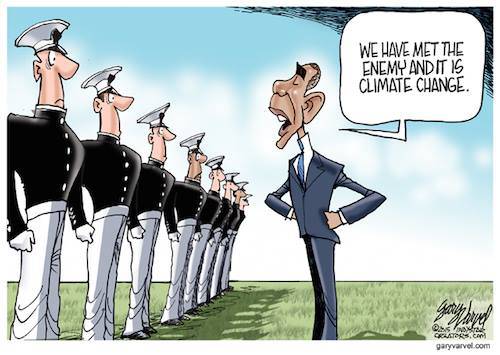
gary_varvel_gary_varvel_for_04272014_5_-500x367 (H/t Freedom is just another word.)

Parts II through ?? of this series will be posted over the next several days.

Rouhani: Saving environment starts with sanctions removal

June 9, 2015

Rouhani: Saving environment starts with sanctions removal, Al-MonitorArash Karami, June 8, 2015

(Human rights, Iranian missiles, Iranian threats, Iranian proxies, theocratic dictatorship? Those are not relevant to the deal. But whatever may help the environment and therefore stop climate change is my top priority — Obama.

enemy

— H/t Freedom is just another word. — DM)

Rouhani’s comments linking the country’s various environmental problems and employment woes to the nuclear negotiations and sanctions relief have upset conservatives, who believe the administration is too eager to resolve the dispute and too optimistic about what the deal means for the country.

**********************

Iranian President Hassan Rouhani has been criticized for suggesting that once a comprehensive nuclear deal is made it will open the door to improving the country’s environmental problems. “The oppressive sanctions must be removed so that investment can come and the problems of the environment, employment, industry and drinkable water are resolved,” Rouhani said at a ceremony on June 7 commemorating Environment Week in Iran.

Rouhani described the sanctions as “a small fever … that at the beginning no attention was paid to this fever, but when the sick person fell ill and was not able to move anymore, we sought a remedy for the illness. Some did not know the reason of the sanctions but step by step, the problems became larger.”

Rouhani added that while “the oppressive sanctions must be removed,” this does not mean “that we must submit to the unreasonable wants of others.”

Iran and five permanent members of the UN Security Council plus Germany (P5+1) are working through the final details of a comprehensive deal that would see Iran reduce its nuclear activity in return for sanctions relief, particularly banking sanctions that have hurt the country’s ability to sell its oil and conduct trade and have prevented Western investment in the country.

But Rouhani’s comments linking the country’s various environmental problems and employment woes to the nuclear negotiations and sanctions relief have upset conservatives, who believe the administration is too eager to resolve the dispute and too optimistic about what the deal means for the country.

In an article titled, “The water, wind, soil and forests have also been tied to sanctions,” the conservative Javan newspaper criticized Rouhani’s latest comments. The article said, “Despite experts warning of not connecting domestic issues of the country to the nuclear issue and negotiations, at this ceremony Rouhani once again suggested that with the removal of sanctions not only will investment become fluid in Iran but the issues of the environment, youth employment, water and banking will be [resolved].”

The article continued that Rouhani’s comments “resulted in many experts becoming surprised and a few hours afterward many hostile Western networks and media … took this point and broadcast this to show [that] sanctions have brought Iran to its knees.”

In an article sarcastically titled, “Solving all the problems is tied to the negotiations, even drinking water,” the Kayhan newspaper also criticized Rouhani. Kayhan repeated Javan’s warning that analysts have warned of not tying the nuclear negotiations to domestic issues and cast doubt that so many problems could be resolved with the removal of sanctions. Kayhan wrote, “Stranger than anything else, Rouhani said the removal of sanctions would increase the water levels.”

Kayhan said, “The issue of sanctions is one the most important obstacles for the negotiators because the Americans do not want to remove sanctions, which is a tool to apply pressure on Iran.”

According to his previous statements, Iran’s Supreme Leader Ayatollah Ali Khamenei, who has final say on the nuclear program, has warned Iranian officials about being optimistic regarding the sanctions and has emphasized focusing on domestic capabilities instead.

On April 29, he said, “The key to solving economic issues is not in Lausanne, Geneva or New York,” three locations where the Iran and P5+1 nuclear talks have taken place under the Rouhani administration. “Without a doubt, sanctions and pressure cannot stop organized and planned efforts to increase domestic production.”


How the Islamic Republic Is Manipulating the U.S.

May 19, 2015

How the Islamic Republic Is Manipulating the U.S., Front Page Magazine, May 19, 2015

iran-s-rouhani-phones-pm-nawaz-after-soldier-s-killing-1395854702-4802-450x336

Rouhani and the moderate camp have persuaded Ayatollah Ali Khamenei that superficial diplomatic ties with the Obama administration will, in fact, empower the Islamic Republic, further its hegemonic ambitions, and raise Tehran’s economic status without the need for the Iranian leaders to give up on their revolutionary principles, anti-Americanism and anti-Semitism.

****************

There is a crucial Machiavellian (but not a strategic) tactical shift in the Islamic Republic’s foreign policy and its pursuit of regional preeminence.

First of all, Iranian leaders have realized that by superficially showing the Obama administration that the Islamic Republic is willing to restore diplomatic ties with his administration, they can in fact further advance their ideological and national interests.

Second, knowing that President Obama is desperate for a “historic” nuclear deal and the establishment of diplomatic ties with the Islamic Republic, Iranian leaders have played the role very well by attempting to satisfy President Obama’s empty goals.

Third, the ruling clerics of the Islamic Republic became cognizant of the fact that dealing with the Obama administration does not necessarily mean that they have to give up anything with respect to its domestic suppression, revolutionary Islamist principles, human rights abuses, regional hegemonic ambitions, anti-Americanism, hatred towards Israel, and foreign policy objectives.

The tactical shift, currently, is to satisfy President Obama’s personal and shallow objectives by allowing him to project that he is making historic moves (such speaking on the phone with the Iranian leaders), while simultaneously pursuing their own ideological objectives.

For example, most recently, Rouhani and the Obama administration agreed on opening new diplomatic offices in Tehran and Washington. For President Obama, opening diplomatic offices can be viewed as another “historic move” cited in his records or on his Wikipedia page. From the perspective of Iranian leaders, it is a crucial pillar for the advancement of Iran’s foreign policy and ideological objectives in the region without pressure from the US.

To pursue their objectives more efficiently, Iranian leaders have agreed to meet frequently with the diplomats at the highest level of the Obama administration, “negotiating,” and having some of their interactions publicly televised on American and Western media. In addition, the American and the Iranian flags are repeatedly shown next to each other in the high level meetings.

These moves, in fact, give legitimacy to the theocratic regime to further its ambitions.

The president was also delighted to make another “historic move” by speaking on the phone with his Iranian counterpart, President Hassan Rouhani. (One would wonder what a great accomplishment it is to pick up a phone and call another president.)

Washington and Tehran broke diplomatic ties in 1979. After the hostage crisis, high American officials and diplomats have not set foot on the Iranian soil due to Iran’s continuous violation of international norms and anti-Americanism.

Nevertheless, President Obama and Secretary of State John Kerry have decided to turn a blind eye on Iran’s egregious human rights abuses, aggressiveness and violations of international laws.

In another shallow move, Kerry claimed to be proud to set foot on Iranian “territory.” He met with Iran’s Foreign Minister, Mohammad Javad Zarif, at the residence of the Iranian ambassador to the United Nations, Gholamali Khoshroo, in New York.

Instead of attempting to change the behavior of the Ayatollahs and their revolutionary principles, President Obama and Kerry are satisfied with these superficial “historic moves.”

Since Iran’s political establishments and policies are driven, not solely by national and geopolitical interests, but also by ideological Islamist (Shiite) principles, hardliners and the office of the Supreme Leader will always view a real rapprochement with the US as taboo.

Restoring full diplomatic ties can also be analyzed as betraying the revolutionary principles of the Islamic Republic, which were based on anti-Americanism, as well as their opposition to Western models of socio-political and socio-economic landscapes.

From the perspective of Iran’s Supreme Leader, Ayatollah Ali Khamenei — who has the final say in foreign policy decisions — genuine diplomatic ties with the US will lead to the empowerment of Iranian civil society and secular factions. From the prism of the senior cadre of the IRGC, relationships with the American government might lead to the opening of the Iranian market, endangering the economic monopoly of IRGC institutions.

On the other hand, Rouhani and his technocrat team, who share the same objectives with the hardliners and want to preserve the interests of the Islamic Republic, came to the realizations that satisfying President Obama’s superficial and shallow objectives of “historic moves,” can indeed assist them in advancing their ambitions.

In conclusion, similar to the ongoing nuclear negotiations, Rouhani and the moderate camp have persuaded Ayatollah Ali Khamenei that superficial diplomatic ties with the Obama administration will, in fact, empower the Islamic Republic, further its hegemonic ambitions, and raise Tehran’s economic status without the need for the Iranian leaders to give up on their revolutionary principles, anti-Americanism and anti-Semitism.

How Iran Saved Obama’s “Blame America” Foreign Policy

April 29, 2015

How Iran Saved Obama’s “Blame America” Foreign Policy, Front Page Magazine, April 28, 2015

rouh-450x313

Obama’s public rejection of every ally, from Israel to Egypt to Saudi Arabia, has finally created the Post-American Middle East that his “Blame America” doctrine sought. The Post-American Middle East is a hive of terrorist groups and a region of nuclear arms races where murderous despots with vast armies dream of resurrecting the Ottoman Empire, the Persian Empire and the Abbasid Caliphate.

*********************

Obama’s Middle East policy was doomed to fail because it was based on the myth that everything wrong with the region was America’s fault.

Senator Obama had argued that Iraq would fix itself once we pulled out. Without America, the Iraqis would create a “political solution”. Instead the Shiites used the withdrawal to take over the government and Al Qaeda rebounded to dominate the Sunnis. After years of denying what was going on, he was forced back into Iraq after genocide and beheadings filled every television screen.

From the White House, he deployed the “Iraq Solution” across the Middle East by withdrawing support from American allies and backing terrorist groups like the Muslim Brotherhood. The chaos tore apart the region and turned over entire cities and countries to terrorists.

Egypt went through multiple coups. Street violence in Tunisia wrecked the country and supplied thousands of fighters to ISIS. His regime change war in Libya led to terrorist takeovers of its capital. Al Qaeda nearly took over Mali. Houthi Jihadists backed by Iran took over Yemen’s capital. The Saudis are bombing Yemen. The Egyptians are bombing Libya. The French are still fighting in Mali.

Iran and Al Qaeda have divided up Iraq, Syria and Yemen between themselves.

Withdrawing American power and influence didn’t work because we were never the problem. American soldiers weren’t causing the Sunnis and Shiites to fight each other. They were the only thing preventing it. American power and influence across the Middle East wasn’t holding back freedom and human rights, it was the only thing keeping a modicum of freedom alive in places like Egypt and Tunisia that quickly fell to Islamist rule in the Arab Spring, resulting in street violence, torture, terrorism and military coups.

The left had been fundamentally wrong about the cause of the problems in the Middle East. Obama trashed the region by following its wrongheaded doctrines.

Once the “Blame America” foreign policy has been implemented and the region went to hell, he had no idea what to do next. Intervening in Libya made sense according to the “Blame America” doctrine because Gaddafi had recently cut a deal with the United States and was obstructing the Jihadists who were implementing the local version of the Arab Spring in coordination with the Muslim Brotherhood.

But intervening in Syria didn’t. Assad wasn’t an American ally. Therefore the “Blame America” doctrine said that he should be left alone. But he was obstructing the Arab Spring. Overthrowing him would let the Muslim Brotherhood claim another country, but would alienate Iran and spoil any reconciliation.

Unable to make a final decision, Obama veered back and forth between Iran and the Muslim Brotherhood. Some days he seemed on the verge of bombing Syria and other days he was against even providing the promised weapons to the Sunni rebels. Even his supporters accused him of having no plan.

Syria’s real red line was the one that it had drawn through his foreign policy. Instead of making the Middle East better, his withdrawals had made it worse. And the beneficiaries of his foreign policy, especially the Muslim Brotherhood, were clamoring for more American military intervention.

Even Iraq’s Shiite government, backed by Iran, wanted American intervention.

Obama’s foreign policy had created a new set of untrustworthy client states which had to be kept alive by American intervention. The great joke of his foreign policy was that his new terrorist states acted just like the old dictators they were supposed to replace. They wanted American weapons and soldiers. Their own people hated them and hated America by extension. The climax of the Arab Spring came with crowds in Tahrir Square denouncing Obama and the Muslim Brotherhood for acting as his client state.

The “Blame America” foreign policy had led to even more blame of America. The new “democratic” Islamist governments that he helped bring to power to appease the Arab Street and atone for the sins of supporting the old secular-ish dictators backfired by making the Arab Street hate us more than ever.

Iran saved Obama’s foreign policy. Just as he was stumbling around Syria and weeping at being stuck back in Iraq, the agents of the Iran Lobby suggested that the whole mess could be put back together again. Iran and the US would fight on the same side against ISIS in Syria and Iraq. And this cooperation could be used to hammer out a nuclear accord that would retroactively justify Obama’s Nobel Prize.

The only problem was that everyone else in the region was completely against the idea.

The Iran Lobby threw Obama’s failed foreign policy a lifeline and he grabbed it. The bombing of Syria was off. Assad turned over some WMDs, but went on using others. The US began acting as the air force for Iran’s Shiite militias in Iraq while the Kurds and the Sunni Sheikhs of the Awakening were shut out.

When the Houthis took over Yemen, Obama shrugged. When the Saudis began bombing Yemen, they didn’t tell him because they were afraid the news would leak to Iran. And the administration covertly began pressuring them to stop, confirming that it now took its marching orders from Tehran, not Riyadh.

Obama ignored the vocal opposition, particularly from Israel’s Netanyahu, because the Iran deal was the only thing holding his foreign policy together. It made it seem as if he knew what he was doing. Take away the Iran deal and there was no longer a strategy, just a series of incoherent panicked responses.

That is why he continues to cling to the Iran deal. Without it, the Emperor’s foreign policy is naked.

The Iran deal salvaged the “Blame America” foreign policy by reorienting it away from the Muslim Brotherhood to deal with our great enemy in the region. By acceding to Iran’s nuclear program, Obama could finally fix everything by atoning for America’s biggest foreign policy sin in the region.

Despite his Muslim family background, Obama never understood the Middle East. Instead he looked at the region through a left-wing lens and saw only America’s crimes.

The Sunnis and Shiites, the Arabs, Kurds, Persians and Turkmen, weren’t fighting because of America. They were fighting over differences in religion, ethnicity and clan. The left has always thought that the way to fix the Middle East was to withdraw American influence. Instead doing that destabilized the region and created a power vacuum that Russia and Iran have been more than happy to fill.

Obama’s final foreign policy act was to fall directly into Iran and Al Qaeda’s trap.

Iran and the various Al Qaeda groups had effectively split parts of the region among themselves. By embracing Iran, Obama alienated the Sunni Middle East and shoved entire populations into Al Qaeda’s waiting embrace. He completed the polarizing process that he began with the Arab Spring by selling out the moderates to the extremists and waiting for everyone in the region to love America again.

But the Muslim Brotherhood lost out to its edgier Al Qaeda children. Egypt and the Saudis are scrambling to hold together some sort of Sunni center without the United States and against its wishes. Obama’s alignment with Iran, his rejection of Egypt’s new government and his failure to back the Saudis in Yemen has sent the message that the only legitimate alternative to Al Qaeda is Iran.

That’s not an alternative that most Sunnis can accept. Many would rather stand with Al Qaeda than Iran.

Obama’s public rejection of every ally, from Israel to Egypt to Saudi Arabia, has finally created the Post-American Middle East that his “Blame America” doctrine sought. The Post-American Middle East is a hive of terrorist groups and a region of nuclear arms races where murderous despots with vast armies dream of resurrecting the Ottoman Empire, the Persian Empire and the Abbasid Caliphate.

While genocide goes on, sex slaves are raped under the rule of a Caliph and black flags are unfurled and nuclear weapons are developed to fulfill apocalyptic Islamic prophecies, Obama smiles for the camera and waits for his second Nobel Prize.

It had been America’s fault all along. Now that Iran and Al Qaeda are in charge, everything will be okay.

Progressives at the Poker Table

April 24, 2015

Progressives at the Poker Table, Mishpacha Magazine, Jonathan Rosenblum, via Jewish Media Resources, April 24, 2015

A comparison of the progressive approach to the threat of climate warming and that of a nuclear-armed Iran offers interesting insights into the progressive mind.

Let’s start with climate warming, which according to the best measures, inconveniently stopped about 18 years ago. First, what is the magnitude of the threat? The most alarmist predictions of future catastrophe are based on computer-generated climate models that have been consistently refuted by events of the real world. According to the alarmists, there would be fifty million refugees from global warming by 2010. Never happened.

Those models are based on a variety of assumptions about “feedback mechanisms” generated by increased CO2 in the atmosphere trapping more heat. NASA satellite date from 2000-2011 showed far more heat escaping the earth’s atmosphere than predicted by the computer models, according to study in the peer-reviewed journal Remote Sensing.

Nor is clear to what extent the global warming of the 20th century was generated by anthropogenic forces – i.e., increased CO2 emissions. Many leading climate scientists now think that solar activity — about which we can do nothing — may be a larger contributor to temperature variation than carbon emissions. That would be consistent with the wide fluctuations between warm and cold periods over the last millennium, even prior to the onset of the Industrial Resolution.

Scientists at CERN, the European Organization of Nuclear Research, which involves 600 universities and national labs and 8,000 scientists, have shown that cosmic rays promote the formation of molecules that grow and seed clouds. And clouds trap heat in the atmosphere. The magnitude of cosmic rays emitted by the sun depends on variations in the sun’s magnetic field.

Finally, that which the alarmists consider an unmitigated disaster — higher levels of CO2in the atmosphere may have many beneficial effects. A 2012 statement signed by 16 distinguished scientists from universities like Harvard, Princeton, MIT, and the Hebrew University, pointed out that CO2 is “not a pollutant,” but rather a “key component of the biosphere’s life cycle.” Higher concentrations of CO2 spur plant growth.

In sum, the threat, if any, is one for the indeterminate future, of unknown magnitude and causation, and may not even be subject to ameliorative action. Yet climate alarmists propose a Global Green Carbon Treaty of such cost and intrusiveness that Yale’s Walter Russell Mead compares it to the 1928 Kellogg-Brand Pact outlawing war for sheer folly. He describes GGCT as less a treaty and more a constitution for world government regulating all economic production in every country on earth. That constitution would be for a “global welfare state with trillions of dollars ultimately sent by the taxpayers of rich countries to governments (however feckless, inept, corrupt or tyrannical) to poor ones.”

These proposals are put forward seemingly oblivious to the economic cost or loss of liberty involved. In his 2001 book The Skeptical Environmentalist, Danish statistician Bjorn Lonborg calculated that enforcement alone of the Kyoto Treaty would cost $150,000 billion a year, money which could save tens of thousands of lives annually.

The above-mentioned statement of the 16 scientists cited the work of Yale economist William Nordhaus, whos showed that the highest benefit-to-cost ratio would be achieved via a policy of fifty years of economic growth unimpeded by greenhouse gas controls. The least developed countries would benefit most by being able to share some of the advantages of material well-being — i.e., health and life expectancy — with the more developed world.

NOW TO THE OTHER SIDE of the comparison. Even President Obama admits that under the unsigned understanding reached at Lausanne, Iran will have zero breakout time to a nuclear weapon thirteen years from now. (Today, he puts the breakout time at three months.)

That fact alone creates a world with as many tripwires leading to war as Europe on the eve of the assassination of Archduke Ferdinand in August 1914. Only this time the weapons of choice will be nuclear.

The proposed agreement with Iran means the end of nuclear non-proliferation. If the world’s leading rogue state and sponsor of terrorism can have its nuclear weapons program effectively endorsed by the members of the U.N. Security Council, every other nation that was dissuaded in the past by international pressure from expanding its civilian nuclear program to include enrichment to weapons level – e.g., South Korea, Brazil – will reconsider.

The most rapid nuclear proliferation will take place in the world’s most volatile region, the Middle East, in which the millennial hatred of Sunnis and Shiites still burns hot. Saudis have made it clear that they will purchase nuclear weapons off-the-shelf from Pakistan, as per a prior agreement, to counter Iran’s ability to obtain nuclear weapons. Egypt and Turkey will almost certainly follow suit.

An already aggressive Iran would become vastly more so with the hundreds of billions of dollars in revenues from the lifting of sanctions and the ability to provide a nuclear umbrella for its regional proxies. As a consequence, the Middle East would become all the more volatile.

The nations most likely to acquire nuclear arms and unstable, which increases the possibility of terrorist groups acquiring nuclear weapons. Iran has long eyed the “holy cities” of Mecca and Medina, and is already stirring up the Shiite population in Saudi Arabia’s eastern, oil-producing provinces and in Yemen on its southern border. Egypt cannot feed its population.

And Iran might find it useful to supply some of its non-state allies, like Hezbollah or Hamas, with dirty nuclear weapons that do not require missiles to deliver. Non-state actors are far harder to deter or hold accountable.

A nuclear Iran should terrify not only Israel, which it has repeatedly threatened to obliterate. Iranian leaders have publicly speculated for years about the grim calculus of a nuclear exchange with Israel: one bomb wipes out Israel; Israeli retaliation still leaves us with tens of millions survivors. Former CIA Director James Woolsey and Peter Fry, a member of the congressional EMP (electro-magnetic pulse) Commission, stress the vulnerability of the United States. The recent “understanding” (the terms of which are unknown and perhaps unknowable given the wide divergence between American and Iranian descriptions of what has been concluded) makes no reference to any limitations on Iran’s ballistic missile program, on which it works closely with North Korea.

Iran may soon possess long-range missiles capable of reaching the United States or the capacity to launch a nuclear-armed satellite above the United States. Even one nuclear weapon detonated above the United States could potentially knock out much of the national power grid. The congressional EMP Commission estimated that a nationwide blackout lasting one year from such an EMP attack could result in the deaths of nine out of ten Americans, with ISIS-like gangs ruling the streets.

Nor are traditional doctrines of nuclear deterrence relevant to the Middle East, in general, and Shiite Iran, in particular. Former secretaries of state Henry Kissinger and George Schultz ask in their devastating critique of the recent agreement how will traditional doctrines of deterrence based on stable state actors “translate into a region where sponsorship of non-state proxies is common, the state structure is under assault, and death on behalf of jihad is a kind of fulfillment?”

As the dean of Middle East scholars Bernard Lewis has pointed out, for Shiite fanatics awaiting the return of the “hidden Imam,” after a cataclysmic event, the destruction of nuclear war might be an inducement rather than a deterrent.

WHAT DOES PRESIDENT OBAMA offer as the response to this description of a nuclear tinderbox waiting to be lit? Pure fantasy.

He and Secretary of State Kerry have made repeated references to a fatwa of the Supreme Leader Ayatollah Khameini against the use of nuclear weapons, which does not exist and certainly is credited by none of Iran’s enemies.

And he speaks hopefully of a newly mellowed Iran after the conclusion of an agreement. What is it about the Supreme Leader’s repeated chants of “Death to America” and insistence that current negotiations have nothing to do with reconciliation that the President can’t hear?

One option that the President has completely excluded is an air campaign to destroy Iran’s nuclear infrastructure and cut of the “head of snake,” as Woolsey once described the Revolutionary Guard to me. Obama has repeatedly accused the opponents of the Lausanne understanding as being advocates of war.

Clearly, then, all the tough talk about “all options are on the table,” “a bad deal is worse than no deal [followed by military attack],” “I will never allow Iran to acquire nuclear weapons,” had the same truth content as “If you like your plan, you can keep your plan.”

Yet no one doubts that the United States has the capability to destroy Iran’s enrichment infrastructure. (If Russia goes through with the delivery of advanced anti-aircraft batteries, as a consequence of the Lausanne understanding, the task will be complicated.) And there will be consequences that cannot be fully known in advance. Iran has terrorist sleeper cells around the world. But it also has lots of assets, besides its nuclear infrastructure, which would be subject to further attacks if it unleashes those cells.

Whatever the Iranian response, the price to be paid will certainly be less than consigning all humanity to live in a world perpetually poised on the cusp of nuclear war.

SO WHY in the case of global warming are progressives willing to incur unbearable costs to combat a future threat of unknown magnitude and immediacy, and against which their solutions may well prove futile, while with respect to the easily identified and imminent danger of a nuclear-armed Iran, they write off from the start a clear and known remedy?

For progressives the solution of worldwide government, run by the executive decree of “the best and the brightest,” is not a cost too great to be contemplated, but rather the fulfillment of the progressive dream. But they will never countenance military action, even to save millions of lives down the road. Churchill’s dictum, “If you want peace, prepare for war,” remains foreign to them.

How Rouhani explained the Nnclear deal to Iranians

April 4, 2015

How Rouhani explained the Nnclear deal to Iranians, Power LineJohn Hinderaker, April 3, 2015

Iran’s President Hassan Rouhani went on state-run television today to explain the deal that has been reached (in principle, at least) to the Iranian people. FARS News describes the speech:

Iran’s President Hassan Rouhani underlined on Friday that all the UN and economic, financial and banking sanctions against Iran will be annuled the moment a final nuclear deal between Iran and the six world powers goes into effect.

This was a key bargaining point for Iran. Iran’s compliance with the agreement will stretch, problematically, over a period of years, but all sanctions will be lifted immediately.

In a public address on the state-run TV on Friday, President Rouhani reminded his election campaign slogan that he would keep Iran’s nuclear industry running and remove the sanctions against the country, and said the Iranian nation is now closer to this goal more than ever.

He said his administration had a four-step plan, which included the attainment of an interim deal, “and after months of efforts, specially during the last few days, the second objective was also materialized last night”.

In other words, the West caved on the immediate lifting of all sanctions.

“In this second step, we have both maintenance of nuclear rights and removal of sanctions alongside constructive interaction with the world,” the president continued.

This last point–”constructive interaction with the world”–is an important one that hasn’t been emphasized enough. Iran has been considered a rogue state for a long time, and deserves to be considered one still. It remains the world’s largest state sponsor of terrorism. But implicit in the deal that Western countries have struck with Iran is acceptance of Iran as a legitimate regional and world power–one whose peaceful intentions are acknowledged, and against which sanctions are no longer appropriate. This acceptance is a huge benefit to Iran’s theocratic rulers, perhaps as great a psychological benefit as the elimination of sanctions will be a material benefit. Opposition to the mullahs can only be demoralized. This is critically important, as it may well be that the only real way to prevent Iran from becoming a nuclear power is through regime change.

“The Group 5+1 (the US, Britain, France, Russia and China plus Germany) has accepted in the framework understanding attained on Thursday night that Iran will have domestic enrichment on its soil; and this means that those who stated that Iran’s enrichment is a threat to the region and the world have admitted today that enrichment in Iran is no threat to anyone,” said President Rouhani.

The Bush administration’s position was that all enrichment must cease. President Obama yielded on that vital point.

“I, hereby, declare in a straightforward manner now that enrichment and all nuclear-related technologies are only aimed at Iran’s development and will not be used against any other countries and the world has acknowledged very well today that Iran is seeking peaceful purposes,” he added.

In that case, will Iran abandon its ICBM development program? No. It said that continuation of its ICBM program was “non-negotiable.” Why? Has any country ever developed ICBMs for any purpose other than delivery of nuclear weapons? No.

He said Arak Heavy Water Reactor will continue its operation with the help of the most modern technologies and “Fordo (uranium enrichment plant) will remain operational forever with 1,000 centrifuges installed in there and nuclear and physics-related activities and technologies will run there”.

Forever. The mullahs take the long view. The Lausanne agreement, such as it is, will expire in ten years.

COLUMN ONE: The diplomatic track to war

April 3, 2015

COLUMN ONE: The diplomatic track to war, Jerusalem Post, Caroline Glick, April 4, 2015
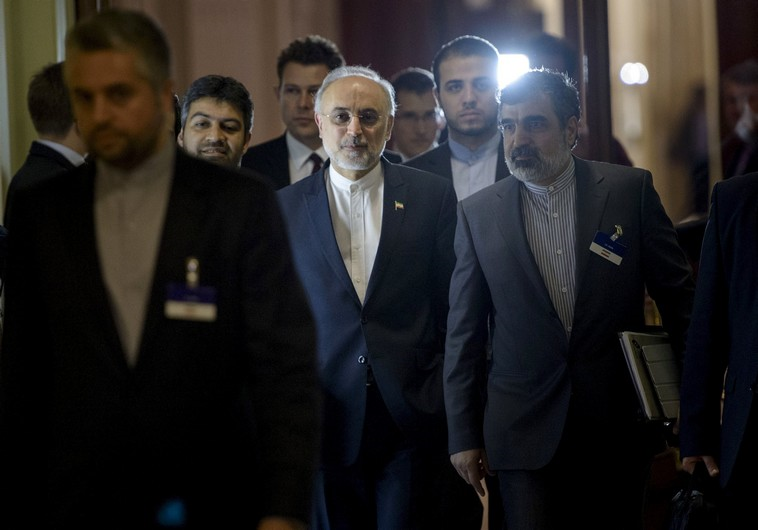
Iran negotiationsIran negotiations. (photo credit:REUTERS)

No one trusts Washington when Obama claims that he is committed to the security of Israel and the US’s Sunni allies in the region.

Iran is far more powerful than the PLO. But the Americans apparently believe they are immune from the consequences of their leaders’ policies. This is not the case for Israel or for our neighbors. We lack the luxury of ignoring the fact that Obama’s disastrous diplomacy has brought war upon us. Deal or no deal, we are again about to be forced to pay a price to maintain our freedom.
********************

Through their nuclear diplomacy, Obama and his comrades started the countdown to war.

The world powers assembled at Lausanne, Switzerland, with the representatives of the Islamic Republic may or may not reach a framework deal regarding Iran’s nuclear program. But succeed or fail, the disaster that their negotiations have unleashed is already unfolding. The damage they have caused is irreversible.

US President Barack Obama, his advisers and media cheerleaders have long presented his nuclear diplomacy with the Iran as the only way to avoid war. Obama and his supporters have castigated as warmongers those who oppose his policy of nuclear appeasement with the world’s most prolific state sponsor of terrorism.

But the opposite is the case. Had their view carried the day, war could have been averted.

Through their nuclear diplomacy, Obama and his comrades started the countdown to war.

In recent weeks we have watched the collapse of the allied powers’ negotiating positions.

They have conceded every position that might have placed a significant obstacle in Iran’s path to developing a nuclear arsenal.

They accepted Iran’s refusal to come clean on the military dimensions of its past nuclear work and so ensured that to the extent UN nuclear inspectors are able to access Iran’s nuclear installations, those inspections will not provide anything approaching a full picture of its nuclear status. By the same token, they bowed before Iran’s demand that inspectors be barred from all installations Iran defines as “military” and so enabled the ayatollahs to prevent the world from knowing anything worth knowing about its nuclear activities.

On the basis of Iran’s agreement to ship its stockpile of enriched uranium to Russia, the US accepted Iran’s demand that it be allowed to maintain and operate more than 6,000 centrifuges.

But when on Monday Iran went back on its word and refused to ship its uranium to Russia, the US didn’t respond by saying Iran couldn’t keep spinning 6,000 centrifuges. The US made excuses for Iran.

The US delegation willingly acceded to Iran’s demand that it be allowed to continue operating its fortified, underground enrichment facility at Fordow. In so doing, the US minimized the effectiveness of a future limited air campaign aimed at significantly reducing Iran’s nuclear capabilities.

With this broad range of great power concessions already in its pocket, the question of whether or not a deal is reached has become a secondary concern. The US and its negotiating partners have agreed to a set of understanding with the Iranians. Whether these understandings become a formal agreement or not is irrelevant because the understandings are already being implemented.

True, the US has not yet agreed to Iran’s demand for an immediate revocation of the economic sanctions now standing against it. But the notion that sanctions alone can pressure Iran into making nuclear concessions has been destroyed by Obama’s nuclear diplomacy in which the major concessions have all been made by the US.

No sanctions legislation that Congress may pass in the coming months will be able to force a change in Iran’s behavior if they are not accompanied by other coercive measures undertaken by the executive branch.

There is nothing new in this reality. For a regime with no qualms about repressing its society, economic sanctions are not an insurmountable challenge. But it is possible that if sanctions were implemented as part of a comprehensive plan to use limited coercive means to block Iran’s nuclear advance, they could have effectively blocked Iran’s progress to nuclear capabilities while preventing war. Such a comprehensive strategy could have included a proxy campaign to destabilize the regime by supporting regime opponents in their quest to overthrow the mullahs. It could have involved air strikes or sabotage of nuclear installations and strategic regime facilities like Revolutionary Guards command and control bases and ballistic missile storage facilities. It could have involved diplomatic isolation of Iran.

Moreover, if sanctions were combined with a stringent policy of blocking Iran’s regional expansion by supporting Iraqi sovereignty, supporting the now deposed government of Yemen and making a concerted effort to weaken Hezbollah and overthrow the Iranian-backed regime in Syria, then the US would have developed a strong deterrent position that would likely have convinced Iran that its interest was best served by curbing its imperialist enthusiasm and setting aside its nuclear ambitions.

In other words, a combination of these steps could have prevented war and prevented a nuclear Iran. But today, the US-led capitulation to Iran has pulled the rug out from any such comprehensive strategy. The administration has no credibility. No one trusts Obama to follow through on his declared commitment to prevent Iran from becoming a nuclear power.

No one trusts Washington when Obama claims that he is committed to the security of Israel and the US’s Sunni allies in the region.

And so we are now facing the unfolding disaster that Obama has wrought. The disaster is that deal or no deal, the US has just given the Iranians a green light to behave as if they have already built their nuclear umbrella. And they are in fact behaving in this manner.

They may not have a functional arsenal, but they act as though they do, and rightly so, because the US and its partners have just removed all significant obstacles from their path to nuclear capabilities. The Iranians know it. Their proxies know it. Their enemies know it.

As a consequence, all the regional implications of a nuclear armed Iran are already being played out. The surrounding Arab states led by Saudi Arabia are pursuing nuclear weapons. The path to a Middle East where every major and some minor actors have nuclear arsenals is before us.

Iran is working to expand its regional presence as if it were a nuclear state already. It is brazenly using its Yemeni Houthi proxy to gain maritime control over the Bab al-Mandab, which together with Iran’s control over the Straits of Hormuz completes its maritime control over shipping throughout the Middle East.

Israel, Jordan, Egypt, Saudi Arabia, Sudan and Eritrea, and their global trading partners will be faced with the fact that their primary maritime shipping route to Asia is controlled by Iran.

With its regional aggression now enjoying the indirect support of its nuclear negotiating partners led by the US, Iran has little to fear from the pan-Arab attempt to dislodge the Houthis from Aden and the Bab al-Mandab. If the Arabs succeed, Iran can regroup and launch a new offensive knowing it will face no repercussions for its aggression and imperialist endeavors.

Then of course there are Iran’s terror proxies.

Hezbollah, whose forces now operate openly in Syria and Lebanon, is reportedly active as well in Iraq and Yemen. These forces behave with a brazenness the likes of which we have never seen.

Hamas too believes that its nuclear-capable Iranian state sponsor ensures that regardless of its combat losses, it will be able to maintain its regime in Gaza and continue using its territory as a launching ground for assaults against Israel and Egypt.

Iran’s Shiite militias in Iraq have reportedly carried out heinous massacres of Sunnis who have fallen under their control and faced no international condemnation for their war crimes, operating as they are under Iran’s protection and sponsorship. And the Houthis, of course, just overthrew a Western-backed government that actively assisted the US and its allies in their campaign against al-Qaida.

For their proxies’ aggression, Iran has been rewarded with effective Western acceptance of its steps toward regional domination and nuclear armament.

Hezbollah’s activities represent an acute and strategic danger to Israel. Not only does Hezbollah now possess precision guided missiles that are capable of taking out strategic installations throughout the country, its arsenal of 100,000 missiles can cause a civilian disaster.

Hezbollah forces have been fighting in varied combat situations continuously for the past three years. Their combat capabilities are incomparably greater than those they fielded in the 2006 Second Lebanon War. There is every reason to believe that these Hezbollah fighters, now perched along Israel’s borders with Lebanon and Syria, can make good their threat to attack and hold fixed targets including border communities.

While Israel faces threats unlike any we have faced in recent decades that all emanate from Western-backed Iranian aggression and expansionism carried out under a Western-sanctioned Iranian nuclear umbrella, Israel is not alone in this reality. The unrolling disaster also threatens the moderate Sunni states including Jordan, Egypt, Saudi Arabia, Kuwait and the United Arab Emirates. The now regional war in Yemen is but the first act of the regional war at our doorstep.

There are many reasons this war is now inevitable.

Every state threatened by Iran has been watching the Western collapse in Switzerland.

They have been watching the Iranian advance on the ground. And today all of them are wondering the same thing: When and what should we strike to minimize the threats we are facing.

Everyone recognizes that the situation is only going to get worse. With each passing week, Iran’s power and brazenness will only increase.

Everyone understands this. And this week they learned that with Washington heading the committee welcoming Iran’s regional hegemony and nuclear capabilities, no outside power will stand up to Iran’s rise. The future of every state in the region hangs in the balance. And so, it can be expected that everyone is now working out a means to preempt and prevent a greater disaster.

These preemptive actions will no doubt include three categories of operations: striking Hezbollah’s missile arsenal; striking the Iranian Navy to limit its ability to project its force in the Bab al-Mandab; and conducting limited military operations to destroy a significant portion of Iran’s nuclear installations.

Friday is the eve of Passover. Thirteen years ago, Palestinian terrorists brought home the message of the Exodus when they blew up the Seder at Netanya’s Park Hotel, killing 30, wounding 140, and forcing Israel into war. The message of the Passover Haggada is that there are no shortcuts to freedom. To gain and keep it, you have to be willing to fight for it.

That war was caused by Israel’s embrace of the notion that you can bring peace through concessions that empower an enemy sworn to your destruction. The price of that delusion was thousands of lives lost and families destroyed.

Iran is far more powerful than the PLO. But the Americans apparently believe they are immune from the consequences of their leaders’ policies. This is not the case for Israel or for our neighbors. We lack the luxury of ignoring the fact that Obama’s disastrous diplomacy has brought war upon us. Deal or no deal, we are again about to be forced to pay a price to maintain our freedom.