Archive for the ‘Refugees’ category

Immigration Priorities: Translators, and Victims of Genocide

January 27, 2017

Immigration Priorities: Translators, and Victims of Genocide, Gatestone Institute, Shoshana Bryen, January 27, 2017

Secretary Kerry described his understanding that Christian women were sold as sex slaves, and both women and men were massacred in areas of Syria and Iraq controlled by ISIS. But of the 10,801 refugees accepted in fiscal 2016 from Syria, only 56 (0.5 percent) were Christian.
********************

Prioritize two groups from the Middle East: those who have worked for the U.S. military as translators (and their families); and Middle East Christians who, according to then-Secretary of State Kerry, were being subjected to genocide in Syria and Iraq.

In 2008, Congress authorized 20,000 special visas for Iraqis who served the U.S. for a year or more; and in 2009, authorized 7,500 visas over seven years for Afghan translators. The idea was to get allies who had risked their lives for American troops out as quickly as possible, but thousands have waited for years.

Iraq and Afghanistan are countries in which being tagged as helpful to the U.S. military can be, and has been, a death sentence. And worse, in July 2016, an extension of the visa program failed to make it out of the Senate.

Of the 10,801 refugees accepted in fiscal 2016 from Syria, only 56 (0.5 percent) were Christian.

Making a concerted effort to bring those two desperately threatened groups to the United States would meet our commitment to the translators, give concrete expression to our revulsion at genocide, protect the interests of the American people, and ensure that America remains hospitable to immigrants and refugees.
If you want security clearances in the United States, the government “vets” you quite thoroughly. They begin by asking you questions and then ask for a list of people to interview — family, friends, employers, etc. They take your list and ask those people for more people who will talk about you, then take that list and ask those people for more people who will talk about you — and so on until the lists have the right number and combination of names that overlap. If you have a vindictive ex-wife, watch out. They do a credit check, a criminal background check, a motor vehicle records check, and a medical records check. Psychiatrist? That too.

When discussing visas for people coming to the U.S. from countries with terrorism issues, it is useful to know what it means to “vet” and why there is no possibility of vetting (or “extreme vetting,” whatever that means) refugees and potential immigrants who have no links to their former lives. Vetting — whether for security clearances or visas — is all about your life to this point.

President Trump’s executive order halting immigration from seven countries for 30 days — for a start — is a reasonable response to the increasing understanding that people from certain countries can pose more of a security risk than people from other countries, even when all the countries are Muslim-majority. The seven are Iraq, Iran, Syria, Yemen, Sudan, Libya and Somalia; the U.S. government, under previous presidents, had cited all for terror links. Countries such as Kuwait, Egypt, Jordan, Indonesia, Oman and Tunisia and other Muslim-majority countries are not affected.

A “Muslim ban” would be racist, wrong, and a violation of deeply held American principles; but the claim by the Council on American-Islamic Relations (CAIR) that visa restrictions are tantamount to slavery and denying women the right to vote is slanderous, exaggerated, inaccurate and anti-American. Restrictions — and post-fact checks — on people who enter the United States from countries with clear links to terrorism, and to which we cannot turn for record-checks and interviews, are simply something the United States does.

In 1979, the U.S. Embassy in Tehran was occupied by radical Islamists bent on war with the United States. The Carter Administration ordered all Iranians with student visas to report physically to U.S. immigration officials or face possible deportation. Ten months later (Carter’s order had to go through the courts), the New York Times, citing an Immigration and Naturalization Service spokesman, reported that nearly 60,000 students had registered as required, about 430 had been deported, and 5,000 had left voluntarily. In the interim, Carter ordered federal officials to:

“invalidate all visas issued to Iranian citizens for future entry into the United States, effective today. We will not reissue visas, nor will we issue new visas, except for compelling and proven humanitarian reasons or where the national interest of our own country requires. This directive will be interpreted very strictly.”

Iran remains at war with the United States and al Qaeda and ISIS are no less at war simply because they lack a central government.

In 2015, the assistant secretary of state for the Bureau of Consular Affairs told a House hearing that the U.S. government had revoked more than 9,500 visas over terrorism concerns since 2001 (the number is now more than 13,000). The attacks of 9/11 were followed by more attacks and plots against symbols of American military, law, justice, and governance as well as trains, bars, and shopping centers that are symbols of everyday life. Mass-casualty attacks in San Bernardino and Orlando were only the latest catalysts for Americans’ underlying concern that have been growing for years about terrorism and the government’s ability to protect us.

If “vetting” is not possible and American security requirements are real, is there a way to bring together our historic sympathy for refugees and historic welcome of immigrants with our reasonable concerns?

Yes.

Prioritize two groups from the Middle East: those who have worked for the U.S. military as translators (and their families); and Middle East Christians who, according to then-Secretary of State Kerry, were being subjected to genocide in Syria and Iraq.

In 2008, Congress authorized 20,000 special visas for Iraqis who served the U.S. for a year or more; and in 2009, authorized 7,500 visas over seven years for Afghan translators. The idea was to get allies who had risked their lives for American troops out as quickly as possible, but thousands have waited for years. Iraq and Afghanistan veteran Spencer Case wrote early in 2016:

“State Department numbers show that an Iraqi applying for a special visa could expect to wait for 292 business days before hearing back — and hearing back may just be another delay or a denial. In Afghanistan, the average wait time is 417 business days.”

Iraq and Afghanistan are countries in which being tagged as helpful to the United States military can be, and has been, a death sentence. And worse, in July 2016, an extension of the visa program failed to make it out of the Senate.

Secretary Kerry described his understanding that Christian women were sold as sex slaves, and both women and men were massacred in areas of Syria and Iraq controlled by ISIS. But of the 10,801 refugees accepted in fiscal 2016 from Syria, only 56 (0.5 percent) were Christian.

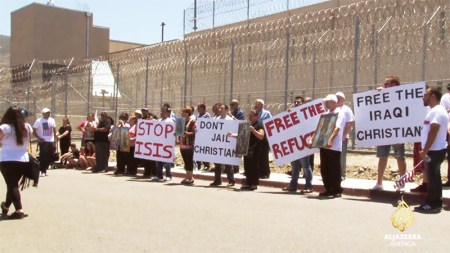
1261-1When a few persecuted Iraqi Christians crossed the border into the U.S., they were thrown in prison for several months and then sent back to the countries persecuting them, possibly to be enslaved, raped, or murdered. Pictured above: Members of California’s Iraqi Christian community and their supporters protest the months-long detention of Iraqi Christian asylum-seekers at the Otay Mesa detention center. (Image source Al Jazeera video screenshot)

Making a concerted effort to bring those two desperately threatened groups to the United States would meet our commitment to the translators, give concrete expression to our revulsion at genocide, protect the interests of the American people, and ensure that America remains hospitable to immigrants and refugees.

Droves of African Migrants in Mexico Awaiting U.S. Asylum Under Secret Pact

September 2, 2016

Droves of African Migrants in Mexico Awaiting U.S. Asylum Under Secret Pact, Judicial Watch, September 1, 2016

The African migrants’ journey begins in Brazil under a South American policy that allows the “free transit” of immigrants throughout the continent. Ecuador, Costa Rica, Nicaragua and Panama facilitate the process by transferring the concentration of foreigners towards Mexico based on an agreement that Mexico will help them gain entry into the U.S. so they can solicit asylum.

The Obama administration has done a great job of promoting its various back-door amnesty programs, which include perpetually extending a humanitarian measure designed to temporarily shield illegal immigrants from deportation during emergencies.

*****************

Herds of African immigrants are being housed in shelters in the Mexican border town of Tijuana while they await entry into the United States under what appears to be a secret accord between the Obama administration, Mexico and the Central American countries the Africans transited on their journey north. A backlog of African migrants is overwhelming limited shelter space in Tijuana and Mexican officials blame the slow pace of U.S. immigration authorities in the San Isidro port of entry for granting only 50 asylum solicitations daily.

Details about this disturbing program come from Mexico’s immigration agency, Instituto Nacional de Migracion (INM), and appear this week in an article published by the country’s largest newspaper. “Mexico is living through a wave of undocumented Africans, due to a humanitarian crisis on that continent, that has saturated shelters in Tapachula, Chiapas, and generated pressure on shelters in Tijuana, Baja California,” the news article states. The African migrants’ journey begins in Brazil under a South American policy that allows the “free transit” of immigrants throughout the continent. Ecuador, Costa Rica, Nicaragua and Panama facilitate the process by transferring the concentration of foreigners towards Mexico based on an agreement that Mexico will help them gain entry into the U.S. so they can solicit asylum.

The Africans are mostly entering Mexico through the southern state of Chiapas, which borders Guatemala. This week alone 424 Africans arrived at the Chiapas immigration station, which is situated in Tapachula. Shelters in Tijuana currently have 154 migrants from African countries waiting on their U.S. asylum solicitations, according to figures provided by the INM. “The undocumented don’t want to stay in Mexico,” the news article clarifies. “They want to make it to U.S. territory to solicit asylum based on the life conditions that prevail in the continent.” Authorities in Tijuana are offering support to migrants from El Congo, Somalia, Ghana and Pakistan to facilitate entering the U.S. through the San Isidro crossing, according to the news story. San Isidro is the largest land border crossing between San Diego, California and Tijuana.

The Obama administration has done a great job of promoting its various back-door amnesty programs, which include perpetually extending a humanitarian measure designed to temporarily shield illegal immigrants from deportation during emergencies. It’s known as Temporary Protected Status (TPS) and in the last few years migrants from several African countries have received it so the new influx is not all surprising. Guinea, Liberia and Sierra Leone got TPS back in 2014 over the lingering effects of the Ebola Virus and earlier this year Homeland Security Secretary Jeh Johnson extended it. The administration cited the “continued recovery challenges” the African countries face for the extension.

Last summer Johnson extended a TPS for Somalians until March 17, 2017, which could have served as a driving force behind the sudden surge via Latin America. A notice in the Federal Register says the extension was warranted because the conditions in Somalia that prompted the TPS designation continue to be met. “There continues to be a substantial, but temporary, disruption of living conditions in Somalia due to ongoing armed conflict that would pose a serious threat to the personal safety of returning Somali nationals, as well as extraordinary and temporary conditions in the country that prevent Somali nationals from returning to Somalia in safety,” the notice states. “The Secretary has also determined that permitting eligible Somali nationals to remain temporarily in the United States is not contrary to the national interest of the United States.”

Dr. Jasser discusses the 10K Syrian refugees admitted into U.S. & examines the importance of vetting

August 30, 2016

Dr. Jasser discusses the 10K Syrian refugees admitted into U.S. & examines the importance of vetting, Fox News via YouTube, August 29, 2016

The Refugee Hostel: Germany’s Islamist Hell

February 23, 2016

The Refugee Hostel: Germany’s Islamist Hell, Front Page MagazineStephen Brown, February 23, 2016

refugee-crisis-357690

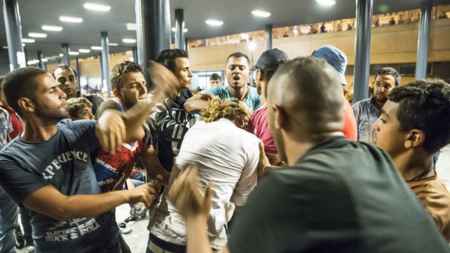
They fled religious hatred, rape and violence in their homelands for the “safe” haven of Germany — only to encounter the same, brutal conditions in their new accommodations: the refugee hostel.

Violence in refugee centers became a national topic in Germany last October, only weeks after Federal Chancellor Angela Merkel invited into Europe one million, mainly Muslim, refugees. But exposure of this disgraceful situation appears to have had little effect, as German newspapers are reporting this month that conditions remain unchanged.

In fact, life in German refugee hostels has now become so unbearable that religious minorities, women traveling alone or with children, and homosexuals are fleeing their accommodations. For them, according to one paper, the word “hostel” has become synonymous with ‘”defenselessness”.

The constant harassment and mistreatment at the hands of Muslim male refugees is not only becoming intolerable and dangerous, but, for some, life-threatening.

“Torn bibles and insults, ripped off crosses and even blows to the face, the complaints about violence in the refugee centers do not let up,” the German newspaper, Die Welt, stated recently.

According to Rainer Wendt, chairman of the German Police Union, outbreaks of violence in German refugee centers were occurring before last August. In the first six months of 2015, police were called out 1,288 times to refugee asylums and registered 499 crimes. One problem is definitely the overcrowding, Wendt said, but there are also “knallharte” (very brutal) criminal structures among the refugees.

Most violent incidents occur between Muslims themselves. They form groups, Wendt says, according to “ethnicity, religion or clan structure and go at one another with knives and self-made weapons.” And the fights, which can involve dozens on each side, concern “power struggles” and are “above all, religious or politically motivated.” Numerous violent disputes have ended in death.

“Here the Sunnis fight the Shiites, there are Salafists of different brands …women are forced to wear the veil. Men are forced to pray. Islamists want to install their values and order there,” said Wendt.

But among the mistreated minority groups, one is especially targeted for abuse: Muslim converts to Christianity. Many are from Iran and Afghanistan where Christians are a persecuted minority and Islamic law demands that they be put to death for leaving the faith.

One human rights organization official says the chances of a Muslim convert to Christianity, unwilling to hide his faith, being subjected to violence or mobbing in a refugee center is “nearly 100 percent.” And the situation is only going to get worse.

“Among those arriving now, a not insignificant portion is at least on the level of the Muslim Brotherhood in its religious intensity,” he said.

Pastor Gottfried Martens, who counts six hundred Christian converts from Islam in his Berlin parish, agrees. Martens, who baptized many of them himself, said, it is “above all Christian converts from Islam who have to suffer as a minority” in the hostels. Christians are not allowed to prepare their meals in the kitchens and “whoever does not pray five times a day in the direction of Mecca is mobbed.”

“Almost all of them have huge problems in their hostels,” said Martens. “Strictly believing Muslims there convey the view: Where we are, sharia rules, our law rules.”

Which causes one to wonder: What does this situation bode for Germany’s future once these “refugees” are let loose in society?

One Christian refugee from Iran is probably also asking himself this same question. In an anonymous interview with Die Welt, he said he would never have thought he would face religious persecution in Germany like that in Iran. There, he had belonged to an underground church and fled after the secret police had arrested his brother for attending one too. After crossing Turkey on foot, he made it to Germany where he thought he could finally live out a Christian life without fear.

But he was wrong. Placed in a hostel with mostly strictly believing Sunni Syrians, the young Iranian says he cannot openly profess his faith or “then I will be threatened.”

“During Ramadan, they wake me up before dawn and say I should eat before the sun comes up,” he told Die Welt. “When I decline, they say I’m an “infidel.” They spit at me. They treat me like an animal and threaten to kill me.”

The one other group suffering equal, and possibly worse, abuse in German refugee asylums is women traveling alone. Overall, women make up 25 percent of the migrant population. And they, as well as children, are particularly vulnerable to sexual violence. The federal official responsible for this area in refugee asylums nation-wide says reports of such violence reach him daily from around Germany.

As regards the number of such incidents, no one knows for sure. But according to the Psychosocial Center for Refugees, “there are many.” In a center in Giessen, there were 15 reported cases of sexual abuse of women in one month, leading police to investigate cases of rape and forced prostitution. The situation there is described as “a second- or third-world situation…like a UN refugee camp in Africa.”

But the “dark number” regarding sexual assaults is thought to be “high.”

“It is difficult to bring a refugee woman to make a statement to the police,” states one article on the subject. “There often exists cultural inhibitions or the fear an act of violence could negatively affect their asylum application.”

Women are usually greatly outnumbered by men in the hostels. In one center, of the 600 residents, only 87 are women and 34 are underage girls. Such is their fear, they rarely go out their doors, keeping to themselves. As a result, women refugees often feel like “fair game” for the male residents and of having been “abandoned” to them.

“For many women in their accommodations, it is like a co-ed visiting a men’s prison,” said one woman, a former hostel employee.

In some hostels, men are reported to be “always lying in wait.” One Iranian Christian woman said male residents in her hostel are constantly trying to grab her between the legs or touch her hair, a foreshadowing of the mass sexual assault of women in Cologne on New Year’s Eve. And, again, a foreshadowing of what is in store for women once these savages descend in large numbers on all of German society.

A female Russian journalist, who fled to Germany after running afoul of the Putin government, said after living in four different refugee hostels that she “would never have thought such conditions are possible in Germany.”

In one asylum, the violence between two groups of men, she relates, was so severe that “many police came every evening.” She also lived in fear her door could be broken open at any time. Once, conditions were so bad, she did not shower for five days. And women only went to the washroom in pairs.

But it was in the women’s washroom that the Russian journalist witnessed the most “humiliating” occurrence. In three of the hostels, a man was constantly there, as if standing guard, changing his “watch” regularly with others. The intruder may have been charging money to use the facilities, as sometimes happens in refugee centers, although she never had to pay. Nevertheless, she believes these men wanted to show women by their unwanted presence “we despise you, you have nothing to say.”

“I comprehended that this had system,” she said. “…The women there are worth nothing, nothing at all. They are being treated like dogs.”

When the Russian refugee asked one asylum administration why it wasn’t doing anything about the danger women face, she got the impression it was being “silently accepted.” The ten thousand private security men stationed in refugee hostels around Germany are obviously providing insufficient protection. Refugees have also sometimes complained about their behaviour.

Some politicians and German police chiefs, like Wendt, demanded last October, after receiving the initial reports of violence, that religious minorities, women traveling alone and unaccompanied children should have separate accommodations. Which would be the sensible solution. But little has been done despite the federal official’s admission that “abusers have it very easy establishing closeness to women and children and committing acts of sexual violence.”

The reason for such inexcusable, and perhaps criminal, indifference, as for much else that is destroying Western civilization, is ‘political correctness’. By separating the refugees by gender, religion and ethnicity, liberals believe one would already be setting up “parallel societies” in the hostels. As well, separation would represent “a victory” for the Islamists as it repudiates Western values regarding equal treatment, thus hindering integration. Such liberals believe that “intensively religious Muslims must learn to live with other religions.”

Good luck with that.

Incredibly, some liberals have convinced themselves the hostels’ problems are not gender, religion or ethnicity related but rather are owed only to organizational factors like cramped living conditions or better staff training. For example, one woman, who researches gender-specific violence with a German human rights organization, sees no “special connection between the hostels, the residents’ origin and the potential for violence.”

“What happens there also happens to German women outside the accommodations,” she said.

With the existence of such indifferent and shameful attitudes among some of those involved with the hostels, it is not surprising one female observer has concluded that women refugees “have no hope for help and understanding.”

And in their dangerous naivety liberals, as usual, fail to recognize the true reality: Strictly believing Muslims, upon crossing the German border, do not automatically become potential human rights activists who are “suddenly filled with the spirit of Western tolerance.” Instead, they shout out ISIS slogans in the refugee hostels and threaten Shiites with beheadings. Tolerating and respecting women, different ethnic groups and religions is not high on their list of things to do in Germany.

Thus, the real tragedy of the refugee asylums is that people, living human beings, are being heartlessly and needlessly sacrificed on the leftists’ altar of utopian ideas, offerings to their multicultural god. Little account is taken of the naked fear women, children and religious minorities are experiencing. Once again proving that Liberal “humanitarianism” only extends as far as its politically correct beliefs.

Germany’s Migrant Deportation Plan: “Political Charade”

February 1, 2016

Germany’s Migrant Deportation Plan: “Political Charade” Gatestone InstituteSoeren Kern, February 1, 2016

♦ N24 television has reported that up to 50% of “asylum seekers” have gone into hiding and their whereabouts are unknown. They presumably include economic migrants and others who are trying to avoid deportation if or when their asylum applications are rejected.

♦ Tens of thousands of migrants destroyed their passports and other identity documents before arriving in Germany. It may take years for German authorities to determine the true identities of these people and their countries of origin.

♦ Even if Germany sends these individuals back to the countries where they first entered the EU (usually Greece, Hungary or Italy), with a borderless Europe, migrants can easily make their way back to Germany.

♦ German authorities are downplaying migrant lawlessness, apparently to avoid fueling anti-immigration sentiment.

♦ Migrants are still coming to Germany at the rate of about 2,000 per day.

♦ “Eight to ten million migrants are still on the way.” – Development Minister Gerd Müller.

After three months of political infighting, Germany’s coalition government has announced new measures aimed at making it easier to deport migrants who are convicted of committing crimes.

The measures emerged in response to voter outrage over the sexual assaults of hundreds of women by migrants in Cologne and other German cities on New Year’s Eve — and alleged attempts by the government and the news media to cover up the crimes.

Known as the Asylum Package II (Asylpaket II), the draft law was announced by the cabinet on January 28 and must now be approved by the Bundestag, the lower house of the German parliament, for it to come into effect.

A central feature of the plan involves increasing the number of migrant reception centers to five, up from two today. The centers would supposedly fast-track legitimate asylum requests submitted by people who can prove they are fleeing war-zones.

The centers would also step up efforts to weed out fraudulent applications submitted by economic migrants who are posing as asylum seekers. The stated aim is to eventually deport those who arrived in Germany under false pretenses.

In addition, the plan would introduce a two-year waiting period for legitimate refugees who want to bring family members to Germany. Exceptions would be made for those who can prove that their family members are being “personally, urgently persecuted.”

The government also said that it would try to limit migration from North Africa by declaring Algeria, Morocco and Tunisia as so-called safe countries, where there is no armed conflict or threat of violence, persecution or torture. This would make it virtually impossible for asylum applications from those countries to be approved.

Critics of the plan say it is more of a political charade than substance and will do little to alleviate Germany’s migration crisis.

First, the German government has lost track of the whereabouts of hundreds of thousands of migrants who entered the country in 2015. N24 television has reported that up to 50% of “asylum seekers” have gone into hiding; their whereabouts are unknown. They presumably include economic migrants and others who are trying to avoid deportation if or when their asylum applications are rejected. The Saarbrücker Zeitung reported that up to 30% of the migrants being sheltered in the eastern German states of Brandenburg, Thuringia and Saxony-Anhalt have “simply vanished.” Separately, German authorities estimate that hundreds of thousands of migrants have entered the country without being registered and whose whereabouts are unknown.

Second, tens of thousands of migrants destroyed their passports and other identity documents before arriving in Germany. It may take years for German authorities to determine the true identities of these people and their countries of origin. This will complicate — and delay — many deportations. Even if Germany sends these individuals back to the countries where they first entered the European Union (usually Greece, Hungary or Italy), with a borderless Europe, migrants can easily make their way back to Germany.

Third, the legal hurdles to deportation from Germany are high. German law states that migrants who commit crimes can only be deported if they are sentenced to prison terms of three years or more. In practice, this rarely happens for most petty crimes. The government is contemplating a change to Section 60 of the Residency Law (Aufenthaltsgesetz) to make it possible to deport migrants sentenced for prison terms of one year. But even if migrants are sentenced for crimes, they cannot be deported to countries that the German government deems “unsafe.” Moreover, migrants cannot be deported to countries where they may face the death penalty.

To many critics, it looks as if the German justice system is being disabled by political correctness. Although migrants are driving a surge in violent crime in cities and towns across Germany, German authorities are downplaying the lawlessness, apparently to avoid fueling anti-immigration sentiment.

A confidential police document leaked to the Rheinischen Post revealed that in 2014, a record-breaking 38,000 asylum seekers in Germany were accused of committing crimes in the country. Analysts believe this figure — which works out to more than 100 crimes a day — is only a fragment: many crimes are not made public.

In Hamburg, police are fighting a losing battle against purse-snatchers. Each year, more than 20,000 purses — roughly 55 a day — are stolen. According to Norman Großmann, the director of the federal police inspector’s office in Hamburg, 90% of the purses are stolen by males between the ages of 20 and 30 who come from North Africa or the Balkans.

In a bestselling new book about the failure of multiculturalism in Germany, Tania Kambouri, a German police officer, describes the breakdown of the German justice system and how German judges are reluctant to punish migrants, including repeat offenders.

Fourth, the German government’s decision to deny asylum requests submitted by migrants from Algeria, Morocco and Tunisia will have little effect in practice. Out of one million migrants who entered Germany in 2015, fewer than 20,000 are believed to have come from those three countries.

Meanwhile, a new poll published by the news magazine, Focus, shows that nearly half the Germans want Chancellor Angela Merkel to resign because of her open-door migration policy: in 2015, it allowed more than one million migrants from Africa, Asia and the Middle East to enter the country.

Still, Merkel steadfastly continues to refuse to implement the one policy that could prevent the migrant crisis from becoming even worse: closing the German borders to keep the migrants out.

Despite snow, ice and freezing temperatures across much of Europe, migrants are still coming to Germany at the rate of about 2,000 per day. More than 54,500 people reached Europe by sea during January 2016, including 50,668 through Greece, according to the United Nations Refugee Agency (UNHCR).

The International Monetary Fund (IMF) estimated that 1.3 million asylum seekers would enter the European Union annually during 2016 and 2017.

In a January 9 interview with Bild, Development Minister Gerd Müller warned that the biggest refugee movements to Europe are still to come. He said that only 10% of the migrants from the chaos in Iraq and Syria have reached Europe so far: “Eight to ten million migrants are still on the way.”

Separately, Germans face being denied visa-free travel to the United States, as U.S. security officials become increasingly alarmed at the proliferation of fake passports that could be used by terrorists. According to a report by Politico:

“In the aftermath of Paris, the U.S. Department of Homeland Security became so worried about the implications for screening travelers to America that it gave France, Belgium, Germany, Italy and Greece a February 1 deadline to fix “crucial loopholes” or lose access to the U.S. visa waiver program. The program allows about 20 million people per year from 38 countries, most of them in Europe, to enter the United States for business or pleasure without a visa.”

1451Left: A new poll shows that nearly half the Germans want Chancellor Angela Merkel to resign because of her open-door migration policy. Right: Interpol has data on 250,000 stolen or lost Syrian and Iraqi passports, including passports that are blank.

According to Politico, in the last five years the number of lost and stolen passports in the EU has doubled. The number of forged passports in the Middle East is also a rising concern. Interpol has data on 250,000 stolen or lost Syrian and Iraqi passports, including passports that are blank.

