Archive for the ‘Red Lines’ category

Forfeiting America’s Military Leverage

June 6, 2015

Forfeiting America’s Military Leverage, American ThinkerAbraham Katsman, June 6, 2015

International diplomacy, it is said, is the art of letting the other party have your way.  While there are numerous diplomatic strategies to accomplish that, one of history’s more effective means of pursuing foreign policy goals was for a superior power to conspicuously display naval forces in the waters of the weaker power, posing a military threat until satisfactory terms with the weaker nation could be reached. Such “gunboat diplomacy” could be remarkably persuasive.

But if there is such a thing as the opposite of gunboat diplomacy, we are witnessing it in the nuclear negotiations with Iran.  There will be repercussions.

The United States and other leading nations taking part in the negotiations have military capabilities that dwarf those of Iran, at best a second-rate power. Yet, in spite of the huge military advantages — not to mention the moral gulf between the U.S and Iran, or the huge stakes of allowing Iran to go nuclear — negotiations have proceeded as if between equals.

U.S. military spending is greater than that of the next seven countries combined. Superpower America has a near-monopoly on those gunboats, as well as military aircraft and cruise missiles. But that power is only useful if there is a willingness to use it — or, more precisely, if America’s enemies believe that that there is such a willingness.

If there were ever thoughts that the U.S. under Obama would lay down the law with Iran and order, under overt military threat, the “voluntary” dismantling of the mullah’s nuclear program, they have passed quietly. Sure, President Obama occasionally makes some perfunctory mention that the military option is still on the table, but no one takes his half-hearted warning seriously, least of all the Iranians.

It doesn’t help matters when Obama says, as he did on Israeli TV this week, “A military solution will not fix [the Iranian nuclear problem]. Even if the United States participates, it would temporarily slow down an Iranian nuclear program but it will not eliminate it.”

Obama has effectively forfeited America’s military leverage. He has taken the position that the only alternative to his Iranian appeasement approach is war, and that war is not an outcome acceptable to him under any circumstances.

No Iranian misconduct disrupts Obama’s pacifism. Against American interests and those of America’s allies, Iran has expanded its reach into Syria, Lebanon, Iraq, and Yemen, ethnically cleansing Sunni communities in Iraq. It has seized a cargo ship under U.S. protection, and holds several Americans hostage (complete with an ongoing farcical “trial” against Washington Post reporter Jason Rezaian for espionage). It has increased its nuclear stockpile and violated its existing international agreements, including regarding type and number of centrifuges it may operate, and announced that it will build additional reactors with the help of China and Russia.

In fact, America’s gunboats notwithstanding, it is Iran that has been dictating the terms of a prospective agreement. Iran’s intransigence in the nuclear negotiations has been rewarded: the U.S. has already backed off demands regarding Iranian nuclear enrichment, centrifuges, missile technology, and duration of the prospective agreement — and gotten nothing in return.

Not only is the United States administration going along with all this, but it has released some $11 billion in cash assets to the Islamic Republic. On top of that, it is offering a “signing bonus” of tens of billions of additional dollars to Iran for coming to a nuclear agreement, irrespective of Iranian behavior, support for terror or holding Americans prisoners.

In this context, with no credible American military threat on the table, we should not be surprised that Iran is getting everything it wants from the negotiations at no cost and no risk. As a bonus, it gets to show the world how unserious its American arch-enemy has become.

For the last century, the United States has asserted a global foreign policy, the core of which is being ready, willing, and able to impose its military might to protect its vital interests. Is there a more compelling current American interest than to keep nuclear weapons out of the reach of a rabidly anti-American, anti-Semitic, destabilizing, theocratic, apocalyptic regime, which also threatens the world’s major oil suppliers and is the world’s greatest supporter of terror? If Obama cannot even consider the military protection of that interest, he has rendered American foreign policy impotent, and its military capabilities irrelevant.

That abandonment of longstanding American projection of military power to protect global interests does not go unnoticed, by either friend or foe. The American military’s deterrent effect has been eroded; its security umbrella to its allies looks a lot less secure. The effect on alliances both current and future is corrosive.

From Riyadh to Taipei to Jerusalem, from Moscow to Beijing to Pyongyang, the world is paying close attention. As much as these nuclear negotiations are about Iran, they are even more about America.
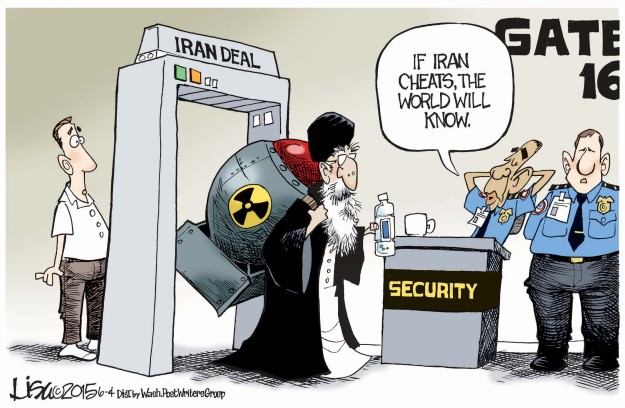
 

Cartoon of the day

June 6, 2015

H/t You Viewed Editorial

cg556fbf6cdc16d

Iran Short Film Series – 3. Believe Them!

June 2, 2015

Iran Short Film Series – 3. Believe Them! Clarion Project, via You Tube, June 1, 2015

(But to believe what Iranian leaders say, repeatedly, would be Islamophobic. Or something. — DM)


Top Iranian Negotiator: We Reached Solution with P5+1 on Site Inspection, But Khamenei Rejected It

May 28, 2015

Top Iranian Negotiator: We Reached Solution with P5+1 on Site Inspection, But Khamenei Rejected It, MEMRI-TV videos, May 28, 2015

In an Iranian TV interview, Iranian Deputy Foreign Minister Abbas Araqchi, who is Iran’s top nuclear negotiator, revealed that the Iranian negotiating team had reached possible solutions with the P5+1 on the issue of inspection of Iranian nuclear facilities, but that Iranian Supreme Leader Ali Khamenei had decisively rejected them. Inspection of the facilities is one of the key issues remaining in the nuclear talks. The interview aired on Iran’s Channel 2 TV on May 25.


Obama’s Not-So-Ironclad Guarantee

May 15, 2015

Obama’s Not-So-Ironclad Guarantee, Commentary Magazine, May 15, 2015

Now that the nuclear deal makes an Iranian bomb only a matter of when rather than if, the Gulf nations were hoping for more than just a carefully worded expression of American indifference.

***********

This was supposed to be the week when President Obama put on a show of his desire to reaffirm America’s support for its Arab allies. Saudi Arabia and the other Gulf states have spent the last year in the unusual position of agreeing more with Israel than the United States, as Obama pushes for détente with Iran. Like the Israelis, the Arabs are pondering their future in a region dominated by an Iranian nuclear threshold state that appears to be the lynchpin of the president’s foreign policy legacy. So to demonstrate his good will, Obama invited these nations to a summit at which he would convince them they had nothing to fear. But with the U.S. putting nothing on the table of substance that would allay those concerns about the weak nuclear deal being negotiated with Iran, the Saudi king and other leaders snubbed the event, turning it into a fiasco even before it began. But it turned out King Salman didn’t miss much. Though Obama offered what he called an “ironclad guarantee’ of America’s support for the Arabs, it was phrased in the kind of ambiguous language that rendered it meaningless. The meeting and especially the statement epitomized an Obama administration foreign policy that puts a premium on appeasing foes and alienating friends.

The wording of the president’s “guarantee” is a marvel of lawyerly ambiguity that any connoisseur of diplomatic doubletalk must appreciate:

In the event of such aggression or the threat of such aggression, the United States stands ready to work with our GCC partners to determine urgently what action may be appropriate, using the means at our collective disposal, including the potential use of military force, for the defense of our GCC partners.

Let’s unpack this carefully so we’re clear about what the United States isn’t promising its Arab allies. As even Obama’s cheerleaders at the New York Times noted, this “carefully worded pledge that was far less robust than the mutual defense treaty the Gulf nations had sought.” In the event of aggression, the U.S. isn’t going to spring into action to defend them. Instead it will “work” with them to “determine” what they might do. That falls quite a bit short of a hard promise of collective action, let alone the drawing of a line in the sand across which the Iranians may not cross. In other words, if something bad happens, Obama will talk with the threatened parties but he won’t say what he will do in advance or if he will do anything at all. If that is an “ironclad guarantee,” I’d hate to see what a less binding promise might sound like.

To understate the matter, this is not the sort of pledge that will deter an Iran that is emboldened by its diplomatic victory in the negotiations that let them their nuclear infrastructure and continuing working toward a bomb. Iran’s push for regional hegemony has also been boosted by the triumph of their Syrian ally Bashar Assad with the help of Tehran’s Hezbollah terrorist auxiliaries. With the Iran-backed Houthi rebels threatening to take over Yemen and Iran also resuming its alliance with Hamas in Gaza, the axis of Iranian allies has Arab states understandably worried about their future. Now that the nuclear deal makes an Iranian bomb only a matter of when rather than if, the Gulf nations were hoping for more than just a carefully worded expression of American indifference.

That’s why the statement at the end of the summit made no mention of America’s chief worry about the Gulf states: the possibility that the Saudis will, either acting alone or in concert with their neighbors, seek to match Iran’s nuclear potential. As critics of the Iran deal foretold, far from saving the Middle East from an Iranian bomb, it has set off an arms race that has will make the world a fare more dangerous place.

This omission will likely make the Iranians even more reluctant to give in to U.S. demands about sanctions, Tehran’s military research and the disposition of its stockpile of enriched uranium in the final stages of the nuclear talks. A better guarantee for the Arabs might have convinced the Islamist state that the president really meant business about strengthening the deal. In its absence, they have no reason to think Obama won’t fold as he has at every other stage of the negotiations.

Under the circumstances, it’s little wonder that Bahrain’s King Hamad preferred to go to a horse show London rather than confer with Obama. Just as Israel has learned that the United States is more interested in a new Iran-centric policy than it backing its traditional allies, so, too, must the Arabs come to grips with a new reality in which their Iranian foe is no longer restrained by the United States.

Israel Establishes Red Lines for Iran and Hezbollah

April 27, 2015

Israel Establishes Red Lines for Iran and Hezbollah
Posted by David Gerstman Monday, April 27, 2015 at 8:30am Via Legal Insurrection


(‘If Iran is emboldened by Obama’s nuclear negotiations, imagine how emboldened they would be with a nuclear arsenal. Then imagine what it would take to stop them at that point. – LS)

Taking a stand because Obama won’t

Yesterday afternoon Israeli Defense Minister Moshe Ya’alon warned Iran not to arm Hezbollah.

“Iran continues to try and arm Hezbollah and it is striving to arm the Lebanese terror group with advanced weapons in every way it can, and by using every avenue,” Ya’alon said in a speech at Israel’s military headquarters in Tel Aviv. “We will not allow the transfer of sophisticated weapons to terror groups, and in particular Hezbollah.”

“We know how to reach [Hezbollah] and those who direct it, at any time and any place,” Ya’alon continued. “We will not allow Hezbollah to establish a terror infrastructure on our borders with Syria, and we know how to lay our hands on anyone who threatens Israeli citizens, along our borders or even far from them.”

It wasn’t clear if Ya’alon was referring to airstrikes targeting weapons depots in Syria, attributed to Israel, that occurred Wednesday and Saturday last week, or if he was threatening future action.

Subsequent to Ya’alon’s talk it appeared that he may have intended both.

First a terror cell was discovered trying to plant a bomb at the Israel-Syria border and was killed by Israel Air Force. The Times of Israel reported:

The IDF said “a group of armed terrorists” were killed by an air force craft after they were spotted crossing into Israeli territory with an explosive device late Sunday.

IDF spokesman Col. Peter Lerner said the cell consisted of four people who were “identified while clearly laying a mine and were shot by an Israeli Air Force aircraft.”

Initial reports indicated the incident took place near the Golan Heights town of Majdal Shams, on the slopes of Mount Hermon.

Overnight, attacks were reported north of Damascus, again targeting weapons systems that could have been intended for Hezbollah.

Hours after an Israeli airstrike on militants along the Syrian border, Arab news networks al-Jazeera and al-Arabiya reported a new Israeli attack in Syrian territory early Monday morning, targeting missile launchers held by Hezbollah and forces loyal to Syrian President Bashar Assad.

It was the third alleged Israeli strike on the Syrian front in two days.

The reported strike in the Qalamoun mountains, northeast of Damascus — also the location of alleged Israeli sorties against Hezbollah and Assad targets on Saturday — was said to cause several casualties, though the number of dead and injured was not immediately provided.

Later reports have attributed the overnight attacks to Jihadist rebels not Israel.

After the earlier airstrikes, the infiltration may well have been expected. An Israeli airstrike against a convoy in the Syrian Golan Heights near Israel, in January, that killed senior Hezbollah operatives and Iranian officers, was followed later that month by a cross-border attack thatkilled two Israel soldiers.

Israel also reportedly hit two military installations near Damascus last December.

The closer involvement of Iran with Hezbollah is likely a product of the Obama administration’s engagement with Iran. Emboldened by the rapprochement and suffering no consequences for its increased aggressiveness, Iran has been working to, in the words of Hezbollah expert Philip Smyth, “encircle” Israel.

When Israeli Prime Minister Benjamin Netanyahu sees this and hears an Iranian general say that Israel’s destruction is “non-negotiable” is it any wonder that he doesn’t trust the deal that’s being worked out?


