Archive for the ‘Putin’ category

Israel is braced for Russian aerial intrusions over its Golan border

October 9, 2015

Israel is braced for Russian aerial intrusions over its Golan border, DEBKAfile, October 9, 2015

Su-25_Frogfoot_ground-attack_planes_B-Syria_10.15_1Russian Su-25 Frogfoot fighter-bombers in Syria

Uncertainty still hangs over Moscow’s precise intentions regarding its air force flights over the Golan close to Israel’s border – even after two days of discussions on coordination ended in Tel Aviv Thursday, Oct. 8 between the Russian Deputy Chief of Staff Gen. Nikolay Bogdanovsky and his Israeli counterpart Maj. Gen. Yair Golan. A coordination mechanism between the two air forces was left as unfinished business for further discussion, DEBKAfile’s military sources report. So it is still not clear to Israel what is supposed to happen if Russian fighters and bombers enter the Syrian-Israeli border district and slip over into Israeli air space.

The bilateral talks left Israel with the impression that this was a distinct possibility.

Israeli and Western aviation and intelligence experts don’t see how Israel can prevent Russia providing air cover for Syrian and Hizballah forces when the war moves close to the Israeli and Jordanian borders of southern Syria.

Last week, Russian SU-30 and Su-24 warplanes twice violated Turkish air space in the southern province of Hatay (called Alexandretta on Syrian maps). Although after the Russian defense ministry apologized for the first intrusion as accidental and lasting just a few seconds, our military sources are certain that the Russians were in fact deliberately testing Turkish air defenses.

This scenario may well repeat itself over the Golan in the very near future.

Gen. Bogdanovsky made no secret of Moscow’s intention to use its air power against rebel targets in battles taking place near the Israeli border. According to our exclusive military sources, Israel braced for this eventually Wednesday night, Oct. 7. Syrian, Hizballah and pro-Iranian Shiite forces then launched a ground offensive with Russian air cover against Syrian rebel forces in the Hama region. This was their first ground operation since the start of the Russian military buildup in late August. Intelligence was received that a second Syrian-Hizballah offensive, covered by Russian fighters and bombers, was scheduled to start at the same time in the Quneitra area, directly opposite the Israeli Golan.

For some reason, it was not launched when expected, but it is unlikely to be deferred for long. After firing Kalibr-NK-SS-27 Sizzler cruise missiles last week to soften rebel resistance to the Syrian government offensive in the Hama area, the Russians may well aim them at the Quneitra arena too in support of another Syrian operation.

What’s Obama’s Next Move on Israel?

October 9, 2015

What’s Obama’s Next Move on Israel? Commentary Magazine, October 9, 2015

(On the other hand, Obama may concentrate on global smarming and bypassing Congress on gun control. — DM)

new-obama

The reasoning behind America’s supine reaction to Russian intervention in Syria is no mystery. It is a clear reflection of President Obama’s longstanding desire to withdraw from the Middle East, as well as his commitment to détente with Iran. Since the Iranians are hoping the Russian forces can do what Hezbollah and Iranian volunteers failed to accomplish in the last few years — destroy Bashar Assad’s opposition — it is hardly surprising that the U.S. would decide to shrug at this nightmarish reversal of fortune for American interests. But that doesn’t mean the president likes being upstaged by Russian President Vladimir Putin. The question for the White House now is how to seize back the initiative on the world stage in a manner better suited to President Obama’s sensibilities. The recent surge of Palestinian terror attacks on Israelis may provide the answer. Though the administration has its hands full with foreign crises right now, it may be that Obama’s answer to Russian adventurism will be a return to the dead in the water peace process between Israel and the Palestinians. Instead of stronger efforts to make good on his promise to destroy ISIS, he may prefer another go at hammering Israeli Prime Minister Netanyahu.

As late as only a couple of weeks ago, the conflict between Israel and the Palestinians didn’t seem to be on the White House’s front burner. To judge by his recent speech at the United Nations General Assembly, President Obama was done with the Israel-Palestinian peace process. For the first time since he became president, Obama didn’t mention the topic once in his annual UN address. With Russia waging war in Syria, the U.S. is unable to do much about ISIS and the region in chaos. The notion that the carnage and suffering that had spread across the Middle East has anything to with Israel or the Palestinians is ludicrous. So it was little surprise that the president preferred to use his address to boast of the dubious virtues of his nuclear deal with Iran than to spout his standard lines about Israel needing to take risks for the sake of a peace process that wasn’t going anywhere.

Indeed, the scheduled meeting with Prime Minister Netanyahu next month was seen as an opportunity to repair the alliance that was damaged by the debate over Iran rather than another chance for Obama to renew his longstanding feud with the Israeli leader. Though Palestinian Authority leader Mahmoud Abbas’s farcical declaration at the UN that the Oslo Accords no longer bound him fell flat, the outbreak of a wave of Palestinian terror directed at Israelis has put that issue back in the news. The administration’s studious neutrality about the recent violence in spite of the incitement from the Palestinian Authority that has stoked the bloodshed has helped to further isolate Israel. The intractable nature of the conflict and the Palestinians’ obvious lack of interest in peace would deter a wiser man than Obama. But the need to do something to assert American influence, or at least get some attention, could prompt the president to use what may be the start of a third intifada to unleash Secretary of State John Kerry and begin a new round of pointless negotiations.

Why would the administration expend what is left of its diminishing political capital for another round of Netanyahu-bashing that would almost certainly do nothing to advance the cause of peace?

The first thing to remember about this president is never to underestimate either the strength of his obsessions or his willingness to hold onto grudges.

President Obama is a man who has learned nothing in his seven years in office. He arrived at the White House determined to foster engagement with Iran and create more daylight between the U.S. and Israel, and convinced that Netanyahu’s Likud was not to his taste. Nothing that has happened in the intervening years has altered his opinion about any of this.

Part of it is rooted in a genuine belief that the only way to solve the Israel-Palestinian conflict is to put sufficient pressure on the Israelis to make concessions. That fits in nicely with his equally sincere conviction that the United States must concentrate its efforts on reaching out to the Muslim and Arab worlds rather than reinforcing the alliance with Israel, which he and advisors like Susan Rice see as an impediment to U.S. interests.

The failure of every previous attempt to foster peace has not influenced the president’s opinion. No matter how many times the Palestinian leadership says no to Israeli offers of peace or incites their people to religious-based violence — as Abbas is currently doing — Obama still thinks that the key to success will be more Israel-bashing.

However, just as important as his faith in pressure on Israel is his animus for Netanyahu. The president’s defining characteristic in office is his arrogant belief in his own superior intellect and Netanyahu’s stubborn refusal to bow to Obama’s demands irritates him in a way that can only be described as disproportionate. As State Department veteran and former Obama staffer Dennis Ross describes in his new book that was excerpted yesterday in Politico, Obama and Susan Rice were so offended by possible Israeli opposition to the Iran deal that they kept Netanyahu in the dark about the talks with Tehran and then spread canards about his dissent being rooted in racism.

It would make political sense for Obama and the Democratic Party for the president to forget about his feud with Netanyahu,  but that isn’t likely to happen. That’s especially true since the prime minister used his own UN speech to reiterate his criticisms of the Iran deal, something that was likely to drive Obama straight up the White House walls even though that’s a fight he’s already won.

Lastly, a new peace process push would let Obama preen on the international stage in a way that he likes. The president disdains and even mocks Putin’s muscular approach to international affairs, even though Russia’s advances come at America’s expense. But he really thinks that moves like appeasing Iran or putting Israel in its place enhance his prestige. That this is dangerous nonsense that only undermines American credibility seems never to occur to him.

The ultimate outcome of any new push for peace with the Palestinians is a foreordained conclusion. Neither Abbas nor his Hamas rivals are willing to recognize the legitimacy of a Jewish state, no matter where its borders might be drawn. Moreover, the violence that Abbas has incited in order to compete with Hamas may not be so easily kept in check. American neutrality about Abbas’ double game in which he stokes hatred with one hand and seeks to restrain it with the other may serve to only make the situation even more dangerous. Instead of allowing the president to claim that the U.S. is a force for peace, more pressure on Israel will just add to the toll of suffering in Iraq and Syria, that Obama’s misguided policies have created.


Russia Missile Attacks Embarrass Obama, Warn Israel

October 9, 2015

Russia Missile Attacks Embarrass Obama, Warn Israel, American ThinkerJonathan Keiler, October 9, 2015

Beyond heaping yet another humiliation on Obama and signaling American admirals to keep their distance, the missile attack probably also sent a very pointed message to Israel. Israel currently deploys four advanced German-made and Israeli equipped Dolphin submarines, with two more on the way.

******************************

Russia’s October 7 cruise missile bombardment of anti-Assad Syrian rebels from ships stationed nearly 1000 miles away was probably the most expensively ineffectual display of military firepower since Bill Clinton launched a similar strike against al Qaeda in 1998. Clinton’s feckless and spendthrift action was supposedly in retaliation for the embassy bombings in Tanzania and Kenya and succeeded by most accounts in wiping out a few empty tents with several tons of explosives and several million dollars’ worth of advanced ordnance.

It is unlikely that Vladimir Putin’s strike did much damage to Syrian rebels either. But unlike Clinton (and the current Democrat in the White House) Putin doesn’t use force to shirk greater national responsibilities, he uses it to pursue clear strategic objectives. In this case, the Russian decision to launch brand-new Kalibr-NK missiles from the Caspian Sea fleet was clearly intended as yet another poke in the eye to President Obama, and a demonstration of Russian firepower, from diminutive but still dangerous Russian warships.

The 26 missiles were launched by three patrol boats and a frigate (a warship smaller than a destroyer.)  Russian spokesmen claimed all landed within nine feet of their targets, a degree of accuracy probably not needed against dispersed irregular infantry, but necessary to hit opposing warships, like those flying American flags. The Syrian rebels served as live practice targets for the Russian missile crews, who got to shoot off the new and previously unproven (in combat) missile.

Beyond heaping yet another humiliation on Obama and signaling American admirals to keep their distance, the missile attack probably also sent a very pointed message to Israel. Israel currently deploys four advanced German-made and Israeli equipped Dolphin submarines, with two more on the way. Most analysts presume that these advanced boats are intended to penetrate the Persian Gulf in the event of war with Iran, and from their launch cruise missiles in support of Israeli air action.

However, several years ago, in this article I proposed that the Israeli purpose was probably otherwise. Israeli is widely presumed to have equipped the subs with Israeli Popeye turbo cruise missiles with a range similar to that of the Russian Kalibr-NK. With such a weapon, Israeli subs need not make the long and dangerous journey to the Persian Gulf, but could launch from off the coast of Syria, the missiles following a flight plan very similar to those the Russian weapons took (but in reverse) where they could strike targets across northern Iran.

If I could conceive of such a plan, so could Russian intelligence services, which have probably backed this idea with hard, but secret intelligence. The Russian attack is a clear signal to Israel, demonstrating that cruise missiles which can go from the eastern Mediterranean to Iran can go the other way too. It is unlikely that it was a message lost on the Israelis, and more evidence that Russia’s movement in to the Syrian arena is proving disastrous for America and her allies.


Iran’s terror general plotted Russian strikes in Syria

October 8, 2015

Iran’s terror general plotted Russian strikes in Syria, Front Page Magazine, Daniel Greenfield, October 8, 2015

(Please see also, Obama Admin’s Iran Point Man Promotes Anti-Israel Conspiracy Theories as it relates to Soleimani. — DM)

Russian propaganda claims that Putin wants to protect Christians. If he really wanted to protect Christians, he would tell his Iranian pals to stop persecuting Christians.

*********************

First, a little background on Qassem Soleimani.

“He’s got American blood on his hands,” Senator John Cornyn said of Soleimani. “I’m not sympathetic to lifting sanctions on him, that’s for sure.”

“Soleimani is the guy that sent the copper-tipped IEDs into Iraq,” said Senate Armed Services Committee Chairman John McCain, referring to powerful improvised explosive devices, which Marine Corps Commandant General Joseph Dunford testified last week were responsible for the deaths of 500 soldiers and Marines. “That is really unbelievable,” McCain said when asked about Soleimani’s name showing up in the bowels of the Iran nuclear deal.

In practice, Soleimani’s IRGC is a terrorist group despite protests from Obama and other Democrats. It’s also the key lever Iran is using to transform the region.

At a meeting in Moscow in July, a top Iranian general unfurled a map of Syria to explain to his Russian hosts how a series of defeats for President Bashar al-Assad could be turned into victory – with Russia’s help.

Major General Qassem Soleimani’s visit to Moscow was the first step in planning for a Russian military intervention that has reshaped the Syrian war and forged a new Iranian-Russian alliance in support of Assad.

As Russian warplanes bomb rebels from above, the arrival of Iranian special forces for ground operations underscores several months of planning between Assad’s two most important allies, driven by panic at rapid insurgent gains.

Soleimani is the commander of the Quds Force, the elite extra-territorial special forces arm of Iran’s Revolutionary Guards, and reports directly to Iran’s Supreme Leader, Ayatollah Ali Khamenei.

Perversely, Soleimani already enjoys US air support from Obama for his Shiite terror militias in Iraq. Now he’s got Russian air power backing his Shiite terror militias in Syria.

One of the world’s top terrorists has two air forces to play with.

Russian propaganda claims that Putin wants to protect Christians. If he really wanted to protect Christians, he would tell his Iranian pals to stop persecuting Christians.

Russia’s endgame in Syria: Follow the Money

October 7, 2015

Russia’s endgame in Syria: Follow the Money, Center for Security Policy, John Cordero, October 6, 2015

(Is Putin engaging in a holy war against the Islamic State, an oily war or both? — DM)

3300795117

The one strategic motivation for Russia that has been widely ignored is the economic one.  Qatar, the richest country in the world per capita and also owner of the world’s largest natural gas field, proposed in 2009 to jointly construct a gas pipeline running through Saudi Arabia, Jordan, Syria, Turkey, and into Europe.  Assad, not wanting to provoke Moscow, refused to sign on.  Instead, he floated an alternative: an Iran-Iraq-Syria and possibly Lebanon pipeline, to then follow under the Mediterranean to Europe. The Qatar-Turkey pipeline would run through majority Sunni countries with the exception of Syria’s Alawite regime. Assad’s counter proposal follows the Shia crescent.

Russia, not wanting to lose its primary market in Europe, is adamantly opposed to a prospective Qatari project.  A military presence in Syria will guarantee that even if Assad is removed from power, the pipeline will not be built.  It will look on favorably to the Iranian proposal, provided Gazprom and other state-owned companies get their share of the pie.

****************************

As Vladimir Putin orders airstrikes against rebels of all stripes fighting Bashar al-Assad’s regime, there are important strategic economic goals behind Russia’s actions in Syria.  The short term goal is easy to discern: prevent Assad’s collapse as no alternative suitable to Russian interests exists, preserve Russia’s only naval base in the Middle East at Tartus, and promote Russia both at home and abroad as a world power that counterbalances American hegemony.

Much of the media has focused on Putin as a personal driver of Russian behavior.  While forays into Georgia and Ukraine have accomplished the tactical goals of preventing increased European Union presence in Russia’s sphere of influence, these have come at a high cost both politically and economically in the form of isolation and sanctions. Putin seems to have concluded that intervening in Syria in the name of fighting terrorism can only help repair Russia’s battered image.

It is important to at least try to understand Putin’s motivation without delving too much into psychoanalysis.  He is on record as lamenting the collapse of the Soviet Union as “the greatest geopolitical catastrophe of the 20th century.”  In power since 2000, the former KGB officer is an ardent Russian nationalist, a promoter of a personality cult concerned with his country’s standing and perception in the world.  With his career spent in the service of the state, he is not one to take a background role in world affairs. Putin has effectively used Russia’s alliance with Iran as an effective tool to undermine the US, both regionally in the Gulf and globally with the nuclear deal.

The current buildup at Tartus and Latakia is nothing new: since Hafez al-Assad’s rise to power in 1970, the Former Soviet Union and then Russia was and is a stalwart ally, long attempting to position Syria as a counterbalance to American and Israeli military superiority in the Middle East.

Russia’s actions are also a message to the world: unlike the US, which abandoned long-time ally Hosni Mubarak during his time of need in Egypt, Russia is prepared to intervene, militarily if necessary, to preserve a friendly regime in danger.  Therefore, it pays for autocrats to court Moscow, especially if they possess valuable resources or are in prime strategic locations.

While Vladimir Putin ostensibly espouses the acceptable goal of a global alliance against IS, the strategic context is that he has entered into a sectarian alliance with Shia Iran, Iraq, Syria, and the proxy army Hezbollah (The P4+1) against the American-backed Sunni alliance of Turkey, Saudi Arabia, Qatar, Jordan, and the UAE, all of whom insist that Assad has no future in Syria.

Through its airstrikes, Russia continues to advance the prior Syrian strategy of focusing efforts against pro-Western rebels, with the recognition that, while dangerous, the Islamic State is the one party in the conflict the West will never support.

The Islamic State will take advantage of both the respite, and the propaganda value of being the recognized number one enemy of the infidel coalition, which it uses to rally supporters simply by pointing out that its enemies are gathering to destroy the renewed Caliphate.

The one strategic motivation for Russia that has been widely ignored is the economic one.  Qatar, the richest country in the world per capita and also owner of the world’s largest natural gas field, proposed in 2009 to jointly construct a gas pipeline running through Saudi Arabia, Jordan, Syria, Turkey, and into Europe.  Assad, not wanting to provoke Moscow, refused to sign on.  Instead, he floated an alternative: an Iran-Iraq-Syria and possibly Lebanon pipeline, to then follow under the Mediterranean to Europe. The Qatar-Turkey pipeline would run through majority Sunni countries with the exception of Syria’s Alawite regime. Assad’s counter proposal follows the Shia crescent.

Russia, not wanting to lose its primary market in Europe, is adamantly opposed to a prospective Qatari project.  A military presence in Syria will guarantee that even if Assad is removed from power, the pipeline will not be built.  It will look on favorably to the Iranian proposal, provided Gazprom and other state-owned companies get their share of the pie.

Pipeline politics in the region have a long and varied history of Russian involvement.  The Baku-Tbilisi-Ceyhan oil pipeline was built only after Moscow’s demand for an alternative pipeline for Azeri oil to Russia was met.  During the 2008 Russia-Georgia war, US intelligence officials determined that an explosion on the pipeline near the Turkish-Georgian border was carried out via Russian government cyber warfare.  Days after the explosion, Russian fighter jets bombed positions in Georgia close to the pipeline. Although the BTC pipeline was built precisely to avoid Russian interference, the Kremlin has never let that stop them.

Turkey and Azerbaijan have also begun construction on a joint natural gas pipeline, theTANAP. This project’s stated goal is to reduce the EU’s dependence on Russian natural gas, a prospect that cannot please Moscow.   Both the BTC and TANAP bypass Armenia, a Russian ally and wary of its neighbors in the Caucasus.

As the endpoint for the Qatari project, Turkey is adamant in calling for Assad to step down or be removed, which dovetails with the proposed Sunni pipeline.  By clearing the way through Syria, Qatar and Saudi Arabia can receive a handsome return on their investment in backing jihadis fighting Assad.  On the other hand, Iran will not sit idly by and leave potential billions of dollars in the hands of its ideological and regional enemies.

Russian intervention in Syria is just beginning. There is every possibility that it will expand as more targets are found, perhaps those that are in the way of the proposed Iranian pipeline, directly threatening Damascus and by extension, the Russian monopoly of gas exports to Europe.  For the time being, Putin has the world’s attention.

Right Turn Opinion Our ‘Baghdad Bob’ president

October 7, 2015

Right Turn Opinion Our ‘Baghdad Bob’ president, Washington PostJennifer Rubin, October 7, 2015

(Ms. Rubin is WaPo’s token conservative. Do go to the link and read the generally unfavorable comments about her article. — DM). 

So it has come to this: We now can recognize that Carter was not malicious or indifferent to American influence; he was simply slow to catch on. If Carter, widely regarded as the weakest foreign policy president of the second half of the 20th century, looks good in comparison, you can understand how daft is Obama’s worldview. Had he been in Carter’s shoes, I suppose he would have cheered rather than take steps to mitigate imperialistic aggression. Umm, thank goodness Carter was in the White House and not Obama? Yes, it has come to that.

****************************

Mohammed Saeed al-Sahaf, better known as “Baghdad Bob,” was the unintentionally hilarious Iraqi information minister who, no matter what evidence to the contrary, emphatically predicted evisceration of U.S. forces during the Iraq war and denied any news suggesting otherwise. As NBC News recalled, “His last public appearance as information minister was on April 8, 2003, the day before the fall of Baghdad, when he said that the Americans ‘are going to surrender or be burned in their tanks. They will surrender, it is they who will surrender.’ ”

Baghdad Bob now seems to be the model for the Obama White House. Ramadi falls to the Islamic State? No bother, we are winning! Russia invades Ukraine? Russian President Vladimir Putin — take this! — is on the “wrong side of history,” is only going to “wreck his country’s economy and continue Russia’s isolation,” was “desperate” to talk to Obama (and the next day commenced bombing U.S.-backed rebels in Syria) and is about to get “stuck in a quagmire” in Syria. Russia moves more forces into Syria, changing the dynamic in the Middle East? President Obama brushes it aside. Putin is acting out of “weakness,” you see. Next thing you know, the Russians will have to “surrender or be burned in their tanks.”

One is tempted to assume, is hopeful even, that the president and his spokesmen don’t believe what they are saying. It is less frightening to imagine this is ham-handed excuse-mongering for a failed foreign policy than to imagine Obama thinks things are going swimmingly. If Obama actually believes we have Putin just where we want him, why not concede all of Ukraine — or the rest of the former Soviet Union, even. If it’s to our advantage to have Russia prop up Syrian President Bashar al-Assad and destroy the U.S.-backed rebels, then we should be thrilled Russia is now being invited into Iraq to bomb the Islamic State. For that matter, why not welcome Iranian domination of Iraq and a new Shiite-Russian-Iranian crescent?

This is the bizarre parallel universe in which U.S. marginalization is good, chaos is nothing to worry about, the worst human rights offenders are our partners and traditional U.S. allies (Israel, Sunni states, even Turkey) will just have to lump it. It’s a world in which the system of nation-state sovereignty is subsumed to zones of influence — without the United States getting a zone. About the only politician willing to buy into such insanity is Donald Trump, who thinks it is a swell idea to have Putin fighting the Islamic State (except he is not fighting the Islamic State).

You can see why conservatives consider Obama a sharp departure from decades of American foreign policy under Democratic and Republican presidents. Instead of acting as a guarantor of the West’s security, the friend of free peoples and a check against rogue states, we rationalize weakness and abandon innocents. We tend to describe the president’s foreign policy as “feckless,” but it is worse: It is monstrous.

Even Jimmy Carter woke up, it is said, when the Soviets invaded Afghanistan. He did not think it was a good thing that the Soviets were invading an independent nation or that the West should huff and puff but take no action.

To the contrary, in what was surely the best speech of his presidency, Carter told the country: “This invasion is an extremely serious threat to peace because of the threat of further Soviet expansion into neighboring countries in Southwest Asia and also because such an aggressive military policy is unsettling to other peoples throughout the world. This is a callous violation of international law and the United Nations Charter. It is a deliberate effort of a powerful atheistic government to subjugate an independent Islamic people.” Unlike Obama, Carter grasped the danger in letting aggressors succeed: “The United States wants all nations in the region to be free and to be independent. If the Soviets are encouraged in this invasion by eventual success, and if they maintain their dominance over Afghanistan and then extend their control to adjacent countries, the stable, strategic, and peaceful balance of the entire world will be changed. This would threaten the security of all nations including, of course, the United States, our allies, and our friends.” He went on to announce a series of concrete steps — “defer further consideration of the SALT II treaty,” “delay opening of any new American or Soviet consular facilities, and most of the cultural and economic exchanges,” “halt or to reduce exports to the Soviet Union,” suspend licensing of “high technology or other strategic items,” end grain sales, pull out of the Olympics and “provide military equipment, food, and other assistance to help Pakistan defend its independence and its national security against the seriously increased threat it now faces from the north.”

More important, unlike Obama, who is emphatic that we stay on the path of slashing our military, Carter began repairing our military and extending covert efforts, as historian Arthur Herman recalls:

The first was pledging that US defense spending would rise by 4.6 percent per year, every year for five years, starting in 1980. This shocked and infuriated his fellow Democrats — and greased the wheels for President Ronald Reagan’s military buildup. (In the event, Reagan wound up increasing defense outlays less than Carter had planned.)

The second step came in the 1980 State of the Union Address, with announcement of the Carter Doctrine: The United States would use military force if necessary to defend our interests in the Persian Gulf.

To back this up, the president authorized the creation of the first Rapid Deployment Force — the ancestor of US Central Command or CENTCOM, the wheelhouse from which the United States would direct Desert Storm in 1991 and the fall of Saddam Hussein a decade later, and which keeps the Straits of Hormuz, vital to global energy markets, safe and open today.

The last step was authorizing the first covert military aid to Afghan guerrillas fighting their Soviet occupiers. That marked the start of the Soviet quagmire in Afghanistan — a major landmark in the ultimate undoing of the Soviet Union.

You see, a “quagmire” happens only when a power is confronted, stalls and undergoes unjustified losses. Otherwise, it is called a successful invasion.

So it has come to this: We now can recognize that Carter was not malicious or indifferent to American influence; he was simply slow to catch on. If Carter, widely regarded as the weakest foreign policy president of the second half of the 20th century, looks good in comparison, you can understand how daft is Obama’s worldview. Had he been in Carter’s shoes, I suppose he would have cheered rather than take steps to mitigate imperialistic aggression. Umm, thank goodness Carter was in the White House and not Obama? Yes, it has come to that.

Cartoons of the day

October 7, 2015

H/t Freedom is just another word

Not on our side

ha

Inspector Clouseau could not be reached for comment

October 7, 2015

Inspector Clouseau could not be reached for comment, Power LineScott Johnson, October 6, 2015

Reading the page-one story (accessible here via Google) by Adam Entous in today’s Wall Street Journal, I’m not sure whether to laugh or cry. The Obama administration appears to be shocked, shocked that Vladimir Putin has not been entirely straightforward with them about Russian intentions in Syria. Entous reports:

Russia has targeted Syrian rebel groups backed by the Central Intelligence Agency in a string of airstrikes running for days, leading the U.S. to conclude that it is an intentional effort by Moscow, American officials said.

The assessment, which is shared by commanders on the ground, has deepened U.S. anger at Moscow and sparked a debate within the administration over how the U.S. can come to the aid of its proxy forces without getting sucked deeper into a proxy war that President Barack Obama says he doesn’t want. The White House has so far been noncommittal about coming to the aid of CIA-backed rebels, wary of taking steps that could trigger a broader conflict.

“On day one, you can say it was a one-time mistake,” a senior U.S. official said of Russia’s strike on one of the allied rebel group’s headquarters. “But on day three and day four, there’s no question it’s intentional. They know what they’re hitting.”

U.S. officials say they now believe the Russians have been directly targeting CIA-backed rebel groups that pose the most direct threat to Mr. Assad since the campaign began on Wednesday, both to firm up regime positions and to send a message to Mr. Obama’s administration.

Russian officials said last week that they had launched the air campaign in Syria to fight the extremist group Islamic State and other terrorists—adopting the language that the Syrian regime uses to refer to all its opponents. U.S. intelligence officials said the primary mission of the operation appeared to be shoring up the Assad regime and preventing rebels gaining any additional ground on government-controlled areas, rather than fighting Islamic State.

Hope abides, however, as the Obama administration continues to repose its faith in the good will of the Supreme Leader and lesser authorities leading the Islamic Republic of Iran.

Judge Jeanine: New world order emerging thanks to Obama

October 6, 2015

Judge Jeanine: New world order emerging thanks to Obama, Fox News via You Tube, October 4, 2015


Cartoons of the day

October 6, 2015

H/t Townhall

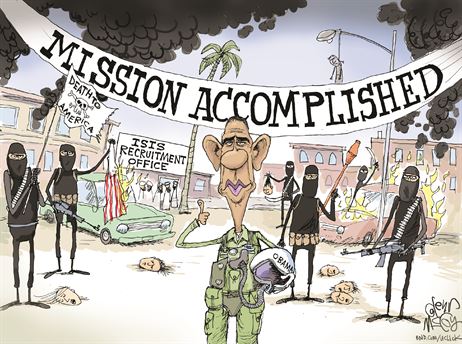
Mission accomplished

H/t Vermont Loon Watch

toys