Archive for the ‘Pope’ category

Humor| A real Grand Unification Theory: Christianity, Islam and Paganism

July 1, 2015

A real Grand Unification Theory: Christianity, Islam and Paganism, Dan Miller’s Blog, June 30,2015

(I refuse to acknowledge that the views expressed in this article are or are not mine. However, they do not necessarily reflect the views of Warsclerotic or any of its (other) editors. — DM)

Einstein tried but failed to develop a Grand Unification Theory. Perhaps he should have selected a name without the acronym GUT. Hope remains, and I developed one in less than an hour. It explains life, the universe and everything.

Einstein

I. posits:

1. An infinite number of universes exist, all of which have infinite numbers of galaxies.

2. Some universes and some galaxies are Christian (whatever that may mean there), some are Islamic (whatever that may mean there) and some are Pagan (whatever that may mean there). Pagan refers to all religions other than Christianity and Islam.

3. The allegedly Christian, Islamic and Pagan galaxies generally, but with exceptions, despise each other and, in some cases, themselves.

4. Each of the universes, and accordingly each of the galaxies, is controlled by a god of its own religion.

5. The multiple gods are, in reality, high-level laboratory technicians who enjoy damaging each other’s lab experiments.

II. Proofs:

1. The Islamic gods forbid alcohol, while the Christian and Pagan gods relish it.

2. Not many years ago, Haiti had developed the best rum in any universe — a fifteen year old nectar of the Christian and Pagan gods. Horrified, the Islamic gods conspired to ruin it and Haiti as well. To that end, they dispatched

a. Earthquakes,

b. Droughts,

c. United Nations peace keeping forces to spread disease, death, instability, poverty and

d. Clinton charities to take whatever Haiti still had.

e. In consequence, Haitian rum ceased to be palatable.

3. Since Dear Leader Osama Obama took office, the Islamic gods have encouraged The Islamic Republic of Iran to increase its nuclear energy weaponization program while pretending not to. By inducing Obama to ignore their efforts and to pretend that the Islamic Republic is as peaceful as He pretends the rest of Islam is, the Islamic gods inspired Him to give the Islamic Republic everything it wants and more. The Islamic gods also promised Him a great foreign policy legacy, akin to nothing ever accomplished by any former or future (if any) president.

Shaken by their defeat on alcohol, the Christian and Pagan gods abstained from interfering with the Islamic gods’ efforts. Some may even have converted to Islam, just to be on the winning side. Conversion — which no Islamic god would even consider — may have caused Christian gods little difficulty.

In the fourteenth century Pope Pius II, having given up on starting another crusade against the Islamist Turks because he could garner little support, wrote a letter to the Turkish ruler, Mehmed. It was distributed throughout Christendom. He

proposed not only to recognize Mehmed’s claim to be the ruler of the Eastern Roman Empire but also to transfer to him the imperium of the West, just as six and a half centuries earlier his predecessor Leo III, by the coronation of Charlemagne, had transferred (or “translated,” to use the technical term) it from the Greeks to the Franks. All the sultan had to do was to convert to Christianity. What, after all, asked the pope in somewhat unpapal terms, were “a few drops of baptismal water” in exchange for the right to rule over the entire Roman world?  It was an empty gesture, as he must have known. [Emphasis added,]

Some Christian and Pagan gods may be more amenable to conversion to Islam than Islamic gods are to Christianity.

Dedication

This otherwise incomparably short essay is dedicated to our Supreme Leader, Barack Humble Osama Obama who, by virtue of His equally incomparable empathy, insight, humility and intellect, has managed to come up even shorter.

barack-bicycle

I am not insane

If I were insane, that’s exactly what I would write. Go figure.

Where’s the Pope’s Encyclical on Christian Persecution?

June 26, 2015

Where’s the Pope’s Encyclical on Christian Persecution? Front Page Magazine, June 26, 2015

(Please see also, The Scorpion, The Frog and The Pope. How about an encyclical on Islamic persecution of Christians and Jews? Others as well.– DM)

pope-francis1-450x281

Where is Pope Francis’ encyclical concerning the rampant persecution that Christians—including many Catholics—are experiencing around the world in general, the Islamic world in particular?

****************

Pope Francis recently released a new encyclical. Portions of it deal with environmentalism, global warming, and climate change. Naturally, this has prompted controversy.

It’s noteworthy that Francis didn’t merely opine on global warming during this or that sermon, but that he issued a papal encyclical on the matter. Encyclicals are much more formal and significant that passing comments made during mass. They are letters written by a pope and sent to bishops all around the world. In turn, the bishops are meant to disseminate the encyclical’s ideas to all the priests and churches in their jurisdiction, so that the pope’s teaching reaches every church-attending Catholic.

All this leads to the following question: Where is Pope Francis’ encyclical concerning the rampant persecution that Christians—including many Catholics—are experiencing around the world in general, the Islamic world in particular?

To be sure, the pope has acknowledged it. On April 21, during mass held at Casa Santa Marta, Francis said that today’s church is a “church of martyrs.” He even referenced several of the recent attacks on Christians by Muslims (without of course mentioned the latter’s religious identity).

Said Pope Francis:

In these days how many Stephens [early Christian martyred in Book of Acts] there are in the world! Let us think of our brothers whose throats were slit on the beach in Libya [by the Islamic State]; let’s think of the young boy who was burnt alive by his [Pakistani Muslim] companions because he was a Christian; let us think of those migrants thrown from their boat into the open sea by other [African Muslim] migrants because they were Christians; let us think – just the day before yesterday – of those Ethiopians assassinated because they were Christians… and of many others. Many others of whom we do not even know and who are suffering in jails because they are Christians… The Church today is a Church of martyrs: they suffer, they give their lives and we receive the blessing of God for their witness. [Note: words not uttered by the Pope are in brackets. –DM)

The pope is obviously well acquainted with the reality of Christian persecution around the world. So why isn’t he issuing an encyclical about it? Such an encyclical would be very useful.

The pope could instruct bishops to acknowledge the truth about Christian persecution and to have this news spread to every Catholic church. Perhaps a weekly prayer for the persecuted church could be institutionalized—keeping the plight of those hapless Christians in the spotlight, so Western Catholics and others always remember them, talk about them, and, perhaps most importantly, understand why they are being persecuted.

Once enough people are acquainted with the reality of Christian persecution, they could influence U.S. policymakers—at least to drop those policies that directly exacerbate the sufferings of Christian minorities in the Middle East.

Whatever the effects of such an encyclical—and one can only surmise positive ones—at the very least, the pope would be addressing a topic entrusted to his care and requiring his attention.

In 1958, Pope Pius XII issued an encyclical that addressed the persecution of Christians. A portion follows:

We are aware—to the great sorrow of Our fatherly heart—that the Catholic Church, in both its Latin and Oriental rites, is beset in many lands by such persecutions that the clergy and faithful … are confronted with this dilemma: to give up public profession and propagation of their faith, or to suffer penalties, even very serious ones.

[…]

Missionaries who have left their homes and dear native lands and suffered many serious discomforts in order to bring the light and the strength of the gospel to others, have been driven from many regions as menaces and evil-doers…

Note that Pius does not mention the burning and bombing of churches, or the abduction, rape, enslavement, and slaughter of Christians. The reason is that Christians living outside the West in 1958 rarely experienced such persecution. In other words, today’s global persecution of Christians is exponentially worse than in 1958. Pius complained about how Christianity was being contained, not allowed to spread and win over converts.

Today, indigenous Christians who’ve been in the Middle East before Islam was conceived are being slaughtered, their churches burned to the ground, their women and children, enslaved, raped, and forced to convert. “ISIS” is the tip of the iceberg.

Even in the West, statistics indicate that Islam is set to supersede Christianity,at least in numbers.

Yet no encyclical from Pope Francis on any of this. Instead, Francis deems it more fit to issue a proclamation addressing the environment and climate change.

Whatever position one holds concerning these topics, it is telling that the pope—the one man in the world best placed and most expected to speak up for millions of persecuted Christians and Catholics around the world—is more interested in speaking up for “the world” itself.

Bear in mind, the Christian worldview is not about “saving the earth”—“where moth and rust do corrupt, and where thieves break through and steal”—but in saving souls, both in the now and hereafter. The Lord questioned Saul of Tarsus as to why he was persecuting his flock, not about the environment.

Yet here we are: if even the Catholic Pope does not deem the ongoing, systematic assault on Christianity and Christians a priority issue in need of its own encyclical, what can be expected from the average secular/atheistic politician in the West?

The answer is before us: brutal persecution and slaughter of Christians on the one hand, and absolute indifference from the West on the other.

Exiled Fatah Terrorist Amna Muna on PA TV: We Will Continue Until Our Entire Land is Liberated

May 26, 2015

Exiled Fatah Terrorist Amna Muna on PA TV: We Will Continue Until Our Entire Land is Liberated, MEMRI TV via You Tube, May 26, 2015

(The Palestinian Authority is Israel’s “partner for peace” and its titular leader, Abbas, can be an angel of peace according to the Pope. Some angel; some peace.– DM)

In a May 15 interview on the official Palestinian Authority TV channel, Amna Muna, a Palestinian terrorist who was freed in the Shalit prisoner swap and exiled to Turkey, said: “Nothing will break our resolve – not imprisonment, not exile, and not martyrdom… We shall continue on our path until our entire land is liberated.” Muna, who was speaking to PA TV over the Internet, was imprisoned for her involvement in the kidnapping and murder of Israeli teenager Ofir Rahum in 2001.


The Pope and the Palestinians

May 20, 2015

The Pope and the Palestinians, Front Page Magazine, May 20, 2015

(The article also deal with Islam in general, as to which the Pope’s fantasies reflect those of the Obama Administration and others. — DM)

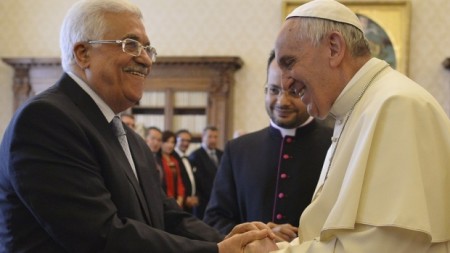
francis-and-abbas-450x253

Perhaps the ultimate expression of this faith in Islam was Pope Francis’ assertion in Evangelii Gaudium that “authentic Islam and the proper reading of the Koran are opposed to every form of violence.”

**************************

Contrary to reports in the mainstream press, Pope Francis did not call Palestinian Authority leader Mahmoud Abbas “an angel of peace.” The correct translation of the pope’s words is “I have thought of you: that you could be an angel of peace.”

Why, then, was it so easy to believe the initial reports? Perhaps because the initial reports seemed to align with previous papal overtures to Palestinian leaders. Pope Francis had previously called Abbas a “man of peace,” he has shown sympathy for Palestinian grievances, and other popes have given the appearance of lending legitimacy to the Palestinian cause. For example, Pope John Paul II is reported to have received PLO leader Yasser Arafat on twelve different occasions.

Arafat was a terrorist. One would think that the Vatican would have wanted to limit its contacts with him. The same goes for Abbas. He has repeatedly honored and praised Palestinian “martyrs” who have slaughtered innocent Jews. There is evidence that he helped fund the 1972 operation that killed eleven Israeli athletes at the Munich Olympic Games. Why is he accorded such a cordial reception at the Vatican?

Although the Church has often declared its spiritual bond with Jews, it has had a less harmonious relationship with the nation where approximately half the world’s Jews now reside. The Vatican was the last Western government to accord diplomatic recognition to the State of Israel (in 1993). In addition, on several occasions, prominent prelates have likened Israel to King Herod, the murderer of innocents; and others have accused Israel of being an apartheid state. Meanwhile, Catholic NGOs such as Pax Christi and Trocaire have been major players in the boycott, divest, and sanctions campaign against Israel.

Of course, the BDS campaign directly impinges on Israeli security. So do the calls by numerous Christian leaders to tear down the security barrier that divides Israel from the West Bank. On his trip to the Holy Land a year ago, Pope Francis allowed himself to be photographed in prayer at a section of the wall where a large graffiti message compared Bethlehem to the Warsaw Ghetto. In a naïve gesture of solidarity with Palestinians, the pope was unwittingly lending credence to the idea that the Israelis could be compared to the Nazi occupiers of Poland.

The wall was constructed to prevent suicide attacks against Israeli citizens. It’s estimated that its construction has saved thousands of lives. To suggest that the wall is offensive, as many Christians have done, is to suggest that Jewish lives don’t matter. Moreover, such judgments betray an entirely lopsided view of the situation. Take the Gaza conflict. The Catholic hierarchy typically had little to say about the daily rocket barrages launched against Israeli citizens from Gaza, but it was quick to condemn Israel on those occasions when it finally retaliated. In a similar vein, Fouad Twal, the Latin Patriarch of Jerusalem, blamed last year’s Gaza war on the Israeli embargo which, he said, had turned Gaza into “a factory of desperate people, designed to easily turn into extremists.”

In short, many Catholic leaders have shown a tendency to blame Israel for defending itself. The implication, of course, is that there would be no need for defense if Israel would only go to the peace table and make the concessions demanded of it by the Palestinians. The Vatican’s recent recognition of the “State of Palestine” reflects this naïve view of the situation. The supposition is that the Palestinians only want to be left in peace, whereas there is abundant evidence that the deepest desire of Palestinian leaders is for the extermination of Israel. Have Vatican officials never seen the photos of Abbas holding up a map of Palestine that encompasses all of the territory currently known as Israel? Are they unaware that he has personally called for a Palestine that is Judenrein? Didn’t they notice that when Israel gambled on disengaging from the Gaza Strip in 2005, Gaza soon turned into a terrorist state governed by an obsession to destroy Israel?

From the Israeli point of view, the call to cooperate with the Palestinian “peace” agenda is a call to cooperate in its own demise. Whenever I hear a UN representative or a Vatican spokesman call for peace talks between Israel and Palestine, I think of that scene from Goldfinger in which James Bond is about to be sliced in two by a laser beam. “Do you expect me to talk?” he asks. “No, Mr. Bond,” replies Goldfinger, “I expect you to die.” The Vatican hasn’t yet grasped the point that the Palestinian leadership doesn’t want the Israelis to talk, it wants them to die.

By words and by actions, the Vatican continues to suggest that there is a moral equivalence between Israel and the Palestinian Authority. This policy not only does a disservice to Jews, it also does a disservice to Catholics and other Christians. The main effect of the moral equivalence stance is to sow confusion among Catholics at a time when they need to be clear and unconfused—clear about Islam, that is. The Vatican policy toward Palestine reflects it overall stance toward the Islamic world. In other words, let’s overlook the dark side—the terrorism, the anti-Semitism, the oppression of Christians and other minorities—and let’s put the best face on the Mohammedan faith. For the sake of peace. And also for the sake of maintaining the threadbare narrative that Islam is a close cousin of Catholicism and, therefore, a religion of peace. Perhaps the ultimate expression of this faith in Islam was Pope Francis’ assertion in Evangelii Gaudium that “authentic Islam and the proper reading of the Koran are opposed to every form of violence.”

How well has this policy worked? Not very. Catholics and other Christians who lived in Muslim lands and who took seriously the Catholic version of “this has nothing to do with Islam” soon found that the tiny minority of misunderstanders were legion and had murder on their minds. Many found out too late. Years of indoctrination in the myth of Islam’s pacific nature had left them unprepared for the violence. Not that the Church was the only culprit. The secular opinion-makers had been preaching the same gospel. The irony is that the Church wants Israel to adopt the same policy of make-believe about Islam that has contributed to the death and displacement of millions of Christians.

The policy requires an almost total denial of facts. In the case of the Arab-Israeli crisis it means ignoring the terrorist ties of the Palestinian government, its unity coalition with Hamas, the massive state-sponsored indoctrination of Palestinian children, and the oft-stated goal of eliminating Israel. Ironically, it also necessitates that one ignore the ongoing persecution of Christians in the Palestinian territories.

The Palestinian leaders do a good job of hijacking Christian themes and imagery in order to gull Christians into thinking that they are, indeed, brothers in Christ. Thus, Palestinians have milked the massacre-of-the-innocents meme for all its worth. They also like to claim that Jesus was the first Palestinian. Another favorite theme is that the Palestinian people are the “new Jesus” who is being crucified by the Israelis.

Many in the Catholic hierarchy seem to fall for the ruse, but the steady exodus of Christians from the Palestinian territories tells a different story. The overall population of Christians in the Palestinian areas has declined from 15 percent in 1950 to 2 percent today. After the Palestinian Authority took control over Bethlehem in 1995, the Christian population there declined by half. In the Gaza Strip, only a few hundred Christians remain. That’s because Christians in Palestine, like Christians in most Muslim-majority societies, are treated as second-class citizens—subject to rape, intimidation, and legalized theft.

Meanwhile, the Christian population of Israel continues to grow. Palestinian Christians want to live there and so do persecuted Christians in other parts of the Middle East. Despite years of propaganda to the contrary, they have come to realize that Israel is a safe haven in a world of Islamic chaos.

Do Christians who migrate to Israel know something that the Vatican doesn’t know? The facts are there for everyone to see, but not everyone sees them. Why do Catholic leaders persist in assigning moral equivalence when there is no moral equivalence? Normally, a belief in moral equivalence grows out of a relativistic outlook. But presumably we can rule that out in the case of Catholic prelates. A more likely cause of their moral neutrality is a misapplication of the principle of “judge not.” Christians today are highly conscious of the sins of Western civilization and are therefore reluctant to judge those who lie outside it—in this case, Muslims. However, the principle is meant to apply to judgments about the state of an individual’s soul, not his behavior. And it was never meant to apply to withholding judgments about ideologies and belief systems.

The reluctance to see the mote in the other’s eye can eventually slide over into willful blindness. There are numerous warnings in the New Testament about spiritual blindness and they apply to those within the Church as well as to those without. The big danger for Church leaders is not that they will be seen as judgmental in the eyes of the world, but that they will be seen as foolishly naïve in the eyes of history.

“First comes Saturday, then comes Sunday” is a well-known slogan in the Middle East. It means that after the Islamists finish with the Jews, they will come after the Christians. The fate of the Saturday people and the Sunday people is intertwined. And the fate of both is put in jeopardy when Christian leaders insist on holding on to a fantasy-based picture of Islam.

Cartoon of the day

May 17, 2015

Source: Jerusalem Post

Angel-of-Peace

Pope calls Abbas ‘angel of peace’ during Vatican visit

May 16, 2015

Pope calls Abbas ‘angel of peace’ during Vatican visit, Times of Israel, May 16, 2015

(Update: According to an article at PJ Media, the words weren’t precisely as reported. Instead, the Pope said “May the angel of peace destroy the evil spirit of war. I thought of you: may you be an angel of peace.”  For the Pope, in the course of recognizing “Palestine,” even to express a hope that Abbas may be an “angel of peace” seems as odd as expressing a hope that a rattlesnake may be a good and friendly companion for one’s children.  — DM)

********************

(The Pope seems to have an odd sense of humor. — DM)

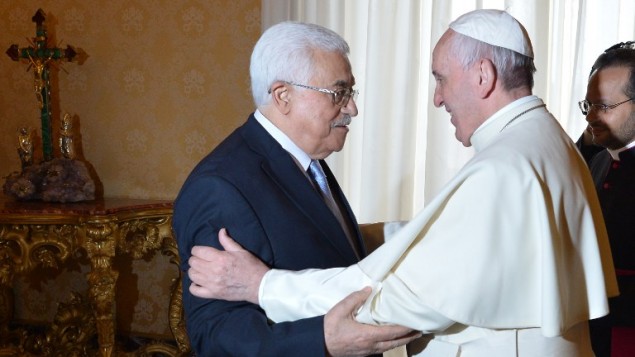
000_DV2030018-e1431765591751-635x357Pope Francis welcomes Palestinian Authority President Mahmoud Abbas during a private audience on May 16, 2015 in Vatican (AFP Pphoto pool/Alberto Pizzoli)

Pope Francis praised Palestinian Authority President Mahmoud Abbas as an “angel of peace” during a meeting at the Vatican.

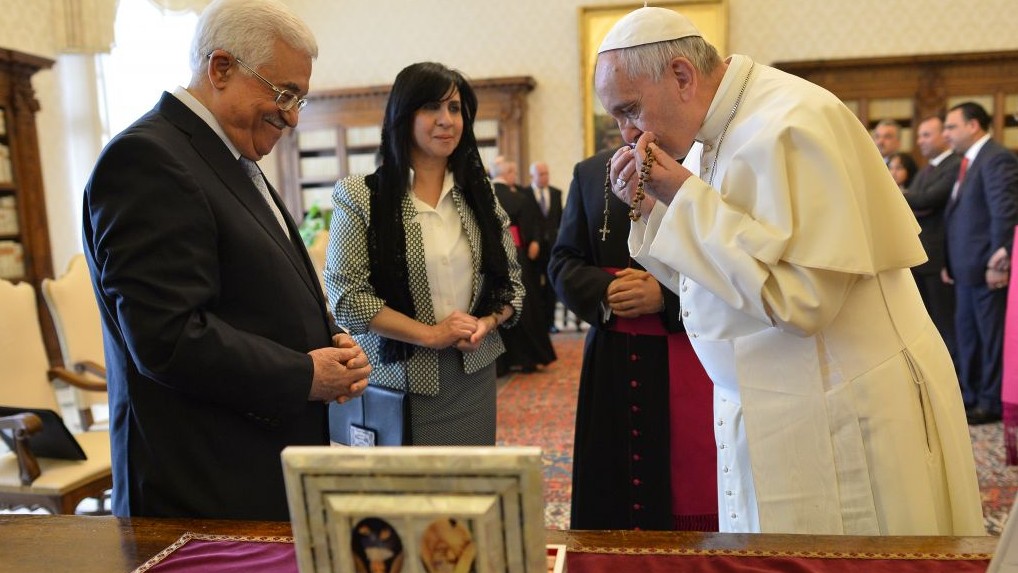
Francis made the compliment Saturday during the traditional exchange of gifts at the end of an official audience in the Apostolic Palace. He presented Abbas with a medallion and explained that it represented the angel of peace “destroying the bad spirit of war.”

Francis said he thought the gift was appropriate since “you are an angel of peace.”

Abbas is in town for the canonization Sunday of two new saints from what was then Ottoman-ruled Palestine. It also comes days after the Vatican finalized a bilateral treaty with the “state of Palestine,” making explicit its recognition of Palestinian statehood.

Abbas, for his part, offered Francis relics of the two new saints.

Vatican-Palestinians_Horo-e1431781749661Pope Francis exchanges gifts with Palestinian leader Mahmoud Abbas during an audience at the Vatican Saturday, May 16, 2015. (Alberto Pizzoli/Pool Photo via AP)

The treaty, which was finalized Wednesday but still has to be signed, makes clear that the Holy See has switched its diplomatic relations from the Palestinian Liberation Organization to the state of Palestine.

A bilateral commission is putting the final touches to the agreement, on the Catholic Church’s life and activities in Palestine, which then “will be submitted to the respective authorities for approval ahead of setting a debate in the near future for the signing,” the Vatican said on Wednesday.

Some observers speculated that the agreement could be signed during Abbas’s visit.

The news of the treaty immediately drew ire from Israel.

“Israel heard with disappointment the decision of the Holy See to agree a final formulation of an agreement with the Palestinians including the use of the term ‘Palestinian State’,” said an Israeli foreign ministry official.

“Such a development does not further the peace process and distances the Palestinian leadership from returning to direct bilateral negotiations. Israel will study the agreement and consider its next step.”

The agreement, 15 years in the making, expresses the Vatican’s “hope for a solution to the Palestinian question and the conflict between Israelis and Palestinians according to the two-state solution,” Antoine Camilleri, the Holy See’s deputy foreign minister, said in an interview earlier this week.

In an interview with the Vatican’s Osservatore Romano newspaper, Camilleri said he hoped “the accord could, even in an indirect way, help the Palestinians in the establishment and recognition of an independent, sovereign and democratic State of Palestine.”

The Palestinian Authority considers the Vatican one of 136 countries to have recognized Palestine as a state, although the number is disputed and several recognitions by what are now European Union member states date back to the Soviet era.

Abbas’s visit came a day before two nuns who lived in Ottoman Palestine during the 19th century will be made saints at a Vatican ceremony.

Marie Alphonsine Ghattas of Jerusalem and Mariam Bawardy of Galilee will become the first Palestinian Arabs to gain sainthood.

Ghattas was born in Jerusalem in 1847, and died there in 1927. She was beatified — the final step before canonization — in 2009.

Bawardy was born in Galilee, now in northern Israel, in 1843. She became a nun in France and died in Bethlehem in 1878.

She was beatified by Pope John Paul II in 1983.

Although there are several saints who lived in the region during Christianity’s early days, Bawardy and Ghattas are the first to be canonized from Ottoman-era Palestine.

The canonization of a third Palestinian — a Salesian monk — is still under review by the Church.