Archive for the ‘Palestinian Authority’ category

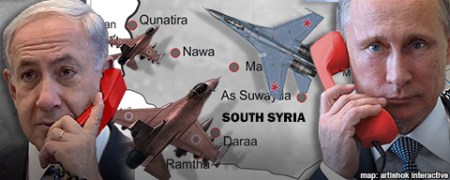
Israel’s PM seeks role in Russian-US duo in Syria

June 6, 2016

Israel’s PM seeks role in Russian-US duo in Syria, DEBKAfile, June 6, 2016

PutinBibi2-480 (1)

During his 48-hour trip to Moscow (Monday and Tuesday June 6-7), Prime Minister Binyamin Netanyahu will try and talk President Vladimir Putin into cutting Israel into the military teamwork evolving between Washington and Moscow for combating the Islamic State in Syria. As a quid pro quo, he will offer to elevate Moscow to senior broker in the Israeli-Palestinian dispute, with Moscow or Geneva selected as the venue for direct Israeli-Palestinian talks, if they occur – and with US participation. Netanyahu is also keen on a role for Egypt’s Presidents Abdek-Fattah al-Sisi.

DEBKAfile sources in Jerusalem and Moscow report exclusively that the floating of this deal was the reason why Russia’s Foreign Minister Sergey Lavrov abstained from attending the Mid East conference staged last weekend by France’s President Francois Hollande in Paris. The UK and German foreign ministers followed the Russian lead and stayed away.

And Friday, June 3, on the day of the Paris meeting, Russian Deputy Foreign Minister Mikihail Bogdanov, who is in charge of Kremlin Middle East policy, offered a formula for resolving the problem of Israeli settlements on the West Bank.  That formula was very similar to the land swaps plan proposed by Defense Minister Avigdor Lieberman a few years ago.

It consisted essentially of the transfer to the Palestinian state of parts of Israel with dense Arab populations, in return for Palestinian recognition of Israeli sovereignty over the Israeli communities of Judea and Samaria.

In comments to Tass news service, Bogdanov said that Moscow is willing to host an Israeli-Palestinian peace conference, and also offered to mediate between the rival Palestinian factions, including Abu Mazen’s Fatah and the radical Hamas which rules the aza Strip.

While some Israeli politicians see the French initiative as offering President Barack Obama a handle for settling accounts with PM Netanyahu before he leaves the White House at the end of the year, Moscow and Jerusalem are concocting a parallel strategy – not merely to block the Franco-American move, but also to lift Washington’s drive for an Israeli-Palestinian accord from Paris to Moscow.

DEBKAfile sources say that this maneuver is based on the early stages of military and political coordination between Washington and Moscow in the Syrian arena, including the fight against ISIS.

No such coordination exists between Washington and Paris.

Netanyahu envisages the tightening military cooperation between Russia and Israel for Syria, along with Israel’s active participation in the airstrikes against ISIS, as becoming integral to American-Russian understandings, and extending also to the Israeli-Palestinian issue.

Moscow and Jerusalem both estimate that an offer of US-Russian-Arab guarantees to the Palestinians, underwritten by Egypt and Saudi Arabia, can move the negotiations forward.

The Old Generals’ Old Plan

May 31, 2016

The Old Generals’ Old Plan, Front Page MagazineCaroline Glick, May 31, 2016

al-aqsa_martyrs_brigade

Originally published by the Jerusalem Post

The Israeli Left is a one trick pony. As it sees things, all of Israel’s problems – with the Palestinians, with the Arab world, with Europe and with the American Left – can be solved by giving up Judea and Samaria and half of Jerusalem (along with Gaza which we gave up already).

Once Israel does this, the Left insists, then the Palestinians, the Arab world, Europe and Bernie Sanders voters will love us as they’ve never loved us before.

The events of the past quarter century have shown the Left’s position to be entirely wrong. Every time Israel has given the Palestinians land, it has become less secure. The Arabs have become more hostile.

The West has become more hostile. The Palestinians have expanded their demands.

Because of their negative experience with the Left’s policy, most Israelis reject it. This is why the Right keeps winning elections.

Given the failure of its plan, the Left could have been expected to abandon it and strike out on a different course. But it didn’t. Instead it has tried to hide its continued allegiance to its failed withdrawal strategy by pretending it is something else.

A central component of the Left’s concealment strategy is its use of former generals.

Over the past quarter century, and particularly since the Palestinians began demonstrating in 2000 that they have no interest in a state living side by side with Israel, the Left has carted out retired generals at regular intervals to proclaim that continued allegiance to the Left’s failed policy of withdrawal is not irrational.

Every couple of years, a new initiative of former generals – often funded by the EU – is published.

Each in turn uses whatever the popular memes of the day may be to repackage their call for withdrawal from Judea and Samaria and the partition of Jerusalem.

The media, itself dominated by the Left, backs these initiatives. The retired war heroes are paraded before the cameras and presented to the public as responsible adults who have grudgingly entered the political fray, despite their aversion to it, because of their patriotism. Just as they heeded the call of duty and led forces in wars of earlier generations, so today, we are told, they heed the call again, in yet another last-ditch effort to save the country.

Just in time for Avigdor Liberman’s swearing in as defense minister, a new group of old generals released a new version of their old, discredited plan.

A group calling itself “Commanders for Israeli Security” has mobilized an impressive roster of 214 generals that have signed on to a new position paper called “Security First: Changing the rules of the game, a plan to improve Israel’s security-diplomatic position.”

The group has a great website replete with a highend web commercial that has been flooding social media feeds for the past several days. The ad shows a person ripping up a “Peace Now” bumper sticker and replacing it with a call for “Security now, peace later.”

Their plan, the ad proclaims, will improve Israel’s security, strengthen its international position, repair the cleavages in Israeli society and set the conditions for future negotiations with the Palestinians.

Unfortunately, like every leftist plan to date, if the generals get their way and the government takes their advice, the results will be precisely the opposite of what they promise. As has been the case with every other well-packaged withdrawal plan, Israel’s security will be harmed. Our international position will be wrecked. Bernie Sanders voters along with the Europeans will expand their devotion to bashing Israel. And the Sunni Arab states that now flock to us will again abandon us.

The generals’ new package involves opening their plan with a hawkish call for continued Israeli security control over Judea and Samaria, until the Palestinians decide to make peace with us.

But as we soon see, that was just throat clearing.

Having established their sober-mindedness, the generals turn to the Left’s unchanging fantasy.

They call for the government to formally relinquish Israel’s sovereign rights over the vast majority of Judea and Samaria and eastern Jerusalem.

They call for the government to permanently stop respecting the property rights of Jews in the areas of Judea and Samaria outside of the security perimeter.

The more than one hundred thousand Jews who live in those areas, they insist, must be denied all right to property, save the right to sell whatever they now own.

They must not be allowed to build anything – no new houses; no new communities; no new infrastructure.

As for the communities inside the perimeter, the generals insist that those should be permitted to continue respecting Jewish property rights, within limits, albeit. For instance, those communities must not be permitted to expand beyond their current construction boundaries. In other words, Jews can build up, but not out.

Jerusalem, which they believe should never have been unified in 1967, should be effectively partitioned.

The generals call for the municipal government to stop administering the city as a unified mixed Jewish and Arab city. Instead, they say, the city should set up a separate governing authority for Arab neighborhoods in eastern, northern and southern Jerusalem. That separate authority should be responsible for all planning and zoning activities in Arab neighborhoods as well as the education system and every other aspect of the daily lives of the Arabs of the city.

Gaza, which has been operating as a Hamas state since 2007, is also brought in from the cold. The generals call for the government to continue to supply Gaza with everything that Hamas demands – water, electricity, employment in Israel, a Hamas-controlled port. They even call for Israel to allow Europe to pay the salaries of Hamas terrorists.

Moreover, the generals recommend that the government announce that Gaza, Judea and Samaria and partitioned Jerusalem are one political entity, despite the fact that they aren’t.

The generals insist that by taking these steps, Israel will prove its devotion to peace and keep the dream of a Palestinian state alive. As a consequence, they say, the Palestinians will be happy and stop trying to murder Israelis. The Arab world will line up to sign peace treaties with Israel. Europe along with Bernie Sanders’ voters will bury the hatchet and embrace Israel.

The problem with the generals’ newest plan and the ones its replaces is that they all ignore basic facts.

There is no Palestinian constituency for peace with Israel. The more Israel offers the Palestinians, the less interested they are in settling.

By announcing that Israel renounces its claims to Judea, Samaria and Jerusalem, and treating the Jews east of the 1949 cease-fire lines as second class citizens, the generals will not only widen Israel’s social cleavages. They will tell the Palestinians that they are right to feel contempt for us. The worse they behave, the more we will offer them. The more Jews they murder, the more the Jews will turn against one another.

As for improving Israel’s international position, it is hard to understand why the generals refuse to learn the lessons of the Gaza withdrawal. Despite the fact that Israel uprooted 24 Jewish communities in Gaza and northern Samaria, and removed its military forces from the area, without exception, the international community insists that Israel still “occupies” Gaza. How can the generals expect the world to act more fairly towards a more limited withdrawal plan from Judea and Samaria and Jerusalem? As for Gaza, Operation Protective Edge brought out into the open the fact that Egypt, Saudi Arabia, the UAE and other Arab states support Israel in its war against Hamas. They do so because they fear Islamic State and Iran more than they hate Israel, whose power they trust.

If Israel announces its intention of leaving Judea and Samaria, which the Arabs know will become a Hamas enclave faster than Gaza did, the Arab faith in Israel’s power will diminish. As a consequence, if Israel follows the generals’ advice our relations with the Sunnis will worsen, not improve.

It is a tragedy for Israel that the generals have allowed the Left to use them in this way. Their role in perpetuating Israel’s destructive adherence to the devastating two-state policy model diminishes their past contributions and endangers Israel’s future.

That Kissinger Promise and Obama’s Fulfillment

May 30, 2016

That Kissinger Promise and Obama’s Fulfillment, The Jewish PressVic Rosenthal, May 30, 2016

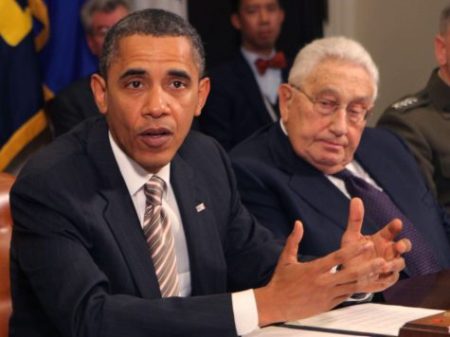
Obama-Kissinger-e1464550543436Pres. Obama seated with Henry Kissinger

{Originally posted to the author’s website, Abu Yehuda}

Old realpolitiker Henry Kissinger was in the news recently when he sat down with Donald Trump, to give him the benefit of his experience. It brought to mind Kissinger’s numerous attempts to get Israel out of the territories it conquered in 1967, before, during and – especially – after the Yom Kippur War.

Kissinger went to Iraq in December of 1975 to try to wean the regime away from the Soviet Union and improve relations with the US. In a discussion with Sa’dun Hammadi, the Iraqi Foreign Minister, Kissinger suggested that American support for Israel was a result of Jewish political and financial power, promised that the US would work to force Israel back to pre-1967 boundaries, and indicated that while the US would not support the elimination of Israel, he believed that its existence was only temporary. Here is an excerpt (the whole thing is worth reading):

I think, when we look at history, that when Israel was created in 1948, I don’t think anyone understood it. It originated in American domestic politics. It was far away and little understood. So it was not an American design to get a bastion of imperialism in the area. It was much less complicated. And I would say that until 1973, the Jewish community had enormous influence. It is only in the last two years, as a result of the policy we are pursuing, that it has changed.

We don’t need Israel for influence in the Arab world. On the contrary, Israel does us more harm than good in the Arab world. You yourself said your objection to us is Israel. Except maybe that we are capitalists. We can’t negotiate about the existence of Israel, but we can reduce its size to historical proportions. I don’t agree that Israel is a permanent threat. How can a nation of three million be a permanent threat? They have a technical advantage now. But it is inconceivable that peoples with wealth and skill and the tradition of the Arabs won’t develop the capacity that is needed. So I think in ten to fifteen years, Israel will be like Lebanon—struggling for existence, with no influence in the Arab world.  [my emphasis] …

Kissinger also promised that aid to Israel, which he presented as a result of Jewish political influence, would be significantly reduced. He indicated that legal changes in the US – he must have been referring to the creation of the Federal Electoral Commission in 1974 to regulate campaign contributions – would attenuate Jewish power and therefore American support for Israel. Naturally, he didn’t foresee the Israel-Egypt peace agreement, which permanently established a high level of military aid to both countries.

He further promised that the US would support a PLO-run Palestinian state if the PLO would accept UNSC resolution 242 and recognize Israel. This of course is what (supposedly) happened in the Oslo accords.

Kissinger insisted that “No one is in favor of Israel’s destruction—I won’t mislead you—nor am I.” But his hint that a smaller Israel might not survive is clear. Surely he understood that a pre-1967-sized Israel (within what Eban called “Auschwitz lines”) would have no chance of surviving, simply because of the strategic geography of the area.

Kissinger was wrong about the Arabs developing the capability to challenge Israel, but their place has been taken by soon-to-be-nuclear Iran and its proxies, who are significantly more dangerous than the Arab states ever were.

US policy, however, has kept more or less the same shape, except that the hypocrisy of insisting that the US supports the existence of Israel but in a pre-1967 size is even more glaring. The substitution of the PLO for the Arab states as the desired recipient of the land to be taken from Israel has barely made a ripple either in America or among the Arabs, suggesting that the policy is more about Israel giving up land than about the Arabs getting it.

The original motivation for Kissinger’s promises was supposedly the desire of the US to replace the Soviet Union as the patron of the Arab states. After the collapse of the USSR and the end of the Cold War in 1991, however, there was no change in policy. Although the Oslo Accords were initiated by left-wing Israelis, the US eagerly embraced them, and the so-called ‘peace process’ became a permanent stick to beat Israel with.

President Obama is especially adept at emphasizing support for Israel’s existence while at the same time demanding that Israel make concessions that would make her continued existence impossible. Apparently agreeing with Kissinger about Jewish power, Obama has worked to reduce the pro-Israel influence of American Jews in numerous ways, such as by providing access to the White House for groups like J Street and the Israel Policy Forum, while marginalizing traditional Zionist organizations like ZOA.

Kissinger’s almost anti-Semitic claim that US support for Israel is bought with Jewish money was probably untrue in 1975 and is even less so today, when a large proportion of American Jews, including wealthy ones, have chosen their liberal or progressive politics over Zionism. The coming struggle over the introduction of a pro-Palestinian plank into the Democratic platform is an indication that the party and with it, many of its Jewish supporters, is moving toward Obama’s position.

The Obama Administration’s program to extricate itself from the Middle East by empowering Iran as the new regional power has given a new impetus to the policy of shrinking Israel. Iran sees Israel as a major obstacle to its hegemony, for both geopolitical and religious/ideological reasons, and is committed to eliminating the Jewish state. Obama found it necessary to restrain Israel from bombing Iran’s nuclear facilities at least once (in 2012), and seems to be prepared to sacrifice Israel in order to achieve his goal of establishing Iranian regional dominance.

Some would go even further and say that Obama’s primary ideological goal is to eliminate Israel and the Iranian gambit is a means to this end, but that is highly speculative! Or maybe it’s a matter of two birds with one stone.

Henry Kissinger didn’t do us any favors, but I think the anti-Israel thread in American policy would have been strong enough without him, running from Truman’s Secretary of State George C. Marshall all the way to Obama’s stable of anti-Zionists like Rob Malley and Ben Rhodes.

Today Israel is long gone from the Sinai, more recently from Gaza, and probably only thanks to the disintegration of Syria, still holding the Golan Heights. I would like to believe that PM Netanyahu was correct when he said that Israel will never leave the Golan. Regarding Judea, Samaria and Jerusalem, I expect that we are about to begin a very difficult time, as the Obama Administration is likely to mount a campaign in its last days to fulfill Kissinger’s promise to the Arabs at long last.

Israel and the Palestinians: What the media won’t report

May 29, 2016

Israel and the Palestinians: What the media won’t report, Gatestone Institute via YouTube, May 28, 2016

The day after Abbas

May 27, 2016

The day after Abbas, Israel Hayom, David M. Weinberg, May 27, 2016

The day Mahmoud Abbas departs his post as president of the Palestinian Authority, or is deposed from his dictatorial perch, could be a watershed moment. It could and should force a reassessment of conventional thinking about the feasible contours of accommodating Palestinian independence.

That moment may be coming soon. Abbas is old, sick and tired. He has little to show for his persistent efforts to isolate Israel diplomatically and force Israel into hasty withdrawals. His regime is viewed as utterly corrupt by 95.5% of Palestinians (according to a recent Palestinian poll). The tens of billions of dollars in international aid he has swallowed have failed to build any real institutional basis for a good or democratic Palestinian government.

Abbas’ thuggish underlings are jockeying aggressively around him for pole position in the battle to succeed him as West Bank despot. Hamas, too, smells blood.

On the diplomatic front, Abbas’ departure will leave nothing behind but scorched earth. He has fled from real negotiation and compromise with Israel, espoused maximalist positions, stoked hatred toward Israelis and Jews, venerated terrorists and pushed the criminalization of Israel internationally. He basically convinced most Israelis that there is no reasonable peace deal to be had with the Palestinians.

And yet, the Obama administration and much of the global community nonsensically still considers Abbas and his gang to be viable partners for a two-state peace arrangement. What will it take for them to move beyond this rotten reliance on Fatah leadership and the creaky two-state construct?

Nevertheless, most Israelis, including Prime Minister Benjamin Netanyahu, still seek to move toward some clarity of borders, stability, and improved quality of life for Israelis and Palestinians alike.

They seek to do so without embarking on insane Israeli withdrawals that would likely lead to the establishment of a second “Hamastan” in the West Bank, or worse, an Islamic State-type regime.

So it’s time for Israel to re-articulate its thinking about the possibilities of an Israeli-Palestinian modus vivendi. Netanyahu should capitalize on his newly broadened government, and the coming transitions in Palestinian and American politics, to reset the diplomatic table. He can outline the acceptable contours of a conflict amelioration process in which Israel can pragmatically participate.

Doing so is especially urgent since the Obama administration is, in extremis, not-so-subtly readying to move the global goal posts farther away from Israel. This, of course, will only make the likelihood of Palestinian compromise with Israel even more remote.

Here are some guidelines and red lines that the Israeli government may want to adopt:

• Regional solutions: Unconventional alternatives to the struggling two-state paradigm must be on the table, including: a Palestinian-Jordanian federation; shared sovereignty with Israel in the West Bank; a three- or four-way land swap involving Egypt and Jordan; and, possibly, a combination of all these approaches.

The major Western powers must be willing to drive serious exploration of such alternatives. Arab states too can take responsibility for solving the Israeli-Palestinian conflict and consider investment of tangible resources in “regional” solutions.

• Baseline: Israel’s position at the outset of talks should be that 100% of the West Bank belongs to Israel, by historical right, and that this right is richly buttressed by political experience, legitimate settlement and security necessity. Only then can Israel hope to obtain a sensible compromise.

Talks should not begin from a 68-year-old armistice line forced upon Israel by Arab aggression; nor “from the point that talks last left off” eight years ago under a previous, defeatist Israeli government; nor from the defensive security fence line forced upon Israel by Palestinian terrorism; nor from any borders high-handedly dictated in advance by U.S. President Barack Obama or the international community.

• Security: The radical Islamic winter buffeting this region, and its inroads into the Palestinian national movement, means that the security envelope encompassing Israeli and Palestinian areas must be militarily controlled by the IDF, fully and indefinitely. This includes the Jordan Valley and the mountain ridges on both sides of Judea and Samaria.

• The Temple Mount: One way in which to wring Palestinian recognition of the Jewish people’s ancient ties to this holy land is to insist on Jewish prayer on the Temple Mount. This can be modestly facilitated either through a time-sharing arrangement (similar to that in place at the Tomb of the Patriarchs in Hebron), or through a small synagogue tucked away on the fringes of the vast Temple Mount plaza (which won’t overshadow the two large Muslim structures on the Mount).

Palestinian denial of Jewish religious, historical and national rights in Israel is the essence of the conflict. It is time to tackle this head-on, cautiously but candidly, at the core — in Jerusalem.

In conclusion, Netanyahu should leverage this turning point to reframe the parameters of how Israel can live astride the very problematic Palestinian national movement.

Has the Pope Abandoned Europe to Islam?

May 26, 2016

Has the Pope Abandoned Europe to Islam? Gatestone InstituteGiulio Meotti, May 26, 2016

♦ In 2006, Pope Benedict XVI said what no Pope had ever dared to say — that there is a link between violence and Islam. Ten years later, Pope Francis never calls those responsible for anti-Christian violence by name and never mentions the word “Islam.”

♦ Pope Francis does not even try to re-evangelize or reconquer Europe. He seems deeply to believe that the future of Christianity is in the Philippines, in Brazil and in Africa. Probably for the same reason, the Pope is spending less time and effort in denouncing the terrible fate of Christians in the Middle East.

♦ “Multiculturalism” in Europe is the mosque standing on the ruins of the church. It is not the synthesis requested by Pope Francis. It is the road to becoming extinct.

♦ Asking Europe to be “multicultural” while it experiences a dramatic de-Christianization is extremely risky. In Germany, a new report found that “Germany has become demographically a multi-religious country.” In the UK, a major inquiry recently declared that “Britain is no longer a Christian country.” In France, Islam is also overtaking Christianity as the dominant religion.

To scroll the list of Pope Francis’s apostolic trips — Brazil, South Korea, Albania, Turkey, Sri Lanka, Ecuador, Cuba, United States, Mexico, Kenya, Uganda, Philippines — one could say that Europe is not exactly at the top of his agenda.

The two previous pontiffs both fought for the cradle of Christendom. Pope John Paul II took on Communism by toppling the Berlin Wall and the Iron Curtain. Benedict XVI took on “the dictatorship of relativism” (the belief that truth is in the eye of the beholder) and bet everything on re-evangelizing the continent by traveling through it (he visited Spain three times) and in speeches such as the magnificent ones at Regensburg, where he spoke bluntly about the threat of Islam, and the German Bundestag, where he warned the gathered politicians against declining religiosity and “sacrificing their own ideals for the sake of power.”

Pope Francis, on the contrary, simply ignores Europe, as if he already considers it lost. This former Argentinian Cardinal, a representative of the “global South” Christianity, made spectacular trips to the migrants’ islands of Lampedusa (Italy) and Lesbos (Greece), but never to the heart of the old continent. Pope Francis has also made it difficult for Anglicans to enter into the Catholic Church, by downplaying the dialogue with them.

Most importantly, however, in his important May 6 speech for the Charlemagne Prize, the Pope, in front of European leaders, castigated Europe on migrants and asked its leaders to be more generous with them. He next introduced something revolutionary into the debate: “The identity of Europe is, and always has been, a multicultural identity,” he said. This idea is questionable.

Multiculturalism is a specific policy formulated in the 1970s. and it was absent from the political vocabulary of Schuman and Adenauer, two of Europe’s founding fathers. Now it has been invoked by the Pope, who spoke of the need for a new synthesis. What is this all about?

Today, Christianity appears marginal and irrelevant in Europe. The religion faces an Islamic demographic and ideological challenge, while the post-Auschwitz remnants of Jewish communities are fleeing from the new anti-Semitism. Under these conditions, a synthesis between the old continent and Islam would be a surrender of Europe’s claim to the future.

“Multiculturalism” is the mosque standing on the ruins of the church. It is not the synthesis requested by the Pope. It is the road to becoming extinct.

Asking Europe to be “multicultural” while it is experiencing a dramatic de-Christianization is also extremely risky. In Germany, a new report just found that “Germany has become demographically a multi-religious country.” In the UK, a major inquiry recently declared that “Britain is no longer a Christian country.” In France, Islam is also overtaking Christianity as the dominant religion. You find the same trend everywhere, from Protestant Scandinavia to Catholic Belgium. That is why Pope Benedict was convinced that Europe needed to “re-evangelized.” Pope Francis does not even try to re-evangelize or reconquer Europe. Instead, he seems deeply to believe that the future of Christianity is in the Philippines, Brazil and Africa.

Probably for the same reason, the Pope is spending less time denouncing the terrible fate of Christians in the Middle East. Sandro Magister, Italy’s most important Vatican observer, sheds light on the Pope’s silences:

“He remained silent on the hundreds of Nigerian schoolgirls abducted by Boko Haram. He remained silent on the young Sudanese mother Meriam, sentenced to death solely for being Christian and finally liberated by the intervention of others. He remains silent on the Pakistani mother Asia Bibi, who has been on death row for five years, because she too is an ‘infidel’, and [He] does not even reply to the two heartrending letters she has written to him this year, before and after the reconfirmation of the sentence.”

In 2006, Pope Benedict XVI, in his Regensburg lecture, said what no Pope had ever dared to say — that there is a link between violence and Islam. Ten years later, Pope Francis never calls those responsible for anti-Christian violence by name, and never mentions the word “Islam.” Pope Francis also recently recognized the “State of Palestine,” before it even exists — a symbolic and unprecedented first. The Pope also might abandon the Church’s long tradition of a “just war,” one regarded as morally or theologically justifiable. Pope Francis always speaks of the “Europe of peoples,” but never of the “Europe of Nations.” He advocates welcoming migrants and washes their feet, while he ignores that these uncontrolled demographic waves are transforming Europe, bit by bit, into an Islamic state.

1624In 2006, Pope Benedict XVI (left) said what no Pope had ever dared to say — that there is a link between violence and Islam. Ten years later, Pope Francis (right) never calls those responsible for anti-Christian violence by name and never mentions the word “Islam.” (Image source: Benedict: Flickr/Catholic Church of England | Francis: Wikimedia Commons/korea.net)

That is the meaning of Pope Francis’ trips to the islands of Lampedusa, Italy, and Lesbos, Greece — both symbols of a dramatic geographical and civilizational boundary. That is also the meaning of the Pope’s speech for the Charlemagne Prize.

Has the head of Christianity given up on Europe as a Christian place?

Secretary-General Of Palestinian Presidency Delivers Speech On Behalf Of President ‘Abbas: In Fighting For Palestine, Our People ‘Loves Death More Than Life’

May 24, 2016

Secretary-General Of Palestinian Presidency Delivers Speech On Behalf Of President ‘Abbas: In Fighting For Palestine, Our People ‘Loves Death More Than Life’ MEMRI, May 24, 2016

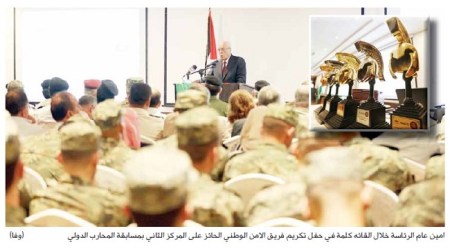
On May 22, 2016, Palestinian Presidency Secretary-General Al-Tayeb ‘Abd Al-Rahim delivered a speech on behalf of Palestinian President Mahmoud ‘Abbas to a group of Palestinian National Security Forces. The speech was part of a ceremony celebrating their second-place win in the international 8th Annual Warrior Competition, which took place in Jordan on May 2-6, 2016.[1]

In his speech, ‘Abd Al-Rahim condemned attempts to intimidate the Palestinian people and divert it from its path, and called such attempts futile, as “our [Palestinian] people loves death more than life.” He added that the National Security Forces victory was a step on the way to establishing an independent Palestinian state, and rejected the notion of establishing a separate independent entity in Gaza, or a state with temporary borders in the West Bank alone.

The following are excerpts from the speech:

28164Abd Al-Rahim speaking at the ceremony (Al-Ayyam, PA, May 23, 2016)

“Today we celebrate the Palestinian man, who suffers a lack of means and opportunity, but has will power and is determined to keep the Palestinian flag flying so that it [the flag] remains in the hearts of peace-loving and liberty-loving peoples. We were very happy with this victory [in the Warrior Competition], and the honorable president and commander-in-chief, president Abu Mazen [Mahmoud ‘Abbas], has expressed his esteem for the brothers who won this award and his pride in their achievements. Many commanders in Arab military institutions have also expressed their pride in this new Palestinian man, who is always new and always renewing [himself].

“The occupation wagered that we would forget our cause and that, as the generations passed, we would dissolve into the societies around us… However, the occupation was the first to realize that each new generation was more determined and had a stronger desire to achieve the goals that the martyrs had died for in the distant and the near past and [are still dying for] in the present. Our blood is still being spilled at the roadblocks and the checkpoints by the gangs of settlers and the extremist soldiers of the occupation, some of whom have acknowledged that they do not act according to moral standards when facing our people and children…

“Occupiers are always destined to fail. This fact should be in our minds forever. We must always cling to hope. Our morale will not be influenced or shaken by anything. We will not grow soft or deviate towards personal interests for the sake of dubious goals such as establishing a state or an emirate in Gaza, or establishing a state with temporary borders in the West Bank. We must always tirelessly stick to our truth, and our faith in victory must never falter. It is the faith in our hearts that will lead us to our rights and to the realization of our righteous and legitimate goals…

“Every achievement is a step on the road to establishing an independent state and strengthens our belief that the future is ours, that tyrants will disappear, and that the aggressors will end up in the trash bin of history. Indeed, they are trying to intimidate us today with people who threatened to strike Gaza or the Aswan Dam [a reference to incoming Israeli defense minister Avigdor Liberman], but these threats are hollow as we are a people who loves death more than life when it fights for Palestine.”[2]

Endnotes:

[1] The Annual Warrior Competition is a combat-oriented competition held at the King Abdullah II Special Operations Training Center (KASOTC) in Amman (Warriorcompetition.com).

[2] Al-Hayat Al-Jadida (PA), May 23, 2016.

French Political Gymnastics and How to Help the Palestinians

May 23, 2016

French Political Gymnastics and How to Help the Palestinians, Gatestone InstituteShoshana Bryen, May 23, 2016

“I call on the Palestinian people to elect new leaders, leaders not compromised by terror. I call upon them to build a practicing democracy, based on tolerance and liberty. If the Palestinian people meet these goals, they will be able to reach agreements with Israel, Egypt and Jordan on security and other arrangements for independence.” — President George W. Bush, 2002.

The Palestinians do not have “a practicing democracy based on tolerance and liberty,” but erasing Israel evidently remains their goal.

Rather than offering the Palestinians no-cost recognition, the French should demand a few changes first.

The French government seems to be falling over itself to undo its craven vote in favor of a UNESCO resolution accusing Israel — referred to as the “Occupying Power” in Jerusalem — of destroying historic structures on the Temple Mount:

  • Prime Minister Manuel Valls apologized. “This UNESCO resolution contains unfortunate, clumsy wording that offends and unquestionably should have been avoided, as should the vote.”
  • Interior Minister Bernard Cazeneuve apologized. [I do] “not take a supportive view of the text.” The resolution “should not have been adopted” and “was not written as it should have been.”
  • President François Hollande apologized. [The vote was] “unfortunate,” and, “I would like to guarantee that the French position on the question of Jerusalem has not changed… I also wish to reiterate France’s commitment to the status quo in the holy places in Jerusalem… As per my request, the foreign minister will personally and closely follow the details of the next decision on this subject. France will not sign a text that will distance her from the same principles I mentioned.”
  • Foreign Minister Jean-Marc Ayrault did not quite apologize: “France has no vested interest but is deeply convinced that if we do not want to let the ideas of the Islamic State group prosper in this region, we must do something.”

It sounds as if they thought they had made a mistake. But the vote was not a mistake. Underestimating the depth of Israel’s anger about it might have been a mistake, but not the vote. The French — who, according to their foreign minister, have “no vested interest” but need to “do something” about Islamic State — could not have thought that a UNESCO resolution that offended Israel would do anything to slow ISIS “in the region” or in Europe. There is no way it could; the two are not connected.

The French however, apparently thought a vote accusing Israel of something, anything, would keep the Palestinian Authority from presenting a resolution on Palestinian independence to the UN Security Council; Ayrault implied in Israel that the UNESCO vote was a quid pro quo. Why? The French have a veto they could exercise in the UN Security Council. But the Palestinians might then object to France replacing the U.S. as the “Great Power” in the “peace process.” They already have experience with a veto-wielding interlocutor — the U.S. — and they do not want another. The price of an elevated status for the French appears to entail not vetoing Palestinian resolutions, voting for them in UNESCO, and sacrificing Israel in a process that will end in French recognition of a Palestinian State, whether Israel agrees to be bound to the altar or not.

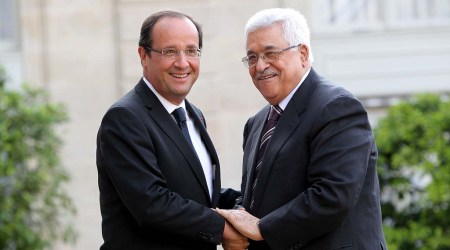
1614French President François Hollande welcomes Palestinian Authority President Mahmoud Abbas in Paris, July 8, 2012. (Image source: Office of the President of France)

It should be noted that the Russians immediately put out a statement that the UN-sponsored Middle East Quartet is the “only mechanism” for resolving the Palestinian issue. It is not clear whether Putin was supporting American or Israeli interests. Iran and ISIS are similarly disinclined to see the French ascend on this issue.

The Palestinians, on the other hand, are thrilled to have an international conference where others will make demands of Israel as the Palestinian experiment in self-government degenerates into poverty and chaos by its own economic, political and social choices, looking more like Venezuela every day.

For Palestinians in the street, killing Jews in the “knife intifada” did not take the edge off the popular anger and frustration with their own leadership.

Under the circumstances, the French, and France’s enabler, U.S. Secretary of State John Kerry, might usefully consider the approach taken in fact by President George W. Bush, which required changes in Palestinian behavior as a prerequisite for support for statehood. Honored mainly in the breach, Bush’s 2002 speech nevertheless remains the best statement of American, and Western, interest in moving the Palestinians toward a functioning state:

It is untenable for Israeli citizens to live in terror. It is untenable for Palestinians to live in squalor and occupation. And the current situation offers no prospect that life will improve. Israeli citizens will continue to be victimized by terrorists, and so Israel will continue to defend herself…

Peace requires a new and different Palestinian leadership, so that a Palestinian state can be born.

I call on the Palestinian people to elect new leaders, leaders not compromised by terror. I call upon them to build a practicing democracy, based on tolerance and liberty. If the Palestinian people meet these goals, they will be able to reach agreements with Israel, Egypt and Jordan on security and other arrangements for independence.

And when the Palestinian people have new leaders, new institutions and new security arrangements with their neighbors, the United States of America will support the creation of a Palestinian state whose borders and certain aspects of its sovereignty will be provisional until resolved as part of a final settlement in the Middle East.

I wrote at the time that,

“Mr. Bush made one huge leap of faith in the speech when he said, ‘I’ve got confidence in the Palestinians. When they fully understand what we’re saying, that they’ll make the right decisions when we get down the road for peace.’ What, in fact, will the U.S. do if the Palestinian people weigh a new constitution and free political parties and STILL decide that blowing up Jews is better? What if they have transparent government, economic advancement and an independent judiciary, and STILL decide Jewish sovereignty must be eradicated with the blood of their children?”

The Palestinians have answered half the question. They do not have a “practicing democracy based on tolerance and liberty,” but erasing Israel evidently remains their goal. Rather than offering no-cost recognition, the French should demand a few changes first.

Sisi and Mideast Peace

May 21, 2016

Sisi and Mideast Peace, American ThinkerC. Hart, May 21, 2016

Egyptian President Abdel Fatah al-Sisi’s speech on Tuesday, May 18, set ripples through Israel’s political establishment. Speaking in the southern city of Assiut, Sisi signaled to the Arab world, the Palestinians, and Israel that it is time for an historic breakthrough in peace negotiations.

Responding immediately to Sisi’s comments, Israeli Prime Minister Benjamin Netanyahu stated that he is open to working with Egypt and Arab states towards advancing the peace process, not only with the Palestinians but with the peoples of the Middle East region.

Netanyahu’s comments come on the heels of a visit to Israel by French Foreign Minister Jean-Mark Ayrault. The two men met but disagreed on how to advance peace.

France insists on hosting an international parley to force Israel and the Palestinians to come to the peace table. Israel is against the French initiative.

Netanyahu would like to go beyond the Israeli-Palestinian conflict and work directly with moderate Arab states on a comprehensive peace deal. Sisi could be instrumental in building an Arab coalition for peace which would dismiss or weaken the divisive French initiative, releasing Israel from conceding to European demands.

Former Israeli ambassador to Egypt, Zvi Mazel, is currently working as a Research Fellow at the Jerusalem Center for Public Affairs (JCPA). He is a Middle East expert who has represented Israel’s Ministry of Foreign Affairs as former Ambassador to Sweden and Romania, as well. This writer asked Mazel if Sisi’s comments were spontaneous or were released at this time for political reasons because he wants to strengthen Egypt’s position in the region by helping Israel.

“I don’t think there is a big design… I think that Sisi understands what is going on in the Middle East and he is identifying according to his view — a kind of possibility of advancing the peace process.”

Egypt, Saudi Arabia, the Gulf countries, and Israel have common enemies: Iran and Islamic State. Already there have been discreet diplomatic and business ties between Israel and these nations

According to Mazel, Sisi is also emerging as a strong respected leader among Egyptians despite the Western media’s portrayal of him as a dictator similar to former Egyptian President Hosni Mubarak.

“Sisi sees himself as a president quite stable among his people. I know that this is not the way they think in the Western media — New York Times and company. They see him as a kind of military dictator; absolutely not! He’s a good man. He’s not Mubarak. He’s Sisi.”

Mazel explains that Egypt is on the way to economic sustainable development. This is what Sisi has been focused on over the past two years and he is seeing success. Unemployment has gone down, despite the fact that almost 90 million people live in Egypt and the country is poor.

“He has started something quite positive, and Sisi thinks that the time has come for Egypt to be in the international arena.”

What that means, according to Mazel, is that Egypt’s current role is still minor. Sisi is asking Israelis and Palestinians to go forward, yet he, himself, does not have a plan. But, in the future, Egypt could emerge as a larger player in the region.

Mazel is pragmatic about the short-term. “It’s a positive step for Egypt, but it is not going to change the world.”

Current peace advances that are being prepared for release are not a positive development for Israel: (a) the French Initiative; (b) a document showing the obstacles to Israeli-Palestinian peace efforts soon to be reported by the Quartet; (c) the 2002 Arab Peace Initiative that, despite being outdated, is still considered a serious option by the Arab world.

In the coming days, the Arab League plans to meet and discuss the Israeli-Palestinian conflict. Mazel thinks that Sisi’s statement was good timing for that meeting, but otherwise, was not connected to a bigger scheme.

However, on Wednesday, May 18, American Secretary of State John Kerry arrived in Egypt one day after Sisi gave his emotional speech. Some analysts believe that the U.S. is behind Sisi’s bold words, in an effort to circumvent the French from becoming a new power broker in the Middle East.

The question is whether Sisi’s encouragement will lead to Israel courting the Arab nations and the Arab nations courting Israel, while by-passing the Palestinians. Mazel thinks that kind of change is slow in coming, because the Arabs continue to entrench themselves in old positions that favor Palestinian demands.

Refusing to sit down and negotiate with Israel, the Palestinians have insisted on preconditions which the Arab League has accepted. They demand that Israel agree on the right of return for so-called Palestinian “refugees” to Israeli land; that Israel withdraw to the 1967 borders; and, that Israel stop building in West Bank settlements (Judea and Samaria). Palestinian President Mahmoud Abbas also expects Israel to release hundreds of Palestinian prisoners, who have blood on their hands, serving time in Israeli jails because of terrorist attacks against the Israeli population.

So far, these unresolved issues have kept Abbas away from face-to-face negotiations with Netanyahu. However, his real diplomatic scheme is to get the international community to affirm the Palestinian position and force Israel to concede to Palestinian demands. Right now, Abbas sees the best venue to accomplish his goal as a French-sponsored future peace conference, followed by a stinging UN anti-Israel resolution.

Meanwhile, the future pressure on Israel will be to immediately stop settlement construction in order to get the peace process going. Mazel declares, “Absolutely not… we have to go on! Half a million people live there. And, they are the shield of Israel. We continue to build until there is peace.”

Mazel has a real problem with the demands of the Arab League, as well. “The Arab Peace Initiative is more or less the same as the Palestinian attitude. The ‘right of return’ is still there. It should be taken completely out. Most importantly, the Palestinians and the Arabs should recognize a Jewish State in Israel.”

Mazel is also not sure that Netanyahu’s insistence on widening his government, to provide greater stability, is a wise idea. Reportedly, Yisrael Beytenu Chairman Avigdor Liberman will soon become Israel’s new Defense Minister as Netanyahu brings several more ministers into his coalition. Mazel thinks this will not provide a wider diplomatic envelope; nor, will it help change European or Arab attitudes towards Israel; nor will it end the Boycott-Divestment-Sanctions (BDS) movement against Israel.

Then there is U.S. President Barack Obama’s failed Middle East policy, which includes his lackluster support of American allies in the region. Mazel says this policy cannot continue.

“It cannot be like that, because America is the most important power in the world… And, whoever will win the presidency, whether it will be Mrs. Clinton or Trump, both of them are in a certain way connected to the Middle East.”

Mazel believes that with 22 countries and more than 300 million people living in the region, the next U.S. president will be more engaged in leading the nations into greater stability.

In the meantime, currently 80% of the Egyptian people support Egyptian President Sisi. His nation has already made peace with Israel (along with Jordan). Helping Israel to extend an olive branch to other Arab countries will encourage Egypt to take up an important leadership role in a region that continues to be embroiled in major upheaval and violence.


Peace: A deceptive, dictatorial word

May 20, 2016

Peace: A deceptive, dictatorial word, Israel Hayom, Martin Sherman, May 20, 2016

No matter how many far-reaching compromises and gut-wrenching concessions Israel has made, they have never been enough to elicit any commensurate counter-concessions from the Arabs. Indeed, rather than satiate the Arab appetite, they have merely whetted it, with each Israeli gesture only leading to further demands for more “gestures.”

****************************

After a long absence, “peace” is back in the headlines, due in large measure to this week’s visit to Israel by French Foreign Minister Jean-Marc Ayrault, who came to try to promote a new French initiative that somehow, by as yet unspecified means, would resuscitate the moribund “peace process.”

Perversely planned to take place without either Israel or the Palestinians, the principal protagonists, the conference has now fortuitously been delayed to accommodate the schedule of U.S. Secretary of State Kerry, who apparently had better things to do than take part in yet another doomed charade to forge “peace” in the Middle East.

However, despite its ill-conceived rationale and dauntingly dim prospects, the planned summit can and should serve one constructive purpose: to focus attention not only on what the quest for the elusive condition of “peace” really entails, but on the even more fundamental question of what is actually meant, and what can realistically be expected, when we talk of “peace” as a desired goal, particularly in the context of the Middle East and particularly from an Israeli perspective.

Indeed, the need for such clarification becomes even more vital and pressing because of recent reports of possible Egyptian involvement in attempts to initiate “peace” negotiations with Arab regimes teetering on the brink of extinction and involving a perilous Israeli withdrawal to indefensible borders. All this in exchange for grudging recognition as a non-Jewish state by a partially no longer existent, partially disintegrating, Arab world.

A dictatorial word

It takes little reflection to discover that, in fact, “peace” is a word that is both dictatorial and deceptive.

It is dictatorial because it brooks no opposition. Just as no one can openly pronounce opposition to a dictator without risking severe repercussions, so too no one can be openly branded as opposing peace without suffering grave consequences to personal and professional stature.

Life can be harsh for anyone with the temerity to challenge the tyrannical dictates of the politically correct liberal perspectives. As British columnist Melanie Phillips remarked several years ago in an interview on Israel’s Channel 1: “Believe me, it [failing to abide by political correctness] has a very chilling effect on people, because you can lose your professional livelihood, your chances of promotion, you lose your friends.”

In a surprisingly candid admission, The New York Times’ Nicholas Kristof wrote that “universities are the bedrock of progressive values, but the one kind of diversity that universities disregard is ideological. … We’re fine with people who don’t look like us, as long as they think like us.”

This peer-imposed doctrinaire uniformity has had a debilitating impact on the quality of intellectual discourse in general, and on the question of “peace” in the Middle East in particular.

A New York Times opinion piece by Arthur C. Brooks cautioned: “Excessive homogeneity can lead to stagnation and poor problem solving.” Citing studies that found a “shocking level of political groupthink in academia, he warned that “expecting trustworthy results on politically charged topics from an ideologically incestuous community [is] downright delusional.”

A deceptive word

The considerable potential for defective analysis in the intellectual discourse on such a politically charged topic as “peace” also accounts for another detrimental attribute of the word.

Not only is it rigidly dictatorial, but, perhaps even more significantly, “peace” is a grossly deceptive word. It can be, and indeed is, used to denote two disparate even antithetical political situations. On the one hand, “peace” can be used to describe a state of mutual harmony between parties, but on the other hand it can just as aptly be used to characterize an absence of violence maintained by deterrence.

In the first meaning, “peace” entails a situation in which the parties eschew violence because they share a mutual perception of a common interest in preserving a tranquil status quo. In the second meaning, “peace” entails a situation in which violence is avoided only by the threat of incurring exorbitant costs.

The significance of this goes far beyond semantics. On the contrary. If it is not clearly understood, it is likely to precipitate calamitous consequences.

The perilous pitfalls of ‘peace’

It is crucial for practical policy prescriptions not to blur the sharp substantive differences between these two political realities. Each requires different policies both to achieve and, even more importantly, to sustain them.

The misguided pursuit of one kind of peace may well render the achievement — and certainly the preservation — of the other kind of peace impossible.

Countries with the mutual harmony variety of “peace” typically have relationships characterized by openness and the free movement of people and goods across borders. As in the relationship between Canada and the U.S., there is little or no effort needed to prevent hostile actions by one state against the other. Differences that arise are not only settled without violence, but the very idea of using force against each other is virtually inconceivable.

By contrast, in the second, deterrence-based variety of peace, such as those between the U.S. and USSR during the Cold War or between Iran and Iraq up to the 1980s, the protagonists feel compelled to invest huge efforts in deterrence to maintain the absence of war.

Indeed, whenever the deterrent capacity of one state is perceived to wane, the danger of war becomes very real, as was seen in the Iraqi offensive against an apparently weakened and disorderly Iran after the 1979 Islamic Revolution.

In this type of “peace,” there is no harmonious interaction between the peoples of the states. Movements across borders are usually highly restricted and regulated, and often prohibited.

It is not surprising to find that peace of the “mutual harmony” variety prevails almost exclusively between democracies, since its characteristic openness runs counter to the nature of dictatorial regimes.

The perils of pursuing one type of peace (mutual harmony) when only the other type (deterrence) is feasible were summed up over two decades ago by Prime Minister Benjamin Netanyahu in his acclaimed book “A Place Among the Nations: Israel and the World.” In it, he calls for making a clear distinction between the “peace of democracies” and the “peace of deterrence.”

“As long as you are faced with a dictatorial adversary, you must maintain sufficient strength to deter him from going to war. By doing so, you can at least obtain the peace of deterrence. But if you let down your defenses … you invite war, not peace,” he wrote.

Much earlier, in 1936, Winston Churchill underscored the dangers: “The French Army is the strongest in Europe. But no one is afraid of France. Everyone knows that France wants to be let alone, and that with her it is only a case of self-preservation. … They are a liberal nation with free parliamentary institutions. Germany, on the other hand, under its Nazi regime … [in which] two or three men have the whole of that mighty country in their grip [and] there is no public opinion except what is manufactured by those new and terrible engines — broadcasting and a controlled press fills unmistakably that part [of] … the would-be dominator or potential aggressor.”

Compromise counterproductive

To grasp the potential for disaster when a policy designed to attain a harmonious outcome is pursued in a political context in which none is possible, it is first necessary to recognize that, in principle, there are two archetypal configurations. In one, a policy of compromise and concession may well be appropriate; in the other, such a policy will be devastatingly inappropriate.

In the first configuration, an adversary interprets concessions as conciliatory, and feels obliged to respond with a counter-concession. Thus, by a series of concessions and counter-concessions, the process converges toward some amicably harmonious resolution of conflict.

However, in the second configuration, the adversary sees any concession as a sign of vulnerability and weakness, made under duress. Accordingly, such initiatives do not elicit any reciprocal gesture, only demands for further concessions.

But further concessions still do not prompt reciprocal moves toward a peaceable resolution. This process ill necessarily culminate either in total capitulation or in large-scale violence, either because one side finally realizes that its adversary is acting in bad faith and can only be restrained by force, or because the other side realizes it has extracted all the concessions possible by non-coercive means, and will only win further gains by force.

In such a scenario, compromise is counterproductive and concessions will compound casualties.

Whetting, not satiating, Arab appetites

Of course, little effort is required to see that the conditions confronting Israel today resemble the latter situation far more than the former. No matter how many far-reaching compromises and gut-wrenching concessions Israel has made, they have never been enough to elicit any commensurate counter-concessions from the Arabs. Indeed, rather than satiate the Arab appetite, they have merely whetted it, with each Israeli gesture only leading to further demands for more “gestures.”

If in any “peace” negotiations such compromises undermine Israeli deterrence by increasing its perceived vulnerability, they will make war, not peace, more imminent.

Indeed, it was none other than Shimon Peres, in recent years one of the most avid advocates of the land-for-peace doctrine (or dogma), who, in his book “Tomorrow is Now,” warned vigorously of the perils of the policy he later embraced.

After detailing how surrendering the Sudetenland made Czechoslovakia vulnerable to attack, Peres writes of the concessions Israel is being pressured to make today to attain “peace” : “Without a border which affords security, a country is doomed to destruction in war. … It is of course doubtful whether territorial expanse can provide absolute deterrence. However, the lack of minimal territorial expanse places a country in a position of an absolute lack of deterrence. This in itself constitutes almost compulsive temptation to attack Israel from all directions.”

e also warns: “The major issue is not [attaining] an agreement, but ensuring the actual implementation of the agreement in practice. The number of agreements which the Arabs have violated is no less than number which they have kept.” Since then, of course, their record has hardly improved.

Will Netanyahu 2016 heed Netanyahu 1993?

In 1996, shortly after Netanyahu was elected prime minister for the first time, Ari Shavit of Haaretz interviewed him on positions he had articulated in “A Place Among the Nations.”Shavit: “In your book, you make a distinction between … a harmonious kind of peace that can exist only between democratic countries, and peace through deterrence, which could also be maintained in the Middle East as it currently is. Do you think we need to lower our expectations and adopt a much more modest concept of peace?”

Netanyahu: “One of our problems is that we tend to nurse unrealistic expectations. … When people detach themselves from reality, floating around in the clouds and losing contact with the ground, they will eventually crash on the rocky realities of the true Middle East.”

Let us all hope that Netanyahu of today will heed the advice of Netanyahu of then. It is the only way Israel will be able to avoid the ruinous ravages of the deceptive and dictatorial word “peace.”