Archive for the ‘Pakistan’ category

Canadian Islamist Groups Lose Charity Status Over Potential Militant Financing

July 19, 2017

Canadian Islamist Groups Lose Charity Status Over Potential Militant Financing, Investigative Project on Terrorism, July 19, 2017

(Please see also, U.S. Group Connected to Terrorists in Kashmir. — DM)

Canadian authorities have stripped two former affiliates of the Islamic Society of North America’s Canada chapter (ISNA-Canada) of their charitable status after discovering financial ties between the Islamic organizations and a Pakistani militant group.

ISNA Islamic Services of Canada and the Canadian Islamic Trust Foundation lost their charity status for “non-compliance” following a Canada Revenue Agency (CRA) audit, according to records acquired by Canada’s Global News.

The CRA discovered several issues during the audit, including evidence that ISNA Islamic Services facilitated donations that may have ended up in the hands of Hizbul Mujahideen (HM), a Kashmir-based militant group. According to the CRA report, the Toronto-based Jami Mosque raised and transferred funds to the ISNA Development Foundation “for remit” to the Relief Organization of Kashmiri Muslims (ROKM), a “charitable arm” associated with HM.

“Given the identified commonalities in directorship between ROKM and Jamaat-e-Islami and the Hizbul Mujahideen executive committee, concerns exist that the funds collected and disbursed as part of this relief fund may have been used to support the political efforts of Jamaat-e-Islami and/or its armed wing Hizbul Mujahideen,” the CRA said.

HM is designated as a terrorist organization by the European Union and India. In June, the State Department put HM’s leader, Syed Salahuddin, on its terrorist designations list, citing his threats to train suicide bombers in Kashmir and HM’s responsibility for several deadly terrorist attacks.

This development comes four years after Canadian authorities revoked ISNA Development Foundation’s charity status for similarly raising funds that may have reached militants in Kashmir. In July 2013, the Toronto Star reported that ISNA-Canada may have funneled $280,000 to ROKM.

The 2013 CRA audit found numerous issues within the ISNA Development Foundation, including missing documentation, misleading financial reports, and sending donations abroad to unapproved groups. The ISNA affiliated organization engaged in these activities despite a stated purpose of serving the poor and needy in Canada.

A 2010 CRA audit found that ISNA-Canada itself misused more than $600,000 in donor funds.

A “very small portion … is distributed to the poor and needy and the major portion is spent on the administration of the centre,” concluded the 2010 audit. “Spending for personal expenses out of the charity’s funds is unethical,” the auditor wrote, saying it is “tantamount to misappropriation of funds.”

U.S. Group Connected to Terrorists in Kashmir

July 17, 2017

U.S. Group Connected to Terrorists in Kashmir, Clarion ProjectRyan Mauro, July 17, 2017

(Please see also, Exclusive: Jihadi Cult Associate Arrested in NY With Firearms Stockpile. — DM)

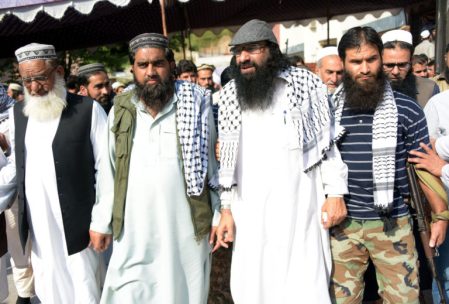
The State Department recently blacklisted Mohammad Yusuf Shah (known as Syed Salahuddin), (2nd from right), leader of the Hizbul Mujahideen terrorist group (Photo: SAJJAD QAYYUM/AFP/Getty Images)

Neither Hizbul Mujahideen nor Jamaat ul-Fuqra (the original informal name of MOA) are on the State Department’s list of Foreign Terrorist Organizations.

***************************************

The U.S. sanctioned the leader of an Islamist terrorist group in Kashmir named Hizbul Mujahideen late last month. The move targets an ideological ally of the U.S.-based Muslims of America organization (MOA), a cultish group known for its “Islamic villages” like Islamberg that is expressing support for the Kashmir terrorist group.

On June 26, the State Department blacklisted Mohammad Yusuf Shah (commonly known as Syed Salahuddin), the leader of the Hizbul Mujahideen terrorist group that fights in Kashmir against India and operates in Pakistan with backing from the Pakistani government.

Pakistan condemned the U.S. action.

Hizbul Mujahideen is the largest militant force in Kashmir. It condemns nationalism and democracy. It fights to create a theocratic Islamic state and caliphate. It is also closely linked to other Pakistani terrorist groups, including Al-Qaeda affiliates.

MOA’s extremist leader, Sheikh Gilani, is based in Lahore, Pakistan and has long been involved in this circle of Pakistani terrorist groups. A 2003 FBI report says MOA acts as a conduit to groups in Pakistan affiliated with Al-Qaeda. This is substantiated by a former MOA member who went to Pakistan.

That is why it is so concerning that Muslims of America, a group that has boasted of having 22 “Islamic villages” in the U.S., is expressing solidarity with Hizbul Mujahideen.

MOA’s relationship with the group goes as far back as 1990.

Click here for FuqraFiles.com, the authoritative database on Muslims of America (also known as Jamaat ul-Fuqra)

On May 2, MOA announced a “multi-dimensional campaign” to “liberate” Kashmir from India. Its written statement was essentially a declaration to Muslims that Allah requires them to rally behind Hizbul Mujahideen.

It exalts the “charismatic leadership” of Burhan Wani, a top Hizbul Mujahideen commander killed last year. It credits him with inspiring “a new generation of fearless youth” and “freedom fighters.” MOA depicts the terrorist group as the face of the Kashmiri resistance to India.

In August 2016, MOA’s newspaper condemned India for killing a “top pro-independence militant leader.” Based on the wording, you’d think MOA was talking about a Kashmiri George Washington. Actually, it was Hizbul Mujahideen’s operations commander. MOA’s coverage presented the group as enjoying massive popular support.

In March 2017, MOA’s newspaper covered a battle between Indian forces and Hizbul Mujahideen and sided with the jihadists. It referred to them as “Kashmiri freedom fighters” contesting the “oppressive and violent treatment of the Kashmiri people by Indian forces.”

There’s good reason to suspect that MOA is providing Hizbul Mujahideen with more than sympathy.

MOA has a long relationship with the terrorist group. In 1990, MOA even wrote a public letter calling on all Muslims to contribute to jihad in Kashmir and to support the “Kashmir Freedom Front,” which was essentially another name for Hizbul Mujahideen.

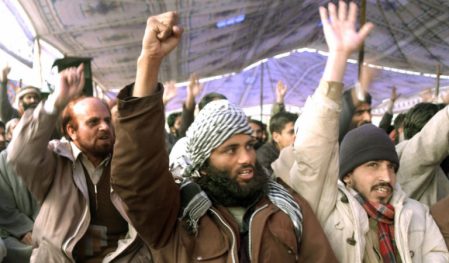
Jihadis in Kashmir (Photo: SAJJAD QAYYUM/AFP/Getty Images)


On July 6, 2016, MOA published a public letter to the U.N. that said Muslims in Pakistan-controlled Kashmir are required to defend the Kashmiris against India “by every possible means.” Gilani and MOA have had a long presence in Kashmir, including a village named “Gillaniville.” Therefore, the letter is declaring that MOA is obligated to become involved “by every possible means.”

The letter also called on Muslim countries to unite into a single organization with a single force for intervention in places where Muslims are oppressed. In other words, to form a caliphate. MOA’s ideologyhas always been in favor of a caliphate, theocratic sharia law and violent jihad in places like Kashmir.

MOA’s May 2 press conference emphasized activism and humanitarian aid, but it did not reject violence or supporting violent elements.

In fact, MOA endorsed jihad by calling on Pakistan to intervene against the Indian military, an obviously violent action. Additionally, MOA’s claim that India is engaged in “genocide” would make jihad defensible, if not mandatory, to any Muslim audience.

The online statement announces its support for Kashmiris’ “struggle for self-determination.” Struggle is the synonym for jihad. That same statement heaps praise upon Hizbul Mujahideen for its jihad against India. MOA obviously chose to avoid using the eye-catching word in favor of the vaguer synonym, knowing that a Muslim audience would understand that it is referring to jihad.

MOA chief executive Hussein Adams, son of convicted terrorist Barry Adams, boasted at the May 2 press conference that MOA has been involved in supporting the Kashmiri “struggle” since the 1980s. Of course, he didn’t mention their involvement in jihad and soliciting of support for Hizbul Mujahideen.

Their own documents acknowledge this violent role in the Kashmir jihad. It is also seen in a secret video by Sheikh Gilani filmed and distributed among some MOA members in 1991-1993. Gilani explicitly says that MOA communes in North America can facilitate such training for jihad in places where Muslims are in battle, with Kashmir being the top priority. Training was open to Muslims outside of MOA.

Sheikh Gilani’s tape, which I was the first to publicly release long excerpts of, showed that MOA’s public face is different than what it says and does in private. This is undeniable proof that MOA was engaged in terrorism and that Gilani used his American camps to train and recruit terrorists for Kashmir and other places,” Martin Mawyer, president of the Christian Action Network told Clarion Project.

The Clarion Project later obtained and released a video of women at Islamberg receiving guerilla training that was filmed in 2001-2002.

MOA spoke of its providing of money, food, supplies and medical to Kashmiris using two fronts: The Kashmir American Friendship Society and the American Muslim Medical Relief Team. We know from government reports and prosecutions that MOA sends money, personnel and material to Gilani in Pakistan for more extremist purposes.

MOA complained that its applications for its “journalists” with its newspapers to go to Pakistan and Kashmir are not being approved. Obviously, the Pakistani government and/or the U.S. government don’t see their trips to Pakistan so innocuously.

This issue exposes a gap in America’s national security policy: Neither Hizbul Mujahideen nor Jamaat ul-Fuqra (the original informal name of MOA) are on the State Department’s list of Foreign Terrorist Organizations.

A dozen Muslim organizations in North America have asked the State Department to review Fuqra/MOA for designation as a Foreign Terrorist Organization, as it fits the listed criteria. The case for designating Hizbul Mujahideen is much stronger, as the State Department has just acknowledged that it fits the criteria for its leader to be blacklisted as a Specially Designated Global Terrorist.

The State Department acknowledges that Hizbul Mujahideen fits the definition of a Foreign Terrorist Organization and it should now designate it as such. Doing so could sever whatever material relationship exists between Hizbul Mujahideen and Islamists in America like MOA and enable investigations and prosecutions of jihadists in America involved with the Pakistan-backed terrorist group.

US drone strikes ‘against spirit of ongoing cooperation,’ Pakistani Army chief says

June 15, 2017

US drone strikes ‘against spirit of ongoing cooperation,’ Pakistani Army chief says, Long War Journal, June 15, 2017

Bajwa insists that all the US needs to do is share intelligence, and the Pakistan military will handle the problem on its own. Yet it is well documented that when the US has given intelligence on groups such as the Haqqani Network, Pakistani officials have passed it along to the terrorists.

Pakistan often views many of these strikes as counterproductive because the US is killing leaders from their pet jihadist groups, such as the Afghan Taliban and the Haqqani Network, the Hafiz Gul Bahadar group, and the Mullah Nazir Group. Pakistani government and military officials have denounced strikes that have killed top leaders from these groups, which are known as “good Taliban” because they don’t actively oppose the Pakistani state. The irony is the good Taliban support the “bad Taliban,” which do fight the Pakistani state.

****************

Pakistan’s Chief of Army Staff General Qamar Javed Bajwa said today that US drone strikes and other unilateral actions “are against spirit of ongoing cooperation” and that any intelligence on terrorist whereabouts should be forwarded to the army for action. Bajwa made the statement despite the fact that Pakistani officials have routinely passed along actionable intelligence to terrorists to help them avoid raids, as well as supposed “counterproductive” drone strikes have historically been effective in killing scores of top tier terrorist leaders.

Bajwa’s view on drone strikes were summarized in an Inter-Services public relations press release that was issued on June 14, just one day after the US killed a Haqqani network leader and two of his deputies in an attack in Pakistan’s northwestern district of Hangu. From the ISPR press release:

COAS [Chief of Army Staff Bajwa] said that unilateral actions like drone strike etc are counterproductive and against spirit of ongoing cooperation and intelligence sharing being diligently undertaken by Pakistan. Pakistan Army is capable of taking effective measure if actionable intelligence is shared. He said that our focus now is to transform our operational achievements in FATA into enduring peace and stability for which early mainstreaming of FATA through reforms is essential and Pakistan Army fully supports all efforts towards that end.

Bajwa’s statement is astounding for many reasons, two of which will be addressed below:

When the US shared “actionable intelligence,” it has been passed along to jihadist leaders

Bajwa insists that all the US needs to do is share intelligence, and the Pakistan military will handle the problem on its own. Yet it is well documented that when the US has given intelligence on groups such as the Haqqani Network, Pakistani officials have passed it along to the terrorists. The Washington Post detailed two such incidents, when, in June 2011, the US passed along information to Pakistani officials on an al Qaeda facility in South Waziristan and a Haqqani Network bomb factory at a girls school in North Waziristan. Unsurprisingly, when Pakistani forces arrived, the two locations were empty.

The US has continued its drone program because the Pakistani military and its intelligence service, the Inter-Service Intelligence Directorate, could not be trusted.

Pakistan’s duplicity when it comes to supporting terrorist organizations in the region is well known. The Afghan Taliban would be a shadow of itself without the support and safe haven provided by the Pakistani government.

“Counterproductive” strikes have killed far more top tier leaders in the Movement of the Taliban in Pakistan than the Pakistani military

US drone strikes in Pakistan have killed more than 120 top tier jihadist leaders and operatives in the 396 recorded strikes in Pakistan since the program began in 2004. The jihadists killed come from a host of groups, including al Qaeda, the Afghan Taliban its subgroup, the Haqqani Network, the Movement of the Taliban in Pakistan, the Islamic Movement of Uzbekistan, Turkistan Islamic Party, Hizb Mujahideen, Lashkar-e-Jhagvi, the Hafiz Gul Bahadar group, and the Mullah Nazir Group (FDD’s Long War Journal maintains a list, here).

Pakistan often views many of these strikes as counterproductive because the US is killing leaders from their pet jihadist groups, such as the Afghan Taliban and the Haqqani Network, the Hafiz Gul Bahadar group, and the Mullah Nazir Group. Pakistani government and military officials have denounced strikes that have killed top leaders from these groups, which are known as “good Taliban” because they don’t actively oppose the Pakistani state. The irony is the good Taliban support the “bad Taliban,” which do fight the Pakistani state.

Oddly enough, Pakistani officials even protest when the US kills members of the Movement of the Taliban in Pakistan, which has killed tens of thousands of Pakistani civilians and soldiers in terrorist attacks and during its decade long insurgency in Pakistan’s northwest. Despite the fact that the Movement of the Taliban in Pakistan is a mortal enemy of the state, the Pakistani military has a paltry record in killing top tier leaders of the group. But US drone strikes have taken out key leaders of the Movement of the Taliban in Pakistan, including:

Hakeemullah Mehsud: Baitullah’s successor
Waliur Rehman Mehsud: Hakeemullah’s deputy and head of the Movement of the Taliban in Pakistan in South Waziristan
Qari Hussain Mehsud: the head of the Movement of the Taliban in Pakistan’s suicide operations and director of suicide camps
Wali Mohammed: the head of the Movement of the Taliban in Pakistan’s suicide operations
Ibn Amin: a Movement of the Taliban in Pakistan military commander in Swat who was also a senior al Qaeda leader

These men were directly responsible for murdering numerous Pakistani civilians and soldiers, and had eluded Pakistani intelligence and military operations for years before they were killed by the US drone program. The killing of these top leaders even led to a schism within the Movement of the Taliban in Pakistan for more than a year before the group could reorganize, with divisions that remain to this day.

Pakistani military and government officials have showed their gratitude by condemning most of these strikes.

However, despite Pakistan’s denouncement of the strikes, there is little the nation can do to halt them, short of deploying its air force and shooting down the US aircraft. In the past, the Pakistani government shut down NATO supply lines into Afghanistan in protest of the US raids. However, the US continued to target and kill top level jihadist leaders in cross-border attacks. The number of US drone strikes have decreased drastically from 117 during the peak year of 2010 to just three in 2016 and four so far this year.

Pakistani objections and international criticism have at times caused the US to halt the strikes, but only for a short period of time. Even though the US hates the optics of unilateral strikes on foreign territory without warning, the US has not reduced the number of strikes in 2016 and 2017 because of fear of retribution from Pakistan or international condemnation. Instead, the reduction can be attributed to several things: the US has shifted some resources and assets to other theaters to target al Qaeda in Somalia and Yemen, as well as the Islamic State in Iraq and Syria; and US intelligence incorrectly assessed al Qaeda’s presence in the region as diminished.

Pakistani Law Makes Ramadan a Dangerous Time for Religious Minorities

June 9, 2017

Pakistani Law Makes Ramadan a Dangerous Time for Religious Minorities, Investigative Project on Terrorism, Ammar Anwer, June 9, 2017

Irfan Masih

The unconscious man rushed to a Pakistani hospital was covered in filth. Irfan Masih was a sewer cleaner, and stricken by poisonous gases trapped inside a sewer hole. Time was of the essence. But emergency staff at the hospital in Pakistan’s Sindh province refused to treat Masih, a 30-year-old Christian, until he was thoroughly washed.

It is Ramadan and the doctors were fasting.

They cleaned Masih and pumped oxygen into him, but the pump was empty. Lying in the corner of the hospital, Irfan died gasping for air.

“My brother died during the process of cleansing the filth from his body,” Irfan’s brother, Parvez, told a local newspaper. Although Muslim medical professionals across the world do interact with patients in all sorts of conditions during Ramadan but according to Irfan’s mother, the doctors refused to treat him because they were fasting and said her son was ‘napaak’ (unclean).

In Pakistan, people from the Christian community face severe discrimination, and are often given jobs in sanitation. Angered at the doctors’ negligence, people from the Christian community staged a protest outside the press club in Umerkot.

During Ramadan, Muslims abstain from eating, drinking and having sex during daylight hours. For non-Muslims in Pakistan, the holiday can be a dangerous time. Last year, police severely beat an elderly Hindu man for eating publicly during the holiday. He was eating food given to him by a charity.

Similarly, a 2013 video showed a man who said he was beaten up for eating publicly during the Muslim fasting month.

Critics blame Pakistan’s Ehtram-e-Ramadhan ordinance for creating this intolerant environment. Enacted in 1981, the ordinance seeks to ensure that the sanctity of the month of Ramadan is preserved.

Minorities are attacked even though article 3 of the ordinance refers to people who follow Islam:

1. No person who, according to the tenets of Islam, is under an obligation to fast shall eat, drink or smoke in a public place during fasting hours in the month of Ramadhan.

2. Whoever contravenes the provisions of sub-section (1) shall be punishable with simple imprisonment for a term which may extend to three months, or with fine which may extend to five hundred rupees, or with both.

Although the law does not mention non-Muslims, the closing of all hotels, restaurants and even common food stores during the day does affect their lives.

The law defines a public place as “any hotel, restaurant, canteen, house room, tent, enclosures, road lane, bridge or other place to which the public have access.” It further requires that those places remain closed during fasting hours.

The ordinance states that it intends to protect the holiness of Ramadan, but while doing so it clearly violates the principles of fundamental freedoms. It forces all Muslims and non-Muslims not to eat in public, an act that could lead to fines and even imprisonment.

An amendment passed last month hikes the fine from Rs.500 to Rs.25,000 (about $388) for hotel owners who would violate the law. Television channels and theaters would pay a minimum fine of Rs.500,000 (about $7,7670) for violating the law.

I wonder whether we could protect the sanctity of any “blessed month” by adopting such harsh, coercive and tyrannical measures. Respect is earned, not imposed.

When the state starts legislating on religious grounds, it creates an environment of intolerance toward religious minorities and legitimizes discrimination. Pakistan has done this with the “Ehtram-e-Ramadhan ordinance.” Just last week, four people were arrested by the police for eating during fasting hours.

This ordinance enshrines intolerance and violates basic human rights. By closing down all the restaurants and food stores, it not only infringes upon the rights of various religious minorities in Pakistan, but also on those Muslims who do not want to comply with the ordinance.

Silence from the local media and Pakistani human rights groups over this controversial law that continues to allow maltreatment of minorities during the entire month of Ramadan is quite depressing.

Ammar Anwer is an ex-Islamist who writes for The Nation, Pakistan Today and other media outlets. He believes in secularism and democracy and aspires to see Pakistan become a pluralistic state.

Afghanistan’s terrorist resurgence: Al Qaeda, ISIS, and beyond

April 27, 2017

Afghanistan’s terrorist resurgence: Al Qaeda, ISIS, and beyond, Long War Journal, April 27, 2017

More than 15 years after the U.S. military invaded Afghanistan to destroy al-Qaeda, the group maintains a persistent and significant presence in the country. Despite the Obama administration’s surge of U.S. forces in Afghanistan from 2010 to 2012, the Taliban, which has maintained its close alliance with al-Qaeda, is resurgent and today holds more ground in the country since the U.S. ousted the jihadists in early 2002.

And the threat posed by jihadist groups in Afghanistan has expanded. The Islamic State has established a small, but significant, foothold in the country. Pakistani jihadist groups that are hostile to the U.S. – such as the Movement of the Taliban in Pakistan, Lashkar-e-Taiba, and Harakat-ul-Muhajideen – operate bases inside Afghanistan as well.

For nearly seven years, the Obama administration wrote off al-Qaeda as a spent force. The group has been described as “decimated.” After Osama bin Laden was killed in Pakistan, President Obama said the “core of al-Qaeda in Pakistan and Afghanistan is on a path to defeat.” The Obama administration pushed this narrative hard, with many counterterrorism analysts adopting the line that al-Qaeda was either defeated or close to it.

Between 2010 and 2016, Obama administration officials, including CIA Director Leon Panetta, as well as other U.S. military and intelligence officials, characterized al-Qaeda’s presence in Afghanistan as minimal and consistently told the American public that the group has a presence of just 50 to 100 fighters. “I think at most, we’re looking at maybe 50 to 100, maybe less. It’s in that vicinity. There’s no question that the main location of al-Qaeda is in tribal areas of Pakistan,” Panetta said on ABC News This Week.


***********************************

Editor’s note: Below is Bill Roggio’s testimony before the House Committee on Foreign Affairs Subcommittee on Terrorism, Nonproliferation. A PDF of the testimony, with footnotes, can be downloaded here.

Chairman Poe, Ranking Member Keating, and other members of this subcommittee, thank you for inviting me here today to speak about the terrorist groups based in Afghanistan and their continuing threat to U.S. national security.

More than 15 years after the U.S. military invaded Afghanistan to destroy al-Qaeda, the group maintains a persistent and significant presence in the country. Despite the Obama administration’s surge of U.S. forces in Afghanistan from 2010 to 2012, the Taliban, which has maintained its close alliance with al-Qaeda, is resurgent and today holds more ground in the country since the U.S. ousted the jihadists in early 2002.

And the threat posed by jihadist groups in Afghanistan has expanded. The Islamic State has established a small, but significant, foothold in the country. Pakistani jihadist groups that are hostile to the U.S. – such as the Movement of the Taliban in Pakistan, Lashkar-e-Taiba, and Harakat-ul-Muhajideen – operate bases inside Afghanistan as well.

U.S. Estimates on al-Qaeda in Afghanistan Were Incorrect

For nearly seven years, the Obama administration wrote off al-Qaeda as a spent force. The group has been described as “decimated.” After Osama bin Laden was killed in Pakistan, President Obama said the “core of al-Qaeda in Pakistan and Afghanistan is on a path to defeat.” The Obama administration pushed this narrative hard, with many counterterrorism analysts adopting the line that al-Qaeda was either defeated or close to it.

Between 2010 and 2016, Obama administration officials, including CIA Director Leon Panetta, as well as other U.S. military and intelligence officials, characterized al-Qaeda’s presence in Afghanistan as minimal and consistently told the American public that the group has a presence of just 50 to 100 fighters. “I think at most, we’re looking at maybe 50 to 100, maybe less. It’s in that vicinity. There’s no question that the main location of al-Qaeda is in tribal areas of Pakistan,” Panetta said on ABC News This Week.

This assessment, which contradicted the U.S. military’s own press releases announcing raids against al-Qaeda in Afghanistan, was consistently repeated by U.S. intelligence and military officials. In June 2015, the U.S. military claimed in its biannual Enhancing Security and Stability in Afghanistan report that al-Qaeda “has a sustained presence in Afghanistan of probably fewer than 100 operatives concentrated largely in Kunar and Nuristan Provinces, where they remain year-round.” The December 2015 report claimed that al-Qaeda is “primarily concentrated in the east and northeast.

This estimate of al-Qaeda’s strength, which consistently downplayed al-Qaeda’s presence in Afghanistan, came crashing down in mid-October 2015, when the U.S. military and Afghan forces orchestrated a large-scale operation against two al-Qaeda camps in the Shorabak district in the southern Afghan province of Kandahar.

The scale of al-Qaeda’s presence at the two camps in Shorabak quickly disproved the longstanding 50 to 100 estimate. A U.S. military statement, quoting spokesman Brigadier General Wilson Shoffner, described the raid as “one of the largest joint ground-assault operations we have ever conducted in Afghanistan.” It took U.S. and Afghan forces more than four days to clear the two camps, with the aid of 63 airstrikes.

Shoffner’s description of the al-Qaeda facilities indicated that they had been built long ago. “The first site, a well-established training camp, spanned approximately one square mile. The second site covered nearly 30 square miles,” Shoffner said. “We struck a major al-Qaeda sanctuary in the center of the Taliban’s historic heartland,” he added.

Weeks later, General John F. Campbell, then the commander of U.S. Forces – Afghanistan and NATO’s Resolute Support mission, described one of the camps, which was run by al-Qaeda in the Indian Subcontinent (AQIS), al-Qaeda’s branch in South Asia, as “probably the largest training camp-type facility that we have seen in 14 years of war.”

It has been estimated that at least 150 al-Qaeda fighters were killed during the raids on the two camps in Shorabak. This is 50 more al-Qaeda fighters than the upper end of the Obama administration’s estimate of al-Qaeda’s strength throughout all of Afghanistan. And the al-Qaeda members were killed in southern Afghanistan, not in the northeastern provinces of Kunar and Nuristan, where we have been told they were concentrated.

The U.S. military was ultimately forced to concede its estimate of al-Qaeda’s strength in Afghanistan was wrong. In mid-December 2016, General Nicholson admitted that the U.S. military killed or captured 50 al-Qaeda leaders and an additional 200 operatives during calendar year 2016 in Afghanistan.

In April 2016, Major General Jeff Buchanan, Resolute Support’s deputy chief of staff, told CNN that the 50 to 100 estimate was incorrect based on the results of the Shorabak raid. “If you go back to last year, there were a lot of intel estimates that said within Afghanistan al-Qaeda probably has 50 to 100 members, but in this one camp we found more than 150,” he said. The estimate of al-Qaeda operatives in Afghanistan was revised upwards to about 300.

However, well before the Shorabak raids, it was evident to those of us closely watching the war in Afghanistan that al-Qaeda was stronger in Afghanistan than the official estimates, and was not confined to small areas in the northeast. Al-Qaeda consistently reported on its operations throughout Afghanistan, and the U.S. military, up until the summer of 2013, reported on raids against al-Qaeda cells in multiple provinces.

Surely, there was something seriously wrong with the CIA and the U.S. military’s ability to properly report on al-Qaeda’s presence in Afghanistan.

Al-Qaeda’s footprint inside Afghanistan remains a direct threat to U.S. national security and, with the resurgence of the Taliban, it is a threat that is only growing stronger.

The Enduring Taliban-al-Qaeda Relationship

Al-Qaeda’s presence in Afghanistan has not occurred in a vacuum. It has maintained its strength in the country since the U.S. invasion, launched a new branch, AQIS, and established training camps with the help and support of the Taliban.

When Generals Campbell and Buchanan discussed al-Qaeda in the wake of the Shorabak raid, they described the group as resurgent. Campbell described the Taliban-al-Qaeda relationship as a “renewed partnership,” while Buchanan said it “has since ‘grown stronger.’”

But like the estimate that al-Qaeda maintained a small cadre of 50 to 100 operatives in Afghanistan between 2010 and 2016, the idea that the Taliban and al-Qaeda have only recently reinvigorated their relationship is incorrect. Al-Qaeda would not have been able to maintain a large cadre of fighters and leaders inside Afghanistan, conduct operations in 25 of Afghanistan’s 34 provinces, establish training camps, and relocate high-level leaders from Pakistan’s tribal areas to Afghanistan without the Taliban’s long-term support.
Al-Qaeda has remained loyal to the Taliban’s leader, which it describes as the Amir al- Mumineen, or the “Commander of the Faithful,” since the U.S. invaded Afghanistan in 2001. Osama bin Laden maintained his oath of allegiance to Mullah Omar, the Taliban’s founder and first emir. When bin Laden died, Ayman al-Zawahiri renewed that oath. And when Mullah Omar’s death was announced in 2015, Zawahiri swore bayat (an oath of allegiance) to Mullah Mansour, the Taliban’s new leader. Mansour publicly accepted Zawahiri’s oath.

The close relationship between the two jihadist groups is also evident with the assent of the Taliban’s new deputy emir, Sirajuddin Haqqani, who leads the powerful Taliban subgroup known as the Haqqani Network. Sirajuddin and the Haqqani Network have maintained close ties to al-Qaeda for years. The relationship is evident in the U.S. government’s designations of multiple Haqqani Network leaders. Two documents seized from Osama bin Laden’s compound show that Siraj has closely coordinated his operations with al-Qaeda in Afghanistan and Pakistan.

The Taliban-al-Qaeda relationship remains strong to this day. And with the Taliban gaining control of a significant percentage of Afghanistan’s territory, al-Qaeda has more areas to plant its flag.

Rise of the Islamic State

Shortly after Abu Bakr al-Baghdadi declared the establishment of the caliphate in 2014, announcing the formation of the Islamic State, a small number of disgruntled jihadists from the Afghan and Pakistani Taliban, as well as al-Qaeda, discarded their oaths to the Taliban, pledged their fealty to Baghdadi, and established the so-called Khorasan province.

While the Islamic State dominates the jihad in Iraq and is a major player in Syria, the group has posed a smaller threat in Afghanistan and Pakistan when compared to the Taliban, al-Qaeda, and their jihadist allies. The U.S. military estimated the group had upwards of 2,000 fighters at the beginning of 2016, but had lost between 25 and 30 percent of its men in the months that followed. While U.S. military estimates of the strength of jihadist groups in Afghanistan must be taken with a grain of salt, this number is likely in the right ballpark.
The Islamic State has a much smaller presence in Afghanistan when compared to the Taliban. While the Taliban controls or contests more than 200 of Afghanistan’s 400 districts, the Islamic State only controls terrain in several districts in the eastern province of Nangarhar. The group also reportedly has a presence in the Afghan north.

The Islamic State’s Khorasan province has remained entrenched in Nangarhar and has withstood multiple U.S.-backed offensives over the past two years. The U.S. military has had success in killing key leaders, but the group has proven resilient.

Still, the so-called caliphate’s Khorasan province has remained on the margins of the Afghan war. It has conducted a limited number of suicide attacks and other operations in the Afghan capital of Kabul and elsewhere, but has not come close to matching the Taliban’s operational tempo.

Khorasan province has had a difficult time gaining traction throughout much of Afghanistan and Pakistan, as it is unwilling to cooperate with other, long-entrenched jihadist groups. In fact, the Taliban crushed the Khorasan province’s forces in Helmand, Farah, and Zabul after they demanded that the Taliban’s fighters swear allegiance to Baghdadi.

Pakistani Jihadist Groups Operating in Afghanistan

In addition to the Taliban, al-Qaeda, and the Islamic State, numerous Pakistan-based jihadist groups are known to operate in Afghanistan. For the most part, these organizations remain in the Taliban and al-Qaeda sphere, and leaders of the groups often backfill leadership positions when al-Qaeda commanders are killed in U.S. airstrikes.

The three largest Pakistani groups operating in Afghanistan are the Movement of the Taliban in Pakistan, Lashkar-e-Taiba, and Harakat-ul-Muhajideen.

The Movement of the Taliban in Pakistan (TTP) is largely made up of Taliban groups from Pakistan’s tribal areas. It is closely allied with the Afghan Taliban and al-Qaeda. In 2010, the TTP organized the Times Square bombing plot.

The TTP has taken advantage of the turbulent and ungoverned Afghan-Pakistani border to shift its base of operations when the Pakistani military targets it in offensives. The U.S. has killed several TTP leaders in airstrikes in Afghanistan.

Lashkar-e-Taiba (LeT) is a dangerous jihadist group that is backed by Pakistan’s military and Inter-Services Intelligence Directorate. The LeT is known to operate training camps in Afghanistan and attacked the Indian Consulate in Herat in 2014.26 The U.S. has killed several senior LeT operatives in airstrikes in northeastern Afghanistan over the years. The U.S. has also listed several senior LeT operatives, including Hafiz Saeed, the group’s emir, as Specially Designated Global Terrorists.

Harakat-ul-Mujahideen (HuM) is another Pakistani jihadist group that is known, as of August 2014, to operate training camps in Afghanistan.27 HuM has been involved in numerous acts of terror in the region, including hijacking an Indian airplane, attacking the U.S. Consulate in Karachi, and murdering Wall Street Journal reporter Daniel Pearl.
A Muslim Woman’s Fight Against Radical Islam

February 25, 2017

A Muslim Woman’s Fight Against Radical Islam, Investigative Project on Terrorism, Abigail R. Esman, February 23, 2017

1990

If one were to find a single question that defines the geo-politics of our age, it might well be the question Farhana Qazi has been asking herself for almost 20 years: why do so many Muslims kill in the name of their religion?

If she has not found all the answers, Qazi has done much to facilitate our understanding of the issues, primarily as they relate to Muslim women and the rise in women extremists. A Muslim herself, she has worked largely behind the scenes: at the Counter-Terrorism Center in Washington, D.C.; at the Rand Corporation think tank; as an instructor on terrorism for the U.S. military; and as an author. Her work has taken her back to her native Pakistan, where she has immersed herself in the lives of Muslim extremist women, met with the mothers of suicide bombers, come to know women who have endured imprisonment, and shared stories with women who, in her words, “have tried to break the barriers of patriarchy and patrilineal traditions.”

Born in Lahore, Pakistan, Qazi came to America with her mother at the age of 1, joining her father who was already working in Tennessee. Soon after, the family moved to Austin, Texas, which Qazi considers her hometown. Her work since then, both in the service of her country and as a beacon for moderate Muslims seeking to reconcile their beliefs with the violent extremism facing the world, has received lavish praise and numerous awards. She is now working on a book that examines why Muslims turn violent, and the ways in which recent political events contribute to violent extremism.

She told us her story in a recent interview, and shared her crucial insights on radical Islam, women terrorists, and where we stand now in the face of the radical Islamist threat.

Abigail R. Esman: Why did your family move to the U.S., and how old were you at the time?

Farhana Qazi: My father came to the U.S. because it was his dream since he was a child. He admired Western values and later, he worked with American clients when he was a young accountant in Lahore, Pakistan. He came to the U.S. (to the rolling hills of Tennessee to pursue an MBA), and thanks to Al Gore, my father was allowed to stay in this country to work after his student visa expired. Gore wrote a letter on my father’s behalf. I was a year old when I moved here with my mother. I barely remember my birth city, Lahore – the cultural nerve of Pakistan. I lived in a small town in Tenn. before moving to the capital city of Austin, Texas, my childhood home.

ARE: How important was religion to you growing up?

FQ: My parents were born Muslim but their practice was liberal, almost secular. My father is an intellectual and philosopher who admires all religions; he values the Ten Commandments that came from Moses. He idolizes the principles of Buddhism and he believes in the Christian concept of charity. My father has raised me to be a “humanist” rather than a Muslim. I embraced Sunni Islam later in life

ARE: Many women in Pakistan face oppression, forced marriage, and family violence. How do you explain the freedom you have had in your life?

FQ: I am blessed to be an American Muslim woman. My father often tells me he came to the U.S. for me; because I am a girl from a middle-class family in Pakistan who would not have had the same opportunities in life had I lived in a country with patriarchal norms, age-old customs, and traditions, most of which deny girls and women their basic rights in Islam. Culture trumps religion in Pakistan. But it’s not true in America, where I can practice faith openly or privately. Because I am free in America, I chose a male-dominated field – in the 1990s, counter-terrorism work was dominated and dictated by men mostly. Often, I was the only female speaker at international conferences and addressed why Muslims kill in the name of my religion. Now, there are more women in the CT field, but at the time, I was not only female, American, but also Muslim – the combination of the three made me stand alone, which is a blessing in disguise. I welcome the opportunity (and attention) for speaking on a subject that I understood. And that’s how my father raised me: to be a bridge between the East and the West. To learn from both worlds, both cultures and to close the gap of misunderstanding.

ARE: Was having that freedom part of what has guided you in your work?

FQ: Yes, my unique cultural and linguistic background made me marketable for the intelligence community. There were no female Muslims in the Counter-Terrorism Center. I believe I was hired to help the Center understand the extremists’ narrative, rhetoric, and recruitment patterns. Later, upon leaving the Center, I joined the RAND Corp as a policy analyst-researcher and traveled to the Muslim world to engage local communities. Because I understand both cultures, I have been able to speak to women who might have not been accessible to other American men or women. When I trained the U.S. forces as a senior instructor, I received the highest honor – the 21st Century Leader Award from The National Committee on American Foreign Policy (NCAFP) in 2012 for my service as an American Muslim woman – when I was presented with the award, I was told that because I knew how to serve the U.S. government as a woman and Muslim is the reason why I was chosen for the award.

ARE: You in fact began working in the area of counterterrorism and issues surrounding the lives of Muslim women very early in your career. What motivated this?

FQ: My mother is a war hero to me. She joined the Pakistani Army when she was barely 20 years old to fight for Kashmir. In the 1960s, Pakistan was at war with India for the second time to fight for the valley of Kashmir. My mama, barely five feet tall and a petite frame, volunteered for the Army and trained at Qaddafi stadium in Lahore, holding a British .303 rifle which was taller than she was. She often told me, “I wanted to prove to my country that women can fight, too.” She was raised in a country at a time when women and girls had few career choices and were often bound by familial responsibilities. But not my mother, who dreamed of being a politician had she not married my father and then settled in the U.S.

ARE: Mostly, you’ve focused your work on women.

FQ: I’d say my work focuses on understanding radical Islam and the divisions in the Muslim world today – a broken mass of billions blinded by age-old customs, traditions, and patriarchal norms steeped in ancient cultures. I’m trying to understand the way that Islam has been destroyed by splinter groups, religious fanatics, and hardline conservatives, issuing fatwas that oppose women’s rights. I’ve come to learn has that while terrorists claim to empower women, the reality is that women are cannon fodder or a ‘riding wave of terrorists’ success.’ In the end, women don’t matter, which begs the question: why do they join?

ARE: Then for many years you worked at Rand. What did you do there?

FQ: Research on Al Qaeda networks and the female suicide trend that began to capture headlines in the conflict in Iraq. I was the first to predict that there would be a series of bombings by women – I wrote my first op-ed on the subject in The Baltimore Sun, predicting more attacks. Women were an anomaly so no one paid attention, until females strapped on the bomb. And then a Newsweek piece caught the attention of multi-national forces in Iraq and the U.S. embassy. Suddenly, we began to pay attention to a trend that would continue to this day, though I have been saying this for the past 17 years: women are deadly, too.

ARE: And the Counter-Terrorism Center.

FQ: I was the first American Muslim girl to be hired. I was 25 years old.

ARE: How serious is the problem of Muslim women extremists right now? Is it a threat that is growing?

FQ: This is an ongoing threat that is shielded by men. We don’t hear of attacks by women because it is unreported. For example, I know from my U.S. military contacts that there were a number of Afghan women strapping on the bomb and I am writing about this in a chapter for my next book on female terrorists, but that phenomenon was not reported. Because we don’t hear of it in the news doesn’t mean it’s not happening. The real concern is women who support extremist men – women have done this since the Afghan jihad. Women write in jihadi magazines. Women raise their children to be terrorists. And women stand by their radical men. This is nothing new.

ARE: Are Muslim women in the West generally more or less likely to radicalize than their counterparts in the Islamic world?

FQ: Western women have different challenges; the main concern for a Muslim girl or woman in the West has to do with identity. Often, girls who join ISIS are trapped between two opposing cultures and societies – the life at home and their life outside the home (at school, for example).

One of my chapters in my new book is called “The Denver Girls” – I remember visiting with the community that was affected by the three East African girls who boarded a plane to join ISIS but were brought back home (the father of one of the girls reported his daughter missing). A Sudanese woman I interviewed told me that ISIS empowers our girls, and I can see why. Because many Muslim girls living in the West are still bound by cultural (read controlled) rules and have little freedom outside of their home environment; they aren’t allowed to ‘hang out’ with Western friends and these girls certainly don’t have the same opportunities as their brothers or male cousins. In these cases, girls look for alternatives, which terrorism provides.

Further, I believe the teachings of Islam (which I live by: peace, compassion and mercy) are not preached or taught at home. When Muslims have spiritual pride and believe that God’s love is only for the select few, then this teaching restricts children in many ways: they are unable to cope in a Western society and compelled to stay within their own communities, which makes girls more vulnerable to extremist recruitment and makes them feel they do not belong.

ARE: What are some of the major reasons you’ve found that explain the phenomenon of female Muslim terrorists?

FQ: No two Muslim female terrorists are alike. And while the motives will vary, I do believe that patterns don’t lie. Contextual clues are important indicators for violence, and by context, this would include a girl’s home (private) and public life; her exposure to violence or trauma or abuse; her access to violent messaging online and the time she spends reading and engaging with violent individuals in the digital space; a personal tragedy (did she lose someone to violence?); and much more. I’ve learned that there is no “aha” moment or trigger point but a sequence of triggers and “aha” moments that lead to the path of violence.

ARE: Based on your expertise, what do you think of Trump’s “Muslim ban” or travel ban?

FQ: The travel ban may have the adverse effect. I believe in protecting our country from external threats. What worries me is that the threat is already here. If we look back at attacks or attempted attacks over the past decade, radical Muslims have been living in our midst. [Orlando shooter] Omar Mateen, [San Bernardino killers] Syed and Tashfeen Farook, [Chattanooga shooter] Muhammad Youssef Abdulazeez, [Fort Hood shooter] Nidal M. Hassan, and more. Many of these terrorists were not from the countries listed in the travel ban. What we need is greater civic involvement and community policing.

ARE: Have you experienced threats of any kind in relation to your work?

FQ: I have been warned to change careers and not talk about Muslim terrorists. But to do that would be to ignore the realities of our time. As a devout Muslim woman, who still believes in Islam’s core message of peace, I have to acknowledge that there are Muslims who kill in the name of Islam, manipulating the faith for political or personal reasons. And these individuals, male or female, need to be stopped and countered by Muslims, too.

ARE: In the now-infamous words of Mitch McConnell, “she persisted.” Why do you persist?

FQ: My father taught me the word “persistence’ when I was a young girl in Texas. He often said, “every challenge is an opportunity,” which made the word “persist’ a positive term in my mind. To persist is to succeed and to succeed is to make a difference. I live by the maxim: lead a life of service – and the only way to do that is to persist.

How Pakistani Law Enshrines Extremism and Weakens Counter-Terror Efforts

February 24, 2017

How Pakistani Law Enshrines Extremism and Weakens Counter-Terror Efforts, Investigative Project on Terrorism, Ammar Anwer, February 24, 2017

985

Pakistani extremists have killed nearly 50,000 people since 9/11. But government ineffectiveness has stymied efforts to contain terrorist violence. The government and military often are not on the same page, or have chosen a narrow and selective approach towards extremism, fighting one outfit and at the same time supporting the other.

For instance, former President Pervez Musharraf acknowledged that Pakistan cultivated and possessed a soft spot for the Afghan Taliban. In addition, Pakistan has failed to take a firm stand against Lashkar-e-Tayyiba, a radical outfit famous for its hateful rhetoric against India. The U.S. designated the organization as a Foreign Terrorist Organization in 2001, and the United Nations designated it as a terrorist outfit in 2005.

Lately, signs of hope have started to emerge. Prime Minister Nawaz Sharif and Army Chief of Staff General Raheel Sharif seem to agree about extremism and also seem to lack the selective approach that their predecessors had often adopted. As evidence, more than 250 people have been arrested for propagating hate speech, and a ban has been imposed on loudspeakers, which were often used to promote sectarian violence.

In addition, Pakistan launched a host of military operations against militants, including 2014’s Operation Zarb-e-Azb, which targeted militant groups including the Tehrik-e-Taliban Pakistan (TTP) and the Haqqani Network. As a result, most of North Waziristan is now controlled by the military.

The Global Terrorism Index (GTI) 2015, complied by the international research group the Institute for Economics and Peace, analyzes the impact of terrorism on the global community. The report conceded success of Zarb-e-Azb and stated, “Pakistan was the only country in the ten most impacted countries that saw a decline in deaths” but still ranked third in the world.

Pakistan still has a long way to go to eradicate Islamist extremism.

Pakistani law remains an obstacle to accomplishing this goal. Its constitution paves the way for religious intolerance as the following examples show:

Declaration of Ahmadis as non-Muslims

Discrimination against Ahmadis began shortly after Pakistan’s inception in 1947. In 1953, a series of violent attacks was instigated against the Ahmadiyya community in Lahore. The Lahore riots resulted in the deaths of hundreds of Ahmadi Muslims.

In 1974, due to the strong pressure from fundamentalists, Ahmadis were officially declared non-Muslims in Pakistan. To this day Ahmadis suffer religious discrimination and persecution while the state shows no inclination toward amending the law or eradicating the discrimination.

Ehtaram-e-Ramadan Ordinance

The Ehtaram-e-Ramadan ordinance was passed in 1981 during the tenure of General Zia-Ul-Haq, and is part of the constitution. It prohibits public eating during Ramadan’s fasting hours. It is a blatant violation of religious freedom for non-Muslims and secular Muslims. The ordinance requires that restaurants remain closed during fasting hours. Violations are punishable by up to three months in prison or a fine.

But vigilantes often take this law into their own hands. During the last Ramadan, an elderly Hindu man was badly beaten for eating publicly.

Pakistan’s contentious blasphemy law

Blasphemy is the act of insulting, showing contempt or a lack of reverence for God or that which is considered sacred. The blasphemy laws are now enshrined in section 295 A, B and C of the Penal Code, with their focus to protect Islam.

Pakistan uses this controversial law at a level unparalleled in any other country. The law has had a disproportionate impact on minority communities. Minorities, which comprise just 4 percent of Pakistan’s population, are targeted in more than half of the 702 total blasphemy law cases. The laws routinely are used to target religious minorities like Hindus or Christians for personal or political motives.

This action contradicts Pakistan’s constitution which guarantees the right to profess religion, equality of citizens and protection of minorities.

The law perpetuates an environment of intolerance and discrimination. To guarantee equal treatment and fundamental rights, the blasphemy laws must be eliminated or dramatically changed. Without this improvement, the state will never be able to achieve peace, tolerance and equal human rights.

Conclusion

The facts are before us, though they might be difficult to face. However, as Aldous Huxley said, “Facts do not cease to exist because they are ignored.”

We in Pakistan cannot claim that we are fighting a war against extremism if there are extremist tenets within our constitution. Until we change those laws, the fight can never be won.

Maryland Mosque Memorializes Islamist Assassin

February 16, 2017

Maryland Mosque Memorializes Islamist Assassin, Clarion Project, February 16, 2017

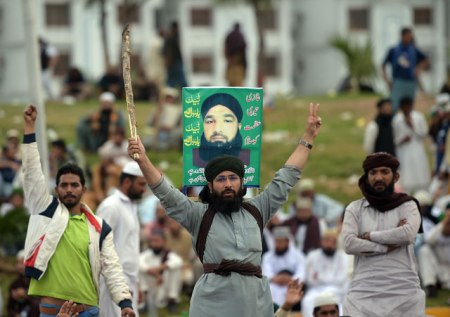
pakistan-mumtaz-qadri-supporters-1-aamir-qureshi-afp-getty-640Pakistani supporters of Mumtaz Qadri (Photo: © AAMIR QURESHI/AFP/Getty)

Baltimore-based Imam Ijaz Hussain, stated, “Mumtaz Qadri was not a terrorist and whoever says, “We are with you O Prophet” cannot be a terrorist.”

****************************

A mosque in Maryland held a celebration in honor of an Islamist assassin who killed a governor in Pakistan for speaking about against the country’s heinous blasphemy laws.

As reported by Rabwah Times, the Gulzar E. Madina Mosque in Pikesville, Maryland, hosted an Urs celebration, a traditional commemoration reserved for saints and holy people, for Mumtaz Qadri who killed the governor of Punjab province Salman Taseer in 2011.

Qadri was Taseer’s bodyguard and was incensed that Taseer called for the reform of Pakistan’s controversial blasphemy laws. Taseer had also expressed support for Asia Bibi, a Christian woman framed for blasphemy, arrested and sentenced to death in Pakistan.

Blasphemy laws in Pakistan, which carry the death penalty, are often used to exact revenge against Pakistan’s mistreated minority populations. Often, just the hint of a blasphemy accusation will spark mob violence resulting in death for the person charged.

After Qadri shot Taseer to death, he was lauded as a national hero.  More than 100,000 people attended his funeral and riots ensued for weeks after he was arrested, tried and hanged for his crime. He is viewed as a saint by a large sector of the population and a shrine is being built in Pakistan to memorialize him.

The Urs event at the Maryland mosque was advertised in the Urdu Times, the largest Urdu newspaper in the U.S. Rabwah Times reported a robust turnout, with participants including young children and teenagers.

The speakers included Syed Saad Ali, an Islamic scholar based in New Jersey, who chastised the crowd, saying:

“Warrior Mumtaz Qadri kissed the noose in love for Prophet Mohammed When Qadri was in jail for five years. What did we do? What effort did we make (for his release? Why did we not go where he was being held? Qadri did everything for us and for the love of Islam and we could not even stand by him? People say Islam teaches peace…..I say Islam teaches us ghairat (honor). Who will now stand up?

Ali also praised another killer, Tanveer Ahmad, a British-Pakistani man who stabbed to death Asad Shah, another British-Pakistani in Scotland. Shah, from the Ahmadi sect, made posts on social media that Ahmad deemed blasphemous.

Speaking about Ahmad, Ali said,

“Our warrior Tanveer, who is sitting in a jail in Scotland, I don’t know if someone knows or not, when that Mirzai (Ahmadi) spoke his ‘sacrilegious rubbish,’ he went there and stabbed him 27 times, and the police arrested him and right now he is in a jail in Scotland. So if we just take a step forward, angels will automatically come for our help. But what Mumtaz Qadri has done is something amazing, he has surpassed all these warriors.”

Another speaker, Baltimore-based Imam Ijaz Hussain, stated, “Mumtaz Qadri was not a terrorist and whoever says, “We are with you O Prophet” cannot be a terrorist.”

Hussain praised the American system of free speech, saying it allowed events such as these to be held:

“We have some freedoms here (in the U.S.) which we do not even have in other Muslim countries. This is the beauty of this country. There are some countries where we can’t even praise the prophet, we can’t celebrate the Day of Imam Hussain. This country has freedom of religion, and this is the beauty of this country.”

Sunni Muslims Storm Ahmadi Mosque On Prophet’s Birthday

December 13, 2016

Sunni Muslims Storm Ahmadi Mosque On Prophet’s Birthday, Clarion Project, Elliot Friedland, December 13, 2016

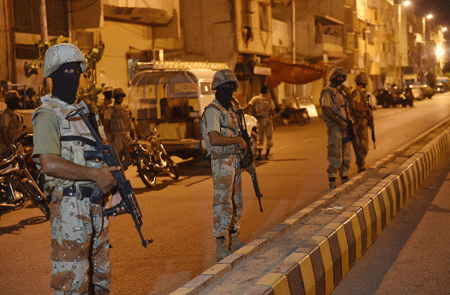
pakistan-rangers-copyright-rizwan-tabassum-afp-gettyimages-594355186-size-640-420Illustrative picture of Pakistani Rangers. (Photo: © Rizwan Tabassum/AFP/Getty Images)

The Ahmadis are regarded as heretical by mainstream strands of Islam, due to their belief that their founder, the 19th century preacher Mirza Ghulam Ahmad, is the second coming of Jesus Christ and a prophet. This is considered by orthodox Muslims as a direct violation of the foundational Islamic belief that Mohammed was the last of the prophets.

***************************

A procession of approximately 2,000 Sunni Muslims descended onto an Ahmadi mosque yesterday in Pakistan, firing weapons at worshippers and hurling bricks, reported Reuters. The attack took place in the Punjab province. The mob was able to wound several people before the police dispersed the crowd, which they had been unable to prevent from reaching and attacking the mosque.

“Police tried its best to stop the attackers but failed because of slim deployment,” Malik Nawaz, the highest ranking police officer in the Choa Saiden Shah area told Reuters. “Later, high officials reached the spot with more troops and chased out the occupants.”

A spokesman for the Ahmadi community, Amer Mahmood, told reporters the mob had been fired up by clerics who said the Ahjmadi community should not be allowed to worship on the prophet’s birthday.

The Ahmadis are regarded as heretical by mainstream strands of Islam, due to their belief that their founder, the 19th century preacher Mirza Ghulam Ahmad, is the second coming of Jesus Christ and a prophet. This is considered by orthodox Muslims as a direct violation of the foundational Islamic belief that Mohammed was the last of the prophets.

In 1974, this foundational belief was codified into Pakistani law and Ahamadis were prohibited from calling themselves Muslims. The Ahmadiyya dispute this and regard themselves as Muslims.

As a result of their beliefs, the Ahmadiyya are routinely persecuted in Pakistan.

Whether or not Ahmadis are authentically Muslim or are a heretical offshoot is completely irrelevant. Persecution and violence against a religious minority is unacceptable. Those who support freedom of religion for Muslims around the world must support the rights of Ahmadis to live in peace without persecution for their beliefs.

UK Home Office allows jihad preacher banned in Pakistan to preach in UK mosque (but even mosque bans him)

December 12, 2016

UK Home Office allows jihad preacher banned in Pakistan to preach in UK mosque (but even mosque bans him), Jihad Watch

Syed Muzaffar Shah Qadri preaching of hatred and jihad violence is so hardline that he is banned from preaching in Pakistan, but the UK Home Office paused from its banning of foes of jihad terror long enough to welcome into Britain. However, the negative publicity over this move was such that even the mosque that had planned to host him has now canceled, claiming that they are shocked! shocked! to learn that Qadri preaches intolerance, hatred, and violence.

This is the comic opera that is contemporary Britain: the Home Office is so bent on appeasing Islamic supremacists that it goes farther than even mosques in the country are willing to do.

syed-muzaffar-shah-qadri

“Mosque leaders dump plans to host controversial hate preacher exposed by Sunday Post,” by Gordon Blackstock, Sunday Post, December 11, 2016:

MOSQUE leaders have praised The Sunday Post for warning them they had booked a hate preacher so extreme he’s banned in Pakistan.

Last week we exclusively revealed that hardline cleric Syed Muzaffar Shah Qadri had been asked to speak at Falkirk Central Mosque.

The booking came despite the fact the preacher had been banned in his native Pakistan for his hardcore message.

The cleric has openly praised a murderer linked to the killing of Glasgow shopkeeper Asad Shah, 40, who was stabbed 27 times by killer Tanveer Ahmed, 32, after wishing customers a “Happy Easter”.

Now, the mosque has dumped any plans to host the controversial cleric – and thanked The Sunday Post for alerting them to the preacher’s background.

Mosque committee member Khalid Saeed is delighted the paper helped spare their blushes.

“The mosque would never knowingly give a platform to views that counter our beliefs of tolerance and non- violence,” he said.

“We would like to take this opportunity to thank The Sunday Post for raising this issue and would like to reiterate our community’s zero tolerance for hatred or violence of any kind.

“Following engagement with members and our own youth committee, Falkirk Central Mosque will ensure that progressive values are promoted and where possible will work with Police Scotland to ensure community safety.

“In addition, the mosque committee is reviewing its procedures when allowing an external booking to ensure this never happens again.”

Politicians praised the mosque for its stance. Scottish Conservative equalities spokeswoman Annie Wells said: “This is a welcome move.”

Concerns were raised about Syed Muzaffar Shah Qadri with British authorities before he arrived from Pakistan last month.

Sources claim a Home Office anti-terror line was tipped off about the cleric. However, The Home Office has refused to be drawn on the issue….