Archive for the ‘P5+1’ category

Obama still believes in a nuclear deal, although Iran is skittish – even against a military option

April 12, 2015

Obama still believes in a nuclear deal, although Iran is skittish – even against a military option, DEBKAfile, April 12, 2015
Ashton_Carter_4.15US Defense Secretary Ashton Carter:The nuclear option is on the table

In the last two days, the Obama administration has swung between conflicting signals on the Iranian nuclear deal. Unable to wave away the tough conditions laid down by Tehran, the US president was nonetheless optimistic about a final deal to curb Iran’s nuclear program in comments he made at the Americas summit in Panama Sunday, April 12. Obama said he was not surprised at the way supreme leader Ali Khamenei had characterized the framework agreement, because “Iran has it own politics and hardliners who need to be satisfied, but there may be ways to structure the final nuclear deal that achieve core objectives while satisfying Iran’s pride.”

Just Saturday, US Defense Secretary Ashton Carter said: “We have the capability to shut down, set back and destroy the Iranian nuclear program.” He referred to the Massive Ordinance Penetrator-MOP, aka the “bunker buster” which is capable of penetrating fortified facilities up to 200 feet underground. “My job is among other things to make sure that the so-called military option is on the table,” he said.

Iranian media headlines screamed: “US Secretary of Defense Ashton Carter has threatened Tehran with war.”

This is exactly what Khamenei was aiming for when on April 9, he laid down two implacable terms for a deal: the removal of sanctions on the day a final deal is signed and a firm refusal to allow international inspections of Iran’s military sites.

Both of these provisions contradicted Washington’s presentation of its core conditions for a comprehensive accord as being gradual sanctions relief and intrusive inspections.

One of Khamenei’s objects was indeed to remove all suspicion on his home front that Iran’s negotiators had given ground to the world powers either in the overt agreement or in any secret annexes.

The Iranian media headlines achieved this purpose.

But underlying the vocal exchanges between the two capitals is Iran’s confidence that President Obama has discarded the option of military force against its nuclear sites. This confidence gave Tehran the edge in round after round of diplomacy with the US and the world powers.

Senior negotiator Foreign Minister Javad Zarif boasted on April 7, that Iran was “capable of producing an atomic bomb at any given moment,” and was contained solely by “religious Islamic injunctions.”

His boast was amply illustrated by the 20,000 centrifuges Iran had built up during the years of negotiations, plus thousands of advanced machines standing by to further accelerate uranium enrichment – even though its stockpile of 3.6 percent had soared to 10 tons – enough to build 4-6 nuclear bombs.

This edge further enabled the Iranians to bring the Arak heavy water plant capable of producing plutonium to its final stages of construction, without encountering a prohibition in Lausanne, any more than the Fordo enrichment site, stealthily installed some years ago, or its ballistic missile program were sentenced to be dismantled.

That Iran would continue to get away with its tactic of talking while enriching was borne out by Obama assurance Sunday that ways would be found “to structure the final nuclear deal that achieve core objectives while satisfying Iran’s pride.”

The negotiating tactics pursued by Secretary of State John Kerry in Lausanne and in the previous round in Geneva not only diluted America’s military option but virtually took it off the table – not only for America but for everyone else, including Israel. To put it back, much more is needed than Ashton Carter’s reference to the bunker-buster. To make it credible, the United States must rebuild its military presence in the Gulf and the Middle East – bringing back two aircraft carriers to reinforce the lone USS Carl Vinson, for starters.

This, however, would contradict the doctrine Obama expounded on April 2 when he said: “When you hear the inevitable critics of the deal sound off, ask them a simple question: Do you really think that this verifiable deal, if fully implemented and backed by the world’s powers, is a worse option than the risk of another war in the Middle East?”

But he failed to explain the multiple versions of the Lausanne deal published in Washington, Tehran and latterly Paris, whose discrepancies can no longer be glossed over.

Speaking after his historic meeting with Cuba’s Raul Castro Sunday, Obama rebuked Republican senators for pointing this out, accusing them of “partisanship which has crossed all boundaries.”

Sen. John McCain shot back that discrepancies between US and Iranian versions of the deal extended to inspections, sanctions relief, and other key issues. ‘‘It is undeniable that the version of the nuclear agreement outlined by the Obama administration is far different from the one described by Iran’s supreme leader,’’ he said.

This exchange took place two days before members of the Senate Foreign Relations Committee plan to vote on Senator Bob Corker’s bipartisan Iran nuclear agreement review act. This would give members of Congress 60 days after a nuclear deal is reached to decide if they want to waive sanctions against Iran.

But most of all it calls into question the Obama administration’s presentation of a tentative set of disputed concepts reached in Lausanne as a finalized framework, which left just a few loose ends for resolving by the next deadline of June 30. The very real gaps have been highlighted and exploited by Tehran.

US tactics don’t work well in the Persian bazaar, where the carpet seller pretends to be unwilling to sell his merchandise to an interested customer, while putting the price up in round after round of haggling.

Khamenei falls naturally into the role of the reluctant carpet seller when he is confronted with an especially keen American customer.
US Admits N. Korea, Maybe Iran, Can Now Target it with EMP-Nukes

April 12, 2015

US Admits N. Korea, Maybe Iran, Can Now Target it with EMP-Nukes, Israel National News,Mark Langfan April 12, 2015

(Please see also, Why IS the US military moving back into ‘Stargate’ base deep under the Rocky Mountains a decade after it was abandoned? — DM)

Adm. Gortney revealed that America’s anti-missile missile shield is not only configured to repulse a North Korean missile, but an Iranian ICBM as well. The Admiral explained that the current assessment is that the threat of an ICBM EMP strike comes from North Korea and not from Iran, but that the system could handle both scenarios. “Our system is designed for North Korea, and if we get our assessment wrong, for Iran. Its [the US homeland missile shield] is designed to defend the nation [the homeland] against both those particular threats today,” he said.

US President Barack Obama is currently negotiating a deal with Iran that he himself has admitted would enable it to manufacture its own nuclear weapons, 12-13 years after it is signed.

*********************

In a blockbuster admission, Admiral Bill Gortney, Commander of North American Aerospace Defense Command (NORAD) and US Northern Command (USNORTHCOM) disclosed that the Pentagon now believes North Korea has mastered the ability to miniaturize its nuclear bombs so they can be fitted onto their latest mobile KN-08 intercontinental ballistic missiles (ICBMs), which are capable of reaching the continental United States.

At the news conference, Adm. Gortney flatly stated, Pyongyang has “the ability to put a nuclear weapon on a KN-08 and shoot it at the homeland [the continental United States].” He expressed confidence that the US could knock down such a missile if launched by North Korea or its ally, Iran.

He also admitted, however, that it is “very difficult” for the US to counter the threat, because its intelligence is unable to follow the mobile ICBMs and give an efficient warning before they are launched.


The admission was accompanied by the announcement that NORAD is reopening its nuclear-EMP-proof Cheyenne Mountain bunker,

The KN-08 is a road-capable, highly mobile ICBM, which can be hidden anywhere throughout the North Korea and could be fired on a short-countdown virtually undetectable by American intelligence. As Adm. Gortney further explained about the North’s KN-08 ICBM, “It’s the relocatable [highly-mobile, can go anywhere – ML] target set that really impedes our ability to find, fix, and finish the [KN-08] threat. And as the [KN-08] targets move around and if we don’t have a persistent stare [i.e., the ability to monitor its location at all times – ML] and persistent [intelligence, surveillance, and reconnaissance] that we do not have over North Korea at this time, that relocatable nature makes it very difficult for us to be able to counter it.”

Despite Adm. Gortney’s concerns, he still believes that if a KN-08 was fired at the US homeland, in the Admiral’s words – “Should one get airborne and come at us [the US homeland], I’m confident we would be able to knock it down.”

Even if this is true, it is not clear if the US ballistic defense could knock down an incoming North Korean ICBM in time, if the nuke is intended as an EMP weapon, which explodes soon after re-entering the atmosphere.

System can defend against Iran strike, too 

In another dramatic revelation, Adm. Gortney revealed that America’s anti-missile missile shield is not only configured to repulse a North Korean missile, but an Iranian ICBM as well. The Admiral explained that the current assessment is that the threat of an ICBM EMP strike comes from North Korea and not from Iran, but that the system could handle both scenarios. “Our system is designed for North Korea, and if we get our assessment wrong, for Iran. Its [the US homeland missile shield] is designed to defend the nation [the homeland] against both those particular threats today,” he said.

Experts have estimated that the KN-08 has a range of 5,600 miles and would be capable of hitting the US’s west coast if launched from North Korea. Experts also believe the missile is not accurate.

However, Adm. Gortney’s statement about North Korea’s nuke-capable KN-08 ICBM must be taken in the context of his simultaneous announcement of the Pentagon’s concern about an EMP-missile strikeon the United States homeland.

South Korean intelligence has long believed that North Korea has been developing an EMP-nuclear device. As early as June 2009, Kim Myong Chol, who was an “unofficial” spokesperson of the then-Supreme Leader Kim Jong-il, openly threatened use of a “high-altitude detonation of hydrogen bombs that would create a powerful electromagnetic pulse” bomb.” And, in November of 2013, South Korea’s intelligence service (NIS) issued a report to the South Korean parliament that North Korea had “purchased Russian electromagnetic pulse (EMP) weaponry to develop its own version” of a nuclear EMP device.

EMP strike on South Korea?

In 2005, then-USAF Major Colin Miller posited, in a public-domain US Air Force University thesis, that the North Koreans could tactically use a nuclear-EMP weapon on the Korean Peninsula to “level-the playing field” against the electronic dependent forces of the United States and South Korea.

The tactical North Korean EMP “decapitation” attack would likely bag as POWs the 40,000 living US marines now guarding South Koreabecause an EMP doesn’t kill human beings, only electronics.

A tactical nuclear-EMP aimed at South Korea would not need an ICBM to reach the 30-50 km level above the earth to explode. Rather, it would only need a much smaller short-range missile to achieve its suitable EMP-location above the Korean peninsula for an effective EMP detonation.

Given the degree of cooperation between the Islamic Republic of Iran and North Korea, it is highly likely that any nuclear-EMP-technology mastered by North Korea has already been shared with Iran. Therefore, the EMP-proliferation danger from North Korea to Iran is a catastrophic danger.

North Korea has been threatening a pre-emptive nuclear strike on the US for two years, as explained in this ABC News report from 2013. At the time of the report, North Korea was said to be “years away” from a developing a missile that could hit the US: These “years” have apparently passed.

And yet, inexplicably, US President Barack Obama is currently negotiating a deal with Iran that he himself has admitted would enable it to manufacture its own nuclear weapons, 12-13 years after it is signed.


US Sec. Defense on Iran nuclear facilities: Bunker buster bombs ‘ready to go’

April 11, 2015

US Sec. Defense on Iran nuclear facilities: Bunker buster bombs ‘ready to go’ Jerusalem Post, April 11, 2015

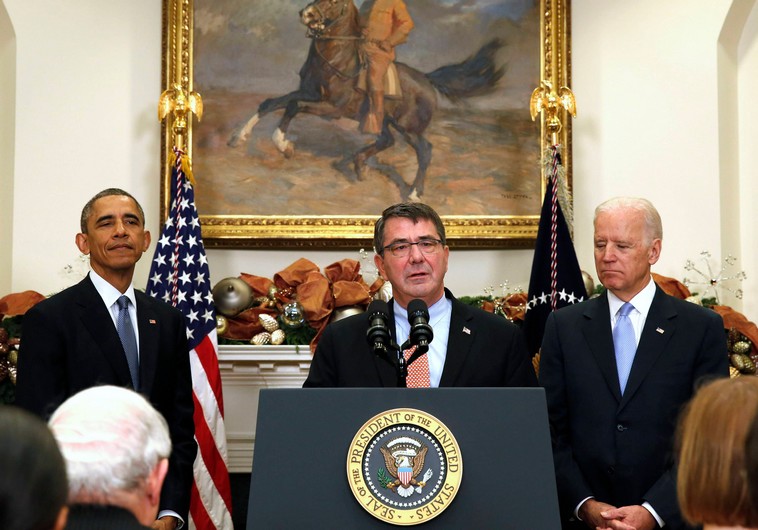
US SecdefAshton Carter (C), US President Barack Obama (L) and US Vice President Joseph Biden (R).. (photo credit:REUTERS)

US Secretary of Defense Ashton Carter addressed the possibility of a military option against Iran, saying that bunker busting bombs, meant to penetrate Iran’s underground facilities, are “ready to go.”

Speaking to CNN in an interview aired Saturday morning, Carter said that the deal between Iran and the P5+1, the basics of which were recently laid out in during negotiations in Switzerland, will hinge not on “trust but rather on “verification.”

“We have the capability to shut down, set back and destroy the Iranian nuclear program and I believe the Iranians know that and understand that,” Carter said, indicating the US’s willingness to utilize high-powered bombs if Tehran does not abide by the deal reached in the Swiss resort town where the various delegations were hosted during the eight day marathon negotiations.

The reference to the Massive Ordinance Penetrator, or MOPS, whose reach extends 200 feet below ground, is the first that any American figure has made concerning substantive military planning against the Islamic Republic’s fortified subterranean facilities.

One such facility is Fordow, near the city of Qom, where Iran maintains a facility dedicated to producing 20% enriched medium-grade uranium. Tehran insists that this would only be used for civilian purposes, a claim that has failed to assuage fears that it could then be further enriched to 90%, the necessary amount needed to produce weaponized material.

While he voiced a more hawkish tone than the White House, Carter echoed Washington’s preference for a diplomatic solution, explaining that negotiations would actually be a more long-lasting method of ensuring a nuclear-bomb free Iran since “military action is reversible overtime.”

Asked about another key factor affecting US interests int the Middle East, namely the White Houses’ willingness to deploy ground troops against the Islamic State group in Iraq and Syria, Carter suggested that the administration has not yet reached that conclusion, but that he “would not hesitate to give that advice.”

The Fable of the Bees

April 10, 2015

The Fable of the Bees, Washington Free Beacon, April 10, 2015

(Please see also, 28 Times Obama Said He’d Prevent Iran from Getting a Nuclear Weapon | SUPERcuts! #184 — DM)

Barack Obama,

Complacency is an understandable response to peace and security. Some problems do go away if you leave them alone. But the world is not the Rose Garden, and the consequences of nuclear attack or nuclear war would be far worse than bug bites. Sometimes it’s right to worry, it’s right to be afraid, it’s right to have the flyswatter nearby. The hornets will strike, and when they do it will be more painful if we have let our guard down.

*********************

A beautiful day: warm, sunny. A garden in bloom filled with the laughter of children. Frolic beneath the whitewashed façade of a stately and classic old house. A friendly man in dress shirt and trousers reads aloud. Then: screams.

The young ones listening to the man are terrified. Bees have been spotted. The kids are afraid. The man, a father of two, projects calm. He pauses from his book—Where the Wild Things Are—and says, “It’s okay guys. Bees are good. They won’t land on you. They won’t sting you. They’ll be okay.”

Doesn’t work. The bees are buzzing, menacing. A few of the kids cry out. The man changes his strategy. He admonishes the children. “Hold on, hold on, you guys are wild things,” he says. “You’re not supposed to be afraid of bees.” Laughter from parents, normalcy restored. The man resumes his tale.

An amusing interruption of an otherwise placid White House Easter Egg Roll? Undoubtedly. But some in the press said more was going on, that this encounter between the innocents, President Obama, and the swarm held a more profound significance.

“‘Bees are good,’ Obama says as children scream,” read the Politico headline. “Perhaps no president in history has made a stronger case for protecting pollinators than Barack Obama,” wrote the Washington Post. “Obama trying to reassure children about bees is a perfect metaphor for his foreign policy,” pronounced a writer for Vox.com, who most recently confused New Hampshire with Vermont.

I say Vox.com is right. “Bees won’t sting you” is an apt slogan for Obama’s attitude toward the world. But I say too that his attitude is patronizing, unrealistic, dangerous. Bees do sting. And kill. And the real wasps of the world, the terrorists and criminals and psychopaths and autocrats, with their knives and box-cutters and bombs and guns and tanks and missiles and rockets and ICBMS—they sting, they hurt, they kill even more. They won’t be “okay.”

“If you stay calm and more or less ignore the bee,” writes Vox.com, “the odds are that things will be fine.” Sure, someone one day will be hurt, even die. “But panicking at every bee sighting would be counterproductive.” In the real world of states and ideologies and nuclear proliferation, “America’s superpower status should make us willing to embark on new diplomatic initiatives and avoid counterproductive panics over minor issues.”

We have here all of the components of the liberal mindset: the threat deflation, the technocratic elitism, the preoccupation with the behavior of the stronger party vis-à-vis the weaker one, the depersonalization of non-Western actors, whose ideas and motives and ambitions and emotions are justified or ignored or explained away.

Bees aren’t dangerous and, Obama says, “Iran understands that they cannot fight us.” John Kerry tells Congress, “We are actually living in a period of less daily threat to Americans and to people in the world,” as a Caliphate is proclaimed in Mesopotamia, as Russia threatens nuclear war, devours Ukraine, and buzzes NATO allies, as jihadist attacks spread, as China builds a system of artificial islandsto expand its regional power.

Worried? Settle down. You’re being irrational, inflating threats, acting out like a spoiled and ignorant brat. Liberals know better. We have this situation under control. Leave it to us—and do not, if you are a member of Congress, try to interfere. It’s America that must not panic but exercise restraint, to bind itself in a thousand petty contracts and agreements, in corrupt institutions, to guarantee that we don’t act rashly, aggressively, or alone.

What most concerns liberals is not the barbarism of our enemies but our conduct toward them. Not the habits of the bee but the decorum of the children. For who can control bees? They behave instinctively. And who can influence Putin? He’s encircled, stuck in the last century. The Iranians? We burned them pretty badly with that whole Mossadegh thing. Terrorism? We can pursue the terrorists, for sure, and we can apprehend them or kill them. They’re not warriors but criminals, and the grievances and furies that drive them can’t be suppressed through force alone. They have to burn themselves out.

Comforting thoughts. And especially attractive to Americans, who are protected by two great oceans, who exist in an unacknowledged confederation with our northern neighbor and whose biggest challenge with the citizens of our southern one is that they all seem to want to move here. Insanely rich, we are anxious over having too much to eat, over the consequences of increasing longevity. We Democrats prefer commerce to conflict, domestic affairs to international ones. We can afford not to panic. Or so it seems.

But try telling an Israeli that bees won’t sting. A Syrian. A Kurd. A Ukrainian. A Nigerian, or a Kenyan. You most likely will be laughed at. Revealed as naïve. Explain to the Saudis and Jordanians and Egyptians, to the Poles and Lithuanians, to the Japanese and South Koreans that America is engaging with rogue regimes because to respond to them in the traditional postwar manner would be “counterproductive.” Our allies will laugh.

Complacency is an understandable response to peace and security. Some problems do go away if you leave them alone. But the world is not the Rose Garden, and the consequences of nuclear attack or nuclear war would be far worse than bug bites. Sometimes it’s right to worry, it’s right to be afraid, it’s right to have the flyswatter nearby. The hornets will strike, and when they do it will be more painful if we have let our guard down.

In which case there will be only one option.

Call pest control.

28 Times Obama Said He’d Prevent Iran from Getting a Nuclear Weapon | SUPERcuts! #184

April 10, 2015

28 Times Obama Said He’d Prevent Iran from Getting a Nuclear Weapon | SUPERcuts! #184, via You Tube, April 9, 2015


Cartoon of the day

April 10, 2015

Via You Viewed Editorial, April 10, 2015

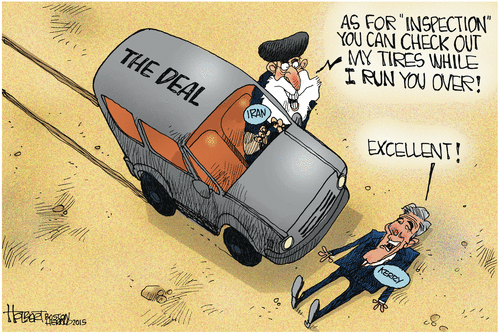
Iran inspections

There is no better deal with Iran

April 9, 2015

There is no better deal with Iran, Israel Hayom, Prof. Efraim Inbar, April 9, 2015

If inspections, sanctions, sabotage and political isolation ever had a chance to stop Iran from getting the bomb (this was always a dicey proposition), that certainly is no longer the case. It is more evident than ever that only military action can stop a determined state such as the Islamic Republic of Iran from building a nuclear bomb. It remains to be seen whether Israel has elected the leader to live up to this historic challenge.

***********************

The debate over the pros and cons of the Iran nuclear framework agreement negotiated between the P5+1 and Iran at Lausanne (April 2, 2015) is simply irrelevant. The search for truth in the conflicting versions about the details of the deal coming out of Washington and Tehran is of no consequence. And the steps suggested by Israel and other critics to improve the efficacy of the deal (by more stringent inspections and so on) will not change much. The deal is basically dangerous in nature, and needs to be rejected outright.

The deal permits Iran to preserve stockpiles of enriched uranium, to continue to enrich uranium, and to maintain illegally-built facilities at Fordow and Arak. Even in the absence of a signed full agreement, the U.S. and its negotiating partners already have awarded legitimacy to Iran’s nuclear threshold status. In all likelihood, the United States, quite desperate to get a formal deal, will make additional concessions in order to have a signed formal deal — which won’t be worth the paper on which it is printed.

This outcome has been a foregone conclusion since November 2013, when the U.S. agreed to the “Joint Plan of Action” on Iran’s nuclear program. Already back then, the U.S. decided not to insist any longer on the goal of rolling back the Iranian nuclear program, ignoring several U.N. Security Council resolutions demanding no uranium enrichment, as well as discarding the security concerns of American allies in the Middle East (primarily Israel, Saudi Arabia and Egypt — who better understand the regional realities).

Middle Easterners clearly discern an Iranian diplomatic victory in this accord, which should not surprise anybody. Iranians are much more adept at negotiating than Americans. Iran is getting more or less what it wanted: the capability to produce enriched uranium and to research weapon design; agreement to keep its missile program intact; and no linkages to Iranian behavior in the region. The deal is a prelude to nuclear breakout and Iranian regional hegemony.

Indeed, with no attempt to roll back the Iranian nuclear program, as was done in Libya, we are progressing toward the North Korean model. Those two are the only options in dealing with nuclear programs of determined states such as Iran. Iran’s nuclear program benefited in many ways from assistance that originated in Pakistan and in North Korea (both are nuclear proliferators despite American opposition). Compare the recent statements by President Obama to the speeches of President Clinton justifying the agreement with North Korea (October 1994). Their similarities are amazing; an indication of the incredible capacity of great powers for self-delusion.

What counts is not the Obama’s administration expression of satisfaction with the prospective deal, but the perceptions of Middle East actors. For example, Saudi Arabia and Egypt have deplored the fact that the U.S. is bestowing international legitimacy on Iran’s status as a nuclear threshold state. They probably believe the interpretations of the deal offered by Tehran more than those professed in Washington. Therefore, they will do their best to build a similar infrastructure leading inevitably to nuclear proliferation in the region — a strategic nightmare for everybody.

Unfortunately, no better deal is in the offing. Whatever revisions are introduced cannot change its basic nature. The accord allows Iran to have fissionable material that can be enriched to weapons grade material in a short time and Tehran can always deny access to inspectors any time it chooses. This is the essence of the North Korean precedent.

Obama is right that the only alternative to this deal is an Iranian nuclear fait accompli or the bombing of the Iranian nuclear infrastructure. Obama’s penchant for engagement, his reluctance to use force, and his liberal prism on international relations (which adds rosy colors to international agreements) has led to this miserable result.

Netanyahu is wrong in demanding a better deal because no such deal exists. Yet denying its ratification by the U.S. Congress could create better international circumstances for an Israeli military strike. In fact, criticism of Obama’s deal with Iran fulfills only one main function — to legitimize future military action. Indeed, Netanyahu is the only leader concerned enough about the consequences of a bad deal with the guts and the military capability to order a strike on the Iranian key nuclear installations.

If inspections, sanctions, sabotage and political isolation ever had a chance to stop Iran from getting the bomb (this was always a dicey proposition), that certainly is no longer the case. It is more evident than ever that only military action can stop a determined state such as the Islamic Republic of Iran from building a nuclear bomb. It remains to be seen whether Israel has elected the leader to live up to this historic challenge.

Ayatollah Khamenei Outlines Requirements of Final Iran Nuclear Deal

April 9, 2015

Ayatollah Khamenei Outlines Requirements of Final Iran Nuclear Deal, Tasnim News Agency (Iranian), April 9, 2015

(All bold face print is from the original. — DM)

139401201524404185070453

TEHRAN (Tasnim) – Supreme Leader of the Islamic Revolution Ayatollah Seyed Ali Khamenei on Thursday defined the main points that a final nuclear deal between Iran and world powers should involve, but refused to adopt a stance on the Lausanne statement that entails no binding commitment.

Addressing a gathering in Tehran on Thursday, Ayatollah Khamenei said he has not taken a position on a statement released by Iran and the Group 5+1 (Russia, China, the US, Britain, France and Germany) after the most recent round of nuclear talks in the Swiss city of Lausanne, because nothing has been still agreed upon, nor have the parties reached any binding agreement.

“What has happened so far does not guarantee either the principle of an agreement, or the negotiations that lead to an agreement or even the content of an agreement, and it does not even guarantee that these talks would result in a deal, so congratulation has no meaning,” the Leader said.

The comments came after Iran and the six powers on April 2 reached a framework nuclear agreement after more than a week of intensive negotiations in Lausanne, Switzerland, with both sides committed to push for a final, comprehensive accord until the end of June.

Ayatollah Khamenei then reaffirmed strong support for a deal that respects the Iranian nation’s dignity, and rejected as “untrue” the reports on his opposition to any agreement.

The Leader, however, underlined that “no deal is better than a bad deal.”

Imam Khamenei then explained that he has only outlined the “general issues, the main guidelines, frameworks and red lines” regarding the nuclear talks and has not specified the details.

“I am not indifferent to the negotiations, but have not interfered in the details of the talks so far, and will not interfere in future either,” the Leader stressed.

The Supreme Leader then pointed to the unreliable nature of the US, an obvious sign of which he said was a biased fact sheet that Washington issued only two hours after the Lausanne statement was declared.

“Drafting such a statement (fact sheet) within two hours is not possible, so they (Americans) had been busy preparing a flawed and wrong statement contrary to the content of the talks at the same time that they were negotiating with us.”

The Leader further called on the country’s negotiators to hold consultations with the critics of the Lausanne statement to better deal with the talks, something known as “rapport” among Iranians.

Imam Khamenei once again made it clear that the talks with the US revolve only around the nuclear issue and nothing else, but at the same time noted that such nuclear negotiations provide an experience to test the possibility of talking on other subjects if Washington puts aside objections.

But, the Leader added, if the US keeps raising objections, Iran’s experience of mistrust of the US will be corroborated.

Commenting on the main points that have to be stipulated in a possible final nuclear deal, Ayatollah Khamenei pointed to the removal of anti-Iran sanctions all at once, adding, “This issue is very important and the sanctions should be completely terminated at the very day of the agreement.”

“If the removal of sanctions is to be conditioned by a new process, the fundamental of negotiations will be nonsense, because the purpose of the talks is lifting of the sanctions,” the Leader said.

The Supreme Leader also categorically rejected foreign access to the country’s “security and defensive” sectors under the pretext of nuclear monitoring.

Imam Khamenei said Iran’s military capabilities must be upheld and strengthened day by day, stressing that Iran’s backing for its “brothers” in the resistance front in different regions should never be diminished.

Moreover, the Leader voiced opposition to any deal that subjects Iran to “unconventional” monitoring and would make it a special case in the world, underlining that monitoring of Iran’s peaceful nuclear program should be conventional, like the other countries.

Iran’s “scientific and technical developments in different dimensions” was another requirement that the Leader emphasized a deal must include.

Ayatollah Khamenei finally said the responsibility lies with the country’s negotiators to fulfill those necessary demands in the talks, calling on them to “find the correct ways of negotiations” by using the view points of the informed and reliable individuals and listening to the critics.

Take Them At Their Word: Iran Might Destroy Us | Bill Whittle

April 9, 2015

Take Them At Their Word: Iran Might Destroy Us | Bill Whittle via You Tube, April 9, 2015


Humor?| Obama to Israel: I have your back

April 8, 2015

(The views expressed in this article are either mine or those of my guest author. They do not necessarily reflect those of Warsclerotic or its other editors. — DM)

The Most Revereddd Mohamed Allah-scimitar

The Most Revereddd Mohamed Allah-scimitar

This is a post by my (imaginary) guest author, the Most Reverend Mohamed Allah-scimitar, President Obama’s chief foreign policy adviser on Islamic relations with Christians and Jews. But first, some related observations:

Iran continues to reject as lies Obama’s statements about the April 2nd P5+1 nuke “deal,” and states that it “could build bomb today” but won’t because of Ayatollah Khamenei’s (non-existent) fatwa. Understandably, Israel is becoming increasingly concerned about her future existence. Obama’s claims that He has her back and that she therefore need not worry about anyone (else) who tries to “mess with Israel.” His assurances have provided scant comfort.

Cartoon_Israel_BB_KnifeInBack

Here’s are the comforting(?) words of the Most Reverend Mohamed Allah-scimitar.

***********************

Lord Obama has Israel’s back almost to the same extent that He has the Obama Nation’s back and will protect her if necessary. For Israel to maintain, and even improve, her weapons minimizing destruction (WMDs) is an unacceptable insult to Him and to all for which He stands.

ObamaWillStandWithMuslims (2)

Obama salute

During Israel’s “Protective Edge” war against peaceful Palestinians in Gaza, Israel shamelessly shifted the odds disproportionately in her own favor by using the Iron Dome to thwart efforts to destroy her major cities. She provided not even one Iron Dome to the Palestinians! Since that time, she has improved the Iron Dome and developed other WMDs less dependent upon lengthy trajectory tracking of missiles and perhaps even mortar rounds. Racist to the core, she has no regard for social justice, equality and the sad plight she has imposed on the Palestinians. Indeed, they are forced to rely on funds (“tens of millions of dollars”) from Iran to help rebuild Tunnels for Peace (TFP) and resupply their stocks of Missiles for Peace (MFP).

Now that Israel claims that peaceful Iranian nuclear weapons are an existential threat, she is doubtless looking for — and probably finding — ways to escape their consequences as well. Doing so is risible because Lord Obama has explained patiently — even as He would to a backward child — that it is unnecessary. He has her back, as He always had and always will.

Nobody except Obama had dare mess with Israel! Not even Netanyahu! Hence, there is no need for Iran to recognize Israel’s speciously claimed right to continue to exist, which would require fundamental changes in Iran. For Israel to insist on it is a fundamental misjudgment.

Lord Obama is able and willing to act, if necessary, to demonstrate the firmness of His resolve. Indeed, it has already been rumored that He may dispatch His own beloved mother in law from her happy home in the White House to live with Prime Minister Netanyahu in Occupied Palestine. If so, she will be accompanied by a suitable contingent of unarmed Organizing for Action volunteers. Recognizing, however, that more may be required, Lord Obama has been negotiating with Iran to provide the unjustly impoverished Palestinians not only free electrical power but also medically useful radioactive isotopes as well as others for other peaceful purposes. Despite the petty squabbles between the Palestinian Authority and Hamas, Iran will treat them equally.

Israel should and will cease to exist but, with Lord Obama in the picture, Iran should not be a concern.

**************************

There is no P5+1 “deal” and it seems unlikely that there ever will be, no matter how many contortions Obama and Kerry attempt. A deal like the one described in Obama’s talking points would be bad enough. However, Iran has rejected His talking points, has stated that it could build nukes now if it so desired and that the only impediment is a (non-existent) fatwa issued by the Supreme Leader. The Iranian foreign minister has been quoted as saying that

Iran will begin using its latest generation IR-8 centrifuges as soon as its nuclear deal with the world powers goes into effect, Iran’s foreign minister and nuclear chief told members of parliament on Tuesday, according to Iran’s semi-official FARS news agency. [Emphasis added.]

If accurate, the report makes a mockery of the world powers’ much-hailed framework agreement with Iran, since such a move clearly breaches the US-published terms of the deal, and would dramatically accelerate Iran’s potential progress to the bomb.

Iran’s military sites are, of course, off limits to inspections according to Iran’s Defense Minister. Meanwhile, the Supreme Leader continues to lead “death to America” chants and Iranian television continues to entertain its viewers with simulations of nuclear attacks on Israel.


More recently,

[T]he Islamic Republic has announced a new documentary film which will celebrate the life of Qods Force Commander Qassem Soleimani. It’s bad enough lionizing a master terrorist responsible for the deaths of hundreds of Americans in Iraq and Afghanistan. But the description of the film is even more telling: The film Commander will depict Iran’s and Soleimani’s strategic approach to destroy not only the Islamic State but also “the Zionist regime.” Importantly, the article describing the film was published after agreement on a nuclear framework between the P5+1 and Iran. [Emphasis added.]