Archive for the ‘Obama’s motivations’ category

Column One: Obama’s enemies list

August 6, 2015

Column One: Obama’s enemies list, Jerusalem Post, Caroline Glick, August 6, 2015
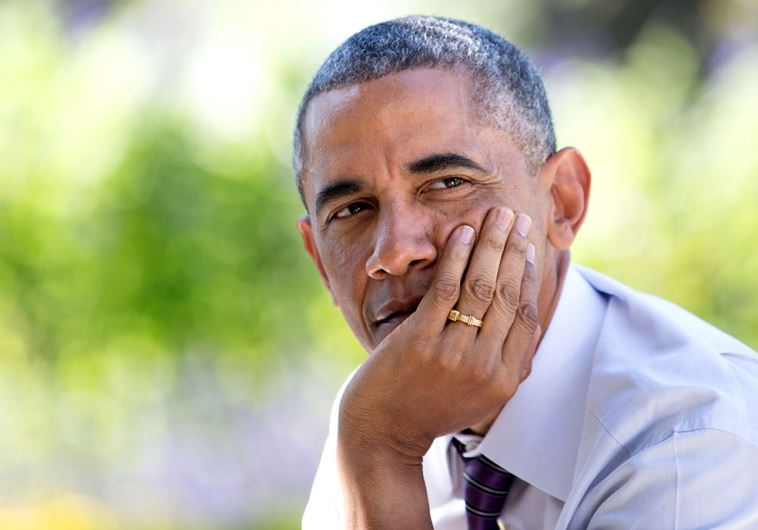
ShowImage (8)US President Barack Obama at the Rose Garden of the White House. (photo credit:OFFICIAL WHITE HOUSE PHOTO / PETE SOUZA)

[T]he real question lawmakers need to ask is whether the deal is good for America. Is Obama right or wrong that only partisan zealots and disloyal Zionists could oppose his great diplomatic achievement? To determine the answer to that question, you need to do is ask another one. Does his deal make America safer or less safe? The best way to answer that question is to consider all the ways Iran threatens America today, and ask whether the agreement has no impact on those threats, or whether it mitigates or aggravates them.

***********************

In President Barack Obama’s defense of his nuclear deal with Iran Wednesday, he said there are only two types of people who will oppose his deal – Republican partisans and Israel- firsters – that is, traitors.

At American University, Obama castigated Republican lawmakers as the moral equivalent of Iranian jihadists saying, “Those [Iranian] hard-liners chanting ‘Death to America’ who have been most opposed to the deal… are making common cause with the Republican Caucus.”

He then turned his attention to Israel.

Obama explained that whether or not you believe the deal endangers Israel boils down to whom you trust more – him or Prime Minister Benjamin Netanyahu. And, he explained, he can be trusted to protect Israel better than Netanyahu can because “[I] have been a stalwart friend of Israel throughout my career.”

The truth is that it shouldn’t much matter to US lawmakers whether Obama or Netanyahu has it right about Israel. Israel isn’t a party to the deal and isn’t bound by it. If Israel decides it needs to act on its own, it will.

The US, on the other side, will be bound by the deal if Congress fails to kill it next month.

So the real question lawmakers need to ask is whether the deal is good for America. Is Obama right or wrong that only partisan zealots and disloyal Zionists could oppose his great diplomatic achievement? To determine the answer to that question, you need to do is ask another one. Does his deal make America safer or less safe? The best way to answer that question is to consider all the ways Iran threatens America today, and ask whether the agreement has no impact on those threats, or whether it mitigates or aggravates them.

Today Iran is harming America directly in multiple ways.

The most graphic way Iran is harming America today is by holding four Americans hostage. Iran’s decision not to release them over the course of negotiations indicates that at a minimum, the deal hasn’t helped them.

It doesn’t take much consideration to recognize that the hostages in Iran are much worse off today than they were before Obama concluded the deal on July 14.

The US had much more leverage to force the Iranians to release the hostages before it signed the deal than it does now. Now, not only do the Iranians have no reason to release the hostages, they have every reason to take more hostages.

Then there is Iranian-sponsored terrorism against the US.

In 2011, the FBI foiled an Iranian plot to murder the Saudi ambassador in Washington and bomb the Saudi and Israeli embassies in the US capital.

One of the terrorists set to participate in the attack allegedly penetrated US territory through the Mexican border.

The terrorist threat to the US emanating from Iran’s terrorist infrastructure in Latin America will rise steeply as a consequence of the nuclear deal.

As The Wall Street Journal’s Mary Anastasia O’Grady wrote last month, the sanctions relief the deal provides to Iran will enable it to massively expand its already formidable operations in the US’s backyard. Over the past two decades, Iran and Hezbollah have built up major presences in Cuba, Venezuela, Nicaragua, Ecuador and Bolivia.

Iran’s presence in Latin America also constitutes a strategic threat to US national security. Today Iran can use its bases of operations in Latin America to launch an electromagnetic pulse attack on the US from a ballistic missile, a satellite or even a merchant ship.

The US military is taking active steps to survive such an attack, which would destroy the US’s power grid. Among other things, it is returning the North American Aerospace Defense Command (NORAD) to its former home in Cheyenne Mountain outside Colorado Springs.

But Obama has ignored the findings of the congressional EMP Commission and has failed to harden the US electronic grid to protect it from such attacks.

The economic and human devastation that would be caused by the destruction of the US electric grid is almost inconceivable. And now with the cash infusion that will come Iran’s way from Obama’s nuclear deal, it will be free to expand on its EMP capabilities in profound ways.

Through its naval aggression in the Strait of Hormuz Iran threatens the global economy. While the US was negotiating the nuclear deal with Iran, the Revolutionary Guards unlawfully interdicted – that is hijacked – the Marshall Islands-flagged Maersk Tigris and held its crew hostage for weeks.

Iran’s assault on the Tigris came just days after the US-flagged Maersk Kensington was surrounded and followed by Revolutionary Guards ships until it fled the strait.

A rational take-home message the Iranians can draw from the nuclear deal is that piracy pays.

Their naval aggression in the Strait of Hormuz was not met by American military force, but by American strategic collapse at Vienna.

This is doubly true when America’s listless response to Iran’s plan to use its Houthi proxy’s takeover of Yemen to control the Bab el-Mandab strait is taken into consideration. With the Bab el-Mandab, Iran will control all maritime traffic from the Persian Gulf and the Red Sea. Rather than confront this clear and present danger to the global economy, America abandoned all its redlines in the nuclear talks.

Then there is Iran’s partnership 20-year partnership with al-Qaida.

The 9/11 Commission found in its report that four of the 9/11 terrorists transited Iran before traveling to the US. As former Defense Intelligence Agency director Lt.-Gen. (ret.) Mike Flynn told Fox News in the spring, Iranian cooperation with al-Qaida remains deep and strategic.

When the US Navy SEALs killed Osama bin Laden in 2011, they seized hard drives containing more than a million documents related to al-Qaida operations. All but a few dozen remain classified.

According to Flynn and other US intelligence officials who spoke to The Weekly Standard, the documents expose Iran’s vast collaboration with al-Qaida.

The agreement Obama concluded with the mullahs gives a tailwind to Iran. Iran’s empowerment will undoubtedly be used to expand its use of al-Qaida terrorists as proxies in their joint war against the US.

Then there is Iran’s ballistic missile program.

The UN Security Council resolution passed two weeks ago cancels the UN-imposed embargoes on conventional arms and ballistic missile acquisitions by Iran. Since the nuclear deal facilities Iranian development of advanced nuclear technologies that will enable the mullahs to build nuclear weapons freely when the deal expires, the Security Council resolution means that by the time the deal expires, Iran will have the nuclear warheads and the intercontinental ballistic missiles required to carry out a nuclear attack on the US.

Obama said Wednesday that if Congress votes down his nuclear deal, “we will lose… America’s credibility as a leader of diplomacy. America’s credibility,” he explained, “is the anchor of the international system.”

Unfortunately, Obama got it backwards. It is the deal that destroys America’s credibility and so upends the international system which has rested on that credibility for the past 70 years.

The White House’s dangerous suppression of seized al-Qaida-Iran documents, like its listless response to Iran’s maritime aggression, its indifference to Iran’s massive presence in Latin America, its lackluster response to Iran’s terrorist activities in Latin America, and its belittlement of the importance of the regime’s stated goal to destroy America – not to mention its complete collapse on all its previous redlines over the course of the negotiations – are all signs of the disastrous toll the nuclear deal has already taken on America’s credibility, and indeed on US national security.

To defend a policy that empowers Iran, the administration has no choice but to serve as Iran’s agent. The deal destroys America’s credibility in fighting terrorism. By legitimizing and enriching the most prolific state sponsor of terrorism, the US has made a mockery of its claimed commitment to the fight.

The deal destroys the US’s credibility as an ally.

By serving as apologists for its worst enemy, the US has shown its allies that they cannot trust American security guarantees. How can Israel or Saudi Arabia trust America to defend them when it is endangering itself? The deal destroys 70 years of US nonproliferation efforts. By enabling Iran to become a nuclear power, the US has made a mockery of the very notion of nonproliferation and caused a nuclear arms race in the Middle East.

The damage caused by the deal is already being felt. For instance, Europe, Russia and China are already beating a path to the ayatollahs’ doorstep to sign commercial and military deals with the regime.

But if Congress defeats the deal, it can mitigate the damage. By killing the deal, Congress will demonstrate that the American people are not ready to go down in defeat. They can show that the US remains committed to its own defense and the rebuilding of its strategic credibility worldwide.

In his meeting with Jewish leaders Tuesday, Obama acknowledged that his claim – repeated yet again Wednesday – that the only alternative to the deal is war, is a lie.

Speaking to reporters after the meeting, Greg Rosenbaum, chairman of the National Democratic Jewish Council, which is allied with the White House, said that Obama rejected the notion that war will break out if Congress rejects the deal with veto-overriding majorities in both houses.

According to Rosenbaum, Obama claimed that if Congress rejects his nuclear deal, eventually the US will have to carry out air strikes against Iran’s nuclear facilities in order to prevent them from enriching uranium to weapons-grade levels.

“But,” he quoted Obama as saying, “the result of such a strike won’t be war with Iran.”

Rather, Obama said, Iran will respond to a US strike primarily by ratcheting up its terrorist attacks against Israel.

“I can assure,” Obama told the Jewish leaders, “that Israel will bear the brunt of the asymmetrical responses that Iran will have to a military strike on its nuclear facilities.”

What is notable here is that despite the fact that it will pay the heaviest price for a congressional defeat of the Iran deal, Israel is united in its opposition to the deal. This speaks volume about the gravity with which the Israeli public views the threats the agreement unleashed.

But again, Israel is not the only country that is imperiled by the nuclear deal. And Israelis are not the only ones who need to worry.

Obama wishes to convince the public that the deal’s opponents are either partisan extremists or traitors who care about Israel more than they care about America. But neither claim is true. The main reason Americans should oppose the deal is that it endangers America. And as a consequence, Americans who oppose the deal are neither partisans nor turncoats.

They are patriots.

Obama’s Strategy Of Equilibrium

August 6, 2015

Obama’s Strategy Of Equilibrium, Middle East Media Research Institute, Yigal Carmon and Alberto M. Fernandez, August 5, 2015

(The conflict between Shiite and Sunni factions has been going on since shortly after the death of Mohamed. Obama is not likely to bring reconciliation. — DM)

This article will analyze the strategy of creating an equilibrium between Sunnis and Shiites as a means to promote peace in the Middle East. It will examine the meaning of the strategy in political terms, how realistic it is, and what its future implications might be on the region and on the United States.

“It is worth noting that the first Islamic State created in the Middle East in the last 50 years was not the one created in the Sunni world in 2014 and headed by Abu Bakr al-Baghdadi.” Rather, it was the Islamic Republic of Iran created in 1979 by Ayatollah Ruhollah Khomeini and currently ruled by his successor, Supreme Leader Ali Khamenei, who maintains – even following the Iran deal – the mantra “Death to America,” continues to sponsor terrorism worldwide, and commits horrific human rights violations.

********************

Introduction

In an interview with Thomas Friedman of The New York Times (“Obama Makes His Case on Iran Nuclear Deal,” July 14, 2015), President Obama asked that the nuclear deal with Iran be judged only by how successfully it prevents Iran from attaining a nuclear bomb, not on “whether it is changing the regime inside of Iran” or “whether we are solving every problem that can be traced back to Iran.” However, in many interviews he has given over the last few years, he has revealed a strategy and a plan that far exceed the Iran deal: a strategy which aims to create an equilibrium between Sunnis and Shiites in the Muslim world.

President Obama believes that such an equilibrium will result in a more peaceful Middle East in which tensions between regional powers are reduced to mere competition. As he told David Remnick in an interview with The New Yorker, “…if we were able to get Iran to operate in a responsible fashion…you could see an equilibrium developing between Sunni, or predominantly Sunni, Gulf states and Iran in which there’s competition, perhaps suspicion, but not an active or proxy warfare” (“Going the Distance,” January 27, 2014).

In discussing the Iran deal, the President recalled President Nixon negotiating with China and President Reagan negotiating with the Soviet Union in order to explain the scope of his strategy for the Middle East and the Muslim world. President Obama seeks, as did Presidents Reagan and Nixon with China and the Soviet Union, to impact the region as a whole. The Iran deal, even if major, is just one of several vehicles that would help achieve this goal.

This article will analyze the strategy of creating an equilibrium between Sunnis and Shiites as a means to promote peace in the Middle East. It will examine the meaning of the strategy in political terms, how realistic it is, and what its future implications might be on the region and on the United States.

The Meaning Of The Equilibrium Strategy In Political Terms

Examining the strategy of equilibrium requires the recollection of some basic information. Within Islam’s approximately 1.6 billion believers, the absolute majority – about 90% – is Sunni, while Shiites constitute only about 10%.  Even in the Middle East, Sunnis are a large majority.

What does the word “equilibrium” mean in political terms? In view of the above stated data, the word “equilibrium” in actual political terms means empowering the minority and thereby weakening the majority in order to progress toward the stated goal. However, the overwhelming discrepancy in numbers makes it impossible to reach an equilibrium between the two camps. Therefore, it would be unrealistic to believe that the majority would accept a policy that empowers its adversary and weakens its own historically superior status.

Implications For The Region

Considering the above, the implications of the equilibrium strategy for the region might not be enhancing peace as the President well intends; rather, it might intensify strife and violence in the region. The empowered minority might be persuaded to increase its expansionist activity, as can be already seen: Iran has extended its influence from Lebanon to Yemen. Iranian analyst Mohammad Sadeq al-Hosseini stated in an interview on September 24, 2014, “We in the axis of resistance are the new sultans of the Mediterranean and the Gulf. We in Tehran, Damascus, [Hizbullah’s] southern suburb of Beirut, Baghdad, and Sanaa will shape the map of the region. We are the new sultans of the Red Sea as well” (MEMRITV Clip No. 4530). Similarly, in a statement dedicated to the historically indivisible connection between Iraq and Iran, advisor to President Rouhani Ali Younesi stressed that, “Since its inception, Iran has [always] had a global [dimension]; it was born an empire” (MEMRI Report No. 5991).

In view of this reality, this strategy might create, against the President’s expectations, more bitterness and willingness on the part of the majority to fight for their status. This has already been realized; for example, when Saudi Arabia intervened in Yemen after facing the Houthi/Shiite revolution, which it perceived as a grave danger to its survival, and created a fighting coalition within a month to counter it. Similarly, Saudi Arabia has previously demonstrated that it regards Bahrain as an area where any Iranian attempt to stir up unrest will be answered by Saudi military intervention. According to reports, Saudi Arabia has been supporting the Sunni population in Iraq, and in Lebanon, a standstill has resulted because Saudi Arabia has shown that it will not give up – even in a place where Iranian proxy Hizbollah is the main power. Hence, the strategy of equilibrium has a greater chance of resulting in the eruption of regional war than in promoting regional peace.

Implications For The United States

Moreover, this strategy might have adverse implications for the United States and its interests in the Sunni Muslim world: those countries that feel betrayed by the strategy might, as a result, take action against the United States – hopefully only politically (such as changing international alliances) or economically. These countries might be careful about their public pronouncements and might even voice rhetorical support to U.S. policy, as the GCC states did on August 3, but the resentment is there.

Realpolitik Versus Moral Considerations

The analysis presented here is based on principles of realpolitik: in politics, one does not align with the minority against the majority. However, sometimes other considerations take precedence. Morality is such an example: the Allies could not refrain from fighting Nazi Germany because it was a majority power – ultimately, they recognized the moral obligation to combat the Third Reich. However, with regard to the Middle East, the two adversaries are on equal standing: the Islamic Republic of Iran is no different than the Wahhabi Kingdom of Saudi Arabia. President Obama and Secretary Kerry would be wrong to think that Mohammad Javad Zarif, the sophisticated partygoer in New York City, represents the real Iran. Zarif, his negotiating team, and President Rouhani himself, all live under the shadow and at the mercy of the Supreme Leader, the ayatollahs, and the IRGC.

“It is worth noting that the first Islamic State created in the Middle East in the last 50 years was not the one created in the Sunni world in 2014 and headed by Abu Bakr al-Baghdadi.” Rather, it was the Islamic Republic of Iran created in 1979 by Ayatollah Ruhollah Khomeini and currently ruled by his successor, Supreme Leader Ali Khamenei, who maintains – even following the Iran deal – the mantra “Death to America,” continues to sponsor terrorism worldwide, and commits horrific human rights violations.

A New Age of Theory

August 6, 2015

http://www.jewishmediaresources.com/1768/a-new-age-of-theoryAugust 7, 2015

The recently signed p5+1 nuclear deal with Iran is based on another beautiful theory: The nicer the United States is to the Iranian mullahs, the more she caves into their demands and acknowledges their valid reasons for hating America, the more they will seek to be like us and want to be good citizens of the world. President Obama has literally bet the fate of the world on that conjecture.

The theory that the Iranian theocracy will be transformed by kindness betrays another failure of progressive theorists from the French Revolution to the present: They view religion as “irrational,” and cannot fathom that anyone else takes its claims seriously. That Iran’s Islamic Revolution really seeks world conquest for Islam is too absurd to countenance as an explanation of regime behavior.

**********************

Alexis de Tocqueville’s explanation of the descent of the French Revolution into the Terror, in The Old Regime and the Revolution, emphasized the outsized role that men of letters played in French political discourse prior to the Revolution. These writers, as described by de Tocqueville, had a decided preference for “general and abstract theories of government” and a tendency “to trust in them blindly.” Since they dwelt at “an almost infinite distance from practice . . . no experience tempered the ardors of their natures; nothing warned them of the obstacles that existing facts might place before them.”

With the passage of time, “they . . . became much bolder in their innovations, fonder of general ideas and systems, more contemptuous of old wisdom, and still more confident of their individual reason. . . ,” writes de Tocqueville.

We live in another such age of theory, writes Alain Finkelkraut. Take for example the lunatic claim that Jews are committing genocide against the Palestinians. Under Israeli rule of the West Bank from 1967 to 1992, life expectancy leaped by 50% — from 48 to 72; infant mortality dropped by 75%; seven universities were built where none had existed, and Palestinian illiteracy was reduced to a fraction of that in neighboring Egypt and Syria; and the West Bank, as of 1992, had the fourth fastest growing economy in the world. If that be genocide, it was genocide of a decidedly peculiar sort.

But, explains Finkelkraut, Europeans have theory according to which Jews are uniquely capable of genocide today. And in an age of theory, a beautiful theory trumps a thousand unruly facts. What’s the theory? Because Jews were the victims of the Holocaust, not its perpetrators, they never learned of the danger of turning one’s fellow human beings into the dehumanized “Other.” From which it follows that Jews dehumanize Palestinians and are committing genocide against them. Never mind the facts.

The recently signed p5+1 nuclear deal with Iran is based on another beautiful theory: The nicer the United States is to the Iranian mullahs, the more she caves into their demands and acknowledges their valid reasons for hating America, the more they will seek to be like us and want to be good citizens of the world. President Obama has literally bet the fate of the world on that conjecture.

Neither tens of thousands chanting “Death to America” nor Supreme Leader Khameini’s insistence that Iran will continue to fight American arrogance even after the deal because hatred of America is the very raison d’etre of the regime register with supporters of the theory.

The theory that the Iranian theocracy will be transformed by kindness betrays another failure of progressive theorists from the French Revolution to the present: They view religion as “irrational,” and cannot fathom that anyone else takes its claims seriously. That Iran’s Islamic Revolution really seeks world conquest for Islam is too absurd to countenance as an explanation of regime behavior.

Another Obama theory holds that even rabid anti-Semites, like the Iranian mullahs, will not act upon their hatreds to the harm of their “rational” interests. But history proves the opposite: The Nazis diverted vital war material in an effort to wipe out Hungarian Jewry in Auschwitz.

The attachment to theory over empirical evidence is evidenced in the way that Left policy prescriptions remain constant despite their repeated failures. What Walter Russell Mead calls the Blue Model of governance – high taxes, high regulation, and generous public union pensions – is failing everywhere. From mid-size California cities to Detroit, Chicago, and most recently, Puerto Rico, it has led to literal bankruptcy.

A vicious cycle sets in of higher taxes to pay pensions based on fantastical assumptions followed by the flight of business and jobs to lower tax states followed by yet higher taxes on those remaining to compensate for the lost business and jobs. Eventually, Blue Model cities and states experience the highest income inequality, as the population divides between extremely high earners, on the one hand, and the menial workers who serve them and welfare recipients, on the other.

The Obama administration has now set out to increase Muslim immigration, despite Europe’s dystopian experience, which has left it poised to become an extension of the Maghreb by the end the century, with an increasingly radicalized and unassimilated Muslim population taking over.

The theories of the Left are unmoored from reality because they have less to do with seeking to make life better than with the emotional reaffirmation they offer their proponents. Every Democratic candidate, for instance, will call for universal pre-school education, despite 50 years of evidence that Head Start early intervention has no lasting impact.

Similarly, every Democratic candidate will advocate heavy government investment in abundant, renewable “green” energy – such as ethanol, the production of which actually creates more pollution than it saves – even though “green energy” consistently proves to be economically unviable and a drag on economic productivity in the form of higher energy costs. Billions of dollars of taxpayer money, however, will inevitably find their way into the pockets of “green energy” crony capitalists.

The attraction of “renewables” is primarily the feeling of moral virtue they confer on proponents. And the same is true of Head Start and calls for a $15/and hour minimum wage, which would only ensure that orders at McDonald’s will be taken by a machine and not by some striving high-school kid eager to earn money for college or a poor, single-mother with no marketable skills. Estimates of the American jobs likely lost if the minimum wage were to rise to $15/hour range from 3,000,000 to 6,000,000, most of them to low-wage earners. But how deliciously virtuous must legislators feel enacting minimum wage laws.

THOSE WHO PREFER THEORY over history and facts do not just produce bad policy: They are subject to a profoundly illiberal, even totalitarian, temptation. That was De Tocqueville’s subject. Their theory of government is that “smart” people – i.e., theoreticians like themselves — ought to run the show. A corollary is that all smart people will reach similar “rational” conclusions, and that those who don’t are either fools or evil. Not surprisingly, when human beings and reality fail to conform to their theories, they turn ornery. Think Pol Pot.

Hostility to free markets and a profound ambivalence towards representative democracy are part and parcel of the preference for abstractions. The former are too irrational and chaotic. Markets give equal value to the desires of the not-so-bright. Central planning, by contrast, is much more rational, or so it seems, until one considers its unbroken record of failure. Just think of resource rich Venezuela, where years of socialist rule have made both food and toilet paper scarce.

Similarly the flaw of representative democracy is that fools and geniuses alike have one vote. The preferred form of municipal government for early American Progressives was unelected city managers, above the fray of partisan politics. And those same early Progressives created the modern administrative state, whose rule-making by unelected bureaucratic “experts,” has become virtually indistinguishable from the law-making power conferred exclusively upon Congress by the Constitution.

Self-styled progressive Barack Obama is perfectly comfortable ruling by executive decree and through administrative agencies, like the Environmental Protection Agency, which seeks to impose by rule-making what could never pass in Congress.

Obama’s progressive ancestor, President Woodrow Wilson, famously declared the U.S. Constitution, with its federal system and checks and balances between the three branches, to be an outmoded document for the modern age, and called for a much more powerful unitary executive.

Progressive thinkers have little patience for the rules of procedure of representative democracy or its allocation of decision-making authority. Only results matter and that the smart people make the decisions – be they judges, agency bureaucrats, or the president himself. Neither Court President Aharon Barak in his heyday nor Justice Anthony Kennedy more recently showed the slightest concern over whom appointed them philosopher-king to determine the nature of human dignity.

The assumption that those who disagree are either stupid or evil undercuts the fundamental democratic value of tolerance. On issues like anthropogenic climate change, modern progressive are ever eager to declare the debate over, and even advocate criminal penalties for global warming deniers. (This at a time when many climate scientists are forecasting a mini-Ice Age based on lower solar activity.)

Anyone who follows nutrition and health reports knows how wildly fluctuating the best scientific advice is. How much more unlikely is the discussion to be over in the vastly more complex area of climate, involving up to twenty different scientific disciplines and in which controlled experiments are impossible.

Not by accident are the most progressive institutions in American society – the universities – those with the most restrictive speech codes designed to regulate various and sundry “micro-aggressions” in speech.

The Orwellian argument of the late Brandeis philosopher Herbert Marcuse that “new and rigid restrictions” on certain teachings that protect the oppressive status quo are required for true freedom of thought to flourish only represents the outer limit of where the preference for abstractions over human reality can lead.

Mark Moyar: Lurching without direction

August 5, 2015

Mark Moyar: Lurching without direction, Power Line, Mark Moyar, August 5, 2015

Because crisis management focuses on reducing symptoms rather than eliminating causes, its practitioners typically resort to half measures and token gestures. By demonstrating that the White House is “doing something,” symbolic actions often suffice to alleviate press scrutiny and public pressure for action, at least temporarily. They seldom remedy the problem that they were ostensibly addressing.

**********************

Mark Moyar is Visiting Scholar at The Foreign Policy Initiative and the author, most recently, of the important new book Strategic Failure: How President Obama’s Drone Warfare, Defense Cuts, and Military Amateurism Have Imperiled America. We invited Mark to write something for us bearing the subject of his book. He has responded with this column:

Last year, shortly before Barack Obama fired him, Secretary of Defense Chuck Hagel chided America’s President for “lurching from crisis to crisis without direction.” The treatment of foreign policy as an exercise in ad hoc crisis management has characterized Obama’s entire Presidency, as indeed it has every Democratic Presidency of the last half century. Fixated on domestic affairs and reluctant to assert American power overseas, Democrats from Lyndon Johnson to Barack Obama have viewed foreign policy challenges as nuisances to be kept off the front page of the New York Times, rather than problems to be solved through a coherent grand strategy.

Whereas a good strategy drives an active foreign policy, crisis management is inherently reactive. International problems reach the President’s attention mainly when they generate inordinate press coverage or cause a spike in unfavorable polling. Active adversaries, like North Vietnam in 1964 and Russia and ISIS in 2015, have consistently beaten a reactive United States to the punch and dodged the counterpunches.

Because crisis management focuses on reducing symptoms rather than eliminating causes, its practitioners typically resort to half measures and token gestures. By demonstrating that the White House is “doing something,” symbolic actions often suffice to alleviate press scrutiny and public pressure for action, at least temporarily. They seldom remedy the problem that they were ostensibly addressing.

In the case of Syria, Obama rejected recommendations from his cabinet to arm moderate Syrian rebels until 2013, by which time most of the moderate rebels had been killed or co-opted by extremists. He then decided to train and equip rebel forces in such small numbers and with such restrictions on their activities as to render them insignificant. When ISIS advances compelled Obama to restart American training of Iraqi forces, Obama put a ceiling on the number of U.S. trainers that limited throughput to 3,000 trainees per year, too few to make a difference in the war against ISIS or to lessen the influence of the 100,000 Iraqi Shiite militiamen whom the Iranians were training.

In Afghanistan, Obama authorized a troop surge, but began withdrawing troops much earlier than his generals advised, preventing completion of the military’s counterinsurgency campaign and discouraging Afghans from siding with the pro-American government. In Libya, Obama joined a NATO campaign against Muammar Gadhafi after international outrage about Gadhafi’s atrocities reached fever pitch, but his refusal to send American military forces to help secure the peace or protect American interests led to the collapse of central governance and the killing of the U.S. ambassador at Benghazi.

Of the recent additions to the administration’s list of token gestures and half measures, the most flagrant offender is Obama’s nuclear deal with Iran. Less well known is his response to the crisis of Russian expansionism. For more than a year, Eastern European allies and American critics—some of them within the Obama administration—have been calling for tougher American actions to discourage further Russian advances. Obama finally made his token gesture at the end of June, announcing that the United States would send American troops and heavy weaponry to several eastern European countries.

The joy that the initial announcement may have brought the eastern Europeans quickly faded when they saw the fine print, which was issued by U.S. ambassador to NATO Douglas Lute. The United States, Lute explained, was not going to deploy forces to eastern Europe on a permanent basis. “The tanks are empty, the … vehicles are empty, and will be parked, stored and maintained in training areas across the six Eastern most allies for training purposes,” Lute said. “Then the soldiers, on exercise after exercise, will be flown in.” One doubts that the Latvians will feel secure, or the Russians will feel deterred, by empty American vehicles and occasional visits from jet-setting American soldiers.

Many of Obama’s token gestures and half measures are clearly intended to keep simmering crises from boiling over until Obama leaves office. Administration spokesmen have repeatedly said that defeating ISIS will be a “multiyear” effort. The diluted U.S. military presence in Afghanistan is scheduled to last until the end of Obama’s term. Most of the fallout from Obama’s bad Iran deal will not hit ground until someone else occupies the White House. Obama and his proxies will no doubt craft stories explaining how his successor’s errors undid all of his foreign policy masterstrokes.

The President’s tokenism also serves one of the few national security objectives that Obama has pursued with any consistency, the diminution of American military power. The White House ramped up drone strikes in Pakistan and Yemen as a means of diverting the American people’s attention and showing that the United States could still do damage to terrorists without large military forces. While boasting about the number of people killed by drones, Obama quietly forced through drastic reductions in the armed services and withdrew American forces from critical regions. The drone strikes, in actuality, succeeded mainly in killing low-level fighters and antagonizing the Pakistani and Yemeni governments to the point that the United States eventually had to discontinue most strikes.

If one believes that Obama’s foreign policy should be driven by mitigation of immediate crises, particularly those that might detract from perceived domestic achievements such as Obamacare and environmental regulation, then there may be cause for optimism about the next year and a half. If, on the other hand, one believes that Obama’s foreign policy should be driven by protection of America’s enduring national security interests, then there is cause only for worry. Obama’s remaining months in office will give America’s enemies time and space to accumulate strength. The continuance of passivity and tokenism may even invite audacious provocations from enemies seeking to steal more sheep before a more vigilant shepherd comes along.

Contentions | Has Obama Read the Khamenei Palestine Book?

August 4, 2015

Contentions | Has Obama Read the Khamenei Palestine Book? Commentary Magazine, August 4, 2015

(Another interesting question would be, does Obama agree with any of Khamenei’s statements and, if so, which? — DM)

The Khamenei Palestine book is important not in and of itself but because the regime’s obsession with Israel is a key to its foreign policy. . . . But as much as Iran is focused on regional hegemony in which Sunni states would be brought to heel, as Khamenei’s Palestine illustrates, it is the fixation on Israel and Zionism that really animates their expansionism and aid for terror groups.

******************

It turns out President Obama isn’t the only world leader who writes books. His counterpart in Iran – Supreme Leader Grand Ayatollah Ali Khamenei — has also just published a new book. But while it may not be as introspective as Obama’s Dreams From My Father, it does tell us at least as much about the vision of the person in charge in Tehran (as opposed to Hassan Rouhani, the faux moderate who serves as its president) as the president’s best-selling memoir. As Amir Taheri reports in the New York Post, Palestine is a 416-page diatribe against the existence of the state of Israel and a call to arms for it to be destroyed. Supporters of the nuclear deal the president has struck with Khamenei’s regime may dismiss this book as merely one more example of the Supreme Leader’s unfortunate ideology that must be overlooked. But as the New York Times noted last week, the administration’s real goal here isn’t so much in delaying Iran’s march to a nuclear weapon (which is the most that can be claimed for the agreement) as it is fostering détente with it. Seen in that light, the latest evidence of the malevolence of the Islamist regime should be regarded as yet another inarguable reason for Congress to vote the deal down.

In his interview with The Atlantic’s Jeffrey Goldberg on May 21, President Obama was asked directly about the significance of Iran’s anti-Semitism and its commitment to destroying Israel. The president said the anti-Semitism of the Iranian leadership did not mean they weren’t also “interested in survival” or being “rational.” As far as he was concerned, the ideology of the regime was not something that would influence its decisions.

But everything Khamenei says and, even more importantly, everything the regime does, by funding terrorist groups at war with Israel such as Hamas and Hezbollah or by embarking on a ruinously expensive nuclear project that placed it in conflict with the West, speaks to its commitment to policies that Obama may think are irrational but which are completely in synch with what he called its “organizing principle.” Why would a nation so rich in oil need to risk international isolation or war seek nuclear power if not to help Khamenei fulfill his pledge to “liberate” what is now Israel for Muslims?

The president told Goldberg that the American military option would be a sufficient deterrent to ensure that Iran didn’t violate the nuclear pact or behave in an irrational manner. But since the president has ruled out the use of force in a categorical manner, it’s hard to see why the Iranians would fear it once the U.S. and Europe are doing business with them. Even if it was a matter of snapping back sanctions, assuming that such a concept is even possible? Once the restrictions are unraveled, it’s fair to ask why would they work then when the president repeatedly tells us additional sanctions won’t work now and require us to accept the current deal that doesn’t achieve the objectives that the administration set for the negotiations when they began.

The Khamenei Palestine book is important not in and of itself but because the regime’s obsession with Israel is a key to its foreign policy. Iran constitutes a grave threat to Neighboring Arab countries that are at least as angry about the president’s embrace of Tehran as the Israelis since their nuclear status would undermine their security. But as much as Iran is focused on regional hegemony in which Sunni states would be brought to heel, as Khamenei’s Palestine illustrates, it is the fixation on Israel and Zionism that really animates their expansionism and aid for terror groups.

As Taheri notes in his article on the book, Khamenei distinguishes his idée fixe about destroying Israel from European anti-Semitism. Rather, he insists, that his policy derives from “well established Islamic principles.” Chief among them is the idea that any land that was once ruled by Muslims cannot be conceded to non-believers no matter who lives there now. While the Muslim world seems to understand that they’re not getting Spain back, the territory that constitutes the state of Israel is something else. Its central location in the middle of the Muslim and Arab worlds and the fact that Jews, a despised minority people, now rule it makes its existence particularly objectionable to Islamists like Khamenei.

Khamenei’s book shows that not only is he serious about wanting to destroy Israel and uproot its Jewish population, he regards this project as a practical rather than a theoretical idea. The administration ignores this because it wants to believe that Iran is a nation that wants to, as the president put it, “get right with the world.” But what it wants is to do business with the world while pursuing its ideological goals. The nuclear deal is a means to an end for the regime and that end does not involve good relations with the West or cooperation with other states in the region, let alone coexisting peacefully with Israel.

What is curious is that this is the same administration that regarded the announcement of a housing project in Jerusalem by low-level Israeli officials as an “insult” to Vice President Biden. But it chooses to regard the “death to America” chants led by regime functionaries in Iran as well as a book by the country’s leader indicating that Obama’s ideas about its character are fallacious as non-events. The only explanation for this remarkable lack of interest in Iranian behavior is an ideological fixation on détente with Tehran that is every bit as hardcore as any utterances that emanate from the mouth or the pen of the Supreme Leader.

Taken out of the context of a vision of friendship with the Iranian regime, the nuclear deal makes no sense. Yet squaring that vision with Khamenei’s literary effort is impossible. Members of the House and Senate must take note of this conundrum and vote accordingly.

Contentions| The Real Goal of the Nuclear Deal: Iran Détente

August 3, 2015

Contentions | The Real Goal of the Nuclear Deal: Iran Détente, Commentary Magazine, August 3, 2015

To listen to President Obama and Secretary of State John Kerry defend their nuclear deal in recent weeks, you’d think the issue at stake is a narrow one that solely concerned whether or not the agreement retards Tehran’s quest for a bomb. The assumption from the administration and its apologists that the deal does this even minimally is a dubious one. But one of the subtexts of the misleading way they have been conducting their end of this debate is their effort to distract both Congress and the public from the broader goals of the pact. While critics of the deal have highlighted Obama’s refusal to make the sanctions relief dependent on an end to support for terrorism, ballistic missile production or the nature of Iranian government, the answers from the administration have been consistent. They want to restrict the discussion to purely technical nuclear issues that can be obfuscated by deceptive claims or to the false choice between the agreement and war. But, to its credit, one of the president’s chief media cheerleaders did highlight the real goals of the administration in an article published on Friday. The New York Times feature titled “Deeper Aspirations Seen in Nuclear Deal With Iran” ought to be required reading for all members of the House and Senate. The choice here isn’t one between a flawed nuclear deal and war, but between Iran détente with a tyrannical, anti-Semitic, aggressive Islamist regime and a reboot of the diplomatic process that has been hijacked by appeasers.

As the Times points out, prior to the announcement of the final, lenient terms of the deal that expires in ten years the administration wasn’t so coy about its real objective:

Before his fight for the deal in Congress, Mr. Obama was far more open about his ultimate goals. In an interview in The Atlantic in March 2014, he said that a nuclear agreement with Iran was a good idea, even if the regime remained unchanged. But an agreement could do far more than that, he said:

“If, on the other hand, they are capable of changing; if, in fact, as a consequence of a deal on their nuclear program those voices and trends inside of Iran are strengthened, and their economy becomes more integrated into the international community, and there’s more travel and greater openness, even if that takes a decade or 15 years or 20 years, then that’s very much an outcome we should desire,” he said. …

And in an interview in December, Mr. Obama even seemed to welcome the rise of a powerful Iran. “They have a path to break through that isolation and they should seize it,” he said. “Because if they do, there’s incredible talent and resources and sophistication inside of — inside of Iran, and it would be a very successful regional power.”

The importance of this context for the discussion of the deal cannot be overemphasized.

The deal ought to be defeated on its own merits because it fails to achieve the administration’s stated objectives about stopping Iran’s nuclear ambitions. All it accomplishes, if it can even be said to do that much, is to delay Iran’s march to a bomb for the period of the agreement while permitting to continue research with a large nuclear infrastructure under a loose inspections regime that makes a mockery of its past promises on all these issues.

But the point on which the administration has been most reluctant to comment is the more than $100 billion in frozen assets that will be released to Tehran. Critics rightly believe this money will, one way or another, help subsidize Iran’s terrorist allies and push for regional hegemony that worries neighboring Arab states as well as Israel, whose existence is threatened by Iran becoming a threshold nuclear state with Western approval.

No rational argument can be mustered against this assertion since the money will be Iran’s to use as it likes and any prohibitions on Iranian adventurism are likely to be even less effective in a post-deal environment than they were prior to it. But if, like President Obama, you believe that Iran is in the process of transforming from a revolutionary threat whose goals are mandated by the extreme religious beliefs and Islamist ideology of its rulers into one eager to be friends with the world, the prospect of a stronger Iran doesn’t trouble you.

That’s why President Obama did not predicate these negotiations on any pledges, even ones that were transparently false, of good behavior from Iran. He claims that insisting on an end to Iranian state sponsorship of terror or forcing it to renounce its goal of eliminating Israel would have prevented him from getting a deal on the nuclear question. But that formulation has it backward. The point of the negotiations was never about the nuclear details, something that was made clear by the astonishing series of concessions that the administration made throughout the talks. In October 2012, during his foreign policy debate with Mitt Romney, Obama pledged that any deal would eliminate Iran’s nuclear program. Now he is advocating for one that leaves it in place under Western sponsorship while rewarding Tehran with the lifting of sanctions.

What Obama always wanted was a deal at any price because he thought it was the pathway to a new entente with Iran that would end the conflict with its Islamist leaders. But while a future in which Iran would no longer be a terror sponsor bent on destroying Israel and dominating the Middle East would be a good thing there is no rational reason to imagine this will happen. Indeed, by strengthening its government the president is ensuring that they will never have to choose between their aggressive goals and economic prosperity.

That’s why rather than being sidetracked into debates about the nuclear details, opponents need to focus on the real goal of the deal: détente with a regime that threatens the U.S. and its allies. The deal fails as a nuclear pact. But it is perhaps an even greater disaster when one realizes that its premise is a naive belief that Islamist tyrants are so enraptured with Obama that they are about to abandon their deeply held beliefs and evil intentions.

Op-Ed: Obama Knows Iran will Use its Nukes on Israel

July 28, 2015

Op-Ed: Obama Knows Iran will Use its Nukes on Israel, Israel National News, Mark Langfan, July 28, 2015

(The very notion that Iran wants to send the Jews of Israel to the ovens is ridiculous. Iran just wants to send the ovens to the Jews of Israel. Since they won’t even have to be transported and shoved in, why make a big deal of it? Hmmmm. — DM)

At first, Obama said we couldn’t talk about his Iranian Nuke Deal unless it was finalized.  Then, Obama said we couldn’t talk about his Iranian Nuke Deal unless we read it all – and simply didn’t disclose all of his side-deals.  Now, he says Mike Huckabee’s comparison of shipping the Jews of Israel to the new ovens of the Iranian Auschwitz-Nuke is “ridiculous.”

Perhaps Obama wants to wait until Iran nukes Israel for it to be politically correct to call Iran’s wiping Israel off the map a “Holocaust.”  But, make no mistake, Obama knows full well that Iran intends to wipe Israel off the map with its Obama-blessed Nukes.

Come on, does anyone (except the American left-wing cool-aid drinking Jews) really believe that Iran will abide by their “voluntary” protocols under the Vienna announcement?  Of course not!  Are Obama or any of the European Unionleaders so rank stupid and naïve that they think Iran won’t build a bomb just like North Korea?  Does anyone not know that one of Iran’s first targets will be to annihilate Israel?

Of course Obama knows Iran will seek to annihilate Israel, so that must be what Obama wants.

Obviously, Obama doesn’t care if he enables the murder of another 6 million Jews through a Palestinian State’s chemical Sarin-tipped Katyusha rockets, or an Iranian Nuke.  It’s simple: Obama wants Israel and its Jews offed.  What is so difficult to understand about that?  Every move Obama has made from the very first moment of his presidency has been to irreparably harm Israel and Saudi Arabia, and irrevocably empower Iran.  It doesn’t matter what Obama’s specific motivation is.  Obama may believe in Farrakhan’s and Rev. Wright’s virulent Chicago anti-Semitism; Obama may be merely steeped in anti-British anti-Colonialism; or both.  All that matters is Obama is acting in ways that will allow others to wipe Israel off the face of the earth. If Obama walks like a Jew-hater, arms Iran like a Jew-hater, and creates a PA “West Bank” State like a Jew-hater, he’s a Jew-hater.

But, now here come the American Leftist Jewish “Holocaust” speech-police like Debbie Wasserman-Schulz who say one isn’t allowed to invoke the “Holocaust” or “Auschwitz” into a political debate when it is Iran’s highest leaders who have repeatedly, openly, and notoriously injected into the political debate that they intend to wipe Israel off the map.  And, in plain sight, Obama is crowning Iran, the greatest openly Holocaust-threatening, terror-state in the world, the nuclear hegemon-state of the Middle East because Iran is “stable.” I guess Obama forgot he helped quash a popular uprising there  as his first foreign policy debacle.

And, let’s also not forget that Iran’s “stability” in Syria has murdered over 250,000 Syrian Sunnis. The Hiroshima “Little Boy” Uranium Gun-type Nuke killed about 150,000 Japanese, and the Nagasaki “Fat Man” Plutonium Implosion Nuke killed about 40,000 Japanese. So, Iran has already killed 2 Hiroshima’s worth of Syrian Sunnis or 6 Nagasaki’s worth of Syrian Sunnis.  So, the 150 Billion Dollars Obama is giving Iran is actually a weapon of mass destruction in itself.  All of the additional hundreds of thousands of dead Sunnis spilt by Iran’s malign use of the 150 Billion dollars is on the hands of Obama, Susan Rice, John Kerry and Samantha Power.

What Is so loathsome, is that every word, every sentence Obama says  is a lie tainted with a patina of truth, Take for example Obama’s statement that Iran had enough enriched Uranium for 10 nukes, but it will be cut down under the supposed deal.  When exactly did Iran enrich 10 nukes worth of Uranium?  Iran enriched the uranium solely in the last 6 years because the CIA’s published declassified number had virtually zero enriched Uranium when Obama became President.  And, Iran’s method to cut down its enrichment is a chemical process that can easily be reversed by a chemical process.

And you have to love Obama’s “If Iran’s ‘stable’ give them nukes” foreign policy.  Under Obama’s “Stability” theory, Obama would have also armed Hitler with an arsenal of nukes because Hitler’s Nazi Germany was very stable.

In short, Obama knows full well that Iran is building an Auschwitz-Nuke that it wants to use to annihilate Israel; and, Obama is doing everything he can to ensure that it can do so.

Don’t let Jew-haters like Obama and Wasserman-Schultz turn “Never again,” into “Too Late.

