Archive for the ‘Obama’s America’ category

8 ISIS terrorists arrested plotting to pose as refugees

November 18, 2015

8 ISIS terrorists arrested plotting to pose as refugees, Front Page Magazine, Daniel Greenfield, November 18, 2015

(Please see also, Obama in Manilla: Republicans Are Afraid of Widows and Three Year-Old Children. — DM)

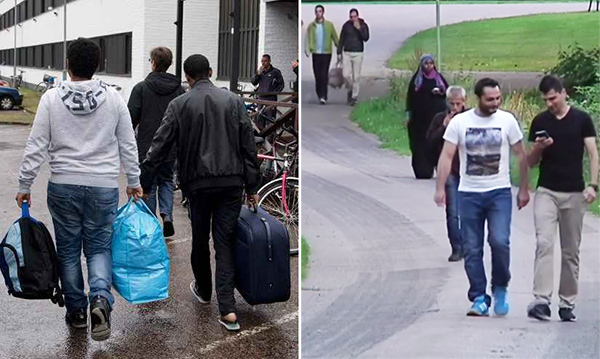
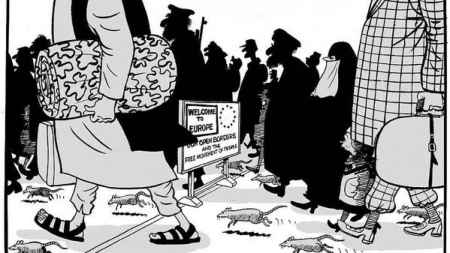
cartoonrefugees

Nothing to worry about. If you’re at all concerned about terrorists posing as refugees, you’re probably some sort of orphan-hating Islamophobe.

Either that or the director of the FBI. Or the Director of National Intelligence.

But Obama knows that only bigots worry about terrorists posing as refugees. So it’s unfortunate that the Islamophobic Muslim government of Turkey just arrested 8 ISIS members who were plotting to pose as refugees to penetrate Europe.

Turkish police have detained eight suspected members of ISIS who were planning to sneak into Europe posing as refugees, state media said today.

Counter-terror police detained the suspects in Istanbul’s Ataturk Airport after they flew in from the Moroccan city of Casablanca on Tuesday, the official Anatolia news agency reported.

The police found a hand-written note on one of the suspects detailing a migration route from Istanbul to Germany via Greece, Serbia and Hungary, including smuggler boats across the Mediterranean Sea, as well as several train and bus journeys.

It comes just a day after it was revealed eight migrants have reached the EU using passports identical to the fake one found on one of the Paris suicide bombers.

We were told over and over again by the refugeecrats that ISIS terrorists would never want to pose as refugees because it’s just too slow and there are so many security checks. Apparently ISIS isn’t aware that it isn’t supposed to infiltrate countries as refugees.

Let’s swiftly ignore this news and take in huge numbers of Syrian migrants the way that Obama and Hillary want us to while completely ignoring the terror risks until an actual attack happens.

Iran attacks, cyber edition, Power Line

November 5, 2015

Iran attacks, cyber edition, Power LineScott Johnson, November 5, 2015

Jay Solomon reports in today’s Wall Street Journal: “U.S. Detects Flurry of Iranian Hacking” (accessible via Google here). The Israel Project’s Omri Ceren takes note and comments in an email message (with the usual footnotes!) that I thought readers would find of interest:

The WSJ revealed last night that there has been a “surge” in Iranian cyber attacks against U.S. officials, journalists, and activists who work on Iran. At least some of the attacks have been successful.

The attacks were launched using the laptop of American-Iranian businessman Siamak Namazi, who was arrested and imprisoned in mid-October. It appears the Revolutionary Guard Corps (IRGC) seized Namazi’s computer, made him log into Outlook or Gmail or whatever program he uses, and then sent malware-infected emails to people in his contact list, who then opened up those emails. The Journal had previously published hints of the story: last week the outlet reported “Iranian intelligence agents ransacked [Namazi’s] family home in Tehran and confiscated his computer, and have since been launching cyber attacks on some of his email contacts” [a]. Journalist Robin Wright subsequently revealed she and State Department officials were among those targeted from the confiscated computer [b]. This new Journal story reveals that the cyber-offensive is widespread and that “Obama administration personnel… have had their computer systems hacked.”

The full article…runs almost 1,500 words. Background on some of the angles:

U.S. politics (sanctions) — “Lawmakers have called for the White House to ramp up sanctions on the IRGC… ‘Iran’s threatening behavior will worsen if the administration does not work with Congress to enact stronger measures to push back, including… targeted pressure against Iran’s Revolutionary Guard,’ Sen. Mark Kirk… said Friday” — Lawmakers are talking about a policy menu that has three tiers of potential targets: (1) Just the IRGC personnel involved in Namazi’s arrest, e.g. by having the Treasury Dept. tag them as Specially Designated Nationals (SDNs) (2) the entire IRGC, e.g. by having the State Dept. designate the IRGC as a Foreign Terrorist Organization (FTO) [c] (3) Iran’s non-nuclear infrastructure (ballistic missile development, human rights violations, terror promotion, regional expansionism, etc), e.g. by supporting Congress in renewing the Iran Sanctions Act (ISA) of 1996.

Middle East geopolitics (U.S.-Iran entente) — “President Barack Obama and Secretary of State John Kerry have voiced hopes that the Iran nuclear agreement reached in July could spur greater cooperation between Washington and Tehran on regional issues… Iran for the first time took part in international talks aimed at ending the multisided war in Syria” — Foreign Policy revealed last night that Obama personally intervened with the Saudis to allow Iran to take part in those talks [d]. The Associated Press had already assessed over the summer that “coziness” between the Iranians and Obama administration officials was “the new normal” [e]. The Iranian cyber-offensive – plus the arrest of Namazi, plus Iran’s arrest last month of U.S. resident Nizar Zakka, plus the new joint Iranian-Russian military offensive in Syria, plus Iran’s recent launch of a ballistic missile in violation of UNSC resolution 1929, plus this week’s widespread Death to America celebrations throughout Iran [f] – risks making the administration look naive.

U.S. National security (cyber) — “The IRGC has used cyberwarfare against other Iranian-Americans and people tied to them detained in recent years… Computer experts have noted that by hacking a target’s contacts… the number of people associated with that target can grow exponentially” — The Iranians have been spear phishing US government targets for years. In May 2014 a computer security firm revealed the existence of a three year Iranian cyber-campaign – the “most elaborate social-engineering campaign” the researchers had ever seen – targeting U.S. military officials, Congressional staffers, diplomats, lobbyists, journalists, and so on [g]. Last spring the American Enterprise Institute published a report assessing that the then-impending nuclear deal would “dramatically increase the resources Iran can put toward expanding its cyber attack infrastructure” [h].

The WSJ story will get wrapped into the broader debate about the wisdom of the Joint Comprehensive Plan of Action (JCPOA). When the article went live last night Reuters took it to the White House for a response, and got a “no comment” on background [i]. As today rolls along, administration spokespeople will shift more explicitly to the usual line about Iranian aggression: they’ll say that of course they have concerns about Iranian behavior, but the nuclear deal was never premised on Iranian moderation, and they’ll add that they can still respond to Iran with options in theory. They’ll refuse to identify any specific pushback they intend to implement in practice.

That move has been a staple of administration messaging for months, but may not satisfy journalists or lawmakers in the aftermath of the Namazi arrest and cyber attacks. The policy menu outlined by the Kirk letter provides a range of options – SDNs, FTO, ISA – and should allow the White House to work with Congress on a calibrated pushback. At the bottom level it suggests sanctions against the specific IRGC officials in the specific intelligence unit who seized Namazi and used his laptop to hack American officials. Imposing sanctions at that individual level is quite literally the least the White House can do in response.

[a] http://www.wsj.com/articles/iranian-american-executive-arrested-in-iran-1446164677
[b] http://www.newyorker.com/news/news-desk/an-american-hostage-in-iran-again
[c] http://thehill.com/blogs/pundits-blog/defense/257399-time-to-designate-irans-revolutionary-guards-as-terror-group
[d] http://foreignpolicy.com/2015/11/04/syria-crisis-tests-newfound-detente-between-washington-and-tehran/
[e] http://bigstory.ap.org/article/dd9010d400be449d88076da5aa85b05e/once-unheard-us-iran-exchanges-becoming-new-normal
[f] http://bigstory.ap.org/urn:publicid:ap.org:a55c0f82739f4ee7902e1dd2fd1cb7c9
[g] http://www.defenseone.com/technology/2014/05/iranian-hackers-target-us-military-officials-elaborate-social-media-scam/85417/
[h] http://www.thedailybeast.com/articles/2015/04/16/report-iranian-hackers-eye-u-s-grid.html
[i] http://www.businessinsider.com/r-iranian-military-hackers-focus-on-us-administration-officials-wsj-2015-11

‘Islamophobia’ in America vs. murderous Christophobia in the Islamic world

November 5, 2015

‘Islamophobia’ in America vs. murderous Christophobia in the Islamic world, Front Page MagazineJack Kerwick, November 5, 2015

(‘Jewophobia’ appears to be at least as prevalent. — DM)

Cross

As organizations like CAIR and their allies wax indignant over “Islamophobia” in America, Muslims around the globe are visiting the worst sort of cruelty upon the Christian minorities in their midst.

For instance, over a span of four days, from October 19-23, the Indonesian government succumbed to the demand of Islamic “extremists” and demolished nine churches.  Six days earlier, on October 13, Muslims unleashed a torrent of violence that left a church burned to the ground and a person dead.

And in the course of this single day, 8,000 Christians found themselves displaced from their homes.

The government has deported them.

According to a local church activist, someone who self-identified only as “Rudy,” Islamic militants issued an ultimatum to the Indonesian government: Either raze these Christian churches to the ground or “the radicals will deploy around 7,000 people” to besiege this Christian community.

The organization Open Doors, a group dedicated to “serving persecuted Christians worldwide,” reports: “Church members wept as they watched in despair [as] civil police officers [began] hammering down their worship houses.” As of this juncture, over 1,000 “churchless believers are prohibited from raising temporary tents to hold Sunday worship services.”

The predominantly Islamic country of Bangladesh is a place where Christian women are regularly subjected to unspeakable violence.  Open Doors states that “two out of every three women in Bangladesh will experience gender-based violence in their lifetimes.” Furthermore, the United Nations’ “Special Rapporteur on Violence Against Women” has found that “girls are regularly harassed and abused on their way to and from school,” a phenomenon that is the function of the fact that “sexual harassment is often seen as ‘part of the culture.’”

One young woman who has fallen victim to this culture is Susmita Chambugonj.  Back in May, the 20-year-old was assailed by five “youths” who dragged her into a microbus.  While inside, Susmita was raped by two of her abductors.

The current “refugee crisis” has hit Syrian and Iraqi Christians particularly hard. Open Doors informs us that Christians in these countries “have had their homes marked by ISIS,” and “some come from historically Christian towns that were obliterated.” Moreover, some Christians are discovering “that they are being discriminated against when it comes to receiving aid.”

In Africa, stories of Islamic-on-Christian oppression are even more grisly.  At the same time, these same stories supply us with proverbial textbook exhibitions of Christian heroism.

Earlier in the year Boko Haram paid Habila Adamu a visit at his home.  When the militants informed Habila that they were “looking for him” in order to end his life, he replied that he had been looking for them as well—but in order to share with them the Gospel of Christ.

The predators weren’t impressed.  When Habila refused to recant his faith, his persecutors shot him in the face and left him for dead.

Thankfully, Habila survived.

Joshua, however, did not.  Joshua was 18 years old.  A member of a family of farmers, he worked in a factory during the dry season.  One day, Islamic militants showed up at his place of employment and proceeded to separate those employees who were Muslims from those that were Christians.  Then, they wasted no time in murdering the Christians one by one.

Initially, Joshua was in another room with some other employees. They watched through a window as the mass murder unfolded.  When an Islamic woman and fellow employee of Joshua begged the latter to deny his Christianity, he refused. Joshua was blunt: “No,” he told her, for “I am a Christian and they are killing my brothers.”

Joshua continued: “I am also going out there. I am not going to stay here and pretend that I am a Muslim.”

Joshua was martyred along with nine young men.

Even as I write this, the Christian community in Turkey has become the object of a systematic, relentless campaign of death threats.  According to Open Doors, the targeted are being blasted for being “heretics” who have “chosen the path that denies Allah[.]”

In Pakistan this past July, Saddique Azam, a veteran school teacher, was promoted to the position of “headmaster” at an elementary school.  Azam is a Christian.  For months, he was repeatedly threatened by Muslims who believed that the office of headmaster should be held by a Muslim.  Azam refused to resign.

Then, on October 6, three of his Islamic colleagues who worked under him physically attacked Azam.

Azam recounted his experience: “Three Muslim teachers entered the school, went into my office and waited for me there.  When I entered the office, I was alarmed to see them.  I asked them the reason for the visit and they launched a tirade of warnings against me to withdraw and resign from teacher headship.”

From the beating, Azam sustained a severe injury to his left eye.  Things could’ve been worst had it not been for other staff that stopped the assault.

But witnesses reported that while they pummeled Azam, his Islamic assailants mocked him by referring to him as “choora,” an anti-Christian epithet used by Pakistani Muslims. “Choora” connotes the “sweeper” or “untouchable” caste.  “You are a ‘Christian Choora,’” his victimizers shouted. How, then, “can you be a headmaster and be given seniority over us?”

The next time that we hear about the “Islamophobia” that Muslims in America allegedly face, let’s recall the face of real religious persecution: the persecution that truly defenseless Christians suffer at the hands of Muslim aggressors throughout the Islamic world.

Leader: Negotiation with US on Regional Issues Meaningless

November 1, 2015

Leader: Negotiation with US on Regional Issues Meaningless, Tasnim News Agency (Iranian), November 1, 2015

139408101241559676429254


While many consider the Joint Comprehensive Plan of Action (JCPOA) a major breakthrough in the improvement of ties between Iran and the West, the Leader has already made it clear that Tehran’s policy toward the US will remain unchanged regardless of the ultimate fate of the JCPOA.

***********************

TEHRAN (Tasnim) – Supreme Leader of the Islamic Revolution Ayatollah Seyed Ali Khamenei dismissed the idea of Iran-US negotiation on regional issues, saying the totally contrasting policies of the two countries and Washington’s attempts to impose its demands make such talks pointless.

In a meeting with the Foreign Ministry staffers in Tehran on Sunday, Ayatollah Khamenei underlined that Iran’s foreign policy is founded upon the Constitution, the long-term interests of the country and the Islamic Republic’s values, and that, consequently, they do not change in different administrations.

Different administrations would affect only the “tactics and executive initiatives” in carrying out the country’s foreign policy strategies, the Leader stressed.

The Supreme Leader then dismissed as a Western illusion the notion that Iran’s foreign policy has undergone a forcible change.

Imam Khamenei further referred to the US policies in West Asia as the root cause of the tense situation across the region, adding, “Unlike the view of certain individuals, the US is the main plank of the region’s problems, not part of a solution to the problems.”

The Leader then called on the Iranian foreign ministry officials, ambassadors and diplomats to stick to the tenets of the Islamic Republic’s foreign policy “firmly, mightily and gloriously”, so that foreigners and their followers inside the country would not pin hopes on a shift in Iran’s foreign policy.

Ayatollah Khamenei referred to Iran’s policies on Palestine, Syria, Iraq, Yemen and Bahrain, saying they differ from those of the US by “180 degrees”.

The root cause of insecurity in the region is Washington’s support for the Zionist regime of Israel and the terrorist groups, the Leader underscored.

Imam Khamenei then categorically dismissed the idea of negotiations with the US on regional issues.

“The Americans seek to impose their interests, not to settle problems. They want to impose 60, 70 percent of their demands via negotiations, and practically implement and impose the rest of their objectives illegally. Then what would negotiations mean?”

Elsewhere, Ayatollah Khamenei lauded Foreign Minister Mohammad Javad Zarif and other diplomats for handling nuclear talks with six world powers well, saying they could very well safeguard the country’s goals in the talks.

Iran and the Group 5+1 (Russia, China, the US, Britain, France and Germany) on July 14 reached a conclusion on a lasting nuclear agreement that would terminate all sanctions imposed on Tehran over its nuclear energy program after coming into force.

While many consider the Joint Comprehensive Plan of Action (JCPOA) a major breakthrough in the improvement of ties between Iran and the West, the Leader has already made it clear that Tehran’s policy toward the US will remain unchanged regardless of the ultimate fate of the JCPOA.

MEMRI: ‘The Emperor Has No Clothes’

October 30, 2015

MEMRI: ‘The Emperor Has No Clothes,’ Yigal Carmon, October 30, 2015

(Where are the media? In Obama’s pocket as usual. — DM)

25564

This MDB is dedicated to the memory of USAF pilot Captain (ret.) David Ganz, a man of honor and gallantry and a decorated officer, who passed away last week.

What Is The “Iran Nuclear Deal?”

What is mistakenly perceived as an agreement under the title of “Joint Comprehensive Plan of Action” (JCPOA), that was concluded on July 14 in Vienna, and celebrated by the White House as anhistoric agreement,” is neither a contract nor even a real agreement between Iran and the P5+1. It is a set of understandings and disputes compiled into a single document.

For example, the JCPOA states that in the event of Iranian violations, sanctions will be re-imposed (snapback). However, the Iranian position, which rejects all sanctions, is incorporated in the same document. In outlining the snapback of the sanctions, Article 37 also stipulates: “Iran has stated that if sanctions are reinstated in whole or in part, Iran will treat that as grounds to cease performing its commitments under this JCPOA in whole or in part.”[1] This is not merely an Iranian reservation expressed outside of the negotiating room. It is incorporated into the text of this selfsame document – and one that completely contradicts preceding provisions that stipulate otherwise. Since the parties were unable to arrive at an understanding on this issue in two entire years of negotiations, they decided to resolve this major issue by incorporating this disagreement into the document itself.

The JCPOA is best characterized by bangs and whimpers – by bold prohibitions on Iran that peter out in qualifying terms such as “unless,” “except if,” and the like.

Why isn’t the JCPOA a contract? Because Iran would never have signed any contract with the U.S. – “the Great Satan” – whose demise it seeks. Likewise, it would not have signed any contract with any other party to the negotiations, since it views the sanctions imposed on it by United Nations Security Council (UNSC) resolutions and by EU and IAEA reports as grievous injustice. By signing such an agreement, it would retroactively legitimize these wrongs done to it.

As Iranian Supreme Leader Ali Khamenei frequently reiterates, Iran agreed to negotiations mainly to get the sanctions lifted. Therefore, as far as Iran is concerned, the only acceptable name for this enterprise is “Joint Comprehensive Plan of Action” – under which each party commits to particular action. It is a joint plan, not a contract.[2]

Has Iran Fulfilled Its Initial Obligation To Approve The July 14 Vienna JCPOA?

The JCPOA includes a timetable and obligations applying to both sides. Within this time frame, both parties had 90 days from July 14 to secure approval for the agreement from their respective national institutions. By “Adoption Day,” set for October 19, which has come and gone, the agreement was meant to have been approved by both sides. The EU was to have announced the lifting of its sanctions, while President Obama, on behalf of the U.S., was to have announced the lifting of the U.S. executive branch’s sanctions, along with waivers on sanctions imposed by the U.S. legislative branch – that is, suspension, because the president is not authorized to lift them.

Adoption Day was preceded by a farcical UNSC endorsement of the agreement/disagreement, as demanded by Iran. The U.S. volunteered to play errand boy for this undertaking. For its part, the UNSC eschewed discussion on the matter, and passed this historic resolution, No. 2231,[3] on such a weighty historic document in record time – under 30 minutes.

The Western side showed its consent long before October 19; the self-effacing EU member countries did not even bother to discuss the agreement in their national parliaments – and thus confirmed their true status as nonentities. And while the U.S Congress did discuss it seriously, the agreement was allowed to proceed, via a convoluted process that was nonetheless legal and binding.

In Iran, however, following discussion in both its Majlis and its Guardian Council, the JCPOA as concluded and announced on July 14 was not approved. The Majlis ratified something else – a set of recommendations to the government of Iran regarding how it should execute the JCPOA. This hardly constitutes approval of the original document. The Guardian Council, for its part, approved what the Majlis had done; Guardian Council secretary-general Ayatollah Jannati said, on Iranian TV, that his council had approved not the JCPOA but a plan for the government to secure Iran’s interests in executing it.[4] Majlis speaker Ali Larijani said the same thing.[5]

Was this a fulfillment of what Iran was obligated to do under the JCPOA? No! Did the U.S. administration insist that Iran approve the JCPOA, as concluded and announced in Vienna on July 14? No! Does the U.S. realize that Iran’s ultimate authority to approve laws rests with Supreme Leader Khamenei, and that he has not yet approved the JCPOA? NO! Nevertheless, the U.S. and Europe have chosen to regard what Iran has done as approval – so that the peace process will not be halted.

The U.S. and Europe then proceeded to the first post-Adoption Day phase in the JCPOA timetable: The EU announced that its sanctions would be terminated. President Obama announced that the U.S.’s executive sanctions would be lifted and its legislative sanctions waived; this announcement was not for immediate execution, but in fact advance notice that these measures would come into effect by December 15 – provided that the IAEA would report that Iran has fulfilled its obligations under the JCPOA.

What are these obligations that Iran has to fulfill between Adoption Day and December 15 in order to merit this sanctions relief? The Arms Control Association, which supports Iran and the JCPOA, listed them on its website:[6]

*reducing the centrifuges at Natanz from over 16,000 to 5,060 IR-1 machines, which will enrich uranium to 3.67 percent, and removing the associated infrastructure;

*reducing the number of IR-1 machines centrifuges at Fordow to 1,000 (328 will operate) and converting the facility for radioisotope production;

*wrapping up testing on advanced centrifuges machines and removing all advanced centrifuges except one IR-4, IR-5, IR-6, and IR-8 machine for testing with uranium;

*storing all dismantled centrifuges under IAEA seal;

*reducing the stockpile of enriched uranium to less than 300 kilograms;

*removing the core of the Arak reactor and disabling it; and

*instituting the necessary transparency and monitoring mechanisms to implement Iran’s additional protocol and the continuous surveillance of key facilities.

Did Iran hasten to meet these obligations? No! The explanation follows below.

Why Has No One Said A Word About Iran’s Noncompliance?

Since Adoption Day, no one in the West – not the media, not Capitol Hill, not Israel – has spoken up about the fraud of Iran’s alleged “approval” of the JCPOA. Western intelligence agencies and think tanks have also held their tongues. Everyone swallowed the lie, in a spirit of goodwill, in order to allow the JCPOA to proceed, for “peace in our time.”

The Republicans should have remembered their revered leader, Abraham Lincoln, invoked by Barack Obama in 2007 when he announced his presidential candidacy at the spot where Lincoln had done so over 150 years previously. After all, it was Lincoln who said, “You cannot fool all the people all the time.”

The pro-JCPOA political media have, of course, misled the public by reporting that Iran approved the JCPOA. But even the anti-JCPOA media have failed to rebut this lie. Why? Ignorance, unprofessionalism, and hatred for President Obama blinded them. Here is what they likely are thinking: Obama gave in to Iran on everything. Obviously, Iran is going to approve this piece of “absolute Western capitulation.”

However, Iran did not get absolutely everything it demanded, and Obama did not give it absolutely everything it demanded – he held out for a tiny scrap of the U.S.’s initial position, as will be detailed below. That is why Iran would not approve the JCPOA – to Iran, anything less than 100% of what it wants is an injustice.

Why Isn’t Iran Rushing To Fulfill Its Obligations And Get Sanctions Relief By December 15?

At this stage, events have taken an absurd turn. Iran has started dragging its feet. Instead of rushing to carry out all the steps to meet its obligations under the JCPOA, it is idling in neutral. It has little time and much to do by December 15. It must dismantle thousands of centrifuges and transfer them to storage monitored by IAEA cameras. It must ship out 9,000 kg of its enriched uranium to a third country, retaining only 300 kg. It must dismantle and pour cement into the core of the Arak plutonium reactor, and transform the facility into a heavy water reactor. It must notify the IAEA of its voluntary acceptance of the NPT Additional Protocol. And more.

But senior Iranian officials are shifting responsibility for initiating fulfillment of these obligations to one another, sometimes with comical effect. For example, President Hassan Rohani sent a letter to Iranian Atomic Energy Organization head Ali Akbar Salehi instructing him to begin to take the appropriate steps. Salehi confirmed that he had received Rohani’s message, but said that it had not stated when he should start doing so. No one wanted to budge without explicit permission from Supreme Leader Khamenei.[7]

Khamenei Issues Nine New Conditions, Blocks Execution Of JCPOA

Now the big secret is out. Khamenei has not approved the JCPOA. And those who pretend that it has been approved – President Rohani, Foreign Minister and negotiator Javad Zarif, and their associates – have been on borrowed time. While they could lie to the West, to President Obama, to Secretary of State Kerry, and to the EU foreign ministers that they can move ahead, they always knew that Khamenei opposed the JCPOA. Now, at the moment of truth, they feared to proceed.

Indeed, it was logical for Khamenei to allow the Iranian negotiators to play along with the P5+1, to see what they could get at no cost to Iran – since it was well known that President Obama was dying for an agreement. But once Khamenei knew that President Obama is standing firm on the last fragment of the original U.S. position, either unwilling or unable to capitulate any further, Khamenei broke his silence. Stepping in in the final act, Khamenei, deus-ex-machina style, dictated, in a letter to President Rohani, nine new conditions for the JCPOA,and declared that if these were not met Iran would stop the agreement.[8]

Actually, Khamenei had issued an early warning in a September 3 speech,[9] in which he said that all the sanctions must be lifted, not suspended, and that if not, there would either be no agreement or Iran would also only “suspend” its obligations. But President Obama did not yield. He cannot override congressional sanctions; he can only issue a suspension via waiver. Politically too, it might be too far for him to go to break his promise of the JCPOA’s built-in security mechanism – snapback of the sanctions. Obviously, snapback is possible only if the sanctions remain in place under suspension. Therefore, Khamenei, realizing that the sanctions would remain, also kept his promise and blocked the agreement with new conditions, one of which – i.e. the lifting of sanctions rather than suspension – he knows for sure cannot be met.

How Did The American Media Describe Khamenei’s Nine New Conditions?

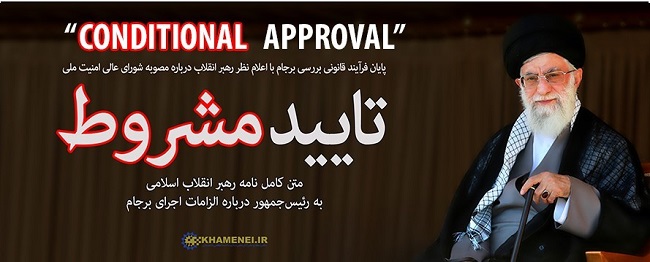
Khamenei’s letter to Rohani with his conditions for the execution of the JCPOA – the publication of which coincided with the days of the Ashura that are of vital religious and national significance in Iran and symbolize steadfastness against the forces of evil – was explicitly termed “conditional approval.” It was labeled thus in red letters, as posted on Khamenei’s website in Persian, tweeted from his Twitter account and posted on his Facebook page in English, and also published in English by the official Islamic Republic of Iran Broadcasting authority IRIB.
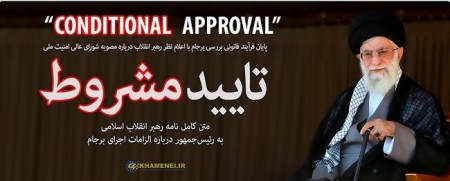
25565

But instead of reporting that at this stage, and at present, Khamenei’s approval is not given unless Khamenei’s conditions are met, the American media said that Khamenei had approved the JCPOA. Would these members of the media also consider a purchase concluded if they had not paid for it? The entire American media, without exception, left, right, and center – as well as, apparently, all the U.S. intelligence agencies and think tanks – claimed that Khamenei had approved the agreement. Only two newspapers in the West wondered about the emperor’s new clothes – but even they did not shout “But he hasn’t any clothes on at all!” They said only that he was missing a couple of accessories.

Khamenei had spoken, banning outright any implementation of the JCPOA by Iran until his new conditions are met. The entire Iranian political system is hewing to this line – including President Rohani, Foreign Minister Zarif, Majlis Speaker Larijani, a majority of Majlis members (166), and more (for a full list to date, see Appendix I).

Everyone, that is, except for Ali Akbar Hashemi Rafsanjani, Khamenei’s political rival and head of Iran’s pragmatic camp, who in an interview published this week by MEMRI openly challenged Khamenei and said that Iran should abide by what it undertook in the JCPOA.[10]

But this cannot happen. Khamenei holds the reins.

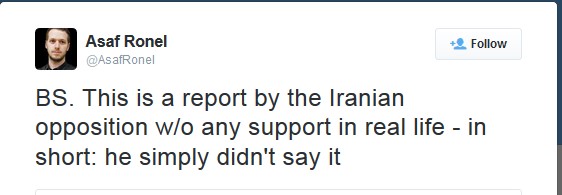
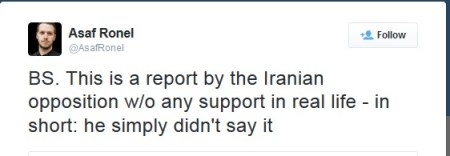
Did the media report on Rafsanjani’s interview? No! But the media in Iran did (see Appendix II). This, however, did not stop the editor of the Israeli daily Haaretz from writing that the interview was faked.
25566

This is a well-known human reaction: When people stand before the complete collapse of what they believe in, they enter a state of denial.

So What Now?

And what is President Obama to do, as everything he has stood for in the Iran deal collapses so ignominiously? On the right, they say he will continue to capitulate. In their ignorance, and in their hatred of him, they fail to realize that he can simply surrender no farther. OK, they say, so the IAEA will provide Obama with the necessary confirmation by December 15 that the Iranians have done their part. But that is impossible as well. What is demanded of Iran is gargantuan in scale, and it would be far more difficult for the IAEA to fake confirmation when the Iranians themselves are declaring loudly that they are not going to do it.

With every passing day, Iran is more and more in violation of the JCPOA. But neither the Republicans nor the Democrats, nor the media, nor anyone else will acknowledge this, for the implications are too devastating. The agreement is no longer in effect. Its clock has stopped.

But the weeks will pass, and the media and politicians will be forced to admit that this is the case. And the last thing they will be willing to do is to force Iran to meet its obligations. Thus, it appears that President Obama’s only option, shameful as it is, is to restart the negotiations with the Iranians and talk with them about their leaders’ new conditions. As is well-known, this administration advocates diplomacy – guaranteeing that there will be no breakthrough any time soon.

This is precisely what will serve President Obama best. All he needs to do is play for time and reach the end of his term with an agreement in hand – albeit virtual – and negotiations in progress – albeit unending. He will pass this situation on to the next administration. The success will be all his, and the failure will be all theirs. The media will zealously guard Obama’s legacy, and his successor, Republican or Democrat, will be too uninformed to protect him or herself from this historic maneuver. And it will serve them right.

Appendix I: Senior Iranian Officials Declare Their Acceptance Of Khamenei’s Instructions On Implementing The JCPOA

On October 10, 2015, Majlis Speaker Ali Larijani  said at a conference on war and peace in Syria: “…The commands of the leader [Khamenei], the decision of the Majlis and the Supreme National Security Council will illuminate the government representatives’ path on implementing the JCPOA… I thank the leader with all my heart.”[11]

President Rohani, responding to the directives letter by the Supreme Leader on carrying out the JCPOA (October 22, 2015): “Your historic letter of October 21, 2015 regarding the approval of decision number 634 of the Supreme National Security Council caused joy within the great Iranian people and warmed the hearts of the public servants in government… The government will obey your criticisms and obligations [that you imposed] and with good intentions will take measures relating to the full implementation of the Supreme National Security Council and the Majlis. We will be fully alert to the performance of the other side’s obligations and in the Supreme National Security Council we will take the necessary decisions to provide a fitting response.”[12]

On October 26, 2015, Foreign Minister Zarif referred in the Majlis to the supreme leader’s letter on carrying out the JCPOA and noted: “I am grateful to the leader for his path-illuminating letter on setting policy in the JCPOA’s implementation. His opinion always lighted the path to the nuclear negotiations team at the foreign ministry. Henceforward, we must make an effort to implement the JCPOA documents in the right way and following the leader’s guidelines.”[13]

On October 27, 2015, Zarif said that the modifications to the nuclear reactor in Arak must be performed after the PMD file has been closed at the IAEA and explained: “we calculated the details of re-planning the reactor following the leader’s guidelines, the decision of the Supreme National Security Council and the Majlis… We will coordinate everything necessary for swapping the uranium stockpiles and this matter will be performed precisely in the way that the leader elaborated and was previously agreed at the Supreme National Security Council and the Majlis nuclear committee.”[14]

In the Majlis, 166 members, constituting a majority, expressed on October 26, 2015 their admiration for the leader for his historic letter in implementing the JCPOA. The letter’s contents read “… For a certainty, the Majlis representatives will act as your stout arms and collaborate with all the supervisory organizations and with the Supreme National Security Council and invest efforts to ensure that after the JCPOA, the enemy will not be able to penetrate our Islamic country even minutely and we will supervise that all violation of promises by the 5+1 group will not remain unanswered.”[15]

Iran’s Judiciary Chief Sadeq Amoli Larijani at an October 26, 2015 conference of senior judicial branch officials said that the letter of conditions that Khamenei published on JCPOA implementation should put an end to debates on the issue. He added: “All groups [within Iran] should treat the leader’s letter as ‘self-explanatory’ and as the axis of unity and from now no they will make progress and think moderately about the future and the next stages of the JCPOA.”[16]

The leader’s representative in the Islamic Revolutionary Guard Corps (IRGC) Ali Saidi said on Wednesday, October 21, 2015: “… The leader is effectively managing the country according to the Koran and custom, the leader sets policy and the others execute it.”[17]

At an October 27, 2015 press conference, the leader’s advisor and the head of the Center for Strategic ResearchAli Akbar Velayati, said: “In the last letter we saw that he criticized the defects and shortcomings in carrying out the JCPOA. I hope that the agreement will be carried out flawlessly in the future. The continued support of the leader for the JCPOA is contingent on the response to the letter that Khamenei wrote the president [Rohani].”[18]

The head of the Majlis nuclear committee, Ebrahim Karkhanehei, referring to the leader’s letter on the JCPOA, said: “This letter produced social calm because in addition to leader the people as well demanded the things that were included in the letter. The most important issue in the letter is the issue of lifting sanctions and the government must seriously handle the matter of lifting the sanctions. In addition to the letter, the leader emphasized many times that if the sanctions are not lifted then there will be no agreement and therefore the US and the EU must fully lift the sanctions.

“The letter from the EU and the American president are not considered a [sufficiently] strong guarantee on the lifting of the sanctions. The Majlis will not be negligent about any clause in the leader’s letter and the government must seriously oversee and handle the sanctions-lifting issue.

“The leader demanded that a professional and  wise team should supervise the sound implementation of the JCPOA and therefore this team must be comprised of at least five people specializing in the legal, nuclear technical political, economic and the sanctions structure issues as well as an expert on security and defense matters.”[19]

An October 25, 2015 Kayhan editorial titled “Giving Interpretations Is Impermissible” wrote: “The leader’s order and the setting of numerous terms for the JCPOA’s implementation is self-explanatory and elaborated a clear path for all arguments and worries, according to religious jurisprudence, the law and the professional perspective. It is obligatory and essential to obey it.. as opposed to some of the impressions, the leader approved the JCPOA’s implementation only following obedience to the terms that may not be damaged and on principle, the leader did not express general approval on the matter.”[20]

Appendix II: Iranian Websites Covering Rafsanjani’s Interview In Inhnews.ir

*IRNA

*ILNA

*Hashemirafsanjani.ir.fa

*Etemaad

*ISNA

*Fars

*Tnews.ir

*Shomaokhabar

*Farsi-news

*Shafaf.ir

*Y. Carmon is president and founder of MEMRI.

Endnotes:

[1] For the complete text of the JCPOA see Eeas.europa.eu/statements-eeas/docs/iran_agreement/iran_joint-comprehensive-plan-of-action_en.pdf

[2] See MEMRI Special Dispatch No. 6151, Khamenei Declares That He Will Not Honor The Agreement If Sanctions Are Merely Suspended And Not Lifted, September 4, 2015; and MEMRI TV Clip #5067 – Iranian Supreme Leader Ali Khamenei: The Americans Must Lift the Sanctions, Not Suspend Them, September 3, 2015.

[3] Unscr.com/en/resolutions/doc/2231.

[4] See MEMRI TV Clip #5114 – Iranian Guardian Council Secretary-General Ahmad Jannati: Khamenei Has Not Approved or Signed the JCPOA, October 16, 2015; and MEMRI TV Clip #5117 – Iranian Guardian Council Spokesman Nejatollah Ebrahimian: The JCPOA Was Not Approved by the Majlis or the Guardian Council, October 18, 2015.

[5] Tasnim (Iran), October 18, 2015.

[6] http://www.armscontrol.org/blog/ArmsControlNow/2015-10-15/The-P5-1-and-Iran-Nuclear-Deal-Alert-October-15

[7] ISNA (Iran), October 18, 2015.

[8] On Khamenei’s nine demands, see MEMRI Inquiry & Analysis No. 1196, Iranian Supreme Leader Khamenei’s Letter Of Guidelines To President Rohani On JCPOA Sets Nine Conditions Nullifying Original Agreement Announced July 14, 2015, October 22, 2015.

[9] See MEMRI Special Dispatch No.  6151, Khamenei Declares That He Will Not Honor The Agreement If Sanctions Are Merely Suspended And Not Lifted , September 4, 2015.

[10] MEMRI Special Report No.43, Breaking Report: Challenging Khamenei, Rafsanjani Demands That Iran Fulfill Its Obligations Under The JCPOA, And Reveals: We Had Nuclear Option In Iran-Iraq War, October 28, 2015.

[11] Mehrnews.com, October 23, 2015.

[12] President.ir/fa/90172

[13] Isna (Iran), October 26, 2015.

[14] Isna (Iran), October 27, 2015.

[15] Mehrnews.com, October 26, 2015.

[16] Nasimonline.(Iran), October 26, 2015.

[17] Snn.(Iran), October 22, 2015.

[18] Isna (Iran), October 27, 2015.

[19] Mehrnews.com, October 26, 2015.

[20] Kayhan (Iran), October 25, 2015.
Madam Hillary is on the right side of herstory

October 25, 2015

Madam Hillary is on the right side of herstory, Dan Miller’s Blog, October 25, 2015

(The views expressed in this article are mine, and do not necessarily reflect those of Warsclerotic or its other editors.– DM)


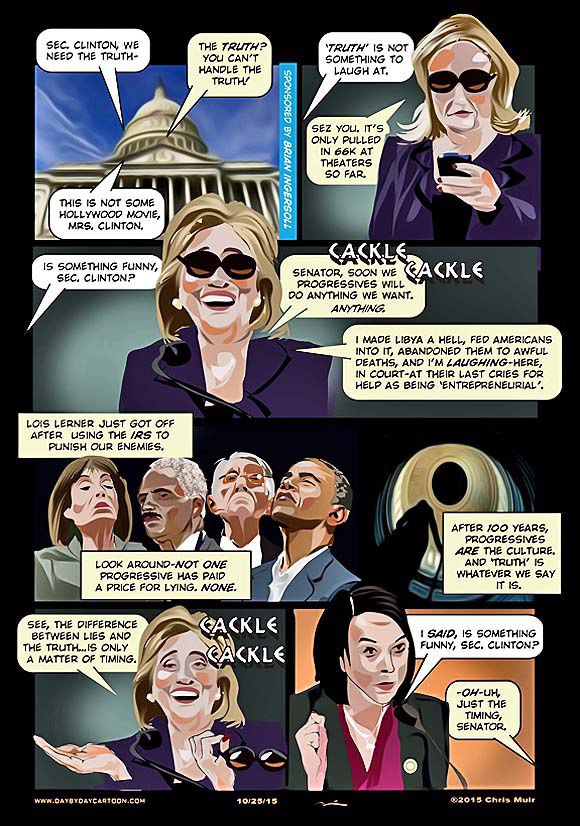
Lies are good and truth is bad because truth would damage Madam Hillary’s and even Imam Obama’s sterling images. Both, bravely and proudly, try to feed us what is “good.” Their people love it, so what difference does it make? 

1025151 (1)

According to John Hinderaker at Power Line, Madam Hillary

lies…it’s not exactly a news flash. On the contrary, based on the liberal media’s reaction to her Benghazi testimony, her willingness to lie, brazenly, is a positive virtue.

There’s always an excuse for having “misspoke.” It need not be a credible excuse, because an incredible excuse works just fine. Anyway, whatever happened was in the past and therefore doesn’t matter now:

What has Imam Obama lied about? Plenty. Here’s an incomplete list: Islam, the nuke “deal” with Iran, Libya, His strength and Putin’s weakness in the Middle East, Israel, Immigration, Crime, Obamacare, race relations and on and on and on. As with Madam Hillary’s spewings, the “legitimate media” generally love it.

Madam Hillary blamed the video repeatedly

According to an article titled “I didn’t blame the video,” Madam Hillary did just that while also managing to lie about substantially more than that.

Hillary simply adores arguing and lawyering.

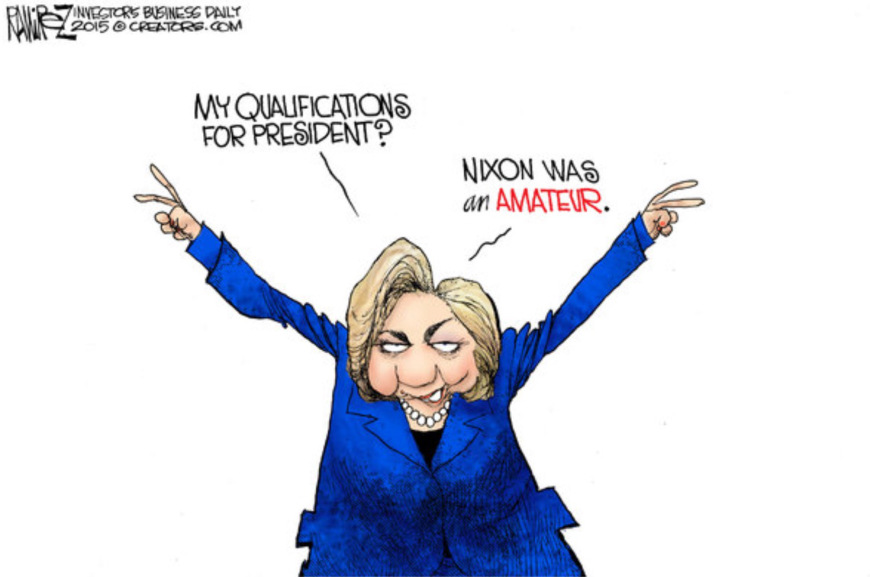
She lives for it and has at least since she was fired from the House Judiciary Committee during its investigation of the Watergate scandal that eventually brought down President Richard M. Nixon in 1974. Hillary’s then-supervisor, lifelong Democrat Jerry Zeifman, said he canned the 27-year-old attorney “because she was a liar … an unethical, dishonest lawyer. She conspired to violate the Constitution, the rules of the House, the rules of the committee and the rules of confidentiality.” [Emphasis added.]

No lie is too big or too small for Hillary, whether it’s a concocted tale of being under enemy fire at an airport in Bosnia, the existence of a “vast right-wing conspiracy” to undermine her husband’s presidency, that she was named after Mt. Everest climber Sir Edmund Hillary even though he rocketed to fame by accomplishing the feat when she was a six-year-old, or that the Clintons were “dead broke” when they exited the White House.

Meanwhile, at the Thursday hearing, Rep. Jim Jordan (R-Ohio) demolished Clinton’s apparently fresh assertion at the hearing that she didn’t actually claim an obscure anti-Islam movie trailer posted on YouTube prompted the terrorist assault in Benghazi on the eleventh anniversary of the 9/11 attacks. She now takes a more nuanced, twisted-like-a-pretzel position in which maybe some non-terrorist Muslims were suddenly stirred to violence in Libya by the video, but really at the same time it was a terrorist attack, something she testified Thursday has been her position the whole time. She talked about the video publicly not to point fingers but as a warning, she testified, to those who might attack U.S. interests in the region. In other words, like a good defense lawyer, Hillary was trying to confuse the issues and muddy the waters. [Emphasis added.]

. . . .

While she was informing the American public that the anti-Islam video was what caused the attack, at the same time she emailed her daughter Chelsea and the governments of Libya and Egypt to pin the blame on Muslim militants, Jordan explained. Around the same time the White House, in the closing weeks of a heated presidential election campaign, was pushing the line that what transpired in Benghazi was a spontaneous demonstration turned violent, but terrorism was not a factor.

“We know that the attack in Libya had nothing to do with the film,” Clinton wrote Egypt’s prime minister the night of the attack. “It was a planned attack, not a protest.” But in public Clinton continued to blame the “offensive” video. The U.S. government acquired $80,000 worth of commercial airtime in Pakistan to apologize for the YouTube clip. [Emphasis added]

Jordan pointed out that there was no video-inspired protest over in Benghazi on Sept. 11, 2012, but there was one in Cairo, Egypt. The same day State Department spokeswoman Victoria Nuland said “Benghazi has been attacked by militants. In Cairo, police have removed demonstrators.”

You want to talk about Madam Hillary’s lies? She didn’t lie, of course, but let’s change the subject to something more important. Right now.

hillary-Nixon-copy


Conclusions

“Her people” not only don’t care, they are delighted with Madam Hillary’s numerous lies. Again, “what difference does it make?” Plenty.

Please think about Madam Hillary’s and Imam Obama’s impunity — and readiness —  to lie, violate laws and do pretty much whatever they please. We have become a nation without law enforcement where we need it most and very much where enforcement of Obama’s executive decrees harms us greatly (climate change and immigration for example). Do we want a nation the governance of which is increasingly based on, and perpetuated through, lies to “We the people?” Do we want Madam Hillary or another Obama clone as the next Commander in Chief?

Here’s what “Commander in Chief” Obama has done with his our military:

Do you approve of those and the other things He has done to our military? Want more of the same? Or even worse? If not, what can we do about it? Supporting Donald Trump may or may not be what we should do, but I think the songs in the video are superb. Back in September, I wrote an article titled To bring America back we need to break some stuff. We still do, and if someone other than Trump is ready, willing and able he (or, of course, she) should also be considered, very seriously.;

The West has developed a dangerous concern for ‘proportionality.’

October 20, 2015

The West has developed a dangerous concern for ‘proportionality.’ National Review, Victor Davis Hanson, October 20, 2015

The question is not only whether the Obama administration, in private, favors the cause of the radical Palestinians over a Western ally like Israel, but also whether it is even intellectually and morally capable of distinguishing a democratic state that protects human rights from a non-democratic, authoritarian, and terrorist regime that historically has hated the West, and the United States in particular — and is currently engaged in clear-cut aggression.

**************************

In the current epidemic of Palestinian violence, scores of Arab youths are attacking, supposedly spontaneously, Israeli citizens with knives. Apparently, edged weapons have more Koranic authority, and, in the sense of media spectacle, they provide greater splashes of blood. Thus the attacker is regularly described as “unarmed” and a victim when he is “disproportionately” stopped by bullets.

The Obama State Department has condemned the use of “excessive” Israeli force in response to Palestinian terrorism. John Kirby, the hapless State Department spokesman, blamed “both” sides for terrorism, and the president himself called on attackers and their victims to “tamp down the violence.”

In short, the present U.S. government — which is subsidizing the Palestinians to the tune of hundreds of millions of dollars a year — is incapable of distinguishing those who employ terrorist violence from the victims against whom the terrorism is directed. But why is the Obama administration — which can apparently distinguish those who send out drones from those who are blown up by them on the suspicion of employing terrorist violence — morally incapable of calling out Palestinian violence? After all, in the American case, we blow away suspects whom we think are likely terrorists; in the Israeli instance, they shoot or arrest those who have clearly just committed a terrorist act.

Two reasons stand out.

One, Obama’s Middle East policies are in shambles. Phony red lines, faux deadlines, reset with Putin, surrendering all the original bargaining chips in the Iranian deal, snubbing Israel, cozying up to the Muslim Brotherhood, dismissing the threat of ISIS, allowing Iraq to collapse by abruptly pulling out all American troops, giving way to serial indecision in Afghanistan, ostracizing the moderate Sunni regimes, wrecking Libya, and setting the stage for Benghazi — all of these were the result of administration choices, not fated events. One of the results of this collapse of American power and presence in the Middle East is an emboldened Palestinian movement that has recently renounced the Oslo Accords and encouraged the offensive of edged weapons.

Mahmoud Abbas, the subsidized president of the self-proclaimed Palestinian State, and his subordinates have sanctioned the violence. Any time Palestinians sense distance between the U.S. and Israel, they seek to widen the breach. When the Obama team deliberately and often gratuitously signals its displeasure with Israel, then the Palestinians seek to harden that abstract pique into concrete estrangement.

Amid such a collapse of American power, Abbas has scanned the Middle East, surveyed the Obama pronouncements — from his initial Al Arabiya interview and Cairo speech to his current contextualizations and not-so private slapdowns of Netanyahu — and has wagered that Obama likes Israel even less than his public statements might suggest. Accordingly, Abbas assumes that there might be few consequences from America if he incites another “cycle of violence.”

The more chaos there is, the more CNN videos of Palestinian terrorists being killed by Israeli civilians or security forces, the more NBC clips of knife-wielding terrorists who are described as unarmed, and the more MSNBC faux maps of Israeli absorption of Palestine, so all the more the Abbas regime and Hamas expect the “international community” to force further Israeli concessions. The Palestinians hope that they are entering yet another stage in their endless war against Israel. But this time, given the American recessional, they have new hopes that the emerging Iran–Russia–Syria–Iraq–Hezbollah axis could offer ample power in support of the violence and could help to turn the current asymmetrical war more advantageously conventional. The Palestinians believe, whether accurately or not, that their renewed violence might be a more brutal method of aiding the administration’s own efforts to pressure the Israelis to become more socially just, without which there supposedly cannot be peace in the Middle East.

But there is a second, more general explanation for the moral equivalence and anemic response from the White House. The Obama “we are the ones we’ve been waiting for” administration is the first postmodern government in American history, and it has adopted almost all the general culture’s flawed relativist assumptions about human nature.

Affluent and leisured Western culture in the 21st century assumes that it has reached a stage of psychological nirvana, in which the Westernized world is no longer threatened in any existential fashion as it often was in the past. That allows Westerners to believe that they no longer have limbic brains, and so are no longer bound by Neanderthal ideas like deterrence, balance of power, military alliances, and the use of force to settle disagreements. Their wealth and technology assure them that they are free, then, to enter a brave new world of zero culpability, zero competition, and zero hostility that will ensure perpetual tranquility and thus perpetual enjoyment of our present material bounty.

Our children today play tee-ball, where there are no winners and losers — and thus they are schooled that competition is not just detrimental but also can, by such training, be eliminated entirely. Our adolescents are treated according to the philosophy of “zero tolerance,” in which the hero who stops the punk from bullying a weaker victim is likewise suspended from school. Under the pretense of such smug moral superiority, our schools have abdicated the hard and ancient task of distinguishing bad behavior from good and then proceeding with the necessary rewards and punishments. Our universities have junked military history, which schooled generations on how wars start, proceed, and end. Instead, “conflict resolution and peace studies” programs proliferate, in which empathy and dialogue are supposed to contextualize the aggressor and thus persuade him to desist and seek help — as if aggression, greed, and the desire for intimidation were treatable syndromes rather than ancient evils that have remained dangerous throughout history.

Human nature is not so easily transcended, just because a new therapeutic generation has confused its iPhone apps and Priuses with commensurate moral and ethical advancement. Under the canons of the last 2,500 years of Western warfare, disproportionality was the method by which aggressors were either deterred or stopped. Deterrence — which alone prevented wars — was predicated on the shared assumption that starting a conflict would bring more violence down upon the aggressor than he could ever inflict on his victim. Once lost, deterrence was restored usually by disproportionate responses that led to victory over and humiliation of the aggressive party.

The wreckage of Berlin trumped anything inflicted by the Luftwaffe on London. The Japanese killed fewer than 3,000 Americans at Pearl Harbor; the Americans killed 30 times that number of Japanese in a single March 10, 1945, incendiary raid on Tokyo. “They have sown the wind, and they shall reap the whirlwind” was the standard philosophy by which aggressive powers were taught never again to start hostilities. Defeat and humiliation led to peace and reconciliation.

The tragic but necessary resort to disproportionate force by the attacked not only taught an aggressor that he could not win the fight he had started, but also reminded him that his targeted enemy might not be completely sane, and thus could be capable of any and all retaliation.

Unpredictability and the fear sown by the unknown also help to restore deterrence, and with it calm and peace. In contrast, predictable, proportionate responses can reassure the aggressor that he is in control of the tempo of the war that he in fact started. And worse still, the doctrine of proportionality suggests that the victim does not seek victory and resolution, but will do almost anything to return to the status quo antebellum — which, of course, was disadvantageous and shaped by the constant threat of unexpected attack by its enemies.

Applying this to the Middle East, the Palestinians believe that the new American indifference to the region and Washington’s slapdowns of Netanyahu have reshuffled relative power. They now hope that there is no deterrent to violence and that, if it should break out, there will be only a proportionate and modest response from predictable Westerners.

Under the related doctrine of moral equivalence, Westerners are either unwilling or unable to distinguish the more culpable from the more innocent. Instead, because the world more often divides by 55 to 45 percent rather than 99 to 1 percent certainty, Westerners lack the confidence to make moral judgments — afraid that too many critics might question their liberal sensitivities, a charge that in the absence of dearth, hunger, and disease is considered the worst catastrophe facing an affluent Western elite.

The question is not only whether the Obama administration, in private, favors the cause of the radical Palestinians over a Western ally like Israel, but also whether it is even intellectually and morally capable of distinguishing a democratic state that protects human rights from a non-democratic, authoritarian, and terrorist regime that historically has hated the West, and the United States in particular — and is currently engaged in clear-cut aggression.

Christians Persecuted by Muslims Even in the West

October 20, 2015

Christians Persecuted by Muslims Even in the West, Gatestone InstituteRaymond Ibrahim, October 19, 2015

(Still, many European Christians seem to have few problems with Islamic murder of Jews in Israel. — DM)

  • “Convert or Die” — Graffiti on a restaurant, Gothenburg, Sweden.
  • “Very religious Muslims are spreading the following idea throughout the refugee centers: Sharia law rules wherever we are.” – Gottfried Martens, pastor of a south Berlin church.
  • “You have a cross on — then you are also a Christian f***ing whore. Do you know what we do to people like you? … You get stoned [to death].” — Muslim threats against Christians in Denmark, documented by TV2.
  • A British Christian family that was attacked says both police and the Anglican Church have failed to provide any meaningful support and are “reluctant to treat the problem as a religious hate crime.”
  • Christian residents of Europe continue to be persecuted, often by Muslims allowed into Europe on the grounds that they are being “persecuted.”
  • As Muslims grow in numbers, so do their demands — assimilation in Europe is falling by the wayside.
  • “Before we put on a show of unity with Muslims, let’s have them begin by respecting our civilization and our culture.” — Giuseppe Berlin, Municipal Councillor of Cinisello Balsamo, Italy.

Last April, police in Sicily reported that Muslim migrants hurled as many as 53 Christians overboard during a recent boat crossing from Libya. The motive was that the victims “professed the Christian faith while the aggressors were Muslim.” Another report cited a boy seen praying to the Judeo-Christian God. Muslims commanded him to stop, saying “Here, we pray only to Allah.” Eventually the Muslims “went mad,” in the words of a witness, started screaming “Allahu Akbar!” [“Allah is Greater!”] and began hurling Christians into the sea.

Even when Christian refugees make it to the West, they often continue to be persecuted by Muslims, their fellow “refugees.”

According to a September 30 report, in Germany “Many Christian refugees from Syria, Iraq or Kurdistan are being intimidated and attacked by Muslim refugees. In several refugee centers set up by the local authorities, Sharia law is being imposed, and Christians — which are a minority — are the victims of bullying.”

Gottfried Martens, pastor of a south Berlin church, said that “very religious Muslims are spreading the following idea throughout the refugee centers: Sharia law rules wherever we are.” Martens expressed especial concern for Muslims who convert to Christianity — apostates who, according to Islamic law, can be killed: “There is a 100% chance that these people will be attacked.”

Earlier, in July 2014, the weekly Die Zeit explained how “an atmosphere of intimidation and hostility towards Christians” reigns in the refugee centers. Christians, referred to as “pigs,” have limited access to communal kitchens. Local authorities said, “The police have reached their absolute breaking point. Our officials are increasingly being called to confrontations in refugee homes.”

The situation is the same in other European nations. Last Tuesday in Gothenburg, Sweden, Markus Samuelsson, of Assyrian descent, found the walls of his restaurant covered with jihadi graffiti. These included the messages: “Convert or Die” and “The Caliphate is Here.” The Arabic letter ن (“N” for “Nasara,” or “Christian”) was painted on the walls of the pizzeria next door and the local bakery as well, though non-Assyrian businesses were left untouched. (The Islamic State is known to mark out Christian homes and businesses with this letter before attacks.)

A July report told of how two small families of Christian asylum seekers were harassed and abused by approximately 80 Muslim asylum seekers from Syria. The Muslims — described by one Swedish newspaper as “fundamentalist Islamists” — and the Christians resided in the same asylum house. As in Germany, the Muslims ordered the Christians not to use communal areas and not to wear crosses around their necks.

After extensive harassment and threats, the Christian refugees, who thought they had escaped ISIS, left the Swedish asylum house “fearing for their own safety.” A spokesman for the government migration agency responsible for their center said:

They dared not stay. The atmosphere became too intimidating. And they got no help… They chose themselves to organize new address and moved away without our participation because they felt a discomfort.

1224 (1)Asylum seekers in the Swedish city of Kalmar, where Christian refugees were forced to move out of public housing after being harassed and threatened by Muslims.

In Denmark, according to the conclusion of a study conducted last year, “Christian asylum seekers are repeatedly exposed to everything from harassment to threats and physical abuse by other [Muslim] refugees in the asylum centers, simply because they have converted from Islam to Christianity.” An eight-year-old Christian boy was repeatedly bullied and beaten by larger Muslim boys on his way to school, to the point that he dropped out. In another incident, someone tampered with a Christian asylum seeker’s bicycle so that he crashed and broke both hands.

According to Niels Eriksen Nyman, who led the study:

There are certainly many more cases around the country than the ones we hear about in the church. I hate to say it, but I’m afraid that on some of the asylum centers there are some very unhealthy control mechanisms when the staff turns their back… I refuse to support Islamophobia, but we have a serious problem here.”

It certainly seems so. After all, such persecution is not limited to refugees. Christians of Middle Eastern or Asian backgrounds who have been living in the West for years are also being targeted.

In Muslim-majority areas of Denmark — voted 2013’s “happiest country in the world” — Christians of Middle Eastern backgrounds experienced “harassment, verbal attacks and in some cases direct violence from Muslims,” according to TV2. One Christian, “Jojo,” born in Denmark to Lebanese parents, said that Muslims sometimes surround and bully her about her Western attire. When one of them noticed she was wearing a cross, he said “Well, you have a cross on — then you are also a Christian f***ing whore. Do you know what we do to people like you? Do you know what we do to people like you? You get stoned [to death].”

Another Christian woman of Iranian background in Denmark recounted how she and her son are harassed on the Muslim-majority block where they live — and where she stands out for not wearing a hijab, the Islamic veil: “My son is being called everything. I get called all sorts of things. Infidel. Filthy Christians. They tell me I ought to be stoned to death. My son was beaten at the bus stop. He was called pig, dirty potato (Muslim slang for Danes), and that ‘you and your mother should die.'”

Similarly, in the United Kingdom, a Pakistani man, his wife, and their six children are suffering “an appalling ordeal at the hands of neighbours who regard them as blasphemers.” Their “crime” is converting to Christianity — over 20 years ago. Despite being “prisoners in their own home after being attacked in the street, having their car windscreens repeatedly smashed and eggs thrown at their windows” the Christian family says both police and the Anglican Church have failed to provide any meaningful support and are “reluctant to treat the problem as a religious hate crime.”

The family plans to relocate from their home city of Bradford to a “white English” area to escape the hate campaign. Nissar Hussain, the father, said: “Our lives have been sabotaged and this shouldn’t happen in the United Kingdom. We live in a free democratic society and what they are doing to us is abhorrent.”

Other refugees who convert to Christianity are snatched back to Islam. Last year, in New Zealand, friends of a Muslim convert to Christianity known as Daniel said they “fear the refugee has been abducted from his Christchurch flat and taken back to Saudi Arabia — home to the Islamic holy city of Mecca — where it is against the law for Muslims to abandon their faith.”

Daniel arrived about five years ago on a Saudi government scholarship to study English, eventually converted to Christianity and applied for asylum. He was granted refugee status on the grounds that he would be persecuted in Saudi Arabia, and told friends he was terrified he would be kidnapped and forced to return. According to the Sunday Star-Times, “his friends … say he was last seen in the company of two strange Arab men and believe he was taken out of the country under duress, possibly by agents of the state or family members. … There have been numerous documented cases of Saudi nationals being uplifted from foreign countries.” In one case, a man who converted to Christianity and was brought back to Saudi Arabia was told “more than once if he did not renounce his Christianity that he could expect to be beheaded.”

Even Europe’s indigenous Christians and their churches under attack by the “refugees” as well:

Italy

Last May, a Muslim schoolboy of African origin beat a 12-year-old girl during school because she was wearing a crucifix around her neck. The boy, who had only started to attend the school a few weeks earlier, began to bully the Christian girl — “insulting her and picking on her in other ways all because she was wearing the crucifix” — before he finally assaulted her. Italian police did not charge the boy with any offense, citing that he was a minor.

On Sunday, May 10, after mass at church, a group of young Muslim immigrants interrupted a Catholic procession in honor of the Virgin Mary. They shouted insults and threats as the group passed in front of the Islamic Cultural Center in Conselice, a small town in lower Romagna. Approximately 100 Catholic Christians, including several small children, were preparing to receive their first Holy Communion.

On New Year’s Day, a 67-year-old Moroccan man, heard mumbling verses from the Koran, used an iron rod to hurl to the ground and severely damage five statues — including of the Virgin Mary, Joseph, and the Christ Child — and destroy the altars and baptistery in the parish church of Santa Maria Assunta in Cles, Trentino.

On January 9, in the chapel of St. Barnabas in Perugia, as a man was kneeling in prayer before a statue of St. Mary, while holding a photograph, presumably of someone he loved, five “foreigners,” described as being of North African descent, attacked him: “The first thing they did was rip the photo from his hands. Next they unleashed their hatred against the image of the Virgin Mary. They broke the statue to pieces and then urinated on it.”

On January 17, a crucifix was destroyed in Cinisello Balsamo, a municipality in the Province of Milan, near a populated mosque. The municipality’s Councillor, Giuseppe Berlin, did not mince words about the identity of the culprit(s): “Before we put on a show of unity with Muslims, let’s have them begin by respecting our civilization and our culture. We shouldn’t minimize the importance of certain signals; we must wake up now or our children will suffer the consequences of this dangerous and uncontrolled Islamic invasion.”

France

On April 15, a man dressed in traditional Muslim attire damaged and desecrated Christian gravestones and crosses in the cemetery of Saint-Roch de Castres (pictures here). The prosecutor said, “The man repeats Muslim prayers over and over, he drools and cannot be communicated with: his condition has been declared incompatible with preliminary detention.” He was hospitalized as “mentally unbalanced.”

Less than two months later, during the early morning of August 5, at Thonon-les-Bains, a man of about 30, described as a “young Muslim,” committed major acts of vandalism in the church of Saint-Hippolyte and in the adjacent basilica of Saint-François-de-Sales. He overturned and broke two altars, the candelabras, and lecterns; he destroyed statues, tore down a tabernacle, twisted a massive bronze cross, broke some stained-glass windows and smashed in a sacristy door.

Austria

After reportedly listening to Muslim chants, a man, known only as Ibrahim A., went on a church-vandalizing spree and desecrated four churches. He overturned and destroyed statues, crosses, and altars. The Archbishop of Vienna described the attack as “so far the worst act of vandalism in my time as Archbishop…. I am shocked by the devastation in the churches. I hope that the perpetrator or perpetrators did not know what they were doing.” Ibrahim A., 37-years-old, was caught in the act of vandalizing St. Stephan’s but was released at the time because police did not realize it was one of many attacks that had been carried out that day. Police have been unable to find him since then.

Germany

A Turkish man being treated in a hospital attacked his nurse because there were “too many crosses” on the wall. According to Mainpost, a German publication, “A 34-year-old went to St. Joseph Hospital … due to a ‘gastro-intestinal flu.’ Suddenly he refused to be treated, because he thought there were too many Christian crosses on the wall. Because of the crosses, the man started insulting the nurse, calling her a bitch, fascist, and the like. Then the man, according to police report, also started becoming physically aggressive. The hospital called the police. The officers seized the man in front of the hospital and checked him.”

United States

Last year in Columbus, Indiana, three churches were vandalized on the same night. The words most frequently sprayed were “Infidels!” and “Koran 3:151.” The verse from the Koran states, “We will cast terror into the hearts of those who disbelieve [or “infidels”] for what they have associated with Allah [reference to Christian Trinity] … And their refuge will be the Fire, and wretched is the residence of the wrongdoers.”

Australia

Last year, a report said that “Church-goers in Sydney’s west have been left shaken after a stranger shouted death threats from a car bearing the Islamic State flag. The car drove past Our Lady of Lebanon Church at Harris Park on Tuesday and witnesses claim it had a flag similar to those brandished by Islamic State jihadists hanging out the window.” A church official said the people in the car threatened to “kill the Christians” and slaughter their children: “They were strong words and people were scared of what they saw.” Witnesses saw a flag outside the window with the words, “There is only one god and Muhammad is the prophet.”

Islamic hostility for Christians remains the same. Just as they are hounded in Muslim majority nations, Christian refugees from the Middle East and even longtime residents of Europe continue to be persecuted — often by Muslims allowed into Europe on the grounds that they are being “persecuted.”

According to what I call “Islam’s Rule of Numbers” — which holds that as Muslims grow in numbers, so do their demands — assimilation in Europe is falling by the wayside.

As millions more Muslims continue to flood the continent, they will not be limited to expressing their anti-Christian hostility on the unprotected dead in cemeteries, or on inanimate church buildings, statues, and crosses. Rather, as in the Islamic world, native Christians themselves will be hounded even more.

That is exactly how the “Muslim world” — most of which rests on lands that once were Christian, then taken by Muslim jihad — came into being.

Russia and Iran Moving to Corner the Mideast Oil Supply

October 15, 2015

Russia and Iran Moving to Corner the Mideast Oil Supply, American ThinkerSteve Chambers, October 15, 2015

It looks like Vladimir Putin and the ayatollahs are preparing to corner the world’s oil supply – literally.

Last May I wrote on this site that Iran was in the process of surrounding the Saudi/Wahhabi oil reserves, along with those of the other Sunni Gulf petro-states.  I added that, “Iran’s strategy to strangle Saudi/Wahhabi oil production also dovetails with Putin’s interests.  As the ruler of the second largest exporter of oil, he would be delighted to see the Kingdom’s production eliminated or severely curtailed and global prices soar to unseen levels.  No wonder he is so overtly supporting Iran.”

We’ve now seen Putin take a major, menacing step in support of the Iranians by introducing combat forces into Syria.  Many analysts argue that he’s doing this both to protect his own naval base at Tartus and as some sort of favor to the Iranians.  Are those really sufficient inducement for him to spend scarce resources and risk Russian lives, or does he have bigger ambitions in mind?  Given the parlous state of Russia’s economy, thanks in very large part to the recent halving of oil prices, he must relish the opportunity now presented to him, in an axis with Iran, to drive those prices back to prior levels.

The Iranians, for their part, must welcome this opportunity as well, for two huge reasons: first, when sanctions are finally lifted, thanks to their friend in the White House, Iran’s oil production will only aggravate the current global excess oil supply, reducing their cash flow (although they will still repatriate the $150 billion released by the nuclear deal).  They and the Russians must both be desperate to find a way to prevent further oil price declines.  And second, Iran’s mortal sectarian enemies and rivals for leadership of all of Islam are the Saudi/Wahhabi clan, so the prospect of simultaneously hurting them while strengthening themselves must seem tremendously tantalizing.

To achieve this, the Russian-Iranian axis can pursue the encirclement strategy of the Arabian Peninsula that Iran has already been overtly conducting, as I described in May, and is evident by referring to the map below.

195414_5_

Iran and its allies already control the border across the Saudi/Wahhabi Kingdom’s northern frontier, although the Iranian grip on the Syrian portion is tenuous – hence the Russian intervention.  Now Iran is also fighting a bitter proxy war with the Kingdom in Yemen, where Iran is backing coreligionist Shi’ites.  From Yemen, Iran can also threaten the Bab-al-Mandeb that provides access to the Red Sea, multiplying the pressure it already exerts on the Kingdom by threatening the Strait of Hormuz at the entrance to the Persian Gulf from its own territory.

Moreover, Iran is widely believed to be supporting the Shi’a who live on top of the Saudi/Wahhabi oil reserves in the Eastern Province.  The natural affinity between the Shi’a of Arabia and Iran has long worried the royal family and led them to discriminate against their Shi’ite subjects, fostering resentment among them.  Attacks on the Shi’a community early this year have increased tensions.  On top of all that, Iran is reportedly behind the recent Shi’a unrest in Bahrain, which Iran considers it lost “14th province” – much as Saddam viewed Kuwait in the late 1980s.

With this being the current state of the Mideast chessboard, consider how the game can unfold.  With Russian assistance, Iran can save its Syrian puppet and reinforce its defensive enclave in the Allawite homeland in the northwest of its putative boundaries.  Then the combined forces of the axis can turn on ISIS, all the while boasting of doing the world a favor, and reduce its territorial control if not extirpate it entirely.  Of course, the Saudi/Wahhabis will probably do whatever they can to assist their vicious ideological offspring, but it would be hard to bet against the axis.

As the axis pacifies Syria, it can then begin pressure the Saudi/Wahhabis and other Sunni petro-states to curtail their oil production enough both to accommodate the increased Iranian flow and to lift prices back to acceptable levels.  $100 a barrel must sound like a nice target.

The axis’s initial pressure will probably be diplomatic, applied by both principal powers.  However, with Iran’s foothold-by-proxy in Yemen and their influence in the Eastern Province and Bahrain, it could easily foment more general violence against the Saudi/Wahhabis, even within the Kingdom itself.  Iran could likewise twist Bahrain’s arm and thereby rattle the cages of the lesser Sunni petro-states.  Then, by trading a reduction in oil for a reduction in violence, the axis could achieve its objective.

If not, the Iranians could escalate the violence further.  Perhaps ideally from the Iranian perspective, the Saudi/Wahhabis would overreact and provide Iran with an excuse to strike directly at the geographically highly concentrated Arabian oil fields and support facilities.  Iran might not be willing to risk royal retaliation by attacking on its own, but it could be emboldened with Russian backing by air and sea, and perhaps even a nuclear umbrella.  In that scenario, the proud Arabs would be forced to bow to the will of their ancient Persian foes – particularly since it is obvious that the US under its current president could not be relied upon for support.

An attack on the Kingdom’s fields would cause a severe and lengthy disruption of Mideast oil supply, which would dreadful for the rest of the world – but certainly not the worst-case scenario.  Such a disruption would precipitate another nasty global recession and could severely weaken the US, Europe, and China, all of whose economies are fragile and probably brittle.  Thus the damage inflicted could far outlast the disruption itself.  This could be yet another highly attractive incentive for Putin and his ayatollah allies.

So, Putin and the ayatollahs have powerful motives to corner the world’s oil market and therefore the US and the rest of the world are facing an enormous risk.  The horrible pity of this is that the US could easily demonstrate the futility of the Russian-Iranian axis trying to take the world hostage with Mideast oil, simply by opening up our surface deposits of oil shales in the Rockies.  As I showed in this analysis last March, these resources could make Mideast oil irrelevant.

The US’ surface oil shales are completely different from the deep shales that are accessed through directional drilling and fracking and that grab all the headlines; the deep shales are a mere side show in terms of reserves.  The surface shales hold up to 3 trillion barrels of oil versus about 50 billion barrels of tight oil accessed by fracking.  The total global proven reserves of oil are 1.6 trillion barrels, and the Canadian tar sands have 1.6 to 2.5 trillion barrels (although they’re officially listed at 175 billion barrels, which are incorporated in the global total).  So, the US and Canada together essentially can triple the global supply of oil, and at prices in the $60-75/barrel range.  Meanwhile, Mideast reserves are about 800 billion barrels – half of Canada’s oil sands, perhaps less than a third of the US surface shales.  The world no longer needs the Muslim oil.

Unfortunately, the vast majority of the Rockies surface shales sit on Federal land, and while George W. Bush opened up those lands for development, Obama rescinded that policy.  These reserves now sit almost entirely idle.

As with any petroleum deposit, these surface shale reserves can’t be turned on with the wave of a wand.  But they can be opened for development with just a pen, and not even a phone.  For the protection of this country, and the good of the world, our current president should immediately open these reserves for development, with great fanfare.  If he will not use our military to protect our interests, he should at least use our economic weapons.

There is no time to lose.  Russia is on the march, in unison with the emboldened and enriched Iranians, thanks again to our president.  Putin and the ayatollahs know they will enjoy only another 464 days with this president and that none of his likely replacements will be so complacent and flexible, to use his own term.  We should therefore expect that they will want to make as much hay as they can while the sun reflects off of Obama’s insouciant grin.


How 200,000 invaders turns into 2,000,000 in the blink of an eye

October 11, 2015

How 200,000 invaders turns into 2,000,000 in the blink of an eye, American ThinkerCarol Brown, October 11, 2015

(Please see also, Germany: Migrant Crime Wave, Police Capitulate. — DM)

If you think 200,000 invaders imported into the United States is appalling, consider this: Once they settle here, they bring their family. The Australian reported on a leaked document that reveals how this results in the base number of invaders expanding almost overnight. Although the article is about the situation in Germany, the point applies to the United States (or any country accepting these conquerors).

Chancellor Angela Mer­kel is facing open dissent from members of her coalition government amid predictions that the number of migrants arriving in Germany this year could reach 1.5 million. (snip)

The new estimate of 1.5 million came in a confidential government paper leaked to the newspaper Bild. It is widely believed the source of the leak was the interior ministry.

The secret document said each refugee had a “family factor” of four to eight people, meaning they could be expected to arrange for up to eight relatives to join them once settled in….

The “family factor.”

So when Obama says we should accept 200,000 “refugees,” what that really means (as if 200,000 isn’t awful enough) is that we are accepting as many as 1,600,000 invaders. If you factor in the high likelihood that many of these families will continue to have children once they’re here, the number easily reaches 2 million.

Two million (more) Muslims, few of whom speak English, many of whom are uneducated, a large number of whom are unemployable or who won’t want to work, many if not most of whom will never integrate into our culture, the majority of whom will come “clinging to their religion” (to use a misdirected phrase in the proper context), and Lord knows how many of whom will inflict harm.

Why are we doing this? Oh, yes. I forgot. The fundamental transformation of America.

In this case, the particular pathway to said transformation has several options and can move pretty rapidly (the left’s favorite pace).

There are as many as three avenues for bringing family members once a refugee is admitted, with an I-730 application being the most common. Eligible family members are those considered “immediate family,” such as spouses (multiple?), children, and/or parents. Cousins, for example, do not qualify. However, in light of how common inbreeding is in Islamic culture, these relationships may be difficult to tease apart.

The timeline for approval is relatively fast. Once an application is submitted, the average processing time (based on global stats) is a year to a year-and-a-half.

Imagine that. You are admitted into the United States and as soon as a year later your entire family may be imported as well. That is how fast 200,000 invaders becomes well over a million and a half. And counting.

So when you educate people and speak out against this madness, be aware that the dangerously high numbers of “refugees” Obama wants to admit is actually much higher. And the higher it goes, the harder we fall.