Archive for the ‘Obama’ category

Obama expounds the limits of Iran’s anti-semitism

May 23, 2015

Obama expounds the limits of Iran’s anti-semitism, Power LineScott Johnson, May 22, 2015

Assuming that Obama intends his remarks to be taken seriously, which I don’t, I find Obama’s comments among the stupidest and most ignorant he has ever uttered, although I concede on this point that that the competition is stiff.

*********************

In the course of his recent interview of President Obama — painful reading from beginning to end — Jeffrey Goldberg asked a somewhat challenging question regarding the Islamic Republic of Iran. “You have argued,” Goldberg observed, “that people who subscribe to an anti-Semitic worldview, who explain the world through the prism of anti-Semitic ideology, are not rational, are not built for success, are not grounded in a reality that you and I might understand. And yet, you’ve also argued that the regime in Tehran—a regime you’ve described as anti-Semitic, among other problems that they have—is practical, and is responsive to incentive, and shows signs of rationality.” Oh, wise man, how do you square this particular circle? Obama responded:

Well the fact that you are anti-Semitic, or racist, doesn’t preclude you from being interested in survival. It doesn’t preclude you from being rational about the need to keep your economy afloat; it doesn’t preclude you from making strategic decisions about how you stay in power; and so the fact that the supreme leader is anti-Semitic doesn’t mean that this overrides all of his other considerations. You know, if you look at the history of anti-Semitism, Jeff, there were a whole lot of European leaders—and there were deep strains of anti-Semitism in this country—

Goldberg (unfortunately) interrupted him at this point. Obama then continued:

They may make irrational decisions with respect to discrimination, with respect to trying to use anti-Semitic rhetoric as an organizing tool. At the margins, where the costs are low, they may pursue policies based on hatred as opposed to self-interest. But the costs here are not low, and what we’ve been very clear [about] to the Iranian regime over the past six years is that we will continue to ratchet up the costs, not simply for their anti-Semitism, but also for whatever expansionist ambitions they may have. That’s what the sanctions represent. That’s what the military option I’ve made clear I preserve represents. And so I think it is not at all contradictory to say that there are deep strains of anti-Semitism in the core regime, but that they also are interested in maintaining power, having some semblance of legitimacy inside their own country, which requires that they get themselves out of what is a deep economic rut that we’ve put them in, and on that basis they are then willing and prepared potentially to strike an agreement on their nuclear program.

This appears to have been good enough for Goldberg, but it should make a serious man cry. Let me count the ways.

Obama is in the process of finalizing an absurd arrangement with Iran that will at the same time obviate the cost of its pursuit of nuclear weapons and reward the regime for entering into the arrangement. They will reap the economic rewards of taking advantage of President Obama’s surrender to their (absurd) terms.

The Islamic Republic continues its program of ideological anti-Semitism and regional expansion. We await Obama’s “ratchet.” The regime evidently fears it not. This is glorified hot air.

Obama reiterates “military option [he’s] made clear[.]” The word “clear” here is the tell; it demonstrates that Obama is lying. There is no United States military option. Indeed, Obama’s public relations work on behalf of the Islamic Republic of Iran is suggestive of its removal from the shelf.

How does a seriously committed anti-Semitic regime weigh the costs and benefits of its anti-Semitism? I long for Professor Obama to draw from the well of his historical learning to apply the cost-benefit analysis to the Nazi regime of 1933-1945. Somebody get this man a copy of Lucy Dawidowicz’s The War Against the Jews, 1933-1945.

The Israelis draw the lesson they refer to in the slogan “Never again.” Emanuele Ottolenghi offers reflections that are precisely on point.

How does Professor Obama apply his cost-benefit analysis to the Iran’s 1979 bombing of the AMIA (Jewish) in Buenos Aires? It targeted Jews and killed 85 people. What costs was Iran prepared to incur? What costs has Iran incurred? The applicable cost-benefit analysis might illuminate how Iran thinks about the prospect of “eliminating” Israel by means of its proxies and with the nuclear weapons it is striving at all cost to obtain.

As for the regime’s alleged need to maintain a “semblance of legitimacy” inside Iran and therefore its alleged need to “get themselves out of a deep economic rut,” what does he mean? Obama is not saying that the regime lacks a semblance of legitimacy inside Iran at present. Obama himself continues to provide the regime something more than a “semblance of legitimacy.” Is the Supreme Leader feeling the pressure? No one outside Obama’s circle of friends can take this at face value.

Assuming that Obama intends his remarks to be taken seriously, which I don’t, I find Obama’s comments among the stupidest and most ignorant he has ever uttered, although I concede on this point that that the competition is stiff.

NOTE: Noah Rothman also takes a stab at doing justice to Obama’s comments here. It occurs to me that the words of Walter Laqueur in connection with Jan Karski’s mid-war report on the Holocaust in his book The Terrible Secret also apply here: “Democratic societies demonstrated on this occasion as on many others, before and after, that they are incapable of understanding political regimes of a different character….Democratic societies are accustomed to think in liberal, pragmatic categories; conflicts are believed to be based on misunderstandings and can be solved with a minimum of good will; extremism is a temporary aberration, so is irrational behavior in general, such as intolerance, cruelty, etc. The effort needed to overcome such basic psychological handicaps is immense….Each new generation faces this challenge again, for experience cannot be inherited.” In Obama’s world, I would add, experience can’t even be experienced. Ideological blinders render him obtuse (again assuming his words are to be taken at face value, which I don’t).

Relying on the U.S. for security is a mistake

May 21, 2015

Relying on the U.S. for security is a mistake, Al Arabiya News, Khalaf Ahmad Al Habtoor, May 21, 2015

(Al Arabiya is based in the United Arab Emirates and is majority-owned by Saudi broadcaster Middle East Broadcasting Center.– DM)

Obama says Iran’s newfound wealth will be used to improve lives rather than end up in the treasure chests of Hezbollah, the Shiite Yemeni Houthis, or other troublemakers under the Iranian wing. Sorry, but to me that smacks of naivety at best, snake oil at worst.

According to a Daily Telegraph investigation, Iran’s Supreme Leader controls “a financial empire” estimated to be worth $95 billion, more than even the grandiose Shah had managed to accumulate. That alone should tell Mr Obama that Iran has no intention of prioritising the needs of its people over its regional mischief makers.

****************

At a passing glance, President Barack Obama’s meetings with the leaders of the Arab Gulf States have borne fruit in terms of furthering mutual respect and as a building block to closer cooperation. But when one digs beneath the flimflam and the verbal pledges – with the exception of a joint missile defense system and a promise that deliveries of U.S. weapons would be fast-tracked – the recent Camp David Summit delivered few tangible benefits.

Indeed, more than a few commentators have described the meeting as a U.S.-hosted arms bazaar, one that will fill the coffers of American weapons manufacturers with billions of dollars. Plus the P5+1 – Iranian nuclear deal is set to enrich and empower Tehran once economic sanctions are lifted.

Obama says Iran’s newfound wealth will be used to improve lives rather than end up in the treasure chests of Hezbollah, the Shiite Yemeni Houthis, or other troublemakers under the Iranian wing. Sorry, but to me that smacks of naivety at best, snake oil at worst.

According to a Daily Telegraph investigation, Iran’s Supreme Leader controls “a financial empire” estimated to be worth $95 billion, more than even the grandiose Shah had managed to accumulate. That alone should tell Mr Obama that Iran has no intention of prioritising the needs of its people over its regional mischief makers.

Eradicating terrorism

The question is whether the leaders of the GCC countries should rightly feel secure from Iranian aggression now that the U.S. President has promised to come to their defense, militarily if deemed necessary. Naturally, that assessment would be made by the White House, not by the threatened states.

Without a signed and sealed security pact and in light of Obama’s track record of hesitancy in ending regional conflicts or eradicating terrorism, I don’t think so. Are we seriously to believe that the U.S. would declare war on Iran were we to be menaced?

Obama’s rhetoric speaks otherwise when he told the New York Times that internal threats to Gulf States are “bigger than Iran” and, at Camp David, he warned his guests not to “marginalise” Tehran. And even if Obama’s undertaking was rock solid, his term expires in just over 18 months. What happens then?

In any case, while there is nothing wrong with cementing better relations with the U.S., we must not on any account rely on its protection or that of any other world power. Yemen proves that we are able and willing to protect ourselves and our allies and when the proposed Joint Arab Force comes into play, our capabilities will be strengthened. We have no need of guardians or bosses in foreign capitals. We have strong, well equipped armies and air forces. We are not helpless, underage youths pleading to be defended, as characterised by sectors of the media.

Merely a public relations exercise

I would urge GCC heads of state to put Camp David under a microscope to ascertain whether it was a genuine attempt on Obama’s behalf to induce closer ties or merely a public relations exercise to bring Gulf States on board a bad deal rewarding Iran for its hostility, regional interference and its backing of terrorists.

In my opinion, trusting the Obama administration to rein in Iran would be a huge mistake. U.S. engagement with Iran was exactly the legacy Obama was after even before he moved into the Oval Office. And to that end he surrounded himself with pro-Iranian officials, such as Vice President Joe Biden, Secretary of State John Kerry and Deputy Secretary-of-State Bill Burns, who have all been championing détente with Iran for many years.

Obama’s personal adviser and family friend, Valerie Jarrett grew up in Iran, speaks Farsi, and was a main player along with Bill Burns in U.S.-Iranian secret talks to pave the way for official negotiations. The President’s National Security Council Director for Iran, Sahar Nowrouzzadeh is a former employee of the National-Iranian American Council, a pro-Iranian lobbying organisation.

The President’s own behaviour with regards to America’s long-time sworn enemy was suspect since the beginning. He has been sending the Iranians video Nawrus (New Year) messages and letters to Iran’s Supreme Leader. This year, Obama actually celebrated the Persian New Year at home with his wife and daughters.

Just as strange was Obama’s silence concerning Iran’s crackdown on street protests following elections. And if he condemns Tehran for its human rights abuses and lack of civil liberties, he must be whispering. Because all we hear from him is condemnation of predominately Sunni Arab states on those issues.

“The greatest supporter and plotter of terrorism”

Stranger still, while Obama comes across as the ayatollahs’ new best friend, just days ago, the Ayatollah Khamenei attacked the U.S. as “the greatest supporter and plotter of terrorism” and accuses Washington of pursuing its own interests making the region insecure, while branding America as the enemy of both Shiite and Sunni Muslims. Far from committing to stay out of Arab affairs, Khamenei stressed that his country would continue supporting “the oppressed people of Yemen, Bahrain and Palestine in every way possible.”

Are we really going to place our trust in America’s Commander-in-Chief when he claims backing the Free Syrian Army against the Syrian regime partnered with Iran and Hezbollah, even as his Air Force provides air cover to Iran’s Quds Force and pro-Iranian Shiite militias in Iraq’s Anbar province? This rabble with blood-stained hands – officially known as Popular Mobilisation Forces (Al-Shaabi) – has been deployed by Prime Minister Haider Al-Abadi and is directed by the commander of Iran’s Quds Force Qassem Soleimani. What is worse is that Iran is poised to send in ground troops as soon as it receives the go ahead from the government.

And what does Mr Obama say about the shocking news revealed by the Times and other papers to the effect that the government in Baghdad is turning away tens of thousands of desperate Sunni refugees fleeing the city of Ramadi, recaptured by ISIS? Nothing much as far as I can tell! Iraq families with nowhere to go are being treated worse than foreign foes, barred entrance into their own capital city unless they happen to have a local “guarantor.” This is a plan to reduce the Sunni population by sending them into the fray to die; there is no other explanation.

In reality, Saudi Arabia’s towns bordering northern Yemen are under direct threat from Houthis, while Iran, close to being literally under the Iranian boot, constitutes a grave threat to Gulf States. Does the Obama administration plan to wait until the horse has bolted before acting? The Iranian plot to dominate the region is taking shape before our eyes. We are being surrounded. Yet the U.S. president asks us to play nice with the plotters.

Qualitative military edge

The bottom line is we did not get what we asked for. Obama’s commitment to intervene in Syria to stop the regime’s killing spree was off the table along with a joint defense pact on the lines of those the U.S. has with Israel, Japan and South Korea. Moreover, he has turned down the Saudi request to purchase state-of-the-art F-35 Joint Strike Fighters to maintain Israel’s qualitative military edge over its neighbors.

And we certainly did not get what we need. Most importantly, any final agreement with Iran should be negotiated with the participation of Gulf states and co-signed by our leaders. Such agreement should not be limited to nuclear issues, but should be conditional upon Tehran’s commitment to quit meddling in the affairs of Arab countries, notably Syria, Lebanon, Iraq, Yemen and Bahrain whether directly (in the case of Iraq and Syria) or via its armed proxies (Lebanon and Yemen).

We should not trust any other countries but our own. We must not await instructions from the White House on how to pursue our own interests, as it is well-known that U.S. friendship is not proffered without strings. We must proceed with our mission to free Yemen of Houthi rabble, continue with our efforts to destroy ISIS and lend every support to that sector of the Syrian opposition fighting for a democratic, inclusive state – as opposed to terrorist groups that seek to drag Syria back to the Middle Ages.

Lastly, we should insist upon the stringent terms outlined above. And if those terms are not put in writing, the GCC should work to weaken the Iranian regime once and for all, beginning with material support for the oppressed Ahwazi Arab citizens of Iranian-occupied Arabistan – a region Iran now calls Khuzestan, which supplies the country with most of its oil and gas.

I fear that Camp David was a well-timed bluff and its weapons bounty no more than candies to sweeten the pill. I trust and believe that our leaders understand the score and will maintain independent strategies to counteract threats to our very existence. We cannot gamble with tomorrow on the words of one man, even if that man is the U.S. president.

Our region has been burned many times before. If the past is a good predictor of the future, we should recognise that ultimately we must become the masters of our own destiny, which is far too precious to be handed to the safekeeping of fair-weather friends.

Richard Engel on Obama’s Strategy Against Islamic State: The Definition of Stupidity

May 21, 2015

Richard Engel on Obama’s Strategy Against Islamic State: The Definition of Stupidity, Washington Free Beacon via You Tube, May 21, 2015


Strategic Failures, the US and the Fall of Ramadi

May 21, 2015

Strategic Failures, the US and the Fall of Ramadi, Clarion ProjectRyan Mauro, May 21, 2015

Islamic-State-Victory-Parade-HPIslamic State fighters celebrate their take over of Ramadi with a victory ‘parade.’ (Photo: Islamic State social media)

The U.S. must correct its strategy by sidelining Iranian-backed militias and terrorists, leveraging influence with the Iraqi government and significantly increasing assistance to the Anbar tribes, Kurds, Iraqi government and to the persecuted Christian minority that is forming its own self-defense force.

Recent history has shown that the Iraqi government will choose the U.S. over Iran if compelled.

********************

The Islamic State (ISIS) has captured Ramadi, the capital of Iraq’s Anbar Province, reportedly “terrifying” Iraqi officials who now foresee a “tsunami of international terror.” It is an important achievement for the terrorist group aimed at pre-empting a potential Sunni tribal uprising.

The Sunni tribes in Anbar Province were critical to the success of the 2007 “surge” that ousted the Islamic State’s predecessor, Al-Qaeda in Iraq. The deterioration in the relationship between these tribes and the central Iraqi government was likewise critical to the terrorists’ comeback in Iraq.

The Islamic State remembered these lessons and acted quickly as the Iraqi government began training tribal fighters and the U.S. defense budget allotted $179 million to Kurdish and Sunni tribal forces. The U.S. forgot these lessons and has long rejected Sunni and Kurdish pleas for direct aid to fight the Islamic State.

The Obama Administration is now planning to change course and directly arm and train the Iraqi Sunni tribes after the fall of Ramadi. The White House previously chose to work only through the central Iraqi government that has given the Kurds and Sunnis inadequate support.

A delegation of 11 Sunni tribal leaders, including Sheikh Ahmed Abu Risha, the President of the Anbar Awakening Council, flew to the U.S. on January 18 to plead for direct assistance. Former President George W. Bush called Abu Risha and listened to his complaints for 20 minutes and offered to help. Administration officials were less willing. One tribal official said, “I wouldn’t call it the ‘cold shoulder,’ but it certainly was a cool one.”

The Obama Administration told them that it would only work through the elected central government. Its viewpoint was that working with forces outside the government’s authority undermines the Iraqi leadership and threatens the country’s unity.

That standpoint ignores what was learned after the fall of Saddam Hussein. Nothing threatens Iraq’s unity and the government’s authority more than instability. Direct U.S. aid to the Sunni tribes helped save Iraq from disintegration into sectarian enclaves ruled by terrorists and militias.

The Islamic State struck Ramadi during a sandstorm that delayed American air support. Former U.S. Central Command advisor Ali Khedery says that a Kurdish member of parliament informed him that 6,000 Iraqi Security Forces fled when faced with a mere 150 Islamic State fighters. About 500 Iraqi security personnel and civilians died in two days. The Iraqi officials spoke straight forwardly and  admitted that the current strategy is failing.

The Pentagon says it has finished training about 7,000 Iraqi Security Forces and another 3-4,000 are in the process of training, but training won’t solve the problem of collapsing Iraqi forces. The U.S. trained the Iraqis from 2003 until the withdrawal in 2011. The strategy of waiting for the Iraqi security forces to become strong enough to stabilize the country is the same strategy that failed before the surge.

Iraqi personnel flee because they don’t want to die for a lost cause or to fight for a replacement worse than the Islamic State.

The Iraqi Security Forces face a fundamental disadvantage when battling the Islamic State: They want to live and their enemies want to die. This disadvantage is further compounded by a lack of confidence. If given the choice to die fighting in a losing battle or to flee and perhaps regroup later with better chances of victory, they will choose the latter.

An Anbar official placed the blame on the Iraqi government, telling CNN, “If 10% of the government’s promises had been implemented, Ramadi would still in our hands and the Islamic State wouldn’t dare to be anywhere near the city.”

Iraqi Sunnis are faced with a terrible choice. The Iranian-backed Shiite militias are often nicknamed “Shiite ISIS” because their crimes are comparable to ISIS but are less known by the West because they aren’t broadcasted. However, the Anbar Provincial Council is officially welcoming them now out of desperation and perhaps an awareness that their opposition will be ignored anyway.

The Shiite militias should be expected to mistreat the local Sunnis the second after the Islamic State is expelled or even during the fighting. Tribal support is far from unanimous. The son of the largest tribe’s leader is in the U.S. asking for support right now and bluntly warned that sending the Shiite militias into Anbar Province “will cause a civil war.”

The New York Times has noticed the change in American attitude towards the Shiite militias. Pentagon spokesperson Col. Steve Warren said, “As long as they’re controlled by the central Iraqi government, there’s a place for them.” Yet, only two months ago, Central Command Commander General Austin said, “I will not—and I hope we will never—coordinate or cooperate with Shiite militias.”

The U.S. must correct its strategy by sidelining Iranian-backed militias and terrorists, leveraging influence with the Iraqi government and significantly increasing assistance to the Anbar tribes, Kurds, Iraqi government and to the persecuted Christian minority that is forming its own self-defense force.

Recent history has shown that the Iraqi government will choose the U.S. over Iran if compelled.

In March, the U.S. withheld support to Iraqi forces fighting the Islamic State in Tikrit because of the involvement of Iranian-backed militias and the Revolutionary Guards Corps. The Iranian proxies stalled and could move no further, displaying the value of U.S. air support. The Iraqis chose America and the Iranians were removed from the battle. U.S. aid delivered the victory that the Iranians could not.

The Iraqis had been asking for U.S. for more help including possibly advisors on the ground since October 2013. By March 2014, the Iraqis were asking for airstrikes on the Islamic State. The Islamic State blitz into Iraq began in June.

The Iraqi ambassador complained that the U.S. had denied requests for help including Apache helicopter sales, thereby putting Iraq “in an uncomfortable position in seeking support from whoever is available on the ground.” He emphasized that the “U.S. is our strategic partner of choice.”

Iran opposed the return of U.S. soldiers on the ground in Iraq as advisors. The Iranian-backed cleric Moqtada al-Sadr threatened to attack the advisors and two other Iranian-backed militias alsoforcefully opposed U.S. involvement. The Iraqi government went ahead anyway.

Even now, Iraqi Prime Minister Haider al-Abadi is in Russia and talking to China and Iran about delivering arms that the U.S. refuses to provide.

The U.S. needs to give the Iraqi government a clear choice: Iran or us.

The Iraqi government should be put on notice. If it is willing to restrain the Shiite militias and work with us to disband them, then we will provide all necessary aid. We will help negotiate with the Sunni tribes so their local forces operate within a national framework.

If the Iraqi government chooses Iran, then we will cut our aid and redirect it towards our Sunni, Kurdish and Christian partners while maintaining contact with friendly Shiites. We will not act as the air force for Iranian proxies. If necessary, we will talk about a role for the forthcoming Arab force led by Egypt to replace yours.

It is positive news that the Obama Administration is reversing its stance and will directly help the Sunni tribes, but the anti- Islamic State strategy requires an anti-Iran strategy.

The Pope and the Palestinians

May 20, 2015

The Pope and the Palestinians, Front Page Magazine, May 20, 2015

(The article also deal with Islam in general, as to which the Pope’s fantasies reflect those of the Obama Administration and others. — DM)

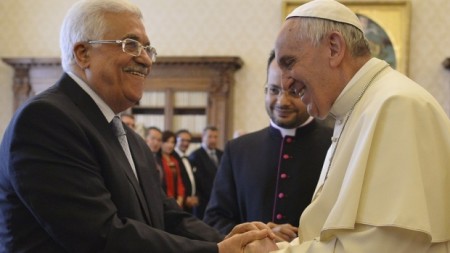
francis-and-abbas-450x253

Perhaps the ultimate expression of this faith in Islam was Pope Francis’ assertion in Evangelii Gaudium that “authentic Islam and the proper reading of the Koran are opposed to every form of violence.”

**************************

Contrary to reports in the mainstream press, Pope Francis did not call Palestinian Authority leader Mahmoud Abbas “an angel of peace.” The correct translation of the pope’s words is “I have thought of you: that you could be an angel of peace.”

Why, then, was it so easy to believe the initial reports? Perhaps because the initial reports seemed to align with previous papal overtures to Palestinian leaders. Pope Francis had previously called Abbas a “man of peace,” he has shown sympathy for Palestinian grievances, and other popes have given the appearance of lending legitimacy to the Palestinian cause. For example, Pope John Paul II is reported to have received PLO leader Yasser Arafat on twelve different occasions.

Arafat was a terrorist. One would think that the Vatican would have wanted to limit its contacts with him. The same goes for Abbas. He has repeatedly honored and praised Palestinian “martyrs” who have slaughtered innocent Jews. There is evidence that he helped fund the 1972 operation that killed eleven Israeli athletes at the Munich Olympic Games. Why is he accorded such a cordial reception at the Vatican?

Although the Church has often declared its spiritual bond with Jews, it has had a less harmonious relationship with the nation where approximately half the world’s Jews now reside. The Vatican was the last Western government to accord diplomatic recognition to the State of Israel (in 1993). In addition, on several occasions, prominent prelates have likened Israel to King Herod, the murderer of innocents; and others have accused Israel of being an apartheid state. Meanwhile, Catholic NGOs such as Pax Christi and Trocaire have been major players in the boycott, divest, and sanctions campaign against Israel.

Of course, the BDS campaign directly impinges on Israeli security. So do the calls by numerous Christian leaders to tear down the security barrier that divides Israel from the West Bank. On his trip to the Holy Land a year ago, Pope Francis allowed himself to be photographed in prayer at a section of the wall where a large graffiti message compared Bethlehem to the Warsaw Ghetto. In a naïve gesture of solidarity with Palestinians, the pope was unwittingly lending credence to the idea that the Israelis could be compared to the Nazi occupiers of Poland.

The wall was constructed to prevent suicide attacks against Israeli citizens. It’s estimated that its construction has saved thousands of lives. To suggest that the wall is offensive, as many Christians have done, is to suggest that Jewish lives don’t matter. Moreover, such judgments betray an entirely lopsided view of the situation. Take the Gaza conflict. The Catholic hierarchy typically had little to say about the daily rocket barrages launched against Israeli citizens from Gaza, but it was quick to condemn Israel on those occasions when it finally retaliated. In a similar vein, Fouad Twal, the Latin Patriarch of Jerusalem, blamed last year’s Gaza war on the Israeli embargo which, he said, had turned Gaza into “a factory of desperate people, designed to easily turn into extremists.”

In short, many Catholic leaders have shown a tendency to blame Israel for defending itself. The implication, of course, is that there would be no need for defense if Israel would only go to the peace table and make the concessions demanded of it by the Palestinians. The Vatican’s recent recognition of the “State of Palestine” reflects this naïve view of the situation. The supposition is that the Palestinians only want to be left in peace, whereas there is abundant evidence that the deepest desire of Palestinian leaders is for the extermination of Israel. Have Vatican officials never seen the photos of Abbas holding up a map of Palestine that encompasses all of the territory currently known as Israel? Are they unaware that he has personally called for a Palestine that is Judenrein? Didn’t they notice that when Israel gambled on disengaging from the Gaza Strip in 2005, Gaza soon turned into a terrorist state governed by an obsession to destroy Israel?

From the Israeli point of view, the call to cooperate with the Palestinian “peace” agenda is a call to cooperate in its own demise. Whenever I hear a UN representative or a Vatican spokesman call for peace talks between Israel and Palestine, I think of that scene from Goldfinger in which James Bond is about to be sliced in two by a laser beam. “Do you expect me to talk?” he asks. “No, Mr. Bond,” replies Goldfinger, “I expect you to die.” The Vatican hasn’t yet grasped the point that the Palestinian leadership doesn’t want the Israelis to talk, it wants them to die.

By words and by actions, the Vatican continues to suggest that there is a moral equivalence between Israel and the Palestinian Authority. This policy not only does a disservice to Jews, it also does a disservice to Catholics and other Christians. The main effect of the moral equivalence stance is to sow confusion among Catholics at a time when they need to be clear and unconfused—clear about Islam, that is. The Vatican policy toward Palestine reflects it overall stance toward the Islamic world. In other words, let’s overlook the dark side—the terrorism, the anti-Semitism, the oppression of Christians and other minorities—and let’s put the best face on the Mohammedan faith. For the sake of peace. And also for the sake of maintaining the threadbare narrative that Islam is a close cousin of Catholicism and, therefore, a religion of peace. Perhaps the ultimate expression of this faith in Islam was Pope Francis’ assertion in Evangelii Gaudium that “authentic Islam and the proper reading of the Koran are opposed to every form of violence.”

How well has this policy worked? Not very. Catholics and other Christians who lived in Muslim lands and who took seriously the Catholic version of “this has nothing to do with Islam” soon found that the tiny minority of misunderstanders were legion and had murder on their minds. Many found out too late. Years of indoctrination in the myth of Islam’s pacific nature had left them unprepared for the violence. Not that the Church was the only culprit. The secular opinion-makers had been preaching the same gospel. The irony is that the Church wants Israel to adopt the same policy of make-believe about Islam that has contributed to the death and displacement of millions of Christians.

The policy requires an almost total denial of facts. In the case of the Arab-Israeli crisis it means ignoring the terrorist ties of the Palestinian government, its unity coalition with Hamas, the massive state-sponsored indoctrination of Palestinian children, and the oft-stated goal of eliminating Israel. Ironically, it also necessitates that one ignore the ongoing persecution of Christians in the Palestinian territories.

The Palestinian leaders do a good job of hijacking Christian themes and imagery in order to gull Christians into thinking that they are, indeed, brothers in Christ. Thus, Palestinians have milked the massacre-of-the-innocents meme for all its worth. They also like to claim that Jesus was the first Palestinian. Another favorite theme is that the Palestinian people are the “new Jesus” who is being crucified by the Israelis.

Many in the Catholic hierarchy seem to fall for the ruse, but the steady exodus of Christians from the Palestinian territories tells a different story. The overall population of Christians in the Palestinian areas has declined from 15 percent in 1950 to 2 percent today. After the Palestinian Authority took control over Bethlehem in 1995, the Christian population there declined by half. In the Gaza Strip, only a few hundred Christians remain. That’s because Christians in Palestine, like Christians in most Muslim-majority societies, are treated as second-class citizens—subject to rape, intimidation, and legalized theft.

Meanwhile, the Christian population of Israel continues to grow. Palestinian Christians want to live there and so do persecuted Christians in other parts of the Middle East. Despite years of propaganda to the contrary, they have come to realize that Israel is a safe haven in a world of Islamic chaos.

Do Christians who migrate to Israel know something that the Vatican doesn’t know? The facts are there for everyone to see, but not everyone sees them. Why do Catholic leaders persist in assigning moral equivalence when there is no moral equivalence? Normally, a belief in moral equivalence grows out of a relativistic outlook. But presumably we can rule that out in the case of Catholic prelates. A more likely cause of their moral neutrality is a misapplication of the principle of “judge not.” Christians today are highly conscious of the sins of Western civilization and are therefore reluctant to judge those who lie outside it—in this case, Muslims. However, the principle is meant to apply to judgments about the state of an individual’s soul, not his behavior. And it was never meant to apply to withholding judgments about ideologies and belief systems.

The reluctance to see the mote in the other’s eye can eventually slide over into willful blindness. There are numerous warnings in the New Testament about spiritual blindness and they apply to those within the Church as well as to those without. The big danger for Church leaders is not that they will be seen as judgmental in the eyes of the world, but that they will be seen as foolishly naïve in the eyes of history.

“First comes Saturday, then comes Sunday” is a well-known slogan in the Middle East. It means that after the Islamists finish with the Jews, they will come after the Christians. The fate of the Saturday people and the Sunday people is intertwined. And the fate of both is put in jeopardy when Christian leaders insist on holding on to a fantasy-based picture of Islam.

Promises are Made to be Broken and Lies are Meant to be Kept

May 20, 2015

US, Israel said to discuss ‘compensation’ in wake of emerging Iran deal


(While increasing U.S. military aid to Israel is a good thing, tying it to a bum deal is not. If I had a say, I would take the deal and get all I can in terms of military hardware and technology. Afterall, bad deals never last, including one with Iran and including Obama’s term in office. – LS)

Additional F-35 jets, anti-missile defense batteries reportedly part of package to win Israel’s quiet acceptance of nuclear accord, Israeli media reports.

Israel and the US were reportedly holding preliminary and unofficial talks over a “compensation” package for Jerusalem that would include the delivery of advanced weapons in exchange for the Netanyahu government’s quiet acceptance of the emerging nuclear deal with Iran.

The package could include an increase of the amount of F-35 fighter jets the US was set to supply Israel with and additional batteries for Israel’s anti-missile defense systems, according to reports in both Haaretz(Hebrew) and Yediot Ahronoth this week.

A senior Obama administration official told Yediot that “the White House is willing to pay a hefty price to get some quiet from the Israelis at this point. We are surprised the demand has not been made.”

But the newspaper also quoted an unnamed Israeli source as conveying a more ambivalent stance about the reported talks.

“If we come with demands at this point, it would mean that we have given up our objections to the deal, and now it is just a matter of at what price. If Israel believes that the deal is bad for its security, it cannot appear as someone who gave up in the end,” the paper quoted the source as saying.

According to the reports in both Haaretz and Yediot, the US-Israel talks revolved around enhancing a previously negotiated deal to supply Israel with 33 F-35 aircraft, the first batch of which was expected next year. The total number of jets could go up to 50, Haaretz reported.

Israel was also said to be asking for more Iron Dome batteries, additional assistance with the Arrow 3 missile system developed jointly by the US and Israel, and possibly, for the purchase of technological systems for intelligence gathering.

Earlier this month, the US House of Representatives Armed Services Committee approved $474 million for Israel’s anti-missile systems.

Included in the US-Israel cooperative missile defense funds is $41.4 million for the short-range Iron Dome rocket defense system, $165 million for David’s Sling, another short-range system, and the longer-range Arrow-3 missile defense programs, as well as $267.6 million in research and development funds.

Israel has been a very vocal opponent of the nuclear deal the US-led P5+1 world powers are negotiating with Iran ahead of the June 30 deadline for an agreement. Prime Minister Benjamin Netanyahu has warned that the deal paves the way for Iran to acquire nuclear weapons and that Israel’s very survival would be at stake.

“We oppose this deal and we are not the only ones,” Netanyahu said on Sunday, noting that regional Arab, largely Sunni Muslim states are also skeptical of the deal. “It is both necessary and possible to achieve a better deal because extremists cannot be allowed to achieve their aims, not in Iran, not in Yemen and not in Jerusalem.”

Arab states of the Gulf fear a nuclear deal could be a harbinger of closer US ties with their Shiite arch-foe Iran, a country they also see as fueling conflicts in Yemen, Syria and Iraq.

US President Barack Obama tried to reassure America’s Gulf allies at a Camp David summit last week that engaging with Iran would not come at their expense. These states were also reportedly negotiating their own “compensation packages” involving advanced equipment and weaponry from the US to counter the perceived Iranian threat.


This is What American Soldiers Fought and Died For?

May 19, 2015

Iraqi troops retreat from Ramadi as Isis militants move in – video
Via The Guardian 5-19-2015 Source: Reuters

CLICK HERE FOR VIDEO

(To say something like ‘what a waste’ is a huge understatement. That sort of comment must be reserved for going into Iraq in the first place. – LS)

Iraqi government forces retreat from Ramadi as Isis militants claim control of the city on Sunday. Iraqi military vehicles are shown driving away from the city. Up to 500 people, Iraqi civilians and soldiers, have been killed in the battle for the city, and 8,000 have fled their homes. One woman describes the situation on the streets of Ramadi as chaotic and violent. On Monday, Iraqi militias were belatedly attempting to push back against Islamic State forces in Anbar province.

Next challenge for US after Ramadi defeat: Iranian ship nears Yemeni shore

May 19, 2015

Next challenge for US after Ramadi defeat: Iranian ship nears Yemeni shore, DEBKAfile, May 19, 2015

Iran_Shahed_21.5.15Iranian aid vessel with “medical relief” personnel

DEBKAfile’s analysts strongly doubt that the USS Theodore Roosevelt carrier and strike force, which have been monitoring the Iranian flotilla’s movements, will be ordered to intervene against the Iranian ships reaching the Yemeni port.

Tehran, for its part has threatened to treat any such inspections as an act of war.

********************

Tuesday, May 19, two days after Ramadi’s fall to the Islamic State landed a major blow to Baghdad and US strategy in the region, 10,000 troops – more than half American – ended a large US-led military exercise in Jordan that was designed to practice tactics for countering ISIS. Taking part surprisingly in the two-week exercise was a heavy US nuclear-capable B-52H bomber, which flew in from the United States, crossing through Israeli air space and returning to home base when it was over.

This was the first time in the 12 years since the US invasion of Iraq that a B-52H, which can deliver nuclear weapons and bunker buster bombers, has appeared in Middle East skies for any military mission.

East of Jordan, as some 25,000 refugees from Ramadi slept in the open, the Islamist conquerors began moving on their next target, the Habbaniyah air base some 70 km west of Baghdad. Its fall would cut Baghdad off from northern and eastern Iraq and place it under siege from three directions – north, east and west.

Most Arab members have dropped out of the US-led coalition committed to fighting the Islamist terrorists in Iraq and Syria. This has left the US Air Force to bear the brunt of the aerial campaign. Its average of 19 air strikes a day is far too few to have any real effect on ISIS’s battle momentum. It certainly did not stop the long columns of black-clad Islamist fighters swarming on Ramadi from all directions in hundreds of tanks, APCs and minivans armed with heavy machine guns, and taking control of the capital of Iraq’s largest province, Anbar.

Western intelligence from the Ramadi region offered disturbing accounts of thousands of fully-armed ISIS fighters springing up apparently from nowhere to descend on the city, with no one able to see where they came from and no air action to scatter them before they entered the city.

After the Ramadi defeat, the Obama administration’s next major test in the region comes from an Iranian cargo vessel heading, accompanied by two warships, for the Yemeni Red Sea port of Hodeida and scheduled to dock Thursday, May 21. According to Tehran, the ship will unload 2,500 tons of humanitarian aid for Yemen, and the hundreds of passengers who disembark are Red Crescent medical relief workers.

The Saudi, US and Egyptian fleets have imposed a sea and air blockade on Yemen to prevent Iran provding the Yemeni Houthi rebels with fresh arms. Saudi and other regional intelligence agencies are convinced that the “paramedics” are in fact Revolutionary Guards officers and instructors in disguise, sent to strengthen the Houthi revolt.

Washington, Riyadh and Cairo have all vowed to stop the Iranian flotilla from putting into port in Yemen and said that its vessels will be forced to submit to inspections to make sure no illicit weapons are aboard and to confirm the passengers’ identities.

Tehran, for its part has threatened to treat any such inspections as an act of war.

Deputy Revolutionary Guards Commander Gen. Masoud Jazayeri put it plainly when he said: “I am distinctly stating that the patience of Iran has limits. If the Iranian aid ship is prevented from reaching Yemen then they, Saudi Arabians and United States, should expect action from us.”

DEBKAfile’s analysts strongly doubt that the USS Theodore Roosevelt carrier and strike force, which have been monitoring the Iranian flotilla’s movements, will be ordered to intervene against the Iranian ships reaching the Yemeni port. It is not a good moment for President Barack Obama to upset Tehran when he is in dire need of the Iraqi Shiite militias controlled by Iran to stand up to ISIS before its columns reach Baghdad.

Without the US, it is hard to see Saudi and Egyptian warships directly engaging an Iranian naval force and risking a major military conflagration.

Therefore, just as the B-52H came and went without action to impede ISIS’s creep closer to Baghdad, the Roosevelt is not likely to halt Iranian warships before they reach Yemen.

Documents: Feds Knew Benghazi Attack Planned in Advance

May 19, 2015

Documents: Feds Knew Benghazi Attack Planned in Advance, Washington Free Beacon, May 18, 2015

(Please see also, Arab military chiefs approve Egyptian-led intervention in Libya — DM)


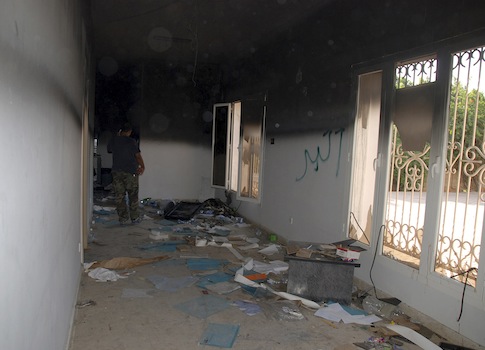
Gutted U.S. consulate in Libya / AP

Documents obtained by Judicial Watch from their May 2014 Freedom of Information Act (FOIA) lawsuits filed against the State Department and the Department of Defense revealed that the Obama administration knew about the attacks on the U.S. Consulate in Benghazi at least 10 days before the attack.

The documents also revealed that the DOD immediately reported the attacks on the consulate.

The documents included an August 2012 analysis predicting the failure of President Obama’s policy of a regime change in Syria as well as a warning about the rise of the Islamic State. The documents also included a confirmation that United States was aware of an arms shipment from Benghazi to Syria.

One of the documents from the DOD’s Defense Intelligence Agency dated September 12, 2012, the day after the attacks in Benghazi, lays out the details of the attack on the consulate and assesses that it was carefully planned by the terrorist group “Brigades of the Captive Omar Abdul Rahman.”

The group is known to have connections to the Muslim Brotherhood as well as  to al Qaeda. Rahman is serving a life sentence in prison for his role in the 1993 bombing of the World Trade Center.

The group’s goal was to “kill as many Americans as possible,” according to the documents, which were sent to Secretary of State Hillary Clinton, Defense Secretary Leon Panetta, the Joint Chiefs of Staff, and the National Security Council.

An October 2012 DOD document contained the first official document that the Obama administration knew of the shipment of weapons from the Benghazi to rebel forces in Syria.

Weapons from the former Libya military stockpiles were shipped from the port of Benghazi, Libya to the Port of Banias and the Port of Borj Islam, Syria. The weapons shipped during late-August 2012 were Sniper rifles, RPG’s, and 125 mm and 155 mm howitzers missiles.

During the immediate aftermath of, and following the uncertainty caused by, the downfall of the (Qaddafi) regime in October 2011 and up until early September of 2012, weapons from the former Libya military stockpiles located in Benghazi, Libya were shipped from the port of Benghazi, Libya to the ports of Banias and the Port of Borj Islam, Syria. The Syrian ports were chosen due to the small amount of cargo traffic transiting these two ports. The ships used to transport the weapons were medium-sized and able to hold 10 or less shipping containers of cargo.

The heavily redacted document did not reveal which weapons were sent to Syria

The DIA consistently warned of the deterioration of the situation in Iraq and warned that it creates an ideal situation for Al Qaeda to return to Mosul and Ramadi, according to an August 2012 report. During this time the U.S. was monitoring weapons flows from Libya to Syria. The agency warned of dire consequences but blocked out what most of what those consequences were.

The State Department produced a single document from a separate lawsuit that Judicial Watch had filed against the department. The document was created by Hillary Clinton’s office the morning after the attacks on the consulate in Benghazi and was sent throughout the State Department.

Neither the State Department nor Hillary Clinton have turned over any documents in regards to Benghazi or her personal email account that was used during her as well as other top aides during her time as Secretary of State.

Judicial Watch has filed multiple FOIA requests and has waited over two years for the documents that they have received.

“These documents show that the Benghazi cover-up has continued for years and is only unraveling through our independent lawsuits,” said Tom Fitton, president of Judicial Watch. “The Benghazi scandal just got a whole lot worse for Barack Obama and Hillary Clinton.”

Arab military chiefs approve Egyptian-led intervention in Libya

May 19, 2015

Arab military chiefs approve Egyptian-led intervention in Libya, DEBKAfile, May 19, 2015

(Obama will be displeased. — DM)

Arab military chiefs held an unpublicized meeting in Cairo Monday to confirm coordinated plans for Egyptian-led regional intervention into the eastern Libya region of Cyrenaica to drive out the armed extremists, who have kept the country locked in chaos since Muammar Qaddafi’s ouster, and install a stable government in the region;s capital of Benghazi. The meeting was attended by the chiefs of staff of Egypt, Jordan, Saudi Arabia, UAE, Kuwait, Bahrain, Sudan and the Libyan Tobruk government. Talks are ongoing with France and Libya to take part in the operation. Both have a direct interest in putting a stop to the ungoverned flow of African refugee migrants to Europe through Libya, which is being used by Islamic State terrorists to infiltrate Europe. France will be asked for logistic support and special forces for the Libyan operation and Italy to provide naval support. Egyptian President Abdel-Fatteh El-Sisi is seeking  early military action cut down the fast-expanding ISIS threat to his country, the region and southern Europe.