Archive for the ‘Obama’ category

Six powers agree on UN sanctions ‘snapback’ in push for Iran deal, sources say

May 31, 2015

Six powers agree on UN sanctions ‘snapback’ in push for Iran deal, sources say, Jerusalem Post, May 31, 2015

(Obviously, the tentative “deal” raises more questions than it answers, including its “non-binding” nature and whether Russia, China and even Iran would have vetoes.– DM)
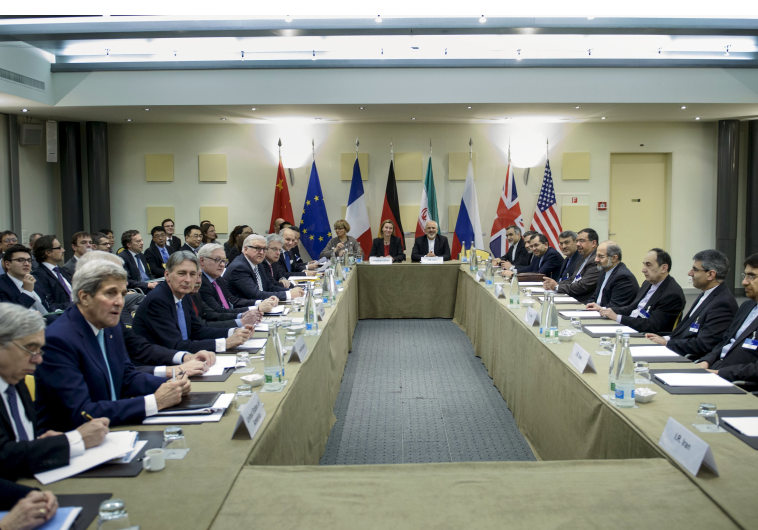
P5+1 meetingOfficials wait for a meeting with officials from P5+1, the European Union and Iran at the Beau Rivage Palace Hotel in Lausanne March 31, 2015.. (photo credit:REUTERS)

As part of the new agreement on sanctions snapback, suspected breaches by Iran would be taken up by a dispute-resolution panel, likely including the six powers and Iran, which would assess the allegations and come up with a non-binding opinion, the officials said.

As part of the new agreement on sanctions snapback, suspected breaches by Iran would be taken up by a dispute-resolution panel, likely including the six powers and Iran, which would assess the allegations and come up with a non-binding opinion, the officials said.

It was unclear exactly how the snapback mechanism would function, and the officials did not discuss the precise details. It was also unclear how the proposal would protect the United States and other permanent Council members from a possible Chinese or Russian veto on sanctions restoration.

**********************

New York, Paris, Ankara – Six world powers have agreed on a way to restore UN sanctions on Iran if the country breaks the terms of a future nuclear deal, clearing a major obstacle to an accord ahead of a June 30 deadline, Western officials told Reuters.

The new understanding on a UN sanctions “snapback” among the six powers – the United States, Britain, France, Germany, Russia and China – brings them closer to a possible deal with Iran, though other hurdles remain, including ensuring United Nations access to Iranian military sites.

The six powers and Iran struck an interim agreement on April 2 ahead of a possible final deal that would aim to block an Iranian path to a nuclear bomb in exchange for lifting sanctions. But the timing of sanctions relief, access and verification of compliance and a mechanism for restoring sanctions if Iran broke its commitments were among the most difficult topics left for further negotiations.

US and European negotiators want any easing of UN sanctions to be automatically reversible if Tehran violates a deal. Russia and China traditionally reject such automatic measures as undermining their veto power as permanent members of the UN Security Council.

As part of the new agreement on sanctions snapback, suspected breaches by Iran would be taken up by a dispute-resolution panel, likely including the six powers and Iran, which would assess the allegations and come up with a non-binding opinion, the officials said.

The International Atomic Energy Agency (IAEA) would also continue regularly reporting on Iran’s nuclear program, which would provide the six powers and the Security Council with information on Tehran’s activities to enable them to assess compliance.

If Iran was found to be in non-compliance with the terms of the deal, then UN sanctions would be restored.

The officials did not say precisely how sanctions would be restored but Western powers have been adamant that it should take place without a Security Council vote, based on provisions to be included in a new UN Security Council resolution to be adopted after a deal is struck.

“We pretty much have a solid agreement between the six on the snapback mechanism, Russians and Chinese included,” a Western official said. “But now the Iranians need to agree.”

Another senior Western official echoed his remarks, describing the agreement as “tentative” because it would depend on Iranian acceptance.

A senior Iranian diplomat said Iran was now reviewing several options for the possible “snapback” of Security Council sanctions against Tehran.

It was unclear exactly how the snapback mechanism would function, and the officials did not discuss the precise details. It was also unclear how the proposal would protect the United States and other permanent Council members from a possible Chinese or Russian veto on sanctions restoration.

US Ambassador to the United Nations Samantha Power has made it clear that Washington does not want Russia’s and China’s recent slew of vetoes on resolutions related to Syria to be repeated with an Iran nuclear agreement.

France’s Ambassador to the United States Gerard Araud said in Washington last week that, under a French idea, sanctions would be reinstated automatically in the event of non-compliance, avoiding the threat of a veto.

Under that idea, which Araud said had not to date been approved by the six powers, the onus would be on Russia or China to propose a Security Council vote not to re-impose sanctions.

Russian and Chinese officials did not respond immediately to requests for confirmation that they signed off on the snapback mechanism.

REVIEWING THE OPTIONS

US Secretary of State John Kerry met with Iranian Foreign Minister Mohammad Javad Zarif in Geneva on Saturday. They discussed progress and obstacles to an agreement in the Iran nuclear talks a month before the deadline for a deal aimed at reducing the risk of another war in the Middle East.

Restoring US and EU sanctions is less difficult than UN sanctions because there is no need for UN Security Council involvement.

For their part, Moscow, Beijing and Tehran have wanted assurances that Washington cannot unilaterally force a sanctions snapback – a risk they see rising if a Republican wins the US presidency in 2016.

A senior Iranian diplomat confirmed that discussions of specific snapback options were underway. He told Reuters Tehran was preparing its own “snapback” in the event the Western powers fail to live up to their commitments under the agreement.

“At least three or four different suggestions have been put on the table, which are being reviewed,” he said. “Iran also can immediately resume its activities if the other parties involved do not fulfill their obligations under the deal.”

He added that it was “a very sensitive issue.”

If Iran accepts the proposed snapback mechanism, there are other hurdles that must be overcome, including IAEA access to Iranian military sites and nuclear scientists and the pace of sanctions relief.

Iran says its nuclear program is entirely peaceful and rejects allegations from Western countries and their allies that it wants the capability to produce atomic weapons. It says all sanctions are illegal and works hard to circumvent them.

Iran weighs turning Hizballah’s anti-Israel missiles against ISIS to save Damascus and Baghdad

May 30, 2015

Iran weighs turning Hizballah’s anti-Israel missiles against ISIS to save Damascus and Baghdad, DEBKAfile, May 30, 2015

(But only about 1,000 of the claimed 80,000.– DM)

Hezbollahs_missile_5.15A Hizballah missile

Hizballah’s General Secretary Hassan Nasrallah frequently brags that his 80,000 missiles can reach any point in Israel. He may have to compromise on this. His masters in Tehran are casting about urgently for ways to save the Assad regime in Damascus and halt the Islamic State’s’ inexorable advance on Baghdad and the Shiite shrine city of Karbala. According to DEBKAfile’s Gulf sources, Iran is eyeing the re-allocation of the roughly 1,000 long-range rockets in Hizballah’s store for warding off these calamities.

Some would be fired from their pads in Lebanon, exposing that country to retaliation, after Beirut rebuffed Hizballah’s demand for the Lebanese army to join in the fight for Assad.

Iran has not so far approved the plan. But if it does go through, Iranian spy drones operating over the war zones would feed with targeting data on ISIS and rebel positions and movements to the Hizballah rocket crews manning the mobile batteries of Fajr-5s – range 400-600 km; Zelzal-2s – range 500 km; Fateh-110s -range 800 km; and Shaheen 2s – 800-900 km.

Discussions in Tehran on this option took on new urgency Thursday, May 28, when White House spokesman Josh Earnest declared that the United States “would not be responsible for securing the security situation in Iraq. Our strategy is to support the Iraqi security forces… back them on the battlefield with coalition military air power as they take the fight to ISIS in their own country,” he said.

Tehran took this as confirmation that the US was quitting the war on the Islamic State in Iraq although the Obama administration’s decision was coupled with a free hand for the Baghdad government to do whatever it must to deal with the peril, including calling on external forces for assistance in defending the country.

In the Iraqi arena, Iran has thrown into the fray surrogate Shiite militias grouped under “The Popular Mobilization Committee.” It is led by Abu Mahdi al-Muhandis, who turns out to be an Iranian, not an Iraqi, and working under cover as the deputy of the Al Qods Brigades Commander Gen. Qassem Soleimani.

This grouping is too shady for President Barack Obama to accept as worthy of US air support. Therefore, the entire anti-ISIS campaign has been dumped in Iran’s lap. Loath to expose its own air force planes to the danger of being shot down over Iraq, Iran is looking at the option of filling the gap with heavy missiles.

In the Syrian arena, Tehran is under extreme pressure:

1. The Assad regime can’t last much longer under fierce battering from the rebel Nusra Front, freshly armed and funded with massive assistance from Saudi Arabia, Qatar and Turkey. To disguise this group’s affiliation with al Qaeda, the Saudis have set up a new outfit called “The Muslim Army of Conquest.” In a few days it was joined by 3,000 Nusra adherents.

2.  The Syrian army has lost heart under this assault and many of its units are fleeing the battlefield rather than fighting, with the result that Bashar Assad is losing one piece of territory after another in all his war sectors. Soon, he will be left without enough troops for defending Damascus.

3.  Although Hizballah’s leaders proclaim their determination to fight for Assad in every part of Syria, the fact is that the Shiite group is too stretched to support a wide-ranging conflict in Syria and defend its own home base in Lebanon at one and the same time.

4. Tehran is also considering rushing through a defense pact with Damascus to enable Assad to call on Iranian troops to come over and rescue him.

5. Saudi Arabia has singled out leaders of top Hizballah leaders for sanctions. This week, Riyadh impounded the assets and accounts of Khalil Harb and Muhammad Qabalan in Gulf banks. This act was taken in Tehran as a major provocation.

The names don’t mean much outside a small circle in the region. However, Harb is Hizballah’s supreme chief of staff whose military standing is comparable to that of the Iranian Revolutionary Guards commander Gen. Ali Jaafary, while Qabalan is the organization’s senior intelligence and operations officer and responsible for orchestrating Hizballah’s terrorist hits outside Lebanon.

The Iranians are not about to let this affront go by without payback, which could come in the form of missile attacks by Hizballah on Saudi-backed groups in Syria.

Permission to Shoot Here Boss

May 29, 2015

Obama Preventing Our Air Force from Firing on ISIS Forces With Absurd ‘Rules’ of Engagement’

By Warner Todd Huston Via Publius’ Forum

(Micromanagement on steriods. – LS)

Our Air Force jet pilots are beginning to gripe about Obama’s ISIS-supporting “rules of engagement” and saying that Obama is telling them they aren’t allowed to fire on ISIS targets. That is right, Obama is preventing our military from killing ISIS terrorists.

Apparently ISIS has their own leader in Washington and it’s Barack Obama who seems to be making sure that ISIS fighters are protected from American power.

U.S. military pilots carrying out the air war against the Islamic State in Iraq and Syria are voicing growing discontent over what they say are heavy-handed rules of engagement hindering them from striking targets.

They blame a bureaucracy that does not allow for quick decision-making. One Navy F-18 pilot who has flown missions against ISIS voiced his frustration to Fox News, saying: “There were times I had groups of ISIS fighters in my sights, but couldn’t get clearance to engage.”

He added, “They probably killed innocent people and spread evil because of my inability to kill them. It was frustrating.”

Sources close to the air war against ISIS told Fox News that strike missions take, on average, just under an hour, from a pilot requesting permission to strike an ISIS target to a weapon leaving the wing.

No wonder ISIS is so bold. They have a most powerful ally in the White House.


On achievements and ideas

May 29, 2015

On achievements and ideas, Israel Hayom, Maj. Gen. (ret.) Yaakov Amidror, May 29, 2015

Lately it looks as though the Islamic State group has managed to rack up highly significant geographic achievements. These coups will lead to the group controlling the enormous expanse of territory west of Baghdad to the Syrian border beyond Palmyra by establishing rule in the north and east of the crumbling Syrian state.

The occupation of Ramadi, one end of an arch that bridges between the Iraqi capital and Palmyra in the heart of northern Syria, serves as a base for future gambits of even greater importance. We shouldn’t wonder if the group needs a little time to “digest” the new areas it has conquered, to take care of any local population that might resist, if any such remains, and to settle its rule on the rest of the residents and prepare for retaliatory attacks by the Syrian and Iraqi armies and their auxiliary militia forces.

It appears that in Iraq and Syria — but more importantly, in the U.S. — it is understood that the counterattack stage could turn out to be critical. If the group overcomes these strikes, it is hard to imagine what might stop it in the future, barring full-scale involvement by the U.S. military that would include heavy ground forces.

After the counter-strikes, the moment the organization feels secure in its new area, and we cannot know how long that will take, it will face the standard dilemma presented by such situations: What next? By nature, a group like this cannot refrain from action for long. It needs constant movement; it is thirsty for new gains and fears the “stagnation” that could affect it after a period of calm. The group is still in its dynamic stage, continuing to rise. It has four options for action, and no one knows which one its leaders will choose. It is possible that they themselves have not made up their minds and are still not ready to decide, at least until the results of any possible counterattack become clear.

Islamic State’s next “natural” effort could be toward Baghdad, to strengthen its rule of everything west of the Iraqi capital. The goal would be to strike a fatal blow to the Shiite government’s operational ability in the Sunni regions the group has taken thus far, and maybe even to bring down the present Iraqi regime.

Such a move would doubtless put pressure on the ruling Shiites and their Iranian allies, because when an organization like this approaches areas with a dense Shiite population, as well as the cities most holy to Shiites, the latter envision a mass slaughter. So there is no question that a move like that, if successful, would force the Iranians to make some tough decisions, mainly about whether to opt for direct military intervention.

The group has another option in Iraq: to the north, beyond Kurdistan. If it managed to take control of the areas where the Kurds are currently extracting oil, it would enjoy maximal success, running nearly an entire country and putting heavy pressure on Turkey. That looks tempting, because the West hasn’t taken care to adequately arm the Kurds, the only ones so far who have fought the group successfully.

It is also possible that after its great success in Iraq, the group will prefer to entrench its rule over northern Syria — in other words, seize control of Aleppo and Homs. That would be an ambitious plan given the size of the geographic area, but it appears any resistance there would be weaker than it would be in a metropolis like Baghdad or from the fierce Kurds. If Islamic State took Aleppo and Homs, it would improve its chances of eventually taking action against the Kurds, particularly their Syrian wing.

In Syria, the main ones opposing the group would be President Bashar Assad’s exhausted army. In that area, other Sunni groups from what is known as the army of insurgents might join Islamic State, granting it legitimacy in the eyes of the locals. A move like that could lead to a dramatic change in Assad’s position and force Hezbollah to spread its forces even thinner. A loss of Hezbollah’s strategic homefront and the presence of its Sunni haters breathing down the neck of the Alawite minority, on the coast of Latakia, means a threat to a region that is vital to Hezbollah and to the Iranians’ position in Syria, and eventually in Lebanon. The Iranians and Hezbollah would do almost anything to protect these, because any threat to them is an existential one. If the Islamic State group acquires control of Alawite or Shiite areas, it will exterminate everyone there. This is a life or death struggle. That’s clear to everyone.

The ambitious option

And there is a fourth option, which for now seems less appealing and therefore less likely, although not impossible. It’s possible that to avoid clashing with Shiite strength around Baghdad or with Alawite and Hezbollah desperation en route to Damascus, the group will turn its attention to Amman.

All the residents of Jordan are Sunni, and some of them could begin to identify with a serious, successful Sunni group that purports to act on behalf of Sunnis, who are in distress because of the Shiite dynamic in the Middle East. The group could asses that it would be easier for it to operate against Jordan, and if it does so successfully it would have more convenient access to Saudi Arabia — the crown jewel of the Muslim world.

Saudi Arabia is the target that anyone who talks about an “Islamic caliphate” dreams of, because it is home to Mecca and Medina, the two holiest cities for any Muslim. In acting against Jordan, the group could combine a military maneuver with an attempt to influence the kingdom from inside by exploiting the social and economic problems in Jordan that have worsened because of the mass influx of refugees from Syria.

Today, the chances of the organization succeeding in Jordan appear very slim. The Jordanian army, unlike the armies of Iraq and Syria, is both serious and professional and among many Jordanians, the king is popular as well as legitimate. Jordan is no easy prey, and it would certainly have the help of everyone for whom the kingdom’s stability is important.

In any case, it is obvious that the American intervention thus far has not brought the U.S. any closer to the goal defined by President Barack Obama of “destroying the organization.” The opposite — it has grown stronger and expanded its area of control since the U.S. declared war on it. The last chance the U.S. has to continue its current policy, avoiding the deployment of massive American ground forces, is conditional upon its ability to give the Iraqi army the assistance it needs in the attack it is promising to execute, and possibly on helping the Syrian army indirectly.

The Americans will take a look at themselves after these battles, when it becomes clearer whether the group’s recent successes are the regular ups and downs seen in conflicts like these, or whether they have altered its standing, and Islamic State will now take advantage of the momentum to move on more ambitious targets.

The rational Ayatollah hypothesis

May 29, 2015

The rational Ayatollah hypothesis, Power LineScott Johnson, May 28, 2015

In his Wall Street Journal column this past Tuesday, Bret Stephens took up “The rational ayatollah hypothesis” (accessible via Google here). That hypothesis — asserted, I would say, as a thesis if not a fact by our Supreme Leader about Iran’s Supreme Leader — holds that economics and other such considerations constrain the anti-Semitic behavior of the Islamic Republic of Iran. So about those nuclear weapons that Iran is developing on — Israel is not to worry. Neither are we. It’s the Alfred E. Newman approach writ large.

Obama articulated his thesis in response to a question posed by Jeffrey Goldberg in his recent interview of Obama. I wrote about it in “Obama expounds the limits of Iran’s anti-Semitism.” I struggled because Obama’s observations are both ignorant and obtuse. Stephens takes up Obama’s thesis somewhat more elegantly than I did:

Iran has no border, and no territorial dispute, with Israel. The two countries have a common enemy in Islamic State and other radical Sunni groups. Historically and religiously, Jews have always felt a special debt to Persia. Tehran and Jerusalem were de facto allies until 1979, when Ayatollah Khomeini came to power and 100,000 Jews still lived in Iran. Today, no more than 10,000 Jews are left.

So on the basis of what self-interest does Iran arm and subsidize Hamas, probably devoting more than $1 billion of (scarce) dollars to the effort? What’s the economic rationale for hosting conferences of Holocaust deniers in Tehran, thereby gratuitously damaging ties to otherwise eager economic partners such as Germany and France? What was the political logic to Mahmoud Ahmadinejad’s calls to wipe Israel off the map, which made it so much easier for the U.S. and Europe to impose sanctions? How does the regime shore up its domestic legitimacy by preaching a state ideology that makes the country a global pariah?

Maybe all this behavior serves Tehran’s instrumental purposes by putting the regime at the vanguard of a united Shiite-Sunni “resistance” to Western imperialism and Zionism. If so, it hasn’t worked out too well, as the rise of Islamic State shows. The likelier explanation is that the regime believes what it says, practices what it preaches, and is willing to pay a steep price for doing so.

So it goes with hating Jews. There are casual bigots who may think of Jews as greedy or uncouth, but otherwise aren’t obsessed by their prejudices. But the Jew-hatred of the Iranian regime is of the cosmic variety: Jews, or Zionists, as the agents of everything that is wrong in this world, from poverty and drug addiction to conflict and genocide. If Zionism is the root of evil, then anti-Zionism is the greatest good—a cause to which one might be prepared to sacrifice a great deal, up to and including one’s own life.

This was one of the lessons of the Holocaust, which the Nazis carried out even at the expense of the overall war effort. In 1944, with Russia advancing on a broad front and the Allies landing in Normandy, Adolf Eichmann pulled out all stops to deport more than 400,000 Hungarian Jews to Auschwitz in just two months. The Nazis didn’t even bother to make slaves of most of their prisoners to feed their war machine. Annihilation of the Jews was the higher goal.

Modern Iran is not Nazi Germany, or so Iran’s apologists like to remind us. Then again, how different is the thinking of an Eichmann from that of a Khamenei, who in 2012 told a Friday prayer meeting that Israel was a “cancerous tumor that should be cut and will be cut”?”

Walter Russell Mead has more here, all of it worth reading. I thought readers who have been tracking the deep thoughts of our Supreme Leader, as we all should, might find Mead’s thoughts and Stephens’s column of interest.

White House: We Won’t Fight ISI.S For The Iraqis, They Must Do It – America’s Newsroom

May 28, 2015

White House: We Won’t Fight ISI.S For The Iraqis, They Must Do It – America’s Newsroom via You Tube, May 28, 2015


Cartoon of the day

May 28, 2015

H/t Vermont Loon Watch.

attack1

WH Admits Need To ‘Adapt Our Strategy’ Against IS, Contradicts Previous Admin Statements

May 27, 2015

WH Admits Need To ‘Adapt Our Strategy’ Against IS, Contradicts Previous Admin Statements, Washington Free Beacon via You Tube, May 27, 2015

(“It’s more complicated than that.” Wash, rinse and repeat– DM)


Obama’s Islamic State strategy sparks doubt, resentment among Pentagon officials

May 27, 2015

Obama’s Islamic State strategy sparks doubt, resentment among Pentagon officials, Washington TimesRowan Scarborough, May 26, 2015

Beneath the glowing battle reports about Iraq from U.S. military spokesmen in recent months, there remains a strong undercurrent of dissatisfaction among the Pentagon rank and file with the Obama administration’s Islamic State strategy.

“What strategy?” asked a Pentagon official involved in counterterrorism analysis. “We are now floating along, reacting to ISIS,” using a common acronym for the Islamic State.

This source said the military has a plan for introducing ground troops and defeating the Islamist group, but the belief is that President Obama will never activate it.

Whether this unhappiness has reached the inner sanctum of the Joint Chiefs of Staff is unclear. In public, the military leadership says it is squarely behind the strategy of limited U.S.-led airstrikes coinciding with the rebuilding of the Iraq army for all the ground fighting.

But a Washington Times spot check of department officials and people who interact with the Pentagon reveals deep-seated doubts.

5_262015_iraq8201_s220x143Photo by: © STRINGER Iraq / Reuters  Iraq’s Shiite paramilitaries claimed to have taken charge of driving the Islamic State out from the western province of Anbar. However, Pentagon officials decry what they see as an unfocused White House plan to rout the terror group. (Reuters)

The Islamic State’s rout of Ramadi on May 18 exposed more than the Iraqi army’s lack of will to fight, as Defense Secretary Ashton Carter bluntly put it over the weekend.

After months of U.S. and coalition airstrikes on hundreds of Islamic State targets, after U.S. surveillance and intelligence collection, and with senior American officers advising Iraqis at a joint command center, the battlefield outcome still was no better than the rout of Mosul 11 months ago.

A former official who is frequently in the Pentagon said, “The building is very guarded about what they say, but clearly the White House is running the campaign, which has them furious.”

This source said combat pilots can loiter over a target for hours before approval comes to strike it. Sometimes approval never comes.

“The targeting requires immaculate rules of engagement, which means they cannot drop if there is a possibility of collateral damage [civilian deaths],” the former official said.

U.S. Central Command’s list of airstrikes around Ramadi showed a smattering of tactical strikes, not concentrated air power.

On May 18, the day Ramadi fell, Central Command listed three targets as being struck around Ramadi — two tactical units and an Islamic State staging area. Destroyed there were an armored vehicle, an excavator and a resupply vehicle.

On the previous day, as Islamic State fighters were taking control of Ramadi, eight airstrikes hit targets near the city. They were three tactical units, eight buildings, two armored vehicles, two mortars, an ammunition storage area and a command center.

“This is worse than pathetic,” the former official said.

Another annoying development, the source said, is the lack of American arms making their way from the Shiite-led national government in Baghdad to Iraqi Kurdish forces in the north. They have proven to be one of the few Iraqi units willing to take on the Islamic State.

The former official said a commitment of U.S. special operations forces and some infantry “could defeat the Islamic State in weeks.”

“But then what?” the source asked, noting that the Shiite-dominated government has badly mismanaged the post-U.S. environment.

“I have never seen such disgruntlement before,” the source said of the mood in the Pentagon.

Another official said a constant theme inside the Pentagon is that the White House does not seem committed to winning. The frequent public relations spin is that this will be a long process to take down the Islamic State when, in fact, officers say, it does not have to be.

“They question whether the U.S. has any interests at stake in Iraq,” this official said. “If we do, they expect Obama to make the case.”

The Iraqi government announced Monday that it has launched a new counteroffensive aimed at retaking Ramadi, the capital of the Sunni-dominated Anbar province. U.S. Marines in the mid-2000s, in an alliance with Sunni tribal leaders, fought a protracted counterinsurgency to rid the western region of al Qaeda terrorists.

So far, the Sunni role in trying to expel the Islamic State, a Sunni extremist army, does not seem as robust. That is why Prime Minister Haider al-Abadi is now relying on Iran-directed Shiite militias to fight in Anbar, as he did in the assault on the Sunni-majority city of Tikrit.

The former defense official said that if one wants to get a sense of the unhappiness inside the Pentagon, they should listen to the few retired senior generals who are speaking out.

One is retired Army Lt. Gen. Michael T. Flynn, the former director of the Defense Intelligence Agency under Mr. Obama. Mr. Flynn is urging a much more aggressive approach to the Islamic State and jihadis worldwide.

“Unless the United States takes dramatically more action than we have done so far in Iraq, the fractious, largely Shiite-composed units that make up the Iraqi army are not likely to be able, by themselves, to overwhelm a Sunni stronghold like Mosul, even though they outnumber the enemy by ten to one,” he wrote in Politico. “The United States must be prepared to provide far more combat capabilities and enablers such as command and control, intelligence, logistics and fire support, to name just a few things.”

Globally, he said, “We must engage the violent Islamists wherever they are, drive them from their safe havens and kill them. There can be no quarter and no accommodation.”

Another is retired Marine Corps Gen. James Mattis, who was Mr. Obama’s Central Command chief until May 2013, a time when the Islamic State had not yet established itself in Iraqi territory.

“The bottom line is we do not have a global strategy,” Mr. Mattis said May 13 at the Heritage Foundation. “Right now we have an America that is starting to reduce its role in the world. That’s not good.”

He noted that Mr. Obama last August said “we don’t have a strategy yet” for defeating the Islamic State. Mr. Mattis said that statement still holds true today. “We don’t really have a good strategy right now,” he said.

He added, “This is what would be called a poor grade at the National War College, to say the least. They would have flunked you.”

Robert Gates, Mr. Obama’s first defense secretary, told MSNBC, referring to the U.S. in Middle East, “We’re basically sort of playing this day to day.”

Mr. Carter took a big step over the weekend in beginning to bluntly blame the Iraqis for failing to hold Ramadi.

“What apparently happened was that the Iraqi forces just showed no will to fight,” the defense secretary told CNN. “They were not outnumbered. In fact, they vastly outnumbered the opposing force, and yet they failed to fight.”

The White House immediately launched damage control so as not to offend Mr. Abadi’s government.

“The recent universal statement by the [secretary of defense] that the Iraqis don’t have the will to fight is unhelpful,” said retired Army Lt. Gen. James Dubik, who led the training of Iraqi troops during the war. “‘Will to fight’ is a complex phenomenon. Why do they fight like hell in some circumstances and not others? That is the real issue.”

Mr. Dubik has been playing close attention to starts and stops of the campaign against the Islamic State as an analyst at the Institute for the Study of War in Washington.

“The fall of Ramadi is a blow to the Iraqi counteroffensive, and it complicates resupply and reinforcements to Al Asad [air base],” he said. “It shows how resilient ISIS is, and how difficult the counteroffensive to re-establish the Iraq-Syria border and re-establish Iraq’s political sovereignty will be. There is no guarantee that Iraq will be successful. And if they’re not, U.S. security interests in the region, and beyond, will suffer.”

U.S. Central Command remains upbeat. On Tuesday, Marine Brig. Gen. Thomas Weidley, the war command’s chief of staff, issued a statement referring to recent setbacks as temporary.

“Positive steps and effects are occurring throughout the battle space, which, in combination, are encouraging signs of the operational-level progress to date within the campaign,” he said.


Obama’s Policies to Empower ISIS Exposed

May 26, 2015

Obama’s Policies to Empower ISIS Exposed, Front Page Magazine, May 26, 2015

obama1-450x288

For months, many Western observers have been closely following the minute-by-minute developments concerning the battle between Islamic State and coalition forces in the hopes that such data will help them discern what the future may hold.

Yet knowledge of the end game has been available for anyone viewing the Obama administration with the eyes of a hedgehog, not a fox.

In an article published over seven months ago, I anticipated the main developments to have taken place since U.S. President Obama declared war (i.e., “airstrikes”) on the Islamic State in September, 2014.  Titled “Does Obama Need ‘Time to Defeat or Forget ISIS?”  I made the following predictions, all of which have come true, and in the same sequence:

Obama’s “it will take time” [to defeat IS] assertion prompts the following prediction: U.S. airstrikes on IS targets will continue to be just enough to pacify those calling for action against the caliphate (“we’re doing what we can”).  The official [U.S. government’s] narrative will be that the Islamic State is gradually being weakened, that victory is a matter of time (remember, “It will take time”)….

[W]e will hear about the occasional victory against IS—this or that leader killed or captured…

Then, just as they “suddenly” appeared in Iraq, we will “suddenly” again hear—probably first from IS itself—that the Islamic State has made some major comeback, winning over some new piece of territory, as the caliphate continues to grow and get stronger.

Now consider how the Obama administration’s actions have fulfilled these predictions, and often in the same sequence.

The official [U.S. government’s] narrative will be that the Islamic State is gradually being weakened, that victory is a matter of time… 

Last February, key Obama administration figures—including Secretary of State John Kerry and retired General John Allen, the president’s special coordinator for the coalition against the Islamic State—triumphantly asserted that, thanks to U.S. airstrikes, “half the group’s [IS] leaders in Iraq had been killed.”

Not long thereafter an investigative report demonstrated that such claims were utterly false and hardly representative of reality.

[W]e will hear about the occasional victory against IS… 

In April, the Pentagon announcedthat, thanks to U.S. airstrikes and the Iraqi army, “ISIL [Islamic State] is no longer the dominant force in roughly 25 to 30% of the populated areas of Iraqi territory where it once had complete freedom of movement.”  The Pentagon even released a map showing which territories the Islamic State had lost.

Soon, however, it became evident that the Pentagon’s claim and map weremisleading and incomplete.  Among other irregularities, the map, while showing territories that IS once held and territories it had since lost, failed to indicate the new territories IS had gained since the coalition effort began—making the 25%-30% claim totally misleading.

[W]e will hear about … this or that leader killed or captured…

Nor was Obama administration grandstanding concerning the killing of “key” ISIS figures wanting.  Most recently, on May 16, U.S. special forces managed to kill Abu Sayyaf.  Although only a mid-ranking leader, Defense Secretary Ashton Carter said his killing “represents another significant blow to Isis.” (Read here for an idea of how many times U.S. officials have made the “significant blow” assertion whenever this or that jihadi dies, only for the jihad to spread and conquer more lands.)

Even the New York Times observed that  “Abu Sayyaf is a midlevel leader in the organization — one terrorism analyst compared him to Al Capone’s accountant — and likely is replaceable in fairly short order.”

Then, just as they “suddenly” appeared in Iraq, we will “suddenly” again hear—probably first from IS itself—that the Islamic State has made some major comeback, winning over some new piece of territory, as the caliphate continues to grow and get stronger.

Finally, after the Obama administration had claimed that it had killed half of IS leadership, that it had pushed IS out of 25%-30% previously held territory, that its killing of an IS midlevel leader was a “significant blow”—right on cue, the Islamic State just announced its takeover of Ramadi, the capital of Anbar, one of Iraq’s most strategic provinces.  According to a May 17 Reuters report:

Islamic State militants said they had taken full control of the western Iraqi city of Ramadi on Sunday in the biggest defeat for the Baghdad government since last summer.

[…]

It was the biggest victory for Islamic State in Iraq since security forces and Shi’ite paramilitary groups began pushing the militants back last year, aided by air strikes from a U.S.-led coalition.

The U.S. Defense Department, while not confirming the fall of Ramadi, sought to play down the impact on the broader Iraq military campaign of an Islamic State seizure of the city.

To fully appreciate the significance of this latest conquest by the Islamic State, consider the words of Anbar governor Ahmed al-Dulaimi spoken back in November 2014: “If we lose Anbar, that means we will lose Iraq.”

Of course, none of these developments are surprising for those among us who were able to take a step back—to transcend the distracting noise and nonsense daily grinded out by mainstream media—and look at the big picture.

For those able to read the plain writing on the wall, the end game of Obama and IS was always easy to discern.