Archive for the ‘Obama and US military’ category

The Perilous Politicization of the Military

April 18, 2016

The Perilous Politicization of the Military, American ThinkerJonathan F. Keiler, April 18, 2016

We are looking at a permanent structural change in the American armed forces that will not only weaken the nation’s ability to defend itself, but endanger constitutional principles. A year ago in an article titled “Obama’s Generals,” I described an American military increasingly politicized under the current administration.  The evidence at the time was already abundant:  the military’s refusal to identify the Fort Hood shootings as terrorism, the coddling of Bowe Bergdahl, the relief or prosecution of politically unreliable generals, and unrealistically rosy appreciations of the campaign against ISIS being the major points.  If anything, things have worsened since, most especially with the purely political decision to remove all restriction on women in combat, and as noted in a recent AT posts the mostly symbolic but still significant decisions by the Navy to issue “gender neutral” uniforms and to ignoreregulations regarding naming ships to honor Democrat politicians and leftwing social activists.  Add to this, ongoing and increasingly aggressive recruiting policies that mandate “diversity” and the situation becomes scary.

Arguably there has been some good news here and there, but even that must be taken with a large grain of salt.  Last year Congress passed legislation allowing for the soldiers wounded at Fort Hood to receive Purple Hearts, and the Army belatedly acknowledged former Major Nidal Hassan’s terrorist ties, though has yet (to my knowledge) formally remove the “workplace violence” moniker it attached to the shooting, despite the fact that Obama late last year reluctantly acknowledged the Fort Hood shooting as a terror attack.

Similarly, in the Bergdahl case, also after incredibly long delays, the Army decided to try the soldier at a General Courts Martial.  This is seen by some as the “old Army” reasserting itself in a case that reeks of liberal political influence.  Perhaps this is so.  However, the decision to try Bergdahl only came after he badly embarrassed the Army by going public with his account of his desertion and capture on NPR, practically forcing the hand of convening officer, General Robert B. Abrams.   Moreover, though the decision to try Bergdahl was made last December (four days after the first NPR appearance), the trial will not take place until August, scarcely demonstrating a hard charging prosecution in a relatively simple case.  Even assuming Bergdahl is convicted, his attorneys will argue that Bergdahl has successfully served on active duty for over two years since his release by the Taliban in May 2014, and thus deserving of leniency, undermining the contention he is a bad soldier.  This might sound ridiculous to some, but the jury will have to consider it, and it is part of the reason why military prosecutions are usually expeditious, though the Army has not demonstrated any sense of urgency in the case.

Meanwhile the low level war against ISIS goes on. The U.S. continues operate under ruinous rules of engagement which result in countless wasted strike sorties, wearing out men and equipment to no gain.  While ISIS is probably weakening under the bombardment, the campaign’s military logic is held hostage to politically correct dogmas.  The Pentagon goes along with this, hyping over-optimistic casualty reports with promises that ISIS is close to breaking.  While the Pentagon and some commentators trumpet the arrival of B-52 bombers in the region, those expecting carpet bombing will be disappointed.  The B-52s replace more capable B-1s which flew many hours but dropped only a small fraction of the munitions they are capable of throwing at the enemy.  The B-52s will do the same.  By contrast, Russia’s politically incorrect but effective Syrian intervention seems to have accomplished much more, in a much shorter time span, with inferior equipment, money and support.

I got to see some of the strain on Marine pilots, ground crew and aircraft when I visited the Beaufort Marine Air Station a few months ago.  While there I also learned a lot about recruiting, and especially political influences that are pervasive and potentially permanent. Beyond the already divisive, controversial and standard-destroying policy of allowing women in all combat billets is the military’s intensive drive to fill the ranks with as many women and other categories of “diverse” recruits as possible, at almost any cost.   Diversity is now effectively the primary goal of military recruiters, even beyond meeting basic quotas.  Recruiters that enlist too many qualified and ready applicants (read Caucasian males) that don’t meet the description of “diverse” can be sanctioned for going after easy pickings.  Recruiting goals are first defined by diversity rather than by quality, availability or cost.  In a situation in which the Marines say over 70% of young American adults are unqualified for service, and in an era in which officer quality is a serious concern, this program verges on folly.

Officers and senior enlisted who wish to progress must effectively buy into this program, and the folks they recruit and advance will too.  While diversity is not a bad thing (I live and work in very diverse environments) its empirical benefits are extremely debatable, and when adopted forcefully as a matter of policy, it is a completely political matter that reflects a strong leftist bent.  It may be desirable to have a military that reflects demographic reality in the country, but effectively favoring some categories of citizens willing to serve over others is a recipe for ineffectiveness, tension, conflict and potentially serious political turmoil.  That is not a price worth paying for a cherry-picked military selected to fit an idealized demographic template.

While to some extent the services have always been and will continue to be organizations affected by politics, among the many departments of government, the services are probably the most sensitive to political influence in terms of maintaining a free society.  The openly leftist orientation that the Obama administration continues to force on the armed forces not only damages morale and national security, but is potentially a serious long term (if not permanent) phenomenon.  Senior officers have to be sympathetic to the administration’s moves in order to advance, and junior officers are oriented politically both by selection and doctrine from the get-go.  On the other hand, mid-grade officers who do not buy in are forced out via the evaluation process or through their own disgruntlement.

While plenty of former senior officers (and Defense secretaries) have criticized the administration, and some were eventually maneuvered out, I’m not aware of any who explicitly resigned on principle, which at least might offer some encouragement for those disturbed by this process.  Whether senior officers continue to soldier on based on loyalty to the military-political system or just plain careerism is hard to say (and certainly in many cases both are true), but the practical effect of going along to get along allows this extremely dangerous politicization to snowball, a process which will only worsen if another Democrat is elected in November.
Iran Continues Needling U.S. Over Navy Boat Seizure

April 8, 2016

Iran Continues Needling U.S. Over Navy Boat Seizure, Front Page Magazine, Ari Lieberman, April 8, 2016

ws_1

Pentagon remains mute.

On January 12, at approximately 9:23 a.m., a pair American navy riverine command boats or RCBs, set sail south from Kuwait to Bahrain, headquarters of the U.S. 5th Fleet. At 2:10 p.m., the navy received a report that the RCBs had been intercepted by the Iranians. At 2:45 p.m., the military reported that all communication with the RCB flotilla was severed. At 6:15 p.m., the U.S. Navy cruiser USS Anzio received a communication from the Iranians that the sailors were being detained. Coincidentally, their detention coincided with Obama’s scheduled State of the Union Address, which predictably, made absolutely no mention of the event.

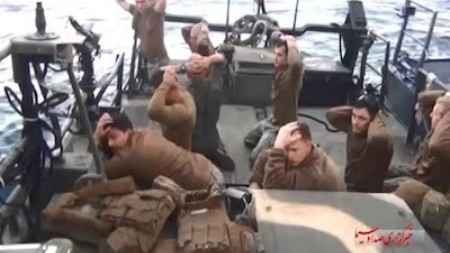
The Pentagon claimed that the RCBs strayed into Iranian territorial waters as a result of a “navigation error” and thereafter, one of the RCBs experienced engine trouble. They were then greeted by a pair of Iranian speed boats. Photos and video of the incident released by the Iranians show that the Iranian boats were armed with nothing more than forward mounted Russian 14.5mm DShK machine guns of Korean War vintage.

At gunpoint, the Iranians transferred the boats and their crew to Farsi Island where they maintain a military base. The boats and crew members were released some 16 hours later during which time, the Iranians thoroughly inspected the RCBs. Two satellite phone sim cards were stolen by the Iranians and the Pentagon has not divulged what, if any, information they contained. The groveling John Kerry thanked his Iranian counterpart profusely for releasing the illegally detained sailors.

Aside from these bare facts, the Pentagon has not released any new information concerning the embarrassing incident, a humiliation unparalleled in modern U. S. naval history. As I previously noted, several troubling questions still remain unanswered.

First, how did an experienced naval crew, equipped with sophisticated navigational equipment and traveling a well-charted, straight forward path, encounter a “navigational error” that led them into the territorial waters of an extremely hostile entity? In the absence of additional information, the Pentagon’s explanation makes absolutely no sense.

There has been speculation that the Iranians employed a device that spoofed or tricked the RCB’s on-board GPS devices with fake signals, leading the sailors into believing that they were on a correct course when they had in fact, substantially deviated. If the Iranians had in fact employed such a device, it would not have been the first time. In 2011, they reportedly misdirected a U.S. drone operating in Afghanistan by hacking into its GPS. The drone and all of its technology fell into Iranian hands relatively intact. The Pentagon has not issued any comment on this theory and notably, has not issued any denial of this troublesome scenario.

Second, and even more troubling, is how did 10 American sailors surrender their heavily armed and armored RCBs to a vastly inferior Iranian force without firing a single shot? Why weren’t readily available military assets immediately deployed and dispatched after the military was notified of the hostile encounter? Who gave the commander the order to surrender and was the decision to surrender influenced by political considerations, notably Obama’s State of the Union Address?

While the Pentagon continues to remain mute on these and other crucial issues surrounding the seizure of the RCBs, the Iranians have been extremely talkative, missing no opportunity to humiliate the “Great Satan.”  The list of outrages includes the following:

  • The sailors were forced to kneel at gunpoint with their hands interlocked behind their heads. The display was videotaped.
  • The commander was forced to apologize and acknowledge his “navigational error” and the graciousness of his Iranian captors on Iranian TV.
  • The Iranians reenacted the surrender spectacle during one of their annual “Death to America” demonstrations.
  • The sailors were subjected to rather intense interrogation.
  • Iranian TV aired footage purporting to show an American sailor crying.
  • A female sailor endured further humiliation and was forced into Sharia compliance by being made to wear a head covering.
  • Iran’s supreme leader, Ayatollah Ali Khamenei, publicly issued the Iranians responsible for capturing the RCB sailors with “medals of conquest.”
  • Approximately two weeks after the sailors were freed; Iran released footage of one its drones shadowing the U.S. aircraft carrier Harry S. Truman. The drone incident occurred on the very day the sailors were captured. A U.S. Navy spokesman called the flyover “abnormal and unprofessional.”
  • As noted, two satellite phone sim cards, likely containing classified information, were stolen by the Iranians.
  • In mid-March, naval commander Gen. Ali Razmjou of the Iranian Revolutionary Guards announced that Iran had retrieved thousands of pages of information from laptops, GPS devices and maps used by U.S. Navy sailors.

It is likely that we have not heard the last from the Iranians on this humiliating saga. In fact, Razmjou said that the IRG will publish a book about the incident. The Iranian bombast stands in marked contrast to the Pentagon’s demurred, almost docile stance. The reasons for the Pentagon’s silence are not hard to fathom. Something happened in the Arabian Gulf on January 12 that if revealed, would likely cause considerable embarrassment to the Obama administration.

In mid-February, Sen. John McCain threatened to subpoena the sailors if the Pentagon was not more forthcoming about the details surrounding the incident. He correctly noted that it did not take that long to debrief the sailors, accused the administration of “dragging [its] feet” and gave the administration a deadline of March 1 to present more information. That deadline has come and gone but the public still remains in the dark thanks to the Obama administration’s attempts to obfuscate.

In the meantime, Iran continues to test ballistic missiles in defiance of UNSC resolution 2231 and flush with $150 billion, continues to operate as a malignant regional influence by providing sophisticated weapons to Hezbollah, the Houthi rebels and other assorted terrorist organizations. More ominously, Iran and its proxy Hezbollah have constructed a ballistic missile base in Syria near the Israeli border, greatly magnifying an already explosive situation.

Obama will ignore these and other Iranian transgressions because he recognizes that the JCPOA, his crowning foreign policy achievement, is on thin ice. For the very same reason, he will continue to order the Pentagon to obfuscate and remain silent on the circumstances surrounding the seizure of U.S. personnel in the Arabian Gulf because it will likely embarrass the administration and add to further congressional calls to toughen sanctions against the Islamic Republic.

Rising Threats: Shrinking Military

April 8, 2016

Rising Threats: Shrinking Military, Fox News, Bret Baier via You Tube, April 6, 2016

Dunford: U.S. Military Isn’t Ready Across the Board

March 22, 2016

Dunford: U.S. Military Isn’t Ready Across the Board, Washington Free Beacon, March 22, 2016

Gen. Joseph Dunford, chairman of the Joint Chiefs of Staff, told lawmakers Tuesday that the United States military currently is not prepared or capable across all the service branches of addressing the threats facing the country.

Dunford gave his assessment of the military’s readiness while testifying before the House Armed Services Committee alongside Defense Secretary Ash Carter on the fiscal year 2017 proposed defense budget.

Rep. Mac Thornberry (R., Texas), chair of the committee, first listed evidence he has heard from other senior military officers to illustrate how the military does not have sufficient readiness capabilities across the services.

“Let me just offer a handful of other quotes on the record,” Thornberry told Dunford. “[Marine Corps Commandant] Gen. [Robert] Neller said, ‘Our aviation units are currently unable to meet our training and mission requirements, primarily due to Ready Basic Aircraft shortfalls.’ [Army Chief of Staff] Gen. [Mark] Milley and Gen. [John] Allen have testified [that] less than one-third of Army forces are at acceptable forces of readiness. The readiness of the United States Army is not at a level that is appropriate for what the American people would expect to defend them.”

Thornberry then referenced Air Force Secretary Deborah Lee James’ testimony from last week in which she said that “less than half our combat forces are ready for a high-end fight… the Air Force is the smallest, oldest, and least ready force across the full spectrum of operations in our history.”

“Do you agree that we have a significant readiness problem across the services, especially for the wide variety of contingencies that we’ve got to face?” Thornberry asked.

“Chairman, I do, and I think those are accurate reflections of the force as a whole,” Dunford said. “From my perspective, there’s really three issues: There are the resources necessary to address the readiness issue, there’s time, and then there’s operational tempo.”

Dunford said that the readiness problem is the result of several years of an “unstable fiscal environment” combined with an “extraordinarily high operational tempo,” or rate of military actions.

The general warned it will take many years to dig out of this situation, but said he is satisfied that the FY 2017 budget meets the fiscal requirements of each service for readiness.

The U.S. cannot buy its way out of the readiness problem this year, Dunford said, because of time and the growing need to deploy resources quickly.

He added that the Army, Navy, and Marine Corps will not be sufficiently ready to counter the challenges they need to until around fiscal year 2020, and the Air Force likely will not reach that point until fiscal year 2028.

Beyond resources, time, and operational tempo, Dunford explained that depot-level maintenance has been back-logged in Marine aviation, and likely in other branches as well, contributing to the delay in reaching full readiness.

“I think it’s important for us and for y’all to continue to not only watch this issue but really understand down deeper what’s happening,” Thornberry said. “Statistics are one thing, but you talk to these folks eyeball to eyeball, and the sense of frustration and concern is very evident.”

The military has been steadily downsized over the course of the Obama administration, with the number of active-duty ships in the Navy reduced to pre-World War I levels and the Marine Corps the smallest it has been since the Korean War in the early 1950s. The size of the Army has been reduced as well.

Top U.S. General: ‘I Do Not Have Authority’ to Offensively Attack Taliban

February 2, 2016

Top U.S. General: ‘I Do Not Have Authority’ to Offensively Attack Taliban, BreitbartEdwin Mora, February 2, 2016

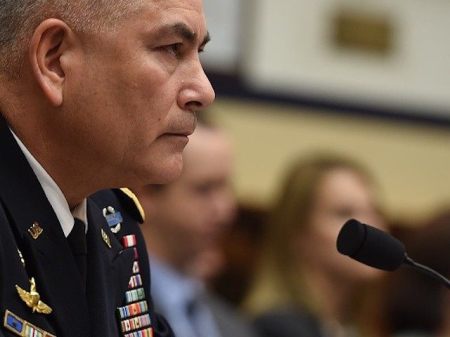
Top Gen in AfghanistanJIM WATSON/AFP/Getty Images

WASHINGTON, D.C. — The U.S. military, since President Obama declared that American troops had ceased their combat mission at the end of 2014, has only been able to attack the Taliban from a defensive position, the top commander of American and NATO forces in Afghanistan told lawmakers.

“I have the authority to protect our coalition members against any insurgency — Haqqani [Network], Taliban, al Qaeda — if they’re posing as a threat to our coalition forces,”testified the commander, Gen. John Campbell, before the House Armed Services Committee.

The general’s comments came in response to Rep. Jim Bridenstine (R-OK)asking if he had the authority to attack the Taliban, which has stepped up attacks since the end of 2014 and has been linked to the deteriorating security conditions in the Afghanistan.

“If the Taliban are attacking coalition forces, then I have everything I need to do that,” responded Gen. Campbell, who is expected to retire soon. “To attack the Taliban just because they’re Taliban, I do not have that authority.”

“It is astonishing that we have an authority to go after the Taliban and the president is preventing us from doing that,” proclaimed Bridenstine.

The Oklahoma Republican argued that the Authorization for Use of Military Force (AUMF) 2001, passed by Congress and signed into law by the U.S. president at the time, grants the top commander the authority to use the necessary force against the Taliban.

Rep. Bridenstine questioned, “Yet, the president, it seems, is saying you can’t attack the Taliban even though they were responsible for September 11?”

“What I think is we adjusted our mission in 2015,” explained Campbell. “We went away from combat operations and we worked with the Afghans to build their capabilities to go after the Taliban.”

President Obama declared an end to the U.S. combat mission in December 2014, marking the beginning of the train, assist, and advise (TAA) role for the American troops on January 1, 2015.

While testifying, Gen. Campbell noted that with only 9,800 U.S. service members in Afghanistan, carrying out the TAA mission is difficult.

“Again if the Taliban are attacking or pose a threat to coalition forces, I have everything I need to provide that force protection,” reiterated Campbell. “To go after the Taliban because they’re Taliban, I don’t do that sir.”

At least 21 American service members have been killed and another 79 wounded since President Obama adjusted the mission so that U.S. troops are unable to attack the Taliban from an offensive position. The majority of the total 2,227 American military deaths and 20,109 injuries since the war began in October 2001 have taken place under President Obama’s watch.

Rep. Bridenstine quoted the Authorization for Use of Military Force (AUMF) 2001.

“That the President is authorized to use all necessary and appropriate force against those nations, organizations, or persons he determines planned, authorized, committed, or aided the terrorist attacks that occurred on September 11, 2001, or harbored such organizations or persons, in order to prevent any future acts of international terrorism against the United States by such nations, organizations or persons,” states the AUMF.

The Taliban has been accused of providing safe haven to al Qaeda members involved in orchestrating the September 11, 2001 attacks on the U.S. homeland, including the late jihadist leader Osama bin Laden.

President Obama is currently expected to reduce the U.S. military presence in Afghanistan to 5,500 troops by the time he left office in 2017.

“We’ll have a very limited ability to do TAA with 5,500,” said Gen. Campbell, who signaled that the U.S. military will stay in Afghanistan for years beyond 2017.

Obama has nominated Army Lt. Gen. John Nicholson, Jr., to replace the outgoing commander.

President Obama has been hesitant to call the Taliban a terrorist group.

Satire | DARPA to Weaponize Thoughts and Prayers

November 22, 2015

DARPA to Weaponize Thoughts and Prayers, Duffel Blog, November 22, 2015

(If this brilliant strategy is not completely successful, Obama plans to tell Supreme Leader Khamenei to issue a fatwa against violent extremism. — DM)

Thoughts-and-Prayers-1-1000x600

“This administration will not hesitate to use any method in the fight against the evil that is ISIS, up to and including international condemnation or the deployment of additional hashtags to the region.”

**********************

WASHINGTON — White House spokesman Josh Earnest announced today that at President Obama’s request, Congress has allocated an additional $176 billion dollars to the military budget for the Defense Advanced Research Projects Agency (DARPA) to weaponize the thoughts and prayers which are routinely offered then discarded after tragedy and terrorism.

Earnest said the program reaffirms President Obama’s commitment to degrading, and ultimately defeating ISIS.

“It is really a brilliant concept,” notes Miles Chamberlain, program lead for the new Mk II “Wishful Thinking” Air Deliverable Engagement Device. “After a major terrorist event, the number one thing guaranteed to come out of western countries are thoughts and prayers. Millions of them. If we can find a way to use them tactically our military options would be limitless.”

“The T&P program has multiple facets,” Earnest said. “The highest priority is better targeting systems for our special operators. Currently the thoughts and prayers are used indiscriminately on family members, friends, and even ordinary citizens in an affected area. We hope to provide a surgical strike capability, eventually being able to deliver millions of thoughts and prayers onto a single target, with devastating effect.”

Chamberlain highlighted the advanced nature of the testing, while acknowledging some setbacks for the program.

“The biggest issue we’re facing is a delivery system. First we proposed printing the thoughts and prayers and air-dropping them over a target area, but we had to stop after environmentalists protested, claiming that the thoughts and prayers from the East Coast alone would cause the deforestation of two national parks,” Chamberlain said.

“Then we collected approximately 650 million tweets, emails, and Facebook posts offering thoughts and prayers to Paris and uploaded them onto a hard drive, but that was canceled after Lockheed demanded a $300 billion dollar software update to synch them with the F-35 targeting computers.”

“We’re still optimistic about this whole process. I just hope this project doesn’t end up as a casualty of the budget wars like other failed programs, including the DX6-Good Intentions Radar, the surface-launched Candlelight Vigil 3.0, or Diplomacy.”

At the press conference Earnest affirmed that the White House is totally committed to defeating the Islamic State, and that in addition to the Wishful Thinking weapons program the President has already initiated a severe hashtag campaign (‪#‎StopTerrorismNow‬), and has facilitated the live-streaming of hundreds of anti-violence and equality rallies on college campuses around the nation.

“Make no mistake,” he said. “This administration will not hesitate to use any method in the fight against the evil that is ISIS, up to and including international condemnation or the deployment of additional hashtags to the region.”


Ash Carter breaks with Obama: ‘We’re prepared to change rules of engagement’ in fight vs. ISIS

November 19, 2015

Ash Carter breaks with Obama: ‘We’re prepared to change rules of engagement’ in fight vs. ISIS, Washington Times

(Please see also, The Obamization of the Military, Pt. 243. How are the rules of engagement actually being changed? — DM)

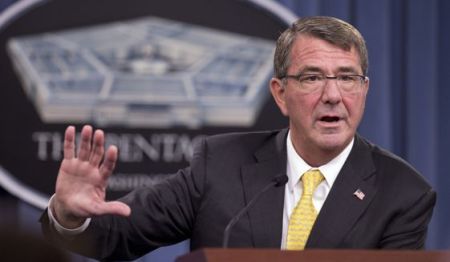
TURKEY_c0-609-5300-3698_s561x327Defense Secretary Ashton Carter speaks during a news conference at the Pentagon, Thursday, Aug. 20, 2015. (AP Photo/Manuel Balce Ceneta) ** FILE

Defense Secretary Ashton Carter says the U.S. is prepared to change the “rules of engagement” in the fight against the Islamic State terrorist group, pointing to methods like targeting fuel trucks controlled by the terrorist group.

“We’ve reviewed them – we review them all the time,” Mr. Carter said in an interview for MSNBC’s “Morning Joe.” “Actually, if you look at the data, the thing that most enhances the impact of the air campaign is better and better intelligence. We’re prepared to change rules of engagement. We’ve changed tactics, as we just did in the case of the fuel trucks.”

Mr. Carter said the U.S. has started going after fuel convoys now, in addition to the 3,500 people on the ground in Iraq and air sorties flying “every day.”

“ISIL uses the oil infrastructure as a way to raise money,” he said. “We took out ‘Jihadi John,’ we took out the head of ISIL in Libya, we’re running raids like the one that got Abu Sayyaf.”

The Obamization of the Military, Pt. 243

November 19, 2015

The Obamization of the Military, Pt. 243, American ThinkerJ.R. Dunn, November 19, 2015

It appears that the New Military is using the campaign against ISIS as an opportunity to rewrite the rules of war – and not in favor of the West.

According to Bridget Johnson of PJ Media, actions taken by U.S. forces in the wake of the Paris massacre include an effort to interdict ISIS oil tanker traffic. U.S. aerial assets carried this out by bombarding the trucks with leaflets warning drivers that an air strike would follow within forty-five minutes. What followed was, evidently, not air strikes at all but low-level buzzing by U.S. Navy fighter-bombers. (Consider for a minute what the pilots must have thought.)

It’s difficult to know what’s more astonishing about this – the fact that it’s taken over a year for the Central Command to move against ISIS’s major source of revenue, or the delight that military spokesmen have taken in this ineffectual, empty operation.

You see, the important thing isn’t hurting ISIS. No — the important thing is not hurting civilians. This is how it was put by Col. Steve Warren, in a passage of pure Obamese that would be hard to beat by the master himself:

“So we had to go through that whole process of one, determining whether or not we felt it was in our best interest to strike these trucks. And then once we determined that, yes, it is in our interest to strike these trucks, how do we go about ensuring that we’re able to mitigate the potential of civilian casualties? And these things take time,”

Uh-huh. Memo to Col. Warren, Central Command, and the Pentagon: they’re all civilians. Every member of ISIS, every supporter, every collaborator, is a civilian. That’s one of the defining points of what a terrorist is. ISIS is not a nation; it does not possess a military. They’re all civilians, from Abu Bakr al-Baghdadi on down, and they’re all legitimate targets. Because anybody supporting ISIS, whether a direct member or not, is a functioning terrorist, and deserves whatever he gets.

But the liberal-left, as we all know, like to slice things fine, so now we’ve got the distinction between “terrorist”, and “civilian”, with a civilian being somebody who evidently does everything but actually shoot or blow up innocents. (Note that this is simply an expansion of the international media’s treatment of Palestinian killers.)

Well, it happens that history covers that aspect as well, and ironically, involving France. As was at one time widely known, France was occupied by the Nazis from 1940 to 1944. During that time thousands of Frenchmen aligned themselves with their conquerors, sharpening the concept of the “collaborator”. In 1944, these traitors were subject to the epuration sauvage (savage purge). In villages and towns throughout France, tribunals were seated and the collaborators brought before them to be tried and in many cases executed immediately. At least 10,000 traitors were killed. Some estimates range as high as 100,000. The doctrine was established that anyone who collaborates with a conqueror is subject to death.  That extends to anybody working to fund ISIS.

(Note that we’re not appealing to traditional “Just War” theory, which covers this situation as well, through the doctrine of “double effect”. A military operation against a legitimate target is allowed to cause limited civilian casualties so long as the intent is to destroy the target rather than kill civilians. This is how strategic bombing that killed thousands of civilians during WW II was justified. It can certainly be extended to a few corrupt Iraqi truck drivers.)

What this represents is the extension of unicorn and butterfly morality to the military.  As Col. Warren puts it: “We’re not in this business to kill civilians, we’re in this business to stop ISIL — to defeat ISIL.”

Actually, they’re not in the business of doing either. It’s unclear whether any driver in fact abandoned his rig. It’s unclear whether air strikes were actually carried out. It’s unclear whether a single shipment was stopped. It’s unclear whether ISIS was deprived of one thin dime of oil revenue.

What is clear is that nothing effective is going to be done to destroy ISIS and curtail Jihadi terror until this administration and its sycophants in the military and elsewhere are ejected.


Hollande, Obama lack the troops and will for total war on ISIS. Mid East rulers are even more reluctant

November 16, 2015

Hollande, Obama lack the troops and will for total war on ISIS. Mid East rulers are even more reluctant, DEBKAfile, November 16, 2015

French_anti-terror_police_15.11.15French anti-terror police

When French President Francois Hollande declared war on ISIS and called the attack in Paris an “act of war,” he gave the terrorist organization’s leader Abu Bakr Al-Baghdadi an unexpected boost. He upgraded the Muslim caliphate to a fully-fledged state against which France is now at war. US President Barack Obama was more cautious, declaring at the G-20 summit in Antalya that his country and France would fight together against terror, without specifying how.

Obama has problems of his own. The attempt to portray the Kurdish conquest of the city of Sinjar in northern Iraq as an important achievement in the war against ISIS dissipated quickly after Peshmerga troops were shown on TV moving into a city that was empty and lying in ruins, after it was abandoned by Islamic State forces. There was no battle there either.

Also, the US and Kurdish claims that they had severed the main road link between the ISIS capitals in Iraq and Syria, Mosul and Raqqa, proved hollow as ISIS had stopped using that route months ago after it became vulnerable to American air strikes.

If that wasn’t enough, Obama ran into an obstacle in Antalya.

The summit’s host, Turkish President Tayyip Erdogan, who is consumed by an overriding aversion to an independent Kurdish state rising on his country’s border, demanded a declaration that all Kurdish forces, including the Peshmerga, the PKK and the YPG, on which the US depends heavily for fighting the war against ISIS, be classified as terrorists and targeted by the West just like ISIS.

Therefore, before broaching any decisions about intensifying the war on the Islamist terrorists, Western and Muslim countries were already at odds on targets.

It therefore makes no sense for President Hollande to try and invoke Article 5 of the NATO charter under which an act of war against one member of the alliance is tantamount to a war on all. Furthermore, making this a NATO operation would rule out a priori any collaboration with Russia in the campaign against ISIS, despite their common objective.  Vladimir Putin was already vexed over the feeble Western response to the bombing of a Russian airliner killing 224 people, compared to the global outcry over the Paris outrage.

In their responses and commentaries on what to do after the Paris assault, Western politicians and security experts seemed to agree that putting their own boots on the ground for finally getting to grips with ISIS was not on the cards – there would just be “more of the same,’ as one American security expert put it.

Others advised assigning the ground battle to the Egyptian, Jordanian, Kurdish, Iraqi, Saudi and other Gulf Arab states.

Who were they kidding? None of those Arab governments or armies is capable or willing to declare full-scale war on the Islamic State. The Kurds alone have stepped into the breach and are confronting the Islamists face to face, but they have sought in vain for the weapons they need, which the US refuses to supply.

Egypt, for instance, even after an ISIS network was able to breach its security system in Sharm El-Sheikh to plant a bomb on the Russian airliner on Oct. 31, has held back from a major military assault on the strongholds of the Ansar Beit Al-Maqdis, otherwise known as ISIS-Sinai. Egypt’s President Fattah Al-Sisi has not uttered a word on the Islamist threat since then.

French security and intelligence services demonstrated that they were unprepared for war on ISIS, and are pretty much in the same boat as other Western powers.

Since the outrage in Paris, French and Belgian security forces have conducted raid after raid to pick up Islamists, claiming to be rounding up the masterminds and confederates of the nine bombers and shooters who attacked Paris and murdered 132 people  In fact, they are acting more to calm a jittery public than in the expectation of achieving meaningful results in the war on terror. Till now, neither France nor any Western government knows exactly how many people were involved in the attack on Paris, or the numbers and locations of the Islamic Caliphate’s worldwide terror networks.

Obama Has a Strategy in the Middle East, and It’s Working

November 12, 2015

Obama Has a Strategy in the Middle East, and It’s Working, Washington Free Beacon, November 12, 2015

Obama CairoPresident Obama in Cairo, 2009 / AP

Consider that if the primary goal of the president is not a certain outcome on the ground, but rather the reset of the American posture in the region from that of a dominant power to that of one nation among many partners collaborating where possible, and, when conflict can’t be avoided, erring on the side of minimalist interventions—well, from the perspective of the Oval Office, it would be possible to conclude that no change of course is required.

As with Obamacare, the “achievement” in all this is to be found less in any one specific policy outcome than in a broad leftward shifting of the conversation, and in the creation of a new normal for January 20, 2017, in which the re-establishment of more sensible policy in the Middle East will be extremely difficult.

************************

The Obama administration is “operating on a crisis basis” in the Middle East, says Leon Panetta, and doesn’t “have any kind of larger strategy” for the region. The president’s recent actions there, including the deployment of 50 special operations troops to Syria, are too incremental and “will not work,” says Fareed Zakaria. Indeed, the situation in that country has “spiraled out of control,” according to Vox’s Max Fisher in a post headlined “Unfixable: How Obama Lost Syria.”

And that’s what liberal critics are saying! The tone on the right is even more harsh—and why shouldn’t it be? Headlines this week from the region inform us that new footage shows about 200 children being shot to death by members of the Islamic State while lying in a row, faces in the dirt; that a Russian airliner that crashed in Egypt was quite likely downed with the use of military grade explosives; and that Russian airstrikes in Syria in support of the Assad regime have increased in intensity. It is Wednesday.

Zooming out, we see Assad in power, the Islamic State not going anywhere, Yemen still the focus of a regional proxy war, and a nuclear deal with Iran that has only empowered hardliners there.

The natural question thus seems to be: Why doesn’t Obama change course? Other presidents have shifted their approaches when confronted with failure—Carter’s late foreign policy and Bush’s Iraq surge both spring to mind. Why not Obama?

One answer to this question we ought to take seriously is that the president thinks things are, on the whole, going just fine.

Consider that if the primary goal of the president is not a certain outcome on the ground, but rather the reset of the American posture in the region from that of a dominant power to that of one nation among many partners collaborating where possible, and, when conflict can’t be avoided, erring on the side of minimalist interventions—well, from the perspective of the Oval Office, it would be possible to conclude that no change of course is required.

This possibility is why I’m not persuaded of Panetta’s charge that the administration lacks a “larger strategy.” It seems entirely possible to explain what might seem to be incompetence as simply the consequence of having as the primary focus of our regional strategy the reduction of the American role.

Evidence for this possibility can be detected through a Kremlinological look at the administration’s own public statements, including the repeated insistence that “local partners” will do the fighting on the ground against the Islamic State, which, in turn, will only “ultimately” be destroyed, as well as the unconventional assertion by Ben Rhodes earlier this year that the avoidance of military casualties is itself a goal of American national strategy. Much of the evidence rounded up by Michael Doran in his excellent essay on the strategy behind the Iran deal points in the general direction I propose. And others have made plausible arguments that the administration has engineered a transition from a Middle Eastern “Pax Americana” system to one where “offshore balancing” prevails—even though such an assessment understates the extent to which responsible outcomes on the ground don’t matter nearly as much to the White House as the nature of the American posture itself.

The most persuasive proof is a form of reductio ad absurdum—denying this assessment seems to require the conclusion that the president and his advisors are profoundly foolish. It seems more likely that they are simply ruthless ideologues.

From their point of view, it is surely lamentable that the region hasn’t responded better to the withdrawal of American power. But there was always going to be a period of transition, and that the shift is somewhat traumatic is not necessarily a surprise. Calls for America to reinsert its military are shortsighted: after all, the presence of the American military in support of corrupt Sunni regimes like Saudi Arabia’s contributed mightily to the targeting of the United States by extremists, and the removal of Saddam led ultimately to the existence of the Islamic State. Our enmity with Iran’s revolutionary government goes back to our backing of the Shah and the ouster of Mossadegh, and anyway, the fact that we are allied with toxic Sunni regimes (not to mention apartheid Israel) but hostile to a religious Shia regime is irrational, at best. Violence may currently be surging, but the death tolls conveyed in lurid headlines must be seen in the context of truly grave global threats, like climate change. Those threats require our best attention, as does the rebuilding of the American economy, and we are better served by working to construct a more equitable and just society at home before taking unilateral, aggressive, and risky actions abroad.

This analysis may be wrong in part or in whole, but it is internally coherent, and if accepted it points to the strategy more or less exactly like the one being pursued. If America is usually part of the regional problem, and if its efforts are better employed elsewhere, then the strategic goal should be to reduce the amount of America in the region. In the administration’s first term, centrist voices in the cabinet would have resisted such an approach—but they are gone now.

The shift in our regional posture has, of course, provoked opposition from hardliners (American hardliners, that is) including conservative politicians and elements of the Pentagon’s leadership, whose actions over the years have empowered Middle Eastern hardliners like the Iranian mullahs. Thus this domestic opposition is also, in a sense, the enemy, and resisting this wing of American politics at home will give moderates in countries like Iran the space to gain influence over time.

This worldview is why Obama isn’t going to change course any time soon, absent a major loss of American life in a terrorist attack and the domestic political pressures that will create. Even then, the response is likely to be conducted with an eye to keeping military engagements highly limited, as with token actions taken in recent weeks in the campaign against the Islamic State. Indeed, seen in this light, incremental deployments of a few dozen troops to Syria need no longer be seen as foolish gestures that are destined to fail, but rather as more or less successful delaying actions meant to placate domestic political opposition.

As with Obamacare, the “achievement” in all this is to be found less in any one specific policy outcome than in a broad leftward shifting of the conversation, and in the creation of a new normal for January 20, 2017, in which the re-establishment of more sensible policy in the Middle East will be extremely difficult.