Archive for the ‘Netanyahu’ category

Syrian official answers Netanyahu: We will use all available means to recapture the Golan

April 17, 2016

Syrian official answers Netanyahu: We will use all available means to recapture the Golan, Jerusalem PostMaayan Groisman, April 17, 2016

(Please see also, Netanyahu to battle Obama, Putin over the Golan. — DM)

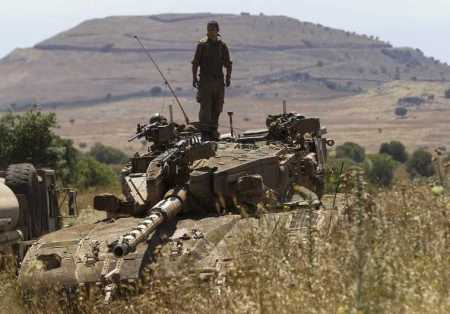
ShowImage (24)An IDF soldier stands atop a tank near Alonei Habashan on the Golan Heights, close to the ceasefire line between Israel and Syria. (photo credit:REUTERS)

In a first reaction to Prime Minister Benjamin Netanyahu’s declaration that “Israel will never leave the Golan Heights,” Syrian Foreign Minister Faisal al-Miqdad said Sunday that Syria is prepared to use every possible means to recapture the area, including military means.

“The Syrian Golan is an occupied Arab land according to the UN Security Council’s resolutions, and the presence of the United Nations Disengagement Observer Forces proves this,” Miqad said in an interview with the Lebanon-based TV channel al-Mayadeen.

“We have never renounced the resistance and we are ready to recapture the Golan in all possible ways, including military ways. Israel wants to provoke us, but we will never surrender,” Miqdad added.

Regarding Syria’s cooperation with Russia, he stated that “the daily communication between the Syrian leadership and the Russian leadership continues. We believe that the Russian policy leans on the international law and on UN Security Council resolutions.

“Neither Russian President Vladimir Putin nor any other president in the world would have accepted the indecent Israeli logic regarding the Golan,” Miqdad argued.

At the opening of a special cabinet meeting held for the first time ever on the Golan Heights on Sunday, PM Netanyahu declared: “The time has come after 40 years for the international community to finally recognize that the Golan Heights will remain forever under Israeli sovereignty.”

Netanyahu to battle Obama, Putin over the Golan

April 17, 2016

Netanyahu to battle Obama, Putin over the Golan, DEBKAfile, April 16, 2016

1 (2)

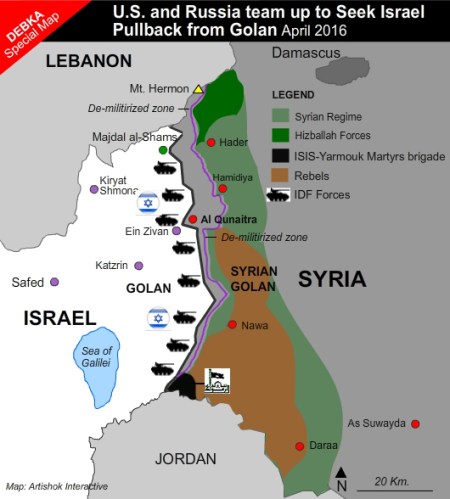
The Israeli cabinet holds its weekly session Sunday April 17, on the Golan. Prime Minister Benyamin Netanyahu will visit Moscow on Thursday, April 21 to meet with Russian President Vladimir Putin and to launch the most important battle of his political career, and one of Israel’s most decisive contests of the last 10 years: the battle over the future of the Golan Heights.

DEBKAfile’s intelligence sources and its sources in Moscow report exclusively that Israel’s top political leaders and military commanders were stunned and shocked last weekend when they found out that US President Barack Obama and Russian President Vladimir Putin have agreed to support the return of the Golan to Syria. The two presidents gave their top diplomats, Secretary of State John Kerry and Foreign Minister Sergei Lavrov, the green light to include such a clause in a proposal being drafted at the Geneva conference on ending the Syrian civil war.

Israel captured the Golan from the Syrian army 49 years ago, during the Six-Day War in 1967 after the Syrian army invaded Israel.

In 1981, during the tenure of then Prime Minister Menachem Begin, Israel passed a law defining the Golan as a territory under Israeli sovereignty. However, it did not state that the area belongs to Israel.

While Israel was preparing for a diplomatic battle over the future of Jerusalem, Judea and Samaria, Obama and Putin decided to deal a diplomatic blow to Israel and Netanyahu’s government on an unexpected issue, the Golan.

It is part of an endeavor by the two powers to use their diplomatic and military cooperation regarding Syria to impose agreements on neighboring countries, such as Israel, Turkey, Saudi Arabia and Jordan.

For example, Washington and Moscow are trying to impose an agreement regarding the granting of independence to Syrian Kurds, despite Ankara’s adamant opposition. The two presidents are also pressuring Riyadh and Amman to accept the continuation of Syrian President Bashar Assad’s rule, at least for the immediate future.

DEBKAfile’s sources report that just like the other diplomatic or military steps initiated by Obama and Putin in Syria, such as those for Assad’s eventual removal from power, the two powers see a resolution of the Golan issue as a gradual process that may take a long time, perhaps even years. But as far as they are concerned, Israel will have to withdraw from the Golan at the end of that process.

It should be noted that Prime Minister Netanyahu is not traveling to Washington to discuss the Golan issue with Obama. The frequent trips by the prime minister, senior officials and top IDF brass to Moscow in recent months show where the winds are blowing in the Middle East.

However, Moscow is not Washington, and Israel has no lobby in the Russian capital defending its interests.

It should be made very clear that the frequent trips by senior Israeli officials to Moscow have not created an Israeli policy that can influence Putin or other senior members of the Russian leadership. Putin has made occasional concessions to Israel on matters of minimal strategic importance, but on diplomatic and military steps regarding Syria and Iran he has shown little consideration of Jerusalem’s stance.

It should also be noted that there has been no basis for the enthusiasm over the Russian intervention in Syria shown by Netanyahu, Israeli ministers and senior IDF officers.

All of the calls by a number of Russia experts, mainly those of DEBKAfile, for extreme caution in ties with Putin have fallen on deaf ears among the political leadership in Jerusalem and the IDF command in Tel Aviv.
Amid these developments, three regional actors are very pleased by Washington and Moscow’s agreement to demand Israeli withdrawal from the Golan: Syrian President Assad, the Iranian leadership in Tehran and Hizballah leader Hassan Nasrallah.

Amid these developments, three regional actors are very pleased by Washington and Moscow’s agreement to demand Israeli withdrawal from the Golan: Syrian President Assad, the Iranian leadership in Tehran and Hizballah leader Hassan Nasrallah.

Now, they do not need to risk a military confrontation with Israel over the Golan because Obama and Putin have essentially agreed to do the dirty work for them.

Netanyahu’s dilemma: Détente with Turkey or recognition of Syrian Kurds

April 4, 2016

Netanyahu’s dilemma: Détente with Turkey or recognition of Syrian Kurds, DEBKAfile, April 4, 2016

obama_erdogan_best_friends_2012They were once good friends

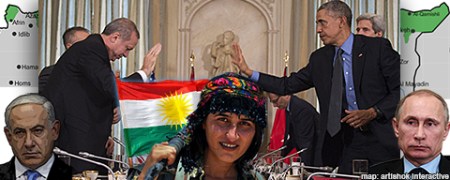
Last Friday, April 1, President Reccep Tayyip Erdogan had his first encounter with a group of American Jewish leaders, at his request. The full details of its contents were hard to sort out because the Turkish translator censored his master’s words with a heavy hand to make them more acceptable to his audience. But Erdogan’s bottom line, DEBKAfile’s New York sources report, was a request for help in explaining to the Obama administration in Washington and the Netanyahu government in Jerusalem why they must on no account extend support to the Syrian Kurdish PYD and its YPG militia or recognize their bid for a separate state in northern Syria.

The Turkish president did not spell out his response to this step, but indicated that a Turkish invasion to confront the Kurdish separatists was under serious consideration in Ankara. His meaning was clear: He would go to war against the Kurds, even if this meant flying in the face of President Barack Obama’s expectation that Turkey would fight the Islamic State.

Relations between the Turkish and US presidents have slipped back another notch in the last two weeks. When he visited Washington for the nuclear summit, Erdogan was pointedly not invited to the White House and his request for a tete a tete with Obama was ruled out. The US president even refused to join Erdogan in ceremonially honoring a new mosque built outside Washington with Turkish government funding.

At odds between them is not just the Kurdish question, but Erdogan’s furious opposition to Obama’s collaboration with Russian President Vladimir Putin on the Syrian conflict, and the two presidents’ tacit accord to leave Bashar Assad in power indefinitely until a handover becomes manageable.

On Feb. 7, on his return for a Latin American tour, the Turkish president warned Obama that he must choose between Ankara and the Kurds, whom he called “terrorists.” By last week, the US president’s choice was clear. It was the Kurds.

ObamaErdogan480_Koteret

When Erdogan arrived home from Washington last week, he discovered that the roughly four million Syrian Kurds dwelling in three enclaves touching on the Turkish border had taken important steps to advance their goal for self-rule: They were drafting a plan for establishing a “Federal Democratic System” in their three enclaves – Hassakeh-Jazeera, Kobani and Afrin – and had announced the amalgamation of their respective militias under the heading the “Syrian Democratic Forces”.

Cold-shouldered in Washington as well as Moscow (since Turkish jets shot down a Russian fighter last November), Erdogan found himself let down by the Jewish leaders whom he tried to woo. They refused to support him or his policy on the Kurdish question for three reasons:

1. Ankara had for years consistently promoted the radical Palestinian Hamas organization. To this, Erdogan replied by denying he had backed Hamas  only acted to improve the lives of the Gaza population. And, anyway, he said he had reacyed understandings with Israel on this issue..

2. His hostility towards Egyptian President Abdel-Fatteh El-Sisi. Erdogan’s response to this was a diatribe slamming the Egyptian ruler.

3. No clear reply had been forthcoming from Jerusalem by that time on Israel’s relations with Turkey or its policy towards the Kurds, despite the Turkish leader’s positive presentation of  mended fences.

The current state of the relationship is laid out by DEBKAfile’s sources:

Prime Minister Binyamin Netanyahu is caught on the horns of multiple dilemmas: While reluctant to respond to Ankara’s suit for warm relations with a leader who is shunned by Obama and Putin alike, Turkey is nonetheless offering to be Israel’s best client for its offshore gas.

Israel’s friendship with the Kurdish people goes back many years. The rise of an independent or autonomous state in Syria and its potential link-up with the semiautonomous Kurdish region of Iraq would create an important new state of 40 million people in the heart of the Middle East.

Israel has no wish to make enemies of its longstanding friends by disowning them in favor of Turkey.

Already, Israel’s evolving ties with the Syrian Kurds have given Israel’s strategic position in Syria a new positive spin, upgrading it versus the Assad regime in Damascus and its Hizballah and Iranian allies, who are avowed enemies of the Jewish state. Those ties offer Israel its first foothold in northern Syria.

And finally, Erdogan is not the only opponent of Kurdish separatism; so too are important Sunni Muslim nations like Saudi Arabia and Egypt. By promoting the Kurds, Israel risks jeopardizing its rapidly developing ties with those governments.

The Fourth Strategy

March 11, 2016

The Fourth Strategy,  Front Page Magazine, Caroline Glick, March 11, 2016
mideast-lebanon-bulga_horo

Originally published by the Jerusalem Post

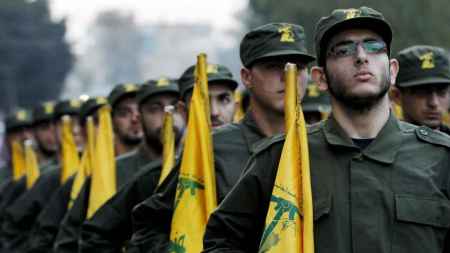
This week we learned that Lebanon is no more. It has been replaced by Hezbollah’s Iranian colony in Lebanon.

Two weeks ago, Saudi Arabia listed Hezbollah as a terrorist organization and canceled its $3 billion aid package to the Lebanese military. The Gulf Cooperation Council followed suit. Rather than support the move by his sponsors and allies, Saad Hariri, the head of the anti-Hezbollah March 14 movement, flew to Syria to meet with Hezbollah leaders.

Saudi Arabia’s decision to end its support for the Lebanese Armed Forces (LAF) doesn’t mean that Saudi Arabia is making peace with Hezbollah.

It means that the Saudis are no longer willing to maintain the fiction that with enough support, the LAF will one day challenge Hezbollah’s effective control of Lebanon.

Hezbollah and its bosses in Tehran don’t seem too upset about the Sunnis’ decision to acknowledge that Hezbollah is a terrorist group. And they are right not to care. In essence, the Saudi move is simply an admission that they have won. Lebanon is theirs.

Hezbollah’s isn’t the dominant force in Lebanon because it has better weapons than the LAF.

Unlike the LAF, Hezbollah has no air force. It has no armored divisions.

Hezbollah is able to dominate Lebanon because unlike the LAF and the March 14 movement, Hezbollah is willing to destroy Lebanon if doing so advances its strategic goals.

This has all been fairly clear for more than a decade. But it took the war in Syria to force the truth above the surface.

And now that it is clear to everyone that Lebanon has ceased to exist and that the country we once knew is now an Iranian colony, the time has come for Israel to reckon with the lessons of its own misadventures in our neighbor to the north.

Since the mid-1990s, Israel has implemented three strategies in Lebanon and in Syria. All of them originated on the Left. All of them failed.

The first strategy was appeasement.

From the mid-1990s until the Syrian war began five years ago, Israel’s strategic framework for understanding Syria was appeasement. Initially, the notion was that Syria was our enemy because we control the Golan Heights. If we surrendered the Golan to Syria, we would have peace in exchange.

In the years leading up to the Syrian war, our leaders embraced the idea that Syria was the weakest link in the Iranian axis. If we gave the Golan Heights to Syria, they said, then the Assad regime would withdraw from the Iranian axis.

As it turned out, these positions had no basis in reality. Appeasement failed.

Then there was unconditional surrender – or disengagement. Then-prime minister Ehud Barak implemented this strategy when he removed IDF units from the security zone in south Lebanon in May 2000.

From the mid-1990s on, Yossi Beilin was the chief advocate of unconditional surrender in Lebanon. The logic of surrender was similar to that of appeasement – of which he was also a principal architect and advocate.

The surrender strategy in Lebanon was based on the idea that Hezbollah fought the IDF in south Lebanon because the IDF was in south Lebanon. If the IDF were to leave south Lebanon, Hezbollah was have no reason to fight us anymore.

So if we were gone, Beilin argued, Hezbollah would stop fighting, ditch terrorism and Iran, and become a normal Lebanese political party.

The war with Hezbollah in 2006 destroyed the credibility of the surrender strategy. But the Left didn’t despair. They simply replaced surrender with the strategy of internationalization.

The internationalization strategy forms the basis of UN Security Council Resolution 1701 that set the cease-fire terms at the end of the war with Hezbollah. IDF soldiers, who left Lebanon without victory, were replaced by UN forces from UNIFIL. UNIFIL forces were supposed to block Hezbollah’s reassertion of control over south Lebanon by facilitating the LAF’s takeover of the border with Israel. While UNIFIL was protecting the LAF on the ground, the LAF itself would be empowered by a massive infusion of US and Saudi aid.

Saudi Arabia’s belated recognition that Hezbollah dominates the LAF, and controls Lebanon, makes clear that like appeasement and disengagement, internationalization is an utter failure.

To a certain degree, Israel’s serial strategic blundering did have one ameliorative effect. Through them, Hezbollah has become so powerful that it now poses a threat to the great powers. So Russia in Syria now needs to curb it. So, too, it is so powerful that Iran is loath to waste it on a war with Israel that it will lose when it is fighting to win the war in Syria.

For now then, Hezbollah is not an immediate threat. This is the case despite Hezbollah chief Hassan Nasrallah’s recent threat to bomb Haifa’s chemical depots and cause a fireball with the cataclysmic effect of a nuclear bomb.

But that doesn’t mean that the lessons of our repeated strategic mistakes in Syria and Lebanon shouldn’t be applied today. They should be applied, but toward another, more immediate foe – the Palestinians, toward whom Israel has applied the same failed policies, one after another, with similarly destructive outcomes.

After the first intifada ground to a halt in 1991, Israel adopted the Left’s first strategy. The so-called peace process with the PLO, which began in 1993, was an attempt to implement a strategy of appeasement. We would gradually give the PLO Judea, Samaria, Gaza and Jerusalem.

In return, the PLO would stop supporting terrorism and live at peace with Israel.

The failure of the appeasement strategy led to the second intifada. The second intifada caused Israel to adopt the Left’s second strategy – unconditional surrender.

Israel’s 2005 disengagement from Gaza failed just as spectacularly as its 2000 disengagement from Lebanon. Not only did it lead to the Hamas takeover of Gaza in 2007. It led to the further radicalization of the PLO and Palestinian society as a whole. The latter became convinced that terrorism worked. The former became convinced that the only way to garner public support was by being just as anti-Israel as Hamas.

Today, the center-left parties – the Zionist Union and Yesh Atid – cling to the failed strategy of disengagement. The far Left, together with the Arab political parties, have already moved on to the internationalization strategy. In the Palestinian context, the goal of the internationalization strategy is the collapse of Israeli sovereignty.

This strategy was in evidence this week with Peace Now head Yariv Oppenheimer’s outrageous claim Wednesday that in killing the terrorists who were in the midst of murdering innocents in Petah Tikva and Tel Aviv, civilians and security forces carried out summary executions.

Oppenheimer, whose group is funded by foreign governments, did not make the claim because he wished to build his support base at home. He demonized his fellow citizens to advance his paymasters’ goal of delegitimizing Israeli sovereignty by among other things, criminalizing Israel’s right to self-defense.

The goal of this delegitimization campaign is to make it impossible for Israel to function as a coherent nation-state and for it instead to become a powerless ward of Europe and the US.

In the face of both the rise in Palestinian terrorism and of efforts by Oppenheimer and his comrades to use Palestinian terrorism as a means to cause the collapse of Israeli sovereignty, the government is at a loss. Its paralysis doesn’t owe to a lack of will. Rather it is the consequence of the government’s difficulty in contending with the coalition of powerful domestic and foreign actors that together make it all but impossible for Prime Minister Binyamin Netanyahu and his ministers to abandon the Left’s failed strategies and embark on a new strategic course.

Perhaps the most poignant and infuriating expression of the government’s distress is its constant demand that PLO chief Mahmoud Abbas condemn Palestinian terrorism.

On seemingly a daily basis our leaders voice the demand that the man who heads a regime that indoctrinates its youth – including its young children – to murder Jews condemn his own actions.

Beyond being irrational, the demand is both defeatist and self-defeating. By demanding action from Abbas, we legitimize him and empower him. But so long as Israel refuses to abandon the appeasement strategy, and continues to accept that there is a peace process that can be resuscitated, the government will be unable to stop treating Abbas as legitimate and moderate.

So, too, so long as the Knesset fails to take serious, concerted action against the nonprofit groups funded by hostile foreign governments and foundations, the government will be unable to take effective action against the radical Left and its partners from the Joint (Arab) List that openly support both Palestinian terrorists and Hezbollah.

Just as Oppenheimer’s remarks weren’t directed toward the domestic audience, but to his European sponsors, so the Arab Knesset members who this week announced their opposition to Saudi Arabia’s decision to label Hezbollah a terrorist group, were directing their remarks toward their supporters – and Hezbollah’s sponsors – in Qatar.

While adopting in turn every failed strategy the Left could invent and recycle, for the past generation, Israel has avoided implementing the only strategy that has ever worked. That is the strategy of sovereignty – or, more broadly, of governing territories necessary for our defense.

From 1982 through 2000, Israel restrained Hezbollah and prevented it from taking over Lebanon by maintaining security control over the security zone in Lebanon. For 28 years, Israel prevented the Palestinians from becoming a terrorist society dedicated to the destruction of the people of Israel, by exerting security and civil authority over Judea, Samaria and Gaza through its military government and its civil administration.

And it worked. By fighting our enemies rather than empowering them, we weakened them.

The image of the first intifada that convinced us to legitimize the PLO was the teenager with a slingshot.

The image of the second intifada that convinced us to run away from Gaza was a bombedout bus.

So far, the image of the third intifada is a girl wielding scissors attempting to stab Jews. And we still haven’t figured out our response to her, although the Left would like us to run away or collapse.

It is time to let this image guide us though.

The girl with the scissors is not empowered. She is both dangerous and pathetic. She is both an enemy and a victim. You cannot destroy her. You can only punish her and then raise her up. In other words, you need to govern her.

Governing enemies is unpleasant. It brings no instant gratification. Instead it promises only thankless, Sisyphean efforts. In other words, governing your enemies is the price you pay to be free.
Cartoons of the Day

March 8, 2016

Via The Jewish Press

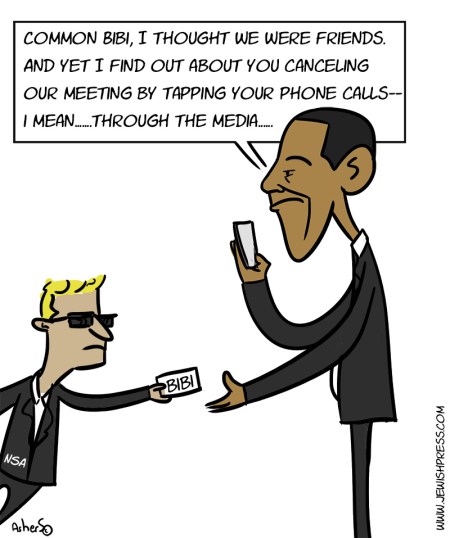
Obama-finds-out

H/t Townhall

Republican base

Cartoon of the Day

March 3, 2016

Via The Jewish Press

Expulsion-Incentive

Iran uses Syrian truce to deploy hundreds of Palestinian terrorists on Golan border

February 27, 2016

Iran uses Syrian truce to deploy hundreds of Palestinian terrorists on Golan border, DEBKAfile, February 27, 2016

Al-Sabirin-logo

Under cover of the Syrian ceasefire that went into effect Saturday, Feb. 27, and the Russian air umbrella, Iran’s Revolutionary Guards Corps finally managed to secretly install hundreds of armed Palestinian terrorists on the Syrian-Israeli border face-to-face with the IDF’s Golan positions.

This is reported exclusively by DEBKAfile’s military and intelligence sources.

These Palestinians belong to Al-Sabirin, a new terrorist organization the Iranian Guards and Hizballah are building in the refugee camps of Lebanon and the Gaza Strip. Their agents clandestinely recruited the new terrorists from among young Palestinians who fled the Yarmouk refugee camp outside Damascus and sought refuge in Lebanon. Hizballah organized their return to Syria through south Lebanon – but not before training and arming them for penetration deep inside Israel to carry out mass-casualty assaults on IDF positions, highways and civilians.

So Iran and Hizballah have finally been able to achieve one of the most cherished goals of their integration in the Syria civil war, namely, to bring a loyal terrorist force right up to Israel’s border.

Israel’s military planners went to extreme lengths to prevent this happening. Last December, Samir Quntar, after being assigned by Tehran and Hizballah to establish a Palestinian-Druze terror network on the Golan, was assassinated in Damascus.

Twelve months before that, on Jan. 18, an Israeli air strike hit an Iranian-Syrian military party surveying the Golan in search of jumping-off locations for Hizballah terror squads to strike across the border against Israeli targets. The two senior officers in the party, Iranian General Allah-Dadi and Hizballah’s Jihad Mughniyeh, were killed.

The hubbub in the run-up to the Syrian truce, coupled with Russia’s protective military presence, finally gave the Islamic Republic and its Lebanese proxy the chance to outfox Israeli intelligence and secretly bring forward a terrorist force to striking range against Israel

This discovery was one of the causes of Prime Minister Binyamin Netanyahu’s urgent phone call to President Vladimir Putin Wednesday, Feb. 24, two days before the ceasefire went into effect. He reminded the Russian leader of the understandings they had reached regarding the deployment of pro-Iranian terrorists on the Syrian-Israeli border. He also sent emissaries to Moscow to intercede with Russian officials.

Putin’s answers to Israel’s demarches were vague and evasive, on the lines of a promise to look into their complaints.

He also tried to fob Netanyahu off by inviting President Reuven Rivlin for a state visit to Russia. Putin promised to use that occasion for a solemn Russian pledge of commitment to upholding Israel’s security in a tone that would leave Tehran in no doubt of Moscow support for the Jewish state.
The Rivlin visit has been scheduled for March 16.

But it is clear that the prime minister and defense minister Moshe Ya’alon were too slow to pick up on the new terrorist menace Iran had parked on Israel’s border. Now their hands are tied, say DEBKAfile’s sources. An IDF operation to evict the pro-Iranian Palestinian Al-Sabirin network from the Syrian Golan, before it digs in, would lay Israel open to the charge of jeopardizing, or even sabotaging, the inherently fragile Syrian ceasefire initiated jointly by the US and Russia.

Netanyahu phones Putin for clarifications on the South Syrian ceasefire

February 24, 2016

Netanyahu phones Putin for clarifications on the South Syrian ceasefire, DEBKAfile, February 24, 2016

PutinBibi2-480

Prime Minister Binyamin Netanyahu phoned President Vladimir Putin Wednesday Feb. 24, to find out how the partial Syrian ceasefire due to go into effect Saturday Feb. 27 will affect Israel’s northern border security. According to the Kremlin statement, “The two leaders discussed the Middle East and reached agreement to hold a number of high-level contact meetings.”

Agreement was also reached on “a range of contact [meetings] on the high and highest level, taking into consideration the 25tyh anniversary of the establishment of diplomatic relations between the two countries,” the communiqué went on to say.

The language and content of this communiqué struck DEBKAfile’s diplomatic sources as oddly off the point compared with statements that came after past conversations.

It is hard to believe that the Russian President, while deeply immersed in tense exchanges with President Barack Obama and Iran’s Hassan Rouhani for tying up the ends of the approaching Syrian ceasefire, would give his attention to the celebration of a historic event.

The words did however convey the impression that the Russian leader was making an effort to calm Israel’s apprehensions about the coming stage of the Syrian crisis.

According to our sources, Netanyahu put in the call to Putin when he learned that the Russian and American presidents had agreed to get the partial ceasefire started in southern Syria, namely on the front closest to the borders of Israel and Jordan.

Israeli and Jordanian military officials have been trying to get a picture of how these arrangements would work and affect their national security, but Washington and Moscow are similarly tightlipped on information. This is also the reaction the Israeli Foreign Ministry’s Director General Dore Gold found when he called on Russian Foreign Minister Sergei Lavrov in Moscow on Feb. 18. The minister was polite but avoided direct answers to questions.

Israel is most deeply troubled by the possibility that Syrian army, Iranian and Hizballah forces currently in offensive momentum in South Syria will exploit the cessation of hostilities to advance towards its Golan border with hostile intent.

With only three days to go before the truce goes into effect, Israel has still not received any clear answers about whether the Russian air force will continue to strike Syrian rebel elements deemed “terrorists” unabated in close proximity to its northern borders.

US officials have tried in the last 24 hours to assuage Israel’s concerns, but they are no more forthcoming with clear information than the Russians.

Netanyahu therefore picked up the phone to the Russian president, with whom he maintains a friendly dialogue, to find out what was ahead in the wake of the truce and to ask for guarantees that Syrian, Iranian and Hizballah forces would not permitted to take advantage of the lull to gain ground.

The prime minister also asked Putin about the huge $14bn arms deal in negotiation with Tehran.

He is most unlikely to have been appeased by the bone the Russian president threw him about a joint celebration of an anniversary. The record is not assuring. In early January, Putin promised Netanyahu that he would make sure that Hizballah forces would not be part of the Russian-backed Syrian army offensive in the South. But then, on Jan. 27, a large Hizballah force entered the southern town of Daraa and Russian air strikes drew ever closer to the Israeli border, until explosions could be heard in Israel from a distance of no more than a few hundred meters.

Russia air strikes seal Jebel Druze against attack and refugees

February 21, 2016

Russia air strikes seal Jebel Druze against attack and refugees, DEBKAfile, February 22, 2016

2717545 10/10/2015 Russian Su-25 attack aircraft take off from the Khmeimim airbase in Syria. Dmitriy Vinogradov/RIA Novosti

2717545 10/10/2015 Russian Su-25 attack aircraft take off from the Khmeimim airbase in Syria. Dmitriy Vinogradov/RIA Novosti

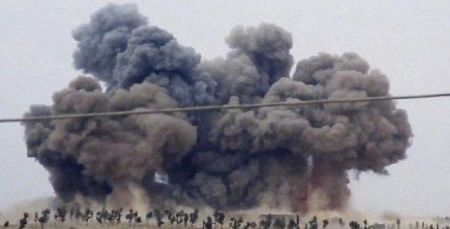
While Syrian war reporting focused over the weekend on the battles around Aleppo and along the Turkish border in the north, Russia since Saturday, Feb. 20 has ramped up its air bombardment of southern cities and towns, especially Daraa and Nawa. Thousands of fleeing rebels with their families and other civilians have meanwhile been turned away from the locked Jordanian border and are heading towards the Golan opposite the Israeli border.

The heaviest Russian air strikes seen hitherto in Syria have two strategic goals.

1. To retake the key southern town of Daraa from rebel hands and restore it to Syrian President Bashar Assad’s full control.

2. To crush rebel resistance in the South and force them to accept surrender, collapse or escape in the direction of the Jordanian or Israeli borders.

The intense Russian sorties are opening the door to Syrian, Iranian and Hizballah forces to move into the South and reach the Israeli borders. Prime Minister Binyamin Netanyahu sent Dr. Dore Gold to Moscow last week as his special emissary to explain how this affected Israel’s security. But he was unable to persuade the Russians to scale down their attacks in this sensitive border region.

Those attacks have a third goal, which is to encircle the Jebel Druze region with a “shield of fire” as protection for this ethnic minority of 750,000, most which inhabit mountain villages.

This unusual operation, the first of its kind in the Syrian war, has three objectives:

A. To shield the Druzes villages against ISIS attack from the east, namely Deir az-Zour.

B. To shut the door against fleeing rebels seeking sanctuary in the Druze enclave.

C. To show other Syrian minorities, especially the Kurds in the north, the great advantage of allying themselves with Moscow. Word of Russian protection of the Druzes has undoubtedly spread to Syria’s other minorities.

As for the rebels and refugees, Jordanian troops moved into the border crossings evacuated by Syrian rebels and closed the last crossing at Ramtha.

The exodus from southern Syria is now heading towards the Golan on Israel’s doorstep.

Israel has imposed a media blackout on this development. However, DEBKAfile’s sources warn that it will soon be impossible to keep it dark. Within a few days, many thousands of Syrian refugees will be massing at Israel’s Ein Zivan gate opposite Quneitra. Like Turkey and Jordan, Israel will have to supply large numbers of distressed Syrian refugees with tents, food, water and medicines.

Special Israeli emissary to Moscow over Russian Syria air strikes near border

February 17, 2016

Special Israeli emissary to Moscow over Russian Syria air strikes near border, DEBKAfile, February 17, 2016

Israel_near_border_16.2.16

In view of the crisis building up on the southern Syrian-Israeli border, Prime Minister Binyamin Netanyahu decided immediately on his return home from Berlin early Wednesday, Feb. 17, to send a special  emissary to Moscow to ask for clarifications. Tuesday, Intensified Russian air strikes came to within 6 km of the Israeli border, sparking a growing exodus of Syrian refugees heading towards the Qoneitra border crossing to Israel.

DEBKAfile’s sources reveal that the envoy is Dr. Dore Gold, director-general of the Foreign Ministry and one of the prime minister’s few trusted confidantes.

It was still not clear whom Gold will meet in the Russian capital, but it is assumed that it will be one of Moscow’s senior decision-makers in the loop on its military operation in Syria.

The fact that Netanyahu decided to dispatch a top diplomat rather than a senior military or intelligence officer is a sign that the prime minister is not of one mind with the IDF’s intelligence assessments of the situation on the ground.

Netanyahu’s concerns grew after after the Russian air force on Tuesday widened its massive bombing of southern Syria from the city of Daraa to the Golan town of Quneitra, in order to help the Syria army’s 7th armored division push the rebels east, so they will not attempt to cross the border and seek shelter in Israel.

DEBKAfile’s military sources report that that 12 of the 15 targets bombed by the Russian air force across from the Israeli border were new rebel positions that had not been attacked before, even by the Syrian army. Military sources monitoring the war said Tuesday night that there is no doubt that the Russians are in the process of wiping out the rebel positions along the Israeli border by means of an offensive comparable to their operations in the northern Aleppo sector.

Our sources report that Israel’s concerns grew when, as the Russians bombing raids neared the Israeli border, Syrian officials threatened Jordan with serious consequences if Amman gave the Saudi air force a base for attacking eastern or southern Syria.

The threats began Tuesday, after Jordanian forces took over the Syrian-Jordanian border crossings formerly held by Syrian rebels, as a measure to stem the volume of Syrian refugees in search of sanctuary in the Hashemite Kingdom. But this step was interpreted by the Syrians and their Russian ally as clearing the way for Saudi intervention in the Syrian conflict using Jordan as a jumping-off base.

Meanwhile, Western military sources reported a sub substantial presence Tuesday of both Russian and Israeli warplanes in the skies over and around southern Syria.