Archive for the ‘Netanyahu’ category

Arab Commentators Strongly Back Netanyahu on Congress Speech, Iran Nuclear Threat

March 4, 2015

Arab Commentators Strongly Back Netanyahu on Congress Speech, Iran Nuclear Threat, Algemeiner, Shirym Ghermezian, March 3, 2015

netanyahu-congress-300x175Prime Minister Netanyahu addresses Congress on the Iranian nuclear threat. Photo: Screenshot.

“What is absurd, however,” Abbas continues, “is that despite this being perhaps the only thing that brings together Arabs and Israelis (as it threatens them all), the only stakeholder that seems not to realize the danger of the situation is President Obama, who is now infamous for being the latest pen-pal of the Supreme Leader of the World’s biggest terrorist regime: Ayottallah Ali Khamenei.”

******************

Leading Arab opinion makers weighed in on the controversy surrounding Israeli Prime Minister Benjamin Netanyahu’s address to Congress on Tuesday and expressed strong support for his stance on the Iranian nuclear threat.

In an op-ed for the Saudi Arabian daily Al-Jazirah on Monday, columnist Dr. Ahmad Al-Faraj asserted that Netanyahu is justified in his campaign against the proposed nuclear deal with Iran, according to The Middle East Media Research Institute. Al-Faraj said Netanyahu’s effort to prevent the signing of the agreement is in the interests of the Gulf states, and that the prime minister “is right to insist on addressing Congress about the nuclear deal.”

“I am very glad of Netanyahu’s firm stance and [his decision] to speak against the nuclear agreement at the American Congress despite the Obama administration’s anger and fury,” Al-Faraj wrote. “I believe that Netanyahu’s conduct will serve our interests, the people of the Gulf, much more than the foolish behavior of one of the worst American presidents.”

The powerful editor-in-chief of Al Arabiya English, Faisal J. Abbas, published a column on Tuesday in which he asked Obama to take notes from Netanyahu on the extent of the Iranian threat. In the piece, titled “President Obama, Listen to Netanyahu on Iran,” Abbas says, “one must admit, Bibi did get it right, at least when it came to dealing with Iran.”

Abbas notes that Netanyahu “hit the nail right on the head” when he said at a recent event in Tel Aviv that “Middle Eastern countries are collapsing and that ‘terror organizations, mostly backed by Iran, are filling in the vacuum.’” In his remarks, Netanyahu “managed to accurately summarize a clear and present danger, not just to Israel (which obviously is his concern), but to other US allies in the region,” Abbas writes.

“What is absurd, however,” Abbas continues, “is that despite this being perhaps the only thing that brings together Arabs and Israelis (as it threatens them all), the only stakeholder that seems not to realize the danger of the situation is President Obama, who is now infamous for being the latest pen-pal of the Supreme Leader of the World’s biggest terrorist regime: Ayottallah Ali Khamenei.”

Abbas slams Obama’s “controversial take on managing global conflicts that raises serious questions.”  The “real Iranian threat” says Abbas, is not just the country’s nuclear ambitions, “but its expansionist approach and state-sponsored terrorism activities which are still ongoing.”

Off topic? Free speech on campus

March 4, 2015

Free speech on campus, Pat Condell via You Tube, March 2, 2015

(Many “highly educated” leftists believe that they should vent their views freely but that others not only should not but should be prevented from doing so. Might the objections of Obama and his cohorts to PM Netanyahu’s address to the Congress have been motivated by substantially the same sort of nonsense Mr. Condell ascribes to academia:  If you don’t agree with Obama, know your place, sit down and shut up?– DM)


Bibi’s Triumph Puts Obama on the Defensive

March 3, 2015

Bibi’s Triumph Puts Obama on the Defensive, Commentary Magazine, March 3, 2015

(Please see also Iran calls Obama’s 10-year nuclear demand ‘unacceptable’– DM)

If President Obama was hoping that Israeli Prime Minister Netanyahu would lay an egg with his much-anticipated and controversial speech to a joint session of Congress, he was gravely disappointed. Netanyahu’s address was a triumph that put the administration on the defensive over its reckless pursuit of détente with Iran. But though the administration’s apologists are willing to admit that Netanyahu won on style points, they are wrong when they claim he offered no alternative to a deal with Iran that abandons the president’s previously stated principles about forcing the Islamist regime to abandon their nuclear ambitions. To the contrary, Netanyahu’s speech was more than stirring rhetoric. It laid out clear benchmarks for what must be achieved in any deal and pointed the way toward a return to tough sanctions and equally tough negotiating tactics. In doing so, he put the administration on the defensive and, no matter what happens in the talks, forces it to explain an indefensible deal and reminded Congress that it has a responsibility to weigh in on the issue to ensure the nation’s security.

What had to most frustrate the White House was Netanyahu’s ability to debunk their main talking point about the speech. After weeks of hyping the address as an injection of partisanship into the U.S.-Israel relationship, the prime minister’s willingness to give the president his due for past support of Israel and his refusal to mention the many instances in which Obama had undercut the Jewish state’s position and deliberately attempted to create more distance between the two allies made the White House’s angry reaction look petty. The prime minister’s initial decision to accept House Speaker John Boehner’s invitation gave the president the opening he needed to distract the country from his Iran policy. With the help of the president’s always helpful press cheering section, White House political operatives made Netanyahu’s supposed breach of protocol the issue rather than the appeasement of Iran. But they eventually succumbed to overkill in denouncing Netanyahu and by the time the prime minister took the podium at the Capitol, the administration’s efforts had the unintended effect of giving him a bigger audience than he might otherwise have had.

Thus, by the time the address was over, the issue was no longer whether he should have given the speech. Though the White House is doggedly trying to portray the speech as partisan, it was not. Now it is the substance of Netanyahu’s concerns about Iran’s behavior and the failure of the Western powers to negotiate a deal that would stop Iran from getting a weapon that is the subject of discussion. Which is to say that after winning news cycles at Netanyahu’s expense throughout February, the White House has set itself up to have to explain years of concessions to a dangerous regime with almost nothing to show for it in terms of making the world any safer.

At the core of the disagreement between Netanyahu and Obama on Iran is the president’s faith that Iran can or will change. Even Obama apologists no longer regard the notion that Hassan Rouhani’s election as president signaled a move toward moderation as a serious argument. Though the administration has been careful not to defend Iran’s past and present behavior, by eloquently laying out the Islamist regime’s record of terrorism and aggression, it put the onus on the president to explain why he thinks that over the course of the next decade, Iran is going to, “get right with the world,” as he has said.

Equally important, the speech forces the president to defend the substance of the deal he is desperately trying to entice the Iranians to sign. Netanyahu reminded the world what has happened since Obama’s pledge during his 2012 foreign-policy debate with Mitt Romney that any deal with Iran would force it to give up its nuclear program. Since then, the administration has not only recognized Iran’s right to enrich uranium but also agreed to let them keep several thousand centrifuges and the rest of their nuclear infrastructure.

As Netanyahu pointed out, even if they abide by the terms of the deal—something about which reasonable people are doubtful given their past record of cheating and unwillingness to open their country to United Nations inspectors—the ten-year sunset clause Obama mentioned in interviews yesterday gives the regime the ability to eventually build a nuclear weapon. Rather than stopping Iran from getting a bomb, the path that Obama has travelled ensures they will eventually get one even if the accord works. The president not only guarantees that Iran will become a threshold nuclear power but, as Netanyahu rightly argued, sets in motion a series of events that will create a new nuclear arms race in the Middle East.

Did Netanyahu offer an alterative to the president’s policy? The answer is yes. The administration is right when they say Netanyahu offered nothing new, but that was the point. After belatedly adopting sanctions, the administration quickly gave up on them just at the moment in 2013 when they were starting to bite. By toughening sanctions, as the Kirk-Menendez bill currently before Congress would do, and increasing the political and economic pressure on the regime, the U.S. has a chance to reverse Obama’s concessions and bring Iran to its knees. The West must insist that Iran change its behavior before sanctions are lifted, rather than afterward. Instead of Obama and Kerry’s zeal for a deal encouraging the Iranians to make no concessions, Netanyahu was correct to remind Congress that Tehran needs a deal more than the U.S. Indeed, Netanyahu not only offered an alternative; he put forward the only one that has a chance of stopping Iran from getting a weapon without using force.

Try as they might to continue to abuse Netanyahu for a brilliant speech, the White House’s response demonstrates nothing but its intolerance for criticism and inability to defend a policy of capitulation to Iran. Rather than engage in pointless discussions about the president’s hurt feelings or Netanyahu’s chutzpah for telling the truth about the negotiations, it’s time for the press and Congress to start asking the administration tough questions about a reckless deal before it is too late.

What Benjamin Netanyahu just did

March 3, 2015

What Benjamin Netanyahu just did, The Washington PostJennifer Rubin, March 3, 2015

Prime Minister Benjamin Netanyahu’s speech to Congress was a devastating indictment of the P5+1′s entire approach, and it reminded and reunited Democrats and Republicans, as did Sen. Robert Menendez’s speech to AIPAC Monday, on what is at stake and why the deal under contemplation can never come to pass.

As a preliminary matter, it is evident that had the president not thrown a fit, Netanyahu’s speech might not have garnered quite so much attention. But to be honest, the fuss mostly remained in the media. When the chips were down, it appeared that all but far-left lawmakers and Congressional Black Caucus members attended. That, incidentally, is a problem on the left, which has become virulently anti-Israel, as has the left in Europe and elsewhere (hence the BDS movement’s prominence on left-wing campuses and European capitals).

The speech was not aimed at the president, who is immune to reason, nor to the negotiators who suffer from a variation of Stockholm Syndrome, whereby they come to identify with their bargaining opponents more than the country they represent. It was aimed at American public opinion and uncertain Democrats on whose good judgment Netanyahu must rely to derail a disastrous deal. By flattering the president and Democrats, Netanyahu gave them an out to agree with him without crossing the president or appearing to give in to Republicans. He said so bluntly it was starting: This is a bad deal. No deal is better. And he explained exactly why.

In laying out his argument in such logical order — explaining the nature of the threat, the two central flaws in the deal (leaving Iran with most of its nuclear infrastructure and lifting restrictions after a decade) and explaining the false choice between this deal and war (instead, hold the line and beef up sanctions) — he made clear that if one understands the nature of the Iranian regime and what the concessions mean, one cannot be in favor of this deal. “Absent a dramatic change, we know for sure that any deal with Iran will include two major concessions to Iran. The first major concession would leave Iran with a vast nuclear infrastructure, providing it with a short break-out time to the bomb. Break-out time is the time it takes to amass enough weapons-grade uranium or plutonium for a nuclear bomb. . . . But the second major concession creates an even greater danger that Iran could get to the bomb by keeping the deal. Because virtually all the restrictions on Iran’s nuclear program will automatically expire in about a decade.” The conclusion was nearly inescapable: “It doesn’t block Iran’s path to the bomb; it paves Iran’s path to the bomb.”

From identical talking points spouted by Obama administration apologists, we know the Obama defense is that there is no alternative. But Netanyahu gave them one, and in doing so pointed Congress in the right direction.”We can insist that restrictions on Iran’s nuclear program not be lifted for as long as Iran continues its aggression in the region and in the world. Before lifting those restrictions, the world should demand that Iran do three things. First, stop its aggression against its neighbors in the Middle East. Second, stop supporting terrorism around the world. And third, stop threatening to annihilate my country, Israel, the one and only Jewish state.” He was greeted with thunderous applause.

And how to get there? “Well, nuclear know-how without nuclear infrastructure doesn’t get you very much. A race car driver without a car can’t drive. A pilot without a plane can’t fly. Without thousands of centrifuges, tons of enriched uranium or heavy water facilities, Iran can’t make nuclear weapons. Iran’s nuclear program can be rolled back well-beyond the current proposal by insisting on a better deal and keeping up the pressure on a very vulnerable regime, especially given the recent collapse in the price of oil. Now, if Iran threatens to walk away from the table — and this often happens in a Persian bazaar — call their bluff. They’ll be back, because they need the deal a lot more than you do. And by maintaining the pressure on Iran and on those who do business with Iran, you have the power to make them need it even more.” In other words, stop chasing a deal, tighten the screws and give the regime a choice between economic collapse and nukes.

He made three other salient points that the administration would rather obscure.

First, even if the deal on the table was inked, it would set off a series of events far worse than having no deal: “So this deal won’t change Iran for the better; it will only change the Middle East for the worse. A deal that’s supposed to prevent nuclear proliferation would instead spark a nuclear arms race in the most dangerous part of the planet. This deal won’t be a farewell to arms. It would be a farewell to arms control.”

Second, he explained that the hope of Iran changing its stripes down the road is entirely illogical. “Why should Iran’s radical regime change for the better when it can enjoy the best of both world’s: aggression abroad, prosperity at home? This is a question that everyone asks in our region. Israel’s neighbors — Iran’s neighbors know that Iran will become even more aggressive and sponsor even more terrorism when its economy is unshackled and it’s been given a clear path to the bomb. . . . If anyone thinks — if anyone thinks this deal kicks the can down the road, think again. When we get down that road, we’ll face a much more dangerous Iran, a Middle East littered with nuclear bombs and a countdown to a potential nuclear nightmare. Ladies and gentlemen, I’ve come here today to tell you we don’t have to bet the security of the world on the hope that Iran will change for the better. We don’t have to gamble with our future and with our children’s future.”

And finally, he went to the heart of the problem with the administration’s premise, namely that reconciliation with Iran can help us defeat the Islamic State. He argued, “Iran and ISIS are competing for the crown of militant Islam. One calls itself the Islamic Republic. The other calls itself the Islamic State. Both want to impose a militant Islamic empire first on the region and then on the entire world. They just disagree among themselves who will be the ruler of that empire. In this deadly game of thrones, there’s no place for America or for Israel, no peace for Christians, Jews or Muslims who don’t share the Islamist medieval creed, no rights for women, no freedom for anyone. So when it comes to Iran and ISIS, the enemy of your enemy is your enemy.”

It was masterful in many ways. But ultimately, Israel won’t be hobbled or restrained if Netanyahu’s message falls on deaf ears. He wrapped up with a reminder, as he pointed to Holocaust survivor Elie Wiesel in the gallery: “And I wish I could promise you, Elie, that the lessons of history have been learned. I can only urge the leaders of the world not to repeat the mistakes of the past. Not to sacrifice the future for the present; not to ignore aggression in the hopes of gaining an illusory peace.  But I can guarantee you this, the days when the Jewish people remained passive in the face of genocidal enemies, those days are over. We are no longer scattered among the nations, powerless to defend ourselves. We restored our sovereignty in our ancient home. And the soldiers who defend our home have boundless courage. For the first time in 100 generations, we, the Jewish people, can defend ourselves.”

He hastened to add to tumultuous applause that “But I know that Israel does not stand alone. I know that America stands with Israel. I know that you stand with Israel. You stand with Israel, because you know that the story of Israel is not only the story of the Jewish people but of the human spirit that refuses again and again to succumb to history’s horrors.”

That’s the hope, and he made it that much more likely by debunking nearly every false note, phony argument and wrong assumption guiding the administration. He is betting congressional Democrats and the American people are smarter and wiser than Obama. How could they not be?

Two things people are missing about Netanyahu’s speech

March 3, 2015

Two things people are missing about Netanyahu’s speech, Instapundit, Glen Reynolds, March 3, 2015

(The link will work only today: that’s the way Instapundit, generally a blog aggregator,  functions. Perhaps Mr. Reynolds will write and post a lengthier article on the topic, with a URL that can be linked.– DM)

(1) He didn’t just make a case for why the U.S. should be harder on Iran. He made the case for unilateral Israeli military intervention too, sub silentio. (2) The most damaging thing to Obama here isn’t even the substance, but the contrast in style. Netanyahu, as someone said on Twitter, was better in his second language than Obama is in his first. And he presented himself as a leader who cares about his country, rather than one, like Obama, who makes excuses for its enemies.


A scenario Netanyahu hasn’t spelled out: One Iranian nuke could obliterate Israel’s heartland

March 3, 2015

A scenario Netanyahu hasn’t spelled out: One Iranian nuke could obliterate Israel’s heartland, DEBKAfile, March 3, 2015

zunamiOne dread Iranian nuclear threat postulated

When Prime Minster Binyamin Netanyahu speaks out against Iran becoming a pre-nuclear state he is warning that Iran could at any time cross the line agreed in diplomacy with the US and build a bomb whenever it chooses. He has never spelled out the mechanics of this threat to Israel’s survival.

The last DEBKA Weekly revealed in detail one potential scenario that, given Israel’s small size, would call for no more than one nuke to destroy its heartland and inflict at least an estimated million casualties. This nuclear bomb or device would be dropped from an IranAir civilian airliner on a regular run from Larnaca over the Mediterranean about 100 km from the Israeli coast.

After the plane disappeared, the delayed action mechanism would detonate the bomb and set off a tsunami. Giant waves would swamp the densely populated Tel Aviv conurbation and its satellites. This 1,500 square kilometer area is home to some 3.7 million people, nearly half of the country’s entire population, its military and banking centers, hi-tech industry and the stock exchange.

The cost in lives would be cataclysmic – at least a million dead.

Iran’s Islamic Revolutionary rulers make no secret of their plans for Israel. On Feb. 26, the second day of Iran’s 2015 war games, a senior Revolutionary Guards officer declared that Iran had the ability to wipe the cities of Haifa and Tel Aviv off the face of the earth.

In projecting this scenario, Israel’s defense chiefs have no doubt set up defenses and a second-strike capacity in a mountainous area outside the range of a tsunami and far from Israel’s shores.

Israel is also on guard on both of its northern borders against the hostile Iranian military presence encroaching from Syria and Lebanon.

The big speech – about which Netanyahu joked: Never has so much been written about a speech before it was given – will be delivered to a joint session of the US Congress Tuesday, March 3, at 6 p.m. IST.

It is hard to see what he hopes to achieve, aside from dramatizing his fight against the emerging US-Iranian deal which, he warns, will enable Iran to consummate its drive for nuclear weapons early in the future.

He takes the august podium under a barrage of criticism from President Barack Obama, his aides and his political opponents at home. About one-fifth of Democratic members will be absent. The White House has warned him against “betraying trust” by revealing details conveyed in confidence. But he won cheers from a large AIPAC audience earlier when he said, “Israel now has a voice and I will use it!”

In a Reuters interview Monday night, Obama said the US and Israel agreed Iran must not acquire nuclear weapons, but differed on how to achieve this goal. Any deal he would agree to, Obama said, would require Iran to freeze its nuclear program at least a decade. The US goal is to make sure “there’s at least a year between us seeing them try to get a nuclear weapon and them actually being able to obtain one,” he said.

A key doubt was whether Iran would agree to rigorous inspection demands and the low levels of uranium enrichment capability they would have to maintain.

Monday, March 2, the International Atomic Energy Agency, IAEA, complained once again that Iran was still not answering key questions about its nuclear projects or opening up suspect sites to inspection.

But US national security adviser Susan Rice, who addressed AIPAC after Netanyahu, insisted that the prime minister’ demand to strip Iran of the ability to enrich uranium would be “neither realistic nor achievable,” adding that President Obama had left all options on the table for preventing a nuclear-armed Iran.

After the speech to Congress, the prime minister will meet Senators Mitch McConnell and Harry Reid with a group of bipartisan lawmakers.

Although no member of the administration will be present for the speech – not just Vice President Joe Biden – the office of House Speaker John Boehner, who invited the Israeli leader to give the address, says the demand for tickets is unprecedented – from both Republicans and Democrats alike. The House and Senate have set up alternative viewing locations.

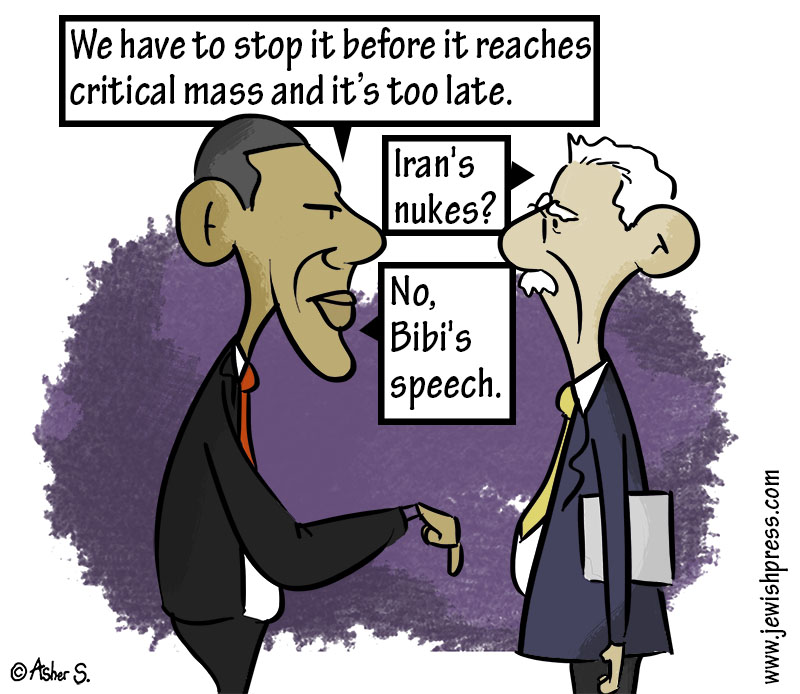
Cartoon of the day

March 2, 2015

The Jewish Press, March 2, 2015


bibis-speech

Netanyahu, Not Obama, Speaks for Us

March 2, 2015

Netanyahu, Not Obama, Speaks for Us, National Review On Line, Quin Hilleyer, March 2, 2015

Benjamin Netanyahu of course speaks first for Israel, but he speaks also for you and for me, for decency and humaneness, and for vigilance and strength against truly evil adversaries. Congress, by inviting him, is wise. Obama, by opposing him, is horribly wrong. And the civilized world, if it ignores him, will be well-nigh suicidal.

************************

While under fierce attack from President Obama, the Israeli prime minister defends Western values and speaks the truth about Iran.

The leader of the free world will be addressing Congress on Tuesday. The American president is doing everything possible to undermine him.

Israeli prime minister Benjamin Netanyahu leads a nation surrounded by enemies, a nation so small that it narrows at one point to just 9.3 miles. Yet, in a world where the Oval Office is manned by someone openly apologetic for most American exercises of power; and where Western Europe’s economy is enervated, its people largely faithless, and its leadership feckless; and where Freedom House has found “an overall drop in [global] freedom for the ninth consecutive year,” the safeguarding of our civilization might rely more on leaders who possess uncommon moral courage than on those who possess the most nukes or biggest armies.

Right now, nobody on the world stage speaks for civilization the way Netanyahu does. While Barack Obama babbles about the supposedly “legitimate grievances” of those who turn to jihad, Netanyahu talks like this (from his speech to the United Nations on September 27, 2012):

The clash between modernity and medievalism need not be a clash between progress and tradition. The traditions of the Jewish people go back thousands of years. They are the source of our collective values and the foundation of our national strength.

At the same time, the Jewish people have always looked towards the future. Throughout history, we have been at the forefront of efforts to expand liberty, promote equality, and advance human rights. We champion these principles not despite of our traditions but because of them.

We heed the words of the Jewish prophets Isaiah, Amos, and Jeremiah to treat all with dignity and compassion, to pursue justice and cherish life and to pray and strive for peace. These are the timeless values of my people and these are the Jewish people’s greatest gift to mankind.

Let us commit ourselves today to defend these values so that we can defend our freedom and protect our common civilization.

When Hamas fired thousands of rockets into Israel last year, Netanyahu, in his necessary military response, did something almost unprecedented in the history of warfare. As he accurately described in his U.N. speech last year, on September 29:

Israel was doing everything to minimize Palestinian civilian casualties. Hamas was doing everything to maximize Israeli civilian casualties and Palestinian civilian casualties. Israel dropped flyers, made phone calls, sent text messages, broadcast warnings in Arabic on Palestinian television, always to enable Palestinian civilians to evacuate targeted areas.

No other country and no other army in history have gone to greater lengths to avoid casualties among the civilian population of their enemies.

As Barack Obama complains (with scant grasp of the historical context) about how Christians were such gosh-darn meanies a thousand years ago in the Crusades, Netanyahu protects the ability of Muslims today to have free access to the Old City of Jerusalem, even as Jews and Christians are prohibited from visiting the Temple Mount. At the beginning of his first term, in his first trip overseas as president, Obama delivered a speech to Turkey’s parliament, under the thumb of the repressive Tayyip Erdogan. “The United States is still working through some of our own darker periods in our history,” he confessed, sounding like America’s therapist-in-chief. “Our country still struggles with the legacies of slavery and segregation, the past treatment of Native Americans.”

Netanyahu, in contrast, in a 2011 Meet the Press interview, offered unabashed words of praise for the United States: “Israel is the one country in which everyone is pro-American, opposition and coalition alike. And I represent the entire people of Israel who say, ‘Thank you, America.’ And we’re friends of America, and we’re the only reliable allies of America in the Middle East.” (Netanyahu was accurate in his description of how much Israelis appreciate Americans, as I saw last summer during a visit to the country.)

In thanking America, Netanyahu was not posturing for political advantage. Netanyahu — who spent far more of his formative years on the American mainland than Obama did, and who took enemy fire at the age when Obama was openly pushing Marxist theory, and who learned and practiced free enterprise at the same age when Obama was practicing and teaching Alinskyism — has spoken eloquently for decades in praise of the Western heritage of freedom and human rights. He also speaks and acts, quite obviously, to preserve security — for Israel, of course, but more broadly for the civilized world. On Tuesday, as he has done for more than 30 years, Netanyahu will talk about the threat to humanity posed by Iran.

It’s mind-boggling to imagine that any national leader in the free world would fail to understand the danger. The ayatollahs have never backed down from their stated aim of destroying Christendom. They have never wavered from their depiction of the United States as the “Great Satan.” Just last week, Iran bragged about its recent test-firing of “new strategic weapons” that it says will “play a key role” in any future battle against the “Great Satan U.S.”

Iran also continues developing, while trying to keep them secret, new missiles and launch sites with devastatingly long-range capability. It continues to enrich uranium, including an allegedly secret program, to a level that’s a short jump-step from bomb strength. It has a lengthy record of lying and cheating about its military activities, its compliance with U.N. mandates (not that the U.N. is worth much anyway), and its protections of even the limited human rights it actually recognizes as such.

About the only thing Iran never lies about is its absolute, unyielding determination to wipe Israel off the face of the earth. It was only a few months ago, for example, that the “revolutionary” regime’s “Supreme Leader,” the Ayatollah Ali Khamenei, released a nine-point plan for how to “annihilate” the Jewish state.

Yet Obama not only begrudges the Israeli prime minister the opportunity to make his case against this existential threat to his nation, but he conducts a diplomatic and political assault against Netanyahu of a ferocity rarely seen in the annals of American foreign policy. Obama’s actions aren’t just wrongheaded; they are malignant. They pervert American tradition and American interests, and they attempt to deprive the entire free world of its single most clarion voice for enlightenment values.

Benjamin Netanyahu of course speaks first for Israel, but he speaks also for you and for me, for decency and humaneness, and for vigilance and strength against truly evil adversaries. Congress, by inviting him, is wise. Obama, by opposing him, is horribly wrong. And the civilized world, if it ignores him, will be well-nigh suicidal.

Netanyahu, Churchill and Congress

March 2, 2015

Netanyahu, Churchill and Congress, The Gatestone InstituteRichard Kemp, March 1, 2015

There are striking similarities between the objectives of Churchill’s speech nearly 75 years ago and Netanyahu’s today; both with no less purpose than to avert global conflagration. And, like Churchill’s in the 1930s, Netanyahu’s is the lone voice among world leaders today.

There is no doubt abut Iran’s intent. It has been described as a nuclear Auschwitz. Israel is not the only target of Iranian violence. Iran has long been making good on its promises to mobilize Islamic forces against the US, as well as the UK and other American allies. Attacks directed and supported by Iran have killed an estimated 1,100 American troops in Iraq in recent years. Iran provided direct support to Al Qaeda in the 9/11 attacks.

Between 2010 and 2013, Iran either ordered or allowed at least three major terrorist plots against the US and Europe to be planned from its soil. Fortunately, all were foiled.

Iran’s ballistic missile program, inexplicably outside the scope of current P5+1 negotiations, brings Europe into Iran’s range, and future development will extend Tehran’s reach to the US.

It is not yet too late to prevent Iran from arming itself with nuclear weapons. In his 1941 speech to Congress, Churchill reminded the American people that five or six years previously it would have been easy to prevent Germany from rearming without bloodshed. But by then it was too late.

This vengeful and volatile regime must not in any circumstances be allowed to gain a nuclear weapons capability, whatever the P5+1 states might consider the short-term economic, political or strategic benefits to themselves of a deal with Tehran.

In a few days, Israeli Prime Minister Benjamin Netanyahu will address the US Congress for the third time. The only other foreign leader to have had that privilege was Winston Churchill. Like Churchill when he first spoke to Congress in December 1941, Netanyahu is taking a risk.

For Churchill the risk was to his life — he had to make a hazardous transatlantic voyage aboard the battleship HMS Duke of York through stormy, U-boat infested waters. For Netanyahu the risk is to his own political life and to his country’s relationship with the United States, given the intense presidential opposition to his speech.

But like Churchill was, Netanyahu is a fighting soldier and, like Churchill, a tough political leader, unafraid to shoulder such risks when so much is at stake. And in both cases, the stakes could not be higher, greater than their own lives, political fortunes or rivalries and affecting not just their own countries and the United States, but the whole of the world.

961Israel’s Prime Minister Benjamin Netanyahu addresses a joint session of U.S. Congress on May 24, 2011. (Image source: PBS video screenshot)

There are striking similarities between the objectives of Churchill’s speech nearly 75 years ago and Netanyahu’s today: both with no less a purpose than to avert global conflagration.

Speaking days after the Japanese attack on Pearl Harbor, Churchill summarized the course of the war thus far but then concluded with a dramatic appeal to the American people for Anglo-American unity to prevent conflict in the future, reminding them that “twice in a single generation, the catastrophe of world war has fallen upon us.”

“Do we not owe it to ourselves, to our children, and to mankind,” he asked, “to make sure that these catastrophes do not engulf us for the third time?”

No less profound, and no less far-reaching, will be Netanyahu’s appeal for American-Israeli unity in the face of a new danger. A danger perhaps even greater than Churchill was able to comprehend in pre-nuclear 1941. Whereas Churchill spoke of a future, as yet unknown peril, Netanyahu will focus on the clear and present threat to world peace if Iran is allowed to produce nuclear weapons.

And like Churchill in the 1930s, Netanyahu’s is a lone voice among world leaders today.

In pursuit of both uranium and plutonium tracks to a bomb, as well as the development of long-range ballistic missiles, there is no doubt about Iran’s intent. It has been described as a nuclear Auschwitz.

It is Netanyahu’s duty to sound the alarm against such a prospect. It is Israel’s survival that is at stake. It is Israel that will have to conduct military intervention if the US will not. And it is Israelis who will die in any subsequent regional conflagration.

But this is not only an existential threat to Israel — it is a danger to other states in the Middle East and to us all. Doubtful of Western resolve, Saudi Arabia, Egypt and Turkey are already investigating the development of their own nuclear capabilities.

An agreement that leaves Iran with the potential to achieve nuclear breakout will trigger a Middle East arms race that will exponentially increase the risks of global nuclear war, a risk multiplied by the vulnerability of regional governments to overthrow by extremists.

Iran’s ballistic missile program, inexplicably outside the scope of current P5+1 negotiations, brings Europe into Iran’s range, and future development will extend Tehran’s nuclear reach to the US. The world’s number one sponsor of terrorism, the regime of the ayatollahs would have no qualms about supplying their terrorist proxies with nuclear weapons.

This is the greatest threat the world faces today. Yet all the signals suggest that the P5+1, driven by President Obama’s apparent desperation for détente with Tehran, is already set on a path towards 1930s-style appeasement that will end with Iran’s acquisition of nuclear weapons.

The view that Cold War style containment and mutual deterrence could prevent this apocalyptic, fanatical regime from using its nuclear weapons is dangerously naïve. Yet the Western leaders who seem to be on the verge of reaching an agreement are not naïve. Lacking the moral strength to face down Iran, they see deception and appeasement as the only way out of their dilemma.

To gauge their intentions, we do not need to rely just on frequent Iranian threats, such as those of General Hossein Salami, who said recently, with negotiations still under way: “As long as the US continue to use the Islamic world as the scene for their regional policies, all the forces of the Islamic world will undoubtedly be mobilized against them.” In the same interview, he threatened Israel too: “The very existence of the Zionist entity and its collapse are of crucial importance.”

Iran’s determination to bring about the violent collapse of the “Zionist entity” is continuously manifested in its directing and funding of armed attacks against Israeli soldiers and civilians at home and overseas, by proxies including Hizballah, Hamas and Palestinian Islamic Jihad. The Gaza conflict last summer, for example, owed much to Iranian funding and weaponry.

Just a few weeks ago, Islamic Revolutionary Guard Corps General Mohammad Allahadi was operating with senior Hizballah commanders to set up a new front on Syrian territory in the Golan, from which to launch attacks against Israel. He was killed by an Israeli air strike while visiting his planned area of operations.

Israel is not the only target of Iranian violence. Iran has long been making good on its promises to mobilize Islamic forces against the US, as well as the UK and other American allies. Attacks directed and supplied from Tehran killed an estimated 1,100 American troops in Iraq in recent years. Strikes have been facilitated in Afghanistan, killing US, British and other Coalition soldiers.

Iran provided direct support to Al Qaeda in the 9/11 attacks and continues to harbor Al Qaeda terrorists. Between 2010 and 2013, Tehran either ordered or allowed at least three major terrorist plots against the US and Europe to be planned from its soil. Fortunately, all were foiled. Direction, support and facilitation to both Sunni and Shia terrorist groups in planning attacks against the US and its allies continues today.

This vengeful and volatile regime must not in any circumstances be allowed to gain a nuclear weapons capability, whatever the P5+1 states might consider the short-term economic, political or strategic benefits to themselves of a deal with Tehran.

Even before the world’s first experience of nuclear bombing in August 1945, Churchill and Roosevelt both understood the dangers of allowing their enemies and potential enemies to acquire such capability. When Allied intelligence identified a Nazi uranium production plant in Oranienburg in eastern Germany, 612 bombers destroyed it in a single raid in March 1945 with 1,506 tons of high explosives and 178 tons of incendiary bombs, to prevent it falling into the hands of advancing Russian troops.

Only a strong stand by the West, and rejection of an agreement that allows development of nuclear weapons, will ensure that such action does not in the future become necessary against Iran. In his 1941 speech to Congress, Churchill reminded the American people that five or six years previously it would have been easy to prevent Germany from rearming without bloodshed. But by then it was too late, and the world was engulfed in unprecedented violence.

It is not yet too late to prevent Iran from arming itself with nuclear weapons. The American people, the American government and the West as a whole must heed Netanyahu’s clear warning not to reach a deal that will allow the mendacious and malevolent Iranian regime to acquire nuclear weapons. Instead, sanctions that stand a chance of compelling Tehran to abandon its world-threatening ambitions must be maintained, and if necessary, increased.
Netanyahu tries to head off Iran’s machinations after Obama empowers Tehran as favored Mid East ally

March 2, 2015

Netanyahu tries to head off Iran’s machinations after Obama empowers Tehran as favored Mid East ally, DEBKAfile, March 1, 2015

Iran's Shite crescent

Netanyahu’s political rivals, while slamming him day by day, turn their gaze away from the encroaching Iranian forces taking up forward positions in Iraq, Syria and Lebanon, where they are busy fashioning a  Shiite Crescent that encircles Sunni Arab states as well as Israel.

It must be obvious that to bolster its rising status as the leading regional power, Iran must be reach the nuclear threshold – at the very least – if not nuclear armaments proper, or else how will Tehran be able to expand its territorial holdings and defend its lebensraum.

****************

Almost the last words Israeli Prime Minister Binyamin Netanyahu heard Sunday, March 1, as he took off for Washington to address Congress on Iran, was in effect “Don’t do it!” They came from a group of 180 senior ex-IDF military officers. After the personal abuse is weeded out of their message, what remains is that Netanyahu’s speech to a joint session of the US Congress Tuesday, March 3, was not worth making because it would damage relations with the US.

Maj. Gen. Amiram Levin, former Northern Command chief and ex-Deputy Director of the Mossad, put it this way: “Bibi, you are making an error in navigation; the target is Tehran not Washington.” He went on to say: “[Instead] of working hand in hand with the president,,, you go there and poke a finger in his eye.”

DEBKAfile’s analysts maintain that the navigation error is the general’s. Before shooting his slings and arrows at the Israeli prime minister’s office, he should long ago have taken note of President Barack Obama’s Middle East record in relation to Israel’s during his six years in the White House.

It took time to catch on to Obama’s two-faced policy towards Israel because it was handled with subtlety.

On the one hand, he made sure Israel was well supplied with all its material security needs. This enabled him to boast that no US president or administration before him had done as much to safeguard Israel’s security.

But behind this façade, Obama made sure that Israel’s security stayed firmly in the technical-material-financial realm and never crossed the line into a strategic relationship.

That was because he needed to keep his hands free for the objective of transferring the role of foremost US ally in the Middle East from Israel to Iran, a process that took into account the ayatollahs’ nuclear aspirations.

This process unfolding over recent years has left Israel face to face with a nakedly hostile Iran empowered by the United States.

Tehran is not letting its oft-repeated threat to wipe Israel off the map hang fire until its nuclear aspirations are assured of consummation under the negotiations continuing later this week in the Swiss town of Montreux between US Secretary John Kerry and Iranian Foreign Minsiter Mohammed Javad Zarif. In the meantime, without President Obama lifting a finger in defense of “Israel’s security,” Iran’s Revolutionary Guards Corps officers are drawing Israel into a military stranglehold on the ground.

Netanyahu’s political rivals, while slamming him day by day, turn their gaze away from the encroaching Iranian forces taking up forward positions in Iraq, Syria and Lebanon, where they are busy fashioning a  Shiite Crescent that encircles Sunni Arab states as well as Israel.

It must be obvious that to bolster its rising status as the leading regional power, Iran must be reach the nuclear threshold – at the very least – if not nuclear armaments proper, or else how will Tehran be able to expand its territorial holdings and defend its lebensraum.

This is not something that Barack Obama or his National Security Adviser Susan Rice are prepared to admit. They are not about to confirm intelligence reports, which expose the military collaboration between the Obama administration and Iran’s supreme leader Aytatollah Ali Khamenei as being piped through the office of Iraq’s Shiite Prime Minister Haider al-Abadi.

Washington denies that there is any such collaboration – or any suggestion that the White House had reviewed recommendations and assessments of an option for the Iranian Revolutionary Guards’ Al Qods Brigades to take over the ground war on the Islamic State in Iraq and Syria as American contractors.

Al Qods chief Gen. Qassem Soleimani is frequently spotted these days flitting between Baghdad, Damascus and Beirut, while his intelligence and liaison officers file reports to the Obama administration, through the Iraqi prime minister’s office, on their forthcoming military steps and wait for Washington’s approval.

America understandably lacks the will to have its ground forces embroiled in another Middle East war. Washington is therefore not about to turn away a regional power offering to undertake this task – even though it may be unleasing a bloody conflagration between Shiite and Sunni Muslims that would be hard to extinguish

Egypt, Saudi Arabia, the rest of the Gulf are as dismayed as Israel by Obama’s regional strategy, which, stripped of its diplomatic veneer, boils down to a straight trade: The US will allow Iran to reach the status of a pre-nuclear power and regional hegemon, while Tehran, in return, will send its officers and ground troops to fight in Iraq, Syria and even Afghanistan.

The 180 ex-IDF officers and Israel’s opposition leaders, Yitzhak Herzog and Tzipi Livni, were right when they argued that Israel’s bond with the US presidency is too valuable to jeopardize. But it is the Obama White House which is trifling with that bond – not Netanyahu, whose mission in Washington is no more than a tardy attempt to check Iran’s malignant machinations which go forward without restraint.