Archive for the ‘Middle East’ category

Beware of Islamic terrorism

November 20, 2015

Beware of Islamic terrorism, Israel Hayom, Yoram Ettinger, November 20, 2015

(Religion and its history are viewed by many in largely secular western societies as essentially irrelevant to how devout Muslims behave. Ignoring the religious foundations of their conduct is a very dangerous mistake. — DM)

All Islamic terrorists — not only the Islamic State group and al-Qaida — systematically and deliberately target civilians, stabbing their Muslim and “infidel” host countries in the back, abusing their hospitality to advance 14 centuries of megalomaniac aspirations to rule the globe in general, and to reclaim the “waqf” (Allah-ordained) regions of Europe in particular.

Emboldened by Western indifference, these destabilizing and terror-intensifying aspirations have been bolstered by the Islamic educational systems in Europe, the U.S. and other Western countries. These proclaim a supposedly irrevocable Islamic title over the eighth-century Islamic conquests of Lyon, Nice and much of France, as well as all of Spain; the ninth-century subjugation of parts of Italy; and the ninth- and 10th-century occupations of western Switzerland, including Geneva.

Europe has underestimated the critical significance of this long anti-Western history in shaping contemporary Islamic education, culture, politics, peace, war, and the overall Islamic attitude toward Europe, North America, Australia, and other “arrogant infidels.” “Infidel” France has been the prime European target for Islamic terrorists, with 11 reported attacks in 2015, despite France’s systematic criticism of Israel and support for the Palestinian Authority — dispelling conventional “wisdom” that Islamic terrorism is Israeli or Palestinian-driven.

Europe has ignored the significant impact the crucial milestones in the life of the Prophet Muhammad have had on contemporary Islamic geostrategy, such as his seventh-century Hijrah, when Muhammad, along with his loyalists, emigrated or fled from Mecca to Yathrib (Medina), not to be integrated and blend into Medina’s social, economic or political environment, but to advance and spread Islam through conversion, subversion and terrorism, if necessary. Asserting himself over his hosts and rivals in Medina, Muhammad gathered a critical mass of military might to conquer Mecca and launch Islam’s drive to dominate the world.

In 1966, this Hijrah precedent was applied by Mahmoud Abbas, Yasser Arafat and the entire Fatah leadership, which emigrated or fled from Syria to Jordan and incited the Palestinian population there, but failed in their attempt to topple the host Hashemite regime. They emigrated or fled from Jordan in 1970, and in 1976, failed in their attempt to topple the host regime in Beirut. In 1990, they collaborated with Saddam Hussein’s invasion and plunder of Kuwait, stabbing the back of the Sabah family, which had hosted them, their relatives and PLO associates after they emigrated or fled from Egypt in the mid-1950s.

On Friday morning, Nov. 13, 2015, a few hours before Islamic terrorists launched their offensive against France, French Muslim children were being taught, and French Muslim adults were hearing in French mosques, that according to the Quran, humanity must submit to Muhammad and the “infidel” must accept Shariah law; that “holy war” (jihad) must be waged on behalf of Islam; and that taking part in jihad brings the reward of the benefits of paradise. Muslims are taught that the Abode of Islam (“Dar al-Islam”) must be expanded by the sword into the Abode of War (“Dar al-Harab’) and the Abode of Infidel (“Dar al-Kufr”). They are taught that they, the believers, are prohibited from submitting to the rule of the infidel, except as a temporary tactic; and that agreements with infidels are provisional, a mere prelude to subordinating the infidel. They learn that emigration of the believers must serve the historical, supremacist goal of Islam; and that shielding the believers from infidels may require the Quran-sanctioned “taqiyya” — double-talk and deception-based statements and agreements to be ignored, contradicted and abrogated once conditions are ripe.

France and all other Western countries tolerate and fund anti-Western Islamic hate-education institutions — in Muslim states and in the West — despite the fact that they are the most effective production line of anti-Western Islamic terrorists.

Europe has failed to read the piercing, bloody writing on the wall, sacrificing long-term homeland security on the altar of short-term convenience and naive, self-destructive interpretation of human rights. Through its immoral tradition of moral equivalence, Europe has embraced Muslim immigrants who are largely ruthlessly controlled and manipulated by rogue terrorist, supremacist organizations and regimes — which use them as a Trojan horse.

In 1982, in the aftermath of Islamic/Palestinian terrorist attacks in Paris that claimed the lives of Israeli diplomat Yaacov Bar-Simantov (April 4) and six patrons of the Chez Jo Goldenberg restaurant (Aug. 9), Israeli Ambassador to France Meir Rosenne denounced the Palestine Liberation Organization but also blamed countries that legitimize and host PLO operatives and supporters for bringing the wrath of terrorism upon themselves. Rosenne was threatened with expulsion from France, but would not retract.

Have France and other Western governments come to grips with reality? Are they ready to heed Rosenne’s warning and dramatically overhaul their ideological and operational approach to counterterrorism, and realize that draining the hate-education swamps is a prerequisite for eliminating the individual mosquitoes?

Or, are they determined to learn from history by repeating — rather than avoiding — past devastating mistakes, which would condemn them, and the rest of the world, to exponentially more ravaging terrorism?

D.C. refuses to arm persecuted Christians fighting ISIS

November 18, 2015

D.C. refuses to arm persecuted Christians fighting ISIS, Front Page MagazineRaymond Ibrahim, November 18, 2015

(Please see also, U.S. ‘discriminates’ against Christian refugees, accepts 96% Muslims, 3% Christians. — DM)

cm

In recent months, Mideast Christians have been forming militias to fight the Islamic State (IS) and other jihadi groups in both Iraq and Syria—even as the Obama administration, which arms the “opposition,” refuses to arm them.

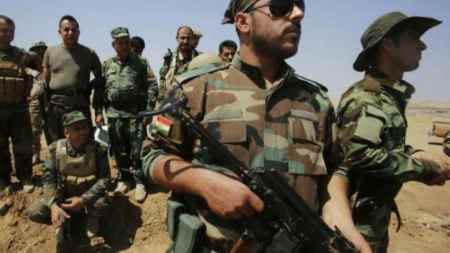
In Iraq, some of the few remaining Assyrian Christians have formed militias under the name Dwekh Nawsha (literally meaning “self-sacrifice” in Christ’s native tongue of Aramaic).  Most of these fighters are from among those Christians displaced from the Ninevah Plain due to the atrocities committed by IS and are on the frontlines fighting the jihadis.

They were formed soon after the U.S.-supported Kurdish Peshmerga, who are leading the fight against IS in the region, retreated from many Christian villages without a fight last summer, declining to protect them from the IS advance which led to the usual atrocities.

According to the Christian Science Monitor, “Christians have taken up arms because they want to protect their own land, and many no longer trust the Kurds to do it for them.” Indeed, the Kurds, including the Peshmerga, have been known to abuse and even persecute Christians.  Like IS, Kurds are Sunni Muslims too.

“We will stay here, and Christians will protect Christians. Not Arabs or Kurds protecting us, but Christians,” said local commander Fouad Masaoud Gorgees.

In neighboring Syria, approximately 500 Syriac Christian fighters recently assembled and managed to prevent the Islamic State from entering the ancient Christian settlement of Sadad.  But on October 30, IS captured a town less than five miles away, leaving Sadad vulnerable to continued assaults.

Even the Patriarch of the Syriac Orthodox church, Ignatius Aphrem II, traveled to Sadad to boost the morale of Christian defenders.  Said Aphrem:

It was emotional but it was also very encouraging to see our young people determined to defend their land and stay in their homeland.  To see them ready to fight and to sacrifice for their land, I think that’s what’s very meaningful, that made me very proud of them.

There’s a reason why Christians are frantically trying to save Sadad from the clutches of IS.  As one Syriac Christian fighter put it, Sadad “is a symbolic place for us and we will not allow it to fall again.”

He is referring to the events of October 2013, when the U.S.-supported Free Syrian Army—widely touted as moderate but in fact working with al-Qaeda’s Al Nusra Front—captured the town.  They made a graphic video (with English subtitles) of those whom they killed, the “dogs of Assad”—“dog” being an ancient Islamic epithet for Christians—while shouting Islam’s victory-cry, “Allahu Akbar” (which John McCain equates to a Christian saying “thank God”) and praise for the Free Syrian Army.

During their one week occupation of Sadad, the moderate/radical coalition tortured, raped, and murdered 45 Christians; the bodies of six people from one family alone, ranging from ages 16 to 90, were found at the bottom of a well (an increasingly common fate for “subhuman” Christians).

At the time, Syriac Archbishop Selwanos Boutros called it Syria’s “largest massacre of Christians.”  Even so, this massacre was wholly ignored by the Obama administration and so-called mainstream media in an effort to maintain the narrative that the Free Syrian Army was “moderate.”

Concerning the Sadad massacres, the archbishop had asked in 2013:

We have shouted aid to the world but no one has listened to us. Where is the Christian conscience? Where is human consciousness? Where are my brothers?

As persecuted Mideast Christians have well learned since, most Western governments—the Obama administration at their head—could care less about their fate.  They care only about one thing:  overthrowing Assad—at any cost, including by directly or indirectly arming the Islamic terrorists that persecute Christians in horrific ways, including slaughtering those who refuse to renounce Christ for Muhammad.

Yet truly “moderate” Christian militias fighting the Islamic State are denied arms from Washington: “Lobbyists in D.C. are blocking weapons and equipment from reaching Dwekh Nawsha, the Christian militia force that has been fighting ISIS in Iraq’s Assyrian Nineveh plains.”

Retired Lt. Col. Sargis Sangari, an Iraq war veteran who served 20 years in the army, says: “As much as you’re giving money to all these individuals who are killing each other [the “moderate” terrorists, Kurds, etc.], why don’t you try to give it to the Assyrians?”….  Currently, their [Christians’] lack of resources prevents them from launching an offensive.”  U.S. funding, training, and equipment would allow these Christian militias to take the fight to IS, added Sangari.

Of course, all of this assumes that U.S. leadership actually wants the Islamic State and other “moderate” jihadis to be defeated in an offensive by anyone—a dubious assumption.

Still, persecuted Christian pleas have not totally fallen on deaf ears.  A few Western Christians, mostly Americans, have traveled to the Middle East to help the indigenous Christians fight the jihadis.

Seeing their governments, which possess the military capability to annihilate the Islamic State, do next to nothing—not even help arm Christians—against IS, these Western Christians have decided to take it on themselves to fight the good fight on behalf of the weak and oppressed.

Brett Felton, a former American soldier who once served in Iraq, now sees himself as a “soldier of Christ” and has returned to help train Dwekh Nawsha against IS.

According to the 28-year-old, “One man’s terrorist is another man’s freedom fighter. But here we’re actually fighting for the freedom of the people … to be able to live without persecution, to keep the church bells ringing.”

U.S. vet Jordan Matson, who has the words “Christ is Lord” inscribed in his vest, said: “I decided that if our government wasn’t going to do anything about it, I would… We’re getting shot at [by IS/jihadis] on pretty much a daily basis….  We don’t have the technology that the United States military has to push our enemies away.”

First the Christians of Iraq and then Syria implored the West for help against the Islamic persecutors that the United States unleashed by overthrowing secular strongman Saddam Hussein and now against Bashar Assad.

Brutally persecuted Christians were totally ignored by both government and media.

Then they implored the Obama administration to simply stop arming their persecutors.  When that too fell on deaf ears, vastly outnumbered and underequipped Christians gathered to fight the Islamic State head on, hoping the U.S., which showers the “opposition” with weapons, would help equip them against IS.

No such luck.  As a result, a few Western Christians who believe in religious freedom are risking their personal lives to help their Mideast brothers against the scourge of “ISIS.”

In light of all this, to still fail to understand which “side” U.S. leadership is on—they currently claim to be on the side of “democracy,” “freedom,” and “human rights”—is to be beyond naïve.

ISIS launches its winter terror offensive with first 274 deaths

November 13, 2015

ISIS launches its winter terror offensive with first 274 deaths, DEBKAfile, November 13, 2015

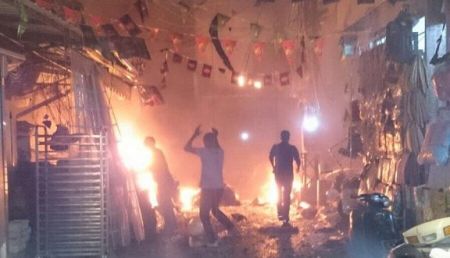
Borj_al-Barajneh12.11.15Suicide bombers strike Hizballah in Beirut
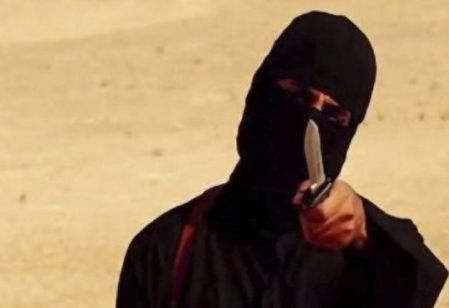
Execution of Steven Sotloff (1983 – 2014) by Jihadi John of ISIS. In August 2013, Sotloff was kidnapped in Aleppo, Syria, and held captive by militants from the Islamic State of Iraq and the Levant. Jihadi John (Mohammed Emwazi, born August 1988) a British man who is thought to be the person seen in several videos produced by the Islamic extremist group ISIL showing the beheadings of a number of captives in 2014 and 2015. (Photo by Universal History Archive/UIG via Getty Images)

Execution of Steven Sotloff (1983 – 2014) by Jihadi John of ISIS. In August 2013, Sotloff was kidnapped in Aleppo, Syria, and held captive by militants from the Islamic State of Iraq and the Levant. Jihadi John (Mohammed Emwazi, born August 1988) a British man who is thought to be the person seen in several videos produced by the Islamic extremist group ISIL showing the beheadings of a number of captives in 2014 and 2015. (Photo by Universal History Archive/UIG via Getty Images)

The US drone strike Thursday night, Nov. 11, targeting the Islamic State’s infamous executioner known as “Jihad John” in the northern Syrian town of Raqqa may or may not have hit the mark – the Pentagon says it is too soon to say. The hooded, masked terrorist with the British accent has been identified as a British Muslim born in Kuwait called Mohamed Emwazi. He appeared on videos worldwide showing the cold-blooded murders of US, British, Japanese and other hostages.

The drone attack occurred shortly after the latest ISIS atrocity: Thursday night, two or three suicide bombers blew themselves up, killing 43 people and injuring at least 240 in the Hizballah stronghold of southern Beirut opposite Burj Barajneh.

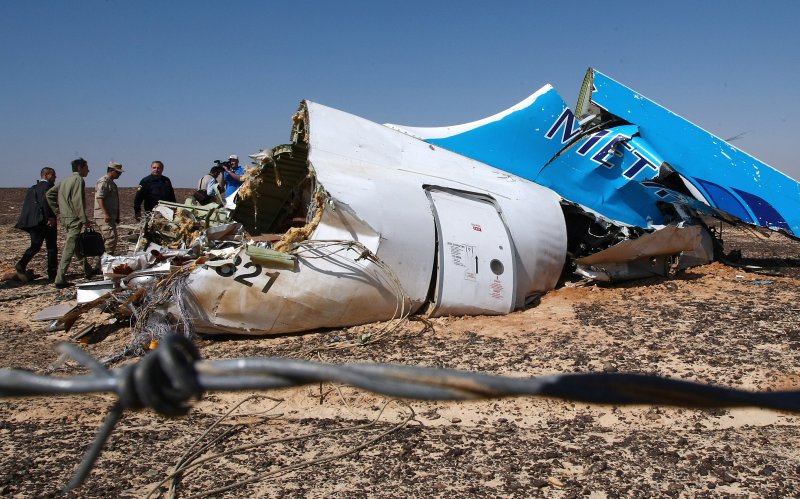
Ten days earlier, the Islamic State brought down the Russian Metrojet airliner over Sinai killing all 224 people aboard. This spectacular act of terror was apparently the first strike of the jihadist group’s winter offensive. It achieved its objectives of multiple murder; mortal damage to Egypt’s tourism industry and a blow to the prestige of its president Abdel-Fatteh El-Sisi.

The attack also punished President Vladimir Putin for bringing the Russian military into the center of the Syrian conflict.

The next Islamic State assault was aimed to undermine the credibility of Jordan’s King Abdullah and his security services: On Nov. 8,  a Jordanian police captain opened fire at a high-security US training facility outside Amman, killing two American trainers, a South African and two Jordanians. The number of US personnel injured in the attack was not released. This attack was timed to coincide with the 10thanniversary of the massive al Qaeda assault on Amman’s leading hotels, all American owned, which left 61 dead.

In northern Sinai, the murder of a family of 9 Egyptians at El Arish Thursday morning raised the total of ISIS murders in less than a month to 274.

DEBKAfile’s counterterrorism sources discern three objectives in the attack Thursday night in Beirut

1. A lesson for Tehran and Hizballah’s leader Hassan Nasrallah to show them that the Islamic State is able to reach them on their home ground, no matter how many troops they deploy to fight the jihadis in Syria (Iran and Hizballah together field an estimated 13,000 soldiers in Syria). ISIS was capable of inflicting terrible casualties both on the battlefield and in their homeland, first in Beirut and eventually in Tehran.

2.  The day before, Wednesday, Nov. 11, in a speech marking the “Day of the Shahid,” Nasrallah gloated over Hizballah’s triumph in a battle outside Aleppo. He also boasted that his domestic security shield in Lebanon presented an impenetrable barrier against ISIS or Nusra Front terrorist intrusions.

The Islamic State’s tacticians determined to blow up both claims in Nasrallah’s face. He and Iran were to be shown that they could not stop ISIS or prevent the Syrian war’s spillover into Lebanon.

3.  By blowing up the Russian airliner over Sinai, the Islamists sought to underscore this point for Moscow too. Russia might send a powerful military force to Syria, but the Islamists would hit Putin from the rear at a location of its choosing anywhere in the Middle East. Moscow may have opted to defend Bashar Assad, but what can it do to protect Hizballah and its other allies?.

DEBKAfile’s counterterrorism sources note that US and Russia have taken lead roles in the broad military effort to defeat ISIS – often by means of pinpointed operations. At the same time, under their noses, the Islamist terrorists have launched their winter campaign, striking with extreme ferocity and agility in unexpected places that are outside the regular battle fronts in which the big powers are engaged.

Hungary’s Migrant Crisis Ends, Europe’s Has Just Begun

November 12, 2015

Hungary’s Migrant Crisis Ends, Europe’s Has Just Begun, The Gatestone InstituteGeorge Igler, November 12, 2015

(Please see also, The annihilating of our western society. — DM)

  • “[H]alf any given year’s total migrants arrive by the start of October. The other half arrives between October and the end of December… If these tendencies remain relevant, we should expect the very opposite of a winter break, and should prepare instead for an increasing flood of people.” — Viktor Orbán, Prime Minister of Hungary, September 21, 2015.
  • The UN High Commission for Refugees announced on Nov. 2 that the number of people who illegally migrated to Europe in October alone (218,394) nearly outstripped the number of those who entered throughout the whole of 2014 (219,000).
  • The reality at Hungary’s central railway station in Budapest had to be seen to be believed. Hungarians were easily outnumbered 200 to 1 by predominantly young Muslim males. These newcomers engaged in sporadic violence, rioted at the sight of camera crews, and left the station littered with human excrement.
  • According to Björn Höcke, of the populist Alternative for Germany Party (AfD), by the end of 2016 there will be as many Muslim males of military age in Germany (5.5 million), as there are young German men of that age.
  • On Nov. 2, Libya threatened to send to Europe millions of migrants from Africa, unless the EU recognizes its self-declared (Islamist) government.

Earlier this year, Hungary’s ferociously articulate Prime Minister Viktor Orbán became the bête noir of European politics. Since then, Orbán has transitioned from being castigated as a threat to European values, into the most recognized defender of his continent’s Christian identity.

In a Europe whose central policy-makers seem in thrall to multiculturalism, Hungarians, after centuries of invasions and attempted invasions, appear unapologetically immune to political correctness. Even in their language, the colloquial phrase for communicating with the bluntest possible candor is magyarul mondva, literally “speaking in Hungarian.”

As over 400,000 predominantly Muslim migrants crossed illegally into Hungary before the completion of a border fence — which ground such incursions to an effective halt by the end of October — there has been a sanctimonious effort in the world’s press either to mischaracterize realities on the ground, or omit them altogether.

The concealment of sobering truths, openly reported in Hungary – ironically a nation whose press freedom has been criticized under Orbán’s leadership – can only have serious long-term consequences, in migrant-friendly countries such as Belgium, Sweden and Germany, especially the scale.

The United Nations High Commission for Refugees (UNHCR) announced on November 2 that the number of people who illegally migrated to Europe in October alone (218,394) nearly outstripped the number of those who entered throughout the whole of 2014 (219,000).

The figures, which even shocked members of the UNCHR, constitute the greatest monthly entry of illegal migrants into the European Union to date. Many had apparently felt that the legal imposition of quotas, initiated on September 22, and aimed at relocating migrants across EU member states, would have at least begun to tackle the EU’s migrant problem.

The quota scheme, which pivoted on forcing non-consenting member states to accept illegal migrants, has, in fact, been an abject failure. Only Sweden has participated directly.

Meanwhile, crossings from Turkey to nearby islands in Greece, the first step in the so-called Western Balkan route — the dominant corridor for illegal migrants at present — have far from peaked, and are accelerating. As winter seas make Mediterranean conditions more difficult, the journey is apparently being offered at a discount.

To observers who speak Hungarian, however, the UNHCR’s figures probably come as no surprise.

Addressing his nation’s parliament, on September 21, and calling this year’s mass migration to Europe an “invasion,” Viktor Orbán declared:

There will be no such thing as a winter hiatus with respect to the illegal immigration issue … If one looks at the tables, graphs and statistics — often available in the public domain — which show the month-by-month influx of illegal immigrants to date, what one sees largely is that half any given year’s total migrants arrive by the start of October. The other half arrives between October and the end of December.

Unlike his European partners, Orbán sees this year’s events not as an unprecedented “crisis,” but the result of a steady and entirely predictable escalation, centered on the unwillingness of member states to defend the union’s external frontiers from human smuggling, which is an obligation under the EU’s freedom-of-movement Schengen Treaty.

Orbán’s analysis led him to conclude:

There will be no let up; we should expect escalating pressure. There is no reason for us to think that people-smugglers will arrange their affairs and the routes they exploit any differently this year than they have in previous years. If these tendencies remain relevant, we should expect the very opposite of a winter break, and should prepare instead for an increasing flood of people.

As Hungary constructed its southern border fence, in line with its Prime Minister’s calculations and in consultation with Israel, experts worldwide called the move both pointless and counter-productive.

Currently, as Germany is opening new migrant reception centers weekly, Hungary is winding up its own.

On November 3, Hungary’s parliament voted overwhelmingly to reject the imposition of mandatory quotas, paving the way for legal action against the EU, in concert with the left-wing government of Slovakia led by Robert Fico. Poland is very likely to follow suit.

Many political analysts have concurred that Orbán has cynically exploited the migration issue to shore up waning domestic popularity. This could not be more wrong. Although Orbán’s poll numbers certainly took a slide in 2014, analysts similarly agreed in April that his national consultation on migration constituted a catastrophic miscalculation.

It is easy to see why. Hungarians, after the 1956 uprising against the Soviet Union, are extremely conscious of their own historic status as genuine refugees. Some national billboards accompanying the nationwide survey were even defaced, as the consultation had posed robust questions on the likely consequences of mass Muslim immigration, which most Hungarians had yet to witness, and which some found discomfiting.

But public opinion swung firmly in Orbán’s favor, with the effective occupation of Budapest’s central railway station (Keleti pályaudvar).

The realities on the ground at Hungary’s international railway terminus had to be seen to be believed. Hungarians were easily outnumbered 200 to 1 by predominantly young Muslim males. These newcomers engaged in sporadic violence; rioted at the sight of passing camera crews, and left the station littered with human excrement.

Migrants refusing to cooperate with authorities who wanted to take them to reception centers, to participate in the EU’s compulsory EURODAC asylum registration process, chanted “no fingerprint” in unison. Frustrated, many charged down motorways towards Austria, a move that led to the closure of major transport arteries.

Unlike the domestic Hungarian media, the international press reported little of the full gravity of events in Hungary. The international press failed to warn nations from Austria to Finland of what was headed their way. Journalists concentrated instead on the handful of children present, to sell a sob story.

Such reporting led Croatia to charge Hungary with the “inhumane” treatment of “refugees,” while Austria claimed, astonishingly, that Hungary’s behavior was reminiscent of the Holocaust. As migrants arrived in those nations, however, both countries rapidly backtracked.

While Hungary was being castigated for supposed xenophobia and for Orbán’s rhetoric, no one seemed to have considered that perhaps the most historically-invaded country in Europe knew what an invasion actually looked like, better than most.

Nor did many of the people criticizing Hungary stop to think that maybe, with such a prominent awareness of once being refugees themselves, Hungarians might be more cognizant of the gratitude, relief and forbearance that marks the conduct of a genuine refugee.

Instead, Hungary was confronted by aggressive economic migrants in numbers so huge that the authorities were “all but submerged.” As the migrants demanded transit to welfare states they had paid handsomely to reach, they threw food and water back at the same Hungarian officials being pilloried by the world’s media for their own efforts to cope.

The nadir of the global press coverage of Hungary came with a defensive action involving tear gas and water cannons, when, on September 16, its frontier post at Röszke was closed to illegal entry. The false story sold by the world’s media led the UN Secretary General, Ban Ki-moon, to condemn Hungary.

No mention was made outside the country of how Hungary’s police had reacted solely with non-lethal crowd control tactics — resorting to these only after a three hour standoff that injured 20 police officers, who had resisted persistent violent efforts to storm the country’s border.

The most conspicuous press failure, however, concerns the key question: With the EU’s border agency Frontex confirming on November 4 that 800,000 have illegally crossed into Europe so far in 2015, each likely paying $1000 to $5000 to a people-smuggler, how is this colossal total expenditure — entirely outside the means of genuine refugee camp residents in Turkey or Jordan — being funded?

Georg Spöttle, an Arabic-speaking German national security expert resident in Hungary, with unique access to the intelligence communities in both countries, has been studying the sources of money used by migrants to traverse Europe. He has frequently identified Gulf States, including Saudi Arabia and the United Arab Emirates, as the true source of the funds.

Spöttle has also examined some of the thousands of pictures and videos found on mobile phones discarded by migrants before entering Hungary. Many images, in his view, are likely to be in the possession only “of those either sympathetic to terrorism or terrorists themselves.”

For other observers, the most alarming evidence thrown up in central Europe by this year’s migrant influx lies in the nature of the identity documents being discarded, at the last stop on the Western Balkan route, before migrants head towards the EU’s freedom-of-movement zone.

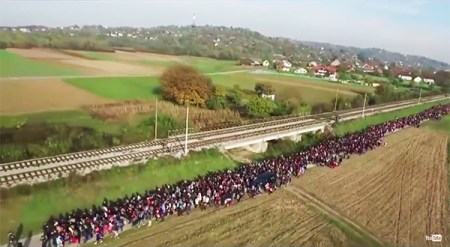
1340Thousands of migrants cross illegally into Slovenia on foot, in this screenshot from YouTube video filmed in October 2015.

In Serbia, the price of superglue has increased 100-fold, given that, when spread across a person’s fingertips, it temporarily allows an imprint of bogus fingerprints on a biometric EURODAC scanner.

Many of the documents thrown away at the Hungarian border include genuine Syrian civilian and military identity papers that would automatically entitle their holder to residence in Germany. The act seems highly irregular: Serbian identity papers, valid Swedish residency documents, papers confirming political refugee status from Jordan, and European passports, have all been found strewn across the border.

The only conclusion that can be drawn from such evidence collected at the EU’s external frontier, argues Hungary’s most notable security analyst, is that it points to the behavior of individuals intent on establishing jihadist sleeper cells in Europe. Or alternatively, that many Muslims with criminal records, already resident in the EU, could be exploiting the migrant crisis to establish entirely new identities for themselves before disappearing across the continent.

The only solution to an ever increasing influx, first from the Middle East, and then, in Orbán’s view, of even greater numbers from Africa, is to intercept and safely return migrant boats to their points of departure. On May 11, however, this “pushback” policy was utterly repudiated by Federica Mogherini, the European Commission’s foreign policy chief. Her announcement may well have acted as the spark for this year’s unprecedented migrant figures.

Orbán’s proposal, a combined European effort to police the narrow stretch of water between Turkey and nearby islands of Greece, has been rejected by the EU’s leaders. As a result, hundreds of thousands of people are still being allowed to enter the EU illegally, thanks to the newly strengthened Islamist government of Turkish President Recep Tayyip Erdoğan. At the moment, he is trying to bully Brussels into giving Turkey the features of an actual European Union membership step-by-step.

Hungary, perhaps to demonstrate how a combined border-protection initiative could work, is already using a joint cooperation force to defend its own EU frontier, with local partners from Slovakia, the Czech Republic and Poland.

The presence and power of Mogherini, whose fondness for political Islam has already been analyzed at the Gatestone Institute, is a damning indictment of the European Union’s claim to democratic legitimacy.

Thanks to what many felt was a profound dissatisfaction with mass migration into the EU, Europe experienced a marked turn to the political right in the 2014 European parliamentary elections.

A conservative European Commission was “elected” in turn — but it nevertheless appointed Mogherini, a former Italian Communist, to the most senior border-protection role in Europe. No matter how its people vote, the commitment of the EU’s institutions to a borderless Europe, both internally and externally, appears to remain undaunted.

It is clear, however, from remarks delivered in his nation’s capital on October 31, that Viktor Orbán’s patience with the EU has finally been exhausted. “Europe is being betrayed,” he told a Christian conference in Budapest. “It is being taken from us.”

Thousands of migrants shipped to the EU daily, Orbán argued, are “not a result of indecisiveness,” but the product of a conscious “left-wing” conspiracy to curb the relevance of Europe’s sovereign nation states by undermining their ethnic foundations.

With the EU having no perceptible mandate, this effort amounts to “treason,” he said, which must be countered by national democracies turning to their people. If not, he said, these people risk losing the ownership of their continent unless a Europe-wide consultation on mass migration immediately takes place.

The next migrant wave (50,000) is scheduled to arrive at the Austrian border next week. A ferry strike in Greece has caused a backlog, which is now moving its way through the Balkans.

According to Björn Höcke, of the populist Alternative for Germany Party (AfD), by the end of 2016 there will be as many Muslim males of military age in Germany (5.5 million), as there are young German men of that age.

Meanwhile, on November 2, Libya threatened to send to Europe millions of migrants from Africa, unless the EU recognizes its self-declared (Islamist) government.

Obama Has a Strategy in the Middle East, and It’s Working

November 12, 2015

Obama Has a Strategy in the Middle East, and It’s Working, Washington Free Beacon, November 12, 2015

Obama CairoPresident Obama in Cairo, 2009 / AP

Consider that if the primary goal of the president is not a certain outcome on the ground, but rather the reset of the American posture in the region from that of a dominant power to that of one nation among many partners collaborating where possible, and, when conflict can’t be avoided, erring on the side of minimalist interventions—well, from the perspective of the Oval Office, it would be possible to conclude that no change of course is required.

As with Obamacare, the “achievement” in all this is to be found less in any one specific policy outcome than in a broad leftward shifting of the conversation, and in the creation of a new normal for January 20, 2017, in which the re-establishment of more sensible policy in the Middle East will be extremely difficult.

************************

The Obama administration is “operating on a crisis basis” in the Middle East, says Leon Panetta, and doesn’t “have any kind of larger strategy” for the region. The president’s recent actions there, including the deployment of 50 special operations troops to Syria, are too incremental and “will not work,” says Fareed Zakaria. Indeed, the situation in that country has “spiraled out of control,” according to Vox’s Max Fisher in a post headlined “Unfixable: How Obama Lost Syria.”

And that’s what liberal critics are saying! The tone on the right is even more harsh—and why shouldn’t it be? Headlines this week from the region inform us that new footage shows about 200 children being shot to death by members of the Islamic State while lying in a row, faces in the dirt; that a Russian airliner that crashed in Egypt was quite likely downed with the use of military grade explosives; and that Russian airstrikes in Syria in support of the Assad regime have increased in intensity. It is Wednesday.

Zooming out, we see Assad in power, the Islamic State not going anywhere, Yemen still the focus of a regional proxy war, and a nuclear deal with Iran that has only empowered hardliners there.

The natural question thus seems to be: Why doesn’t Obama change course? Other presidents have shifted their approaches when confronted with failure—Carter’s late foreign policy and Bush’s Iraq surge both spring to mind. Why not Obama?

One answer to this question we ought to take seriously is that the president thinks things are, on the whole, going just fine.

Consider that if the primary goal of the president is not a certain outcome on the ground, but rather the reset of the American posture in the region from that of a dominant power to that of one nation among many partners collaborating where possible, and, when conflict can’t be avoided, erring on the side of minimalist interventions—well, from the perspective of the Oval Office, it would be possible to conclude that no change of course is required.

This possibility is why I’m not persuaded of Panetta’s charge that the administration lacks a “larger strategy.” It seems entirely possible to explain what might seem to be incompetence as simply the consequence of having as the primary focus of our regional strategy the reduction of the American role.

Evidence for this possibility can be detected through a Kremlinological look at the administration’s own public statements, including the repeated insistence that “local partners” will do the fighting on the ground against the Islamic State, which, in turn, will only “ultimately” be destroyed, as well as the unconventional assertion by Ben Rhodes earlier this year that the avoidance of military casualties is itself a goal of American national strategy. Much of the evidence rounded up by Michael Doran in his excellent essay on the strategy behind the Iran deal points in the general direction I propose. And others have made plausible arguments that the administration has engineered a transition from a Middle Eastern “Pax Americana” system to one where “offshore balancing” prevails—even though such an assessment understates the extent to which responsible outcomes on the ground don’t matter nearly as much to the White House as the nature of the American posture itself.

The most persuasive proof is a form of reductio ad absurdum—denying this assessment seems to require the conclusion that the president and his advisors are profoundly foolish. It seems more likely that they are simply ruthless ideologues.

From their point of view, it is surely lamentable that the region hasn’t responded better to the withdrawal of American power. But there was always going to be a period of transition, and that the shift is somewhat traumatic is not necessarily a surprise. Calls for America to reinsert its military are shortsighted: after all, the presence of the American military in support of corrupt Sunni regimes like Saudi Arabia’s contributed mightily to the targeting of the United States by extremists, and the removal of Saddam led ultimately to the existence of the Islamic State. Our enmity with Iran’s revolutionary government goes back to our backing of the Shah and the ouster of Mossadegh, and anyway, the fact that we are allied with toxic Sunni regimes (not to mention apartheid Israel) but hostile to a religious Shia regime is irrational, at best. Violence may currently be surging, but the death tolls conveyed in lurid headlines must be seen in the context of truly grave global threats, like climate change. Those threats require our best attention, as does the rebuilding of the American economy, and we are better served by working to construct a more equitable and just society at home before taking unilateral, aggressive, and risky actions abroad.

This analysis may be wrong in part or in whole, but it is internally coherent, and if accepted it points to the strategy more or less exactly like the one being pursued. If America is usually part of the regional problem, and if its efforts are better employed elsewhere, then the strategic goal should be to reduce the amount of America in the region. In the administration’s first term, centrist voices in the cabinet would have resisted such an approach—but they are gone now.

The shift in our regional posture has, of course, provoked opposition from hardliners (American hardliners, that is) including conservative politicians and elements of the Pentagon’s leadership, whose actions over the years have empowered Middle Eastern hardliners like the Iranian mullahs. Thus this domestic opposition is also, in a sense, the enemy, and resisting this wing of American politics at home will give moderates in countries like Iran the space to gain influence over time.

This worldview is why Obama isn’t going to change course any time soon, absent a major loss of American life in a terrorist attack and the domestic political pressures that will create. Even then, the response is likely to be conducted with an eye to keeping military engagements highly limited, as with token actions taken in recent weeks in the campaign against the Islamic State. Indeed, seen in this light, incremental deployments of a few dozen troops to Syria need no longer be seen as foolish gestures that are destined to fail, but rather as more or less successful delaying actions meant to placate domestic political opposition.

As with Obamacare, the “achievement” in all this is to be found less in any one specific policy outcome than in a broad leftward shifting of the conversation, and in the creation of a new normal for January 20, 2017, in which the re-establishment of more sensible policy in the Middle East will be extremely difficult.

Shortly before the Obama-Netanyahu summit, ISIS hit Americans in Jordan

November 9, 2015

Shortly before the Obama-Netanyahu summit, ISIS hit Americans in Jordan, DEBKAfile, November 9, 2015

Isis_Jordan480

After the Islamic State succeeded in downing a Russian airliner that took off from Sharm El-Sheikh on October 31, causing the deaths of all 224 passengers and crew, the terrorist organization Monday, Nov. 9, put a US military target in its crosshairs. A captain in the Jordanian police opened fire in the cafeteria of the Special Operations Training Center outside the Jordanian capital, Amman, where American instructors train Iraqi troops to fight ISIS. Two trainers from the US and one from South Africa were initially reported killed and another six wounded, including two more Americans and four Jordanians.

A Jordanian government spokesman said later Monday that the number of fatalities had risen to eight, without specifying how many foreigners.

The gunman did not survive. He was variously reported to have committed suicide after the assault or killed by Jordanian troops.

The modus operandi resembled the “green on blue” insider attacks committed in Afghanistan by al Qaeda and Taliban “insiders” against American and British troops serving at the same base.

Jordan’s Al-Rai newspaper identified the shooter as Anwar Abu Ubayd, but other news outlets said his name was Anwar Abu Zaid.

If the downing of the Russian plane rocked the regime of Egyptian President Fattah El-Sisi, there is no doubt that Monday’s attack will shake King Abdullah’s Hashemite throne.

The attack, furthermore, demonstrated that ISIS is rapidly approaching Israel’s borders with Syria in the north, Egypt in the south and Jordan in the east. The assault gained particular attention as it was carried out just hours before the summit Monday between Israeli Prime Minister Binyamin Netanyahu and US President Barack Obama at the White House in Washington.

They met for the first time after more than a year and after a major row over the Iranian nuclear accord. Both leaders made statements strongly indicating that they had determinedly buried the hatchet and were looking to the future of strong and amicable ties and expanded US support for Israel’s security.

A large part of their two-hour conversation was undoubtedly devoted to the threat posed by ISIS, on which they concur.

Until now, Jordan had been home to the most important and secure US forward base for the war on ISIS in Iraq and Syria.  US air strikes come from bases in Turkey, but more than 10,000 ground troops and special operations forces troops are present in Jordan. The kingdom serves as a training, operations and logistical center for US missions in Iraq and Syria, and for that purpose a command center, the US Central Command Forward-Jordan, was established outside Amman.

Until now, ISIS had not managed to infiltrate Jorda for attacks capable of destabilizing Abdullah’s rule. Numerous infiltration and terrorist attacks were thwarted by Jordanian intelligence and security. The Jordanian authorities focused primarily on keeping the jihads out of the refugee camps housing Syrians and Iraqis in flight from war zones, but this came at the expense of efforts to block the threat from reaching inside the Hashemite kingdom and its security facilities.

Their first success will no doubt embolden ISIS to keep on pressing its advantage. Immediately following Monday’s shooting, Jordan’s military went into high alert nationwide and along its borders. The US, Russia, Egypt, Jordan and Israel are all boosting their vigilance as the threat from ISIS continues to grow. But no one can reliably predict where the Islamist terrorists strike next.

Keeping up warm relations

November 6, 2015

Keeping up warm relations, Israel Hayom, Shlomo Cesanam, November 6, 2015

(Please see also, Obama rules out Israeli-Palestinian peace deal before leaving office. — DM)

Two state is deadScience and Technology Minister Ofir Akunis, seen with Defense Minister Moshe Ya’alon in the Knesset, says the two-state solution is “dead.” | Photo credit: Noam Revkin-Fenton

The imminent meeting between Prime Minister Benjamin Netanyahu and U.S. President Barack Obama won’t repair their soured ties, but it’s clear that their face-offs are on hold as Israel and the U.S. prepare to deal with Middle East instability.

*********************

Two weeks ago, Defense Minister Moshe Ya’alon met with his American counterpart Defense Secretary Ashton Carter. The defense secretary accompanied Ya’alon everywhere: to a memorial service at the Israeli Embassy marking 20 years since the assassination of former Prime Minister Yitzhak Rabin, on a visit to the American Cyber Command at Fort Meade, in a dialogue with students and to a laid-back meal at the Pentagon, at which a military choir performed “Jerusalem of Gold” accompanied by a violinist. The Americans promise that the warm welcome Ya’alon received will continue — even if not with the same intensity — for another two days, when Prime Minister Benjamin Netanyahu is scheduled to land in Washington, ahead of a Monday meeting with U.S. President Barack Obama at the White House.

The meeting will not obliterate the soured relations between the two leaders. They “did not have a chance to meet” this year, but they did manage to publicly face off on important issues and policies. The main bone of contention is of course the understandings reached between six world powers on Iran’s nuclear program. Nevertheless, it is clear to everyone that the confrontations are over as is the discussion of whether the tension between the two leaders harmed the relations between their respective nations. Both sides agree that the threats, challenges and mutual interests supersede the various disagreements, and that new arrangements must be made for the future.

The agenda of the meeting will address coordination on a strategic outlook for the region. Two specific issues are up for discussion: Preserving Israel’s qualitative advantage over the rest of the countries in the region, and American aid to strengthen Israel during the next 10 years. The aforementioned edge was created as a result of the nuclear deal with Iran and the “compensation packages” the U.S. handed out to its allies in the Persian Gulf — first and foremost Saudi Arabia, but also countries like Jordan and Egypt. The aid comes in the form of information, technology, financial aid, weapons and ammunition.

The American aid will be provided under a 10-year plan. Former President George W. Bush signed the last aid deal, which expires at the end of 2017. Israel expects to fill up a “shopping cart” with items that already appear on a long list of requests, including a bump in the amount of defense assistance from $3.1 billion to $4 billion.

Since the deal will only take effect two years from now, diplomatic officials are discussing two separate lists: one for the long term, and a second that will give Israel the help it needs to preserve its advantage. The goals of the meeting between Netanyahu and Obama are based on the assumption that the Middle East is unstable, and will remain so for the next decade. That assumption is backed up by reports from teams of professionals in both the U.S. and Israel.

The bottom line, a member of Israel’s Diplomatic-Security Cabinet said this week, is that “the U.S. and Israel are in sync. They see eye to eye on the existing situation and have identical assessments of the changing situation in the region.”

Both Israel and the U.S., for example, agree that even after the Iran nuclear deal, the Tehran regime is no less dangerous. They both know that the Iranian money that was unfrozen when the sanctions were lifted, is already going to fund terrorism.

Netanyahu and Obama are going to talk about strategy, as the proposals for aid to bolster Israel are already known. But because in our region it is hard to know what the day will bring, both sides have built a model according to which “a variety of measures to provide a variety of solutions to a variety of threats” must be offered. The discussion in the White House will deal with all of the security ties between the two countries: Long-term financial aid; cooperation on cybersecurity; air, land, sea, and satellite power; intelligence; technological and defense development, including more Iron Dome batteries and similar defense systems, and the promotion of solutions that are still being developed. On everything relating to the immediate and broad-scale answer, Israel is asking for a way of defending itself against long-range and precision-guided missiles.

Netanyahu and Obama will also have to decide whether the time has come to strike a reciprocity deal — a defense pact between the two nations — that does not include a requirement to inform each other of certain covert actions, such as an attack on Iran. A deal like that would provide an answer for any scenario in which Iran breaks through to a nuclear bomb before the deal on its nuclear program is up.

“We left Gaza — and what did we get?”

But the headaches do not end there. When Netanyahu returns from the U.S., he will be facing two other important events: passing the state budget, which will among other things determine the defense budget, and the scheduled release of convicted spy Jonathan Pollard from a U.S. prison, which will mark the end of a long dispute with the Americans on the Pollard matter.

In Jerusalem, Netanyahu’s meeting with Obama is seen with utmost importance. Many officials at the diplomatic echelon argue that the meeting explains Netanyahu’s conduct these past few weeks: his measured responses to events in the field, the ban on MKs visiting the Temple Mount, the delay on committee discussions about construction in Jerusalem, and his remark that comparatively speaking, he is the prime minister who has allowed the least amount of building in Judea and Samaria.

On the other hand, Netanyahu is not hiding his official policy that Palestinian Authority President Mahmoud Abbas is not a partner with whom a peace deal can be made and that for now, Israel’s security and defense prowess in Judea and Samaria must be solidified without any visible changes.

The opposition and some media outlets have voiced criticism of Ya’alon, who is being accused of wanting to “manage” the conflict with the Palestinians and of directing “a policy of carrots” rather than finding a solution to it. Netanyahu, on the other hand, is accused of marking time and cultivating a vision in which we will “always live by the sword.”

The criticism is local, but it echoes throughout the world. That is why it was important to Netanyahu to issue a reply this week: “I’m not deceiving the public. We are living in the heart of radical Islam, and no policy we adopt will turn our neighbors into Norwegians or Swedes. We withdrew from every last [inch] of the Gaza Strip and didn’t get peace, [we got] rockets and terrorism. Therefore — with an arrangement or without one — we will always need the IDF to protect ourselves.”

Netanyahu is arriving in Washington as the head of a narrow right-wing government, most of whose members oppose a two-state solution. A member of his own Likud party, Science, Technology and Space Minister Ofir Akunis, said twice this week — at a weekend cultural event in Beersheba and at a Likud conference in Kfar Saba — that “the two-state solution is dead.”

According to Akunis, “the idea is irrelevant and is no longer at all possible.”

The understandings and agreements between Israel and the U.S. are also tied into the American and European demand to “end the occupation” at any price and “prevent apartheid.” While the security and defense factor is in place, Israel has no solution when it comes to the world’s demands on the Palestinian issue.

‘Islamophobia’ in America vs. murderous Christophobia in the Islamic world

November 5, 2015

‘Islamophobia’ in America vs. murderous Christophobia in the Islamic world, Front Page MagazineJack Kerwick, November 5, 2015

(‘Jewophobia’ appears to be at least as prevalent. — DM)

Cross

As organizations like CAIR and their allies wax indignant over “Islamophobia” in America, Muslims around the globe are visiting the worst sort of cruelty upon the Christian minorities in their midst.

For instance, over a span of four days, from October 19-23, the Indonesian government succumbed to the demand of Islamic “extremists” and demolished nine churches.  Six days earlier, on October 13, Muslims unleashed a torrent of violence that left a church burned to the ground and a person dead.

And in the course of this single day, 8,000 Christians found themselves displaced from their homes.

The government has deported them.

According to a local church activist, someone who self-identified only as “Rudy,” Islamic militants issued an ultimatum to the Indonesian government: Either raze these Christian churches to the ground or “the radicals will deploy around 7,000 people” to besiege this Christian community.

The organization Open Doors, a group dedicated to “serving persecuted Christians worldwide,” reports: “Church members wept as they watched in despair [as] civil police officers [began] hammering down their worship houses.” As of this juncture, over 1,000 “churchless believers are prohibited from raising temporary tents to hold Sunday worship services.”

The predominantly Islamic country of Bangladesh is a place where Christian women are regularly subjected to unspeakable violence.  Open Doors states that “two out of every three women in Bangladesh will experience gender-based violence in their lifetimes.” Furthermore, the United Nations’ “Special Rapporteur on Violence Against Women” has found that “girls are regularly harassed and abused on their way to and from school,” a phenomenon that is the function of the fact that “sexual harassment is often seen as ‘part of the culture.’”

One young woman who has fallen victim to this culture is Susmita Chambugonj.  Back in May, the 20-year-old was assailed by five “youths” who dragged her into a microbus.  While inside, Susmita was raped by two of her abductors.

The current “refugee crisis” has hit Syrian and Iraqi Christians particularly hard. Open Doors informs us that Christians in these countries “have had their homes marked by ISIS,” and “some come from historically Christian towns that were obliterated.” Moreover, some Christians are discovering “that they are being discriminated against when it comes to receiving aid.”

In Africa, stories of Islamic-on-Christian oppression are even more grisly.  At the same time, these same stories supply us with proverbial textbook exhibitions of Christian heroism.

Earlier in the year Boko Haram paid Habila Adamu a visit at his home.  When the militants informed Habila that they were “looking for him” in order to end his life, he replied that he had been looking for them as well—but in order to share with them the Gospel of Christ.

The predators weren’t impressed.  When Habila refused to recant his faith, his persecutors shot him in the face and left him for dead.

Thankfully, Habila survived.

Joshua, however, did not.  Joshua was 18 years old.  A member of a family of farmers, he worked in a factory during the dry season.  One day, Islamic militants showed up at his place of employment and proceeded to separate those employees who were Muslims from those that were Christians.  Then, they wasted no time in murdering the Christians one by one.

Initially, Joshua was in another room with some other employees. They watched through a window as the mass murder unfolded.  When an Islamic woman and fellow employee of Joshua begged the latter to deny his Christianity, he refused. Joshua was blunt: “No,” he told her, for “I am a Christian and they are killing my brothers.”

Joshua continued: “I am also going out there. I am not going to stay here and pretend that I am a Muslim.”

Joshua was martyred along with nine young men.

Even as I write this, the Christian community in Turkey has become the object of a systematic, relentless campaign of death threats.  According to Open Doors, the targeted are being blasted for being “heretics” who have “chosen the path that denies Allah[.]”

In Pakistan this past July, Saddique Azam, a veteran school teacher, was promoted to the position of “headmaster” at an elementary school.  Azam is a Christian.  For months, he was repeatedly threatened by Muslims who believed that the office of headmaster should be held by a Muslim.  Azam refused to resign.

Then, on October 6, three of his Islamic colleagues who worked under him physically attacked Azam.

Azam recounted his experience: “Three Muslim teachers entered the school, went into my office and waited for me there.  When I entered the office, I was alarmed to see them.  I asked them the reason for the visit and they launched a tirade of warnings against me to withdraw and resign from teacher headship.”

From the beating, Azam sustained a severe injury to his left eye.  Things could’ve been worst had it not been for other staff that stopped the assault.

But witnesses reported that while they pummeled Azam, his Islamic assailants mocked him by referring to him as “choora,” an anti-Christian epithet used by Pakistani Muslims. “Choora” connotes the “sweeper” or “untouchable” caste.  “You are a ‘Christian Choora,’” his victimizers shouted. How, then, “can you be a headmaster and be given seniority over us?”

The next time that we hear about the “Islamophobia” that Muslims in America allegedly face, let’s recall the face of real religious persecution: the persecution that truly defenseless Christians suffer at the hands of Muslim aggressors throughout the Islamic world.

Anti-air missiles in ISIS hands also imperil Saudi, Jordanian and Israeli skies

November 5, 2015

Anti-air missiles in ISIS hands also imperil Saudi, Jordanian and Israeli skies, DEBKAfile, November 5, 2015

Shut_up

The Ansar al Sharia terrorist organization in Libya, which attacked the US consulate in Benghazi and murdered the American ambassador in 2012, has the very missiles capable of shooting down large airliners flying at high altitudes: Russian-made ground-to-air Buk missiles, which have a range of between three and 42 kilometers. This ultra-violent Islamist terror group has very close operational ties with ISIS-Sinai, and very possibly smuggled the missile system into Sinai from Libya.

****************************

The British Cobra (emergency cabinet) decision of Wednesday, Nov. 4, not to send airliners to or from Sharm El-Sheikh, where 20,000 British tourists are stranded, further strengthens the assumption that the Russian Metrojet Flight 9268 was downed over Sinai Saturday by a terrorist missile. It confirms that air traffic over Sinai and landings at Sharm are under threat from the ground – else why leave a large group of Britons under virtual siege in the Egyptian Red Sea resort? London said that the suspension of flights to Sharm was “indefinite.”

Moscow early Thursday accused London of being moved to this action out of hostility to Russia rather than security concerns.

Downing Street released a statement Wednesday saying: “As more information has come to light, we have become concerned that the plane may well have been brought down by an explosive device.” This statement was criticized by Egypt as “premature” – not a good omen for the conversation Prime Minister David Cameron is due to hold with his visitor, Egyptian president Abdel-Fatteh El-Sisi, later Thursday.

The British government has therefore stubbed toes in Moscow and Cairo without coming up with an emergency plan for evacuating its citizens from Egypt, whether overland to Cairo by bus or by sea aboard ships picking them up at the Red Sea resort and sailing through the Suez Canal.

This lack of initiative is a sign of confusion and uncertainty.

So far, the drawn-out deliberations and prevarications by officials in several countries regarding the crash of the Russian plane are meant for one purpose: to gain time for doing nothing about ISIS in Sinai. Neither the US, Russia or Britain is ready to send forces to the peninsula to confront the terrorists head-on.

The Ansar al Sharia terrorist organization in Libya, which attacked the US consulate in Benghazi and murdered the American ambassador in 2012, has the very missiles capable of shooting down large airliners flying at high altitudes: Russian-made ground-to-air Buk missiles, which have a range of between three and 42 kilometers. This ultra-violent Islamist terror group has very close operational ties with ISIS-Sinai, and very possibly smuggled the missile system into Sinai from Libya.

A number of intelligence agencies are aware of this and so a flock of leading European and Persian Gulf airlines lost no time in rerouting their flights to avoid Sinai straight after the Russian air disaster.

By causing this disaster, the Islamist terrorists coolly aimed for four goals:

1.  Retaliation for Russian intervention in Syria

2.  An attempt to destabilize the regime of Egyptian President Fattah Al-Sisi

3.  To show up the inadequacies of the 63-member coalition that the US formed in its effort to fight ISIS

4. To parade before the world the Islamic State’s operational prowess, its ability to shoot down the large passenger planes of the world’s biggest powers.

For five days, intelligence and flight safety experts dismissed the claim of responsibility that ISIS issued on the evening of October 31, maintaining that it was not to be taken seriously because no proof had been provided to support the claim – as if the charred fragments of the plane spread across tens of kilometers of desert were deniable.

In the second of its three messages, ISIS repeated its claim Wednesday, Nov. 4, promising details of how it downed the plane at a later date.

While more and more Western governments are coming around to accepting that the Russian airliner’s crash was caused by an explosive device, DEBKAfile’s counterterrorism sources repeat that they cannot rule out the possibility of a missile. The argument made on Wednesday in Washington and London that terrorist organizations do not have missiles capable of downing such planes is are simply incorrect.

ISIS-Sinai’s possession of an advanced ground-air missile system does not only endanger planes in the peninsula’s airspace, but also those aircraft flying over the Suez Canal as well as parts of Saudi Arabia, Jordan and Israel. One of the Egyptian president’s main purposes in his London visit was to try and persuade Prime Minister Cameron to join an Egyptian military operation against Ansar al Sharia in Libya and so eliminate a major prop and arms supplier for ISIS-Sinai. He does not hold out much hope of success.

Russia warns that Syria war could become a ‘proxy war’

November 1, 2015

Russia warns that Syria war could become a ‘proxy war’ BreitbartJohn J. Xenakis, November 1, 2015

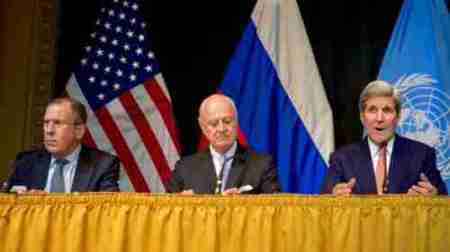
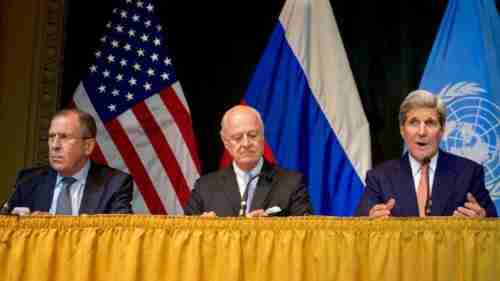
g151031bL-R: Sergei Lavrov, United Nations Special Envoy for Syria Staffan de Mistura, and John Kerry in Vienna on Friday (state.gov)

Russia has poured millions of dollars of heavy weapons into Syria, and is now sending in Russian troops to establish bases there. Recently, Russia launched 27 cruise missiles from the Caspian Sea to targets in Syria. Iran is pouring new troops into Syria. Iran has also given Lebanon’s Hezbollah terrorist group a great deal of money, and Hezbollah has sent thousands of troops into Syria to support Syria’s president Bashar al-Assad.

Al-Assad’s genocidal attacks on innocent Syrian Sunnis, killing hundreds of thousands and forcing millions from their homes, has caused Sunni jihadists from all of the world to fight against al-Assad, Russia, Hezbollah, and Iran in Syria. Along the way, these jihadists formed the so-called Islamic State (IS or ISIS or ISIL or Daesh).

And now, on Friday, Russia’s Foreign Minister Sergei Lavrov made a pronouncement that Barack Obama was going to trigger a “proxy war” in Syria by sending in 50 special operations forces, as we reported yesterday.

You can’t make this stuff up.

Thanks to Iran, Russia, al-Assad and Hezbollah, there are now tens of thousands of foreign troops fighting each other in Syria, with al-Assad in particular supported by massive amounts of foreign weapons.

But somehow, those tens of thousands of foreign fighters don’t make it a “proxy war,” but America’s 50 special forces troops do.

You can’t trust any garbage that comes out of Lavrov’s mouth, or out of al-Assad’s mouth, or out of Vladimir Putin’s mouth, but I listen to BBC, al-Jazeera, FOX, CNN, and other media sources all the time, and I see these news anchors report this crap with a straight face all the time. I don’t know whether it is more sickening to watch those fatuous news anchors, or to watch the fawning Secretary of State John Kerry suck up to Lavrov and Putin, which has happened in issues involving Ukraine, Iran’s nuclear development, and Syria.

All this verbiage is coming out of a meeting in Vienna whose purpose is to find a “political solution” to the Syria problem. With hundreds of thousands of Syrian migrants pouring into Europe, and with hundreds of ISIS militants returning to Russia to fight Putin, there is a lot of pressure to find a “political solution.” But this week’s announcement that Iran will fully enter the war in Syria on the side of the Syrian regime makes any “political solution” farther away than ever. On the contrary, Saudi Arabia and other Gulf countries will never agree to anything like the emerging situation. Actions by Russia and Iran, intervening militarily in Syria, is an emerging disaster, likely triggering a sectarian Sunni versus Shia war throughout the region. BBC and International Business Times and Reuters

Syria’s civil war and Generational Dynamics

In the 12 years that I’ve been doing this, I’ve posted about 4,000 articles with hundreds of Generational Dynamics predictions.

In 2011, when the Syrian civil war began, I said that the war should fizzle within a year or two. Of all the hundreds of Generational Dynamics predictions, this is the one where I’ve clearly been (depending on how you look at it) either wrong or poorly described.

Syria’s last generational crisis war was civil war that climaxed in 1982 with the massacre at Hama. There was a massive uprising of the 400,000 mostly Sunni citizens of Hama against Syria’s president Hafez Assad, the current president’s father. In February, 1982, Assad turned the town to rubble, 40,000 deaths and 100,000 expelled. Hama stands as a defining moment in the Middle East. It is regarded as perhaps the single deadliest act by any Arab government against its own people in the modern Middle East, a shadow that haunts the Assad regime to this day.

(As a related matter, the civil war in Lebanon also climaxed that year, with the bloody massacre at Sabra and Shatila occurring in September 1982. And it occurred as the Iran/Iraq war was ongoing, three years after Iran’s bloody Great Islamic Revolution in 1979. At that time, much of the Mideast was re-fighting World War I and the collapse of the Ottoman Empire, 60 years earlier.)

So, in 2011, I said that the civil war in Syria would fizzle, and could not turn into a crisis civil war. And that’s both wrong and true. There are too many survivors who remember the 1982 slaughter, and do not want to see it repeated. And so there’s been no massive anti-government uprising, as there was in 1982, and Bashar al-Assad’s Shia/Alawite troops have been fighting half-heartedly, with many soldiers defecting or deserting.

But the war did not fizzle.

It should have fizzled in 2011 or 2012, but Hezbollah and Iran starting pouring troops in to support al-Assad. And foreign fighters from around the world arrived to fight al-Assad and to form ISIS. That’s not something that Generational Dynamics could have predicted.

Earlier this year, it looked like al-Assad’s army was near collapse. In July, a desperate al-Assad gave a national speech in which he admitted he was losing. The war should have fizzled this year. But now, Russia and Iran are pouring tens of thousands more troops into Iran to bolster al-Assad. And that also is not something that Generational Dynamics could have predicted.

So the problem for me is: How should I have characterized the situation in 2011? The prediction that it wouldn’t turn into a crisis civil war was correct, but the war did not fizzle, because it turned into a proxy war.

Well, I don’t think there’ll be a next time, but if there is, I’ll try to characterize the situation differently, without simply using the word “fizzle.” NPR (1-Feb-2012)

Generational Dynamics and crisis civil wars

I write about a number of civil wars going on in the world today, so this is a good time to discuss civil wars from the point of view of Generational Dynamics.

Among generational crisis wars, an external war is fundamentally different than a civil war between two ethnic groups. If two ethnic groups have lived together in peace for decades, have intermarried and worked together, and then there is a civil war where one of these ethnic groups tortures, massacres and slaughters their next-door neighbors in the other ethnic group, then the outcome will be fundamentally different than if the same torture and slaughter is rendered by an external group. In either case, the country will spend the Recovery Era setting up rules and institutions designed to prevent any such war from occurring again. But in one case, the country will enter the Awakening era unified, except for generational political differences, and in the other case, the country will be increasingly torn along the same ethnic fault line.

The period following the climax of a crisis war is called the “Recovery Era.” One path that the Recovery Era can take is that the leader of one ethnic group decides that the only way to prevent a new civil war is for him to stay in power, and to respond to peaceful anti-government demonstrations by conducting massive bloody genocide, torture and slaughter of the other ethnic group, in order to maintain the peace. (Dear Reader, I assume you’ve grasped the irony of the last sentence.)

For example, in a July article about Burundi, I described how Burundi’s Hutu president Pierre Nkurunziza was using such violence to quell Tutsi protests, supposedly to avoid a repeat of the 1994 Rwandi-Burundi genocidal war between Hutus and Tutsis.

As another example, in a June article about Zimbabwe, I described how Zimbabwe’s president Robert Mugabe was even worse. His 1984 pacification campaign was known as “Operation Gukurahundi” (The rain that washes away the chaff before the spring rain). During that campaign, accomplished with the help of Mugabe’s 5th Brigade, trained by North Korea, tens of thousands of people, mostly from the Ndebele tribe, were tortured and slaughtered. Later, Mugabe single-handedly destroyed the country’s economy by driving all the white farmers off the farms, resulting in one of the biggest hyperinflation episodes in world history.

That is what Bashar al-Assad is doing in Syria. Fearing a Sunni uprising, like the one in 1982, al-Assad is conducting a massive “peace campaign” by slaughtering and displacing millions of innocent Sunnis. As I wrote above, this should have fizzled in 2011 or 2012, but it’s turned into a proxy war, and it’s a disaster for the Mideast and the world.

But none of the above three examples is a crisis civil war. A crisis war has to come from the people, not from the politicians. So, for example, there’s a massive crisis civil war going on today in Central African Republic (CAR), between the Muslim ex-Seleka militias fighting Christian anti-Balaka militias.

Unlike the previous examples, CAR is in a generational Crisis era. CAR’s last generational crisis war was the 1928-1931 Kongo-Wara Rebellion (“War of the Hoe Handle”), which was a very long time ago, putting CAR today deep into a generational Crisis era, where a new crisis war is increasingly likely. That’s why the CAR is a genuine crisis civil war, and won’t fizzle out. In fact, it won’t end until it has reached some kind of explosive conclusion — of the kind we described in Hama or Sabra and Shatila. ( “2-Oct-15 World View — Violence resurges in Central African Republic crisis war”)

Generational Dynamics and war between Palestinians and Israelis

I’ll discuss one more example — not a civil war, but very similar to a civil war, with the same kinds of issues.

In the last few years, there have been three non-crisis wars between Israelis and Palestinians in Gaza. In each case, the Israelis destroyed Hamas’s infrastructure, ending the war. The war began again each time when Hamas’s infrastructure was rebuilt.

But the point I want to make is that these three non-crisis wars were all directed by politicians. Palestinians attacked when the leadership told them to, and stopped attacking when the leadership told them to stop.

What I have been describing in numerous articles recently is that there is emerging a major, fundamental, historic change.

In the emerging situation, young people today are no longer willing to listen to these leaders. According to the CIA World Fact Book, 20% of Gaza’s population are in the 15-24 age range, and so are 21% of the West Bank — about 200,000 males in each territory, or 400,000 young males total.

On the Israeli side, there are over 600,000 young males in the same age range. There have been unconfirmed reports of young Israelis also disgusted with the leadership. It is possible that, like the young Palestinians, they are willing to take matters into their own hands.

So in this environment, what could happen next? The last three Gaza wars were non-crisis wars, but the next one could be a crisis war between Israelis and Palestinians.

How can a crisis war begin? How about if those 200,000 young male Gazans blow holes in the walls, pour across into Israel and start killing Israeli citizens en masse in their homes and villages? And how about if they are joined by those 200,000 young male Palestinians on the West Bank, who start with the Jewish settlers and continue with the Jews in Jerusalem. And how about if the young Israeli males strike back and start killing Palestinians in their homes and villages?

Israel’s tanks and bombers would not be of much use. You can’t bomb Jerusalem, and you can’t bomb Israeli villages and settlements to kill Palestinians.

That is the difference. That is what a generational crisis war is like. It is not two tanks shooting at each other. It is hand to hand combat in homes, neighborhoods and streets by people armed with sticks and knives. It is what happened in Central African Republic last year, it is what happened in Rwanda in 1994, in Bosnia in 1994, and in Palestine in 1947.

And by the way, that assumes that the bloody mess stays confined to Israel and the Palestinian territories. The Palestinians are likely to be joined by tens or hundreds of thousands from Jordan, Lebanon and Egypt.

The recent widely reported changes in the attitudes and behaviors of young Palestinians is a sign that this kind generational crisis war is coming.