Archive for the ‘Mad Mullahs’ category

‘Messing’ with Israel

April 7, 2015

‘Messing’ with Israel, Israel Hayom, Elliott Abrams, April 7, 2015

(“If you like your country you can keep it.” Even if Obama’s phrasings were not ambiguous, and they are, he could not be trusted. Moreover, since Obama’s talking points about the “once in a lifetime deal” and those of his Iranian counterparts are very different, there is no way of knowing now whether there will be a deal, whether the U.S. Congress will block it, or what it will be. — DM)

In his lengthy interview with Thomas Friedman of The New York Times, President Obama makes many statements about Israel’s security and how the proposed deal with Iran enhances it. These words from the interview are key:

“I have to respect the fears that the Israeli people have,” he added, “and I understand that Prime Minister Netanyahu is expressing the deep-rooted concerns that a lot of the Israeli population feel about this, but what I can say to them is: Number one, this is our best bet by far to make sure Iran doesn’t get a nuclear weapon, and number two, what we will be doing even as we enter into this deal is sending a very clear message to the Iranians and to the entire region that if anybody messes with Israel, America will be there.”

What does “messes with Israel” mean? No one has the slightest idea. The president unfortunately uses this kind of diction too often, dumbing down his rhetoric for some reason and leaving listeners confused. Today, Iran is sending arms and money to Hamas in Gaza, and has done so for years. Is that “messing with Israel?” Iran has tried to blow up several Israeli embassies, repeating the successful attack it made on Israel’s embassy in Buenos Aires in 1992. Fortunately Israel has foiled the more recent plots, but is attempting to bomb Israeli embassies “messing with Israel?” Iranian Revolutionary Guards, along with Hezbollah troops, are in southern Syria now near the Golan. Is that “messing with Israel?” And what does the president mean by “America will be there?” With arms? With bandages? With the diplomatic protection his administration is now considering removing at the United Nations?

Later in the interview, the president says this:

“Now, what you might hear from Prime Minister [Benjamin] Netanyahu, which I respect, is the notion, ‘Look, Israel is more vulnerable. We don’t have the luxury of testing these propositions the way you do,’ and I completely understand that. And further, I completely understand Israel’s belief that given the tragic history of the Jewish people, they can’t be dependent solely on us for their own security. But what I would say to them is that not only am I absolutely committed to making sure that they maintain their qualitative military edge, and that they can deter any potential future attacks, but what I’m willing to do is to make the kinds of commitments that would give everybody in the neighborhood, including Iran, a clarity that if Israel were to be attacked by any state, that we would stand by them. And that, I think, should be … sufficient to take advantage of this once-in-a-lifetime opportunity to see whether or not we can at least take the nuclear issue off the table.”

This is not much help. For one thing, the president says “attacked by any state,” presumably leaving out Hamas and Hezbollah, and for that matter the Islamic State group and al-Qaida. One has to assume he means “attacked by Iran,” but what does “we would stand by them” mean? It doesn’t add much to “America will be there.” There will be no conventional war between Israel and any Arab state in the foreseeable future, so Hezbollah is the most likely problem and is presumably excluded from the president’s formulation. What Israel worries about today is a nuclear attack by Iran or a terrorist group like Hezbollah to which Iran has given the bomb. No doubt that qualifies as “messing with Israel,” but were that to occur what exactly would “America will be there” and “stand by them” mean? Take in refugees from the destroyed State of Israel after the nuclear attack on it? The president’s language about “commitment” suggests that he may envision a formal defense commitment by the United States to Israel. Israel has not wanted such a treaty because it has always said it wants to defend itself, not have Americans dying to defend it. That position has served the U.S.-Israel relationship well for 67 years. Should it really be changed now, and would that really help Israel? What would the value of such a commitment be? To ask the question another way, are not Poles and Estonians wondering right now about the value of their membership in NATO, if Mr. Putin “messes” with them?

There were other problems in the interview, such as this language:

“There has to be the ability for me to disagree with a policy on settlements, for example, without being viewed as … opposing Israel. There has to be a way for Prime Minister Netanyahu to disagree with me on policy without being viewed as anti-Democrat, and I think the right way to do it is to recognize that as many commonalities as we have, there are going to be strategic differences. And I think that it is important for each side to respect the debate that takes place in the other country and not try to work just with one side. … But this has been as hard as anything I do because of the deep affinities that I feel for the Israeli people and for the Jewish people. It’s been a hard period.”

“You take it personally?” Friedman asked.

“It has been personally difficult for me to hear … expressions that somehow … this administration has not done everything it could to look out for Israel’s interest — and the suggestion that when we have very serious policy differences, that that’s not in the context of a deep and abiding friendship and concern and understanding of the threats that the Jewish people have faced historically and continue to face.”

“Respect the debate?” “Personally difficult?” This is the White House whose high officials called the prime minister of Israel a “chickens—” and a “coward,” in interviews meant to be published — not off the record. And the officials who said those things remain in place; no effort was ever made to identify and discipline them.

But the deeper problem is that the reassurances the president is offering to Israel … are simply not reassuring. Iran is already, right now, while under sanctions that are badly hurting its economy, spending vast amounts of money and effort to “mess with Israel.” This administration’s reaction has been to seek a nuclear deal that will give Iran more economic resources to dedicate to its hatred and violence against Israel, but will in no way whatsoever limit Iran’s conventional weapons and its support for terrorism.

Several times in this interview the president went out of his way to suggest that he fully understands Israel’s security problems, but the full text suggests that he does not — because he believes that his statements that “if anybody messes with Israel, America will be there” and would “stand by them” actually solve any of those problems. Time alone undermines the value of those statements, because he will not be president in 22 months. The words he used are sufficiently vague to undermine their value as well. It is hard to believe that many Israelis will be reassured by the interview, especially if they read the Iranian press and see what, in their own interviews, Iranian officials are claiming they got out of the new nuclear agreement.

Can and should Israel destroy Iran’s nuclear facilities?

April 5, 2015

Can and should Israel destroy Iran’s nuclear facilities? Dan Miller’s Blog, April 5, 2015

(The views expressed in this article are mine and do not necessarily reflect those of Warsclerotic or any of its other editors. — DM)

It has been suggested that Israel should seriously consider destroying Iranian nuclear facilities, but Israeli officials obviously haven’t said, and won’t say, if, how or when she might.

Iran fenced in

Speaking to Arutz Sheva Friday, Professor Efraim Inbar, who heads the Begin-Sadat Center for Strategic Studies, said the deal had realized Israel’s worst fears by leaving Iran’s nuclear program essentially intact.

The Islamic Republic’s nuclear program has been granted “legitimacy” by the agreement, which still allowed it to continue enriching uranium and to maintain a reactor capable of producing enriched plutonium, he said. “And that’s what worries Israel, that they (Iran) will be able within a short time frame to reach a nuclear bomb.”

“I hold the view that the only way to stop Iran in its journey to a nuclear bomb is through military means,” Inbar maintained, suggesting that “Israel needs to seriously consider striking a number of important nuclear facilities” to head off the threat.

On March 28, former U.S. Ambassador Bolton said that it should be done.

The P5+1 nuclear “deal,” proudly announced by President Obama on April 2nd, is a sham. There is no “deal,” and public announcements by Iran and Obama cast it in very different lights. According to Iran, all sanctions will be lifted immediately when an agreement is reached on or before June 30th. According to Obama, sanctions relief will be gradual and based on Iran’s compliance with invasive inspections and other conditions. Even National Public Radio (NPR) has pointed out differences. NPR observed that, according to Iran,

all sanctions relief – U.N., EU and U.S. – would be immediate. It was unequivocal. It stated that Iran under the deal was free to pursue industrial scale enrichment to fuel its own reactors – unequivocal. It stated that Iran was unhindered in its ability to conduct centrifuge R&D.

Iran has also emphasized that its intention to destroy Israel is non-negotiable, and the Obama Administration has rejected any efforts to make Iran recognize Israel’s right to exist, on the ground that

“This is an agreement that is only about the nuclear issue,” State Department spokeswoman Marie Harf told reporters on Friday night, according to Fox News. “This is an agreement that doesn’t deal with any other issues, nor should it.” [Emphasis added.]

Israeli Prime Minister Netanyahu has said that Israel’s right to exist is non-negotiable.

Iran is very unlikely to retreat from its perception of the “deal,” Obama is very likely to retreat in Iran’s favor, and Israel is very unlikely to retreat from its perceptions about Iran, the “deal” or Israel’s right to exist.

What should Israel do?

In Martin Archer’s novel Islamic War, which I reviewed here, Israel dispatched elderly, large and substantially refurbished remove controlled aircraft, full of high explosives, from Somalia to half dozen nuclear facilities operated by hostile nations. They flew circuitous routes at varying altitudes to avoid detection until it was too late to stop them. Over a period of weeks, they crashed into and destroyed their targets, amid speculation about who had done it and why. Israel was not suspected. Would that have been possible then? Now? I don’t know.

It has been reported that Saudi Arabia has given Israel clearance to use her airspace for an attack on Iran’s nuclear facilities.

Fox News reports that US Defense sources claim the Saudis are conducting tests on their air defense systems after giving Israel permission to to enter a narrow corridor to shorten the distance to attack Iran.

The testing would make sure that Saudi jets don’t get scrambled when Israel entered Saudi airspace. Once the IAF planes complete their mission and exit Saudi airspace, Saudi defenses would go back online again. [Emphasis added.]

Might Saudi Arabia, Egypt and perhaps other Gulf States go beyond not interfering with an Israeli attack to provide air support and other help? They seem to be as displeased with the “deal” as Israel is.

Assuming that Israel is not overly concerned about being identified as the attacker and is willing to act alone, she might:

Detonate one or more high-altitude atomic bombs to emit sufficient electromagnetic pulses (EMP) to fry all above-ground Iranian electronics. That would substantially disable Iranian above-ground command and control facilities as well as other communications, hence diminishing (but not eliminating) the possibility of counter-strikes by Iran and/or its proxies. Perhaps she has other, non-nuclear, means of generating EMPs; she hasn’t said.

Immediately thereafter, drop whatever suitable bombs she may have on all Iranian military and nuclear facilities. Does Israel have bunker-buster bombs? Probably not of U.S. manufacture, but that does not mean that she has not developed her own. It would be surprising if she had not.

Obama and other “leaders of the free world” would complain and the U.N. would emit fits of angry censures. However, that happens with great frequency in any event, and would be an insufficient reason for Israel to commit national suicide through inaction against Iran.

I am no “military expert” and would appreciate any comments on the suggestions I have made as well as any other suggestions anyone might care to offer.

Arabs Blast “Obama’s Deal” With Iran

April 4, 2015

Arabs Blast “Obama’s Deal” With Iran, Gatestone InstituteKhaled Abu Toameh, April 4, 2015

“This is a dangerous agreement…[It ]provides Iran with what it needs most to pursue its wars and expansionism against the Arabs: funds.” —Salah al-Mukhtar, Ammon News”

“Iran has tried to intervene in Iraq, Lebanon and Syria and it is seeing that it’s not paying any price…There is also a feeling in Tehran that the U.S. is avoiding a military confrontation with the Iranians.”– Hassan al-Barari, Al-Sharq

The deal means that the international community has accepted Iran as a nuclear power.” — Hani ala-Jamal, al-Wafd

Many Arabs have expressed deep concern over the nuclear deal that was reached last week between Iran and the world powers, including the US.

Arab leaders and heads of state were polite enough not to voice public criticism of the agreement when President Barack Obama phoned them to inform them about it. But this has not stopped Arab politicians, political analysts and columnists reflecting government thinking in the Arab world from lashing out at what they describe as “Obama’s bad and dangerous deal with Iran.”

The Arabs, especially those living in the Gulf, see the framework agreement as a sign of US “weakness” and a green light to Iran for Iran to pursue its “expansionist” scheme in the Arab world.

“Some Arab countries are opposed to the nuclear deal because it poses a threat to their interests,” said the Egyptian daily Al-Wafd in an article entitled, “Politicians: (President Barack) Obama’s deal with Iran threatens Arab world.” http://www.alwafd.org/838527

The newspaper quoted Hani al-Jamal, an Egyptian political and regional researcher, as saying that the deal means that the international community has accepted Iran as a nuclear power. He predicted that the framework agreement would put Iran and some Arab countries such as Saudi Arabia and Egypt on a course of collision.

Al-Jamal advised the Arab countries to form a “Sunni NATO” that would guarantee Pakistan’s status as a nuclear power Arab ally in face of the “Iranian and Israeli threat.”

Jihad Odeh, an Egyptian professor of political science, said that Obama’s “achievements are designed to dismantle the Arab world. Obama wants to make historic achievements before the end of his term in office by destroying Al-Qaeda, seeking rapprochement with Cuba and reaching a nuclear agreement with Iran.”

http://www.alwafd.org/838527

Although Saudi Arabia, which is currently waging war on Iranian-backed Houthi militiamen in Yemen, “welcomed” the nuclear agreement, it has privately expressed concern over the deal.

http://gulfnews.com/news/gulf/saudi-arabia/public-saudi-welcome-for-iran-nuclear-deal-but-unease-remains-1.1485119

Similarly, several Gulf countries that initially welcomed the agreement are beginning to voce concern over its repercussions on the region. For the past several months, the Arabs have been warning against Iran’s ongoing effort to take control over their countries.

“The US surely does not want to see a more powerful Iranian hegemony in the region, but at the same time, it does not appear to mind some kind of Iranian influence in the region,” said Nasser Ahmed Bin Gaith, a United Arab Emirates researcher. “Iran has been seeking to reclaim its previous role as the region’s police.”

http://www.aljazeera.com/news/2015/04/saudi-arabia-israel-oppose-iran-nuclear-deal-150401061906177.html

Bin Gaith said that it was clear that a Western recognition of Iranian regional influence would come at the expense of the Gulf countries.

“The Gulf states should build strategic partnerships with the regional powers of Pakistan and Turkey, who share the Gulf nations’ fears of Iranian ambitions in the region,” he added.

Echoing widespread fear among Arabs of Iran’s territorial ambitions in the Middle East, political analyst Hassan al-Barari wrote in Qatar’s daily Al-Sharq against the policy of appeasement toward Tehran.

“Iran has tried to intervene in Iraq, Lebanon and Syria and it is seeing that it’s not paying any price; on the contrary, there are attempts by the big powers to reach understandings with Iran,” al-Barari pointed out. There is also a feeling in Tehran that the US is avoiding a military confrontation with the Iranians and their proxies. The Gulf countries have learned from the lessons of the past in various areas. The policy of appeasement has only led to wars. Any kind of appeasement with Iran will only lead it to ask for more and probably meddle in the internal affairs of the Arab countries and increase its arrogance.”

http://www.al-sharq.com/news/details/324014#.VR7KLjuUevV

Even Jordanians have joined the chorus of Arabs expressing fear over Iran’s growing threat to the Arab world, especially in wake of the nuclear deal with the US and the big powers.

Salah al-Mukhtar, a Jordanian columnist, wrote an article entitled, “Oh Arabs wake up, your enemy is Iran,” in which he accused the US of facilitating Tehran’s wars against the Arab countries.

http://www.ammonnews.net/article.aspx?articleno=225764

Describing Iran as “Eastern Israel,” al-Mukhtar said that the most dangerous aspect of the framework agreement is that allows Iran to continue with its “destructive wars” against the Arabs. “This is a dangerous agreement, particularly for Saudi Arabia and the opposition forces in Iraq and Syria,” the Jordanian columnist cautioned. This agreement provides Iran with what it needs most to pursue its wars and expansionism against the Arabs: funds. Lifting the sanctions is America’s way of backing the dangerous and direct wars against Arabs; the lifting of the sanctions also provides the Iranians with the funds needed to push with their Persian advancement. The US wants to drain Saudi Arabia and the Arab Gulf countries in preparation for dividing them.”

Lebanon’s English language The Daily Star newspaper also voiced skepticism over the nuclear deal. “For all the talk of this deal contributing to making the world safer, if Obama is truly concerned with his legacy, especially in the Middle East, he must now work with Iran to encourage it to become a regular member of the international community once again, and not a country which sponsors conflict, whether directly or via proxies, across the region,” the paper editorialized. “Otherwise, this deal could just leave Iran emboldened in its expansionist designs.”

http://www.dailystar.com.lb/Opinion/Editorial/2015/Apr-03/293201-a-deal-or-legacy.ashx

In addition to the Arabs, Iranian opposition figures have also come out against the nuclear deal.

Maryam Rajavi, an Iranian politician and President of the National Council of Resistance, commented that the a “statement of generalities, without spiritual leader Khamenie’s signature and official approval, does not block Tehran’s path to a nuclear bomb nor prevent its intrinsic deception.

“Continuing talks with religious fascism in Iran – as part of a policy of appeasement – will not secure the region and world from the threat of nuclear proliferation,” Rajavi warned. “Complying with UN Security Council resolutions is the only way to block the mullahs from obtaining nuclear weapons. Leniency and unwarranted concessions by the P5+1 to the least trustworthy regime in the world today only grants it more time and further aggravates the dangers it poses to the Iranian people, to the region and to the wider world.”

http://irannewsupdate.com/news/nuclear/2047-iran-maryam-rajavi-fearful-mullahs-reluctantly-take-one-more-step-backward-toward-drinking-the-chalice-of-nuclear-poison.html

Cartoons of the day

April 4, 2015

Cartoon of the day via Freedom is just another word, April 4, 2015

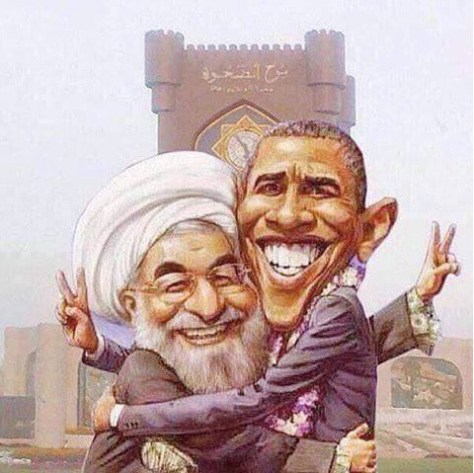
Obama gets a great deal with Iran

Obama Iran selfie

COLUMN ONE: The diplomatic track to war

April 3, 2015

COLUMN ONE: The diplomatic track to war, Jerusalem Post, Caroline Glick, April 4, 2015

Iran negotiationsIran negotiations. (photo credit:REUTERS)

No one trusts Washington when Obama claims that he is committed to the security of Israel and the US’s Sunni allies in the region.

Iran is far more powerful than the PLO. But the Americans apparently believe they are immune from the consequences of their leaders’ policies. This is not the case for Israel or for our neighbors. We lack the luxury of ignoring the fact that Obama’s disastrous diplomacy has brought war upon us. Deal or no deal, we are again about to be forced to pay a price to maintain our freedom.

********************

Through their nuclear diplomacy, Obama and his comrades started the countdown to war.

The world powers assembled at Lausanne, Switzerland, with the representatives of the Islamic Republic may or may not reach a framework deal regarding Iran’s nuclear program. But succeed or fail, the disaster that their negotiations have unleashed is already unfolding. The damage they have caused is irreversible.

US President Barack Obama, his advisers and media cheerleaders have long presented his nuclear diplomacy with the Iran as the only way to avoid war. Obama and his supporters have castigated as warmongers those who oppose his policy of nuclear appeasement with the world’s most prolific state sponsor of terrorism.

But the opposite is the case. Had their view carried the day, war could have been averted.

Through their nuclear diplomacy, Obama and his comrades started the countdown to war.

In recent weeks we have watched the collapse of the allied powers’ negotiating positions.

They have conceded every position that might have placed a significant obstacle in Iran’s path to developing a nuclear arsenal.

They accepted Iran’s refusal to come clean on the military dimensions of its past nuclear work and so ensured that to the extent UN nuclear inspectors are able to access Iran’s nuclear installations, those inspections will not provide anything approaching a full picture of its nuclear status. By the same token, they bowed before Iran’s demand that inspectors be barred from all installations Iran defines as “military” and so enabled the ayatollahs to prevent the world from knowing anything worth knowing about its nuclear activities.

On the basis of Iran’s agreement to ship its stockpile of enriched uranium to Russia, the US accepted Iran’s demand that it be allowed to maintain and operate more than 6,000 centrifuges.

But when on Monday Iran went back on its word and refused to ship its uranium to Russia, the US didn’t respond by saying Iran couldn’t keep spinning 6,000 centrifuges. The US made excuses for Iran.

The US delegation willingly acceded to Iran’s demand that it be allowed to continue operating its fortified, underground enrichment facility at Fordow. In so doing, the US minimized the effectiveness of a future limited air campaign aimed at significantly reducing Iran’s nuclear capabilities.

With this broad range of great power concessions already in its pocket, the question of whether or not a deal is reached has become a secondary concern. The US and its negotiating partners have agreed to a set of understanding with the Iranians. Whether these understandings become a formal agreement or not is irrelevant because the understandings are already being implemented.

True, the US has not yet agreed to Iran’s demand for an immediate revocation of the economic sanctions now standing against it. But the notion that sanctions alone can pressure Iran into making nuclear concessions has been destroyed by Obama’s nuclear diplomacy in which the major concessions have all been made by the US.

No sanctions legislation that Congress may pass in the coming months will be able to force a change in Iran’s behavior if they are not accompanied by other coercive measures undertaken by the executive branch.

There is nothing new in this reality. For a regime with no qualms about repressing its society, economic sanctions are not an insurmountable challenge. But it is possible that if sanctions were implemented as part of a comprehensive plan to use limited coercive means to block Iran’s nuclear advance, they could have effectively blocked Iran’s progress to nuclear capabilities while preventing war. Such a comprehensive strategy could have included a proxy campaign to destabilize the regime by supporting regime opponents in their quest to overthrow the mullahs. It could have involved air strikes or sabotage of nuclear installations and strategic regime facilities like Revolutionary Guards command and control bases and ballistic missile storage facilities. It could have involved diplomatic isolation of Iran.

Moreover, if sanctions were combined with a stringent policy of blocking Iran’s regional expansion by supporting Iraqi sovereignty, supporting the now deposed government of Yemen and making a concerted effort to weaken Hezbollah and overthrow the Iranian-backed regime in Syria, then the US would have developed a strong deterrent position that would likely have convinced Iran that its interest was best served by curbing its imperialist enthusiasm and setting aside its nuclear ambitions.

In other words, a combination of these steps could have prevented war and prevented a nuclear Iran. But today, the US-led capitulation to Iran has pulled the rug out from any such comprehensive strategy. The administration has no credibility. No one trusts Obama to follow through on his declared commitment to prevent Iran from becoming a nuclear power.

No one trusts Washington when Obama claims that he is committed to the security of Israel and the US’s Sunni allies in the region.

And so we are now facing the unfolding disaster that Obama has wrought. The disaster is that deal or no deal, the US has just given the Iranians a green light to behave as if they have already built their nuclear umbrella. And they are in fact behaving in this manner.

They may not have a functional arsenal, but they act as though they do, and rightly so, because the US and its partners have just removed all significant obstacles from their path to nuclear capabilities. The Iranians know it. Their proxies know it. Their enemies know it.

As a consequence, all the regional implications of a nuclear armed Iran are already being played out. The surrounding Arab states led by Saudi Arabia are pursuing nuclear weapons. The path to a Middle East where every major and some minor actors have nuclear arsenals is before us.

Iran is working to expand its regional presence as if it were a nuclear state already. It is brazenly using its Yemeni Houthi proxy to gain maritime control over the Bab al-Mandab, which together with Iran’s control over the Straits of Hormuz completes its maritime control over shipping throughout the Middle East.

Israel, Jordan, Egypt, Saudi Arabia, Sudan and Eritrea, and their global trading partners will be faced with the fact that their primary maritime shipping route to Asia is controlled by Iran.

With its regional aggression now enjoying the indirect support of its nuclear negotiating partners led by the US, Iran has little to fear from the pan-Arab attempt to dislodge the Houthis from Aden and the Bab al-Mandab. If the Arabs succeed, Iran can regroup and launch a new offensive knowing it will face no repercussions for its aggression and imperialist endeavors.

Then of course there are Iran’s terror proxies.

Hezbollah, whose forces now operate openly in Syria and Lebanon, is reportedly active as well in Iraq and Yemen. These forces behave with a brazenness the likes of which we have never seen.

Hamas too believes that its nuclear-capable Iranian state sponsor ensures that regardless of its combat losses, it will be able to maintain its regime in Gaza and continue using its territory as a launching ground for assaults against Israel and Egypt.

Iran’s Shiite militias in Iraq have reportedly carried out heinous massacres of Sunnis who have fallen under their control and faced no international condemnation for their war crimes, operating as they are under Iran’s protection and sponsorship. And the Houthis, of course, just overthrew a Western-backed government that actively assisted the US and its allies in their campaign against al-Qaida.

For their proxies’ aggression, Iran has been rewarded with effective Western acceptance of its steps toward regional domination and nuclear armament.

Hezbollah’s activities represent an acute and strategic danger to Israel. Not only does Hezbollah now possess precision guided missiles that are capable of taking out strategic installations throughout the country, its arsenal of 100,000 missiles can cause a civilian disaster.

Hezbollah forces have been fighting in varied combat situations continuously for the past three years. Their combat capabilities are incomparably greater than those they fielded in the 2006 Second Lebanon War. There is every reason to believe that these Hezbollah fighters, now perched along Israel’s borders with Lebanon and Syria, can make good their threat to attack and hold fixed targets including border communities.

While Israel faces threats unlike any we have faced in recent decades that all emanate from Western-backed Iranian aggression and expansionism carried out under a Western-sanctioned Iranian nuclear umbrella, Israel is not alone in this reality. The unrolling disaster also threatens the moderate Sunni states including Jordan, Egypt, Saudi Arabia, Kuwait and the United Arab Emirates. The now regional war in Yemen is but the first act of the regional war at our doorstep.

There are many reasons this war is now inevitable.

Every state threatened by Iran has been watching the Western collapse in Switzerland.

They have been watching the Iranian advance on the ground. And today all of them are wondering the same thing: When and what should we strike to minimize the threats we are facing.

Everyone recognizes that the situation is only going to get worse. With each passing week, Iran’s power and brazenness will only increase.

Everyone understands this. And this week they learned that with Washington heading the committee welcoming Iran’s regional hegemony and nuclear capabilities, no outside power will stand up to Iran’s rise. The future of every state in the region hangs in the balance. And so, it can be expected that everyone is now working out a means to preempt and prevent a greater disaster.

These preemptive actions will no doubt include three categories of operations: striking Hezbollah’s missile arsenal; striking the Iranian Navy to limit its ability to project its force in the Bab al-Mandab; and conducting limited military operations to destroy a significant portion of Iran’s nuclear installations.

Friday is the eve of Passover. Thirteen years ago, Palestinian terrorists brought home the message of the Exodus when they blew up the Seder at Netanya’s Park Hotel, killing 30, wounding 140, and forcing Israel into war. The message of the Passover Haggada is that there are no shortcuts to freedom. To gain and keep it, you have to be willing to fight for it.

That war was caused by Israel’s embrace of the notion that you can bring peace through concessions that empower an enemy sworn to your destruction. The price of that delusion was thousands of lives lost and families destroyed.

Iran is far more powerful than the PLO. But the Americans apparently believe they are immune from the consequences of their leaders’ policies. This is not the case for Israel or for our neighbors. We lack the luxury of ignoring the fact that Obama’s disastrous diplomacy has brought war upon us. Deal or no deal, we are again about to be forced to pay a price to maintain our freedom.

Obama blinked, Iran didn’t

April 3, 2015

Obama blinked, Iran didn’t, Legal Insurrection, April 3, 2015

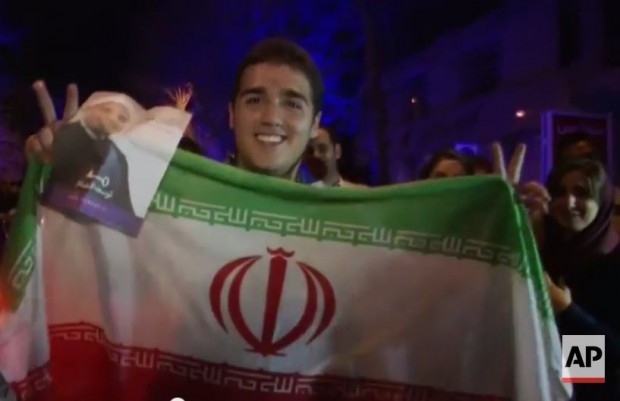
Iran celebrates

Well that “Framework” negotiation was fun.

For the Iranians, who got a great deal at least as far as a Framework goes.

As this WaPo editorial points out, the Obama administration gave up on key parameters:

THE “KEY parameters” for an agreement on Iran’s nuclear program released Thursday fall well short of the goals originally set by the Obama administration. None of Iran’s nuclear facilities — including the Fordow center buried under a mountain — will be closed. Not one of the country’s 19,000 centrifuges will be dismantled. Tehran’s existing stockpile of enriched uranium will be “reduced” but not necessarily shipped out of the country. In effect, Iran’s nuclear infrastructure will remain intact, though some of it will be mothballed for 10 years. When the accord lapses, the Islamic republic will instantly become a threshold nuclear state.

That’s a long way from the standard set by President Obama in 2012 when he declared that “the deal we’ll accept” with Iran “is that they end their nuclear program” and “abide by the U.N. resolutions that have been in place.” Those resolutions call for Iran to suspend the enrichment of uranium. Instead, under the agreement announced Thursday, enrichment will continue with 5,000 centrifuges for a decade, and all restraints on it will end in 15 years.

In his speech after the announcement, Obama took care not only to repeat the false rhetorical device of the only choice being between this deal and war, he blamed that choice on Israeli Prime Minister Benjamin Netanyahu. David Horvitz at The Times of Israel writes, Defeatist Obama’s deal with the devil:

Extolling the virtues of his deal with Iran on Thursday, President Barack Obama made a false and extremely nasty assertion: “It’s no secret,” he claimed, incorrectly, “that the Israeli prime minister and I don’t agree about whether the United States should move forward with a peaceful resolution to the Iranian issue.”

It is indeed no secret that Obama and Netanyahu don’t agree on how to thwart Iran’s nuclear weapons ambitions. It is emphatically not the case, however, that Israel’s prime minister opposes “a peaceful resolution to the Iranian issue.” It is emphatically not the case, despite Obama’s insinuation, that Israel’s leader regards military intervention as the only means to thwart Iran.

Netanyahu has not been saying no to diplomacy. His endlessly stated contention is not that war is the only alternative to the deal so delightedly hailed by Obama as “the most effective way to ensure Iran doesn’t get a nuclear weapon.” Rather, in Netanyahu’s insistent opinion, what is needed is simply a different, far more potent deal.


Why throw Netanyahu under the bus again? There are plenty of people, including Democrats in Congress, who don’t view this deal as the only non-war choice.

Netanyahu issued the following statement after the announcement of the Framework deal:

Statement by Prime Minister Benjamin Netanyahu
April 3, 2015

I just came from a meeting of the Israeli cabinet. We discussed the proposed framework for a deal with Iran.

The cabinet is united in strongly opposing the proposed deal.
This deal would pose a grave danger to the region and to the world and would threaten the very survival of the State of Israel.

The deal would not shut down a single nuclear facility in Iran, would not destroy a single centrifuge in Iran and will not stop R&D on Iran’s advanced centrifuges.

On the contrary. The deal would legitimize Iran’s illegal nuclear program. It would leave Iran with a vast nuclear infrastructure. A vast nuclear infrastructure remains in place.

The deal would lift sanctions almost immediately and this at the very time that Iran is stepping up its aggression and terror in the region and beyond the region.

In a few years, the deal would remove the restrictions on Iran’s nuclear program, enabling Iran to have a massive enrichment capacity that it could use to produce many nuclear bombs within a matter of months.

The deal would greatly bolster Iran’s economy. It would give Iran thereby tremendous means to propel its aggression and terrorism throughout the Middle East.

Such a deal does not block Iran’s path to the bomb.

Such a deal paves Iran’s path to the bomb.

And it might very well spark a nuclear arms race throughout the Middle East and it would greatly increase the risks of terrible war.

Now, some say that the only alternative to this bad deal is war.

That’s not true.

There is a third alternative – standing firm, increasing the pressure on Iran until a good deal is achieved.

And finally let me say one more thing.

Iran is a regime that openly calls for Israel’s destruction and openly and actively works towards that end.

Just two days ago, in the midst of the negotiations in Lausanne, the commander of the Basij security forces in Iran said this: “The destruction of Israel is non-negotiable.”

Well, I want to make clear to all. The survival of Israel is non-negotiable.

Israel will not accept an agreement which allows a country that vows to annihilate us to develop nuclear weapons, period.

In addition, Israel demands that any final agreement with Iran will include a clear and unambiguous Iranian recognition of Israel’s right to exist.

Thank you.

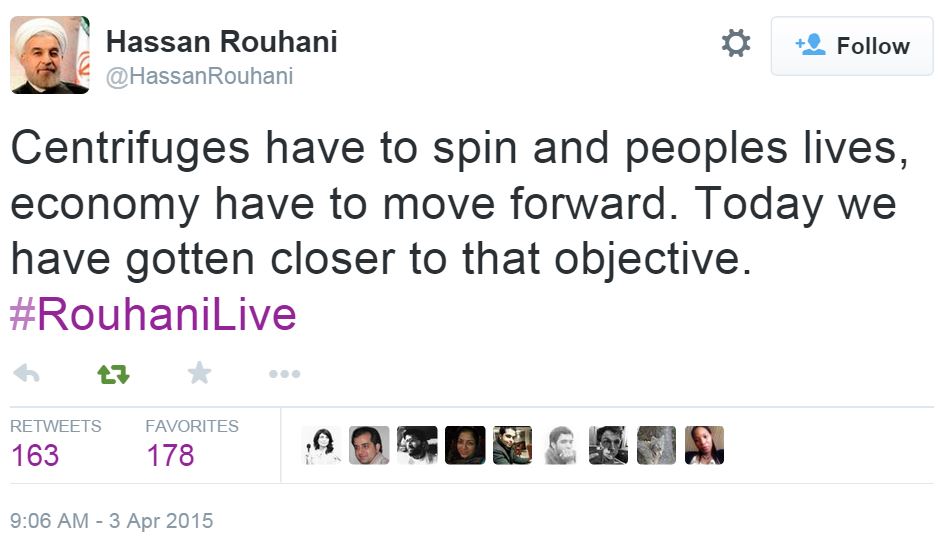
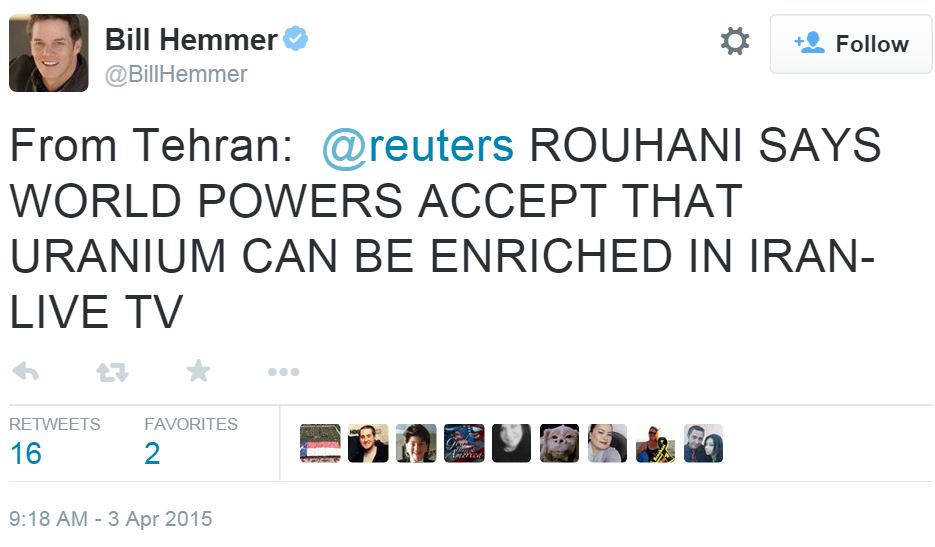
Meanwhile, the Mullah regime crowed at how they got what they wanted (see also tweets in yesterday’s post):

Twitter-Rhouani-Iran-Deal-Centrifuges-spin
Twitter-Bill-Hemmer-Rhouani-Iran-Deal-Enrichment
Twitter-Fars-News-Agency-Iran-Deal-Rouhani

Seems to me the Mullahs know something we don’t.

And Iranians took to the streets to celebrate:


There was a better deal to be had. The sanctions were hurting. Obama blinked, the Iranians didn’t.

Losin’ in Lausanne (8) [Updated]

April 3, 2015

Losin’ in Lausanne (8) [Updated], Power LineScott Johnson, April 2, 2015

The last time Zarif accused the Obama administration of lying on a factsheet was after the JPOA was announced, in the context of granting a “right to enrich.” He was 100% right and the Americans were 100% wrong.

***************

Omri Ceren writes from Lausanne to put today’s announcement of a “framework” for an agreement in perspective:

Zarif just finished his speech, and there’s a break while the President speaks back in DC. But some of what Zarif revealed has already generated controversy. There was a lot of braggadocio in the speech: no closing of facilities, R&D will continue on Iran’s scientific schedule, enrichment will continue, the heavy water at Arak will be modernized, etc.

Perhaps most relevant to people who have been following the day-to-day in Lausanne, is that Zarif confirmed the U.S. has completely caved on the Fordow concession that the AP blew open on Thursday. Recall that Fordow is the underground bunker, built into the side of a mountain, which the Iranians emptied and made into an illicit enrichment facility. The assumption had always been that the Iranians would have to close it under any reasonable deal.

President Obama was saying as late as 2012: “We know they don’t need to have an underground, fortified facility like Fordo in order to have a peaceful program” [1].

The Iranians simply said no [2]. So the Americans caved and said that they could keep it open as a research facility, but they had to remove all the centrifuges for storage [3]. The compromise was the brainchild of Robert Einhorn from Brookings – a top State nonproliferation official stretching back to the Clinton era – and there was a lot of talk of Iranian flexibility when they accepted it [4]. Then this week, it emerged that in fact the Iranians would be allowed to keep centrifuges spinning inside the mountain.

But instead of spinning uranium, the centrifuges would be spinning germanium or similar non-nuclear elements. That’s the administration’s talking point: that there will not be any “enrichment” going on at Fordow. The claim is – bluntly – false. Centrifuges spin isotopes into lighter and heavier elements, thereby “enriching” the material. That’s what they do. In fact that’s all they do. The administration has gone all-in on a talking point can be defeated by a Google search for “centrifuges enrich germanium” (if you’re fastidious you can set the Google search to before the AP scoop, to make sure you’re not getting Fordow-specific articles).

This isn’t a minor point. The concession has the potential to gut the whole deal:

(1) Allows N-generation centrifuge R&D beyond the reach of the West – since the process is the exact same process, Iran will have a hardened facility where it will be able to research and develop N-generation centrifuges. Zarif bragged from the stage in Lausanne that Iranian R&D on centrifuges will continue on IR-4s, IR-5s, IR-6s, and IR-8s, and that the pace of research will be tied to Iranian scientific progress. The development of advanced centrifuges would give the Iranians a leg up if they decide to break out, and will put them instantly within a screw’s turn of a nuke when the deal expires.

(2) Leaves Iranian nuclear infrastructure running beyond the reach of the West – if the Iranians kick out inspectors and dare the world to respond, the West will have zero way to intervene. The Iranians will have a head start on enrichment, and a place to do it beyond the reach of Western weapons. The administration’s early pushback has been that the breakout time will still be a year, so they could in theory reimpose sanctions, but it takes more than a year for sanctions to take an economic toll. So: zero options to stop a breakout.

[1] http://www.wsj.com/articles/bret-stephens-the-capitulationist-1427758881
[2] http://www.jpost.com/Middle-East/Rejecting-US-comments-on-its-nuclear-program-Iran-FM-says-Fordo-Arak-are-non-negotiable-340458
[3] http://articles.chicagotribune.com/2014-07-09/news/sns-rt-us-iran-nuclear-fordow-20140709_1_fordow-enriched-uranium-interim-nuclear-deal
[4] http://www.brookings.edu/research/papers/2014/03/31-nuclear-armed-iran-einhorn

Omni follows up with this:

The issue of sequencing sanctions relief – how, when, and to what extent sanctions will be lifted in exchange for Iranian compliance – was one of the key sticking points over the last week. At some points journalists were describing it as a near-obsession of the Iranians, the suspicion being that they had received some very specific instructions from the Supreme Leader (or had made some very ambitious representations to him).

Achieving an understanding on sanctions would bhave to be counted as a major achievement, and it’s already being claimed as such. But there’s something wrong here. I haven’t figured out what it is yet, but I’m pretty sure I don’t like it.

– The EU/Iran joint statement says sanctions will be terminated “simultaneously” with Iran implementing its obligations (http://www.eeas.europa.eu/statements-eeas/2015/150402_03_en.htm): The EU will terminate the implementation of all nuclear-related economic and financial sanctions and the US will cease the application of all nuclear-related secondary economic and financial sanctions, simultaneously with the IAEA-verified implementation by Iran of its key nuclear commitments.

– The White House factsheet says sanctions will be suspended “after” Iran has taken “all” of its nuclear-related steps (https://www.scribd.com/doc/260719595/Parameters-for-a-Joint-Comprehensive-Plan-of-Action-regarding-the-Islamic-Republic-of-Iran-s-Nuclear-Program): U.S. and E.U. nuclear-related sanctions will be suspended after the IAEA has verified that Iran has taken all of its key nuclear-related steps. If at any time Iran fails to fulfill its commitments, these sanctions will snap back into place.

Zarif is already saying the White House is lying about how sanctions will be lifted:

The solutions are good for all, as they stand. There is no need to spin using “fact sheets” so early on.

Iran/5+1 Statement: “US will cease the application of ALL nuclear-related secondary economic and financial sanctions.” Is this gradual?

Iran/P5+1 Statement: “The EU will TERMINATE the implementation of ALL nuclear-related economic and financial sanctions”. How about this?

The last time Zarif accused the Obama administration of lying on a factsheet was after the JPOA was announced, in the context of granting a “right to enrich.” He was 100% right and the Americans were 100% wrong.

It’s not clear what the actual sanctions deal is, but it’s worrying that there are already differences. If the Americans are right, then the Iranians are setting up unrealistic expectations for their people and making a deal untenable. If the Iranians are right, then the White House is again misleading journalists and lawmakers about the actual scope of their concessions.

Iran Accuses U.S. of Lying About New Nuke Agreement

April 3, 2015

Iran Accuses U.S. of Lying About New Nuke Agreement, Washington Free Beacon, April 2, 2015

(Breaking news: Obama lied! That’s shocking. Who would’a thunk? — DM)

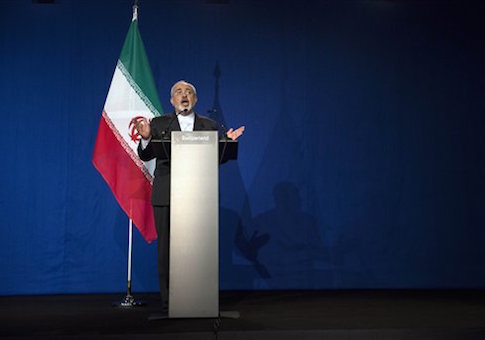
Switzerland Iran Nuclear TalksJavad Zarif / AP

LAUSANNE, Switzerland — Just hours after the announcement of what the United States characterized as a historic agreement with Iran over its nuclear program, the country’s leading negotiator lashed out at the Obama administration for lying about the details of a tentative framework.

Iranian Foreign Minister Javad Zarif accused the Obama administration of misleading the American people and Congress in a fact sheet it released following the culmination of negotiations with the Islamic Republic.

Zarif bragged in an earlier press conference with reporters that the United States had tentatively agreed to let it continue the enrichment of uranium, the key component in a nuclear bomb, as well as key nuclear research.

Zarif additionally said Iran would have all sanctions lifted once a final deal is signed and that the country would not be forced to shut down any of its currently operating nuclear installations.

Following a subsequent press conference by Secretary of State John Kerry—and release of a administration fact sheet on Iranian concessions—Zarif lashed out on Twitter over what he dubbed lies.

“The solutions are good for all, as they stand,” he tweeted. “There is no need to spin using ‘fact sheets’ so early on.”

Zarif went on to push back against claims by Kerry that the sanctions relief would be implemented in a phased fashion—and only after Iran verifies that it is not conducting any work on the nuclear weapons front.

Zarif, echoing previous comments, said the United States has promised an immediate termination of sanctions.

“Iran/5+1 Statement: ‘US will cease the application of ALL nuclear-related secondary economic and financial sanctions.’ Is this gradual?” he wrote on Twitter.

He then suggested a correction: “Iran/P5+1 Statement: ‘The EU will TERMINATE the implementation of ALL nuclear-related economic and financial sanctions’. How about this?”

The pushback from Iran’s chief diplomat follows a pattern of similar accusations by senior Iranian political figures after the announcement of previous agreements.

Following the signing of an interim agreement with Iran aimed at scaling back its nuclear work, Iran accused the United States of lyingabout details of the agreement.

On Thursday evening, Zarif told reporters the latest agreement allows Iran to keep operating its nuclear program.

“None of those measures” that will move to scale back Iran’s program “include closing any of our facilities,” Zarif said. “We will continue enriching; we will continue research and development.”

“Our heavy water reactor will be modernized and we will continue the Fordow facility,” Zarif said. “We will have centrifuges installed in Fordow, but not enriching.”

The move to allow Iran to keep centrifuges at Fordow, a controversial onetime military site, has elicited concern that Tehran could ramp up its nuclear work with ease.

Zarif said that once a final agreement is made, “all U.S. nuclear related secondary sanctions will be terminated,” he said. “This, I think, would be a major step forward.”

Zarif also revealed that Iran will be allowed to sell “enriched uranium” in the international market place and will be “hopefully making some money” from it.

The Tricks Obama Is Trying to Play with the Iran Announcement

April 2, 2015

The Tricks Obama Is Trying to Play with the Iran Announcement, Commentary Magazine, April 2, 2015

(When will Iran say what and to whom about Obama’s new “framework?” Will Iran cloud the results of the negotiations as cleverly as did Obama? — DM)

If you look at what happened today between the U.S. and Iran through the lens of domestic American politics, Barack Obama has made a very clever play here—because what might be called “the agreement of the framework of the possibility of a potential deal” gives him new leverage in his ongoing battle with the Senate to limit its ability to play a role in the most critical foreign-policy matter of the decade.

The “framework” codifies the Obama administration’s cave-ins but casts them as thrilling reductions in Iran’s capacities rather than what they are—a pie-in-the-sky effort to use inspections as the means by which the West can “manage” the speed with which Iran becomes a nuclear power.

Obama’s tone of triumph this afternoon was mixed with sharp reminders that the deal is actually not yet done—and that is entirely the point of this exercise from a domestic standpoint. the triumph signals his troops and apologists that the time has come for them to stand with him, praise the deal sheet and pretend it’s a deal, declare it historic, and generally act as though the world has been delivered from a dreadful confrontation by Obama and Kerry.

But since the deal is not yet done, it could still be derailed. And that is where Obama’s truly Machiavellian play here comes in: He may have found a way to put the Senate in a box and keep Democrats from melting away from him on Iran and voting not only for legislation he doesn’t want but also to override the veto he has promised.

The Senate has two provisions at the ready with which it could go ahead any time. One, called Kirk-Menendez, imposes new sanctions on Iran. Obama promised a veto of this bill should it pass, and after today, one ought to presume that it’s dead.

The other, Corker-Menendez, requires the administration to submit any deal to the Senate within 60 days of its signing. This is a key provision because, of course, what the Iranians want—and what they said today they got—was the lifting of all sanctions. The president, in his statement, vowed to lift the “nuclear” sanctions (there are others involving human rights) if the Iranians comply by the terms of the deal.

Existing sanctions legislation features waivers the president can arguably use to do that. But those sanctions were put into place specifically to make it incredibly painful for Iran to retain any nuclear-weapons capability—not as a means of acceding to Iran’s retention of a nuclear capability.

For this reason, and for the reason that the president is essentially negotiating an arms-control treaty with Iran, the Senate should approve any final deal. Obama disagrees and claims this is merely a nuclear-agreement, not a treaty, and therefore Congress has no role.

That’s a very nervy argument. It is not only disrespectful of the Senate but it misrepresents the nature of what’s being negotiated. And that’s why it’s an argument it appeared the president would lose—that senators would not only vote for Corker-Menendez but would override his veto of it.

Which is why the deal-that’s-not-yet-a-deal works in his favor. Talks are now to continue until the end of June. Obama can and will argue to Democrats that they owe it to him, to their base, and to their governing ideology to give him all the room he needs to get to June 30.

Of course, if the legislation does not pass by June 30 and Obama signs a final deal, the game is up; the Senate can’t retroactively insist in July he bring it to them for a vote.

Will there be a deal by June 30? Maybe, maybe not; maybe they’ll finish, maybe they won’t; maybe the Iranians will say they didn’t agree to this or that and blow up the whole thing; who knows. Probably the total collapse, after all this, would bring the Kirk-Menendez sanctions back to life. Which is why there will never be a total collapse—because these talks can simply go on….

Khameni to Zarif: Don’t sign! Obama to Kerry: Make them sign! Gridlock

April 2, 2015

Khameni to Zarif: Don’t sign! Obama to Kerry: Make them sign! Gridlock, DEBKAfile, April 2, 2015

Kerry_hotel_nuclear_talks_C_1.4.15John Kerry takes a break from the Lausanne talks

Tehran is not averse to negotiating ad infinitum – so long as the talks go their way. 

So the real gridlock centered on finding a procedure that fitted the US delegation’s instructions to get some sort of a deal signed, and the Iranian group’s directive to sign nothing that could be seen as an accord. So who will give ground first?

***************

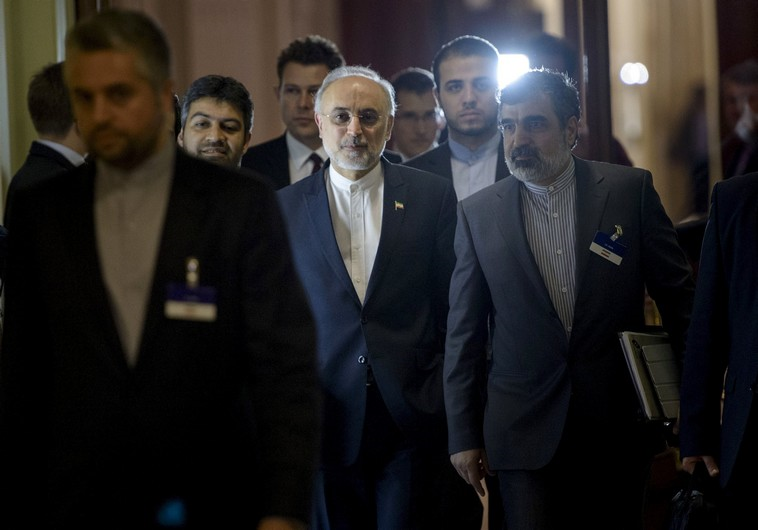
It is hard to make out exactly what the seven exhausted foreign ministers of the world powers and Iran were actually talking about in Lausanne this week – especially in the last two days, when the negotiations overran their March 31 deadline for a framework nuclear accord.

The highly-colored reports from the Swiss hotel up until Thursday, April 2, bespoke a mighty battle between the American negotiators led by Secretary of State John Kerry and Energy Secretary Ernest Moniz, and the Iranian group, headed by Foreign Minister Mohammed Javad Zarif, over four key points still at issue between them: the pace of sanctions relief, research and development projects, international inspections – including snap visits to any nuclear facilities they demanded, and, finally, the quantity of low-enriched uranium Iran may retain after the bulk of its stockpile is shipped overseas.

The drama was heightened by the sight of the American delegation marching into a tent set up in the hotel yard “to defeat eavesdropping” for a video conference with President Barack Obama in the White House. Kerry wanted to know whether to carry on the never-ending negotiations, which were looking more and more farcical as the hours ticked by without closure, or quit. This would be tantamount to the failure of the entire structure of nuclear diplomacy.

Obama directed the delegation to carry on talking with the Iranians and disregard the missed deadline as though nothing had changed.

The Secretary of State earlier appeared in an upper hotel window gazing out in the distance. Was he seeing a solution of the impasse visible to no one else?

The French Foreign Minister, Lauren Fabius, fed up with the game playing out between the Americans and the Iranians, left more than once for home. He returned Thursday saying: “We are a few meters from the finishing line, but it’s always the last meters that are the most difficult. We will try and cross them. It’s not done yet.”

Zarif told reporters: “Our friends need to decide whether they want to be with Iran based on respect or whether they want to continue based on pressure. They have tested the other one; it is high time to test this one.”

Those words carried two messages: One that the Iranians were serious when they reiterated in the past weeks that a framework accord for ending the current phase of negotiations was unacceptable, and insisted on the talks carrying straight through to a comprehensive deal by June 30.

The Iranian foreign minister’s second message was a negation of “pressure” – i.e., sanctions, in obedience to supreme leader Ayatollah Ali Khamenei’s directive to the delegation to reject the incremental easing of international sanctions and press Tehran’s demand for immediate relief.

That directive was laid down by the ayatollah on February 18, when he determined that “an agreement would be arrived at not in two stages but in one stage to be completed by the end of June 2015 and the agreement would include the removal of all sanctions on Iran.”

The writing was on the wall for all the parties to see. The current deadline crisis could have been avoided by understanding that there was no way the Iranian delegation would ever disobey the supreme leader’s dictates.

Tehran is not averse to negotiating ad infinitum – so long as the talks go their way.

So the real gridlock centered on finding a procedure that fitted the US delegation’s instructions to get some sort of a deal signed, and the Iranian group’s directive to sign nothing that could be seen as an accord. So who will give ground first?