Archive for the ‘Mad Mullahs’ category

Obama Assures Iran It Has Nothing to Fear

June 2, 2015

Obama Assures Iran It Has Nothing to Fear, Commentary Magazine, June 1, 2015

(Obama seems to have been talking about Iranian efforts to militarize nukes, not peaceful uses such as medical or generation of electricity. If, as claimed, Iran has no intention of getting, keeping or using nukes why try to halt it? Why bother even to negotiate?– DM)

“A military solution will not fix it. Even if the United States participates, it would temporarily slow down an Iranian nuclear program but it will not eliminate it.”

****************

At this point, there is virtually no one in Israel or the United States who thinks it is remotely possible that the Obama administration would ever, under virtually any circumstances, use force against Iran. Though President Obama and his foreign policy team have always claimed that “all options,” including force, are always on the table in the event that Iran refuses to back down and seeks to produce a nuclear weapon, that is a threat that few took seriously. But President Obama has never been quite as explicit about this before as he was in an interview with Israel’s Channel 2 in which he reportedly said there is no military option to stop Iran. If Obama wanted to telegraph Iran that it could be as tough as it likes in the talks over the final text of the nuclear deal being negotiated this month this statement certainly did the job. Though they had little worry about Obama’s toughness or resolve, the ayatollahs will be pleased to note that the president no longer even bothers to pretend he is prepared to do whatever is necessary to stop Iran’s nuclear ambition.

According to the Times of Israel, Obama said:

“A military solution will not fix it. Even if the United States participates, it would temporarily slow down an Iranian nuclear program but it will not eliminate it.”

Though he continued to use rhetoric that left force as an option, the implicit threat of American action if a nuclear weapon were a possibility has lacked credibility since the president began his second term. Once he embarked upon secret back-channel talks in which, one by one, he abandoned his previous pledges about forcing Iran to shut down its program in concessions and virtually every other U.S. position on the issue, force was never a real possibility. The signing of a weak interim deal in November, 2013, and then the framework agreed upon this spring signaled the end of any idea that the U.S. was prepared to act. That is especially so because the current deal leaves Tehran in possession of its nuclear infrastructure and with no guarantees about inspections or the re-imposition of sanctions in the event the agreement collapsed. The current deal, even with so many crucial details left unspecified makes Iran a U.S. partner and, in effect, the centerpiece of a new U.S. Middle East policy that essentially sidelines traditional allies like Saudi Arabia and Israel that are directly threatened by Iran.

Moreover, it must be conceded that the use of force against Iran would be problematic even for the United States and its vast military resources. As for Israel, despite a lot of bold talk by some in the Jewish state, there has always been skepticism that its outstanding air force had the ability to sustain an air campaign for the length of time that would be required to make a difference. Nevertheless, the notion that force would not be effective in forestalling an Iranian bomb is mistaken. Serious damage could put off the threat for a long time and, if sanctions were kept in place or made stricter as they should have been to strengthen the West’s bargaining position, the possibility of an Iranian nuke could have been put off for the foreseeable future.

Yet, while talk about using force has been largely obsolete once the interim deal was signed in 2013, for the president to send such a clear signal that he will not under any circumstances walk away from the current talks, no matter what Iran does, is significant.

After all, some of the most important elements of the deal have yet to be nailed down. Iran’s Supreme Leader, Grand Ayatollah Ali Khamenei has publicly stated that he will never allow the sort of inspections that would make a deal verifiable. He has also demanded that sanctions be lifted permanently on the day the agreement is signed, and that there should be no provision for them to be snapped back. Nor are the Iranians conceding that their stockpile of nuclear fuel be taken out of their hands.

So if Obama is to get the “verifiable tough agreement” he told Channel 2 he seeks, the U.S. must somehow convince the Iranians to back down on all these points. That’s going to be difficult since the past two years of negotiations with Obama have taught them to wait for him to give up since he always does so sooner or later. The president’s statement makes it clear that, no matter how obdurate the Iranians remain, he will never walk away from the talks. And since this deal is the lynchpin of his foreign policy legacy, they know very well that all they have to do is to be patient.

Iran already knows that the deal in its current form allows them two clear paths to a bomb. One is by cheating on its easily evaded terms. The other is by waiting patiently for it to expire, the sunset provision being another astonishing concession by Obama.

If a tough deal were even a possibility, this would have been the moment for the president to sound tough. But throughout this process, the only toughness the president has shown has been toward Israel as he sought to disparage and dismiss its justifiable worries about his course of action. Merely saying now, as he does in the Channel 2 interview, that he understands Israel’s fears is mere lip service, especially since it comes along with a virtual guarantee to Iran that it needn’t worry about a U.S. strike under any circumstance.

With only weeks to go until the June 30 deadline for an Iran deal, there is no question that Obama’s statement makes an unsatisfactory final text even more certain than it was before. That’s good news for Tehran and very bad news for an Israeli people who have no reason to trust the president’s promises or believe in his good intentions.

The Check’s in the Mail

May 21, 2015

Israel Ordered to Pay Iran Over $1 Billion for Oil
By: Lauren Calin, World Israel News May 21, 2015, 7:43


(To think Israel and Iran once had a partnership in the past is amazing. My, how times have changed since the mad-dog mullahs took over. – LS)

In 1979, Iran declared Israel an enemy and severed all business ties. Now, a Swiss court has ruled that Israel must compensate Iran for its half of a joint oil production program that existed before the Islamic revolution.

A Swiss court has ordered an Israeli company to pay Iran $1.1 billion in compensation for taking over the Iranian share of a business partnership that was cancelled by Iran following the Islamic Revolution.

Israel rejected the court’s ruling. Israel’s Finance Ministry indicated that the money would not be paid as it is a violation of Israeli law to transfer funds to an enemy state. The ministry issued a statement, saying: “Without relating to the heart of the matter, we point out that according to the Law for Trading with the Enemy it is prohibited to transfer money to an enemy country including the Iranian National Oil Company.”

The Eilat Ashkelon Pipeline Company (EAPC) was established in 1968 as a joint partnership between Israeli fuel companies and the Israeli and Iranian governments. Iran cancelled its contract in 1979 following the Islamic Revolution. In response, Israel expropriated Iran’s share.

Iran launched three lawsuits in Swiss and French courts in order to claim a share of the profits to which it would have been entitled, compensation for expropriated property and payment for crude oil that was delivered to Israel, but not paid for at the time of the Revolution. According to IRNA, the official Iranian news agency, this specific judgment deals with the matter of the crude oil.

Israel argues that Iran is not entitled to compensation due to having been the party to violate the partnership agreement. Israel and Iran maintained close business ties under the Shah, but the Islamic Republic rescinded Iran’s recognition of Israel and ended all diplomatic relations. Ayatollah Khomeini declared Israel an “enemy of Islam” and the “little Satan.” Since the revolution, it has been Iranian government policy to call for the destruction of Israel and to fund its enemies, especially the Hezbollah and Hamas terror organizations.

The legal intricacies of the case are complicated by the fact that the lawsuits were launched in 2004, whereas Israel only officially declared Iran an enemy state in 2011. Furthermore, Iran did not sue EAPC directly, but rather Trans-Asiatic Oil (TAO), which is owned by EAPC but registered in Panama.

Iran and suspension of disbelief

May 8, 2015

Iran and suspension of disbelief, Israel Hayom, Yoram Ettinger, May 8, 2015

The term “suspension of disbelief” — coined in 1817 by the philosopher Samuel Taylor Coleridge — refers to a willingness to suspend one’s critical faculties and believe the unbelievable; sacrificing reality, common sense, doubt and complexity on the altar of a pretend reality, convenience and oversimplification; infusing a semblance of truth into an untrue narrative.

U.S. President Jimmy Carter’s policy toward Iran in 1977-1979 was characterized by suspension of disbelief: energizing the Ayatollah Ruhollah Khomeini while ignoring or underestimating his track record and his radical, supremacist and violent worldview. The betrayal of the Shah transformed Tehran from “the U.S. policeman in the Gulf” to the worst enemy of the U.S.

Currently, the suspension of disbelief undermines the U.S. posture of deterrence and vital U.S. national security and commercial interests. It was demonstrated by U.S. President Barack Obama, who — irrespective of Middle East reality — referred to the brutally intolerant, terror-driven, anti-U.S., anti-infidel, repressive, tumultuous Arab tsunami as the “Arab Spring.” He said it was “casting off the burdens of the past,” “a story of self-determination,” “a democratic upheaval,” “a peaceful opposition,” “rejection of political violence” and “a transition toward [multi-sectarian, multi-ethnic] democracy.”

Suspension of disbelief, coupled with the ayatollahs’ mastery of ‘taqiyya’ (Islam-sanctioned double-talk and deception), is what led U.S. Secretary of State John Kerry to assert on November 24, 2013 that “Iran’s Foreign Minister [Mohammad Javad] Zarif emphasized that they don’t intend to acquire nuclear weapons, and Iran’s supreme leader has indicated that there is a ‘fatwa’ [an authoritative religious ruling] which forbids them to do this.”

In an April 7, 2015 NPR interview, Obama made a reality-stretching assumption which underlines the Iran policy: “If in fact Iran is engaged in international business … then in many ways it makes it even harder for them to engage in behaviors that are contrary to international norms. … It is possible that if we sign this nuclear deal, we strengthen the hand of the more moderate forces in Iran.”

Rebutting Obama’s remarks, Amir Taheri, a leading authority on Iran, wrote: “Hope is not a sufficient basis for a strategy. … [The relatively moderate former President Akbar Hashemi] Rafsanjani has little chance of surviving a direct clash with [Supreme Leader Ayatollah Ali] Khamenei.

The Saudi frustration with U.S. policy on Iran — shared by all pro-U.S. Arab regimes — was expressed on April 25, 2015 by the opinion editor of the prestigious Saudi daily Asharq Al-Awsat, which echoes the position of the House of Saud: “While the U.S. considers the ayatollahs a legitimate partner to negotiation, Saudi Arabia and other Persian Gulf states are in a state of war with Iran, which is the main source of chaos in the region.” The editor-in-chief of the Saudi daily added: “Has the axis of evil collapsed to the extent that President Obama is courting one of its key members?! Isn’t this the same Tehran that has posed a clear and present danger to the Gulf states for the past 36 years?!”

• An agreement is not the goal, but a tool to achieve the real goal.

• Transforming an agreement to a goal undermines the real goal.

• Details of an agreement are less critical than the details of the ayatollahs’ 36-year track record of supremacist, apocalyptic and megalomaniacal violence, martyrdom, sponsorship of global Islamic terrorism, subversion of pro-U.S. Arab regimes, repression, anti-U.S. hate education- and policies, a systematic noncompliance with agreements and mastery of concealment.

• Such a track record warrants a “guilty until proven innocent” approach.

• Preconditioning an agreement upon a dramatic change in the conduct of the rogue, anti-U.S. ayatollahs would be “a poison pill” to a bad deal, but a vitamin to a good deal.

• A “bad deal” would nuclearize Iran; “no deal” would allow the U.S. to choose the ways and means to prevent Iran’s nuclearization.

• Nuclear capabilities would extend the life of the repressive, rogue ayatollah regime, precluding any hope for civil liberties or home-induced regime change.

• An agreement — not preconditioned upon the transformation of the ayatollahs — would compound their clear and present threat to vital U.S. interests.

• The transformation of the nature of the ayatollahs — as a precondition to an agreement — would prevent the nuclearization of the ayatollahs.

• Precluding the option of military pre-emption has strengthened and radicalized the rogue ayatollahs, and could lead to a nuclear war.

• Misrepresenting the option of military pre-emption as war defies reality, since it should be limited to surgical — no troops on the ground — air and naval bombings of critical parts of Iran’s nuclear infrastructure from U.S. bases in Bahrain, Qatar, Saudi Arabia, Oman and the Indian Ocean, or aircraft carriers.

• A U.S. military option forced Iran to end the 1980-1988 war against Iraq, convinced Libya to give away its nuclear infrastructure in 2003, and led Iran to suspend its nuclear development in 2003.

• “Ironclad” supervision and intelligence failed to detect the nuclearization of the USSR, China, Pakistan, India and North Korea.

• Unlike the USSR, which was deterred by Mutual Assured Destruction, the apocalyptic ayatollahs would be energized by MAD-driven martyrdom.

• The zeal to strike a deal has led to a U.S. retreat from six U.N. Security Council Resolutions, which aimed to prevent Iran’s nuclearization.

• A nuclear Iran, which celebrates “Death to America Day,” would devastate cardinal U.S. interests: toppling the oil-producing Arab regimes (impacting supply and price of oil) and other pro-U.S. Arab regimes; intensifying Islamic terrorism, globally and on the U.S. mainland; agitating Latin America; collaborating with North Korea; cooperating with Russia and destabilizing Africa and Asia.

• The track record of the ayatollahs on the one hand, and compliance with agreements on the other hand, constitute an oxymoron.

• Suspension of disbelief, in the case of Iran’s nuclearization, entails overlooking facts that highlight the implausibility of a viable agreement with the ayatollahs, thus damaging crucial U.S. interests and fueling a nuclear war.

Report: Kerry Told Iran He Wishes ‘U.S. Had a Leader like Iran’s Supreme Leader’

April 29, 2015

Report: Kerry Told Iran He Wishes ‘U.S. Had a Leader like Iran’s Supreme Leader’ Washington Free Beacon, April 29, 2015

(Who is fibbing?– DM)

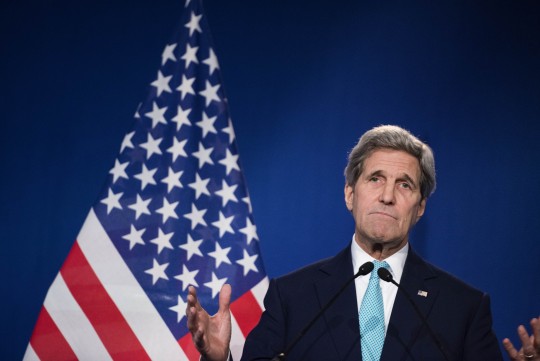
Kerry againAP

Secretary of State John Kerry told his Iranian counterpart that he wished the United States had a leader more like Supreme Leader Ayatollah Khamenei, according to comments made by a senior Iranian cleric and repeated in the country’s state-run media.

Ayatollah Alam al-Hoda claimed during Friday prayer services in Iran that in negotiations over Tehran’s contested nuclear program, Kerry told the country’s foreign minister that he “wished the U.S. had a leader like Iran’s supreme leader,” according to a Persian-language report on the remarkspublished by the Asriran news site.

“In the negotiations Kerry told [Iranian Foreign Minister Javad] Zarif that he [Kerry] wished U.S. had a leader like Iran’s supreme leader,” according to Alam al-Hoda, who is a senior member of the Iran’s powerful Assembly of Experts.

A senior administration official told the Washington Free Beacon that such a contention is patently absurd.

The remarks are the latest in a string of comments made by Iranian leaders purporting to reveal private details of the talks.

Iranian newspapers have carried multiple reports in recent months suggesting that Iranian Foreign Minister and chief negotiator Javad Zarif was ordered to stop screaming at Kerry behind closed doors.

In his Friday remarks, al-Hoda went on to say that Obama is set on striking a deal with Iran by June.

“Both Republicans and Democrats want these negotiations with Iran, but they fight each other for partisan interests,” he was quoted as saying. “Obama wants the negotiation to succeed so his party can win the next election and Republicans want to stop him.”

Alam al-Hoda also celebrated Iran’s expansion in the region and controversial activities in war-torn countries such as Syria and Yemen.

“Today, the resistance crescent has gone beyond Syria and Lebanon and reached to Yemen,” he said. “Today the resistance front is in control of Strait of Hormuz and Bab-el-Mandeb.”

The “U.S. and Israel have not been so weak anytime before,” he continues. “All these events are being managed by the hidden Imam,” a revered religious figure in Shia Islam.

Saeed Ghasseminejad, an Iranian dissident and fellow at the Foundation for Defense of Democracies (FDD), said U.S. overtures to Iran at the negotiating table have failed to win it any respect from the Islamic Republic’s leaders.

“President Obama thinks that by making more concessions he can gain the trust and respect of Iranian leaders,” Ghasseminejad said. “However, Iranian leaders neither trust him nor respect him.

“Seeing unprecedented weakness in the U.S. president, Iranian leaders do not fear the United States anymore. Partnership, trust, and alliance between the radical Islamist regime of Tehran and United States cannot and should not exist.”

Meanwhile, Zarif said over the weekend that fighting between the Obama administration and Congress over a potential final deal could not stop America from implementing any agreement the White House signs.

“As we have stated since the beginning, we consider the U.S. administration responsible for implementing the agreement and internal problems and conflicts in the U.S. are not related to us and to the implementation of the agreement, and based on the international laws, the countries’ internal problems don’t exempt them from implementing their undertakings and this is the main framework that we attach importance to,” Zarif said, according to the Fars News Agency.

On Monday, Zarif urged the United States to woo Iran.

“Maintaining an uncertain and unstable situation is not acceptable to Iran and the Americans should take practical and confidence-building measures to reach a comprehensive nuclear agreement,” Zarif was quoted as telling reporters.

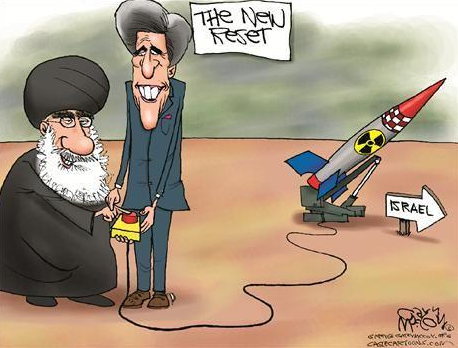
Cartoon of the day

April 26, 2015

(Tip of the hat to Joopkiepzeiker — DM)

Kerry reset with Iran

Empowering Iran

April 24, 2015

Empowering Iran, Weekly Standard, Lee Smith, May 4, 2015 (print date)

Obama’s foreign policy legacy will be to have tied America’s fortunes to an imperial and nuclear Iran governed by an ambitious and ruthless anti-American regime.

*****************

Last week, the Obama administration urged Saudi Arabia to halt its air campaign against the Iranian-backed Houthi rebels who have wrested control of the Yemeni capital Sanaa. The White House’s professed concern was that Riyadh’s Operation Decisive Storm was killing too many civilians. Unfortunately, that’s hardly surprising since Iranian proxies, like Hezbollah and Hamas, typically stash their missiles and rockets in civilian areas. Presumably, the Houthis have read from the same playbook. The effect of the administration’s diplomatic efforts, then, was to protect Iranian arms in Yemen. And this, in turn, the administration no doubt believes, protects Obama’s nuclear agreement with Iran.

Houthi rallyHouthis rally against Saudi Arabia, April 1. Newscom

In public, Obama is eager to show that the United States still stands by its traditional allies, like Riyadh. But behind the scenes, it’s clear that the White House’s real priority is partnering with Iran. Sure, the White House dispatched an aircraft carrier to the Arabian Sea, but this was not to stop Iran from shipping arms to the Houthis. As Obama himself explained, America’s blue-water Navy was present to ensure freedom of navigation in the Persian Gulf. The notion that the White House really intended to interdict Iranian arms shipments beggars belief. For more than four years Obama has done nothing to stop Bashar al-Assad from killing nearly a quarter of a million people in Syria, lest he endanger his nuclear agreement with Iran. With a deal so close, Obama is certainly not going to risk what he sees as the capstone of his foreign policy legacy by disarming Iranian allies in Yemen.

The problem is that by protecting his nuclear agreement with Iran, the president has protected and empowered the Islamic Republic. Tehran may boast of controlling four Arab capitals, but the reality is that its regional position is a house of cards. Pull out one of those Arab capitals, or the nuclear program, and Iran’s burgeoning empire quickly collapses. It’s Obama who is propping it up.

It’s interesting to imagine how these last six years might have gone for the Islamic Republic had the White House not been so determined to have a nuclear deal. Perhaps the Tehran regime would have been toppled when the Green Movement took to the streets in June 2009 to protest a fraudulent election if the American government had decided to back the opposition early, openly, and resourcefully. Perhaps another administration would at least have seen that uprising as an opportunity to gain leverage over the Iranian regime. Not Obama. He wanted a nuclear deal with the existing regime.

Another White House might have backed the Syrian rebels in order to bring down Assad. Indeed, a good portion of Obama’s cabinet counseled as much. To topple Tehran’s key Arab ally would have been the biggest strategic setback to Iran in 20 years, said Gen. James Mattis. Obama chose to leave Assad alone, and even ignored his own red line against the use of chemical weapons. Instead of the airstrikes he threatened on Syrian regime targets, Obama made a deal to ostensibly remove the chemical weapons that Assad is still employing.

As Assad’s position became weaker, Hezbollah entered the Syrian war to prop him up. The Iranian-backed militia was stretched thin between Syria and Lebanon, but the Obama administration helped the terrorist organization cover its flank by sharing intelligence to keep Sunni car bombs out of Hezbollah strongholds in Beirut. Another administration might have understood this as an opportunity to weaken Iran’s position in Damascus and Beirut, but not Obama. He had his eyes on the prize.

In sum, over the last six years, almost all of Iran’s advances in the region, including its move into Iraq to fill the vacuum in Baghdad after the American withdrawal from that country, has taken place with either the overt or tacit assistance of Obama. The White House brags about it. Israel might have attacked Iranian nuclear facilities, as one administration official told the press, but we deterred Prime Minister Benjamin Netanyahu from striking. If the Iranians strut with confidence these days, that’s because they understand who has their back.

The nuclear deal, as the president has explained, means that within a little more than a decade, Iran’s breakout time will be down to zero—which is a nice way of saying the clerical regime will have the bomb. The likely result is that the agreement will ensure Iran’s regional position long after Obama’s presidency is around to safeguard it. It will strengthen the hand of the hardliners. It is not Rouhani or Zarif or other so-called moderates who hold the nuclear file, but Khamenei and the Revolutionary Guard Corps. And in the future, American policymakers will have a vital interest in ensuring there are no internal regime fights over who controls the bomb.

In other words, Obama’s foreign policy legacy will be to have tied America’s fortunes to an imperial and nuclear Iran governed by an ambitious and ruthless anti-American regime.

Progressives at the Poker Table

April 24, 2015

Progressives at the Poker Table, Mishpacha Magazine, Jonathan Rosenblum, via Jewish Media Resources, April 24, 2015

A comparison of the progressive approach to the threat of climate warming and that of a nuclear-armed Iran offers interesting insights into the progressive mind.

Let’s start with climate warming, which according to the best measures, inconveniently stopped about 18 years ago. First, what is the magnitude of the threat? The most alarmist predictions of future catastrophe are based on computer-generated climate models that have been consistently refuted by events of the real world. According to the alarmists, there would be fifty million refugees from global warming by 2010. Never happened.

Those models are based on a variety of assumptions about “feedback mechanisms” generated by increased CO2 in the atmosphere trapping more heat. NASA satellite date from 2000-2011 showed far more heat escaping the earth’s atmosphere than predicted by the computer models, according to study in the peer-reviewed journal Remote Sensing.

Nor is clear to what extent the global warming of the 20th century was generated by anthropogenic forces – i.e., increased CO2 emissions. Many leading climate scientists now think that solar activity — about which we can do nothing — may be a larger contributor to temperature variation than carbon emissions. That would be consistent with the wide fluctuations between warm and cold periods over the last millennium, even prior to the onset of the Industrial Resolution.

Scientists at CERN, the European Organization of Nuclear Research, which involves 600 universities and national labs and 8,000 scientists, have shown that cosmic rays promote the formation of molecules that grow and seed clouds. And clouds trap heat in the atmosphere. The magnitude of cosmic rays emitted by the sun depends on variations in the sun’s magnetic field.

Finally, that which the alarmists consider an unmitigated disaster — higher levels of CO2in the atmosphere may have many beneficial effects. A 2012 statement signed by 16 distinguished scientists from universities like Harvard, Princeton, MIT, and the Hebrew University, pointed out that CO2 is “not a pollutant,” but rather a “key component of the biosphere’s life cycle.” Higher concentrations of CO2 spur plant growth.

In sum, the threat, if any, is one for the indeterminate future, of unknown magnitude and causation, and may not even be subject to ameliorative action. Yet climate alarmists propose a Global Green Carbon Treaty of such cost and intrusiveness that Yale’s Walter Russell Mead compares it to the 1928 Kellogg-Brand Pact outlawing war for sheer folly. He describes GGCT as less a treaty and more a constitution for world government regulating all economic production in every country on earth. That constitution would be for a “global welfare state with trillions of dollars ultimately sent by the taxpayers of rich countries to governments (however feckless, inept, corrupt or tyrannical) to poor ones.”

These proposals are put forward seemingly oblivious to the economic cost or loss of liberty involved. In his 2001 book The Skeptical Environmentalist, Danish statistician Bjorn Lonborg calculated that enforcement alone of the Kyoto Treaty would cost $150,000 billion a year, money which could save tens of thousands of lives annually.

The above-mentioned statement of the 16 scientists cited the work of Yale economist William Nordhaus, whos showed that the highest benefit-to-cost ratio would be achieved via a policy of fifty years of economic growth unimpeded by greenhouse gas controls. The least developed countries would benefit most by being able to share some of the advantages of material well-being — i.e., health and life expectancy — with the more developed world.

NOW TO THE OTHER SIDE of the comparison. Even President Obama admits that under the unsigned understanding reached at Lausanne, Iran will have zero breakout time to a nuclear weapon thirteen years from now. (Today, he puts the breakout time at three months.)

That fact alone creates a world with as many tripwires leading to war as Europe on the eve of the assassination of Archduke Ferdinand in August 1914. Only this time the weapons of choice will be nuclear.

The proposed agreement with Iran means the end of nuclear non-proliferation. If the world’s leading rogue state and sponsor of terrorism can have its nuclear weapons program effectively endorsed by the members of the U.N. Security Council, every other nation that was dissuaded in the past by international pressure from expanding its civilian nuclear program to include enrichment to weapons level – e.g., South Korea, Brazil – will reconsider.

The most rapid nuclear proliferation will take place in the world’s most volatile region, the Middle East, in which the millennial hatred of Sunnis and Shiites still burns hot. Saudis have made it clear that they will purchase nuclear weapons off-the-shelf from Pakistan, as per a prior agreement, to counter Iran’s ability to obtain nuclear weapons. Egypt and Turkey will almost certainly follow suit.

An already aggressive Iran would become vastly more so with the hundreds of billions of dollars in revenues from the lifting of sanctions and the ability to provide a nuclear umbrella for its regional proxies. As a consequence, the Middle East would become all the more volatile.

The nations most likely to acquire nuclear arms and unstable, which increases the possibility of terrorist groups acquiring nuclear weapons. Iran has long eyed the “holy cities” of Mecca and Medina, and is already stirring up the Shiite population in Saudi Arabia’s eastern, oil-producing provinces and in Yemen on its southern border. Egypt cannot feed its population.

And Iran might find it useful to supply some of its non-state allies, like Hezbollah or Hamas, with dirty nuclear weapons that do not require missiles to deliver. Non-state actors are far harder to deter or hold accountable.

A nuclear Iran should terrify not only Israel, which it has repeatedly threatened to obliterate. Iranian leaders have publicly speculated for years about the grim calculus of a nuclear exchange with Israel: one bomb wipes out Israel; Israeli retaliation still leaves us with tens of millions survivors. Former CIA Director James Woolsey and Peter Fry, a member of the congressional EMP (electro-magnetic pulse) Commission, stress the vulnerability of the United States. The recent “understanding” (the terms of which are unknown and perhaps unknowable given the wide divergence between American and Iranian descriptions of what has been concluded) makes no reference to any limitations on Iran’s ballistic missile program, on which it works closely with North Korea.

Iran may soon possess long-range missiles capable of reaching the United States or the capacity to launch a nuclear-armed satellite above the United States. Even one nuclear weapon detonated above the United States could potentially knock out much of the national power grid. The congressional EMP Commission estimated that a nationwide blackout lasting one year from such an EMP attack could result in the deaths of nine out of ten Americans, with ISIS-like gangs ruling the streets.

Nor are traditional doctrines of nuclear deterrence relevant to the Middle East, in general, and Shiite Iran, in particular. Former secretaries of state Henry Kissinger and George Schultz ask in their devastating critique of the recent agreement how will traditional doctrines of deterrence based on stable state actors “translate into a region where sponsorship of non-state proxies is common, the state structure is under assault, and death on behalf of jihad is a kind of fulfillment?”

As the dean of Middle East scholars Bernard Lewis has pointed out, for Shiite fanatics awaiting the return of the “hidden Imam,” after a cataclysmic event, the destruction of nuclear war might be an inducement rather than a deterrent.

WHAT DOES PRESIDENT OBAMA offer as the response to this description of a nuclear tinderbox waiting to be lit? Pure fantasy.

He and Secretary of State Kerry have made repeated references to a fatwa of the Supreme Leader Ayatollah Khameini against the use of nuclear weapons, which does not exist and certainly is credited by none of Iran’s enemies.

And he speaks hopefully of a newly mellowed Iran after the conclusion of an agreement. What is it about the Supreme Leader’s repeated chants of “Death to America” and insistence that current negotiations have nothing to do with reconciliation that the President can’t hear?

One option that the President has completely excluded is an air campaign to destroy Iran’s nuclear infrastructure and cut of the “head of snake,” as Woolsey once described the Revolutionary Guard to me. Obama has repeatedly accused the opponents of the Lausanne understanding as being advocates of war.

Clearly, then, all the tough talk about “all options are on the table,” “a bad deal is worse than no deal [followed by military attack],” “I will never allow Iran to acquire nuclear weapons,” had the same truth content as “If you like your plan, you can keep your plan.”

Yet no one doubts that the United States has the capability to destroy Iran’s enrichment infrastructure. (If Russia goes through with the delivery of advanced anti-aircraft batteries, as a consequence of the Lausanne understanding, the task will be complicated.) And there will be consequences that cannot be fully known in advance. Iran has terrorist sleeper cells around the world. But it also has lots of assets, besides its nuclear infrastructure, which would be subject to further attacks if it unleashes those cells.

Whatever the Iranian response, the price to be paid will certainly be less than consigning all humanity to live in a world perpetually poised on the cusp of nuclear war.

SO WHY in the case of global warming are progressives willing to incur unbearable costs to combat a future threat of unknown magnitude and immediacy, and against which their solutions may well prove futile, while with respect to the easily identified and imminent danger of a nuclear-armed Iran, they write off from the start a clear and known remedy?

For progressives the solution of worldwide government, run by the executive decree of “the best and the brightest,” is not a cost too great to be contemplated, but rather the fulfillment of the progressive dream. But they will never countenance military action, even to save millions of lives down the road. Churchill’s dictum, “If you want peace, prepare for war,” remains foreign to them.

US warship en route to block Iranian ships carrying weapons

April 20, 2015

US warship en route to block Iranian ships carrying weapons
By MARK MAZZETTI and HELENE COOPER APRIL 18, 2015 Via The NYT


(US Navy to Iran….’Be boarded or be sunk’. What’s that? Death to America you say?? – LS)

WASHINGTON — The U.S. Navy aircraft carrier USS Theodore Roosevelt is steaming toward the waters off Yemen to beef up security and join other American ships that are prepared to intercept any Iranian vessels carrying weapons to the Houthi rebels fighting in Yemen.

Navy officials said Monday that the Roosevelt was moving through the Arabian Sea. The U.S. Navy has been beefing up its presence in the Gulf of Aden and the southern Arabian Sea amid reports that a convoy of about eight Iranian ships is heading toward Yemen and possibly carrying arms for the Houthis. Navy officials said there are about nine U.S. warships in the region, including cruisers and destroyers carrying teams that can board and search other vessels.

The officials spoke on condition of anonymity because they were not authorized to discuss the ship movement on the record.

The Houthis are battling government-backed fighters in an effort to take control of the country. The U.S. has been providing logistical and intelligence support to Saudi Arabia-led coalition launching airstrikes against the Houthis. That air campaign is now in its fourth week.

The U.S. Navy generally conducts consensual boardings of ships when needed, including to combat piracy around Africa and the region. So far, however, U.S. naval personnel have not boarded any Iranian vessels since the Yemen conflict began.

White House spokesman Josh Earnest would not comment specifically on any Navy movements in Yemeni waters, but said the U.S. has concerns about Iran’s “continued support for the Houthis.

“We have seen evidence that the Iranians are supplying weapons and other armed support to the Houthis in Yemen. That support will only contribute to greater violence in that country. These are exactly the kind of destabilizing activities that we have in mind when we raise concerns about Iran’s destabilizing activities in the Middle East.”

He said “the Iranians are acutely aware of our concerns for their continued support of the Houthis by sending them large shipments of weapons.”

Take Them At Their Word: Iran Might Destroy Us | Bill Whittle

April 9, 2015

Take Them At Their Word: Iran Might Destroy Us | Bill Whittle via You Tube, April 9, 2015


Humor?| Obama to Israel: I have your back

April 8, 2015

(The views expressed in this article are either mine or those of my guest author. They do not necessarily reflect those of Warsclerotic or its other editors. — DM)

The Most Revereddd Mohamed Allah-scimitar

The Most Revereddd Mohamed Allah-scimitar

This is a post by my (imaginary) guest author, the Most Reverend Mohamed Allah-scimitar, President Obama’s chief foreign policy adviser on Islamic relations with Christians and Jews. But first, some related observations:

Iran continues to reject as lies Obama’s statements about the April 2nd P5+1 nuke “deal,” and states that it “could build bomb today” but won’t because of Ayatollah Khamenei’s (non-existent) fatwa. Understandably, Israel is becoming increasingly concerned about her future existence. Obama’s claims that He has her back and that she therefore need not worry about anyone (else) who tries to “mess with Israel.” His assurances have provided scant comfort.

Cartoon_Israel_BB_KnifeInBack

Here’s are the comforting(?) words of the Most Reverend Mohamed Allah-scimitar.

***********************

Lord Obama has Israel’s back almost to the same extent that He has the Obama Nation’s back and will protect her if necessary. For Israel to maintain, and even improve, her weapons minimizing destruction (WMDs) is an unacceptable insult to Him and to all for which He stands.

ObamaWillStandWithMuslims (2)

Obama salute

During Israel’s “Protective Edge” war against peaceful Palestinians in Gaza, Israel shamelessly shifted the odds disproportionately in her own favor by using the Iron Dome to thwart efforts to destroy her major cities. She provided not even one Iron Dome to the Palestinians! Since that time, she has improved the Iron Dome and developed other WMDs less dependent upon lengthy trajectory tracking of missiles and perhaps even mortar rounds. Racist to the core, she has no regard for social justice, equality and the sad plight she has imposed on the Palestinians. Indeed, they are forced to rely on funds (“tens of millions of dollars”) from Iran to help rebuild Tunnels for Peace (TFP) and resupply their stocks of Missiles for Peace (MFP).

Now that Israel claims that peaceful Iranian nuclear weapons are an existential threat, she is doubtless looking for — and probably finding — ways to escape their consequences as well. Doing so is risible because Lord Obama has explained patiently — even as He would to a backward child — that it is unnecessary. He has her back, as He always had and always will.

Nobody except Obama had dare mess with Israel! Not even Netanyahu! Hence, there is no need for Iran to recognize Israel’s speciously claimed right to continue to exist, which would require fundamental changes in Iran. For Israel to insist on it is a fundamental misjudgment.

Lord Obama is able and willing to act, if necessary, to demonstrate the firmness of His resolve. Indeed, it has already been rumored that He may dispatch His own beloved mother in law from her happy home in the White House to live with Prime Minister Netanyahu in Occupied Palestine. If so, she will be accompanied by a suitable contingent of unarmed Organizing for Action volunteers. Recognizing, however, that more may be required, Lord Obama has been negotiating with Iran to provide the unjustly impoverished Palestinians not only free electrical power but also medically useful radioactive isotopes as well as others for other peaceful purposes. Despite the petty squabbles between the Palestinian Authority and Hamas, Iran will treat them equally.

Israel should and will cease to exist but, with Lord Obama in the picture, Iran should not be a concern.

**************************

There is no P5+1 “deal” and it seems unlikely that there ever will be, no matter how many contortions Obama and Kerry attempt. A deal like the one described in Obama’s talking points would be bad enough. However, Iran has rejected His talking points, has stated that it could build nukes now if it so desired and that the only impediment is a (non-existent) fatwa issued by the Supreme Leader. The Iranian foreign minister has been quoted as saying that

Iran will begin using its latest generation IR-8 centrifuges as soon as its nuclear deal with the world powers goes into effect, Iran’s foreign minister and nuclear chief told members of parliament on Tuesday, according to Iran’s semi-official FARS news agency. [Emphasis added.]

If accurate, the report makes a mockery of the world powers’ much-hailed framework agreement with Iran, since such a move clearly breaches the US-published terms of the deal, and would dramatically accelerate Iran’s potential progress to the bomb.

Iran’s military sites are, of course, off limits to inspections according to Iran’s Defense Minister. Meanwhile, the Supreme Leader continues to lead “death to America” chants and Iranian television continues to entertain its viewers with simulations of nuclear attacks on Israel.


More recently,

[T]he Islamic Republic has announced a new documentary film which will celebrate the life of Qods Force Commander Qassem Soleimani. It’s bad enough lionizing a master terrorist responsible for the deaths of hundreds of Americans in Iraq and Afghanistan. But the description of the film is even more telling: The film Commander will depict Iran’s and Soleimani’s strategic approach to destroy not only the Islamic State but also “the Zionist regime.” Importantly, the article describing the film was published after agreement on a nuclear framework between the P5+1 and Iran. [Emphasis added.]