Archive for the ‘Latin America’ category

State Dept.: Hezbollah, Islamic State Maintain Presence in Latin America

June 7, 2016

State Dept.: Hezbollah, Islamic State Maintain Presence in Latin America, BreitbartEdwin Mora, June 6, 2016

Hezbollah-Getty-640x480Getty Images

WASHINGTON, D.C. —The U.S. Department of State (DOS) has determined that Venezuela, which has refused to cooperate with the United States’ antiterrorism efforts in Latin America for nearly a decade, remains a “permissive environment” that promotes ideological and financial support for terrorist organizations, namely Iran’s Lebanese proxy Hezbollah.

Although the “primary threats” to the Western Hemisphere stem from left-wing guerrillas known as the Revolutionary Armed Forces of Colombia (FARC) and the National Liberation Army (ELN), the Islamic extremist groups Shiite Hezbollah, also spelled Hizballah, and Sunni Islamic State (ISIS/ISIL) also maintain a presence across the region, according to DOS’ Country Reports on Terrorism 2015, a congressionally mandated assessment of terrorism activities across the world authored by DOS.

The assessment declares:

South America and the Caribbean also served as areas of financial and ideological support for ISIL and other terrorist groups in the Middle East and South Asia. In addition, Hizballah continued to maintain a presence in the region, with members, facilitators, and supporters engaging in activity in support of the organization. This included efforts to build Hizballah’s infrastructure in South America and fundraising, both through licit and illicit means.

[…]

There were credible reports that Venezuela maintained a permissive environment that allowed for support of activities that benefited known terrorist groups… [including] Hizballah supporters and sympathizers.

Moreover, the DOS evaluation highlights the Tri-Border Area (TBA) between Paraguay, Brazil, and Argentina, in addition to Peru, as regions where Hezbollah was operating last year.

“Illicit activities within the TBA remained potential funding sources for terrorist organizations, most notably Hizballah,” it says, adding, “The Tri-Border Areas of Argentina, Brazil, and Paraguay remained an important regional nexus of arms, narcotics, pirated goods, human smuggling, counterfeiting, and money laundering — all potential funding sources for terrorist organizations.”

The TBA border region has long been a hotbed for Hezbollah members.

In its terrorism reports, the DOS also points out that Peruvian authorities in 2014 arrested a Lebanese national and his wife, a U.S-Peruvian citizen, for suspected links to Hezbollah, adding that “there were residue and traces of explosives” in their apartment.

Hezbollah, along with other terrorists and criminals in Latin America, are known to use networks that support illicit activities, such as trafficking drugs, wildlife, bulk cash, weapons, humans, in addition to illegal logging and mining.

The DOS released its assessment Thursday, a day after the U.S. military declared the region’s illicit trafficking networks as one of the greatest security threats facing the United States.

Gen. John Kelly – former commander of U.S. Southern Command (SOUTHCOM), which oversees military activities in Latin America and the Caribbean – warned last year that jihadist groups like ISIS could exploit the illicit networks in the region to infiltrate the United States, adding that Hezbollah is already using known routes to traffic drugs and other contraband.

Although Hezbollah is believed to be the most prominent jihadist group in Latin America and the Caribbean due to Iran’s enduring presence in the region, Gen. Kelly warned in March 2015 that a small number of Sunni extremists are actively “radicalizing  converts and other Muslims in the region and also provide financial and logistical support to designated terrorist organizations within and outside Latin America.”

Pentagon and DOS have recently revealed that between 100 and 150 people from Latin America and the Caribbean have traveled to the Middle East to engage in jihad on behalf of ISIS, without specifying the names of any of the countries in the region.

According to the Department of State, some people from Trinidad and Tobago, as well as Argentina, are believed to have joined ISIS in the Middle East.

“More than 70 nationals of Trinidad and Tobago are believed be fighting with ISIL in Syria,” reports DOS, adding, “It is possible small numbers of Argentine citizens may have sought to travel to Syria and Iraq to join ISIL,” without providing any specific figures.

DOS also mentioned an ISIS-related arrest in Brazil involving a money laundering group accused of moving $10 million-plus and having social media ties to the jihadist group.

Iran’s growing presence in Latin America is believed to be facilitated by Venezuela.

“The International Development Bank, a subsidiary of the Development and Export Bank of Iran, continued to operate in Venezuela [in 2015] despite its designation in 2008 by the U.S. Treasury Department under E.O. [Executive Order] 13382 (‘Blocking Property of Weapons of Mass Destruction Proliferators and their Supporters’),” mentions the DOS assessment.

Justin Siberell, acting coordinator for counterterrorism at the State Department, briefed reporters Thursday about the 2015 Country Reports on Terrorism, stressing that the enduring presence in the region of leading state sponsor of terror Iran continues to trouble the United States.

“I think Iran’s presence in the Western Hemisphere and its support for groups that might be engaged in facilitation or operational planning is a continued concern,” Siberell told reporters.

Nevertheless, he added, “I don’t think we’ve seen an increase in 2015 in Iran’s activity in the Western Hemisphere, but it remains a high priority for us.”

Federal Judge Orders ‘Deceptive’ DOJ Lawyers to Take Ethics Classes

May 20, 2016

Federal Judge Orders ‘Deceptive’ DOJ Lawyers to Take Ethics Classes, PJ Media, May 20, 2016

(Cf. John Kerry: Enthusiastic Proponent of a ‘Borderless World’. How about a lawless world too?– DM)

Judge-Hanen.sized-770x415xc

In a stunning rebuke to the Department of Justice Thursday, U.S. District Judge Andrew Hanen ordered annual ethics classes for the DOJ attorneys who were “intentionally deceptive” during the course of executive amnesty litigation. At issue was whether the DOJ intentionally misled the judge into believing that Obama’s DACA amnesty program would be halted until he made a ruling on a lawsuit brought by 26 states.

From November of 2014 until February of 2015, while the judge was still deciding the case, the Department of Homeland Security gave more than 108,000 illegal immigrants three-year reprieves. They did this after DOJ lawyers led him to believe that they would halt the program during that period. The 26 states who filed a lawsuit were thus misled into “foregoing a request for a temporary restraining order,” Hanen wrote in his blistering decision. “Such conduct is certainly not worthy of any department whose name includes the word ‘Justice.'”

Via the Washington Examiner:

The facts of the deception are not in doubt, Hanen emphasized. “[DOJ] has now admitted making statements that clearly did not match the facts,” he said in the May 19 opinion, first noted by the National Law Journal. “It has admitted that the lawyers who made these statements had knowledge of the truth when they made these misstatements … This court would be remiss if it left such unseemly and unprofessional conduct unaddressed.”

As punishment, Justice Department attorneys who wish to appear in any state or federal court within the 26 states that brought the lawsuit have to undergo annual ethics training. “At a minimum, this course (or courses) shall total at least three hours of ethics training per year,” he wrote.

In another case, such “egregious conduct” would lead him to strike the government’s pleadings, but Hanen decided not to take that step because the Supreme Court heard oral arguments in the case in April.

“The national importance of the outcome of this litigation outweighs the benefits to be gained by implementing the ultimate sanction,” Hanen wrote. “Striking the government’s pleadings would not only be unfair to the litigants, but also unfair, and perhaps even disrespectful, to the Supreme Court as it would deprive that Court of the ability to thrash out the legal issues in this case.”

Hanen cited multiple instances in which Justice Department attorneys claimed that Department of Homeland Security directive announced in November of 2014 would not be implemented until February 18, 2015, even though they knew that DHS had begun implementing a portion of the order that pertained to the original “deferred action for childhood arrivals” policy announced in 2012.

Justice Department attorney Kathleen Hartnett told Judge Hanen during a January 2015 hearing that nothing would be happening with regard to DACA until Feb. 18, 2015. On Feb. 16, 2015, Hanen sided with the states and issued a preliminary injunction blocking Obama’s actions. Then he found out that the reprieves and work permits had been continuing all along.

That March, the exasperated judge chastised Hartnett for lying to him in January. “Like the judge, the states thought nothing was happening,” Hanen said. “Like an idiot, I believed that”:

A flustered Hartnett repeatedly apologized to Hanen for any confusion related to how the reprieves and work permits were granted.”We strive to be as candid as possible. It truly became clear to us there was confusion on this point,” she said.

Hanen seemed genuinely disappointed that he could not disbar the DOJ attorneys who lied to him, but he did ban them from practicing law in Texas:

The court does not have the power to disbar the counsel in this case, but it does have the power to revoke the pro hac vice status of out-of-state lawyers who act unethically in court. By a separate sealed order that it is simultaneously issuing, that is being done.

In the meantime, perhaps the court-ordered ethics classes will help the “confused” lawyers understand the concept of “justice” a little better.

Full Measure Episode 32: May 08, 2016 (P1) – Child trafficking

May 9, 2016

Full Measure Episode 32: May 08, 2016 (P1) – Child trafficking via YouTube, May 9, 2016

(But it’s an “act of love.” For whom? The children or those who use and abuse them?– DM)


John Kerry’s New Terror Treason

March 30, 2016

John Kerry’s New Terror Treason, Front Page Magazine, Daniel Greenfield, March 30, 2016

ko

Stop by your local post office and you might just see a poster of Rodrigo “Timochenko” Londono hanging next to the Most Wanted posters of bank robbers and fugitives. The State Department is offering a $5 million reward for information about the Communist terrorist leader.

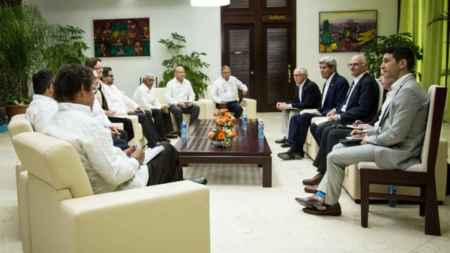
But all the State Department had to do was ask Secretary of State Kerry. Obama did the wave with the Cuban dictator and Kerry met with Timochenko , the leader of FARC, a Marxist terrorist organization that appears on his own department’s list of foreign terrorist organizations a little above Al Qaeda.

Timochenko is a Communist who was trained at the USSR’s infamous Patrice Lumumba University. The State Department accuses him of ordering the kidnapping of Americans and responsibility for much of the cocaine that is smuggled into the United States. But none of that bothered Kerry who accepted a signed copy of a memoir by the terror group’s former leader which was addressed to “Senor” Kerry.

The signatures in Kerry’s new keepsake include Pablo Catatumbo, a FARC leader with a $2.5 million reward on his head from the State Department, who is wanted for “the production, manufacture, and distribution of hundreds of tons of cocaine to the United States and the world” and “the murder of hundreds of people who violated or interfered with the FARC’s cocaine policies.”Also signing Kerry’s book was Iván Márquez, who has a $5 million reward on his head for most of the same reasons.

Two of the men sitting opposite John Kerry had been convicted of forcing children to join the terror group as soldiers and sex slaves. FARC runs on thousands of child soldiers and sex slaves. Little girls as young as 7 and 9 were brought into the terror group whose fronts have a “quota” of women to fill. Families that refuse to turn over their daughters to FARC have been massacred as a warning to others.

Rape is a typical tactic for the military arm of the Colombian Communist Party. Children were seized from families. Others were “bought” from kidnappers operating in cities. Girls who became pregnant had their children forcibly aborted so the babies wouldn’t interfere with their job of servicing male fighters who protected the narcotics trade while keeping the dream of a Communist dictatorship alive.

But Kerry’s new Communist narcoterrorist chums also had American blood on their hands.

“Take them across the river and burn them.” That was how the lives of three left-wing American environmental activists had ended in the spring of 1999. Their killers were members of the FARC Marxist terror group. The victims were shot in the face after being tortured.

The Clinton administration had engaged in covert contacts with FARC terrorists even while the Marxist terrorists were helping move huge amounts of heroin and cocaine into the United States. Meanwhile it applied pressure on the Columbian government to negotiate with the terrorists by holding up weapons.

Congressman Dan Burton blasted the Clinton White House for “sitting down at the table with a group that actively seeks to wantonly kidnap and murder Americans.”

After the killings, Clinton’s press secretary warned that, “The United States will not rest until those who have committed these crimes have been brought to justice.” The US ambassador to Colombia stated that the United States, “cannot have direct contact with the FARC until it hands over those responsible for the crime.”

That comes as news to Secretary of State John Kerry. Last year, Obama Inc. said that it would not seek the extradition of FARC terrorists. It’s also possible that Obama may hand over Simon Trinidad, a FARC commander serving a sixty-year sentence for his role in taking three American hostages.  Freeing Trinidad has become a popular cause for American leftists.

The three hostages, Marc Gonsalves, Thomas Howes, and Keith Stansell, were held for 5 years until they were rescued. Their pilot, 56-year-old Tom Janis, a Vietnam veteran and Bronze Star recipient, was shot. He left behind a wife and four children. Tom is yet another Vietnam vet betrayed by John Kerry.

Mark Rich, David Mankins, and Rick Tenenoff, three missionaries, were kidnapped and murdered by FARC. As were two other missionaries, Tim Van Dyke and Steve Welsh. Frank Pescatore, a geologist, was kidnapped and murdered by FARC in 1996. The Marxist terrorists packed his body with lime and formaldehyde and tried to pretend that he was still alive in the hopes of collecting a ransom for him.

FARC attempted to murder US Ambassador Myles Frechette and the Deputy Assistant Secretary of Defense. It plotted to bomb President Clinton during his visit to Colombia. Agricultural scientist Thomas Hargrove was kidnapped and held by FARC for almost a year. His story inspired the movie Proof of Life. Eldon Lee Horton and Clyde Nolan Killgore, two American oil workers, were also held hostage by FARC. As was missionary Ray Rising. And bird watchers Peter Shen, Todd Mark and Louise Augustine, a former nun and retired schoolteacher. Tom Fiore, another bird watcher, escaped through the jungle.

In 2003, a FARC terrorist threw grenades at bars that Americans often visited. Five Americans were injured in the blast. Vance Vogeli described his reaction. “I looked down and there was blood.” That same year, FARC had tried to set off a car bomb near the US embassy and American hotels.

FARC’s war on America dates back to 1983 when the Marxist terror group took its first American hostage. Its last American hostage, Kevin Scott Sutay, an ex-Marine, was freed only a few years ago.

Now wanted FARC terrorists have met with Kerry and attended a baseball game with Obama. These are some of the most direct contacts possible. The indictments issued by Attorney General Ashcroft and Gonzalez are null and void. The rewards will eventually be erased by the State Department.

The Bush Administration had parted ways with Clinton’s pandering to terrorists. Instead it indicted FARC leaders and helped Colombia target them with smart bombs. Martin Caballero, a FARC commander who had plotted to bomb Clinton was blown away. As was Raul Reyes, who had been indicted in the abduction of the three American hostages.

But the victories against FARC have been thrown away once again. The peace deal gives FARC the breathing room it needs. At their meeting with Kerry, FARC leaders asked for American protection. And there is little doubt that they will receive it. Obama bailed out Cuba and intends to bail out its FARC terror group. Its American victims will never see justice. Instead their killers and torturers will thrive.

In an administration of endless lows, Secretary of State John Kerry has found a new low by meeting with wanted terrorists from a Marxist organization with American blood on its hands.

“This Cuba policy is also our Latin American policy,” Ben Rhodes boasted. Rhodes is the man who wrote Obama’s Cairo speech. The Cuba policy is solidarity with Communist enemies of the United States. Reversing JFK’s inaugural address, Obama and Kerry will pay any price, oppose any friend and support any foe in order to assure the death and defeat of liberty. That much they have pledged and done.

50 years after Kerry first turned traitor, his betrayal of the United States continues without end.

Off Topic | Cuban migrant crisis continues in Panama

March 19, 2016

Cuban migrant crisis continues in Panama, Newsroom Panama, March 18, 2016

(Why are these Latin American nations less welcoming to Cuban refugees than The United States? And, in view of Obama’s reset of relations with Cuba, why do so many Cubans want to leave Cuba? — DM)

uban-migrants-620x264The first air-lifted migrants disembark

ON The DAY that a Chiriqui resident fed up with accumulating  filth around his home,  was  videoed attacking a Cuban migrant with a machete and only days after Panama and Costa Rica declared that the airlift of thousands of stranded  Cuban migrants en route to the United States had been completed, another 1,000 Cuban migrants are on the Panama-Costa Rica border, according to an EFE news agency report.

“In Chiriqui, the  province that borders Costa Rica, there are about 1,000 Cubans,” waiting to continue their journey northward, said  Osiris Abrego, the program coordinator for Caritas International, a Catholic Church agency told EFE on Thursday March 17..

The Cuban migrant crisis exploded last Nov. 15 when Nicaragua, decided to close its border, claiming risks to its security and sovereignty, which caused almost 8,000 Cubans to accumulate in Costa Rica.

The Costa Rican government stopped issuing visas to the islanders in mid-December and said it was no longer able to admit any more people. As a result, some 1,000 Cubans were left stranded in Panama, forcing the Panamanian government to strike its own accord with Mexico to fly the migrants northward.

What at the time was believed to be the last of those Cubans – a group of 300 migrants – were flown from Panama to Mexico on a commercial flight on March 15  when Panama  declared the airlift operation, of nine flights over three weeks, to be completed.

Now, however, it seems that the flow of Cubans has not ended. Meanwhile, conditions for the latest group of 1,000 migrants on the Costa Rica border are worse than those faced by the Cubans who came before them, as the Panama  has ceased providing them with humanitarian aid, according to Caritas International.

The migrants also cannot be airlifted to Mexico, because the accord between Panama and Mexico applied only to the Cubans left stranded in Panama when Costa Rica stopped issuing them visas and does not apply to any new arrivals.

According to Caritas, not only is the Panamanian government not providing humanitarian aid, the government is attempting to dismantle their encampments.

T e director of Panama’s National Migration Service, Javier Carrillo, denied those claims and said that the migrants were being cared for.

“Of course we are helping them. Anyway, Costa Rica is causing the problem [by not issuing them visas], What can we do? We cannot force another country to receive foreigners,” Carrillo told EFE.

Cuban nationals receive preferential immigration status upon setting foot in the United States under the Cuban Adjustment Act, commonly known as the “wet foot, dry foot” policy.

But warming relations between the United States and Cuba have led to fears on the island that the policy may come to an end, sparking an unprecedented wave of Cuban migration that hasn’t been seen in decades.

Progressivism: Easing the Way to Mass Murder

September 26, 2015

Progressivism: Easing the Way to Mass Murder, American ThinkerKenneth Levin, September 26, 2015

The progressive creed as it relates to foreign policy, and as represented most notably by our Progressive-in-Chief, President Obama, holds that the impact of United States behavior in the world has largely been negative. It casts American foreign policy as a variation on European colonialism: exploitative, indifferent to the peoples subjected to American attention and intervention, and inexorably engendering anti-American sentiment among those peoples.

The translation of this comprehension of the world into a progressivism-informed foreign policy has had the effect of making the world safer for mass murder.

President Obama has offered apologies for past American policy to Europeans, to Arabs and the Muslim world more broadly, to the peoples of Central and South America. Various media outlets have noted that, according to a 2011 Wikileaks publication, only a negative response by the Japanese government prevented Mr. Obama from going to Hiroshima in September, 2009, and offering apologies for America’s atomic bomb attack on the city.

But whatever the President’s erstwhile intentions vis-a-vis Hiroshima, the broader focus of his apologetics has been on those nations and peoples that are hostile to America. His key foreign policy syllogism, and that of America’s progressive camp, is that anti-American sentiment is essentially a product of American abuses and that American self-reform and accommodation, a kinder, gentler United States, will bring an end to current hostility and engender a new comity between this nation and its long-time victims.

Most of the world’s nations offer their citizens at best very limited rights. Some authoritarian regimes have close relations with the United States; others are hostile to the United States. One might think that progressives would object to despots of whatever sort and aspire to the liberation of populations from such governments.

But that is not case. The progressivist pattern, rather, is to oppose despotic regimes with which this nation has had positive relations but to be sympathetic and accommodating towards those that have viewed us as the enemy — that view being congruent with progressive orthodoxy.

Moreover, the advocates of genuine democratic reform in closed societies of either sort, pro- or anti-American, are essentially given short shrift. Such advocates typically look to the United States as a model for their aspirations, and that is sufficient to alienate, and preclude any hoped for support from, the progressive camp. Within pro-American authoritarian regimes, American progressives reserve their sympathy primarily for anti-regime forces that likewise look to America as the source of their respective nations’ ills and seek to replace those in power with a despotism of their own, a despotism with an anti-American stamp.

In Latin America, a number of democracies have in recent decades been subverted by left-wing populists who gained power at the ballot box and then proceeded to dismantle their nations’ democratic institutions with, for example, measures against competing parties, a free media and an independent judiciary. The pattern was established by Hugo Chavez, who became president of Venezuela in 1998, and was followed by, among others, Evo Morales in Bolivia and Rafael Correa in Ecuador. The new despots commonly justified their anti-democratic measures as necessary to counter the supposed nefarious aims of parties domestic and foreign, among which the United States is commonly trotted out as key bogeyman.

Obama and his administration displayed a notable sympathy for Chavez and have likewise done so for his emulators. The victims — among media figures or political opponents — that suffered at the hands of the post-democratic strongmen have enjoyed no such sympathy. Amazingly, when President Manuel Zelaya of Honduras likewise sought to undo his nation’s democracy and consolidate his personal control of the country but had his subversion of Honduras’s constitution blocked by the nation’s parliament and courts, the Obama administration backed Zelaya, attacked the “coup” that pushed him from power, and sought his reinstatement.

All of these populist despots were supported, of course, by Castro’s Cuba, which remains the chief example of anti-democratic leftism in Latin America both in terms of its longevity and in terms of its record of thousands murdered and myriad more imprisoned among those who have dared to take issue with the island’s dictatorship. But here, too, the progressive camp, and the Obama administration, have chosen to look upon the regime’s anti-American cant sympathetically, to see the proper way forward as American reform and cultivation of the Castros, and to close their ears and eyes to the regime’s victims.

But this progressivist cultivating of despotic forces which have only their anti-Americanism to recommend them takes on an even more sinister hue — indeed, much more sinister, in terms of the slaughters perpetrated by such forces and essentially ignored by American progressives — in the arena of the Muslim Middle East.

Virtually from its inception, the Obama administration has demonstrated support for the Muslim Brotherhood. The Brotherhood, founded in 1928 and closely linked to the Nazis during World War II, has consistently promoted an anti-American, anti-Western and anti-Semitic agenda. Its offshoot, Hamas, openly declares its dedication not only to the murder of all Israel’s Jews but of all Jews worldwide. Yet the Obama administration has appointed American Muslims associated with the Muslim Brotherhood to government posts and even as liaisons with federal law enforcement and security agencies and the military, and Brotherhood associates have been frequent guests at the White House.

Obama intervened to provide Brotherhood leaders prominent audience placement for his 2009 Cairo speech in which he apologized for America’s past role in the Middle East and sought more generally to propitiate the Arab and broader Muslim world. The President subsequently undercut pro-American Egyptian strongman Hosni Mubarak when the so-called “Arab spring” exploded in Egypt. He helped force Mubarak from office, and, as in Latin America, rather than support moderate, democratically oriented, groups in Egyptian society in the shaping of an alternative to Mubarak (including groups that consisted of Muslims and Coptic Christians working together for a democratic Egypt), threw his support behind the Brotherhood. One expression of this was the administration’s pushing for quick elections, which provided less time for challengers to the Brotherhood — the best organized political group in Egypt — to mount effective campaigns.

The election in June 2012, did bring the Brotherhood to power, with Mohamed Morsi as president and with the White House’s blessing. In the ensuing months, which saw increased murderous Brotherhood assaults on Egypt’s Coptic Christians — more than ten percent of the population and the Middle East’s largest Christian community — as well as Brotherhood cultivation of its Hamas protégés, the Obama administration continued to offer its support. (The only high profile criticism of Morsi came in the wake of the rarest of events, a New York Times front page, above-the-fold piece on Muslim anti-Semitism, in this instance a newly revealed Morsi anti-Semitic diatribe recorded some years earlier. On this occasion, the White House finally felt obliged to break from its typical indulgence of the Brotherhood and its leaders by releasing some comment condemning Morsi’s remarks.)

The Brotherhood ultimately lost popular favor, in large part because of its failure to address Egypt’s economic ills. But Egyptians were also put off by Morsi’s pursuit of the Brotherhood’s Islamist agenda. As, for example, The Economist noted

“… [I]n power the Brotherhood began to abandon its previous caution regarding its foes. Mr Morsi appeared to dismiss secular opponents and minorities as politically negligible. Instead of enacting the deeper reforms that had been a focus of popular revolutionary demands, such as choosing provincial governors by election rather than presidential appointment, or punishing corrupt Mubarak-era officials, the Brothers simply inserted themselves in key positions…

“When nearly all the non-Islamist members of a body charged with drafting a new constitution resigned in November 2012, the Brothers brushed the problem aside. Mr Morsi issued a snap decree rendering him and his constitution-writers immune from court oversight. This was when his popularity started to slide…

“The Brothers pushed through a hastily drafted constitution to a national referendum despite angry criticism from all other parties, and the referendum went Mr Morsi’s way. But his high-handedness lost him a crucial part of the electorate…”

But, again, none of this seemed to dampen Obama’s enthusiasm for Morsi and the Brotherhood, and when the Egyptian army under Abdel Fattah al-Sisi deposed Morsi in July, 2013, with wide popular support, the White House condemned the coup and dismissed its popular backing and the transgressions of the Morsi regime that generated that support. For much of the subsequent two years, the administration has given the pro-American al-Sisi the cold shoulder. Its withholding of military grants and sales to Egypt — only recently softened to some degree — has pushed al-Sisi to renew Egypt’s long dormant military links with Russia.

Before its victory in Egypt, the country where the Muslim Brotherhood had been most successful in gaining power had been Sudan, where its members made up a large part of the government following the 1989 coup d’état by General Omar Hassan al-Bashir. Bashir, who still rules Sudan, led a genocidal campaign against the black and non-Muslim — Christian and animist — population of southern Sudan over many years, until that region successfully seceded and established its independence. He currently continues a campaign of mass murder and displacement of the Muslim — but, again, black rather than Arab — population of Darfur. Bashir is under indictment by the International Criminal Court for genocide in Darfur.

President Obama, during his 2008 campaign as well as in earlier speeches, promised to act against the Darfur genocide. But he has done nothing, even as the slaughter, displacement and suffering continue. On the contrary, the Obama administration has reached out to Bashir. In addition, consistent with the Sudan government’s wishes and despite the horrible consequences for the people of Darfur, the administration appears to be supporting the downsizing of the UN peacekeeping mission in Darfur. Once again, for President Obama, appeasing anti-American entities such as the Muslim Brotherhood, an appeasement consistent with progressive orthodoxy, trumps supporting the victims of those entities.

Obama’s favorite Middle East leader has long been, according to various sources, Turkey’s Recep Tayyip Erdogan. Turkey is, of course, a NATO member and remains so even under Erdogan’s Islamist regime. It is not openly anti-American. But Erdogan has clearly turned away from the West, has developed close ties with the Muslim Brotherhood and has sought to establish himself as the leading figure in a Middle East and broader Muslim world dominated by Islamist policies that emulate those of the Brotherhood.

Having notably described democracy as like a streetcar from which one exits upon reaching one’s destination, Erdogan has done much to undermine Turkish democracy. He has essentially dismantled the nation’s independent judiciary, closed down opposition media and arrested journalists — with Turkey having more journalists incarcerated than either China or Iran — and engineered his Islamist camp’s infiltrating and seizing control over other Turkish institutions, both public and private.

Erdogan was an enthusiastic supporter of the Muslim Brotherhood’s rise to power in Egypt, is reported to have cried over the downfall of Morsi and the Brotherhood, and some months ago declared that he still regards Morsi rather than al-Sisi as Egypt’s president. He remained silent over and apparently indifferent to the Brotherhood’s slaughter of Egyptian Christians both before and during its period in power.

Erdogan likewise supports the Brotherhood offshoot Hamas in its genocidal war against Israel and has, through statements by him and leaders of his party and through his party-controlled media, whipped up domestic anti-Israel and anti-Jewish sentiment. He has opened Turkey as a refuge for members of both Hamas and the Egyptian Brotherhood, and attacks on Israelis, such as the kidnapping and murder of three Israeli teenagers last year, have been orchestrated by senior Hamas agents in Turkey.

Yet none of this seems to have shaken President Obama’s enthusiasm for the Turkish leader. On the contrary, Erdogan’s turning from the West and embracing an agenda close to that of the Brotherhood has, once more consistent with the president’s progressive world view, rendered him worthy of the administration’s propitiation.

Obama’s reaching out to the Iranian mullahs virtually from the moment of his taking office in 2009 is likewise in line with his progressivist comprehension of foreign hostility to the United States as a response to past American transgressions. Following from this, his path to ending the hostility lay in breaking from that past, offering mea culpas for it, and cultivating new policies of understanding and comity.

More particularly, the CIA’s involvement in the overthrow of Iranian Prime Minister Mossadegh in 1953 (which in fact at the time had the support of Iran’s religious establishment) and America’s subsequent ongoing support for Shah Reza Pahlavi are construed as the source of Iranian enmity and the history for which the President seeks to apologize and atone.

The popular uprising that followed the disputed reelection of President Mahmoud Ahmadinejad in June, 2009, led to the regime’s killing of dozens of protesters and the arrest and reported torture and rape of thousands more. Protesters urged the outside world, particularly the United States and President Obama, to support them, but Obama refrained even from offering significant verbal support, apparently not wanting to do anything that might undermine his outreach to the mullahs.

In the ensuing years, torture, including rape, and murder of political prisoners, among them suspected student critics of the regime culled in raids on Iranian universities, have been an ongoing fact of life in Iran. So, too, have been the imprisonment and execution of homosexuals and individuals accused of religious crimes, and abuses targeting members of the embattled Baha’i community and elements of Iran’s ethnic minorities, who represent more than fifty percent of the nation’s population.

But on all of this the Obama administration has been essentially silent as it has pursued its policy of winning over the apocalyptic Iranian theocracy through accommodation and concessions. That policy culminated this summer in the agreement on the Iranian nuclear program, which provides Iran with a path to nuclear weapons and even offers American aid to Iran in defending its nuclear program against sabotage and attack.

Nor has the administration let Iran’s role in killing Americans in Lebanon, Saudi Arabia, Afghanistan and Iraq, and Iran’s assertions of never compromising in its enmity towards America, interfere with Obama’s agenda of pursuing its progressivist fantasies of peace with Iran through accommodation. Nor has the mullahs’ genocidal anti-Semitism, including their openly and repeatedly declared determination to destroy Israel, or their arming and training of Hezb’allah and Hamas to pursue Israel’s annihilation, led to the administration’s wavering from its course. On the contrary, the nuclear agreement appears to offer Iran protection against any Israeli attempt to derail the Islamo-fascist theocracy’s development of nuclear weapons. It also promises to soon provide the regime with tens of billions of dollars in previously embargoed funds, which has already translated into Iran’s embarking on a massive acquisition of advanced warplanes and other major weapons systems from China and Russia and its promising enhanced military aid to Hezb’allah and its other terrorist allies for use in pursuit of Israel’s destruction.

But the off-handedness regarding existential threats to Israel, and regarding as well myriad instances of wholesale human rights abuses, including mass slaughter by those the Obama administration has sought to propitiate, is apparently due to such matters being regarded as of no great consequence when measured against the central international dynamic as construed by progressivism. Administration indifference to the fact of some of those hostile regimes and non-state entities — the objects of American cultivation — having dismantled working democracies or having strangled incipient democratic movements derives from the same worldview. All their various crimes are mere epiphenomena, at most secondary, and potentially an unwelcome distraction, when measured against what is comprehended as the essential world-shaping dynamic: hostility towards America whose roots lie in past American abuses, and an end to hostility and creation of a more peaceful world through American contrition and accommodation.

In this way, Obama’s, and the progressive camp’s, comprehension of reality and playing out of that delusional “reality” on the world stage inexorably makes the world safer for the crimes, including mass murder, of the anti-American forces that are the object of progressivist propitiation.


Column One: Obama’s enemies list

August 6, 2015

Column One: Obama’s enemies list, Jerusalem Post, Caroline Glick, August 6, 2015

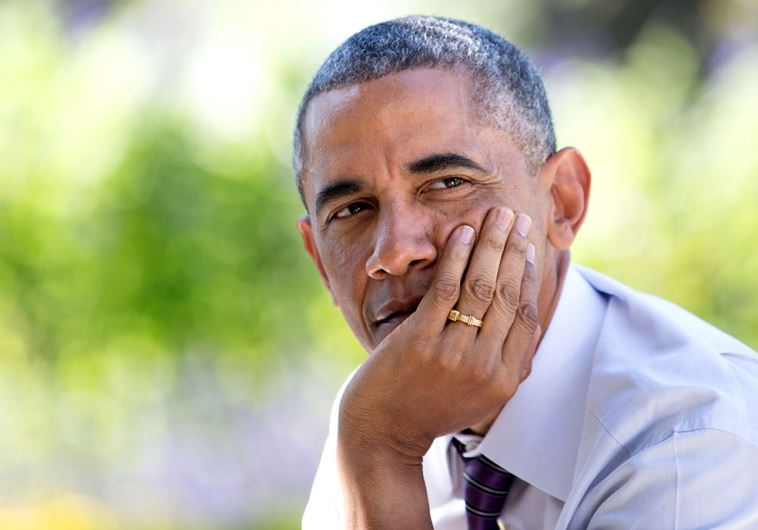
ShowImage (8)US President Barack Obama at the Rose Garden of the White House. (photo credit:OFFICIAL WHITE HOUSE PHOTO / PETE SOUZA)

[T]he real question lawmakers need to ask is whether the deal is good for America. Is Obama right or wrong that only partisan zealots and disloyal Zionists could oppose his great diplomatic achievement? To determine the answer to that question, you need to do is ask another one. Does his deal make America safer or less safe? The best way to answer that question is to consider all the ways Iran threatens America today, and ask whether the agreement has no impact on those threats, or whether it mitigates or aggravates them.

***********************

In President Barack Obama’s defense of his nuclear deal with Iran Wednesday, he said there are only two types of people who will oppose his deal – Republican partisans and Israel- firsters – that is, traitors.

At American University, Obama castigated Republican lawmakers as the moral equivalent of Iranian jihadists saying, “Those [Iranian] hard-liners chanting ‘Death to America’ who have been most opposed to the deal… are making common cause with the Republican Caucus.”

He then turned his attention to Israel.

Obama explained that whether or not you believe the deal endangers Israel boils down to whom you trust more – him or Prime Minister Benjamin Netanyahu. And, he explained, he can be trusted to protect Israel better than Netanyahu can because “[I] have been a stalwart friend of Israel throughout my career.”

The truth is that it shouldn’t much matter to US lawmakers whether Obama or Netanyahu has it right about Israel. Israel isn’t a party to the deal and isn’t bound by it. If Israel decides it needs to act on its own, it will.

The US, on the other side, will be bound by the deal if Congress fails to kill it next month.

So the real question lawmakers need to ask is whether the deal is good for America. Is Obama right or wrong that only partisan zealots and disloyal Zionists could oppose his great diplomatic achievement? To determine the answer to that question, you need to do is ask another one. Does his deal make America safer or less safe? The best way to answer that question is to consider all the ways Iran threatens America today, and ask whether the agreement has no impact on those threats, or whether it mitigates or aggravates them.

Today Iran is harming America directly in multiple ways.

The most graphic way Iran is harming America today is by holding four Americans hostage. Iran’s decision not to release them over the course of negotiations indicates that at a minimum, the deal hasn’t helped them.

It doesn’t take much consideration to recognize that the hostages in Iran are much worse off today than they were before Obama concluded the deal on July 14.

The US had much more leverage to force the Iranians to release the hostages before it signed the deal than it does now. Now, not only do the Iranians have no reason to release the hostages, they have every reason to take more hostages.

Then there is Iranian-sponsored terrorism against the US.

In 2011, the FBI foiled an Iranian plot to murder the Saudi ambassador in Washington and bomb the Saudi and Israeli embassies in the US capital.

One of the terrorists set to participate in the attack allegedly penetrated US territory through the Mexican border.

The terrorist threat to the US emanating from Iran’s terrorist infrastructure in Latin America will rise steeply as a consequence of the nuclear deal.

As The Wall Street Journal’s Mary Anastasia O’Grady wrote last month, the sanctions relief the deal provides to Iran will enable it to massively expand its already formidable operations in the US’s backyard. Over the past two decades, Iran and Hezbollah have built up major presences in Cuba, Venezuela, Nicaragua, Ecuador and Bolivia.

Iran’s presence in Latin America also constitutes a strategic threat to US national security. Today Iran can use its bases of operations in Latin America to launch an electromagnetic pulse attack on the US from a ballistic missile, a satellite or even a merchant ship.

The US military is taking active steps to survive such an attack, which would destroy the US’s power grid. Among other things, it is returning the North American Aerospace Defense Command (NORAD) to its former home in Cheyenne Mountain outside Colorado Springs.

But Obama has ignored the findings of the congressional EMP Commission and has failed to harden the US electronic grid to protect it from such attacks.

The economic and human devastation that would be caused by the destruction of the US electric grid is almost inconceivable. And now with the cash infusion that will come Iran’s way from Obama’s nuclear deal, it will be free to expand on its EMP capabilities in profound ways.

Through its naval aggression in the Strait of Hormuz Iran threatens the global economy. While the US was negotiating the nuclear deal with Iran, the Revolutionary Guards unlawfully interdicted – that is hijacked – the Marshall Islands-flagged Maersk Tigris and held its crew hostage for weeks.

Iran’s assault on the Tigris came just days after the US-flagged Maersk Kensington was surrounded and followed by Revolutionary Guards ships until it fled the strait.

A rational take-home message the Iranians can draw from the nuclear deal is that piracy pays.

Their naval aggression in the Strait of Hormuz was not met by American military force, but by American strategic collapse at Vienna.

This is doubly true when America’s listless response to Iran’s plan to use its Houthi proxy’s takeover of Yemen to control the Bab el-Mandab strait is taken into consideration. With the Bab el-Mandab, Iran will control all maritime traffic from the Persian Gulf and the Red Sea. Rather than confront this clear and present danger to the global economy, America abandoned all its redlines in the nuclear talks.

Then there is Iran’s partnership 20-year partnership with al-Qaida.

The 9/11 Commission found in its report that four of the 9/11 terrorists transited Iran before traveling to the US. As former Defense Intelligence Agency director Lt.-Gen. (ret.) Mike Flynn told Fox News in the spring, Iranian cooperation with al-Qaida remains deep and strategic.

When the US Navy SEALs killed Osama bin Laden in 2011, they seized hard drives containing more than a million documents related to al-Qaida operations. All but a few dozen remain classified.

According to Flynn and other US intelligence officials who spoke to The Weekly Standard, the documents expose Iran’s vast collaboration with al-Qaida.

The agreement Obama concluded with the mullahs gives a tailwind to Iran. Iran’s empowerment will undoubtedly be used to expand its use of al-Qaida terrorists as proxies in their joint war against the US.

Then there is Iran’s ballistic missile program.

The UN Security Council resolution passed two weeks ago cancels the UN-imposed embargoes on conventional arms and ballistic missile acquisitions by Iran. Since the nuclear deal facilities Iranian development of advanced nuclear technologies that will enable the mullahs to build nuclear weapons freely when the deal expires, the Security Council resolution means that by the time the deal expires, Iran will have the nuclear warheads and the intercontinental ballistic missiles required to carry out a nuclear attack on the US.

Obama said Wednesday that if Congress votes down his nuclear deal, “we will lose… America’s credibility as a leader of diplomacy. America’s credibility,” he explained, “is the anchor of the international system.”

Unfortunately, Obama got it backwards. It is the deal that destroys America’s credibility and so upends the international system which has rested on that credibility for the past 70 years.

The White House’s dangerous suppression of seized al-Qaida-Iran documents, like its listless response to Iran’s maritime aggression, its indifference to Iran’s massive presence in Latin America, its lackluster response to Iran’s terrorist activities in Latin America, and its belittlement of the importance of the regime’s stated goal to destroy America – not to mention its complete collapse on all its previous redlines over the course of the negotiations – are all signs of the disastrous toll the nuclear deal has already taken on America’s credibility, and indeed on US national security.

To defend a policy that empowers Iran, the administration has no choice but to serve as Iran’s agent. The deal destroys America’s credibility in fighting terrorism. By legitimizing and enriching the most prolific state sponsor of terrorism, the US has made a mockery of its claimed commitment to the fight.

The deal destroys the US’s credibility as an ally.

By serving as apologists for its worst enemy, the US has shown its allies that they cannot trust American security guarantees. How can Israel or Saudi Arabia trust America to defend them when it is endangering itself? The deal destroys 70 years of US nonproliferation efforts. By enabling Iran to become a nuclear power, the US has made a mockery of the very notion of nonproliferation and caused a nuclear arms race in the Middle East.

The damage caused by the deal is already being felt. For instance, Europe, Russia and China are already beating a path to the ayatollahs’ doorstep to sign commercial and military deals with the regime.

But if Congress defeats the deal, it can mitigate the damage. By killing the deal, Congress will demonstrate that the American people are not ready to go down in defeat. They can show that the US remains committed to its own defense and the rebuilding of its strategic credibility worldwide.

In his meeting with Jewish leaders Tuesday, Obama acknowledged that his claim – repeated yet again Wednesday – that the only alternative to the deal is war, is a lie.

Speaking to reporters after the meeting, Greg Rosenbaum, chairman of the National Democratic Jewish Council, which is allied with the White House, said that Obama rejected the notion that war will break out if Congress rejects the deal with veto-overriding majorities in both houses.

According to Rosenbaum, Obama claimed that if Congress rejects his nuclear deal, eventually the US will have to carry out air strikes against Iran’s nuclear facilities in order to prevent them from enriching uranium to weapons-grade levels.

“But,” he quoted Obama as saying, “the result of such a strike won’t be war with Iran.”

Rather, Obama said, Iran will respond to a US strike primarily by ratcheting up its terrorist attacks against Israel.

“I can assure,” Obama told the Jewish leaders, “that Israel will bear the brunt of the asymmetrical responses that Iran will have to a military strike on its nuclear facilities.”

What is notable here is that despite the fact that it will pay the heaviest price for a congressional defeat of the Iran deal, Israel is united in its opposition to the deal. This speaks volume about the gravity with which the Israeli public views the threats the agreement unleashed.

But again, Israel is not the only country that is imperiled by the nuclear deal. And Israelis are not the only ones who need to worry.

Obama wishes to convince the public that the deal’s opponents are either partisan extremists or traitors who care about Israel more than they care about America. But neither claim is true. The main reason Americans should oppose the deal is that it endangers America. And as a consequence, Americans who oppose the deal are neither partisans nor turncoats.

They are patriots.

Iran’s Expansive Role In The Middle East And Latin America, And The Nuclear Negotiations

February 28, 2015

Iran’s Expansive Role In The Middle East And Latin America, And The Nuclear Negotiations, Center for Security Policy, Nancy Menges Luis Fleischman, February 26, 2015

(Aside from everything, what’s wrong with letting Iran get and use (or keep and use) nukes?  Afer all, they are “our” partner for peace.)– DM)

333893762

As negotiations move forward on a nuclear arms agreement with the Islamic Republic of Iran, the United States along with the P5+1 appears to be oblivious to activities of Iran in the Western Hemisphere and other regions of the world.

In the Middle East, Iran has most recently supported insurgencies in both Bahrain and Yemen. The pro-Iranian Houthis just overthrew the American backed government in Yemen which we were working with on terrorism related issues.

In Syria, Iran and its proxy, Hezbollah, continue to support the Bashar Al Assad regime with Hezbollah fighting together with Assad’s forces. So far 200,000 people have been killed in Syria with millions dispersed in refugee camps in Jordan and Turkey. Hezbollah now has a perfect excuse to be involved in supporting Assad by invoking the need to defeat the bloody Islamic State. Hezbollah may think that this card could play well in the West which is trying to avoid direct intervention to defeat ISIS and would prefer that local forces to do the fighting.

In Iraq, hundreds of thousands of young Shiites are fighting as part of Iranian-backed militias, with a Shiite sectarian orientation likely to aggravate the sectarian strife prevailing in the country. These militias outnumber the Iraqi security forces, and in addition members of the Iranian revolutionary guards, the pro-Iranian Badr organization, and the pro-Iran Katain Hezbollah are heavily involved, mostly operating outside of Iraqi government control.

In Latin America ever since the election of the late Hugo Chavez to the presidency of Venezuela in 1998, Iran has become more embedded in the region in an effort to spread its influence. Several episodes and activities are illustrative of this point.

A few years ago the late Argentinean prosecutor, Alberto Nisman reported in a 500 page document the presence of Iranian and Hezbollah cells in twelve countries in South America.

For at least ten years if not longer, there have been direct airline flights from Caracas to Tehran. Though these are commercial airlines no passengers are allowed and no one seems to know the cargo they carry but it is believed that weapons and members of Hezbollah or the Iranian Revolutionary Guards might be on those flights. Hezbollah has reportedly trained Venezuelan and other guerillas and has strengthened relations with a number of revolutionary regimes in the region. Likewise, tunnels built across the Mexican-American border are akin to those built by Hezbollah along the Israeli/Lebanese border.

In 2011, U.S. Attorney General Eric Holder accused the Iranian Quds Force of plotting to assassinate the Saudi Ambassador to the United States. Though Iran vehemently denied complicity, the American government pointed to high officials in the Iranian hierarchy with having approved the plan.

Another Iranian activity that goes largely unnoticed is Iran’s outreach to several small Caribbean nations. In return for financial assistance, these nations have issued passports to Iranian citizens who wish to enter the United States but could not do so using their Iranian passports. Venezuela and a number of other countries connected directly or indirectly to ALBA countries are providing passports to Iranians. One of those holding such a passport is Moshen Rabbani, the man believed to be behind the terrorist attacks against the Argentinean Jewish Community Center (AMIA) in 1994.

Iran has also been the recipient of uranium from Venezuela.

Most recently the government of Uruguay confirmed that an Iranian diplomat left the country after Uruguayan security suspected him of collecting intelligence about the Israeli embassy in Montevideo.

The diplomat was thought to have placed an explosive device near the Israeli embassy early in January. The device was not particularly powerful but investigations carried out by Uruguayan intelligence indicated the possibility of Iran’s involvement in this serious incident. It was not clear to the authorities whether the device was intended to do harm or was just testing their ability to respond.

But what is astonishing about this story is that two months earlier another incident occurred which was intentionally kept out of the public eye by the Uruguayan government. Indeed, on November 24, somebody placed a suitcase near the building that belonged to the old Israeli embassy in Montevideo. Although the suitcase was empty, cameras located a car belonging to the Iranian embassy nearby. Inside there was a man that the police could not identify immediately but it was assumed he was an Iranian diplomat. The police concluded that the empty suitcase was aimed at testing Uruguayan security forces’ ability to respond.

The Uruguayan government apparently decided to expel the diplomat, who himself, is an appointee of the former Iranian president Mahmoud Ahmadinejad. That appointee was a vocal anti-Semite, a Holocaust denier and apparently served as a translator in the conversations between Ahmadinejad and the late Venezuelan president, Hugo Chavez. Furthermore, the man was reportedly working in Uruguay with Muslim converts that have been activists in a radical left wing party. These individuals could well have been potential candidates for terrorist recruitment; an activity Iran has been systematically performing.

Interestingly enough, Uruguay has been and is a friendly country towards Iran (without being a close ally like Venezuela and the other ALBA countries). Uruguay’s outgoing president, Jose Mujica, declared in the past that his country would pursue relations with Iran because it is good and convenient for the country. The Uruguayan foreign minister Luis Almagro was a commercial attaché in Teheran for about five years and under his watch commercial relations between the two countries flourished. Likewise, a Uruguayan parliamentary delegation visited Teheran to strengthen relations and Almagro himself defined Uruguay and Iran as “two countries that fight against injustice and oppression”. (Almagro is the most likely candidate to be the next Secretary General of the Organization of American States).

The incident in Uruguay is another instance where Iran once again displays its nature as a terrorist entity that does not hesitate in using its embassies and the good faith of the host countries to apply its lethal methods. This is what Iran did in Argentina previous to the two deadly terrorist attacks against the Israeli Embassy and the Jewish community center.

Why shouldn’t Iran be doing so if there is no demand for Iran to stop supporting and encouraging terrorism? After all, a year ago Argentina signed a memorandum with Iran where representatives from that country would be part of the investigation into a terrorist attack where Iran remains the main suspect. By the same token, the chief investigator of the terrorist attack, Mr. Nisman, is dead because he dared to investigate a suspected cover up by the Argentinean government-a government that allegedly wanted to exonerate Iran.

Furthermore, the Argentinean foreign minister Hector Timerman summoned the American and Israeli Ambassadors and asked that these two countries stop meddling in Argentinean internal affairs and stop bringing Middle East conflicts to Argentina. The irony of this statement is that Iran chose Argentina as the target of its’ own intense hatred and violence.

Iranians probably laugh at these events where they are being given a pass over and over again. So, the fact that Iranians may have considered an attack on the Israeli Embassy in a country that is friendly to them such as Uruguay shows the ruthless nature of the regime and how little relations or agreements mean to them.

The negotiations between Iran and the P 5 +1 are mainly focused on Iran’s nuclear program. Thus, Iran is treated as a partner in a negotiation over a specific issue but Iran’s terrorist and treacherous nature is not a factor being considered in this equation.

At this point the U.S. strategy could well be to try to reach an agreement with Iran where the latter would be allowed to enrich uranium at a low level. However, there could be a possibility that if Iran decides to develop nuclear weapons, it could take the Iranians a short time to develop them from the moment they make the decision to do so.

The examples of Iran’s activities show several negative signs. First, if Iran can betray friendly countries like Uruguay, why wouldn’t it betray the P5+1? Likewise, what makes us think that we can live with a terrorist subversive Iran that not only has good chances of having a dominant role in a post-ISIS Syria and Iraq but also expands its influence and activities beyond the Middle East including regions as far as Latin America (from where Iran can strike the U.S. via a terrorist attack or by placing missiles in friendly countries such as Venezuela or Nicaragua)?

Iran presents a very complex challenge. Iran’s non –nuclear, threat is not being discussed, nor considered. This possible nuclear arms agreement should not be treated, as if it were something comparable to a commercial transaction. After all, as a nation state, Iran for the last thirty five years has been the foremost exporter of terrorism.. As the United States along with the P5+1 continues with its negotiations with Iran, they might question whether as a non-nuclear power, Iran presents a threat to world peace and stability and if so how will that play out once they were to become a nuclear power.