Archive for the ‘Kerry’ category

Our World: The anti-peace administration

August 12, 2015

Our World: The anti-peace administration, The Jerusalem PostCaroline B. Glick, August 11, 2015

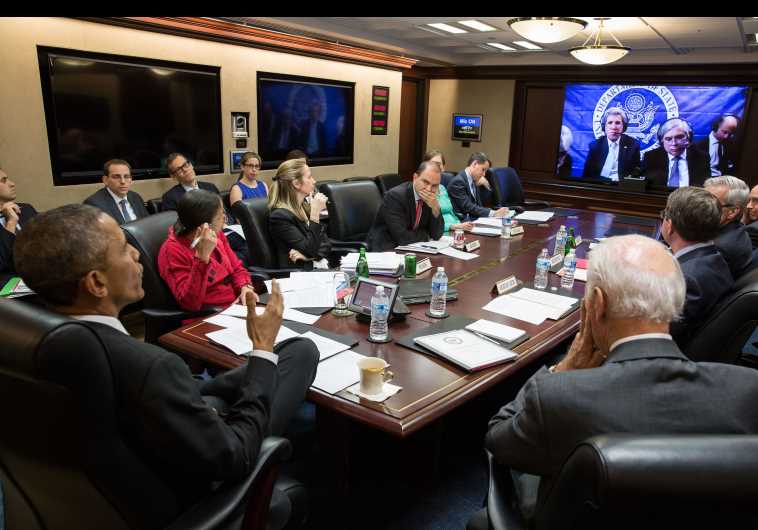
ShowImage (9)President Barack Obama, Vice President Joe Biden, and White House aides receive an update from Secretary of State John Kerry and Secretary of Energy Ernest Moniz via teleconference in Lausanne. (photo credit:WHITE HOUSE)

The US has striven to achieve peaceable relations between the states of the Middle East for nearly 70 years. Yet today, US government is disparaging the burgeoning strategic ties between the Sunni Arab states and Israel.

In a briefing to a delegation of visiting Israeli diplomatic correspondents in Washington last week, a senior Obama administration official sneered that the only noticeable shift in Israel-Arab relations in recent years is that the current Egyptian government has been coordinating security issues “more closely” with Jerusalem than the previous one did.

“But we have yet to see that change materialize in the Gulf.”

If this is how the US views the state of Israel’s relations with the Arabs, then Israel should consider canceling its intelligence cooperation with the US. Because apparently, the Americans haven’t a clue what is happening in the Middle East.

First of all, to characterize the transformation of Israeli-Egyptian relations as a mere question of “more closely” coordinating on security issues is to vastly trivialize what has happened over the past two years.

Before then Egyptian defense minister Abdel Fattah el-Sisi overthrew the US-backed Muslim Brotherhood regime headed by Muhammad Morsi in July 2013, there was a growing sense that Morsi intended to vacate Egypt’s signature to the peace deal with Israel at the first opportunity. Just a month after Morsi ascended to power in January 2013, the Muslim Brotherhood began threatening to review Egypt’s continued commitment to the peace treaty.

The main reason Morsi did not cancel the peace deal with Israel was that Egypt was bankrupt. He needed US and international monetary support to enable his government to pay for imported grain to feed Egypt’s destitute population of 90 million.

During his year in power, Morsi used Hamas as the Brotherhood’s shock troops. He embraced Iran, inviting president Mahmoud Ahmadinejad to visit Cairo in February 2013.

If Morsi were still in power today, with its $150 billion in sanctions relief Iran would have been in a position to support Egypt’s economy. So it is possible that if Morsi were still president, he would have felt he had the financial security to walk away from the peace treaty.

In happy contrast, under Sisi, Israeli-Egyptian ties are closer than they have ever been. Just last week Egyptian diplomats told Al Ahram that Israel’s support was critical for building administration support for Sisi.

Over Ramadan, Egyptian television broadcast a pro-Jewish mini-series.

Israel is closely working with the Egyptians on defeating the growing threat of Islamic State, Hamas and other Islamic terrorist groups waging a bloody insurgency against the regime in Sinai.

Last summer, it was due to the close coordination between Sisi and Israel that the US failed to force Israel to accept Hamas’s cease-fire terms, as those were represented by the Islamist regimes of Qatar and Turkey.

In part due to Israel’s critical support for Sisi’s government, and in part owing to their opposition to Iran’s rise as a regional hegemon armed with nuclear weapons, Saudi Arabia, the UAE and Jordan have all joined Egypt in viewing Israel as a strategic partner and protector.

Last year Saudi Arabia together with the UAE and Jordan supported Israel and Egypt in opposing Hamas and its American, Turkish and Qatari defenders. Had it not been for this massive Arab support, it is very likely that Israel would have been forced to accept the US’s demands and grant Hamas control over Gaza’s international borders.

In June, as negotiations between the US and the other five powers and Iran were moving toward an agreement, the Council on Foreign Relations in New York hosted a meeting between then incoming Foreign Ministry director general Dore Gold and retired Saudi General Anwar Eshki, a former advisor to the Saudi ambassador to the US. The two revealed that over the previous 18 months, they had conducted five secret meetings to discuss Iran.

Although President Barack Obama harangued Israel in his speech at American University last Wednesday, claiming that the Israeli government is the only government that has publicly opposed his nuclear deal with the Iranians, Monday US congressmen now shuttling between Egypt and Israel told Israeli reporters that Egypt opposes the nuclear deal.

As for the Gulf states, according to the US media, last week they told visiting US Secretary of State John Kerry that they support the nuclear deal.

Kerry addressed his counterparts in the Gulf Cooperation Council.

But the fact is that the only foreign minister who expressed such support was Qatari Foreign Minister Khaled al-Attiyah. To be sure, Attiyah was charged to speak for all of his counterparts because Qatar holds the GCC’s rotating chairmanship. But given that Qatar has staked out a pro-Iranian foreign policy in stark contrast to its neighbors and GCC partners, Attiyah’s statement is impossible to take seriously without the corroboration of his colleagues.

As for Qatar’s statement of support, Qatar has worked for years to cultivate good relations with Iran. It might have been expected therefore that Attiyah’s endorsement of the deal would have been enthusiastic. But it was lukewarm at best.

In Attiyah’s words, Kerry promised that the deal would place Iran’s nuclear sites under continuous inspections. “Consequently,” he explained, “the GCC countries have welcomed on this basis what has been displayed and what has been talked about by His Excellency Mr. Kerry.”

The problem of course is that Kerry wasn’t telling the truth. And the Arabs knew he was lying. The deal does not submit Iran’s nuclear sites to a rigorous inspection regime. And the GCC, including Qatar, opposes it.

In his briefing with Israeli reporters, the high-level US official rejected the importance of the détente between Israel and its Arab neighbors because he claimed the Arabs have not changed their position regarding their view of a final peace deal between Israel and the Palestinians.

But this is also nonsense. To be sure, the official position of the Saudis and the UAE is still the so-called Arab peace initiative from 2002 which stipulates that the Arabs will only normalize relations with Israel after it has ceded Jerusalem, Judea, Samaria and the Golan and allowed millions of foreign-born Arabs to freely immigrate to the shrunken Jewish state. In other words, their official position is that they will only have normal relations with Israel after Israel destroys itself.

But their official position is no longer their actual position. Their actual position is to view Israel as a strategic ally.

The senior official told the Israeli reporters that in order to show that “their primary security concern is Iran,” then as far as the Arabs are concerned, “resolving some of the other issues in the region, including the Palestinian issue should be in their interest. We would like to see them more invested in moving the process forward.”

In the real world, there is no peace process. And the Palestinian factions are fighting over who gets to have better relations with Iran. Monday we learned that PA leader Mahmoud Abbas wishes to visit Iran in the coming months in the hopes of getting the money that until recently was enjoyed by his Hamas rivals.

Hamas for its part is desperate to show Tehran that it remains a loyal client. So today, no Palestinian faction shares the joint Israeli-Saudi-Egyptian interest in preventing Iran from becoming a nuclear armed regional hegemon.

The administration showed its hand in that briefing with the Israeli reporters last week. For all their talk about Middle East peace, Obama and his advisors are not at all interested in achieving it or of noticing when it has been achieved.
Obama vs. the Jews

August 11, 2015

Obama vs. the Jews, Front Page Magazine, Daniel Greenfield, August 11, 2015

21obama

Even in the extremely unlikely circumstance that enough Democrats would come together to veto the deal, Obama had already told the agreement’s leading Democratic opponent in the House, “If Congress overrides my veto, you do not get a U.S. foreign policy that reflects that vote. What you get is you pass this law and I, as president, will do everything possible to go in the other direction.”

****************

It was his birthday and Obama was grouchy.

“It’s my birthday and I’m going to be blunt,” Obama told the Jewish leaders meeting with him. When they complained that, “Words have consequences, and when they come from official sources, they can be even more dangerous,” he was unapologetic. 

“If you guys would back down, I would back down from some of the things I’m doing,” he warned.

By that he meant that if they stopped objecting to the Iran deal, he would stop accusing critics of his nuclear sellout to Iran of being money-grubbing warmongers.

Obama complained, “It’s been a really busy day. You’d think they’d be nicer to me on my birthday.”

His busy day had consisted of a meeting with the ineffectual UN Secretary General, lunch with Biden and a photo op in the East Room. But he also had reservations at Rose’s Luxury, an expensive Capitol Hill restaurant where ordinary people wait for hours to get in.

Rose’s doesn’t take reservations, but Obama was an exception.

Shortly after his meeting with Jewish leaders, he and his close Iranian-born adviser Valerie Jarrett skipped the line at Rose’s and got the party started. On the next day, Obama blasted Republican opponents as treasonous allies of those who chant “Death to America,” even though he was the one who had actually made common cause with Iran’s regime.

The day after that, Senator Schumer called Obama to tell him he would oppose the deal and asked him to let him announce it on Friday. The White House instead leaked it to the Huffington Post.  The first response to Schumer’s announcement came from MoveOn, which blew the dog whistle loudly enough to be heard in the next state over, “Our country doesn’t need another Joe Lieberman in the Senate.”

The only obvious thing that both politicians had in common was that they were Jewish.

Obama had lost the argument on the facts. The majority of Americans opposed the deal by 52 to 28 percent. Even among Democrats, support stood at only 52 percent.

His game plan for winning the debate was to get as ugly and dirty as possible.

Despite having just gotten back into Iraq, after contemplating an attack on Syria and coming off an illegal assault on Libya, any Democrat opposing him risked being accused of wanting another Iraq War. Or as White House press secretary Josh Earnest coyly put it, “This difference of opinion that emerged overnight is one that has existed between Senator Schumer and President Obama for over a decade.”

Obama allies emphasized that Schumer had voted for the Iraq War. Obama was once again rerunning his old campaign against Biden and Hillary, even though one was his VP and the other his successor.

Barack Obama had already rolled out the “lonely little guy in the White House” playbook complaining about lobbies and money. He had been irked at his representatives not getting full access to the AIPAC activists who were visiting members of Congress and was reading from Bush I’s old script. But now he began to sound more like Pat Buchanan ranting about Israel’s “amen corner” beating the drums for war.

Having forgotten the time he sent his campaign consultants to defeat Netanyahu in the Israeli election, he complained that Netanyahu was inappropriately interfering. During his speech, he rediscovered a love for the Constitution which he claimed obligated him to sideline Israel. Sadly he lacked the same love for the Constitution’s Treaty Clause which requires two-thirds of the Senate to ratify a treaty.

The complaints about lobbies and money sounded strange coming from a guy who had his own SuperPAC with tens of millions of dollars to spend. Behind him was a network of organizations with hundreds of millions of dollars in cash on hand and billionaire donors to donate on demand.

The Rockefeller Brothers Fund had invested a fortune into the project. Some of the money went into the Ploughshares Fund, which did its own promotion for the deal, and funneled cash to Global Zero, which released a video promoting the deal featuring Jack Black and Morgan Freeman.  His position was backed by George Soros’ J Street, an astroturfed anti-Israel group that was bringing serious money to the party.

Once Schumer came out on the deal, he was targeted by Credo Mobile and MoveOn, among other powerful left-wing groups, determined that nothing would be allowed to interfere with Iran’s nukes.

There was no shortage of lobbies and money in Obama’s corner. The citizen activists opposed to the deal might have the support of the American people, but they were outmatched by the massive wealth and infrastructure of the Democracy Alliance and Obama’s mainstream media allies.

The teachers, mothers, engineers and small businessmen could travel to Washington D.C. and complain to their Congressman. Obama could go on the Daily Show and complain about them to Jon Stewart.

There was no comparing their respective power.

And all that was without mentioning the Iran Lobby which boasted close relationships with Joe Biden and John Kerry.

Obama continued to escalate tensions with the Jewish community, even though he faced no real risk that enough Democrats would come together to override his veto. Even Schumer’s rejection had bent over backward to praise and flatter him. The American people might disapprove of the deal, but they had also disapproved of ObamaCare and his illegal war in Libya. And he had just rolled over them.

The administration wasn’t in this fight because it worried that it might lose. Between the GOP establishment and Obama, the game had already been rigged. Everyone, including Schumer, would play their parts, get their applause and the agreement would move forward. Hundreds of AIPAC members lobbying a few members of Congress wouldn’t stop that. Neither would a few ads.

Even in the extremely unlikely circumstance that enough Democrats would come together to veto the deal, Obama had already told the agreement’s leading Democratic opponent in the House, “If Congress overrides my veto, you do not get a U.S. foreign policy that reflects that vote. What you get is you pass this law and I, as president, will do everything possible to go in the other direction.”

Obama would implement the deal no matter what Congress did. Iran would get its nukes.

But for Obama, scowling and impatiently tapping his fingers while waiting to go for his birthday dinner, musing that he could have already been there if it wasn’t for these old white men whining to him, looking forward to his round of golf and a trip to Camp David, it had become petulantly personal.

For the left, the political is often indistinguishable from the personal, and for Obama it has always been that way. Obama’s view of government is Louis XIV’s “I am the State”. All opposition is personal. All dissent is treason. Enemies have to be punished on the principle of the thing.

It didn’t matter that the Jewish leaders had zero chance of actually stopping his agreement with Iran. Most of them didn’t even want to be there. What mattered was that they had opposed him and they had to be punished for it.

Obama had compared Americans uneasy about Iran’s “Death to America” slogan to schoolyard bullies who wanted to “smack around” the “little guy” who dared to “mouth off.” But he was the one playing the bully, going out of his way to sow tension, using rhetoric condemned even by Jewish supporters of the deal, not because he needed it to win, but because he was angry and resentful.

Millions of Jews around the world saw the specter of an atomic cloud rising into the sky, but Obama had a birthday meal at Rose’s Luxury to go to, a round of golf to play and his feelings were being hurt and his birthday was being ruined by these annoying Jews who wouldn’t take “No” for an answer.

Obama isn’t even stirring up anti-Semitism to defend the Iran deal. He’s lashing out, accusing critics of being traitors and warmongers, because they ruined his birthday party.

Compromised – John Kerry has much to hide on his ties to Iran.

August 11, 2015

Compromised – John Kerry has much to hide on his ties to Iran, Front Page MagazineKenneth R. Timmerman, August 11, 2015

John Kerry has much to hide on his ties to Iran. As I revealed more than ten years ago, Mr. Kerry has long been sympathetic to the Islamist regime in Tehran.

******************

Secretary of State John Kerry is becoming increasingly frantic as he takes his case for the deeply flawed Iran nuclear deal around the country. 

His latest argument, that congressional disapproval of the deal will be the “ultimate screwing” of Iran’s clerical Supremo – and that we should care – verges on hysteria.

Whether it’s hysterically funny or a psychotic condition would be a tough call, if only the stakes weren’t so high for our security and the security of our friends and allies, starting with the Iranian people.

John Kerry has much to hide on his ties to Iran. As I revealed more than ten years ago, Mr. Kerry has long been sympathetic to the Islamist regime in Tehran.

In June 2002 – just nine months after the 9/11 attacks on America – Mr. Kerry headlined a fund-raising gala for the American-Iranian Council, a pro-regime lobbying group seeking to roll back U.S. sanctions and promote U.S. investment in Iran.

The next day, AIC members returned the favor and hosted a fund-raiser for Senator Kerry’s re-election campaign at the Ritz Carlton in San Francisco that netted more than $26,000. Many of those same fund-raisers became bundlers for Mr. Kerry’s failed 2004 presidential bid.

Among those opening their wallets was a stunning 34-year-old Iranian woman named Susan Akbarpour, aka Zahra A. Mashadi. “I am an actor in U.S. politics,” Ms. Akbarpour boasted to a reporter. “I am a fund-raiser for all candidates who listen to us and our concerns.”

The only problem was, her political contributions were illegal because she did not have a green card. The Kerry campaign never returned those contributions and the Federal Election Commission never investigated.

Mr. Kerry has been accused of behaving as “Iran’s lawyer” in the nuclear negotiations, finding excuses for Iran’s bad behavior and justifications for a seemingly endless stream of U.S. capitulations to Iran.

But that behavior is not new. In fact, during a debate with President George W. Bush during the 2004 campaign, Mr. Kerry pledged that had he been president since 2001, he would have “offered the opportunity to provide the nuclear fuel” to Iran, to “test them, see whether or not they were actually looking for it for peaceful purposes.”

Why would the United States appoint as lead negotiator a politician whose long-held views favoring our adversary in those negotiations were well-known?

Much has been made recently of Secretary Kerry’s family ties to Iran, a fact that was never raised during his confirmation hearings as Secretary of State.

Vanessa Kerry tartly dismissed rumors that have circulated in the Iranian-American community in Los Angeles since her 2009 wedding that the son of Iran’s Foreign Minister, Mehdi Zarif, was best-man for her husband, Behrouz Vala Nahed, an American-born neuro-surgeon. “Happy 2 verify. No wedding party when we married. No Zarif’s son. Sorry 2 disappoint,” she tweeted recently.

An Iranian website close to the father, Mohammad Javad Zarif, initially reported that Brian Nahed and Mahdi Zarif had “only” been college roommates, but later changed the on-line version of the article without noting the correction.

Mahdi Zarif attended the City University of New York and lived in the United States for more than a decade while his father was the Islamic Republic’s ambassador to the United Nations (and repeatedly met with U.S. Senators in Washington, DC, including now vice-president Joe Biden). Dr. Nahed took his pre-med undergraduate degree several years earlier at UCLA.

But the presence or not of Zarif the son at Kerry the daughter’s wedding is a side show and detracts from an examination of Mr. Kerry’s fundamental conflict of interest in serving as chief U.S. negotiator with Iran.

The facts are indisputable:

  • Mr. Kerry took illegal campaign cash from an Iranian national who, while claiming to be a political refugee, assaulted anti-regime protesters in Los Angeles, promoted U.S. computer and software investment in Iran in violation of U.S. sanctions, and boasted of influencing U.S. politicians with a pro-Tehran agenda. Taking that illicit cash tainted Mr. Kerry and identified him a “soft target” to agents of the Iranian regime.
  • Mr. Kerry carried through his side of the bargain, embracing the pro-Tehran agenda during his 2004 presidential campaign, while his Iranian backers kicked in substantial fresh cash to his campaign.
  • Mr. Kerry met Zarif at a private reception hosted by George Soros in New York in 2005, shortly after Soros’s Open Society Institute hosted Zarif at a policy luncheon for New York media elites.
  • Mr. Kerry sought to travel to Tehran to jumpstart diplomatic negotiations in December 2009, but was rebuffed by Tehran.

As I wrote earlier this year, a former aide to Iranian president Rouhani, who defected while covering the nuclear talks, revealed that Mr. Kerry and the U.S. delegation were seen by the Iranian negotiating team as secret allies who helped arm-twist reluctant partners such as France into making major concessions.

I know Iranian-Americans who volunteered for U.S. military service who were forced to leave the military when family members traveled to Iran. Why? Because counter-intelligence professionals who understood the Iranian government track record of exploiting family relationships for intelligence or political purposes indicated they could be compromised.

After all, the Soviets used family relationships all through the Cold War to compromise unwilling individuals to collaborate with their cause.

The game is as old as the intelligence business itself: find some string to manipulate or blackmail your adversary, then pull as hard as you can.

When it comes to Iran, John Kerry is about as compromised as they get.

What Iran’s hostile reaction to the Parchin issue means for the nuclear deal

August 11, 2015

What Iran’s hostile reaction to the Parchin issue means for the nuclear deal, Washington Post, David Albright, August 10, 2015

The United States and Congress should clearly and publicly confirm, and Congress should support with legislation, that if Iran does not address the IAEA’s concerns about the past military dimensions of its nuclear programs, U.S. sanctions will not be lifted. To do otherwise is to make a mockery of the nuclear deal.

********************

Chico Marx said: “Who you gonna believe? Me or your own eyes?” Iran’s Foreign Minister Mohammad Javad Zarif said over the weekend that my organization, the Institute for Science and International Security, was spreading lies when we published satellite imagery that showed renewed, concerning activity at the Parchin military site near Tehran. This site is linked by Western intelligence and the International Atomic Energy Agency (IAEA) to past work on nuclear weapons. But like Chico, instead of acknowledging the concern, the Iranians chose to deny the visible evidence in commercial satellite imagery. Iran’s comments would be mirthful if the topic were not so serious.

Zarif is also calling U.S. intelligence officials and members of Congress liars. They are the original source of the information both about renewed activity at Parchin and concerns about that activity. All we did was publish satellite imagery showing this activity and restate the obvious concern.

Moreover, this information about renewed activity at Parchin does not come from opponents of the Joint Comprehensive Plan of Action negotiated between the United States, five other world powers and Iran, as Zarif suggested. We are neutral on whether the agreement should be implemented and have made that position clear for weeks. The U.S. intelligence community is hardly opposed to the deal. Iran’s attempts to dismiss this concern as the work of the deal’s foes also is just wrong.

Concern about Parchin has become more urgent now that there is a debate raging over whether the IAEA will have adequate access to this site under the terms of its deal with Iran. It would be irresponsible not to worry about reports that suggest that Iran could be again sanitizing the site to thwart environmental sampling that could reveal past nuclear weapons activities there. This concern is further heightened because Iran has demanded to do this sampling itself instead of letting the IAEA do it. Such an arrangement is unprecedented and risky, and will be even more so if Iran continues to sanitize the site. In the cases of the Iranian Kalaye Electric site and the North Korean plutonium separation plant at Yongbyon, the success of sampling that showed undeclared activities depended on samples being taken at non-obvious locations identified during previous IAEA visits inside buildings. The IAEA will not be able to visit Parchin until after the samples are taken, and it remains doubtful that the inspectors will be able to take additional samples.

Some of this can be written off to Zarif’s volatility. At one point during the negotiations, he yelled so loudly at Secretary of State John F. Kerry that those outside the room could hear him. He obviously angers easily. But he is also one of the more reasonable Iranian government officials. I can remember in the late 1990s discussions with Iranian government and nuclear officials in New York where the Iranians vehemently stated, despite the overwhelming evidence to the contrary, that they did not have any gas centrifuge programs. I was presenting the evidence that they did, in fact, have a centrifuge program, one in fact aided by Pakistan, and at one of these meetings, Zarif quietly said to me that he had always told me that Iran had the entire fuel cycle — technical language admitting to an enrichment program. His willingness to admit the obvious gave me hope that the crisis over Iran’s program could be solved diplomatically. But on Parchin, his words appear to reflect Iranian government intransigence on its past nuclear weapons program. Its action is an assault on the integrity and prospects of the nuclear deal.

Iran’s reaction shows that it may be drawing a line at Parchin. Resolving the Parchin issue is central to the IAEA’s effort to resolve concerns about Iran’s past work on nuclear weapons by the end of the year, but Parchin is not the only site and activity involved in this crucial issue. The IAEA needs to visit other sites and interview a range of scientists and officials. Instead of allowing this needed access, Iran appears to be continuing its policy of total denial, stating that the concerns are merely Western falsifications and fantasies. The United States recently reasserted that it believes Iran had a nuclear weapons program and stated that it knows a considerable amount about it. So, if Iran sticks to its strategy, one can expect an impasse that includes Iran refusing to allow the IAEA the access it needs to sites and scientists within the coming months.

U.S. officials have stated that the Joint Comprehensive Plan of Action requires Iran to address concerns about its past work on nuclear weapons prior to the lifting of sanctions. However, Iran may argue otherwise, and one could easily conclude that its recent actions are the start of such a reinterpretation of the agreement. The United States and Congress should clearly and publicly confirm, and Congress should support with legislation, that if Iran does not address the IAEA’s concerns about the past military dimensions of its nuclear programs, U.S. sanctions will not be lifted. To do otherwise is to make a mockery of the nuclear deal.

Cartoons of the day

August 10, 2015

H/t Vermont Loon Watch


hollywood
the-flag

H/t Joopklepzeiker

Poliyicus-prostitue

Russia and US woo Saudis to help save Assad – albeit putting Israel and Jordan in danger from S. Syria

August 9, 2015

Russia and US woo Saudis to help save Assad – albeit putting Israel and Jordan in danger from S. Syria, DEBKAfile, August 9, 2015

Lavrov_Kerry_and_al-Jubeir-_Doha_3.8.15Lavrov, Kerry, Al-Jubeir at Doha

[N]either Israel nor Jordan has been co-opted to this big power initiative, as though they are not concerned. However, both have a big stake in Saudi Arabia’s next decisions. If Riyadh is won over by US-Russian blandishments and goes back on its decision to boycott Assad, the Saudi-Israeli-Jordanian effort to support Syrian rebel control of southern Syria will fall apart. This will open up both countries to new perils on their  northern borders.

************************

Building on the nuclear accord signed in Vienna last month, the Obama administration has been in close communion with Moscow and Tehran on regional moves to save the Assad regime, as the key to their next regional policies, including a united front against the Islamic State.. Saudi Arabia and its Gulf partners are being assiduously wooed to join the new alignment being set up for this purpose. The live wire in getting them all together is Omani Foreign Minister Khalid bin Mohamed Al-Attiyah, the secret broker who brought Iran and the United States to the negotiating table for a nuclear accord. This was first reported in the last DEBKA Weekly.

Wednesday, Aug. 7, Obama threw out his first hint on this development: “The window has opened a crack for us to get a political resolution in Syria, partly because both Russia and Iran, I think, recognize that the trend lines are not good for Assad,” he said. “Neither of those patrons are particularly sentimental; they don’t seem concerned about the humanitarian disaster that’s been wrought by Assad and this conflict over the last several years, but they are concerned about the potential collapse of the Syrian state. And that means, I think, the prospect of more serious discussions than we’ve had in the past.”

The US president then affirmed more strongly in a CNN interview Sunday, Aug. 9:  “Is there the possibility that having begun conversations around this narrow issue [the nuclear accord with Iran] that you start getting some broader discussions about Syria, for example, and the ability of all the parties involved to try to arrive at a political transition that keeps the country intact and does not further fuel the growth of ISIL and other terrorist organizations? I think that’s possible,” Obama said. “But I don’t think it happens immediately.”

The administration and its prospective partners are united by the will to destroy ISIS – in its Syrian stronghold, for starters – but are divided on much else, DEBKA file reports. And so the process is moving forward in careful steps.

Their initial focus is on Syria, the bloody battleground which in less than five years has left at least 300,000 dead and more than 10 million people homeless.

The plan the group started out with in the last ten days was a swap as simple as it was ruthless: Saudi Arabia and the United Arab Emirates would slow their assistance to Syrian rebel groups, against whom President Bashar Assad’s army and allies would hold their fire; Iran, for its part, was to start withdrawing its support from the Yemeni Houthis insurgents.

The informal truce in Syria would be the stage for the Assad regime and rebel groups to start discussing a new government with room for opposition parties. The Islamists of the Islamic State and Al Qaeda’s Nusra Front would not be invited.

In Yemen, Tehran would cut back on the arms and intelligence which have enabled the Houthi insurgents to stand up to the combined forces of Saudi Arabia, the UAE and Egypt. The pro-Western Yemeni President Abd Rabo Mansour Hadi would be restored to his palace in Sanaa and invite the insurgent leader, Abdu Malik Al-Houthi, to discuss his partnership in a new government.

This deal was tantamount to a joint US-Russian guarantee of Bashar Assad survival in power in return for a Tehran-Riyadh compact for Hadi’s reinstatement in Sanaa.

These arrangements were debated back and forth in exchanges, some semi-secret, among the leading actors for most of July. The visit to Riyadh of the Syrian intelligence chief Maj. Gen. Ali Mamlouk was set up by Moscow as a major push forward.

The plan was for the entire enterprise to be brought out in the open and sealed in Doha, Qatar, Tuesday, Aug. 3 at a conference attended by US Secretary of State John Kerry, Russian Foreign Minister Sergey Lavrov, Saudi Foreign Minister Adel Al-Jubeir and other top Gulf diplomats.

Iranian Foreign Minister Mohammed Javad Zarif was not there. But he put a strong oar into the proceedings by calling in at Muscat, Oman the day before the conference and subsequently on Friday Aug. 7. Assad also kept his hand in by sending his foreign minister Walid Moallem to Tehran and Muscat last week.

But then, at Doha, just as the package was ready to unveil, the Saudi foreign minister pulled away and blew it up with two provisions: a) Riyadh would not countenance Bashar Assad being allowed to stay in office, and: b) Saudi Arabia would not do business with any representative of the Assad regime.

This put a large spoke in the main wheel of the initiative and also scuttled some of the secondary plans depending on it.

But by then, a lot was happening in the Yemeni and Syrian war arenas:

1. Saudi and UAE armored forces had landed in Aden and were closing in on the Yemeni capital, Sanaa. The Houthi rebels, trained and armed by Iran, were forced to retreat without negotiations on their future role in government.

2. Syrian rebel leaders, sensing the approaching betrayal, sent a secret delegation to Tehran to discuss terms for opening negotiations with Assad. They too were left at sea about the deals in play among Washington, Moscow, Tehran and Riyadh over their future.

Saturday, Aug.8, the Russians, egged on by the Americans, set about winning Riyadh into the fold, Foreign Minister Al-Jubeir was invited to pay a visit to Moscow Tuesday, Aug. 11, for talks about the Syrian conflict and the war on the Islamic State.

Refusing to accept that the new initiative had been grounded in Doha, Moscow presented the visit as continuing the ongoing dialogue on the issues raised at that encounter.

DEBKAfile’s military and intelligence sources note that neither Israel nor Jordan has been co-opted to this big power initiative, as though they are not concerned. However, both have a big stake in Saudi Arabia’s next decisions. If Riyadh is won over by US-Russian blandishments and goes back on its decision to boycott Assad, the Saudi-Israeli-Jordanian effort to support Syrian rebel control of southern Syria will fall apart. This will open up both countries to new perils on their  northern borders.

No Trust, No Verification, No Sanctions: Obama’s Humiliating Capitulation to the Mullahs

August 8, 2015

No Trust, No Verification, No Sanctions: Obama’s Humiliating Capitulation to the Mullahs, National Review, Andrew C. McCarthy, August 8, 2015

(I have been beating this drum for quite a while. So have others. The Obama administration’s position still makes no sense whatever, unless unfortunate motives are attributed to the Commander in Chief. — DM)

The sanctions regime President Obama and Secretary of State Kerry vowed to step up has already collapsed. The mullahs are already scooping up billions in unfrozen assets and new commerce, and they haven’t even gotten the big payday yet. Obama’s promises of “anytime, anywhere” inspections have melted away as Tehran denies access and the president accepts their comical offer to provide their own nuclear-site samples for examination. Senator John Barasso (R., Wyo.), a medical doctor, drew the apt analogy: It’s like letting a suspect NFL player what he says is his own urine sample and then pronouncing him PED-free.#

And now even the Potemkin verification system has become an embarrassing sham, with Iran first refusing to allow physical investigations, then declining perusal of documentation describing past nuclear work, and now rejecting interviews of relevant witnesses.

Recall that administration officials indignantly assured skeptics that there would be no agreement in the absence of Iran’s Iran’s coming clean on the “past military dimensions” of its nuclear work. As Kerry put it, “They have to do it. It will be done. If there’s going to be a deal; it will be done.”

The reason it had to be done is obvious. According to Obama, his Iran deal is built on verification, not trust — at least when the president is not trusting Ayatollah Khamenei’s phantom anti-nuke fatwa. Plainly, it would be impossible to verify whether Iran was advancing toward the weaponization of nuclear energy — whether it had shortened the “breakout time” the elongation of which, Obama claims, is the principal objective of his deal — unless one knew how far the mullahs had advanced in the first place

But now, in open mockery of an American president they know is so desperate to close this deal he will never call their bluff, the mullahs have told the International Atomic Energy Agency to pound sand — although not sand in Iran, where the IAEA is not permitted to snoop around. Tehran is steadfastly refusing to open its books, and the IAEA sheepishly admits that it cannot answer basic questions about Iran’s programs and progress.

So what does Team Obama do? Do they, as they promised, walk away from an unverifiable and thus utterly indefensible deal that lends aid and comfort to our enemies? Of course not. Now they’re out there telling Americans, “We don’t need this IAEA program to discover whether or not Iran was pursuing a nuclear weapon — they were,” as Senator Chris Murphy, a Connecticut Obamabot, told the Wall Street Journal.

Well good for you, Sherlock; Obama, Kerry, and Hillary Clinton may still be hanging on that fatwa, but you hit the bull’s-eye.

Here’s the thing, though, Senator Murphy: Yes, all of us know the Iranians, as you cheerily put it, “were” pursuing a nuclear weapon — especially all of us who oppose Obama’s Iran deal and who recognize that the jihadist regime has waged war against us since 1979, killing thousands of Americans. But you “let’s make a deal” guys told us your objective was to uncover how far along they “were” and to roll back their progress. (Actually, you used to tell us your objective was to prevent them from getting nuclear weapons, period — as in “if you like your health-care plan, you can keep your health-care plan, period.”)

If you don’t have a baseline from which to begin verification, you can’t verify the time of day, much less the progress of nuclear research, development, procurement, and experimentation. Iran is saying we don’t get the baseline without which the Obama administration guaranteed there would be no agreement.

So in the grand deal our president describes as subjecting the mullahs to historically rigorous inspection, disclosure, and verification requirements, there is no inspection, no disclosure, and no verification.

And did I mention no sanctions?

On July 29, Kerry assured lawmakers that Iranian Quds Force commander “Qassem Soleimani will never be relieved of any sanctions.” Soleimani orchestrates the regime’s terrorist operations and, according to the Pentagon, is responsible for killing at least 500 American soldiers in Iraq.

Yet, only five days before Kerry gave that testimony, Soleimani traveled to Russia for meetings with Putin’s government — notwithstanding the vaunted sanctions that, Kerry would have us believe, confine him to Iran.

Russia, of course, is a member of the U.N. Security Council, from which Obama sought and obtained endorsement of his Iran deal before seeking congressional review. Not only has Russia rendered the current sanctions a joke; it has made Obama’s implausible promise of future “snapback” sanctions against Iran even more laughable. Russia, by the way, has also agreed to build yet another nuclear reactor for the mullahs in Busheir — which Obama’s deal obligates the United States to protect against sabotage. And Putin has also just agreed to supply the terrorist regime in Tehran with $800 million worth of S-300 anti-aircraft missiles that can be used against the U.S. Air Force and have enough range to strike planes in northern Israel.

What a deal, Mr. President!

Actually, we really don’t know quite what a deal it is because key provisions remain secret. After its bold verification promises, the Obama administration was too embarrassed to reveal exactly how pathetic the agreement’s inspections provisions are. So, as I outlined in a recent column, Obama and Kerry tucked them into a secret side deal between Iran and the IAEA. It then twaddled that the details — i.e., the heart of the deal from the American perspective — are, conveniently, between Iran and the IAEA. None of our business, you see.

This message was reiterated on Capitol Hill this week by the IAEA. Understand: The IAEA could not function (to the limited extend it does function) without the United States Congress’s underwriting of 25 percent of its budget — the American taxpayer contribution dwarfs that of every other country, including Iran’s, which is tiny. Yet, the IAEA chief told lawmakers that he could not reveal the agreement between his agency and Tehran because that is “confidential” information, disclosure of which would compromise the IAEA’s “independence.” The only things the IAEA would confirm are that (a) there are verification provisions and (b) Iran is not cooperating with them.

Feel better?

Well, to further improve your mood, let’s talk the Corker bill. Remember, that’s the legislation by which the GOP-controlled Congress reversed the constitutional presumption against international agreements and virtually assured that Obama’s Iran deal — no matter how appalling it may be, no matter how much aid and comfort if provides to the enemy — will become law.

Why on earth would Beltway Republicans agree to anything so catastrophic for the national security that the Constitution’s Treaty Clause is designed to protect? Because, they proclaimed, by making this devil’s bargain, they would ensure that Congress and the American people got full disclosure of the Iran deal that Obama would otherwise shroud in secrecy.

But as I asked at the time, what possessed them to think Obama would not shroud the agreement in secrecy just because there would now be a law forbidding that?

Supporters are telling themselves that the Corker bill’s benefits [include that] the president will have to produce the agreement. . . . But this is a mirage. . . . The president is notoriously lawless, and thus Republicans can have no confidence that the agreement he produces to Congress will, in fact, be the final deal he signs off on with Iran and, significantly, submits to the U.N. Security Council for an endorsing resolution.

And so it has come to pass: Republicans forfeited their constitutional power for an unenforceable promise of transparency from an infamously duplicitous backroom dealer. Now they have no power and no idea what they’ve enabled.

The president had it backwards Wednesday when, in his repulsively demagogic speech on the Iran deal, he said that Republicans are aligned with the Iranian chanting ‘Death to America.’” It is Obama who is aiding and abetting the hardliners. Republicans have merely aided and abetted Obama.

Iran confirms trip by Quds Force Commander to Moscow to discuss arms shipments

August 8, 2015

Iran confirms trip by Quds Force Commander to Moscow to discuss arms shipments, Fox News, , August 8, 2015

Iranian officials confirmed Friday that General Qassem Soleimani, the heavily sanctioned Revolutionary Guard Quds Force commander, traveled to Russia last month and was conducting weapons deals, including discussion of the S-300 missile system, according to Reuters.

The U.S. ambassador to the United Nations, Samantha Power, said Friday the U.S. is very concerned about the development.

“Qassem Soleimani is subject to a UN travel ban and this travel ban requires all states to prohibit Qassem Soleimani from traveling to their nation and the only exception to that is if the Iran sanctions committee grants an exemption,” she said at UN headquarters in New York.

The White House did not specifically blame the Russians for hosting the Iranian general.

“I can’t confirm these specific reports but it is an indication of our ongoing concerns with Iran and their behavior,” White House press secretary Josh Earnest told reporters Friday at the daily press briefing.

Mike Rogers, former chairman of the United States House Permanent Select Committee on Intelligence, weighed in late Friday afternoon.

 “We should not underestimate what this means to our national security,” he said. “A leading general in Iran just told the world that the United States of America is irrelevant and Russia welcomed him with open arms. Not only do Russia and Iran not fear us, they do not respect us. And that, is dangerous.”

According to two separate Western intelligence sources, Soleimani arrived in Moscow on Iran Air flight 5130 from Tehran on July 24, ten days after the nuclear agreement between Iran and six world powers was announced that included a provision to lift the arms embargo on Iran.

Five days later, Secretary of State John Kerry testified about the Iran nuclear deal before the Senate Armed Services Committee, assuring Congress pressure would remain on Iran’s shadowy general.

“Under the United States’ initiative, Qassem Soleimani will never be relieved of any sanctions,” Kerry told the Senate Armed Services Committee.

In Moscow, Soleimani met with President Vladimir Putin and Russia’s defense minister.

In June, Russia announced it would send S-300 anti-aircraft missiles to Iran by next year, according to a top Kremlin official.

Soleimani was photographed in Iraq recently on the front lines with Iranian-backed Shia militias battling ISIS, also in defiance of the travel ban.

Soleimani is blamed for the deaths of 500 Americans in Iraq. He also is suspected of orchestrating the failed assassination attempt on the Saudi Arabian ambassador to the United States at a popular Georgetown restaurant in Washington.

Soleimani’s Moscow visit elicited a reference during the Republican debate Thursday night.

“He’s directly responsible for the murder of over 500 American servicemen in Iraq and part of this Iranian deal was lifting international sanctions on Gen. Soleimani — the day Gen. Soleimani flew back from Moscow to Iran was the day we believe Russia used cyber warfare against the joint chiefs,” said Sen. Ted Cruz, R-Texas.

Iran’s acknowledgement of Soleimani’s visit to Moscow indicates a possible split in Iran’s leadership: those loyal to the military are unconcerned about blazingly defying sanctions even before the nuclear deal is sealed.

Kerry says sinking of Iran deal would be ‘ultimate screwing of ayatollah’

August 5, 2015

Kerry says sinking of Iran deal would be ‘ultimate screwing of ayatollah,’ Jerusalem Post, August 5, 2015

(It’s as pro-Israel as the Obama administration gets. Please see also, Daniel Greenfield’s comments here. — DM)

ShowImage (6)
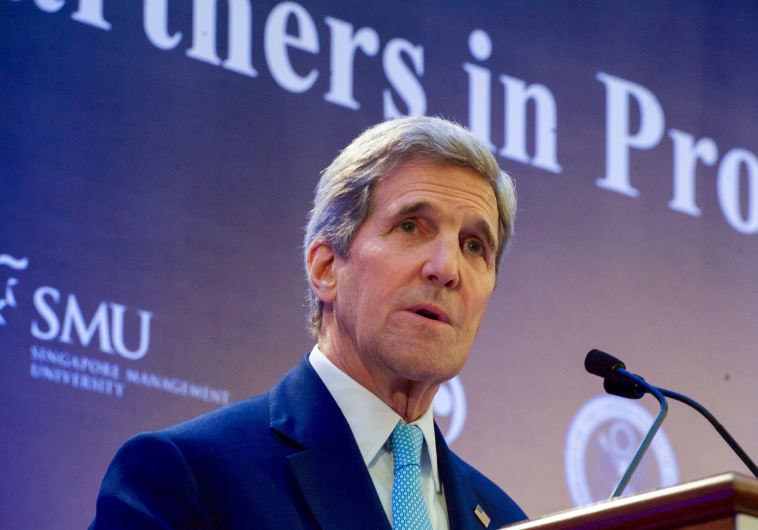
US Secretary of State John Kerry speaks in Singapore. (photo credit:STATE DEPARTMENT)

The secretary rejected Israel’s criticism of the nuclear agreement, saying that the deal “is as pro-Israel” as it gets.

******************

U.S. Secretary of State John Kerry told The Atlantic on Wednesday that if Congress were to shoot down the Iran nuclear agreement, it would be “the ultimate screwing” of Supreme Leader Ayatollah Ali Khamenei.

Kerry made the remarks in an interview with The Atlantic‘s Jeffrey Goldberg.

The secretary rejected Israel’s criticism of the nuclear agreement, saying that the deal “is as pro-Israel” as it gets.

Reneging on the nuclear agreement, which has the support of the major world powers, would constitute a setback for Washington and justify anti-American animus in Iran.

“The ayatollah constantly believed that we are untrustworthy, that you can’t negotiate with us, that we will screw them,” Kerry said. “[Having Congress vote down the nuclear pact] will be the ultimate screwing.”

“The United States Congress will prove the ayatollah’s suspicion, and there’s no way he’s ever coming back. He will not come back to negotiate. Out of dignity, out of a suspicion that you can’t trust America. America is not going to negotiate in good faith. It didn’t negotiate in good faith now, would be his point.”

Kerry also commented on the vociferous opposition to the deal expressed by Israel, which the secretary referred to as “visceral” and “emotional.” He was adamant that the agreement was positive for Israel’s geopolitical standing.

“I’ve gone through this backwards and forwards a hundred times and I’m telling you, this deal is as pro-Israel, as pro-Israel’s security, as it gets,” Kerry said. “And I believe that just saying no to this is, in fact, reckless.”

Kerry said that he was “sensitive” to Israeli concerns over Iran’s long-term aims, but he rejected arguments made by Jerusalem that the Islamic Republic was planning its annihilation.

“I haven’t seen anything that says to me [that Iran will implement its vow of wiping Israel off the map],” the secretary said. “They’ve got 80,000 rockets in Hezbollah pointed at Israel, and any number of choices could have been made. They didn’t make the bomb when they had enough material for 10 to 12. They’ve signed on to an agreement where they say they’ll never try and make one and we have a mechanism in place where we can prove that. So I don’t want to get locked into that debate. I think it’s a waste of time here.”

“I operate on the presumption that Iran is a fundamental danger, that they are engaged in negative activities throughout the region, that they’re destabilizing places, and that they consider Israel a fundamental enemy at this moment in time,” Kerry said. “Everything we have done here [with the nuclear agreement] is not to overlook anything or to diminish any of that; it is to build a bulwark, build an antidote.”

The secretary said that the nuclear deal is even more imperative if Israel’s fears that Iran is plotting its destruction are true, since the agreement neutralizes Tehran’s nuclear program.

More bad news for Obama from Iran about the secret deals

August 4, 2015

More bad news for Obama from Iran about the secret deals, Dan Miller’s Blog, August 4, 2015

(The views expressed in this article are mine and do not necessarily reflect those of Warsclerotic or its other editors. — DM)

An Iranian official recently stated that no International Atomic Energy Agency (IAEA) personnel will be permitted to enter military or missile sites. Another stated that “no country is permitted to know the details of future inspections conducted by the IAEA.” Their statements are probably consistent. There may well be other secret deals we don’t know about and perhaps never will. Meanwhile, Iran is preparing to test long range ballistic missiles “to prove that the missile ban was invalid.”

It's not MY fault.

It’s not MY fault.

I. No IAEA inspections of the sites that matter most

Entry-into-Iran-military-sites-forbidden (1)

In an interview on Al Jazeera TV last week Ali Akbar Velayati, Security Adviser to Iran’s Supreme Leader, stated that

United Nations nuclear inspectors from the International Atomic Energy Agency would not be given access to Tehran’s sensitive military nuclear sites.

. . . .

“First, allow me to emphasize that the issue of the missiles and of Iran’s defensive capabilities were not part of the negotiations to begin with,” Velayati said. [Emphasis added.]

“No matter what pressure is exerted, Iran never has negotiated and never will negotiate with others – America, Europe, or any other country – about the nature and quality of missiles it should manufacture or possess, or about the defensive military equipment that it needs. This is out of the question.” [Emphasis added.]

A video of Mr. Velayati remarks, with translations by the Middle East Media Research Institute (MEMRI), is available here. Since I have been unable to find it on You Tube I have no way to embed it.

Unfortunately, Mr. Velayati is essentially correct. The November 2013 Joint Plan of Action focused almost exclusively on Uranium enrichment, to the exclusion of the “possible military dimensions” of Iran’s military nuclear activities including missile research, development and testing.

II. Details of IAEA inspections will not be disclosed

Reza Najafi, Iran’s ambassador and permanent envoy to the IAEA, stated over the weekend that “no country is permitted to know the details of future inspections conducted by the IAEA.”

Najafi’s statement could mean (a) that no details about inspection methodology will be disclosed, (b) that no details about inspection results will be disclosed or (c) both. If inspection methodologies — who did the inspections as well as when, where and how, are not disclosed, what useful purpose will they serve, other than for Iran? If details of the results of inspections are not disclosed, that will also be the case. How, in either or both cases, will the members of the P5+1 negotiating teams have sufficient information to decide whether to “snap back” sanctions — if doing so is now even possible — or anything else?

III. Even details about inspections of non-military sites will be hidden

Considering Parts I and II together, and assuming that the statements of Iranian officials are reasonably consistent and not mere gaffes, IAEA personnel will be permitted to inspect non-military sites only and hence only to keep tabs on Uranium enrichment; even the details of those inspections will not be disclosed. Is that what Kerry and the other P5+1 negotiators had (pardon the expression) in mind?

IV. Iran says, Ballistic missile testing and development are OK

games

As reported by DEBKAfile,

Shortly before US Secretary of State John Kerry was due in Qatar Monday, Aug. 3, Iran’s highest authorities led by supreme leader Ayatollah Ali Khamenei Sunday launched a public campaign to support Tehran’s noncompliance with the Vienna nuclear accord and UN Security Council Resolution 2231 of July 20, on its ballistic missile program. The campaign was designed by a team from Khamenei’s office, high-ranking ayatollahs and the top echelons of the Revolutionary Guards, including its chief, Gen. Ali Jafari. [Emphasis added.]

It was kicked off with a batch of petitions fired off by the students of nine Tehran universities and Qom religious seminaries to Iran’s chief of staff Maj Gen. Hassan Firouzabadi, demanding immediate tests of long-range ballistic missiles to prove that the missile ban was invalid. [Emphasis added.]

. . . .

The Security Council Resolution, which unanimously endorsed the Joint Comprehensive Plan of Action (Vienna nuclear accord) signed by Iran’s Foreign Minister Mohammed Javad Zarif, called on Iran “not to undertake any activity related to ballistic missiles designed to be capable of delivering nuclear weapons, including launches using such ballistic technology until the date eight years after the JCPOA Adoption Day.” [Emphasis added.]

Tehran retorted that none of its ballistic missiles were designed to deliver nuclear weapons, and so this provision was void. Shortly after its passage, the foreign ministry in Tehran issued an assurance that “…the country’s ballistic missile program and capability is untouched and unrestricted by Resolution 2231.” [Emphasis added.]

This appears to confirm that all of Iran’s ballistic missile sites are off-limits to inspectors.

V. What does Kerry know?

When questioned by members of Congress on the secret deals, Secretary Kerry testified that he had neither seen nor read them but that he had been fully briefed and knew “exactly” what they say. Put charitably, it seems unlikely that he knew that much.

Less charitably, Kerry knew far more than he said and declined to be forthcoming. Now that two Iranian officials have provided highly important information, thus far probably unknown to Congress, will Kerry have additional comments? Not if he can help it.

VI. Conclusions

I wrote early and often about the miserable “deal” about to be entered into by P5+1 under Obama’s dubious leadership. As Iranian officials provide additional information it should be clear — even to the most enthusiastic “deal” supporters — that the “deal” is far worse than earlier thought possible and that the U.S. Congress is obligated to disapprove it and to override any Obama veto, partisan politics notwithstanding.