Archive for the ‘Jordan’ category

Shortly before the Obama-Netanyahu summit, ISIS hit Americans in Jordan

November 9, 2015

Shortly before the Obama-Netanyahu summit, ISIS hit Americans in Jordan, DEBKAfile, November 9, 2015

Isis_Jordan480

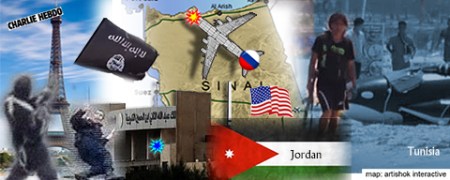
After the Islamic State succeeded in downing a Russian airliner that took off from Sharm El-Sheikh on October 31, causing the deaths of all 224 passengers and crew, the terrorist organization Monday, Nov. 9, put a US military target in its crosshairs. A captain in the Jordanian police opened fire in the cafeteria of the Special Operations Training Center outside the Jordanian capital, Amman, where American instructors train Iraqi troops to fight ISIS. Two trainers from the US and one from South Africa were initially reported killed and another six wounded, including two more Americans and four Jordanians.

A Jordanian government spokesman said later Monday that the number of fatalities had risen to eight, without specifying how many foreigners.

The gunman did not survive. He was variously reported to have committed suicide after the assault or killed by Jordanian troops.

The modus operandi resembled the “green on blue” insider attacks committed in Afghanistan by al Qaeda and Taliban “insiders” against American and British troops serving at the same base.

Jordan’s Al-Rai newspaper identified the shooter as Anwar Abu Ubayd, but other news outlets said his name was Anwar Abu Zaid.

If the downing of the Russian plane rocked the regime of Egyptian President Fattah El-Sisi, there is no doubt that Monday’s attack will shake King Abdullah’s Hashemite throne.

The attack, furthermore, demonstrated that ISIS is rapidly approaching Israel’s borders with Syria in the north, Egypt in the south and Jordan in the east. The assault gained particular attention as it was carried out just hours before the summit Monday between Israeli Prime Minister Binyamin Netanyahu and US President Barack Obama at the White House in Washington.

They met for the first time after more than a year and after a major row over the Iranian nuclear accord. Both leaders made statements strongly indicating that they had determinedly buried the hatchet and were looking to the future of strong and amicable ties and expanded US support for Israel’s security.

A large part of their two-hour conversation was undoubtedly devoted to the threat posed by ISIS, on which they concur.

Until now, Jordan had been home to the most important and secure US forward base for the war on ISIS in Iraq and Syria.  US air strikes come from bases in Turkey, but more than 10,000 ground troops and special operations forces troops are present in Jordan. The kingdom serves as a training, operations and logistical center for US missions in Iraq and Syria, and for that purpose a command center, the US Central Command Forward-Jordan, was established outside Amman.

Until now, ISIS had not managed to infiltrate Jorda for attacks capable of destabilizing Abdullah’s rule. Numerous infiltration and terrorist attacks were thwarted by Jordanian intelligence and security. The Jordanian authorities focused primarily on keeping the jihads out of the refugee camps housing Syrians and Iraqis in flight from war zones, but this came at the expense of efforts to block the threat from reaching inside the Hashemite kingdom and its security facilities.

Their first success will no doubt embolden ISIS to keep on pressing its advantage. Immediately following Monday’s shooting, Jordan’s military went into high alert nationwide and along its borders. The US, Russia, Egypt, Jordan and Israel are all boosting their vigilance as the threat from ISIS continues to grow. But no one can reliably predict where the Islamist terrorists strike next.

Murder as politics

October 24, 2015

Murder as politics, The Washington Times, Louis Rene Beres, October 22, 2015

Even as growing numbers of Palestinian terrorists stab madly at Israeli men, women, and children, much of the world still endorses creation of “Palestine.” Such mindless support continues, moreover, despite the fact that the Palestinians themselves reject any sort of two-state solution. Indeed, the latest such poll (September 2015), conducted by Palestinian research organizations, concluded that almost half the resident Arabs strongly favor the use of armed force and generalized violence against Israeli noncombatants.

For the most part, western news reports notwithstanding, knife wielding attackers are not “lone wolves.” Rather, they have been conspicuously spurred on by vitriolic PA incitements, and by carefully synchronized calls from the mosques to murder “The Jews.”

The Palestinian Authority shares with Hamas the irredentist vision of a one-state solution. There is nothing hidden or ambiguous about this true plan for Israel’s disappearance. It is plainly codified on the official maps of both factions, where Israel is identified only as “Occupied Palestine.”

For virtually all Arab forces in the Middle East, the conflict with Israel is never about land. It is about God, and about always-related promises of personal immortality. It is about power over death.

For the Palestinians, their carefully sanitized public rhetoric notwithstanding, the enemy is not the Israelis (that term is just subterfuge, for the media), but “The Jews.” The screaming young Palestinian, who strikes indiscriminately with his serrated blade, fully expects to become a “martyr.” He only risks “death” in order not to die.

There is more. A Palestinian state — any Palestinian state — would rapidly be taken over by ISIS, or by related jihadi adversaries. Already, ISIS is operating in parts of Syria that could bring it to the critical borders of Israel’s Golan Heights. Significantly, it has also set recognizable operational sights on Jordan and West Bank (Judea/Samaria).

Over the next several months, and even while the Palestinian Authority continues to orchestrate more “Third Intifada” attacks on Israelis, ISIS will commence its fated march westward, across Jordan, ending up at the eastern boundaries of West Bank. These boundaries, of course, would represent the territorial margins of what PA/Fatah both already affirm as the geographic heart of “Palestine.”

Palestinian forces, primarily Fatah, would then yield to ISIS, and to its local proxies. Fatah would then have to choose between pleading with the Jewish State to become an ally against a now-common foe, or abandoning all its residual military operations to the IsraelDefense Forces directly. Arguably, without IDF assistance in such desperate circumstances, “Palestine” wouldn’t stand a chance.

One additional irony ought to be noted. In Israel, Prime Minister Benjamin Netanyahu has long made acceptance of any Palestinian state contingent upon prior Palestinian “demilitarization.” Should the Palestinian Authority and Hamas somehow accede to this problematic expectation, it could make ISIS’ predictable destructions in the area much easier to carry out. Paradoxically, a “Palestine” that had properly stood by its pre-state legal concessions to Israel, could effectively increase the overall danger posed to both Palestinians and Israelis.

What about Jordan? Under pertinent international law, the Hashemite Kingdom has incurred certain binding obligations regarding joint cooperation with Israel against terrorism. These obligations, as reinforcing complements to more generally binding legal rules, are expressly codified at the 1994 Treaty of Peace Between the State of Israel and the Hashemite Kingdom of Jordan.

Could this treaty still have any palpable effect upon Jordan’s capacity to militarily block anticipated ISIS advances?

Not at all. The more generic problem of enforcing treaties had already been identified back in the 17th century, by Thomas Hobbes. Said the English philosopher, in his “Leviathan,” a work well known to America’s founding fathers: “Covenants, without the Sword, are but words …”

From the 17th century onward, the world political system has been anarchic, or, in Hobbesian terms, a “state of nature.” In the anarchic Middle East, especially, considerations of raw power routinely trump international law. Here, too, truth here may be counter-intuitive. On those endlessly perplexing matters concerning Palestinian statehood, for example, it is finally time to understand that “Palestine‘s” true enemy in the region is not Israel, but rather a hideously sordid amalgam of Islamist Arab forces. Going forward, any further Palestinian advances toward statehood would likely be solely to the longer-term tactical advantage of ISIS.

Is this the sort of statehood cause that should be enthusiastically supported in Washington, and in most European capitals? It is, but only if we should first want to see an expansion of “Third Intifada” terror to the homeland. Not likely.

If you like Syria, Iraq, and Afghanistan, you’ll love “Palestine.”

Diplomacy: Looking for ways to douse the spark

October 23, 2015

Diplomacy: Looking for ways to douse the spark, Jerusalem PostHerb Keinon, October 23, 2015

(They “dance around in a ring and suppose, but the secret sits in the middle and knows,” with apologies to Robert Frost. — DM)

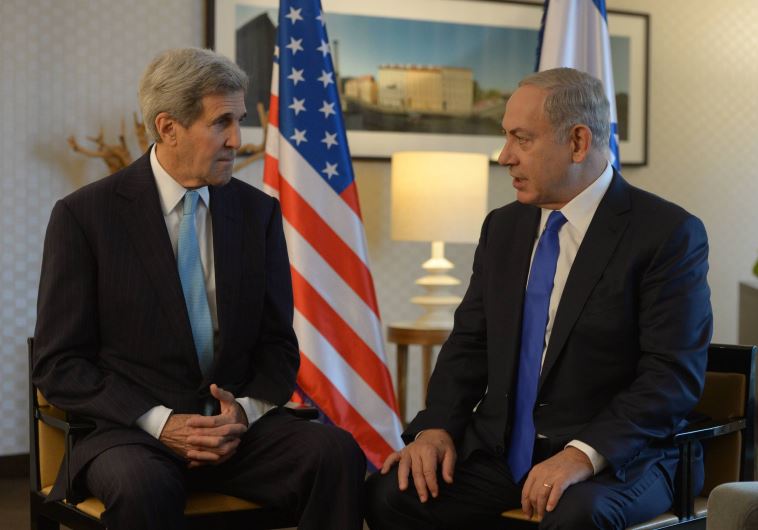
ShowImage (15)Netanyahu and Kerry meeting in Berlin. (photo credit:AMOS BEN-GERSHOM/GPO)

And now the diplomatic dance begins, again.

After three weeks of runaway terrorism on the streets, UN Secretary-General Ban Ki-moon arrived for a quick visit midweek; US Secretary of State John Kerry – after meeting with Prime Minister Benjamin Netanyahu on Thursday in Berlin – is expected to meet on Saturday with Palestinian Authority President Mahmoud Abbas in Amman, along with Jordan’s King Hussein; EU foreign policy chief Federica Mogherini is doing the same; and the French are floating various proposals to take to the UN Security Council.

All predictable, all the traditional steps taken in a time of Mideast crisis.

Ban did what Ban does in these situations – he comes, meets with both sides, issues platitudes about the need for both sides to show restraint, and declares how important it is to keep that light of hope burning.

The UN secretary-general dutifully fulfilled his role in the script. Netanyahu obliged by meeting politely with Ban, who then went on to meet politely with Abbas, to what appears to be absolutely no effect. It’s a dance whose steps – and way of ending – are known far in advance.

Jerusalem does not take Ban’s efforts overseriously, as the organization that he heads is seen as a big part of the problem rather than the solution.

Witness Wednesday’s one-sided resolution adopted by UNESCO, the UN’s cultural heritage agency, condemning “Israeli aggression” on the Temple Mount and declaring that the Jewish holy sites of Rachel’s Tomb and the Cave of the Patriarchs are an “integral part of Palestine.”

Similar disdain, to a certain extent, characterizes Israel’s view of the EU’s efforts. Netanyahu will listen to Mogherini, and lament both Abbas’s incitement and the EU’s acceptance of it, but will place little stock in the EU’s ability to play a constructive role in calming down the situation.

Brussels is not seen in Jerusalem as a particularly honest broker on all things Palestinian but, rather, as the institution that nurtures – perhaps more than any other – the hope among the Palestinians that if they press long enough and hard enough, the international community will deliver to them what they publicly say they want: a Palestinian state along the pre-1967 borders with east Jerusalem as its capital, and some kind of “fair and just” accommodation for the refugees.

The very skeptical Israeli view of the EU in any diplomatic process is reinforced by steps taken by France, which this week considered bringing a resolution to the UN Security Council to place international observers on the Temple Mount.

This idea, which Israel would never accept, and which even Jordan and the Palestinians have apparently rejected, is born of a burning French diplomatic desire to always do something, anything, in the Mideast – especially when there seems to be a stalemate or vacuum.

It is also the product of sour relations currently prevailing between Paris and Jerusalem, as well as a lingering French hope for the internationalization of Jerusalem – for the establishment of a corpus separatum in Jerusalem under a special international regime – which France hopes to be a part of.

So with the UN out, the EU out, and France out, that leaves the US.

But it is not as if Jerusalem is harboring any hopes that Kerry will be able to ride in and save the day.

From Jerusalem’s perspective the US track record in the region is not sterling, and though it appreciates Washington’s desire to help, there is little illusion that high-profile, high-level meetings will have any immediate effect on the ground.

And while Jerusalem is not waiting for Kerry with baited breath, it was clear from the beginning that he would get involved. An uptick in terrorism and violence leads to a well-worn pattern in Washington: condemnations of the terrorism, then statements that anger Israel about proportionality or settlements, followed by calls for restraint on both sides, and then meetings with the leaders.

But this current spurt of terrorism and violence is different from previous rounds, in that there is no identifiable organization – such as Hamas and Fatah’s Tanzim militia – to hold directly responsible for the bloodshed. This time it is more amorphous, individual terrorists incited by calls for Jewish blood on Facebook and from various leaders, going out to kill Jews.

The lack of a clear organizational structure behind the terrorism makes it more difficult for the security services to stop, because it is much more difficult to gather intelligence on an individual who grabs a knife and goes out to kill than on attacks directed by an organization.

Also, there is not one person seemingly in control who may be pressured to cease the violence.

It is not as if Kerry can talk to Abbas and convince him to issue a call to his people to “hold your horses,” and the horses will obediently be held. Abbas does not have anything near that type of control – many of the horses simply do not heed him.

This time around, thankfully, neither the State Department nor Kerry are inflating expectations; they are not talking about Kerry’s separate meeting with the leaders as a potential breakthrough for restarting the diplomatic talks and bringing a peace deal in a number of months.

Washington, it should be remembered, is still engaged in its own Mideast policy reassessment, a policy reassessment brought about after the breakdown of the Kerry-led peace talks in April 2014, and re-announced after Netanyahu’s preelection statement – which he later retracted – of less than full fealty to the notion of a two-state solution.

Rather, this time the bar has been set low, with the goals very limited.

State Department spokesman John Kirby said on Wednesday that the meetings would deal with “practical ways in which political breathing space can be had to help end the violence.”

No overreaching there, just looking for breathing space. The breathing space that Kirby mentioned but did not elaborate upon is likely to be an attempt – in discussions with Netanyahu, Abbas and especially Jordan’s King Abdullah – to come up with a clear set of procedures for governing the Temple Mount.

The Temple Mount has – like so many times over the last century – been the spark to violence against Jews. To douse the fire, there will be some need to deal with the spark, but this has to be done in a way where both Israel and the Palestinians can say that they have not given in.

In recent days Kerry has spoken about the need for clarity. Everyone talks about the status quo on the Temple Mount, but there is little understanding of what that entails.

“Israel understands the importance of the status quo and… our objective is to make sure that everyone understands what that means,” Kerry said at press conference on Monday in Madrid, adding that “we are not seeking a new change or outsiders to come in; I don’t think Israel or Jordan wants that, and we’re not proposing it. What we need is clarity.”

The new “clarity” is expected to involve enhanced coordination and cooperation with Jordan, possibly even more Jordanian representatives on the site, in such a way as to undercut the spurious charge that Israel is somehow threatening al-Aksa Mosque.

Former National Security Council head Yaakov Amidror said in an Israel Radio interview this week that he had little expectation regarding Kerry’s meeting with Netanyahu or Abbas, because the US has little impact on the Palestinians – which is true.

But the US does have leverage on Jordan, and this leverage may now be needed to get Abdullah to take a greater role in day-to- day administration and involvement at the site – if only as a way to suck the oxygen out of the lie propelling the current round of terrorism: that Israel is endangering al-Aksa.

Jordanian Writer: Arafat, The Knives Stabbed Into The Israelis’ Heads Are The Fruit Of Your Revolution

October 16, 2015

Jordanian Writer: Arafat, The Knives Stabbed Into The Israelis’ Heads Are The Fruit Of Your Revolution, Middle East Media Research Institute, October 16, 2015

(A Jordanian writer’s paean to the patron saint of Palestinian terrorists. — DM)

Against the backdrop of the current wave of Palestinian attacks on Israelis in Jerusalem, the West Bank, and other parts of Israel, Jordanian writer Abd Al-Hadi Raji Al-Majali wrote in the Jordanian government daily Al-Rai of his yearning for Yasser Arafat. He stated that Arafat’s influence continued to this day in Palestine, and added that even from the grave he had the power to lead the third intifada and defeat Israel.

Addressing Arafat, Al-Majali said that the seeds of his revolution had borne fruit, since today’s Palestinian youth are leading this uprising and this “revolution of the knives.”

The following are excerpts from the article, which was published October 15, 2015: 

25300

Al-Rai

“When you see the sights in Palestine, you recall the martyr Yasser Arafat. He seems to be monitoring, from Ramallah, the river of Palestinian blood and the new generation of young people that has invented the revolution of the knives. I still remember all his statements, every word of his, how he would rage and grasp his kaffiyeh with his right hand and rearrange it… I remember his khakis… the medals, the flag of Palestine, the gray whiskers on his face, his lips trembling in anger when an interviewer annoyed him.

“This is not just a revolution, but also the blood of Arafat, who [still] rouses the Palestinian blood; even Arafat’s grave energizes the Arabness of the Palestinian land… When I see in the Palestinian arena a new generation of young people – of whom Arafat spoke at length, [as he] dreamed of the day that they would fly the Palestinian flag above the walls of Jerusalem – I imagine that the man is still in Ramallah; that he is instructing [us] to care for the families of the martyrs; that he still makes the decisions and leads a diplomatic effort; that  his companions are bringing him his pistol; that the documents are piling up in his office; that he just now finished breakfast… and that he just now issued a secret revolutionary order to be carried out by the factions. He is the main expert in the tactic of revolution, and he knows how to disturb the sleep [of the Israelis].

“Mr. President, the dew still moistens the dust of your grave, and the birds circle above it, perhaps even bringing you messages and news. The stones [on your grave], sir, have left their place temporarily – [how else] would they enable the sun to peek through, or the air to seep in?

“Oh you who rest in Ramallah, trust and be sure that in the Palestinian dictionary there is no one who is pleased with the current situation. It is you who compiled this dictionary, formulating every word, and every revolution since the Palestinians began to pick up the rifle. Rest assured, the flowers and the lion cubs [i.e. the young Palestinian women and men] of whom you spoke are now the vanguard in the arena, and [it is they who are leading] the stabbing of the heads [of the Israelis], which is the only thing that will satisfy the will of Palestine.

“I cannot imagine a revolution of which you are not a part… and I cannot conceive of the occupation army’s defeat without you planning its details.

“Oh you who rest in Ramallah, it is now your privilege to smile a bit, because the seeds of the revolution that you sowed in the land of Palestine are now sprouting our sharp knives, and their blades are [stabbing] the head and the vein [of the Israelis].

“Oh you who rest in Ramallah, I am sending you regards from Kerak [in Jordan], and I understand that even from your grave you are capable of leading the third intifada. [The Israelis] may besiege your grave as they besieged you in the capitals and in your seat in Ramallah – but this intifada will launch a new turn, the thrust of which is that the graves are triumphant.

“Your grave will defeat Israel, Mr. President.”

The day after the deal

August 9, 2015

The day after the deal, Israel Hayom, Prof. Eyal Zisser, August 9, 2015

(Please see also, Russia and US woo Saudis to help save Assad – albeit putting Israel and Jordan in danger from S. Syria.– DM)

[Soleimani] wanted Russia and Iran to agree on the division of the Middle East in a way that would serve their clients in the region (among them, Assad) and check their joint enemies (the Islamic State). After figuring that out, they probably moved on to the next topic: how to marginalize America in the region. As a means to both ends, Russia will continue to serve as Assad’s protector (despite his many crimes), all the while providing Iran with international backing. But above all it will send arms to Iran, to the Syrian regime, and if needed, to Hezbollah.

***********************

Over the weekend it transpired that Maj. Gen. Ghasem Soleimani, the commander of Iran’s Quds Force, had visited Moscow two weeks ago and met with President Vladimir Putin. The Quds Force, in case you forgot, is in charge of the Iranian Revolutionary Guards’ clandestine operations (including terrorism). The Quds Force is responsible for providing aid to Hezbollah and Hamas as well as to Syrian President Bashar Assad and the Houthi rebels in Yemen. In light of his direct involvement in terrorism, the international community imposed sanctions on Soleimani, including travel restrictions.

Only last week, at a hearing on Capitol Hill, U.S. Secretary of State John Kerry vowed that the U.S. will make sure the sanctions on Soleimani would stay in effect and that the Obama administration would counter Iran’s efforts to destabilize the Middle East. But no one takes Kerry seriously anymore. While Kerry continues to engage Iran’s unimportant Foreign Minister Mohammad Javad Zarif, the real wheeling and dealing is actually in Moscow.

Soleimani did not go to Moscow because he had tickets to the Bolshoi. Rather, he arrived because he wanted to discuss “the day after the nuclear deal” with Putin. Namely, he wanted Russia and Iran to agree on the division of the Middle East in a way that would serve their clients in the region (among them, Assad) and check their joint enemies (the Islamic State). After figuring that out, they probably moved on to the next topic: how to marginalize America in the region. As a means to both ends, Russia will continue to serve as Assad’s protector (despite his many crimes), all the while providing Iran with international backing. But above all it will send arms to Iran, to the Syrian regime, and if needed, to Hezbollah.

The Russians, unlike the Iranians, don’t consider Israel to be an enemy state. But as a famous Russian official once said: “When you chop wood, chips fly.” Israel has become the latest chip — the collateral damage. Soleimani’s visit is just the tip of iceberg. It shed light on the not-so-secret deals that are being negotiated in the wake of the “Vienna nuclear agreement.” Europe, as usual, is focused on profit and its corporate executives are already traveling in droves to Tehran to ink deals. There are also political deals Iran wants to secure, which are as important for Tehran. Their price, however, will be measured in blood rather than in euros or dollars.

No one in the Middle East, it seems, is keen on parsing each and every provision in the nuclear deal. Nor is there an attempt to see whether, in the grand scheme of things, it is will have been a worthwhile endeavor some 10 or 15 years from now, when its key elements expire. In this region, what counts is the way this agreement is perceived here and now — and what really matters to people is the way it is portrayed in the media. Under that criteria, Iran is the victor and America is the vanquished, because it caved to Iran. The deal, according to how the media has portrayed it, is a crushing political blow to Israel and the moderate Arab states, led by Saudi Arabia.

This knockout victory will likely produce a new Iranian-American partnership. At the very least, the two nations will mend fences. This will alienate many of Washington’s clients, who will have to look elsewhere for a more reliable ally. Egypt and the Saudis have already realized this and turned to Russia for aid and arms, figuring it would be more trustworthy than the “staff of this broken reed” (Isaiah 36:6).

Saudi Arabia is reportedly sending feelers to see if there is a deal to be had with Russia and Iran. Under the terms of the proposed deal, Saudi Arabia would withhold aid to the Syrian rebels if Iran ends its rogue presence in the state. Such a deal would secure Assad a victory over the insurgents, or a least ensure his regime survives.

The ongoing developments have caused panic, but not over the rising clout of Iran and Russia. The White House, it seems, is fretting over the possibility that Congress may vote against the Iran deal and further tarnish Obama’s image.

Russia and US woo Saudis to help save Assad – albeit putting Israel and Jordan in danger from S. Syria

August 9, 2015

Russia and US woo Saudis to help save Assad – albeit putting Israel and Jordan in danger from S. Syria, DEBKAfile, August 9, 2015

Lavrov_Kerry_and_al-Jubeir-_Doha_3.8.15Lavrov, Kerry, Al-Jubeir at Doha

[N]either Israel nor Jordan has been co-opted to this big power initiative, as though they are not concerned. However, both have a big stake in Saudi Arabia’s next decisions. If Riyadh is won over by US-Russian blandishments and goes back on its decision to boycott Assad, the Saudi-Israeli-Jordanian effort to support Syrian rebel control of southern Syria will fall apart. This will open up both countries to new perils on their  northern borders.

************************

Building on the nuclear accord signed in Vienna last month, the Obama administration has been in close communion with Moscow and Tehran on regional moves to save the Assad regime, as the key to their next regional policies, including a united front against the Islamic State.. Saudi Arabia and its Gulf partners are being assiduously wooed to join the new alignment being set up for this purpose. The live wire in getting them all together is Omani Foreign Minister Khalid bin Mohamed Al-Attiyah, the secret broker who brought Iran and the United States to the negotiating table for a nuclear accord. This was first reported in the last DEBKA Weekly.

Wednesday, Aug. 7, Obama threw out his first hint on this development: “The window has opened a crack for us to get a political resolution in Syria, partly because both Russia and Iran, I think, recognize that the trend lines are not good for Assad,” he said. “Neither of those patrons are particularly sentimental; they don’t seem concerned about the humanitarian disaster that’s been wrought by Assad and this conflict over the last several years, but they are concerned about the potential collapse of the Syrian state. And that means, I think, the prospect of more serious discussions than we’ve had in the past.”

The US president then affirmed more strongly in a CNN interview Sunday, Aug. 9:  “Is there the possibility that having begun conversations around this narrow issue [the nuclear accord with Iran] that you start getting some broader discussions about Syria, for example, and the ability of all the parties involved to try to arrive at a political transition that keeps the country intact and does not further fuel the growth of ISIL and other terrorist organizations? I think that’s possible,” Obama said. “But I don’t think it happens immediately.”

The administration and its prospective partners are united by the will to destroy ISIS – in its Syrian stronghold, for starters – but are divided on much else, DEBKA file reports. And so the process is moving forward in careful steps.

Their initial focus is on Syria, the bloody battleground which in less than five years has left at least 300,000 dead and more than 10 million people homeless.

The plan the group started out with in the last ten days was a swap as simple as it was ruthless: Saudi Arabia and the United Arab Emirates would slow their assistance to Syrian rebel groups, against whom President Bashar Assad’s army and allies would hold their fire; Iran, for its part, was to start withdrawing its support from the Yemeni Houthis insurgents.

The informal truce in Syria would be the stage for the Assad regime and rebel groups to start discussing a new government with room for opposition parties. The Islamists of the Islamic State and Al Qaeda’s Nusra Front would not be invited.

In Yemen, Tehran would cut back on the arms and intelligence which have enabled the Houthi insurgents to stand up to the combined forces of Saudi Arabia, the UAE and Egypt. The pro-Western Yemeni President Abd Rabo Mansour Hadi would be restored to his palace in Sanaa and invite the insurgent leader, Abdu Malik Al-Houthi, to discuss his partnership in a new government.

This deal was tantamount to a joint US-Russian guarantee of Bashar Assad survival in power in return for a Tehran-Riyadh compact for Hadi’s reinstatement in Sanaa.

These arrangements were debated back and forth in exchanges, some semi-secret, among the leading actors for most of July. The visit to Riyadh of the Syrian intelligence chief Maj. Gen. Ali Mamlouk was set up by Moscow as a major push forward.

The plan was for the entire enterprise to be brought out in the open and sealed in Doha, Qatar, Tuesday, Aug. 3 at a conference attended by US Secretary of State John Kerry, Russian Foreign Minister Sergey Lavrov, Saudi Foreign Minister Adel Al-Jubeir and other top Gulf diplomats.

Iranian Foreign Minister Mohammed Javad Zarif was not there. But he put a strong oar into the proceedings by calling in at Muscat, Oman the day before the conference and subsequently on Friday Aug. 7. Assad also kept his hand in by sending his foreign minister Walid Moallem to Tehran and Muscat last week.

But then, at Doha, just as the package was ready to unveil, the Saudi foreign minister pulled away and blew it up with two provisions: a) Riyadh would not countenance Bashar Assad being allowed to stay in office, and: b) Saudi Arabia would not do business with any representative of the Assad regime.

This put a large spoke in the main wheel of the initiative and also scuttled some of the secondary plans depending on it.

But by then, a lot was happening in the Yemeni and Syrian war arenas:

1. Saudi and UAE armored forces had landed in Aden and were closing in on the Yemeni capital, Sanaa. The Houthi rebels, trained and armed by Iran, were forced to retreat without negotiations on their future role in government.

2. Syrian rebel leaders, sensing the approaching betrayal, sent a secret delegation to Tehran to discuss terms for opening negotiations with Assad. They too were left at sea about the deals in play among Washington, Moscow, Tehran and Riyadh over their future.

Saturday, Aug.8, the Russians, egged on by the Americans, set about winning Riyadh into the fold, Foreign Minister Al-Jubeir was invited to pay a visit to Moscow Tuesday, Aug. 11, for talks about the Syrian conflict and the war on the Islamic State.

Refusing to accept that the new initiative had been grounded in Doha, Moscow presented the visit as continuing the ongoing dialogue on the issues raised at that encounter.

DEBKAfile’s military and intelligence sources note that neither Israel nor Jordan has been co-opted to this big power initiative, as though they are not concerned. However, both have a big stake in Saudi Arabia’s next decisions. If Riyadh is won over by US-Russian blandishments and goes back on its decision to boycott Assad, the Saudi-Israeli-Jordanian effort to support Syrian rebel control of southern Syria will fall apart. This will open up both countries to new perils on their  northern borders.

Jordan launches war on ISIS in Iraq, Turkish warplanes hit ISIS in Syria. US, Israel involved in both ops

July 24, 2015

Jordan launches war on ISIS in Iraq, Turkish warplanes hit ISIS in Syria. US, Israel involved in both ops, DEBKAfile, July 24, 2015

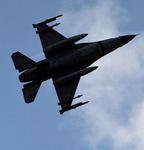
ISIS_24.7.15F-16 warplane in action against ISIS

The Middle East woke up Friday, July 24, to two new full-fledged wars launched by Jordan and Turkey for cutting down the Islamic State of Iraq and the Levant as is forces advanced on their borders. The United States and Israel are involved in both campaigns. Jordanian armored, commando and air forces are already operating deep inside Iraq, while Friday morning, Turkey conducted its first cross-border air strike against ISIS targets in Syria. Clashes between Turkish troops and Islamic fighters erupted at several points along the border. Both governments also conducted mass arrests of suspected Islamists. The Jordanian police picked up ISIS adherents, while 5,000 Turkish police detained 250 Islamist and outlawed Kurdish PKK suspects in Istanbul, Ankara, Izmir and Saniurta. Jordan Friday shut down its only border crossing with Iraq.

Earlier this week, Turkey permitted US warplanes to us the Incirlik air base in the south for bombing missions against ISIS, and Israel handed over to Jordan 16 Cobra combat helicopters and assured Jordan of air force cover for its anti-ISIS operation.

Read more about this new chapter in the war on ISIS in the DEBKAfile report of Thursday, July 23.

In the first publicized Israeli military hardware transaction with an Arab nation, Israel has handed over “around 16 Cobra” combat helicopters in support of Jordan’s war on the Islamic State. This was confirmed Thursday, July 23, by a US official close to the transfer. It was also the first time US-Jordanian-Israeli military cooperation in the struggle against ISIS was publicly disclosed.

“These choppers are for border security,” said the unnamed US official.DEBKAfile’s military and counter-terror sources disclose that the Cobras are needed for a large-scale Jordanian aerial-commando operation launched in the western Iraqi province of Anbar, which borders on the Hashemite Kingdom. This operation is designed to carve out a security belt tens of kilometers deep inside Iraq as a barrier against Islamic State’s encroachment.

Amman approached Washington for combat helicopters to back the operation and was told that the US is short of these items and would turn Israel to pitch in. The US first provided mechanical overhauls for the aircraft before they were incorporated free of charge in Jordan’s existing Cobra fleet.

The transfer was announced while US Defense Secretary Ashton Carter was touring the Middle East. He arrived in Amman Tuesday, July 21,after talks in Israel, and visited Baghdad unannounced Thursday, July 23 for an update on the war on ISIS

The mounting Islamist threat to Jordan is coming now from two directions – the Iraqi province of Anbar and  Syria. ISIS forces have grabbed positions in southern Syria near the intersection of the Jordanian, Iraqi and Syrian borders. They have also moved up to the eastern Syrian town of Abu Kamal on the Iraqi border and, since mid-May, have gradually detached small groups from the captured central Syrian town of Palmyra and quietly built up positions in the south near Jabal Druze.

This buildup has been tracked by US, Jordanian and Israeli surveillance.

The Islamist domestic threat to the Hashemite Kingdom is no less acute. Jihadist sleeper cells have been planted in Jordan ready to strike strategic targets for a reign of terror to coincide with the onset of external Islamic State attacks staged from Iraq and Syria.

Our military sources report that US-Israeli-Jordanian cooperation is channeled through the US Central Command Forward-Jordan from its headquarters north of Amman. It is staffed by US, British, Jordanian, Saudi and Israeli officers working together to defeat ISIS.

Israel gives Jordan 16 Cobra helicopters to fight ISIS – with US approval

July 23, 2015

Israel gives Jordan 16 Cobra helicopters to fight ISIS – with US approval, DEBKAfile, July 23, 2015

IAF_CobraCobra combat helicopter

In the first publicized Israeli military hardware transaction with an Arab nation, Israel has handed over “around 16 Cobra” combat helicopters in support of Jordan’s war on the Islamic State. This was confirmed Thursday, July 23, by a US official close to the transfer. It was also the first time US-Jordanian-Israeli military cooperation in the struggle against ISIS was publicly disclosed.

“These choppers are for border security,” said the unnamed US official. DEBKAfile’s military and counter-terror sources disclose that the Cobras are needed for a large-scale Jordanian aerial-commando operation launched in the western Iraqi province of Anbar, which borders on the Hashemite Kingdom. This operation is designed to carve out a security belt tens of kilometers deep inside Iraq as a barrier against Islamic State’s encroachment.

Amman approached Washington for combat helicopters to back the operation and was told that the US is short of these items and would turn Israel to pitch in. The US first provided mechanical overhauls for the aircraft before they were incorporated free of charge in Jordan’s existing Cobra fleet.

The transfer was announced while US Defense Secretary Ashton Carter was touring the Middle East. He arrived in Amman Tuesday, July 21,after talks in Israel, and visited Baghdad unannounced Thursday, July 23 for an update on the war on ISIS

The mounting Islamist threat to Jordan is coming now from two directions – the Iraqi province of Anbar and  Syria. ISIS forces have grabbed positions in southern Syria near the intersection of the Jordanian, Iraqi and Syrian borders. They have also moved up to the eastern Syrian town of Abu Kamal on the Iraqi border and, since mid-May, have gradually detached small groups from the captured central Syrian town of Palmyra and quietly built up positions in the south near Jabal Druze.

This buildup has been tracked by US, Jordanian and Israeli surveillance.

The Islamist domestic threat to the Hashemite Kingdom is no less acute. Jihadist sleeper cells have been planted in Jordan ready to strike strategic targets for a reign of terror to coincide with the onset of external Islamic State attacks staged from Iraq and Syria.

Our military sources report that US-Israeli-Jordanian cooperation is channeled through the US Central Command Forward-Jordan from its headquarters north of Amman. It is staffed by US, British, Jordanian, Saudi and Israeli officers working together to defeat ISIS.

Goodnight Vienna (12)

July 13, 2015

Goodnight Vienna (12)Scott Johnson, July 13, 2015

The new Iranian demand to lift the United Nations arms embargo is getting a lot of talk, and probably a bit more than it deserves. It’s not that the concession wouldn’t be devastating – it would light up the region in so many different ways that they’re difficult to catalogue – but it just doesn’t seem possible that the Americans can give ground on this.

*********************

As we remain on the final countdown to the full catastrophe taking place in Vienna, Omri Ceren helps us keep track of the details. In his second email update this morning, Omri draws attention to Andrew Bowen’s Daily Beast column Give the mullahs ballistic missiles?” (quoted below). Omri writes:

The last few hours have been a flurry of bilateral and trilateral meetings – Kerry/Zarif, Kerry/Zarif/Mogherini, Hammond/Lavrov, Lavrov/Zarif, etc – and a full P5+1/Iran meeting will probably take place this evening. That plenary is presumably supposed to serve as something of a final meeting: the negotiators will send the deal text back to the capitals, they’ll get pro forma approval, and in the morning there will be a formal announcement.

In the meantime, the new Iranian demand to lift the United Nations arms embargo is getting a lot of talk, and probably a bit more than it deserves. It’s not that the concession wouldn’t be devastating – it would light up the region in so many different ways that they’re difficult to catalogue – but it just doesn’t seem possible that the Americans can give ground on this. What’s the sales pitch to Congress going to be? “Not only are we giving Iran $150 billion to bolster its military, but we’re also lifting arms restrictions to make it easier for them to buy next-generation cruise missiles they’ll use against the U.S. military and our allies.”

But just for the sake of argument, because some pro-Iran voices have taken to publicly suggesting otherwise, yes of course lifting the arms embargo would detonate American national security:

Rather, the real threat from increased Iranian military might lies elsewhere. The Islamic Revolutionary Guard Corps (IRGC)… does not hesitate to remind the world through its harassment of commercial shipping, military exercises, and frequent rhetoric that it can control or shut the Strait of Hormuz, through which 30 percent of the world’s petroleum supplies passes. Keeping the Strait open depends on the U.S. Navy being able to keep up with effective counter measures against improved Iranian cruise missiles… and so Tehran has invested in weapons such as cruise missiles, mines, submarines, and even swarming armed speedboats to specifically target U.S. naval vulnerabilities… Lifting the conventional arms embargo would allow Russia or China to sell Iran the latest generation cruise missiles and drones, which only increase Tehran’s ability to frustrate or harass America’s protectorate of this vital waterway… Moreover, Iranian ballistic missiles outfitted with Russian or Chinese quality precision-guidance munitions could be devastating for U.S. and GCC naval and air bases if there are further relaxations on Iran’s acquisition of missile technology.

The article is by Andrew Bowen, the Director of Middle East Studies at the Center for the National Interest. He goes on to list several other ways Iran would exploit lifting the arms embargo, including by providing advanced missiles to terror proxies to use against U.S. allies such as Israel and Jordan.

The demand is so delusional that some people are speculating the Iranians just brought it up to gain leverage. Whether that’s true or not, the stunt will make it more difficult for the Obama administration to justify the deal to Congress. If Kerry agrees to drop the arms embargo, it’s difficult to see Congress accepting the agreement. If Kerry gets the Iranians to give up on the the demand, Congress will want to know what he had to trade away to do it.

Israeli deterrence in the eye of the hurricane

July 12, 2015

Israeli deterrence in the eye of the hurricane, Jerusalem PostLouis Rene Beres, July 12, 2015

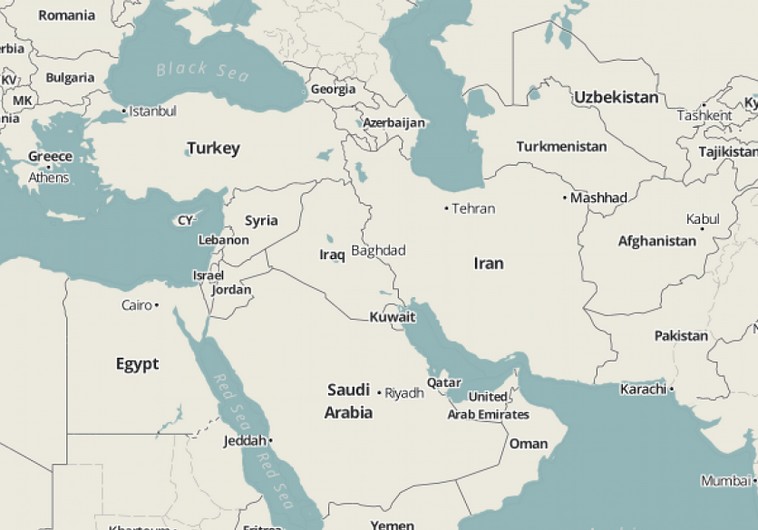
ShowImage (1)Map of Middle East. (photo credit:Courtesy)

Everything is very simple in war, but the simplest thing is difficult.”
– Carl von Clausewitz, On War

To prevent a nuclear war amid steadily growing regional chaos, especially as Iran will soon be fully nuclear (and the grateful beneficiary of US President Barack Obama’s pretend P5+1 diplomacy), Israel will need suitably complementary conventional and nuclear deterrents.

**********************

Left to themselves, especially as more “normal” hostilities dissolve into a full-blown regional chaos, Israel’s adversaries could drive the Jewish state toward an unconventional war. This fateful endangerment could be produced singly or collaboratively, by deliberate enemy intent or by the “collateral damage” of sectarian strife. Militarily, these Islamic adversaries of Israel, both Sunni and Shi’ite, could be either non-nuclear, or, in the future, nuclear.

They might also include certain wellarmed sub-state or terrorist forces. Already, Iranian-backed Hezbollah may have more usable missiles than all NATO countries combined.

To most effectively deal with such interpenetrating threats – including reasonably expected “synergies” and “force multipliers” – Israel’s leaders will first need to consider some largely-opaque factors. These include: 1) probable effects of regional chaos upon enemy rationality; 2) disruptive implications of impending Palestinian statehood; and 3) re-emergence of a corrosively Cold War-style polarity between Russia and the United States. Apropos of a “Cold War II,” there is already evidence of growing contact between Russia and Saudi Arabia, the world’s two largest oil producers.

In essence, Jerusalem must take all necessary steps to successfully manage an expectedly unprecedented level of adversarial complexity and weaponization. Israel’s leaders, in this connection, must take proper measures to ensure that any conceivable failures of its national deterrent would not spark biological or nuclear forms of regional conflict. To accomplish this indispensable goal, the IDF, inter alia, must continue to plan carefully around the core understanding that nuclear deterrence and conventional deterrence are inherently interrelated and meaningfully “seamless.”

Sometimes, in strategic matters, seeing requires distance. A nuclear war in the Middle East is not beyond possibility. This is a sensible assessment even if Israel were to remain the only nuclear weapons state in the region.

How is this possible? A bellum atomicum could come to Israel not only as a “bolt from the blue” enemy nuclear attack (either by a state or by a terrorist group), but also as the result, intended or otherwise, of certain uncontrolled military escalations.

Needed prudence in such narratives calls for additional specificity and precision. If particular Arab/Islamic enemy states were to launch conventional attacks upon Israel, Jerusalem could then respond, sooner or later, with calculated and more-or-less calibrated nuclear reprisals. Alternatively, if some of these enemy states were to launch large-scale conventional attacks, Jerusalem’s own still-conventional reprisals could then be met, perhaps even in the not-too-distant future, with enemy nuclear counterstrikes.

How should Israel prepare for such perilous contingencies? More than likely, Israel has already rejected any doctrinal plans for fielding a tactical/theater nuclear force, and for assuming any corollary nuclear war fighting postures. It would follow further from any such well-reasoned rejection that Israel should do whatever is needed to maintain a credible conventional deterrent.

By definition, such a measured threat option could then function reliably across the entire foreseeable spectrum of non-nuclear threats.

Still, any such strategy would need to include an appropriately complementary nuclear deterrent, a distinctly “last resort” option that could display a “counter-value” (counter-city) mission function. Si vis pacem, para bellum atomicum: “If you want peace, prepare for atomic war.”

A persuasive Israeli conventional deterrent, at least to the extent that it might prevent a wide range of enemy conventional attacks in the first place, could reduce Israel’s growing risk of escalatory exposure to nuclear war. In the always arcane lexicon of nuclear strategy, a complex language that more-or-less intentionally mirrors the tangled coordinates of atomic war, Israel will need to maintain firm control of “escalation dominance.” Otherwise, the Jewish state could find itself engaged in an elaborate but ultimately lethal pantomime of international bluster and bravado.

The reason for Israel’s obligation to control escalatory processes is conspicuous and unassailable. It is that Jerusalem’s main enemies possess something that Israel can plainly never have: Mass.

At some point, as nineteenth century Prussian military thinker Carl von Clausewitz asserts in On War: “Mass counts.”

Today, this is true even though Israel’s many enemies are in chaotic disarray. Now, amid what Clausewitz had famously called “friction” and the “fog of war,” it could become harder for Israel to determine real and pertinent differences between its allies, and its adversaries.

As an example, Jordan could soon become vulnerable to advancing IS forces.

Acknowledging this new vulnerability, an ironic question will come immediately to mind: Should Israel support the Jordanian monarchy in such a fight? And if so, in what specific and safe operational forms? Similarly ironic questions may need to be raised about Egypt, where the return to military dictatorship in the midst of surrounding Islamist chaos could eventually prove both fragile and transient.

Should President Abdel Fattah Sisi fail to hold things together, the ultimate victors could be not only the country’s own Muslim Brotherhood, but also, in nearby Gaza, Palestinian Hamas. Seemingly, however, Hamas is already being targeted by Islamic State, a potentially remorseless opposition suggesting, inter alia, that the principal impediment to Palestinian statehood is not really Israel, but another Sunni Arab terrorist organization. Of course, it is not entirely out of the question that IS’s Egyptian offshoot, the so-called “Sinai Province of Islamic State,” could sometime decide to cooperate with Hamas – the Islamic Resistance Movement – rather than plan to it.

To further underscore the area’s multiple and cross-cutting axes of conflict, it is now altogether possible that if an IS conquest of Sinai should spread to Gaza, President Sisi might then “invite” the IDF to strike on Egypt’s behalf. Among other concerns, Egypt plainly fears that any prolonged inter-terrorist campaign inside Gaza could lead to a literal breaking down of border fences, and an uncontrolled mass flight of Palestinians into neighboring Sinai.

Credo quia absurdum. “I believe because it is absurd.” With such peculiar facts in mind, why should Israel now sustain a conventional deterrent at all? Wouldn’t enemy states, at least those that were consistently rational, steadfastly resist launching any conventional attacks upon Israel, for fear of inciting a nuclear reprisal? Here is a plausible answer: suspecting that Israel would cross the nuclear threshold only in extraordinary circumstances, these national foes could be convinced, rightly or wrongly, that as long as their initial attacks were to remain conventional, Israel’s response would remain reciprocally non-nuclear. By simple extrapolation, this means that the only genuinely effective way for Israel to continually deter large-scale conventional war could be by maintaining visibly capable and secure conventional options.

As for Israel’s principal non-state adversaries, including Shi’ite Hezbollah and Sunni IS, their own belligerent calculations would be detached from any assessments of Israeli nuclear capacity and intent. After all, whatever attacks they might sometime decide to consider launching against the Jewish state, there could never be any decipherable nuclear response.

Nonetheless, these non-state jihadist foes are now arguably more threatening to Israel than most enemy national armies, including the regular armed forces of Israel’s most traditional enemies – Egypt, Jordan and Syria.

Some other noteworthy nuances now warrant mention. Any still-rational Arab/ Islamic enemy states considering firststrike attacks against Israel using chemical and/or biological weapons would likely take Israel’s nuclear deterrent more seriously. But a strong conventional capability would still be needed by Israel to deter or to preempt certain less destructive conventional attacks, strikes that could escalate quickly and unpredictably to assorted forms of unconventional war.

If Arab/Islamic enemy states did not perceive any Israeli sense of expanding conventional force weakness, these belligerent countries, now animated by credible expectations of an Israeli unwillingness to escalate to nonconventional weapons, could be more encouraged to attack. The net result here could be: 1) defeat of Israel in a conventional war; 2) defeat of Israel in an unconventional (chemical/biological/ nuclear) war; 3) defeat of Israel in a combined conventional/unconventional war; or 4) defeat of Arab/Islamic enemy states by Israel in an unconventional war.

For Israel, even the presumptively “successful” fourth possibility could prove too costly.

Perceptions are vitally important in all calculations of nuclear deterrence. By continuing to keep every element of its nuclear armaments and doctrine “opaque,” Israel could unwittingly contribute to the injurious impression among its regional enemies that Jerusalem’s nuclear weapons were unusable. Unconvinced of Israel’s willingness to actually employ its nuclear weapons, these enemies could then decide to accept the cost-effectiveness of striking first.

With any such acceptance, Israeli nuclear deterrence will have failed.

If enemy states should turn out to be correct in their calculations, Israel could find itself overrun, and thereby rendered subject to potentially existential harms.

If they had been incorrect, many states in the region, including even Israel, could eventually suffer the assorted consequences of multiple nuclear weapons detonations. Within the directly affected areas, thermal radiation, nuclear radiation and blast damage would then spawn uniquely high levels of death and devastation.

To prevent a nuclear war amid steadily growing regional chaos, especially as Iran will soon be fully nuclear (and the grateful beneficiary of US President Barack Obama’s pretend P5+1 diplomacy), Israel will need suitably complementary conventional and nuclear deterrents. Even now, at the eleventh hour, it will also require a set of residual but still-available preemption options. Under authoritative international law, actually exercising any such last-resort options would not necessarily represent lawlessness or “aggression.”

On the contrary, such strikes could readily meet the long-established and recognizable jurisprudential standards for “anticipatory self-defense.”

Going forward, Israeli nuclear deterrence – reinforced, of course, by ballistic missile defense – must become an increasingly central part of the Jewish state’s overall survival plan. Fulfilling this requirement should in no way suggest any corresponding violations of international law. After all, every state in world politics has an overriding obligation to survive.

International law is not a suicide pact.