Archive for the ‘Israeli settlements’ category

Analysis:The dangers of UN Security Council Resolution 2334 (2016)

December 28, 2016

Analysis: The dangers of UN Security Council Resolution 2334 (2016), Israel National News, Amb. Alan Bake, December 28, 2016

The resolution cannot, in and of itself, serve as grounds for legal proceedings in the International Criminal Court (ICC) or other international tribunals. But clearly, it will be used by the Palestinian leadership as a political tool to buttress existing complaints. This despite the fact that the issues of Palestinian status vis-à-vis the ICC and the court’s jurisdiction regarding the territories have yet to be reviewed juridically. The fact that the ICC Prosecutor has recognized the accession of “the State of Palestine” to the ICC Statute and has accepted their complaints are political decisions.

****************************

The resolution does not make law, and as such, the determinations as to the lack of legal validity of Israel’s settlements are no more than declaratory, but they are a major impediment to negotiations.

The December 23, 2016, resolution adopted by the UN Security Council regarding Israel’s settlement policy has been received with mixed and even extreme reactions.  [Click to read the text of UN Security Council Resolution 2334]

The Palestinian leadership, having initiated the resolution, is celebrating its adoption as an affirmation by the international community, including the United States, of its claims against Israel.

Israel sees this resolution as a major impediment to continued peace negotiations in light of the fact that it by-passes the negotiation process in an attempt to prejudge central issues that are on the negotiating table. As such, it seriously prejudices any possible return to the negotiating process.

Israel considers that the resolution provides political incentives to those in the international community hostile to Israel. It advances boycotts and sanctions and could even be used to support possible litigation against Israeli leaders.

Summary of Implications

Following is a brief summary of the legal and quasi-legal implications of the resolution:

The resolution (as all previous resolutions regarding Israel) was adopted under the sixth chapter of the UN Charter (Pacific Settlement of Disputes) and as such is not mandatory. It contains a series of political determinations and recommendations to the international community. The resolution does not make law, and as such, the determinations as to the lack of legal validity of Israel’s settlements are no more than declaratory.

Much of the terminology repeats UN terminology and language used in previous Security Council and General Assembly resolutions (“inadmissibility of acquisition of territory by force,” “Palestinian territory occupied since 1967 including East Jerusalem,” “secure and recognized borders,” “violation (serious or flagrant) under international law,” the references to the lack of legal validity of settlements, and their being an “obstacle” or “major obstacle” to achieving a two-state solution).

References in the tenth preambular paragraph to the fact that “the status quo is not sustainable” and “entrenching a one-state reality” are new and would appear to be inspired by, or even direct quotes from statements by President Obama, Secretary of State Kerry, and Vice President Biden. Similarly, expressions not previously included in major Security Council resolutions regarding the peace process, such as “two-state solution based on the 1967 lines” (operative paragraph seven), as well as the references in the ninth paragraph to the “Arab Peace Initiative” and the “principle of land for peace” as additional bases for peace, clearly are intended to instill concepts that have never been agreed-upon elements in the negotiating process.

The call upon states in the fifth operative paragraph to distinguish between dealings between Israel-proper and the territories will also be used by BDS activists and states to buttress their boycott campaigns.

The reference in the third operative paragraph to the “4 June 1967 lines” as a basis for negotiations would appear to be a new element, echoing statements by Obama and Kerry, and running counter to the 1967 Security Council resolution 242, which is the basis for all of the Arab-Israeli peace process, which calls for negotiation of “secure and recognized boundaries.” The Israeli-Palestinian Oslo Accords make no specific reference to the 1967 lines. As such this reference would appear to be an attempt to prejudge or unduly influence the negotiating issue of borders.

Despite the declaratory and recommendatory determinations in the resolution attempting to prejudge the status of the territories, east Jerusalem, borders, and settlements, the resolution nevertheless would appear to contradict itself in that it goes on to reaffirm the call for negotiations on “all final status issues” (operative paragraph eight) and for “a comprehensive, just and lasting peace.”

Analysis

While the resolution does not replace Security Council Resolution 242, which is the accepted and agreed basis for the Israel-Arab peace process, it nevertheless contains elements that attempt to modify Resolution 242 and to sway the negotiating process in a particular direction.

The resolution cannot, in and of itself, serve as grounds for legal proceedings in the International Criminal Court (ICC) or other international tribunals. But clearly, it will be used by the Palestinian leadership as a political tool to buttress existing complaints. This despite the fact that the issues of Palestinian status vis-à-vis the ICC and the court’s jurisdiction regarding the territories have yet to be reviewed juridically. The fact that the ICC Prosecutor has recognized the accession of “the State of Palestine” to the ICC Statute and has accepted their complaints are political decisions.

The United States, through its decision not to veto the resolution, enabled acceptance of a Security Council resolution referring to “occupied Palestinian territory including East Jerusalem.” This indicates U.S. acceptance of the fact that the territories and east Jerusalem belong to the Palestinians. This despite the claim that the United States has consistently agreed with Israel that there has never been any legal determination, agreement, treaty, or other binding source determining that.

This represents a serious, and even irresponsible departure from U.S. policy which has consistently advocated negotiated settlement of the issues of permanent status, Jerusalem, and borders. This position taken by the United States (as well as the other members of the Security Council) also undermines the basic obligation of the Oslo Accords, signed by the PLO and witnessed by the United States (as well as the EU, Russia, Egypt and others), that the permanent status of the territories, the issues of Jerusalem, and borders are to be negotiated.

While the United States and Israel have entertained basic disagreements on settlement policy, the United States has consistently rejected, as a matter of basic policy, any attempt by the international community to prejudge this or the other permanent status negotiating issues.

The outrage voiced by Israel with both the resolution itself and the Obama administration’s enabling it to pass stems from five basic components:

  • The text of the resolution, which is unprecedented in the extent of the condemnatory language used.
  • Israel’s frustration at the irresponsible behavior by the Obama administration.
  • The evident irreversibility of the resolution and the potential for future damage.
  • The imbalance between accusations of Israeli violations of the Oslo Accords and the Palestinians’ blatant violations of international law in their incitement and payment to terrorists.
  • The issue of settlements is not the core of the conflict. It remains the Palestinians’ refusal to recognize the Jewish State and its right to any part of the land west of the Jordan River.
The UN resolution on Israel

December 28, 2016

The UN resolution on Israel, Israel Hayom, Elliott Abrams, December 28, 2016

Since the adoption last week of the Security Council resolution on Israel, I’ve had my say in ‎The Weekly Standard and The Washington Post condemning the Obama administration’s ‎decision to allow the resolution to pass.

The resolution rewards the Palestine Liberation Organization for refusing to ‎negotiate and adopts its tactic of replacing serious, face-to-face negotiations with useless ‎dramas in New York. It is a danger to Israel. And by refusing to veto the resolution, the Obama ‎administration abandoned the usual American practice of defending Israel from what ‎former U.S. Ambassador to the U.N. Jeane Kirkpatrick called “the jackals” at the United Nations.‎

Over this past weekend, administration spokesmen have tried to defend this abandonment ‎of Israel in truly Orwellian terms, inverting the meaning of their action. This was done to ‎”help” Israel and to “defend” it; we know better than its ‎elected government (and main opposition parties) where its interests lie; we abandoned Israel because we are its ‎friend.‎

These were main themes of the president’s aide Ben Rhodes when he spoke to reporters ‎Friday, saying the resolution “expresses the consensus international view on Israeli settlement ‎activity. … This is consistent with long-standing bipartisan U.S. policy as it relates to ‎settlements. … One of our grave concerns is that the continued pace of settlement activity, ‎which has accelerated in recent years, which has accelerated significantly since 2011. … ‎

“Let’s be clear here: We exhausted every effort to pursue a two-state solution through ‎negotiations, through direct discussions, through proximity discussions, through ‎confidence-building measures, through a lengthy and exhaustive effort undertaken by ‎Secretary [of State John] Kerry earlier in the president’s second term. We gave every effort that we could ‎to supporting the parties coming to the table.‎

“So within the absence of any meaningful peace process, as well as in the face of accelerated ‎settlement activity that put at risk the viability of a two-state solution, that we took the ‎decision that we did today to abstain on this resolution.‎

“Where is the evidence that not doing this is slowing the settlement construction?‎”

Those who enjoy the children’s exercise where the child is asked to find all the things wrong in ‎a picture — signs upside down, dogs with horns, etc. — will enjoy pondering Rhodes’ ‎misleading narrative.‎

Yes, the resolution “expresses the consensus international view on Israeli settlement ‎activity,” and calls them illegal, and that is the point: Until the Obama administration, the ‎United States’ position was that they were unhelpful but not illegal. Therefore, the ‎resolution is not “consistent with long-standing bipartisan U.S. policy.”‎

As to the pace of settlement activity, Rhodes is simply wrong. I reviewed the ‎statistics in Foreign Policy and there Uri Sadot and I concluded that‎: “A careful look into the numbers shows that neither the population balance between Jews ‎and Palestinians, nor the options for partition in the West Bank have materially ‎changed. … Israeli population in the settlements is growing, but at a rate that reflects mostly ‎births in families already there, and not in-migration of new settlers.‎”

In fact, settlement growth has not “accelerated significantly” since 2011, whatever ‎Rhodes says.‎

His most disingenuous remark is about the failure of negotiations. Indeed, the ‎Obama/Kerry efforts failed because the Palestinians refused to come to the table even ‎when Israel undertook a 10-month construction freeze. One of President Barack Obama’s officials, ‎Martin Indyk, was described in Haaretz as saying this in 2014 about those negotiations:‎ ‎”Netanyahu moved to the zone of possible agreement. I saw him sweating bullets to find a ‎way to reach an agreement.”

Indyk continued that Palestinian Authority President Mahmoud Abbas did not show flexibility.

“We tried to get Abu Mazen [Abbas] to the zone of possible agreement but we were ‎surprised to learn he had shut down,”‎ Indyk said.

So what is to be done when the Palestinians refuse to negotiate? Punish Israel. Join the ‎jackals in Turtle Bay. Adopt the PLO view that action in the United Nations will replace face-‎to-face talks. That was Obama’s decision.‎

Rhodes’ twisted formulation of “where is the evidence that not doing this is slowing the ‎settlement construction?” is a kind of epitaph for Obama policy. He said: “We have a ‎body of evidence to assess how this Israeli government has responded to us not taking this ‎kind of action, and that suggests that they will continue to accelerate the type of settlement ‎construction that puts a two-state solution at risk.”

Settlements expand if we veto ‎resolutions, he is saying, so we have decided not to veto resolutions.‎

This is precisely wrong, an inversion of the truth. The Obama account of settlement ‎expansion is invented and avoids the facts to build a case against Israel. Netanyahu is not ‎popular among settlers exactly because he has restrained settlement growth and ‎adopted a 10-month freeze. In 2009, Hillary Clinton said, “What the prime minister has ‎offered in specifics on restraints on a policy of settlements … is unprecedented.” What has ‎been the Obama reaction to his restraint, to his freeze, to the PLO refusal to negotiate?‎

The reaction has been to blame Israel and assault Netanyahu year after year, including with ‎childish epithets. And this attitude culminated finally in the abandonment of Israel at the ‎United Nations. Supporters of strong Israel-American relations can only be glad that the ‎‎22nd Amendment limits presidents to two terms in the White House.‎

Transcript claims to show US worked with Palestinians on UN resolution

December 28, 2016

Transcript claims to show US worked with Palestinians on UN resolution, Times of Israel, December 27, 2016

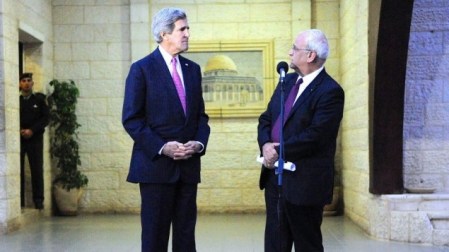
kerryandpalPalestinian Authority lead negotiator Saeb Erekat, right, and US Secretary of State John Kerry in Ramallah, West Bank, on January 4, 2013. (State Department)

Report published in Egypt has Kerry and Rice advising senior Palestinians on strategy at UN and after Trump takes power.

An Egyptian paper published what it claims are the transcripts of meetings between top US and Palestinian officials that, if true, would corroborate Israeli accusations that the Obama administration was behind last week’s UN Security Council resolution condemning Israeli settlements.

An Egyptian paper published what it claims are the transcripts of meetings between top US and Palestinian officials that, if true, would corroborate Israeli accusations that the Obama administration was behind last week’s UN Security Council resolution condemning Israeli settlements.

At the same time, a report in an Israeli daily Tuesday night pointed to Britain helping draft the resolution and high drama in the hours leading up to the vote, as Jerusalem tried to convince New Zealand to bury the Security Council measure.

In a meeting in early December with top Palestinian negotiator Saeb Erekat, US Secretary of State John Kerry told the Palestinians that the US was prepared to cooperate with the Palestinians at the Security council, Israel’s Channel 1 TV said, quoting the Egyptian Al-Youm Al-Sabea newspaper.

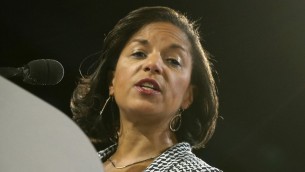
Also present at the meeting were US National Security Adviser Susan Rice, and Majed Faraj, director of the Palestinian Authority’s General Intelligence Service.

riceniceUS National Security Adviser Susan Rice speaks during the American Israel Public Affairs Committee 2015 Policy Conference, March 2, 2015 in Washington, DC. (photo credit: Mark Wilson/Getty Images/AFP)

Kerry is quoted as saying that he could present his ideas for a final status solution if the Palestinians pledge they will support the proposed framework. The US officials advised the Palestinians to travel to Riyadh to present the plan to Saudi leaders.

Israel fears that Kerry, who is slated to give a speech Wednesday on the subject, will then lay out his comprehensive vision for two-state solution at a Paris peace conference planned for January. Israel has refused to attend. Israel further fears that this Kerry framework could be enshrined in another UN Security Council resolution.

The Egyptian report fits with Israeli claims that it had received “ironclad” information from Arab sources that Washington actively helped craft last week’s UN resolution declaring Israeli settlements illegal.

samanthaSamantha Power, U.S. Ambassador to the United Nations, addresses the United Nations Security Council, after the council voted on condemning Israel’s settlements in the West Bank and East Jerusalem, Friday, Dec. 23, 2016 (Manuel Elias/The United Nations via AP)

Responding to a question about the Al-Youm Al-Sabea report, State Department Spokesman Mark Toner denied that the US discussed the language of the resolution with Erekat or in a meeting with officials from New Zealand.

The Obama administration has denied it was behind the resolution, saying that it only decided not to veto it after reading the final text.

Meanwhile, a report in the daily Haaretz Tuesday cited Western and Israeli officials detailing how Britain, and not the US, worked with the Palestinians to craft the text of the resolution, toning it down to make it palatable enough for Washington to avoid a veto.

“The Israeli diplomats say that from information that reached the Foreign Ministry in Jerusalem, British legal figures and diplomats had been working directly with the Palestinians on the wording of the resolution even before it was distributed by Egypt,” Haaretz said.

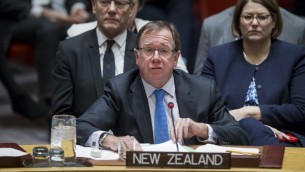
nzdipNew Zealand Foreign Minister Murray McCully addresses a Security Council meeting on the situation in the Middle East on December 16, 2016. (UN/Manuel Elias)

According to Haaretz, in the hours before the resolution went forward, Netanyahu phoned New Zealand Foreign Minister Murray McCully, and warned him that going ahead with the resolution “will be a declaration of war.”

“It will rupture the relations and there will be consequences. We’ll recall our ambassador to Jerusalem,” Netanyahu is reported to have said.

Since the resolution passed, Netanyahu has taken a series of measures against the states that supported the resolutions, minimizing ties with some and calling in their envoys for rebuke.

According to the Egyptian report, the US diplomats expressed their mistrust of Netanyahu, saying he wanted to destroy the two-state solution and was only interested in maintaining the status quo between Israel and the Palestinians.

The transcript showed Kerry and Rice advising the Palestinians not to make any provocative moves when US President-elect Donald Trump takes office on January 20, calling him dangerous.

They warned against such steps as ending security cooperation with Israel, pursuing legal action against Israeli officials in the ICC, or dissolving the Palestinian Authority.

They also said Trump’s administration was likely to adopt a policy on the Israel-Palestinian conflict that would be totally different to that of previous administrations going back to 1967.

mideast-palestinians-_horo-4-305x172In this Friday, Dec. 11, 2015 file photo, Palestinian chief negotiator Saeb Erekat delivers a speech at the Mediterranean Dialogues Conference Forum, in Rome. (AP Photo/Andrew Medichini, File)

When asked how the Palestinians would react if Trump carried out his promise to move the US embassy to Jerusalem, Erekat reportedly said the Palestine Liberation Organization would rescind its recognition of Israel and ask Arab states to expel their US envoys.

Erekat made precisely that threat in a December 19 conference call organized by the Wilson Center policy forum. He said he would immediately resign as the chief Palestinian negotiator, and that “the PLO will revoke its recognition of Israel” as well as all previously signed agreements with Israel. Furthermore, said Erekat, all American embassies in the Arab world would be forced to close — not necessarily because Arab leaderships would want to close them, but because the infuriated public in the Arab world would not “allow” for the embassies to continue to operate.

The Associated Press contributed to this report.

The issue is Israel’s existence

December 28, 2016

The issue is Israel’s existence, Israel Hayom, Dr. Ephraim Herrera, December 27, 2016

The current phase is no less dangerous: diplomatic, legal and public relations warfare against Israel — a variety of initiatives aiming to present it as an immoral, apartheid, “illegal” country that must be denounced. Lest we delude ourselves: The goal of the public diplomacy war is the collapse of the Jewish state. International pressure demanding that Israel return  to the June 4, 1967, borders is understood as the first stage, not the last. PA President Mahmoud Abbas has consistently declared that he will never recognize the State of Israel as the state of the Jewish people. And that he will never surrender the right of return for Palestinian refugees.

******************************

The U.N. resolution on Israeli settlements is perceived throughout the entire Muslim world as a giant victory and a historic achievement for the rights of Palestinians. Indeed, the resolution, which “will not recognize any changes to the 4 June 1967 lines, including with regard to Jerusalem, other than those agreed by the parties through negotiations,” renders negotiations pointless because the international community rejects outright any Israeli legitimacy over any land beyond the lines drawn before the Six-Day War. In other words: Israel must withdraw from the Jewish Quarter, from Jerusalem’s new neighborhoods and from all of Judea and Samaria.

The common denominator in the Palestinian reaction — whether Fatah, Hamas or Islamic Jihad — is that this victory has to be leveraged, with vigor. A Palestinian Authority spokesman said actions must be taken to isolate Israel in the international arena, and called on the international community to take the necessary steps to implement the resolution ratified by the United Nations. The PA foreign minister called for actions that would put an end to the “Judaization” of Judea and Samaria. Other mouthpieces noted the need for legal action against Israelis for war crimes.

From the onset of Israel’s creation, the Muslim world without exception has sought to exterminate the Zionist entity. Its initial efforts focused on classical armed conflict: from the War of Independence to the Lebanon War, the enemies’ armies suffered staggering defeats, even if exacting from us a painful price. From the mid-1980s, the Muslim world shifted to a different strategy: intifadas. Here, too, Israel paid a heavy price, but was able to withstand the threat. For years now, calls for another intifada in Judea and Samaria and among Israeli Arabs have fallen on deaf ears. The third wave of terrorism, which is still ongoing, has introduced a new method of resistance: lone-wolf attackers, armed with knives or behind the wheel of a careening vehicle, seeking to terrorize the civilian population. However, a series of measures implemented by Israel’s security forces, alongside quick and effective action by civilians at the scene of attacks, have suppressed the phenomenon significantly.

The current phase is no less dangerous: diplomatic, legal and public relations warfare against Israel — a variety of initiatives aiming to present it as an immoral, apartheid, “illegal” country that must be denounced. Lest we delude ourselves: The goal of the public diplomacy war is the collapse of the Jewish state. International pressure demanding that Israel return to the June 4, 1967, borders is understood as the first stage, not the last. PA President Mahmoud Abbas has consistently declared that he will never recognize the State of Israel as the state of the Jewish people. And that he will never surrender the right of return for Palestinian refugees.

The heated argument between the Israeli Left and Right overlooks the essence of the problem: The issue is not the territories but the very existence of the State of Israel. It is imperative that Israel find effective ways to counter this new type of warfare, which is no less an existential threat than classic wars, intifadas and knives.

Infamous United Nations Security Council Resolution on Israel is a Symptom of a Deeper Foreign Policy Crisis That Requires Change

December 27, 2016

Infamous United Nations Security Council Resolution on Israel is a Symptom of a Deeper Foreign Policy Crisis That Requires Change, Center for Security Policy, Luis Fleischman, December 27, 2016

soongone

The recent resolution of the United Nations Security Council (UNSC) condemning Israel over settlements represents another foreign policy blow for the United States.

It is consistent with this administration’s policy to appease enemies that do not deserve it (e.g., Iran and Cuba), spit in the face of allies, and thus weakening the image of the United States worldwide.

What is the meaning of this security council resolution for Israel and the settlements?

Let us start with the basics. The resolution fails to distinguish between ‘settlements blocs’ and settlements in areas where a Palestinian state is supposed to be created. Former U.S President George W. Bush accepted construction in a set of Jewish settlements next to the 1967 border as long as the scope of settlements does not expand well into the West Bank.

However, the UNSC resolution, supported and initiated by Obama, defines settlements as every piece of territory that was taken by Israel in the war of June 1967. This includes the Western Wall (the holiest site in Judaism), neighborhoods that have been in existence for decades and had no previous Arab presence, and even the Golan Heights. The latter, having nothing to do with the future of a Palestinian state, was taken from Syria before June 1967, and was used by the Syrians before that date to bomb Israeli civilian targets. Nowadays, if Israel withdraws from the Golan, the territory is likely to fall in the hands of the Iran-backed murderous Bashar Al Assad, or worse, in the hands of the radical Islamist group Al Nusra (now controlling Syrian territory next to the Golan).

On the other hand, the resolution demands nothing from the Palestinians. In the past, peace agreements between Israel and the Palestinians failed not because of settlements but because the Palestinian leadership refused to recognize Israel as a Jewish state by requiring the so –called “right of return” of three million Palestinians to Israel proper. That proposal is not a formula for peace but a formula for the continuation of war.

Very much in contrast to the Palestinians, Israel offered solutions in the past by offering generous concessions that included withdrawal from most of the West Bank, the creation of a Palestinian state, and agreement to share Jerusalem with the Palestinians. Israel also unilaterally withdrew from the Gaza Strip and dismantled the Jewish settlements in the area.

This unbalanced resolution ignores these past painful and risky Israeli concessions, contemptuously rejected by the Palestinian leadership. Furthermore, the resolution failed to include the demand that the Palestinians recognize Israel as a Jewish state and abandon the “right of return.”

After Egypt backed off from introducing the resolution at the request of the U.S, Vice-President Joe Biden proceeded to recruit other sponsors. He called the Ukraine first, a country that still has serious problems recognizing its population’s collaboration with the anti-Semitic Nazi murderous machine and has even honored a Ukrainian militia that murdered Jews during WWII. The other three were New Zealand, Malaysia, and Venezuela. Malaysia is a country that has refused to recognize Israel and whose former president made statements supporting theories of a Jewish conspiracy. Venezuela has adopted an open anti-American ideology, has cooperated with Iran and Hezbollah and its political and military elite are heavily involved in drug trafficking. Moreover, Venezuela is a massive violator of human rights whose policies have led to the starvation of its population

What kind of message is the United States sending to its enemies when we it makes alliances against its own ally?

This kind of resolution has been long supported by France. France’s foreign policy towards the Middle East is mainly motivated by the desire to diminish the status and influence of the United States and increase its own. Israel is considered to be a U.S ally and an easy political target.

As an example, for France, that resolution constitutes a tremendous political victory from their narrow point of view. However, as they face serious terrorist attacks in their own soil, the French have weakened themselves by voting against the country that is at the forefront of the fight against the kind of terrorism that now they themselves are facing.

However, despite the stupidity displayed by the French, their weakness is our problem too. A defenseless West also exposes America and its citizens to danger and risk. If our western allies are not strong enough, we will collapse and be hung with them.

The Russians and the Chinese provide political backing to their allies such as Syria, Iran or even North Korea. The West does not.

What is now needed is a strong American leadership that can provide a sense of common purpose to the West as a whole. The U.S needs to set the tone as well as take the initiative and leadership in the West, in order to defeat ISIS, Al Qaeda, Hezbollah, and Hamas and reduce the power of rogue states such as Iran, North Korea, or Venezuela. Such leadership needs to be expanded to other countries including Latin American countries with significant potential such as Brazil and Argentina.

The anti-Israel UNSC resolution is a problem that transcends Israel. The challenge ahead for President–elect Donald Trump is huge, but the opportunity to make substantial change happen is there too.

Mike Huckabee: Obama’s legacy is to ‘embrace Iran’ and ‘reject Israel’

December 27, 2016

Mike Huckabee: Obama’s legacy is to ‘embrace Iran’ and ‘reject Israel’, Washington Times, December 27, 2016

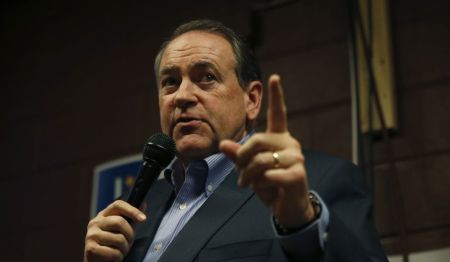
mikehuckabee_c0-0-4080-2378_s885x516Republican presidential candidate and former Arkansas Gov. Mike Huckabee speaks at Inspired Grounds Cafe in West Des Moines, Iowa. (Associated Press)

Former Arkansas Gov. Mike Huckabee said Tuesday he’s not sure there’s any value to the United Nations, after the United States abstained from a vote last week on a resolution condemning Israeli settlements.

“We provide most of the funding for the U.N. and it’s time for us to re-evaluate,” Mr. Huckabee, a former 2016 GOP presidential candidate, said on Fox Business Network. “I’m not sure there’s any value to the U.N. It’s a joke.”

“If I were Obama, I probably wouldn’t plan a vacation to Tel Aviv anytime soon,” said Mr. Huckabee, who has traveled to Israel on a fairly regular basis and is leaving for another trip there soon.

 “It certainly forever damages his legacy. His legacy is to embrace Iran — the biggest sponsor of terrorism in the world — and to reject Israel, the only democracy that exists in the entire Middle East,” he said.

On Friday, the U.S. declined to veto a resolution from the U.N. Security Council in a move that critics saw as a slap at Israel. The resolution said Israel was violating international law by building settlements on territory Palestinians want as part of a future independent state.

The situation drew intense criticism from Israeli Prime Minister Benjamin Netanyahu and bipartisan criticism from U.S. lawmakers.

“This has been condemned by Democrats as well as Republicans. This transcends party,” Mr. Huckabee said.

The ‘occupied’ Western Wall

December 27, 2016

The ‘occupied’ Western Wall, Israel Hayom, Nadav Shragai, December 27, 2016

At the beginning of the last century, Jews had to collect the dung from the donkeys and horses that the Arabs intentionally left at the “occupied territory” of the Western Wall, among the Jews huddled against its stones. The Mughrabi Arabs who immigrated here from North Africa placed their homes and their toilets next to “the occupied territory of the Western Wall,” and sullied it with human feces and sewage more than once. In return for their willingness to correct their bad manners, the Jews had to bribe the heads of the Mughrabi quarter with large sums of money, and even then, it did not always help.

For the sake of the struggle for the Western Wall, the Palestinians enlisted Buraq, the Prophet Muhammad’s miraculous beast, over 100 years ago, as well as the tradition of the place where Muhammad tied him at the end of his nocturnal journey from Mecca to Jerusalem — which was transferred from the eastern and southern walls to the Western Wall. Even the grand mufti, the hateful Haj Amin al-Husseini, one-time Hitler ally, “adopted” the Western Wall. Inspired and orchestrated by Husseini, the Palestinians waged a war over the Western Wall, which led to the murder of Jews in the 1929 Palestine riots and the establishment of a British commission of inquiry, which, just as now, distorted the facts and determined that the Muslim Waqf had ownership of the Western Wall.

The holiness of the Western Wall to Muslims did not prevent them from building homes, staircases and sewage pipes adjacent to the wall for generations. For the duration of the 19 years of their rule as conquerors of Jerusalem, the Jordanians prevented Jews from visiting the Western Wall — in contrast to their signed commitment. They also shattered and desecrated 38,000 of the graves in the ancient Jewish cemetery on the Mount of Olives — now “Israeli-occupied” territory; they leveled the “occupied territory” of the Jewish Quarter and destroyed dozens of “occupied” synagogues. They expelled the thousands of refugees who settled in the quarter’s ruins and kept it as the Shuafat refugee camp, another “occupied territory,” with the rights to its establishment in their name.

In our generation, the official Palestinian television station promises its viewers that “Arab homes” will soon be built on “the occupied territory” of the Western Wall Plaza (formerly the Mughrabi neighborhood) and makes it clear that the sinful Jews are “defiling the Western Wall.” The Muslim Waqf and the Palestinians have for years — listen closely — prevented Israel from clearing garbage and debris from the “Little Western Wall,” which is a continuation of the Western Wall. Oh, the absolute shame of it — this garbage has become part of the status quo of the place.

Here, then, is a golden opportunity to take the necessary step — the first of many — that will put us on a sane path of action. Later on, the time will come to throw the U.N. Security Council’s shameful resolution into the garbage and to go back to building in Jerusalem and its suburbs. This is what we did for years. We owe it first and foremost to ourselves.

Martin Karo: A Modest (Statutory) Proposal

December 27, 2016

Martin Karo: A Modest (Statutory) Proposal, Power LineScott Johnson, December 27, 2016

(The US Congress and the UN Security Council resolution damning Israel. — DM)

Reader Martin Karo is a Philadelphia attorney. Mr. Karo has submitted a modest if lawyerly proposal for the consideration of President-elect Donald Trump and the 115th Congress. He writes:

After the passage of UN Security Council Resolution 2334, declaring that all Israeli building and activity in any territory captured in the 1967 war (the third war imposed on the Israelis) is illegal under international law, Donald Trump immediately vowed that things will be different come January 20. Virtually all Democrats in Congress immediately went on record opposing the Obama Administration’s feckless betrayal of Israel as well. Chuck Schumer purported to be particularly outraged. In order to convert outrage to action, herewith a modest proposal for the first law to be presented to and passed by the Congress under the Trump Administration:

Whereas, it is a bedrock principle of the United States, and a sound principle generally, that no peace deal may be imposed by outside parties on any party not directly involved in any conflict; and

Whereas, said principle is especially relevant in the context of Israel and the Palestinians, and the conflict that has embroiled that region since the passage of the UN plan partitioning the British Mandate;

The following provisions of law are hereby enacted:

Section 1. The United States does not recognize, and repudiates, UN Security Council Resolution 2334. Said act shall have no force whatsoever within the United States, shall in no way influence any action of the Government of the United States, and shall not be observed in any way by any company that does business in the United States, except as necessary to carry out the following provisions of law.

Section 2. The United States shall, at the next meeting of the United Nations Security Council, introduce a resolution formally revoking UNSC 2334 and reaffirming that any peace deal between the Israelis and Palestinians must and shall be negotiated and concluded between those parties only. This resolution shall be reintroduced by the United States at every UNSC session until it is passed.

Section 3. The United States Treasury is directed to reduce all United States payments or transfers to the United Nations, and all constituent elements thereof, to match those of New Zealand, Malaysia, Senegal, or Venezuela, whichever is least, until UNSC 2334 is revoked. The United Nations seeks to force the United States to follow the political contributions of those nations; consequently it shall be limited to the economic contributions provided by those nations.

Section 4. The United States shall revoke and withhold any direct or indirect aid to the Palestinians, or any organization that in any way assists the Palestinians, until UNSC 2334 is revoked pursuant to Section 2.

Section 5. No bank registered in the United States shall do any business whatsoever with any country that proposed, voted for or recognizes UNSC 2334, or with any bank registered in such countries, for any purpose, without an explicit waiver from the United States Congress. No bank registered in any country which recognizes UNSC 2334 shall do any business whatsoever in the United States or with any bank registered in the United States, without an explicit waiver from the United States Congress.

Section 6. The provisions of Sections 1 – 4 of this Act shall be effective immediately. The provisions of Section 5 shall be effective six months from the passage of this Act.

I’m informally considering titling this the “Mr. T’s Prediction Was Right” Act, though other titles are solicited.

EDITOR’S NOTE: For readers who may be wondering, I think this is “Mr. T’s prediction”:

(The short video is at the link. — DM)

Dem lawmaker: Israel waging ‘war on the American government’

December 27, 2016

Dem lawmaker: Israel waging ‘war on the American government’, Washington ExaminerKelly Cohen, December 26, 2016

(How deplorably ungrateful of wicked Israel after all that Obama has done to for her. — DM)

mcdermotRep. Jim McDermott, D-Wash., says Israelis attacking Obama for not giving them ‘everything they want.’ (AP Photo/Elaine Thompson)

McDermott added that because Israel “never could get 100 percent from Barack Obama, so they decided to attack him and use him as the reason why Trump should come in and give them everything they want.”

*******************************

A retiring Democratic congressman warned that the war-of-words over the United Nations’ vote on Israel settlements is the beginning of a rhetorical “war on the American government” by Israel.

Rep. Jim McDermott, D-Wash., made the comments Monday in an interview with MSNBC when asked to react to accusations that the Israeli government has proof that the Obama administration helped influence the U.N. Security Council’s vote to condemn Israeli settlements.

Ron Dermer, the Israeli Ambassador to the U.S., had said earlier on MSNBC that the Israelis would be sharing the proof to the incoming Trump administration only.

“What we are seeing is the beginning of a war on the American government [by Israel],” McDermott said in response to Dermer.

“We’re seeing the air war right now, we’re seeing all these tweets, all this kind of innuendo and all these half stories, and all this stuff is to create tremendous tension,” McDermott explained.

He added that creating the tension will help President-elect Donald Trump begin the “ground war” when he takes over the White House next month. That, McDermott said, is when “his appointees begin to carry out his actions in the departments across the government.”

“The American people are being subjected to a campaign of anxiety production,” McDermott said. “And it really is very, very disturbing to watch.”

McDermott added that because Israel “never could get 100 percent from Barack Obama, so they decided to attack him and use him as the reason why Trump should come in and give them everything they want.”

Israel is now “running their own war against us and our policies” because they are angry that Obama has pushed back against telling them to stop with settlements, McDermott said.

Bye Bye, Obama

December 26, 2016

Bye Bye, Obama, PJ Media, Michael Ledeen, December 25, 2016

(Please see also, Is real change coming to Iran? Get ready for March 15, 2017. — DM)

maddog

What would President Trump do if Khamenei passed from the scene, and millions of Iranians took to the streets again?  The president-elect has said he’s not a great enthusiast of regime change, but it’s hard to imagine he’d abandon the Iranians as Obama did seven years ago.  He ought to be thinking it through.

Yes, I know good news is hard to swallow, but we are living in a revolutionary moment, of which the Trump election is a dramatic symptom.  The crisis of the Islamic Republic would be a fitting end to the Obama era. He dreamt of a glorious strategic alliance with Iran, and a definitive lethal blow against Israel. How fitting with the Divine sense of humor to have the Palestinians and Iranians to wreck their own enterprises.

***********************

As I promised, as the days of Obama draw down, the jihadis are stepping up the terror tempo.  They know that there will be no reprisals from the Oahu links, and they fear Trump’s lineup of tough guys in the cabinet, so they’re in a hurry to kill infidels while the killing’s good. Therefore we, along with the other Western nations, are at maximum risk right now, until roundabouts January 20th.

And the killing’s plenty good, isn’t it?  Berlin,  Zurich, Ankara, Moscow, with a very nasty plot uncovered in Melbourne, and yet another involving terrorists in Detroit, Maryland, and Virginia.  Not to mention the ongoing slaughter in Syria, and, on Christmas day, Cameroon.

What does the “western world” do in response?  Declare the Western Wall “occupied territory.” This is no accident, since the jihadis believe that they have unleashed holy war against infidels.  That war will not end, in their view, until we infidels have been crushed and subjected to the will of a caliph.  They’ve got plenty of support from the Russians, without whom thousands of Iranians and Iranian proxies would have been killed in Syria and Iraq, and the Assad regime would have been destroyed.

That would have been a better world, but Obama did not want that world.  Nor did the feckless Europeans, who act as if profits on Iran trade compensate for the open subversion of public order.  Indeed, as Christmas arrived we were treated to the spectacle of the bishop of Rome—aka Pope Francis–blaming material misery for the jihadist assault on the West. Thus the first Jesuit pontiff surrenders the moral high ground to his mortal enemies.

Maybe Obama should convert and run for pope.

Paradoxically, the jihadis and their secular allies are launching their new assault just as they are suffering systematic setbacks on the battlefield, their own internal conflicts are intensifying, and there are signs of a religious and patriotic revival within the boundaries of their archenemy, the United States. Walter Russell Mead neatly catches the irony that, just as Obama handed the Palestinians a resounding political victory, a sober look at the situation suggests that the Palestinians have not been this weak, this divided, or this helpless in many decades.

In like manner, the Iranian regime, flush with its success in Aleppo, is increasingly riven.  Supreme Leader Ali Khamenei has had two medical events in the past 10 days, and the scrambling for the succession has resumed.  You may have noticed that General Qasem Soleimani has returned to the front pages, which invariably happens when the leader is ill; the Revolutionary Guards want him as the strongman of the next regime (he can’t be supreme leader for lack of theological standing, but he could still be a dominant figure). And it isn’t all peaches and cream for Soleimani, as recent demonstrations in Tehran against the rape of Aleppo make clear. Iranian apologists love to tell us that Persian nationalism  overwhelms internal tribal and sectarian divisions, but Iran has lost thousands in Syria, and the Persian nationalists don’t like their husbands and sons dying to save Bashar Assad.

What would President Trump do if Khamenei passed from the scene, and millions of Iranians took to the streets again?  The president-elect has said he’s not a great enthusiast of regime change, but it’s hard to imagine he’d abandon the Iranians as Obama did seven years ago.  He ought to be thinking it through.

Yes, I know good news is hard to swallow, but we are living in a revolutionary moment, of which the Trump election is a dramatic symptom.  The crisis of the Islamic Republic would be a fitting end to the Obama era. He dreamt of a glorious strategic alliance with Iran, and a definitive lethal blow against Israel. How fitting with the Divine sense of humor to have the Palestinians and Iranians to wreck their own enterprises.

You never know. Life is full of surprises.