H/t Conservative Tree House, July 13, 2015

Iranian official: ‘We will take 1,000 Americans hostage’ if US comsiders military action, Breitbart, Adelle Nazarian, July 13, 2015
(“Iran won’t back down from acquiring nuclear missiles.” But Khamenei claims that Iran has no desire for nuclear weapons. Who is kidding whom? — DM)
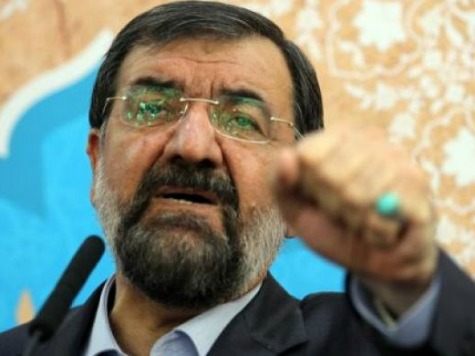 ATTA KENARE/AFP/Getty Images
Rezaei then went on to suggest that Iran will not back down from acquiring nuclear missiles.
*************
Iran’s secretary of the Expediency Discernment Council and recently-returned head of the Iranian Revolutionary Guards Corps (IRGC) Mohesen Rezaei says Iran is prepared to take 1,000 Americans hostages and demand millions of dollars in ransom for each of them if the United States even considers waging war against Iran.
In an interview with Iran’s State TV IRIB on Saturday, Rezaei made this solemn vow:
I am promising you, I promise the people of Iran, that as a soldier of Iran and a revolutionary militant, if America even thinks about taking military action against Iran, they can rest assured that in the first week we will take 1,000 Americans hostage and demand millions of dollars in ransom for each of their releases. That will likely help solve our economic issues as well. We are warning them in advance so that they can get this thought out of their minds.
Rezaei then went on to suggest that Iran will not back down from acquiring nuclear missiles. “If tomorrow Israel decides to attack Iran, shouldn’t Iran be able to respond to them [with nukes]?”
Pulling no punches in the interview, Rezaei referred to President Barack Obama as “weak” and said Iran blames him for causing the mess it is in, noting that it is time for President Obama to fix it. He also referred to John Kerry as an “orphaned child” (yateem in Farsi) who returns to the negotiating table with “sorry expressions” each time he receives a call from Washington, pleading for changes to what was previously discussed.
He said, “Of course it was Obama who caused the situation in Iran because even George W. Bush, as strong as his stances were, did not dare to impose last year’s sanction on Iran” during the course of his presidency. Rezaei was referring to the oil sanctions imposed by Congress in 2012, which was actually introduced and pushed by Republicans and passed as a bipartisan bill with the help of a handful of Democrats. In reality, Obama was against imposing oil sanctions on Iran, but a veto-proof majority tied his hands. Nonetheless, he appears to be receiving both the credit and criticism for the move.
Goodnight Vienna (11), Power Line,
Omri Ceren continues his series of reports by email from Vienna:
Good Monday from Vienna, where we’re now into day 17 of the current round of negotiations and yet summer continues to surprise us.
The JPOA is again set to expire at midnight after having been extended a few days ago. Just about everyone is saying that another short-term extension is not being considered. Of course the parties always say that, until they don’t, but this time the comments feel a little bit different. The Europeans could not be more frustrated – they don’t understand why the Americans and the Iranians can’t get their nonsense together – and the Russians and Chinese actually have things they need to take care of. Rouhani was even scheduled to speak on TV today, though the Iranians are now saying he’ll wait until there’s a formal announcement.
The conventional wisdom is that negotiations will wrap up today and a ceremony will be held tomorrow.
As for what the parties are still talking about: Reuters has been saying all week that sanctions remain unresolved, and today the wire piled on with “among the biggest sticking points in the past week has been Iran’s insistence that a United Nations Security Council arms embargo and ban on its ballistic missile program dating from 2006 be lifted immediately… Other problematic issues are access for inspectors to military sites in Iran” [1]. The Associated Press report from this morning also identified those two areas as key disagreements, and added that there are complications due to a new Iranian demand “that any U.N. Security Council resolution approving the nuclear deal be written in a way that stops describing Iran’s nuclear activities as illegal” [2].
As far as the UNSCR gambit goes, it seems like a not-very-sophisticated attempt to craft language that would later be used to undermine the IAEA’s authority to inspect Iranian facilities. The Iranians have successfully pulled off similar tricks throughout the talks: they inserted vague language into Geneva that they interpreted as a right to enrich, and they did the same thing at Lausanne so they could later claim that the arms embargo has to be lifted. U.S. negotiators have proven less than adept in detecting how and when the Iranians are laying traps for them.
As far as the arms embargo goes, there are multiple Iranian motives. The most obvious is that the Iranians are engaged in four hot wars across the region against traditional American allies, and they’re eager to purchase Russian weapons to fight in those wars. David Ignatius to MSNBC this morning: “Israel will see that as a direct threat, as it will arm the people Israel is fighting. The Sunni Arabs, as you said, will see this as a major capitulation by the U.S.” The more subtle reason has to do with how the Iranians conduct their illicit nuclear trade. The Iranians have an interest in weakening international restrictions against arms transfers in in general, because they then use newly-legitimized procurement channels to violate whatever restrictions remain. I’m [linking] below an article published yesterday by Benjamin Weinthal – a Berlin-based fellow for Foundation for Defense of Democracies (FDD) – on how Iran has been violating UNSC nuclear sanctions over the last few months:
While U.S.-led world powers hold talks with Iran in Vienna to curb Tehran’s illicit nuclear weapons program, the Islamic Republic’s spies have been seeking atomic and missile technology in neighboring Germany as recently as last month, according to German intelligence sources… Iran has a long history of illegally obtaining nuclear technology from within Germany and transporting it in ways that circumvent international sanctions. German companies have shown an eagerness to legally tap the Iranian market, though none are accused of abetting illegality in the latest efforts by Iran.
Of course there’s also what ought to be the major diplomatic scandal of the Iranians cheating on nuclear sanctions even as nuclear negotiations continue [reported by Benjamin Weinthal in the linked story]. But the Iranians have been caught cheating throughout the talks: they’ve violated UNSC resolutions in exactly this way and they’ve violated the JPOA by busting through oil caps, testing advanced centrifuges, and failing to convert excess enriched gas into dioxide. In literally every case the Obama administration has found a reason to publicly play Iran’s lawyer by spinning away those violations.
_________________
[1] http://www.reuters.com/article/2015/07/13/us-iran-nuclear-idUSKCN0PM0CE20150713
[2] http://bigstory.ap.org/article/1bfd89dfd94b47b19706949ae2255c02/iran-talks-hit-final-stage-announcement-expected
The Islamist state of Iran scoring victories, Front Page Magazine, Dr. Majid Rafizadeh, July 13, 2015

Why negotiations are shaping up to be a win-win for the Mullahs
The mainstream media have ignored and overlooked the Islamic Republic’s recent moves, which threatened regional security. The Islamic Republic’s search for regional hegemony has also been overshadowed by President Obama’s prioritization of signing a nuclear deal.
Iranian leaders and media outlets have given an estimate of how much they have so far gained from the nuclear talks. The Iranian leaders and state-owned media have recently boasted about receiving approximately $12 billion in assets over the period of the nuclear talks by July 7th.
The ruling clerics in the Islamic Republic and Iran’s Revolutionary Guard Corps have also unveiled and are celebrating the deployment of a new and second long-range Ghadir radar. According to an Iranian state-owned outlet, Brigadier General Farzad Esmaili, commander of the Islamic Revolutionary Guards Corps’ (IRGC) air defense force, who unveiled the Ghadir phased-array radar, pointed out that “Discovering and tracking micro aerial vehicles (MAV)… is one of the special qualities of the Ghadir radar system.”
This is part of long-range and air defense system. The Islamic Republic is attempting to completely shield its nuclear facilities when it is close to obtaining nuclear weapons. Russia has also made a deal with the Islamic Republic to ship the S-300 advanced missile system to Iran.
The Islamic Republic also continues to receive billions of dollars due to the nuclear talks. One recent example includes a side deal that the Islamic Republic worked out at the nuclear talks with the Obama administration, which would give Tehran 13 tons of gold worth about $700 million.
The winners of these nuclear talks are primarily President Obama, the Iranian government, Shiite proxies in the region, Iran’s Revolutionary Guard Corps, President Rouhani, the Syrian government and Bashar Al Assad, and Western corporations and companies.
President Obama desires to seal and achieve his final legacy. President Obama and his administration are creating the narrative that the deal is a historic and good one.
On the other hand, the easing of sanctions creates a whole array of other winners in the Islamic Republic including the IRGC, office of the Supreme Leader, and the Quds force (elite branch of IRGC which operates in extraterritorial landscapes).
As the economic power of the IRGC and the Quds force increases, Iran’s Shiite proxies in the region will benefit from the trickling down of these funds. Al Assad can also be more assured and confident that the Islamic Republic will continue supporting his government financially, economically, militarily, and through intelligence and advisory roles.
Entities or governments which will not benefit from these nuclear talks or latest developments are countries which are threatened by extremist militia groups in the region and are concerned with Iran’s hegemonic ambitions, it’s search for regional preeminence and supremacy, Iran’s attempts to tip the balance of power in its favor.
The Islamic Republic fuels extremism in the region, gives birth to militias and is the major root of atrocities, terrorism, human rights abuses and the vicious cycle we are witnessing in the Middle East and beyond. In fact, there is a powerful correlation between the Islamic Republic’s rising military buildup and the rising power of extremism and terrorism in the region.
As Israeli Prime minister Benjamin Netanyahu stated, the Islamic State (IS) threat is nothing in comparison to the Islamic Republic’s threat.
The Iranian government is also scoring further victories with regard to the nuclear talks. When we comprehensively and meticulously look at the deal, the agreement will not only maintain Iran’s nuclear ambitions, but it will create whole new security and geopolitical concerns in the region. The agreement is not final but temporary, broadly speaking. After 10 years, economic sanctions will have lifted, Iran’s breakout capacity will be nearly complete, and Iran can reinitiate its program with full speed.
As a result, Iranian leaders will have it both ways.
President Obama is treating the Islamic Republic completely differently from groups such as the Islamic State. He calls Iran a successful regional player.
Obama fails to recognize the fact that any victory or military capability that the Islamic Republic gains is a step towards more militarization, terrorism, violence and regional insecurity. As Israeli PM Benjamin Netanyahu stated, “Obviously no one thinking with a clear mind would consider giving Islamic State nuclear weapons,” and he adds, “But in the negotiations taking place now with Iran, this extreme state that spreads terrorism around the world is being given the ability to develop a nuclear weapons arsenal with many nuclear bombs, together with the means to deliver them… We should not strengthen one at the expense of the other…We need to weaken both and prevent the aggression and military buildup of both of them.”
It is the time to pay closer attention to the Islamic Republic’s covert military buildup and treat it the same way the international community treats the Islamic State, not as a successful regional player.
Addicted to self-deception, Israel Hayom, Dr. Reuven Berko, July 13, 2015
There is an Arab proverb that says, “What is written on the brow will inevitably be seen by the eye,” meaning that one will inevitably meet one’s destiny.
But the eyes of the West do not see the writing. The negotiators responsible for the talks between Iran and the world powers see the sights and hear the voices, but ignore reality and engage in the wishful thinking of those who sent them to Vienna.
Like failed psychologists, U.S. Secretary of State John Kerry and his team are managing the negotiations with the unquestionably stubborn Iranians as if they were therapy sessions. The Iranians, following the directives of a cynical ayatollah whispering to them from the wings, are deliberately displaying manic personality shifts, up and down, playing the West like a marionette between hope and despair.
The West watches eagerly as Iran continues to develop its missiles and its nuclear program, as the centrifuges constantly whirl throughout this period of intentional procrastination. World leaders hear the threats of Ayatollah Ali Khamenei and his band of clerics, who shun the deal and preach the destruction of Israel, while declaring that the Iranian nation’s struggle against the “boastful” United States will continue and that there will be no access to the sites where the bomb is being developed. If that is what the leader thinks, then the masses will follow. And indeed, the Iranian media, defense establishment, and the crowds in the streets of Tehran parade their zealous hatred and their anti-Western incitement as they demand that sanctions be lifted while American and Israeli flags go up in flames.
It appears the leaders in the talks are using “denial” and “repression” as psychological tricks to delude themselves, and not, God forbid, as negotiation tactics to achieve the desired deal from the enemy. These masters of self-deception respond to threatening declarations from Iran’s supreme leader that his country will never giver up its nuclear achievements by saying that it is his way of preparing the masses in Iran for the concessions to come. This is like saying that the harsh and radical comments repeatedly made are simply a way to “vent” the feelings of rage in the Iranian public and are a sign “from above” of the concession of the nuclear project.
Those who have eyes in their heads understand that things are not going well. Lifting the sanctions will swell Iran’s purse, which funds global terrorism, particularly in Syria, Yemen, Jordan, Lebanon and Iraq, and seeks urgently to import Chinese and Russian weapons. Can the leaders of the negotiations admit that they were mistaken and were led astray by the masters of Iranian diplomacy? Will they be able to take a step back and admit that Prime Minister Benjamin Netanyahu was right to call the deal a disaster? Since we are dealing with deception, it appears that Kerry and his staff are trapped in cognitive dissonance of the same sort as a person who buys a beautiful car and then discovers that he has been deceived and the engine is burned out, yet still takes comfort in the fact that the horn works just fine.
From a psychological perspective, this is the line between the impulse for a collective Shiite suicide mission in the name of Allah and the megalomaniacal desire to control the world at the cost of the lives of everyone who opposes. However, in a Persian bazaar, what you see is what you buy. Iran is declaring, planning and working toward destroying every country in the Middle East — especially Israel — with its nuclear program, and no deal with Kerry will change that. Instead of the simple solution — the complete dismantling of the Iranian nuclear program — the West has become addicted to the process of self-deception and procrastination. At least therapy is discreet.
Hillary Clinton is the X-factor for the Iranian nuclear deal’s congressional survival, DEBKAfile, July 13, 2015
 Hillary Clinton faces tough decision
“A parade of concessions to Iran,” was Israeli Prime Minister Binyamin Netanyahu’s comment on the nuclear accord expected to be announced and fully revealed later on Monday July 13 in Vienna. He underscored his point by playing back President Bill Clinton’s words upon signing the nuclear deal with North Korea 21 years ago: “North Korea will freeze and then dismantle its nuclear program,” Clinton announced then. “South Korea and our other allies will be better protected. The entire world will be safer as we slow the spread of nuclear weapons.”
Despite Bill Clinton’s pledge of carefully monitoring, Pyongyang broke through to a nuclear bomb in October 2006, twelve years later. By comparison; a ten-year limit on the period during which Iran is allowed to develop a bomb is believed to be incorporated in the Vienna accord. Its full text of100 pages plus is still to be fully disclosed.
By playing back the Clinton clip, Netanyahu aimed to place high on Washington’s agenda, the leverage in the hands of his wife, Hillary Clinton, in determining whether the deal survives the US Congress, which will have 60 days to review it.
Hillary is currently rated by the polls with a 62 percent lead in her run for the Democratic nomination in the 2016 presidential election. She tops the lists of alll declared Democratic and Republic contenders combined.
In the first week of July, she is quoted as supporting Obama’s relentless drive for a deal when she said: “I so hope that we are able to get a deal in the next week that puts a lid on Iran’s nuclear weapons program because that’s going to be a singular step in the right direction.”
Before that, she echoed Obama’s words that “no deal is better than a bad deal.”
Now that the accord is in its last stage, she has held back from judging whether it is good or bad – only in private conversations with wealthy Jewish contributors to her campaign, she has promised to be “a better friend to Israel than President Barack Obama.”
But once the final accord is in the bag – expected in the coming hours – Clinton will have to come out in the open, because she holds the key to a Senate majority for blocking it. The 54 Republican senators are committed to voting against it: Senate Majority leader Mitch McConnell told Fox News Sunday: “I think it’s going to be a very hard sell, if it’s completed, in Congress. We already know it’s going to leave Iran as a threshold nuclear state. It appears as if the administration’s approach to this was to reach whatever agreement the Iranians are willing to enter into,” he said.
But the 44 Democratic senators are wobbling between being loyal to the president and their profound misgivings about the deal with Iran. It would take 13 Democrats to cross the floor and join the Republicans to achieve the necessary majority for annulling the promised presidential veto of a negative vote.
A Clinton declaration against the deal could swing those 13 senators against the accord – so painfully crafted in 13 months of agonizing bargaining led by Secretary of State John Kerry – and leave Obama in the position of a lame duck president.
Iran’s leaders, after reading the map in Washington, took the precaution of submitting to the Majlis a motion that would require a parliamentary review every few months of the US performance in complying with the accord with the power to annul it if this performance was judged unsatisfactory.
This pits the Iranian parliament against the US Senate and, by implication, puts Hillary Clinton in the driving seat in Washington versus Ayatollah Ali Khamenei in Tehran.
Whatever she decides now – whether for or against the Iranian deal – will have consequences for her campaign for president. That campaign has almost a year and a half to run before the November 2016 election. If she backs the deal and lets the Democratic senators refrain from voting against it, she will be held accountable – not only by Jewish campaign donors, but, up to a point, the American voter too. Israeli and Saudi intelligence will certainly use a microscope to discover the tiniest particles of evidence of Iran’s non-compliance. They will be thrown in her face.
Republican rivals will certainly fuel their campaigns with allegations of the total surrender to Iran by Obama and Kerry – with consequences for the prospects of Obama’s former secretary of state, Hillary Clinton.
Backing Obama would therefore cast a shadow over her presidential hopes, whereas taking the lead of a Democratic senatorial mutiny against it may well undo the deal before the year is out. Either way, Clinton faces one of her toughest decisions since she decided to run as the first American woman president.
Israeli deterrence in the eye of the hurricane, Jerusalem Post, Louis Rene Beres, July 12, 2015
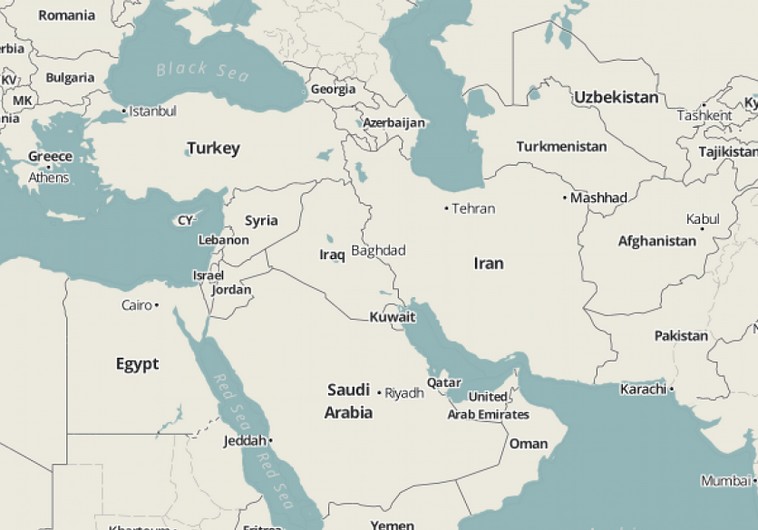 Map of Middle East. (photo credit:Courtesy)
Everything is very simple in war, but the simplest thing is difficult.”
– Carl von Clausewitz, On War
To prevent a nuclear war amid steadily growing regional chaos, especially as Iran will soon be fully nuclear (and the grateful beneficiary of US President Barack Obama’s pretend P5+1 diplomacy), Israel will need suitably complementary conventional and nuclear deterrents.
**********************
Left to themselves, especially as more “normal” hostilities dissolve into a full-blown regional chaos, Israel’s adversaries could drive the Jewish state toward an unconventional war. This fateful endangerment could be produced singly or collaboratively, by deliberate enemy intent or by the “collateral damage” of sectarian strife. Militarily, these Islamic adversaries of Israel, both Sunni and Shi’ite, could be either non-nuclear, or, in the future, nuclear.
They might also include certain wellarmed sub-state or terrorist forces. Already, Iranian-backed Hezbollah may have more usable missiles than all NATO countries combined.
To most effectively deal with such interpenetrating threats – including reasonably expected “synergies” and “force multipliers” – Israel’s leaders will first need to consider some largely-opaque factors. These include: 1) probable effects of regional chaos upon enemy rationality; 2) disruptive implications of impending Palestinian statehood; and 3) re-emergence of a corrosively Cold War-style polarity between Russia and the United States. Apropos of a “Cold War II,” there is already evidence of growing contact between Russia and Saudi Arabia, the world’s two largest oil producers.
In essence, Jerusalem must take all necessary steps to successfully manage an expectedly unprecedented level of adversarial complexity and weaponization. Israel’s leaders, in this connection, must take proper measures to ensure that any conceivable failures of its national deterrent would not spark biological or nuclear forms of regional conflict. To accomplish this indispensable goal, the IDF, inter alia, must continue to plan carefully around the core understanding that nuclear deterrence and conventional deterrence are inherently interrelated and meaningfully “seamless.”
Sometimes, in strategic matters, seeing requires distance. A nuclear war in the Middle East is not beyond possibility. This is a sensible assessment even if Israel were to remain the only nuclear weapons state in the region.
How is this possible? A bellum atomicum could come to Israel not only as a “bolt from the blue” enemy nuclear attack (either by a state or by a terrorist group), but also as the result, intended or otherwise, of certain uncontrolled military escalations.
Needed prudence in such narratives calls for additional specificity and precision. If particular Arab/Islamic enemy states were to launch conventional attacks upon Israel, Jerusalem could then respond, sooner or later, with calculated and more-or-less calibrated nuclear reprisals. Alternatively, if some of these enemy states were to launch large-scale conventional attacks, Jerusalem’s own still-conventional reprisals could then be met, perhaps even in the not-too-distant future, with enemy nuclear counterstrikes.
How should Israel prepare for such perilous contingencies? More than likely, Israel has already rejected any doctrinal plans for fielding a tactical/theater nuclear force, and for assuming any corollary nuclear war fighting postures. It would follow further from any such well-reasoned rejection that Israel should do whatever is needed to maintain a credible conventional deterrent.
By definition, such a measured threat option could then function reliably across the entire foreseeable spectrum of non-nuclear threats.
Still, any such strategy would need to include an appropriately complementary nuclear deterrent, a distinctly “last resort” option that could display a “counter-value” (counter-city) mission function. Si vis pacem, para bellum atomicum: “If you want peace, prepare for atomic war.”
A persuasive Israeli conventional deterrent, at least to the extent that it might prevent a wide range of enemy conventional attacks in the first place, could reduce Israel’s growing risk of escalatory exposure to nuclear war. In the always arcane lexicon of nuclear strategy, a complex language that more-or-less intentionally mirrors the tangled coordinates of atomic war, Israel will need to maintain firm control of “escalation dominance.” Otherwise, the Jewish state could find itself engaged in an elaborate but ultimately lethal pantomime of international bluster and bravado.
The reason for Israel’s obligation to control escalatory processes is conspicuous and unassailable. It is that Jerusalem’s main enemies possess something that Israel can plainly never have: Mass.
At some point, as nineteenth century Prussian military thinker Carl von Clausewitz asserts in On War: “Mass counts.”
Today, this is true even though Israel’s many enemies are in chaotic disarray. Now, amid what Clausewitz had famously called “friction” and the “fog of war,” it could become harder for Israel to determine real and pertinent differences between its allies, and its adversaries.
As an example, Jordan could soon become vulnerable to advancing IS forces.
Acknowledging this new vulnerability, an ironic question will come immediately to mind: Should Israel support the Jordanian monarchy in such a fight? And if so, in what specific and safe operational forms? Similarly ironic questions may need to be raised about Egypt, where the return to military dictatorship in the midst of surrounding Islamist chaos could eventually prove both fragile and transient.
Should President Abdel Fattah Sisi fail to hold things together, the ultimate victors could be not only the country’s own Muslim Brotherhood, but also, in nearby Gaza, Palestinian Hamas. Seemingly, however, Hamas is already being targeted by Islamic State, a potentially remorseless opposition suggesting, inter alia, that the principal impediment to Palestinian statehood is not really Israel, but another Sunni Arab terrorist organization. Of course, it is not entirely out of the question that IS’s Egyptian offshoot, the so-called “Sinai Province of Islamic State,” could sometime decide to cooperate with Hamas – the Islamic Resistance Movement – rather than plan to it.
To further underscore the area’s multiple and cross-cutting axes of conflict, it is now altogether possible that if an IS conquest of Sinai should spread to Gaza, President Sisi might then “invite” the IDF to strike on Egypt’s behalf. Among other concerns, Egypt plainly fears that any prolonged inter-terrorist campaign inside Gaza could lead to a literal breaking down of border fences, and an uncontrolled mass flight of Palestinians into neighboring Sinai.
Credo quia absurdum. “I believe because it is absurd.” With such peculiar facts in mind, why should Israel now sustain a conventional deterrent at all? Wouldn’t enemy states, at least those that were consistently rational, steadfastly resist launching any conventional attacks upon Israel, for fear of inciting a nuclear reprisal? Here is a plausible answer: suspecting that Israel would cross the nuclear threshold only in extraordinary circumstances, these national foes could be convinced, rightly or wrongly, that as long as their initial attacks were to remain conventional, Israel’s response would remain reciprocally non-nuclear. By simple extrapolation, this means that the only genuinely effective way for Israel to continually deter large-scale conventional war could be by maintaining visibly capable and secure conventional options.
As for Israel’s principal non-state adversaries, including Shi’ite Hezbollah and Sunni IS, their own belligerent calculations would be detached from any assessments of Israeli nuclear capacity and intent. After all, whatever attacks they might sometime decide to consider launching against the Jewish state, there could never be any decipherable nuclear response.
Nonetheless, these non-state jihadist foes are now arguably more threatening to Israel than most enemy national armies, including the regular armed forces of Israel’s most traditional enemies – Egypt, Jordan and Syria.
Some other noteworthy nuances now warrant mention. Any still-rational Arab/ Islamic enemy states considering firststrike attacks against Israel using chemical and/or biological weapons would likely take Israel’s nuclear deterrent more seriously. But a strong conventional capability would still be needed by Israel to deter or to preempt certain less destructive conventional attacks, strikes that could escalate quickly and unpredictably to assorted forms of unconventional war.
If Arab/Islamic enemy states did not perceive any Israeli sense of expanding conventional force weakness, these belligerent countries, now animated by credible expectations of an Israeli unwillingness to escalate to nonconventional weapons, could be more encouraged to attack. The net result here could be: 1) defeat of Israel in a conventional war; 2) defeat of Israel in an unconventional (chemical/biological/ nuclear) war; 3) defeat of Israel in a combined conventional/unconventional war; or 4) defeat of Arab/Islamic enemy states by Israel in an unconventional war.
For Israel, even the presumptively “successful” fourth possibility could prove too costly.
Perceptions are vitally important in all calculations of nuclear deterrence. By continuing to keep every element of its nuclear armaments and doctrine “opaque,” Israel could unwittingly contribute to the injurious impression among its regional enemies that Jerusalem’s nuclear weapons were unusable. Unconvinced of Israel’s willingness to actually employ its nuclear weapons, these enemies could then decide to accept the cost-effectiveness of striking first.
With any such acceptance, Israeli nuclear deterrence will have failed.
If enemy states should turn out to be correct in their calculations, Israel could find itself overrun, and thereby rendered subject to potentially existential harms.
If they had been incorrect, many states in the region, including even Israel, could eventually suffer the assorted consequences of multiple nuclear weapons detonations. Within the directly affected areas, thermal radiation, nuclear radiation and blast damage would then spawn uniquely high levels of death and devastation.
To prevent a nuclear war amid steadily growing regional chaos, especially as Iran will soon be fully nuclear (and the grateful beneficiary of US President Barack Obama’s pretend P5+1 diplomacy), Israel will need suitably complementary conventional and nuclear deterrents. Even now, at the eleventh hour, it will also require a set of residual but still-available preemption options. Under authoritative international law, actually exercising any such last-resort options would not necessarily represent lawlessness or “aggression.”
On the contrary, such strikes could readily meet the long-established and recognizable jurisprudential standards for “anticipatory self-defense.”
Going forward, Israeli nuclear deterrence – reinforced, of course, by ballistic missile defense – must become an increasingly central part of the Jewish state’s overall survival plan. Fulfilling this requirement should in no way suggest any corresponding violations of international law. After all, every state in world politics has an overriding obligation to survive.
International law is not a suicide pact.
Know Comment: Sham smiles all around, Jerusalem Post, David M. Weinberg, July 9, 2015
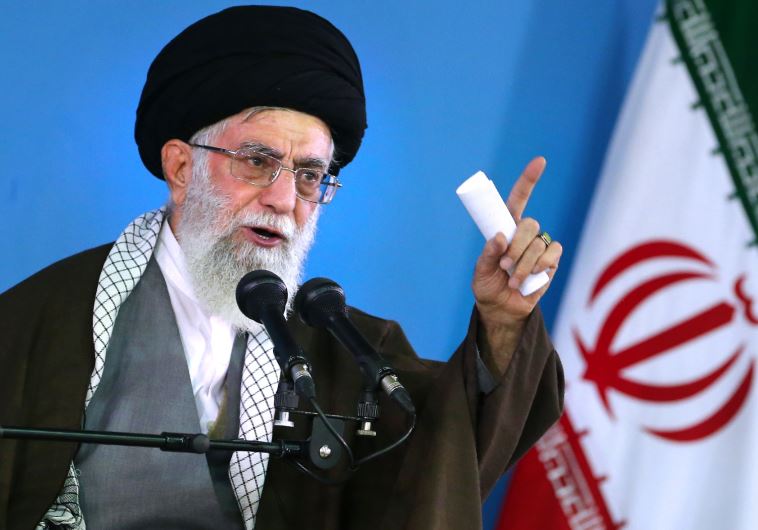 Iran’s supreme leader, Ayatollah Ali Khamenei. (photo credit:AFP PHOTO)
Decoupling allows Obama to smile and sell sham narratives about Iran, even as Khamenei rebuffs and humiliates America. With a smile, of course.
*************************
With four deadlines come and gone, it’s probably safe to predict that there won’t be a grand package deal with Tehran this weekend, or at all. Instead, we’ll get a lot of smiles, and agreement to continue talking indefinitely, “for as long as the talks are useful,” without closure on Iran’s nuclear weapons drive.
Meanwhile, Ayatollah Khamenei’s centrifuges will continue to spin, Iran’s adventurism in the region will proceed unchecked, and President Obama won’t have to reveal to Congress the deep concessions he has already deposited in Iran’s pocket.
American analyst Michael Ledeen puts it bluntly: Khamenei doesn’t want to sign anything. He has two fixed principles: No “new relationship” with the Great Satan, and relentless pursuit of the atomic bomb. But since Obama won’t take an Iranian “no” for a definitive answer, the default American position will be a new form of “creative appeasement.”
Iran will promise to try really, really hard to be nice, and Obama will pay for this. Iran will continue to get its monthly sanctions relief payoff, while Obama will get Iranian smiles.
This will allow Obama to give another interview in which he blathers about meeting Iran’s “legitimate needs and concerns” and about his hopes that Iran will become “a very successful regional power.” After all, Obama will yet tell us, Iran “is one of the oldest and grandest civilizations in the world” – or something obsequious like that.
Who could have imagined, just a few years ago, that the president of the United States of America would wish the mullahs well in their quest for regional hegemony? What strategic thinker would have believed that the US would actively enter a de facto alliance with Shi’ite Iran (in Iraq, Syria and the Gulf) at the expense of America’s traditional Sunni allies and its ally in Israel? The metamorphosis of Iran, in pro-Obama elite opinion circles, from terrorist state into US partner is a long-brewing triumph for a certain set of pro-Iranian apologists and anti-Israel lobbyists in Washington.
Writing in The Wall Street Journal this week, Sohrab Ahmari showed how the National Iranian American Council advanced the argument that Iran deserves strategic respect, and placed its people in the Obama National Security Council.
Indeed, US think tanks played a prominent role in paving the way toward a climb-down from Obama’s declared policy of halting Iran’s nuclear drive.
Start with Thomas R. Pickering, the former under secretary of state for political affairs (and US ambassador to Russia, the UN and Israel), who showed up in Israel in 2012 as the head of “The Iran Project.” Peddling a “nuanced and sophisticated” view of Iran, he counseled an “engagement” strategy.
In a lecture at the Begin-Sadat Center for Strategic Studies, Pickering asserted that the US must end its confrontation with Iran over nuclear weapons. Sanctions, he said, were only “contributing to an increase in repression and corruption within Iran,” and were “sowing the seeds of longterm alienation between the Iranian people and the US.” What about the use of military force to crush the Iranian nuclear bomb program? Well, military force should be the very last resort taken by the US, Pickering told us, “and probably not at all.”
Next was the Center for a New American Security.
Its 2013 report, primarily authored by former Obama administration deputy assistant secretary of defense for the Middle East Colin H. Kahl, outlined “a comprehensive framework to manage and mitigate the consequences of a nuclear- armed Iran.” In other words, stopping the Iranian nuclear effort was already a passé discussion.
Then came the Atlantic Council, which called for Washington to “lessen the chances for war through reinvigorated diplomacy that offers Iran a realistic and face-saving way out of the nuclear standoff.” That’s diplomatic-speak for a containment strategy.
Then the Rand Corporation concluded that a nuclear-armed Iran would not pose a fundamental threat to the US and its regional allies. “An Iran with nuclear weapons will still be a declining power,” it said. “Iran does not have territorial ambitions and does not seek to invade, conquer, or occupy other nations.”
In his last article before dying in 2013, the leading realist theorist Ken Waltz of Columbia University even argued that Iran should get the bomb. It would create “a more durable balance of military power in the Middle East,” he wrote in the establishment journal Foreign Affairs.
The writing has been on the wall. Both Washington’s retreat from confrontation with Iran and its shift toward appeasement of Iran were there for those willing to see.
Obama has even invented a fancy term – “decoupling” – to obscure the magnitude of American collapse before Iran.
“Decoupling” means that the nuclear talks can take place in a virtual vacuum, without reference to Iranian behavior in any other field or arena – as if Iran were Iceland. There is just no coupling or link between Iran the nuclear power and Iran the aggressive adversary.
Decoupling means that Obama can be forgiven for failing to constrain Iranian terrorism. It means that Iran can get nuclear sanctions relief without having to scale back its hegemonic and subversive muckraking around the region.
The suave concept allows Obama to “decouple” the ayatollahs’ unpleasant anti-Semitic and genocidal rhetorical outbursts from Iran’s “responsible” (sic) understandings with the West on nuclear matters. It also allows Obama to ignore Iran’s human rights abuses.
Decoupling allows Obama to smile and sell sham narratives about Iran, even as Khamenei rebuffs and humiliates America. With a smile, of course.
US-Israeli-Egyptian mobile sensor-fence projects to block further ISIS Mid East expansion, DEBKAfile, July 10, 2015
 A US mobile surveillance sensor tower
US counter-terror experts are overseeing a lightning operation for setting up mobile sensor towers and electronic fences in Tunisia, Egypt, Jordan and Israel in a desperate bid to seal their borders off against the fast-moving impetus of the Islamic State of Iraq and the Levant – ISIS, or at least slow it down. This reign of terror is spreading out from Iraq and Syria and creeping into southern Jordan, the Israeli Negev, and Egyptian Sinai, then on to Libya and over to Tunisia and Algeria, covering a distance of 4,000 km.
When President Abdel-Fatteh El-Sisi saw his army had not repelled the ISIS Sinai affiliate’s offensive in North Sinai as it went into its second week – controlling only the main highway from El Arish to Cairo via Bardawil Lake – he turned to Washington with an urgent request to ship over mobile surveillance sensor towers and American crews to operate them. His plan is to string them across the Sinai Peninsula and along Egypt’s borders with Libya and Sudan in a last-chance bid to block the constant influx of reinforcements and weapons to ISIS fighters reaching Sinai from Libya, through the Egyptian borde,r and from Iraq, through southern Jordan and the Israeli Negev.
The State Department acceded to the Egyptian request and has submitted the application worth $100 million for congressional approval.
The application states: “This procurement is intended for Egyptian Border Guard Forces, which currently lack any remote detection capability along unpatrolled areas of Egypt’s borders.” Libya, Sudan and Sinai are specified. The application goes on to explain: “The system would provide an early warning capability to allow for faster response times to mitigate threats to the border guards and the civilian population.”
DEBKAfile’s counter-terror and intelligence sources disclose that Egypt already has one set of American mobile sensor towers. They were installed on the 193 km long banks of the Suez Canal more than a year ago and have kept ISIS terrorists from reaching those banks and firing missiles at passing ships to block the waterway, like the RPG attack of Sept. 5, 2013.
The sensor towers have proved effective so long as the various terrorist groups, such as ISIS, were deterred from directly attacking American facilities by tactical considerations of their own, such as a preference for those systems rather than a large-scale army forces to police the Suez zone, which would physically impede the convoys carrying men and arms from Libya into Egypt.
The drivers of these convoys stop over at Suez and Port Suez to rest up before carrying on with the long drive to their destinations in Sinai. Scattering the mobile sensor towers in areas unpatrolled by Egyptian troops would expose the American operators to ISIS attacks and abductions. So while solving one problem, they may well generate another. In any case they won’t make the ISIS threat go away.
Whereas Egypt asked for mobile sensors, Tunisia is to have a new, permanent fence with electronic warning stations along its route. Our counter-terror experts point out that, however effective this system is, it can’t promise Tunisia hermetic protection against terrorist encroachment.
ISIS has at least two ways of getting around the fence barrier:
1. Landing by sea. The gunman who massacred 39 tourists on the Soussa beach on June 26 landed from the Mediterranean by speedboat.
2. Circumventing the fence through the meeting point of the Tunisian-Libyan-Algerian borders. That point will not be enclosed. Tunisia may be reached through western Algeria where the border is wide open.
The second electronic fence the United States is providing will run down 30 km of the border between Israel and Jordan from Timna to Eilat. It is a joint project, which has become necessary to curb ISIS movements from southern Jordan through the Israeli Negev and onto Egyptian Sinai and the Gaza Strip.




 anneinpt
 artaxes
 danmillerinpanama
 davidking1530
 Peter Hofman
 Joseph Wouk
 Peter
Peter Louisiana Steve
 WarSclerotic
Recent Comments