Archive for the ‘Israel’ category

The Iran Nuclear Deal: What the Next President Should Do

October 2, 2015

The Iran Nuclear Deal: What the Next President Should Do, Heritage Foundation, October 2, 2015

(But please see, The Elephant In The Room. — DM)

The failure of Congress to halt the implementation of the Obama Administration’s nuclear agreement with Tehran means that the U.S. is stuck with a bad deal on Iran’s nuclear program at least for now. Iran’s radical Islamist regime will now benefit from the suspension of international sanctions without dismantling its nuclear infrastructure, which will remain basically intact. Iran’s path to a nuclear weapon is unlikely to be blocked by the Administration’s flawed deal, any more than North Korea was blocked by the Clinton Administration’s 1994 Agreed Framework.

The next President should not passively accept Obama’s risky deal with Tehran as a fait accompli. Instead, he or she should immediately cite any violations of the agreement by Iran, its continued support for terrorism, or other hostile policies as reason to abrogate the agreement. The Bush Administration, faced with bad deals negotiated by the Clinton Administration, eventually withdrew from both the Agreed Framework and the Kyoto Protocol.

Rather than endorsing a dangerous agreement that bolsters Iran’s economy, facilitates its military buildup, and paves the way for an eventual Iranian nuclear breakout, the next Administration must accelerate efforts to deter, contain, and roll back the influence of Iran’s theocratic dictatorship, which continues to call for “death to America.”

How the Next President Should Deal with Iran

Upon entering office, the next Administration should immediately review Iran’s compliance with the existing deal, as well as its behavior in sponsoring terrorism, subverting nearby governments, and attacking U.S. allies. Any evidence that Iran is cheating on the agreement (which is likely given Iran’s past behavior) or continuing hostile acts against the U.S. and its allies should be used to justify nullification of the agreement.

Regrettably, Tehran already will have pocketed up to $100 billion in sanctions relief by the time the next Administration comes to office because of the frontloading of sanctions relief in the early months of the misconceived deal. Continuing to fork over billions of dollars that Tehran can use to finance further terrorism, subversion, and military and nuclear expansion will only worsen the situation.

In place of the flawed nuclear agreement, which would boost Iran’s long-term military and nuclear threat potential, strengthen Iran’s regional influence, strain ties with U.S. allies, and diminish U.S. influence in the region, the new Administration should:

1. Expand sanctions on Iran. The new Administration should immediately reinstate all U.S. sanctions on Iran suspended under the Vienna Agreement and work with Congress to expand sanctions, focusing on Iran’s nuclear program; support of terrorism; ballistic missile program; interventions in Syria, Iraq, and Yemen; human rights violations; and holding of four American hostages (Washington Post reporter Jason Rezaian, Christian pastor Saeed Abedini, former U.S. Marine Amir Hekmati, and former FBI agent Robert Levinson, who has been covertly held hostage by Iran since 2007).

The new Administration should designate Iran’s Islamic Revolutionary Guard Corps (IRGC) as a foreign terrorist organization and apply sanctions to any non-Iranian companies that do business with the IRGC’s extensive economic empire. This measure would help reduce the IRGC’s ability to exploit sanctions relief for its own hostile purposes.

Washington should also cite Iranian violations of the accord as reason for reimposing U.N. sanctions on Iran, thus enhancing international pressure on Tehran and discouraging foreign investment and trade that could boost Iran’s military and nuclear programs. It is critical that U.S. allies and Iran’s trading partners understand that investing or trading with Iran will subject them to U.S. sanctions even if some countries refuse to enforce U.N. sanctions.

2. Strengthen U.S. military forces to provide greater deterrence against an Iranian nuclear breakout.Ultimately, no piece of paper will block an Iranian nuclear breakout. The chief deterrent to Iran’s attaining a nuclear capability is the prospect of a U.S. preventive military attack. It is no coincidence that Iran halted many aspects of its nuclear weapons program in 2003 after the U.S. invasion of and overthrow of hostile regimes in Afghanistan and Iraq. Libyan dictator Muammar Qadhafi, motivated by a similar apprehension about the Bush Administration, also chose to give up his chemical and nuclear weapons programs.

To strengthen this deterrence, it is necessary to rebuild U.S. military strength, which has been sapped in recent years by devastating budget cuts. The Obama Administration’s failure to provide for the national defense will shortly result in the absence of U.S. aircraft carriers from the Persian Gulf region for the first time since 2007. Such signs of declining U.S. military capabilities will exacerbate the risks posed by the nuclear deal.

3. Strengthen U.S. alliances, especially with Israel. The nuclear agreement has had a corrosive effect on bilateral relationships with important U.S. allies in the Middle East, particularly those countries that are most threatened by Iran, such as Israel and Saudi Arabia. Rather than sacrificing the interests of allies in a rush to embrace Iran as the Obama Administration has done, the next Administration should give priority to safeguarding the vital security interests of the U.S. and its allies by maintaining a favorable balance of power in the region to deter and contain Iran. Washington should help rebuild security ties by boosting arms sales to Israel, Saudi Arabia, and other members of the Gulf Cooperation Council (GCC) that are threatened by Tehran, taking care that arms sales to Arab states do not threaten Israel’s qualitative military edge in the event of a flare-up in Arab–Israeli fighting.

To enhance deterrence against an Iranian nuclear breakout, Washington also should transfer to Israel capabilities that could be used to destroy hardened targets such as the Fordow uranium enrichment facility, which is built hundreds of feet beneath a mountain. The only non-nuclear weapon capable of destroying such a target is the Massive Ordnance Penetrator (MOP), a precision-guided, 30,000-pound “bunker buster” bomb. Giving Israel these weapons and the aircraft to deliver them would make Tehran think twice about risking a nuclear breakout.

The U.S. and its European allies also should strengthen military, intelligence, and security cooperation with Israel and the members of the GCC, an alliance of Bahrain, Kuwait, Oman, Qatar, Saudi Arabia, and the United Arab Emirates, founded in 1981 to provide collective security for Arab states threatened by Iran. Such a coalition could help both to contain the expansion of Iranian power and to facilitate military action (if necessary) against Iran.

4. Put a high priority on missile defense. Iran’s ballistic missile force, the largest in the Middle East, poses a growing threat to its neighbors. Washington should help Israel to strengthen its missile defenses and help the GCC countries to build an integrated and layered missile defense architecture to blunt the Iranian missile threat. The U.S. Navy should be prepared to deploy warships equipped with Aegis ballistic missile defense systems to appropriate locations to help defend Israel and the GCC allies against potential Iranian missile attacks as circumstances demand. This will require coordinating missile defense activities among the various U.S. and allied missile defense systems through a joint communications system. The U.S. should also field missile defense interceptors in space for intercepting Iranian missiles in the boost phase, which would add a valuable additional layer to missile defenses.

5. Deter nuclear proliferation. For more than five decades, Washington has opposed the spread of sensitive nuclear technologies such as uranium enrichment, even for its allies. By unwisely making an exception for Iran, the Obama Administration in effect conceded the acceptability of an illicit uranium enrichment program in a rogue state. In fact, the Administration granted Iran’s Islamist dictatorship better terms on uranium enrichment than the Ford and Carter Administrations offered to the Shah of Iran, a U.S. ally back in the 1970s.

The Obama Administration’s shortsighted deal with Iran is likely to spur a cascade of nuclear proliferation among threatened states such as Saudi Arabia, Turkey, Egypt, and the United Arab Emirates. Such a multipolar nuclear Middle East, on hair-trigger alert because of the lack of a survivable second-strike capability, would introduce a new level of instability into an already volatile region. To prevent such an outcome, the next Administration must reassure these countries that it will take military action to prevent Iran from gaining a nuclear capability as well as to deter Iranian military threats to their interests.

6. Expand domestic oil and gas production and lift the ban on U.S. oil exports to put downward pressure on world prices. In addition to sanctions, Iran’s economy has been hurt by falling world oil prices. Its oil export earnings, which constitute more than 80 percent of the regime’s revenue, have been significantly reduced. By removing unnecessary restrictions on oil exploration and drilling in potentially rich offshore and Alaskan oil regions, Washington could help to maximize downward pressure on long-term global oil prices. Lifting the ban on U.S. oil exports, an obsolete legacy of the 1973–1974 energy crisis spawned by the Arab oil embargo, would amplify the benefits of increased oil and gas production. Permitting U.S. oil exports not only would benefit the U.S. economy and balance of trade, but also would marginally lower world oil prices and Iranian oil export revenues, thereby reducing the regime’s ability to finance terrorism, subversion, and military expansion.

7. Negotiate a better deal with Iran. The Obama Administration played a strong hand weakly in its negotiations with Iran. It made it clear that it wanted a nuclear agreement more than Tehran appeared to want one. That gave the Iranians bargaining leverage that they used shrewdly. The Administration made a bad situation worse by downplaying the military option and front-loading sanctions relief early in the interim agreement, which reduced Iran’s incentives to make concessions.

The next Administration should seek an agreement that would permanently bar Iran from acquiring nuclear weapons. At a minimum, this would require:

  • Banning Iran from uranium enrichment activities;
  • Dismantling substantial portions of Iran’s nuclear infrastructure, particularly the Fordow and Natanz uranium enrichment facilities and Arak heavy water reactor;
  • Performing robust inspections on an “anytime anywhere” basis and real-time monitoring of Iranian nuclear facilities;
  • Linking sanctions relief to Iranian compliance;
  • Ensuring that Iran comes clean on its past weaponization efforts; and
  • Determining a clear and rapid process for reimposing all sanctions if Iran is caught cheating.

The Bottom Line

The nuclear deal already has weakened relationships between the U.S. and important allies, undermined the perceived reliability of the U.S. as an ally, and helped Iran to reinvigorate its economy and expand its regional influence. After oil sanctions are lifted, Iran will gain enhanced resources to finance escalating threats to the U.S. and its allies. The next Administration must help put Iran’s nuclear genie back in the bottle by taking a much tougher and more realistic approach to deterring and preventing an Iranian nuclear breakout.
Israel’s Risk Aversion Problem

October 2, 2015

Israel’s Risk Aversion Problem, Town Hall, Caroline Glick, October 2, 2015

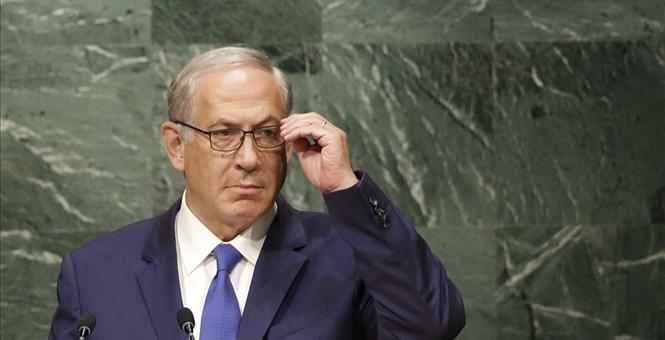
Netanyahu and glasses

Because his strategy is based on ideological beliefs rather than power calculations rooted in reality, Obama’s position cannot be swayed by evidence, even when evidence shows that his administration’s policies endanger US national security.

The more Israel allows other actors to determine the nature of the emerging regional order, the less secure Israel will be. The more willing we are to take calculated risks today the greater our ability will be to influence the future architecture of regional power relations and so minimize threats to our survival in the decades to come.

***********************

On Wednesday the Obama administration was caught off guard by Russia’s rapid rise in Syria. As the Russians began bombing a US-supported militia along the Damascus-Homs highway, Secretary of State John Kerry was meeting with his Russian counterpart, Sergei Lavrov, at the UN. Just hours before their meeting Kerry was insisting that Russia’s presence in Syria would likely be a positive development.

Reacting to the administration’s humiliation, Republican Sen. John McCain said, “This administration has confused our friends, encouraged our enemies, mistaken an excess of caution for prudence and replaced the risks of action with the perils of inaction.”

McCain added that Russian President Vladimir Putin had stepped “into the wreckage of this administration’s Middle East policy.”

While directed at the administration, McCain’s general point is universally applicable. Today is no time for an overabundance of caution.

The system of centralized regimes that held sway in the Arab world since the breakup of the Ottoman Empire nearly a century ago has unraveled. The shape of the new order has yet to be determined.

The war in Syria and the chaos and instability engulfing the region are part and parcel of the birth pangs of a new regional governing architecture now taking form. Actions taken by regional and global actors today will likely will influence power relations for generations.

Putin understands the opportunity of the moment.

He views the decomposition of Syria as an opportunity to rebuild Russia’s power and influence in the Middle East – at America’s expense.

Russia isn’t the only strategic player seeking to exploit the war in Syria and the regional chaos. Turkey and Iran are also working assiduously to take advantage of the current absence of order to advance their long term interests.

Turkish President Recep Tayyip Erdogan is exploiting the rise of Islamic State in Syria and Iraq to fight the Kurds in both countries. Erdogan’s goal is twofold: to prevent the establishment of an independent Kurdistan and to disenfranchise the Kurds in Turkey.

As for Iran, Syria is Iran’s bulwark against Sunni power in the Arab world and the logistical base for Tehran’s Shi’ite foreign legion Hezbollah. Iranian dictator Ali Khamenei is willing to fight to the bitter end to hold as much of Syrian territory as possible.

Broadly speaking, Iran views the breakup of the Arab state system as both a threat and an opportunity.

The chaos threatens Iran, because it has radicalized the Sunni world. If Sunni forces unite, their numeric advantage against Shi’ite Iran will imperil it.

The power of Sunni numbers is the reason Bashar Assad now controls a mere sixth of Syrian territory. To prevent his fate from befalling them, the Iranians seek to destabilize neighboring regimes and where possible install proxy governments in their stead.

Iran’s cultivation of alliances and proxy relationships with Hamas, the Muslim Brotherhood and al-Qaida, and its phony war against Islamic State all point to an overarching goal of keeping Sunni forces separated and dependent on Tehran.

The Iranian regime also fears the prospect of being overthrown by its domestic opponents. To counter this threat the regime engages in large-scale and ever escalating repression of its perceived foes.

Iran’s nuclear program also plays a key role in the regime’s survival strategy. As Khamenei and his underlings see things, nuclear weapons protect the regime in three ways. They deter Iran’s external foes. They increase domestic support for the regime by enriching Iran which, no longer under international sanctions, sees its diplomatic and economic prestige massively enhanced due to its nuclear program.

Finally, there is Iran’s war with Israel and the US. A nuclear-armed Iran is a direct threat to both countries.

And this, too, is a boon for the mullacracy. From the regime’s perspective, fighting Israel and the US serves to neutralize the Sunni threat to the regime. The more Iran is seen as fighting Israel and the US the more legitimate it appears to Sunni jihadists.

This then brings us to the Americans. Like the Russians, the Turks and the Iranians, President Barack Obama and his associates are strategic players. Unlike those powers however, the administration is moved not by raw power calculations but by ideological dictates.

Obama and his advisers are convinced that the instability and radicalization of states and actors throughout the region is the consequence of the actions of past US administrations and those of America’s regional allies – first and foremost, Israel and Egypt. The basis for this conviction is the administration’s post-colonial ideological underpinnings.

Because his strategy is based on ideological beliefs rather than power calculations rooted in reality, Obama’s position cannot be swayed by evidence, even when evidence shows that his administration’s policies endanger US national security.

This brings us to Israel.

Israel has limited power to influence regional events.

It cannot change its neighbors’ values or cultures. Israel can however limit its neighbors’ ability to harm it and expand its ability to deter would be aggressors by among other things, using its power judiciously to influence now forming power balances between various regional and world actors.

Israel has followed this model in Syria with notable success.

At an early stage of the war our leaders recognized that aside from the Kurds, who have no shared border with us, there are no viable actors in Syria that are not dangerous to Israel. As a result, Israel has no interest in the victory of one group against others.

The only actor in Syria that Israel has felt it necessary to actively rein in is Hezbollah. So it has acted repeatedly to prevent Hezbollah from using its operational presence in Syria as a means for augmenting its offensive capabilities in Lebanon.

The problem with this strategy is that it has ignored the fact that from Hezbollah’s perspective, there is no operational difference between Lebanon and Syria.

The war in Syria spread to Lebanon years ago.

Now, with Iranian and Russian assistance, Hezbollah is beginning to develop the industrial capacity to bypass Israel and independently produce advanced weapons inside Lebanon. This rapid industrialization of Hezbollah’s military capabilities requires Israel to end its respect for the all-but-destroyed international border and take direct action against Hezbollah’s capabilities in Lebanon.

This brings us to Hezbollah’s boss, Iran. For the past several years, the same caution that has led Israel to grant de facto immunity to Hezbollah forces in Lebanon has led to Israel’s passivity and deference to the Obama administration in relation to Iran’s nuclear program.

With regard to Iran’s nuclear installations, the strategy of passivity has largely been forced onto an unwilling political leadership by Israel’s military leaders.

For the past several years, the IDF’s General Staff has refused to support the government’s position on Iran’s nuclear program.

Our military leaders have justified their insubordination by arguing that if Israel takes independent action against Iran’s nuclear program it will undermine its bilateral relations with the US, which they consider more important than preventing Iran from acquiring nuclear weapons.

Although under the best of circumstances, the IDF’s position would be unacceptable from the perspective of democratic norms of governance, since the ideologically driven Obama administration took power seven years ago, the military’s position has imperiled the country.

So long as Obama – or the ideology that informs his actions – remains in power in Washington, US security guarantees towards Israel will have no credibility.

The IDF’s assessment that ties to the US are more important than preventing Iran from becoming a nuclear power will remain incorrect, and dangerously so.

Today is Israel’s opportunity to shape the future of the Middle East by not only preventing Iran from becoming a nuclear power, but by preventing a regional nuclear arms race.

The closer Iran comes to emerging as a nuclear power, the more Sunni regimes, including Islamic State, will seek their own nuclear capabilities. It goes without saying that the more regional actors have nuclear weapons, the more dangerous the region becomes for Israel, and indeed for the world as a whole.

For many Israelis, the story of the week wasn’t Russia’s air strikes against US-allied forces in Syria. It was PLO chief and Palestinian Authority President Mahmoud Abbas’s speech at the UN General Assembly.

Leftists expressed horror in the face of Abbas’s threat to end the PLO’s adherence to the agreements it signed with Israel in the 1990s (and has stood in material breach of ever since). The government insisted, for its part that the reason the peace process has not brought peace is because Abbas and his PLO refuse to negotiate with Israel.

Unfortunately, both sides’ responses to Abbas’s speech indicate that Israel has lost all semblance of strategic purpose in regard to the Palestinians.

Fifteen years ago this week, on September 28, 2000, the Palestinians opened their terrorist war against Israel. Ever since it has been clear that no Palestinian faction is interested in living at peace with Israel.

Despite this, for the past 15 years, Israel has refused to reconsider its strategic allegiance to the false notion that it has the ability to influence the hearts and minds of the Palestinians and bend them in the direction of peace.

This delusional thinking is what caused the IDF’s General Staff to convene immediately after Operation Protective Edge ended and try to figure out how to rebuild Gaza.

Ever since the cease-fire came into force, Hamas has diverted all the assistance it has received from Israel and the international community not to rebuild Gaza, but to rebuild its military capacity to harm Israel. And yet, from the IDF’s perspective, ever since the war ended our most urgent task has been to save Hamas and the Palestinians alike from reckoning with the price of their aggression.

Likewise, Israel continues to insist that we have a strategic interest in peace with the PLO. Even if this is true in theory, chances are greater that unicorns will fall from the sky and prance through Jerusalem’s Old City than that the PLO will agree to make peace with Israel.

Our continued defense of the PLO as a legitimate actor harms our ability to secure other strategic interests that are achievable and can improve Israel’s regional position. These interests include securing transportation arteries in Judea and Samaria and strengthening Israel’s military and political control over the areas. These interests have only grown more acute in recent years with the rise of jihadist forces throughout the region and among the Palestinians themselves.

This brings us back to McCain and his strategic wisdom.

Israel must not allow the risks of action to lure us into strategic paralysis that imperils our future.

The more Israel allows other actors to determine the nature of the emerging regional order, the less secure Israel will be. The more willing we are to take calculated risks today the greater our ability will be to influence the future architecture of regional power relations and so minimize threats to our survival in the decades to come.

The Most Dangerous Man In the World

October 2, 2015

The Most Dangerous Man In the World, American ThinkerAndrew Logar, October 2, 2015

…is neither Russia’s Vladimir Putin nor China’s Xi Jinping, nor at this time, Ayatollah Khamenei – it’s none other than America’s Barack Hussein Obama.  This is not because of any aggressive, risk-laden actions he has taken, far from it.  It is because of those he has failed to take at critical times to credibly dissuade strategic competitors and potential aggressors, such as Russia and China, from actions that may suddenly compound into  destabilizing confrontations, even war.  When the Middle East cauldron spawned the barbaric ISIS, Obama’s indecisive, pusillanimous response allowed this Islamic malignancy to rapidly metastasize, compounding and accelerating an existing refugee problem that will involve America.  Additionally, throughout his tenure, overt actions Obama has taken served to steadily and materially, degrade American military capabilities, while enemies grow stronger.

In retrospect, divining Obama’s foreign policy should have been relatively easy given his background – a world seen through the eyes of someone whose father was a Muslim, as was his step-father, whose early education was in a Muslim madrassa, followed by mentoring from the known communist Frank Marshall Davis, associations with Columbia University’s Palestinian activist Edward Said and later, Harvard’s leftist Brazilian socialist Roberto Unger, later close association with admitted communist and Weatherman terrorist Bill Ayers, then followed by 20 years of anti-American and anti- Semitic sermons by Reverend Jeremiah Wright who, placing much of the world’s ills at America’s doorstep, culminated a post 9-11 sermon sententiously intoning, “…America’s chickens have come home to roost.”

Ironically, other chickens have indeed come home to roost.   American liberalism’s pernicious obsession to eradicate the odium of slavery long gone and any vestiges of remaining discrimination in one fell swoop, blindly promoted the candidacy of the first black president, propelling a relatively unknown, unvetted and remarkably unqualified candidate to two electoral victories.  That most unfortunate occurrence followed by resultant deleterious fallout at home and abroad, are liberalism’s chickens coming home to roost – in the White House – where they’ll cluck away until January 20, 2017.

After winning the 2008 election, Obama launched his now infamous “Apology Tour,” covering three continents in some 100 days, during which the Heritage Foundation identified 10 major apologies Obama made for America’s past behavior.  Mitt Romney, in his book, “No Apology,” correctly criticized Obama’s gratuitous apologies.  Indeed, unnecessary apologies by our president projected a weakness in resolve, confidence and appreciation of our nation’s accomplishments, our beliefs and values.  While in Europe, when asked if he believed in American “exceptionalism,” he said yes – in the same way that, “ …the Brits believe in British exceptionalism and the Greeks in Greek exceptionalism.”

This was an arresting, if not downright stupefying statement – coming from the head of state of the world’s most powerful nation, with a manifestly unrivaled history.  This is a nation which in 239 years since the Declaration of Independence, grew from 13 colonies and 3 million people to 50 states and 320 million people, a nation victorious in its Revolutionary War, the War of 1812 and which fought its bloodiest of wars, the Civil War, to expunge slavery; this is a nation victorious in the Mexican-American War, the Spanish-American War, WWI and WWII, that introduced the incontestably successful Marshall Plan critical in European post war recovery, that sent men to the moon and back, 6 times – and the nation that won the Cold War – a nation that has consistently led the world in Nobel prizes in medicine, science and technology. This is unequivocally a nation like none other, a nation of unparalleled achievements and sadly, one whose president does not consider particularly exceptional.

The historical record now shows global competitors and enemies have taken their measure of Obama: the Russians have acted with impunity in Crimea, Ukraine and Syria, the Chinese are establishing a stranglehold on the South China Sea while Russians, Chinese and Iranians are engaged in flagrant cyber-espionage against America, ISIS is growing, while Syria, Iraq and Afghanistan are all in play.

Barack Obama’s sophomoric efforts at geopolitics derived from his warped, kaleidoscopic misreading of 20th century history have now spiraled into a veritable tragicomedy of incompetence.  Witness his administration’s $500 million program to train Syrian rebels to fight ISIS: not only didn’t that produce the projected 5,000 trained fighters, or even 500, but only, according to General Lloyd Austin, “…four or five.” This is grist for a Marx Brothers movie and attributable to abysmally poor leadership, planning and organization which can only be placed at the doorstep of the White House.

An objective review of the Obama administration’s policies reveals they have consistently posed a direct or indirect threat to national security:

– The unilateral cancellation of the Easter Europe ABM deployment without securing a tangible quid pro quo from Moscow and no counter to Russia’s recent decision to sell the potent S-300 anti-aircraft system to Iran.

– The ill-advised support for the overthrow of long-term ally of the West, Egypt’s Mubarak and the inexplicable enthusiastic White House support of the Muslim Brotherhood.

– The equally ill-advised and ill-planned toppling of Libya’s Gaddafi, resulting in a country without a functional government now overrun with Islamists, where at Benghazi four Americans died needlessly.

– The withholding of vital intelligence from the Senate that Russia had been flagrantly cheating on the existing INF treaty to advance ratification of New START in 2010. Seventy-one Senators voted for ratification without full background knowledge.

– The 2011 withdrawal of all American troops from Iraq by Obama while blaming the Bush administration for inadequacies of the 2008 Status of Forces Agreement (SOFA).  This allowed Iraq to descend back into sectarian chaos, giving rise to ISIS and advantage to Iran.  A war won at high cost in blood and treasure was thus lost.

– The military drawdown in Afghanistan – mindlessly pre-announced to the enemy – may lose that war as well if continued.

– The release of five dangerous Taliban in exchange for Sgt. Bergdahl is beyond rational justification and/or discussion.

– The manifest dereliction of duty in not taking strong measures to protect America from devastating EMP attack – which can be done at very affordable cost.

– The lack resolute policy has turned Syria into a graveyard of American credibility. Nothing substantive has been achieved to slow, let alone destroy, rapidly metastasizing ISIS, unconscionably leaving a compounding problem to future administrations.

– The opening of our southern border to a tsunami of illegal immigration, arguably to permanently bias future voter demographics toward a one-party (Democratic) state. That many of those gaining easy entry may wish us harm is apparently of no concern to Obama.

– The continuing undermining of America’s military superiority is increasing the likelihood of confrontation with adversaries. According to the Heritage Foundation Index of Military Strength, our Commander-In-Chief has allowed our military power to degrade to “Marginal,” leaving the US Army at its relatively weakest level since the end of WWII, while our antagonists pour money into their armed forces.

– Finally (but Obama is not through yet!) – during recent post-summit remarks, China’s Xi Jinping suggested tough U.S. response to Chinese hacking would bring retaliation; obligingly, Obama affirmed sanctions wouldn’t be directed against governments. Essentially, Xi stepped forward, Obama blinked and stepped back – signaling a major geopolitical sea change. Cyberespionage by Russia and Iran haven’t been addressed.

Before winning the 2008 election and still a senator, during the Bush administration’s then ongoing nuclear negotiations with Iran, Obama, in a brazen and historically unprecedented move, secretly sent a personal emissary to Iran, William G. Miller, a former Ambassador to Ukraine, essentially conveying this message: Obama will very likely to be elected president, after which time Iran will find negotiating with him far easier.  The Bush negotiations reportedly then reached a stalemate.  Fast-forward to 2015, through Obama’s and Kerry’s “hard” bargaining, we’ve reached an agreement with Iran whereby monitoring Iran’s programs will be left to the Iranians as they now have the right to self-inspect” and so as to take the sting away from such an onerous deal, we’ll give them $100 billion of frozen assets  – with which to do as they please – while America agrees to protect Iran’s nuclear facilities from cyber warfare.

Though Red China, Russia and Iran increasingly challenge America, the Middle East bloodshed continues and ISIS grows stronger, President Obama has declared “…no challenge–poses a greater threat to future generations than climate change.” This extraordinarily vacuous statement is from either a hopelessly delusional ideologue, woefully untutored in world history, geopolitics and the unequaled greatness of America, or a brilliant Manchurian Candidate marching to his own drumbeat.  In any case, Obama is a president like none other – and may we never see the likes of him again.


Abbas’s Trap: The Big Bluff

October 2, 2015

Abbas’s Trap: The Big Bluff, Gatestone InstituteKhaled Abu Toameh, October 2, 2015

(Please see also, Three cheers for Terroristine — DM)

  • Those who rushed to declare the death of the Oslo Accords fell into Abbas’s trap.
  • Abbas’s threats are mainly designed to scare the international community into pressuring Israel to offer Abbas more concessions. He is hoping that inaccurate headlines concerning the purported abrogation of the Oslo Accords will cause panic in Washington and European capitals, prompting world leaders to demand that Israel give Abbas everything he asks for.
  • Abbas knows that cancelling the agreements with Israel would mean dissolving his Palestinian Authority, and the end of his political career.
  • The tens of thousands of Arab refugees now seeking asylum in Europe could not care less about the “occupation” and settlements.
  • Ironically, Abbas declared that, “We are working on spreading the culture of peace and coexistence between our people and in our region.” But his harsh words against Israel, in addition to continued anti-Israel incitement in the Palestinian media, prove that he is moving in the opposite direction. This form of incitement destroys any chance of peace.

After weeks of threatening to drop a bombshell during his speech before the UN General Assembly, Palestinian Authority (PA) President Mahmoud Abbas on September 30 proved once again that he is an expert in the art of bluffing.

In the end, the bombshell he and his aides promised to detonate at the UN turned out to be a collection of old threats to abrogate signed agreements and a smear campaign against Israel.

There was nothing dramatic or new in Abbas’s speech. During the past few years, he and some of his aides have been openly talking about the possibility of cancelling the Oslo Accords if Israel does not fulfill its obligations towards the peace process.

In his speech, Abbas repeated the same threat, although some Western political analysts and journalists misinterpreted it as an announcement that he was abrogating signed agreements with Israel.

As one of Abbas’s advisors, Mahmoud Habbash, later clarified, “President Abbas did not cancel any agreements. He only made a threat, which is not going to be carried out tomorrow.”

Now, it is obvious that the talk about a bombshell was mainly intended to create tension and suspense ahead of Abbas’s speech. This is a practice that Abbas and his aides have become accustomed to using during the past few years in order to draw as much attention as possible.

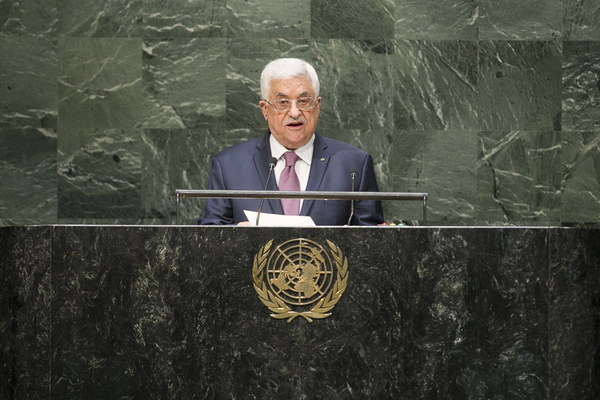
General Debate, 69th Session of the General Assembly Palestine-Bosnia-Samoa

General Debate, 69th Session of the General Assembly
Palestine-Bosnia-Samoa

The threat to cancel the Oslo Accords with Israel is not different from other threats that Abbas and his aides have made over the past few years. How many times has Abbas threatened in the past to resign from his post or suspend security coordination with Israel? In the end, he did not carry out any of these threats.

Abbas is unlikely, also this time, to carry out his latest threat to cancel the agreements with Israel. He knows that such a move would mean dissolving his Palestinian Authority and the end of his political career. But Abbas would like the world to believe that he has already cancelled the Oslo Accords. Judging from the inaccurate headlines in the international media, he seems to have achieved his goal.

Now, many in the international community are falsely convinced that Abbas has annulled all signed agreements with Israel. Those who rushed to declare the death of the Oslo Accords fell into Abbas’s trap.

Abbas’s threats are mainly designed to scare the international community into pressuring Israel to offer Abbas more concessions. He is hoping that the inaccurate headlines concerning the purported abrogation of the Oslo Accords will cause panic in Washington and European capitals, prompting world leaders to demand that Israel give Abbas everything he is asking for.

Abbas is also hoping that his recurring threats will put the Israeli-Palestinian conflict back at the world’s center stage. Abbas and the Palestinians feel that the world has lost interest in the conflict, largely due to the ongoing turmoil in the Arab world, the refugee crisis in Europe and the growing threat of the Islamic State terror group.

This concern was voiced by the PLO’s Saeb Erekat immediately after President Barack Obama’s speech at the UN General Assembly, which did not include any reference to the Israeli-Palestinian conflict.

Expressing “disappointment” over Obama’s speech, Erekat asked, “Does President Obama believe he can defeat ISIS and terrorism, or achieve security and stability in the Middle East, by ignoring the continued Israeli occupation, settlement expansion and the continued attacks on al-Aqsa Mosque?”

Of course, there is no direct link between Israeli “occupation” and settlements and the growing threat of radical Islam or the turmoil in the Arab world. The Islamic State is not beheading Muslims and non-Muslims because of the settlements or “occupation.” The Islamic State is not committing all these atrocities because it wants to “liberate Palestine.” Its main objective is to conquer the world after killing all the “infidels” in order to establish a sharia-ruled caliphate. The Islamic State would kill Erekat and Abbas — and many other Muslims — on its way to achieve its goal. In the eyes of the Islamic State, folks like Erekat and Abbas are a fifth column and traitors.

But instead of supporting the world’s war against the Islamic State and radical Islam, Abbas and Erekat want the international community to look the other way and devote all its energies and attention to the Israeli-Palestinian conflict. The tens of thousands of Arab refugees who are now seeking asylum in several European countries could not care less about the “occupation” and settlements. These people have lost everything they used to possess and their only dream is to either return to their homes and lands safely or start a new life in Europe and the US.

Abbas wanted worldwide attention in wake of the international community’s preoccupation with the refugee crisis and the radical Islam threat. For now, he appears to have achieved his goal, largely thanks to the international community’s misreading of his speech at the United Nations.

But while everyone is busy talking about Abbas’s bombshell, only a few have noticed that his speech consisted mostly of anti-Israel rhetoric that is likely to aggravate tensions between the Palestinians and Israel. Abbas used the UN General Assembly podium to make grave charges against Israel concerning “apartheid,” settlements and tensions on the Temple Mount. His fiery rhetoric, which has been partially welcomed by Hamas and other radical Palestinian groups, is likely to exacerbate tensions between Israelis and Palestinians and encourage more Palestinians to engage in violence.

It is this form of incitement that destroys any chance of peace between Israel and the Palestinians. This is the kind of rhetoric that prompts Palestinian youths to take to the streets and throw rocks and firebombs at Israeli civilians and policemen. Still, the international media, by and large, chose to ignore this destructive part of Abbas’s speech.

Ironically, Abbas declared in his speech that, “We are working on spreading the culture of peace and coexistence between our people and in our region.” But his harsh words against Israel, in addition to continued anti-Israel incitement in the Palestinian media, prove that he is moving in the opposite direction. As Abbas was addressing the UN General Assembly, some of his loyalists in Ramallah threatened and expelled Israeli Jewish journalists who came to interview Palestinians. This is certainly not a way to spread a “culture of peace and coexistence.”

Chinese warplanes to join Russian air strikes in Syria. Russia gains Iraqi air base

October 2, 2015

Chinese warplanes to join Russian air strikes in Syria. Russia gains Iraqi air base, DEBKAfile, October 2, 2015

Russia_China_480

Russia’s military intervention in Syria has expanded radically in two directions.DEBKAfile’s military and intelligence sources report that China sent word to Moscow Friday, Oct. 2, that J-15 fighter bombers would shortly join the Russian air campaign that was launched Wednesday, Sept. 30. Baghdad has moreover offered Moscow an air base for targeting the Islamic State now occupying large swathes of Iraqi territory

Russia’s military intervention in Syria has five additional participants: China, Iran, Iraq, Syria and Hizballah.

The J-15 warplanes will take off from the Chinese Liaoning-CV-16 aircraft carrier, which reached Syrian shores on Sept. 26 (as DEBKAfile exclusively reported at the time). This will be a landmark event for Beijing: its first military operation in the Middle East as well the carrier’s first taste of action in conditions of real combat.

Thursday night, China’s foreign minister Wang Yi, made this comment on the Syrian crisis at a UN Security Council session in New York: “The world cannot afford to stand by and look on with folded arms, but must also not arbitrarily interfere (in the crisis).”

A no less significant development occurred at about the same time when Iraqi Prime Minister Haider al-Abadi, speaking to the US PBS NewsHour, said he would welcome a deployment of Russian troops to Iraq to fight ISIS forces in his country too. As an added incentive, he noted that this would also give Moscow the chance to deal with the 2,500 Chechen Muslims whom, he said, are fighting with ISIS in Iraq.

DEBKAfile’s military sources add that Al-Abadi’s words came against the backdrop of two events closely related to Russia’s expanding role in the war arena:

1.  A joint Russian-Iranian-Syrian-Iraqi war room has been working since last week out of the Iraqi Defense Ministry and military staff headquarters in Baghdad to coordinate the passage of Russian and Iranian airlifts to Syria and also Russian air raids. This command center is also organizing the transfer of Iranian and pro-Iranian Shiite forces into Syria.

2.  Baghdad and Moscow have just concluded a deal for the Russian air force to start using the Al Taqaddum Air Base at Habbaniyah, 74 km west of Baghdad, both as a way station for the Russian air corridor to Syria and as a launching-pad for bombing missions against ISIS forces and infrastructure in northern Iraq and northern Syria.

Russia has thus gained a military enclave in Iraq, just as it has in Syria, where it has taken over a base outside Latakia on the western coast of Syria. At the same time, the Habbaniyah air base also serves US forces operating in Iraq, which number an estimated 5,000.

Benjamin Netanyahu • United Nations Address • 10/1/15

October 1, 2015

Benjamin Netanyahu • United Nations Address • 10/1/15 via You Tube, October 1, 2015


According to the blurb at You Tube,

October 1st, 2015 • Israeli Prime Minister Benjamin Netanyahu renewed his warning that the Iranian nuclear deal threatens to destabilize the Middle East and will make a war more likely. He cautioned that already Iran is ramping up efforts to fund terror cells worldwide, while also arming Islamists in Syria, Yemen, Lebanon, and the Palestinian territories.

Netanyahu told that Iran was already building up its own armament stockpiles and that billions of dollars in sanctions relief would only fuel the effort. He reminded the nations of the world that Iran already has the capability to target Israel with ballistic weapons and that it’s current ballistic efforts can only be meant to threaten Europe and the United States.

The Prime Minister chastised the member states of the U.N. for their failure to speak out against Iranian threats to destroy Israel, and that the silence was deafening. Netanyahu emphasized the point by staring at the delegates in silence for 45 seconds.

Netanyahu responded to Palestinian Authority President Mahmoud Abbas’s declaration the previous day that it would no longer honor the Oslo Peace Accords by offering to reopen peace talks with the PA without any conditions. He also rejected the assertion by Abbas that Israel intended to change the status of the al-Asqa Mosque on the Temple Mount in Jerusalem, a Palestinian allegation that has recently fomented violent incidents.

Prime Minister Netanyahu pleaded with U.N. member states to cease decades of anti Israeli rhetoric, and to undertake an honest effort to work toward an Israeli – Palestinian peace agreement.

He also urged the United Nations to advance peace in the Middle East after decades of the UN working against Israeli interests.

‘Yesterday Russia Turned A New Page In The History Of The World’

October 1, 2015

Chairman Of The Hizbullah-Affiliated ‘Al-Akhbar’ Daily On Russian Air Campaign In Syria: ‘Yesterday Russia Turned A New Page In The History Of The World,’ Middle East Media Research Institute, October 1, 2015

In an article published in the Hizbullah-affiliated Lebanese daily Al-Akhbar on October 1, 2015, the chairman of the newspaper’s board of directors, Ibrahim Al-Amin, predicted that Russia’s air campaign in Syria will be merely a prelude to a larger military offensive involving ground operations by the Syrian Army, Iran, Hizbullah, and even the Iraqi Popular Mobilization Forces. Al-Amin is known to have close ties to Hizbullah, and in the past he has proven a reliable source on matters relating to the Iran-Syria-Hizbullah axis.

24967Ibrahim Al-Amin (source: Siyese.net)

The following is the translation of the article:

“…This is the first test for the granddaughter of the Eastern dynasty [i.e. Russia] since World War II, and it is the first field test of whether America’s unipolar position in the world over the past quarter century has truly been broken. Above all, this is a repositioning of Russian military force in the direct labor market of the regions of ‘cold’ confrontation with the U.S.-led West… Today we find ourselves before the best opportunity of putting Syria on a path to a true solution, even if it be prefaced by fire.

“As for the facts, the Russian air force carried out the first missions of a working program laid out in detailed form in an existing plan of cooperation between Moscow and its allies in the war in Syria and Iraq. This is a plan that is coordinated down to the finest details with the two allies Syria and Iran, and consequently with Hizbullah [as well]… What happened yesterday, and which will soon reach its culmination, is a necessary preface to a larger military action that will include a land component undertaken by other forces in the alliance. To put it more directly, [Russia’s] aerial bombardment of [the rebels’] command and control centers, major weapons arsenals, and artillery positions will be a preface to a military operation carried out by the Syrian army on the ground, with direct support from Iran and Hizbullah, and even from the Iraqi Popular Mobilization Forces… It may be emphasized that Russia’s activity yesterday means clearly that all the discussions in New York didn’t change an iota in the military plan of action…

“The signs of surprise and astonishment on [the faces of] the Americans, the Westerners, the Israelis, the Turks, and the Saudis are an additional proof of the weakness of the prior coordination regarding the fate of the initiatives surrounding the Syria crisis. In fact, the step taken by Russia is a kind of dare to all those who employed every violent means they could against the Syrian regime. If they decide to broaden the confrontation, they will be forced to deal with the new realities, which today are openly represented by the Russian military presence, and tomorrow will be represented by an open Iranian military presence as well…

“This must not hide from our eyes the picture of the complicated reality, which tells us that the joy felt by the regime elements in Syria must not turn into any slackening, not on the part of the regime itself, and not on the part of all those who fight alongside it. It would be naive to consider the Russian strikes sufficient to counter the enemies. It would rather be realistic to profit from the support of Russia – which is a supporting actor, and is not [itself] a member of the axis of resistance – in order to prepare to wage harsh and decisive battles in a number of places in Syria. This is a matter that requires raising the level of readiness and mobilization, and the creation of operative means of benefitting from the Russian military arsenal that is present in or coming to Syria.

“Yesterday Russia turned a new page in the history of the world. However far its military action in the field reaches, it is the political and strategic results that will remain more important. These results will invite those who delude themselves in thinking that America is still the leader of the world and controller of its fate to revise their stance. Those who do not want to change their minds, let them stay as they wish, but they should take into account that they must rely on themselves more than at any time in the past. This goes for Syria, Iraq, Palestine, and even the Arabian Peninsula and North Africa!”

Satire | Three cheers for Terroristine

October 1, 2015

Three cheers for Terroristine, Sultan Knish Blog, Daniel Greenfield, October 1, 2015

(He refers, of course, to “Palestine.” — DM)

We need a terrorist state. Where the politicians are terrorists, the police are terrorists and even the men sitting at the desk when you come in to drop off a form are terrorists.

3egypt081613

There are states that support terrorists, and give safe harbor to them, but that’s not good enough. We don’t want another Pakistan or Iran. We’re not half-assing it this time. What we want is the genuine article. Terrorists from the top down. Terrorists everywhere. A state where every branch of government and the entire country is nothing but terrorists.

Terroristine has been an ancient dream since 1973 or was it 1967. A generation of keffiyah draped thugs, KGB operatives and human rights activists have looked out into the darkness and called it into being. It is a vision of a country where everyone is a murderer and children are taught from a very young age that their purpose in life is to die killing people who don’t share their religion.

And now after decades of negotiations, treaties, suicide bombings, mutilations, billions of dollars in vanishing into Swiss bank accounts and the death of its Egyptian born leader of AIDS– Terroristine is closer than ever to coming into being.

Abbas, its unelected dictator, who has struggled long and hard so that one of his sons might have his own cigarette monopoly in Gaza, has come to the UN to promise that Terroristine will have “will actively contribute to the achievement of economic, cultural, and humanitarian progress of civilization.”

And who can doubt him? Certainly not Terroristinians who don’t have elections or a free press.

Terroristine, whose noble flag (that looks like nearly every other Arab flag) flies over the UN, has done wonders for civilization. Consider the airplane hijacking. The suicide bomber. Has there ever been a civilization that did as much for civilized living as the Terroristinians?

Every time you get groped at an airport, thank Terroristine. Without the Terroristinian contribution to civilization, you might actually be able to get on a plane in peace. Or visit the Twin Towers.

The Terroristinian contribution to human progress is unquestionable. But only one thing stands in the way of it unleashing its full Terroristinian potential for all mankind.

Them. Those pesky people who live in that country that is always in the way. You know the ones, with too many Nobel prizes, newly invented tomatoes and microchips. They stand in the way of the great cultural contributions of Terroristine. They must die so that Terroristine must live.

They must be thrown out of their homes, village by village and city by city, so that the noble Terroristinians can plant their rockets on the rubble of their houses, the charred remains of their fields, and point them at their cities.

Trying to end terrorism by creating a terrorist state makes is like trying to put out a fire with more fire. It can’t work, but we must try. So that we can say that we tried. Over and over again. We’ll keep trying until we run out of land to try with. And people to try with.

Until there’s nothing left but Terroristines everywhere. Until all the world is Terroristine. The question is can we make it happen? Yes, we can. Oh sweet Allah, yes we can.

Israel must return to the 1967 borders, which are really the 1948 borders. Why are the borders of the 1948 war, so much better than the borders of the Six Day War? Because the Terroristinians came closer to winning that war. Came closer to driving the Yahood into the sea and ululating over miles  of their corpses.

boy_bomb.preview

But the dream failed. Farmers armed with outdated rifles. Volunteer pilots from America and Canada. Refitted cargo ships filled with half-dead men, women and children straight from the camps. Used Czech artillery. They held off the armies of seven Terroristinian nations. Farm by farm, they stood off tanks and infantry. In Jerusalem, they fought for every house. And so the Zionist entity survived.

Allah curse them. They survived.

But now it’s back to 1948 again. Every war undone. Every defeat turned to victory. Cut Jerusalem in two. Drive out the farmers. Burn their land. Dig up their graves. March the borders back to 1948. And fly the Terroristinian flag over dust and rubble. Had they won in 1948 or 1967 or 1973, there would be no Israel and no Terroristine. The land would have become part of Syria, Egypt and Jordan. And only when the mobs of the faithful would drive out the tyrants to replace them with Islamic states, would there finally be a Terroristine.

But despite what Abbas says, there is still hope for a two state solution. And we must do everything in our power to salvage the two state solution so that there will be a state of civilization on one side and a state of terrorists on the other. Hospitals here, launching pads there. Schools here, bomb factories there. Life here, death here. We all know the story. Olive trees and bomb belts. Rocks and dead families in burning cars by the side of the road. Children with their throats cut.

A dream. A nightmare. Who even knows anymore.

Why do we need Terroristine? Peace. There can be no peace without a terrorist state. Not a chance of it. The only way we’ll ever have peace is to give the terrorists a country of their own. A country dedicated to terrorism. Only then will the Terroristinians finally give up on all the killing, and dedicate themselves to medical research, quantum mechanics and the arts. It hasn’t happened yet to. But it’s bound to.

After decades as an autonomous territory, spreading death and destruction, it’s time for Terroristine to finally be recognized as an independent state. With contiguous borders cutting Israel in half. It is the only hope for peace in the region. Would Sunnis and Shiites be killing each other from Yemen to Iraq? Assuredly not. The moment the flag of Terroristine rises above the wounded hills, and its peaceful anthem, “Palestine is My Revenge” is heard in the land, then a great echoing sigh will rise up from the mouths of one billion Muslims. And the violence will cease.

The international community is impatient. They want Terroristine and they want it now. Whatever Israel has offered in the past, it isn’t enough. It must offer more and more. Whatever it takes. We know the Terroristinians want their own state. Every time they walk out of negotiations or end them with a round of terrorist attacks, it shows their deep and abiding passion for a state. They want it so badly they aren’t willing to make a single concession for it. Or even negotiate for it.

That’s how committed they are to realizing their great dream to Terroristine. And who can blame them? Have any people suffered the way the Terroristinians have? (Besides all the people the Terroristinians have killed over the last 1,400 years.) Have any other people been wholly subsidized by a UN agency dedicated only to them? Have any other people inspired such a stylish fashion statement? No more excuses. The world demands Terroristine. Middle East peace demands Terroristine.

How much longer can Israel expect to draw out the necessary concessions with weak justifications about terrorism. We know they’re terrorists. That’s why we’re giving them a state. If they weren’t terrorists, they could go to the back of the line with the Jews, Kurds and Armenians.

From one corner of the Muslim world to the other, a cry goes out. “We Are All Terroristinians.” They cry it it Cairo and Damascus, in Tehran and Islamabad, in Dubai and Paris. They mosques go up, the asses go up and the bombs go off. And off to the peace negotiations we go.

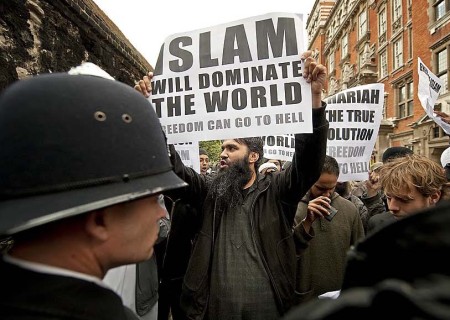
Islam will dominate the world

Everyone is impatient. Everyone is on fire. Especially the Terroristinians. Jewish store windows are smashed in London, Terroristinians butcher Rabbis in Jerusalem synagogues, fuming Terroristinians shoot up American recruiting centers. And the crowds cheer. “We Are All Terroristinians Now.”

It is a great day, I tell you. A great day for negotiating. ISIS impatiently beheads infidels to create its own Islamic Terroristine. In Afghanistan the word goes out, “We are the Taliban, we are the Afghan people, we are Terroristinians.” In Egypt and Turkey, they cry, “Khaybar Ya Yahood”. Churches burn. Soldiers die. The smoke rises to heaven. A man waits in line at the airport. His passport is Dutch, Welsh, German, American, it doesn’t matter. He is a Terroristinian. Yallah.

One day the borders of Terroristine will stretch from Spain to Pakistan. Or beyond Why settle for Jerusalem, when we can have London, Paris and Hamburg too. Why settle for anything at all? Allah is generous to the believers. Our people are in Africa. Even China. The Great Satan himself bows toward Mecca. The old governments are falling. The pawns of the Kufir are fleeing before our eyes.

We are all Terroristinians now. There is no other book on our shelves than the Koran. No law but Sharia in our hearts. And no nation but Terroristine. The ghost of Chamberlain stands outside No. 10 Downing Street promising peace. A Terroristinian refugee beheads him and holds up his spectral head to the cheers of the crowd. Rockets sail through the sky. The crowd cheers. Hip Hip Hooray. Hierosylma Est Perdita. Three cheers for Terroristine.

Satire? | Election 2048 – Under the peace of Islam

September 30, 2015

Election 2048 – Under the peace of Islam, Sultan Knish Blog, Daniel Greenfield, September 30, 2015

Election Coverage 2048 – Al-CNN

As the election of 2048 approaches, the candidates from both parties continue to exchange strong views on the issues that affect the lives of Americans. The Party of Democracy and Justice (Hezb-Al-Dimukratie-Wa’al Adalah) continues to maintain that the election will come down to social justice issues.

crescent&stripes.jpeg

“With 34 percent unemployment and the price of goat so far out of range of most working families that they have been forced to switch to chicken, it is time that our opponents stopped dodging the issues and took a serious look at the economic consequences of their policies,” Bashar Mohammed Hussein Al-Hamdani, said during a campaign stop at a HalalBurger in Peoria, Illinois.

However the ruling Freedom and Religion Party (Hezb Al-Hurriyah Wa’al Allah) denounced this as class warfare. Still preoccupied with the ongoing occupation of the Netherlands and Greece, the party has taken criticism for ignoring the economic problems of the United States while being preoccupied with waging foreign wars in the name of Islam.

Nevertheless President Mohammed Al-Thani, fresh off a pilgrimage from Mecca, vigorously defended his record while conducting a photo op at a San Diego Madrassa. “The Freedom and Religion Party believes in creating opportunities, rather than offering hand outs. Our subjugation of infidel nations has opened up new territories to be dominated by the believers and our vigorous drive for national morality has revived the family unit as an economic force. Our program of heavily fining women who go out with their naked hair exposed and raising the Jizya tax on the People of the Book has also raised billions of dollars that will go toward repaying the nation 93 trillion dollar debt.”

The high Jizya tax has provoked outrage in some parts of the United States, but the continuing decline of the nation’s non-Muslim population has made the Christian vote much less of a factor in the election. Hamdani has promised to cut the Jizya tax by 20 percent if elected, but it is unclear whether conservative elements in his own party will allow him to do it. National surveys show that since making the proposal, Hamdani’s ratings have gone down 9 points in Illinois and 14 points in California.

President Al-Thani’s advisors view the 2 million conversions to Islam since the Jizya tax was tripled as a major benefit to the party which lost its Christian support during the Great Transition. Since then the Freedom and Justice Party has picked up a Christian and Jewish bloc vote, but the value of that bloc has not held up well over the last two elections.

Christian rights activists attribute the decline of American Christians to the Jizya tax which has made it impossible for many Christian families to earn a living. They also blame the bloody 2045 Riots which marked the end of the Christian presence in former strongholds such as Nashville and Cedar Rapids, as well as rumors about the kidnapping and forced conversion of Christian girls.

However popular talk show host and pundit, Abdul Greene countered that the decrease was best explained by the large scale immigration of Christians out of the country. “The Christians are too bigoted to live in the same country with us, just like their parents and grandparents. If they can’t control the country, they refuse to live here and accept our laws.”

Christian rights activists have accused Greene of playing a major role in stirring up the 2045 Riots which torched Christian areas in major cities across the United States after a Christian man was accused of having an intimate encounter with a Muslim woman. Greene however insists that the Christians are the ones to blame. Greene’s support of the Freedom and Religion Party has been controversial, but President Al-Thani has refused to disavow him.

The latest round of attacks by Greek guerrillas on liberation forces in Athens led to smaller attacks on Christian businesses in New York, Chicago and Los Angeles last month. They also accentuated the debate over the continuing occupation of Greece which began in 2031 when the United States government intervened to protect the territorial claims of the Turkish Republic of Cyprus. Much as in the Netherlands, the intervention to protect a Muslim community turned into a full blown occupation and a war against an insurgency that is believed to be backed and supplied by rogue states such as the breakaway Arctic Republic and the Zionist Entity.

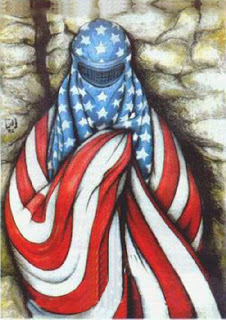
BurkaRedWhitandBlue-vi

The Freedom and Religion Party under President Al-Thani continues to take the position that American prosperity is closely linked to the welfare of the rest of the Muslim world. In the State of the Union address the president stated that, “We cannot repeat the folly of the Americans of the pagan period who believed that they could have material wealth without religion. Our prosperity comes from Allah and it is only by spreading the way of Allah and conducting our Jihad in the way of Allah on behalf of our endangered brothers and sisters in Europe and Asia that we will be deserving of Allah’s bounty.”

Hoping to exploit the widespread economic dissatisfaction, Hamdani, a former Wisconsin governor, has promised to withdraw troops from Greece within two years and the Netherlands within five years with the majority of remaining liberation forces being drawn from other Muslim countries. “We can best aid our fellow believers in the Muslim world by being a model of stability and a beacon of tolerance.”

Yusuf Al-Amiriki, a member of Hamdini’s foreign policy defense team and a first generation convert descended from two American presidents, courted controversy with a proposal to set up a coalition government of Muslim and moderate Christian groups in the Netherlands. Such governments had been tried in Europe before during the 2030’s, but invariably fell apart. Leading Senators from the Freedom and Justice Party accused Hamdani of selling out Muslim interests in order to court the Christian vote. Hamdani’s spokeswoman, Aisha Zubedi, has refused to comment on the Amiriki proposal except to say that Hamdani was open to any solution that would restore peace to the people of the Netherlands and protect the rights of European Muslims.

Hamdani courted further controversy by appearing at the funeral of former President Bob Thompson. Thompson had served two terms and while his administration had worked hard on outreach to the Muslim world, he also engaged in the targeted murder of Muslim religious leaders and provided aid to the Zionist entity. For these reasons, President Al-Thani chose not to appear at his funeral even though President Thompson had been a member of the pre-transition Freedom and Religion Party, which was then known as the Republican Party.

Despite the official disapproval, Thompson was viewed positively by many in the Muslim community. Tens of millions of Pakistani-Americans remember how after the India-Pakistan war, the Thompson Administration generously opened its borders to victims of the nuclear fallout in Pakistan. Without that step it might have taken decades more before America achieved a Muslim majority.

During the beginning of his second term, Thompson became the first president to take the oath of office on both a Bible and a Koran declaring that he wanted to make no separation between the books of god. At the Thompson funeral, Hamdani appeared to promise that he would repeat that gesture, but his spokeswoman quickly disavowed any notion that he would ever take an oath on a text that was not the Koran.

“No American president has taken an oath on a bible in over a decade, all that the governor meant was that he would keep both Christians and Muslims in mind as the people of Allah when he takes his oath to protect and defend the Sharia,” Aisha Zubedi said.

While the Democracy and Justice Party has often appealed to the poor, its missteps have raised concerns in traditional Muslim communities that Hamdani is going too far in pandering to non-Muslims. “Next thing you know he’ll say we should let the Jews come back to America,” Congressman Mohammed Mogabe declared. “If Hamdani wants votes out of Cleveland then he is going to show he will fight for us, not for the enemies of the prophets.”

Hamdani has hurriedly scheduled an upcoming visit to the Ground Zero Mosque, but it may not be enough to improve his image in the eyes those who have accused him of flirting with apostasy. While the Mosque is a traditional stop for presidential candidates, Hamdani is unlikely to pay tribute to the souls of the 19 martyrs as Al-Thani did during the previous election.

Hoping to refocus attention on his economic program, Hamdani called for higher corporate taxes and accused some corporations of abusing Islamic banking, in particular Hibah payments, to avoid paying taxes. Such charges are not new, but particularly galling at a time when over half the country is out of work and tycoons like Ahmed Shalafi and Sheikh Johnson have used their connections with the Al-Thani government to become billionaires.

To counter Hamdani, Al-Thani’s economic advisers have offered up a stimulus plan that raises the Jizya tax on infidels for the second time in a year and vowed to cut spending even further without affecting subsidies to Islamic schools or military preparedness for the Global Jihad. Though the election is still some time away, the Al-Thani campaign has also rolled out a series of ads targeting poor communities which accuse Hamdani of plotting with Jewish and Christian tycoons to subvert the Islamic system of finance through freemasonry and Communist class warfare tactics.

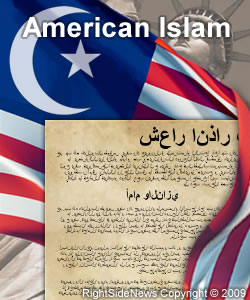
americanislam

Adding further drama to the election is the possibility of a third party campaign. Andrew McMillan who has been running as an independent in elections for almost twenty years without appealing to anyone but the same racist groups who have been disavowed even by most Christians and Jews, but there is talk that McMillan’s America Party might consider replacing the eccentric millionaire with sports star Ted March. As leading goalscorer who helped the United States win the 2042 World Cup, March is one of the most admired non-Muslims in the country. With him on the ticket, the America Party might be able to adopt a new moderate image that is no longer associated with bigotry and intolerance. But frustrating his own party members, the septuagenarian McMillan appeared to an event commemorating the 2045 riots and gave a rousing speech which hit on many of the same old themes. “For thirty-six years I’ve been involved in politics and the only thing that I can tell you about politics is that it’s all bunk. We weren’t talking about the things that mattered thirty-six years ago and we aren’t talking about them now.”

First US-Russian air clash builds up as Moscow orders US planes to exit Syrian air space

September 30, 2015

First US-Russian air clash builds up as Moscow orders US planes to exit Syrian air space, DEBKAfile, September 30, 2015

SU-25-30.9.15Russian warplanes head to Syria

A day after the White House said that “clarity” on Russian intentions in Syria had been achieved at the Obama-Putin summit in New York, the Russian President Vladimir Putin notched up the military tensions around Syria Wednesday, Sept. 30. A senior US official said that Russian diplomats had sent an official demarche ordering US planes to quit Syria, adding that Russian fighter jets were now flying over Syrian territory. US military sources told Fox News that US planes would not comply with the Russian demand. “There is nothing to indicate that we are changing operations over Syria,” a senior defense official said.

Earlier, Putin sought from the Russian upper house, the Federation Council, authorization for the use of military force abroad. He did not specify the country or region, but the only part of the world where Russia is currently building up its ground, air and naval forces outside the country is Syria.

A short time after the request, the Federation Council announced that it had unanimously authorized the use of Russian military force in Syria. The last time Putin sought this authorization was in early 2014 when he decided to annex the Crimean Peninsula from Ukraine. His action now contradicts his assertion to CBS on Sept. 28: “Russia will not participate in any troop operations in the territory of Syria or in any other states. Well, at least we don’t plan on it right now.”

DEBKAfile’s military sources report that Russian preparations for military action in Syria are clearly not limited to that country. They are being run by a joint coordination forward command and war room established a few days ago by Russia, Iran, Iraq and Syria in Baghdad. It is designed as the counterpart of the US Central Command-Forward-Jordan war room established north of Amman for joint US-Saudi-Qatari-Israeli-Jordanian and UAE operations in support of Syrian rebel operations against the Assad regime.

Two rival power war rooms are therefore poised at opposite ends of the Syrian arena – one representing a US-led alliance for operations against Assad, and the other a Russian-led group which is revving up to fight on his behalf.

Conspicuous in the swiftly evolving Syrian situation is the detailed advance planning which went into the Russian military buildup and partnerships, and the slow perception of what was going on, on the part of the United States and Israel.

Tuesday, US Defense Secretary Ashton Carter instructed his staff to establish a communication channel with the Kremlin to ensure the safety of US and Russian military operations and “avoid conflict in the air” between the two militaries. The Russian defense ministry shot back with a provocative stipulation that coordination with the US must go through Baghdad, an attempt to force Washington to accept that the two war rooms would henceforth communicate on equal terms.

Israel’s Defense Minister Moshe Ya’alon denied Tuesday night that Israel was coordinating its operations with the Russian army, stressing that Israel reserves the IDF’s right to freedom of action over Syria and would continue to prevent arms supplies reaching terrorist organizations such as Hizballah.

Meanwhile, six advanced Russian SU-34 strike fighter jets landed at Latakia’s Al-Assad international airport, after flying to their destination through Iraqi airspace.

The Russian military buildup is assuming far greater proportions than either imagined, far outpacing US or Israeli efforts at coordination.