Archive for the ‘Israel’ category

Russia air strikes seal Jebel Druze against attack and refugees

February 21, 2016

Russia air strikes seal Jebel Druze against attack and refugees, DEBKAfile, February 22, 2016

2717545 10/10/2015 Russian Su-25 attack aircraft take off from the Khmeimim airbase in Syria. Dmitriy Vinogradov/RIA Novosti

2717545 10/10/2015 Russian Su-25 attack aircraft take off from the Khmeimim airbase in Syria. Dmitriy Vinogradov/RIA Novosti

While Syrian war reporting focused over the weekend on the battles around Aleppo and along the Turkish border in the north, Russia since Saturday, Feb. 20 has ramped up its air bombardment of southern cities and towns, especially Daraa and Nawa. Thousands of fleeing rebels with their families and other civilians have meanwhile been turned away from the locked Jordanian border and are heading towards the Golan opposite the Israeli border.

The heaviest Russian air strikes seen hitherto in Syria have two strategic goals.

1. To retake the key southern town of Daraa from rebel hands and restore it to Syrian President Bashar Assad’s full control.

2. To crush rebel resistance in the South and force them to accept surrender, collapse or escape in the direction of the Jordanian or Israeli borders.

The intense Russian sorties are opening the door to Syrian, Iranian and Hizballah forces to move into the South and reach the Israeli borders. Prime Minister Binyamin Netanyahu sent Dr. Dore Gold to Moscow last week as his special emissary to explain how this affected Israel’s security. But he was unable to persuade the Russians to scale down their attacks in this sensitive border region.

Those attacks have a third goal, which is to encircle the Jebel Druze region with a “shield of fire” as protection for this ethnic minority of 750,000, most which inhabit mountain villages.

This unusual operation, the first of its kind in the Syrian war, has three objectives:

A. To shield the Druzes villages against ISIS attack from the east, namely Deir az-Zour.

B. To shut the door against fleeing rebels seeking sanctuary in the Druze enclave.

C. To show other Syrian minorities, especially the Kurds in the north, the great advantage of allying themselves with Moscow. Word of Russian protection of the Druzes has undoubtedly spread to Syria’s other minorities.

As for the rebels and refugees, Jordanian troops moved into the border crossings evacuated by Syrian rebels and closed the last crossing at Ramtha.

The exodus from southern Syria is now heading towards the Golan on Israel’s doorstep.

Israel has imposed a media blackout on this development. However, DEBKAfile’s sources warn that it will soon be impossible to keep it dark. Within a few days, many thousands of Syrian refugees will be massing at Israel’s Ein Zivan gate opposite Quneitra. Like Turkey and Jordan, Israel will have to supply large numbers of distressed Syrian refugees with tents, food, water and medicines.

Sean Hannity Full One-on-One Interview with Donald Trump (2/18/2016)

February 19, 2016

Sean Hannity Full One-on-One Interview with Donald Trump (2/18/2016), Fox News via You Tube, February 18, 2016

(Trump discusses the Israel – “Palestine” situation and the mess Obama has made beginning at 11:05 during the interview. The rest is very good too. — DM)

Kuwaiti Columnist: Israel Has Outdone Us In Everything – We Must Learn From It

February 18, 2016

Kuwaiti Columnist: Israel Has Outdone Us In Everything – We Must Learn From It,  MEMRI, February 18, 2016

On February 1, 2016, Ahmad Al-Sarraf, wrote in his column in the Kuwaiti daily Al-Qabas about Israel’s advantages over the Arabs in a wide variety of fields – democracy, military, science and technology, human rights and freedom of worship, and economics. He called on the Arabs to look at the reasons for Israel’s success and superiority, instead of viewing it as a political-religious foe about which they know nothing at all.

Following are excerpts from his article:[1]

26807Ahmad Al-Sarraf (image: Twitter.com/ahmedalsarraf1)

“In theory, Arabs have [only] one enemy in the region – except that recently we have made additional enemies, such as Iran. Some went even further, stepping up their hatred of Iran, while at the same time becoming more accepting of Israel [than in the past], to the point where it has become more friend than foe…

“Usually, every conflict is rooted in one side’s ignorance of the situation and nature of the other – though I tend to believe that Iran knows far more about the 22 Arab countries that those countries know about it. I attended Kuwaiti schools; in my day, their curricula were far more developed and were open to the other. Despite this, I do not remember reading a single line about [Iran] that was even remotely positive – neither about [its] geography or climate, nor about [its] strength, weakness, or history. So it was only natural for us to view it negatively, [even though we] had no [concrete] reason to do so.

“As for Israel, many [of us] view it as a political-religious foe, as opposed to a cultural danger, and this is a serious mistake. Even though our conflict with it has never ceased, we have remained ignorant regarding everything it represents, and for 70 years we have lacked, and continue to lack, all knowledge about it, and have learned nothing from it.

“Israel has outdone us in all fields – military, scientific, and cultural – but despite this we have refused to consider the reason for its obvious superiority to us, and have never stopped calling it ‘the monstrous entity’…

“Since its founding, Israel has been committed to democracy, while we refuse to even speak of it [i.e. democracy], let alone adopt it…

“Israel has given its minorities rights that most citizens in most Arab countries do not even dream of. Furthermore, the freedom of worship there exceeds that in any Arab or Islamic country.

“Israel has focused its attention on science, spending large sums on research, while we are still focused on whether drinking camel urine or using it medicinally is actually helpful.

“Israel has managed to unite people emigrating to it from 50 countries, and to forge a single people from them, while we have not managed [even] to create a [joint] army out of the [Arab] people, with its deep historical roots.

“Israel has known law and order since its first day, while we still try to comprehend the meaning of both these words. Two of [Israel’s] senior leaders went to prison for corruption, while we still argue over how to convict the master thieves in our midst.

“Israel has developed its technologies and developed its agriculture, industry, and military, becoming an advanced and respected country, while we currently occupy the bottom slot in every field.

“Israel has managed to get its companies traded on the international stock market, while we consider liquidating our assets after nearing bankruptcy.

“The list is long, and the sorrow that accompanies it persists.”


Endnotes:

[1] Al-Qabas (Kuwait), February 1, 2016.

Report: Hizballah Has Russian Technology Capable of Downing Israeli Jets

February 16, 2016

Report: Hizballah Has Russian Technology Capable of Downing Israeli Jets, Investigative Project on Terrorism, February 16, 2016

Hizballah is using advanced radar technology to “lock on” to Israeli aircraft flying reconnaissance missions over Lebanon, according to Israel’s Walla news service and reported by i24 News.

The new technology enables Hizballah to identify Israeli jets and fire missiles at them, Israeli security sources said.

“The connection between Hizballah, Russia and Syria have greatly changed the rules of the game in the region…Hizballah is indicating to Israel that it is ready for the next stage,” said an Israeli security official, quoted in Walla.

Israeli fighter jets are capable of detecting radar that threatens them, allowing pilots to alter their course. Nevertheless, the reports signal a troubling development that could hinder Israel’s freedom of movement in airspace across the northern border and its ability to effectively monitor Hizballah.

Following the 2006 war between Israel and Hizballah, the terrorist organization began acquiring sophisticated anti-aircraft systems and other advanced weapons from Syria and Iran. A recent report suggests that Hizballah is using Iranian anti-tank missiles in Syria that could be used against Israel in a future confrontation.

In light of these developments, Israel has allegedly targeted Hizballah weapons convoys on several occasions coming into Lebanon from Syria over the past few years. Nevertheless, the terrorist organization continues to build up its weapons arsenal and consolidate a base of operations on the Syrian Golan in order to attack the Jewish state.

Last month, Hizballah field commanders with operatives fighting in Syria told the Daily Beast that Russia is providing the terrorist organization with advanced weaponry amid enhanced coordination among both actors. The report outlines that Hizballah is acquiring long-range tactical missiles, anti-tank systems, and laser guided rockets from the Russians.

Op-Ed: Contemplating a US/Russia Alliance

February 16, 2016

Op-Ed: Contemplating a US/Russia Alliance, Israel National News, Ted Belman and Alexander Maistrovoy, February 16, 2016

Before Donald Trump’s blowout win in New Hampshire he shocked the world by saying he would allow the Russians to do the “dirty work” and would “let them beat the s*** out of ISIS also.”. Trump went further, “I have always felt that Russia and the United States should be able to work well with each other towards defeating terrorism and restoring world peace, not to mention trade and all of the other benefits derived from mutual respect,”

Putin, responded by saying: “He (Trump) says that he wants to move to another level of relations, to a deeper level of relations with Russia. How can we not welcome that? Of course we welcome it.”

The condemnation of Trump for his remarks was immediate but certainly not universal. Many American’s are beginning to see Russia in a new light.

Until the fall of the USSR, the 20th Century was dominated by an ideological struggle between American capitalism and Russian communism. But now that Russia has abandoned communism and the US is embracing socialism, as seen by the Sander’s victory in the New Hampshire primary, the two powers are more alike than ever before.

Now we have a different ideological struggle to contend with, namely a civilizational war between the Christian/Secular West and the Islamic Caliphate. They are inimical to each other. North America, Europe and Russia are natural allies in this struggle as they are different daughters of one civilization.

In the past, both Russia and the US have backed different Arab states or Muslim groups, including radical Islamists. The end result of this US/Russia enmity was to destabilize the ME and Europe and to allow an Islamic fifth column into America and Europe.

The reality is that Russia, Europe and the US desperately need each other. Together they can withstand the hydra of pan-Islamism with its countless heads (ISIS, al-Qaeda, Jabhat al-Nusra, Salafis, Muslim brothers, etc.), can stabilize the Middle East, the cradle of Islamic fanaticism and can stabilize Europe.

For Russia, the triumph of the Caliphate in any form will be a deadly threat to its “soft underbelly”: the Caucasus and Volga region with Tatarstan.

Penetration of Islamic militancy from Afghanistan into Central Asia means the appearance of the Islamists on the longest and vulnerable southeastern border of Russia.

From Europe’s point of view, a destabilized North Africa and Middle East is resulting in a mass migration of Muslims including radical Islamists which threaten to tear it apart and irreparably change it. This in turn will have dire consequences for both Russia and America.

Both US and Russia are not able to cope with the global “jihad” separately” especially when they are supporting different sides. Russia has no resources for a war against radical Islam made more difficult by western sanctions and pressure. The West, in spite of its material power, lacks the will needed to defeat such a savage and ruthless enemy.

Thus an alliance is imperative.

“New Middle East”

A new Middle East is in the making. It will not look like the “New Middle East” as envisioned by Shimon Peres.  Syria, Iraq and Libya are no more. Lebanon looks like it will also fracture due to the influx of 1.5 million Sunnis, either Palestinian or Syrian. Hezbollah Shia have been reduced from 40% to 25% of the population by this influx so expect a power struggle to ensue there.

Alawite Syria, a strong Kurdish state in the north of former Iraq and Syria, tribal unions in Libya, Druze enclaves in Syria, a Christian enclave in Lebanon and perhaps in Iraq, all will appear on the map of the new Middle East. They will all need the support, both militarily and diplomatically, of either the US or Russia. In this way, the west will be empowered to keep the radical Islamists out.

Russia already has supported the Kurdish PYD (Democratic Union Party) in northern Syria diplomatically (Kremlin insists on PYD’s participation in negotiations about the future of Syria) and by providing them with weapons. The US is also supportive of the Kurds but bas been restrained by Turkey’s insistence that the Kurds be denied independence.  If the US forms an alliance with Russia it no longer needs an alliance with Turkey.

The American embrace of the Muslim Brotherhood and Turkey must be seen as the aberration it is. Rather than support the Islamization of the Middle East and North Africa, America should fight it. Rather than embrace the Muslim Brotherhood and other Islamists, as Obama did, the US should embrace Russia.

Pressure could then be brought to bear on Turkey to change its Islamist allegiances and to allow greater autonomy to its 10 million Kurdish citizens who otherwise will want to join the newly formed Kurdistan.

The US, by destroying Qaddafi and Mubarak, greatly destabilized North Africa. By waging war against Assad, the US has destabilized the Middle East and Europe. What is needed now is that the US and Russia come together to strengthen President al Sisi of Egypt to enable him to defeat ISIS in Sinai and Libya. Russia should be invited back into Libya to assist in its stabilization.  Europe and Tunisia will also benefit from this stabilization as will African states to the south.

In addition, US and Russia should cut a deal for a political solution for Syria in which Syria is divided into three states based on ethnic lines; Alawite Syria in which Russia holds sway, Kurdish Syria which will join with Kurdistan in Iraq and a Sunni state amalgamating the Sunni areas of both Syria and Iraq.

Such a deal will involve cooperation between Russia, US, Turkey and Saudi Arabia. ISIS must be defeated and non-Islamist Sunnis must be put in charge. Saudi Arabia would have a major role in the creation and maintenance of such a state. It is not inconceivable that Jordan would in the end, amalgamate with this state given the number of Sunni refugees it is now host to. This state would serve as a bulwark to an expansionist Iran.

It is in the interest of Russia to placate Saudi Arabia so that Saudi Arabia will cut down on her oil production and allow the price of oil to rise. Saudi Arabia would be agreeable to doing so and to such a division of Syria if Russia would restrain Iran.

Iran

Today, Russia is the de facto ally of Iran and the US is a wannabe.  The Iranian star reached its zenith with the total capitulation of the US in the Iran Deal. Since then it’s been downhill all the way. Without the help of Russia they would have lost Syria as an ally and their connection to Hezbollah. But with that help, Russia is now calling the shots.

It wasn’t so long ago that Russia supported the sanctions on Iran and didn’t want to remove them because it meant the addition of Iranian oil to the world market and the weakening the already weak ruble. Kremlin couldn’t betray its ally but in fact (aside from rhetoric) will not object to a renewal of sanctions. This will save Russia from a powerful competitor in the energy market.

Moscow needs Iran primarily as a means to put pressure on the West but it can quite easily sacrifice it for the sake of strategic considerations. Iran is not a natural ally of Russian for it doesn’t have any historical or cultural connection similar to the connection both Serbia and Armenia have for example.

The View from the Kremlin

Since the 16th century, the main threat to Russia came from the West. Moscow was occupied by Poles in the 17th century and by Napoleon in the 19th century.  In 1941, the troops of the Wehrmacht came within a few kilometers of Moscow.  St. Petersburg was built by Peter Great to resist the invasion of the Swedes.

The collapse of the Soviet Union was a painful blow to Russia and the West took advantage of this collapse. The bombing of Serbia and recognition of Kosovo, the “color revolutions” in the former Soviet Union, NATO’s extension to the Baltic countries, and the constant hectoring of Russia on human rights served to undermine Russia and make her feel threatened. This formed the impetus for the revival of nationalism under the leadership of Vladimir Putin.

The US, Britain and France intervened in Libya in order to both destroy the Gadaffi regime and oust Russia.  Accordingly, they refused Russia’s mediation efforts.  Similarly they tried to oust Assad. But this time, Russia, who had lost its Mediterranean port in Libya was determined to keep its Mediterranean port in Syria.  After many years of death and destruction in Syria brought about by the desire of the US and Saudi Arabia to oust Assad, Assad was on his “death bed”. Russia and Iran doubled down on their efforts to support him. Russia supplied their air force and air defense radar systems and Iran provided more troops. As a result Assad has gained much ground and is in a much better negotiating position today.

During this period, Russia acquired Crimea from the Ukraine and supported an insurgency in eastern Ukraine. A majority of the population of both areas are Russian. The Russians didn’t understand why the West came to the defense of Ukraine. It’s impossible to believe that EU wanted to bring Ukraine into the EU given its large population and systemic corruption.  Moscow believes the West didn’t do so in order to protect the sovereignty of Ukraine but to weaken Russia.  Ukraine, after all, is the backyard of Russia, as Mexica is backyard of US and Corsica is backyard of France.

Last week Russia’s Prime Minister, Medvedev, urged a “more constructive and more cooperative relationship with Russia… I strongly believe that the answer lies with both more defense and more dialogue.”

Last week Henry Kissinger delivered a speech in Moscow in which he began:

“I am here to argue for the possibility of a dialogue that seeks to merge our futures rather than elaborate our conflicts. This requires respect by both sides of the vital values and interest of the other,”

And concluded,

“It will only come with a willingness in both Washington and Moscow, in the White House and the Kremlin, to move beyond the grievances and sense of victimization to confront the larger challenges that face both of our countries in the years ahead.”

Should the West want to pursue such an alliance, it must recognize Russia’s “Near Abroad” – its traditional zone of influence since the 18th century: Ukraine and Belarus, Crimea, whose history is inseparable from Russia, the Caucasus and Central Asia. Russia also seeks influence in Europe and in the Eastern Mediterranean. This is imperial policy but Russia is no longer obsessed with ideological madness.  Thus, it is possible to negotiate a rapprochement and to respect each other’s sphere of influence.

Israel is not an ally of Russia nor its enemy.  Israel and Russia agreed to respect each other’s spheres of interest in Syria. In addition, Moscow mediated in delicate situations between Israel and Hezbollah.  This model can be used on a global scale by the US.

It is of historical note that the Byzantium, otherwise known as the Eastern Roman Empire, fought a sustained battle against the Ottoman Turks, who had invaded, only to finally succumb in 1453.  The Turks changed the name of their capital city, Constantinople, to Istanbul.  The Ottoman Empire succeeded over the years in conquering more of Europe and finally laid an unsuccessful siege to Vienna in 1529. There followed 150 years of bitter military tension and attacks, culminating in the Battle of Vienna of 1683. This battle was won by the Holy Roman Empire of the German Nations in league with the Polish-Lithuanian Commonwealth thereby saving Europe from Islamic conquest.

What is needed today is a similar resolute stand by both east and west against the Islamic Jihad’s attempt to conquer Europe.

Will the old prejudices and enmity focused on Russia prevail over rational considerations and the instinct for self-preservation?

According to the Munich Accords just signed, perhaps not.

It now appears that Russia and the US have come to an agreement for the implementation of a ceasefire and a division of spheres of influence. The document was signed by 17 nations, including Saudi Foreign Minister Adel al-Jubayr for the Syrian opposition and Iran’s top diplomat Muhammed Javad Zarif in the name of the Assad regime.

DEBKA reports:

“The nub of the Munich accord was therefore the parties authorized to name the terrorists. This was spelled out as follows: “The determination of eligible targets and geographic areas is to be left up to a task force of nations headed by Russia and the United States.”

“This puts the entire agreement in the joint hands of the US and Russia. Lavrov emphasized, “The key thing is to build direct contacts, not only on procedures to avoid incidents, but also cooperation between our militaries.”

“The Munich accord therefore provided the framework for expanding the existing US-Russian coordination on air force flights over Syria to cover their direct collaboration in broader aspects of military operations in the war-torn country.

“Lavrov mentioned a “qualitative” change in US military policy to cooperate with Russia in continuing the fight against the Islamic State, but it clearly goes beyond that.”

“This pact as sets out a division of military responsibility between the two powers: The Americans took charge of areas east of the Euphrates, leaving the Russians responsible for the territory east of the river. “

Hopefully, this accord is just the beginning of a new alliance.

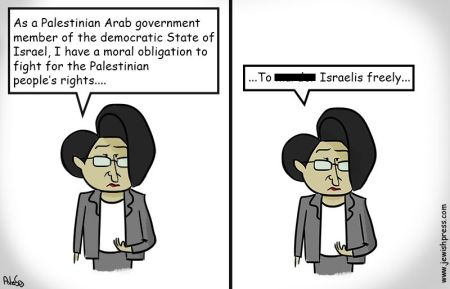
Cartoon of the Day

February 8, 2016

H/t The Jewish Press


Arab MK loyalty

Israeli Arab MK Ahmed Tibi Hosted at White House, State Dept. — Video

February 8, 2016

Israeli Arab MK Ahmed Tibi Hosted at White House, State Dept. — Video, Israel National NewsHana Levi Julian. February 8, 2016

Arab MKArab MK Ahmed Tibi on the Temple Mount with PLO flag. Photo Credit: Channel 2: Taamar Abidat

Israel Joint Arab List MK Ahmed Tibi was hosted for meetings over the past several days in Washington DC by officials at the White House and State Department.

Tibi met with U.S. President Barak Obama’s chief adviser to the Middle East, Robert Malley, and other senior officials at the White House.

The Israeli Arab lawmaker met with U.S. Special Envoy for Israeli-Palestinian Negotiations Frank Lowenstein, and Christopher Henzel, director of the Office of Israel and Palestinian Affairs, at the State Department as well.

“Simultaneously with our struggle within Israel, the Knesset and outside it, it is necessary to spread the word regarding the Arab public’s situation and distress to the international community, including the United States,” Tibi told journalists at a news conference.

He spoke about the “institutionalized discrimination against Arab citizens in all walks of life, including the demolition of homes, the lack of employment and racist legislation.

“Once again I found a lack of knowledge on our social and political situation, and this requires all of us to increase our efforts in the important international forum,” Tibi said.

“There is not a single member of the current Israeli government, including [Prime Minister Benjamin] Netanyahu, who publicly supports the vision of the two states and the establishment of an independent Palestinian state; whereas all the Palestinian ministers support that vision,” he added.

It is especially important for readers to understand exactly who MK Tibi is, and which “struggle” he refers to when he appears in the White House and the State Department to lobby for “his people.”

Tibi — who is currently Deputy Speaker of the Knesset and paid generously with Israeli taxpayer money – was seen at a September 2011 Palestinian Authority event carried on PA TV openly praising Arab terrorists with the symbol of the late PLO Chairman Yasser Arafat (the black-and-white keffiyeh) around his neck. The footage is provided and his remarks are translated by thePalestinian Media Watch (PMW) monitoring organization.


“Nothing is more exalted than those whom Israel dubs ‘terrorists-shahids,’” he said. In local Arab culture, the word – which literally translates as “martyrs” – is used to refer to those who die while trying to murder Israelis. “In the history and struggles of nations, the shahid is the ultimate glory,” Tibi told his audience at that time. “There is no value more August than the Shahada (the act of dying for Allah.) The shahid is the trailblazer, drawing with his blood the path to freedom and liberation. The shahid is the symbol of the homeland.”

While Tibi has been visiting with U.S. officials his party colleagues in Israel were visiting with the families of Arabs who were killed while carrying out terror attacks against Israelis.

This past weekend, Prime Minister Benjamin Netanyahu requested Attorney General Avichai Mandelblit weigh the possibility of taking legal steps against Israeli Arab MKs Hanin Zoabi, Jamal Zahalka and Basel Ghattas of the Joint Arab List in connection with their visit last Tuesday to the families of several Arab terrorists.

Hezbollah tries to shift attention to the West Bank

February 5, 2016

Hezbollah tries to shift attention to the West Bank, Long War Journal, February 5, 2016

Hezbolla Gaza

Israeli security forces announced last week their dismantling of a five-man terror cell from the West Bank city of Tulkarem, jihadists who were recruited by Hezbollah’s secretive Unit 133. The men were instructed to gather intelligence information on Israel Defense Forces (IDF) training facilities for attacks and prepare a bomb for use in a suicide operation against civilians. The foiled plot was Hezbollah’s latest attempt to stir up Israeli-Palestinian violence, exploiting the conflict to improve its tarnished image while bogging down Israeli forces in a battlefield far from its home base.

Hezbollah established Unit 133 in the early 2000s, to focus its operations on Israeli targets both domestically and across the Middle East and Europe. Unit 133 relies primarily on human intelligence activity, luring recruits with money. Due to the nature and purpose of the Unit’s activities, it does not exclusively draw on Shia Muslims for recruitment. Recruits are given broad security and military training, charged with recruiting new assets as well as intelligence collection, target acquisition, surveillance, reconnaissance, managing sources and establishing cover stories.

For its operations within Israel, the unit was tasked with recruiting intelligence assets and terror operatives from among Palestinians in the West Bank and Israel’s Arab citizens. To accomplish that, it turned to Lebanese drug dealers who work with Israeli-Arab smugglers.

Unit 133 has been linked to previous attempts, some unsuccessful, to carry out attacks within Israel. In April 2012, for example, it tried to smuggle 24 C-4 explosive devices, M-16 rifles and other weapons past Israel’s border with Lebanon through Israeli-Arab smugglers. The goal was to have one of the Unit’s cells within Israel use the materials to carry out a mass-casualty attack, but the attempt was foiled by Israel’s Shin Bet security services before they reached their intended recipients. Last summer, Israeli security forces arrested Hezbollah operative Hassan Khalil Hizrana dual Lebanese-Swedish citizen, at Ben-Gurion Airport. Hizran was to report on the airport’s security procedures, recruit Israeli Arabs with ties to Israeli civilians or military personnel, and gather intelligence on military targets.

This newest cell, taken down last week, was put together and funded by Hezbollah chief Hassan Nasrallah’s son, Jawad. He instructed the men to recruit more Palestinians and Israeli Arabs, providing them with $5,000 to acquire the necessary weapons and materials for the intended attacks.

Israeli security officials said the cell hoped to reignite the months-long wave of Palestinian violence that has waned in recent weeks. Hezbollah likely hoped the attacks would be the catalyst for turning the violence into a real Intifada, or uprising, on par with the bloody Al-Aqsa Intifada of the early 2000s. Beyond simply killing Israelis, Hezbollah has much to gain from such a heightened level of violence.

For one, full-blown violence would refocus the ire of Sunni Arabs (particularly the wealthy Gulf states) on what they insist is the “central cause” of the Arabs – Palestine – and away from Hezbollah and its Iranian masters. Sparking another Intifada would also improve Hezbollah’s image on the Arab street, allaying some of the anger directed at it over its involvement in the Syrian civil war. It would allow Hezbollah to portray itself as primarily fighting Israel, while – unlike during the 2006 war – keeping the fight away from Lebanese soil.

Finally, if Israel were once again plagued with frequent Palestinian suicide bombings and large-scale attacks as in the early 2000s,  the IDF would become bogged down again in counter-terror operations in the West Bank, severely reducing its ability to act against Hezbollah – either in Lebanon or Syria.

Atwan: ISIS Savagery – from Islamic History; West Likely to “Contain” ISIS Like It Contained Arafat

February 5, 2016

Atwan: ISIS Savagery – from Islamic History; West Likely to “Contain” ISIS Like It Contained Arafat, MEMRI-TV via You Tube, February 4, 2016


From the blurb beneath the video:

In a December 15 lecture about ISIS at the American University in Beirut, Abdel Bari Atwan, former editor-in-chief of “Al-Quds Al-Arabi” and the current editor-in-chief of “Al-Rai Al-Youm” rejected common claims that the savagery of ISIS is alien to Islam, presenting examples of similar conduct from Islamic history. Atwan said that the West faces two options: to contain ISIS or to destroy it. The former is more likely than the latter, he added. The West always starts by trying to destroy organizations that it considers to be terrorist and ends up negotiating with them, Atwan said, citing the Taliban, the PLO, and the IRA as prominent examples.

Turkey planning $5 billion for Gaza seaport

February 5, 2016

Turkey planning $5 billion for Gaza seaport, Israel National News, Ari Yashar, February 5, 2016

In the midst of ongoing normalization talks with Israel, Turkey is planning to invest $5 billion in reconstructing the Hamas stronghold of Gaza including a seaport – which Israel has fiercely opposed due to the blatant threat of weapons smuggling.

The Turkish Hurriyet Daily News on Friday reported that a team of the Union of Chambers and Commodity Exchanges of Turkey (TOBB) announced the expensive rebuilding plan, which is being prepared by the Center for Multilateral Trade Studies at the Economic Policy Research Foundation of Turkey (TEPAV).

The plans to reconstruct the Hamas-held region came after meetings with Palestinian Authority (PA) and Hamas officials, as well as Israeli officials.

“As the Turkish business world, we can fulfill this work,” said TOBB chairman Rifat Hisarciklioglu, who led the group. TEPAV claims that by 2020, Gaza will be “unlivable” with no drinking water left.

Indicating the subversive nature of the plan, TEPAV Executive Director Guven Sak said, “we made a strategic plan. A Gaza port will be one of the most important projects in this plan.”

Prime Minister Binyamin Netanyahu has rejected the idea of a port or lifting the maritime blockade on Gaza, which is meant to block the influx of weapons and which is fully legal according to international law, contrary to the claims of Israel’s opponents. Surprisingly, Agriculture Minister Uri Ariel (Jewish Home) in December called to build a seaport in Gaza.

The matter of the naval blockade has been a key sticking point in the reconciliation talks with Turkey, which continues to firmly support the Hamas terrorist organization. Turkey also continues to host Hamas terrorists, including those planning attacks in Israel.

With Israeli permission

Regarding the Turkish plan, TEPAV’s Sak said, “Turkish contractors will be an important part of this project,” while Hisarciklioglu said, “our contractors are materializing world-class works. They rank second in the world.”

The group met with Israeli officials unnamed in the report, and also met with Palestine Liberation Organization (PLO) Prime Minister Rami Hamdallah as well as several PA ministers and officials, in addition to Hamas officials and the Gaza Chamber of Commerce.

Israel gave the Turkish team permission to visit Gaza and plan the project according to the report, in an apparent sign of the growing rapprochement between the two states.

“It is not possible to go to Gaza without the permission of Israel,” said Hisarciklioglu. “But we did this. This is an indicator that the tensions between Turkey and Israel are easing.”

Israel’s normalization talks with Turkey have caused outrage in Egypt, where officials have urged Israel not to normalize ties.

Turkish defense sources revealed in December that Turkey is primarily interested in rapprochement so as to buy Israeli military hardware, with Ankara interested in buying more advanced Israeli drones as well as reconnaissance and surveillance systems for its fighter jets.

Turkish Prime Minister Ahmet Davutoglu in December also said that Turkey is only interested in the normalization talks so as to “benefit…Palestine and Gaza.”

Senior Israeli security sources for their part said they doubt Turkey is serious about rapprochement, noting on the crisis in ties with Russia – a key gas supplier for Turkey – that apparently prompted the desire for natural gas trade with Israel as Ankara hurts financially.

Bilateral ties disintegrated in the infamous 2010 Mavi Marmara flotilla incident, when IDF soldiers were forced to board the Turkish ship that had ignored repeated warnings to stop its attempt to breach the maritime blockade on Gaza.

The soldiers were brutally attacked by IHH Islamist extremists on board wielding knives and metal bars, and had no choice but to open fire, killing ten of the IHH members on board. After an investigation, Israeli authorities discovered the vessel to be carrying no humanitarian aid, despite the flotilla’s claims that it was on a “humanitarian” mission.