Archive for the ‘Israel’ category

Sisi as key to Arab anti-ISIS pact with Israel

April 3, 2017

Sisi as key to Arab anti-ISIS pact with Israel, DEBKAfile, April 3, 2017

(Please see also, Restore the U.S.-Egyptian Strategic Alliance, Designate the Muslim Brothers as Terrorists. — DM)
Our Washington sources report that President Trump aims to complete his plan for bringing together Egypt, Saudi Arabia, Jordan and Israel on a new footing by September.


*********************************

US President Donald Trump’s first face to face with Egyptian President Abdel-Fatteh El-Sisi at the White House Monday, April 3, focuses on four main topics, DEBKAfile reports: The fight against Islamist State terror rampant in Egyptian Sinai and neighboring Libya; topping up US military assistance to Cairo, aid for easing Egypt’s dire economic straits and, finally, the effort to bolster normal relations between the Arab world (including the Palestinians) and Israel.

From the moment he assumed the Egyptian presidency in June 2014, El-Sisi has waged a never-ending war on Islamist terror against Ansar Beit-al Maqdis, which later pledged alliance to the Islamic State’s leader Abu Bakr Al-Baghdadi. The Egyptian army has so far been worsted.  The Egyptian president is not deaf to the criticism of the Second and Third Armies’ failure to overcome a few thousand armed men, even though they can at a moment’s notice raise several thousand more fighters from the Bedouin tribes of Sinai. US intelligence has rated the Egyptian forces as slow-moving and unwieldy; but for limited forays, its contingents preferring to sit safely in their barracks rather than risk going out and pursuing the enemy across the Peninsula.

Shortly before President El-Sisi’s trip to Washington, the Egyptian air force conducted intense bombardments of ISIS concentrations around the northern town of El Arish, killing at least 14 terrorists, nabbing 22 and seizing large caches of roadside bombs. But they too long delayed bearding the Islamists in their main stronghold atop Mount Jabal Hala in central Sinai. ISIS is therefore free to move around the territory and strike at will, the while expanding its operations into Egypt proper.

The weekend air strikes came after months in which ISIS overran sections of El Arish, Sinai’s biggest town (pop: 100,000). Their grip is such that Egyptian forces no longer dared venture into those lawless neighborhoods, especially at night. Earlier this year, terrible persecution including executions forced the few thousand indigenous Christians, most of them Copts, to flee their homes in El Arish. Egyptian forces proved unequal to safeguarding the US-led international observer force (MFO) monitoring the 1972 Egyptian-Israel peace treaty at a nearby station.

American military aid to Egypt stands today at $1.3bn a year. Even though the US president means to slash foreign aid programs, he may make an exception in this case and expand military assistance -, possibly in the coin of advanced military hardware, given the country’s unending frontline battle against Islamist terror.

Its presence in El Arish, 130km from the Egyptian-Israeli border, plants the peril on the doorsteps of Egypt’s neighbors as well: Northern Sinai borders on Israel, its northwestern district shares a border with the Gaza Strip, abutting in the east on Jordan and in the southwest on Libya. The cities of western Sinai sit on the banks of the Suez Canal.

The Islamic State’s Sinai affiliate is closely allied with Salafi organizations in the Gaza Strip and works hand in glove with its Palestinian Hamas rulers, especially in the lucrative arms-smuggling business.

Al-Baghdadi last year posted a group of Iraqi officers in his service to the Sinai contingent. They travelled through southern Jordan to reach the peninsula. The Islamist cells in Libya have moreover made ISIS-held turf in Sinai their safe highway for traveling undetected to their other strongholds across the Middle East.

To stamp out this sprawling, multi-branched menace, the Trump administration needs to bring Egypt, Jordan and Israel into a coalition for a sustained, common campaign.

The Obama administration, which boycotted President El-Sisi for persecuting Egypt’s Muslim Brotherhood, tried unsuccessfully to build Turkey, Egypt and Israel into a counterterrorism pact. The Trump administration, for which the Brotherhood is anathema, has a better chance. But first, relations between the Arab world and Israel need to be placed on a regular footing. Some groundwork already exists in the informal bilateral military ties Egypt and Jordan maintain with Israel. DEBKAfile’s military sources have revealed in past reports the limited give-and-take relations for fighting terror Saudi Arabia and Abu Dhabi maintain with Israel.

The US President’s advisers recognize that before a broad, effective front against ISIS and Al Qaeda can be put together from these partial, often covert ties, progress is necessary towards normalizing relations between the Arab governments and the Jewish state, including the Israeli-Palestinian track.

Trump will certainly want to hear what role his Egyptian guest is willing to take for bringing this process forward. He will ask his next Middle East visitor, Jordan’s Abdullah II, the same question, when he arrives in Washington Tuesday. As for the Palestinian leader Mahmoud Abbas, he was promised an invitation to the White House this month, but not yet been given a date. He is clearly being left to wait until the senior players in the region have had their say. Our Washington sources report that President Trump aims to complete his plan for bringing together Egypt, Saudi Arabia, Jordan and Israel on a new footing by September.

Think-tank offers Trump policy recommendations on Israel

March 29, 2017

Think-tank offers Trump policy recommendations on Israel, Israel National News, Mordechai Sones, March 29, 2017

Aerial view of Capitol HillUS gov’t / public domain)

Heritage recently released a report authored by James Phillips, Heritage’s Senior Research Fellow for Middle Eastern Affairs, and a latest volume of Mandate, outlining specific policy recommendations for the Trump Administration. Four topics treated are Iran, the defeat of Islamist terrorist groups, the Israeli–Palestinian conflict, and President Trump’s promise to move the U.S. embassy to Jerusalem.

**************************

Weeks after President Ronald Reagan’s first election victory, the U.S. was engulfed in problems and the new President was confronting challenges unparalleled in nearly a half-century. At that time, the prominent conservative Heritage Foundation produced a detailed road map designed to help the fledgling administration steer the nation into a sound future, guided by conservative principles, called Mandate for Leadership. By the end of President Reagan’s first year in office, nearly two-thirds of Mandate’s more than 2,000 specific recommendations had been or were being transformed into policy.

Since then, Heritage has produced the Mandate series for incoming administrations, marshaling the talents of scores of experts.

Heritage recently released a report authored by James Phillips, Heritage’s Senior Research Fellow for Middle Eastern Affairs, and a latest volume of Mandate, outlining specific policy recommendations for the Trump Administration. Four topics treated are Iran, the defeat of Islamist terrorist groups, the Israeli–Palestinian conflict, and President Trump’s promise to move the U.S. embassy to Jerusalem.

Regarding Iran, the report finds Iran to be “the chief long-term regional threat to the U.S. and Israel. While the Obama Administration turned a blind eye to many of Iran’s malign activities to avoid jeopardizing its flawed nuclear agreement with Tehran, the Trump Administration is committed to confronting and pushing back against Iran.”

Findings regarding Iran state that “Cooperation on missile defense should be an especially important agenda item. Iran’s medium-range missiles already can reach Israel with a 1,000-pound payload. On February 4, Mojtaba Zonour, a member of Iran’s National Security and Foreign Policy Commission, helpfully reminded the world that ‘only seven minutes are needed for an Iranian missile to hit Tel Aviv’ and that 36 U.S. military bases in the Middle East are within range of Iranian missiles. Israel is now deploying the Arrow-3 interceptor, developed jointly with the United States, and the two leaders should agree to support cooperation in further enhancing missile defenses.”

Heritage recommends: “President Trump should discuss plans to hold Iran accountable for its hostile regional policies and roll back its influence, outlining the Administration’s strategy for ratcheting up sanctions on Iran and particularly on the IRGC, which controls Iran’s ballistic missile program and efforts to export terrorism. President Trump and Prime Minister Netanyahu should also coordinate on interdicting the flow of Iranian arms to Hezbollah, Hamas, and other terrorist groups.”

On the Islamic State (ISIS) and the war in Syria, Heritage concludes, “Both the U.S. and Israel seek the rapid destruction of ISIS in Syria, but Israel is concerned that President Trump’s intention to cooperate with Russia in Syria could strengthen the influence of Iran and Hezbollah there.” Explaining Israel’s needs, Heritage councils the Trump Administration that “Netanyahu will want to gain an understanding of U.S. plans for Syria, efforts to split Russia from Iran, and the implications for Israeli security. At a minimum, Jerusalem wants to prevent Iran and Hezbollah from establishing a military presence near the Israeli–Syrian border.”

Recommendations: “Israel has legitimate concerns about the increasing role that Iran and Hezbollah are playing in Syria. Trump needs to ensure that U.S. policies in regard to Syria will not inadvertently harm Israel’s security.

“Islamist terrorist groups pose a significant threat to the U.S. and Israel. Both countries can benefit from better coordination. Trump and Netanyahu should coordinate policies on fighting ISIS in Syria and explore ways to reduce the ISIS threat to Jordan and Egypt. Jordan needs intelligence and counterterrorism help in uncovering terrorist plots and economic support to lighten the burden of more than 600,000 Syrian refugees. Egypt has sustained heavy losses fighting ISIS in the Sinai Peninsula, and the group claimed responsibility on February 9 for a cross-border rocket attack on the Israeli city of Eilat. Cairo needs quiet help in defeating the ISIS insurgency, which has received extensive aid from Hamas and other Islamist extremist groups in Gaza.”

The Israel-Palestinian conflict is summed up thus: “In contrast to the Obama Administration—which allowed the passage of U.N. Security Council Resolution 2234 condemning Israel and added insult to injury with a blistering anti-Israel speech from Secretary of State John Kerry—the Trump Administration will be much more supportive of Israel at the U.N. and elsewhere. Trump should publicly underscore that the U.S. will veto any one-sided U.N. Security Council resolutions and assert that only direct bilateral negotiations, not the U.N., can produce a peace agreement.

“President Trump should also stress that Palestinian terrorist attacks, not Israeli settlements, are the chief obstacles to peace. Although the Administration has not taken an official position on settlements, it did release a statement saying that new settlements “may not be helpful” in achieving a peace agreement. A senior Administration official later told The Jerusalem Post that new settlements could undermine Trump’s plans to engineer a final status agreement.

“Trump has described an Israeli–Palestinian peace agreement as ‘the ultimate deal,’ but the situation is not ripe for such a deal. The Palestinian Authority is unwilling to make the necessary concessions and too weak to enforce any agreement in the face of Hamas’s implacable opposition to Israel.”

Recommendations include: “The Administration should focus on managing rather than resolving the conflict, which is impossible for the immediate future. Trump should consult with Netanyahu about how to restore calm, undermine Hamas and other Islamist extremist groups, and create a more stable environment for future step-by-step negotiations.” However, Phillips adds, “Refraining from establishing new settlements would be helpful in this context.”

Regarding the embassy move, Heritage says, “President Trump’s commitment to move the U.S. embassy from Tel Aviv to Jerusalem would correct a historic anomaly: The United States has never recognized any part of Jerusalem as Israel’s capital. However, moving the embassy could ignite protests, riots, and anti-American backlashes among Palestinians, Arabs, and Muslims.”

Therefore, Heritage recommends to “Ensure that certain standards are met before moving the U.S. embassy to Jerusalem. To mitigate the risks of the move, Trump should consult with Netanyahu on the timing; pick a site in West Jerusalem, which has been controlled by Israel since 1948; and explain that the move does not change other aspects of U.S. policy. The U.S. should make it clear that the borders and final status of Jerusalem should be determined through negotiations; that the embassy move would not preclude a Palestinian state; that the U.S. consulate-general in Jerusalem would continue to function as the U.S. representative to the Palestinian Authority; and that no changes would be made in the status of Muslim holy sites, which would continue to be administered by Jordan.”

In conclusion, the Heritage report says that “Israel is America’s foremost ally in the Middle East. Both countries are democracies, value free-market economies, and uphold human rights at a time when many other countries in the Middle East reject those values.” It says recent developments represent “a promising opportunity to reassert American leadership in the Middle East and strengthen U.S.–Israel strategic cooperation on foreign policy, defense, and counterterrorism issues.”

Georgetown University and Radical Islamists: It’s a Family Affair

March 28, 2017

Georgetown University and Radical Islamists: It’s a Family Affair, Investigative Project on Terrorism, March 28, 2017

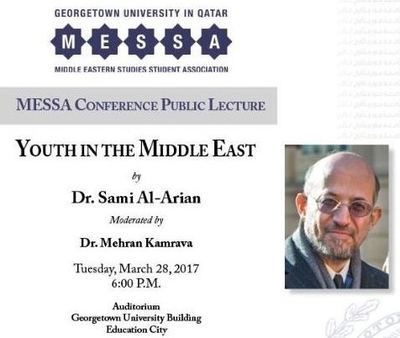
Georgetown University’s Qatar campus is set to host Sami Al-Arian for a lecture tonight in Doha. According to a news release from the school’s Middle Eastern Studies Student Association, Al-Arian is a “civil rights activist” who hopes to challenge students to “make it a better, and more equitable and peaceful world.”

Those are charitable descriptions for Al-Arian, a documented member of the Palestinian Islamic Jihad’s Majlis Shura, or board of directors. According to the Islamic Jihad’s bylaws, which law enforcement agents found during searches of Al-Arian’s home and offices, there can be “No Peace without Islam.” The group’s objective is to create “a state of terror, instability and panic in the souls of Zionists and especially the groups of settlers, and force them to leave their houses.”

It’s an agenda Al-Arian took to heart. Following a double suicide bombing in 1995 that killed 19 Israelis, Al-Arian solicited money from a Kuwaiti legislator. “The latest operation, carried out by the two mujahideen who were martyred for the sake of God, is the best guide and witness to what they believing few can do in the face of Arab and Islamic collapse at the heels of the Zionist enemy…” he wrote.

“I call upon you to try to extend true support of the jihad effort in Palestine so that operations such as these can continue, so that the people do not lose faith in Islam and its representatives…” he wrote. Four years earlier, he spoke at a fundraiser in Cleveland, introduced as the head of the “active arm of the Islamic Jihad Movement in Palestine.”

Why, then, is a Jesuit university, albeit at a campus in Qatar, hosting a leader of a designated terrorist group’s “active arm”?

There’s a family bond between Georgetown University and the Al-Arians. Son Abdullah is an assistant professor at Georgetown’s Qatar campus, teaching history in its School of Foreign Service. He earned his Ph.D. at Georgetown, writing his dissertation about the Egyptian Muslim Brotherhood during the 1970s, a time his father acknowledges being part of the global Islamist movement.

Jonathan Brown, Al-Arian’s son-in-law, also works at Georgetown, as the [Saudi] Prince Alwaleed Bin Talal Chair of Islamic Civilization. Brown recently drew criticism for a lecture in which he argued that slavery isn’t inherently “morally evil” if the slave is treated well. He also minimized sexual consent as a recent social more, arguing no one is really free enough to grant consent anyway.

Property records show Brown and his wife Laila Al-Arian bought a modest house just outside Tampa in 2015. Brown also owns a $1.1 million house in Mclean, Va.

Brown’s boss, Georgetown University Professor John Esposito, has been a staunch Al-Arian defender. Al-Arian is “an extraordinarily bright, articulate scholar and intellectual-activist, a man of conscience with a strong commitment to peace and social justice,” Esposito wrote in a letter to a federal judge.

Brown’s slavery and sexual consent lecture was hosted by the International Institute of Islamic Thought (IIIT) in Herndon, Va. The IIIT was a prime financial supporter of a think tank Al-Arian founded in Tampa called the World and Islam Studies Enterprise (WISE). It provided cover for at least three other members of the Palestinian Islamic Jihad’s Shura Council, including his brother-in-law Mazen Al-Najjar, an academic named Basheer Nafi and Ramadan Abdullah Shallah – the Islamic Jihad’s secretary general since late 1995.

Federal prosecutors wanted Al-Arian to tell a grand jury what he knew about the IIIT’s financial support for terrorists. He refused. Al-Arian was charged with criminal contempt after maintaining that stance even after a judge granted him immunity for his truthful testimony.

The case never went to trial. Al-Arian was deported to Turkey in 2015, pursuant to terms in his 2006 guilty plea connected to his Palestinian Islamic Jihad support. He now works as “director of the Center for Regional Politics at Istanbul Sabahattin Zaim University,” the Georgetown Middle East students group’s news release said.

Al-Arian is a computer scientist.

Sabahattin Zaim opened in 2010 and claims to have about 1,100 undergraduate students.

While the Georgetown University program is organized by a student group, promotional material lists Mehran Kamrava as moderator. Kamrava directs the Georgetown School of Foreign Service’s Center for International and Regional Studies.

His presence adds the university’s imprimatur to the Al-Arian event. In addition, the School of Foreign Service posted the news release promoting Al-Arian’s lecture.

Qatar has supported Hamas, the Islamic Jihad’s rival Palestinian terrorist group, providing money and refuge for Hamas leaders. In that light, Al-Arian’s invitation doesn’t seem out of place. But it is still an event hosted by a Georgetown University campus, moderated by one of its prominent faculty.

While Al-Arian has tried to deny his Islamic Jihad activities, or at least minimize them, his work to advance the group’s bloody ambitions is undeniable. He self-identified as the Shura Council’s secretary. In his plea agreement, he admits lying about Shallah’s prominent role in the Islamic Jihad.

During his 1991 remarks in Cleveland after his “active arm” introduction, Al-Arian urged donations for jihad. “Your brothers in Palestine are struggling with their beings,” he said, “so let us struggle here with our money.”

“This is the way of giving,” he said earlier. “This is the way of struggle. This is the way of battle. This is the way of jihad. This is the way of martyrdom. Thus is the way of blood, because this is the path to heaven.”

The student association’s news release failed to mention this background as a convicted felon, describing the former University of South Florida professor as a “civil rights advocate.” It fails to mention Al-Arian’s guilty plea, and whitewashes his resulting deportation to Turkey by saying “Al-Arian relocated.”

The federal judge who saw all the evidence against Al-Arian, who watched him lie about his true identity and violent ambitions, called him a “master manipulator.” Old habits die hard, apparently. The question in this case is whether Georgetown and its student groups are being duped or are witting accomplices in whitewashing a terrorist into a “human rights advocate.”

David M. Friedman is the New US Ambassador to Israel

March 23, 2017

David M. Friedman is the New US Ambassador to Israel, The Jewish PressLori Lowenthal Marcus, March 23, 2017

David Friedman

David Melech Friedman is the new U.S. Ambassador to Israel, following a close 52-46 vote in the Senate on Thursday afternoon. The only Democrats to vote in favor were Sen. Bob Menendez (NJ) and Sen. Joe Manchin (WV).

Friedman, nominated by President Donald J. Trump on his first day in office, was forced to patiently tap his foot before a hearing was scheduled, and then to endure a hostile, at times brutal, grilling during the confirmation hearing process. Nonetheless, the intensely partisan Washington vapors which have infiltrated even previously bipartisan issues such as support for Israel was overcome, and Friedman was confirmed thanks to the Republican majority in the Senate.

Friedman now prepares to head to Jerusalem, where he will attempt to continue dismantling the Obama legacy of hostility towards the Jewish State and, especially, towards Benjamin Netanyahu, Israel’s Prime Minister.

The first signal people will be watching for is whether Friedman sets up shop in Jerusalem, as he has promised. The U.S. Embassy has been in Tel Aviv which is not the capital of Israel, a sore point between the two strong allies.

Friedman’s nomination hearing in the Senate Foreign Relations Committee took place on March 9. That hearing was contentious, with the nominee forced to repeatedly apologize for strongly Zionist statements he had made in writing and public speeches.

A particular focus of the Democrats on the committee was Friedman’s contempt for the “Two State Solution” as the only goal of the peace process, as well as his support for Jewish communities beyond the 1949 Armistice Line. In addition, Friedman was castigated for his bald criticisms of those whose pro-Israel bona fides are strongly suspect, including J Street members and Jonathan Greenblatt, the new head of the Anti-Defamation League.

It is expected that Friedman will quickly leave for Israel where he has long maintained a residence in Jerusalem.

Fatah Official: We Should Launch Popular Resistance Against Israel Because What Unites Us Is The Struggle Against It, Not Dialogue With It

March 22, 2017

Fatah Official: We Should Launch Popular Resistance Against Israel Because What Unites Us Is The Struggle Against It, Not Dialogue With It, MEMRI, March 22, 2017

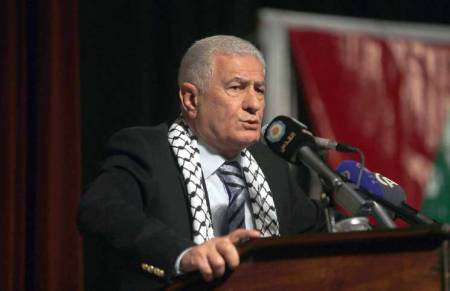
In a March 21, 2017 article in the Palestinian daily Al-Quds, Fatah Central Committee member ‘Abbas Zaki wrote that nothing has changed since the 1967 defeat. Therefore, he said, Fatah must mobilize its tens of thousands of members and launch a popular resistance campaign against Israel, which all the other Palestinian factions will then join. He claimed that Fatah already did this in the past, after 1967, when its resistance operations “restored the Arab nation’s hope and realized the Palestinian legitimacy,” because “the sword is ever aimed [at the enemy] and the rifle comes before the olive branch.” He called on the Palestinian officials to continue pursuing Israel in international courts and to put the good of the homeland before their personal interests, as the “generation of pioneers” did.

The following are excerpts from his article:[1]

‘Abbas Zaki (image: Al-Quds, Jerusalem)

“How similar our current time is to yesteryear. In the June 1967 [war] we suffered defeat, and the [West] Bank, Sinai, and the Golan fell into Israeli hands. The leader of the [Arab] ummah, [Gamal] ‘Abd Al-Nasser, [felt] compelled to resign from his position and become a private citizen, [but] the public came out and stopped him from doing this. He had a high measure of national honor and people like him do not accept defeat, in accordance with his eternal slogan: What was taken by force cannot be restored by anything other than force, and therefore he decided on a war of attrition [against Israel].

“At the time, a message was sent to Fatah in Damascus that read: Oh, boys of Fatah, mobilize and fight, even by starting fires. If you don’t do this, Arab banners will never be raised [in these lands]. The leader of our path and the commander of our revolution, Yasser Arafat, took the hint and left for the occupied lands immediately – crossing the Syria-Jordan border and reaching the [Jordan] valley. The [deputy] commander of [Fatah’s] Al-‘Asifa unit, Abu Sabri Saidam, also followed suit. From there they crossed the Jordan River to the place their hearts yearned for – to Palestine, which is suffering the wound of the occupation and the disappointments of defeat…

“Fatah restored the nation’s hope and realized the Palestinian legitimacy by [creating] the PLO framework and with other achievements that cannot be downplayed. Despite the ups and downs, the sword remains aimed [at the enemy] and the rifle comes before the olive branch, while [Fatah] is showing the entire world that the Palestinian people are heroes who will never surrender or bend; that the smallest geographic region [can] occupy the world’s decision-makers; and that the Palestinian issue is the strongest card in the equation of Middle East conflicts…

“[We] require the awakening and practical action of tens of thousands of Fatah activists, [who must] join the civil popular resistance against the settlers and occupation forces, and their number will double once they are joined by national and Islamic parties and organizations, and by the entire public of our mighty people. For what unites the Palestinians is the struggle rather than the dialogue [with Israel], [a dialogue] which has already lost its effectiveness on all tracks. If the sweeping [masses] block the bypass roads [leading to the Israeli settlements in the West bank], Israel and the settlers will not remain [in the West Bank] because their presence there is motivated by their freedom [of movement] and an absence of resistance to their presence there as imperialists who occupy our Palestinian land.

“The government and the [PLO] Executive Committee need to pursue Israel in international courts for its ongoing crimes, presenting everything related to these issues: the settlements; the prisoners; the destruction of the foundations of Palestinian life; the crimes of arson, murder and demolition of homes, and the denial of our people’s freedom. [All this in order] to place Israel on the list [of countries that practice] apartheid, as the report of the [UN’s] Economic and Social Commission for Western Asia [ESCWA] stated – and we cherish the role played by [the commission’s former head,] Rima Khalaf, in this – and in order to place Jerusalem… at the top of the priority list of Palestinian missions on the economic level, and support the steadfast position and all needs of life in a manner befitting [Jerusalem’s] status as the eternal capital of Palestine and its spiritual status in the world.

“In order to belong to the generation of pioneers at this difficult phase, we must be loyal to the oath of devoting our time, money, and spirit to the homeland… and make sure that those who are concerned with the Palestinian cause will win out over those who seek privileges at the expense of the homeland… [All this] in order to fulfill our national dream of return and the establishment of an independent state with Jerusalem as its capital and our people’s right to self-determination. Each of us should ask himself what proof he can give that we are following in the footsteps of the great ones in order to rally our public – which is water and life, and the recipient of future rights. Long live the memory, the glory of the martyrs, and the freedom for prisoners.”

_________________________________

[1] Al-Quds (Jerusalem), March 21, 2017.

Palestinians: Abbas’s Empty Promises

March 20, 2017

Palestinians: Abbas’s Empty Promises, Gatestone Institute, Khaled Abu Toameh, March 20, 2017

Abbas’s modus operandi is to flee from his problems at home by presenting himself to the international community as a leader who seeks peace. With every lick of the flames that threaten to engulf his palace of deception, the 82-year-old Abbas runs to seek sympathy among world leaders and international public opinion. Abbas’s promises of peace are as empty as the political sway he parades to his Western donors.

*****************************

Notably, these calls in favor of an armed struggle against Israel were coming from the streets of Ramallah and not the Hamas-ruled Gaza Strip.

Abbas can make all the promises in the world to the new US envoy. Fulfillment of any of them, however, is a different story altogether.

Abbas knows anyhow that he would never be able to win the support of a majority of Palestinians for any peace agreement he signs with Israel. No Palestinian leader is authorized to offer any concessions to Israel in return for peace.

On the eve of US envoy Jason Greenblatt’s visit to Ramallah last week, hundreds of Palestinians demonstrated in the city, calling on Palestinian Authority (PA) President Mahmoud Abbas to resign. The protesters also condemned the ongoing security cooperation between the PA and Israel.

“Listen, listen to us, Abbas; collect your dogs and leave us alone,” the Palestinian protesters chanted during what has been described as the largest anti-Abbas demonstration in Ramallah in recent years. They also called for the abrogation of the Oslo Accords with Israel, and denounced Abbas as a “coward” and an agent of the Americans.

It is not clear if Greenblatt had been aware of the large anti-Abbas demonstration, which came in protest against PA security forces’ violent crackdown on peaceful demonstrators in Ramallah a few days earlier.

Palestinian Authority President Mahmoud Abbas (right) meets with US envoy Jason Greenblatt (left), in Ramallah, on March 14, 2017. (Image source: NTDTV video screenshot)

At that protest, PA security officers used excessive force to disperse Palestinians who were demonstrating against the PA’s decision to prosecute four Palestinians for illegal possession of weapons. PA security forces arrested — and later released — the four suspects, although they had reportedly planned to carry out an attack against Israelis. One of the suspects, Basel Al-Araj, was killed in an armed clash with Israeli soldiers. (Al-Araj was wanted by Israel for planning an attack on Israelis. When Israeli soldiers surrounded the house where he was hiding, he opened fire from at them before he was killed.)

The killing of Al-Araj and the PA’s decision to prosecute his friends triggered the first protest that was brutally suppressed by the PA security forces. The second demonstration in Ramallah, a few days later, came in response to the excessive use of force by the PA security forces against the protesters.

The protests in Ramallah, the de facto capital of the Palestinians, are yet another sign of growing discontent among Palestinians with Abbas and his autocratic regime. The Palestinians are particularly enraged over the Palestinian Authority’s security coordination with Israel, which is primarily aimed at combating terrorism and preventing Hamas from seizing control over the West Bank.

Yet this was far from a simple a protest against Abbas and his security forces. It was also a rallying cry for pursuing with further vigor the armed struggle against Israel.

“No to peace and no to all the nonsense, we want bullets and rockets,” some of the protesters chanted. Notably, these calls in favor of an armed struggle against Israel were coming from the streets of Ramallah and not the Hamas-ruled Gaza Strip.

The protests also reflect Palestinians’ rejection of the so-called peace process with Israel. In addition to the calls on Abbas to step down, the protesters demanded as well that the PA leadership cancel all agreements with Israel, first and foremost the Oslo Accords.

In other words, Palestinians are trying extremely hard to get their message across: Israel is our enemy, not our peace partner.

In a desperate bid to contain the growing resentment on the Palestinian street, Abbas ordered an inquiry into the police violence against the Ramallah protesters. In that episode, journalists and lawyers, too, were among those who were brutally beaten by Abbas’s security officers.

Still, many Palestinians voiced skepticism about Abbas’s intentions, and pointed out that previous commissions of inquiry into police violence have rarely led to punitive measures against those responsible. “The formation of a commission of inquiry into the police violence is another attempt by Abbas to contain the anger of the Palestinian street and avoid an intifada against his regime,” remarked a Palestinian journalist in Ramallah. “Abbas’s Zionist Palestinian Authority poses a threat to the Palestinian cause.”

As Abbas was meeting with the US envoy, a public opinion poll published in Ramallah showed that a majority of 64% of Palestinians would like to see their president resign. Another 61% of Palestinians expressed dissatisfaction with Abbas’s performance. The poll also found that if presidential elections were held in the West Bank and Gaza Strip today, Hamas leader Ismail Haniyeh would receive the same percentage of votes as Abbas.

None of this — not the protests of rage and not the Palestinians’ expressions of disgust — appears to bother Abbas.

This is a president who seems utterly unconnected to reality — namely that a large number of Palestinians are disillusioned with him and see him as a puppet in the hands of Israel and the US. For now, he does not seem to care what his people think about him. But in the long run, he would never be able to deliver on any peace process with Israel without the backing of his people. Like his predecessor, Yasser Arafat, he does not want to go down in history as a “traitor” who sold out to Israel and the Jews.

Abbas, whose four-year-term term in office expired back in January 2009, is reported to have told the US envoy that a “historic” peace deal with Israel is possible. According to a statement released by the US Consulate in Jerusalem, Abbas also “committed to preventing inflammatory rhetoric and incitement (against Israel).”

So here is a Palestinian leader mouthing off about a “historic” deal with Israel, while only a few hundred meters away his people have made their message of rejection — of him and of peace — clear as a bell.

In a further irony, here is a Palestinian leader talking about preventing incitement while he and his media outlets and senior officials still spearhead a campaign to delegitimize and isolate Israel.

Just this week, Abbas decided to decorate for “bravery” senior UN official Rima Khalaf for publishing a controversial report that accuses Israel of “apartheid.” Khalaf has become a hero in the eyes of many Palestinians because of her report and subsequent resignation.

Abbas’s foreign minister, Riad Malki, has meanwhile voiced outrage over the UN secretary-general’s decision to drop the “apartheid” report (the reason Khalaf resigned). Malki said that the PA leadership has instructed all its embassies and representatives around the world to distribute the report as evidence of Israeli “crimes” against the Palestinians.

Abbas’s pledge to prevent inflammatory rhetoric against Israel seems to have missed his editors and journalists.

Take, for example, the Palestinian Authority-controlled media’s response to last week’s Jerusalem marathon. In the PA media, the sports event is depicted as part of Israel’s scheme to “Judaize” Jerusalem and change the “Arab and Islamic character” of the city.

In addition, Abbas’s media continues to portray visits by Jews to the Temple Mount as “provocative invasions” of the Al-Aqsa Mosque. The Jewish visitors are described as “settler gangs” who carry out “suspicious tours” of Islamic religious sites. It is precisely this kind of terminology that is driving many Palestinians to carry out stabbings and car-rammings against Israelis.

Abbas can make all the promises in the world to the new US envoy. Fulfillment of any of them, however, is a different story altogether.

Abbas has had multiple opportunities to reach a “historic” deal with Israel, yet he has never delivered. Quite the contrary: he has repeatedly rejected offers for holding direct talks with Israel, insisting instead on pursuing his campaign to internationalize the conflict with the hope of imposing a solution on Israel.

Abbas knows anyhow that he would never be able to win the support of a majority of Palestinians for any peace agreement he signs with Israel. No Palestinian leader is authorized to offer any concessions to Israel in return for peace.

The “cordial” and “positive” meeting with the new US envoy will change nothing — certainly not Abbas’s stripes.

Abbas’s modus operandi is to flee from his problems at home by presenting himself to the international community as a leader who seeks peace. With every lick of the flames that threaten to engulf his palace of deception, the 82-year-old Abbas runs to seek sympathy among world leaders and international public opinion. Abbas’s promises of peace are as empty as the political sway he parades to his Western donors.

Opposition Builds Against Mattis Pick Who Met With Muslim Brotherhood

March 13, 2017

Opposition Builds Against Mattis Pick Who Met With Muslim Brotherhood, Washington Free Beacon, March 13, 2017

(Why and for what purpose does General Mattis want her at the Department of Defense? What do her views on the Muslim Brotherhood and anything else have to do with Department of Defense activities? The article does not indicate. — DM)

WASHINGTON, DC – NOVEMBER 04: Assistant Secretary of State for Near Eastern Affairs, Anne Patterson testifies during a House Foreign Affairs Committee hearing on Capitol Hill, November 4, 2015 in Washington, DC. (Photo by Mark Wilson/Getty Images)

Opposition is mounting on Capitol Hill and in conservative foreign policy circles over Defense Secretary James Mattis’s efforts to hire a former Obama administration official who lobbied in favor of engagement with the Muslim Brotherhood and spearheaded efforts to criticize Israeli counter-terrorism efforts, according to multiple sources close to the Trump administration.

Mattis is lobbying to hire former diplomat Anne Patterson as undersecretary of defense for policy, according to multiple reports, a position that would make her the third most powerful voice at the Defense Department.

Multiple sources on Capitol Hill and those close to the Trump foreign policy teams are voicing concerns about the pick, warning that Patterson would seek to continue some of the former Obama administration’s most controversial foreign policies, such as conducting outreach to the Muslim Brotherhood.

Patterson, who served as U.S. ambassador to Egypt when the Muslim Brotherhood rose to power, advocated in favor of negotiating with the terror group. Her efforts drew outrage in the Egyptian reformist community, which still views Patterson as working to legitimize the Muslim Brotherhood.

As assistant secretary of state for near east affairs in the Obama administration, Patterson also led efforts to criticize Israeli authorities after they killed a Palestinian-American terrorist who was attempting to stab civilians.

Patterson’s record under the Obama administration has raised concerns on Capitol Hill, where she would require Senate confirmation in order to assume the Defense Department post.

Multiple sources who spoke to the Washington Free Beacon about the matter expressed opposition to the pick and outlined larger concerns about efforts by Mattis to hire former Obama administration officials who conservatives view as responsible for multiple failures in U.S. foreign policy.

These sources also expressed concern about the Trump administration’s failure to remove former Obama officials from the administration, citing the efforts by some to kneecap President Donald Trump’s foreign policy team and preserve Obama-era policies.

“This would be a disastrous choice,” one senior congressional aide tracking the matter told the Free Beacon. “Patterson has a well-documented track record of sticking up for extremist groups at every turn. Her selection would mean elevating someone whose views not only run counter to the president’s, but U.S. national security as well. The administration should seriously reconsider.”

A second senior Republican Senate aide expressed similar concerns. Patterson’s views run counter to the foreign policy outlook expressed by Trump on the campaign trail, the source noted.

There is mounting concern over the promotion of Patterson to such a senior role, according to the source, who said this would “would send the wrong message given her background in Egypt, in particular her sympathies to the Muslim Brotherhood.”

Insiders close to Trump’s national security team described mounting concern over Mattis’s efforts to hire Patterson.

“People concerned about the U.S.-Egypt relationship don’t know what to make of Mattis’s support for Anne Patterson,” said one source, who explained that Patterson’s record on Egypt is vastly different that Mattis’ own comments about recalibrating relations with the country.

“Egyptians I have spoken to, both in and outside government, are extremely worried right now,” the source added. “First, they can’t believe they might have to contend with Patterson’s pro-Brotherhood polices; and second, it’s causing them to re-evaluate who they thought Secretary Mattis is.”

As the Trump administration looks to reset years of strained relations with Cairo, the selection of Patterson could draw outrage from secular leaders who are still angered by her engagement with the Muslim Brotherhood, sources explained.

One Egyptian opposition leader who spoke to the Free Beacon during the 2013 revolution in Egypt described Patterson as “the first enemy of the revolution,” claiming “she is hated even more than [former Muslim Brotherhood leader Mohammed] Morsi.”

Patterson met in 2012 with Brotherhood leader Mohammed Badie, who has been extremely critical of the United States.

Patterson still has strained relations with current Egyptian President Abdel Fattah al-Sisi. Reports in Middle Eastern publications indicated that Patterson pressured al-Sisi to release imprisoned Muslim Brotherhood members and later threatened him when he refused to do so.

Sources also raised questions about Patterson’s commitment to Trump’s foreign policy, which seeks to isolate fanatical religious organizations such as the Brotherhood and Iran’s Revolutionary Guard Corps, or IRGC.

Patterson cast doubt during a 2015 Senate hearing on efforts to designate the IRGC as a terrorist group, efforts that are likely to be revisited by Trump’s team.

One senior Republican foreign policy adviser who has close ties to the White House told the Free Beacon that Patterson would represent a continuation of the Obama administration’s failed engagement in the Middle East.

“Anne Patterson is the embodiment of the Obama administration’s failed approach to the Middle East, which focused on crowding out our traditional Arab allies with radical Islamists from Iran and the Muslim Brotherhood,” said the source, who requested anonymity to speak freely about the administration.

“As the post-Kerry State Department becomes less and less relevant, and the White House and Defense Department take over foreign policy strategy, it’s beyond irresponsible to put her in charge of the Pentagon’s policy apparatus,” the source said.

Living in Sderot: Ten seconds to save your life

March 13, 2017

Living in Sderot: Ten seconds to save your life, Rebel Media via YouTube. March 13, 2017

The blurb beneath the video states,

Less than 1 km from Gaza and the target of over 10,000 rockets, Mayor of Sderot, Alon Davidi, tells Sheila Gunn Reid why he stays in what he describes as “the front line in the battle against evil”.

The Turkish-Dutch culture clash

March 13, 2017

The Turkish-Dutch culture clash, Israel Hayom, Ariel Bolstein, March 13, 2017

How ironic that the Netherlands, Germany and Switzerland (and you can be sure that others in the Old World will follow) suddenly praise sovereignty and protest against attempts by the dictator in Ankara to interfere in their affairs. Indeed, the actions of a variety of European bodies in regard to Israel are no different from those of Erdogan. He is trying to influence Europe’s internal affairs, funding organizations and communities that suit his outlook, and that is exactly what the EU is trying to do with us. At least Erdogan has an excuse in that he is to a great extent communicating with his citizens on the continent. But the Europeans interfere in Israel’s affairs with the aim of influencing its democratic elections, and without even the slightest justification for doing so.

*********************************************

The recent confrontation between Turkey and the Netherlands is indicative of the significant change underway in both countries. It all began when the Netherlands prevented Turkish Foreign Minister Mevlut Cavusoglu from entering the country. Cavusoglu was scheduled to attend a rally in support of Turkish constitutional reforms that would increase presidential powers in the country. Turkish President Recep Tayyip Erdogan responded to the move by calling the Dutch fascists and Nazis. Turkey has further threatened the Netherlands with sanctions.

For close to two decades, Turkey has put increasing emphasis on its Muslim identity and imperialist mission. Erdogan has succeeded relatively quickly in erasing much of the legacy of Mustafa Kemal Ataturk, the founder and first president of the Turkish republic. Instead of a secular and pro-Western republic, Turkey, now a regional power far from extolling liberal values, aspires to return to the days of the Ottoman sultanate. Erdogan might still be called a president, and Ankara might still be the capital, but in all other aspects, the country is more reminiscent of days of yore. A strong autocracy based on Islam that purports to force its positions on its citizens, neighboring countries and now even distant countries.

On the other side of the this diplomatic feud is the Netherlands, which has experimented with liberal democracy and extreme multiculturalism, and is only now beginning to understand that in certain precarious situations, neither will be their salvation. A large Muslim minority has taken root in several European countries that has not only refused to adopt Western values, but does not hesitate to confront those around it to impose its imported Islamic lifestyle. European weakness is primarily responsible, but there are other factors, such as countries like Saudi Arabia, Turkey and Iran, which stir up the Muslim enclaves in Western Europe and fund, incite and guide them. In quite a few of the cities’ largest suburbs, the imams, selected by foreign, not local authorities, are effectively in control. The change is the willingness of the traditional European population to regain sovereignty at home.

How ironic that the Netherlands, Germany and Switzerland (and you can be sure that others in the Old World will follow) suddenly praise sovereignty and protest against attempts by the dictator in Ankara to interfere in their affairs. Indeed, the actions of a variety of European bodies in regard to Israel are no different from those of Erdogan. He is trying to influence Europe’s internal affairs, funding organizations and communities that suit his outlook, and that is exactly what the EU is trying to do with us. At least Erdogan has an excuse in that he is to a great extent communicating with his citizens on the continent. But the Europeans interfere in Israel’s affairs with the aim of influencing its democratic elections, and without even the slightest justification for doing so.

The current crisis between the Turks and the Europeans will eventually subside, one way or another, but a resolution to the imminent clash between the two cultures is nowhere in sight. Moreover, the points of friction between them will only multiply. Erdogan, who is used to galloping ahead and trampling his opponents at home and abroad, is not used to folding to anyone who is not equally as determined. And in Europe, they are sick of past capitulations, which only served to whet the appetites of Muslim immigrants o change the face of the continent and demand sovereignty. There will be no calm there.

IRGC-controlled Iraqi militia forms ‘Golan Liberation Brigade’

March 13, 2017

IRGC-controlled Iraqi militia forms ‘Golan Liberation Brigade’, Long War Journal, , March 12, 2017

(Please see also, Iran’s Islamic Revolutionary Guards now opposite Israeli troops on 1967 ceasefire line in Golan Heights — DM)

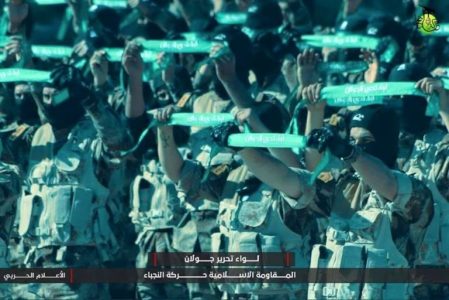
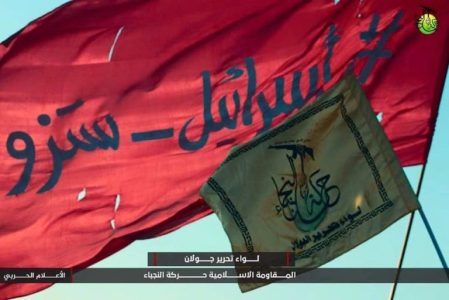
Photo 1: Harakat al Nujaba Golan Liberation Brigade, as portrayed in propaganda video.

The IRGC’s goals in southern Syria are to crush Syrian opposition forces, and build the capability to open another front against Israel. The IRGC hopes a viable Golan foothold would serve as deterrence against Israel and US, and that it could activate in a future conflict, such as another Israel-Hezbollah war. For now, the IDF’s fortified posture in the Golan remains a difficult, if not futile, target for the Guard and its allies. The IRGC nevertheless intends to project steadfast commitment to ideological principles and defiance of adversaries.

*****************************

The Iranian-controlled Iraqi militia Harakat al Nujaba this week announced the formation of its “Golan Liberation Brigade.” While it is not uncommon for entities to name themselves after areas they aim to “liberate,” the militia’s spokesman has said that the unit could assist the Syrian regime in taking the Golan Heights, a region in the Levant that has been controlled by Israel since the 1967 Six-Day War.

If true, the unit would likely participate in a future offensive to capture territory from Syrian opposition in the part of the Golan Heights still controlled by Syria, before moving on to the much taller order of dislodging the Israelis across the border. This week’s announcement reflects Tehran’s priorities in southern Syria since finally taking the fiercely contested city of Aleppo late last year: crush Syrian opposition, and pose military threat to Israel from the Golan Heights. While the Islamic Republic is incapable of credibly challenging the Jewish state’s fortress in the Golan, reaffirming ideological commitment to fighting Israel signals defiance to a global audience amid a reportedly converging American-Arab-Israeli military alliance against Tehran.

Harakat al Nujaba, or Movement of the Noble, has sustained operations in the Syrian and Iraqi combat zones. An offshoot of the Iranian-backed militias Asaib Ahl al Haq and the Hezbollah Brigades, Harakat al Nujaba was formed in 2013 to fight in the Syrian Civil War as part of Iranian-led Iraqi expeditionary forces. The militia joined the Popular Mobilization Forces, the umbrella organization of Iraqi militia, the following year, after the Islamic State incursion into Iraq. Operating as one of the largest Iraqi-Shiite militia contingents in Syria, the militia has claimed to field 10,000 forces. Harakat al Nujaba played an important role in assisting Iran’s Islamic Revolutionary Guard Corps (IRGC) and pro-Syrian regime forces conquer Aleppo late last year.

The Iraqi militia functions as an extension of the Islamic Republic. Having sworn full allegiance to Iran’s Supreme Leader, Ayatollah Ali Khamenei, the militia promotes velayat-e faqih (guardianship of jurisprudence), the Islamic Republic’s founding ideology. Harakat al Nujaba takes direct orders from Major General Qassem Soleimani, the chief of the IRGC extraterritorial branch the Qods Force. Last year, the Iraqi militia, which is also known as Harakat Hezbollah al Nujaba, proclaimed that it and Lebanese Hezbollah, Iran’s most powerful foreign militia, were “the twins of resistance.”

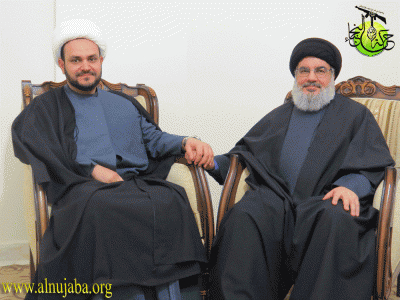
The militia leader Akram al Kabi is close to the top Iranian leadership, including the supreme leader. A co-founder of the Asaib Ahl al Haq – itself an offshoot of the Mahdi Army – Kabi was designated in September 2008 by the US Treasury as a terrorist for aiding Iraqi insurgents. In 2015, he openly said he would depose the Iraqi government if Khamenei issued the order. Last year, top Iranian officials close to Khamenei gave Kabi a highly publicized reception in Tehran, unprecedented in scope and scale for a militia leader. This past December, Harakat al Nujaba publicized Kabi’s meeting with Khamenei on the sidelines of a conference in Tehran.

Harakat al Nujaba has divulged some details about the Golan Liberation Brigade. The commander of the militia’s forces in Syria released a statement declaring the unit to be a synthesis of combat experiences gained in Lebanon, Syria and Iraq. The militia’s official spokesman confirmed the event as a press conference March 8 in Tehran at the IRGC-affiliated Tasnim News Agency, saying the unit was formed following “recent victories” (an implicit reference to Aleppo). He claimed the Golan unit is comprised of “special” forces.

“Should the Syrian government make the request, we are ready to participate in the liberation of occupied Golan with our allies,” the spokesman said. “We will not permit the soil of Arab countries to remain in the grasps of occupiers.”

Harakat al Nujaba also released a video promoting the Golan unit that showed fighters marching in columns and carrying a banner reading, “Israel will be destroyed.”

(The video is at the link. — DM)

Tehran’s goal of establishing a foothold in the Golan Heights is not a secret. Last year, the head of the Israeli foreign and defense legislative committee revealed without divulging details that Israel had repelled several Iran-directed attempts to move forces into Syrian Golan Heights.

Senior Iranian military commanders are known to operate in Syrian Golan. Last July, the then-commander of the IRGC Basij paramilitary publicized an inspection of Quneitra by the Israel border. In January 2015, an Israeli strike in the area killed several high-value targets including IRGC Brigadier General Mohammad Ali Allah-Dadi and multiple Hezbollah operatives.

A chasm remains between the capabilities and ambitions of Harakat al Nujaba and the IRGC to retake the Golan from Israel. The combined forces of the Syrian regime and IRGC-led militias are no match for the Israel Defense Forces (IDF), and this disparity is expected to hold for the foreseeable future. Israel could also adopt a more proactive approach in Syria to foil IRGC encroachment by the Golan, for example coordinating with Syrian rebels positioned in the area. Syrian Golan’s flat geography furthermore denies the IRGC suitable terrain to replicate the southern Lebanon model of concealing rocket launch sites dispersed across a widespread area, making it easier for the IDF to search and destroy weapons systems. For years, the IDF has been fortifying positions in the rocky plateau of Golan to face greater capabilities than the IRGC and its allies can muster.

Yet the claim to retake Israeli Golan underscores Harakat al Nujaba’s ideological commitment to the IRGC’s and Khamenei’s declared goal of destroying Israel. Khamenei and his top Guard generals have frequently spoken that that the divine hand would aid the faithful who take steps towards “divine-inspired” ideological principles.

Brandishing the formation of the Golan unit also challenges Arab countries on the Palestinian issue, as the Tehran has accused them of abandoning the cause in service of Israel. The Islamic Republic has slammed reported Arab-Israeli rapprochement and talks to form a US-brokered military coalition with the goal of countering Tehran, as covered in The Wall Street Journal. Last month, top Iranian government officials hosted another round of the Support of Palestinian Intifada Conference in a show of unity and defiance. This past week, Tehran’s interim Friday prayer leader this week excoriated “some leaders in Islamic countries who are with Zionists,” calling them “not human.” Suffering from loss of legitimacy over support of Syrian President Bashar al Assad against a Sunni-Arab uprising and nervous over a converging Israeli-Arab alliance, the Islamic Republic is projecting to the globe and “sell-out”Arab leaders a defiant commitment to fighting Israel.

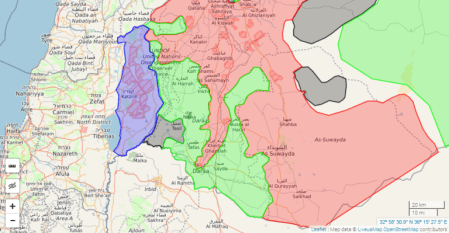
The Iraqi militia’s Golan unit and IRGC-led expeditionary forces could help pro-Syrian regime forces take opposition-held areas in the south. In February 2015, IRGC-led forces launched a failed campaign in the Daraa and Quneitra in the south. Since conquering Aleppo last year, the IRGC-led expeditionary forces and other pro-Syrian regime forces have been able to redirect their dwindling assets to several fronts in north, central, and south Syria. Pro-regime forces backed by Russian air power have been pounding Daraa in the south for more than a month to slow an opposition offensive, and have recently launched a new bid to capture it. An IRGC colonel was also killed last month in the area. A pro-Syrian regime propaganda outlet late last month reaffirmed the government’s intention to retake all of Daraa and open a major border crossing with Jordan. Meanwhile, pro-regime forces have made progress in the northern pocket of Quneitra Governorate, located in the Syrian-controlled part of the Golan.

Map 1: southern Syria front, March 2017. Red: pro-Syrian regime forces. Green: rebel forces including Free Syrian Army and al Qaeda-affiliate Jabhat Fath al Sham. Black: Islamic State affiliates. Credit: Liveuamap.

The IRGC’s goals in southern Syria are to crush Syrian opposition forces, and build the capability to open another front against Israel. The IRGC hopes a viable Golan foothold would serve as deterrence against Israel and US, and that it could activate in a future conflict, such as another Israel-Hezbollah war. For now, the IDF’s fortified posture in the Golan remains a difficult, if not futile, target for the Guard and its allies. The IRGC nevertheless intends to  project steadfast commitment to ideological principles and defiance of adversaries.

Photo 2.
Photo 3: Harakat al Nujaba Golan Liberation Brigade flag at front, and “Israel will burn” banner in the back.

Amir Toumaj is a Research Analyst at Foundation for Defense of Democracies.