Archive for the ‘Islamists in America’ category

Should the Muslim Brotherhood Debate Include Another Rogue Islamist Party?

April 8, 2017

Should the Muslim Brotherhood Debate Include Another Rogue Islamist Party? Investigative Project on Terrorism, Abha Shankar, April 7, 2017

A leading Islamist party recently demanded punishment for bloggers who “insult” Islam and condemned the execution of the murderer of a prominent politician who spoke up against his country’s rigid blasphemy laws. The Islamist party also blamed the U.S.-led war on terror for the rise in global jihadism and the destruction of Islamic civilization.

For those of you wondering, the Islamist party in question is not the Ikhwan al-Muslimeen, or Muslim Brotherhood (MB), whose designation as a terrorist organization is currently a hot topic of debate in Washington. Rather, it is the Jamaat-e-Islami (JI), a South Asian Sunni revivalist movement that has an active network in North America and the West.

The Islamist movement often defends terrorists and rationalizes attacks against Western targets, in addition to working to advance a rigid interpretation of Islam in the U.S. and other secularly-governed nations. The debate over political action against Islamist parties, therefore, does not stop with the Muslim Brotherhood.

JI’s recent blasphemy push provides an example of that thinking in action.

In a press release, Sirajul Haq, the leader of JI’s Pakistan affiliate, condemned the execution of Mumtaz Qadri, who had killed former Punjab governor Salman Taseer, a fierce opponent of Pakistan’s blasphemy laws. Haq also called on Pakistan’s political leadership “not to link terrorism with Islam…to please colonial powers,” and alleged “that the enemy was trying to destroy the Islamic civilization and values and to promote its obscener [sic] and nude culture.”

Haq had earlier described Qadri’s hanging as the “darkest moment in the country’s history” and said that by executing him, the Pakistani government “had proved itself a slave of US President Obama and not a slave of the Holy Prophet.” He added that “the government had executed one Mumtaz Qadri but now every youth and [sic] grown up in the country would turn into Mumtaz Qadri.”

JI’s Ideological Similarities with the MB

The JI was founded in 1941 in Lahore, Pakistan (then part of British India) by Islamist scholar Maulana Syed Abdul Ala Maududi. Maududi is a leading pioneer of Islamic revivalism in South Asia who was inspired by the Brotherhood ideology. Maududi also had a profound influence on Sayyid Qutb, a leading Muslim Brotherhood ideologue who has been described as the “father of modern Islamist fundamentalism.” Qutb is believed to have also inspired al-Qaida leader Osama bin Laden.

Soon after the Arab Spring protests led to the ouster of the Hosni Mubarak regime in Egypt, top Brotherhood and JI leaders met in Cairo to “strengthen the relations between the Islamic movements in different countries ” and “promote Islam.”

JI’s primary objective in Pakistan “is to implement Sharia” and “make Pakistan an Islamic welfare state” based on the “model of the state of Madina,” the multi-religious Islamic state established by the Islamic prophet Muhammad in the 7th century.

Although the MB has a deeper foundation and wider network in North America, the front groups of the JI—Islamic Circle of North America (ICNA) and its charitable arm ICNA Relief—also have an active and long-term presence.

ICNA and ICNA Relief collaborate extensively with MB front groups in the U.S. and Canada. For example, ICNA annually partners with the Muslim American Society (MAS) to host its national conventions that feature radical speakers who advocate jihad and call for the elimination of Israel. MAS was created in 1993 as the Brotherhood’s arm in the U.S.

Both ICNA and ICNA Relief are listed as members of the U.S. Council of Muslim Organizations (USCMO), an umbrella group featuring several groups tied to the American Muslim Brotherhood. It was launched in March 2014 to lobby Congress to enforce an Islamist agenda on U.S. counterterrorism efforts, as well as on issues concerning American Muslims and the larger Muslim ummah (community).

ICNA’s educational programs feature staunch Islamist ideologues, and Maududi’s books have been promoted on the website of ICNA’s youth division, “Young Muslims.”

After trying him in absentia, a Bangladeshi war crimes tribunal sentenced to death ICNA’s former vice president and leader of its New York chapter Ashrafuzzman Khan on charges connected to the kidnapping and murder of several intellectuals during the country’s 1971 war of independence from Pakistan. The tribunal claimed Khan was the “chief executor” of the killing squad, Al-Badr, a militant offshoot of the Jamaat-e-Islami. Following accusations of alleged war crimes against Khan, ICNA scrubbed the names of executive board members, including Khan, from its web page.

Khan still is believed to be in New York. But others convicted by the tribunal have been executed, drawing criticism from ICNA as a “shameful act of judicial killing which is part of the ongoing brutal persecution of political opponents” in Bangladesh.

The Muslim Brotherhood also condemned the executions and called on the global community to “reject and condemn these unjust and unfair trials that violate all international norms and conventions….”

The Brotherhood’s website described JI leader Mir Quasem, who was executed in September after being convicted of running the lethal Al-Badr militia, as an “icon of freedom and resistance against tyranny.”

Quasem’s “martyrdom” was compared to that of MB ideologue Sayyid Qutb in 1966: “When the Egyptian regime executed Sayyid Qutb in 1966, they thought they killed his ideas and ideology; but—as tyrants do in every era and place—they unintentionally immortalized him, inadvertently spread his ideas, and unwittingly introduced the people to his call—his ideology.”

JI Leaders Featured As Speakers at ICNA Events

Yusuf Islahi, a leader of JI’s Indian affiliate (JI Hind), is scheduled to speak at the upcoming MAS-ICNA convention in Baltimore. Islahi, a chief patron of ICNA’s dawah or proselytizing project, WhyIslam, has spoken at past MAS-ICNA conferences. In a 2009 interview, Islahi criticized the Western interest-based economic system: “A society where interest is accepted and becomes widespread is disliked to such an extent that both Allah and His Prophet, peace and blessings be upon him, are at war with them.”

At a 2001 JI Hind event hosted in the Indian city of Aligarh, Islahi reportedly blamed Jews for the 9/11 attacks, which he described as a fitting response to American arrogance: “[T]he September 11 event is a well-planned conspiracy to defame Islam. Muslims are being blamed for it without any evidence. Everyone knows who is the real culprit, Jews …. The United States has unjustly and arrogantly ruled the world for too long. Allah has destroyed that arrogance on September 11. God willing, this will also inaugurate the age of Islam the world over.”

ICNA’s invitations to JI leaders to speak at its events goes back a long way. Former JI leader Qazi Hussein Ahmed, for example, was a featured speaker at ICNA’s 1999 convention in Baltimore. In an interview the same year with ICNA’s newsmagazine Message International, Ahmad spoke about the role Islamist movements such as the JI and MB play in creating an Islamic state: “The Islamic movements through out [sic] the world under the guidance of Maulana Syed Abdul A’la Maudoodi (r) and Shaheed Hasan al-Banna (r) and many other prominent Muslim leaders and scholars and Mujahideen have adopted the same attitude and the same process which was evolved by the Prophet of Allah. Call the people towards Allah and to train and purify them, organize them into Jama’ah and work for the service of mankind. In this process we will create an Islamic society, an Islamic government and an Islamic state.”

The late Ghulam Azam, a former leader of JI’s Bangladesh chapter, also spoke at the 1999 convention. Azam was sentenced to 90 years in prison for committing war crimes during Bangladesh’s 1971 war of independence. Hamas leader Sheikh Muhammad Siyam also was part of the 1999 convention.

JI’s Support for Terror

JI affiliates in Bangladesh and Pakistan criticize the United States, openly voice support for terrorist groups and praise their leaders. For example, people like Osama bin Laden never die, former JI Pakistan leader Syed Munawar Hasan said in a 2014 video. They continue to live in the people’s hearts people and give voice to their people, he said. Hasan described Taliban leader Hakimullah Mehsud’s killing of in a U.S. drone strike as “martyrdom.” He called the U.S. an enemy of Pakistan: “America was our enemy yesterday, it is so today, and tomorrow too it will not refrain from enmity against us.”

The JI has provided an ideological platform and recruiting base for terrorist groups in South Asia. One example is the Hizb-ul Mujahideen (HuM), a Kashmiri jihadist group that emerged in 1989 as JI’s militant wing.

The U.S. designated HuM as a foreign terrorist organization in 2004. In a recent video, HuM commander Zakir Rashid Bhat noted that the Kashmiri people’s struggle for independence was “nationalistic” and was “haraam” (“not permissible”) in Islam. “Nationalism and democracy are not permissible in Islam,” he said. HuM has been behind several terrorist attacks in Kashmir. In 2013, HuM claimed responsibility for an attack on an Indian police camp in Kashmir that killed five security personnel.

JI’s former student wing in India, the Student Islamic Movement of India or SIMI has been implicated in some of the deadliest terror attacks in the country. The group has been banned in India and is alleged to have links to terrorist groups such as the Indian Mujahideen (IM) and the Pakistan-based Lashkar-e-Taiba (LeT) and Jaish-e-Mohammed (JeM).

Nurul Islam Marzan, one of the masterminds behind the July terror attack on a Dhaka café that killed 17 foreigners, helped lead a group with alleged ties to the banned Jama’atul Mujahideen Bangladesh (JMB) and was active in JI’s student wing Islami Chhatra Shibir (ICS) at Chittagong University. Suspects in the 2013 murder of blogger and activist Ahmed Rajib Haider reportedly acted on orders from an ICS leader.

The Jamaat-e-Islami global network’s support for a totalitarian Islamist ideology provides an environment conducive to the radicalization of future terrorists. The Islamist movement’s active presence in the U.S. and the West, its defense of terrorists, condemnation of U.S. foreign policy, justification of terror attacks against the U.S. and its allies, and rejection of Western democratic values and ideals make it relevant in the debate about designating the Muslim Brotherhood as a terrorist group. The Islamist threat is not isolated to one source.

Sisi, Trump, and the Politics of Designating the Muslim Brotherhood

April 6, 2017

Sisi, Trump, and the Politics of Designating the Muslim Brotherhood, National Review, Clifford Smith, April 6, 2017

President Trump welcomes Egyptian President El-Sisi to the White House, April 3, 2017. (Reuters photo: Carlos Barria)

Hopes that the Trump administration will designate the Muslim Brotherhood as a terrorist organization have hit rough waters, with anonymous officials citing concerns about diplomatic blowback and frayed relationships with Muslims at home and abroad. The leaks come on the eve of a historic visit to Washington by Egyptian president Abdel Fattah el-Sisi, a key Arab ally and devoted Muslim who is locked in a life-or-death struggle with the Brotherhood.

The irony is hard to miss, particularly given that Egypt and several other Arab countries have already designated the Brotherhood a terrorist organization.

Whatever the truth behind the leaks, they underscore that the inside-the-Beltway conventional wisdom — that the Brotherhood is “moderate” and so popular that designation would be seen as “a declaration of war against . . . Islam itself” — will not die as easily as many hoped.

This thinking is rooted in a failure to understand the difference between Islamists — a sizable but distinct minority of Muslims who adhere to a totalitarian religious ideology — and the moderate majority of Muslims, who are our friends and allies. President el-Sisi, who has publicly called out extremism to clerics in Egypt, understands this. After all, Egypt is not the only state in which the Brotherhood engaged in attempts to kill its way to power. It did the same in Syria in the early 1980s.

Despite the Brotherhood’s long history of bloodshed, claims that it is “moderate,” or opposes violence, are still prominent. While above-ground Brotherhood organizations use peaceful means when effective, they are “prepared to countenance violence . . . where gradualism is ineffective,” as a 2015 report by the British government noted with significant understatement.

Claims that designation will complicate U.S. relationships with certain Arab allies are overblown. While it is true that some allies, such as Jordan, have Muslim Brotherhood–affiliated parties represented in their parliaments, this is easy enough to finesse. Members of Hezbollah, a U.S.-designated terrorist organization, have long served in Lebanon’s parliament, but American diplomats manage to avoid contact with them and still do business with the Lebanese.

Moreover, failure to designate the Brotherhood complicates some alliances. The Egyptian public has grown deeply suspicious of the U.S. government precisely because under Obama the U.S. came to be seen as overly sympathetic to the Brotherhood. When Senator Ted Cruz introduced the Muslim Brotherhood Terror Designation Act, many Egyptians saw it as a sign the U.S. may be waking from its long slumber. A tweet introducing the bill was the subject of a segment by popular Egyptian talk-show host Amr Adib and was retweeted 17,000+ times.

Domestically, in the wake of Trump’s admittedly troubling comments suggesting a “Muslim ban” during his presidential campaign last year, some fear that designation will fuel anti-Muslim bigotry and pave the way for “a legal assault on the institutions of American Muslim life.” After all, several organizations claiming to represent U.S. Muslims, particularly the Council on American–Islamic Relations (CAIR), have deep Muslim Brotherhood ties.

But groups such as CAIR are hardly “institutions of American Muslim life” — they’re just pretending to be. A 2011 Gallup poll found support for CAIR among U.S. Muslims to be just under 12 percent. Britain’s inquiry into the Brotherhood found that its activists in the U.K. “appear to be unable to generate any grassroots support.”

Frankly, however, if public support for CAIR were higher, that would be all the more reason to be concerned. Notwithstanding its carefully crafted public image, CAIR was named an unindicted co-conspirator in the 2007–09 Holy Land Foundation terror-finance case, and was blacklisted by the FBI as a result. Unfortunately, the Obama administration failed to aggressively continue an FBI investigation into CAIR after it conspired to fund terrorist-designated organization Hamas, the Palestinian wing of the Muslim Brotherhood. Indeed, the United Arab Emirates has declared CAIR itself a terrorist organization.

Trump’s rhetorical excesses cannot be understood without recalling the Obama administration’s refusal to name the problem. Using euphemisms such as “violent extremism” and feigning puzzlement as to the motives of obvious jihadists made the administration’s rhetoric concerning terrorism a national joke. In both the U.S. and Europe, when elites insist that voters must believe them, rather than their own “lying eyes,” the voters turn sharply in the opposite direction. The cure for Trump’s rhetorical excesses is increased security, not denial.

Trump laid out a number of smart proposals on radical Islam during his campaign. His administration should now use President el-Sisi’s visit to move forward with these ideas. In particular, it should follow up designation of the Brotherhood with the formation of a congressionally authorized commission on radical Islam tasked with developing a strategy for winning the war against Islamic extremists and explaining the threat of Islamism to the American people. Both are badly needed. Wrongheaded conventional wisdom won’t keep Americans, or our Muslim allies, safe.

Dr. Jasser discusses CAIRs attempts to have a teacher fired claiming he is ‘islamophobic’

April 5, 2017

Dr. Jasser discusses CAIRs attempts to have a teacher fired claiming he is ‘islamophobic’, AIFD via YouTube, April 4, 2017

(Please see also CAIR Smears and Tries to Silence an IPT Fellow — DM)

According to the blurb beneath the video,

Dr. Jasser joins the Dana Loesche Show discussing CAIRs pressuring the Air Force to fire Patrick Dunleavy, an instructor it deems islamophobic.

Zuhdi refutes CAIRs claims and exaggerations saying that Dunleavy’s course educates Air Force personnel about issues critical for them to know o [sic] the front lines.

NATO Ally Turkey Working with U.S. Muslim Brotherhood

April 4, 2017

NATO Ally Turkey Working with U.S. Muslim Brotherhood, Center for Security Policy, April 3, 2017

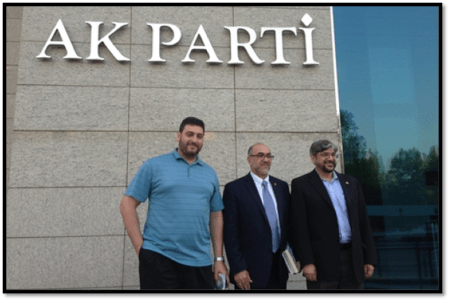
Osama Abu-Irshaid (National Director of American Muslims for Palestine, AMP, a founding member of the USCMO), USCMO Secretary General Oussama Jammal (center) and Naeem Baig (President of the Islamic Center of North America, ICNA, a founding member of the USCMO) outside AK Party Headquarters in Ankara, Turkey, during an August 2014 visit

While the Center for Security Policy has followed the activities of the USCMO, MLFA and AMJA, the realization of just how closely the Turkish government at the highest level is working in collusion with these Muslim Brotherhood-associated groups to thwart any legal measures that may be directed their way by the new Trump administration and Department of Justice led by Attorney General Jeff Sessions still comes as something of a shock. The U.S. Brotherhood and its international partners were way ahead of the Trump team in foreseeing a possible renewal of legal risk and liability under this new management and began taking steps to confront it. They bring significant financial and legal resources to the fight, plus, as we now see, state-level backing from NATO member Turkey whose pro-HAMAS stance has long been known.

But given that an official organization of the Ankara regime is now operating a large Center (with numerous associated centers and mosques) barely thirteen miles from the U.S. Capitol and working there in collaboration with the U.S. Muslim Brotherhood to thwart possible legal actions by the U.S. government is certainly noteworthy. As the international as well as U.S. Muslim Brotherhood gear up for coming confrontations, so must U.S. national security leadership as well.

************************

During the 2016 U.S presidential campaign, senior leadership figures of the United States Council of Muslim Organizations (USCMO) began strategic planning to ensure the advancement and protection of the group’s objectives, no matter who won the White House. USCMO Secretary General Oussama Jammal and HAMAS dba Council on American Islamic Relations (CAIR) Executive Director Nihad Awad set plans in motion to defend the Muslim Brotherhood’s Civilization Jihad inside the U.S. Those objectives were first exposed and described in the Center’s 2015 publication, in Star Spangled Shariah: The Rise of America’s First Muslim Brotherhood Party.

Joining directly in those efforts then and now is the pro-HAMAS Turkish government, under the leadership of President Recep Tayyip Erdoğan and his Justice and Development Party (AKP). The groundwork for what is now a close working relationship began well before the March 2014 announcement of the USCMO’s formation, but it is known that on 15 May 2013, a visiting President Erdoğan placed a ceremonial stone on the 16-acre construction site that would become the Turkish Diyanet Center of America in Lanham, Maryland. The following year, in August 2014, a USCMO delegation led by Secretary General Oussama Jammal traveled to Ankara to meet with President Erdoğan and AK Party leaders. And then, on 29 December 2014, in a recorded video message, Dr. Mehmet Görmez, President of the Presidency of Religious Affairs (Diyanet), addressed the 13th Annual MAS-ICNA (Muslim American Society-Islamic Circle of North America) Conference in Chicago, Illinois and discussed a gift for all Muslims: the Turkish Diyanet Center of America. Of note for the future of the US Muslim Brotherhood-Turkish relationship, this conference was sponsored by the Turkish-backed American Zakat Foundation and included the first-ever attendance of a Turkish-American group at a MAS-ICNA conference.

Turkish President Recep Tayyip Erdoğan shaking hands with USCMO Secretary General Oussama Jammal during the USCMO delegation reception with Erdoğan in NYC in September 2016
Turkish President Recep Tayyip Erdoğan addressing an assembly of US Muslim Brotherhood leadership during the week of the September 2016 UN General Assembly meeting. USCMO Secretary General Oussama Jammal is in the front row at the far right, Mazen Mokhtar, Executive Director of the Muslim American Society (MAS), can be seen in the middle, and Nihad Awad, CAIR Executive Director, is seated at the far left. Awad also welcomed the Turkish government delegation to CAIR’s WDC headquarters that same week.

It will be recalled that Erdoğan himself joined U.S. President Barack Obama on 2 April 2016 at the opening ceremonies for the Diyanet Center of America, located on a large 16-acre site in Lanham, Maryland. The Diyanet Center, also known as the Turkish American Cultural Center (TACC), is a wholly-owned facility of The Presidency of Religious Affairs, an official state institution of the Turkish government.

Under the Trump administration, the USCMO is especially concerned with legal issues, as calls were heard during the 2016 campaign urging that the 2008 Holy Land Foundation (HLF) HAMAS terror funding trial be re-opened to pursue possible cases against the more-than-200 unindicted co-conspirators named by the Department of Justice. Apparently concerned over possible vulnerability should the books of mosques, Islamic Centers and Muslim Brotherhood front groups come under renewed official scrutiny, CAIR and other members of the USCMO therefore engaged the services of the Muslim Legal Fund of America (MLFA), itself a founding member of the USCMO.

It should come as no surprise, then, that the first major event to be co-sponsored by the USCMO, TACC and the MLFA in the Trump era will be a 13 May 2017 Muslim Non-Profit Leadership Conference, to be held at the Diyanet Center of America. Among the program topics are Safeguarding 501(c)3 status; Board fiduciary responsibilities; record keeping and disclosure requirements; Fundraising regulations, state registrations, unrelated business income; and Banking regulations, FDIC, DOJ, Watchlists, international charitable giving.

One of the MLFA’s top legal representatives, now working openly with the U.S. Muslim Brotherhood, is U.S. Navy Lieutenant Commander (ret.) Charles Swift, formerly of the Judge Advocate General’s Corps. Swift, a 1984 graduate of the U.S. Naval Academy, who was recognized by the Muslim Brotherhood for his legal role advocating for client Salim Ahmed Hamdan in the U.S. Supreme Court case Hamdan v. Rumsfield 548 US 557 (2006). This role doubtless contributed to the choice of Swift as Director and Counsel for the Constitutional Law Center for Muslims in America (CLCMA), a project of the Muslim Legal Fund of America led by Executive Director Khahil Meek.

The MLFA’s CLCMA project presents itself as dedicated to two primary missions:

    • “Challenging governmental security measures affecting Muslim communities which encroach upon the constitutional liberties guaranteed to all.”
    • “Protecting the rights of Muslim individuals and organizations in the United States to exercise their constitutionally and statutorily protected rights to worship.”
Pictured left to right: “Jihadis in Suits” Nihad Awad, Khalil Meek, Oussama Jammal

In apparent pursuance of these missions, the MLFA continues actively to seek the release from federal prison of defendants in the HLF trial, which concluded in late 2008 with a unanimous guilty verdict on all 108 counts. The MLFA also engages in lawfare, using lawsuits as an offensive means of shutting down opposition to its civilization jihad operations. For example, as noted by the Thomas More Law Center in the 2009 case of Joe KAUFMAN, Appellant, v. ISLAMIC SOCIETY OF ARLINGTON, Texas, Islamic Center of Irving, DFW Islamic Educational Center, Inc., Dar Elsalam Islamic Center, Al Hedayah Islamic Center, Islamic Association of Tarrant County, and Muslim American Society of Dallas, Appellees, No. 2-09-023-CV: “The head of that organization [MLFA], Khalil Meek, admitted on a Muslim radio show that lawsuits were being filed against Kaufman and others to set an example. Indeed, for the last several years, Muslim groups in the U.S. have engaged in the tactic of filing meritless lawsuits to silence any public discussion of Islamic terrorist threats.”

More recently, in response to U.S. President Donald J. Trump’s early March 2017 revised executive order to restrict immigration from six Muslim-majority nations, the MLFA working in conjunction with the USCMO, is referring all Muslims to its “advisory prepared by Constitutional Law Center for Muslims in America.” The MLFA may cloak itself in the colors of Star Spangled Shariah as a “constitutional rights organization” but Executive Director Khalil Meek still whines that “We continue to be troubled by this administration’s ongoing attempts to single out Muslims for adverse actions. Such blatant discrimination is a violation of our nation’s constitutional freedoms of speech, expression and religion.”

Finally, it is worth taking note of the following guidance. The Assembly of Muslim Jurists of America (AMJA) provides the authoritative juridical backup on Islamic Law (shariah) for the American Muslim community and U.S. Islamic legal organizations such as the MLFA. Addressing the U.S. Muslim community on 28 November 2016, shortly after Donald Trump won the U.S. presidential election, AMJA issued the following bracing statement:

“No one could possibly be unaware of the political storm that has recently overtaken this country…For this reason, the Assembly of Muslim Jurists in America is addressing the Imams, Islamic workers and the entire Muslim community with permanent values that must be emphasized during this stage as well as a number of principles to be used in dealing with these events, what has happened as well as what is expected to happen…Islam, with respect to its belief and legal foundations, is unalterably fixed. It does not accept any replacement for change. (emphasis added)

While the Center for Security Policy has followed the activities of the USCMO, MLFA and AMJA, the realization of just how closely the Turkish government at the highest level is working in collusion with these Muslim Brotherhood-associated groups to thwart any legal measures that may be directed their way by the new Trump administration and Department of Justice led by Attorney General Jeff Sessions still comes as something of a shock. The U.S. Brotherhood and its international partners were way ahead of the Trump team in foreseeing a possible renewal of legal risk and liability under this new management and began taking steps to confront it. They bring significant financial and legal resources to the fight, plus, as we now see, state-level backing from NATO member Turkey whose pro-HAMAS stance has long been known.

But given that an official organization of the Ankara regime is now operating a large Center (with numerous associated centers and mosques) barely thirteen miles from the U.S. Capitol and working there in collaboration with the U.S. Muslim Brotherhood to thwart possible legal actions by the U.S. government is certainly noteworthy. As the international as well as U.S. Muslim Brotherhood gear up for coming confrontations, so must U.S. national security leadership as well.

Outrageous Unconstitutional Intimidation of Private Citizens Who Opposed Mosque Project; Thomas More Law Center Steps In

March 30, 2017

Outrageous Unconstitutional Intimidation of Private Citizens Who Opposed Mosque Project; Thomas More Law Center Steps In, Thomas More Law Center, March 28, 2017

(The township’s press release referenced in the last paragraph is dated November 18, 2016. The lawsuit had been filed on March 10th and, four days later, the Department of Justice “notified the Township that the DOJ was going to investigate the ISBR allegations.” The press release also states,

The private lawsuit and Plaintiffs’ issuance of punitive subpoenas on private citizens merely for participating in the land use process raise further Constitutional issues of free speech and privacy concerns. These invasive probes went so far as to require documents sufficient to show endorsements of, donations to, or associations with political campaigns from the local to the national level.

Among various concerns, we anticipate that the actions of the DOJ and Plaintiffs may well dissuade residents from participating in future land use hearings for fear of retribution from an applicant and the government.

Eight months after the suit was filed, the DOJ filed its own suit against the township. The DOJ should ask the court to dismiss the suit filed on its behalf and that filed by the Islamic Society of Basking Ridge. — DM)

ANN ARBOR, MI – If you speak out against building a mosque in your community, you may be slapped with a subpoena demanding all your personal documents, including emails, voicemails, text messages, and social media posts concerning Muslims, Islam, mosques, the Quran, Muslim worship or prayer services, wudu, imams, burkas, hijabs, Sharia, jihad, or anything else associated with or related to Muslims or Islam.

This was part of the harassment and intimidation experienced by scores of private citizens of the small New Jersey town, Bernards Township (also known as Basking Ridge), who spoke out at public hearings against a plan to build a disproportionately-sized mosque on a small piece of residential property.  The mosque project, sponsored by the Islamic Society of Basking Ridge (“ISBR”) and its president, Mohammad Ali Chaudry, was denied by Township officials for not complying with local building ordinances.

On March 10, 2016, ISBR and Mohammad Ali Chaudry sued Bernards Township in federal court, claiming various violations of the Religious Land Use and Institutionalized Persons Act.  Shortly after, ISBR had coercive subpoenas served on private citizens whose only involvement was voicing concerns at public planning board meetings about whether the proposed mosque complied with local building ordinances.

The United States District Court for the District of New Jersey recently granted the Thomas More Law Center, a national public interest law firm based in Ann Arbor, Michigan, permission to represent, without charge, several of these citizens who desired to quash the coercive and abusive subpoenas.  Westfield, New Jersey attorney Michael P. Hrycak is assisting the Law Center.

Richard Thompson, President and Chief Counsel of the Thomas More Law Center, commented: “ISBR is setting a dangerous unconstitutional precedent by abusing a court process to chill and trample on the First Amendment Rights of private citizens whose only involvement was to speak out against the mosque at public hearings. Because the U.S. Supreme Court has held that speech at a public place on a matter of public concern is entitled to special protection, we will ask the Federal District Court to quash the subpoenas served on our clients as a misuse and abuse of the Court’s process.”

Lori Caratzola, described in the ISBR Complaint as a fervent and frequent objector to the mosque, was a prime target for ISBR’s personal attacks.  She was personally mentioned over a dozen times in their Complaint.  Yet she has remained steadfast in her opposition.  Ms. Caratzola commented:

“Being served with a Federal Court Subpoena to turn over all my personal communications including voicemails, social media, emails, notes wherein I make any mention of anything having to do with Islam is an absolute violation of my First Amendment rights. I was a citizen exercising my right to attend public planning board meetings about a land use application that affected my community.”

She continued:

“Dr. Chaudry’s clear intent was to embarrass, strike fear, silence and cause financial harm to any citizen who dared oppose his nonconforming project.  And if these subpoenas are allowed to stand, it will set a chilling precedent for all citizens who wish to exercise their Constitutionally protected right to free speech and to petition their government.

“I was named numerous times in the Complaint, yet as a non-party, I had no standing to challenge the lies and half-truths told about me.  After the Complaint was filed, mainstream media picked up and repeated these lies and half-truths.”

Caratzola concluded:

“I have lost days, probably weeks, devoting time to trying to find counsel – only to find most attorneys are afraid of challenging an Islamic group in today’s political climate.”

Attorney Karen Lugo, a specialist on constitutional law and zoning issues, echoed Lori Caratzola’s concerns:

“ISBR’s subpoena of private citizens’ communications with local government, as well as all personal email and social media statements related to ‘anything associated with or related to Muslims or Islam’ is in direct violation of speech protections enshrined in the Constitution and in Supreme Court rulings. ISBR’s blatant efforts to chill the free exercise of speech while intimidating local citizens with these subpoenas must not only be denied, but must be rebuked, by the courts.”

Cody Smith, another subpoenaed resident who opposed the Mosque, stated:

“The planning board did exactly what it should have done—set emotions aside and judge ISBR’s application solely on its merits and whether it complied with our local regulations. It’s unfortunate that Dr. Chaudry, the Township’s former mayor, has resorted to an all-out smear campaign and retaliation against residents who exercised their fundamental Constitutional rights of Free Speech in a public forum.”

Soon after ISBR’s lawsuit, DOJ investigators opened another coercive front by attempting to interview the private citizens who opposed the mosque.  Eight months later, the DOJ filed its own lawsuit against the Township.

Astonishingly, the DOJ was dismissive of an apparent conflict of interest between Mohammad Ali Chaudry and the DOJ’s chief investigator, Caroline Sadlowski, both of whom were serving together on the Center for Religious and Cultural Conflicts board at Drew University.

See Bernards Township Press Release here

CAIR Smears and Tries to Silence an IPT Fellow

March 30, 2017

CAIR Smears and Tries to Silence an IPT Fellow, Investigative Project on Terrorism, March 30, 2017

Using misleading claims and engaging in rank hypocrisy, the Council on American-Islamic Relations (CAIR) is waging a campaign to silence an Investigative Project on Terrorism senior fellow.

CAIR issued a news release Wednesday announcing its efforts to pressure the United States Air Force Special Operations School (USAFSOS) into dropping Patrick Dunleavy as an instructor in “The Dynamics of International Terrorism” course. Dunleavy, who served as deputy inspector general for New York State’s Department of Corrections, focuses on prison radicalization.

It’s a topic he learned about first hand, including work on “Operation Hades,” an investigation into radical Islamist recruitment both in and out of prison.

CAIR’s release, however, ignored Dunleavy’s long record of accomplishment which includes serving as a consultant for the FBI and the International Association of Chiefs of Police on the National Data Exchange Program. He also has been a featured speaker at the United States Army’s Counter Terrorism Conference.

Instead, CAIR described a letter it sent to U.S. Air Force Special Operations Commander, Lieutenant General Marshall B. Webb, demanding Dunleavy be dropped from future programs. It cited three statements CAIR sees as “Islamophobic”:

1) “To Americans [morality] means individual liberty, equal rights for men and women, religious freedom, free speech, etc. But these are contrary to the moral code of Islam.” 2) “The concept of ‘friendship,’ . . .is a relationship based on at least some degree of shared moral and political ideals. By that standard no Muslim nation is a friend of the U.S.” and 3) “To many Muslim parents, visions of violence and death are indeed the ‘better future.'”

All three come from a 2011 article Dunleavy co-authored with Peter Gadiel, whose son James was killed in the World Trade Center on 9/11. As we’ll show, none of these statements is Islamophobic, as each is rooted in Quranic verses or is exhibited by disturbing numbers of Muslims throughout the world.

CAIR’s credibility should be considered first.

This is an organization deemed persona non grata by the FBI in 2008, based upon evidence agents uncovered which prove that CAIR was created as part of a Muslim Brotherhood-run Hamas support network in the United States. In addition to internal documents which place CAIR under the umbrella of the Muslim Brotherhood’s “Palestine Committee,” CAIR co-founder Nihad Awad – the only executive director in the organization’s 23 year existence – is on the Palestine Committee’s telephone list. He also participated in a secret 1993 gathering of Hamas supporters in America who debated ways to “derail” the fledgling, U.S.-brokered Oslo Accords that at the time offered hope for a peaceful settlement to the Israeli-Palestinian conflict.

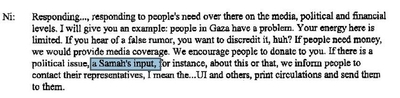
Palestine Committee members could not accept a deal that recognized Israel’s right to exist and felt politically threatened by the elevation of the secular Palestine Liberation Organization to run a newly autonomous Palestinian Authority. Participants were encouraged not to mention Hamas by name. Rather, they were instructed to flip the spelling of the name, and talk about “Samah.” As this FBI translation shows, Awad dutifully followed these instructions.

In addition, CAIR not only defends people caught supporting terrorists, it often lauds them. Among many examples, it defended Palestinian Islamic Jihad board member Sami Al-Arian for years even after his conviction for supporting the terrorist group, and in 2014, chose to honor his family with a “Promoting Justice Award.”

It continues to laud convicted Palestinian bomber Rasmieh Odeh, who was responsible for a 1969 Jerusalem bombing that killed two college students.

This is the organization that finds Dunleavy unacceptable.

Officials already have reviewed all of Dunleavy’s USAFSOS presentations and told him that they found nothing offensive, and he has logged no complaints after teaching multiple courses a year for the past five years.

It’s worth noting that CAIR relies on one five-year-old article as the basis for its complaint. Potomac Books published Dunleavy’s The Fertile Soil of Jihad in 2011 and he is frequently published by the IPT and elsewhere. The absence of any truly bigoted statements is telling.

So is CAIR’s hypocrisy. Its website features a page devoted to debunking what it calls “Misinformation and Conspiracy Theories About CAIR.” (See the IPT’s analysis of CAIR’s false claims here.) On that “misinformation” page, CAIR whines twice about “guilt by association,” including a response to the number of CAIR officials who were implicated in terrorism-related cases.

Yet, the only other reason CAIR cites to disqualify him from the Air Force training is the fact that he’s an IPT senior fellow and CAIR does not like the IPT. It’s easy to understand why. We’ve done more to expose its history and highlight the radical views of its top officials and its opposition to law enforcement counter-terrorism efforts than anyone else.

But, again, Dunleavy has written more than two dozen articles for the IPT. CAIR cited none in arguing he “does not fit the U.S. military’s standards for a subject-matter expert” working with the dreadfully “Islamophobic” IPT.

The example CAIR does cite, as mentioned above, utterly fails to make CAIR’s case. First is the statement, “To Americans [morality] means individual liberty, equal rights for men and women, religious freedom, free speech, etc. But these are contrary to the moral code of Islam.”

That could sound bad. But looking at the world today, and the treatment of women, gays and other minorities living in majority-Muslim nations, individual liberty and equal rights are sorely missing. Right now, a Twitter hashtag is calling for the death of a Pakistani blogger named Ayaz Nizami. Nizami, an atheist, was among three people arrested last week and charged with blasphemy. #HangAyazNizami trended on Twitter in Pakistan afterward.

Polling indicates a shocking number of Muslims agree that death is the appropriate punishment for apostasy. In 2013, the Pew Research Center found 88 percent support among Egypt’s Muslims and among 62 percent of Pakistanis. Majority support also exists in Malaysia, Jordan and inside the Palestinian territories. More than a third of young British Muslims agreed.

No other religion today carries such risks for those who leave. Even Scientology stops at merely disconnecting people from their families when someone leaves the church.

Both Iran and the Islamic State execute homosexuals.

Meanwhile, most American mosques still segregate men and women during prayer, often sending the women into sparse and cramped back areas and side rooms. American clerics like Yasir Qadhi advocate a Saudi Arabian lifestyle for American Muslim women. Stay home and tend to your husbands, he preached. They “should not work, because their role is as wives and mothers.”

“You please your husband,” Qadhi said. “And in return your husband will give you the far more difficult things to do of earning money and doing this and that.”

This is a Muslim American cleric prominent enough to warrant an 8,500 word New York Times profile, preaching his view of Islam’s moral code in the 21st century.

There are Muslim reformers who want to change this mindset, and advocate for genuine equality for women and minorities. CAIR, like other Islamist groups, has refused to endorse their agenda and generally pretends they do not exist.

The second Dunleavy statement CAIR singles out: “The concept of ‘friendship,’ . . .is a relationship based on at least some degree of shared moral and political ideals. By that standard no Muslim nation is a friend of the U.S.”

In the Quran, verse 5:51 instructs Muslims not to “take the Jews and the Christians as allies. They are [in fact] allies of one another. And whoever is an ally to them among you – then indeed, he is [one] of them. Indeed, Allah guides not the wrongdoing people. Verse 9:30 calls on Allah to “destroy” Jews and Christians.

Finally, CAIR takes issue with his 2011 statement that, “To many Muslim parents, visions of violence and death are indeed the ‘better future.'”

This is certainly true among a disturbing number of Palestinians. Parents of Palestinians killed attempting to carry out terrorist attacks against Israelis speak of their pride. It is routine for deadly attacks to be celebrated with people handing out sweets on Palestinian streets. Hamas media for years has indoctrinated children into jihad, using everything from training camps to plays and video productions showing young children pretending to be in combat. Hamas television even “martyred” a Mickey Mouse rip-off, and then sent a puppet bumblebee “to continue the path of Islam, of heroism, of martyrdom and of the mujahideen.”

CAIR has never condemned this indoctrination, and on a broader level, its officials refuse to condemn Hamas by name. In fact, they take great umbrage at the suggestion this is something worth doing.

But the organization does find time to smear a veteran law enforcement official and expert on radicalization because it does not agree with his message. It does not appear that the tactic will work in Dunleavy’s case. But it’s time for law enforcement officials, the military and the media to follow the FBI’s lead and recognize CAIR for what it is and simply dismiss such baseless attacks out of hand.

Access Islam: US Department of Education

March 30, 2017

Access Islam: US Department of Education, Christian Access Network via YouTube, March 28, 2017

(I assume that this promotion of Islam by the Department of Education started during the Obama administration. Apparently, DOE provides no promotion of Christianity, Judaism or other religion. Nor should it. When will Betsy DeVos, President Trump’s Secretary of Education, repudiate and pull this Federal intervention in favor of Islam?

April 1 Update — at my blog— DM)

Here is the blurb following the video:

The United States Department of Education has developed an Islamic indoctrination program for public schools called, ‘Access Islam.’

The lesson plans are written for grades 5 through 12. They include worksheets and videos to help students perform the 5 Pillars of Islam – prayer, fasting, alms giving, pilgrimage to Mecca and the proclamation of Muslim faith.

This short video contains excerpted clips taken from the “Access Islam’ program which not only teaches children how to perform a Muslim prayer, but asks students such questions as: ‘What does a Muslim prayer sound like?’ ‘What do the movements look like?’ and ‘What are some of the things Muslims say during prayer?’

Children are also expected to memorize verses from the Quran and give the meaning of those verses.

Taken as a whole, the U.S. Department of Education’s ‘Access Islam’ program is nothing short of a Sunday school class on Islam.

Here is a video of an interview with the founder of the Christian Action Network:

https://www.youtube.com/watch?v=KwIX5RUr7JU


U.S. Muslim Brotherhood and Saul Alinsky: A Match Made in America

March 28, 2017

U.S. Muslim Brotherhood and Saul Alinsky: A Match Made in America, Center for Security Policy, March 28, 2017

(Please see also Trump backs off Muslim Brotherhood’s designation as terrorist organization. — DM)

In September 2015, the Center for Security Policy (CSP) published Star Spangled Shariah: The Rise of America’s First Muslim Brotherhood Party. Warnings issued then have since been confirmed, specifically, that the United States Council of Muslim Organizations (USCMO), while deceptively cloaked in red, white, and blue, is simply the leading edge of the Islamic Movement in this country. In pursuit of Civilization Jihad, the Muslim Brotherhood’s information operations – including many tactics learned directly from the KGB – have enabled this organization to insinuate itself gradually into a position from which it can assault the pillars of our society. These include: academia, the U.S. judicial system, faith groups, all levels of government, the media, intelligence and security agencies, and our refugee resettlement and other immigration processes. As will be shown here, a development not new but recently uncovered reveals that USCMO Secretary General Ousamma Jammal is directly connected to Saul Alinsky’s Industrial Areas Foundation (IAF), a Marxist-Leninist organization dedicated to revolution in America.

In his Brotherhood/USCMO leadership role, Jammal has a well-established track record of political activism and success at developing strategic relationships for the benefit of the Muslim Brotherhood including with members of the U.S. government. In the ‘About Us’ section on the USCMO website, the third prong of the USCMO Mission Statement declares the necessity “to create and sustain an urgent, collective sense of direction that well-serves the American Muslim community toward the betterment and guidance of our nation.” What the USCMO fails to share with the American people is the USCMO’s commitment to the establishment of Islamic Law (shariah) in place of the U.S. Constitution.

It’s long been known that the USCMO is openly allied with far-left racist and revolutionary movements like Black Lives Matter. Recall that, in March 2016, the Center released a videowhich highlighted the statements of Muslim Brotherhood leaders that should be chilling to Americans who cherish the Constitution and oppose the expansion of shariah. That video showed top USCMO leadership figure, Nihad Awad (also the Executive Director of HAMAS USA dba the Council on American Islamic Relations or CAIR), explicitly aligning the U.S. Muslim Brotherhood with the Black Lives Matter movement. The Muslim Brotherhood alignment with the overall Red-Green Axis demonstrates the genuine aims of jihadis in suits: undermining the U.S. Constitution and national security through the global Islamic Movement.

In CSP’s Civilization Jihad Reader series publication, The Red-Green Axis: Refugees, Immigration, and the Agenda to Erase America, author James Simpson provides several crucial data points that hint at the Brotherhood’s other, Marxist-Leninist, affiliations.

  • The Catholic Campaign for Human Development (CCHD) is the grant making vehicle of the USCCB. It was founded in Chicago in 1969 with the help of radical organizer Saul Alinsky specifically to fund Alinsky’s Industrial Areas Foundation (IAF).
  • CCHD has been a radical leftist funding vehicle ever since, giving millions to ACORN, the radical training school, Midwest Academy and others. IAF receives the largest percentage of CCHD grants of any CCHD grantee.

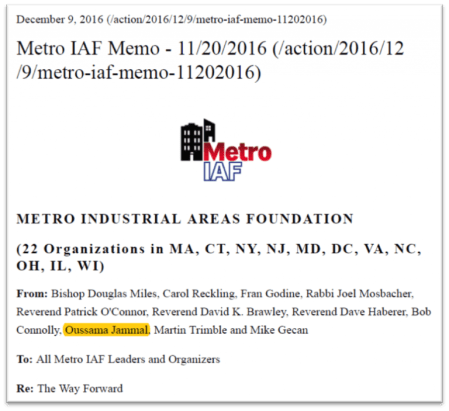
In a Metro Industrial Areas Foundation action memo dated 20 November 2016 and published by member organization ‘Dupage United’ on 9 December 2016, USCMO Secretary General Oussama Jammal is listed among the leadership. The …And Take Counsel section on the USCMO website states, “When we speak with one clear, communal voice, our advice can help true the direction of American society toward justice.” It must be understood, however that within Islam, the word ‘justice’ means ‘shariah’ and only shariah. Thus, the Muslim Brotherhood version of social justice is not intended as benevolence towards non-Muslims; quite to the contrary. Rather, in true Saul Alinsky form, the aim of the Red-Green Axis is anarchy intended to collapse the U.S. system of Constitutional law and order.

Jammal is fully cognizant that the Muslim Brotherhood’s manipulation of progressive leftist social justice entities aligned with the Red-Green Axis is strategic for the advancement of the settlement process. The Muslim Brotherhood has both co-opted the interfaith religious dialogue movement and mastered the operational mechanics of the political process in the U.S. to advance Islam’s shariah objectives. That Jammal works so closely with IAF leadership should be a red flag warning and belies what the USCMO shares with non-Muslims when it says: “Our well-deliberated and sincerely expressed words for the benefit of the nation can fortify attitudes that propagate harmony between people and institutionalize policies that spread prosperity to all.”

This revelation, that the U.S. Muslim Brotherhood works directly with the Marxist-Leninist Alinsky-founded IAF at the highest levels, lends yet additional substance to the overall Red-Green Axis, whose seemingly disparate elements nevertheless have been collaborating to bring down this Republic for some time. Forthcoming CSP publications will delve even further into the Brotherhood-IAF connection.

Trump backs off Muslim Brotherhood’s designation as terrorist organization

March 28, 2017

Trump backs off Muslim Brotherhood’s designation as terrorist organization, Washington TimesGuy Taylor, March 27, 2017

(Please see also, Five Reasons The Muslim Brotherhood Is a Terror Group. Who at the State Department are advising against designation as a terrorist organization? Holdovers from the Obama administration?– DM)

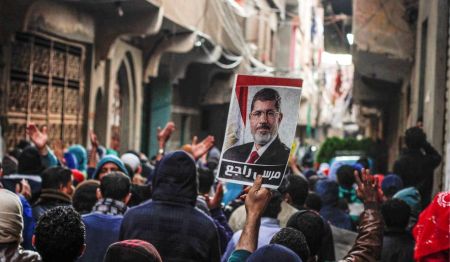
In 2011, the Muslim Brotherhood briefly was elected democratically to power in Egypt before its leader, Mohammed Morsi, was ousted from power.

President Trump has — for the time being — put on the back burner an executive order designating the Muslim Brotherhood a terrorist organization, according to U.S. officials close to a heated debate inside the administration over the status of the global Islamist movement.

While the White House has declined to comment publicly, officials speaking on condition of anonymity say the administration backed down from a plan to designate the Brotherhood last month after an internal State Department memo advised against it because of the movement’s loose-knit structure and far-flung political ties across the Middle East.

The memo “explained that there’s not one monolithic Muslim Brotherhood,” according to one of the officials, who told The Washington Times that while the movement may well be tied to such bona fide terrorist groups as Hamas, its more legitimate political activities would complicate the terrorist designation process.

The Brotherhood has prominent political factions engaged — at least perfunctorily — in democracy in Jordan, Morocco, Tunisia and several other Muslim-majority nations, and the State Department memo coincided with high-level pressure placed on the Trump administration from at least one of them.

Senior diplomats from Jordan — a close U.S. ally — are believed to have weighed in heavily against the idea of adding the Brotherhood to the State Department’s foreign terrorist organizations list, said the official, because the movement’s political arm in Amman currently holds 16 Jordanian parliament seats.

But debate over the Brotherhood’s status remains biting in Washington, where hard-liners in the fight against radical Islamic terrorism say former President Barack Obama erred for years by failing to target the organization’s promotion of extremist ideology, and that President Trump is now badly fumbling a chance to rectify the situation.

Links to terror

A small but vocal group of Republicans on Capitol Hill is pushing legislation that would direct the State Department to either designate the Brotherhood, as well as the Iranian Revolutionary Guard Corps, as terrorist organizations or justify why they are being kept off the list.

Sen. Ted Cruz, who reintroduced the Muslim Brotherhood portion of the legislation last month with a House version backed by Rep. Mario Diaz-Balart, says listing the movement would “codify needed reforms in America’s war against radical Islamic terrorism.”

“This potent threat to our civilization has intensified under the Obama administration due to the willful blindness of politically-correct policies that hamper our safety and security,” the Texas Republican said in a statement at the time.

“This bill would impose tough sanctions on a hateful group that has spread violence and spawned extremist movements throughout the Middle East,” added Mr. Diaz-Balart, Florida Republican.

While hard-line groups have rallied behind such assertions for years, the legislation also has a number of more moderate backers, including Qanta A. Ahmed, a Muslim British physician and author, who argues that the Brotherhood “birthed modern-day Islamism” as a “supremacist totalitarian ideology that seeks to undermine pluralist societies and impose hardline theocratic regimes.”

“Founded in Egypt in 1928 and with branches or affiliates in over 70 nations, the Muslim Brotherhood today masquerades as a legitimate Islamic institution and a benign democratic actor,” Ms. Ahmed argued in an article published this month by the National Review.

“It is neither,” she wrote, adding that the movement has “well-documented links to the financing of terrorism” and that “the United States should designate [it] as a foreign terrorist organization.”

Missing the nuances

Current and former State Department officials say those calling for the designation of a movement as broadly based as the Muslim Brotherhood are ignoring a host of complex factors that could undermine the designation’s legitimacy.

The Brotherhood, analysts say, exists as a vast and loosely knit political and social organization, with millions of followers and dozens of factions spread across the Muslim world.

Few question its promotion of Shariah or Islamic law, or that some of its followers have embraced terrorism — the most notable example being the Palestinian group Hamas, whose official charter calls for the destruction of Israel. Hamas was put on the terror list in 1997 and has stayed there since.

But away from Hamas, many Brotherhood leaders were known during the 1970s to renounce violence in favor of politics. And recent decades saw factions of the movement embrace democracy to gain legitimacy in various Middle East nations, as well as to try to topple dictatorships.

Following the 2011 overthrow of Egypt’s authoritarian President Hosni Mubarak, the Brotherhood was — albeit briefly — democratically elected to power in Cairo before the nation’s military ousted the movement’s national leader, Mohammed Morsi.

While several Gulf Arab monarchies view the Brotherhood as an internal political threat, the movement’s factions are seen as part of the democratic landscape in other places, including Turkey, where many see the ruling Justice and Development Party (AKP) as a distant Brotherhood affiliate.

Creating problems

“If you’re talking about just broadly listing the Muslim Brotherhood as a terrorist organization, you’re going to run quickly into a serious definitional problem,” says P.J. Crowley, who served as an assistant secretary of state for public affairs under President Obama.

“Certainly, if you look at Hamas, it’s part of the Muslim Brotherhood family,” Mr. Crowley told The Times. “But the Brotherhood is also a distant cousin of the AKP in Turkey, so once you start down that road, you get into an immediate problem that could create significant diplomatic issues. And what about Morocco, Jordan and Tunisia?

“The one thing that distinguishes the Muslim Brotherhood from groups like al Qaeda is that al Qaeda wants to blow up any democratic process, while the Brotherhood is theoretically prepared to participate in the democratic process,” he said.

A report by NPR recently maintained that the Brotherhood became popular among Middle East university activists in the 1960s and 1970s — and when some immigrated to the United States with student visas, they brought the movement’s ideology with them.

“They were helped even by our State Department,” Hossein Goal, who emigrated from Iran during the period, told NPR. “They gave them sanctuary to come here.”

It follows that members of the movement had significant roles in establishing mosques, Islamic schools and other U.S.-based Muslim organizations. NPR suggested that, over the years, the situation fueled debate over the whether the movement’s true aim was to participate in American life or to advance an Islamist political agenda in the U.S.

Seeking truth

One prominent U.S. Muslim organization says the push to get the Brotherhood listed as a terrorist organization today is a ruse. “We believe it is just a smokescreen for a witch hunt targeting the civil rights and civic participation of American Muslims,” said Ibrahim Hooper, a spokesman for the Council on American-Islamic Relations.

“Sponsors and supporters of the designation have for many years falsely linked the majority of mainstream American Muslim organizations and leaders to the Muslim Brotherhood,” Mr. Hooper told The Times. “[This] will inevitably be used in a political campaign to attack those same groups and individuals, to marginalize the American Muslim community and to demonize Islam.”

One of the strongest advocates for designating the Brotherhood says that’s nonsense.

“It is a terrorist organization,” says Frank Gaffney, who heads the Center for Security Policy think tank in Washington. “It’s the leading edge in this country and elsewhere in the West for Shariah supremacism.”

Mr. Gaffney, who drew liberal ire during the Obama years for claiming the former president was secretly a Muslim, told The Times that U.S. policy has long been afflicted by thinking the “Brotherhood is part of the solution, not part of the problem.”

“We are in the fix we’re in today, 16 years since 9/11 and having basically lost two wars, not due to military inadequacies but due to this incoherent understanding, or nonunderstanding, of the nature of the enemy,” Mr. Gaffney said.

“One of the things that was most important about Donald Trump’s claim that he understood the nature of the enemy was that he seemed to recognize that it involves the Muslim Brotherhood — and, for that reason, he should designate it a terrorist organization.”

Political Islam Is Today’s Anti-American ‘Long March Through The Institutions’

March 27, 2017

Political Islam Is Today’s Anti-American ‘Long March Through The Institutions’, The Federalist, , March 27, 2017

(I agree with nearly everything Hirsi Ali says, except for her last paragraph:

We should therefore claim, in the name of tolerance, the right not to tolerate the intolerant. We should claim that any movement preaching intolerance places itself outside the law, and we should consider incitement to intolerance and persecution as criminal, in the same way as we should consider incitement to murder, or to kidnapping, or to the revival of the slave trade, as criminal.

As written, what she proposes comes dangerously close to, and could easily be construed to be the same as, Canada’s new “anti-Islamophobia” law. We should not be required to be tolerant of Islamism or any other ideology; we should be free to criticize it for being what it is. Those who try to defend it should be as well, disgusting though they may be. 

The First Amendment recognizes our right to freedom of speech because it helps good to prevail over evil; the possibility that it may occasionally permit the reverse is not a valid argument against freedom of speech. It may be an argument — which I reject — that we are no longer capable of living in a free society. Criminalization of free speech because it may be considered “intolerant” of any religious or political view can be the end of free speech and produce a society congruent with that which the Islamists desire. — DM)


It cannot be said often enough that the United States is not at war with Islam or with Muslims. It is, however, bound to resist the political aspirations of Medina Muslims where those pose a direct threat to our civil and political liberties. It is also bound to ensure that Mecca Muslims and reforming Muslims enjoy the same protections as members of other religious communities who accept the fundamental principles of a free society. That includes protection from the tactics of intimidation that are so central to the ideology and practice of political Islam.

******************************

It is refreshing and heartening that President Trump acknowledges the need for an ideological campaign against “radical Islam.” This deserves to be called a paradigm shift.

President Bush often referred to a “war on terror,” but terror is a tactic that can be used for a variety of ideological objectives. President Obama stated that he was opposed to “violent extremism” and even organized an international summit around this subject. Yet at times he made it seem as if he worried more about “Islamophobia” than about radical Islam.

In a speech to the United Nations General Assembly in 2012, Obama declared: “The future must not belong to those who slander the prophet of Islam.” In what follows, however, I shall refer to “political Islam” rather than radical Islam.

Political Islam is not just a religion as most Western citizens recognize the term “religion,” a faith; it is also a political ideology, a legal order, and in many ways also a military doctrine associated with the campaigns of the Prophet Muhammad. Political Islam rejects any kind of distinction between religion and politics, mosque and state. Political Islam even rejects the modern state in favor of a caliphate. My central argument is that political Islam implies a constitutional order fundamentally incompatible with the U.S. Constitution and with the “constitution of liberty” that is the foundation of the American way of life.

Yes, Islamists Have Everything to Do with Islam

There is no point in denying that political Islam as an ideology has its foundation in Islamic doctrine. However, “Islam,” “Islamism,” and “Muslims” are distinct concepts. Not all Muslims are Islamists, let alone violent, but all Islamists—including those who use violence—are Muslims. I believe the religion of Islam itself is indeed capable of reformation, if only to distinguish it more clearly from the political ideology of Islamism. But that task of reform can only be carried out by Muslims.

Insisting that radical Islamists have “nothing to do with Islam” has led U.S. policy makers to commit numerous strategic errors since 9/11. One is to distinguish between a “tiny” group of extremists and an “overwhelming” majority of “moderate” Muslims. I prefer to differentiate among Medina Muslims, who embrace the militant political ideology adopted by Muhammad in Medina; Mecca Muslims, who prefer the religion originally promoted by Muhammad in Mecca; and reformers, who are open to some kind of Muslim Reformation.

These distinctions have their origins in history. The formative period of Islam can be divided roughly into two phases: the spiritual phase, associated with Mecca, and the political phase that followed Muhammad’s move to Medina. There is a substantial difference between Qur’anic verses revealed in Mecca (largely spiritual in nature) and Qur’anic verses revealed in Medina (more political and even militaristic). There is also a difference in the behavior of the Prophet Muhammad: in Mecca, he was a spiritual preacher, but in Medina he became a political and military figure.

It cannot be said often enough that the United States is not at war with Islam or with Muslims. It is, however, bound to resist the political aspirations of Medina Muslims where those pose a direct threat to our civil and political liberties. It is also bound to ensure that Mecca Muslims and reforming Muslims enjoy the same protections as members of other religious communities who accept the fundamental principles of a free society. That includes protection from the tactics of intimidation that are so central to the ideology and practice of political Islam.

Background on Today’s State of Affairs

The conflict between the United States and political Islam in modern times dates back to at least 1979, when the U.S. embassy in Tehran was seized by Islamic revolutionaries and 52 Americans were held hostage for 444 days. In the decades that followed, the 1993 World Trade Center bombing and the 1998 embassy bombings in Kenya and Tanzania reminded Americans of the threat posed by political Islam.

But it was not until the 9/11 attacks that political Islam as an ideology attracted sustained public attention. The September 11, 2001, attacks were inspired by a political ideology that has its foundation in Islam, specifically its formative period in Medina.

Since 9/11, at least $1.7 trillion has been spent on combat and reconstruction costs in Iraq, Syria, Afghanistan, and Pakistan. The total budgetary cost of the wars and homeland security from 2001 through 2016 is more than $3.6 trillion. Yet in spite of the sacrifices of more than 5,000 armed service personnel who have lost their lives since 9/11 and the tens of thousands of American soldiers who have been wounded, today political Islam is on the rise around the world.

Violence is the most obvious—but not the only—manifestation of this trend. Jihadist groups have proliferated all over the Middle East and North Africa, especially where states are weak and civil wars rage (Iraq, Libya, Somalia, and Syria, not forgetting northern Nigeria). Islam-inspired terrorists also have a global reach. France is in a permanent state of emergency, while the United States has been profoundly shaken by terror attacks in Boston (the Marathon bombers); Fort Hood, Texas; San Bernardino, California; Orlando, Florida; and Ohio State University, to name but a few.

Of the last 16 years, the worst year for terrorism was 2014, with 93 countries experiencing attacks and 32,765 people killed. The second worst was 2015, with 29,376 deaths. Last year, four radical Islamic groups were responsible for 74 percent of all deaths from terrorism: the Islamic State (also known as ISIS), Boko Haram, the Taliban, and al-Qaeda. Although the Muslim world itself bears the heaviest burden of jihadist violence, the West is increasingly under attack.

How large is the jihadist movement in the world? In Pakistan alone, where the population is almost entirely Muslim, 13 percent of Muslims surveyed—more than 20 million people—said that bombings and other forms of violence against civilian targets are often or sometimes justified in order to defend Islam from its enemies.

Disturbingly, the number of Western-born Muslim jihadists is sharply increasing. The United Nations estimated in November 2014 that some 15,000 foreign fighters from at least 80 nations have traveled to Syria to join the radical jihadists. Roughly a quarter of them come from Western Europe.

Yet the advance of political Islam manifests itself not only in acts of violence. Even as billions are spent on military intervention and drone strikes, the ideological infrastructure of political Islam in the United States continues to grow because officials are concerned only with criminal conspiracies to commit acts of violence, not with the ideology that inspires such acts.

According to one estimate, 10−15 percent of the world’s Muslims are Islamists. Out of well more than 1.6 billion, or 23 percent of the globe’s population, that implies more than 160 million individuals. Based on survey data on attitudes toward sharia in Muslim countries, total support for Islamist activities in the world is likely significantly higher than that estimate.

What Scholarship on Political Islam Says

There are two sets of academic literature aimed at helping policy makers grapple with the threat of radical Islam. In the first set, Islamic religious ideas form a marginal factor at best. Authors such as John Esposito, Marc Sageman, Hatem Bazian, and Karen Armstrong argue that a combination of variables such as poverty and corrupt political governance lies at the root of Islamic violence. They urge the U.S. government and its allies to tackle these “root causes.”

For these authors, devoting attention to religious motives is at best irrelevant, and at worst a harmful distraction. They are not concerned about political Islam as an ideology, only about individual acts of violence committed in its name.

A second set of scholars—which is growing in importance—sees a radical ideology derived from Islamic theology, principles, and concepts as the driving force of our current predicament. Scholars such as Michael Cook, Daniel Pipes, Jeffrey Bale, and David Cook, and authors such as Paul Berman and Graeme Wood, acknowledge that factors such as poverty and bad governance are relevant, but argue that U.S. policy makers should take seriously the religious ideology that underlies Islamist violence.

The failed polices since 9/11 (and even before) in the struggle against radical Islam were built on false premises derived from the first set of literature, which absolves Islam wholly of the atrocities that it inspires. As the failure of American strategy since 2001 has become increasingly clear, however, the view has gained ground that the ideology underlying Islamist violence must be tackled if our efforts are to be successful.

This view is not only held by a few Western scholars. All over the world, there are now Muslims who are engaged in a long-overdue process of reassessing Islamic thought, scripture, and laws with a view to reforming them. These Muslim reformers can be found in positions of leadership in some governments, in universities, in the press, and elsewhere. They are our natural allies. An important part of our future policies in the war on Islamic extremism should be to encourage and empower them.

It’s Time to Understand Dawa

From 9/11 until now, the dominant Western response to political Islam has been to focus only on “terror” and “violent extremism.” This approach has failed. In focusing only on acts of violence, we have ignored the ideology that justifies, promotes, celebrates, and encourages those acts. By not fighting a war of ideas against political Islam (or “Islamism”) as an ideology and against those who spread that ideology, we have made a grave error.

If Islamism is the ideology, then dawa encompasses all the methods by which it is spread. The term “dawa” refers to activities carried out by Islamists to win adherents and enlist them in a campaign to impose sharia law on all societies. Dawa is not the Islamic equivalent of religious proselytizing, although it is often disguised as such by blending humanitarian activities with subversive political activities.

Dawa as practiced by Islamists employs a wide range of mechanisms to advance the goal of imposing Islamic law (sharia) on society. This includes proselytization, but extends beyond that. In Western countries, dawa aims both to convert non-Muslims to political Islam and to bring about more extreme views among existing Muslims. The ultimate goal of dawa is to destroy the political institutions of a free society and replace them with strict sharia. Islamists rely on both violent and nonviolent means to achieve their objectives.

Dawa is to the Islamists of today what the “long march through the institutions” was to twentieth-century Marxists. It is subversion from within, the use of religious freedom in order to undermine that very freedom. After Islamists gain power, dawa is to them what Gleichschaltung (synchronization) of all aspects of German state, civil, and social institutions was to the National Socialists.

There are of course differences. The biggest difference is that dawa is rooted in the Islamic practice of attempting to convert non-Muslims to accept the message of Islam. As it is an ostensibly religious missionary activity, proponents of dawa enjoy a much greater protection by the law in free societies than Marxists or fascists did in the past.

Worse, Islamist groups have enjoyed not just protection but at times official sponsorship from government agencies duped into regarding them as representatives of “moderate Muslims” simply because they do not engage in violence. Islamist groups that have been treated in this way include:

The Council on American-Islamic Relations (CAIR)
The Muslim Public Affairs Council (MPAC)
The Islamic Society of North America (ISNA)
The International Institute of Islamic Thought (IIIT)
The Islamic Society of Boston

For organizations engaging in dawa, the main elements of the strategy are:

  • to have well-organized Islamist groups such as the Muslim Brotherhood claim to speak on behalf of all Muslims, while marginalizing Muslim reformers and dissidents.
  • to take ownership of immigration trends to encourage the “Islamization” of Western societies by invoking hijra, the emigration of the Prophet Muhammad from Mecca to Medina.
  • to reduce women to the status of reproductive machines for the purpose of demographic transformation.
  • to take advantage of the focus on “inclusion” by progressive political parties in democratic societies, then to force these parties to accept Islamist demands in the name of peaceful coexistence.
  • to take advantage of self-consciously progressive movements, effectively co-opting them.
  • to increase Islamists’ hold over the educational system, including some charter schools, “faith” schools, and home schooling.

Typically, Islamists study target societies to identify points of vulnerability. In the United States, Islamists focus on vulnerable African-American men within prison populations, as well as Hispanic and Native American communities. Recent targets of Islamist infiltration include the Women’s March and Black Lives Matter.

Agents of dawa also systematically lobby private-sector organizations, governments, and international bodies:

  • They seek to pressure governments to accede to Islamist demands on the grounds of freedom of religion or status as a religious minority.
  • They urge the United Nations and the European Council to combat “Islamophobia” by devising what amounts to censorship guidelines for politicians and journalists and by punishing those who dissent.
  • They press institutions such as the Associated Press to distort the language they use to suit Islamist objectives.
  • They wage sustained campaigns to discredit critics of radical Islam.

The Sinews of Dawa

The global infrastructure of dawa is well funded, persistent, and resilient. From 1973 through 2002, the Kingdom of Saudi Arabia spent an estimated $87 billion to promote dawa efforts abroad. Josh Martin estimates that, since the early 1970s, Middle Eastern charities have distributed $110 billion, $40 billion of which found its way to sub-Saharan Africa and contributed heavily to Islamist ideological indoctrination there.

Nongovernmental organizations in Kuwait, Qatar, and Saudi Arabia continue to distribute large sums overseas to finance ideological indoctrination and activities. Powerful foundations such as the Qatar Foundation continue to grant financial support and legitimacy to radical Islamic ideology around the world.

Many Islamic charitable foundations use zakat (mandatory charity) funds to mix humanitarian outreach with ideological indoctrination, laying the ground for future intolerance, misogyny, and jihad, even if no violence is used in the short term. When informal funding mechanisms are included, the zakat funds available could reach “hundreds of billions of dollars” worldwide each year.

The Key Problem Is Using Our Freedoms to End Them

Let it be said explicitly: The Islamists’ program is fundamentally incompatible with the U.S. Constitution, religious tolerance, the equality of men and women, the tolerance of different sexual orientations, and other fundamental human rights.

The biggest challenge the United States faces in combating political Islam, however, is the extent to which agents of dawa can exploit the constitutional and legal protections that guarantee American citizens freedom of religion and freedom of speech—freedoms that would of course be swept away if the Islamists achieved their goals.

In 2010, one senior American intelligence analyst summed up our predicament: “In the US there are First Amendment issues we’re cognizant of. It’s not a crime to radicalize, only when it turns to violence . . . America is thus vulnerable to a threat that is not only diversifying, but arguably intensifying.”

To give just one example: A cleric in Maryland, Imam Suleiman Bengharsa, has openly endorsed the Islamic State, posted gruesome videos, and praised terrorist attacks overseas. As of February 2017, however, he remains a free man and U.S. authorities insist nothing can be done against him because he has not yet plotted to commit a specific act of violence. One expert has said that Imam Bengharsa “can take his supporters right up to the line. It’s like making a cake and not putting in the final ingredient. It’s winks and nods all the way.” This is what we are up against.

The global constitution of political Islam is formidable. The Muslim Brotherhood, with its numerous American affiliates, is an important component, but not the only one. Even if one were able to eliminate the Brotherhood overnight, the ideological infrastructure of dawa would remain powerful. The network of radical Islamist preachers, “charities,” and organizations that perpetuate political Islam is already well established inside and outside the United States.

To resist the insidious advance of political Islam, we need to develop a strategy to counter not only those who use violence to advance their politico-religious objectives—the jihadists—but also the great and complex ideological infrastructure known as dawa, just as we countered both the Red Army and the ideology of communism in the Cold War. Focusing only on “terror” as a tactic is insufficient. We ignore at our peril the ideological infrastructure that supports political Islam in both its violent and its nonviolent forms.

It is not just that jihad is an extension of dawa; according to some observers, it is dawa by other means. Put differently, nonviolent and violent Islamists differ only on tactics; they share the same goal, which is to establish an unfree society ruled by strict sharia law. Institutionally, nonviolent Islamists have benefited from terror attacks committed by jihadists because such attacks make nonviolent Islamists appear moderate in the eyes of Western governments, even when their goals and values are not. This is known as the “positive radical flank effect. Ian Johnson, a writer for the Wall Street Journal, observed:

Al Qaeda was the best thing to happen to these [Islamist] groups. Nowadays, our bar is so low that if groups aren’t Al Qaeda, we’re happy. If they’re not overtly supporting terrorism, we think they’re okay. We don’t stop to think where the terrorism comes from, where the fish swim.

Dawa must therefore be countered as much as jihad.

Yet, as things stand, dawa cannot be countered. Its agents hide behind constitutional protections they would dismantle unhesitatingly were they in power. In 2017, Congress must therefore give the president the tools he needs to dismantle the infrastructure of dawa in the United States and to counter the spread of political Islam at home and abroad.

While recognizing that our freedoms are sacrosanct, we must also remember the wise words of Karl Popper, who memorably identified what he called “the paradox of tolerance,” namely that “unlimited tolerance must lead to the disappearance of tolerance.”

If we extend unlimited tolerance even to those who are intolerant, if we are not prepared to defend a tolerant society against the onslaught of the intolerant, then the tolerant will be destroyed, and tolerance with them. In this formulation, I do not imply, for instance, that we should always suppress the utterance of intolerant philosophies; as long as we can counter them by rational argument and keep them in check by public opinion, suppression would certainly be unwise.

But we should claim the right to suppress them if necessary even by force; for it may easily turn out that they are not prepared to meet us on the level of rational argument, but begin by denouncing all argument; they may forbid their followers to listen to rational argument, because it is deceptive, and teach them to answer arguments by the use of their fists or pistols.

We should therefore claim, in the name of tolerance, the right not to tolerate the intolerant. We should claim that any movement preaching intolerance places itself outside the law, and we should consider incitement to intolerance and persecution as criminal, in the same way as we should consider incitement to murder, or to kidnapping, or to the revival of the slave trade, as criminal.