Archive for the ‘Islamism’ category

Iran’s remarkable achievement

April 3, 2015

Iran’s remarkable achievement, Washington PostMichael Gerson, April 3, 2015

Will Iran continue to hold U.S. policy in the Middle East hostage — causing the United States to hush its reactions to Iranian aggression for fear the regime will walk out of a nuclear deal? This is precisely what American friends in the region fear. The real test — for allies and for members of Congress — will be whether Obama can accompany a final nuclear agreement with a much more aggressive resistance to Iranian ambitions in places such as Syria, Iraq and Yemen. Otherwise, Iran will simply use the wealth that comes from lifted sanctions to cause more havoc.

******************

Whatever else the Obama administration accomplished in the Iran nuclear framework, it did a good job keeping the bar of expectations low and then clearing it.

Many assumed various provisions would last 10 years or less; most are for 15 years or more. Many expected the number of operating centrifuges to exceed 6,000; the target is lower. Many expected the total amount of fissile material Iran is allowed to keep to be higher than the agreed 300 kilograms. These achievements created an initial halo of success.

But as former national security adviser Stephen Hadley emphasized to me, “things that seem too good to be true usually are.” In the days of Cold War arms-control agreements, Soviet negotiators would join in the announcement of notional goals. Later, they would claim that some elements would not fly with Moscow. The strategy was to pocket elements of consensus, then use this as the starting point for new negotiations and additional U.S. concessions.

Tehran can be expected to use every ambiguity in the agreement to its advantage as goals are converted into the language of a final deal. Disagreements are already emerging between the Obama administration and the Iranians on how and when sanctions will be lifted in exchange for compliance, with Foreign Minister Mohammad Javad Zarif essentially accusing the White House of deception.

Given the months of hard negotiations ahead, the self-congratulatory tone of President Obama’s speech announcing the agreement was extremely premature. “Depending on what we learn about critical details,” says professor Peter Feaver of Duke University, “this is not spiking in the end zone. It is spiking on the 5-yard line.”

A number of issues seem murky. What becomes of all the fissile material Iran has apparently agreed to export? What is done with the decommissioned centrifuges and infrastructure to make sure they can’t be easily reinstalled during a breakout attempt? What is the pace and ordering of sanctions relief by the United States, the European Union and the United Nations? How fully will Iran be required to account for past military dimensions of its nuclear programs?

But the largest question will not be answered by the next stage of nuclear negotiations. Will this agreement give the Iranian regime cover for what it is currently doing in the Middle East — actively spreading its influence and threatening our allies? Negotiations on the nuclear issue have taken place in isolation from the ballistic missile issue, the terrorism issue and the regional destabilization issue.

For all the praise Obama is claiming, the Iranian regime counts the most remarkable achievement. It has engaged in nuclear negotiations with the United States while actively engaged in a regional conflict against American friends and proxies. Since Obama has prioritized the nuclear negotiations — the only alternative to which, he constantly reminds us, is war — other concessions have seemed small in comparison. Opposition to Bashar al-Assad has become muted, even as he crosses every blood-red line of brutality, to avoid disrupting relations with his Iranian patron. Human rights issues within Iran have become secondary to avoid giving offense. Obama has sometimes seemed more tolerant and empathetic toward Iranian positions than those of allies and partners such as Israel.

Will Iran continue to hold U.S. policy in the Middle East hostage — causing the United States to hush its reactions to Iranian aggression for fear the regime will walk out of a nuclear deal? This is precisely what American friends in the region fear. The real test — for allies and for members of Congress — will be whether Obama can accompany a final nuclear agreement with a much more aggressive resistance to Iranian ambitions in places such as Syria, Iraq and Yemen. Otherwise, Iran will simply use the wealth that comes from lifted sanctions to cause more havoc.

If Iran is treated as a normal nation simply because of its nuclear cooperation — if it interprets a deal as a green light for its actions in the region — neither our traditional allies nor members of Congress will sustain Obama’s nuclear agreement in the long term. And the support of Congress could be dramatically helpful in surrounding a deal with snapback sanctions and the pre-authorization of military force in the event of an Iranian breach.

To secure his nuclear deal with Iran, Obama must show resistance to Iranian aggression across the range of our relationship.
Israel Should ‘Seriously Consider’ Striking Iran, Expert Says

April 3, 2015

Israel Should ‘Seriously Consider’ Striking Iran, Expert Says, Israel National News, Benny Toker and Ari Soffer, April 5, 2015

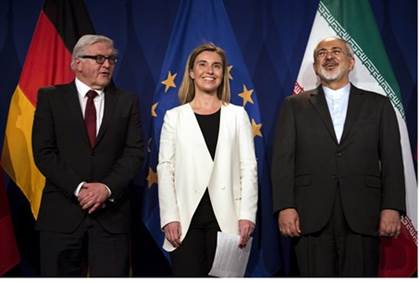
img576072Iranian FM Javad Zarif (R) at press conference announcing nuclear deal Reuters

[M]any countries – most notably Israel’s immediate neighbors – would be supportive of such a strike, and were waiting for Israel to neutralize the threat posed to them by a nuclear-capable Iranian regime.

“In practice no one wants to see a nuclear Iran; all of them are playing the gameso that Israel can pulls the chestnuts out of the fire.

******************

Israel should “seriously consider” a military strike on Iran’s nuclear facilities in the aftermath of the “framework deal” announced between Tehran and western powers Thursday, a leader defense and security expert said.

Speaking to Arutz Sheva Friday, Professor Efraim Inbar, who heads the Begin-Sadat Center for Strategic Studies, said the deal had realized Israel’s worst fears by leaving Iran’s nuclear program essentially intact.

The Islamic Republic’s nuclear program has been granted “legitimacy” by the agreement, which still allowed it to continue enriching uranium and to maintain a reactor capable of producing enriched plutonium, he said. “And that’s what worries Israel, that they (Iran) will be able within a short time frame to reach a nuclear bomb.”

“I hold the view that the only way to stop Iran in its journey to a nuclear bomb is through military means,” Inbar maintained, suggesting that “Israel needs to seriously consider striking a number of important nuclear facilities” to head off the threat.

Inbar went further, stating that Israel had made a serious mistake in not taking out Iran’s nuclear facilities until now. Now that the deal – however bad – was struck, a military strike would be far more difficult, he posited.

Nevertheless, practically-speaking Israel was left with little choice short of accepting a nuclear-armed Iran.

“As long as there was no deal it was easier for Israel to strike. They should have carried out a strike two years ago,” he said. “This is not an easy decision but it’s what needed to be done.”

Despite that fact, many countries – most notably Israel’s immediate neighbors – would be supportive of such a strike, and were waiting for Israel to neutralize the threat posed to them by a nuclear-capable Iranian regime.

“In practice no one wants to see a nuclear Iran; all of them are playing the game so that Israel can pulls the chestnuts out of the fire.

The deal, announced yesterday at a joint conference in Switzerland and widely celebrated as a “victory” in Iran, was quickly lauded by US President Barack Obama as an “historic” agreement.

“I am convinced that if this framework leads to a final comprehensive deal it will make our country, our allies and our world safer,” Obama asserted, insisting that despite criticisms the agreement would effectively cut off any options for Iran to build a nuclear bomb.

But despite Obama’s claim that there was “no daylight” between the US’s commitment to Israel’s security and the framework deal, Israeli officials heavily criticized it as an “historic mistake“.

“If an agreement is reached on the basis of this framework, it is an historic mistake which will make the world far more dangerous,” said the officials, briefing journalists on condition of anonymity.

“It is a bad framework which will lead to a bad and dangerous agreement. The framework gives international legitimacy to Iran’s nuclear program, the only aim of which is to produce a nuclear bomb,” they added.

In Congress as well – where legislators on both sides of the aisle have expressed serious concerns over the pending deal – House Speaker John Boehner branded the agreement “an alarming departure” from the president’s own declared goals. Nevertheless, legislators have given the White House a three-month reprieve on a bill to level harsher sanctions against Iran.

Israeli Prime Minister Binyamin Netanyahu is due to address the deal directly at a press conference Friday, after holding top-level talks withsecurity officials.

Benghazi, Bergdahl, and the Bomb

April 3, 2015

Benghazi, Bergdahl, and the Bomb, Washington Free Beacon, April 3, 2015

Column: President Obama’s stories haven’t held up before. How is the Iran deal any different?

ObamaAP

What the president and Secretary of State John Kerry unveiled Thursday was another fancy, another fairy-tale, another fable about what might happen in an ideal world where enemies and allies share common interests and objectives, autocratic and theocratic regimes adhere to compacts, and moral sincerity is more important than results. Best be skeptical—these so-called triumphs of Obama’s diplomacy have a way of falling to pieces like ancient parchment. And keep in mind this rule: When the president enters the Rose Garden, run for cover.

******************

President Obama strode to the lectern in the Rose Garden Thursday to announce a “historic” agreement between the United States and the Islamic Republic of Iran. The preliminary deal made in Lausanne, Switzerland, the president said, “cuts off every pathway Iran could take to develop a nuclear weapon.” I hope he’s right.

But I’m not counting on it. The president has a terrible record of initial public pronouncements on national security. He has a habit of confidently stating things that turn out not to be true. Three times in the last four years he has appeared in the Rose Garden and made assertions that were later proven to be false. He and his national security team have again and again described a world that does not correspond to reality. No reason to assume these concessions to Iran will be any different.

The U.S. consulate in Benghazi, Libya, was attacked on September 11, 2012. Four Americans were killed, including our ambassador. Obama delivered remarks on the attack in the Rose Garden the following day. “No acts of terror will ever shake the resolve of this great nation,” he said. What he didn’t say was that the killings in Benghazi specifically were a “terrorist attack” or “terrorism.” On 60 Minutes,when asked if he believed Benghazi was a “terrorist attack,” the president replied, “It’s too early to know how this came about.” On September 14, neither the president nor Secretary of State Hillary Clinton called what had happened a terrorist attack. On September 15, Obama referred to Benghazi as a “tragic attack.” On September 16, Susan Rice, then U.N. ambassador, called it a “spontaneous attack.”

By September 24, when Obama recorded a campaign interview with The View, he again refused to say Benghazi was an attack by terrorists. “We’re still doing an investigation,” he told Joy Behar. It was not until two days later that administration officials began referring to Benghazi as a terrorist attack—something the Libyan government had been saying since September 13.

The story originally put out by the White House, that Benghazi was the result of spontaneous anger at an Internet video offensive to Muslim extremists, fell apart in a matter of days. Yet the White House persisted in its false description of reality, declining to confirm what was widely accepted as a premeditated terrorist assault on a U.S. compound, and chose to ascribe responsibility for the events in question to anti-Islamic bias. The evidence continues to mount that Ansar al-Sharia, the Qaeda affiliate in lawless Libya, was behind the events of September 11, 2012, not the stupid video.

In August 2013 President Obama announced in the Rose Garden that Syrian dictator Bashar Assad had crossed the “red line” by gassing his own people. “Now, after careful deliberation, I have decided that the United States should take military action against Syrian regime targets,” the president said. Then he punted the issue to Congress. But no action against Syrian regime targets was ever taken, because the president reversed himself and accepted a Russian proposal to ship Assad’s WMD out of Syria. “This initiative has the potential to remove the threat of chemical weapons without the use of force, particularly because Russia is one of Assad’s strongest allies,” Obama said in a September 10, 2013, televised address. Almost two years later, Assad is dropping barrel bombs filled with chlorine gas on civilians. Success.

Last May, President Obama again walked purposefully to a lectern in the Rose Garden, and informed the world that he had released five Taliban commanders from Guantanamo Bay in exchange for Sergeant Bowe Bergdahl, who had been held prisoner by the Islamic militia for almost half a decade. “Right now,” the president said, “our top priority is making sure that Bowe gets the care and support that he needs and that he can be reunited with his family as soon as possible.”

Criticism of the prisoner swap was immediate, and intensified when Bergdahl’s platoon-mates said he had deserted his post. The White House, as usual, struck back against the critics and repeated its story. On June 2, Susan Rice, now national security adviser, went onThis Week with George Stephanopoulos and said Bergdahl “served the United States with honor and distinction.”

The Government Accountability Office concluded that the Obama administration’s actions were illegal. Bergdahl himself was kept isolated as the Army reviewed the circumstances of his capture by the enemy. Completed in the fall of 2014, the report by Brigadier General Kenneth Dahl still has not been released to the public.

Last week, however, the Army charged Bergdahl with desertion and misbehavior before the enemy. Has the White House reevaluated its trade? Of course not. On the contrary: Pentagon officials suggested on background that Bergdahl wasn’t a deserter, he was a whistleblower!

Three stories that collapsed under the weight of the evidence, three instances of the White House doggedly sticking to its policy line despite everything. This president’s resistance to events in the actual world of space and time is more than ideology, however. It’s also good politics: By refusing to concede the facts of the case, Obama is able to hold his base and stay on offense against his true adversaries: Republicans, conservatives, and Bibi Netanyahu.

And now we have the Iran story. Iran, the president says, will reduce its centrifuges, dilute its enriched uranium, open its nuclear sites to inspectors, and turn its fortified underground reactor into a “research” facility in exchange for sanctions relief. The only alternatives, Obama goes on, are bombing Iran or ending negotiations and re-imposing sanctions. “If, in fact, Prime Minister Netanyahu is looking for the most effective way to ensure Iran doesn’t get a nuclear weapon, this is the best option. And I believe our nuclear experts can confirm that.”

Sure they can. Though I believe other nuclear experts, such as Charles Duelfer, can also confirm that this agreement has major holes, such as the spotty effectiveness of inspections and the failure to get Iran to disclose fully the possible military dimensions of its nuclear program. And there’s always the tricky issue of sanctions relief: The United States says the process of lifting sanctions will be gradual and contingent on Iranian compliance, but Iranian foreign minister Javad Zarif says it will be immediate.

What the president and Secretary of State John Kerry unveiled Thursday was another fancy, another fairy-tale, another fable about what might happen in an ideal world where enemies and allies share common interests and objectives, autocratic and theocratic regimes adhere to compacts, and moral sincerity is more important than results. Best be skeptical—these so-called triumphs of Obama’s diplomacy have a way of falling to pieces like ancient parchment. And keep in mind this rule: When the president enters the Rose Garden, run for cover.

A “preliminary deal” is announced in Lausanne. Zarif: There is no agreement, no commitments

April 2, 2015

A “preliminary deal” is announced in Lausanne. Zarif: There is no agreement, no commitments, DEBKAfile, April 2, 2015

Obama nuke dealBarack Obama hails nuclear “agreement”

Iranian Foreign Minister Mohammed Javad Zarif and EU Foreign Policy Executive Federica Mogherini announced Thursday, April 2 that “a general agreement for a peaceful nuclear program and a lifting of sanctions against Iran” had been reached in Lausanne. “We have reached solutions on key parameters of a join comprehensive plan of action,” the details to be negotiated between now and June 30,” she said.

Speaking after the EU official, Zarif delivered a long statement ending with the declaration: “There is no agreement; and so no commitments” before June 30.

But President Barack Obama, commenting on the event at the White House, hailed the agreement as a historic event that will change the face of the world and make it a safer place.  “It is a deal that meets our core objectives.” There is no way Iran can get round it to build a bomb, or produce plutonium at its Arak plant. Obama stressed that the verification mechanisms built into the agreed framework would ensure that “if Iran cheats, the world with know it.”

This is a long-term agreement which promises that Iran’s nuclear program will be closely monitoried for the next 20 years. There is much work to be done to hammer out the details before June 30, Obama said, and voiced the hope that the Iranians would not back out of the principles they had accepted in Lausanne.

In the his view, there were just three options for dealing with the Iranian nuclear program: Military force that would hold the program back for no more than two years; more sanctions, when the first round had proved to have little impact; or diplomacy, which he had chosen.

Obama said hoped the US Congress would not heap obstacles in the path of an accord, because the majority of the American popular approved of the course he led.

Before the end of the day, the president said he would talk to Israeli Prime Minister Binyamin Netanyahu and Saudi King Salman, the two leading opponents of the nuclear deal.

The parameters outlined by Mogherini agreed for future negotiation:

• Iran’s enrichment capacity and stockpile would be limited, and Iran’s sole enrichment facility would be at the Natanz nuclear facility. Other nuclear facilities would be converted to other uses.

• The nuclear facility at Fordo would be converted to a nuclear physics and technology center and the facility at Arak would be redesigned as a heavy-water research reactor that will not produce weapons-grade plutonium.

• The European Union would terminate all nuclear-related economic and financial sanctions against Iran, and the United States would do the same once Iran’s implementation of the agreement is confirmed.

• The United Nations would terminate all previous resolutions sanctioning Iran, and would incorporate other restrictions for an agreed-upon period.

The Shadow of Munich Haunts the Iran Negotiations

April 2, 2015

The Shadow of Munich Haunts the Iran Negotiations, National Review Online, Victor Davis Hanson, April 2, 2015

(Hitler did tell the truth occasionally, in Mein Kampf for example. It was generally ignored until too late. “Death to America and Israel” are spouted by the Iranian Supreme Leader at every opportunity. Obama, et al, ignore it. Will Israel be Obama’s Czechoslovakia? And then what?– DM)

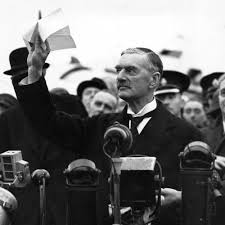
Neville Chamberlain

Our dishonor in Lausanne, as with Munich, may avoid a confrontation in the present, but our shame will guarantee a war in the near future.

*********************

Once again our leaders are needlessly appeasing a hostile state that shows them nothing but contempt.

The Western capitulation to Adolf Hitler in the 1938 Munich Agreement is cited as classic appeasement that destroyed Czechoslovakia, backfired on France and Britain, and led to World War II. All of that is true.

But there was much more that caused the Munich debacle than simple Western naiveté. The full tragedy of that ill-fated agreement should warn us on the eve of the Obama’s administration’s gullible agreement with Iran on nuclear proliferation. Fable one is the idea that most people saw right through the Munich folly. True, Europeans knew that Hitler had never once told the truth and was already murdering German citizens who were Jews, Communists, or homosexuals. But Europeans did not care all that much.

Instead, the Western world was ecstatic over the agreement. After the carnage of World War I, Europeans would do anything to avoid even a small confrontation — even if such appeasement all but ensured a far greater bloodbath than the one that began in 1914.

Another myth was that Hitler’s Wehrmacht was strong and the democracies were weak. In fact, the combined French and British militaries were far larger than Hitler’s. French Char tanks and British Spitfire fighters were as good as, or superior to, their German counterparts.

Czechoslovakia had formidable defenses and an impressive arms industry. Poland and perhaps even the Soviet Union were ready to join a coalition to stop Hitler from dissolving the Czech state.

It is also untrue that the Third Reich was united. Many of Hitler’s top generals did not want war. Yet each time Hitler successfully called the Allies’ bluff — in the Rhineland or with the annexation of Austria — the credibility of his doubters sank while his own reckless risk-taking became even more popular.

Munich was hardly a compassionate agreement. In callous fashion it immediately doomed millions of Czechs and put Poland on the target list of the Third Reich.

Munich was directly tied to the vanity of Neville Chamberlain. In the first few weeks after Munich, Chamberlain basked in adulation, posing as the humane savior of Western civilization. In contrast, loud skeptic Winston Churchill was dismissed by the media and public as an old warmonger.

Hitler failed to appreciate the magnanimity and concessions of the French and British. He later called his Munich diplomatic partners “worms.” Hitler said of the obsequious Chamberlain, “I’ll kick him downstairs and jump on his stomach in front of the photographers.”

The current negotiations with the Iranians in Lausanne, Switzerland, have all the hallmarks of the Munich negotiations.

Most Westerners accept that the Iranian government funds terrorist groups such as Hezbollah and Hamas. It has all but taken over Iraq, Lebanon, Syria, and Yemen. Yet the idea of stronger sanctions, blockades, or even force to stop Iranian efforts to get a bomb are considered scarier than Iran getting a bomb that it just possibly might not threaten to use.

The U.S. and its NATO partners are far stronger than Iran in every imaginable measure of military and economic strength. The Iranian economy is struggling, its government is corrupt, and its conventional military is obsolete. Iran’s only chance of gaining strength is to show both its own population and the world at large that stronger Western powers backed down in fear of its threats and recklessness.

Iran is not united. It is a mishmash nation in which over a third of the population is not Persian. Millions of protestors hit the streets in 2009. An Iranian journalist covering the talks defected in Switzerland — and said that U.S. officials at the talks are there mainly to speak on behalf of Iran.

By reaching an agreement with Iran, John Kerry and Barack Obama hope to salvage some sort of legacy — in the vain fashion of Chamberlain — out of a heretofore failed foreign policy.

There are more Munich parallels. The Iranian agreement will force rich Sunni nations to get their own bombs to ensure a nuclear Middle East standoff. A deal with Iran shows callous disagreed for our close ally Israel, which is serially threatened by Iran’s mullahs. The United States is distant from Iran. But our allies in the Middle East and Europe are within its missile range.

Supporters of the Obama administration deride skeptics such as Democratic senator Robert Menendez and Israeli prime minister Benjamin Netanyahu as if they were doubting old Churchills.

Finally, the Iranians, like Hitler, have only contempt for the administration that has treated them so fawningly. During the negotiations in Switzerland, the Iranians blew up a mock U.S. aircraft carrier. Their supreme leader, Ayatollah Khamenei, did his usual “death to America” shtick before adoring crowds. Our dishonor in Lausanne, as with Munich, may avoid a confrontation in the present, but our shame will guarantee a war in the near future.

Victory Against ISIS in Tikrit Will Embolden Iran

April 2, 2015

Victory Against ISIS in Tikrit Will Embolden Iran, Front Page Magazine, April 2, 2015

370x270xtikrit-450x328.png.pagespeed.ic.9xBCkeIFLH

The downside to playing on the same team as the Iranian regime, even in just this one military campaign against ISIS, is that we are helping to enable a far more dangerous power than ISIS to extend its hegemonic dominance throughout the entire region.

****************

Iraq’s defense minister Khalid al-Obeidi is claiming victory over ISIS forces in the city of Tikrit, which ISIS had captured last summer as its forces advanced across large swaths of territory in northern and western Iraq. “We have the pleasure, with all our pride, to announce the good news of a magnificent victory,” Obeidi said. The Pentagon and a spokesman for the U.S.-led coalition were a bit more cautious, noting some residual ISIS resistance. However, they too reported that significant progress had been made in wresting control of Saddam Hussein’s birthplace from ISIS’s grip.

The next strategic military objective in pushing ISIS back from the territories it controls in Iraq is to re-take Iraq’s second largest city, Mosul.

Iran supplied significant military support to the Shiite militia forces, who were a major part of the Iraqi counter-offensive on the ground. At the same time, U.S. air strikes seemed to have helped in supporting the Iraqi ground forces’ advance into Tikrit. The precise extent of any behind-the-scenes direct or indirect coordination between the U.S. and Iran is unknown at the present time. However, according to DebkaFile {March 26, 2015), “In the last two weeks of the Tikrit operation, liaison between the US and Iranian military in Iraq was routed through the office of the Iraqi Prime Minister in Baghdad.”

There is little question that without the Iranian-backed Shiite militia and substantial military support on the ground from Iran, ISIS would most likely still be in control of Tikrit today. U.S. airstrikes may have been necessary to soften ISIS’s resistance, but only ground troops with Iran’s support could dislodge them.

The downside to playing on the same team as the Iranian regime, even in just this one military campaign against ISIS, is that we are helping to enable a far more dangerous power than ISIS to extend its hegemonic dominance throughout the entire region.

As General David Petraeus, who certainly knows something about Iraq, told the Washington Post recently:

In fact, I would argue that the foremost threat to Iraq’s long-term stability and the broader regional equilibrium is not the Islamic State; rather, it is Shiite militias, many backed by — and some guided by — Iran… Longer term, Iranian-backed Shia militia could emerge as the preeminent power in the country, one that is outside the control of the government and instead answerable to Tehran.

Without downplaying ISIS’s horrific acts, its rapid-fire successes in Syria and Iraq (even with the setback in Tikrit), and its growing allegiances in Libya, Nigeria and areas further away from its home base including Afghanistan, the fact is that ISIS’s ambitions far exceed its current means for achieving them.  ISIS is proficient in using social media for recruitment, propaganda and intimidation purposes, but that can only take ISIS so far.

Iran, by contrast, has built up its military capabilities to the point that it can back up its aggressive threats in the region. And that’s even without the nuclear arms capability that President Obama seems to be willing to risk allowing Iran to achieve in order to secure his legacy with a deal.

As a result, America’s traditional Sunni allies in the region such as Saudi Arabia and other Persian Gulf states are doubting whether they can continue to count on the United States for support. And they are taking matters into their own hands, including a decision to form a multinational Arab military force to respond to Iranian aggression and other perceived threats.

As explained by Gamal Abdel Gawad Soltan, a political scientist at the American University in Cairo and quoted by the New York Times: “The U.S. is much less trusted as an ally, as an insurance policy towards the security threats facing the governments in the region, and so those governments decide to act on their own.”

These governments know their neighborhood well and see Iran as a much graver threat to regional peace and security than ISIS. Iran’s military and financial support of the Shiite Houthi rebels in taking control of major parts of Yemen was the last straw. Saudi Arabia on its own initiative decided to launch an air campaign against Houthi positions in Yemen and has not ruled out a ground attack along with the military forces of other Arab countries.

In response to the air and sea blockade of Yemen that Saudi Arabia is imposing on Yemen, Iran’s supreme leader Ayatollah Ali Khamenei decided to dispatch “two naval task forces to sail to the Red Sea,” according to DebkaFile (March 31, 2015). “The naval task forces are being sent to draw a sea shield around the Houthi forces to defend them against Saudi-Egyptian assaults. This maneuver was orchestrated by the Al Qods Brigades chief Gen. Qassem Soleimani,” DebkaFile reported.

Soleimani certainly gets around. Earlier this month he popped up in Iraq to lead the Shiite militias in their fight against ISIS. Now the man who fought on the same side as us against ISIS in Iraq is apparently coordinating Iran’s fight to hold onto the Houthis’ gains in Yemen where they forced the American and Saudi Arabian-backed president to flee.

Soleimani is “the puppet master controlling numerous Iranian surrogates in various countries,” said Jim Phillips, Middle East analyst for the Heritage Foundation. “His organization is drenched in American blood,” Phillips added. “It’s infused with an anti-American philosophy and a cooperation with him or his followers would not be on a sustainable basis. The U.S. would regret it.”

The Obama administration is now scrambling to catch up with Iran’s multi-pronged offensives, some of which are under Soleimani’s coordination. Thus, President Obama decided to support the Sunni Gulf coalition and Egypt against Iranian-backed action by the Shiite Houthi rebels to take control of Yemen.

However, the Obama administration’s reactive tactics in dealing with the crisis in Yemen are too little too late. Saudi Arabia is reportedly looking to Pakistan for help in acquiring its own nuclear arms to counter the Saudis’ well-founded suspicions that any deal negotiated by the Obama administration with Iran will not prevent Iran from becoming a nuclear armed power. And while Obama finally lifted the arms freeze he imposed against Egypt two years ago, clearing the way for the delivery of F-16 aircraft, Harpoon missiles and tanks, he also decided to end Egypt’s ability to finance purchases of American arms by drawing credits in advance based on future aid Egypt expects to receive starting in the 2018 fiscal year. Obama also wants to reduce Egypt’s flexibility in what it can purchase with the future military aid. Thus, the Egyptian government can be expected to continue on its course to find other sources for military aid and weapons including Russia, because of doubts that the U.S. will remain a reliable supplier.

The Obama administration has been willing to sacrifice the confidence of its Arab allies, not to mention the United States’ historically close alliance with Israel, in a vain effort to lure the Iranian regime into acting as a responsible party in the Middle East that can help stabilize this volatile region. Instead, Obama should listen to the expert on Iraq, General Petraeus, whose surge victory Obama undermined completely with his precipitous withdrawal of all U.S. troops from Iraq in 2011:

The current Iranian regime is not our ally in the Middle East. It is ultimately part of the problem, not the solution. The more the Iranians are seen to be dominating the region, the more it is going to inflame Sunni radicalism and fuel the rise of groups like the Islamic State…Iranian power in the Middle East is thus a double problem. It is foremost problematic because it is deeply hostile to us and our friends. But it is also dangerous because, the more it is felt, the more it sets off reactions that are also harmful to our interests — Sunni radicalism and, if we aren’t careful, the prospect of nuclear proliferation as well.

We can rejoice in the pushback of ISIS out of Tikrit. Perhaps it is a sign of more victories over ISIS to come. However, we should not delude ourselves into thinking that we have more in common with the Iranian regime in combatting ISIS in Iraq or Syria than the Iranian regime ultimately has in common with ISIS. They may be bitter enemies in the struggle over which set of fanatical jihadists should get to rule the global Islamic ummah or caliphate they both fantasize about. However, both fervently believe in the fundamental ideological goal of universal Islamic supremacy. And both are willing to sacrifice the lives of millions of people to reach that goal, no matter how long it takes them. The difference is that a nuclear-armed Iran would be much more capable of carrying out its jihadists’ apocalyptic vision than ISIS and in a much shorter period of time.

Humor? Obama abducted by aliens

April 1, 2015

Obama abducted by aliens, Dan Miller’s Blog, April 1, 2015

(The views expressed in this article are not necessarily mine or those of Warsclerotic or its other editors. — DM)

Today, April fool’s day first, Obama was abducted by aliens from Venus who were concerned about His warlike stance toward the peaceful Islamic Republic of Iran.

Venus

Organizing for Action logo 1

Mars is the god of war, Venus is the goddess of peace. Aliens from Mars had been slightly disturbed that Obama’s efforts to give Iran nuclear weapons might fail, but had seen that her status as a nuclear power was inevitable and hence did nothing. Aliens from Venus were equally pleased with the prospects of Iranian nuclear weapons but were very concerned that Obama, by failing adequately to praise Iranian attempts to extend its hegemony over the entire Middle East and beyond, had retarded those praiseworthy efforts on behalf of true Islamic peace. Hence, they secretly abducted Him this morning as He deplaned from Air Force One following an off-the-books trip to His spiritual birth place in Manchuria.

Since Obama’s abduction and remedial training required only a few minutes He was not missed, even by His dear soul mate, Valerie Jarrett. Ms. Jarrett was, therefore, pleasantly surprised when Obama called a press conference in the Rose Garden to make an announcement, following a splendid rendition of Hail to the Chief:


Fellow world citizens, I have finally awakened from my slumbers to realize that Iran is the only country in the world capable of bringing true peace through submission in accord with the word of Allah, may His Holy name be forever praised by all. Israel claims to desire peace, but only through war. Saudi Arabia, Egypt, Jordan and other misbegotten specs of excrement on the face of our dear planet — now in peril of imminent death due to climate change to which their vile oil has contributed massively — have dared even to challenge Iran’s peaceful pursuits of peace throughout the Middle East in Iraq, Syria, Yemen and elsewhere.

Henceforth, it will be My supreme duty as your Commander in Chief to promote and otherwise to assist Iran in her glorious efforts for peace. I know in my heart that that’s the principal reason that you, My people, elected Me as your very own Supreme Leader. Accordingly, I pledge that My efforts will be unstintingly directed to the end that you desire.

May Allah bless Iran, Damn America, Israel and all other enemies of true peace, and give a blessed day to you all, inshallah.

Iran’s leaders, due to their extensive relations with the aliens who had abducted Obama, were not at all surprised but pretended that they were. Supreme Leader Khamenei personally accepted Supreme Leader Obama’s gracious words by saying that Obama had finally managed to tame the Great Satan and promised to do everything within his power to help, inshallah. He also commented favorably on Secretary Kerry’s use of “inshallah” in rebutting suggestions by defeatists that the P5+1 negotiations would collapse without giving Iran nuclear weapons.

Kerry34

Even those who had previously viewed Obama as weak and indecisive will now be forced to see Him as He truly is, a towering beacon of strength and light to a world beset with tribulation, turmoil and darkness.  His legacy as the Greatest Peace Maker, Ever, is assured, inshallah.

Smoking pot is lots better than making war!

Smoke ganja. War is for sissies!

Let’s hope it’s just April Fool’s Day nonsense.

Satrapy fishing in the Yemen

April 1, 2015

Satrapy fishing in the Yemen, Israel Hayom, Clifford D. May, April 1, 2015

Bab_el-Mandeb_strait_31.3.15

Three years ago, film-goers were treated to “Salmon Fishing in the Yemen,” which critic Kenneth Turan called a “pleasant fantasy” about the Middle East. Today, of course, Yemen is the hub of a bloody conflict, one which U.S. President Barack Obama persists in viewing with equal unreality.

Most obviously: Yemen is not, as the administration has touted, a “success” brought about by its “smart diplomacy.” Most importantly: Iran has a plan. Yemen is a vital component.

Prime Minister Benjamin Netanyahu sees that. So does Saudi King Salman (and no, I will not dwell on the pun). His foreign minister, Saud al-Faisal, last week called Iran “an aggressive state that is intervening and operating forces in the Arab world.” Iran’s nuclear weapons program, he added, represents “a threat to the Gulf and the entire world.”

A quick tour of the neighborhood: Much of Syria is already an Iranian satrapy. Hezbollah, Iran’s terrorist foreign legion, is the most powerful force in Lebanon. Iranian military advisors and Iranian-backed Shia militias increasingly call the shots in Iraq. And now Iran is aggressively supporting the Houthi rebels in Yemen.

Over the weekend, a Houthi spokesman directly threatened the Saudis. “When we decide to invade,” he said, “we won’t stop in the city of Mecca, but will continue on to Riyadh to topple the government institutions.” While that invasion may not be imminent, Iran’s strategy and objectives are now apparent.

Iran has begun what Netanyahu called a “pincer movement.” To the east of Saudi Arabia is the Persian Gulf, in and around which is the world’s largest repository of known oil and gas reserves — vital to the international economy. The Gulf’s only outlet to open waters is the 24-mile-wide Strait of Hormuz. More than a third of the petroleum traded by sea passes through this strait which Iran’s rulers have for years referred to as their “territorial waters.” On a number of occasions, U.S. ships in the strait have been harassed by Iranian vessels.

To the west of Saudi Arabia is the Red Sea. Iranian domination of Yemen would mean control of Bab-el-Mandeb, the “Gateway of Tears.” This 20-mile-wide strait separates Yemen and the Arabian Peninsula from Djibouti and Africa. Whoever controls Bab-el-Mandeb also controls marine traffic in and out of the Red Sea which has, at its northern end, Egypt’s Suez Canal.

Control of these two waterways would give Iran an economic choke hold on Europe and Asia. With Iraq, Syria, Lebanon and Yemen already under Iranian domination, other Arab nations would soon come under severe pressure to accept the suzerainty — and perhaps the hegemony — of what could legitimately be called a new Persian empire.

What about al-Qaida and the Islamic State group? The Arab nations might decide their interests are best served by supporting them (beyond the clandestine support that may have been provided in the past) so long as they continue to fight against, rather than collaborate with, Iranian imperialism. Even so, Iran’s rulers are doubtless confident that, over time, they will defeat their Sunni jihadi rivals — with Americans continuing to assist the effort.

It’s an ambitious plan. Nothing would do more to bolster it than for America and Europe to lift economic sanctions and end their opposition to Iran’s nuclear weapons program. That appears to be where the delayed and drawn-out talks are heading.

Consider: On November 24, 2013, when negotiations with Iran produced a Joint Plan of Action, Obama announced: “We have halted the progress of the Iranian nuclear program.” The interim agreement, Secretary of State John Kerry added, will ensure that Iran “cannot build a nuclear weapon.”

Last week, however, Kerry implicitly acknowledged how wrong that earlier appraisal has been. “So this is not a choice, as some think it is, between the Iran of long ago and the Iran of today,” he said. “It’s not a choice between this moment and getting them to give up their entire nuclear program, as some think. It’s not going to happen.”

Over the weekend, Amir Hossein Motaghi, an Iranian public relations aide, defected to the West. According to the Telegraph (U.K.), he revealed that American diplomats have been carrying Iran’s water. “The U.S. negotiating team are mainly there to speak on Iran’s behalf with other members of the 5+1 countries and convince them of a deal,” he said in an interview.

Summing up the current state of affairs, Lt. Gen. Michael Flynn, former chief of the Defense Intelligence Agency — a position from which he was forced to resign in 2014 because his analyses contradicted the Obama administration’s rosy narratives — told Fox’s Chris Wallace that “Iran is clearly on the march,” in response to which the White House has adopted a policy of “willful ignorance,” and that the only way to limit the damage now is to “stop all engines on this nuclear deal.”

It is unlikely that Obama and his envoys will give up their pleasant fantasies about the Islamic Republic of Iran. On the contrary, “smart diplomacy” may soon include awarding both economic and nuclear weapons to jihadi revolutionaries vowing to annihilate America’s allies and, in time, bring “Death to America!” as well. So if Iran’s supreme leader does become a 21st century emperor, he’ll have the United States to thank — and may do so in creative ways.

Those members of Congress who see this situation clearly need to speak out loudly and push back powerfully. That’s harder for Democrats than for Republicans — I get that. But if they can’t do their jobs now, they might just as well go fishing.

Why Allying With Iran Helps ISIS

March 31, 2015

Why Allying With Iran Helps ISIS, Front Page Magazine, Daniel Greenfield, March 31, 2015

287x203xIslamic_State_IS_insurgents_Anbar_Province_Iraq1.jpg.pagespeed.ic.-peTL_37oH

The Jihad is a machine for generating atrocities.

A new horror is deployed. Then it becomes routine. The horror of one decade, such as suicide bombing, has to be made dirtier and uglier by using women and children, by targeting houses of worship and families, and then finally superseded by the horror of another decade, mass beheadings.

Terrorism is a shock tactic. It only works if you’re horrified by it. If you get bored of ISIS beheading its victims, it will bring out child beheaders. It will set men on fire. Then it will have children set men on fire.

Like an acrobat juggling at a telethon, it’s always looking for ways to top its last trick.

In a crowded market, each Jihadist group has to be ambitious about its atrocities. No matter what horrifying thing an Islamic group did last year or last decade, another group will find a way to top it.

The old group will become the lesser evil. The new group will become the greater evil.

“If Hitler invaded Hell,” Churchill said of the Nazi invasion of the USSR, “I would at least make a favourable reference to the Devil in the House of Commons.”

There are a lot of favorable references to the Jihadist devil in Foggy Bottom where the terrible terror groups of yesteryear turn out to be misunderstood moderates who can help us fight this year’s devil. Obama’s Countering Violent Extremism program is tweeting Al Qaeda criticisms of ISIS. Iran and its Hezbollah terrorists no longer show up on the list of terror threats. Instead they’re our new allies.

When Western governments embrace the “lesser evil” doctrine, they ally with terrorists who are not fundamentally any different than the terrorists they are fighting. When ISIS broke through into the media, multiple stories emphasized that it was more extreme than Al Qaeda (despite having once identified as Al Qaeda.) But is a terrorist group that flies planes full of civilians into buildings full of civilians more moderate than a sister group that chops off heads on television? Is ISIS’s sex slavery more extreme than Iran’s practice of raping girls sentenced to death so that they don’t die as virgins?

The distinction between one evil and another is insignificant compared to their overall evil. The search for the lesser evil is really a search for ways to exonerate evil.

The Jihad creates endless greater evils. Today’s greater evil is tomorrow’s lesser evil. If another Jihadist group rises out of Syria that commits worse atrocities than ISIS, will we start thinking of the Islamic State’s rapists and headchoppers as moderates? The behavior of our diplomats suggests that we will.

Experts used the rise of ISIS to urge us to build ties with everyone from Hamas to Hezbollah to the Taliban to head off ISIS in their territories. The new president of Afghanistan is proposing apologies to the Taliban while defining ISIS as beyond the pale. Obama has chosen to turn over Iraq and Syria to Iran and its terrorist groups to fight ISIS.

If the process continues, then the United States will end up allying with terrorist groups to fight ISIS. And all this will accomplish is to make ISIS stronger while morally corrupting and discrediting our own fight against Islamic terrorism.

And if ISIS loses, there will always be a Super-ISIS that will be even worse.

We had few options in WW2, but ISIS is not the Wermacht. We don’t need to frantically scramble to ally with anyone against it; especially when the distinctions between it and our newfound allies are vague.

The Syrian opposition, that we armed and almost fought a war for, consists of Jihadists, many of them allied with Al Qaeda. But the Syrian government which we are now allied with, turned the Iraq War into a nightmare by funneling the suicide bombers across the border that ISIS used to kill American soldiers.

ISIS may be officially at war with the Syrian government, but it’s also selling oil to it, and there have been accusations that there is a secret understanding between Assad and ISIS.

How unlikely is that? Almost as unlikely as a Hitler-Stalin pact.

The Communists and the Nazis were tactically intertwined, despite their official ideological enmities, because they shared many of the same enemies (moderate governments, the rest of Europe) and many of the same goals (seizing territory, radicalizing populations, shattering the European order).

Iran and Sunni terrorist groups, including Al Qaeda, cooperate based on similar premises. That was why Al Qaeda could pick up terror tips from Iranian terror groups to prep for September 11. Both Sunni and Shiite Islamic revolutionaries want to topple governments, conquer territory and radicalize populations. Despite their mutual enmity, they share bigger enemies, like America, and bigger goals, destroying the current map of the Middle East and remaking it along completely different lines.

The collapse of the Iraqi military that led to ISIS marching on Baghdad was caused by its Shiite officer corps inserted into place by a sectarian Shiite government. That government was not interested in maintaining the American fantasy of a multicultural democratic Iraq. It wanted to crush the Sunnis and Kurds through a partnership with Iran. The collapse of the Iraqi military endangered its survival, but fulfilled its overall goal of driving recruitment to Shiite militias in Iraq trained and commanded by Iran.

Obama’s avoidance of Iraqi entanglements and panic at the ISIS juggernaut led him to a deal with Iran. The deal effectively gives control of Iraq to its Shiite proxies. The sheiks of the Sunni Awakening were ignored when they came to Washington. The Kurds have trouble getting weapons. Instead they’re going to the Shiite militias. By using ISIS to create a crisis, Iraq’s Shiite leaders forced a US deal with Iran.

ISIS has killed a lot of Shiites, but for Iran taking over Iraq is a small price to pay for losing the pesky ‘not really Shiite’ Alawites of Syria. And it hasn’t actually lost them yet.

Iran’s ideal situation would be an ISIS Caliphate spread across parts of Syria and Iraq that would destabilize the Sunni sphere. Like the Hitler-Stalin pact, such an arrangement could end with the ISIS Hitler stabbing the Iranian Stalin in the back, but ISIS does not actually need to defeat Assad. It is not a nationalist group and doesn’t believe in nations. Its focus is on ruling Sunni territories.

Sunni nations have far more to worry about from ISIS than Iran does. Its advance challenges the bonds that hold their nations together. Its goal is the destruction of the Sunni countries and kingdoms.

That is also Iran’s goal.

Both the USSR and Nazi Germany described Poland as an illegitimate child of Versailles. Iran and the Sunni Islamists likewise view the countries of the Middle East as illegitimate children of Sykes-Picot with Israel standing in for Poland as the infuriating “foreign-created” entity ruled by a “subject” people.

ISIS and Iran want to tear down those old borders and replace them with different allegiances. The USSR and the Nazis elevated ideology and race over the nation state. Iran and ISIS elevate the Islamic religion over the nation state. It’s an appeal that can destroy the Sunni nations that block Iran’s path to power.

The trouble with the “lesser evil” doctrine is that the lesser evil is often allied with the greater evil. Hitler used Stalin to cut off any hope of support for Eastern Europe. Stalin then used Hitler to conquer Eastern Europe. While huge numbers of Russians died, Stalin got what he wanted. And that’s all he cared about.

Shiites are dying, but Iran is getting what it wants from ISIS.

Before we start saying favorable things about the devil, we might want to think about the hell we’re getting into.

Iran, North Korea, nukes and Obama

March 30, 2015

Iran, North Korea, nukes and Obama, Dan Miller’s Blog, March 30, 2015

(The views expressed in this article are mine and do not necessarily reflect those of Warsclerotic or its other editors. — DM)

North Korea has ample nukes and wants money. Iran wants (and may already have) nukes, has money and will have more as sanctions are ended. The two rogue nations have long had a symbiotic relationship and it has not diminished. Yet “our” P5+1 negotiators, under the leadership of Obama’s minions, ignore that inconvenient problem as well as Iran’s missile development, “possible” nuclear weaponization and increasing regional hegemony.

I wrote about the Iran – North Korea connection back in 2013 in articles titled China, Iran and North Korea — a radioactive stew,  Iran, North Korea and Nuke Negotiations and elsewhere. As I noted in the radioactive stew article,

The main thing that puzzles me is why we continue to focus on Iran’s uranium enrichment. Is Iran (again) playing us for suckers? North Korea is fully capable of enriching uranium for Iran (or for anyone else) and would doubtless be happy to enrich as much as may be desired in exchange for the hard currency freely available to Iran if it were only to cease its own enrichment. North Korea needs the money and is not likely very particular about its sources. Just as our sanctions have not impacted Iran’s enrichment capabilities significantly, neither have they impacted those of North Korea. Perhaps we may awaken before it’s too late and notice Iran playing its Korean hole card in our high-stakes poker game.

We have not awakened and the problem has worsened since 2013.

Soure: American in North Korea

Soure: American in North Korea

In 2014, I summarized several earlier articles in one titled The Iran scam continues. There, I pointed out that the English language version of the interim P5+1 deal and the White House summary generally ignore “undisclosed” — but known — Iranian sites for missile and warhead development and the work done there– despite warnings from the International Atomic Energy Agency. I also noted the Iran – North Korea nexus. Again, the situation has become worse since then. As the magic date of March  31, 2015 arrives, Iran is still demanding – and likely will get — more and more concessions.

“The Iranians are again outplaying the Americans,” said one source in Europe familiar with the negotiations. “They know they’ll have to give up certain things eventually. So they’re digging in their heels on issues that mean everything and preparing to give ground on relatively minor issues—but not yet, and not until they see how much more the Americans are willing to give.” [Emphasis added.]

. . . .

“Iran has successfully dragged the administration toward their positions to attain massive concessions, and, sensing that kind of weakness, they are seeking to press their advantage to gain further ground on critical points,” according to the source, who added that on the sanctions relief front, Iran is seeking a rollback “without dismantling anything.” [Emphasis added.]

a1  Obama and Kahameni -building a toaster

What might Iran be willing to give up in order to get additional important concessions? How about stuff that North Korea will be pleased to do in exchange for a share of the extra funds Iran will have as sanctions are eliminated?

Occasionally but not often, news media raise the Iran – North Korea connection. For example, a March 29th article at the Washington Post by Ali Alfoneh and Reuel Marc Gerecht is titled What else is Iran hiding? Another article at the Daily Beast by Gordon G. Chang is titled Does Iran Have Secret Nukes in North Korea?

As noted in the Washington Post article,

The unfinished North Korean-designed reactor that was destroyed by Israeli planes on Sept. 6, 2007, at Deir al-Zour in Syria was in all likelihood an Iranian project, perhaps one meant to serve as a backup site for Iran’s own nuclear plants. We draw this conclusion because of the timing and the close connection between the two regimes: Deir al-Zour was started around the time Iran’s nuclear facilities were disclosed by an Iranian opposition group in 2002, and the relationship between Shiite-ruled Syria and Shiite Iran has been exceptionally tight since Bashar al-Assad came to power in 2000. We also know — because Ali Akbar Hashemi Rafsanjani, the former Iranian president and majordomo of the political clergy, proudly tells us in his multivolume autobiography — that sensitive Iranian-North Korean military cooperation began in 1989. Rafsanjani’s commentary leaves little doubt that the Iranian-North Korean nexus revolved around two items: ballistic missiles and nuclear-weapons technology. [Emphasis added.]

. . . .

The Iranian-North Korean contacts intensify in 1992, the year that Rafsanjani, with Rouhani at his side, launches a policy of commercial engagement with the Europeans. On Jan. 30, Rafsanjani receives intelligence minister Ali Fallahian and Mostafa Pourmohammadi, the ministry’s director of foreign espionage, to discuss “procurement channels for sensitive commodities.” On Feb. 8, Rafsanjani writes, “The North Koreans want oil, but have nothing to give in return but the special commodity. We, too, are inclined to solve their problem.” Rafsanjani orders defense minister Akbar Torkan to organize a task force to analyze the risks and benefits of receiving the “special commodity.” This task force recommends that the president accept the “risk of procuring the commodities in question.” Rafsanjani adds that “I discussed [this] with the Leader [Ayatollah Ali Khamenei] in more general terms and it was decided to take action based on the [task force’s] review.” [Emphasis added.]

It’s most unlikely that the “special commodity” and the technical know-how surrounding it have anything to do with ballistic missiles; Rafsanjani expresses anxiety that the “special commodity” could be intercepted by the United States, but doesn’t share this worry about missile procurement. In a March 9, 1992, journal entry, the cleric gloats about the U.S. Navy having tracked a North Korean ship bound for Syria but not two ships destined for Iran. Two days later, when the “special commodity” is unloaded, he writes: “The Americans were really embarrassed.” [Emphasis added.]

. . . .

Odds are good that North Korea helped to jump-start Iran’s nuclear-weapons program. If so, how long did this nefarious partnership continue?

Rouhani was Rafsanjani’s alter ego. He’s undoubtedly the right man to answer all of the PMD questions that the IAEA keeps asking and the Obama administration keeps avoiding. [Emphasis added.]

As noted at the Daily Beast article,

In October 2012, Iran began stationing personnel at a military base in North Korea, in a mountainous area close to the Chinese border. The Iranians, from the Ministry of Defense and associated firms, reportedly are working on both missiles and nuclear weapons. Ahmed Vahidi, Tehran’s minister of defense at the time, denied sending people to the North, but the unconfirmed dispatches make sense in light of the two states announcing a technical cooperation pact the preceding month.

. . . .

[N]o inspections of Iranian sites will solve a fundamental issue: As can be seen from the North Korean base housing Tehran’s weapons specialists, Iran is only one part of a nuclear weapons effort spanning the Asian continent. North Korea, now the world’s proliferation superstar, is a participant. China, once the mastermind, may still be a co-conspirator. Inspections inside the borders of Iran, therefore, will not give the international community the assurance it needs.

The cross-border nuclear trade is substantial enough to be called a “program.” Larry Niksch of the Center for Strategic and International Studies in Washington, D.C., estimates that the North’s proceeds from this trade with Iran are “between $1.5 billion and $2.0 billion annually.” A portion of this amount is related to missiles and miscellaneous items, the rest derived from building Tehran’s nuclear capabilities. [Emphasis added.]

Iran has bought a lot with its money. Mohsen Fakhrizadeh, thought to be Tehran’s chief nuclear scientist, was almost certainly in North Korea at Punggye-ri in February 2013 to witness Pyongyang’s third atomic test. Reports put Iranian technicians on hand at the site for the first two detonations as well.

The North Koreans have also sold Iran material for bomb cores, perhaps even weapons-grade uranium. The Telegraph reported that in 2002 a barrel of North Korean uranium cracked open and contaminated the tarmac of the new Tehran airport.

. . . .

Even if Iran today were to agree to adhere to the Additional Protocol, it could still continue developing its bomb in North Korea, conducting research there or buying North Korean technology and plans. And as North Korean centrifuges spin in both known and hidden locations, the Kim regime will have a bigger stock of uranium to sell to the Iranians for their warheads. With the removal of sanctions, as the P5+1 is contemplating, Iran will have the cash to accelerate the building of its nuclear arsenal.

So while the international community inspects Iranian facilities pursuant to a framework deal, the Iranians could be busy assembling the components for a bomb elsewhere. In other words, they will be one day away from a bomb—the flight time from Pyongyang to Tehran—not one year as American and other policymakers hope. [Emphasis added.]

Why does the Obama administration persistently avoid raising the Iran – North Korea nexus? Perhaps doing so would scuttle the “negotiations” and thereby Obama’s dreams about His legacy. Perhaps Obama is keen for Iran to have, and be in a position to use, nukes to enhance its hegemony over the Middle East and to displace Israel as well as regional Arab allies in the Gulf states. Since Israel is unwilling to commit suicide in present circumstances by agreeing to a two state solution with Palestinians — intent upon and capable of causing her destruction — that may well be His only way to bring to fruition His desire for Middle east “peace” through submission and “social justice.”

to follow the Constitution.  It's to old and too slow.

to transform the Middle East with social justice

Conclusions

The Iran – North Korea nexus, regardless of its importance, was not considered (or was considered but deemed too intractable to approach) when the framework for the P5+1 negotiations was decided and it will not be considered now. That’s bad and dangerous. If a deal with Iran evolves from the current mess, Obama will gloat about His legacy and the Mad Mullahs will gloat about having put one over on the weak and declining free world. That’s frustrating but otherwise of little consequence.

Because of the Iran – North Korea nexus, Iran would need little time to repair any damage Israel and/or her Arab allies might do to Iran’s existing or future nuclear infrastructure. What can and should be done? I wish I knew. Perhaps Iran’s borders could be sealed adequately to keep North Korean stuff out, but that would require an expensive long term commitment. Perhaps others will think of something better. I hope so.