Archive for the ‘Islamic supremacy’ category

Hamas Cleric and TV Host Abu Funun: We Will Not Leave a Single Jew, Dead or Alive, on Our Land

October 20, 2015

Hamas Cleric and TV Host Abu Funun: We Will Not Leave a Single Jew, Dead or Alive, on Our Land, Middle East Media Research Institute via You Tube, October 19, 2015


According to the blurb beneath the video,

Hamas cleric and TV host Sheikh Iyad Abu Funun recently said that he would swear on the Quran “that not a single Jew will remain on this land.” He further said: “W will not leave a single one of you, alive or dead, on this land. By Allah, we will dig up your bones from your graves and get them out of this country.” He was speaking on Al-Aqsa TV on October 13, 2015.

Al-Aqsa Preacher: Jews Will Worship the Devil, Then be Exterminated by Muslims

October 20, 2015

Al-Aqsa Preacher: Jews Will Worship the Devil, Then be Exterminated by Muslims, Truth Revolt, October 19, 2015

(A true man of Islamic peace. — DM)

“The Children of Israel will all be exterminated, the Anti-Christ will be killed and the Muslims will live in comfort for a long time.”


According to Palestinian Media Watch, Sheikh Khaled Al-Mughrabi, who teaches Islam twice a week in the Al-Aqsa Mosque, said in his lesson this week that Jews are destined to build a Temple outside the area of the Temple Mount, where they will worship the Devil. At the End of Time, Muslims will seek out the Jews everywhere and exterminate them. The Sheikh cited the well-known hadith which foretells that one day Jews will hide from Muslims, but the rock and the tree will call out: “O Muslim, there is a Jew behind me, come and kill him”:
“The Children of Israel will be forced – they will not concede – they will be forced to change their plans to build the Temple inside the structure of the Al-Aqsa Mosque and will have to build it outside the Al-Aqsa Mosque…
A Temple of heresy to worship the Devil. Why? Because the Anti-Christ won’t appear unless this Temple is built and the Devil is worshipped there…
[At the End of Days] we will follow the Jews everywhere. They will not escape us. They will not be able to escape us. The rock and tree will speak, according to the Hadith (tradition) of the Prophet [Muhammad]… and it is a reliable promise from the Prophet according to which the tree and the rock will speak and say: ‘O Muslim, there is a Jew behind me, come and kill him.’ The Children of Israel will all be exterminated, the Anti-Christ will be killed and the Muslims will live in comfort for a long time.”
This isn’t the first time Sheikh Khaled Al-Mughrabi has incited Jew-hatred in his sermons in the mosque. Palestinian Media Watch has reported on many other instances.

European Influx of Militiamen Loyal To Iran Could Pose Problems

October 20, 2015

European Influx of Militiamen Loyal To Iran Could Pose Problems, Investigative Project on Terrorism, John Rossomando, October 19, 2015

1249

Evidence uncovered on social media indicates that members of Iranian-trained Shiite militias may be entering Europe as refugees, a London-based Iraqi émigré group says. The Foreign Relations Bureau – Iraq (FRBI) identified images of 48 men on Facebook and Twitter who it says fought with Iranian-trained Shiite militias in Iraq and now are in Europe.

FRBI came into existence in 2014 and promotes women’s rights, equality, Iraqi independence from foreign control, and a non-sectarian approach to governance.

FRBI’s list shows pictures of militiamen in uniform and carrying weapons. Alongside those images are pictures showing the same people wearing Western street clothes and standing in places such as Germany, Sweden, Belgium, Greece and Finland. This same list also includes 16 people belonging to Iraq’s security services who similarly made their way to Europe and who FBRI accuses of crimes against the Iraqi people.

These militias engaged in serious human-rights abuses in places like Tikrit after they ousted the Islamic State, and Iraqi security forces similarly engaged in unlawful killings, according to Human Rights Watch (HRW). FRBI refers to HRW’s research about human-rights abuses in Iraq as a reason why these men should not have been allowed into the E.U.

Images of these fighters began surfacing on social media in August and early September, said FRBI spokesman A. Al-Mahmoud.

“Our lists are compiled with the efforts of some of our affiliate analysts who follow social media of all sorts mainly militia related pages whom suddenly started posting images from within the EU as the refugee situation escalated,” Al-Mahmoud said in an email to the Investigative Project on Terrorism (IPT). “A public page was then set up on our website to document what can be from these accounts in hope that media would find it easier to have what they need all in one page.”

Thus far, FRBI has no evidence that the influx of Shiite militiamen into Europe has been organized or orchestrated by Iran or any organized crime syndicate in Europe, but the scale of the militiamen’s migration is unprecedented, Al-Mahmoud said.

They may have varying motivations, he said. Some may fear war crimes prosecutions and are trying to remake themselves into refugees. Others may no longer care about their government’s or clergy’s goals.

The men regularly posted images of themselves on the battlefield, Al-Mahmoud said, then suddenly began posting images showing them in Europe, which led FBRI to believe they had infiltrated the wave of refugees.

No matter the reasons for their move, FRBI fears these men are on a collision course with European values and trapped by a vicious sectarian ideology that makes them a potential threat to their host countries. It alleges that some of these men may have participated in war crimes in Iraq.

“[M]ost of the people who did join the militias do have sectarian leanings and they will export their irrational thought of non co-existence outside Iraq, which will collide with other open and liberal societies, so they will bring their problems with them,” Al-Mahmoud said. “Finally, the background they are from is very low and poor with minimal education; unskilled and foreign, they will quickly find it easy to get into the criminal/theft and drug world adding more problems to the European Union immigrant communities already suffering from stereotyping and media pressure.

“They were paid members of organizations that were trained to kill under religious banners; this is the first time they have come out of Iraq in such large numbers.”

The men belonged to deadly militias such as Al-Hashid al-Shaabi and its subsidiaries such as: Kataib Hizballah (aka Hizballah Iraq), Kataib Imam Ali militia, Saraya al-Salam militia (Iraqi cleric Moqtada al-Sadr’s Peace Brigades) – all of which are trained and strongly influenced by the Iranian Revolutionary Guard Qods Force under the command of Gen. Qasem Soleimani. He emerged as a controversial figure in the discussions of the Iranian nuclear deal.

Kataib Imam Ali militia formed from splinter elements of al-Sadr’s militia that fought American forces during the Iraq War and remain “extremely anti-American,” said Phillip Smyth, an adjunct fellow at the Washington Institute and an expert on Shiite militias in Iraq and Syria. Kataib Imam Ali militiamen have been implicated in human-rights abuses similar to those carried out by the Islamic State (ISIS), he said. In one case, a video showed a militiaman dismembering the burned corpse of a Islamic State fighter as if he were “shwarma,” which sparked a reprisal video by the Islamic State in which two Shiite fighters were burned to death.

An IPT review of the information provided by FRBI lends credence to its contention that Shiite fighters have entered Europe among groups of refugees.

For example, the Facebook page of Al-Hashid al-Shaabi militia member Ali Spaaki shows a clear progression from being on the battlefield in Iraq in June to making his way across Europe throughout September and on to Helsinki, Finland on Oct. 4. Spaaki’s Facebook page shows him getting off a ferry along with a crowd of people in a picture posted to his timeline on Sept. 20 in front of a Greek-flagged ferry and a large crowd. A related photo, also taken Sept. 20, shows him standing in front of a boat that reads “Bodrum” [Turkey] on its stern as its homeport, suggesting the ferry may have departed from that Turkish town. Bodrum has become a “magnet” for refugees, and large numbers of refugees have left the town hoping to make it to Greece since the summer, according to news reports. Spaaki’s departure date came weeks after the body of Aylan Kurdi, a toddler refugee, washed up onshore near Bodrum.

A similar story can be told by examining the Facebook page belonging to Al-Hashid Al-Shaabi fighter Mustafa Al-Azawi. There, he explicitly discusses his effort to enter Greece on the island of Lesbos on Sept. 17 via Izmir, Turkey, which news reports say is a common point of departure for refugees. Pictures on Al-Azawi’s timeline of himself posing on the shore of the island and of inner tubes and a crowd of likely refugees happened the same day a Getty Images photographer captured an image of migrants arriving on Lesbos. Days earlier, on Sept. 10, Al-Azawi posted Google Maps images of routes to Lesbos on Facebook, suggesting he planned his route to the island. Like Spaaki, Al-Azawi’s Facebook page shows his travel across Europe before making his to his final destination in Oulu, Finland on Oct. 3.

Al-Mahmoud also worries these militiamen could become entangled in organized crime and become involved in Iranian-controlled social organizations across Europe, and they will be used for Iran’s political ends.

“A lot of them believe in … Iran’s guiding ideology, and that political and social matters are presided over by Ayatollah Khamenei … so they follow what he says,” Smyth said. “They (Iraqi Shiite militiamen in Europe) do pose a risk.

“These groups believe that both America and the State of Israel are their existential foes.”

In the past, Hizballah supporters living in Europe, Canada or the United States have engaged in criminal activities. This includes cigarette smuggling in the U.S. and accusations of organized crime in Canada and in the E.U. Hizballah supporters also plotted and carried out terrorist attacks in Argentina and Bulgaria. Although these Iraqi militias are not part of Hizballah, they are branches on the same Iranian Qods Force tree – first cousins in effect.

Shiites who support Hizballah and Iran in places like Sweden already have been recruited as foreign fighters by Iranian proxies to fight in Iraq, said Smyth, who traveled to Scandinavia last year on a related research trip. Having a passport from someplace like Sweden means a foreign fighter can come and go from hot zones like Iraq or Syria without the same hassles someone traveling on a Lebanese, Syrian or Iraqi passport.

While most attention has been given to Sunni foreign fighters traveling to Syria and Iraq to fight for the Islamic State and other Sunni jihadist groups, Smyth said, not enough attention has been given to Shiite fighters with ties to Iran.

“You now have a new transnational threat that is loyal to the Iranians, that is anti-American, is anti-Western, is anti-Israel,” Smyth said. “There is a direct threat that’s there.”

It is hard to tell how many people on the FRBI list actually are refugees or if they are in the E.U. vacationing or are there for some other reason. But Smyth sees them as a national-security threat either way.

“Here are examples of these guys when they are out of uniform, when they are possibly still militiamen, and they are traveling to Europe, which says something. How did they get there with a visa? Why, after all of this has been publicized, are they all still going?” Smyth asked in a phone interview with the IPT. “There are already examples of Shia militiamen, Hizballah for instance, who have used Western passports to go different places and to engage in bad deeds.”

This also has U.S. Customs officials concerned. The ease in which these Shia militiamen have entered Europe raises fears that they will be able to travel to the U.S. on E.U. passports, said one Immigration and Customs Enforcement (ICE) agent who spoke under the condition of not being named. Anyone with a passport from places like Germany, Sweden can easily get on a flight to the U.S. without the sorts of hassles they might experience traveling on an Iraqi or a Syrian passport.

A spokeswoman for Europe’s top law enforcement agency, EUROPOL, told the IPT her agency was unaware of any organized effort by terrorist organizations to infiltrate the E.U. However, none of the Shia militia groups whose members have made their way to Europe are listed as terror groups by the E.U.

“There are however concerns about the use of the Mediterranean routes. While the majority of irregular migrants and refugees are in search of safety, other groups such as returning foreign fighters and other individuals linked to IS (Islamic State), might make use of the services provided by the organized crime groups,” EUROPOL spokeswoman Agnieszka Biegaj wrote in an e-mailed statement. “Given the hazardous nature of the illegal migratory routes, from a terrorists’ perspective, it makes more sense to use regular travel methods and other resources such as false or genuine travel documents.”

ISIS Fires Up Palestinians

October 19, 2015

ISIS Fires Up Palestinians, Gatestone InstituteBassam Tawil, October 19, 2015

  • The current wave of stabbings of Jews in Israel is an attempt to imitate Islamic State terrorists, who have been using knives to behead many Muslims and non-Muslims. In most attacks, the Palestinian terrorists focused on the victims’ throats and necks. They are trying to replace Islamic State jihadis as the chief “butchers” of humans in the Middle East.
  • How can our leaders in Ramallah accuse Jews of “contaminating” the Aqsa Mosque with their “filthy feet” at a time when our youths burn a religious site such as Joseph’s Tomb? Palestinian Authority security forces, which maintain a tight grip on Nablus, did nothing to prevent the arson attack.
  • The attacks are an attempt to erase history so that Jews will not be able to claim any religious ties to the land. This is exactly what the Islamic State is doing in Syria and Iraq.
  • Mahmoud Abbas and other Palestinian leaders are lying. This is not a struggle against “occupation” or a wall or a checkpoint. This is an Islamic State-inspired jihad to slaughter Jews and wipe Israel off the face of the earth.

By now, it has become clear that our young Palestinian men and women have learned a lot from the Islamic State (ISIS) terror group.

This new “intifada” that some Palestinians are now waging against Israel should be seen in the context of the wider jihad that is being waged by the Islamic State, Hamas, Islamic Jihad, Boko Haram and Al-Qaeda against the “infidels, Zionists, apostates, Crusaders” and against non-extremist Muslims.

The tactics employed by Palestinian youths over the past two weeks show that they are doing their utmost to copy the crimes and atrocities committed by the Islamic State in Syria, Iraq, Libya and other Arab countries.

Although the Islamic State is not physically present in the West Bank or Jerusalem (largely thanks to the efforts of the Israel Defense Forces and other Israeli security agencies), there is no denying that its spirit and ideology are hovering over the heads of many of our young men and women.

The current wave of stabbings of Jews in Israel and the West Bank is an attempt to imitate Islamic State terrorists who have been using knives to behead many Muslims and non-Muslims during the past two years.

Like the Islamic State, many of the Palestinian terrorists who recently stabbed Jews saw themselves as jihadis acting in the name of Allah, the Quran and the Prophet Mohammed. This was evident by the Palestinian terrorists’ cries of “Allahu Akbar!” [“Allah is Greater!”] as they pounced on their victims. Our young men and women must have been watching too many videos of Islamic State jihadis shouting “Allahu Akbar!” as they beheaded or burned their victims.

The stabbing attacks that were carried out in the past two weeks were actually attempts to slit the throats of Jews, regardless of their age and gender. In most instances, the terrorists were aiming for the upper part of the body, focusing on the victims’ throats and necks. The Palestinian terrorists are now trying to replace Islamic State jihadis as the chief “butchers” of human beings in the Middle East. For now, they seem to be partially successful in their mission.

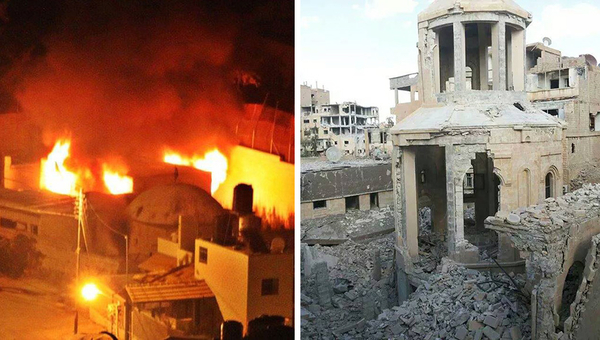
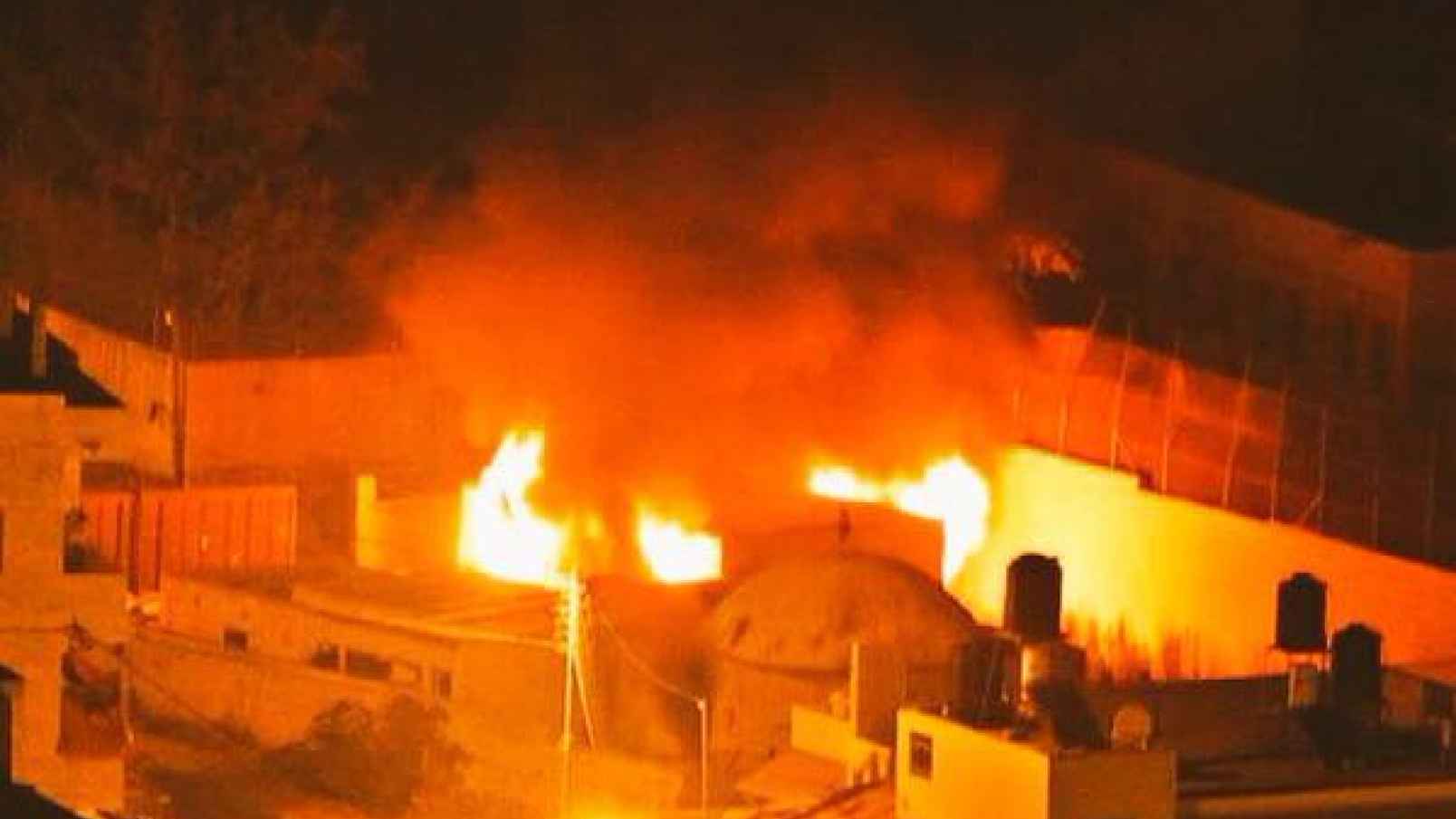
Our young men and women have learned from the Islamic State not only the practice of stabbing the “infidels,” but also how to destroy religious sites. On Thursday night, scores of Palestinians attacked and torched Joseph’s Tomb in the West Bank city of Nablus, in scenes reminiscent of the Islamic State’s destruction of ancient and holy sites in Syria and Iraq.

1309Last week, Palestinians torched Joseph’s Tomb in Nablus (left), in scenes reminiscent of the Islamic State’s destruction of holy sites in Syria and Iraq, such as the Armenian Church in Deir Zor (right).

The shrine was set on fire for no reason other than that it is revered as the tomb of a Jewish biblical figure. This is a site frequented by Jewish worshippers, although it is under the control of the Palestinian Authority (PA) and its security forces in Nablus. It is worth noting that agreements signed between Israel and the Palestinians guarantee access for Jewish worshippers to Joseph’s Tomb, and there were assurances to the Israelis that the PA could be trusted to safeguard the site.

What the Palestinians did to Joseph’s Tomb is no different from what the Islamic State and other terrorist groups have been doing to holy sites and archaeological sites in Syria and Iraq. The Palestinians who attacked Joseph’s Tomb were obviously influenced by the crimes of the Islamic State against religious and ancient sites.

What is still not clear is why the Palestinian Authority security forces, which maintain a tight grip on Nablus, did nothing to prevent the arson attack.

How can our leaders in Ramallah accuse Jews of “contaminating” the Aqsa Mosque with their “filthy feet” at a time when our youths burn a religious site such as Joseph’s Tomb?

This is not the only Jewish holy site that has been targeted by Palestinians in recent years. While our leaders are screaming day and night about Jews “invading” and “desecrating” the Aqsa Mosque, Palestinians from Bethlehem have been throwing stones, petrol bombs and explosive devices at Rachel’s Tomb near the city. This has been going on for several years now, in an attempt to kill Jewish worshippers and the Israeli soldiers guarding Rachel’s Tomb.

The attacks on Joseph’s and Rachel’s Tombs in Nablus and Bethlehem are part of a Palestinian-Islamic campaign to destroy Jewish holy sites and deny any Jewish link to the land. The attacks are an attempt to rewrite history so that Jews will not be able to claim any religious ties to the land. This is exactly what the Islamic State is doing these days in Syria and Iraq: “erasing history that lets us to learn from the past.”

The terror campaign that we have been waging against Israel in the past few weeks shows that the Islamic State and Islamic fundamentalism and fascism have invaded the minds and hearts of many of our young men and women. We have turned the conflict with Israel into a jihadi war, the goal of which is to slaughter Jews, erase their history and expel them from this part of the world. This is not an intifada. This is brutal killing spree targeting Jews of all ages, including a 13-year-old boy, a 72-year-old woman and a 78-year-old man.

President Mahmoud Abbas and other Palestinian leaders are lying to us — and the rest of the world — when they describe the stabbing attacks against Jews as a “peaceful popular resistance.” This is not a struggle against “occupation” or a wall or a checkpoint. It is time to recognize that this is an Islamic State-inspired jihad to slaughter as many Jews as possible and wipe Israel off the face of the earth. When and if the Islamic State is finally eliminated or disappears, the Palestinians will emerge as the successors of one of the most brutal and murderous Islamic gangs that has surfaced in modern history.

An Islamist Intifada

October 18, 2015

An Islamist Intifada, American ThinkerJonathan F. Keiler, October 18, 2015

The history of phony Palestinian Arab nationalism inevitably has led back to this point, revealing the violence for what it is: a war against Jews, and ultimately against anybody else who refuses to submit.

***************************

The current Palestinian Arab “uprising” against Israel appears to be a mostly Islamist offensive, not different in any significant ideological way from radical Islamist movements like ISIS, al-Qaeda, and Hezb’allah.  The idea that it is motivated by Israeli policies, the stalled “peace process,” or Palestinian Arab nationalism is nothing but propaganda, and the laziness and bias of the international press and political classes.

The violence is motivated by the Palestinian Authority’s deliberate agitation, which knowingly taps into the Arab masses deep-seated hatred of Jews and other infidels.  The Authority has a parochial interest in diverting the attention of the masses from its own corruption and incompetence.  It also wants to insulate itself against its Hamas rival in Gaza, which correctly sees the Authority for the hapless and rotten organization it is and would replace it with an incompetent and corrupt Islamist entity in the West Bank.

What neither the Palestinian Authority nor Hamas wants is independence, having rejected every opportunity to create a viable Palestinian Arab state.  The Authority, like all Palestinian Arab leadership since the 1930s, has rejected every opportunity to create a Palestinian state, despite claiming that purpose.  Correspondingly, Gaza is already a wholly independent Palestinian territory, but Hamas also laughably still claims it is “occupied” by Israel.  This patently idiotic assertion is nonetheless accepted as truth by the international left, many governments, and most likely the current occupant of the White House.

Still, Palestinian Arabs in the recent past have consistently played the nationalist card.  The first and second Palestinian intifadas could be characterized as nationalist uprisings, at least to the extent that the stated motivations of Arab leadership and the masses was to end Israeli occupation of the West Bank and Gaza.  The name of the uprisings, “intifada,” or “shaking off” in Arabic, suggested as much.  Predictably, though the Palestinian Arabs succeeded in ending the occupations of Gaza and most of the West Bank, they rejected the fruits of victory.

The uprisings demonstrated the disingenuous nature of Palestinian nationalism.  They furthered supposed Palestinian Arab national aspirations by intensifying international support of Palestinian goals and winning Israeli territorial concessions, but because of Palestinian disinterest in an actual state, these gains have led nowhere.

The result of the first intifada was the Oslo Accords, the withdrawal of the Israeli military from most populated parts of the West Bank, and the establishment of the Palestinian Authority.  If the Palestinian Arabs had any real interest in ending the conflict with Israel and establishing a real national polity, this could have led to a state in the West Bank and Gaza.  However, when Israel offered Yasser Arafat just that, accompanied by further Israeli territorial concessions, he rejected the offer and instead launched another intifada.

The second intifada was manufactured by Arafat, and also erupted over false claims of an Israeli violation of Arab sensitivities on the Jerusalem’s Temple Mount.  But with Arafat’s guidance, it quickly adopted the rhetoric of nationalist occupation.  The extreme violence of the second intifada, which cost Israel almost ten times the losses of the first intifada, also resulted in a tangible gain for the Palestinian Arabs: the abandonment of Israeli communities in Gaza and the Israeli military’s full retreat from that enclave.  When the Israelis departed, they intentionally left behind valuable infrastructure that the Palestinians could have used to build their nation.  In addition, the international community lavished aid and investment on the newly independent territory, which might have tried to transform itself into an Arab Singapore.

But again, the Palestinian Arabs rejected the opportunity.   They destroyed the abandoned Israeli infrastructure in typical self-destructive fits of “rage,” embezzled hundreds of millions of dollars’ worth of international aid, and launched a series of pathetic military offensives against Israel, designed to make their own people suffer.

Under Arafat’s successor Mahmoud Abbas (who remains in charge of the Palestinian Authority in the tenth year of a four-year term), and later under Hamas (after they kicked Abbas and his Fatah Party out), the Palestinians have ludicrously continued to claim that Gaza is occupied.

What is most interesting about the current uprising is that the Palestinians appear to have mostly abandoned any pretense of fighting for a state, and instead have now fully joined the Islamist wave sweeping the Middle East.  Other than Abbas’s posturing, the violence is relatively leaderless, at least in terms of traditional Palestinian Arab political organizations, and driven by Islamist youth.  This uprising, like the second intifada, was instigated by Abbas’s repeated lies about Israeli actions and intentions regarding holy sites in Jerusalem.  But it is persisting in that vein, as radicalized Palestinian Islamists attack Jews in the name of protecting Islam.

Thus, the current violence is less of a piece with the first and second intifadas as it is with the Arab revolts in Mandated Palestine during the 1930s.  Those uprisings were religious, based also on supposed threats posed to Islamic holy sites, with little nationalist motivation.  That’s because in the 1930s there was no Palestinian national movement, there being no such thing as a Palestinian historically, ethnically, or culturally.  To the extent there was any national element to the revolts, it was of the pan-Arab variety – a movement that has proven to be as chimeric as Palestinian nationalism.

In theory, the religious nature of this revolt should put “Palestine’s” many supporters in the West in a more difficult position.  The basis of Western support of Palestine, from the BDS movement to formal recognition to the “peace process,” has been the idea that the conflict between Israel and the Arabs is nationalist, not religious.  As a national conflict, the left and liberal Western governments take the side of the “indigenous” people (Palestinian Arabs), as opposed to the colonial occupiers (Israelis).  But with Palestinians adopting the ideas of the most radical Islamists, this ought to challenge that narrative.  And it reflects reality, because from the 1930s until today, there never has been an authentic Palestinian national movement, as opposed to a basically Islamist desire to rid the Middle East of its only non-Islamic polity.

Hamas has always been an assertively an Islamist organization, openly embracing terror; hostage-taking; public executions of infidels and heretics; and tyranny, both political and religious.  But it also claims to want to vindicate Palestinian national aspirations, which allows some governments and leftists in general to ignore Hamas’s Islamist nature and accept its partial self-depiction as a “resistance movement” to (nonexistent) Israeli occupation.   Likewise, Hezb’allah, the Shia-Islamist terror organization, also self-depicts as a resistance movement to nonexistent Israel occupation (Israel having totally quit Lebanon over 15 years ago).  This nationalist cover allows Western leftist politicians like Jeremy Corbyn (Britain’s new Labor leader) to embrace these groups .

It has also allowed Western leaders like President Obama and Secretary of State Kerry to divorce the Israeli-Palestinian Arab conflict from the larger war on terror.  They prefer to depict it as a local nationalist phenomenon, in which Israeli occupation – rather than Jews simply trying to live as Jews – drives Arab terror.  So far, true to form, the White House and State Department are sticking with that story with the current violence, blaming Israel and the Palestinian Arabs equally, and willfully ignoring the facts of Abbas’s incitement and the Islamist motivations of Arab murderers.

The history of phony Palestinian Arab nationalism inevitably has led back to this point, revealing the violence for what it is: a war against Jews, and ultimately against anybody else who refuses to submit.


CNN: Jewish holy site somehow “catches fire” After Muslim attack

October 16, 2015

CNN: Jewish holy site somehow “catches fire” After Muslim attack, Front Page Magazine, Daniel Greenfield, October 16, 2015

josephs_tomb

Setting Joseph’s Tomb on fire is some sort of national Muslim sport. It happens so often that I don’t think anyone has even collected all the incidents together.

If Jews were constantly setting a Muslim holy site on fire, there would be so many UN resolutions they would provide toilet paper for UN HQ for a year. But Jewish holy sites don’t matter. Jewish lives don’t matter.

****************************

The media is really doubling down on passive voice Muslim terrorism. Israel “actively” does things all the time. But terror attacks on Jews just seem to “happen”. Jewish holy sites just “catch on fire.”

Ask CNN. “Joseph’s Tomb site catches fire in wave of Palestinian-Israeli violence”

It caught fire from the wave of violence? The wave of violence was just sweeping around the place and ignited Joseph’s Tomb?

Even the New York Times headlined its story as, “Palestinians Set Fire to Joseph’s Tomb in West Bank”. The Washington Post called it, “Palestinian protesters set fire to a Jewish holy shrine in West Bank”.

The technical term for people who set things on fire is arsonist, not protester, but at least the Washington Post got “Jewish holy site” in the headline which no one else seems to have managed to do.

(But don’t give the Post too many bonus points yet. Here’s their headline describing a Muslim terrorist who stabbed an Israeli soldier and was shot. “Palestinian with ‘press’ logo on shirt shot dead in stabbing”.)

Let’s do a little thought experiment here.

Suppose a bunch of angry Jews stormed onto the Temple Mount and set the Islamic Al Aqsa Victory Mosque, planted by the Muslim invaders on the holiest site in Judaism, on fire. Would the headline read, “Al Aqsa Mosque catches fire in wave of Palestinian-Israeli violence.”

Or would it read, “Jewish Extremist Mob Torches Muslim Holy Site”?

Here’s a CNN headline from 2009. “Jewish Settlers Blamed over Mosque Attack”. Note how the mosque didn’t spontaneously “catch on fire”. It was attacked. The first words name Jews as the perpetrators because CNN believes it’s a priority to communicate blame in that instance to readers. Here its a priority for CNN to whitewash what happened. There’s no mysterious wave of violence that somehow relates to buildings catching on fire.

This isn’t just a headline issue. Ben Brumfield’s disgusting piece starts off, “Fire broke out overnight at the compound housing Joseph’s Tomb”.

The fire didn’t “break out”. There was no spontaneous combustion. It was set. But Ben Brumfield somehow takes 5 paragraphs to tell you that and to hint at who set it.

Some Palestinians had started a barricade to prevent Israeli troops from entering Nablus to destroy Palestinian homes when a smaller group tried to set fire to the tomb, a Palestinian official told CNN under condition of anonymity. Part of the compound burned, but the tomb remained intact, the official said.

So to summarize, Ben Brumfield’s warped spin here.

The Muslims were trying to protect themselves from Israeli soldiers… so naturally they set a Jewish holy site on fire. Or, as he puts it, they “tried to set fire to the tomb”. All those flames suggest that they succeeded insofar as there was a fire. Even if the tomb wasn’t destroyed.

For example, if CNN headquarters were set on fire by “Palestinian protesters” looking to defend themselves, the news network would still report that it had been set on fire, even if the building remained standing.

CNN follows that up with a lot of “context” and anti-Israel spin, none of which mentions how often Muslims attack Joseph’s Tomb. There was a Muslim arson attempt on the Tomb just this August. Then a Muslim terror cell plotted a bombing and shooting attack on the Tomb… also in August.

The plan of the four arrested terrorists was to set off explosives at Joseph’s Tomb and machine-gun the Jewish worshippers there.

Or, as Ben Brumfield might have reported it, “Explosives Were Set Off in a Wave of Palestinian-Israeli Violence.”

Setting Joseph’s Tomb on fire is some sort of national Muslim sport. It happens so often that I don’t think anyone has even collected all the incidents together.

Muslims vandals have defaced Joseph’s Tomb in yet another instance of Muslims attacking Jewish holy sites. The Muslims  hooligans destroyed furniture, desecrated holy Jewish books, sprayed anti-semitic graffiti throughout the tomb’s grounds. There was also evidence that they had attempted to destroy Joseph’s Tomb by fire.

According to Samaria Council Chairman Gershon Mesika, “Only barbarians are capable of doing terrible things like this, destroying a holy place. The State of Israel must reclaim the Tomb of Yosef, as described in the Oslo Accords.”

That one was two years ago. But destroying other people’s holy places is how Muslim holy places are created.

Unfortunately, this was not the first time that Muslims have attacked Joseph’s Tomb. In 2011, a nephew of Science and Culture Minister Limor Livnat, Ben-Joseph Livnat, was murdered by Palestinian Authority security forces while visiting Joseph’s Tomb and four other Israelis were wounded. At his funeral, Limor Livnat stated, “He was murdered simply because he was Jewish.”

Muslims then proceeded to set Joseph’s Tomb on fire and they also attacked the funeral procession of Ben Joseph Livnat with rocks.

Let’s give these lovely people a state.

Furthermore, in 2008, 16 burning tires were thrown at Joseph’s Tomb and in other instances Joseph’s Tomb has been vandalized with swastikas and other anti-semitic graffiti. In 2000, the Palestinian Authority stormed Joseph’s Tomb, killed an IDF soldier, demolished Joseph’s Tomb, and desecrated Jewish holy books at the Jewish holy site. A Palestinian flag was raised over the Jewish holy site. Afterwards, the Palestinians attempted to transform Joseph’s Tomb into a mosque. Indeed, Palestinians to date claim that Joseph was a Muslim, yet this supposed claim holds no validity; otherwise, the Palestinians would treat Joseph’s Tomb more respectfully than they historically have.

Here’s a brief Wiki summary of the incredibly respectful treatment Joseph’s Tomb has received from Muslims over the last decade or so.

In the early days of the al-Aqsa Intifada, on the morning of October 7, 2000, Israel withdrew the small contingent of IDF border policemen who had been guarding the site of the Tomb of the Patriarch Joseph and its Yeshiva. The holy site was located in Shechem in Samaria, the town the Arabs call “Nablus”. Over the preceeding days, the Tomb had been attacked with gunfire, stones, and firebombs. The IDF defenders in the compound withstood the attacks and stopped several attempts by armed Palestinians to break in. An IDF border policemen was wounded, and the heavy rioting prevented his evacuation for treatment in time to save his life.

The PA also pledged to prevent any vandalism and to return the Tomb to its original state after the violence settled down.

The PA pledge was brazenly violated about two hours after the Israeli evacuation, when a Palestinian Arab mob entered the Tomb compound and began to systematically destroy everything in sight, including all remnants of the Yeshiva. The furniture and books that were left behind were burned by the mob. The Palestinian police stood by, failing to prevent any of these violent activities, despite their commitment to guard the Tomb. Within hours, Joseph’s Tomb was reduced to a smoldering heap of rubble. Within two days, as an Associated Press dispatch reported, “the dome of the tomb was painted green and bulldozers were seen clearing the surrounding area,” as the Palestinian Arabs sought to transform the biblical Joseph’s resting place into a Moslem holy site.

Minister Natan Sharansky wanted the foreign ministry to publicize photos of the desecrated site, which is in the Palestinian Authority-controlled town of Nablus, the biblical Shechem.

“If we would have razed the gravesite of one of the founders of Islam, billions of Muslims would have taken to the streets,” Sharansky said. “It’s inconceivable that the world should not know about this travesty.”

Nablus mayor Ghassan Shakaa promised to repair the site to its pre-1967 state, and repairs were carried out; however, workers painted the exterior of the shrine’s dome green (the color of Islam), fuelling speculation that the Palestinians intended to build a mosque on the site. After some world outcry, the dome was repainted a neutral colour.

On February 23, 2003 the carved stone covering the grave was destroyed.

In February 2003 it was reported in the Jerusalem Post that the grave had been pounded with hammers and that the tree at its entrance had been broken; car parts and trash littered the tomb which had a “huge hole in its dome.”

In 2007, it was discovered that the tomb had been vandalised, and filled with burning garbage.

In early 2008, a group of MKs wrote a letter to the Prime Minister asking that the tomb be renovated: “The tombstone is completely shattered, and the holy site is desecrated in an appalling manner, the likes of which we have not seen in Israel or anywhere else in the world.”

In February, it was reported that Israel would officially ask the Palestinian Authority to carry out repairs at the tomb, but in response, vandals set tires on fire inside the tomb.

In December 2008, Jewish workers funded by anonymous donors painted the blackened walls and re-built the shattered stone marker covering the grave.

In late April 2009, a group of Jewish worshipers found the headstone smashed and swastikas painted on the walls, as well as boot prints on the grave itself

If Jews were constantly setting a Muslim holy site on fire, there would be so many UN resolutions they would provide toilet paper for UN HQ for a year. But Jewish holy sites don’t matter. Jewish lives don’t matter.

Jordanian Writer: Arafat, The Knives Stabbed Into The Israelis’ Heads Are The Fruit Of Your Revolution

October 16, 2015

Jordanian Writer: Arafat, The Knives Stabbed Into The Israelis’ Heads Are The Fruit Of Your Revolution, Middle East Media Research Institute, October 16, 2015

(A Jordanian writer’s paean to the patron saint of Palestinian terrorists. — DM)

Against the backdrop of the current wave of Palestinian attacks on Israelis in Jerusalem, the West Bank, and other parts of Israel, Jordanian writer Abd Al-Hadi Raji Al-Majali wrote in the Jordanian government daily Al-Rai of his yearning for Yasser Arafat. He stated that Arafat’s influence continued to this day in Palestine, and added that even from the grave he had the power to lead the third intifada and defeat Israel.

Addressing Arafat, Al-Majali said that the seeds of his revolution had borne fruit, since today’s Palestinian youth are leading this uprising and this “revolution of the knives.”

The following are excerpts from the article, which was published October 15, 2015: 

25300

Al-Rai

“When you see the sights in Palestine, you recall the martyr Yasser Arafat. He seems to be monitoring, from Ramallah, the river of Palestinian blood and the new generation of young people that has invented the revolution of the knives. I still remember all his statements, every word of his, how he would rage and grasp his kaffiyeh with his right hand and rearrange it… I remember his khakis… the medals, the flag of Palestine, the gray whiskers on his face, his lips trembling in anger when an interviewer annoyed him.

“This is not just a revolution, but also the blood of Arafat, who [still] rouses the Palestinian blood; even Arafat’s grave energizes the Arabness of the Palestinian land… When I see in the Palestinian arena a new generation of young people – of whom Arafat spoke at length, [as he] dreamed of the day that they would fly the Palestinian flag above the walls of Jerusalem – I imagine that the man is still in Ramallah; that he is instructing [us] to care for the families of the martyrs; that he still makes the decisions and leads a diplomatic effort; that  his companions are bringing him his pistol; that the documents are piling up in his office; that he just now finished breakfast… and that he just now issued a secret revolutionary order to be carried out by the factions. He is the main expert in the tactic of revolution, and he knows how to disturb the sleep [of the Israelis].

“Mr. President, the dew still moistens the dust of your grave, and the birds circle above it, perhaps even bringing you messages and news. The stones [on your grave], sir, have left their place temporarily – [how else] would they enable the sun to peek through, or the air to seep in?

“Oh you who rest in Ramallah, trust and be sure that in the Palestinian dictionary there is no one who is pleased with the current situation. It is you who compiled this dictionary, formulating every word, and every revolution since the Palestinians began to pick up the rifle. Rest assured, the flowers and the lion cubs [i.e. the young Palestinian women and men] of whom you spoke are now the vanguard in the arena, and [it is they who are leading] the stabbing of the heads [of the Israelis], which is the only thing that will satisfy the will of Palestine.

“I cannot imagine a revolution of which you are not a part… and I cannot conceive of the occupation army’s defeat without you planning its details.

“Oh you who rest in Ramallah, it is now your privilege to smile a bit, because the seeds of the revolution that you sowed in the land of Palestine are now sprouting our sharp knives, and their blades are [stabbing] the head and the vein [of the Israelis].

“Oh you who rest in Ramallah, I am sending you regards from Kerak [in Jordan], and I understand that even from your grave you are capable of leading the third intifada. [The Israelis] may besiege your grave as they besieged you in the capitals and in your seat in Ramallah – but this intifada will launch a new turn, the thrust of which is that the graves are triumphant.

“Your grave will defeat Israel, Mr. President.”

Iraqi ayatollah: ‘Abducting women’ and ‘destroying churches’ is ‘real Islam’

October 15, 2015

Iraqi ayatollah: ‘Abducting women’ and ‘destroying churches’ is ‘real Islam’ Front Page MagazineRaymond Ibrahim, October 15, 2015

(He must lack the deep understanding of the Religion of Peace claimed by Imam Obama. — DM)

ga

During a recent televised interview with Grand Ayatollah Ahmad al-Baghdadi, the leading Shia cleric of Iraq made clear why Islam and the rest of the world can never peacefully coexist.

First he spent some time discussing “defensive jihad,” saying that all capable Muslims are obligated to fight for the “liberation” of “occupied” territory, for instance, Israel (see here for a list of European countries also deemed “occupied” in the eyes of Islam).

He then explained “offensive jihad,” Islam’s primary bloodline, which forged what we now call the “Muslim world” over the centuries.

According to the ayatollah, when they can—when circumstance permits it, when they are strong enough—Muslims are obligated to go on the offensive and conquer non-Muslims (a fact to be kept in mind as millions of Muslim “refugees” flood the West).

The Muslim cleric repeatedly yelled at the secularized host who kept interrupting him and protesting that Islam cannot teach such intolerance.  At one point, he burst out: “I am the scholar of Islam [al-faqih].  You are just a journalist.  Listen to me!”

Expounded Al-Baghdadi:

If they are people of the book [Jews and Christians] we demand of them the jizya—and if they refuse, then we fight them.  That is if he is Christian. He has three choices: either convert to Islam, or, if he refuses and wishes to remain Christian, then pay the jizya [and live according to dhimmi rules].

But if they still refuse—then we fight them, and we abduct their women, and destroy their churches—this is Islam!… Come on, learn what Islam is, are you even a Muslim?!

As for the polytheists [Hindus, Buddhists, etc.] we allow them to choose between Islam and war!  This is not the opinion of Ahmad al-Husseini al-Baghdadi, but the opinion of all five schools of jurisprudence [four Sunni and one Shia].

Towards the end of the interview, because the clean-shaven, suit-and-tie-wearing host kept protesting that this cannot be Islam, the ayatollah burst out, pointing at him with contempt and saying, “Who are you? You’re going to tell me what to believe?  This is the word of Allah!”

Indeed.  Not only is it the word of Islam’s deity, but it is the fundamental, insurmountable obstacle for peace between Muslims and non-Muslims. Al-Baghdadi—and the countless other Muslim clerics, Sunni and Shia, that hold these views—are not “radicals.”  For offensive jihad is no less codified than, say, Islam’s Five Pillars, which no Muslim rejects.

The Encyclopaedia of Islam’s entry for “jihad” states that the “spread of Islam by arms is a religious duty upon Muslims in general … Jihad must continue to be done until the whole world is under the rule of Islam … Islam must completely be made over before the doctrine of jihad can be eliminated.”

Islam has yet to “completely be made over.”

Renowned Muslim historian and philosopher Ibn Khaldun (d. 1406) explained jihad as follows:

In the Muslim community, jihad is a religious duty because of the universalism of the Muslim mission and the obligation to convert everybody to Islam either by persuasion or by force. The other religious groups did not have a universal mission, and the jihad was not a religious duty for them, save only for purposes of defense. But Islam is under obligation to gain power over other nations.

Here it’s worth noting that even the most offensive jihad is seen as an “altruistic” endeavor, not unlike the “white man’s burden” of the 19th century.   After all, the ancient argument that “we must reform your ways, with our ways, for your own good” has been one of the most cited justifications for offensive jihad since the 7th century.

Indeed, soon after the death of Islam’s prophet Muhammad (634), when his jihadis burst out of the Arabian peninsula, a soon-to-be conquered Persian commander asked the invading Muslims what they wanted. They reportedly replied as follows:

Allah has sent us and brought us here so that we may free those who desire from servitude to earthly rulers and make them servants of Allah, that we may change their poverty into wealth and free them from the tyranny and chaos of [false] religions and bring them to the justice of Islam. He has sent us to bring his religion to all his creatures and call them to Islam. Whoever accepts it from us will be safe, and we shall leave him alone; but whoever refuses, we shall fight until we fulfill the promise of Allah.

Fourteen hundred years later, in March 2009, Saudi legal expert Basem Alem publicly echoed this view:

As a member of the true religion [Islam], I have a greater right to invade [others] in order to impose a certain way of life [according to Sharia], which history has proven to be the best and most just of all civilizations. This is the true meaning of offensive jihad. When we wage jihad, it is not in order to convert people to Islam, but in order to liberate them from the dark slavery in which they live.

Even al-Qaeda partially justified its jihad against America for being “a nation that exploits women like consumer products”; for not rejecting the “immoral acts of fornication, homosexuality, intoxicants, gambling, and usury.”

If the “white man’s burden” was/is to “civilize” Muslims, by bringing them “democracy,” “human rights,” and “secularism,” the “Muslim man’s burden”—captured by Allah’s word to Muslims, “Jihad is ordained for you, though you dislike it” (Koran 2:216)—has long been to “civilize” Westerners by bringing them under the umbrella of Sharia.

This positive interpretation of jihad ensures that, no matter how violent and ostensibly unjust a jihad is, it will always be vindicated in Muslim eyes: the ugly means will be justified by the “altruistic” ends.

Finally, as Grand Ayatollah Ahmad al-Baghdadi pointed out, the need for Muslims to wage offensive jihad “is not the opinion of Ahmad al-Husseini al-Baghdadi… This is the word of Allah!”

Nor is it the “opinion” of ISIS Caliph Abu Bakr, al-Qaeda leader Ayman Zawahiri, Boko Haram leader Abubakar Shekau, or any of the other countless past and present jihadis.  No, jihad to conquer and bring Sharia to non-Muslims is the command of Allah.

Does the PA have a strategy?‎

October 11, 2015

Does the PA have a strategy?‎ Israel Hayom, Richard Baehr, October 11, 2015

Abbas may sense that a reconciliation between Israel and the ‎Obama administration is not at hand this time around. The obvious and petty ‎boycott of Netanyahu’s speech at the U.N. certainly supports that thesis. This president ‎carries grudges. In Israel’s case, he seems to have come into office carrying one. ‎With the president in full-time legacy-building mode in his last 16 months in office ‎‎(the climate treaty and executive action on gun control are next up), it is hard to ‎believe that he will simply accept defeat and an inability to influence the Israeli-‎Palestinian conflict in the time he has left. ‎

************************

A third intifada has not yet been officially designated by Haaretz or The New York ‎Times or National Public Radio, though it may feel as if one is underway, when ‎over 60% of Israelis in the latest public opinion survey say they now fear for their ‎personal safety. So too, there is no evidence yet that the wave of Palestinian ‎attacks or — new to this current campaign — the attempted mass crossings from Gaza, ‎have peaked. ‎

Certainly, the reporting on the current events in Israel reflects old habits about ‎how most journalists cover stories of Palestinian violence and Israeli responses. ‎Two standbys always work. One if that there is “a cycle of violence” ( a pox on both ‎your houses), always leaving unclear who the original perpetrators were in an ‎individual attack or group of attacks. A second is to keep a daily scorecard of the ‎comparative body counts, especially when there are more Palestinian casualties ‎and fatalities than Israeli, courtesy of Israeli police or soldiers responding to ‎stabbing attacks, not all of which prove lethal before the attacker is neutralized. ‎This narrative leads to the inevitable charge of disproportionality, one that has ‎become the principal media assault on Israeli responses to terror emanating from ‎Gaza in recent years. As in every other instance in recent years, Haaretz is playing ‎its appointed role of feeding the many international journalists in the country with ‎the “truth in English” as it sees it, and as the international media want to receive ‎and see it, confirming all their established biases about Israel behavior.

For Israeli ‎responses to the current violence to be “fair” and proportional, the comparative ‎Jewish and Arab body counts would need to be more in balance than in prior ‎years. When the current campaign of attacks on Israelis began, The New York Times ‎relegated the story to it its interior pages. Once a few Palestinians were killed by ‎Israeli police, the story became front page news.‎

Any attack on Arabs by an Israeli is always highlighted since it removes any ‎attempt by Israel to argue it is the victim of attacks. It also buttresses the PA’s ‎charges that Israelis, whether in security roles or settlers, are willing executioners, ‎committing crimes against Palestinians. Regardless of how infrequent these individual attacks by Israelis ‎are, they serve to solidify the cycle of violence theme. The Israeli government can ‎condemn these attacks and capture the perpetrators, but it makes no difference. ‎The PA, meanwhile, will applaud the heroism of their new martyrs protecting the ‎holy places on the Temple Mount from an invasion of stinking Jewish filth.‎

The current wave of Arab attacks followed a Palestinian Authority incitement ‎campaign with language such as that above, in which President Mahmoud Abbas, ‎seemingly the president for life, though only elected to a four year term, ‎condemned Israel’s campaign to change the status of the Temple Mount, for which ‎there is no evidence whatsoever. U.S. Secretary of State John Kerry, probably in ‎seclusion and being treated with antidepressants since being denied the Nobel ‎Peace Prize for his abject surrender to the Iranians in Geneva, has acknowledged ‎to Israeli Prime Minister Benjamin Netanyahu that the Americans understand there is no ‎Israeli effort underway to reshape any policy regarding behavior on the Temple ‎Mount. Kerry can probably blame Yasser Arafat’s Nobel Peace Prize for the peace ‎prize medal he did not receive (and likely would not have tossed away). The ‎selection committee was probably not anxious to have the Iranians make them look ‎like fools in years to come once they violated the nuclear deal as Arafat tossed Oslo ‎aside when it was inconvenient. ‎

The naked demagoguery of Abbas’ continually repeated lies about Israeli plans for ‎the Temple Mount will always have the desired affect on the many young men on ‎whom the PA can depend to take to the streets and do their part to protect the ‎‎”holy places” for a fee. While there is no consensus on the degree of PA control ‎over the attacks, the Palestinians certainly know where their rhetoric leads.‎

The question, though, is why the Palestinians have chosen this point in time to ‎overheat the situation, resulting in the loss of both Israeli and Palestinian lives.‎

The answer offered by most analysts so far is that the PA wanted to draw ‎international attention back to its grievances with Israel, which most basically ‎begins with the continued existence of the State of Israel. For many months, ‎relations between Israel and the United States, never very good at any time during ‎the Obama years, have become much more fractious as a result of the ‎disagreement between the two countries over the wisdom of America’s ‎spearheading the effort to make all the concessions required as achieve the ‎nuclear deal with Iran by the ‎P5+1 group of nations. ‎

In prior administrations, when relations between the two countries hit a rough ‎patch over some policy disagreement, typically there was an effort made by both ‎parties to try to restore the historic relationship. In the Obama years, the White ‎House has had problems with Israel on pretty much everything — whether to ‎impose new sanctions on Iran, inhibiting Israeli steps targeting Iran’s nuclear ‎program, the nuclear deal itself, and of course the peace process with the ‎Palestinians, the breakdown of which was blamed on Israel by the administration. ‎In no prior administration has the public rhetoric and off-the-record commentary ‎about Israel and its elected leader been so consistently hostile. A boycott of Netanyahu’s speech to a joint meeting of Congress was supported by the ‎administration, which pulled Vice President Joe Biden from attendance. Near a quarter ‎of all Democrats in Congress chose to observe the boycott. The administration ‎doubled down on its boycott campaign when Kerry and ‎Ambassador Samantha Power were instructed not to attend ‎Netanyahu’s recent speech to the U.N. General Assembly. It makes sense that the president has never condemned the Boycott, Divestment and Sanctions campaigns targeting Israel on American ‎college campuses. He would probably be leading them if he were now a student. ‎

In any case, Abbas may sense that a reconciliation between Israel and the ‎Obama administration is not at hand this time around. The obvious and petty ‎boycott of Netanyahu’s speech at the U.N. certainly supports that thesis. This president ‎carries grudges. In Israel’s case, he seems to have come into office carrying one. ‎With the president in full-time legacy-building mode in his last 16 months in office ‎‎(the climate treaty and executive action on gun control are next up), it is hard to ‎believe that he will simply accept defeat and an inability to influence the Israeli-‎Palestinian conflict in the time he has left. ‎

Abbas has resorted to the strategy that always works to get his cause back in the ‎news — get some of his people killed by Israel, and blame it on Israeli over-reaction ‎and trigger-happy behavior. Maybe Obama will then show his disgust with Israel ‎and commit to not vetoing new measures targeting Israel at the U.N. Security ‎Council, including establishing a plan for Israeli withdrawal from the West Bank ‎and Jerusalem. ‎

It is also possible that Obama planned to lower the temperature of the American-‎Israeli relationship now that the Iran deal had not been blocked by Congress. The prime minister had been invited to the White House next month, and reportedly ‎the president planned to show up. If Abbas thought this was the new glide path, ‎then throwing a monkey wrench into the mix with new violence would certainly ‎complicate things. Obama’s press secretary, Josh Earnest, gave a particularly awful ‎response when questioned about the new wave of Palestinian violence this week, ‎suggesting he had not been advised to turn any page:‎

“The United States condemns in the strongest possible terms ‎violence against Israeli and Palestinian civilians. We call upon ‎all parties to take affirmative steps to restore calm and refrain ‎from actions and rhetoric that would further enflame tensions ‎in that region of the world. We continue to urge all sides to find ‎a way back to the full restoration of the status quo at the ‎Temple Mount in Haram al-Sharif, the location that has ‎precipitated so much of the violence that we’ve seen there.”

In other words, both sides are guilty for attacking the other’s ‎civilians, and somehow a change in the status of the Temple ‎Mount (Israel’s doing) was the root cause of the new problems. ‎

When the administration’s top spokesperson makes this kind ‎of comment, do you think Abbas will decide to ease ‎up on the violence accelerator?

Op-Ed: Chaos and 2nd Cold War, Part II: Israel’s Nuclear Strategy

October 11, 2015

Op-Ed: Chaos and 2nd Cold War, Part II: Israel’s Nuclear Strategy, Israel National News, Prof. Louis René Beres, October 11, 2015

(Part I is available here. — DM)

Israel should now be calculating the exact extent or subtlety with which it should consider communicating key portions of its nuclear posture and positions. Naturally, Israel should never reveal any too-specific information about its nuclear strategy, its nuclear hardening, or even its nuclear yield-related capabilities. Still, sometimes, the duty of finely-honed intelligence services should not be to maximize strategic secrecy, but rather, to carefully “share” certain bits of pertinent information.

**********************************

How will Russia respond to any ramped up American uses of force in the Middle East, and, more plausibly, vice-versa?  One must assume that Jerusalem is already asking these key questions, and even wondering whether, in part, greater mutualities of interest could sometime exist with Moscow than with Washington.

To wit, Prime Minister Benjamin Netanyahu met with Russia’s President Vladimir Putin in September 2015. Among other things, the Israeli leader must  be calculating: 1)Will the Obama Administration’s incoherent retreat from most of the Middle East point toward a more permanent United States detachment from the region; and 2) If it does, what other major powers are apt to fill the resultant vacuum? Just as importantly, and as an obvious corollary to (2), above, the prime minister should be inquiring: “How will the still-emerging Cold War II axis of conflict impact America’s pertinent foreign policy decisions?”

There are some additional ironies yet to be noted. Almost certainly, ISIS, unless it is first crushed by U.S. and/or Russian-assisted counter-measures, will plan to march westward across Jordan, ultimately winding up at the borders of West Bank (Judea/Samaria). There, ISIS Jihadists could likely make fast work of any still-posted Hamas and Fatah forces, in effect, taking over what might once have become “Palestine.” In this now fully imaginable scenario, the most serious impediment to Palestinian statehood is not Israel, but rather a murderous band of Sunni Arab terrorists.[16]

What about the larger picture of “Cold War II?” Israeli defense planners will need to factor into their suitably nuanced calculations the dramatically changing relationship between Washington and Moscow. During “Cold War I,” much of America’s support for the Jewish State had its most fundamental origins in a perceived need to compete successfully in the Middle East with the then Soviet Union. In the progressive development of “Cold War II,” Jerusalem will need to carefully re-calculate whether a similar “bipolar” dynamic is once again underway, and whether the Russian Federation might, this time around, identify certain strategic benefits to favoring Israel in regional geo-politics.

In all such strategic matters, once Israel had systematically sorted through the probable impact of emerging “superpower” involvements in the Middle East, Jerusalem would need to reassess its historic “bomb in the basement.” Conventional wisdom, of course, has routinely pointed in a fundamentally different policy direction. Still, this “wisdom” assumes that credible nuclear deterrence is simply an automatic result of  physically holding nuclear weapons. By the logic of this too-simplistic argument, removing Israel’s nuclear bomb from the “basement” would only elicit new waves of global condemnation, and would likely do so without returning any commensurate security benefits to Jerusalem.

Scholars know, for good reason, that the conventional wisdom is often unwise. Looking ahead, the strategic issues facing Israel are not at all uncomplicated or straightforward.  Moreover, in the immutably arcane world of Israeli nuclear deterrence, it can never really be adequate that enemy states merely acknowledge the Jewish State’s nuclear status. Rather, it is also important that these states should be able to believe that Israel holds usable nuclear weapons, and that Jerusalem/Tel-Aviv would be willing to employ these usable weapons in certain clear, and situationally recognizable, circumstances.

Current instabilities in the Middle East will underscore several good reasons to doubt that Israel could ever benefit from any stubborn continuance of deliberate nuclear ambiguity. It would seem, too, from certain apparent developments already taking place within Mr. Netanyahu’s “inner cabinet,” that portions of Israel’s delegated leadership must now more fully understand the bases of any such informed skepticism.

In essence, Israel is imperiled by compounding and inter-related existential threats that justify its fundamental nuclear posture, and that require a correspondingly purposeful strategic doctrine. This basic need exists well beyond any reasonable doubt. Without such weapons and doctrine, Israel could not expectedly survive over time, especially if certain neighboring regimes, amid expanding chaos,  should soon become more adversarial, more Jihadist, and/or less risk-averse.

Incontestably, a purposeful nuclear doctrine could prove increasingly vital to coping with various more-or-less predictable strategic scenarios for Israel, that is, those believable narratives requiring preemptive action, and/or an appropriate retaliation.

Typically, military doctrine carefully describes how national forces should fight in various combat operations. The literal definition of “doctrine” derives from Middle English, from the Latin doctrina, meaning teaching, learning, andinstruction. Though generally unrecognized, the full importance of doctrine lies not only in the several ways that it can animate and unify military forces, but also in the uniquely particular fashion that it can transmit certain desired “messages.”

In other words, doctrine can serve an increasingly imperiled  state as a critical form of communication, one directed to its friends, and also to its foes.

Israel can benefit from just such broadened understandings of doctrine. The principal security risks now facing Israel are really more specific than general or generic. This is because Israel’s extant adversaries in the region will likely be joined, at some point, by: (1) a new Arab state of “Palestine;” and/or by (2) a newly-nuclear Iran. It is also because of the evidently rekindled global spark of “bipolar” or “superpower” adversity, and the somewhat corollary insertion of additional American military forces to combat certain new configurations of Jihadi terror.

For Israel, merely having nuclear weapons, even when fully recognized in broad outline by enemy states, can never automatically ensure successful deterrence. In this connection, although starkly counter-intuitive, an appropriately selective and thoughtful end to deliberate ambiguity could improve the overall credibility of Israel’s nuclear deterrent.  With this point in mind, the potential of assorted enemy attack prospects in the future could be reduced by making available certain selected information concerning the safety of  Israel’s nuclear weapon response capabilities.

This crucial information, carefully limited, yet more helpfully explicit, would center on the distinctly major and inter-penetrating issues of Israeli nuclear capability and decisional willingness.

Skeptics, no doubt, will disagree. It is, after all, seemingly sensible to assert that nuclear ambiguity has “worked” thus farWhile Israel’s current nuclear policy has done little to deter multiple conventional terrorist attacks, it has succeeded in keeping the country’s enemies, singly or in collaboration, from mounting any authentically existential aggressions. This conclusion is not readily subject to any reasonable disagreement.

But, as the nineteenth-century Prussian strategic theorist, Karl von Clausewitz, observed, in his classic essay, On War, there may come a military tipping point when “mass counts.” Israel is already coming very close to this foreseeable point of no return. Israel is very small.  Its enemies have always had an  undeniable advantage in “mass.”

More than any other imperiled state on earth, Israel needs to steer clear of such a tipping point.

This, too, is not subject to any reasonable disagreement.

Excluding non-Arab Pakistan, which is itself increasingly coup-vulnerable, none of Israel’s extant Jihadi foes has “The Bomb.”  However, acting together, and in a determined collaboration, they could still carry out potentially lethal assaults upon the Jewish State. Until now, this capability had not been possible, largely because of insistent and  persistently overriding fragmentations within the Islamic world. Looking ahead, however, these same fragmentations could sometime become a source of special danger to Israel, rather than remain a continuing source of  national safety and reassurance.

An integral part of Israel’s multi-layered security system lies in the country’s ballistic missile defenses, primarily, the Arrow or “Hetz.” Yet, even the well-regarded and successfully-tested Arrow, now augmented by the newer and shorter-range iterations of “Iron Dome,” could never achieve a sufficiently high probability of intercept to meaningfully protect Israeli civilians.[17] No system of missile defense can ever be “leak proof,” and even a single incoming nuclear missile that somehow managed to penetrate Arrow or corollary defenses could conceivably kill tens or perhaps hundreds of thousands of Israelis.[18]

In principle, at least, this fearsome reality could be rendered less prospectively catastrophic if Israel’s traditional reliance on deliberate ambiguity were suitably altered.

Why alter? The current Israeli policy of an undeclared nuclear capacity is unlikely to work indefinitely. Leaving aside a Jihadi takeover of already-nuclear Pakistan, the most obviously unacceptable “leakage” threat would come from a nuclear Iran. To be effectively deterred, a newly-nuclear Iran would require convincing assurance that Israel’s atomic weapons were both (1) invulnerable, and (2) penetration-capable.

Any Iranian judgments about Israel’s capability and willingness to retaliate with nuclear weapons would then depend largely upon some prior Iranian knowledge of these weapons, including their expected degree of protection from surprise attack, as well as Israel’s expected capacity to “punch-through” all pertinent Iranian active and passive defenses.

Jurisprudentially, at least, following JCPOA in Vienna, a  nuclear weapons-capable Iran is a fait accompli. For whatever reasons, neither the “international community” in general, nor Israel in particular, had ever managed to create sufficient credibility concerning a once-timely preemptive action. Such a critical defensive action would have required very complex operational capabilities, and could have generated Iranian/Hezbollah counter actions that might have a  very significant impact on the entire Middle East. Nevertheless, from a purely legal standpoint, such preemptive postures could still have been justified, under the authoritative criteria of anticipatory self-defense, as permitted under customary international law.

It is likely that Israel has undertaken some very impressive and original steps in cyber-defense and cyber-war, but even the most remarkable efforts in this direction will not be enough to stop Iran altogether. Earlier, the “sanctions” sequentially leveled at Tehran – although certainly better than nothing – could have had no tangible impact on effectively halting Iranian nuclearization.

Strategic assessments can sometimes borrow from a Buddhist mantra. What is, is. Ultimately, a nuclear Iran could decide to share some of its nuclear components and materials with Hezbollah, or with another kindred terrorist group. Ultimately, amid growing regional chaos, such injurious assets could find their way to such specifically U.S- targeted groups as ISIS.

Where relevant, Israeli nuclear ambiguity could be loosened by releasing certain very general information regarding the availability and survivability of appropriately destructive  nuclear weapons.

Israel should now be calculating the exact extent or subtlety with which it should consider communicating key portions of its nuclear posture and positions. Naturally, Israel should never reveal any too-specific information about its nuclear strategy, its nuclear hardening, or even its nuclear yield-related capabilities. Still, sometimes, the duty of finely-honed intelligence services should not be to maximize strategic secrecy, but rather, to carefully “share” certain bits of pertinent information.

What about irrational enemies? An Israeli move from ambiguity to disclosure would not likely help in the case of an irrational nuclear enemy. It is even possible, in this regard, that particular elements of Iranian leadership might meaningfully subscribe to certain end-times visions of a Shiite apocalypse. By definition, any such enemy would not necessarily value its own continued national survival more highly than any other national preference, or combination of preferences. By definition, any such enemy would present a genuinely unprecedented strategic challenge.

Were its leaders to become authentically irrational, or to turn in expressly non-rational directions, Iran could then effectively become a nuclear suicide-bomber in macrocosm.  Such a profoundly destabilizing strategic prospect is improbable, but it is also not inconceivable. A similarly serious prospect exists in already-nuclear Pakistan.

To protect itself against military strikes from irrational enemies, especially those attacks that could carry existential costs, Israel will need to reconsider virtually every aspect and function of its nuclear arsenal and doctrine. This is a strategic reconsideration that must be based upon a number of bewilderingly complex intellectual calculations, and not merely on ad hoc, and more-or-less presumptively expedient political judgments.

Removing the bomb from Israel’s basement could enhance Israel’s strategic deterrence to the extent that it would heighten enemy perceptions of the severe and likely risks involved. This would also bring to mind the so-called Samson Option, which, if suitably acknowledged, could allow various enemy decision-makers to note and underscore a core assumption. This is that Israel is prepared to do whatever is needed to survive. Interestingly, such preparation could be entirely permissible under governing international law, including the 1996 Advisory Opinion of the International Court of Justice.[19]

Irrespective of  its preferred level of ambiguity, Israel’s nuclear strategy must always remain oriented toward deterrence, not to actual war-fighting.[20] The Samson Option refers to a policy that would be based in part upon a more-or-less implicit threat of massive nuclear retaliation for certain anticipated enemy aggressions.  Israel’s small size means, inter alia, that any nuclear attack would threaten Israel’s very existence, and could not be tolerated. Israel’s small size also suggests a compelling need for sea-basing (submarines) at least a recognizably critical portion of its core nuclear assets,

From a credibility standpoint, a Samson Option could make sense only in “last-resort,” or “near last-resort,” circumstances. If the Samson Option is to be part of a convincing deterrent, as it should, an incremental end to Israel’s deliberate ambiguity is essential. The really tough part of this transformational process will lie in determining the proper timing for such action vis-a-vis Israel’s security requirements, and in calculating authoritative expectations (reasonable or unreasonable) of the “international community.”

The Samson Option should never be confused with Israel’s overriding security objective: To seek stable deterrence at the lowest possible levels of military conflict. As a last resort, it basically states the following warning to all potential nuclear attackers:  “We (Israel) may have to `die,` but (this time) we won’t die alone.”

There is a related observation. In our often counter-intuitive strategic world, it can sometimes be rational to pretend irrationality. The nuclear deterrence benefits of any such pretended irrationality would depend, at least in part, upon an enemy state’s awareness of Israel’s intention to apply counter-value targeting when responding to a nuclear attack. But, once again, Israeli decision-makers would need to be aptly wary of ever releasing too-great a level of specific operational information.

In the end, there are specific and valuable critical security benefits that would likely accrue to Israel as the result of a purposefully selective and incremental end to its historic policy of deliberate nuclear ambiguity.   The right time to begin such an “end”  has not yet arrived. But, at the precise moment that Iran verifiably crosses the nuclear threshold, or arguably just before this portentous moment, Israel should  promptly remove The Bomb from its “basement.”

When this critical moment arrives, Israel should already have configured (1) its presumptively optimal allocation of nuclear assets; and (2) the extent to which this preferred configuration should now be disclosed. Such strategic preparation could then enhance the credibility of Israel’s indispensable nuclear deterrence posture.

When it is time for Israel to selectively ease its nuclear ambiguity, a second-strike nuclear force should be revealed in broad outline. This robust strategic force – hardened, multiplied, and dispersed – would need to be fashioned so as to recognizably inflict a decisive retaliatory blow against major enemy cities. Iran, it follows, so long as it is led by rational decision-makers, should be made to understand that the actual costs of  any planned aggressions against Israel would always exceed any expected gains.

In the final analysis, whether or not a shift from deliberate ambiguity to some selected level of nuclear disclosure would actually succeed in enhancing Israeli nuclear deterrence would depend upon several complex and intersecting factors. These include, inter alia, the specific types of nuclear weapons involved; reciprocal assessments and calculations of pertinent enemy leaders; effects on rational decision-making processes by these enemy leaders; and effects on both Israeli and adversarial command/control/communications operations. If  bringing Israel’s bomb out of the “basement” were to result in certain new enemy pre-delegations of nuclear launch authority, and/or in new and simultaneously less stable launch-on-warning procedures, the likelihood of unauthorized and/or accidental nuclear war could then be substantially increased.

Not all adversaries may be entirely rational. To comprehensively protect itself against potentially irrational nuclear adversaries, Israel has no logical alternative to developing an always problematic conventional preemption option, and to fashion this together with a suitable plan for subsequent “escalation dominance.” Operationally, especially at this very late date, there could be no reasonable assurances of success against many multiple hardened and dispersed targets. Regarding deterrence, however, it is noteworthy that “irrational” is not the same as “crazy,” or “mad,” and that even an expectedly irrational Iranian leadership could still maintain susceptible preference orderings that are both consistent and transitive.

Even an irrational Iranian leadership could be subject to threats of deterrence that credibly threaten certain deeply held religious as well as civic values. The relevant difficulty here for Israel is to ascertain the precise nature of these core enemy values. Should it be determined that an Iranian leadership were genuinely “crazy” or “mad,” that is, without any decipherable or predictable ordering of preferences, all deterrence bets could then have to give way to preemption, and possibly even to certain plainly unwanted forms of war fighting.

Such determinations, of course, are broadly strategic, not narrowly jurisprudential. From the discrete standpoint of international law, especially in view of Iran’s expressly genocidal threats against Israel, a preemption option could still represent a permissible expression of anticipatory self-defense. Again, however, this purely legal judgment would be entirely separate from any parallel or coincident assessments of operational success. There would be no point for Israel to champion any strategy of preemption on solely legal grounds if that same strategy were not also expected to succeed in specifically military terms.

Growing chaotic instability in the Middle East plainly heightens the potential for expansive and unpredictable conflicts.[21] While lacking any obviously direct connection to Middle East chaos, Israel’s nuclear strategy must now be purposefully adapted to this perilous potential. Moreover, in making this adaptation, Jerusalem could also have to pay special attention not only to the aforementioned revival of  major “bipolar” animosities, but also, more specifically and particularly, to Russia’s own now-expanding nuclear forces.

This cautionary warning arises not because augmented and modernized Russian nuclear forces would necessarily pose any enlarged military threat to Israel directly, but rather because these strategic forces could determine much of the way in which “Cold-War II” actually evolves and takes shape. Vladimir Putin has already warned Washington of assorted “nuclear countermeasures,” and recently test launched an intercontinental nuclear missile.[22] One such exercise involved a new submarine-launched Bulava missile, a weapon that could deliver a nuclear strike with up to 100 times the force of the 1945 Hiroshima blast.

Current adversarial Russian nuclear posturing vis-à-vis the United States remains oriented toward the Ukraine, not the Middle East.[23] Nevertheless, whatever happens to U.S.-Russian relations in any one part of the world could carry over to certain other parts, either incrementally, or as distinctly sudden interventions or escalations. For Jerusalem, this means, among other things, an unceasing obligation to fashion its own developing nuclear strategy and posture with an informed view to fully worldwide power problems and configurations.

Whether looking toward Gaza, West Bank (Judea/Samaria), Iran, Lebanon, Iraq, Jordan, Egypt, or Syria, Israel will need to systematically prioritize existential threats, and, thereafter, stay carefully focused on critically intersecting and overriding factors of global and regional security. In all such meticulously careful considerations, both chaos and Cold War II should be entitled to occupy a conspicuous pride of place.

Sources:

[16] A further irony here concerns Palestinian “demilitarization,” a pre-independence condition of statehood called for by Israeli Prime Minister Benjamin Netanyahu. Should Palestinian forces (PA plus Hamas) ever actually choose to abide by any such formal legal expectation, it could makes these forces less capable of withstanding any foreseeable ISIS attacks. Realistically, however, any such antecedent compliance would be highly improbable. See, for earlier legal assessments of Palestinian demilitarization, Louis René Beres and (Ambassador) Zalman Shoval, “Why a Demilitarized Palestinian State Would Not Remain Demilitarized: A View Under International Law,” Temple International and Comparative Law Journal, Winter 1998, pp. 347-363; and Louis René Beres and Zalman Shoval, “On Demilitarizing a Palestinian `Entity’ and the Golan Heights: An International Law Perspective,” Vanderbilt Journal of Transnational Law, Vol. 28, No. 5, November 1995, pp. 959-972.

[17] There is another notable and more generic (pre-nuclear age) risk of placing too-great a reliance on defense. This is the risk that a corollary of any such reliance will be a prospectively lethal tendency to avoid taking otherwise advantageous offensive actions. Recall, in this connection, Carol von Clausewitz On War:  “Defensive warfare…does not consist of waiting idly for things to happen. We must wait only if it brings us visible and decisive advantages. That calm before the storm, when the aggressor is gathering new forces for a great blow, is most dangerous for the defender.” See: Carl von Clausewitz, Principles of War, Hans W. Gatzke, tr., New York: Dover Publications, 2003, p. 54.

[18] For early authoritative accounts, by the author, of expected consequences of a nuclear attack, see: Louis René Beres, Apocalypse: Nuclear Catastrophe in World Politics (Chicago: University of Chicago Press, 1980); Louis René Beres, Mimicking Sisyphus: America’s Countervailing Nuclear Strategy (Lexington, Mass., Lexington Books, 1983); Louis René Beres, Reason and Realpolitik: U.S. Foreign Policy and World Order (Lexington, Mass., Lexington Books, 1984); and Louis René Beres, Security or Armageddon: Israel’s Nuclear Strategy (Lexington, Mass., Lexington Books, 1986).

[19] See: “Summary of the Legality of the Threat or Use of Nuclear Weapons,” Advisory Opinion, 1996, I.C.J., 226 (Opinion of 8 July 1996). The key conclusion of this Opinion is as follows: “…in view of the current state of international law, and of the elements of fact at its disposal, the Court cannot conclude definitively whether the threat or use of nuclear weapons would be lawful or unlawful in an extreme circumstance of self-defense, in which the very survival of a State would be at stake.”

[20] This advice was a central recommendation of the Project Daniel Group’s final report,  Israel’s Strategic Future (ACPR, Israel, May 2004: “The overriding priority of Israel’s nuclear deterrent force must always be that it preserves the country’s security without ever having to be fired against any target. The primary point of Israel’s nuclear forces must always be deterrence ex ante, not revenge ex post.” (p. 11). Conceptually, the core argument of optimizing military force by not resorting to any actual use pre-dates the nuclear age. To wit, Sun-Tzu, in his ancient classic, The Art of War, counseled: “Supreme excellence consists of breaking the enemy’s resistance without fighting.”

[21] Once again, Prussian military thinker, Carl von Clausewitz, had already highlighted the generic (pre-nuclear age) dangers of unpredictability, summarizing these core hazards as matters of “friction.”

[22] ICBM test launches are legal and permissible under the terms of New START, It does appear, however,  that Russia has already developed and tested a nuclear-capable cruise missile with a range of 500-5500 KM, which would be in express violation of the Intermediate Nuclear Forces Treaty (INF). At the same time, current research into the U.S. Conventional Prompt Global Strike Program seeks to circle around INF Treaty limitations, by employing a delivery vehicle trajectory that is technically neither ballistic nor cruise.

[23] Russia, of course, is operating much more openly and substantially in Syria, but here, in the Middle East theatre, at least, Moscow’s public tone toward Washington is somewhat less confrontational or adversarial.