(Some of this is directly pertinent to Israel and the Middle-East, some is pertinent only as U.S. politics affect both. It’s intended to be humorous, in a macabre way. — DM)
The Obama Nation’s multicultural society has become so politically correct and otherwise obtuse that words and phrases are used in any odd ways that may be desired — just as Humpty Dumpty did.
“When I use a word,” Humpty Dumpty said, in rather a scornful tone, “it means just what I choose it to mean—neither more nor less.”
“The question is,” said Alice, “whether you can make words mean so many different things.”
“The question is,” said Humpty Dumpty, “which is to be master—that’s all.”
Here are a few examples and explanations.
Religion of peace. Amish? Quakers? Of course not: it’s Islam. Although the Islamic State, according to Obama, is not “Islamic,” the Islamic Republic of Iran, Turkey, Qatar, Saudi Arabia, et al — which are “Islamic” — are among the world’s foremost sponsors of Islamic terrorism. However, that is irrelevant because Muslims would be offended.
Here’s Andrew Klavan on how to survive an Islamic Quaker massacre:
Islamic extremists are extreme because they follow the Koran and demand Shari Law. So do “moderate Muslims.”
Bitter clingers are Christians in fly-over country who support the Second Amendment, while revering and trying to live according to their Bibles. Islamists who cling to their scimitars, guns and suicide vests, while revering and trying to live by their Korans and Sharia law, are not bitter clingers.
That’s racist! Unless you happen to be Black and therefore not conservative, see Great Uniter, below.
The science is settled and the debate is over. Ipse dixit.
Honest discussion. According to Attorney General Holder, Federal Dick, we need to have an honest discussion about race. “Honest” means agreeing with and favoring his people above all others. Or something.
Gender identity. Don’t like your gender? Try another; it’s probably on the house.
The war on women has long been fought byRepublican scoundrels, not by Democrats like Billie BJ Clinton or various Islamic states such as Saudi Arabia, Iran and Turkey. The (non Islamic) Islamic State and other (non Islamic) freaks may be fighting a war on women and girls, whom they capture as sex slaves, use and sell. However, few engaged in fierce combat against the war on women seem to notice or care, so the vile war on women must still be exclusively a Republican thing.
Feminism rejects the vast powers that men have over women by, among many other things, demanding free contraception and abortion on request. Although opposed by some bitter clingers, both are needed to empower women and girls to have sex as often and with as many men as they may desire, with no illnesses (such as pregnancy) or other adverse consequences. Is lesbianism the cure? Should it replace heterosexual nymphomania?
Truth. “Beauty is truth, Truth is beauty. This is all ye know on Earth and all ye need to know.” Truth is beautiful only if it “sounds good” and can become a helpful sound bite to be memorized and used effortlessly.
Party of billionaires. This refers to Republicans. It does not mean Democrats who pay big bucks (up to $32,000 or more in some cases) to hear Obama tell them how filthy rich Republicans are ruining the country and how wonderful He is.
As Gwyneth Paltrow, an impoverished working mother who only “makes $16 million per movie,” said at a recent Obama fundraiser thrown at her humble shanty in California, Obama is
a president who would be studied for generations, and a role model for everyone of this generation.
“It would be wonderful if we were able to give this man all of the power that he needs to pass the things that he needs to pass,” she told the crowd.
Having been reminded of His greatness, attendees contribute more big bucks. It’s a good thing Obama is not a narcissist.
Great uniter refers to Obama, who has done more to unite Blacks against Whites than any other American President. (Conservative Blacks, such as Allen West, Ben Carson and others are White, not Black.) Great progress, Big Guy! Oh. He’s also a like, way cool military strategist.
Oh well. Try not to laugh cry; it may cause even more global warming, cooling, climate change and other demons not yet exploited discovered. As Jon Carson at BarackObama.com advised my spam filter just today,
We’re going to win on climate change. We don’t really have another option.
The question is how long will it take for the other side to take this fight seriously — to push the climate change deniers out of the way, and to defeat the powerful interest groups protecting the status quo.
We’re not waiting.
Climate change is already affecting Americans’ lives now — droughts, wildfires, and super storms have devastated every corner of the country.
“Fat cats” such as Tom Steyer, who is using his billions to impact multiple races in key states in ways that no ordinary voter can? Of course not. He’s the right kind of fat cat, meaning he is on the left. Plus, he controls NextGen and pays Lehane a lot of money to come up with its strategies. The libertarian-minded Koch brothers are the wrong kind of fat cats, so the billionaire-funded NextGen, led by consummate Beltway insider Chris Lehane, is pushing Democrat candidates to attack them. [Emphasis added.]
According to a linked article at Politico, the NextGen strategy of demonizing Republican “billionaires” seems to be working. So is the NextGen strategy:
According to the Lehane [NextGen] memo:
“In virtually every state NextGen is electorally engaged, there is an issue where the Republican candidate”s anti-climate, anti-basic science beliefs has manifested itself in policies with harmful consequences for all voters in state, including Republican voters. Our Republican Haircut Strategy – a precision focus on a specific harm in target Republican markets – we will seek to degrade Republican performance.” [Emphasis added.]
There’s a lot of loaded language in that — “anti-climate, anti-basic science beliefs” could describe anyone who ignores the fact that the climate scare-mongers keep being proved wrong, and that the data shows that the earth has not warmed in the past 15 to 18 years. Climate hysterics systematically rule out the role that the Sun plays in climate stability and change. Which is a very large thing to omit. And we cannot control it with any carbon trade scheme, tax, regulatory regime or any other means. [Emphasis added.]
Having nothing substantive to say, the Dems apparently attract voters by misleading and scaring them. The farce continues apace.
(Obama needs high profile stuff and photo ops to keep his polls from falling even more dramatically than they have. He needs help from Iran and little if anything else matters. It will be rewarded. — DM)
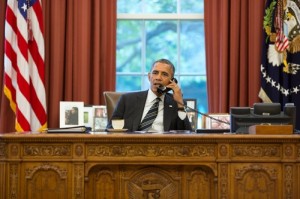
From the Oval Office, U.S. President Barack Obama speaks on the phone with Iranian President Hassan Rouhani on Sept. 27, 2013.
Instead of preemptively stopping ISIS from spreading into Iraq, Obama effectively waited until some high-profile beheadings forced him to focus on the danger. While such gruesome murders can reliably rally public opinion in favor of military action, the duty of the Commander-in-Chief is to lead and take military action when and how national security requires it, and not just when terrorists provoke some tardy and token airstrikes into empty buildings.
Kobani also has geostrategic importance to the Iranian nuclear threat. The more ISIS succeeds at capturing territory and recruiting fighters, a trend bolstered by Kobani’s fall, the more desperate the U.S. becomes for help from Iran, which, as leader of the Shiite world, is the natural enemy of the Sunni ISIS fighters.
[A]s Iran watches how feebly the U.S. responds to the loss of Iraq and how Obama cowers from a relatively minor fight in Kobani, the Ayatollahs can rest assured that there really is no U.S. military option to stop their nuclear program. This conclusion becomes all the more inevitable, when they look at Obama’s waning influence at home, as he enters the lame-duck period of his presidency.
Whatever the U.S. accomplished after about a decade of war in Iraq has, in a matter of months, deteriorated to a situation that may become unprecedented in its instability and threat to Western interests. Obama’s clumsy departure from Iraq, his military mismanagement of the mess that ensued, and his refusal to intervene in Syria – again, overruling his top security advisers – are what produced the current quagmire.
The loss of Christianity in Mosul didn’t have to happen. Obama’s tardy airstrikes managed to prevent the Mosul Dam from falling, but the city may never be the same. Similarly, why did the Yazidis have to find themselves besieged on Mount Sinjar before the U.S. took action?
Instead of preemptively stopping ISIS from spreading into Iraq, Obama effectively waited until some high-profile beheadings forced him to focus on the danger. While such gruesome murders can reliably rally public opinion in favor of military action, the duty of the Commander-in-Chief is to lead and take military action when and how national security requires it, and not just when terrorists provoke some tardy and token airstrikes into empty buildings.
As the next disaster is about to unfold on Obama’s watch, he should recognize that there is much more at stake with the fight for Kobani than just the loss to ISIS of a small town on the Syria-Turkey border.
Above all, letting Kobani fall means betraying our only ally fighting ISIS on the ground, and allowing them to be massacred while the world watches. What message does the U.S. send to Mideast partners and the world at large, if the Kurds are the only force providing the ground troops that Obama so desperately needs now, and yet Obama is unwilling to support them enough to avoid the horrific slaughter that will follow an ISIS victory in Kobani?
Kobani also has geostrategic importance to the Iranian nuclear threat. The more ISIS succeeds at capturing territory and recruiting fighters, a trend bolstered by Kobani’s fall, the more desperate the U.S. becomes for help from Iran, which, as leader of the Shiite world, is the natural enemy of the Sunni ISIS fighters. Because Iran also has one of the most powerful militaries in the region, and has – even before the ISIS crises – outmaneuvered the West in talks to curb Iranian nuclear ambitions, Iran could easily leverage the situation to secure tacit Western acceptance of its nukes. Indeed, Iran has already signaled its fight-ISIS-for-nukes strategy.
Even more important, as Iran watches how feebly the U.S. responds to the loss of Iraq and how Obama cowers from a relatively minor fight in Kobani, the Ayatollahs can rest assured that there really is no U.S. military option to stop their nuclear program. This conclusion becomes all the more inevitable, when they look at Obama’s waning influence at home, as he enters the lame-duck period of his presidency.
There is also a moral dimension to Kobani. Obama – in his 2009 and 2012 speeches on Holocaust Remembrance Day – proudly recalled how his great uncle helped to liberate a Nazi death camp. Yet Obama’s inaction in Syria has left about 200,000 dead, including many who were simply massacred, and Kobani may be where the next atrocities happen. Does the U.S. not hold itself to a higher standard than that of Turkey, which has thus far chosen just to watch the fighting a mere mile from its border?
Turkish history already includes genocides against the Armenian Christians and the Kurds (in the Dersim Massacre), so it’s no surprise that the Islamist regime of Recep Tayyip Erdoğan would let his army stand idly by, watching and waiting for ISIS to slaughter thousands of Kobani Kurds. But does the U.S. really want to be in the same camp as the Turks on this one? How much more shame will fall upon the United States, and the Obama legacy, when the Internet overflows with images of mass graves containing Kobani’s brave and abandoned fighters, along with Kurdish civilians who were too weak, infirm, or elderly to flee the approaching ISIS barbarism?
As if the above concerns weren’t enough to goad Obama into action, there is also the strategic impact of letting Kobani fall. As good as ISIS recruiting on social media already is, the popularity of this terrorist army among Islamists worldwide will surge when ISIS can boast about one more example of how even the mighty U.S. military can’t stop them.
Having foolishly telegraphed that he won’t send ground troops to confront ISIS, Obama can still try to convert his error into a feint by doing the opposite and sending troops to Kobani. At least that would restore some element of unpredictability to how ISIS regards U.S. military moves in the region.
Obama is effectively weeks away from the lame-duck portion of his presidency. If Republicans take Congress in next month’s midterm elections, then Obama will become that much more ineffectual. But the president can still try to demonstrate some leadership by changing his strategic approach to Mideast threats – if only to prevent his legacy from going into freefall. If the Middle East has only one lesson for Obama, it is that much can go terribly wrong in very little time. With Iranian nukes around the corner and ISIS on the march, two years of Mideast deterioration is a frighteningly long time to be on Obama’s watch.
(Might German antisemitism be a factor? “[T]he ugly truth that many in Europe don’t want to confront is that much of the anti-Jewish animus originates with European people of Muslim background.” — DM)
German officials are tangled up in knots over Islamic State. While they recognize the threat, there has been little appetite over the years to clamp down on jihadist networks in the country. In short, Berlin’s lax policies toward terrorist groups have contributed to its Islamic State crisis.
There is a growing sense among leading German politicians that the Federal Republic’s preoccupation with the NSA surveillance scandal should not overshadow the pressing need to confront the Islamic State.
“German worry over Islamist attack eclipses spy scandal,” Bloomberg News headlined its Oct. 8 report on the issue. A new reality appears to be sinking in. Roderich Kiesewetter, a Bundestag deputy from Chancellor Angela Merkel’s Christian Democratic Union and a former army colonel, was quoted as saying, “In the German public, there is more of an awareness that our intelligence services need information to confront these terror threats.”
Some German politicians from powerful opposition parties, the Greens and the Left Party, have called for US airstrikes on Islamic State positions near the besieged city of Kobane in northern Syria. This call has come despite the Greens’ and the Left Party’s traditional anti-Americanism and hardline anti-intervention policies.
According to German authorities, an estimated 450 German Muslims have gone to fight against the Syrian regime. Most of the 450 sought membership with Islamic State. Roughly 40 women and a 13-year-old boy are among those who have departed for Syria. Die Welt provides a helpful systematic breakdown of “German Jihadists in Syria.”
A spokeswoman for Germany’s intelligence agency told this writer that the government cannot track individuals traveling to Turkey because the country does not require visas. European jihadists frequently use southern Turkey as an entry point into Syria.
Germany’s interior ministry is struggling to modernize its counterterrorism policies. On Oct. 2, Interior Minister Thomas de Maiziere acknowledged, “The situation has changed over the last few months.” Germany outlawed Islamic State activities in September. In the same month, a Frankfurt court started the trial of 20-year-old Kreshnik Berisha for membership in the Islamic State; it is the first terrorism trial of an Islamic State member in Germany. Berisha, who was born in Germany to Kosovan parents, was arrested in December 2013.
De Maiziere stressed the need for more sophisticated surveillance mechanisms to track Islamist combatants. He cited revocation of passports and identity cards as ways to combat terrorism.
German officials are tangled up in knots over Islamic State. While they recognize the threat, there has been little appetite over the years to clamp down on jihadist networks in the country. In short, Berlin’s lax policies toward terrorist groups have contributed to its Islamic State crisis.
It is worth recalling that Hezbollah’s so-called political wing is legal in the country. According to Germany’s national domestic intelligence report covering 2013, and published in June 2014, Hezbollah has 950 active members in the Federal Republic. There are also roughly 6,300 radical Islamists in Germany who are supporters of the Sunni branch of Salafism, Interior Minister de Maiziere said last week. Many of these Salafists are connected to the ideologies of al Qaeda, Shabaab, or the Islamic State.
An estimated 150 radical Islamists have returned from the Middle East war theater to Germany. In recent days, the battle for the northern Syrian town of Kobane, where Islamic State fighters are carrying out an assault on Kurdish civilians and fighters, has had repercussions in Germany. On Oct. 7, pro-Islamic State Muslims fought Kurds in the city of Hamburg, resulting in 14 people being injured and 22 arrests. The police used water cannons to disperse the street battle [see video from Online Focus].
In an eye-popping report last week, Germany’s ARD television station stated that over the years authorities allowed — and even encouraged — the travel of German Islamists to foreign countries. The policy appeared to be a kind of “export of terror” designed to reduce the risk domestically. “Persons who are dangerous and could launch attacks are brought outside of the country,” a government official said.
“Germany is on the way to be world champion in terrorism export,” one commentator wrote in Die Weltnewspaper in 2010. The author was not referencing the green light from German authorities for jihadists to leave for the Afghanistan and Pakistan war theaters, but rather the sheer number of radical German Muslims departing for conflict zones. The ARD report helps to explain why so many radical German Islamists have enjoyed unrestricted movement.
The chief destination for German jihadists now is to fight in Syria, Die Welt reported last week. German intelligence agencies also believe that jihadists who were based in terror camps in Afghanistan and Pakistan are now in Syria or on their way there. Pakistani jihadist networks — ranging from al Qaeda to the Taliban to the Islamic Movement of Uzbekistan — have attracted German Muslims to Pakistan and Afghanistan. The large number of Germans gave rise to so-called “German colonies” in the region.
According to German security information obtained by Die Welt, the German-Moroccans Yassin and Mounir Chouka and their wives, Nele Ch. and Luisa S., as well as Seynabou S. from Hamburg, along with children, relocated from Pakistan to Syria. It is unclear if the terrorists made it to Syria. Some of the group’s children were born in terror camps in Pakistan. While in Pakistan, the Choukas joined the Islamic Movement of Uzbekistan. Now, they have declared allegiance to Islamic State.
The Choukas, who are originally from the western German city of Bonn, motivated Arid Uka, a 24-year-old radical Islamist and Kosovo native who worked at Frankfurt’s airport, to murder two American airmen and wound two others in March 2011. Uka was sentenced to life in prison but Germany’s liberal judicial system may release him after 18 years of prison time.
Another German jihadist, former rapper Denis Cuspert a.k.a. singer Deso Dogg, is said to be in Syria and has been linked to both the Islamic State and al Qaeda’s Al Nusrah Front. Germany plans to submit his name for inclusion in the UN’s sanctions list, Der Spiegel reported on Oct. 5.
While issuing rhetorical support for strikes on Islamic State, the Merkel administration decided not to join US president Barack Obama’s airstrike coalition in Iraq and Syria to knock out Islamic State fighters and sites. Merkel did, however, send military arms to the Kurds and military personnel to train the Kurdish fighters.
It is unclear why President Obama chose not to twist Germany’s arm to join his anti-Islamic State airstrike coalition. Commentators in Germany believe the Merkel administration could do much more to stem Islamic State violence. In a late September commentary in Germany’s mass circulation paper Bild, the headline screamed, “All Talk, no action!”
“The clashes started in early October, and now the armed groups have taken full control of the town,” said a university professor who fled Hit for a nearby town with his wife and three children three days ago. Speaking by phone, he asked that his name not be published. “The problem was the air strikes; they were shelling houses and residential areas, which led to about 50 per cent of the population fleeing.” [Emphasis added.]
***************
Islamist insurgents on Monday seized control of a key military garrison and town in western Iraq, allowing them to surround the provincial capital.
Witnesses and officials reported that Iraqi forces abandoned the military base in Hit, a rural enclave of about 100,000 people on the Euphrates River in Anbar province, to the surging forces of the Islamic State of Iraq and the Levant, or Isis, after days of fierce clashes and US and Iraqi air strikes that sent residents fleeing for safety.
“The clashes started in early October, and now the armed groups have taken full control of the town,” said a university professor who fled Hit for a nearby town with his wife and three children three days ago. Speaking by phone, he asked that his name not be published. “The problem was the air strikes; they were shelling houses and residential areas, which led to about 50 per cent of the population fleeing.”
The news of Hit’s fall came as Philip Hammond, the UK foreign secretary, arrived in Baghdad for meetings with politicians and security officials. The UK has joined the US in conducting aerial combat and intelligence missions against Isis, as well as training Iraqi troops.
“The action the UK has taken to date, including air strikes and surveillance flights, shows the UK will play its part in standing with the Iraqi people in their fight against Isil,” he said, according to an announcement.
Despite the US-led air strikes, Iraq has been struggling to fend off Isis advances in Iraq’s Anbar province. The group and its allies have been battling Iraqi forces for control of the sparsely populated province for months, and already control the city of Fallujah, 50km east of Anbar’s capital, Ramadi, and 55km west of Baghdad.
A security source in Iraq described the loss of Hit as a “tactical withdrawal” by the Iraqi army unit that controlled the base and protected the town. It is the latest military base to fall in Anbar.
Jassim Assal, the deputy governor of the province, insisted in comments made to Baghdad TV that the police and army retain “almost compete control” over the provincial capital of Ramadi, despite the withdrawal and the assassination on Sunday of the province’s police chief.
Hit lies well away from the strategic international highway linking Baghdad to the Jordanian border. But Isis’s control of the town would put it in a position to attack Ramadi from two sides.
US forces have in recent days struck numerous targets in and around Hit. The Iraqi defence ministry issued a statement saying the Baghdad government had launched 500 air strikes against Isis’s “dens” in four provinces, including Anbar, in the past week.
But Iraq’s ground forces have proved largely incapable of capitalising on the air strikes to hold territory or take new ground and have watched their control over the province erode week after week since Isis’s June sweep through much of northern and western Iraq.
In recent days, Anbar’s members of parliament have described dire conditions in Hit and warned of an impending massacre similar to when Isis captured and executed dozens of soldiers in Saqlawiyah, or Tikrit.
Iraqi officials say Isis now controls 80 per cent of Anbar province, which is mostly uninhabitable desert. Some Iraqi officials have warned that Ramadi could fall within two weeks to Isis, giving it near full control of the province, which is adjacent to the capital.
Obama likely to extend Iran nuclear talks and flex on demands says senior Israeli source, even as Egypt wages diplomatic war on Israel.
**************
According to a senior diplomatic source in Jerusalem, the chances of a deal being reached on Iran’s nuclear program between it and world powers before the November 24 deadline are slim – but US President Barack Obama is liable to flex on several points, including the deadline.
“When there’s a will on the part of both leaders everything is possible, but Israel needs to stand guard so that a bad deal won’t be made,” the source told Walla!, warning against a deal that will leave the Islamic regime with thousands of centrifuges and breakout capability to quickly create a nuclear bomb.
The source further warned that the current American-led coalition against Islamic State (ISIS) terrorists in Iraq and Syria may impact the deal with Iran, as Obama’s administration has already backtracked about possible military cooperation with Iran.
There is a real danger that the US will hold secret talks with Iran and make agreements against Israeli interests, warns the source.
Indeed, Obama was revealed last November to have been holding secret talks with Iran for over half a year which led to a temporary agreement, and likewise reportedly had been easing sanctions on Iran for five months ahead of the deal.
“Iranian boastfulness has taken over their minds and they aren’t hurrying to reach an agreement that will contradict their red lines and add to their sanctions. That’s their real concern,” the source said of Iran.
On the other side, he added “the Americans want to reach a deal, and the true danger is that they will flex their position for the Iranians.”
“A nuclear Iran will undermine all of the balance in the region,” warned the source against a bad deal. “The Arabs won’t agree – not Saudi Arabia and not Egypt. The Egyptians already said officially that they will arms themselves with nuclear weapons (in the case of a deal). These are the dangers that senior officials are repressing.”
Egypt has also been increasingly hostile towards Israel according to the source, who says the Nile state backed by other Arab countries is pushing an initiative to have Israel recognized as a nuclear capable state – a process that is part of the diplomatic war on Israel.
“It doesn’t even interest anyone in Israel and that is serious,” warned the source. “Their goal is to weaken Israel.”
Cairo has been holding host to the truce talks between Israel and the Hamas terror organization, and just on Sunday hosted an international donor conference that saw world states pledge $5.4 billion for Gaza.
(Here’s a video clip of Susan “Blame it on the Video” Rice talking about Obama’s Islamic State strategy.
Does Obama have a problem? Do we? — DM)
Susan Rice / AP
While Rice insisted that there would not be any U.S. ground troops, or recommendations for them, statements by current and former military advisors suggested the comment was premature.
******************
On Sunday, National Security Advisor Susan Rice said the United States would not reevaluate the strategy to “degrade and destroy” the Islamic State of Iraq and the Levant (ISIS or ISIL), despite its recent territorial advances, and said that the Obama administration is still not considering boots on the ground.
“This is very early days of the strategy. The strategy is very clear. We’ll do what we can from the air. We will support the Iraqi security forces, the Kurds, and ultimately over time, the moderate opposition in Syria to be able to control territory and take the fight to ISIL,” Rice told NBC’s “Meet the Press.”
“There has been no recommendation from the American military commanders, either on the ground or here in Washington, that the United States put any ground combat forces into Iraq. That has not come up the chain to anyone at the White House and I don’t anticipate that it will,” Rice said. “The president has been very plain that this is not a campaign that requires, or even would benefit from, American ground troops in combat again.”
Rice’s defense of the American strategy came as many question its effectiveness as the Islamic State makesadvances in Anbar province, a region that neighbors Baghdad, and Kobani, a Kurdish town in northern Syria, despite weeks of US-led airstrikes.
While Rice insisted that there would not be any U.S. ground troops, or recommendations for them, statements by current and former military advisors suggested the comment was premature.
Joint Chiefs of Staff General Martin Dempsey pointed to Mosul as an instance where U.S. ground troops may be recommended.
ABC’s Martha Raddatz asked Dempsey, “Would we be more effective against ISIS if we had U.S. troops on the ground spotting targets?”
“Yeah. There will be circumstances when the answer to that question will likely be yes, but I haven’t encountered one right now,” Dempsey said.
“Mosul will likely be the decisive battle in the ground campaign at some point in the future. When [the Iraqi Security Forces] are ready to go back on the offensive. My instinct at this point is that that will require a different kind of advising and assisting because of the complexity of that fight.”
Former Secretary of Defense Leon Panetta seemed to broadly echo that sentiment on CBS’s “Face the Nation,” and warned against taking options off the table.
“I’ve always felt that the President of the United States ought to keep every option available in dealing with this kind of enemy… I think you want to protect every possible option because we are dealing with a very resilient enemy and the only way you deal with a resilient enemy is with flexibility, adaptability, and the kind of determination that we’re going to need if we’re ever going to win this war.”
The overall strategy will take time, Panetta noted, but airstrikes alone will not win the war against ISIS.
“These airstrikes can help to a degree, I think they’ve helped kind of stifle some of the momentum in ISIS, but to make these airstrikes work you’ve got to have information on targets and you’ve got to be able to pinpoint where the enemy location is and that, frankly, is going to take time.”
“You’ve got to have boots on the ground,” Panetta continued, “maybe it doesn’t have to be American boots on the ground, but you have got to have people on the ground who can identify targets and who can help us develop the kind of effective airstrikes that are going to be needed if we’re going to be able to undermine, destroy this vicious enemy that we’re dealing with.”
Rice defended the air campaign, arguing that it was in the early stages, but “off to a strong start.”
“Our efforts have various, different lines of effort, as we call them. On the one hand, we’re trying to build up the capacity of the Iraqis, which means the Iraqi army, the Kurds – the Peshmerga inside of Iraq… we’re building up that capacity and we have seen some success in that regard. On the Syrian side, we also have a longer-term challenge of supporting the moderate opposition, and giving them, while they have great will, greater capacity to fight Assad and to fight ISIL.”
“So, this is going to take time,” Rice continued. “Our air campaign is off to a strong start… it can’t be judged by merely what happens in one particular town or in one particular region.”
(The Korean mess was similar, particularly after China entered the conflict in mid – late 1950. Political attempts to end the conflict (1951 – 1953) by putting things back where they had been before the Russian sponsored June 25, 1950 invasion of South Korea resemble current negotiations with Iran over its nukes.
In Korea and Vietnam, we were not fighting for our homes and mothers; they were not at risk. In Korea, after China joined the conflict against us, we were fighting to maintain our status quo as a world power against alien cultures (mainly China) and to bring as many of our “boots on the ground” back home alive as possible. After initial successes and attempts to win, we no longer sought victory. Victory was not politically useful and had ceased to be an objective.
Have we learned much since then? It does not appear that we, or our “leaders,” have. Here we go again, this time with (as Obama has often pledged) no boots on the ground against the “not Islamic” Islamic State although it may in time threaten our homes and mothers, and with little interest in keeping Iran from getting (or keeping) nukes. — DM)
The “grand strategy” of Obama in the Middle East is an indecent flux of poll numbers and sound bites. It is to react to crises that affect American public opinion until the media and the voters are lulled into thinking that he has done something. The purpose of American national security policy is to make Barry look good.
The price for such selfishness is that innocent blood is spilt for ignoble vanities. Today it is Kurdish blood, but because ISIS is the sort of existential threat to Western values that in time will demand either its defeat or our surrender, inevitably it will be the blood of our best and bravest that will wash away the venality of Obama and his Vietnam.
***************
Vietnam has long been recognized as a failure caused by political meddling in military operations, coupled with lying by Democrat presidents anxious to protect their image and popularity. Although many Americans – count me in that group – believed that the cause of freedom demanded that communist aggression in Southeast Asia be stopped, implementing this policy demanded presidential leadership. The man in the White House had to tell us why spending treasure and blood to win a war was in our nation’s interest, and he had to explain, at least in broad terms, how we were going to win.
Vietnam was a winnable war. The idea that American military power could not stop a communist attack from the north and a guerrilla war from within South Vietnam was absurd. As Goldwater accurately explained during his 1964 presidential campaign, our command of the air meant that if we let military leaders decide the targeting in North Vietnam, we could “bomb them back to the Stone Age.” (This phrase was twisted by leftists to imply that he wanted to use nuclear weapons.)
Our four Iowa-class battleships – each with nine sixteen-inch guns, which could hit targets in 90% of North Vietnam with perfect precision – if all four were brought out of mothballs, had a combined rate of fire of one sixteen-inch shell every two seconds. Every factory, every bridge, every railway, every anti-aircraft battery, every North Vietnamese Army post, every power generation plant – everything of any military, political, or economic value – could have been utterly destroyed in a few months.
Our minelayers, our bombers, and our submarines had the capacity to completely blockade Haiphong Harbor, where nearly all the munitions, weapons, and supplies the North Vietnamese came through, with an airtight quarantine. The Ho Chi Minh Trail, if hit at irregular intervals by different types of attacks, could have been stopped cold. The very preventable Holocaust that Cambodia and Vietnam endured happened because of gutless American presidents and in spite of the courage and honor of our fighting men.
Whatever the faults of George H. Bush, he fully grasped the reasons we failed in Vietnam, and he scrupulously avoided those in Desert Storm, a war against a much more powerful Iraq (we tend to forget that the battle-tested Iraqi army had outfought, in a decade-long war, an Iranian army three times as big.) We had a specific goal, and we used every weapon we had to achieve that goal. Leftists at the time predicted that this would be “another Vietnam,” but they were utterly and pathetically wrong.
Obama, now, is demonstrating that it is possible to repeat all the mistakes of Vietnam. He is following what fifty years ago was called “escalation,” or the incremental response with American military power to communist aggression with the vague intention of raising the costs high enough so that the rational actors who were leading enemy forces would decide that peace was in their best interest. ISIS leaders, like communists and like similar radical Islamists, are madmen obsessed with the destruction of those they cannot conquer. These are the folks who successfully recruit suicide bombers.
Obama also fails to tell us what victory will look like. Will we establish and support a free Kurdistan? Is our goal to both defeat ISIS and the Assad regime and create a functioning democracy in Syria? Are we trying to prevent a general conflagration in West Asia? Obama doesn’t say, and, scary as this sounds, his dull-witted advisers – truly embarrassingly dumb folks – don’t know any more than he does what we are trying to do.
The “grand strategy” of Obama in the Middle East is an indecent flux of poll numbers and sound bites. It is to react to crises that affect American public opinion until the media and the voters are lulled into thinking that he has done something. The purpose of American national security policy is to make Barry look good.
The price for such selfishness is that innocent blood is spilt for ignoble vanities. Today it is Kurdish blood, but because ISIS is the sort of existential threat to Western values that in time will demand either its defeat or our surrender, inevitably it will be the blood of our best and bravest that will wash away the venality of Obama and his Vietnam.
Parallels between the current negotiations with Iran over nukes and those with North Korea and China over the end of the U.S. – U.N. “police action” in Korea should be considered in evaluating the former. That is the purpose of this article.
Among the conclusions to be drawn is that Obama’s America and the rest of the “international community” are heading down a foolishly misguided path in nuke negotiations with Iran. The path is likely to lead to results more inconclusive and substantially worse than did negotiations to end the Korean Conflict.
Korea negotiations
Negotiations looking to the end of the Korean conflict began on July 10, 1951 at Kaesong, a town occupied by North Korea. On November 25th, negotiations moved to neutral territory in Panmunjom, where they continued until July 19, 1953, just over two years after they had begun.
During the Korea negotiations — which South Korea opposed and at which North Korea and China, but not South Korea were represented — fighting continued with many casualties on all sides. The push for “peace” and political strategies to achieve it — mainly on the part of the United Nations, America and her allies — overwhelmed military considerations. Those factors pushed the casualty rate higher than it would likely have been during more normal combat operations had there been no “peace process.” (Note: much of the information provided here on the Kaesong – Panmunjom peace process and the continuing combat which accompanied it is from T. R. Fehrenbach’s excellent book titled This Kind of War, first published in 1963. During the conflict, Mr. Fehrenbach served in Korea as a U.S. Army officer.)
The resulting agreement put the geographical situation back where it had been when North Korean troops – supplied, trained and led by Stalin’s Russia — invaded the South on June 25, 1950.
Still a horridly repressive country, North Korea still remains aggressive against South Korea and now has nuclear weaponry. In contrast Japan — which we nuked to end the war in the Pacific with fewer casualties than would otherwise likely have occurred had the war continued — has become one of few reasonably free, democratic and prosperous nations in Asia. Another is South Korea, far past the days of the Japanese occupation followed by the increasingly dictatorial reign of U.S. supported Syngman Rhee.
is the key trading partner of Iran.[4]Iran’s nuclear program depends mainly upon German products and services. For example, the thousands of centrifuges used to enrich the uranium are controlled by Siemens “Simatic WinCC Step7” software.[5][6] Around 50 German firms have their own branch offices in Iran and more than 12,000 firms have their own trade representatives in Iran. Several well-known German companies are involved in major Iranian infrastructure projects, especially in the petrochemical sector, like Linde, BASF, Lurgi, Krupp, Siemens, ZF Friedrichshafen, Mercedes, Volkswagen and MAN (2008). (Emphasis added.]
Iran’s relationships with Russia and China are similar. Negotiations have continued at various venues since February of 2013 with little if any progress and have been extended through November 24, 2014. They seem likely to be extended further. By November 24th, they will have lasted one year and nine months. An extension could well prolong them beyond the two years consumed by negotiations over the Korean conflict.
Iran has benefited substantially from the amelioration of sanctions which pressed it into negotiations and which seem highly unlikely to be restored in any effective manner no matter what happens during the negotiations. Iran has very likely continued its efforts to obtain (or keep) and militarize nukes. P5 + 1 negotiators, with “guidance” from Obama, have yielded to many if not most Iranian demands pointing to that result.
Iran continues to refuse the U.N. “watchdog,” the International Atomic Energy Agency (IAEI), access to sites such as Parchin, where it is thought that Iran continues its nuclear weapons research but which the IAEI has not been permitted to inspect since 2005. According to the IAEI, it has
collected about 1,000 pages of information that point to attempts to develop such weapons.
Several meetings have resulted in little progress since Iran and the IAEA agreed late last year on a new effort to try and clear up the allegations.
The agency said Thursday that Iran presented no new proposals at the latest talks with IAEA experts. An IAEA statement gave no date for a new meeting.
The explosions at Parchin may have been workplace violence a workplace accident, sabotage or, perhaps more likely, an effort by Iran to hide its nuke developments because pressure to allow inspection by IAEI has increased significantly.
The timing of the blast is notable. On Monday night, a delegation from the IAEA landed in Tehran for a new round of talks scheduled for that Tuesday. The UN’s demand to inspect Parchin was set to be one of the top agenda items at the talks. [Emphasis added.]
Given the timing, it is certainly possible that the Iranians carried out the explosion themselves as a means of preventing the IAEA from demanding access.
The explosions at Parchin strongly suggest that Iran continues its nuclear weapons development while Obama and many others continue to live in a world of fantasy, hoping that Iran does not have, may not get and in any event will not use nukes. Obama has not declared the Islamic Republic of Iran “non-Islamic,” so evidently He fantasizes that it (unlike the “non-Islamic” Islamic State) is benign and trustworthy.
Here is an Iranian video simulation of a nuclear attack on Israel:
According to the summary posted at You Tube,
A short animated film being aired across Iran, shows the nuclear destruction of Israel and opens with the word ‘Holocaust’ appearing on the screen, underneath which a Star of David is shown, Israel’s Channel 2 reported on Tuesday.
Israel may well be the first to suffer an Iranian nuclear attack if when Iran decides to use its nukes. Why would Iran — which continues to proclaim to the West its innocence of any past, present or future desire for nuclear weapons — try to convince its denizens otherwise? Just as South Korea had the most to lose, opposed and was not represented at the Korean peace process negotiations, Israel is not represented in the P5+1 peace process. She can do little more than sit on the sidelines and urge an international community that rejects her contentions to deny Iran nukes.
As was the case during the Panmunjom peace process, the human rights abuses by Iran appear to be deemed irrelevant. Despite Iranian President Rouhani’s pre-election promises to improve Iranian human rights, its human rights record remains little if any better than that of North Korea. Indeed, far from improving, the situation under “moderate” Iranian President Rouhani has worsened.
The Iranian regime executed more people per capita than any other country, executing as many as 687 people in 2013—an increase of 165 over the prior year. In March 2014, Reuters quoted Dr. Ahmed Shaheed, the U.N. special rapporteur for human rights in Iran, as saying: “I am still at a loss to understand how a reformist president should be in office and see such a sharp rise in executions. The government hasn’t given an explanation, which I would like to hear.”
The United Nations cited an increase in the rate of executions in Iran under Rouhani’s presidency in the second half of 2013. As the Office of the United Nations High Commissioner for Human Rights (OHCHR) noted in an April 2014 report: “An escalation in executions, including of political prisoners and individuals belonging to ethnic minority groups such as Baloch, Ahwazi Arabs and Kurds, was notable in the second half of 2013. At least 500 persons are known to have been executed in 2013, including 57 in public. According to some sources, the figure may be as high as 625.”
Under Rouhani, Iranian authorities have executed more than two people per day in 2014. As Iran Human Rights reported in June 2014: “at least 320 prisoners have been executed in 2014 in Iran. Iranian official sources have announced at least 147 executions in the period between 1. January and 1. June 2014. In addition, more than 180 executions have been reported by human rights groups and not announced by the official sources. Based on these numbers, the Iranian authorities have executed in average, more than 2 people every day in the first five months of 2014. This is despite the fact that there has been a 3 week’s halt in the executions around the Iranian New Year in March.” [All emphasis is in the original.]
It also appears to be deemed inconsequential that Iran is among the world’s foremost state sponsors of Islamic terrorism, perhaps because Obama and His minions refuse to recognize the nature of Islamic terrorism. Indeed, the State Department recently
issued a tweet endorsing a manual that promotes sharia and admonishes investigators not to use terms like “jihad,” which it describes as “a noble concept” in Islam.
. . . .
Upon reading the book, Toronto Star columnist Anthony Furey observes that it frowns on “liberal values,” forbidding such things as the intermingling of the sexes in civil society and the marriage of a Muslim woman to a non-Muslim, while promoting the treatment of adultery and premarital sex as crimes for which “punishments are harsh.” [Emphasis added.]
Even if Iran does not itself use nukes against its enemies (e.g., Israel) how likely is it that it will provide nukes to its Islamic terrorist clients? It has been supplying them with conventional weapons for years.
Iranian negotiators, like the negotiators for North Korea and China, are skillful, well led and devious. They know what they want and will not accept less. “Our” negotiators? Not so much. Indefinite continuation of the Iran Scam negotiations helps rather than hurts Iran. Please see The Iran Scam continues for a summary of the problems as of January of this year. The situation has not got better and instead continues to worsen.
Summany
The Korean “police action” was a deadly mess and its results were inconclusive. Ditto the 1951 – 1953 peace process and the attenuation of military strategy and tactics for the political purpose of achieving “success” at Panmunjom. In view of Obama’s likely willingness to continue negotiations with Iran for however long it may take to get a deal – any deal that He can claim will bring peace in His time – the results are likely to be far worse than merely inconclusive.
Iran even without nukes — assuming that it does not already have them — has been and continues to be a major problem. With nukes, it will become an even greater threat to world security, including that of the United States.
While North Korea has nukes, it has not yet used them. Since North Korea (unlike the Islamic Republic of Iran) is “not Islamic,” perhaps it may eventually do so. However, North Korea has more than enough problems for now. It continues to deteriorate economically and it is not now even known for sure whether Kim Jong-un remains in power, if he ever was. As I noted here in January of 2013,
I disagree that Young Kim leads the direction in which North Korea travels and contended even prior to the death of Kim Jong-il, his father, that a regency would be needed to “guide” his steps. Kim Jong-un is only twenty-eight or so. He is simply too young, too unworldly, too untrained, and by himself too weak, to govern a nation — particularly one such as North Korea, where age is revered and poverty worse than we can imagine based on our own experiences is endemic. For those reasons, and because continuation of the Kim Dynasty was and remains necessary to prevent unfortunate events — among them the death or worse of those in Kim Jong-il’s inner circle — a regency was and remains necessary. There have been changes in the Kim Jong-un regency as central leaders have gained power and those at the periphery have lost it or been ousted. But there is still a regency and Kim Jong-un still seems to dance in step with the music it plays and directs.
Iran — with which North Korea has collaborated in nuke development — is very different. Supreme Leader Khamenei is its most powerful leader; “moderate” President Rouhani has comparatively little power. With the amelioration of sanctions, and despite Iran’s abysmal record of human rights abuses and continuing sponsorship of terrorism, Iran has grown economically as it continues to pursue nuclear weapons; its government seems more than merely stable because it has and uses forceful means to keep it so.
Conclusions
P5 +1 negotiations with the Persian rug merchants of Iran should terminate on November 24th and Iran should be told, clearly and emphatically, that any further attempt to augment its nuclear arsenal will be met with such force as may be needed to eliminate it. That of course assumes something quite unlikely, that such attempts will come to our attention. It also assumes with little basis that the “international community” will care enough to do anything substantial.
However, any Iranian attempt to use its nuclear weapons is more likely to be obvious, and the U.S., what’s left of Israel and others should respond forcefully. It can probably be done effectively even without boots on the ground.
It would be criminally insane to leave the matter up to the “international community” and the U.N. The U.N. in June of 1950, immediately following the North Korean invasion of South Korea, took several of its rare useful steps to respond to aggression. Then, however, Russia was boycotting the U.N. in its efforts to have Communist China admitted as a member. At the request of the U.N. as then very temporarily configured, members of what was then an international community of sorts sent troops and supplies to fight along with the American and South Korean troops. Had Russia been present in the Security Council, the U.N. could not and would not have taken those steps. The Russian boycott stopped soon after the initial U.N. actions and, by 1951, the U.N. and the “international community” were clamoring for an end of military conflict regardless of the outcome and its consequences. America now has far fewer friends there and the U.N. is now far worse than in June of 1950.
Hopefully, Obama will be out of office by the time that Iran uses its nuclear weapons and there may be someone in the Oval Office with sufficient courage, testicular fortitude, belief in freedom and democracy to collaborate with Israel in eliminating those weapons. That remains to be seen, but the prospects do not seem very encouraging.
TEL AVIV – NATO member Turkey is providing direct intelligence and logistical support to the ISIS terrorist organization, according to a senior Egyptian security official speaking to WND.
The official said Egypt has information Turkish intelligence is passing to ISIS satellite imagery and other data, with particular emphasis on exposing to ISIS jihadists the positions of Kurdish fighters and the storage locations of their weapons and munitions.
The official confirmed reports that Turkey released ISIS terrorists from jail in a sweeping deal with the jihadist organization that saw the release of 49 hostages from the Turkish embassy in Mosul who were being held by ISIS.
While some news media reports say Turkey may have released at least 180 ISIS terrorists in the deal, including two British jihadists, the Egyptian official said the number of ISIS terrorists released by Turkey was closer to 700.
Tensions between the Turkish government and its Kurdish population have been high as Kurds have sought autonomy for three decades and have faced mass ISIS attacks.
Kurdish forces have been leading a military campaign targeting ISIS in Iraq and Syria.
On Tuesday, Kurdish protesters demanding help in the fight against ISIS clashed with police in Turkey, leaving at least 14 people dead and scores injured, according to reports.
The Egyptian information about Turkey’s alleged role in providing support to ISIS seems to bolster accusations against Turkey and Arab allies made last week by Vice President Joseph Biden.
It was reported Biden last weekend apologized to Turkish President Recep Tayyip Erdogan for “any implication” that Turkey or Arab allies had intentionally supplied weapons to ISIS or helped in the growth other Islamic jihadist groups in Syria, according to the White House.
One week ago, Biden told an audience at Harvard’s Kennedy School of Government that ISIS had been inadvertently strengthened by actions taken by Turkey, the United Arab Emirates and Arab allies who were supporting the insurgency against Syrian President Bashar al-Assad.
Biden further implied Turkey, the UAE and other Arab countries were supplying weapons to al-Qaida and its offshoots in Syria, including the al-Nusra front.
“They poured hundreds of millions of dollars and thousands of tons of weapons into anyone who would fight against Assad,” Biden told students. “Except that the people who were being supplied were al-Nusra and al-Qaida and the extremist elements of jihadis coming from other parts of the world.
“We could not convince our colleagues to stop supplying them,” Biden said.
Regarding Turkey’s alleged role, Biden said, “President Erdogan told me, he’s an old friend, said, ‘You were right. We let too many people (including foreign fighters) through.’ Now they are trying to seal their border.”
Erdogan told reporters he vehemently denied making such a statement.








 anneinpt
 artaxes
 danmillerinpanama
 davidking1530
 Peter Hofman
 Joseph Wouk
 Peter
Peter Louisiana Steve

Recent Comments