Archive for the ‘Islamic State’ category

The Unresolved Problem with Boots on the Ground

October 10, 2014

The Unresolved Problem with Boots on the Ground, Commentary Magazine, October 10, 2014

(If the U.S. were to put boots on the ground, how many would be needed to do what? Trainers? Spotters for airstrikes? Infantry? Artillery? Psychological operations? Field medics? Something else? Could we shift from a peacetime mode to a wartime mode in time to do significant damage to the Islamic State, et al? — DM)

[T]here is nothing more dangerous to any potential ground troops than to be inserted into a warzone without broad public consensus about their mission and to have a commander-in-chief who has consistently met the requests of forces in the field with indecision and a failure to deliver what ground commanders consider their minimum basic needs.

****************

A growing chorus of analysts, generals, and even cabinet secretaries who served under President Obama suggest that Obama’s stated goal to “degrade and ultimately destroy” ISIS is not going to occur by means of air power alone. That might be true, although it’s also true that Obama hasn’t used airpower to its full effect. To read a Pentagon press release is to read reports of five, six, or seven airstrikes. Given that an aircraft carrier can launch planes every 30 to 40 seconds, this suggests that the Obama administration is effectively committing the equivalent of three or four minutes of dedicated aircraft carrier time to achieve its goals. And even then, many of the strikes Obama has ordered (and the president has said that he approves every strike carried out inside Syria) attack empty buildings or equipment far away from the fronts of the fight.

But even if boots on the ground are necessary with an augmented air campaign, there is one problem that is unsolvable, and that is the personality and lack of commitment of the commander-in-chief. President Obama has the strategic equivalent of Attention Deficit Disorder. Despite his September 10 speech, it’s unclear whether he is truly committed to destroying ISIS or was simply reacting to the spike in public outrage following the murder of James Foley.

Now make no mistake: I personally feel that the defeat of ISIS is an overwhelming national interest, and that the goal should not simply be “deradicalization” for its fighters, but rather their death. That said, there is nothing more dangerous to any potential ground troops than to be inserted into a warzone without broad public consensus about their mission and to have a commander-in-chief who has consistently met the requests of forces in the field with indecision and a failure to deliver what ground commanders consider their minimum basic needs.

What can be done? Unfortunately, there’s no good answer with such lackluster leadership in the White House and Congress. But those serving in uniform and placing themselves in harm’s way should not be a political football. At present, however, that is exactly how the president and some members of both parties treat them and the ISIS problem. Until there is focus and responsibility in both the White House and Congress, and recognition that military action cannot be governed by polls or political timelines, it is foolhardy to insert ground forces.  Regardless of how they might be needed and how determined ISIS is to strike the United States, ground troops without serious leadership would be unwise. Never again should there be a deployment of ground forces without political consensus, broad public support. If these are lacking and we have to pay the consequence, then that will be a “teachable moment” for the public about the importance of freedom and the nature of the evil that the United State must confront.

Bombing for show? Or for effect?

October 10, 2014

Bombing for show? Or for effect? Washington Post OpinionCharles Krauthammer, October 9, 2014

The indecisiveness and ambivalence so devastatingly described by both of Obama’s previous secretaries of defense, Leon Panetta and Bob Gates, are already beginning to characterize the Syria campaign.

The Iraqis can see it. The Kurds can feel it. The jihadists are counting on it.

*********************

During the 1944 Warsaw uprising, Stalin ordered the advancing Red Army to stop at the outskirts of the city while the Nazis, for 63 days, annihilated the non-Communist Polish partisans. Only then did Stalin take Warsaw.

No one can match Stalin for merciless cynicism, but President Recep Tayyip Erdogan of Turkey is offering a determined echo by ordering Turkish tanks massed on the Syrian border, within sight of the besieged Syrian town of Kobane, to sit and do nothing.

For almost a month, Kobane Kurds have been trying to hold off Islamic State fighters. Outgunned, outmanned and surrounded on three sides, the defending Kurds have begged Turkey to allow weapons and reinforcements through the border. Erdogan has refused even that, let alone intervening directly. Infuriated Kurds have launched demonstrations throughout Turkey protesting Erdogan’s deadly callousness. At least 29 demonstrators have been killed.

Because Turkey has its own Kurdish problem — battling a Kurdish insurgency on and off for decades — Erdogan appears to prefer letting the Islamic State destroy the Kurdish enclave on the Syrian side of the border rather than lift a finger to save it. Perhaps later he will move in to occupy the rubble.

Moreover, Erdogan entertains a larger vision: making Turkey the hegemonic power over the Sunni Arabs, as in Ottoman times. The Islamic State is too radical and uncontrollable to be an ally in that mission. But it is Sunni. And it fights Shiites, Alawites and Kurds. Erdogan’s main regional adversary is the Shiite-dominated rule of Syria’s Bashar al-Assad. Erdogan demands that the United States take the fight to Assad before Turkey will join the fight against the Islamic State.

 It took Vice President Biden to accidentally blurt out the truth when he accused our alleged allies in the region of playing a double game — supporting the jihadists in Syria and Iraq, then joining the U.S.-led coalition against them. His abject apologies to the United Arab Emirates, Saudi Arabia and Turkey notwithstanding, Biden was right.

The vaunted coalition that President Obama touts remains mostly fictional. Yes, it puts a Sunni face on the war. Which is important for show. But everyone knows that in real terms the operation remains almost exclusively American.

As designed, the outer limit of its objective is to roll back the Islamic State in Iraq and contain it in Syria. It is doing neither. Despite State Department happy talk about advances in Iraq, our side is suffering serious reverses near Baghdad and throughout Anbar province, which is reportedly near collapse. Baghdad itself is ripe for infiltration for a Tet-like offensive aimed at demoralizing both Iraq and the United States.

As for Syria, what is Obama doing? First, he gives the enemy 12 days of warning about impending air attacks. We end up hitting empty buildings and evacuated training camps.

Next, we impose rules of engagement so rigid that we can’t make tactical adjustments. Our most reliable, friendly, battle-hardened “boots on the ground” in the region are the Kurds. So what have we done to relieve Kobane? About 20 airstrikes in a little more than 10 days, says Centcom.

That’s barely two a day. On the day after the Islamic State entered Kobane, we launched five airstrikes. Result? We hit three vehicles, one artillery piece and one military “unit.” And damaged a tank. This, against perhaps 9,000 heavily armed Islamic State fighters. If this were not so tragic, it would be farcical.

No one is asking for U.S. ground troops. But even as an air campaign, this is astonishingly unserious. As former E.U. ambassador to Turkey Marc Pierini told the Wall Street Journal, “It [the siege] could have been meaningfully acted upon two weeks ago or so” — when Islamic State reinforcements were streaming in the open toward Kobane. “Now it is almost too late.”

Obama has committed the United States to war on the Islamic State. To then allow within a month an allied enclave to be overrun — and perhaps annihilated — would be a major blow.

Guerrilla war is a test of wills. Obama’s actual objectives — rollback in Iraq, containment in Syria — are not unreasonable. But they require commitment and determination. In other words, will. You can’t just make one speech declaring war, then disappear and go fundraising.

The indecisiveness and ambivalence so devastatingly described by both of Obama’s previous secretaries of defense, Leon Panetta and Bob Gates, are already beginning to characterize the Syria campaign.

The Iraqis can see it. The Kurds can feel it. The jihadists are counting on it.

Islamic State, Al-Qaeda, Islam and Iran

October 10, 2014

(Please listen to this twenty-two minute interview with Clare M. Lopez. She highlights Iran’s central involvement and the benefits it receives. — DM)


U.S. airstrike in Mosul underscores military questions ahead in dealing with Iraqi cities

October 9, 2014

U.S. airstrike in Mosul underscores military questions ahead in dealing with Iraqi cities, Washington PostDan Lamothem October 9, 2014

(Will the IDF be asked for advice on limiting civilian casualties as it did, successfully, in Gaza? Probably not. Soliciting and following it would be politically inconvenient. — DM)

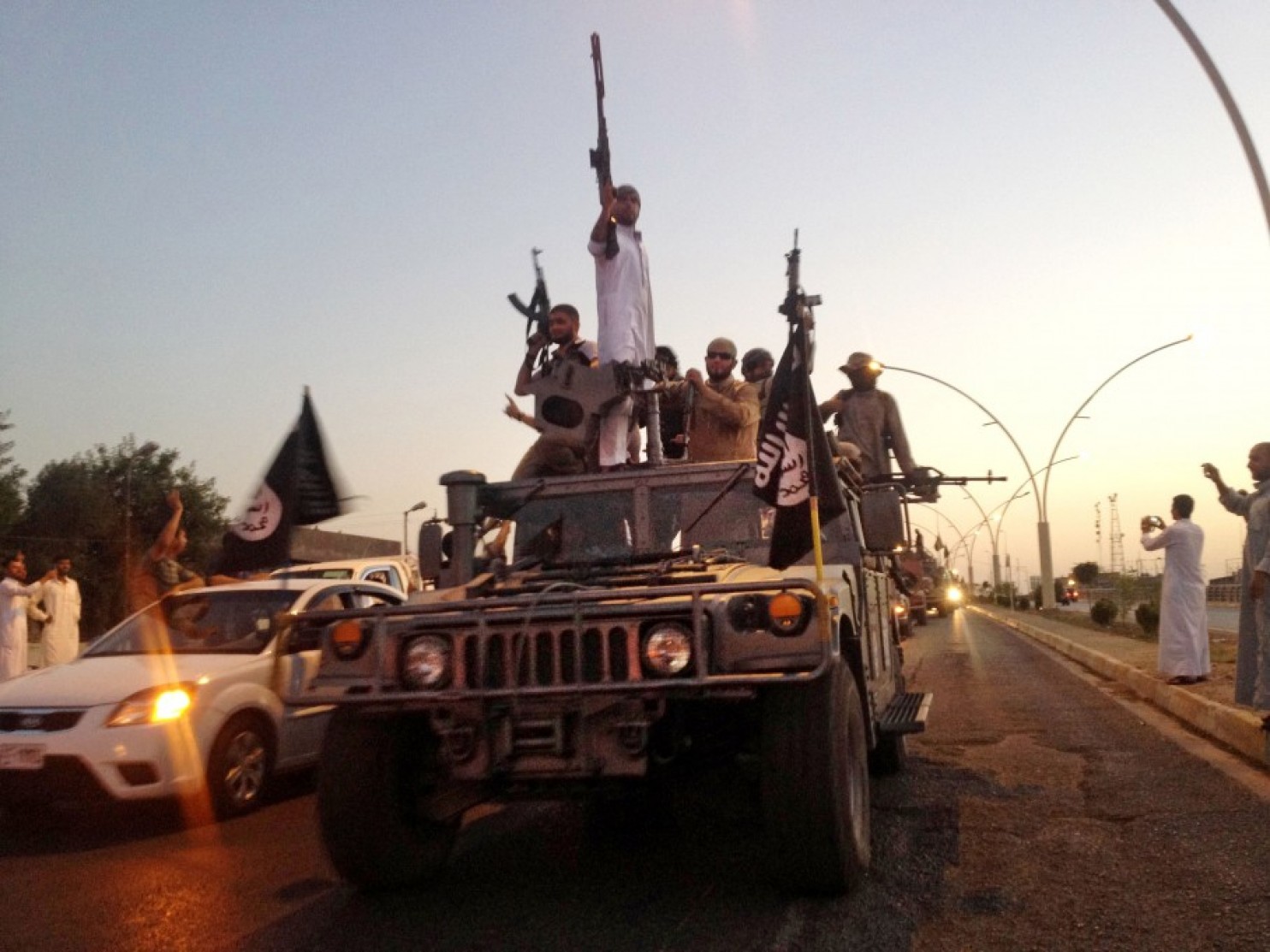
IS in MosulMilitants from the Islamic State parade down a main street in Mosul, Iraq, in June in a Humvee they commandeered from Iraqi troops. (AP Photo, File)

[T]he planning, along with the U.S. launching its first airstrike inside Mosul on Wednesday, raises questions about how the United States and its partners will be able to assist in an urban military campaign if their mission is restricted to an air campaign and advising Iraqi forces.

***************

Shortly after retired U.S. Gen. John Allen arrived in Baghdad as the new U.S. envoy to the coalition against the Islamic State, he made it perfectly clear what part of the plan against the Islamic State militant group included: taking back Mosul.

The city, Iraq’s second most populous, fell to Islamist fighters in June, as they captured broad sections of the country’s north. Mosul has remained under their control since, with religious shrines destroyed, women forced into marriage and human rights activists and others murdered after publicly disagreeing with the Islamic State.

Plans to retake Mosul already are underway. Kurdish militia troops are preparing for a complex battle to retake the city, according to a Los Angeles Times report. And Allen said Iraqi forces will launch operations to retake Mosul within the next year. [Emphasis added. — DM]

“It’s not a single battle,” he said, according to the New York Times. “It’s a campaign.”]

imrs

But the planning, along with the U.S. launching its first airstrike inside Mosul on Wednesday, raises questions about how the United States and its partners will be able to assist in an urban military campaign if their mission is restricted to an air campaign and advising Iraqi forces.

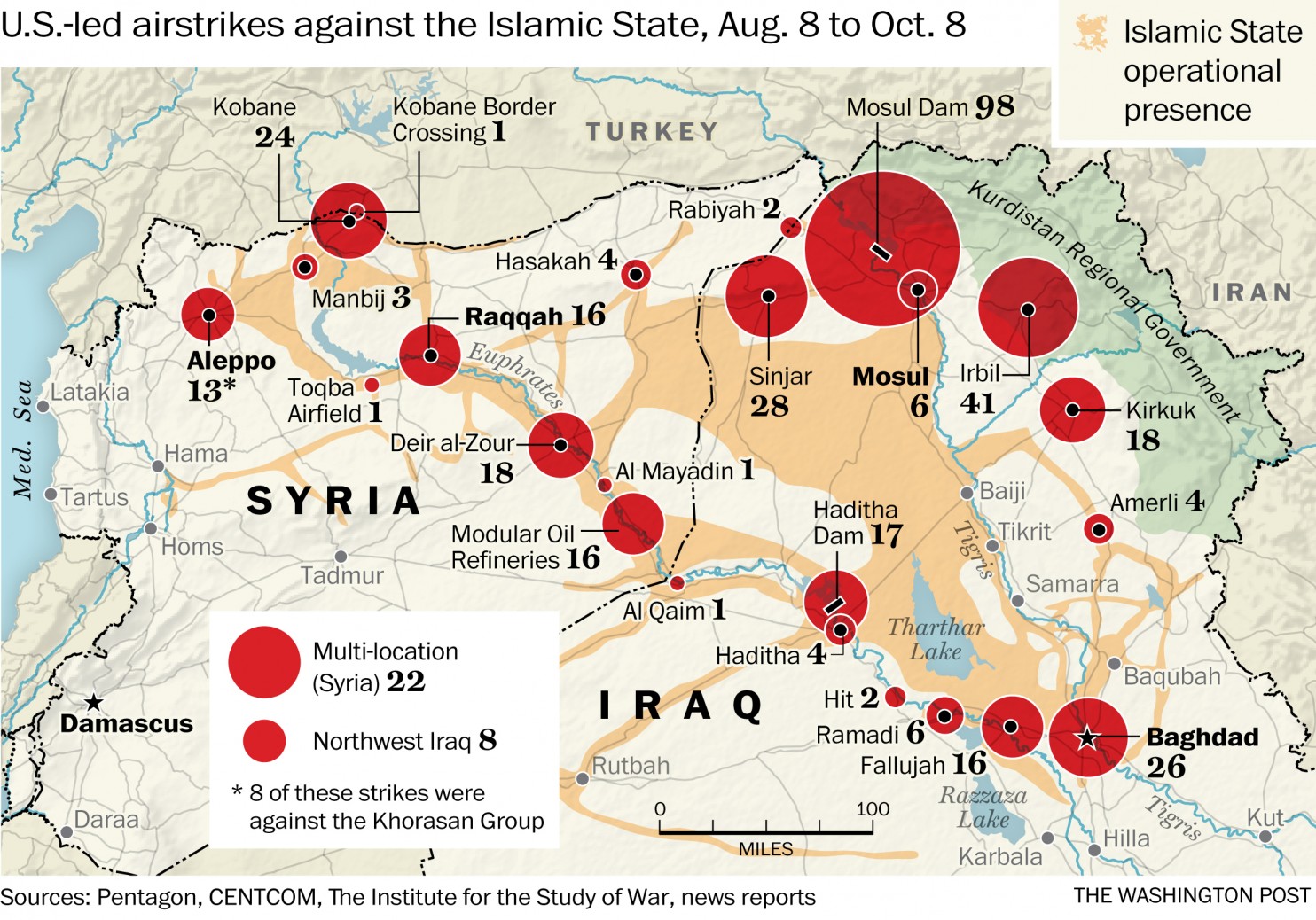
The U.S. has launched hundreds of airstrikes in Iraq and Syria in the last two months against the Islamic State, but until Wednesday they all had been carried out outside population centers. The primary targets have been militant training camps and groups of fighters who have massed in vehicles or on foot, making them obvious marks for U.S. aircraft.

As the U.S. and its partners intensified their airstrikes against the militant group in recent days, they hit a variety of targets around many of Iraq’s other major cities, including Baghdad, Irbil, Fallujah and Ramadi. Some of the strikes have been designed to keep militants out of areas they do not control, but Fallujah fell to the Islamic State months ago, and Ramadi, the capital of Anbar province, remains heavily contested.

Officials in Anbar told the Wall Street Journal this week that they are concerned the entire province could fall in coming days. They also raised concerns that too much attention has been devoted to Kobane, a Syrian town on the Turkish border that is under assault by the Islamic State and also is in danger of falling.


Special Report: How Syria policy stalled under the ‘analyst in chief’

October 9, 2014

Special Report: How Syria policy stalled under the ‘analyst in chief, Reuters, David Rohde and Warren Strobel, October 9, 2014

(Fireman: “Chief! The firehouse is on fire. Can we hose it down” Fire Chief: “Let’s analyze this. First we need to requisition a new fire hose. The old one has holes at both ends.” Fireman: “But it needs them. Water goes in one end and out the other.” Fire Chief. “So get one closed at both ends. It will work better. Trust me on this. Wait a minute. We need to decide what color hose to requisition. We’ll need a committee for that.” Et tu, Reuters?– DM)
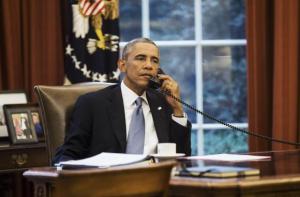
U.S. President Obama speaks on the phone with Saudi Arabia's King Abdullah from the Oval Office of the White House in WashingtonPresident Obama speaks on the phone from the Oval Office, September 10, 2014. CREDIT: REUTERS/KEVIN LAMARQUE

Decisions small as well as large are made at the White House, often with scant influence from the Pentagon and State Department and their much larger teams of analysts and advisers. Senior Cabinet officials spend long hours in meetings debating tactics, not long-term strategy, the officials said.

**********************

Throughout 2012, as signs mounted that militants in Syria were growing stronger, the debate in the White House followed a pattern. In meeting after meeting, as officials from agencies outside the executive residence advocated arming pro-Western rebels or other forms of action, President Barack Obama’s closest White House aides bluntly delivered the president’s verdict: no.

“It became clear from the people very close to the president that he had deep, deep reservations about intervening in Syria,” said Julianne Smith, who served as deputy national security advisor to Vice President Joe Biden. “And the likelihood of altering those views was low, very low.”

This summer, events overwhelmed the status quo. In June, the radical group Islamic State, after seizing wide swaths of Syria, conquered Iraq’s second largest city and threatened Baghdad as the Iraqi army collapsed. The insurgents beheaded two American journalists, increasing U.S. public support for military action. Finally, U.S. intelligence agencies detected foreign jihadists who they believe had moved to Syria to plot attacks against the United States and Europe.

The radicals had undermined the administration’s argument it had successfully ended the war in Iraq and were threatening Obama’s record of defending the homeland. The jihadists, said Smith, “turned the debate on its head.”

On September 18, Obama reversed his three-and-a-half-year opposition to military action in Syria and ordered open-ended airstrikes against militants. It wasn’t his first U-turn on Syria. In August 2012, Obama had warned President Bashar Assad that using chemical weapons was a “red line” Syria dare not cross; when evidence emerged that Damascus had gassed the rebels and civilians, Obama opted not to respond with force.

The bombing campaign, which could last for years, is a major course correction for a president with a famously cautious foreign policy.

Obama’s handling of Syria – the early about-face, the repetitive debates, the turnabout in September – is emblematic, say current and former top U.S. officials, of his highly centralized, deliberative and often reactive foreign policy.

They say Obama and his inner circle made three fundamental mistakes. The withdrawal of all American troops from neighboring Iraq and the lack of a major effort to arm Syria’s moderate rebels, they say, gave Islamic State leeway to spread. Internal debates focused on the costs of U.S. intervention in Syria, while downplaying the risks of not intervening. And the White House underestimated the damage to U.S. credibility caused by Obama’s making public threats to Assad and then failing to enforce them.

“REAL CHOKEPOINT”

This week, former Defense Secretary and CIA director Leon Panetta joined Hillary Clinton and a growing list of former cabinet members and aides who said Obama made major mistakes in the Middle East. Panetta singled out the U.S. troop withdrawal from Iraq.

“It was clear to me – and many others,” Panetta wrote in his memoir, “Worthy Battles,” “that withdrawing all our forces would endanger the fragile stability then barely holding Iraq together.”

Such arguments were rejected at the time inside the White House, where the foreign policy machine has grown dramatically in power under Obama and cabinet members and their departments have felt marginalized.

The National Security Council staff, which coordinates U.S. defense, diplomatic and intelligence policy from inside the White House, has nearly doubled in size on his watch. It has gone from about 50 under George H.W. Bush to 100 under Bill Clinton, 200 under George W. Bush and about 370 under Obama.

Decisions small as well as large are made at the White House, often with scant influence from the Pentagon and State Department and their much larger teams of analysts and advisers. Senior Cabinet officials spend long hours in meetings debating tactics, not long-term strategy, the officials said.

Robert S. Ford, the former U.S. ambassador to Damascus, recalled long meetings to debate small issues, such as which Syrian opposition members he could meet with and whether it was okay to give cell phones, media training and management classes to a local Syrian government council controlled by the opposition.

Sometimes, this more centralized White House system becomes overwhelmed.

“There’s a real choke point,” said Michele Flournoy, who served as the Under Secretary of Defense for Policy, the No. 3 Pentagon civilian, in Obama’s first term. “There’s only so much bandwidth and there’s only so much they can handle at one time. So, things start to slow down.”

Flournoy and other former officials who criticize the administration’s approach concede that the most important decisions – using military force – must ultimately be the president’s call. They argue, though, that intensified White House control has resulted in the United States being behind the curve, whether in trying to counter Russian propaganda about the Ukraine crisis or battle online recruitment by jihadists.

Syria, where the estimated death toll has topped 190,000, is cited as a prime example.

By the fall of 2012, covertly arming Syria’s rebels had been accepted by Obama’s top three national security Cabinet members – Clinton, Panetta and CIA chief David Petraeus – as the best way to slow radicalism in Syria. The president and his inner circle first rejected the advice, then mounted a small scale program to arm the rebels, and now, two years later, after Islamic State has seized swaths of Syria and Iraq, embrace the approach.

Obama’s aides say tight White House coordination is a must in an era when the United States faces threats like terrorism, which requires harnessing the capabilities of the Pentagon, the U.S. intelligence community, the State Department and other agencies. It’s the president’s duty to take ultimate responsibility for matters of war and peace, they say.

“Other than, of course, the men and women in uniform” and other officials deployed abroad, said Ben Rhodes, a White House deputy national security adviser, “only the president of the United States is assuming the risk of the cost of action.”

WHITE HOUSE CONTROL

This account of Obama’s national security decision-making is based on interviews with more than 30 current and former U.S. government officials, who have served both Democratic and Republican administrations going back to President Richard Nixon.

In some ways, Obama’s closer control and the frequent marginalization of the State and Defense departments continues a trend begun under Bill Clinton and George W. Bush.

But under Obama, the centralization has gone further. It was the White House, not the Pentagon, that decided to send two additional Special Operations troops to Yemen. The White House, not the State Department, now oversees many details of U.S. embassy security – a reaction to Republican attacks over the lethal 2012 assault on the U.S. consulate in Benghazi, Libya. A decision to extend $10 million in nonlethal aid to Ukraine also required White House vetting and approval.

On weightier issues, major decisions sometimes catch senior Cabinet officers unawares. One former senior U.S. official said Obama’s 2011 decision to abandon difficult troop negotiations with Baghdad and remove the last U.S. soldiers from Iraq surprised the Pentagon and was known only by the president and a small circle of aides.

The president, initially perceived as one of the greatest communicators of his generation, is now viewed as having done a poor job of defining and defending his foreign policy, polls indicate. A majority of Americans – 54 % – disapprove of Obama’s foreign policy performance, according to Reuters/Ipsos polling, one of the lowest ratings of his presidency.

Rhodes, one of Obama’s longest-serving national security aides, says a series of complex world crises, not policy mistakes, has driven down the president’s approval numbers. More broadly, he says, Obama has been right to be deliberative in the wake of costly wars in Iraq and Afghanistan.

“What he’s always said is that if there’s a threat against us, we will act,” Rhodes said. “But when it comes to shaping events in cultures that are foreign to the United States we have to have some degree of realism.”

Obama has had notable national security successes. His record of protecting U.S. territory from attack remains largely unblemished. Current and former officials praise his policy on nuclear talks with Iran as clear and consistent. He is building a coalition against Islamic State that includes Arab nations participating in airstrikes with the United States, Britain,France and others.

And while past presidents faced grave dangers, most notably the possibility of Cold War Armageddon, for Obama the world is very different. The decisions he must make on using U.S. military force have multiplied. This reality, supporters say, is overlooked by detractors.

Obama has launched a humanitarian military intervention in Libya; overseen counter-terrorism operations in Pakistan, Libya, Somalia, Yemen, Iraq, Afghanistan and elsewhere; moved to end his predecessor’s wars in Iraq and Afghanistan;  wrestled with lethal threats to U.S. hostages and diplomatic posts; and sent the American military to West Africa to help tackle the Ebola virus and search for kidnapped Nigerian schoolgirls.

“ANALYST IN CHIEF”

Current and former officials say the globalized world of Twitter and 24-7 news creates an expectation at home and abroad that the United States will quickly take a position on any foreign policy issue. The demand for instant American positions – and American leadership – can be overwhelming.

“One of the biggest problems in Washington,” said retired General James Jones, who was Obama’s national security advisor from 2009 to 2010, “is to find the time to think strategically, not tactically. You’d wake up and there would be a new crisis and you’d be scrambling to deal with them.”

Six years of grinding partisan warfare over foreign policy (and much else) have left Obama increasingly fatalistic about his critics.

While on vacation in Martha’s Vineyard in late August, he was widely criticized for golfing after making a condolence call to the family of murdered American journalist James Foley. Minutes after declaring Foley’s murderer – Islamic State – a “cancer” that had “no place in the 21st century,” Obama teed off with a campaign contributor, an old friend and a former NBA star.

Obama later told aides the criticism was inevitable. No matter what I do, he said, my enemies will attack me.

Far from being disengaged or indecisive on foreign affairs, as he is sometimes portrayed, Obama drives decision-making, say current and former officials.

Obama prepares thoroughly for meetings, has an encyclopedic memory and methodically dissects problems, former officials who have been with him in meetings say. The former law professor dominates foreign policy sessions, from small Oval Office gatherings to formal National Security Council meetings he chairs. Obama promoted open NSC debate, asked for dissenting opinions from cabinet members and called on junior officials who traditionally don’t speak at such meetings, they said.

Some aides complained that alternative views on some subjects, such as Syria, had little impact on the thinking of the president and his inner circle. Despite the open debate, meetings involving even Cabinet secretaries were little more than “formal formalities,” with decisions made by Obama and a handful of White House aides, one former senior U.S. official said.

Obama “considers himself to be analyst in chief, in addition to Commander in Chief,” on certain issues, according to Fred Hof, a former State Department envoy on Syria. “He comes to a lot of the very fundamental judgments on his own, based on his own instincts, based on his own knowledge, based on his own biases, if you will.”

The president’s supporters say his approach is based on principle, not bias. He ran on a platform of winding down the Iraq War and made his views crystal-clear on military action in the Middle East. Obama believed that the human and financial costs of large-scale interventions weren’t worth the limited outcomes they produced. He held that U.S. force could not change the internal dynamics of countries in the region.

THE SYRIA DEBATE

In August 2011, Obama issued a 620-word statement on Syria that his aides hoped would put him on the right side of history. After weeks of pressure from Congress, Syrian-Americans and allies in the Middle East and Europe, he called for Assad to “step aside.”

“It is time for the Syrian people to determine their own destiny,” Obama said.

Ford, ambassador to Syria from 2011 to 2014, said he supported the statement, but now regrets it because Washington didn’t back up the words with action. He said the Syria case reflects a pattern in the administration of issuing public statements without developing a clear policy.

When Assad refused to relinquish power, it became clear that the administration and its allies lacked a plan – or the political will – to forcibly remove him. American and European credibility in the region suffered.

Taking the removal of Assad into their own hands, Turkey and other Arab states overtly backed – or turned a blind eye to – the emergence of jihadist groups in Syria. American officials warned the countries that it would be impossible to control the militants, according to former U.S. officials. The Turks, according to one former official, replied that with Washington itself sitting on the sidelines, they had no choice but to back certain anti-Assad radicals.

As jihadists gained strength in the Syrian opposition in 2012, members of Obama’s first-term cabinet began to support covert U.S. action in Syria.

In the summer of 2012, three senior advisors outside the White House – Clinton, Panetta and Petraeus – proposed that the CIA train and equip the relatively moderate Syrian rebels operating as the Free Syrian Army.

At about that time, Ford said, the Free Syrian Army was warning – and U.S. officials confirmed independently – that militant groups were luring away fighters with cash. The more Western-friendly rebels had few funds to counter with.

In December 2012, Obama rejected the proposal.

Eight months later, in August 2013, U.S. intelligence concluded that Assad had used poison gas against rebels and civilians in a Damascus suburb, defying Obama’s public warning against chemical attacks. For a week, Obama appeared on the verge of launching airstrikes. After a walk with Chief of Staff and longtime aide Denis McDonough on the White House grounds, Obama changed course without consulting his national security Cabinet members and announced he would seek Congress’ approval, which never materialized. Instead, Washington and Moscow agreed on a deal to remove Syria’s chemical arms.

The missile strike reversal was widely cited by officials interviewed as the clearest example of Obama not engaging in a full Cabinet-level debate before making a strategic decision.

State Department officials warned for years that extremists would benefit from a power vacuum in Syria. “We were saying this area is going to be controlled by extremists and they’ll link up with Iraq,” said Ford. Obama made the wrong decision, Ford concludes. “It’s clear, in retrospect, that they needed more help then to counter the extremism.”

Another former official involved in Syria policy defended Obama. He said that in the early years of the Syrian conflict, with the long Iraq War fresh in their minds, Obama’s senior lieutenants struggled to find any vital national interest that would merit American intervention. Warnings of terrorism were discussed, this official said. But the White House responded that there were “more efficient and cheaper ways of dealing with the threat than intervening in Syria.”

Smith, the former NSC aide, said the Obama years hold a lesson.

“The instinct is to centralize decision-making with the hope of exerting more control,” she said. “But that often limits the U.S. government’s agility and effectiveness at a time when those two traits are most needed.”
Iran Says It’s Under Attack by ISIS

October 9, 2014

Iran Says It’s Under Attack by ISIS, Daily BeastJassem Al Salami, October 9, 2014

IS figherYouTube

Iranian political and military leaders tend to censor terrorist threats inside Iran, to bolster their reign over the country. But the ISIS threat is so bold inside Iran that even the highest officials have publicly acknowledged it.

While the threat of Sunni extremism influenced by ISIS success is increasing, the Iranian military’s front lines have appeared to be unreliable in the eastern part of the country.

**********************

Suicide bombs. Captured soldiers. Guerrilla attacks. Iran claims it’s under assault by Sunni militants like ISIS. Now Tehran is making mass arrests to try to stop the onslaught.

On May 13, 2014, a pickup truck approached a caravan of white vans moving on a road near Baqubah, east of Baghdad, in Iraq. Within few meters of the caravan, the pickup exploded, leaving five Iranian engineers and several of their Iraqi guards dead, according to local news reports. The attack came less than 24 hours after a threat by ISIS spokesperson, Abu Mohammad al Adnani.

ISIS could—and very much wanted to—“transform Iran into pools of blood,” Adnani said. After all, Iran was the “bitterest enemy” of the Islamic State.

But al Qaeda long has been known to have deep, complex relations with Iran. And so ISIS, which grew out of a branch of al Qaeda in Iraq, “held back its soldiers and repressed its rage over the years to preserve the unity” of al Qaeda’s ranks.

“So let history record that Iran owes an invaluable debt to al Qaeda,” he added.

But in May, Adnani announced a change of plans: ISIS would not respect al Qaeda requests any more. And while Adnani did not overtly threaten Iran, the May 13th attack turned out to be one in a string of purported terror attacks against Iran and Iranians. These attacks have been pinned by local media and Iranian officials to ISIS and other Sunni extremist groups.

The American intelligence community has heard the claims. But they’re not sure whether the violence can be blamed on the Islamic State—or some other Sunni militants. “While no one is ruling out the possibility of an ISIL presence in Iran,” a U.S. intelligence official told The Daily Beast, using the government’s preferred acronym for ISIS, “at this time we are not able to validate reports of any activity there.”

ISIS’s rampage through Iraq has produced collateral damage that’s been largely unnoticed in the West. Iran, on the other hand, has been paying close attention. When ISIS took over the city of Jalawlah near the Iranian border, several Iranian media outlets reported a heavy attack on a border guard post near the city of Qasr-e-Shirin—on Iranian soil. The initial toll was reported four guardsmen killed in the incident. Qasr-e-Shirin’s representative in the Iranian parliament, a hardliner conservative named Fathollah Husseini, denied any casualties. But less than two days later, Iranian media outlets reported on funerals held for privates killed in the incident. Later reports suggested at least 11 Iranian border guards were killed in the incident.

Iranian political and military leaders tend to censor terrorist threats inside Iran, to bolster their reign over the country. But the ISIS threat is so bold inside Iran that even the highest officials have publicly acknowledged it. MohamdReza Rahmani Fazli, the Iranian interior minister and the highest ranking government official in charge of coordinating police and security efforts inside Iran, issued a warning on September 7 saying “Daesh”—a pejorative term for ISIS—“is posed to attack Iran imminently.”

Perhaps. But don’t expect a full-out ISIS invasion. After the extremist group took the Iraqi city of Tikrit in early July 2014, the majority of ISIS’s efforts have been concentrated on consolidating its power and eliminating pockets of resistance inside its territory. Evidently, ISIS’s current strategy is to launch guerrilla attacks and not a full invasion of Iran’s border regions. Given the history of arrangements of Iranians with sunni extremist militia that directly threatened Iran (as noted by Abu Mohamad Al Adnani), such attacks could push Iran to dial back its support for the Iraqi army and force Iran to accept ISIS’s presence in Sunni-populated regions of Iraq.

On the August 28, Jihadi twitter accounts associated with ISIS reported clashes of Islamic State sympathizers with Iranian Revolutionary Guard Corps units near the city of Urmia in West Azarbaijan providence. Iranian news outlets claimed that the attack was carried by ISIS, but no casualties were reported. The results of another strike, not far away, were quite different. On October 2, independent sources reported another ISIS attack near Khoi city, close to Urmia. The attack was an assassination which targeted an IRGC Sargent. Thousands attended the funeral of Sargent Mostafa Mohammad-Nezhad in Urmia on October 3.

In response, Iran has carried out mass arrests at home—and backed a series of offensives against ISIS abroad. On October, Iranian Minester of Intelligence Mahmoud Alavi was summoned by Iranian parliament to report on the latest developments around Sunni extremist groups in Iran. “As a result of tens of intelligence operations, more than 130 individuals believed to be key members of Takfiri [infidel] groups were arrested in past few months,” Alavi reported, using a pejorative term commonly attached to ISIS and other Sunni extremist outfits.

These arrests, Alavi claimed, were the result of a five-month long intelligence efforts which foiled at least four suicidal attack in Tehran—including a suicide bombing which targeted a massive demonstration in Tehran in late July.

Iran’s support for the Iraqi army—and Shi’a militias inside Iraq—is also putting a great deal of pressure on ISIS. On August 31, U.S. warplanes delivered at least four air strikes in support of Shi’a militia operations in the Iraqi village of Amirli. Later reports revealed that the operation in fact was led by notorious commander of the IRGC’s Qods Force, Maj. Gen.Qassem Suleimani.

Early on October 6, Iraqi army and Shi’a militia units operating in Anbar Providence identified a meeting of a half-dozen or more senior ISIS field commanders. According to Iraqi Army Lt. Gen. Rashid Falih, the location of the meeting place were passed to allied forces and three air strikes were carried “immediately” to the given coordinates. However, the results of that particular strike were not clear, The methodology suggests that Iraqi officers are probably mediating between allied officers and their Iranian and Iranian-led counterparts.

ISIS and its sympathizers have begun to open up a wide front against Iran, according to local media accounts. The group not only has demonstrated its presence in Iran’s Shi’ite west and north, closer to Iraq and Turkey. ISIS is also beginning to make its presence felt in long-troubled and mostly Sunni-populated eastern Iran. In early September 2014 residence of Mashhad city in northeastern iran reported graffiti hailing ISIS. The tags were signed by an unknown group calling itself the “Khorasan Division.” At the same time, the Tasnim news agency, run by the IRGC, reported that ISIS is sending propaganda via text message inside Iran. One of the texts: a claim that the Iranian government had poisoned Dates in southern Iran to kill Iran’s Arab minority.

While the threat of Sunni extremism influenced by ISIS success is increasing, the Iranian military’s front lines have appeared to be unreliable in the eastern part of the country. An attack in early September by a Sunni jihadist group called Jaysh Al Adl overran a border post called Eskan in a matter of minutes. JAA attack was executed “ISIS-Style.” 26 armed pick-up trucks, known as “technicals,” carrying 150 fighters were reportedly involved in the attack.

According Jaysh Al Adl, the attack started midnight when JAA fighters opened suppressive fire on the post and destroyed a BMP-2 armored vehicle inside. Then a suicide bomber drove a car to the post’s gate to cause a breach. To his astonishment, the driver found the gate open; guards already had abounded the border post. The driver parked the car near another BMP armored vehicle, ran away and then detonated 600 kilograms of explosive via a remote detonator. Backup forces rushed to the scene, but the JAA was ready. On the roads leading to the post, JAA fighters ambushed a quick response team, killing at least one IRGC officer.

JAA claims it have killed 30 IRGC officers in the raid, but there is no evidence supporting that claim. Nonetheless, the severity of the incident is appalling—especially given Iran’s recent history of trying to stop such strikes. In past 10 months, southeastern Iran has seen several brutal attacks from JAA. One attack in November 2013 killed 17 Iranian border guards; another in March 2014 captured five soldiers alive [6]. In May, the IRGC declared that it was taking over responsibility of border police and is reinforcing border posts. It was one of these reinforced posts that was ran over almost with no resistance.

But perhaps the most terrifying attack wasn’t on Iranian soil. It involved Iranian citizens. On May 20, a pickup truck drove to an Iraqi army checkpoint in the city of Tal Afar. While waiting on line, the driver detonated the truck. 13 guards and civilians died, according to local press reports. The driver was an Iranian man in his mid-30s.

Abou Ebrahim Al Irani was in Iran, less than three months before the attack. ISIS had summoned him from the Talesh area in the Guilan province north of Tehran, to perform the unholy duty. Less than a week later, the head of Iranian Ministry of Intelligence’s branch in Guilan claimed that Iranian security forces have captured a Takfiri cell leader there. However, the security official, which Iranian state media didn’t name, didn’t say who was captured—whether Iran had really eliminated the cell which sent Abu Ebrahim to Iraq.

But if an Iranian extremist cell could so easily spare a suicidal jihadi to go to Iraq to perform an attack, the real question is: How many others are out there?

ISIS on verge of seizing “complete control” in Anbar: tribal official

October 9, 2014

ISIS on verge of seizing “complete control” in Anbar: tribal official, Asharq al-Awsat, October 9, 2014

(According to Wikipedia, “The paper was founded with the approval of the Saudi royal family and government ministers, and is noted for its support of the Saudi government.[2] The newspaper is owned by Faisal bin Salman, a member of the Saudi royal family.[3]“– DM)

A man looks at a vehicle belonging to the Iraqi security forces in the Anbar province town of HitA man looks at a vehicle belonging to the Iraqi security forces in the Anbar province town of Hit, Iraq, on October 6, 2014. (Reuters)

It was Anbar’s police force that was protecting citizens from ISIS, he said, adding that military forces were actively hindering efforts to combat the extremist group. “Unfortunately, the military has become a source of assistance for ISIS because for the most part ISIS is able to attack and defeat the military, taking control of their arms and equipment,” said Ibrahim.

**********************

Baghdad, Asharq Al-Awsat—Iraq’s restive western province of Anbar is on the verge of completely falling into the hands of the Islamic State of Iraq and Syria (ISIS) unless urgent action is taken to address military failures, the Anbar Tribal Council warned on Wednesday.

The Anbar Tribal Council, the senior-most Sunni tribal organization in the province, is backing central government attempts to combat ISIS but has complained to Baghdad about the appointment of Lt. Gen. Rashid Fleih as head of the Anbar Military Command, calling for him to be replaced. In comments to Asharq Al-Awsat, Anbar Tribal Council member Faris Ibrahim said “[Fleidh] is unable to do anything.”

“The security situation in Anbar Province is going from bad to worse due to a lack of support, as well as the almost complete absence of security and military leadership. The military leadership is unable to devise new plans to address ISIS advances on the ground,” Ibrahim added.

“ISIS has strongly advanced in a number of areas in the province following the formation of the international alliance, as part of attempts to impose their position on the ground as a fait accompli.”

The Anbar Tribal Council member alleged that ISIS is also setting up sleeper cells in the province with the objective of entrenching its position and securing even more territory.

More than 500,000 residents of Anbar province have been displaced by fighting between Iraqi forces and ISIS since the conflict began in December 2013. Despite Iraqi military efforts and the formation of an international alliance to combat the terrorist group, ISIS has continued to advance in Iraq. ISIS forces most recently took over the town of Hit last week, leading to attempts by Shi’ite volunteer fighters backed by Iraqi military forces to recapture the western town.

“It is strange that while ISIS is developing its presence and capabilities on the ground in Anbar, military and security leadership are not doing anything new to address this. As a result of this, most parts of Anbar province are now completely in ISIS’s hands, including Ramadi city center,” Ibrahim told Asharq Al-Awsat.

It was Anbar’s police force that was protecting citizens from ISIS, he said, adding that military forces were actively hindering efforts to combat the extremist group. “Unfortunately, the military has become a source of assistance for ISIS because for the most part ISIS is able to attack and defeat the military, taking control of their arms and equipment,” said Ibrahim.

International efforts to combat ISIS in Iraq have focused on central and northern parts of the country, where ISIS is actively advancing. The terrorist group had initially advanced into Iraq from Syria through the western province, which had been the center of a Sunni-led protest movement against former Prime Minister Nuri Al-Maliki’s government over its perceived sectarian bias.

The government put together by the new premier, Haider Al-Abadi, has received a cautious welcome from Iraq’s Sunnis. However, the Anbar Tribal Council has called for Baghdad and the anti-ISIS international alliance to do more for Anbar.

Faris Ibrahim called on Baghdad to do more to tackle ISIS in Anbar, saying it was a critical front in the overall struggle, yet remained overlooked.

He said: “These operations have not reached the required level. It is strange that Anbar province has been completely forgotten over the past three months with the focus being on Mosul and the northern provinces. However, everybody knows that Anbar is the main incubator of ISIS and it is expanding to Iraq’s other regions from here . . . Therefore ignoring Anbar has led to disaster, as we are seeing today.”

The truth about diversity

October 8, 2014

The truth about diversity, Israel Hayom, Clifford D. May, October 8, 2014

(Please see also a satirical post by Mike at Make an Effort, in which he proposes a Middle East solution. Here’s an excerpt:

Here in the United States we have an abundance of Well Trained, Amazingly Equipped and Overly Funded Diversity Trainers.  (It’s worth noting that many of these same people are cross-trained in Sexual Harassment Education and Gender Sensitivity Issues.  All Added Value as far as my Proposal is concerned.)

I cannot believe it would take much to initiate a Mission composed of the Majority of these ‘Special Operators’ to head over to Syria and Iraq to impose Mandatory Diversity Training.  We can even make sure they wear comfortable shoes so they don’t challenge the President’s ‘No Boots on the Ground’ edict.

It may well be the best idea yet. It’s short; please read the entire thing.- DM)

Freedom may not be everyone’s cup of tea.

*****************

In theory, we Americans are great proponents of diversity. In practice, how many of us stop to seriously consider the meaning of the word? If peoples really are diverse — if we differ not just about clothes and cuisine but over ideas, values, interests, morality, and human rights — that implies there is no “international community,” certainly not one that embraces “international norms.” For years, we’ve told ourselves the world is a “global village.” Turns out it may be more like the “several remote nations” to which Gulliver traveled.

Multiculturalists of the Left are most likely to misconstrue diversity. But there also are those on the Right who believe all human hearts yearn for freedom. By now, I think, it’s become apparent: Freedom may not be everyone’s cup of tea.

The Iranians who took to the streets chanting “Death to the dictators” in 2009: I am convinced they did — and still do — want freedom, which, at a minimum, would mean liberation from theocracy, limiting the power of the billionaire mullahs, as well as the Islamic Revolutionary Guards and the Basij thugs who have oppressed ordinary Iranians since the Islamic Revolution of 1979.

Those protesting in Hong Kong now are risking life and limb to prevent Beijing Communist Party bosses from encroaching on their freedoms. Under the 1984 declaration that paved the way for the British colony to be turned over to China, Hong Kong was promised “a high degree of autonomy” for the half century following the transfer of sovereignty in 1997. The idea was not that when 2047 rolled around the people of Hong Kong would accept dictatorship with bovine passivity. Rather, it was assumed that by then dictators would have been relegated to the dustbin of history. At this point, that seems rather a long shot.

In a diverse world, there will be those who believe in peaceful coexistence and those who believe in what Franklin Roosevelt called “philosophies … based on conquest and the subjugation of other people”; those who believe that liberal democracy is the best form of governmental organization and those who prefer authoritarianism or totalitarianism; those who regard the intentional killing of other people’s children for political purposes as wrong, and those who kill other people’s children for political purposes, as well as moral relativists who say: “One man’s terrorist is another man’s freedom fighter.”

Addressing the U.N. General Assembly last month, President Barack Obama asserted that “the future belongs to those who build, not those who destroy.” First: That’s a hope, not a fact. Second: The hundreds of young Muslim men (and some women) flocking to the Islamic State group in Syria and Iraq see no contradiction between the two.

As they destroy ancient Christian, Yazidi, Kurdish and “apostate” Muslim communities, they also intend to build a caliphate for the 21st century, an empire in the image of what they imagine Muhammad founded in the seventh century, what my colleague Reuel Marc Gerecht calls “a new conquest society.” Obama may not think that’s a useful thing to construct but, in a diverse world, he can hardly expect everyone to concur.

Similarly, Hamas wants to build “an Islamic state in Palestine, all of Palestine” as Hamas Political Bureau member Mahmoud al-Zahar said last week. That would, obviously, require the destruction of Israel, a goal to which Hamas has always been openly and unequivocally committed.

Some of the Americans and Europeans who hold up signs reading “Free Palestine” ignore that. Others are just not troubled by it. Many turn a blind eye to this, too: Wherever Islamic militants rule, freedom is limited to a choice between submission and death. In Gaza, as in Islamic State, as in the Islamic Republic of Iran, no one gets up on a soap box in the public square, speaks his mind, criticizes those in power, and then goes home for a quiet dinner with the family. In a diverse world, some people are tolerant; others jail or slaughter those who displease them.

There is diversity among Islamists. For example, Hamas, al-Qaida and Iran don’t recognize the legitimacy of Islamic State. Over the weekend, however, the Pakistani Taliban declared its allegiance to Caliph Ibrahim, as the entity’s ruler, Abu Bakr al-Baghdadi, now calls himself. That must have come as a disappointment to al-Qaida leader Ayman al-Zawahri, who is al-Baghdadi’s rival (but not his enemy — there’s a difference).

There are Russians who value freedom. President Vladimir Putin is not among them. Then-president George W. Bush was mistaken when he looked into Putin’s eyes and thought he saw an aspiring democrat, just as Obama was wrong to think he could “reset” relations with Russia based on mutual respect and a shared commitment to peace and international law.

If the polls are to be believed, more than eight out of 10 Russians support Putin. An analysis by Radio Free Europe/Radio Liberty leads to the conclusion that most Russians value national pride and power over freedom and democracy. That’s diversity for you.

Within the U.S., diversity is most loudly trumpeted on our campuses — ironic because a scholar with unfashionable ideas has about as much chance of getting tenure as of winning the lottery. People forget that tenure was supposed to protect intellectual diversity, not abolish it.

And while many Americans continue to treasure freedom, others are more concerned with equality of outcome. There is a tension between the two because when individuals with dissimilar backgrounds, habits and talents compete in a free market they inevitably wind up in different places. But that’s not the kind of diversity most of those who claim to be championing diversity are willing to defend.

Turkey’s leaders see Kobani as opportunity, not threat

October 8, 2014

Turkey’s leaders see Kobani as opportunity, not threat, al Monitor, Amberin Zaman, October 7, 2014

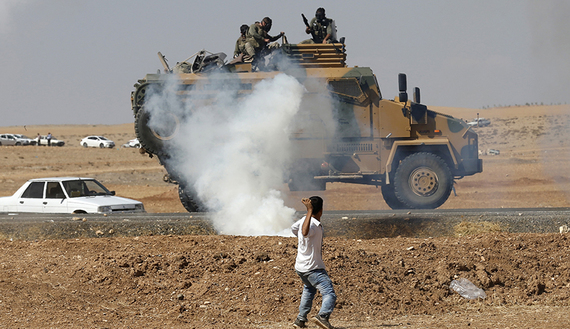
A protester throws stones at an armoured army vehicle during a pro-Kurdish demonstration, near the Mursitpinar border crossing on the Turkish-Syrian border, in SurucA protester throws stones at a Turkish armored vehicle during a pro-Kurdish demonstration in solidarity with the people of Kobani, near the Mursitpinar border crossing on the Turkish-Syrian border, Oct. 7, 2014. (photo by REUTERS/Umit Bektas)

The fall of Kobani would deal a severe blow to Kurdish independence hopes and bolster Turkey’s political goals.

The town has emerged as a symbol of Kurdish resistance.

***************

As Islamic State (IS) fighters keep up their battle to gain control over Kobani, a strategic Syrian Kurdish-controlled enclave on Turkey’s border, the effects of the conflict are being felt in Turkey itself. Thousands of Kurds took to the streets across the country on Oct. 7 to protest Turkey’s inaction against IS’ seemingly unstoppable advance. In the southeastern town of Varto, the government slapped curfews on six provinces in the mainly Kurdish southeast region after clashes between protestors and the security forces, and between rival Kurdish groups, left at least 14 people dead. Elsewhere across the country, police clashed with demonstrators, trying to push them back with pressurized water and pepper spray while the Kurds responded with Molotov cocktails in a foretaste of the violence that is likely to engulf the country should Kobani fall.

None of this comes as a surprise. Many Kurds continue to believe that Turkey is complicit in the jihadists’ onslaught against Kobani. Cemil Bayik, one of the top commanders of the Kurdistan Workers Party (PKK), repeated this claim in a Sept. 25 interview with Al-Monitor. Abdullah Ocalan, the imprisoned PKK leader, is threatening to call off peace talks with the Ankara government should there be a massacre in the enclave. Turkey denies it is siding with IS.

But it is doing little to aid the Kurds. This in turn invites the question of whether Turkey sees the Kurds as a greater threat than the jihadists, who stand to grab their third border crossing with Turkey. Turkish President Recep Tayyip Erdogan appeared to suggest that IS and the PKK were equally dangerous. “It is wrong to view them differently, we need to deal to them jointly,” he told reporters Oct. 3 in Istanbul. Erdogan’s comments hold the key to understanding Turkey’s policy on Kobani.

Turkey’s inaction over Kobani is undermining the peace process. Erdogan’s hopes of winning Kurdish support for constitutional amendments that would boost his presidential powers hang on friendship with the Kurds. A breakdown of the PKK’s 18-month-long cease-fire would likely jeopardize his ruling Justice and Development Party’s (AKP) chances in nationwide parliamentary elections scheduled for June. None of this appears to faze the Ankara government. This is because Erdogan and his AKP disciples view Kobani as an opportunity rather than a threat.

The opportunity ought to be to win the hearts and minds of Turkey’s Kurds by riding to the rescue of their brethren in Syria. Instead, Erdogan has chosen to exploit Kobani’s imminent fall to wrest maximum concessions from assorted Kurdish leaders. This was amply on display during last week’s secret meeting in Ankara between Salih Muslim, the co-chair of the Democratic Union Party (PYD), and senior Turkish officials from the Foreign Ministry and the national intelligence agency, MIT. Muslim reportedly beseeched the officials to allow the passage of arms and, most crucially, anti-tank weapons through the Mursitpinar border crossing with Kobani to enable Syrian Kurdish People’s Protection Units (YPG) fighters to fend off IS. Turkey said it would do so only if the PYD severed all its ties with the Syrian regime, joined the rebels, dissolved the PYD-dominated local governments running the enclaves, shared power with rival Syrian Kurdish parties and distanced itself from the PKK.

Muslim seems to have offered conflicting versions of what transpired, telling Al Jazeera that “agreement was reached in a number of areas” and the BBC that Turkey “did not keep its promises.” He has not responded to Al-Monitor’s repeated requests for comment. Either way, it’s hard to imagine that he yielded to Turkey’s demands or that he even has the authority to do so, because Ocalan and the PKK leadership in the Kandil Mountains call the final shots.

Turkey to its credit has offered sanctuary to more than 100,000 refugees from Kobani, and it is letting wounded YPG fighters in for treatment in hospitals. But Turkey would probably be happy to see Kobani fall. The town has emerged as a symbol of Kurdish resistance. It hosted Ocalan when he used to live in Syria under the patronage of the late Syrian President Hafez al-Assad. Kobani also has huge strategic significance. It lies between a swath of uninterrupted Kurdish-controlled towns and villages to the east collectively known as the canton of Jazeera and the Kurdish-administered town of Afrin to the southwest. The Kurds have long wanted to link the three by pushing out IS and other Syrian rebels from the areas separating them. The prospect of a Kurdish entity run by the PKK is more than Turkey, and especially its generals, can stomach.

Kobani’s fall would deal a humiliating blow to the PKK and weaken its support among Syria’s Kurds. It would also force Muslim and the PYD to patch up their differences with Massoud Barzani, the president of the Kurdistan Regional Government (KRG) in Iraq, who claims to be the “true leader” of all the Kurds. Although Barzani has spoken in defense of Kobani, he has yet to reproach Turkey over its stance.

Meanwhile, the PKK’s threats to resume its war sound like bluster to Turkish ears. Aaron Stein, a security analyst, told Al-Monitor, “The Turkish government is banking on the fact that the PKK can ill afford to open a second front against Turkey when it is battling IS in Iraq and in Syria.” Not only that, Ocalan would be loath to condemn himself to political irrelevance and spend the rest of his days rotting in prison. No matter how bitter, Kobani is a pill the Kurds will be forced to swallow. Ocalan will be forced to continue the peace talks, the pro-Kurdish People’s Democracy party (HDP) will play along and the PKK will hold its fire. This, anyway, seems to be Ankara’s thinking.

But it is fraught with risk.

The new generation of Kurds, as Bayik warned in his interview with Al-Monitor, is so radicalized that even the PKK finds it hard to keep them in line. Should Ocalan be perceived as capitulating to Turkey, he would lose his grip over them, too.

It was the fear of a PKK-dominated Kurdish statelet in Syria that propelled Turkey to resume peace talks with Ocalan in 2012 in the hope that he would keep the Syrian Kurds’ aspirations in check. The plan doesn’t seem to have worked. “The peace process began because of Syria’s Kurds,” recalls Arzu Yilmaz, a scholar of Kurdish affairs at Ankara University. “And it is because of them that it will unravel,” she concludes.

Editor’s Note: This piece has been updated since its initial publication.


U.S. officials: ISIS will capture Kobani, but it’s not a big concern to us

October 8, 2014

U.S. officials: ISIS will capture Kobani, but it’s not a big concern to us, CNN, Holly Yan and Elise Labott, October 8, 2014

(Please see video at the link. Turkey is not interested in helping the Kurds in Kobani, including the Kurdish fighters who are getting overwhelmed. Is keeping Turkey happy part of the Obama Administration war “strategy?”– DM)

As Time.com put it, “If the ISIS militants take control of Kobani, they will have a huge strategic corridor along the Turkish border, linking with the terrorist group’s positions in Aleppo to the west and Raqqa to the east.”

And Staffan de Mistura, U.N. special envoy for Syria, warned of the horrors ISIS could carry out against the people of Kobani — horrors it has carried out elsewhere. “The international community needs to defend them,” he said. “The international community cannot sustain another city falling under ISIS.”

********************

The key Syrian border city of Kobani will soon fall to the Islamist terror group ISIS, several senior U.S. administration officials said.

They downplayed the importance of it, saying Kobani is not a major U.S. concern.

But a look at the city shows why it would mark an important strategic victory for the Islamic mlitant group. ISIS would control a complete swath of land between its self-declared capital of Raqqa, Syria, and Turkey — a stretch of more than 100 kilometers (62 miles).

As Time.com put it, “If the ISIS militants take control of Kobani, they will have a huge strategic corridor along the Turkish border, linking with the terrorist group’s positions in Aleppo to the west and Raqqa to the east.”

And Staffan de Mistura, U.N. special envoy for Syria, warned of the horrors ISIS could carry out against the people of Kobani — horrors it has carried out elsewhere. “The international community needs to defend them,” he said. “The international community cannot sustain another city falling under ISIS.”

Coalition batters ISIS positions with airstrikes

A U.S.-led coalition has been pounding ISIS positions in the region with airstrikes for a few weeks.

The latest strikes, late Tuesday into Wednesday, included nine in Syria, the U.S. military said. Six were in the Kobani area, destroying an ISIS armored personnel carrier, four armed vehicles and two artillery pieces, U.S. Central Command said. U.S. and coalition forces also conducted five airstrikes against ISIS in Iraq, the military said.

The primary goal of the aerial campaign is not to save Syrian cities and towns, the U.S. officials said. Rather, the aim is to go after ISIS’ senior leadership, oil refineries and other infrastructure that would curb the terror group’s ability to operate — particularly in Iraq.

Saving Iraq is a more strategic goal for several reasons, the officials said. First, the United States has a relationship with the Iraqi government. By contrast, the Obama administration wants Syrian President Bashar al-Assad to step down.

Another reason: The United States has partners on the ground in Iraq, including Iraqi forces and Kurdish fighters known as Peshmerga.

Local fighters apparently made some headway Wednesday morning, when some ISIS militants in Kobani were pushed back to the city’s perimeter, Kurdish official Idriss Nassan said.

The battles have been bloody. More than 400 people have been killed in the fight for Kobani since mid-September, the Syrian Observatory for Human Rights said. The opposition group said it has documented the deaths of 219 ISIS jihadists, 163 members of the Kurdish militia and 20 civilians.

Kobani mapMap: Kobani (Ayn al-Arab)

U.S. plan against ISIS: Iraq first, then Syria

The United States’ goal is to first beat back ISIS in Iraq, then eliminate some of its leadership and resources in Syria, the U.S. administration officials said.

If all goes as planned, by the time officials turn their attention to Syria, some of the Syrian opposition will be trained well enough to tackle ISIS in earnest.

Washington has been making efforts to arm and train moderate Syrian opposition forces who are locked in a fight against both ISIS and the al-Assad regime.

Training Syrian rebels could take quite a long time.

“It could take years, actually,” retired Gen. John Allen said last week. “Expectations need to be managed.”

The United States also wants Turkey to do more, the officials said. The administration is urging Turkey to at least fire artillery at ISIS targets across the border.

But the Turkish reluctance, the officials say, is wrapped up in the complex relationship with their own Kurds and the idea that they don’t want to help any of the Kurds in any way.

Hundreds of strikes, millions of dollars

The United States and its allies have made at least 271 airstrikes in Iraq and 116 in Syria.

The cost? More than $62 million for just the munitions alone.

The effect? Negligible, some say, particularly in Iraq.

One by one, the cities have fallen to ISIS like dominoes: Hit, Albu Aytha, Kubaisya, Saqlawia and Sejal.

And standing on the western outskirts of Baghdad, ISIS is now within sight.

“That’s DAIISH right over there,” said Iraqi Brig. Gen. Ali Abdel Hussain Kazim, using the Arabic acronym for ISIS.

The militants’ proximity to the capital is cause for concern. If the terror group manages to infiltrate and launch attacks in Baghdad or its green zone, the results could be disastrous.

Kazim said ISIS has not been able to move from eastern Anbar province to Baghdad. But another brigadier general said that’s not even the biggest threat.

The real danger to the Iraqi capital, Brig. Gen. Mohamed al-Askari said, is from ISIS sympathizers in the city.

“They are a gang,” he said. “They deploy among civilians. They disappear into the civilian population and camouflage themselves.”