Archive for the ‘Islamic State’ category

Putin Plays Mideast Chess as Obama Looks On

October 1, 2015

Putin Plays Mideast Chess as Obama Looks On, American ThinkerJonathan F. Keiler, October 1, 2015

(Unfortunately, Obama was “in the game” which led to the nuke “deal” with Iran. There, he was not incompetent; he got what he sought. — DM)

Obama has made a lot of foreign policy mistakes in office, but his capitulation on the Iranian nuclear talks followed by Russia’s move into Syria is impossible to explain away as anything but a stupendous strategic fiasco.  Incompetence is too nice a word.  Obama was never even in the game.

*********************

It is sometimes said that in negotiations with foreigners, American leaders play checkers, while their wilier opponents play chess.   There is perhaps some truth to this, as American leaders sometimes chase short-term political results, a consequence of democratic governance and constantly changing leadership.  By contrast, despotic Persians are credited with inventing chess, and in modern times autocratic Russians have been its master, and so it is tempting to say of President Obama’s dealings with those two countries that the analogy holds.

But that is way too charitable.  As Vladimir Putin skillfully reasserts Russian power and influence in the Middle East with Islamic Persian Iran as a willing partner, a more apt analogy might be that while the Russians and Iranians move their chessmen, isolating and threatening opposing pieces, Obama is not even at the table, but rather childishly looking on, as he pushes diplomatic dirt around the Middle East sandbox.

For over 150 years, a primary objective of Western diplomatic and military strategy was to keep the Russians out of the Middle East and Southwest Asia.  In the 1850s, the British and French went to war in Crimea to protect the Ottomans from Russian predation and to preserve the balance of power.  Later, the so-called “Great Game” centered on similar British efforts to frustrate Russian domination of Iran and Afghanistan.  A century later, the United States took up the task, offsetting Russian influence in newly socialist Arab dictatorships by backing Israel and more traditional Arab monarchies in the Middle East, while openly and successfully opposing the Soviet incursion into Afghanistan.

Today, one can’t even say there remains any Western strategy regarding Russia.  Western Europe has mostly forfeited its military and political influence overseas to support decadent welfare states, even as it is being progressively and deliberately overwhelmed by millions of Islamist migrants.  Under Obama, who supports and admires Europe’s demise, the United States has increasingly joined in the decline.  The laughable Libyan campaign, “fought” by Europeans while the U.S. led from behind, set an example of pursuing a feckless, feel-good military campaign without regard for consequences or traditional strategic concerns.  Obama’s encouragement of the so-called Arab Spring and its Islamist provocateurs almost lost Egypt and did lose Syria, with catastrophic humanitarian and geopolitical results.

Putin is taking advantage of American weakness and inaction.  A half-century of successful American effort to keep the Russians out of the Middle East has been forfeit in a few months of breathtaking American diplomatic and military incompetence.  Obama’s capitulation in the Iran deal effectively completed the groundwork for the Russian move, Putin having carefully monitored America’s year-long and ineffectual air campaign against ISIS.  Putin now claims that Russia’s push into Syria is to redeem the campaign against ISIS with Russian troops fighting with Syria and Hezb’allah.  Embarrassed by Putin at the U.N., Obama gave up any pretense of strength, effectively welcoming the Russian “intervention” against ISIS.  Unexplained is why a large percentage of Russian anti-ISIS forces are heavily equipped with anti-aircraft weapons, something that even a flaccid NATO command cannot ignore, inasmuch as ISIS have an air force.  Those weapons are useful only against NATO or Israeli aircraft.

So lost was Obama before his meeting with Putin at the U.N. that his stated strategy for dealing with the Russian strongman was to ask him what he was doing.  From the stiff and awkward body language of the president following the meeting (a painful handshake and awkward smile) it is clear that Putin told Obama at least some of the story, whether Obama liked it or not.  Most particularly, his client Bashar Assad will remain in power with Russian backing, regardless of Obama’s view on the matter.  But likely Obama had known what he was in for, and just going through the motions.  The day before, Secretary of State of State John Kerry responded to a question about how long the U.S. could tolerate the survival of Assad, saying, “… it doesn’t have to be on day one or month one or whatever.”  Right, dude, whatever.  Between Obama and Kerry, it is now fair to assume that our much muddled and irresolute Syrian policy is “whatever,” which means we just don’t care.  We take our toys and go home.

If Obama was hoping, as he and his supporters implied, that the Iranian deal would produce a more moderate, cooperative Iran, Putin and the mullahs are doing all they can to demonstrate how wrong he was.  If he was hoping that “international pressure” and the conflict in Ukraine would moderate Putin’s aggressive strategies, he was wrong again.  And if he thinks that by quitting, he has left Putin an unwinnable game, the Russian leader aims to prove him wrong again.  And since Obama is almost always wrong when it comes to foreign policy, it’s a fool’s errand to bet against Putin.

In chess, before going for the opponent’s king, typical strategy calls for supporting one’s important pieces, while threatening and isolating opposing pieces.  The Russians and Iranians are now going about this with a vengeance, without the United States or the West making any noticeably effective counter-moves.  Russia is backing and protecting Assad and has closely allied itself with a newly empowered (thanks largely to Obama) Iran.  Meanwhile, traditional American allies in the region, Israel, Egypt, and the Arab monarchies are indeed increasingly threatened and isolated.  The stage is being set for a Russo-Iranian endgame that could prove disastrous to America’s traditional allies and the West in general.

Some of Obama’s liberal supporters dismiss such analysis as over the top, and insist that Putin’s moves have more to do with domestic politics than a long-term Middle Eastern power play.  They point out Putin’s problems at home, and the relative weakness of the Russian military.  However, relative Russian weakness means little when moving into a power vacuum created by Obama’s flight from international responsibilities and, to a large extent, reality.  And besides, this has been the basic way liberals have sought to excuse Obama whenever he is pushed around by a foreign leader (which is almost always).  Putin’s got problems, so he invades Ukraine, threatens the Baltic States, and moves into Syria.  The Chinese have problems, so they push naval vessels into American waters and fortify disputed Western Pacific archipelagos.  Korea’s got problems, Iran’s got problems, and none of their aggressive actions has anything to do with the dilettante in the White House.  It’s all about solving problems at home with international temper tantrums.

Obama has made a lot of foreign policy mistakes in office, but his capitulation on the Iranian nuclear talks followed by Russia’s move into Syria is impossible to explain away as anything but a stupendous strategic fiasco.  Incompetence is too nice a word.  Obama was never even in the game.


Obama’s U.N. message — kick me, I won’t feel a thing

September 30, 2015

Obama’s U.N. message — kick me, I won’t feel a thing, Power LinePaul Mirengoff, September 30, 2015

Obama’s options are to counteract the expansion or offer lectures while Russia gives him a “back kick.” Like so much of his conduct, Obama’s U.N. speech amounts to pasting a “kick me” sign on his backside.

*********************************

“History, Stephen said, is a nightmare from which I am trying to awake. . .What if that nightmare gave you a back kick?”

This passage from Ulysses captures the Obama presidency in the realm of foreign policy. History, the nightmare from which the president is trying to escape, has given him a “back kick” — in Iraq, Syria, Libya, Ukraine, and Yemen for example — and he risks becoming a laughingstock as a result.

But there’s a twist. President Obama denies he has been kicked. His nightmare thus becomes ours.

Obama’s speech to the United Nations illustrates the problem. Elliott Abrams, describing the speech as “surreal,” writes that it “is filled with nice lines that unfortunately bear no relationship to his seven years of foreign policy — and in some cases, no relationship to reality.”

Abrams supports this claim by analyzing what Obama had to say about Syria, Libya, Ukraine, and Cuba. The analysis is well worth reading.

I want to focus, though, on a portion of just one passage. Obama stated:

I stand before you today believing in my core that we, the nations of the world, cannot return to the old ways of conflict and coercion. We cannot look backwards. We live in an integrated world — one in which we all have a stake in each other’s success. . . .And if we cannot work together more effectively, we will all suffer the consequences. That is true for the United States, as well.

The disdain for history is evident and, in a sense, warranted. But it doesn’t follow from the fact that history has been unpleasant that we cannot (or should not) look back at it. History has much to teach us.

One lesson is that Obama’s claim that “we cannot return to the old ways of conflict and coercion” is rubbish. The world not only can “return” to them, it has (and never stopped).

Another lesson is that conflict and coercion don’t necessarily cause “all” to “suffer” bad “consequences.” Often conflict and coercion produce winners and losers. The losers suffer, but the winners, though often paying some price, thrive for decades and sometimes centuries.

The fact that we “live in an integrated world” doesn’t alter this reality. If Obama knew anything about history, he would understand that integration isn’t new. Europe and large portions of Asia were integrated by trade and migration more than two thousand years ago. In important ways, today’s world, with its religious wars and mass movement of peoples, bears more resemblance to the ancient one than to yesterday’s world of seemingly solid nation states (which was also integrated).

Obama wasn’t offering a history lesson, though. The speech was an exercise in self-justification — an attempt to demonstrate that although he looks like a loser, he isn’t really one because the old world of losers and winners has been extinguished. This farcical claim will only enhance Obama’s status as a laughingstock.

But the speech had a serious side, I think. It seems to me that Obama was sending this message to Putin: Russia will suffer if you don’t cooperate with the U.S. In fact, Obama mentioned the sanctions against Russia and their consequences (“capital flight, a contracting economy, a fallen ruble, and the emigration of more educated Russians”) in his speech.

The message isn’t implausible. Russia reportedly is starting to run short on foreign currency reserves, thanks in part to sanctions. Russia also runs the risk of military overreach if it continues to become more involved in Syria. Its dirty little war in Ukraine enjoys only mixed support at home and polls show little appetite by Russians for large scale military involvement in Syria. (Just as we had Vietnam, Russia had Afghanistan).

But Putin is a skillful operator. He doesn’t need lessons from Obama.

Taking on ISIS to a serious degree would require a level of military engagement that might erode Putin’s domestic support. But it’s unlikely that Putin is serious about doing ISIS in (though I’m pretty sure he would like to). He just dangles this prospect, as Iran does, to tantalize Obama.

Putin’s goals, it seems to me, are (1) to work with Iran to help Assad maintain control over a portion of Syria, (2) cement relations with Iran, and (3) diminish U.S. influence in the region. He may well be able to accomplish these objectives without a level of military involvement that might hurt him at home.

As for Russia’s finances, they appear to be a looming problem. Ironically, however, Obama has undercut the Russia sanctions by lifting those on Iran. The Iran deal will boost the Russian economy by enabling Russians to sell all manner of weapons to the mullahs.

These sales alone won’t solve Russia’s economic problems. It needs a strong rebound of oil prices, which may or may not be in the cards.

But history suggests that “capital flight, a contracting economy, a fallen ruble, and the emigration of more educated Russians” won’t be sufficient to dissuade an autocrat like Putin from expanding Russia’s influence in Eastern Europe and the Middle East.

Obama’s options are to counteract the expansion or offer lectures while Russia gives him a “back kick.” Like so much of his conduct, Obama’s U.N. speech amounts to pasting a “kick me” sign on his backside.

12 Hair-Raising Facts from Congressional Terror Report

September 30, 2015

12 Hair-Raising Facts from Congressional Terror Report, Clarion ProjectRyan Mauro, September 30, 2015

Islamic-State-Victory-Parade-HPAn Islamic State victory parade

Yesterday, the House Homeland Security Committee released the final report of its Task Force on Combating Terrorist and Foreign Fighter Travel and its conclusions weren’t pretty. The following are a dozen hair-raising facts from the bipartisan report:

“Today, we are witnessing the largest global convergence of jihadists in history.”

If you consider how the jihad in Afghanistan against the Soviets impacted the terrorist threat to the West, then we’re in for a heap of trouble due to the jihad in Syria, Iraq and elsewhere.

About 10,000 foreign fighters joined the jihad against the Soviets over roughly a 10-year period, with only 3-4,000 fighter joining at once. Today, over 25,000 foreign fighters are currently in Syria and the civil war is only four years old. When it started in 2011, the number of foreign fighters was a mere 1,000.

“We have largely failed to stop Americans from traveling overseas to join jihadists … Several dozen also managed to make it back into America.”

This stunning conclusion will add ammunition to efforts to revoke the passports of Americans who are believed to have joined jihadists overseas. Aside from constitutional objections, one rebuttal has been if the government has the evidence to show an American has joined terrorists, then it can simply arrest them if they try to re-enter. The report shows that these American traitors have been able to evade detection and come back home to potentially carry out attacks and/or radicalize others.

“The U.S. government lacks a national strategy for combating terrorist travel and has not produced one in nearly a decade.”

This statement, unfortunately, speaks for itself.

“The unprecedented speed at which Americans are being radicalized by violent extremists is straining federal law enforcement’s ability to monitor and intercept suspects.”

Over 250 Americans have joined or tried to join the jihadist groups in Iraq and Syria, including around 30 females. They come from 19 states, with 26% coming from Minnesota, 12% from California and 12% from New York/New Jersey.

“There have now been twice as many ISIS-inspired terror plots against the West in 2015 than there were in all of 2014.”

This conclusion is unsettling—and charitable. A review by terrorism expert Patrick Poole found that the number of Islamist terrorism cases in the U.S. this year was double that of the previous two years combined. And that was as of about four months ago.

“[ISIS] is believed to have inspired or directed nearly 60 terrorist plots or attacks against Western countries, including 15 in the United States.”

“Military officials estimate airstrikes have killed over 10,000 [ISIS] extremists, but new foreign fighters replace them almost as quickly as they are killed.”

This substantiates the admission that the U.S. fight with ISIS was at a “stalemate.” Our analysis of the numbers led to thesame conclusion back in May. If you look at ISIS’ membership and territorial expansion, the U.S. is barely making a dent.

Additionally, optimistic claims of success exempt ISIS’ growth outside of Iraq and Syria. The Committee mentions reports that there are “hundreds, if not thousands” of ISIS members in Afghanistan now and the Libyan government believes it is dealing with 5,000 of its own jihadist foreign fighters now.

“Gaping security weaknesses overseas—especially in Europe—are putting the U.S. homeland in danger…”

The report raises several warnings about European security procedures, a pressing issue considering that about 1,550 fighters from France, 700 from Germany and 700 from the United Kingdom have joined the jihad in Syria and Iraq. The Committee found that counter-terrorism checks at European borders and airports are insufficient.

One-third of the international community does not issue fraud-resistant E-Passports or utilize the INTERPOL databases that contain the names of terrorists.

“In short, information about foreign fighters is crossing borders less quickly than the extremists themselves.”

The report emphasizes that intelligence-sharing remains a severe problem. There isn’t even an international comprehensive database of foreign fighter names.

“The federal government has failed to develop clear early intervention strategies—or ‘off-ramps’- to radicalization—to prevent suspects already on law enforcement’s radar from leaving to join extremists.”

Someone who is actively trying to join a group like ISIS or Al-Qaeda is probably too far gone to be rescued, unless they get a brutal wakeup call when they see the caliphate first-hand. The report states that 80% of foreign fighters download extremist propaganda and/or engage a jihadist online. It is critical that we target the ideology that precedes the violent act.

“Few initiatives exist nationwide to raise community awareness about foreign fighter recruitment and to assist communities with spotting warning signs.”

The report says that 75% of foreign fighter arrests in the U.S. happen due to the involvement of a confidential informant who is close enough to the suspect to provide the critical evidence. Presumably, this would be a Muslim in most cases. This is why Islamist propaganda that demonizes the FBI and its informants must be rebutted, such as when the Council on American-Islamic Relations (CAIR) claims that the War on Terror is “made up” by the FBI and its informants are paid to frame innocent Muslims.

“The Administration has launched programs to counter-message terrorist propaganda abroad, but little is being done here at home.”

The report isn’t exactly kind to our ideological strategy abroad, either. It says the U.S. government has not exploited the opportunity presented by “jaded jihadists”— Islamist terrorists who join the caliphate, realize it wasn’t all it was cracked up to be and flee. For example, a State Department video featuring such testimonies had only 500 views over two months.


Tiny minority of extremists: ISIS got 30,000 recruits

September 29, 2015

Tiny minority of extremists: ISIS got 30,000 recruits, Front Page Magazine, Daniel Greenfield, September 29, 2015

isis-terror

That’s 30,000 foreign fighters. Not Syrians or Iraqis. ISIS heavily depends on foreign fighters and there are plenty of Muslims from around the world who are eager to join.

Nearly 30,000 foreign recruits have now poured into Syria, many to join the Islamic State, a doubling of volunteers in just the past 12 months and stark evidence that an international effort to tighten borders, share intelligence and enforce antiterrorism laws is not diminishing the ranks of new militant fighters.

Among those who have entered or tried to enter the conflict in Iraq or Syria are more than 250 Americans, up from about 100 a year ago, according to intelligence and law enforcement officials.

Those are sizable numbers when you consider how much trouble conventional armies have filling recruitment numbers. And ISIS often pays late, though it pays well.

And those 30,000 recruits have often had to smuggle themselves in, dodge law enforcement and make difficult trips. Not only does this shut down the “ISIS is losing” narrative. But if even a group that most Muslims take issue with (mainly because it demands that they accept it or die) can pick up that many recruits, the whole “Tiny minority of extremists” narrative looks shaky.

The worse ISIS behaves, the more Muslims flock to join it. Not only isn’t its brutality a turn off, it’s a turn on. The more horribly it kills people, the more Muslims want to be part of it.

That’s just the reality and it has to be dealt with.

All these lectures on how ISIS is un-Islamic and has nothing to do with Islam haven’t fooled any actual Muslims. All they’ve done is fooled deluded Western leaders into thinking that black is white and up is down.

At the U.N., Obama refuses to see the chaotic world he has made,

September 29, 2015

At the U.N., Obama refuses to see the chaotic world he has made, BreitbartJohn Hayward, September 28, 2015

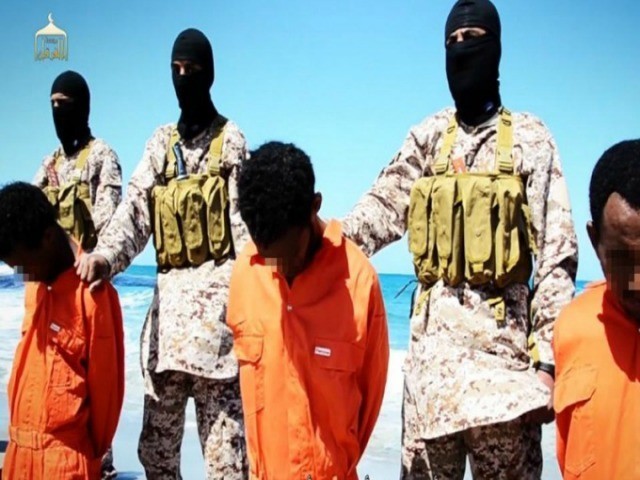
ISIS-beheading-Christians-Libya-ap-640x480

President Obama’s address to the U.N. General Assembly on Monday morning was a rambling journey through a fantasy world where his foreign policy hasn’t been an unmitigated disaster.

Perhaps the most bizarre moment came when he tried to tout his Libyan adventure as a success.

There was plenty of tough-guy posturing that intimidated absolutely no one.  The Russian and Iranian delegations were especially good at looking bored and unimpressed when he called upon them to do this-or-that because The World supposedly demanded it. Obama hasn’t figured out he’s the only leader at the U.N. eager to sacrifice his nation’s interests to please The World.

Obama made the weird decision to vaguely threaten Russia over its invasion of Ukraine by claiming that The World would not stand idly by and allow it… when that’s exactly what The World, and especially First Citizen of the World Barack Obama, has been doing.  He essentially pleaded with Iran to stop supporting terrorist proxies and pursuing its aggressive regional ambitions, and focus on their economy instead.  (Of course, in Obama’s vigorous imagination, the U.S. has been enjoying an economic boom under his stewardship, instead of an endless grinding non-recovery and limp, sporadic growth, after Obama’s spending doubled the national debt in a single presidency.)

It was bad enough that the President talked about American troops coming home from Iraq and Afghanistan as the triumphant conclusion of an effective policy, rather than the hideous blunder that allowed ISIS to create a terror state, al-Qaeda to rise from the ashes, and the Taliban to begin planning its return to power.  At the same moment Obama was speaking, the Taliban was conducting a major offensive in Afghanistan, on par with the importance of ISIS taking Mosul in Iraq.  Obama’s pitifully small “New Syrian Force” of U.S.-backed rebels just handed a good deal of its American equipment over to al-Qaeda, and no one really knows what became of the unit itself.  Their predecessors were destroyed by al-Qaeda’s Nusra Front in Syria, with less than half a dozen survivors still on the field.

When Obama boasted of the Libyan operation as the successful removal of a tyrant, jaws must have hit the floor around the room.  Libya is an unholy disaster, a wasteland of warlords fighting to keep ISIS off their turf.  It’s a key gateway for the incredible migratory tide blasting out of Africa and the Middle East and now surging across Europe.  And yet, Obama portrays it as [a] laudable example of tyrant removal… while modestly admitting that “our coalition could have, and should have, done more to fill a vacuum left behind.”

Of course he blamed everyone else in the “coalition” for the disaster in Libya. He’s Barack Obama.  The day may come when he takes responsibility for something, but today is not that day, and tomorrow isn’t looking good either.

The scary thing about Obama is that he believes so completely in the power of his own rhetoric.

He thinks he can reshape reality with his words.  When he scolds the Iranians for their “Death to America!” rhetoric by saying bloodthirsty chants don’t create jobs, he’s asking Iran to live up to the silly talking points he foisted off on the American people to cover the Iranian nuclear deal.  He’s commanding Iran to act like the enlightened, responsible nation-state he gambled the future of Israel, America, and much of the Western world on.

The Iranians, on the other hand, see no reason to knock off the “Death to America!” chants, disband their theocracy, and begin spending their days arguing about stimulus bills.  Belligerence has gotten them everything so far.  They’ve been rewarded for it… by Barack Obama.  They’ve got $150 billion in sanctions relief coming their way.  They can afford to send a few guys to sit in the U.N. General Assembly with pissy expressions on their faces while Obama rambles on about how geo-political crime does not pay.  They know for a fact it pays, quite handsomely.  The Iranians are already using their Obama loot to reinforce terror proxies like Hamas and Hezbollah, and secure Bashar Assad in power.

Ah, yes, Bashar Assad… the dictator Obama still blathers on about removing from power, even as his own diplomatic apparatus gets used to the idea Assad is not going anywhere.  The only really good part of Obama’s speech was when he spent five seconds glaring at the Syrian ambassador before launching into his denunciation of barrel bombs and chemical weapons.  But you know what?  That Syrian ambassador gets paid enough to take a few seconds of hairy eyeball from the ineffectual American president.  The Russians are smoothly replacing American influence across the Middle East, in partnership with Iran.  The new order is taking shape.  Obama isn’t going to reverse that process by telling aggressive, bare-knuckle conquerors they should be ashamed of themselves.

The other dangerous thing about this delusional President is his belief in the “judgment of history.”

He’s constantly hitting on the idea that all of the world’s villains are on the wrong side of history, and will find themselves buried in the sands of time any day now.  It’s a dodge, a way of Obama evading responsibility.  Bashar Assad is going to remerge from the Wrong Side of History in pretty good shape.  ISIS is very comfortable there, as is Iran.  Qaddafi didn’t assume room temperature because History caught up with him. Vladimir Putin has a lovely view of Crimea from the wrong side of history.  The history of Europe is being reshaped by the tramping of a million “refugee” feet.

In every example, Obama clings to the idea that he can change the world by talking and scoring debate points, while his adversaries seize territory and control the course of events.  It’s not as though Obama has some deep-seated reluctance to use deadly force – there have been a lot of deaths by drone strike since he won that Nobel Peace Prize.  What Obama lacks is commitment.  His foreign policy is all about gestures and distractions.  He cooks up half-baked plans that will blow up a terrorist here and there, so he can’t be accused of doing “nothing,” but he won’t do anything that could cost him political capital at home.  Even Libya was half-hearted and calculated for minimum risk, which is why the place went to an even deeper Hell after Qaddafi was overthrown.

Obama talks as if he’s taken action against numerous crises, but all he ever did was talk about them.  The men of action are stacking up bodies, and raising flags over conquered cities, while this President is writing speeches and trying to win applause from editorial boards.  The men of action know that Obama’s promises all have expiration dates, his vows of action always have escape clauses, and no matter how he loves to boast that he heads up the most powerful military the world has ever seen, he’s done everything he can to make it weaker.

President Obama is still clinging to a romantic vision of the “Arab Spring” as a flourishing of democracy, despite all evidence to the contrary.  He’s giving the same foreign policy speeches he gave in 2009 because he can’t bear to live in the world he made.  He talks about filling vacuums and voids… but those voids are already filled, by hard characters with plans to make the most of the extraordinary opportunity Barack Obama afforded them.

(Video of Obama’s UN address — DM):


Israel’s biggest fears are materializing

September 27, 2015

Israel’s biggest fears are materializing, Israel Hayom, Boaz Bismuth, September 27, 2015

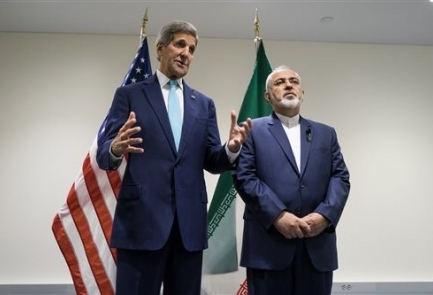
144334028328300476a_bThe Munich moment is upon us. U.S. Secretary of State John Kerry with Iranian Foreign Minister Mohammad Zarif at U.N. headquarters on Saturday | Photo credit: AP

Washington is reaching out to Russia, which is openly helping Syrian President Bashar Assad, who is working in conjunction with Iran, which in turn supports Hezbollah. Now Europe is prepared to talk to Assad, but what about us, for heaven’s sake?

Two years ago to the day, in September 2013, U.S. Secretary of State John Kerry compared Bashar Assad to Adolf Hitler, after the Syrian dictator once again used chemical weapons against his own people. “This is our Munich moment,” Kerry said at the time.

As far as the Americans were concerned, Assad had crossed a line. In those days (more like in those hours, actually), Washington briefly believed that a failure to respond to Assad’s actions would send a dangerous message to Iran regarding its nuclear ambitions.

“Will [Iran] remember that the Assad regime was stopped from those weapons’ current or future use, or will they remember that the world stood aside and created impunity?” Kerry asked at the time. History and retrospect have turned what may have been Kerry’s greatest speech into remarks entirely detached from reality.

The United States did not attack, Assad is still in power, and an ominous nuclear deal has been signed with Iran. It is no wonder that there is a new kind of atmosphere in the region, under American auspices. There are no more good guys and bad guys; everyone is a partner. And thanks to this new reality, Assad now has a renewed license to rule, after having received a license to kill.

Washington is reaching out to Russia, which is openly helping Assad in Syria, who is working in conjunction with Iran, which in turn supports Hezbollah. Europe (Angela Merkel), in the meantime, startled by its refugee crisis, is already prepared to talk with Assad; the same Assad who was compared to Hitler only two years ago. But what about us, for heaven’s sake?

Regretfully, Israel’s biggest fears are now materializing. Instead of being the architects and shaping a new reality in the Middle East, Washington is falling into line with the existing reality. Russia, Syria and Iran are enjoying the consequent vacuum. When the cat is away, the mice will play. Now, all of a sudden, even Hezbollah chief Hassan Nasrallah is letting himself go on television, beaming with joy. Aside from the 75 tanks Damascus is giving him, he now sees his two patrons (Damascus and Tehran) become partners with the West, without having to change one bit.

There is no diplomatic vacuum

The latest developments in Syria are not encouraging: Assad’s first target, with Russia’s help, is expected to be the Nusra Front rebel group, which not only threatens Assad but is also a bitter enemy of the Islamic State group. In other words, somewhat paradoxically, Islamic State could initially benefit from the Russian intervention in Syria.

And one final word about Iran’s rapprochement with the international community: We have been told repeatedly that this was only about the nuclear deal, but in reality we can see cooperation between the U.S. and Iran in Iraq and in the war against Islamic State. We can also see American-Iranian dialogue regarding Syria’s future, and on Saturday night we learned of a gigantic deal worth upwards of $21 billion between Iran and Russia. This time I am forced to agree with Secretary Kerry: This really does look like a Munich moment.

US-backed rebels handed over equipment to al Qaeda in Syria

September 26, 2015

US-backed rebels handed over equipment to al Qaeda in Syria, Long War Journal, September 26, 2015

Al-Nusrah-in-Aleppo-300x169

[T]he Jaysh al Fateh alliance, which is led by Al Nusrah and its closest jihadist allies, has captured more territory from Assad’s regime this year than the Islamic State has.

Not only has al Qaeda thwarted America’s first efforts under the overt $500 million train and equip program, which is managed by the US military, it has also taken out rebels who received unofficial support from the US intelligence community.

*****************************

US-backed rebels in the so-called “New Syrian Forces” (NSF) have turned over at least some of their equipment and ammunition to a “suspected” intermediary for Al Nusrah Front, US Central Command (CENTCOM) conceded in a statement released late yesterday. The coalition-provided supplies were given by the rebels to Al Nusrah, an official branch of al Qaeda, in exchange for “safe passage within their operating area.

The “NSF unit contacted Coalition representatives and informed us that on Sept. 21-22 they gave six pick-up trucks and a portion of their ammunition to a suspected Al Nusrah Front intermediary, which equates to roughly 25 percent of their issued equipment,” CENTCOM spokesperson Col. Patrick Ryder said. “If accurate, the report of NSF members providing equipment to Al Nusrah Front is very concerning and a violation of Syria train and equip program guidelines.”

While Ryder left open the possibility that the report is not accurate, he did not offer any explanation for why the NSF unit would lie about giving the equipment to Al Nusrah. The admission further jeopardizes the unit’s ability to receive American arms in the future.

Rebels belonging to Division 30, a group supported by the US, suffered losses immediately upon entering the Syrian fray earlier this year.

More than 50 members of Division 30 were sent into Syria in July. But Al Nusrah quickly thwarted their plans, even though the US-backed rebels intended to fight the Islamic State, Al Nusrah’s bitter rival. A number of Division 30 fighters were captured or killed within days of embarking on their mission.

Al Nusrah released a statement at the time saying that Division 30 is part of an American scheme that is opposed to the interests of the Syrian people. Al Qaeda’s branch accused the group of trying to form “the nucleus” of a “national army” and blasted the attempt to bolster the “moderate opposition.”

Al Nusrah also attacked Division 30’s headquarters in Azaz, a city north of Aleppo. The US responded with airstrikes, killing a number of jihadists, but the damage to the limited US effort was done. US officials said earlier this month that only four or five rebels were left in the fight. Dozens of additional US-supported rebels have entered the war in recent weeks, according to US military officials.

Not only has al Qaeda thwarted America’s first efforts under the overt $500 million train and equip program, which is managed by the US military, it has also taken out rebels who received unofficial support from the US intelligence community.

Al Nusrah Front has consistently resisted the West’s meager attempts to build a reliable opposition force. Late last year, al Qaeda’s branch pushed the Syrian Revolutionaries Front (SRF), which had reportedly received some support from the West, out of its strongholds in the Idlib province. The SRF’s demise helped pave the way for Al Nusrah and its allies in the Jaysh al Fateh (“Army of Conquest”) coalition to capture much of Idlib beginning in late March.

After being vanquished, SRF head Jamaal Maarouf accused Al Nusrah’s emir, Abu Muhammad al Julani, of being a “Kharijite” (or extremist). This was an about-face in the relationship, as the SRF and Al Nusrah had previously fought side-by-side. Maarouf also publicly lamented the limited support he had received from the West.

Earlier this year, Al Nusrah also took the fight to Harakat Hazm (the Hazm Movement) outside of Aleppo. Despite receiving Western support, including US weaponry, Hazm had fought alongside the jihadists in the past and its leaders had praised Al Nusrah. Regardless, it was eventually forced to disband under Al Nusrah’s relentless pressure. Hazm’s remaining members were folded into other rebel groups.

It is suspected that American-made anti-tank TOW missiles fell into al Qaeda’s hands as a result of the battle against Hazm. The weapons were used during the jihadists’ successful assault on Idlib in March, as well as during other key confrontations with the Assad regime.

Recent events demonstrate that the US is consistently underestimating al Qaeda’s presence and capabilities in Syria, and does not have a true strategy for the multi-sided conflict. The rebels who have gone through the train and equip program are supposed to fight the Islamic State and not, according to public accounts, Al Nusrah. But it is Al Nusrah, which has been seeded with al Qaeda veterans in its upper ranks and is openly loyal to al Qaeda emir Ayman al Zawahiri, that has interfered with the US effort.

The US apparently did not anticipate Al Nusrah blocking Division 30’s first foray into northern Syria in July. The al Qaeda branch did so not to support Abu Bakr al Baghdadi’s men, but because it is opposed to any US presence in the country. The US has targeted individual al Qaeda commanders in Syria, especially those believed to pose an immediate threat to the West, but has not sought to degrade the Al Nusrah-led wing of the anti-Assad insurgency. However, the Jaysh al Fateh alliance, which is led by Al Nusrah and its closest jihadist allies, has captured more territory from Assad’s regime this year than the Islamic State has.

Clearing my spindle, Syria edition

September 26, 2015

Clearing my spindle, Syria edition, Power LineScott Johnson, September 26, 2015

The withdrawal of the United States from Iraq and points elsewhere around the Middle East has created a vacuum that has been filled by forces hostile to the United States. Syria is representative. ISIS has moved into Syria from Iraq. Iran and Hezbollah have both moved into Syria to defend the Assad regime from ISIS.

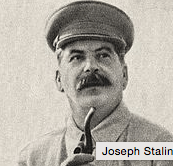
Stalin

The Obama administration has taken a sort of Stalinist tack. Obama has concentrated on building socialism in one country (i.e,, the United States) rather than protecting the national interests of the United States abroad in a difficult foreign theater, especially insofar as doing so might complicate Obama’s dreams of an entente with Iran.

Last week brought a new round of Syria related stories. At the Weekly Standard, Lee Smith noted “Obama’s Syria doctrine.” Obama disclaims responsibility even for his own pathetically failed approach:

In the wake of last week’s embarrassing revelation that only four or five U.S.-trained rebels are currently engaged in fighting the Islamic State, the White House was scrambling to deflect blame. It wasn’t Obama’s fault, said White House press secretary Josh Earnest. The president never wanted to back the rebels in the first place. His hand was forced by administration figures and Republican lawmakers who wanted to aid the rebels. It’s time, said Earnest for “our critics to fess up in this regard as well. They were wrong.”

Enter Russia. Barbara Starr & Ross Levitt report for CNN: Russian fighter jets enter Syria with transponders off”

Lucas Tomlinson & Jennifer Griffin report for FOX News “Russians, Syrians and Iranians setting up military cooperation cell in Baghdad”. Tomlinson and Griffin note:

Russian, Syrian and Iranian military commanders have set up a coordination cell in Baghdad in recent days to try to begin working with Iranian-backed Shia militias fighting the Islamic State, Fox News has learned.

Western intelligence sources say the coordination cell includes low-level Russian generals. U.S. officials say it is not clear whether the Iraqi government is involved at the moment.

Describing the arrival of Russian military personnel in Baghdad, one senior U.S. official said, “They are popping up everywhere.”

The Wall Street Journal published two important stories last week. Dion Nissenbaum & Carol Lee report: “Russians expand military presence in Syria, satellite photos show.” Jay Solomon & Sam Dagher report: “Russia, Iran seen coordinating seen coordinating of Assad regime in Syria.”

And Prime Minister Netanyahu flew to Moscow with two members of the IDF General Staff to meet with Putin about Russia’s moves in Syria. “In Moscow,” the Times of Israel reported, “presence of generals sends a message of military urgency.” President Obama, however, is taking the long view. A couple of weeks ago Obama declared Russia’s Syrian adventure to be “doomed to failure.” Obama’s judgment represents a striking case of projection.

Swedes’ Homes May Be Confiscated to Accommodate Asylum Seekers

September 25, 2015

Swedes’ Homes May Be Confiscated to Accommodate Asylum Seekers, Gatestone InstituteIngrid Carlqvist, September 25, 2015

(Possible confiscation of homes is only a minor part of the story. The rest is worse. — DM)

Translation of the original text: Svenskarnas bostäder kan konfiskeras till förmån för asylsökande.

  • In 1992, the “Threat and Risk Assessment Commission” established that the government should have the option to seize property, especially summer homes, from the Swedish people in a time of crisis.
  • Despite Sayadi’s commission of three rapes and his sexual molestation of young girls, as well as his systematic criminal activity, he received only a four-year prison sentence, and will not have to face deportation.
  • Husein wants a Swedish passport so he can go back to Somalia, the country he claims to have escaped from — to “visit his mom and establish business contacts.”
  • “The situation affects everyone who lives and stays in our little county. The climate has grown tougher, many people feel scared and unsafe and with that comes the risk of increased xenophobia, antagonism and exclusion.” — From a letter to the government from Örkelljunga County leaders. The county swiftly received criticism from the mainstream media, and the Immigration Service let it be known that they have no intention of helping Örkelljunga.

August 3: Ahmad El-Moghrabi, 21, who has no driver’s license, was indicted for driving like a madman through the city of Malmö in February, and nearly killing a mother and baby. On February 11, he drove a luxury Mercedes at high speed, with some other Arab men as passengers, one of whom is a well-known extremist, when the police tried to pull the car over. Instead of stopping, El-Moghrabi sped away at about 150 km/h on the busy inner city street of Amiralsgatan, where the speed limit is 40 km/h.

The police chase ended when El-Moghrabi hit some parked cars. Three people were injured, and the mother and baby sustained life-threatening injuries after being crushed between the cars.

El-Moghrabi fled the scene, but was apprehended later. He has been charged with gross negligence, grievous bodily harm, fleeing the scene of an accident, and driving without a license. His own explanation to the rampage was that he did not want to be caught by the police, as his license had been revoked.

August 3: It was reported that 2000 third-world immigrants are seeking asylum in Sweden — each week. The largest groups were Syrians, then Afghans, stateless people, Eritreans and Somalis. The Immigration Service now reports that there are close to 50,000 asylum seekers living in various housing and rental facilities, and more are on their way to a country that already suffers from a major housing shortage.

The question is: Where will they live? More and more people are now worrying that the government will confiscate the homes of Swedes and give them to asylum seekers. In 1992, the “Threat and Risk Assessment Commission” (Hot- och riskutredningen) established that the government should have the option to seize property, especially summer homes, from the Swedish people in a time of crisis. In early September, editorial columnist Anna Dahlberg ofExpressen, one of Sweden’s largest dailies, urged Swedes to “make way” and “hand over the keys to their apartments to those in greater need.”

August 3: Another shooting took place in the violence-stricken city of Malmö. No one was hurt this time, but the police found empty shell casings on Rasmusgatan Street in the Seved area, one of Malmö’s “no go-zones,” where a majority of the inhabitants are of foreign descent. The area is known for its open drug trade, and over the last few years, a large number of shootings and grenade attacks have occurred there. (On June 12, a hand grenade was thrown, and four people were wounded.) In an attempt to bring down the crime rate, local authorities gave the police permission on August 12 to place four cameras in the area to film events around the clock.

August 5: The Stockholm police department caused an uproar with a shocking story about everyday life in immigrant-heavy suburbs such as Tensta-Rinkeby, Hjulsta, Kista and Husby. Youth gangs regularly attack police by using lasers to blind them, and throwing rocks and firebombs. Criminal gangs resolve conflicts by shooting at each other in public places, risking the lives of innocent people who may be in their way. Police officer Nikolina Bucht wrote in a columnin the daily Svenska Dagbladet that it is time to “take back the area from the criminals and protect all the respectable people who have their neighborhoods destroyed, their cars set on fire and feel unsafe.” She wrote:

“Last week my colleagues got a call about a sudden cardiac arrest in Rinkeby. … When they arrive at the scene, they are met by about ten young people who are provoked by their mere presence, turn aggressive and mask their faces. The police are forced to focus on the rock throwing instead of going up to the apartment and starting CPR. He had to wait for several minutes extra before he got help, time that could have saved his life. This was not an isolated event.”

August 7: A Somali refugee, Mohamed Husein, complained he has not yet received a Swedish citizenship. Somalis must wait three years longer than others for citizenship, as they cannot prove their identity. Husein wants a Swedish passport so he can go back to the country he claims to have escaped from — to “visit his mom and establish business contacts.”

August 10: It was reported that a 15-year-old pregnant girl, who six weeks prior traveled with her boyfriend to Syria, had been captured by the Islamic State (ISIS). How the girl managed to travel without a passport or identification papers remains a mystery. Swedish media made no effort to sort out why she would object to living with ISIS. Her boyfriend is reported to have joined an al-Qaeda-affiliated group.

August 11: The law journal Dagens Juridik reported that a 19-year-old girl was taken into custody, in accordance with the LVU law (“Care of Young Persons Special Provisions Act”), after her family threatened to subject her to honor violence. Social service workers on the island of Gotland applied for “administered care” after the girl, in spite of threats, had escaped from the shelter where she was living and moved back with her family. The court stated that the investigation showed that the girl’s desire to return is rooted in her upbringing, which has taught her that the honor of the family is more important than her individual rights. She may also feel guilt, because she thinks she is dishonoring the family by not being with them. According to the court, the girl’s behavior should be considered socially disruptive under the definition of the LVU law, and therefore, she needs to be protected.

August 14: Two men, 21 and 26 years of age, were remanded, suspected of two of the many recent hand grenade attacks in Malmö. At the same time, another 26-year-old was remanded for attempted murder and possession of an illegal weapon, both of which occurred in Rasmusgatan, in Malmö’s “no-go” Seved neighborhood.

Early that morning, police also discovered two hand grenades in Adelgatan, in central Malmö. One had exploded, and the other one failed to work. A large area was barricaded and several buildings had to be evacuated. The police suspected the incident could be linked to a car bomb that had detonated in Malmö two days earlier. Malmö has experienced the most bomb attacks of all Scandinavian cities: this year alone, 20 bombings have taken place.

August 12: A 43-year-old Iranian citizen, Ramin Sayadi, was sentenced to four years in prison for three rapes and two counts of sexual molestation of young girls. Sayadi also sold the girls large quantities of prescription narcotics such as Tramadol, Ritalin and Subutex. The police investigation showed that he had close to 1,000 customers. When the girls became addicted to the drugs, he took advantage of them sexually. The police believe there are many more victims who have not come forward. Detective inspector Jan-Åke Stendahl told daily Göteborgs-Postenthat the man had over 200 contacts listed in his mobile phone, and a majority of the numbers belonged to young girls. Sayadi was caught in May of last year, walking around Gothenburg’s central station trawling for customers.

Despite his systematic criminal activity, he received only a four-year prison sentence, and will not have to face deportation.

August 14: A so-called unaccompanied refugee child was prosecuted on rape charges. The act took place on the night of January 10, in a youth home in Västerbotten in northern Sweden. The suspect is a native of Afghanistan and claims to be 17 years old. The police believe he raped the woman when she was in a drunken stupor, and therefore in what the law calls a “particularly vulnerable situation.”

August 17: The police issued an international arrest warrant for a Congolese citizen, Loran Guy Mogi, 23, wanted for the murder of his ex-girlfriend, Therese Eriksson, 23, of Vårgårda. Eriksson had been found dead four days earlier in Mogi’s apartment, but he had fled the scene. She was killed by blows to the head and body. After a week on the run, Loran Guy Mogi was apprehended at a refugee facility in the German city of Hannover. He has since been remanded pending trial. According to the prosecutor, Robert Beckard, Mogi has pled not guilty to the murder charge, but admits that he beat Eriksson and may thus have caused her death.

August 18: The media website Avpixlat wrote that an Algerian man, who has not lived in Sweden for six years, is entitled to financial aid to cover doctor’s visits and the cost of his medicine. The man came to Sweden in the 1990s, but never worked or paid taxes there. Six years ago, he returned to Algeria, but in April of this year, he suddenly appeared in Sweden again to seek emergency health care. He underwent two surgeries at taxpayer expense, and considered himself entitled to financial aid for the cost of his medicine and several doctor’s visits. The municipality of Gothenburg had ruled against the request, but an administrative court now ruled that since the man has no income or assets, he is entitled to aid.

August 18: Five representatives of the Church of Sweden wrote, in an op-ed in the Swedish dailyDagens Nyheter, that the church should also be open to Muslims. The article astonished and angered Christians. Stefan Gustavsson, secretary general of the Swedish Evangelical Alliance,pointed out that Islam, Judaism and Christianity promote three radically different versions of what happened to Jesus:

  • Islam: Jesus did not die.
  • Judaism: Jesus died but was not resurrected.
  • Christianity: Jesus died and was resurrected.

These different versions cannot all be true, Gustavsson points out, and urges the Church of Sweden to awake from their Sleeping Beauty-slumber and start taking big questions seriously:

“The religion relativism that is now widespread throughout the Church of Sweden is not just an intellectual dead end, it is an insult to the Christians of Iraq and Syria who face forced conversion and who are willing to give their lives for their faith in Jesus Christ.”

But the Church of Sweden persists, and on August 30, it invited imam Mohammad Muslim Eneborg to take part in high mass. Before he converted, the imam was named Åke Daniel Eneborg and he was a left-wing activist.

August 24: Former member of parliament Thoralf Alfsson (Sweden Democrats) wrote on his blog that the Immigration Service had hired no fewer than 1,200 people during the last year. Earlier, in August 2014, the Immigration Service had about 5,000 employees; in August 2015 that figure was 6,200. This means that the wage costs have increased by 50 million kronor (about $5.9 million) a month. In all, the Immigration Service’s staff now cost Swedish taxpayers 250 million kronor ($29.6 million USD) a month, or 3 billion kroner ($360 million) a year.

Aside from skyrocketing costs, Alfsson questions why so many people of foreign descent find employment with the Immigration Service. He writes: “I can’t but wonder what kind of screening process the Immigration Service have in regard to the people they hire. Could there be employees with residency status in Sweden who use a fake identity? Are there ISIS-sympathizers among the employees?” And there are.

Social commentator and author Merit Wager, who frequently publishes anonymous posts from Immigration Service employees, wrote in an August 21 blog post that authorities now no longer take rejected asylum seekers into custody, due to attacks from left-wing extremists. That is why the IKEA-murderer, who had received a deportation order, was not in custody, a failure that led to the death of two innocent people in the heart of the Swedish idyll. One Immigration Service employee said:

“Years ago, the Immigration Service was often heavily criticized by various left-wing groups who wanted to ‘protect’ the asylum seekers who had been found lacking in reasons for protection and targeted for deportation. Sometimes there were big demonstrations and now and again Immigration Service buildings were vandalized. Today these actions have ceased almost completely. The reason is very simple – the Immigration Service has hired the activists. They are now officials at the authority! I’ve met several people who are quite open about their backgrounds in these activist groups. The reason the Immigration Service hires them is that they state on their CVs exactly what the government wants to hear – that they have a ‘burning engagement in human rights issues.'”

August 24: A police van was attacked with a hand grenade in the Stockholm suburb of Tumba. Four policemen were in the vehicle at the time. If it had not been for the fact that the vehicle was armored, the incident could have ended in a bloodbath. The attack began when several people threw rocks at police officers, and a fire was set at the local police station. Moments later, the hand grenade was thrown and landed about five feet from the police van. No one was injured, but the vehicle sustained 105 holes from shrapnel. Despite intense police efforts, the perpetrators of this attempted murder have not yet been apprehended.

1262A police van is riddled with shrapnel (left) from a hand grenade attack in Stockholm on August 24. The four policemen in the vehicle at the time could have been killed if the van had not been armored. At right, the Malmö police bomb squad disarms a hand grenade found in Landskrona, on September 22.

August 25: Local politicians in small southern county of Örkelljunga (population 10,000) wrote a desperate letter to the government; its signatories begged for help in solving the problems brought by the wave of asylum seekers. The Immigration Service has opened housing in Örkelljunga for about 250 asylum seekers in apartments, a former motel, and a number of private family residences — including housing for unaccompanied refugee children. An additional 100 units may open up in the Åsljungagården Hotel.

The local politicians wrote in their letter that crime rates have risen and that the police have been called on a number of occasions. Rape, assault, battery and shoplifting are mentioned, as is the temporary closing of the Centrumhuset youth center. At the largest housing facility, an old motel, there are 90 adults and children. The mix of various ethnic groups is said to have led to riots, threats and hunger strikes. The letter states:

“The situation affects everyone who lives and stays in our little county. The climate has grown tougher; many people feel scared and unsafe and with that comes the risk of increased xenophobia, antagonism and exclusion.”

The county swiftly received criticism from the mainstream media, and August 27 the Immigration Service let it be known that they have no intention of helping Örkelljunga. Immigration Service Press Officer Fredrik Bengtsson, quoted in the daily Helsingborgs Dagblad, was especially angry about the county’s criticism concerning different groups being placed together:

“If one thinks along the lines of placing asylum seekers any other way, you’re on a slippery slope. Separate housing for Christians and Muslims is not something we have in society. We have freedom of religion, and that applies to housing as well. You have to stop for a moment and think about it, because that’s not how we do things in society.”

August 26: Swedes heard the news that politicians in the nation’s three largest cities want to offer courses in “self-care and sexual matters” to gypsy women beggars. Stockholm, Gothenburg and Malmö are applying for 8.7 million kronor (just over $1 million USD) from the European Social Fund, for the project, and hope to reach 250 women. Twice a week they will attend class and get food, free health checkups and free hygiene- and sanitary articles and condoms. They will also receive compensation for “loss of work income.” Local politicians from opposition parties in Stockholm criticized the project strongly.

August 28: “Afrikas Horn,” an immigrants’ organization, reports another “Swedish” ISIS-warrior killed in battle. The man was in his thirties and originally from Somalia, but lived in the immigrant-heavy area of Vivalla in Örebro. The man was apparently one of three who have repeatedly traveled to join ISIS, but were twice intercepted in Turkey and sent back to Sweden. The man is the fourth resident of Örebro who has died as an ISIS terrorist. The chairman of Afrikas Horn tells the local paper Nerikes Allehanda that “the family is in mourning.”

August 28: Ali Khoddami, once an asylum seeker to Sweden, was sentenced to prison for defrauding an elderly woman. Khoddami worked in home care services and tricked Inga Lill, a 90-year-old woman suffering from dementia, out of millions of kronor. By pretending to be the woman’s friend, Khoddami was able to take over her bank accounts and move into her house, along with his family. He used her savings of two million kronor (about $240,000 USD) for luxury items, as well as several cars. Khoddami also managed to persuade Lill to sign over her house — her childhood home built by her father — to him. The house is apparently worth five million kronor ($590,000 USD). It was only after Khoddami put Lill, who has no living relatives, in a nursing home that the fraud was uncovered. The District Court sentenced Khoddami to 2.5 years in prison and fined him 7 million kronor ($830,000) plus interest and damages.

August 28: There were reports that people-smugglers have, over a short period of time, dumped 100 asylum seekers in the Gothenburg area. Pernilla Wallin, unit manager of the application unit at the Immigration Service for the Western Region, told Swedish Public Television that she never thought the situation would escalate like this and that the circumstances are “exceptional.” The Immigration Service is now desperately looking for “external contractors who want to bid on temporary housing for asylum seekers.”

Iraqi Columnist: Why Aren’t Muslim Clerics Calling For Jihad Against ISIS?

September 24, 2015

Iraqi Columnist: Why Aren’t Muslim Clerics Calling For Jihad Against ISIS? Middle East Media Research Institute, September 15, 2015

(The author contends that there are three possible reasons for their relative silence: 1. They are cowards, 2. they believe that its interpretation of Islam is correct or 3. “their regimes are involved in the actions of ISIS and they are unable to disobey their leaders.” I’ll go with 2 and just a dash of 3. — DM)

In his July 9, 2015 column, titled “Why Won’t They Declare Jihad Against ISIS? Secularists and Infidels Are More Zealous for Islam than the Sheikhs,” in the Arabic internet daily Raialyoum.com, Kurdish-Iraqi columnist Anas Mahmoud Al-Sheikh Mazhar harshly criticized Muslim clerics for their apathy and silence in the face of ISIS and its actions, and wondered whether they should not declare jihad and struggle against the organization in light of the dangers it posed. He added that Muslim clerics should be ashamed of themselves, particularly considering that foreign politicians and armies have rushed to defend Islam from ISIS. The following are excerpts from his column:[1]

24825Anas Mahmoud Al-Sheikh Mazhar (Source: Facebook.com, May 16, 2015)

The Muslim Clerics’ Silence In Face Of ISIS Actions Is Incomprehensible

“In the past, we were accustomed to seeing clerics ascend to mosque pulpits and launch their lofty sermons with attacks on the mistaken policies and actions of the politicians in their countries… All the preacher had to do was to raise his voice and shout, and the worshippers and listeners would moan and cry ‘Allah Akbar’ after every word emerging from his throat. Thus, the measure of a preacher’s skill was his ability to attack government policy. Preachers would compete vigorously amongst each other, and the leading mosques were those that frequently dealt with politics and attacked [politicians].

“This ‘fashion’ continued until ISIS emerged and took over large swaths of the [Middle East] region. Then, as though ordained by fate, these voices fell silent. Their interest in politics waned, and religious matters took up more of their sermons – and not only in the mosques. The clerics and preachers filling the TV channels [also] dealt mainly with the life and times of the Prophet [Muhammad], with religious laws and affairs, and with questions concerning the afterlife and its horrors, to the point where viewers must have felt that they were living in an entirely different world.

“In light of the circumstances in the region, and in light of the plot against Islam being carried out by extremist organizations that have twisted this tolerant religion and replaced it with one consumed by murder, slaughter, floggings, and chopping off of hands, we see Islam’s sheikhs and clerics living in enviable peace and complacency, paying no heed to the perplexed Muslims, who by now are confused about their faith and no longer know right from wrong.

“How can clerics who consider themselves zealous about their religion remain silent as the grave, in light of the events in the region and the acts against Islam that these organizations are committing? Could it be that we are wrong and that the true Islam is the one that ISIS preaches? If this is Islam, why be ashamed to admit it[?] And if it is not, why are they refraining from telling the truth?

“Some may say that most Muslim clerics have expressed anti-ISIS positions. This is true, but can such a grave problem be addressed merely with [weak] verbal opposition, without a serious and determined stand that reflects this opposition? We have seen clerics conduct major popular campaigns against matters that are trivial, to say the least, and devote all their time and resources to [these matters]. But faced with the problem of twisting the religion, they settle for [mere] verbal objections, and provide them only when directly asked to do so.

“It is strange that some of the ‘sheikhs of Islam’ encouraged the Arab peoples’ enthusiasm to topple their rulers during the Arab Spring – issuing fatwas calling for jihad against them, even though the Arab rulers’ crimes did not compare to despicable crimes of ISIS. Over the decades [of their rule,] tyrannical Arab regimes did not distort Islam the way ISIS has over the past three years. It is also strange that some sheikhs were enraged when the Muslim Brotherhood regime in Egypt was ousted, since it is at best a political group or faction. These sheikhs described those who made this change [the ouster of the Muslim Brotherhood regime] as infidels who have left Islam, and even incited the Egyptian people against their new government and declared jihad against it – yet they are silent in light of the actions of these terrorist organizations who are trying to topple Islam as a religion, not just some party or group. Doesn’t the danger posed by ISIS require them to declare jihad against it?”

Shame On You For Remaining Silent In Light Of The Dangers Of ISIS – While “Infidels” Protect Us

“There are three possible explanations for their silence in light of the phenomenon and behavior of ISIS:

“One – the sheikhs and preachers of Islam are cowards and dare not speak the truth, fearing that extremist organizations will kill them, leading them to act in contradiction to their [own] sermons, which encourage telling the truth even at the cost of one’s life.

“Two – they [believe] in their hearts that this is Islam, and are [therefore] pleased by the actions of these extremist groups and believe in them. Therefore, regimes and security mechanisms should treat these sheikhs like any other terrorist, and apply the terrorism laws to them.

“Three – their regimes are involved in the actions of ISIS and they are unable to disobey their leaders. Therefore they follow these leaders at the expense of the truth, without feeling that the responsibility is on their shoulders as clerics. This makes them hypocrites.

“If we give the clerics the benefit of the doubt, and choose the first option – i.e. that they are motivated by fear, even though this is a shameful option – we say to them: Shame on you for standing by and playing blind, deaf, mute, and dumb – while armies, nations, and peoples that you have termed infidels rush to defend us and our religion, even if they are also defending themselves. It is shameful that the European politicians [whom you call] ‘infidels’ come out to purge the Islamic arena of this extremist ideology, and that secular Arab artists [whom you call] ‘murtadoun‘ [apostates] criticize ISIS actions that deviate from the straight path – while you hide behind mosque pulpits and utter not a sound, as though it does not concern you.

“You wretches… Have you no shame?”

Endnote:

[1] Raialyoum.com, July 9, 2015.