H/t Dry Bones Blog

ISIS Fires Up Palestinians, Gatestone Institute, Bassam Tawil, October 19, 2015
By now, it has become clear that our young Palestinian men and women have learned a lot from the Islamic State (ISIS) terror group.
This new “intifada” that some Palestinians are now waging against Israel should be seen in the context of the wider jihad that is being waged by the Islamic State, Hamas, Islamic Jihad, Boko Haram and Al-Qaeda against the “infidels, Zionists, apostates, Crusaders” and against non-extremist Muslims.
The tactics employed by Palestinian youths over the past two weeks show that they are doing their utmost to copy the crimes and atrocities committed by the Islamic State in Syria, Iraq, Libya and other Arab countries.
Although the Islamic State is not physically present in the West Bank or Jerusalem (largely thanks to the efforts of the Israel Defense Forces and other Israeli security agencies), there is no denying that its spirit and ideology are hovering over the heads of many of our young men and women.
The current wave of stabbings of Jews in Israel and the West Bank is an attempt to imitate Islamic State terrorists who have been using knives to behead many Muslims and non-Muslims during the past two years.
Like the Islamic State, many of the Palestinian terrorists who recently stabbed Jews saw themselves as jihadis acting in the name of Allah, the Quran and the Prophet Mohammed. This was evident by the Palestinian terrorists’ cries of “Allahu Akbar!” [“Allah is Greater!”] as they pounced on their victims. Our young men and women must have been watching too many videos of Islamic State jihadis shouting “Allahu Akbar!” as they beheaded or burned their victims.
The stabbing attacks that were carried out in the past two weeks were actually attempts to slit the throats of Jews, regardless of their age and gender. In most instances, the terrorists were aiming for the upper part of the body, focusing on the victims’ throats and necks. The Palestinian terrorists are now trying to replace Islamic State jihadis as the chief “butchers” of human beings in the Middle East. For now, they seem to be partially successful in their mission.
Our young men and women have learned from the Islamic State not only the practice of stabbing the “infidels,” but also how to destroy religious sites. On Thursday night, scores of Palestinians attacked and torched Joseph’s Tomb in the West Bank city of Nablus, in scenes reminiscent of the Islamic State’s destruction of ancient and holy sites in Syria and Iraq.
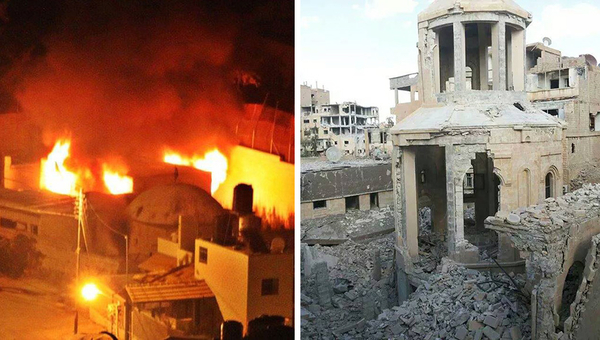 Last week, Palestinians torched Joseph’s Tomb in Nablus (left), in scenes reminiscent of the Islamic State’s destruction of holy sites in Syria and Iraq, such as the Armenian Church in Deir Zor (right).
The shrine was set on fire for no reason other than that it is revered as the tomb of a Jewish biblical figure. This is a site frequented by Jewish worshippers, although it is under the control of the Palestinian Authority (PA) and its security forces in Nablus. It is worth noting that agreements signed between Israel and the Palestinians guarantee access for Jewish worshippers to Joseph’s Tomb, and there were assurances to the Israelis that the PA could be trusted to safeguard the site.
What the Palestinians did to Joseph’s Tomb is no different from what the Islamic State and other terrorist groups have been doing to holy sites and archaeological sites in Syria and Iraq. The Palestinians who attacked Joseph’s Tomb were obviously influenced by the crimes of the Islamic State against religious and ancient sites.
What is still not clear is why the Palestinian Authority security forces, which maintain a tight grip on Nablus, did nothing to prevent the arson attack.
How can our leaders in Ramallah accuse Jews of “contaminating” the Aqsa Mosque with their “filthy feet” at a time when our youths burn a religious site such as Joseph’s Tomb?
This is not the only Jewish holy site that has been targeted by Palestinians in recent years. While our leaders are screaming day and night about Jews “invading” and “desecrating” the Aqsa Mosque, Palestinians from Bethlehem have been throwing stones, petrol bombs and explosive devices at Rachel’s Tomb near the city. This has been going on for several years now, in an attempt to kill Jewish worshippers and the Israeli soldiers guarding Rachel’s Tomb.
The attacks on Joseph’s and Rachel’s Tombs in Nablus and Bethlehem are part of a Palestinian-Islamic campaign to destroy Jewish holy sites and deny any Jewish link to the land. The attacks are an attempt to rewrite history so that Jews will not be able to claim any religious ties to the land. This is exactly what the Islamic State is doing these days in Syria and Iraq: “erasing history that lets us to learn from the past.”
The terror campaign that we have been waging against Israel in the past few weeks shows that the Islamic State and Islamic fundamentalism and fascism have invaded the minds and hearts of many of our young men and women. We have turned the conflict with Israel into a jihadi war, the goal of which is to slaughter Jews, erase their history and expel them from this part of the world. This is not an intifada. This is brutal killing spree targeting Jews of all ages, including a 13-year-old boy, a 72-year-old woman and a 78-year-old man.
President Mahmoud Abbas and other Palestinian leaders are lying to us — and the rest of the world — when they describe the stabbing attacks against Jews as a “peaceful popular resistance.” This is not a struggle against “occupation” or a wall or a checkpoint. It is time to recognize that this is an Islamic State-inspired jihad to slaughter as many Jews as possible and wipe Israel off the face of the earth. When and if the Islamic State is finally eliminated or disappears, the Palestinians will emerge as the successors of one of the most brutal and murderous Islamic gangs that has surfaced in modern history.
Iran’s Deputy Chief of Staff: ISIL Created to Maintain Israel’s Security. FARS News Agency (Iranian), October 16, 2015
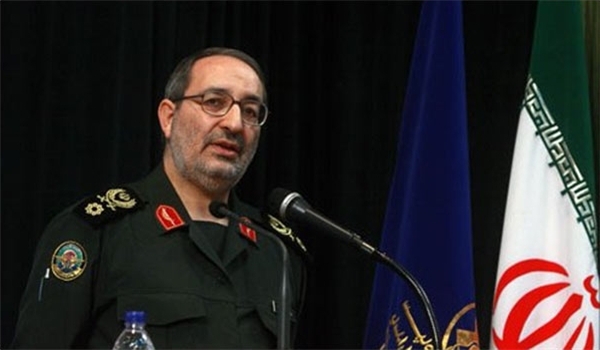
“Today by looking at this issue (of terrorism) from every angle, we see the Americans standing behind the scene of ISIL terrorism in the region; they do this to sway away threats from Israel,” General Jazzayeri said on Friday, addressing the funeral procession ceremony held for two Iranian military commanders killed in Syria.
He pointed to Iran’s military counseling services for Syria and the martyrdom of Iranian military commanders in the Arab country, and said, “Were it not because of Iran’s wisdom, Syria would not be in the hands of the Americans and Israelis… .”
On Tuesday, two other IRGC commanders, providing military counseling services to the Syrian forces in their fight against the Takfiri terrorists, were killed in Syria.
Colonel Farshad Hasounizadeh, the former commander of IRGC’s Saberin Special Brigade, was martyred while fulfilling his duty as military adviser in Syria and fighting the Takfiri terrorists in the Muslim country.
Also, the former commander of IRGC Hazrat Hojjat 1 Brigade Hajj Hamid Mokhtar-band, nicknamed Abu Zahra, was killed in Syria.
Both Hasounizadeh and Mokhtar-band were IRGC war veterans and were martyred in Southern Syria.
Their martyrdom comes just days after another IRGC war veteran Brigadier General Hossein Hamadani was martyred during an attack by the ISIL Takfiri terrorists in the outskirts of the city of Aleppo while fulfilling his duty as military advisor and defending the holy Shiite shrines in the country, an IRGC statement said on Friday.
General Hamadani was in Syria to render military advice to the Syrian army and popular forces in their fight against the ISIL terrorists in the Arab country.
According to Iran’s military rules, those missed or killed in operation are promoted to a higher rank and that’s why in a few Persian-language sources, Colonel Hasounizadeh has been referred to as a General.
In September 2014, Deputy Chief of Staff of the Iranian Armed Forces Major General Gholam Ali Rashid announced that Iran’s military advisors are present in the friendly regional states to provide those nations with necessary military recommendations.
“Some of our commanders are in the field to give military advice to the Iraqi army, Lebanon’s Hezbollah and the Palestinian resistance movement,” Major General Rashid said, addressing a conference attended by a group of senior military commanders in Tehran.
“Russia” calling “another US’ bad bluff”! Zero Point via You Tube, October 14, 2015
According to the blurb below the video,
The US has now thrown in the towel on the ill-fated strategy of training Syrian fighters and sending them into battle only to be captured and killed by other Syrian fighters who the US also trained..
The Pentagon’s effort to recruit 5,400 properly “vetted” anti-ISIS rebels by the end of the year ended in tears when the entire world laughed until it cried after word got out that only “four or five” of these fighters were actually still around. The rest are apparently either captured, killed, lost in the desert, or fighting for someone else..
This has cost the US taxpayer somewhere in the neighborhood of $40 million over the last six months..
Because this latest program was such a public embarrassment, the Pentagon had to come up with a new idea to assist Syria’s “freedom fighters” now that they are fleeing under bombardment by the Russian air force only to be cut down by Hezbollah..The newest plan: helicopter ammo. No, really. The US has now resorted to dropping “tons” of ammo into the middle of nowhere and hoping the “right” people find it..
Here’s CNN:
U.S. military cargo planes “gave” 50 tons of ammunition to rebel groups overnight in northern Syria, using an air drop of 112 pallets as the first step in the Obama Administration’s urgent effort to find new ways to support those groups..
Details of the air mission over Syria were confirmed by a U.S. official not authorized to speak publicly because the details have not yet been formally announced..
C-17s, accompanied by fighter escort aircraft, dropped small arms ammunition and other items like hand grenades in Hasakah province in northern Syria to a coalition of rebels groups vetted by the US, known as the Syrian Arab Coalition..
And here’s a bit more color from GOP mouthpiece Fox News:
The ammunition originally was intended for the U.S. military’s “train and equip” mission, the official said. But that program was canceled last week..
“So now we are more focused on the ‘E’ [equip] part of the T&E [train & equip],” said the official, who described equipping Syrian Arabs as the focus of the new strategy against ISIS..
The Defense Department announced Friday that it was overhauling the mission to aid Syrian rebel fighters. After the program fell far short of its goals for recruiting and training Syrian fighters, the DOD said it would focus instead on providing “equipment packages and weapons to a select group of vetted leaders and their units so that over time they can make a concerted push into territory still controlled by ISIL”..
The shift also comes as Russia continues to launch airstrikes in Syria, causing tension with the U.S. amid suspicions Moscow is only trying to prop up Bashar Assad..
Col. Steve Warren, spokesman for the U.S.-led anti-ISIS coalition, confirmed that coalition forces conducted the airdrop..
“The aircraft delivery includes small arms ammunition to resupply counter-ISIL ground forces so that they can continue operations against ISIL. All aircraft exited the drop area safely,” he said in a statement. All pallets successfully were recovered by friendly forces, a U.S. official said..
The US just paradropped 50 tons of ammo on pallets into the most dangerous place on the face of the planet with no way of ensuring that it falls into the “right” hands (it goes without saying that the term “right” is meaningless there). Meanwhile, the Russians are dropping bombs on the same extremists who are set to receive the guns the US is dropping..
Of course if it does somehow fall into the “wrong” hands, it wouldn’t be the first time (see Mosul and recall the $500 billion worth of weapons Washington “misplaced” in Yemen) and as we said a few days ago, this is at least great news for the military-industrial complex. It means more “terrorist attacks” on U.S. “friends and allies”, and perhaps even on U.S. soil – all courtesy of the US government supplying the weapons – are imminent…
Russia and Iran Moving to Corner the Mideast Oil Supply, American Thinker, Steve Chambers, October 15, 2015
It looks like Vladimir Putin and the ayatollahs are preparing to corner the world’s oil supply – literally.
Last May I wrote on this site that Iran was in the process of surrounding the Saudi/Wahhabi oil reserves, along with those of the other Sunni Gulf petro-states. I added that, “Iran’s strategy to strangle Saudi/Wahhabi oil production also dovetails with Putin’s interests. As the ruler of the second largest exporter of oil, he would be delighted to see the Kingdom’s production eliminated or severely curtailed and global prices soar to unseen levels. No wonder he is so overtly supporting Iran.”
We’ve now seen Putin take a major, menacing step in support of the Iranians by introducing combat forces into Syria. Many analysts argue that he’s doing this both to protect his own naval base at Tartus and as some sort of favor to the Iranians. Are those really sufficient inducement for him to spend scarce resources and risk Russian lives, or does he have bigger ambitions in mind? Given the parlous state of Russia’s economy, thanks in very large part to the recent halving of oil prices, he must relish the opportunity now presented to him, in an axis with Iran, to drive those prices back to prior levels.
The Iranians, for their part, must welcome this opportunity as well, for two huge reasons: first, when sanctions are finally lifted, thanks to their friend in the White House, Iran’s oil production will only aggravate the current global excess oil supply, reducing their cash flow (although they will still repatriate the $150 billion released by the nuclear deal). They and the Russians must both be desperate to find a way to prevent further oil price declines. And second, Iran’s mortal sectarian enemies and rivals for leadership of all of Islam are the Saudi/Wahhabi clan, so the prospect of simultaneously hurting them while strengthening themselves must seem tremendously tantalizing.
To achieve this, the Russian-Iranian axis can pursue the encirclement strategy of the Arabian Peninsula that Iran has already been overtly conducting, as I described in May, and is evident by referring to the map below.

Iran and its allies already control the border across the Saudi/Wahhabi Kingdom’s northern frontier, although the Iranian grip on the Syrian portion is tenuous – hence the Russian intervention. Now Iran is also fighting a bitter proxy war with the Kingdom in Yemen, where Iran is backing coreligionist Shi’ites. From Yemen, Iran can also threaten the Bab-al-Mandeb that provides access to the Red Sea, multiplying the pressure it already exerts on the Kingdom by threatening the Strait of Hormuz at the entrance to the Persian Gulf from its own territory.
Moreover, Iran is widely believed to be supporting the Shi’a who live on top of the Saudi/Wahhabi oil reserves in the Eastern Province. The natural affinity between the Shi’a of Arabia and Iran has long worried the royal family and led them to discriminate against their Shi’ite subjects, fostering resentment among them. Attacks on the Shi’a community early this year have increased tensions. On top of all that, Iran is reportedly behind the recent Shi’a unrest in Bahrain, which Iran considers it lost “14th province” – much as Saddam viewed Kuwait in the late 1980s.
With this being the current state of the Mideast chessboard, consider how the game can unfold. With Russian assistance, Iran can save its Syrian puppet and reinforce its defensive enclave in the Allawite homeland in the northwest of its putative boundaries. Then the combined forces of the axis can turn on ISIS, all the while boasting of doing the world a favor, and reduce its territorial control if not extirpate it entirely. Of course, the Saudi/Wahhabis will probably do whatever they can to assist their vicious ideological offspring, but it would be hard to bet against the axis.
As the axis pacifies Syria, it can then begin pressure the Saudi/Wahhabis and other Sunni petro-states to curtail their oil production enough both to accommodate the increased Iranian flow and to lift prices back to acceptable levels. $100 a barrel must sound like a nice target.
The axis’s initial pressure will probably be diplomatic, applied by both principal powers. However, with Iran’s foothold-by-proxy in Yemen and their influence in the Eastern Province and Bahrain, it could easily foment more general violence against the Saudi/Wahhabis, even within the Kingdom itself. Iran could likewise twist Bahrain’s arm and thereby rattle the cages of the lesser Sunni petro-states. Then, by trading a reduction in oil for a reduction in violence, the axis could achieve its objective.
If not, the Iranians could escalate the violence further. Perhaps ideally from the Iranian perspective, the Saudi/Wahhabis would overreact and provide Iran with an excuse to strike directly at the geographically highly concentrated Arabian oil fields and support facilities. Iran might not be willing to risk royal retaliation by attacking on its own, but it could be emboldened with Russian backing by air and sea, and perhaps even a nuclear umbrella. In that scenario, the proud Arabs would be forced to bow to the will of their ancient Persian foes – particularly since it is obvious that the US under its current president could not be relied upon for support.
An attack on the Kingdom’s fields would cause a severe and lengthy disruption of Mideast oil supply, which would dreadful for the rest of the world – but certainly not the worst-case scenario. Such a disruption would precipitate another nasty global recession and could severely weaken the US, Europe, and China, all of whose economies are fragile and probably brittle. Thus the damage inflicted could far outlast the disruption itself. This could be yet another highly attractive incentive for Putin and his ayatollah allies.
So, Putin and the ayatollahs have powerful motives to corner the world’s oil market and therefore the US and the rest of the world are facing an enormous risk. The horrible pity of this is that the US could easily demonstrate the futility of the Russian-Iranian axis trying to take the world hostage with Mideast oil, simply by opening up our surface deposits of oil shales in the Rockies. As I showed in this analysis last March, these resources could make Mideast oil irrelevant.
The US’ surface oil shales are completely different from the deep shales that are accessed through directional drilling and fracking and that grab all the headlines; the deep shales are a mere side show in terms of reserves. The surface shales hold up to 3 trillion barrels of oil versus about 50 billion barrels of tight oil accessed by fracking. The total global proven reserves of oil are 1.6 trillion barrels, and the Canadian tar sands have 1.6 to 2.5 trillion barrels (although they’re officially listed at 175 billion barrels, which are incorporated in the global total). So, the US and Canada together essentially can triple the global supply of oil, and at prices in the $60-75/barrel range. Meanwhile, Mideast reserves are about 800 billion barrels – half of Canada’s oil sands, perhaps less than a third of the US surface shales. The world no longer needs the Muslim oil.
Unfortunately, the vast majority of the Rockies surface shales sit on Federal land, and while George W. Bush opened up those lands for development, Obama rescinded that policy. These reserves now sit almost entirely idle.
As with any petroleum deposit, these surface shale reserves can’t be turned on with the wave of a wand. But they can be opened for development with just a pen, and not even a phone. For the protection of this country, and the good of the world, our current president should immediately open these reserves for development, with great fanfare. If he will not use our military to protect our interests, he should at least use our economic weapons.
There is no time to lose. Russia is on the march, in unison with the emboldened and enriched Iranians, thanks again to our president. Putin and the ayatollahs know they will enjoy only another 464 days with this president and that none of his likely replacements will be so complacent and flexible, to use his own term. We should therefore expect that they will want to make as much hay as they can while the sun reflects off of Obama’s insouciant grin.
Looking beyond the ‘third intifada’ Jerusalem Post, Louis Rene Beres, October 13, 2015
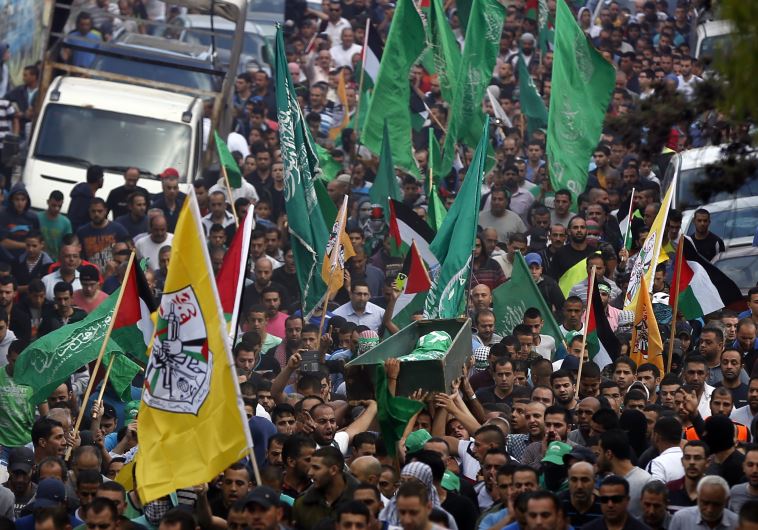 Funeral in the Shuafat refugee camp in east Jerusalem, on October 10, 2015. (photo credit: AHMAD GHARABLI / AFP)
About expected Palestinian state intentions, there is little real mystery to fathom. It should already be widely understood that any new state of Palestine could provide a ready platform for launching endlessly renewable war and terrorism against Israel. Significantly, not a single warring Palestinian faction has ever even bothered to deny such overtly criminal intent. On the contrary, aggressive intent has always been openly embraced, fervently cheered as a distinctly sacred “national” incantation.
*********************************
It’s farewell to the drawing-room’s civilized cry, The professor’s sensible where to and why, The frock-coated diplomat’s social aplomb, Now matters are settled with gas and with bomb.”
– W.H. Auden, Danse Macabre
With apparent suddenness, and a very deliberate brutality, Palestinian terrorists are launching a new wave of indiscriminate assaults they proudly hail as a “third intifada.”
But behind the protective veneer of language, where homicide is conveniently transfigured into revolution, these latest Arab attacks remain what they have always been – that is, crudely camouflaged expressions of rampant criminality.
Jurisprudentially, this is all perfectly obvious. Prima facie, under all pertinent international law, calculated assaults on mostly women and children can never be sanitized or justified. Always, rather, they represent codified crimes of war and crimes against humanity.
Always, such crimes are unpardonable.
Oddly enough, even after the painfully long history of egregious Palestinian crimes carried out against noncombatant populations, a sizable portion of the “international community” still seeks to encourage Palestinian statehood. Self-righteously, of course, and with ritualistic indignation directed against Israeli “intransigence,” the “civilized community of nations” remains willing to rip a 23rd Arab state from the still-living body of Israel. Even now, as the Palestinians remain rigorously segmented into barbarously warring factions – into opponents who enthusiastically maim and torture each other, all while cooperating in doing the same to their commonly despised Israeli victims – world public opinion calls naively for Palestinian “self-determination.”
Even now, when any new Palestinian state could quickly come to resemble an already-fractured Syria, the United Nations and its secretary – general seem much more concerned with comforting the markedly unheroic Palestinian criminals than with protecting fully innocent Israeli civilians.
Unapologetically, and whatever their unhindered and ongoing excesses, Fatah, Hamas and Islamic Jihad are easily able to incite followers to inflict and then celebrate incessant harms upon Israel.
At some point, it is likely that such harms, joyously imposed with a reassuring impunity, could involve diverse weapons of mega-terrorism, including assorted chemical, biological, or even nuclear agents.
In this last category of insidious choice, Palestine, after formalizing its sought-after condition of statehood or sovereignty, could be placed in an optimal position to assault Israel’s Dimona nuclear reactor.
This plainly sensitive facility was previously attacked, in both 1991 and again in 2014. Those earlier missile and rocket barrages, which produced no ascertainably injurious damages to the critical reactor core, had originated with Iraqi and Hamas aggressions, respectively.
About expected Palestinian state intentions, there is little real mystery to fathom. It should already be widely understood that any new state of Palestine could provide a ready platform for launching endlessly renewable war and terrorism against Israel. Significantly, not a single warring Palestinian faction has ever even bothered to deny such overtly criminal intent. On the contrary, aggressive intent has always been openly embraced, fervently cheered as a distinctly sacred “national” incantation.
A September 2015 poll by the Palestinian Center for Policy and Survey research – the leading social research organization in the Palestinian territories – found that a majority of Palestinians unhesitatingly reject a two-state solution.
When asked, as a corollary question, about any preferred or alternate ways to establish an independent Palestinian state, 42 percent called for “armed action.”
Only 29% favored “negotiation,” or some sort of peaceful resolution.
Not much mystery here.
On all currently official Hamas and Palestinian Authority (PA ) maps of “Palestine,” Israel has been removed altogether, or identified exclusively as “occupied Palestine.”
By these revealingly forthright and vengeful depictions, Israel has already been forced to suffer a “cartographic genocide.” Unambiguously, from the standpoint of any prospective Palestinian state policies toward Israel, such incendiary maps are portentous, predictive and possibly even prophetic.
What is not generally recognized is that a Palestinian state, any Palestinian state, could play a determinedly serious role in bringing some form of nuclear conflict to the Middle East. Palestine, of course, would itself be non-nuclear; but that’s not the issue. There would remain several other ways in which the new state’s predictable infringements of Israeli security could make the Jewish state more vulnerable to an eventual nuclear attack from Iran, or, in the even more distant future, from a newly-nuclear Arab state.
This second prospect would likely have its core origins in understandable reactions to the plainly impotent Vienna pact with Iran.
Following the July 14, 2015 Joint Comprehensive Plan of Action (JCPOA ), several Sunni states in the region, most plausibly Egypt and/ or Saudi Arabia, will likely feel compelled to “go nuclear.”
In essence, any such considered Sunni Arab nuclear proliferation would represent a more-or-less coherent “self-defense” reaction against expectedly escalating perils, once still-avoidable dangers now issuing from the reciprocally fearful Shi’ite world.
There is also more to expect from the Sunni side. Here, in actions that would have no apparent connection to expected Iranian nuclearization, Islamic State (IS) could begin an avowedly destructive march westward, across Jordan, and all the way to the borders of West Bank (Judea/Samaria). There, should a Palestinian state already be established and functional, dedicated Sunni terrorist cadres would likely make quick work of any deployed Palestinian army. In the event that a new Arab state had not yet been suitably declared – that is, in a fashion consistent with codifying Montevideo Convention (1934) expectations – invading IS forces (not Israel) will have become the principal impediment to Palestinian independence.
Credo quia absurdum – “I believe because it is absurd.” In either case, any such IS or IS-related conquest could create another available platform for launching relentless terrorist attacks across the region.
In time, of course, most of these murderous attacks would be aimed precisely at Israel.
IS, as everyone can see, is on the move. It has already expanded well beyond Iraq and Syria, notably into Yemen, Libya, Egypt and Somalia.
Although Hamas leaders generally deny any IS presence in Gaza, that terrorist group’s black flag is now seen more and more regularly in that expressly Palestinian space.
In principle, at least, Israel could sometime find itself forced to cooperate with Hamas against IS, but any reciprocal willingness from the Islamic Resistance Movement, whether glaringly conspicuous or beneath the radar, is implausible.
Additionally, Egypt regards Hamas as part of the much wider Muslim Brotherhood, and prospectively, just as dangerous as IS.
In any event, after Palestine, and even in the absence of any takeover of the new Arab state by IS forces, Israel’s physical survival would require increasing self-reliance in existential military matters.
Such expansions, in turn, would demand: 1) an appropriately revised nuclear strategy, involving deterrence, defense, preemption and warfighting capabilities; and 2) a corollary conventional strategy.
Significantly, however, the birth of Palestine could impact these strategies in several disruptive ways.
Most ominously, a Palestinian state could render most of Israel’s conventional capabilities substantially more problematic. It could thereby heighten certain eventual chances of a regional nuclear war.
Credo quia absurdum. A nuclear war in the Middle East is not out of the question. At some point, such a conflict could arrive in Israel not only as a “bolt-from-the-blue” surprise missile attack, but also as a result, whether intended or inadvertent, of escalation.
If, for example, certain enemy states were to begin “only” with conventional and/or biological attacks upon Israel, Jerusalem might then respond, sooner or later, with nuclear reprisals. Or if these enemy states were to begin hostilities with certain conventional attacks upon Israel, Jerusalem’s own conventional reprisals might then be met, at least in the future, with enemy nuclear counterstrikes.
For now, this second scenario could become possible only if Iran were to continue its evident advance toward an independent nuclear capability. It follows that a persuasive Israeli conventional deterrent, at least to the extent that it could prevent enemy state conventional, and/or biological attacks, would substantially reduce Israel’s risk of any escalatory exposure to a nuclear war. Israel will need to maintain its capacity for “escalation dominance,” but Palestinian statehood, on its face, could still impair this overriding strategic obligation.
A subsidiary question comes to mind. Why should Israel need a conventional deterrent at all? Israel, after all, seemingly maintains a capable nuclear arsenal and corollary doctrine, even though both still remain “deliberately ambiguous.”
And there arises a still further query. Even after “Palestine,” wouldn’t enemy states desist from launching conventional and/or biological attacks upon Israel, here, out of an entirely reasonable and prudent fear of suffering a nuclear retaliation? Not necessarily. Aware that Israel would cross the nuclear threshold only in certain extraordinary circumstances, these enemy states could be convinced – rightly or wrongly – that so long as their attacks were to remain non-nuclear, Israel would respond only in kind. Faced with such probable calculations, Israel’s ordinary security would still need to be sustained by conventional deterrent threats.
A strong conventional capability will still be needed by Israel to deter or to preempt conventional attacks – attacks that could, if undertaken, lead quickly, via escalation, to various conceivable forms of unconventional war.
Credo quia absurdum. It is still not sufficiently understood that Palestine could have serious effects on power and peace in the Middle East. As the creation of yet another enemy Arab state would need to arise from the intentional dismemberment of Israel, the Jewish state’s strategic depth would inevitably be diminished. Over time, therefore, Israel’s conventional capacity to ward off assorted enemy attacks could be correspondingly reduced.
Paradoxically, if enemy states were to perceive Israel’s own sense of expanding weakness and desperation, this could strengthen Israel’s nuclear deterrent. If, however, pertinent enemy states did not perceive such a “sense” among Israel’s decision-makers (a far more likely scenario), these states, now animated by Israel’s conventional force deterioration, could then be encouraged to attack. The cumulative result, spawned by Israel’s post-Palestine incapacity to maintain strong conventional deterrence, could become: 1) defeat of Israel in a conventional war; 2) defeat of Israel in an unconventional chemical/biological/nuclear war; 3) defeat of Israel in a combined conventional/unconventional war; or 4) defeat of Arab/Islamic state enemies by Israel in an unconventional war.
For Israel, a country less than half the size of Lake Michigan, even the “successful” fourth possibility could prove intolerable. The tangible consequences of a nuclear war, or even a “merely” chemical/ biological war, could be calamitous for the victor as well as the vanquished.
Under such exceptional conditions of belligerency, the traditional notions of “victory” and “defeat” would likely lose all serious meaning.
Although a meaningful risk of regional nuclear war in the Middle East must exist independently of any Palestinian state, this uniquely serious threat would be still greater if a new Arab terrorist state were authoritatively declared.
Palestine, it has increasingly been argued, could sometime become vulnerable to overthrow by even more militant jihadist Arab forces, a violent transfer of power that could then confront Israel with an even broader range of regional perils.
In this connection, IS, again, could find itself at the outer gates of “Palestine.” In such a scenario, it is plausible that the IS fighters would make fast work of any residual Palestinian defense force, PA and/ or Hamas, and then absorb Palestine itself into a rapidly expanding Islamic “caliphate.”
Before anything remotely decent could be born from such a determined theocracy, a very capable sort of gravedigger would have to wield the forceps.
The “third intifada” is just another legitimizing term for remorseless Palestinian terrorism. Should it transform the always fratricidal Palestinian territories into another corrupted Arab state, Palestine, either by itself, or as a newly-incorporated part of a still-growing IS “caliphate,” would become another Syria. Even more significantly, Palestine could bring specifically nuclear-based harms to the broader region.
Then, quite predictably, all pertinent “matters” would be settled “with gas and with bomb.”
Islamic State grows in Afghanistan, encroaches on Kabul as U.S. remains ‘passive observer’ Washington Times, Rowan Scarborough, October 11, 2015
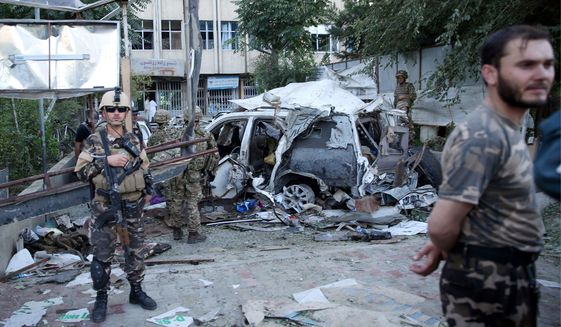 Photo by: Massoud Hossaini Afghan security forces and British soldiers inspect the site of a suicide attack in the heart of Kabul, Afghanistan. Loyalists of the Islamic State group are making inroads into Afghanistan, with homegrown militants claiming allegiance to the Islamic State as it controls territory in some parts of the country. (Associated Press)
Afghanistan’s 3,000-member ISIL army is about one-tenth the size of the Afghan Taliban’s forces. But NATO says the Islamic State has reached the next stage of being an emerging threat. If its growth in other regions, such as North Africa, is a gauge, its Afghan component will only expand further as young Muslims are drawn by social media to its ultraviolent ways and Sunni orthodoxy.
************************
The Islamic State is growing at an alarming rate in Afghanistan, within striking distance of the capital, and there does not seem to be a concerted U.S. effort to strike the terrorist army as there is in the Syria-Iraq war theater.
An independent think tank has concluded that the allies are “reacting disjointedly and ineffectively” to the group in Afghanistan and other places outside those two countries.
The Islamic State’s numbers now may reach as high as 3,000 in Afghanistan, mostly in Nangarhar province, less than 50 miles east of Kabul. The emergence presents the NATO-backed elected government there with a fifth deadly enemy in addition to the Taliban, al Qaeda, the Haqqani network and elements of the Pakistani intelligence service.
Globally, the Islamic State, also called ISIL and ISIS, has affiliates in nearly 20 countries.
“It’s like a metastasizing cancer spreading throughout certain parts of the Islamic world,” said James Russell, a former Pentagon official and an instructor at the Naval Postgraduate School in Monterey, California. “We have to hope that the antibodies in these societies can ward off the death, misery and destruction that will come raining down upon them if ISIS takes hold in their communities.”
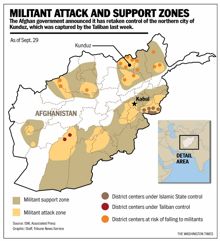
Afghanistan’s 3,000-member ISIL army is about one-tenth the size of the Afghan Taliban’s forces. But NATO says the Islamic State has reached the next stage of being an emerging threat. If its growth in other regions, such as North Africa, is a gauge, its Afghan component will only expand further as young Muslims are drawn by social media to its ultraviolent ways and Sunni orthodoxy.
Yet unlike in Syria and Iraq, where a U.S.-led coalition conducts a series of daily airstrikes against the Islamic State, there appears to be no such strategy in Afghanistan, where Afghan government forces now have the lead in all combat operations and request NATO air power on an ad hoc basis.
“What concerns me most is the fact that the United States has become a passive observer rather than the driver of the policy,” said Larry Johnson, a former counterterrorism official at the State Department, commenting on the overall U.S. effort against the Islamic State.
U.S. military spokesmen had no immediate comment on the question of American policy toward the Afghan Islamic State. Army Gen. John Campbell, the allied commander in-country, was asked at congressional hearings last week what triggers action against Islamic State. He answered that the criterion is “force protection.”
After the Syria-Iraq war theater, Islamic State’s emergence near Kabul could be the most troublesome for the U.S., whose troop levels have dropped to less than 10,000, and only a small portion of those forces are dedicated to assist in counterterrorism. The Islamic State has shown it can execute brutal attacks and deploy vehicle bombs to take territory and hold it.
Gen. Campbell said Afghanistan’s security forces lack the leadership and troop numbers to respond to every trouble spot.
Meanwhile, the Islamic State is beginning to flex its terrorism muscle in Afghanistan.
Islamic militant competition
The Institute for the Study of War (ISW) in Washington is tracking the Islamic State’s violent ways in Afghanistan and other countries. It said the Islamic State launched attacks in mid-September against a UNICEF convoy, Afghan government forces, the Afghan Taliban and Shiite civilians. In late September the Islamic State “launched coordinated attacks on multiple Afghan security positions” in Nangarhar, the think tank said.
“The group reportedly also shut down several schools in eastern Afghanistan amid other efforts to assert social control,” the institute said. “ISIS has established robust ground campaigns in Libya, Egypt and Afghanistan.”
The ISW said in the special report “ISIS Global Strategy: A Wargame,” written by counterterrorism analyst Harleen Gambhir, that the Islamic State’s expansion stems from its ability to attract local jihadis.
“The coalition is focused on Iraq and Syria, and it is reacting disjointedly and ineffectively to ISIS’s activities in Libya, Egypt, Afghanistan, and other places,” Ms. Gambhir writes. “ISW’s war game demonstrated how this failure enables ISIS to strategically outpace the U.S. and its allies.”
U.S. intelligence agencies are still trying to digest the meaning of Islamic State setting up shop in South Asia.
Nicholas Rasmussen, director of the National Counterterrorism Center, speaks of an “increasing competition between extremist actors” in the Afghanistan-Pakistan region involving al Qaeda, the Taliban and the Islamic State.
“So that’s an additional factor that we’re still trying to understand,” Mr. Rasmussen told the Combating Terrorism Center at West Point in remarks published last month. He characterized the burgeoning competition as an “interesting feature of the South Asia landscape.”
Gen. Campbell, the U.S. commander closest to Islamic State terrorism in Afghanistan, said foreign fighters are arriving to join the Islamic State as they “try to bring in some sort of funding stream to build a place in Nangarhar.”
He said the emergence of Islamic State “has further complicated the theater landscape and potentially expanded the conflict.”
Mr. Johnson, the former counterterrorism official, said the leaders of Middle East and South Asia countries “concede that the U.S. has no appetite for being engaged, especially militarily in the region.”
The struggle between two radical Sunni groups, the Taliban and the Islamic State, may be sparked in part by the Taliban’s willingness to do business with Iran, a Shiite Islamic country.
“The Taliban have always been far more pragmatic in dealing with Iran, and the religious difference is not a critical factor,” Mr. Johnson said. “Not so with the ISIS crowd. For them, theology takes precedence, and Iran is an apostate state that must be destroyed.”
Egypt will begin construction of church dedicated to ISIS martyrs, Breitbart, Thomad D. Williams, PH.D., October 10, 2015
(The church will be dedicated to those murdered by the Islamic State. In what other Muslim nation would that happen? — DM)
 YouTube via NBC News
President al-Sisi has asked Christians for a greater commitment in politics, urging them to vote and to run for office, to ensure a Christian presence in Parliament.
***********************
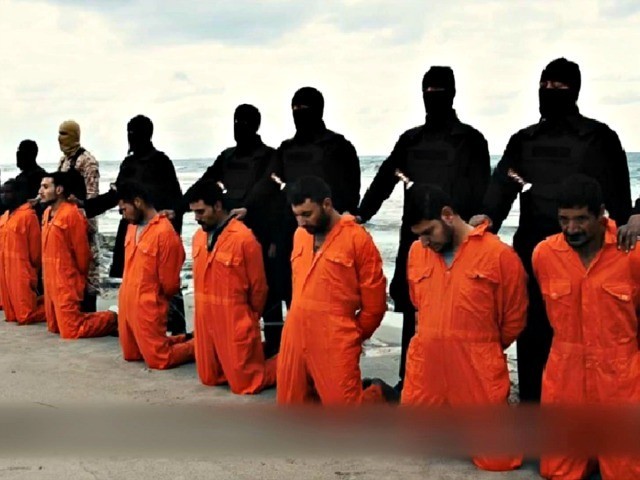
In the coming days, construction will commence on a new church in Egypt dedicated to the martyred Coptic Christians beheaded by the Islamic State in Libya in February.
The new church, bearing the name “Church of the Libyan Martyrs,” will be built in the Minya Governorate, south of the capital, Cairo. The church will cost $1.3 million, half of which has already been raised.
Egyptian President Abdel Fattah al-Sisi granted permission for the construction of the church last February after Islamic State militants murdered 21 Coptic Christians on a Libyan beach.
According to Father Rafic Greiche, spokesman for the Catholic Church in Egypt, the construction is indicative of a slow but noticeable shift taking place in Egyptian culture as well as among state officials. The change comprises improving attitudes toward Christians, but also resistance to Islamic extremism.
Until now, Fr. Greiche said, the procedure involved in getting a church building permit was extremely complex, involving a series of authorizations and approvals, which have been streamlined in this case. The decision also indicates that the government wished to send a strong message against religious discrimination, he said.
Greiche says that there have also been timid attempts at exegesis of the Koran and Islamic texts, accompanied by a ban on women teachers wearing a burka in the classroom and struggles against fundamentalism and extremist sermons in mosques.
Last week, the president of the University of Cairo, Dr. Hossam Kamel, prohibited teachers from wearing the burka in the classroom. They may continue to wear it, if they choose, at home or on the street, but not during teaching time.
Egypt’s top Islamic school, Al-Azhar, followed suit by banning women from wearing the burka in all its affiliate schools after a leading cleric said the burka was only a “tradition” and not necessary in Islam.
With general elections in late October and a possible reform of the Constitution, some expect a greater presence and visibility of Christians in society and in national politics as a result. While a transformation of the mentality naturally takes time, Greiche said, the fact remains that Christians are far more accepted in Egyptian society now than in the past.
President al-Sisi has asked Christians for a greater commitment in politics, urging them to vote and to run for office, to ensure a Christian presence in Parliament.
The High Electoral Commission also decided that at the first stage of the elections on October 17, women wearing the full veil must show their faces if they want to cast their vote.
For some time, there has been a greater determination to limit fundamentalism and extremism in mosques. The priest spoke of a “greater secularism without renouncing the religious element.”




 anneinpt
 artaxes
 danmillerinpanama
 davidking1530
 Peter Hofman
 Joseph Wouk
 Peter
Peter Louisiana Steve
 WarSclerotic
Recent Comments