Archive for the ‘Islamic State’ category

Across the Border

June 3, 2016

Across the Border, Power LineScott Johnson, June 3, 2016

(Somehow, Mr. Johnson seems to have missed this information from the Washington Times:

The group of six men nabbed inside the U.S. — the Afghan and five men identified as Pakistanis — all made asylum claims when they were eventually caught by the Border Patrol. Mr. Hunter said his understanding is that the five men from Pakistan were released based on those claims and have disappeared.

— DM)

At the Washington Times Stephen Dinan has a timely scoop that highlights the national security implications of our porous border with Mexico. Dinan reports:

A smuggling network has managed to sneak illegal immigrants from Middle Eastern terrorism hotbeds straight to the doorstep of the U.S., including helping one Afghan who authorities say was part of an attack plot in North America.

Immigration officials have identified at least a dozen Middle Eastern men smuggled into the Western Hemisphere by a Brazilian-based network that connected them with Mexicans who guided them to the U.S. border, according to internal government documents reviewed by The Washington Times.

Those smuggled included Palestinians, Pakistanis and the Afghan man who Homeland Security officials said had family ties to the Taliban and was “involved in a plot to conduct an attack in the U.S. and/or Canada.” He is in custody, but The Times is withholding his name at the request of law enforcement to protect investigations.

Some of the men handled by the smuggling network were nabbed before they reached the U.S., but others made it into the country. The Afghan man was part of a group of six from “special-interest countries.”

Rep. Duncan Hunter appears to have given Dinan a hand with his story:

The group, guided by two Mexicans employed by the smuggling network, crawled under the border fence in Arizona late last year and made it about 15 miles north before being detected by border surveillance, according to the documents, which were obtained by Rep. Duncan Hunter, California Republican.

As the Obama administration imports a wave of immigrants from Syria and forces them down our throats at locations unknown around the country, Dinan also adds this timely note:

[T]he documents obtained by Mr. Hunter confirm fears of a pipeline that can get would-be illegal immigrants from terrorist hotbeds to the threshold of the U.S.

Just as troubling, the Border Patrol didn’t immediately spot the Afghan man’s terrorist ties because the database that agents first checked didn’t list him. It wasn’t until agents checked an FBI database that they learned the Afghan may be a danger, the documents say.

Dinan’s current scoop follows up on his December 2015 story “Agents nab Pakistanis with terrorist connections crossing U.S. border.” At Politifact (!), Joshua Gillin has a useful roundup of such stories.

Do you suppose that others fitting the profile Dinan sketches have made it across the border undetected? I do. And that porous border with Mexico — President Obama means for us to keep it that way.

Europe Braces for More Jihadist Attacks

June 2, 2016

Europe Braces for More Jihadist Attacks, Gatestone InstituteSoeren Kern, June 2, 2016

♦ Sports stadiums and big music events are especially vulnerable: “This is where you put a small town into a small area for a couple of hours.” — Neil Basu, deputy assistant commissioner of the Metropolitan Police, London.

♦  “We know that the Islamic State has the European Championship in its sights.” — Hans-Georg Maaßen, head of Germany’s domestic intelligence agency.

♦  According to Patrick Calvar, head of the France’s domestic intelligence agency, at least 645 French nationals or residents, including 245 women, are currently with the Islamic State in Syria and Iraq. Another 200 individuals are “in transit,” either on their way to Syria or returning to France. Around 244 jihadists have already returned to France.

♦British police chiefs are struggling to recruit enough officers who are willing to carry a firearm, because many fear they will be treated as criminal suspects if they use their weapon in the line of duty.

European security officials are bracing for potential jihadist attacks at public venues across Europe this summer.

In France, officials are preparing for possible attacks against the European Football Championships. The games, which start on June 10, comprise 51 matches involving 24 teams playing in 10 host cities across the country.

Interior Minister Bernard Cazeneuve said that more than 90,000 security personnel will be on hand to protect the 2.5 million spectators expected to attend the games, as well as the hundreds of thousands more who will watch the matches on big screens in so-called “fan zones” in major cities.

Patrick Calvar, the head of the France’s domestic intelligence agency (Direction générale de la sécurité intérieure, DGSI), warned: “We know that the Islamic State is planning new attacks in France.” He added:

“We risk being confronted with a new form of attack: a terrorist campaign characterized by placing explosive devices in places where large crowds are gathered, and repeating this type of action to create a climate of panic.”

According to Calvar, at least 645 French nationals or residents, including 245 women, are currently with the Islamic State (ISIS) in Syria and Iraq. Another 200 individuals are “in transit,” either on their way to the Middle East or returning to France. Around 244 jihadists have already returned to France, and another 818 people have “demonstrated their intention to go to Syria.”

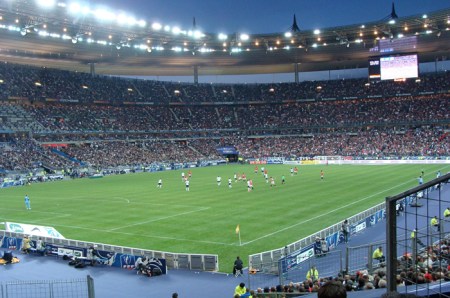
1636The Stade de France, located in a Paris suburb, was attacked by three Islamic State suicide bombers in November 2015. The stadium will be hosting games during the UEFA Euro 2016 football championships (June 10 – July 10, 2016), and French officials are preparing for possible jihadist attacks. (Image source: Wikimedia Commons/Liondartois)

Calvar’s concerns have been echoed by Hans-Georg Maaßen, the head of Germany’s domestic intelligence agency (Bundesamt für Verfassungsschutz, BfV). In an interview with Rheinische Post, Maaßen said: “We know that the Islamic State has the European Championship in its sights.”

On May 29, British media quoted Belgian security sources as saying they had discovered an Islamic State plot to attack British football fans in the southern French city of Marseille when England plays Russia on June 11. The plans were reportedly discovered on a laptop used by Salah Abdeslam, a Belgian-born French national of Moroccan descent who is thought to be the mastermind of the November 2015 terrorist attacks on Paris which left 130 dead.

The laptop is said to have contained information about a plot to kill large numbers of British fans using assault rifles, suicide bombers and possibly even drones armed with chemical weapons. The laptop contained photos and references to Marseille’s historic Old Port, where tens of thousands of football fans are expected to gather at the many bars and restaurants in the area.

Meanwhile, French Interior Minister Bernard Cazeneuve also announced that more than 23,000 police will be deployed to protect the Tour de France, the world’s premier bicycle race, which takes place from July 2 to 24.

Teams of special operations forces (Groupe d’intervention de la Gendarmerie Nationale, GIGN) will guard riders and an estimated 12 million spectators along a route that covers 3,500 kilometers (2,180 miles). “Everyone understands that this year the Tour de France is taking place in a particular context,” Cazeneuve said. He added: “The terrorist threat remains very high.”

In Poland, officials are preparing for possible jihadist attacks against the Catholic Church’s World Youth Day, which is expected to draw 2.5 million to Krakow from July 26 to 31. Poland will impose border controls at all of its national borders from July 4 to August 2.

In Britain, music festivals, big sports venues and nightclubs have been placed on “high alert” for potential jihadist attacks, according to a senior anti-terrorism officer interviewed by the Sunday Times.

Neil Basu, the deputy assistant commissioner of the Metropolitan Police, said that crowded places — including Glastonbury, billed as the world’s largest music festival, which will draw 135,000 people to Somerset from June 22 to 26 — are a major concern for police this summer. Basu warned:

“These people are perfectly happy to target civilians with the maximum terror impact. Crowded places were always a concern for us, but now they are right at the top of the agenda.”

Basu said that sports stadiums and big music events are especially vulnerable: “This is where you put a small town into a small area for a couple of hours.”

Police in rural communities in Britain that host large summer festivals are warning that they could be “sitting ducks” in the face of a jihadist attack as they wait for armed backup to arrive from many miles away.

In an interview with the BBC, John Apter, the head of the Hampshire and Isle of Wight Police Federation, said:

“Being realistic, if a firearms unit was coming from the middle of the county you are still talking about 30 miles away — you are not talking about a few minutes. There would be an understandable delay. If a firearms unit is the other side of the county they could be 70 miles away so you are talking a significant distance. So the only officers that you have available are unarmed and vulnerable officers and they are the officers that are saying to me that in a terrorist situation they would be sitting ducks.”

Most police in Britain are unarmed. According to Deputy Chief Constable Simon Chesterman, the UK’s top firearms officer, British police chiefs are struggling to recruit enough officers who are willing to carry a firearm, because many fear they will be treated as criminal suspects if they use their weapon in the line of duty.

Senior British security officials estimate that the UK needs an extra 1,500 armed officers to tackle jihadist attacks such as those carried out in Paris. Because half of the recruits will not make it through the rigorous training, however, 3,000 volunteers are needed to come forward.

Che Donald of the Police Federation — which represents the 5,647 officers throughout Britain who currently carry firearms — told the Guardian that while major cities such as London are sufficiently protected, other large towns and cities are not: “Currently there are not enough firearms officers who could deal with an incident in quite a lot of areas of Britain.”

In Brussels, Manuel Navarrete Paniagua, the head of the European Counter Terrorism Centre at the European police agency Europol, warned Members of the European Parliament that terrorist cells in Europe are stockpiling weapons and explosives for future attacks:

“We have some information reported by the member states that terrorists groups are trying to establish large clandestine stockpiles of explosives in the European Union to be used eventually in large scale home attacks.”

Paniagua added that police had foiled more than 200 terrorist attacks in the EU in 2015. A total of 151 people were killed and more than 360 injured during terrorist attacks in the EU in 2015. More than 1,000 people were arrested for terrorist-related crimes.

In an interview with Time magazine, Europol director Rob Wainwright revealed that “several hundred” battle-trained European jihadists are probably plotting new attacks. He said that his agency is working on 50 ongoing terrorist investigations:

“This is the highest terrorist threat we have faced in Europe since the days of 9/11. We have 5,000 Europeans who have been radicalized by the Islamic State and have traveled to Syria and Iraq and engaged in conflict experience. We suspect that about one-third of them have come back: That is our best guess. We don’t know for sure…

“Our real concern is that there are other networks, either in Europe already, or who are being trained in Syria for further action. We know that the Islamic State last year took a strategic decision to establish an external operations command, a division to plan exactly the kind of attacks we have now seen. We think that they are still active and planning to do that. The threat is alive and current. Another attempted attack is almost certain. Whether it gets through depends of course. I am concerned about the Islamic State’s clearly expressed desire for the spectacular.”

On May 31, the U.S. State Department issued a travel alert for Europe this summer:

“We are alerting U.S. citizens to the risk of potential terrorist attacks throughout Europe, targeting major events, tourist sites, restaurants, commercial centers and transportation. The large number of tourists visiting Europe in the summer months will present greater targets for terrorists planning attacks in public locations, especially at large events.”

The travel alert urges vigilance when in public places or using mass transportation, and avoiding crowded places.

What is happening in Jordan?

June 2, 2016

What is happening in Jordan? Israel Hayom, Mudar Zahran, June 2, 2016

Days ago, King Abdullah II‎ of Jordan dissolved the parliament and appointed a new prime minister.

This came ‎weeks after the king amended the constitution to expand his already swollen authority as the sole ‎ruler, and has launched a wave of speculation in the Western and Israeli media. The media are puzzled and rather clueless about what exactly is happening in my country, Jordan. Some, including respected publications, jumped to the convenient conclusion ‎that the king has “appointed a pro-Israel prime minister” and even that “Israel has a new friend ‎in the Middle East, Jordan’s prime minister.” These statements by ‎themselves are irrelevant to the status quo and the situation in Jordan is much more critical and ‎dire than anyone in the Israeli media realizes.‎

In November 2015, U.S. presidential candidate Hillary Clinton said ‎Jordan’s future was “not clear” and that Palestinians and Israelis needed to know what will ‎happen in Jordan and “whether Jordan will remain stable” before they resume the peace process. Clinton’s tenure as U.S. secretary of state saw anti-regime protests in Jordan, particularly the November 2012 revolution, ‎when a million Jordanians took to the streets demanding that the Hashemite royals leave the ‎country. She knows more about the reality in Jordan from firsthand experience than any other U.S. presidential candidate.

While Clinton’s statements cannot be taken as prophecies from the Torah or the Quran, the facts on the ‎ground do support her concerns for Jordan. As these lines are being written, unrest continues in the ‎Wadi Mousa-Petra area, including gun battles between the king’s police and the locals, arrests, the ‎destruction of vehicles and other property, stone throwing, and rumors of casualties on both sides. In ‎short, there is an intifada at one of Jordan’s most significant tourist sites.

Days ago, King Abdullah II‎ of Jordan dissolved the parliament and appointed a new prime minister.

This came ‎weeks after the king amended the constitution to expand his already swollen authority as the sole ‎ruler, and has launched a wave of speculation in the Western and Israeli media. The media are puzzled and rather clueless about what exactly is happening in my country, Jordan. Some, including respected publications, jumped to the convenient conclusion ‎that the king has “appointed a pro-Israel prime minister” and even that “Israel has a new friend ‎in the Middle East, Jordan’s prime minister.” These statements by ‎themselves are irrelevant to the status quo and the situation in Jordan is much more critical and ‎dire than anyone in the Israeli media realizes.‎

In November 2015, U.S. presidential candidate Hillary Clinton said ‎Jordan’s future was “not clear” and that Palestinians and Israelis needed to know what will ‎happen in Jordan and “whether Jordan will remain stable” before they resume the peace process. Clinton’s tenure as U.S. secretary of state saw anti-regime protests in Jordan, particularly the November 2012 revolution, ‎when a million Jordanians took to the streets demanding that the Hashemite royals leave the ‎country. She knows more about the reality in Jordan from firsthand experience than any other U.S. presidential candidate.

While Clinton’s statements cannot be taken as prophecies from the Torah or the Quran, the facts on the ‎ground do support her concerns for Jordan. As these lines are being written, unrest continues in the ‎Wadi Mousa-Petra area, including gun battles between the king’s police and the locals, arrests, the ‎destruction of vehicles and other property, stone throwing, and rumors of casualties on both sides. In ‎short, there is an intifada at one of Jordan’s most significant tourist sites.

In addition, anti-regime ‎protests take place every Friday, yards away from the king’s palace. Those protests are not ‎continuous, but they are a regular occurrence and likely to grow. Protests against Egyptian President Hosni Mubarak began in the same ‎way in 2004, and 10,000 protests later, a one-strike revolution toppled him in ‎‎2011, the same year that the current protests in Jordan began.‎

Jordan’s debt-to-GDP ratio is above 90%. Greece’s economy collapsed when it hit ‎the same rate, and the Jordanian regime is not getting the help from Arab states that Greece got from the European Union. Nevertheless, the Jordanian royal family spends beyond belief and is not shy about showing off its opulent lifestyle to its starving subjects.‎

Less than a month ago, Jordan’s king visited our Saudi brothers and came back speaking ‎about billions of Saudi riyals “on the way.” None of this has yet materialized. While these ‎things do take time, Saudi King Salman‎ announced a $25 billion aid package to the el-Sissi regime half an hour ‎after the king’s arrival in Egypt in April. ‎

There are also no signs or news of aid money coming from the ‎Gulf states. Our Arab brothers are wise; they won’t give their money to an ailing regime.‎

On the other hand, the king has been fragile for years now, and many — myself included — have ‎predicted his fall, yet he remains on the throne in Amman. So why should anyone worry that ‎the king might fall now?

In fact, the situation has completely changed.‎

Today, Jordan’s army is independent of the king, and so is Jordan’s intelligence service. Both are tightly coordinated with the U.S. Central Command. When the Islamic State group became a real threat to Jordan, ‎the U.S. must have realized it could no longer tolerate the king’s recklessness, inexperienced ‎handling of security, and mismanagement of Jordan’s military operations and funds. Thus, the ‎U.S. supported separating the army and intelligence apparatus from the king’s influence. This happened trough tight and direct cooperation between the Jordanian and U.S. militaries, and between Jordanian and U.S. intelligence agencies, particularly the U.S. Defense Intelligence Agency.‎

This new arrangement might explain the record-smooth cooperation between Jordan and Israel on ‎security, which is described in the Israeli media as “unprecedented.” Yes, it is unprecedented, ‎because the king no longer has any influence over the army or intelligence service.‎

Further, the U.S. has announced it is about to finish building a massive security wall separating ‎Jordan from Syria and extending along the Iraqi borders. This little-publicized wall will be fully ‎operational in August, according to its contractor, Raytheon, at a cost of over $500 million. At the same time, Israel is quickly and publicly building a $1 billion wall ‎along its border with Jordan.‎

These measures, taken by the U.S. and Jordanian armies, suggest that both are expecting major change in ‎Jordan. The outcome should be safe; Islamic State cannot take over Jordan with thousands of American soldiers stationed ‎in several major U.S. bases across Jordan. ‎

Meanwhile, Jordan’s king sees firsthand signs that his angry, hungry, and hopeless ‎people could actually topple him, and with him having no control over the army now, the king ‎could face a situation like that of Egypt’s 2011 revolution, which was supported by the ‎Egyptian army.‎

Afraid and helpless, Jordan’s regime has turned to the oldest trick in the book: beating the Israeli ‎drum. The regime knows that if a new intifada breaks out in Israel, this ‎could buy it more time in power; the world would be too busy to let it go and Jordan’s ‎public would be distracted by anti-Israel hatred once again. This might explain why an official Israeli ‎statement on Sept. 21, 2015, confirmed that “Jordan was a major contributor to Temple ‎Mount tension” and accused Jordan’s government of exacerbating tensions in Jerusalem with ‎inciting statements and actions.‎

In November 2014, I published an article in which I warned that Jordan’s regime was ‎planning to set the West Bank and Jerusalem on fire in order to stay in power. Also, a month ‎before the “knife intifada” broke ut, I noted several times on social media that Jordan’s ‎regime was going to launch unrest in Jerusalem itself.‎

Change is coming to Jordan. It could be tomorrow morning or in five years, but the ‎Hashemites already have a one-way ticket out, and it seems they are now purposely ‎causing damage to Jordanian, alestinian, American and Israeli interests. ‎

It is about time the few pro-Hashemite hopeless romantics wake up and smell the strong ‎Jordanian coffee already brewing in Amman.‎

As far as the Israeli government is concerned, it has been clear from the beginning: The Israelis ‎will not be involved in the Arab Spring or its aftermath, and will keep good ties with Jordan’s ‎regime, military and intelligence agencies, without any involvement in Jordan’s internal politics. As ‎Jordan’s opposition, we highly appreciate Israel’s stance and fully understand it.‎

As we expect change in Jordan, we must work hard to make sure Jordan remains committed ‎to peace while it becomes economically prosperous and gives hope to all its citizens.‎

Mudar Zahran is secretary-general of the Jordanian Opposition Coalition. Twitter ‎@mudar_zahran.

Antwerp Terror Arrests Underscore Growing Threat to Europe and America

June 1, 2016

Antwerp Terror Arrests Underscore Growing Threat to Europe and America, Investigative Project on Terrorism, Abigail R. Esman, June 1, 2016

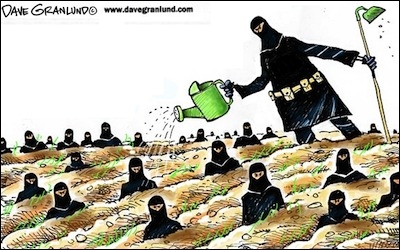
768

Last Wednesday, just two years and a day after the deadly terrorist attack on the Jewish Museum in Brussels, and barely more than two months after the twin attacks on the Brussels airport and metro, Belgian police arrested a group of Muslim youth planning yet another attack, this time in Antwerp. Aiming “to kill as many kufar,” or non-Muslims, as possible, the group is believed to have been planning to bomb Antwerp’s Central Station. The group also is believed to have made previous plans to assassinate right-wing politician Filip Dewinter, the leader of the Vlaams Belang party. Those plans were put on hold, however, in favor of a larger-scale attack.

The suspects were members of a group of radicalized Muslim teens believed to have kept contact with Antwerp native Hicham Chaib, who is now a high-ranking leader of the Islamic State. It was Chaib who informed the public that the March 22 attacks on Belgium’s Zaventem airport and Maelbeek metro station “were just a taste of what’s to come.” And it is Chaib, the former second-in-command of Shariah4Belgium who left Antwerp for Syria in 2012, who now actively recruits other Antwerp-based youth to join ISIS or to execute terrorist attacks in their homeland.

The four arrests followed a series of raids by Antwerp police into the homes of several suspects in the Borgerhout district. Two suspects have been released, but other members of the group, some arrested previously, remain in custody. All suspects are said to be between the ages of 16 and 19, confirming earlier Dutch reports that European Muslims under the age of 20 are increasingly becoming involved in Islamic State activities and jihadist plots.

According to some accounts, the Antwerp group is comprised of nine youths, at least five of whom are minors. At least two members tried to join the Islamic State in Raqqa in March, but were stopped by officials en route and sent back to Belgium.

With security and counter-terror investigations heightened in Brussels after the March 22 attacks there, it is unsurprising that jihadists might be moving their activities and focus to nearby Antwerp. The city has a long history of Muslim unrest, with riots as early as 2002 and the founding, by Hizballah-linked Lebanese immigrant Dyab Abou Jahjah, of the Arab European League (AEL) in 2000. An organization with pan-Arab aspirations, the AEL aimed to create what Jahjah called a “sharocracy” – a kind of combination of democracy and sharia – that would eventually become European law.

More recently, Antwerp native Fouad Belkacem founded the notorious Sharia4Belgium, alleged to have organized most of the recruiting for ISIS in Belgium, with some outreach to neighboring countries such as France and The Netherlands. And, of the estimated 500 Belgian Muslims who have joined terrorist groups in Syria, more than 100 come from Antwerp.

But the indication of heightened new activity in Antwerp also suggests possible changes in strategy for Europe-based jihadists and recruiters. While French-speaking Brussels maintains close ties to France (several of the terrorists involved in the two attacks in Paris last year were based or were born in Brussels), Flemish-speaking Antwerp holds a stronger relationship to The Netherlands. Antwerp is also a mere 30 minutes from Rotterdam by high-speed train, offering easy access to Europe’s largest and busiest port. The Rotterdam Port is also the launching point for the vast majority of European exports to America, Europe’s largest external trading partner.

This matters. According to the National Institute of Justice, “Few would dispute that, if terrorists used a cargo container to conceal a weapon of mass destruction and detonated it on arrival at a U.S. port, the impact on global trade and the world economy could be immediate and devastating.” And the New York Times further observed, “The cargo containers arriving on ships from foreign ports offer terrorists a Trojan horse for a devastating attack on the United States. As the Harvard political scientist Graham T. Allison has put it, a nuclear attack is ‘far more likely to arrive in a cargo container than on the tip of a missile.'”

The good news, however, is that The Netherlands’ intelligence and counter-terrorism agencies are well-recognized for their research, acuity, and effectiveness. And Rotterdam takes an especially hard line on Islamic extremism: its Essalam Mosque, Holland’s largest, served as the site for anti-extremist protests. Last year, the mosque dismissed all foreign Arabs from its board of directors. And following the January 2015 attacks in Paris, Ahmed Aboutaleb, Rotterdam’s Muslim mayor, famously invited any Dutch Muslim wishing to join the jihad in Syria to make the trip and never try to return. More, his fierce response to youth who dislike Dutch values was even more direct: he told them to “f*** off.”

Perhaps, then, even as these latest arrests demonstrate just how much Europe’s radical Muslim problem threatens to become America’s radical Muslim problem, we should consider making some of Europe’s more radical solutions America’s solutions, too.

US military chiefs overrate damage to ISIS

May 28, 2016

US military chiefs overrate damage to ISIS, DEBKAfile, May 28, 2016

The US military chiefs fighting ISIS, have recently claiming that the US has re-organized its military resources and is determined to cut down the Islamic state after its lame efforts in the last two years.

These words of encouragement have come from genral Votel commander of US Middle East forces and the first US General to be assigned to Syria in its nearly six years of war, and Lt. Gen Charles Brown commanding the US Al Udied Air Base in Qatar where 750 aircraft operating in the Gulf and Middle East are based.

When US airstrikes against the Jihadist organization began the offensive in late 2014 was marred by inadequate intelligence and (specifically that of intelligence analysis), and sporadic aerial action.

DEBKAfiles repeatedly reported that American and coalition air strikes  against the Jihadists were too few, misfired and many of the bombers returned to base with much of their ordinance unused.

It appears that the Obama administration has finally decided to tackle ISIS in earnest.

Our military and anti-terror experts claim it is too soon to determine whether the US commitment is real.

It is true that there are signs of limited US military movement in Syria, Libya and Iraq indicating a possible change.

For example: Increasing the number of US special forces in these three countries, far beyond the framework that President Obama is talking about publicly, when he says ‘small forces’.

There are about 7,500 US soldiers deployed in Iraq and Syria, with an additional  2,000-3,000 fighters working for private security contractors. In Libya there are an additional 1,000 to 1,250  soldiers. American planes take off from Incirlilk base in South Turkey 350km by air from Raqqa, ISIS Syrian capital, and 700km from Mosul, ISIS Iraqi capital, and do not need to fly more than 1,450km (about 770 miles) when they approach from the Persian Gulf.

ISIS still shows no sign of cracking or dismantling its Islamic Caliphate, and its military and terrorist capabilities.

ISIS_State_of_war_25.5.16

There are several reasons for this:

ISIS is expanding fast. While the Obama administration treats Iraq and Syria as the main fronts against the jihadi organization, ISIS has opened three more fronts: in Egypt, Sinai Peninsula, and Libya. While the US had quietly added 4 to 5 detachments of US special forces, these forces are too small to be a military challenge to the terror organization, and all they can do is fight ISIS with the help of local forces, as the US are doing in Iraq and Syria.

In addition to Mosul and Raqqa, the ISIS has established capitals at the Lybian port of Sirte on the Mediterranean Sea and in Jabal Halal mountain range in central Sinai with a cluster of ISIS bases. They provide a fallback option for the terrorist organization in the still distant prospect of Raqqa and Mosul falling to US and local forces.

When General Brown reported that the US Air Force is now hitting ISIS held oil fields, funds and headquarters, and that its revenue has fallen “only” to $56 million per day, he omitted to mention the ISIS Lybian oil fields and their revenue. In fact, DEBKAfile’s military sources note that ISIS is making up for revenue shortfalls in Syria and Iraq by pumping oil in Libya and the surrounding desert.

While US military sources claim that 45 percent of the territory the Islamic State seized in Iraq in 2014, and 20 percent in Syria, has been reclaimed, ISIS still hangs on to its key strategic assets.

Furthermore ISIS this week launched an offensive in the northern and eastern Syrian regions of Aleppo, Azaz, and Deir-a-Zor`; and inflicted damaging assaults on May 14 and May 23 on Russian bases and Syrian Syrian government centers near Jableh and Tartous in Western Syria. It is obvious its external terrorist capacity has not been cut down as was expected.

US and Middle East intelligence agencies hold information showing that ISIS is going to expand its bomb attacks in major cities in Europe and the Middle East, in the coming weeks. This follows an estimate of the organization’s leaders that the attacks on the Russian and Egyptian passenger aircrafts, and the terror attacks in Paris, Brussels and Tunisia, to be very successful.

CNN Exclusive Explores ISIS Fighters Mixing In with Refugees to Europe

May 27, 2016

CNN Exclusive Explores ISIS Fighters Mixing In with Refugees to Europe via YouTube, May 26, 2016

(Surprise! — DM)


Canada Home to Islamic Radicals

May 25, 2016

Canada Home to Islamic RadicalsThe Toronto Sun via Middle East Forum, Tarek Fatah, May 24, 2016

2683

In November 2014, while testifying before the Senate Committee on National Security and Defence, I raised the issue of Islamic clerics using mosque sermons to attack the foundational principles of Western civilization and liberal secular democracy.

Liberal Senator Grant Mitchell was outraged by my testimony that at most Canadian mosques, the Friday congregation includes a ritual prayer asking, “Allah to give victory to Muslims over the ‘Kufaar’ (non-Muslims).” In a heated exchange with me, the senator suggested I wasn’t telling the truth, implying I was motivated by Islamophobia. Sadly, Sen. Mitchell is not alone in such views.

But neither is there any let-up in the attacks on Canadian values emanating from many mosque pulpits and Islamic conferences hosted by radical Islamist groups.

For example, in a sermon on Friday, May 6, delivered at a mosque in Edmonton, an imam invoked the memory of Prophet Muhammad to whip up hatred against Israel. He declared peace accords with Israel are “useless garbage” and vowed that Jerusalem will be conquered “through blood.”

In February, the same cleric predicted Islam would soon conquer Rome, “the heart of the Christian state.”

The Edmonton mosque diatribe was not isolated.

On May 13, just north of Toronto, an Islamic society hosted a celebration of Iranian mass murderer, Ayatollah Khomeini. The poster promoting the event described Khomeini as a, “Liberator and Reformer of the Masses.”

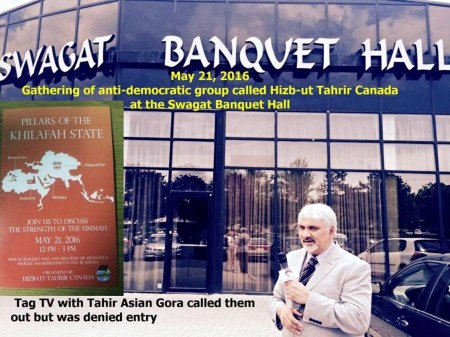
On Saturday, the Islamist group Hizb-ut-Tahrir, banned in some countries, hosted a conference to discuss the re-establishment of a global Islamic caliphate.

Pakistan-Canadian writer Tahir Gora went to cover the event, but was barred from entering the hall. “They said this was a closed door, in-camera meeting for our supporters,” Gora told me after he was asked to leave.

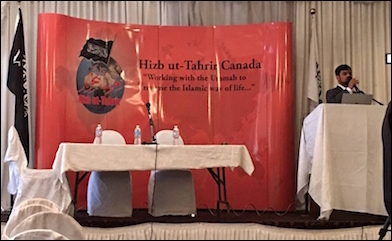
2684A speaker addresses the Hizb-ut-Tahrir conference in Mississauga, Ontario, on May 21.

Fortunately, one Palestinian-Canadian woman was able to enter the event.

She shared with me some of the proceedings from inside the gathering. “I walked into the banquet hall with approximately 100 attendees who were gender segregated. I sat next to a woman who said she had been in Canada for 40 years.” When I asked her if she felt any disconnect between enjoying 40 years of democracy, yet supporting the Hizb-ut-Tahrir who wanted to end it, she explained that democracy has done nothing good to people, so she and other believers follow Allah’s rule.

“The first speaker reminded Muslims that they are obligated to implement Allah’s orders that fulfil the Islamic State. It is “not permissible for us to choose’ he said, citing the Quran. However, he said it was necessary to win the public’s hearts and minds; and to partner with people of power, citing examples from the life of the Prophet.”

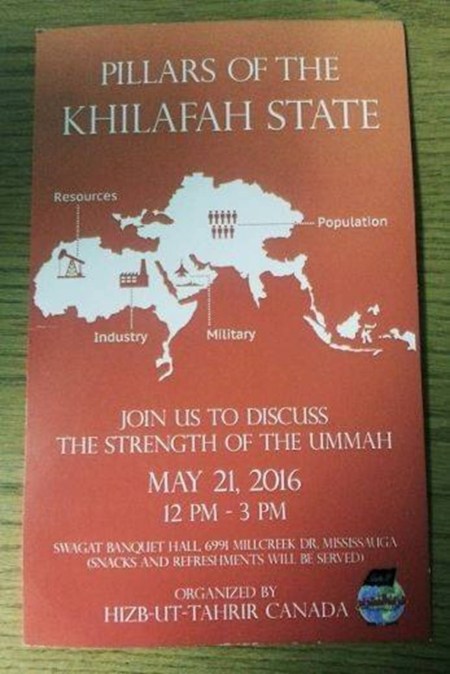
“At the end, a three-minute video was presented to demonstrate the collective oil and natural gas production capabilities of the Muslim world, the human capital needed to mine and process these resources … the military power required to protect them and the types of weapons needed to make such a military effective.”

While this was unfolding we received news that the Trudeau government, as part of its infrastructure development program, had authorised a $200,000 grant to a southern Ontario mosque with links to the Muslim Brotherhood.

Which begs the question: Who’s minding the store?

My First Hizb-ut-Tahrir Conference

May 24, 2016

My First Hizb-ut-Tahrir Conference, Gatestone InstituteZ., May 24, 2016

The first speaker was Brother Mostafa, of Arabic roots. Mostafa started by calling nationalism and sectarian conflict the main reasons for division in the Ummah (Islamic nation). He reminded Muslims that they are obligated to implement Allah’s demands that fulfill the Islamic State. It is “not permissible for us to choose, ” he said. He cited the verse:

“It is not for a believing man or a believing woman, when Allah and His Messenger have decided a matter, that they should [thereafter] have any choice about their affair. And whoever disobeys Allah and His Messenger has certainly strayed into clear error.” — Surat-Al-Ahzab (33), verse 36.

*********************

Time: Saturday May 21, 2016, 12:00-3:00PM
Venue: Swagat Banquet Hall, 6991 Millcreek Dr., Mississauga, Ontario, Canada

1616

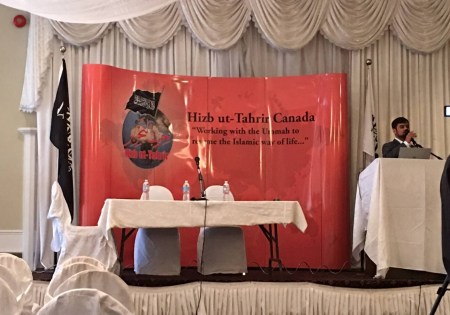
The half-full banquet hall, divided into the men’s side and the women’s side, admitted about 100 attendees. A black flag with white script was on display, on both the screen and on the podium. “Why,” I said to the woman next to me, “is this flag there? Is that not the ISIS flag?” The woman, later identified as Naeema, said it was not, and called her son, one of the organizers, to address the question. It seemed difficult for him, too; he went off to look for someone else more knowledgeable to the help with the problem. Naeema explained that the writing was different. “I can read Arabic,” I said. No one could be found to answer the question.

As the event started late, Naeema began a conversation. We talked about our origins and how long we had been in Canada. She said she had been here 40 years, so I asked about the disconnect between enjoying 40 years of democracy, yet trying to end it. I mentioned a book published by Hizb-ut-Tahrir:

“Democracy is Infidelity: its use, application and promotion are prohibited.”

“الديمقراطية نظام كفر، يحرم أخذها أو تطبيقها أو الدعوة إليها”

Naeema said she was not qualified to debate the topic, but that democracy had done nothing good for people, so she and other believers would follow the rule of Allah. Reflecting on the Muslim Brotherhood’s year in power in Egypt, I asked if she were prepared to have a dictator claim to be Allah’s spokesman even if he abused the power. She said she had never thought about it like that, but, again, that she was not qualified to debate the topic. As the conference began, the conversation stopped.

1617

The first speaker was Brother Mostafa, of Arabic roots. Mostafa started by calling nationalism and sectarian conflict the main reasons for division in the Ummah (Islamic nation). He reminded Muslims that they are obligated to implement Allah’s demands that fulfill the Islamic State. It is “not permissible for us to choose, ” he said. He cited the verse:

“وما كان لمؤمن ولا مؤمنة إذا قضى الله ورسوله أمرا ان يكون لهم الخيرة من أمرهم و من يعص الله ورسوله فقد ضَل ضلالا مبين.” سورة الأحزاب، آية ٣٦.

“It is not for a believing man or a believing woman, when Allah and His Messenger have decided a matter, that they should [thereafter] have any choice about their affair. And whoever disobeys Allah and His Messenger has certainly strayed into clear error.” — Surat-Al-Ahzab (33), verse 36.

Mostafa then focused on two pillars for advancing the Islamic State:

  1. Winning the public’s hearts and minds; and
  2. Partnering with people of power

To illustrate the point, he referred to the prophet’s sira (life) and cited two examples:

The first was a comparison between the Pledges of Aqabah 1 and 2. In the first, the prophet focused on seeking moral support from the tribes which he called to Islam. In the second, he sought their pledge for militant defense. This second pledge, Mostafa said, represented the foundation of the Islamic State.

His next example was an illustration of the right choice of allies. He cited the prophet’s negotiations with a tribe, the Banou-Shayban. When asked how strong they were, the Banou-Shayban had replied: “We are 1000 men who take weapons of war as our toys, and we care for our horses more than we care for our children.” This reply, it seems, enabled them to win the contract.

As Mostafa spoke, his teenage daughter proudly but quietly cheered him; her younger sisters played with glitter and coloring books.

1618

The next speaker was brother Bilal, of Asian origin. Bilal’s message focused on how to make the Ummah powerful and independent. He summarized the requirements: a capable military, economic engines, natural resources, and trained and dedicated people. A short video was presented to demonstrate these points. They included the collective oil and natural gas production capacities of the Muslim world, the human capital needed to mine and process these resources, the military power required to protect both natural and human resources, and the types of weapons needed to make this military effective.

Everyone waved the black flags with the white script.

Islamic State: “Only one way for US to gain victory and that is by taking the Quran out of the hearts of Muslims”

May 23, 2016

Islamic State: “Only one way for US to gain victory and that is by taking the Quran out of the hearts of Muslims” Jihad Watch

If we didn’t have learned imams such as John Kerry and David Cameron and Pope Francis assuring us otherwise, we might almost get the impression that the Islamic State had something to do with Islam. It’s a good thing we have such erudite leaders who are so helpful in aiding our understanding of the enemy ideology.

Abu-Mohamed-al-Adnani

“‘There is only one way for the US to gain victory,’ ISIS spokesman warns,” Rudaw, May 21, 2016:

ERBIL, Kurdistan Region – A spokesman of the Islamic State (ISIS) said in a defiant audio message that his group would not be defeated, even if it loses its strongholds in Syria and Iraq or its leader is killed in US air strikes.

“Your threats do not frighten us and you will never win over us,” Abu Mohamed al-Adnani, the official spokesman of the terrorist group, said in an audio message posted online Saturday.

The militant, whose real name is Taha Subhi Falaha, said that even if ISIS loses its Syrian stronghold of Raqqa or Mosul in Iraq, that would not amount to defeat, nor would the death of its leader, Abu Bakr al-Baghdadi.

“The loss of Raqqa, Mosul and the death of Abu Bakr al-Baghdadi would not mean that we have lost,” the spokesman said in the 30-minute recording.

He said Western reports about the group growing weaker – as US military officials have recently been saying – are untrue.

“You think defeat is the loss of a city or a land? Were we defeated when several cities of Iraq were taken away from us and we went to the desert? Will we lose if you control Mosul, Raqqa and other cities that were previously controlled by us: Definitely ‘no,’ because defeat is only the loss of the wish and will to fight.”

Naming several top ISIS leaders that have been killed in US airstrikes over the past several months, Adnani said their deaths – or the deaths of other living leaders – would not drive the group to defeat.

“There is only one way for the US to gain victory and that is by taking the Quran out of the hearts of Muslims,” Adnani claimed.

FULL: Donald Trump at Morning Joe, May 20, 2016- ‘Would you consider Sanders as your running mate?’

May 20, 2016

FULL: Donald Trump at Morning Joe, May 20, 2016- ‘Would you consider Sanders as your running mate?’ May 20, 2016

(Spoiler alert: The question about Sanders as Trump’s VP choice comes at the tail end of the interview, and Trump’s answer was that Sanders should run as an independent. The interview is wide-ranging and deals with foreign policy, China, Mexico, the Islamist threat, the terrorist attack on EgyptAir and a bunch of other stuff. — DM)

https://www.youtube.com/watch?v=B36FldQmVq4