Archive for the ‘Iraq war’ category

Humor | The DB interview: White House Press Secretary clarifies U.S. involvement in Iraq

May 11, 2016

The DB interview: White House Press Secretary clarifies U.S. involvement in Iraq, Duffel Blog, May 11, 2016

joshua-earnest-1-1000x600

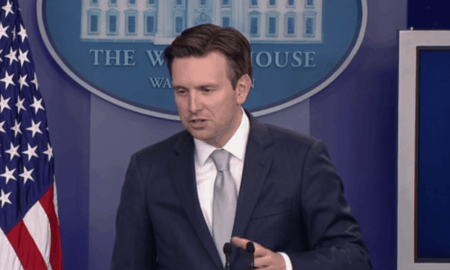
WASHINGTON — Reporter Kate C sat down for an exclusive interview with White House Press Secretary Joshua Earnest to get straight answers on U.S. involvement in Iraq.

Kate C: Thank you for sitting down with us today, Press Secretary Joshua Earnest.

Joshua Ernest: Please, call me Press Secretary Josh Earnest.

KC: Sure thing, Press Secretary Josh Earnest. Three U.S. troops have died in Iraq since 2014, the most recent being Navy SEAL Charles Keating IV in a firefight.

PSJE: Yes, terrible news for us here. Oh, and for everyone of course.

KC: But at Tuesday’s press conference you said U.S. troops “do not have a combat mission” in Iraq. Could you clarify “combat mission?”

PSJE: Excellent question. You’ll notice I use “quotation marks” a lot with my “hands” for this interview, but don’t pay too much “attention” to that.

KC: Got it. So the mission —

PSJE: You have to understand that “combat” and “mission” are just two words from a dictionary. What do they “really” mean? What are words even? Hard to say.

KC: Perhaps I should rephrase. It’s documented that our troops are coming under fire in Iraq. You said, “the relatively small number of U.S. service members that are involved in these operations are not in combat but are in a dangerous place.” What is the White House’s definition of “combat?”

PSJE: I like your use of “hand quotes” at the end there. See how it really looks like quotation “marks”?

KC: The definition of combat —

PSJE: My hands have been tied — I mean dry — lately so I use Aveeno “Active Naturals” in “Lavender.”

KC: Um, ok. Let’s move on to the number of “boots on the ground” in Iraq. President Obama announced a troop cap of 3,870 and this April it was raised to 4,087, but there are an estimated 5,000 there now, not including contractors.

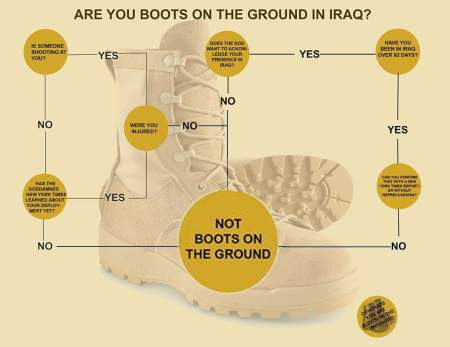
PSJE: I’ve actually been working on a “flow chart” for this one.

boots-on-the-ground-flow-1

KC: I’m not sure you’re supposed to be showing anyone that.

PSJE: Look, it’s better to keep things murky until a major “news” paper makes a fuss about it. Discretion keeps our troops “safe” and the “enemy” on their “toes”. You want our troops “safe” don’t you?

KC: I’m not sure what’s happening right now, and I am actually more confused about U.S. involvement in Iraq than before this interview started. But thank you for your time?


Christian Self-Defense Forces Emerge in Iraq & Syria

April 12, 2016

Christian Self-Defense Forces Emerge in Iraq & Syria, Clarion ProjectRyan Mauro, April 12, 2016

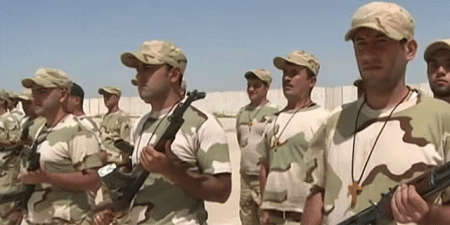
Babylon-Brigade-HPMembers of the Christian Babylon Brigade in Iraq (Video: screenshot)

The Christians of Iraq and Syria have had a breathtaking commitment to passivity since being victimized by what we all now finally agree qualifies as a genocide.

Now, the Christians are increasingly organizing to defend themselves—and the West should stand by them instead of outsourcing our moral responsibility to the Iraqis and their Iranian partners and various groups with questionable track records.

A poll in December 2014 found that only one-third of Iraqis say they are concerned about the persecution of Christians in their country. About 67 percent said they are not concerned at all or only “somewhat” concerned.

It’s easy to say that the U.S. should pressure the Iraqi government to protect the Christians, but its track record and these poll results do not inspire hope that it’ll work. The pace of the genocide is such that the Christians and those who care for them simply cannot afford to spend time hoping for the best.

A Christian force known as the Babylon Brigade has been incorporated into the Popular Mobilization Units, an assortment of militias led by the Iraqi government and their partners from the Iranian regime and Hezbollah. The Babylon Brigades and their supporters boast of their nationalism, having battled the Islamic State in non-Christian areas like Ramadi and Tikrit.

However, it numbers only 500 to 1,000 The Iraqi government should be applauded for supporting a Christian unit, but don’t mistake this for an Iraqi commitment to a Christian self-defense force that enables the community to have a say over whether it goes extinct or not.

Current U.S. policy still gambles their survival on the chance that the Iraqi government tied to Iran will protect them, particularly when the U.N. says Christian persecution in Iran has reached unprecedented levels.

The Kurds are allies of the U.S. but, when it comes to protecting Christians, they have been far from ideal. The Iraqi and Syrian Christians have plenty of stories of mistreatment at the hands of the Kurds.

The growth of a number of Christian self-defense forces in Iraq and Syria show potential for what could happen if they receive outside support.

There’s the Nineveh Plain Protection Units in northern Iraq under the helm of the Assyrian Democratic Movement of Iraq, which has a branch in northeastern Syria named the Gozarto Protection Forces. They are backed by the Middle East Christian Committee. The secretary-general of the Assyrian Democratic Movement claims that proper support would quickly grow the NPU’s numbers to 5,000.

Another small force is called Dwekh Nawsha, which is linked to the Assyrian Patriotic Party and has gotten attention because of Westerners joining their ranks. One of their advisers warned in November, “All we’re saying is we’re done. We don’t have equipment. We don’t have the weapons. We don’t have the training,” as he pleaded for U.S. backing.

In Syria, there is the Syriac Military Council, estimated to be about 2,000-strong including a Christian female unit. It belongs to a Kurdish-majority coalition known as the Syrian Democratic Forces. There is also a local Christian defense force near the Khabur River called the Khabur Guards.

Of course, any Christian force will have to be properly vetted. Hezbollah has set up a non-denominational force named Saraya al-Muqawama that includes Christians, Sunnis and non-religious Shiites.

A Christian police force that is favorable towards the Assad regime clashed with Kurdish forces in Qamishli, Syria. Sources close to the situation there emphasize that the Christians who embrace Assad are motivated by a fear of Islamist rebels, not because of any affinity for dictatorship or the regime’s brutality.

It would be a mistake to dismiss the viability of Christian self-defense forces because of their current sizes and capabilities. Unlike the Iraqi and Syrian militias and rebels, the Christians have had to rely only upon themselves for survival. They don’t have a state sponsor like Saudi Arabia, Qatar or Iran to build them up.

The U.S. has provided material support to Sunnis, Shiites and Kurds, despite records of human rights abuses, Islamism and ties to terrorists and enemy regimes. The Christians are reliable foes of Islamic extremism who, despite all they have suffered, have never formed a sectarian militia to exact bloody revenge.

It’s time for the U.S. to ask itself: Why are Sunnis, Shiites and Kurds worthy of our direct material aid but the Christians are not? Why do they deserve a chance to stop the murder, raping and torturing of their people, but the Christians do not and are left facing extinction if trends continue?

Mosul Campaign Hampered by Fear of Iraq’s Shia Army

April 7, 2016

Mosul Campaign Hampered by Fear of Iraq’s Shia Army, Washington Free Beacon, April 7, 2016

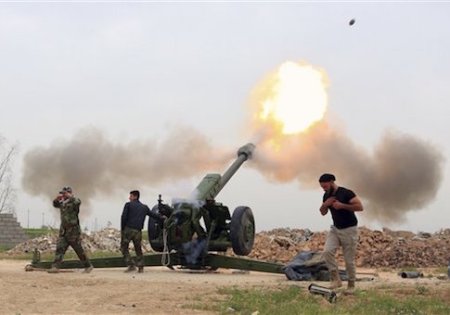
FILE - In this Saturday, March 26, 2016 photo, Iraqi security forces fire at Islamic State militants positions from villages south of the Islamic State group-held city of Mosul, Iraq. The Iraqi military backed by U.S.-led coalition aircraft on Thursday launched a long-awaited operation to recapture the northern city of Mosul from Islamic State militants, a military spokesman said. (AP Photo, File)

FILE – In this Saturday, March 26, 2016 photo, Iraqi security forces fire at Islamic State militants positions from villages south of the Islamic State group-held city of Mosul, Iraq. The Iraqi military backed by U.S.-led coalition aircraft on Thursday launched a long-awaited operation to recapture the northern city of Mosul from Islamic State militants, a military spokesman said. (AP Photo, File)

The grinding village-to-village war against ISIS in Northern Iraq has been weighed down by public complaints from Kurdish officials and military commanders who fear that the Shia-dominated Iraqi army will provoke stiffer resistance from ISIS defenders in Mosul.

Sunni, Shia, and Kurd units all want the political capital that goes with liberating a city of a million people and the capital of Sunni Iraq from ISIS, according to military observers.

A see-saw battle between elements of the predominantly Shia 15th Iraqi Army Division and ISIS fighters over control of abandoned villages on the Makhmour Front 40 miles southwest of Mosul took a turn for the worse on Monday, April 4, according to sources near the front. Last week the Iraqi Army, supported by Kurdish Peshmerga forces, captured four villages, including Al Nasr, but an ISIS counterattack recovered the village and left 20 soldiers dead, Rudaw reported.

Of these casualties, six were Peshmerga soldiers killed by a suicide vehicle that passed through the front line, said Ali Awni, a Kurdish Democratic Party leader in the Shekhan District north of Mosul.

The Shia soldiers reportedly abandoned their posts in the recent combat, according to Awni. “They left behind many guns, ammunition, and equipment for ISIS,” Awni said.

The campaign to retake the Iraq’s northern province of Nineweh started on March 24, according to the Iraqi Defense Ministry. That day, Iraqi Security forces backed by the Peshmerga and anti-ISIS Sunni tribal fighters recaptured four villages west of Makhmour.

Iraqi military spokesmen hailed the operations as “heroic,” but military observers say there is no sign of the final offensive to retake the city. The Iraqi defense minister has promised that the campaign to capture Mosul will start no later than May.

The array of armed forces ready and eager to retake the city of Mosul includes the Shia brigades of the Iraqi Security Forces, the Peshmerga army of the Kurdish Regional Government, the Iranian-backed Popular Mobilization Units, and Sunni-tribal fighters from Nineweh itself.

Until now, however, the Iranian-backed forces have not been allowed to join the campaign to recapture Mosul due to the high aversion to them by Sunni citizens in the north of Iraq.

The Iraqi Army has approximately 4,500 soldiers in the current campaign, not nearly an adequate force to secure the city, according to Michael Pregent, a career Army intelligence officer and former adviser to the Peshmerga in Mosul during 2005-06, who now serves as an adjunct scholar at the Hudson Institute in Washington.

“The force to retake Mosul has not been built yet. It must be a majority-Sunni unit to be accepted by the population,” Pregent said, adding that the defending force of ISIS fighters has been weakened and could be defeated by a patient, intelligence-heavy counter-insurgency campaign.

“There are more than 4,000 reluctant ISIS fighters in Mosul who don’t want to be there, who as soon as an operation begins may dwindle down to 1,500 or 2,000 as they melt into the population to wait the offensive out,” Pregent told a closed briefing at the Westminster Institute in Mclean, VA recently.

Awni, the Kurdish official, says the residents of Mosul despise the Popular Mobilization Units and will fight hard to resist them. “The people of Mosul believe the PMU will destroy the city with artillery and air strikes the way they did Ramadi a few months ago and Tikrit last year. When they entered Tikrit the looted houses and killed many people,” Awni says, adding: “the Mosul residents say if Shia militia are joining the fight, they will fight with ISIS, but if not, they will support the Coalition forces.”

Col. Tariq Ahmed Jaff, deputy commander of the 9th Combat Brigade of Peshmerga based in Kirkuk said in an email, “After ISIS we may have to fight the PMU. These guys pretend to be heroes but they intimidate elderly men, women, and children.” Sectarian war is a pervasive threat throughout Iraq’s territory south of Kurdistan’s borders. Hundreds of thousands of Iraqis have died in sectarian fighting that worsened after the U.S. invasion of 2003.

“Wherever there is PMU, there is Baghdad, and where there is Baghdad there is Tehran,” observed Ernie Audino, a retired U.S. Army brigadier general and a Senior Military Fellow at the London Center for Policy Research.

“All three are Shia, all three are allies to some degree, and all three vigorously support the concept of a unified Iraq, by force if necessary,” said Audino, who spent a year as an embed with the Pershmerga.  “Consequently, Shia militias cadred by Iranian Quds Forces, and Shia-dominated Iraqi Army units have pressed into Kurdish areas in and around Jalawla and Tuz Khurmatu to directly challenge Peshmerga control. Their continuing presence is seen by Kurds as a hammer waiting to fall.”

Shifting blame, White House faults war general’s 2014 ISIS assessment as he departs

March 31, 2016

Shifting blame, White House faults war general’s 2014 ISIS assessment as he departs, Washington TimesRowan Scarborough, March 30, 2016

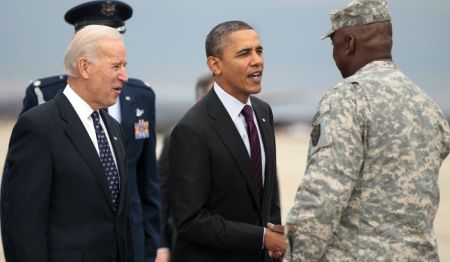
obama_lea_c0-80-4500-2703_s885x516President Obama (center) and Vice President Joseph R. Biden Jr. (left) greet Gen. Lloyd Austin, the top U.S. commander in Iraq, on the apron at Joint Base Andrews outside Washington on Tuesday, Dec. 20, 2011. (AP Photo/Carolyn Kaster)

Army Gen. Lloyd Austin relinquished command in Tampa, Fla., on Wednesday of the U.S. forces fighting the Islamic State –– as a bit of a sour note hung in the air back in Washington.

President Obama has been consistently criticized for a 2014 comment to the New Yorker magazine that the Islamic State, as it invaded Iraq from Syria, was merely the “jayvee.” In other words, it was not to be taken seriously. Months later, the terror army controlled large swaths of Iraq and Syria, forcing Mr. Obama to ordered a new war.

Then, The Atlantic’s Jeffrey Goldberg interviewed Mr. Obama and came out with a long favorable story this month on the commander in chief’s foreign policy views. In the story is this:

“Early in 2014, Obama’s intelligence advisers told him that ISIS was of marginal importance. According to administration officials, General Lloyd Austin, then the commander of Central Command, which oversees U.S. military operations in the Middle East, told the White House that the Islamic State was ‘a flash in the pan.’ This analysis led Obama, in an interview with The New Yorker, to describe the constellation of jihadist groups in Iraq and Syria as terrorism’s ‘jayvee team.’”

The quote clearly showed the White House was shifting blame from Mr. Obama to Gen. Austin, a 40-year Army combatant, leader and commander, as he went out the door.

Gen. Austin, through his public affairs office at U.S. Central Command, has denied ever making such a remark.

His supporters point out that, as the last four-star general to leave Iraq in December 2011, he had recommended to the White House that more than 20,000 American troops remain in the country because the gains there were reversible.

At the time Mr. Obama downplayed the Islamic State, then known by a different name, it had built a large army in Syria and had begun its expansion into Iraq.

Mr. Obama has a track record of shifting blame. For example, when the White House plan to train a Syrian army to fight the Islamic State failed, he told an interviewer that he always knew it would not work.

Gen. Austin turned over command at MacDill Air Force Base, Fla., to Army Gen. Joseph Votel, who had been chief of U.S. Special Operations Command.

At the ceremony, Defense Secretary Ashton Carter heaped praise on Gen. Austin, a West Point graduate and recipient of the Silver Star for gallantry in battle.

As CentCom leader for three years, he has directed operations in Afghanistan, Iraq and Syria, and kept watch on an expansionist Iran in the Persian Gulf.

“The people of CentCom have met these challenges under the extraordinary leadership of a towering figure in the life of our military, General Lloyd Austin,” Mr. Carter said. “It’s one of the highest compliments in the Army to be called ‘a soldier’s soldier.’ For more than four decades, Lloyd Austinhas not only demonstrated what it means to be a soldier’s soldier. He has come to define it.”

At the Pentagon on Tuesday, Peter Cook, Mr. Carter’s spokesman, was asked if the secretary would clear the four-star general of the “flash in the pan” quote at the change of command.

“I don’t think Secretary Carter needs to clear General Austin of that,” Mr. Cook said. “I think General Austin himself has indicated that that statement is factually incorrect, and I believe there are others who have said the same.  So I’m not aware that General Austin ever made that comment, and I think I would refer you to the White House as well if you want to check with them.

“But General Austin does not need to have his name cleared for any reason.  He has led admirably and with distinction for, as I said earlier, close to 40 years, and I think his record of accomplishment speaks for itself.”

Assad’s troops enter Palmyra after massive Russian air blitz to smash ISIS

March 27, 2016

Assad’s troops enter Palmyra after massive Russian air blitz to smash ISIS, DEBKAfile, March 27, 2016

Forces loyal to Syria's President Bashar al-Assad drive a tank during their offensive to recapture the historic city of Palmyra in this picture provided by SANA on March 24, 2016. REUTERS/SANA/Handout via Reuters ATTENTION EDITORS - THIS PICTURE WAS PROVIDED BY A THIRD PARTY. REUTERS IS UNABLE TO INDEPENDENTLY VERIFY THE AUTHENTICITY, CONTENT, LOCATION OR DATE OF THIS IMAGE. FOR EDITORIAL USE ONLY. NOT FOR SALE FOR MARKETING OR ADVERTISING CAMPAIGNS. THIS PICTURE IS DISTRIBUTED EXACTLY AS RECEIVED BY REUTERS, AS A SERVICE TO CLIENTS

Forces loyal to Syria’s President Bashar al-Assad drive a tank during their offensive to recapture the historic city of Palmyra in this picture provided by SANA on March 24, 2016. REUTERS/SANA/Handout via Reuters

Vladimir Putin after all took the momentous decision for Russian carpet bombing to level the Islamic State forces holding Palmyra since last May, and so clear the way for Bashar Assad’s troops and allied forces to enter the heritage city Saturday and Sunday, March 26-27 and take control of several districts. Television footage showed waves of explosions inside Palmyra and smoke rising from buildings, as Syrian tanks and armored vehicles fired from the outskirts.

But just as the Iraqi army, even with foreign assistance, never completely captured Ramadi or Baiji from Islamist forces, so too Assad’s forces can’t hope for complete control of the strategic town of Palmya. After pulling back to the east, ISIS forces will continue to harass the Syrian army and town with sporadic raids. And government forces will stay dependent on a Russian air umbrella to hang on.

The big question DEBKAfile’s military and intelligence sources were asking Sunday was what brought president Putin to give this groundbreaking military success to the Syrian ruler, just days after he withdrew Russian air support in southern Syria and opened the door for an Islamic State advance. He did this in an effort to break Assad’s resistance to the US-Russian deal for a political solution of the Syrian conflict by August.

Our sources offer two likely motivations:

1. Palmyra is strategically important to the Russian command because its fall to government forces opens the way to ISIS headquarters at Raqqa, 225 kilometers away.

2. Palmyra is also the gateway to Deir ez-Zour, 188 kilometers distant on Syria’s eastern border with Iraq. For the Russian military command, the importance of Deir ez-Zour outweighs that of Raqqa, because it is the key to control of the Euphrates Valley and access from Syria to Baghdad.

While these considerations bear heavily on Moscow’s strategic calculations, they have little direct impact on Assad’s overriding objective, which is to hold on to power. While the Syrian ruler may hope for acclaim for achieving a major success against ISIS, the laurel wreath belongs to Russian pilots. His forces essentially performed  a ground operation in Palmyra in Moscow’s interest and goal, which is to strengthen the Russian grip on his country.

On Saturday, DEBKAfile set forth the background for these events.

Cracks in the united US-Russian front over the Syrian ruler’s fate surfaced – even before the ink was dry on the joint announcement issued in Moscow Friday, March 25, by US Secretary of State John Kerry and Russian Foreign Minister Sergey Lavrov, setting  August as the deadline for a political solution of the five-year Syrian conflict.

Shortly after Kerry’s departure for Brussels, Russian Deputy Foreign Minister Sergey Ryabkov told reporters, “Washington now accepts Moscow’s argument that Assad’s future shouldn’t be open for negotiation right now.” However, taking exception to the phrase “right now,” State Department spokesman John Kirby immedieately snapped back, “Any suggestion that we have changed in any way our view of Assad’s future is false.”

Did this exchange spell another Washington-Moscow impasse on the future of the war and the Syrian ruler? Not exactly; Our military and intelligence analysts report that the two powers are in accord on the principle that Assad must go, but are maneuvering on the timeline for the war to end and the Syrian ruler’s handover of power.

The Americans want it to be sooner. The transition should start in August and result in adding opposition parties to the regime in positions of real influence.

President Barack Obama, when he conducts his farewell Gulf tour in April, would like to show Saudi Arabia and Gulf emirates that he has finally kept his word to them to evict Bashar Assad from power before he leaves the White House next January. The US would also be better placed for bringing the Syrian opposition into line for a negotiated deal.

But Putin prefers a delay because he has problems to solve first. The six-month long Russian military intervention in the Syrian conflict turned the tide of the war. The Syrian army and its Iranian and Hizballah allies were able to stabilize their positions and even score some important victories against rebel forces in central and northern Syria. Last year, Putin and Iran’s supreme leader Ayatollah Ali Khamenei were definitely on the same page and fully coordinated.

That cordial relationship was thrown out of kilter by the Kremlin’s decision to work with the White House for bringing the disastrous Syrian war to an end and terminating the Assad era.

From November, Iran’s Gen. Qassem Soleimani’s frequent visits to Moscow on liaison duty petered out.

Khamanei is adamantly opposed to Russia and the US commandeering the decision on Assad’s departure and its timetable. He is even more outraged by the way Putin has moved in on Syria and made it Russia’s home ground in the Middle East.

The rift with Tehran prompted Putin to announce on March 14 the partial pullback of his military forces from Syria. It was a threat to pull the rug that had turned the tide of the war in favor of Damascus and Tehran.
4 (1)

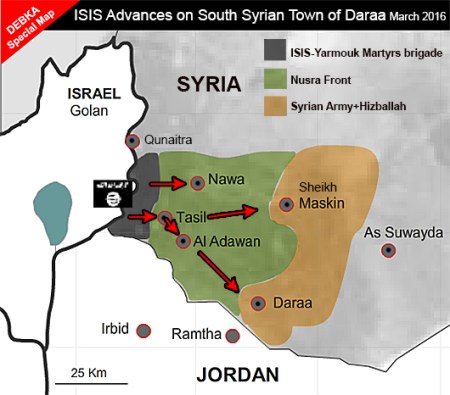
Reluctant to burn those boats, Moscow has been juggling its balls in the air, trying not to drop any. At first, he suspended Russian air cover for government-led battles. The Islamic State immediately seized on this opening in the south and advanced on the towns of Nawa, Sheikh Maskin and Daraa.

Moscow hoped that this setback would teach Bashar Assad to toe the Russian line.

Then, in the second part of last week, Putin ordered the Russian air force to renew its air strikes in the east in support of the Syrian army’s march from central Syria on the historic town of Palmyra. Friday and Saturday, the Syrian army and its allies were battling for control of the UNESCO World Heritage city, nearly a year after the Islamic State overran it and vandalized its historic remains.

DEBKAfile’s military sources stress that their capture of the reconstructed ancient Citadel perched on a hill over the city would have been beyond their strength without Russian air support. Finishing the job and recovering the entire city of Palmyra will depend heavily on Russian air strikes continuing to hammer the jihadist occupiers.

Putin faces a momentous decision. He has already taught Assad and Tehran a harsh lesson: with Russian air support, they win battles, but not without it, as their failure in the south has demonstrated.

Will he help Assad win Palmyra?

Crowning the Syrian dictator with such a striking victory would stiffen his resistance to American pressure for him to quit in short order. He would stand out as the only Syrian war leader capable of pushing ISIS back. But if the Russian leader decides to cut off air support in mid-battle for Palmyra, Assad and Iran will be forced to face the fact that without active Russian military support, they are in hot water.

The Syrian ruler would then have to accept his approaching end. That is the dilemma facing Putin.
Sean Hannity Full One-on-One Interview with Donald Trump (2/18/2016)

February 19, 2016

Sean Hannity Full One-on-One Interview with Donald Trump (2/18/2016), Fox News via You Tube, February 18, 2016

(Trump discusses the Israel – “Palestine” situation and the mess Obama has made beginning at 11:05 during the interview. The rest is very good too. — DM)

ISIS is flying homemade drones, developing a missile-armed model

January 20, 2016

ISIS is flying homemade drones, developing a missile-armed model, DEBKAfile, January 20, 2016

isis-drone_B_1.16

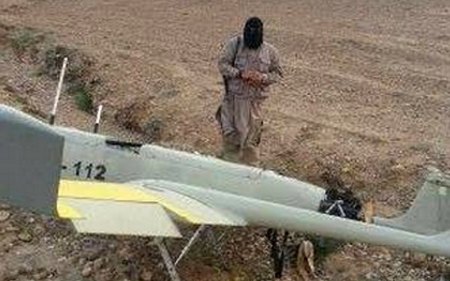
The first ISIS unmanned aerial vehicles were seen this week flying over the battlefields of the western Iraqi province of Anbar. Two were shot down by Iraqi Sunni militias, who had been trained and were supported by American military instructors at the big Iraqi Ayn al-Asad airbase in the province. The downed craft when tested at the base facilities showed they were fitted with cameras for spying on the militias and capable of transmitting surveillance images to the jihadists’ rear commands.

Their first appearance over Fallujah and Haditha, both of which are in ISIS hands, were a shock to the ground forces. DEBKAfile’s military sources report that some weeks ago, US intelligence had discovered that ISIS had begun manufacturing UAVs at a military industrial plant located outside their Iraqi capital of Mosul. Production was not considered advanced enough for putting the drones in the air so soon.

This substantial upgrade of ISIS resources at extremely short notice is assumed to have been enabled by the skills of the former Iraqi army officers who are part of the terrorist group’s command structure, and fighters from Russia and western Europe who have joined the Islamists and are contributing their experience in making unmanned aerial vehicles operational.

Initial tests of the downed vehicles showed them capable of covering the 69 kilometer distance from Falujjah to Baghdad.

ISIS is now busy working on the design of a drone model capable of carrying arms,DEBKAfile’s intelligence sources disclose. This was first revealed at a closed meeting of senior officers at Central Command Headquarters at MacDill Air Force Base in Tampa, Florida. The conference was called for a briefing on the state of the war against ISIS and a discussion of new tactics for combating the Islamists.

They were informed that the jihadi terrorists were in the final stages of preparations for testing drones armed with missiles or bombs, having hired the services of experts in a number of Muslim countries to work on their development at top speed for exceptionally high pay.

US-Iranian-Russian-Iraqi offensive launched to recover Ramadi from ISIS

December 22, 2015

US-Iranian-Russian-Iraqi offensive launched to recover Ramadi from ISIS, DEBKAfile, December 22, 2015

Ramadi_Map

Ramadi, the capital of the vast Anbar Province, was the second major Iraqi city to fall to the Islamic State after the devastating loss of Mosul. The importance of the offensive launched Tuesday, Dec. 22 for its recapture from ISIS lies chiefly in the makeup of the assault force, which is unique in contemporary Syrian and Iraqi conflicts.

DEBKAfile’s military sources name its partners as US and Russian army and air force elements, two varieties of Iraqi militia – Shiites under Iranian command and Sunnis, as well as the regular Iraqi army.

The Iraqi army is depicted as leading the assault. But this is only a sop to its lost honor for letting this Sunni city fall in the first place. The real command is in the hands of US Special Operations officers alongside Iraqi troops, and the Russian officers posted at the operational command center they established last month in Baghdad.

This Russian war room is in communication with US military headquarters in the Iraqi capital. It is from the Russian war room that the top commanders of the pro-Iranian militias send their orders. The most prominent is Abu Mahadi al-Muhandis, who heads the largest Iraqi Shiite militia known as the Popular Mobilization Committee.

Noting another first, our military sources disclose that Iranian officers liaise between the Americans and Russians on the front against ISIS. If this combination works for Ramadi, it will not doubt be transposed to the Syrian front and eventually, perhaps next summer, serve as the format for the general offensive the Americans are planning for wresting Mosul from the Islamic State.

When US Defense Secretary Ashton Carter was in Baghdad last week to review the final preparations for the Ramadi operation, US officials were still insisting that the Iraqi army was fit for the heavy lifting after being trained by American instructors.

By Tuesday, US sources were admitting that pro-Iranian militias were also part of the operation.

DEBKAfile’s military sources report on the division of tasks as follows:

Iraqi army forces are attacking the Ramadi city center from the north; Shiite militias from the south. The US air force is pounding ISIS targets inside the town in order to cripple its ability to fight off the oncoming forces. The Russian air force is standing by, ready to destroy any ISIS reinforcements attempting to cross in from Syria to aid their comrades in beleaguered Ramadi.

Experts keeping track of the offensive have no doubt that it will end in success. The jihadists holding Ramadi are few in number – 400-500 fighters at most. However, cleansing the town after victory will presents a daunting difficulty. In Tikrit and the refinery town of Baiji, ISIS split its defense structure into two levels – one on the surface and the second hidden underground.

The top level was thinly manned by fighting strength, but crawling with mines, booby-trapped trucks and IEDs detonated by remote control.

The lower level, consisting of deeply-dug interconnected tunnel systems, was where ISIS fighters hid out and jump out at night for attacks. According to the experience gained in other Iraqi battle arenas against ISIS, neither the Iraqi army nor local Shiite militias have been able to plumb and destroy these tunnel systems. And so they could never really purge the Islamic State from “liberated” towns.

Ramadi will face the same quandary.

Student Shakes Off Threats to Win Miss Iraq in Name of Women’s Rights

December 22, 2015

Student Shakes Off Threats to Win Miss Iraq in Name of Women’s Rights, NBC News,  and

(Finding anything even remotely hopeful about Iran is rare. This article suggests that some baby steps are being taken against Sharia law in Iraq.

— DM)

A 20-year-old economics student has shaken off death threats to rivals and a barrage of criticism to be crowned the first official Miss Iraq since 1972.

“I want to prove that the Iraqi woman has her own existence in society, she has her rights like men,” Shaima Qassem Abdulrahman told NBC News. “I am afraid of nothing, because I am confident that what I am doing is not wrong.”

More than 150 women applied for Miss Iraq pageant, which organizers said was a chance to “create life in Iraq” and “revive our country” after years of bloodshed and internal chaos.

But a backlash saw 15 contestants drop out of the competition, according to one of the judges, Iraqi fashion designer Sinan Kamel. Reuters reported that least two of these women had received death threats.

151221-miss_iraq_photo-1122_43308ffea562dea085e58865a2246e4d.nbcnews-ux-320-320

Abdulrahman, from the northern city of Kirkuk, said that she hoped “to reflect the culture of Iraq,” adding that Saturday’s competition was “not about beauty alone,” and it was not just a fashion show.

“I call all Iraqi girls to feel this experience,” she said after winning.

Abdulrahman had to convince her parents to let her enter after they initially banned her from participating.

“In the past I heard that such contests used to be held in Baghdad — I dreamed of being a part of one of these contests,” she told NBC News in October. She said the Iraqi people were “badly in need of such cultural activities” after the turmoil the country had been through.

Like many Iraqis, Abdulrahman has been directly affected by the violence brought to her country by ISIS. Two of her cousins were members of Iraq’s federal police until they were killed while fighting the militants.

Five of her fellow contestants were also forced to find new homes last year after ISIS overran the northern city of Mosul.

151221-miss-iraq-yh-1114a_9a254b73c2671e2046b4fd292e481d09.nbcnews-ux-600-480Participants wait for judges to determine the winner of Miss Iraq during the final round of judging in Baghdad. AHMED SAAD / Reuters

Iraq has a long history of holding beauty pageants. In the 1930s, women competed at monthly events including “Miss Baghdad” and “Baghdad’s Queen of Beauty,” according to an article published in Nina Iraq magazine.

Wijdan Burhan al-Deen, who won in 1972, was the last internationally-recognized Miss Iraq. She went on to represent her country at Miss Universe the same year.

Since then, pageants have been held under various monikers but none were in accordance with international standards — a prerequisite for having a shot at Miss Arab and then the global Miss World event.

Oh by the way, Turkey is trying to get into a war w/Iraq

December 6, 2015

Oh by the way, Turkey is trying to get into a war w/Iraq, Front Page Magazine, Daniel Greenfield, December 6, 2015

hqdefault_1

Open question: What does Turkey’s deranged Islamist leader have to do to be disavowed by NATO, Europe and the US?

Erdogan armed terrorists in Syria, but pretty much everyone is doing that. He nearly began a war with Russia. Now Iraq keeps ordering Turkish troops off its soil. But they’re there at the supposed request of Sunnis militias around Mosul. Possibly to fight ISIS. But considering Turkey’s track record and Baghdad’s protests, probably not.

It’s a given that Baghdad, which has become a puppet regime for Iran, would oppose arming Sunni militias. Its preferred means of operation is through Iranian trained Shiite militias.

Since Turkey is really in Syria to overthrow Assad, it looks like its version of the Sunni-Shiite conflict is spreading to Iraq. Essentially Turkey is advancing into a war with the Shiite axis of Iran-Syria and its Russian patron, not to mention all the various Shiite terror militias.

I won’t object if Sunni and Shiite terrorists and their state sponsors shoot and bomb each other. Especially if it’s Turkey and Iran, but as long as Turkey is in NATO, its lunatic tyrant trying to revive the Ottoman Empire has the ability to drag us into his wars.

And that’s an obvious problem.

Turkey should not be in NATO. And only a madman would consider it for EU membership.

But Erdogan’s migrant games have forced Germany to come crawling to him offering cash and EU membership acceleration.

Obama, who was once closest to Erdogan, is obviously not about to cut him off no matter what he does. But the United States is now in the strange position of having a ridiculously confused presence in a Muslim civil war.

Obama is backing Sunni Jihadists in Syria and Shiite Jihadists in Iraq. He refuses to arm Sunni militias in Iraq, but stands by while Turkey carries out what is effectively an illegal invasion of Iraq. (Remember that one the next time Kerry squeals about Jews living in Jerusalem.) He backs Kurdish militias that Turkey is bombing. He’s trying to appease Iran and Turkey at the same time and it can’t work.

The only thing Obama has managed to do is shove the United States in the middle of a Muslim civil war while making occasional noises about un-Islamic ISIS.