Archive for the ‘Iranian nukes’ category

Iran Threatens to Walk Away From Nuke Deal After New Missile Test

March 8, 2016

Iran Threatens to Walk Away From Nuke Deal After New Missile Test, Washington Free Beacon, March 8, 2016

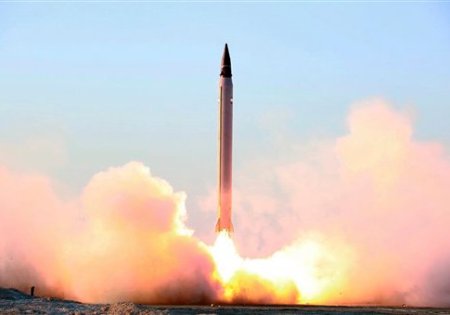
FILE - This file picture released by the official website of the Iranian Defense Ministry on Sunday, Oct. 11, 2015, claims to show the launching of an Emad long-range ballistic surface-to-surface missile in an undisclosed location. Iran tested a ballistic missile again in November 2015, a U.S. official said Dec. 8, describing the second such test since this summerís nuclear agreement. The State Department said only that it was conducting a "serious review" of such reports. The test occurred on Nov. 21, according to the official, coming on top of an Oct. 10 test Iran confirmed at the time. The official said other undeclared tests occurred earlier than that, but declined to elaborate. The official wasnít authorized to speak on the matter and demanded anonymity. (Iranian Defense Ministry via AP)

FILE – This file picture released by the official website of the Iranian Defense Ministry on Sunday, Oct. 11, 2015, claims to show the launching of an Emad long-range ballistic surface-to-surface missile in an undisclosed location. Iran tested a ballistic missile again in November 2015, a U.S. official said Dec. 8, describing the second such test since this summerís nuclear agreement. The State Department said only that it was conducting a “serious review” of such reports. The test occurred on Nov. 21, according to the official, coming on top of an Oct. 10 test Iran confirmed at the time. The official said other undeclared tests occurred earlier than that, but declined to elaborate. The official wasnít authorized to speak on the matter and demanded anonymity. (Iranian Defense Ministry via AP)

Iranian leaders now say that they are poised to walk away from the deal if the United States and other global powers fail to advance the Islamic Republic’s “national interests.”

*************************

Iran on Tuesday again threatened to walk away from the nuclear agreement reached last year with global powers, hours after the country breached international agreements by test-firing ballistic missiles.

Iran’s most recent ballistic missile test, which violates current U.N. Security Council resolutions, comes a day after the international community’s nuclear watchdog organization disclosed that it is prohibited by the nuclear agreement from publicly reporting on potential violations by Iran.

Iranian leaders now say that they are poised to walk away from the deal if the United States and other global powers fail to advance the Islamic Republic’s “national interests.”

“If our interests are not met under the nuclear deal, there will be no reason for us to continue,” Abbas Araqchi, Iran’s deputy foreign minister, warned during remarks delivered to a group of Iranian officials in Tehran.

“If other parties decide, they could easily violate the deal,” Araqchi was quoted as saying by Iran’s state-controlled media. “However, they know this will come with costs.”

Araqchi appeared to allude to the United States possibly leveling new economic sanctions as a result of the missile test. The Obama administration moved forward with new sanctions earlier this year as a result of the country’s previous missile tests.

Iran’s latest missile test drew outrage from longtime regime critics on Capitol Hill.

“The administration’s response to Iran’s new salvo of threatening missile tests in violation of international law cannot once again be, it’s ‘not supposed to be doing that,’” Sen. Mark Kirk (R., Ill.) said in a statement. “Now is the time for new crippling sanctions against Iran’s Islamic Revolutionary Guard Corps, Ministry of Defense, Aerospace Industries Organization, and other related entities driving the Iranian ballistic missile program.”

House Majority Leader Kevin McCarthy (R., Calif.) warned that the nuclear agreement has done little to moderate Iran’s rogue behavior.

“Far from pushing Iran to a more moderate engagement with its neighbors, this nuclear deal is enabling Iran’s aggression and terrorist activities,” McCarthy said in a statement. “Sanctions relief is fueling Iran’s proxies from Yemen to Iraq to Syria to Lebanon. Meanwhile, Khamenei and the Iranian regime are acting with impunity because they know President Obama will not hold them accountable and risk the public destruction of his nuclear deal, the cornerstone of the president’s foreign policy legacy.”

McCarthy went on to demand that the Obama administration step forward with new sanctions as punishment for the missile test.

Meanwhile, the U.S. State Department had difficulty Monday explaining why the nuclear agreement limits public reporting by the International Atomic Energy Agency, or IAEA, on potential deal violations by Iran.

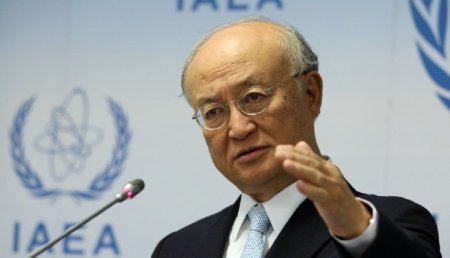
Yukiya Amano, the IAEA’s chief, disclosed on Monday that his agency is no longer permitted to release details about Iran’s nuclear program and compliance with the deal. The limited public reporting is a byproduct of the nuclear agreement, according to Amano.

When asked about these comments again Tuesday, a State Department official told the Free Beacon that the IAEA’s reports would continue to provide a complete picture of Iran’s nuclear program, though it remains unclear if this information will be made publicly available.

“There isn’t less stringent monitoring or reporting on Iran’s nuclear program,” the official said. “The IAEA’s access to Iran’s nuclear program and its authorization to report on it has actually expanded. It’s a distortion to say that if there is less detail in the first and only post-Implementation Day IAEA report then that somehow implies less stringent monitoring or less insight into Iran’s nuclear program.”

While the IAEA “needs to report on different issues” under the final version of the nuclear agreement, the agency continues to provide “a tremendous amount of information about Iran’s current, much smaller nuclear program,” the source maintained.

The IAEA’s most recent February report—which was viewed by nuclear experts as incomplete and short on detail—“accurately portrays the status of Iran’s nuclear program,” including its efforts to uphold the nuclear deal, the official added.

“We expect this professional level of reporting to continue in the future,” the official said.

What to Expect in Iran

February 22, 2016

What to Expect in Iran, Gatestone InstituteJagdish N. Singh, February 22, 2016

♦ “The destruction of Israel is non-negotiable.” — Mohammad Neza Naghdi, Commander of Iran’s Basij paramilitary force.

♦ Sanctions relief will mainly benefit Ayatollah Khamenei and members of the Revolutionary Guards: they control up to one-third of Iran’s economy.

♦ Part of the Iranian regime’s grand strategy is to inflict “death to America” and replace it with its own radical version of Islamic governance. Ayatollah Khamenei himself called for America’s destruction amid nuclear negotiations.

♦ Officials also believe Iran is indirectly funding the Islamic State (IS) in the Sinai. “Suitcases of cash” are sent directly to Hamas officials in the Gaza Strip; part of the money is then transferred to IS.

♦ Iran now poses an even greater threat. If democracies today continue their present policies towards Iran, it will only embolden Iran’s regime to continue its quest to obtain nuclear weapons as well as its terrorism and human rights violations.

Humanity seldom seems to learn its lessons. The governments of the world’s leading democracies appear to be suffering from this predicament in their nuclear dealings with the Islamic Republic of Iran. To avoid catastrophe, democracies need quickly to correct their course.

One of the fatal blunders of Western democracies is their repeated commitment to appeasing and delaying action against aggressive regimes. Between the two World Wars, despite plenty of evidence of the widely-declared global racist agenda of Germany’s Adolf Hitler, democratic powers waited to take action until it was too late. Hitler was able to carry out a genocide that continues to haunt many nations.

Today, Western democratic governments, with their Eastern counterparts such as India, seem on a similar course in dealing with the Islamic Republic of Iran.

The domestic and international agenda of the Khomeinist government is publicly documented. Since the Iranian Revolution of 1979, part of the regime’s open grand strategy is to inflict “death to America,” the leader of the free world, and replace it with its own radical version of Islamic governance. Under the current Supreme Leader Ayatollah Ali Khamenei and his Islamic Revolutionary Guards Corps (IRGC), Iran has been gaining influence across the Middle East, Latin America, the Caribbean and South Asia. Despite nuclear talks with the West, Iran’s goal of “death to America” remains. The Ayatollah himself even called for America’s destruction amid nuclear negotiations.

Currently, Iran is a major player in aiding the autocratic regime of Basher al-Assad in Syria, the Houthis in Yemen, Hezbollah in Lebanon, Palestinian Islamic Jihad and Hamas in the West Bank and Gaza and the Islamic State (IS) in Egypt’s Sinai Peninsula.

To advance its imperial agenda, Iran has proceeded to develop its conventional and nuclear ballistic missile program. According to Director of National Intelligence James Clapper, Iran has “one of the largest inventories of ballistic missiles in the Middle East.”

In line with Iran’s missile development program, Iran’s Revolutionary Guard Navy Rear Commander, Ali Fadavi, announced: “Based on the fifth five-year plan, we should materialize our objective of mass-producing military speedboats with the speed of 80 knots per hour… and are equipped with missiles with a range of 100km; the vessels no one can catch.”

Aside from its military aspirations, since the fall of the Shah in 1979, successive Iranian governments have voiced their plans to annihilate the State of Israel, the only pluralist democracy in the Middle East, and an effective military deterrent to Iran’s designs in the region.

Hostile messages have been pouring forth from Iran. Mohammad Neza Naghdi, Commander of the Basij paramilitary force, stated in clear terms in April 2015, that, “The destruction of Israel is non-negotiable.”

Major General Yahya Rahim Safavi, a former IRGC commander and a top military aide to Khamenei, warned in May 2015, that “More than 80,000 missiles are ready to rain down on Tel Aviv and Haifa.”

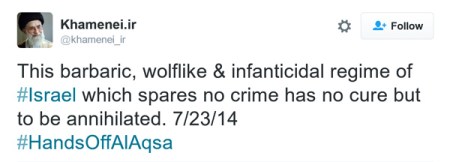
As late as November, Iran’s Supreme Leader Khamenei himself tweeted, “This barbaric, wolflike & infanticidal regime of #Israel which spares no crime has no cure but to be annihilated.”
1477

Bewilderingly, Western democracies have chosen to overlook Iran’s speeches and actions. They chose instead to appease the regime. Last July, despite genuinely serious reservations expressed by international strategic and military experts (including retired American military officers), the United States, United Kingdom, France and Germany – the four democracies in the P5+1 — concluded a nuclear deal with themselves that they proposed to Iran. Iran so far has not signed the deal, and apparently even if it did, according to the U.S. Department of State, the deal would not be legally binding.

Tehran will greatly benefit financially from the terms of the nuclear agreement in the months to come. Under the administration of President Barack Obama, nuclear sanctions against Iran have been lifted. To advance the deal and make it more appealing to Iran, the president has also agreed to pay Iran a $1.7 billion settlement for $400 million in “frozen” assets held in the United States since 1981.

The Society for Worldwide Interbank Financial Telecommunication (SWIFT), “the electronic bloodstream of the global financial system,” had disconnected 15 Iranian banks from its system in 2012. after coming under pressure from both the United States and the European Union at the height of efforts to curb Iran’s nuclear ambitions. Today, SWIFT is ready to let those banned banks, including the Central Bank of Iran, use its system once again. Iran now has an even greater ability to fund its terrorist proxies around the world.

European political and business leaders have been rushing to Tehran to sign new agreements. On January 28, in Paris, Iran’s President Hassan Rouhani and France’s President Francois Hollande signed major business deals, including a joint venture between car-makers PSA Peugeot Citroen and Iran’s Khodro. Iran is in the process of buying 118 Airbus passenger planes to update its aging fleet. The construction group Bouygues and the French airport operator ADP are now set to build an extension for Tehran’s airport, while Vinci, another construction firm, has been commissioned to design, build and operate new terminals for the Mashhad and Isfahan airports. The French oil company Total has agreed to buy Iranian crude oil, and agreements in shipping, health, agriculture and water provision have also been signed.

Democratic India is also cultivating relations with Iran. In a meeting in May, India’s Minister of Road Transport and Highways, Nitin Gadkari, and Iranian Transport and Urban Development Minister, Abbas Ahmad Akhoundi signed a Memorandum of Understanding on India’s participation in the development of the Chabahar Port in Iran.

The Chabahar project will impart strategic leverage to India and its access to Afghanistan and energy-rich Central Asia by bypassing Pakistan. The distance between the Chabahar Port and Gujarat – India’s westernmost state, located near the Persian Gulf, is less than the distance between Delhi and Mumbai. Transit times are estimated to be reduced by a third. Indian firms have already agreed to lease two existing berths at the port and operate them as container and multi-purpose cargo terminals.

The Chabahar project, New Delhi calculates, will be highly beneficial. As India has invested over $2 billion in Afghanistan, the Indian government plans to link the Chabahar port with the Zaranj-Delaram road it built in Afghanistan, thereby opening alternative routes to Afghanistan and enhancing access to regional and global markets.

Russia and China, permanent members of the UN Security Council, are also strengthening their cooperation with Iran. Both Russia and China adopted a policy of ambivalence towards Iran and saw to it that sanctions imposed by the West were not too tough. They also repeatedly blocked attempts at sanctioning Iran’s ally, the current Syrian regime, out of concern over financial ties in the region.

China is also capitalizing on the lifting of sanctions against Iran. Chinese President Xi Jinping rushed to Iran after the so-called nuclear agreement to discuss a 25-year strategic cooperation plan. In a landmark deal worth up to $600 billion, Xi committed to increase trade between the two nations during the next decade. Beijing and Tehran also agreed to enhance security cooperation through intelligence-sharing, counter-terror measures, military exchanges and coordination. Incidentally, despite international sanctions, China-Iran trade increased from $3 billion in 2001 to more than $50 billion in 2014.

Given its fanatical and sectarian ideological agenda, Iran is likely to use the new funds to boost its armament program and ongoing clandestine terror acts. Sanctions relief will mainly benefit Khamenei and members of the IRGC: they control up to one-third of Iran’s economy.

Iran now poses an even greater threat to the entire civilized world. The pattern of Tehran’s behavior shows the government can never be trusted on any promises it makes not to advance its nuclear weapons program. Khamenei has made an open declaration that Tehran will not allow effective inspections of its military sites or interviews with its nuclear scientists.

The links of the IRGC’s Qods Force with Hezbollah, Hamas, Palestinian Islamic Jihad, the Houthis and other terror militias pose a major threat to peace and stability in the Middle East.

Hezbollah’s networks have expanded over the years, infiltrating Latin America and the Caribbean through Shiite cultural centers in the region. According to an official Argentine report, Tehran has established its terrorist, intelligence and operational networks throughout Latin America as far back as the 1980s. Iran’s intelligence activities in the region are being conducted directly by Iranian officials or through its proxy, Hezbollah. Criminal activity may already be underway in Brazil, Colombia, Chile, Paraguay, Uruguay, Suriname and Trinidad and Tobago. Iran’s involvement in the cocaine trade has bolstered the regimes regional access and strengthened ties with its allies in Venezuela, Ecuador, Bolivia and elsewhere.

According to senior Western intelligence officials, the IRGC has transferred tens of millions of dollars to Hamas to be used for weapons, military equipment and training, and that Iran also delivers arms and funds to Hamas through the Red Sea and the Sinai. Officials also believe Iran is indirectly funding the Islamic State (IS) in the Sinai. “Suitcases of cash” are sent directly to Hamas officials in the Gaza Strip; part of the money is then transferred to IS.

Tehran’s links with Hamas and IS are part of a grander strategy of using proxy forces to gain hegemony over the Middle East and undermining American allies such as Egypt and Israel. In Lebanon, Iraq and Syria, Iran seeks to preserve its influence. By fighting IS, Iran strengthens existing pro-Iran regimes and maintains its relevance in the region.

While Iran does support IS indirectly in the Sinai, the government’s goal is to weaken the current Egyptian regime and the Sunni Arab alliance between Egypt, Saudi Arabia and Jordan. It has no problem with IS gaining strength in the Sinai right now. If IS does gain more power in the Sinai, Iran can use it to impose its own agenda in the future. Tehran evidently wants to use IS victories against Sunni states as an opportunity to take over.

Iran also supports the Gaza-based terror group al-Sabireen [“The Patient Ones”], established in the wake of previous tensions between Iran, Hamas and Islamic Jihad. The group has about 400 followers and its emblem is identical to that of Hezbollah. Each member receives a monthly salary of $250-$300, while senior members receive at least $700. Annually, the terror group receives a budget of $10 million from Iran, smuggled in suitcases through tunnels along the border with Egypt. Potential members are wooed by al-Sabireen through familiar channels of philanthropy and education. The group’s publications refer to the United States as “the source of superpower terrorism,” and its slogan is, “The road to the liberation of Palestinian goes through Karbala” — a Shiite holy city in Iraq.

Al-Sabireen has extended its operations from the Gaza Strip to the West Bank and Jerusalem with Iran’s backing. Hisham Salim, the founder of al-Sabireen, admitted that his group is directly financed by Iran. “We have an armed branch whose goal is to wage war on the Israeli occupation everywhere,” Salim said. “Within this framework we have members in the West Bank and Jerusalem.”

The Obama administration has forged ahead with its Iran policies despite knowing the regime’s support of global terrorism. U.S. President Barack Obama himself spoke about Iran’s terror activities in a press conference last year. “Now, we’ll still have problems with Iran’s sponsorship of terrorism; its funding of proxies like Hezbollah that threaten Israel and threaten the region; the destabilizing activities that they’re engaging in, including place like Yemen,” he said, adding that the nuclear “deal is not contingent on Iran changing its behavior. Its not contingent on Iran suddenly operating like a liberal democracy.”

History urges those living in democracies today to rein in their governments and correct their fatal Iran policies. The world cannot afford to overlook the damage of these governments. If democracies today continue their present policies towards Iran, it will only embolden Iran’s regime to continue its quest to obtain nuclear weapons as well as its terrorism and human rights violations.
Clapper: Iran Views Deal as ‘Means to Remove Sanctions While Preserving Nuclear Capabilities’

February 9, 2016

Clapper: Iran Views Deal as ‘Means to Remove Sanctions While Preserving Nuclear Capabilities’ Washington Free Beacon, February 9, 2016

Director of National Intelligence James Clapper testified to lawmakers Tuesday that Iran sees the nuclear deal it struck with the United States and five other world powers as a way to remove burdensome sanctions while simultaneously maintaining a strong nuclear infrastructure.

Clapper made his statement to the Senate Armed Services Committee at a hearing in which the intelligence chief discussed the intelligence community’s annual assessment of worldwide threats to U.S. interests and national security.

Part of Clapper’s testimony focused on the threats posed by the Islamic Republic and how the Iran nuclear deal, known formally as the Joint Comprehensive Plan of Action (JCPOA), affects the country’s relationship with America going forward.

“Iran probably views the JCPOA as a means to remove sanctions while preserving nuclear capabilities,” Clapper told lawmakers.

He added that “Iran’s perception of how the JCPOA helps it achieve its overall strategic goals will dictate the level of its adherence to the agreement over time.”

The nuclear deal was signed in July and implemented on Jan. 16, at which time Iran received an estimated $50 billion to $150 billion in sanctions relief after it took steps to curb its nuclear program.

Some experts have said Iran’s objective throughout negotiations was to ensure the removal of sanctions that were crippling its economy while retaining a nuclear weapons capability to possibly exercise at a future time.

One argument critics of the JCPOA make is that the agreement grants Tehran large-scale sanctions relief whileallowing it to have a vast nuclear infrastructure whose most important restrictions have clear expiration dates, after which time Iran could breakout to a nuclear weapon in little time.

The Obama administration maintains that the deal ensures Iran cannot obtain a nuclear weapon and is at least a year away from producing one.

Clapper’s testimony comes upon his release of the annual “Worldwide Threat Assessment of the U.S. Intelligence Community,” which outlines the current array of challenges threatening U.S. national security.

The report says the intelligence community “continue[s] to assess that Iran does not face any insurmountable technical barriers to producing a nuclear weapon, making Iran’s political will the central issue.”

Directly addressing Iran’s political will, the document adds that “Supreme Leader [Ayatollah Ali] Khamenei continues to view the United States as a major threat to Iran, and we assess that his views will not change, despite implementation of the JCPOA deal … Iran’s military and security services are keen to demonstrate that their regional power ambitions have not been altered by the JCPOA deal.”

The assessment also describes how Tehran’s pursuit of nuclear weapons is part of its “overarching strategic goals of enhancing its security, prestige, and regional influence.”

Beyond the nuclear deal, the intelligence assessment calls the Islamic Republic the world’s foremost state sponsor of terrorism. Clapper explained to lawmakers how Iran’s aggression in the Middle East and elsewhere is dangerous to American interests and national security, as well as its growing missile arsenal and cyber capabilities.

The intelligence community, according to its assessment, views Iran as “an enduring threat to US national interests” and a country that sees itself as leading an “axis of resistance” against American influence and the influence of U.S. allies.

“Tehran might even use American citizens detained when entering Iranian territories as bargaining pieces to achieve financial or political concessions in line with their strategic intentions,” the report added.

When North Korea Tests a Nuke, Assume It’s Iran’s as Well

January 13, 2016

When North Korea Tests a Nuke, Assume It’s Iran’s as Well, Clarion ProjectRyan Mauro, January 13, 2016

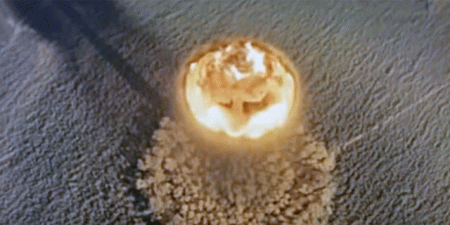
North-Korean-Nuclear-Test-HPA previous nuclear Test made by North Korea (Photo: Video screenshot)

Given the spotty record of U.S. intelligence assessments (to say the least), the West must operate under the assumption that there isn’t an Iranian WMD problem and a North Korean WMD problem, but an Iranian-North Korean WMD problem.

********************************

North Korea briefly reclaimed the global press’ attention again by claiming to have tested a hydrogen bomb. While coverage focused on whether that was an exaggeration, the press missed a much more important question: Was this test only for Kim Jong-Un or was it also for the Iranian regime?

The North Korean and Iranian nuclear and ballistic missile programs should be seen as a single entity, as should be their shared cyber warfare programs. The advance of one is an advance of the other. Differences in their activity should be seen as a common-sense division of labor. Gordon Chang, a prominent expert on Asian affairs, has written about the likelihood that this is the case.

Last May, an Iranian opposition group that has accurately identified hidden nuclear sites in the past reported that it had specific intelligence about North Korean nuclear and missile experts secretly visiting Iran. Intelligence analyst Ilana Freedman said in January 2014 that her sources said a relocation of major parts of Iran’s nuclear program to North Korea began as early as December 2012.

For Iran, it is best to let the North Koreans put the finishing touches on the most provocative nuclear and missile work. Whereas the Iranian regime does suffer from sanctions and must always keep the 2009 Green Revolution in the back of its mind, North Korea thrives off isolation and international provocation.

North Korea has nothing to lose and can only gain by such an arrangement. Kim Jong-Un’s regime has already crossed the nuclear pariah threshold, so it might as well let its Iranian allies take the lucrative deal offered by the West. It has been content to spend $1.1-$3.2 billion each year on it. Plus, the deal puts Iran in a more advantageous position  and its economic improvements can help it invest more in North Korea’s activity.

The good news is that this latest test—North Korea’s fourth— does not appear to be more powerful than its last one, indicating no significant advance in technology. RAND Corporation analyst Bruce Bennett says North Korea is still working on the “basics” of a nuclear fission bomb.

It is hard for some to accept that an Islamist theocracy like that in Iran would work with a cultish communist dictatorship like North Korea, but there is nothing in either one’s ideology that would prevent such cooperation. In fact, North Korea’s success in building a nuclear arsenal actually encourages Iran to see nuclear weapons as a key lesson for the Islamic Revolution.

“The entire world may well consider North Korea a failed state, but from the view point of [Iran], North Korea is a success story and a role model: A state which remains true to its revolutionary beliefs and defies the Global Arrogance,” Ali Alfoneh, an expert on the Iranian regime, told the Washington Free Beacon.

Given the spotty record of U.S. intelligence assessments (to say the least), the West must operate under the assumption that there isn’t an Iranian WMD problem and a North Korean WMD problem, but an Iranian-North Korean WMD problem.

Richardson: North Korea May Have Launched Nuclear Test to Get Nuclear Deal Like Iran’s

January 7, 2016

Richardson: North Korea May Have Launched Nuclear Test to Get Nuclear Deal Like Iran’s, Washington Free Beacon, January 6, 2016

(Why not? Their human rights records are comparable. — DM)

Richardson, who ran for president in 2008, endorsed Clinton for the 2016 election. Clinton, Obama’s former secretary of state, has been a vocal supporter of the Iran nuclear agreement.

**********************

Hillary Clinton supporter and former New Mexico governor Tom Richardson said North Korea’s nuclear test may have been an attempt to gain leverage for a nuclear deal similar to the one Iran struck with the Obama administration and other world powers.

North Korea claimed it successfully tested a hydrogen bomb on Tuesday, although nuclear experts doubt that was the actual device tested. CNN reported the test corresponded with a 5.1 seismic event.

CNN host Wolf Blitzer asked Richardson whether North Korean dictator Kim Jong-un was crying out for attention with this latest act of aggression.

“I think he’s trying to get attention, number one, but I think he’s also sending a message that if you want to deal with me, if you want me to curb our nuclear weapons, it’s going to be a very high price,” Richardson said. “It’s a very poor country. They need humanitarian assistance. They need energy assistance. They need all kinds of sanctions lifted. It could be that he’s preparing for a negotiation. I think he’s looking at what happened with Iran, and he says, ‘You know, maybe there’s a deal that can be struck for me,’ although we don’t know this man thinks. He’s very unpredictable.”

Richardson, who ran for president in 2008, endorsed Clinton for the 2016 election. Clinton, Obama’s former secretary of state, has been a vocal supporter of the Iran nuclear agreement.

The Iran nuclear deal made in July and championed by the Obama White House, despite numerous concessions, was met with celebration in Tehran. The world’s largest state sponsor of terrorism received billions of dollars in sanctions relief, among other sweeteners, as part of the agreement.

Examining Allegations Of Nuclear Ties Between North Korea & Iran

January 6, 2016

Examining Allegations Of Nuclear Ties Between North Korea & Iran, Fox News, January 6, 2016

(This video relates the claimed North Korean test of a miniaturised H-Bomb to previous joint Iran – North Korea nuke efforts. — DM)


Cartoon of the Day

January 5, 2016

H/t The Jewish Press

Obama-gun-control-in-America

Iran Executes Three Iranians Every Day; The West Rewards It.

December 30, 2015

Iran Executes Three Iranians Every Day; The West Rewards It. Gatestone InstituteJudith Bergman, December 30, 2015

♦ “Death sentences in Iran are particularly disturbing because they are invariably imposed by courts that are completely lacking in independence and impartiality. They are imposed either for vaguely worded or overly broad offences, or for acts that should not be criminalized at all, let alone attract the death penalty. Trials in Iran are deeply flawed, detainees are often denied access to lawyers in the investigative stage, and there are inadequate procedures for appeal, pardon and commutation” — From a July 2015 Amnesty International report.

♦ How ironic that Europeans have no problem stuffing themselves with syrupy Iranian dates exported by this regime, knowing full well that there are thousands of prisoners are being tortured in Iran while awaiting their executions.

♦ Amnesty International reports that in the fall of 2015, cartoonist Atena Farghadani was forced to undergo a “virginity and pregnancy test” prior to her trial. The charge? “Illegitimate sexual relations,” for having shaken hands with her lawyer.

♦ Iran nevertheless won a top seat on the U.N.’s Commission on the Status of Women in April 2014. Not a single UN member, not even the US, objected.

On the UN’s Human Rights Day, observed December 10, an Iranian woman was sentenced to death by stoning in the Islamic Republic of Iran.

Since the Islamic Revolution in 1979, Iran is believed to have imposed death by stoning on at least 150 people, according to the International Committees against Execution and Stoning.

“Stoning,” Iranian human rights activist Shabnam Assadollahi said, “is an act of torture. There are 15 countries in which stoning is either practiced and authorized by law or tolerated. One of those 15 countries is Iran. The last known execution by stoning was in 2009. In Iran under the Islamic law, stonings, hangings, and executions are legal torture.

“In Islam under Sharia law, the stoning (Rajm) is commonly used as a form of capital punishment, called Hudud,” Assadollahi explained.

“Under the Islamic Law, it is the ordained penalty in cases of adultery committed by a married man or married woman with others who are not her/his legal partner. Stoning is carried out by a crowd of Muslims who follow the Sharia law by throwing stones (small and large) at a convicted person until she or he is killed. The international community must pressure Iran, Afghanistan, Saudi Arabia, Yemen, Sudan, Somalia, Pakistan, and other countries where stoning is legally carried or tolerated. Why cannot the public loudly cry out and advocate for women oppressed by those regimes?”

Instead of cries of outrage, the West, in the wake of the nuclear “deal” Iran has not even signed, has been scrambling to ingratiate itself with the Iranian regime. Countries such as France, Germany, Austria and Switzerland have barely been able to contain themselves at the prospect of doing business with them. It has been years since the Europeans could legally engage in trade with the murderous regime of the mullahs, who still cry, “Death to Israel, Death to America” — the “Little Satan” and the “Great Satan’ — and they have not been wasting time.

In fact, the P5+1 negotiators (the five permanent members of the UN Security Council plus Germany) had just finished signing the “deal” with themselves, when Germany’s Vice Chancellor, Sigmar Gabriel, hurried himself and a group of representatives from German companies and industry groups onto a plane for a visit to Iran.

The French Foreign Minister, Laurent Fabius, who usually knows better, likewise, found it “… completely normal that after this historic deal was signed, France and Iran should restart normal relations.”

1407French Foreign Minister Laurent Fabius said that it is “completely normal that after this historic [nuclear] deal was signed, France and Iran should restart normal relations.” Left, Iranian Foreign Minister Javad Zarif hugs Fabius at the close of nuclear talks in Geneva, Nov. 23, 2014. Right: A public execution in Iran.

Before the sanctions took effect in 2011, French companies such as Renault and Peugeot were making billions of euros from their involvement with Iran’s auto industry. Similarly, the French company Total was heavily involved in the oil sector. France was evidently not going to miss a beat in bringing this lucrative trade back to la République.

How ironic that the country of “liberté, egalité and fraternité” finds it “completely normal” to have normal diplomatic and trade relations with a country that treats its own citizens, especially women, worse than the mud under the mullah’s feet; that executes whoever disagrees with the regime, and that hangs homosexuals from cranes. How ironic that Europeans have no problem stuffing themselves with syrupy Iranian dates exported by this smiling regime, knowing full well that there are thousands of Iranian prisoners being tortured in Iranian prisons while awaiting their execution day.

Iranian authorities are believed to have executed 694 people between January 1 and July 15, 2015 — an average of three executions a day. Since the election of the “moderate” President Hassan Rouhani in 2013, the number of executions has markedly gone up. According to a July 2015 Amnesty International report:

“Death sentences in Iran are particularly disturbing because they are invariably imposed by courts that are completely lacking in independence and impartiality. They are imposed either for vaguely worded or overly broad offences, or for acts that should not be criminalized at all, let alone attract the death penalty. Trials in Iran are deeply flawed, detainees are often denied access to lawyers in the investigative stage, and there are inadequate procedures for appeal, pardon and commutation.”

The report goes on to state that the majority of those put to death in 2015 were people from disadvantaged backgrounds, who were convicted on drug charges. “This is in direct breach of international law, which restricts the use of the death penalty to only the ‘most serious crimes’ – those involving intentional killing. Drug-related offences do not meet this threshold.”

Among those executed in Iran this year are members of ethnic and religious minorities convicted of “enmity against God” and “corruption on earth.” These include Kurdish political prisoners and Sunni Muslims. On August 26, 2015, Behrouz Alkhani, a 30-year-old man from Iran’s Kurdish minority, was executed despite awaiting the outcome of a Supreme Court appeal.

Iran is the second most prolific executioner in the world after China, according to Amnesty International’s latest global death penalty report.

Iran also tops the global list statistically for executioners of juvenile offenders, even though it is a state party to the Convention on the Rights of the Child and the International Covenant on Civil and Political Rights, both of which prohibit the imposition of the death penalty against persons who were below 18 years of age at the time of the crime, without exception. (Of course Iran was also a signatory to the nuclear Non-Proliferation Treaty, which it also violated repeatedly.) Iran continues to impose the death penalty against juvenile offenders, frequently deferring the execution until after they pass the age of 18. In 2015, at least four juvenile offenders are believed to have been executed: Javad Saberi, Vazir Amroddin, Samad Zahabi and Fatemeh Salbehi.

Iran is scheduled to be reviewed by the Committee on the Rights of the Child on January 11-12, 2016. The Committee has already expressed deep concerns about the use of death penalty against juvenile offenders and asked Iran to provide information on the progress and outcome of the cases of juvenile offenders undergoing re-trial.

Despite all the atrocities that Iran commits towards its citizens, women hold a special place of denigration and humiliation in Iranian society. Young women are reported brutally arrested by the thousand every week for not wearing a “proper hijab.” A woman in Iran is de facto first her father’s property, then after marriage, her husband’s property. According to the UN Secretary General’s February 2015 Report on the Situation of Human Rights in Iran, child marriage is prevalent. The legal age of marriage for girls is 13; some as young as 9 may be married by permission of the court. In 2011, about 48,580 girls between the age of 10 and 14 were married; in 2012, there were at least 1,537 girls under the age of 10 who were reportedly married. Pedophilia is thereby widespread and legal.

Married women may not work, attend sporting events or leave the country without their husband’s permission. When arrested, they suffer unspeakable torture in prison. Rape is commonly used as torture in prison against both women and men.

Forced “virginity testing” is also commonly used in prison, a serious violation of international law. It violates women’s and girls’ human rights to physical integrity, dignity, privacy and right to be free from torture and cruel and inhuman and degrading treatment. According to Amnesty International, satirical cartoonist Atena Farghadani, held in prison since January 2015, was sentenced in June 2015 to twelve years and nine months in prison for her peaceful activism, including meeting with families of political prisoners, and for drawing a satirical cartoon depicting legislators as monkeys, cows, and other animals. The cartoon was to protest a bill that sought to criminalize voluntary sterilization and restrict access to contraception and family planning services.

In December 2014, when Farghadani was out on bail, she released a video message on YouTube, detailing how female prison guards at Evin prison had beaten her, verbally abused her and forced her to strip naked for body searches. She was rearrested in January 2015, and in the fall of 2015 she was forced to undergo a “virginity and pregnancy test” prior to her trial. The charge? “Illegitimate sexual relations” for having shaken hands with her lawyer.

Iran nevertheless won a top seat on the U.N.’s Commission on the Status of Women in April 2014. Not a single UN member, not even the US, objected, to that election.

An exhaustive account of the atrocities that the Iranian regime continues to commit against its own people would require volumes. Nevertheless, the West, seems to remain unfazed in furthering its lucrative relations with the murderous regime.

Those politicians and executives scrambling to do business with the mullahs should realize that Iran’s intercontinental ballistic missiles can tomorrow be aimed at them. Those who comfort themselves with the thought that Iran only wants to annihilate Israel might do well to think again. Iran has tested a two-stage solid-fuel missile, the Sejjil-2, with a range of more than 2,000 km, allowing it to target southeastern Europe. In addition, Iran recently unveiled the Soumar cruise missile, reportedly a reverse-engineered version of the Russia’s Raduga Kh-55 — which was designed as a nuclear delivery system. It has a claimed range of 2,500-3,000 km.

Nevertheless, the International Atomic Energy Agency (IAEA) has acceded to Iran’s demands toclose its 12-year investigation into whether Iran had a secret nuclear weapons program. The IAEA produced a report earlier this month that strongly suggested Iran did have a nuclear weapons program for the years up until 2003.

The West clearly not only fails to care about the plight of the Iranians — it does not even care about its own populations being within Iranian missile range.

Will The West Ease The Sanctions Even Though Iran Is Not Meeting Its JCPOA Obligations?

December 18, 2015

Will The West Ease The Sanctions Even Though Iran Is Not Meeting Its JCPOA Obligations? MEMRI, A. Savyon and Y. Carmon* December 17, 2015

26096

According to various reports, Iran is holding contacts with the U.S. vis-à-vis implementation of the JCPOA. On November 29, 2015, Iranian Foreign Minister Javad Zarif announced that the U.S. must do its part, that is, lift the sanctions, even before Iran meets its obligations – expressly contradicting the JCPOA.

*********************

Introduction

With the International Atomic Energy Agency (IAEA) Board of Governors’ closure, on December 15, 2015, of Iran’s PMD (Possible Military Dimensions) dossier, the JCPOA is now back on track for the implementation that began on Adoption Day, October 18, 2015.

It is now Iran’s turn to meet its JCPOA obligations, which include removing nine tons of low-level enriched uranium from the country, dismantling centrifuges so that only 6,000 active ones remain, pouring concrete into the core of the nuclear reactor at Arak in a way that will prevent it from being used for producing plutonium, adopting the Additional Protocol of the Nuclear Non-Proliferation Treaty, and more.

Once the IAEA confirms that Iran has done this, Implementation Day will be declared; under it, the lifting of some of the sanctions on Iran and the suspension of others will take place, as promised by the U.S. and European countries on October 19, 2015.

However, at this point, Iran is providing only a show of making progress in its implementation of its obligations. Inactive centrifuges are being transferred from site to site, and not a single active centrifuge has yet been dismantled. Iran has reached agreements with Russia to store its enriched uranium, and documents have been signed with the superpowers for changing the designation of the Arak reactor. But so far Iran has actually met none of its obligations.[1]

Holding back Iran’s implementation is the October 21, 2015 letter from Iranian Supreme Leader Ali Khamenei to Iranian President Hassan Rohani setting nine new conditions that must be met first.

According to various reports, Iran is holding contacts with the U.S. vis-à-vis implementation of the JCPOA. On November 29, 2015, Iranian Foreign Minister Javad Zarif announced that the U.S. must do its part, that is, lift the sanctions, even before Iran meets its obligations – expressly contradicting the JCPOA.[2] Zarif also announced, upon his arrival in New York on December 17, 2015, that there is a possibility that he will meet with U.S. Secretary of State John Kerry “for discussions on the implementation of the JCPOA.”[3]

Could The U.S. And Europe Ease Or Lift Sanctions Even If Iran Does Not Meet Its JCPOA Obligations?

U.S. representatives have given no indication that the sanctions will be eased or lifted if Iran does not meet its obligations under the JCPOA. However, in his December 15, 2015 statements, when he presented his PMD report to the IAEA Board of Governors, IAEA secretary-general Yukiya Amano hinted at such a possibility. He said: “First, Iran needs to complete the necessary preparatory steps to start implementing its nuclear-related commitments under the Joint Comprehensive Plan of Action agreed with the E3/EU+3 countries. JCPOA Implementation Day will occur when the Agency has verified that Iran has implemented measures specified in that agreement. I will inform the Board promptly when the Agency has verified that the preparatory steps have been completed [emphasis MEMRI’s].”[4]

The term “preparatory steps” does not appear in the JCPOA. It is not reasonable to suppose that the West would be satisfied with mere “preparatory steps” on Iran’s part instead of full implementation of its obligations before sanctions are eased.

It should also be noted that Amano said on the same occasion: “All parties must fully implement their commitments under the JCPOA.”[5]

At this stage, it is unclear whether Amano’s use of the words “preparatory steps” instead of the words “fully implement… commitments under the JCPOA” represents intentions on the part of the U.S. administration; it could be nothing more than a general statement. This will become clear in the near future.

In the meantime, in his December 16, 2015 address to the nation, Iranian President Rohani effusively praised the JCPOA and Iran’s gains under it, and stated that in “January” the sanctions on Iran would be lifted.[6]

However, “January” is not a reasonable time frame. Iran would not succeed in completing all its tasks in such a short time, and IAEA would certainly not be able to submit a report verifying it had done so by then.


*A. Savyon is Director of the MEMRI Iran Media Project; Y. Carmon is President of MEMRI.


Endnotes:

[1] MEMRI Inquiry & Analysis No. 1209, Power Struggle Between Iranian Supreme Leader Khamenei’s Ideological Camp And Rafsanjani’s Pragmatic Camp Intensifies – Part I: Khamenei Blocks Iran’s Implementation Of The JCPOA, December 11, 2015.

[2] See Zarif’s statements in MEMRI Inquiry & Analysis No. 1209, Power Struggle Between Iranian Supreme Leader Khamenei’s Ideological Camp And Rafsanjani’s Pragmatic Camp Intensifies – Part I: Khamenei Blocks Iran’s Implementation Of The JCPOA, December 11, 2015.

[3] ISNA (Iran), December 17, 2015. It was also reported that secret talks were held in Oman in November 2014 between U.S. Energy Secretary Ernest Moniz and Atomic Energy Agency of Iran (AEAO) director Ali Akbar Salehi, on the possibility that Kazakhstan would be the country to which Iran would sent its enriched uranium, instead of Russia. The Wall Street Journal, December 8, 2015.

[4] Iaea.org/newscenter/statements/introductory-statement-board-governors-67, December 15, 2015.

[5] Iaea.org/newscenter/statements/introductory-statement-board-governors-67, December 15, 2015.

[6] President Rohani said: “I announce to the Iranian people that in January the sanctions will be lifted; thus, one of the 11th government’s election promises to the people will be kept, the sanctions will be lifted from the feet of the Iranian economy, and the way will be opened for more cooperation with the world.” President.ir (Iran), December 16, 2015.

Nuke watchdog approves Iran for sanctions relief

December 15, 2015

Nuke watchdog approves Iran for sanctions relief, Washington ExaminerDavid Brown, December 15, 2015

(The watchdog’s teeth were extracted and its glasses taken away by the “side deals.” — DM)

730x420-79ad08c54362ad0f598ff795dd9dc307Director General of the IAEA Yukiya Amano said, “the agency has no credible indications of activities in Iran relevant to the development of a nuclear explosive device after 2009.” (AP Photo/Ronald Zak, File)

The board of the nuclear watchdog group agreed to close the file on Iran’s past nuclear work on Tuesday, clearing the way for Tehran to receive billions in relief from international sanctions, according to news reports.

The board’s decision, according to diplomats quoted by Agence France-Presse, followed the recommendation of International Atomic Energy Agency Director General Yukiya Amano, who earlier on Tuesday said “the agency has no credible indications of activities in Iran relevant to the development of a nuclear explosive device after 2009.”

“Nor has the agency found any credible indications of the diversion of nuclear material in connection with the possible military dimensions to Iran’s nuclear program,” he said.

“Significant progress has been made on the Iran nuclear issue, but now is not the time to relax. This issue has a long and complex history, and the legacy of mistrust between Iran and the international community must be overcome,” he said. “Much work lies ahead of us. All parties must fully implement their commitments under the JCPOA. Considerable effort was required in order to reach this agreement. A similar and sustained effort will be required to implement it.”