Archive for the ‘Iranian missiles’ category

Obama Puts Fear Before Facts on Iran

August 6, 2015

Obama Puts Fear Before Facts on Iran, Bloomberg View, The Editors, August 5, 2015

(Please see also, Iran Already Sanitizing Nuclear Site, Intel Warns. — DM)

The pact is not a treaty: A future president and Congress might overturn it, arguing that it was sealed without proper consideration. And history often looks with disgust at causes built on fear, especially if they go awry. Obama wouldn’t want to face the kind of scorn he heaped on George W. Bush today.
***********************

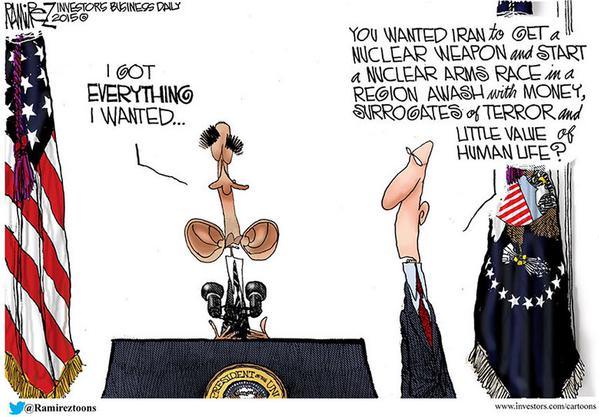
President Barack Obama took to the airwaves today, aiming to sell Congress and the American people on the wisdom of his nuclear deal with Iran. He had a case to make but chose not to make it. He decided instead to cast legitimate criticism of his pact as ignorant warmongering. 

A few examples:

“We have achieved a detailed arrangement that permanently prohibits Iran from obtaining a nuclear weapon.” Actually, the deal’s restrictions end abruptly after 15 years, with some of the constraints on uranium enrichment fading away after just 10. Late in the speech, Obama made the case that much can change in a decade and that the West could be in a stronger position then to continue to block Iran’s nuclear desires. But the temporary nature of the deal remained disguised.

“Many of the same people who argued for the war in Iraq are now making the case against the Iran nuclear deal.” Certainly the Iraq war was sold on spurious grounds and had tragic results. Certainly Republicans and Democrats alike were far too credulous in accepting the Bush administration’s rationale. But these facts have absolutely nothing to do with this agreement.

“Before the ink was even dry on this deal, before Congress even read it, a majority of Republicans declared their virulent opposition.” That’s true, but ignores that opponents had plenty of time to study the draft agreement reached last spring. The real problem is that Congress still hasn’t read the entire accord, its side agreements and the inspections plan negotiated by the International Atomic Energy Agency. Even Secretary of State John Kerry says there are aspects of the deal he has never seen.

“If there is a reason for inspecting a suspicious undeclared site anywhere in Iran, inspectors will get that access even if Iran objects. This access can be with as little as 24 hours’ notice.” The key words here are “as little as.” Iran can draw that process out for as long as 24 days if it so chooses. Foreign Minister Javad Zarif says some military sites will remain off-limits to IAEA personnel.

“If, as has also been suggested, we tried to maintain unilateral sanctions, beefen them up … we’d have to cut off countries like China from the American financial system. And since they happen to be major purchasers of our debt, such actions could trigger severe disruptions in our own economy, and, by way, raise questions internationally about the dollar’s role as the world’s reserve currency.” Rejection by Congress could cause the sanctions regime to fray. Lawmakers should weigh this. The idea that it might cripple the U.S. economy is absurd.

“I’ve had to make a lot of tough calls as president, but whether or not this deal is good for American security is not one of those calls, it’s not even close.” Maybe this deal is the best chance to delay the mullahs’ race to the bomb and keep the Middle East out of a nuclear arms race. But the case is anything but open-and-shut. It’s hard to see what the president gains from denying this.

Well, perhaps one thing: Obama may hope that denigrating those who disagree with him will rally Democrats in Congress to support a veto of any measure of disapproval. Tactics aside, it would be far better to win this fight fairly. The pact is not a treaty: A future president and Congress might overturn it, arguing that it was sealed without proper consideration. And history often looks with disgust at causes built on fear, especially if they go awry. Obama wouldn’t want to face the kind of scorn he heaped on George W. Bush today.
Cartoons of the day

August 6, 2015

H/t Freedom is just another word


wanted

deal

Iranian negotiator discusses talks with Moniz

August 6, 2015

Iranian negotiator discusses talks with Moniz, Al Monitor, Arash Karami, August 5, 2015

(A sweet deal between good friends. — DM)

REUTERS/Carlos Barria

Salehi said that he was asked to join the nuclear talks when the discussions on the Natanz enrichment facility reached a dead end. Salehi said he would only join the talks if Moniz, his American counterpart, did as well. According to Salehi, this was approved by Undersecretary Wendy Sherman and Deputy Foreign Minister Abbas Araghchi, which he described as “the communications link between America and Iran.”

*****************

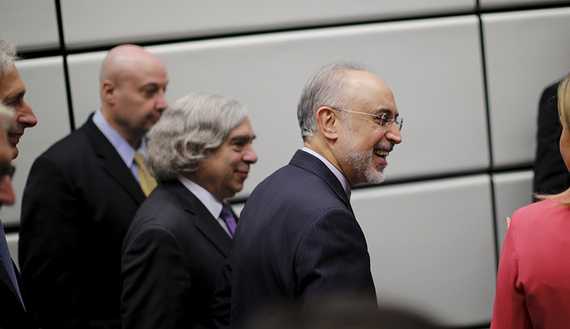
One of the most popular American negotiators in Iranian social media was US Energy Secretary Ernest Moniz. The Massachusetts Institute of Technology (MIT) professor emeritus and former director of the MIT Laboratory for Energy and the Environment joined the nuclear talks between Iran and five permanent members of the UN Security Council plus Germany (P5+1) to discuss the technical aspects of the nuclear deal with the head of Iran’s Atomic Energy Organization, Ali Akbar Salehi.

In an interview with an Iranian newspaper, Salehi spoke about the negotiations and his relationship with Moniz. Just as Moniz was picked to lead the technical negotiations due to his nuclear expertise, Salehi, an MIT graduate, is one of the few individuals to have held important positions for three consecutive administrations — a sign that he has the trust of Supreme Leader Ayatollah Ali Khamenei.

Salehi first denied accusations that former hard-line nuclear negotiator Saeed Jalili was not a serious negotiator. Salehi was Iran’s foreign minister at the time and said that when he was at the meetings with the Supreme National Security Council, Jalili’s negotiating positions were in line with the country’s positions and that “he did not go rogue.”

According to Salehi, the reason for the deadlock during that time was the differences among the P5+1. Specifically, the EU3 (France, United Kingdom and Germany) saw their positions and interests separate from the E3 (US, Russia and China). He said that even when European Union Chief Catherine Ashton reached a point of agreement with Iran on one issue, one country would oppose it and throw everything off. This is why Iran agreed to bilateral talks with the United States in Oman.

Salehi said that he was asked to join the nuclear talks when the discussions on the Natanz enrichment facility reached a dead end. Salehi said he would only join the talks if Moniz, his American counterpart, did as well. According to Salehi, this was approved by Undersecretary Wendy Sherman and Deputy Foreign Minister Abbas Araghchi, which he described as “the communications link between America and Iran.”

Salehi said he and Moniz did not know each other well when they were at MIT, but when they first met during the talks, “there was a feeling that he has known me for years.” Salehi added, “A number of my classmates are now Mr. Moniz’s experts.”

According to Salehi, Moniz entering the talks was important because Salehi expressed that he had been sent with “full authority” to sign off on all technical issues in the nuclear negotiations and Moniz had told him that he had the same authority. He added, “If the negotiations did not take place with the Americans, the reality is that it would not have reached a conclusion. No [other] country was ready to sit with us and negotiate for 16 days with their foreign minister and all of its experts.”

Salehi said that one of the more difficult times negotiating with Moniz was after they reached an agreement on a particular issue. Moniz would take it to the other members of P5+1, who would then make their own requests.

It was also reported that Moniz had given Salehi a gift for the birth of his granddaughter — clothes and a toy embossed with MIT logos. Salehi said that he had also brought gifts for Moniz — Iranian honey and trail mix of Iranian nuts.


Iran Already Sanitizing Nuclear Site, Intel Warns

August 5, 2015

Iran Already Sanitizing Nuclear Site, Intel Warns, Bloomberg View&  August 5, 2015

The U.S. intelligence community has informed Congress of evidence that Iran was sanitizing its suspected nuclear military site at Parchin, in broad daylight, days after agreeing to a nuclear deal with world powers.

For senior lawmakers in both parties, the evidence calls into question Iran’s intention to fully account for the possible military dimensions of its current and past nuclear development. The International Atomic Energy Agency and Iran have a side agreement meant to resolve past suspicions about the Parchin site, and lawmakers’ concerns about it has already become a flashpoint because they do not have access to its text.

Intelligence officials and lawmakers who have seen the new evidence, which is still classified, told us that satellite imagery picked up by U.S. government assets in mid- and late July showed that Iran had moved bulldozers and other heavy machinery to the Parchin site and that the U.S. intelligence community concluded with high confidence that the Iranian government was working to clean up the site ahead of planned inspections by the IAEA.

The intelligence community shared its findings with lawmakers and some Congressional staff late last week, four people who have seen the evidence told us. The Office of the Director of National Intelligence briefed lawmakers about the evidence Monday, three U.S. senators said.

“I am familiar with it,” Senate Intelligence Committee Chairman Richard Burr told us Tuesday. “I think it’s up to the administration to draw their conclusions. Hopefully this is something they will speak on, since it is in many ways verified by commercial imagery. And their actions seem to be against the grain of the agreement.”

Burr said Iran’s activities at Parchin complicate the work of the IAEA inspectors who are set to examine the site in the coming months. IAEA’s director general, Yukiya Amano, was in Washington on Wednesday to brief lawmakers behind closed doors about the side agreements.

“They are certainly not going to see the site that existed. Whether that’s a site that can be determined what it did, only the technical experts can do that,” Burr said. “I think it’s a huge concern.”

A senior intelligence official, when asked about the satellite imagery, told us the IAEA was also familiar with what he called “sanitization efforts” since the deal was reached in Vienna, but that the U.S. government and its allies had confidence that the IAEA had the technical means to detect past nuclear work anyway.

Another administration official explained that this was in part because any trace amounts of enriched uranium could not be fully removed between now and Oct. 15, the deadline for Iran to grant access and answer remaining questions from the IAEA about Parchin.

Senate Foreign Relations Committee Chairman Bob Corker told us Tuesday that while Iran’s activity at Parchin last month isn’t technically a violation of the agreement it signed with the U.S. and other powers, it does call into question Iran’s intention to be forthright about the possible military dimensions of its nuclear program.

“The intel briefing was troubling to me … some of the things that are happening, especially happening in such a blatant way,” he said. “Iran is going to know that we know.” He added the new information gave him “a lot of concerns” about Iran coming clean on military dimensions of its nuclear work.

According to the overall nuclear agreement, sanctions relief for Iran can come only after the IAEA and Iran resolve their outstanding concerns about possible military dimensions of past and current work. But the agreement does not specify how the issue must be resolved, only that it be resolved to the IAEA’s satisfaction.

Several senior lawmakers, including Democrats, are concerned that Iran will be able to collect its own soil samples at Parchin with only limited supervision, a practice several lawmakers have compared to giving suspected drug users the benefit of the doubt to submit specimens unsupervised. Iran’s sanitization of the site further complicates that verification.

Democratic Senator Chris Coons, a member of the Foreign Relations Committee, told us Tuesday that this area is part of why he is undecided on supporting the Iran deal.

“I have concerns about the vigorous efforts by Iran to sanitize Parchin,” he said. “I’ve gotten some reassurance about how difficult it is for them to effectively conceal what we know to have been their illicit nuclear weapons developments there.”

Coons said he was most concerned about the integrity of the IAEA inspection process going forward and not as concerned about figuring out what happened in the site in the past: “We know what the Iranians did at Parchin.”

David Albright, the president of the Institute for Science and International Security, obtained a commercially available image of the Parchin site taken by satellites on July 26 that shows renewed activity at the Parchin site. He told us there are two new large vehicles, alterations ongoing to roofs of two of the buildings and new structures near two of the buildings.

“You have to worry that this could be an attempt by Iran to defeat the sampling, that it’s Iran’s last-ditch effort to eradicate evidence there,” he said. “The day is coming when they are going to have to let the IAEA into Parchin, so they may be desperate to finish sanitizing the site.”

The facility, outside of Tehran, first came to the attention of the international community in 2004 when news reports surfaced that it was being used to test explosives for a nuclear warhead.

A 2007 U.S. National Intelligence Assessment concluded that Iran halted this kind of work in 2003. Between 2005 and today, Iran has allowed IAEA inspectors access to Parchin — a vast complex with dozens of buildings — on only five occasions. In 2012, Abright’s group reported on satellite imagery that it said showed efforts to clean up evidence of an explosives testing chamber there.

Representative Ed Royce, the Republican chairman of the House Foreign Affairs Committee, said that Amano had told him in recent conversations that the IAEA had “thousands of pages of documentations on tests to weaponize a nuclear device.” Royce added, “For a long time, they have been altering sites.”

The IAEA has documented this as well. The agency’s report from May 29 this year said there was  satellite imagery of vehicles, equipment and “probable construction materials” at Parchin. The report said, “The activities that have taken place at this location since February 2012 are likely to have undermined the Agency’s ability to conduct effective verification.”

Secretary of State John Kerry has said that the U.S. government has “absolute knowledge” about what Iran has done in the past. Ahead of the vote on the agreement next month, many lawmakers don’t share Kerry’s confidence. Iran would seem to have its doubts as well, since it’s still trying to cover its tracks.

Obama negotiator says she didn’t see final Iran ‘side deals’

August 5, 2015

Obama negotiator says she didn’t see final Iran ‘side deals,’ The Hill, Kristina Wong, August 5, 2015

(Were the secret agreements on which Kerry, et al, were “fully briefed” and hence know “exactly” what they say also “rough drafts?” Unlike Ms. Sherman, Kerry testified that he had not seen the secret agreement(s).– DM)

shermanwendy_052715gettyGetty Images

[L]ater in the hearing, she walked back her comments about not seeing the final arrangements. 

“I was shown documents that I believed to be the final documents, but whether there were any further discussions…” she added before being cut off by another question by Sen. Pat Toomey (R-Pa.). Later, she said responded, “I have” when asked whether she saw the final versions of the deals.

****************

The only Obama administration official to view confidential “side deals” between Iran and the International Atomic Energy Agency (IAEA) admitted Wednesday she and her team have only seen rough drafts.

“I didn’t see the final documents. I saw the provisional documents, as did my experts,” said Wendy Sherman, a lead U.S. negotiator for the deal, at a Senate Banking Committee hearing.  

Sherman, undersecretary of State for political affairs, said she was only allowed to see the confidential deals “in the middle of the negotiation” when the IAEA “wanted to go over with some of our experts the technical details.” 

She maintained the deals — which focus on with Iran’s prior work on a bomb and access to Iran’s Parchin military site — are still confidential and can’t be submitted to Congress.

Sherman said the U.S. did not protest to the confidentiality of the agreements, despite the Iran Nuclear Agreement Review Act demanding all related agreements, because the administration wanted the IAEA to respect the confidentiality of their agreements with the U.S.

“We want to protect U.S. confidentiality … this is a safeguards protocol. The IAEA protects our confidential understandings … between the United States and the IAEA,” she said.

However, later in the hearing, she walked back her comments about not seeing the final arrangements.

“I was shown documents that I believed to be the final documents, but whether there were any further discussions…” she added before being cut off by another question by Sen. Pat Toomey (R-Pa.). Later, she said responded, “I have” when asked whether she saw the final versions of the deals.

She also argued they could not be submitted to Congress because the administration does not have the deals, and that the Senate had “every single document” the administration has.

Sherman emphasized she would brief Senators later Wednesday afternoon in a classified session on everything she knows about the deal.

A similar briefing for House lawmakers last week did not assuage concerns for Rep. Ed Royce (R-Calif.), chairman of the House Foreign Affairs Committee, who sent a letter to Secretary of State John Kerry on Monday calling on the administration to submit the deals.

She also noted that IAEA Director General Yukiya Amano was meeting with the Senate Foreign Relations Committee later in the afternoon.

Although she said the U.S. did not ask or pressure Amano to conduct the briefing, she suggested it was a gesture beyond what the IAEA is obligated to do.

Kerry says sinking of Iran deal would be ‘ultimate screwing of ayatollah’

August 5, 2015

Kerry says sinking of Iran deal would be ‘ultimate screwing of ayatollah,’ Jerusalem Post, August 5, 2015

(It’s as pro-Israel as the Obama administration gets. Please see also, Daniel Greenfield’s comments here. — DM)

ShowImage (6)
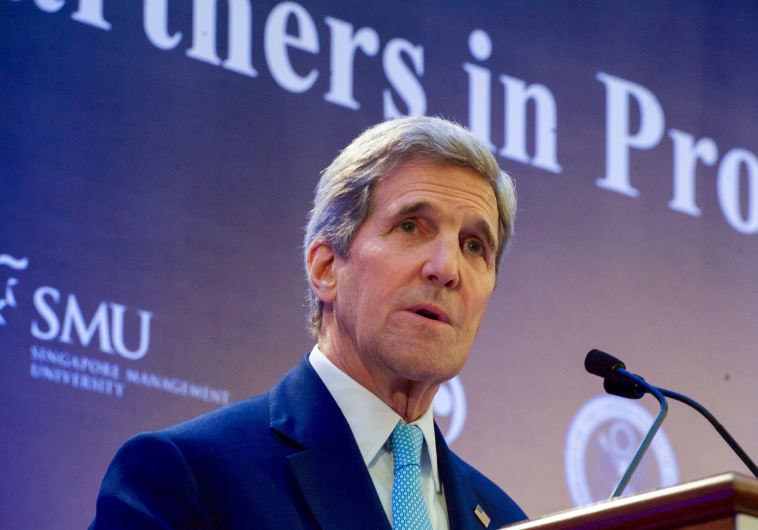
US Secretary of State John Kerry speaks in Singapore. (photo credit:STATE DEPARTMENT)

The secretary rejected Israel’s criticism of the nuclear agreement, saying that the deal “is as pro-Israel” as it gets.

******************

U.S. Secretary of State John Kerry told The Atlantic on Wednesday that if Congress were to shoot down the Iran nuclear agreement, it would be “the ultimate screwing” of Supreme Leader Ayatollah Ali Khamenei.

Kerry made the remarks in an interview with The Atlantic‘s Jeffrey Goldberg.

The secretary rejected Israel’s criticism of the nuclear agreement, saying that the deal “is as pro-Israel” as it gets.

Reneging on the nuclear agreement, which has the support of the major world powers, would constitute a setback for Washington and justify anti-American animus in Iran.

“The ayatollah constantly believed that we are untrustworthy, that you can’t negotiate with us, that we will screw them,” Kerry said. “[Having Congress vote down the nuclear pact] will be the ultimate screwing.”

“The United States Congress will prove the ayatollah’s suspicion, and there’s no way he’s ever coming back. He will not come back to negotiate. Out of dignity, out of a suspicion that you can’t trust America. America is not going to negotiate in good faith. It didn’t negotiate in good faith now, would be his point.”

Kerry also commented on the vociferous opposition to the deal expressed by Israel, which the secretary referred to as “visceral” and “emotional.” He was adamant that the agreement was positive for Israel’s geopolitical standing.

“I’ve gone through this backwards and forwards a hundred times and I’m telling you, this deal is as pro-Israel, as pro-Israel’s security, as it gets,” Kerry said. “And I believe that just saying no to this is, in fact, reckless.”

Kerry said that he was “sensitive” to Israeli concerns over Iran’s long-term aims, but he rejected arguments made by Jerusalem that the Islamic Republic was planning its annihilation.

“I haven’t seen anything that says to me [that Iran will implement its vow of wiping Israel off the map],” the secretary said. “They’ve got 80,000 rockets in Hezbollah pointed at Israel, and any number of choices could have been made. They didn’t make the bomb when they had enough material for 10 to 12. They’ve signed on to an agreement where they say they’ll never try and make one and we have a mechanism in place where we can prove that. So I don’t want to get locked into that debate. I think it’s a waste of time here.”

“I operate on the presumption that Iran is a fundamental danger, that they are engaged in negative activities throughout the region, that they’re destabilizing places, and that they consider Israel a fundamental enemy at this moment in time,” Kerry said. “Everything we have done here [with the nuclear agreement] is not to overlook anything or to diminish any of that; it is to build a bulwark, build an antidote.”

The secretary said that the nuclear deal is even more imperative if Israel’s fears that Iran is plotting its destruction are true, since the agreement neutralizes Tehran’s nuclear program.

More bad news for Obama from Iran about the secret deals

August 4, 2015

More bad news for Obama from Iran about the secret deals, Dan Miller’s Blog, August 4, 2015

(The views expressed in this article are mine and do not necessarily reflect those of Warsclerotic or its other editors. — DM)

An Iranian official recently stated that no International Atomic Energy Agency (IAEA) personnel will be permitted to enter military or missile sites. Another stated that “no country is permitted to know the details of future inspections conducted by the IAEA.” Their statements are probably consistent. There may well be other secret deals we don’t know about and perhaps never will. Meanwhile, Iran is preparing to test long range ballistic missiles “to prove that the missile ban was invalid.”

It's not MY fault.

It’s not MY fault.

I. No IAEA inspections of the sites that matter most

Entry-into-Iran-military-sites-forbidden (1)

In an interview on Al Jazeera TV last week Ali Akbar Velayati, Security Adviser to Iran’s Supreme Leader, stated that

United Nations nuclear inspectors from the International Atomic Energy Agency would not be given access to Tehran’s sensitive military nuclear sites.

. . . .

“First, allow me to emphasize that the issue of the missiles and of Iran’s defensive capabilities were not part of the negotiations to begin with,” Velayati said. [Emphasis added.]

“No matter what pressure is exerted, Iran never has negotiated and never will negotiate with others – America, Europe, or any other country – about the nature and quality of missiles it should manufacture or possess, or about the defensive military equipment that it needs. This is out of the question.” [Emphasis added.]

A video of Mr. Velayati remarks, with translations by the Middle East Media Research Institute (MEMRI), is available here. Since I have been unable to find it on You Tube I have no way to embed it.

Unfortunately, Mr. Velayati is essentially correct. The November 2013 Joint Plan of Action focused almost exclusively on Uranium enrichment, to the exclusion of the “possible military dimensions” of Iran’s military nuclear activities including missile research, development and testing.

II. Details of IAEA inspections will not be disclosed

Reza Najafi, Iran’s ambassador and permanent envoy to the IAEA, stated over the weekend that “no country is permitted to know the details of future inspections conducted by the IAEA.”

Najafi’s statement could mean (a) that no details about inspection methodology will be disclosed, (b) that no details about inspection results will be disclosed or (c) both. If inspection methodologies — who did the inspections as well as when, where and how, are not disclosed, what useful purpose will they serve, other than for Iran? If details of the results of inspections are not disclosed, that will also be the case. How, in either or both cases, will the members of the P5+1 negotiating teams have sufficient information to decide whether to “snap back” sanctions — if doing so is now even possible — or anything else?

III. Even details about inspections of non-military sites will be hidden

Considering Parts I and II together, and assuming that the statements of Iranian officials are reasonably consistent and not mere gaffes, IAEA personnel will be permitted to inspect non-military sites only and hence only to keep tabs on Uranium enrichment; even the details of those inspections will not be disclosed. Is that what Kerry and the other P5+1 negotiators had (pardon the expression) in mind?

IV. Iran says, Ballistic missile testing and development are OK

games

As reported by DEBKAfile,

Shortly before US Secretary of State John Kerry was due in Qatar Monday, Aug. 3, Iran’s highest authorities led by supreme leader Ayatollah Ali Khamenei Sunday launched a public campaign to support Tehran’s noncompliance with the Vienna nuclear accord and UN Security Council Resolution 2231 of July 20, on its ballistic missile program. The campaign was designed by a team from Khamenei’s office, high-ranking ayatollahs and the top echelons of the Revolutionary Guards, including its chief, Gen. Ali Jafari. [Emphasis added.]

It was kicked off with a batch of petitions fired off by the students of nine Tehran universities and Qom religious seminaries to Iran’s chief of staff Maj Gen. Hassan Firouzabadi, demanding immediate tests of long-range ballistic missiles to prove that the missile ban was invalid. [Emphasis added.]

. . . .

The Security Council Resolution, which unanimously endorsed the Joint Comprehensive Plan of Action (Vienna nuclear accord) signed by Iran’s Foreign Minister Mohammed Javad Zarif, called on Iran “not to undertake any activity related to ballistic missiles designed to be capable of delivering nuclear weapons, including launches using such ballistic technology until the date eight years after the JCPOA Adoption Day.” [Emphasis added.]

Tehran retorted that none of its ballistic missiles were designed to deliver nuclear weapons, and so this provision was void. Shortly after its passage, the foreign ministry in Tehran issued an assurance that “…the country’s ballistic missile program and capability is untouched and unrestricted by Resolution 2231.” [Emphasis added.]

This appears to confirm that all of Iran’s ballistic missile sites are off-limits to inspectors.

V. What does Kerry know?

When questioned by members of Congress on the secret deals, Secretary Kerry testified that he had neither seen nor read them but that he had been fully briefed and knew “exactly” what they say. Put charitably, it seems unlikely that he knew that much.

Less charitably, Kerry knew far more than he said and declined to be forthcoming. Now that two Iranian officials have provided highly important information, thus far probably unknown to Congress, will Kerry have additional comments? Not if he can help it.

VI. Conclusions

I wrote early and often about the miserable “deal” about to be entered into by P5+1 under Obama’s dubious leadership. As Iranian officials provide additional information it should be clear — even to the most enthusiastic “deal” supporters — that the “deal” is far worse than earlier thought possible and that the U.S. Congress is obligated to disapprove it and to override any Obama veto, partisan politics notwithstanding.

Contentions| The Real Goal of the Nuclear Deal: Iran Détente

August 3, 2015

Contentions | The Real Goal of the Nuclear Deal: Iran Détente, Commentary Magazine, August 3, 2015

To listen to President Obama and Secretary of State John Kerry defend their nuclear deal in recent weeks, you’d think the issue at stake is a narrow one that solely concerned whether or not the agreement retards Tehran’s quest for a bomb. The assumption from the administration and its apologists that the deal does this even minimally is a dubious one. But one of the subtexts of the misleading way they have been conducting their end of this debate is their effort to distract both Congress and the public from the broader goals of the pact. While critics of the deal have highlighted Obama’s refusal to make the sanctions relief dependent on an end to support for terrorism, ballistic missile production or the nature of Iranian government, the answers from the administration have been consistent. They want to restrict the discussion to purely technical nuclear issues that can be obfuscated by deceptive claims or to the false choice between the agreement and war. But, to its credit, one of the president’s chief media cheerleaders did highlight the real goals of the administration in an article published on Friday. The New York Times feature titled “Deeper Aspirations Seen in Nuclear Deal With Iran” ought to be required reading for all members of the House and Senate. The choice here isn’t one between a flawed nuclear deal and war, but between Iran détente with a tyrannical, anti-Semitic, aggressive Islamist regime and a reboot of the diplomatic process that has been hijacked by appeasers.

As the Times points out, prior to the announcement of the final, lenient terms of the deal that expires in ten years the administration wasn’t so coy about its real objective:

Before his fight for the deal in Congress, Mr. Obama was far more open about his ultimate goals. In an interview in The Atlantic in March 2014, he said that a nuclear agreement with Iran was a good idea, even if the regime remained unchanged. But an agreement could do far more than that, he said:

“If, on the other hand, they are capable of changing; if, in fact, as a consequence of a deal on their nuclear program those voices and trends inside of Iran are strengthened, and their economy becomes more integrated into the international community, and there’s more travel and greater openness, even if that takes a decade or 15 years or 20 years, then that’s very much an outcome we should desire,” he said. …

And in an interview in December, Mr. Obama even seemed to welcome the rise of a powerful Iran. “They have a path to break through that isolation and they should seize it,” he said. “Because if they do, there’s incredible talent and resources and sophistication inside of — inside of Iran, and it would be a very successful regional power.”

The importance of this context for the discussion of the deal cannot be overemphasized.

The deal ought to be defeated on its own merits because it fails to achieve the administration’s stated objectives about stopping Iran’s nuclear ambitions. All it accomplishes, if it can even be said to do that much, is to delay Iran’s march to a bomb for the period of the agreement while permitting to continue research with a large nuclear infrastructure under a loose inspections regime that makes a mockery of its past promises on all these issues.

But the point on which the administration has been most reluctant to comment is the more than $100 billion in frozen assets that will be released to Tehran. Critics rightly believe this money will, one way or another, help subsidize Iran’s terrorist allies and push for regional hegemony that worries neighboring Arab states as well as Israel, whose existence is threatened by Iran becoming a threshold nuclear state with Western approval.

No rational argument can be mustered against this assertion since the money will be Iran’s to use as it likes and any prohibitions on Iranian adventurism are likely to be even less effective in a post-deal environment than they were prior to it. But if, like President Obama, you believe that Iran is in the process of transforming from a revolutionary threat whose goals are mandated by the extreme religious beliefs and Islamist ideology of its rulers into one eager to be friends with the world, the prospect of a stronger Iran doesn’t trouble you.

That’s why President Obama did not predicate these negotiations on any pledges, even ones that were transparently false, of good behavior from Iran. He claims that insisting on an end to Iranian state sponsorship of terror or forcing it to renounce its goal of eliminating Israel would have prevented him from getting a deal on the nuclear question. But that formulation has it backward. The point of the negotiations was never about the nuclear details, something that was made clear by the astonishing series of concessions that the administration made throughout the talks. In October 2012, during his foreign policy debate with Mitt Romney, Obama pledged that any deal would eliminate Iran’s nuclear program. Now he is advocating for one that leaves it in place under Western sponsorship while rewarding Tehran with the lifting of sanctions.

What Obama always wanted was a deal at any price because he thought it was the pathway to a new entente with Iran that would end the conflict with its Islamist leaders. But while a future in which Iran would no longer be a terror sponsor bent on destroying Israel and dominating the Middle East would be a good thing there is no rational reason to imagine this will happen. Indeed, by strengthening its government the president is ensuring that they will never have to choose between their aggressive goals and economic prosperity.

That’s why rather than being sidetracked into debates about the nuclear details, opponents need to focus on the real goal of the deal: détente with a regime that threatens the U.S. and its allies. The deal fails as a nuclear pact. But it is perhaps an even greater disaster when one realizes that its premise is a naive belief that Islamist tyrants are so enraptured with Obama that they are about to abandon their deeply held beliefs and evil intentions.

Iran: U.S. Banned from Knowing Details of Iran Nuclear Inspection Agreement

August 3, 2015

Iran: U.S. Banned from Knowing Details of Iran Nuclear Inspection Agreement, Washington Free Beacon,  , August 3, 2015

(Mr. Najafi states in the highlighted paragraph that “no country is permitted to know the details of inspections. That likely refers to the P5+1 negotiators as well as to nations other than Iran. Does it refer to the results of the inspections or to how and by whom they were conducted when? Either way, how will the P5+1 negotiators know whether Iran continues to seek nuke weaponization and whether to “snap back” sanctions? If they are told little more than “everything is just peachy,” will that be satisfactory evidence that Iran has not violated the “deal?” Please see also, Iran Openly Refuses UN IAEA Inspectors Access to Military Sites.– DM)

Reza Najafi, Iran’s ambassador and permanent envoy to the IAEA, stated over the weekend that no country is permitted to know the details of future inspections conducted by the IAEA. In addition, no U.S. inspectors will be permitted to enter Iran’s nuclear sites.

**********************

Iran’s ambassador to the International Atomic Energy Agency (IAEA) said the nuclear inspection organization is barred from revealing to the United States any details of deals it has inked with Tehran to inspect its contested nuclear program going forward, according to regional reports.

Recent disclosures by Iran indicate that the recently inked nuclear accord includes a series of side deals on critical inspections regimes that are neither public nor subject to review by the United States.

Reza Najafi, Iran’s ambassador and permanent envoy to the IAEA, stated over the weekend that no country is permitted to know the details of future inspections conducted by the IAEA. In addition, no U.S. inspectors will be permitted to enter Iran’s nuclear sites.

“The provisions of a deal to which the IAEA and a second country are parties are confidential and should not be divulged to any third country, and as Mr. Kerry discussed it in the Congress, even the U.S. government had not been informed about the deal between IAEA and Iran,” Najafi was quoted as saying by Iran’s Mehr News Agency.

Due to the secretive nature of these agreements, IAEA officials vising with lawmakers are barred from revealing to them the details of future inspections.

The revelation has rattled lawmakers on Capitol Hill, several of whom are now rallying colleagues to sign a letter to President Barack Obama protesting these so-called side deals.

Rep. Mike Pompeo (R., Kansas) and at least 35 other lawmakers are circulating a letter to Obama to provide Congress the text of these agreements as is required under U.S. law.

“It has come to our attention that during the recent negotiation of the Joint Comprehensive Plan of Action (JCPOA) with Iran, at least two side deals were made between the International Atomic Energy Agency (IAEA) and Iran,” the letter states, according to a copy obtained by the Washington Free Beacon.

“These side deals, concerning the ‘roadmap for the clarification of past and present outstanding issues regarding Iran’s nuclear programs,’ have not been made available to the United States Congress,” it states. “One deal covers the Parchin military complex and the other covers possible military dimensions (PMDs) of Iran’s nuclear program.”

An informational email being circulated to lawmakers explains, “according to the International Atomic Energy Agency (IAEA) and the Obama Administration, these agreements have been negotiated in secret between the IAEA and Iran.”

Secretary of State John Kerry has personally “stated he has not seen these agreements and the Administration failed to submit these agreements as part of the JPCOA,” the email states.

Under the terms of a bill meant to give Congress a final say over the deal, the Obama administration is required to provide text of all agreements, the lawmakers write to Obama.

“Under the clear language of the Iran Nuclear Agreement Review Act, which you signed into law, members of Congress are entitled to the text of these two side deals,” it states. “Specifically, members have a right to all ‘annexes, appendices, codicils, side agreements, implementing materials, documents, and guidance, technical or other understandings and any related agreements, whether entered into or implemented prior to the agreement or to be entered into or implemented in the future.’”

“Congress’s legal right to these documents creates a corresponding legal obligation for your administration to provide them for our review,” the letter says.

The lawmakers are demanding that the White House “immediately secure” these documents from IAEA “and then provide them to Congress” for review.

Pompeo and Rep. Tom Cotton (R., Ark.) sent a separate letter to Obama administration official last week asking for them to disclose the nature of all secret side agreements with Iran.

Iran’s IAEA ambassador claims the agreements with the IAEA are separate from the actual nuclear accord inked with global powers.

“The Agency would know the nature of confidential documents and Iran have clearly briefed the IAEA on this; we have agreed on implementation of a roadmap which is not a part of the JCPOA, with the implementation already on process even before the Congress could examine and approve the deal,” Najafi was quoted as saying.

One senior congressional source familiar with the effort to obtain further information about the deal told the Free Beacon the Obama administration is not being transparent in the review process.

“On top of all the concessions–from ballistic missiles to conventional arms to a 24-day inspection period–we now learn that additional side deals were struck between the IAEA and Iran,” said a senior congressional source familiar with the effort to obtain further information about the deal.

“The Administration promised a transparent review process that would allow Americans and their elected representatives to assess the deal for themselves, but as it turns out, that was just utter bullsh**,” the source added. “The Administration signed off on an agreement that included a series of Iranian Eastern eggs, including secret deals regarding the possible military dimensions of Tehran’s nuclear program, to which Congress and the public are not privy.”

Iran plans missile tests to flaunt defiance of Vienna deal and UNSC resolution

August 3, 2015

Iran plans missile tests to flaunt defiance of Vienna deal and UNSC resolution, DEBKAfile, August 3, 2015

iranian_long-range_ballistic_Shahab-3Iran’s long-range ballistic Shahab-3

Before taking off from Cairo Sunday, Kerry issued this emphatic statement:  “There can be absolutely no question that if the [Iran deal] is fully implemented, it will make Egypt and all the countries of this region safer.”

*********************

Shortly before US Secretary of State John Kerry was due in Qatar Monday, Aug. 3, Iran’s highest authorities led by supreme leader Ayatollah Ali Khamenei Sunday launched a public campaign to support Tehran’s noncompliance with the Vienna nuclear accord and UN Security Council Resolution 2231 of July 20, on its ballistic missile program. The campaign was designed by a team from Khamenei’s office, high-ranking ayatollahs and the top echelons of the Revolutionary Guards, including its chief, Gen. Ali Jafari.

It was kicked off with a batch of petitions fired off by the students of nine Tehran universities and Qom religious seminaries to Iran’s chief of staff Maj Gen. Hassan Firouzabadi, demanding immediate tests of long-range ballistic missiles to prove that the missile ban was invalid.

It was essential, said one student letter, “…to underline the necessity for protecting the country’s defense capabilities and ensuring continued development of Iran’s ballistic missile capability.”

The students, whose influence on public opinion is substantial, went on to argue: “Firing the ballistic missiles in military drills would discourage the US Congress, the Israeli Knesset and their regional Takfiri mercenaries (a reference to the Islamic State) from future strikes against the Islamic Republic.”

The Security Council Resolution, which unanimously endorsed the Joint Comprehensive Plan of Action (Vienna nuclear accord) signed by Iran’s Foreign Minister Mohammed Javad Zarif, called on Iran “not to undertake any activity related to ballistic missiles designed to be capable of delivering nuclear weapons, including launches using such ballistic technology until the date eight years after the JCPOA Adoption Day.”

Tehran retorted that none of its ballistic missiles were designed to deliver nuclear weapons, and so this provision was void. Shortly after its passage, the foreign ministry in Tehran issued an assurance that “…the country’s ballistic missile program and capability is untouched and unrestricted by Resolution 2231.”

On July 30, Ali Akbar Velayati, Khamenei’s senior adviser on international affairs and member of the Expediency Council, told reporters, “The recent UNSC Resolution on Iran’s defensive capabilities, specially (sic) its missiles, is unacceptable to Iran.”

DEBKAfile’s Iranian sources report that Tehran deliberately engineered this campaign’s timing for it to surface the day before the arrival of John Kerry, the live wire behind the Vienna Accord, in Doha, Qatar, Monday. He has defined his mission as an effort to ease the concerns of the Gulf and other Arab nations about the negative affect of the accord on their security.

Before taking off from Cairo Sunday, Kerry issued this emphatic statement:  “There can be absolutely no question that if the [Iran deal] is fully implemented, it will make Egypt and all the countries of this region safer.”

This proposition may be harder than ever to sell to Iran’s neighbors once its ballistic missiles are launched over their heads.