Archive for the ‘Iranian anti-semitism’ category

Iran Steps Up Threats to Israel, U.S.

January 11, 2017

Iran Steps Up Threats to Israel, U.S., Gatestone InstituteMajid Rafizadeh, January 11, 2017

(This can’t be accurate. Obama has told us that Islam is the religion of peace and tolerance. Isn’t it odd that he has not told us that the Islamic Republic has “nothing to do with Islam?” — DM)

“En Sha’a Allah [God willing], there will be no such thing as a Zionist regime in 25 years. Until then, struggling, heroic and jihadi morale will leave no moment of serenity for Zionists.” — Iran’s Supreme Leader, Ayatollah Ali Khamenei, September, 2015.

“If the Supreme Leader’s orders [are] to be executed, with the abilities and the equipment at our disposal, we will raze the Zionist regime in less than eight minutes.” — Ahmad Karimpour, a senior adviser to the Iranian Revolutionary Guards’ elite unit, the Quds Force.

Iran is also attempting to intimidate Donald Trump from taking a tough stance against Iran. Trump ought to be wary of falling into Iran’s tactical game of fear-mongering. For Iran, US concessions and silence in the face of Iran’s threats mean weakness and fear. On the other hand, when Iran sees that the US is taking a robust stance and that the military option is always on the table, Tehran retreats.

As long as Iran’s Supreme Leader is alive and as long as the ruling clerics preserve the political establishment, Iran will maintain the core pillars of its foreign policies and revolutionary principles: these are anchored in anti-Israeli, anti-American and anti-Semitic politics. Iranian politicians across the political spectrum totally agree on these fundamentals.

Iran’s threats against Israel and the US are becoming bolder and louder. Iran’s Supreme Leader, Ayatollah Ali Khamenei, is now repeatedly threatening Israel’s annihilation relatively soon.

According to Iran’s Press TV, Khamenei recently stated:

“The Zionist regime — as we have already said — will cease to exist in the next 25 years if there is a collective and united struggle by the Palestinians and the Muslims against the Zionists.”

In addition, Iranian officials are warning President-elect Donald Trump that if he makes any wrong move, it would lead to a World War, wiping Israel from the face of earth and destroying the smaller Gulf states.

Iranian leaders are adopting their classic tactics and strategy of threatening in advance — and frequently — probably to obtain concessions, push the next US administration to pursue policies of appeasement, and, more importantly, to drive the US to abandon Israel.

In addition, through anti-Israeli and incendiary statements, Khamenei and Iran’s Islamic Revolutionary Guards Corps (IRGC) are inciting Palestinians and the Muslim world to use violence against the Israeli nation. As a result, Khamenei heightens even further his anti-Israeli and anti-Semitic sentiments. Many who follow his beliefs consider it their Islamic duty to fulfill his policies, religious doctrines and prophesies.

Ahmad Karimpour, a senior adviser to the Revolutionary Guards’ elite unit, the Quds Force, previously said that Iran is ready to follow Khamenei’s orders once the leader gives the green light. According to the semi-official Fars News Agency, Karimpour said, “If the Supreme Leader’s orders [are] to be executed, with the abilities and the equipment at our disposal, we will raze the Zionist regime in less than eight minutes.”

In order to project himself as the leader of the Muslim world (both Shia and Sunni) and to mobilize opposition to Israel and the US, Khamenei reaffirmed the Islamic Republic’s support for groups that stand against Israel and America:

“Despite being engaged in certain regional issues, the Islamic Republic has always announced explicitly that Palestine is the number one issue in the Muslim world and has fulfilled its obligations in this regard.”

Iran’s leader then went on to lash out at the United States as “the most arrogant [power] and the Great Satan.”

Khamenei is correct that his generals and he have previously threatened Israel’s destruction.

In July 2016, the deputy commander of the (IRGC) warned that Iran possesses tens of thousands of missiles outside Iran to hit Israel. According to Iran’s state-owned news agency Tasnim, General Hossein Salami pointed out:

“Hezbollah has 100,000 missiles ready to hit Israel to liberate the occupied Palestinian territories if the Zionist regime repeats its past mistakes… today, the grounds for the annihilation and collapse of the Zionist regime are (present) more than ever.”

In addition, Khamenei has already published a 9-point plan on how to destroy Israel. In September 2015, he called on violence and jihad against Israel, until it is completely destroyed:

“En Sha’a Allah [God willing], there will be no such thing as a Zionist regime in 25 years. Until then, struggling, heroic and jihadi morale will leave no moment of serenity for Zionists.”

Beside exploiting people’s grievances and inciting violence against Israel, Khamenei primarily relies on Hezbollah, Hamas and the IRGC to pursue his anti-Israel agenda.

Hassan Nasrallah, the leader of Lebanon’s Hezbollah, previously disclosed that Iran is lifeline of Hezbollah. In a speech broadcast by the Shiite party’s Al-Manar TV station, he said:

“We do not have any business projects or investments via banks… We are open about the fact that Hezbollah’s budget, its income, its expenses, everything it eats and drinks, its weapons and rockets, come from the Islamic Republic of Iran. We have no money in Lebanese banks, neither in the past nor now. We do not transfer our money through the Lebanese banking system…. We totally reject this [U.S.] law until the Day of Judgment. … Even if the law is applied, we as a party and an organizational and jihadi movement, will not be hurt or affected”.

Nasrallah also insisted that, “as long as Iran has money, we have money… Just as we receive the rockets that we use to threaten Israel, we are receiving our money. No law will prevent us from receiving it.”

Notably, there are no differences across Iran’s political spectrum when it comes to opposing and threatening Israel. Moderates, reformist, principalists [in Farsi, Osolgarayan: ultra revolutionary and conservatives] and hardliners all pursue the core anti-Israel pillar of the Islamic Republic’s foreign policy.

The so-called moderate Iranian president, Hassan Rouhani, said previously:

“The Zionist regime (Israel) is a regional base for America and the global arrogance … Disunity and discord among Muslim and terrorist groups in the region … have diverted us from the important issue of Palestine… We stand with the dispossessed Palestinian nation.”

Iranian leaders believe that arming groups and people who oppose Israel is critical. Khamenei tweeted that “I announced and it will absolutely happen that, just like #Gaza, the #WestBank must also be armed…”

Iran is also attempting to intimidate Trump from taking a tough stance against Iran. Trump ought to be wary of falling into Iran’s tactical game of fear-mongering. For Iran, US concessions and silence in the face of Iran’s threats mean weakness and fear. The fact is that whenever the US surrenders to Iran’s threats, Iranian leaders become louder and bolder in their threats. On the other hand, when Iran sees that the US is taking a robust stance and that military option is always on the table, Tehran retreats.

2204

Finally, at least as long as Iran’s Supreme Leader is alive, and as long as the ruling clerics preserve the political establishment, the Islamic Republic of Iran will maintain the core pillars of its foreign policies and revolutionary principles: these are anchored in anti-Israel, anti-American and anti-Semitic politics. Iranian politicians across the political spectrum totally agree on these fundamentals.

What Washington Doesn’t Get about Iran

June 1, 2016

What Washington Doesn’t Get about Iran, The National Interest, Lincoln P. Bloomfield Jr.Ramesh Sepehrrad, May 31, 2016

(It’s a very long article. That’s necessary when trying to analyze the mess Washington has made through its dealings with Iran. — DM)
ayatollah (1)

Obscured by the drama of America’s presidential campaign, one major foreign policy issue—the future direction of the U.S. approach to Iran—is at a crossroads. President Obama stood before world leaders at the UN General Assembly in September 2013 and stated, “If we can resolve the issue of Iran’s nuclear program, that can serve as a major step down a long road towards a different relationship, one based on mutual interests and mutual respect.” Yet in the aftermath of the July 2015 nuclear accord, statements by Iran’s Supreme Leader Ali Khamenei and Iranian actions have provided little indication that U.S.-Iran relations are moving in a direction more respectful of American interests.

“It is now clear,” writes UAE Ambassador to the United States Yousef al-Otaiba, “that one year since the framework for the deal was agreed upon, Iran sees it as an opportunity to increase hostilities in the region.” Internally, executions of prisoners is at a twenty-year high. Still, the occasion of national elections in February for Iran’s parliament and Assembly of Experts—like the June 2013 election of President Hassan Rouhani—generated widespread commentary by policy experts in the United States that a process of meaningful change was at hand, as “reform” candidates outpolled their hard-line opponents in Tehran.

Testifying before the Senate on April 5, Under Secretary of State for Political Affairs Thomas Shannon asserted that “the extent to which reformers. . . swept the board” in polling for parliamentary seats in Tehran “highlights the fact that President Rouhani, and his intent on opening Iran to the world and addressing the fundamental stumbling blocks, has resonated in a positive way.” Under Secretary Shannon cited the difficulty in determining the impact of these electoral results on “how Iran behaves strategically” because, as he explained, Iran is “a mix of conflictive entities and groups, with hard-liners aligning themselves both with religious. . . and security leadership to prevent reformists from moving too fast, too far.” Part of the supreme leader’s work, said Mr. Shannon, “is to balance forces inside of Iran.”

Factionalism and jockeying for influence and position occur quite naturally in leadership ranks of democracies and dictatorships alike, including Iran. The key question Under Secretary Shannon could not answer definitively is whether regime politics would ever allow for real change in Iran’s “strategic” behavior. His remarks, however, reflected a long-standing belief by policymakers and advisors that the clerical circle in power since the 1979 revolution is capable of empowering political stewards who are inclined to reform Iran and fulfill President Obama’s hopeful vision, reciprocating his administration’s solicitude and forbearance toward Tehran.

Decades of Chasing the Elusive Promise of Reform

U.S. policymakers have experienced cycles of hope and disappointment with Tehran. After being singed by scandal in the mid-1980s, when President Reagan’s arms-for-hostages dealings were exposed, U.S. officials anticipated positive change in Iran when Akbar Hashemi Rafsanjani gained the presidency in 1990 with the promise of rebuilding an economy weakened after eight years of war with Iraq. However, terror attacks in Germany and Argentina ensued, along with assassinations of exiled regime opponents, tied directly to Rafsanjani and Khamenei. The June 25, 1996, bombing of Khobar Towers in Saudi Arabia killed nineteen U.S. airmen, as the Clinton administration maintained a “dual containment” approach toward both Iran and Iraq, backed by mounting sanctions.

When Mohammad Khatami took office as president in 1997 and proposed a “Dialogue of Civilizations,” again Washington judged that he was a reasonable interlocutor signaling a departure from Iran’s pattern of repression at home and terrorism abroad. The wave of domestic oppression that followed, including what came to be known as the “chain murders” of dissidents by Iran’s intelligence ministry, appeared to many as a hard-line reaction to Khatami’s agenda; nevertheless, for the Iranian people, hopes for reform under Khatami gave way to “fears of darker times ahead.”

Not even the fact that Iran’s nuclear program advanced dramatically in secret under President Khatami would shake Washington’s durable conviction that progressive elements within the Tehran ruling elite might one day ascend to power, as keen to see Iran adhere to international norms and uphold universal rights as are Western governments and citizens.

Listening to most Iran analysts at policy gatherings in Washington, two themes will be apparent. First, any mention of Iran’s status as the leading state sponsor of terrorism, its domestic human rights abuses or the destructive activities of the Islamic Revolutionary Guard Corps (IRGC), including its elite Quds Force, will be at once acknowledged and dismissed with a figurative hand-wave. This is old news; Iran has for years been sanctioned over it. Since there is no new story here, only unenlightened warmongers would harp on these aspects of Iranian affairs which, while condemnable, only stifle consideration of the possibilities for U.S. policy with Iran looking forward.

Second, the topic that animates the policy cognoscenti, and comports with the aspirations of the Obama White House, is the dynamic ebb-and-flow of political factions competing within Iranian leadership circles: “principlists” versus “reformers,” “conservatives” versus “moderates,” the hard-line Khamenei group versus the Rafsanjani group that seeks to integrate Iran more with the outside world. At a time when America’s own presidential election process has featured candidates channeling popular discontent toward the country’s political and economic elites, media coverage of Iran’s most recent elections—encouraged by the administration’s own rhetoric—has amplified the theme of grassroots rebellion at the polls. Given the lack of details reported about Iran’s managed electoral process, the average American would be forgiven for assuming that 79 million Iranian citizens were freely exercising popular sovereignty.

Iran’s wrongful behavior, other than actions seen as possible violations of the Joint Comprehensive Plan of Action (JCPOA), is reported, but not debated, as the policy community seems devoid of confidence that it could constructively influence the regime organs overseeing terrorism, paramilitary operations, judicial abuse, monopoly control of economic and financial assets, restraints on journalism, communications monitoring and censorship, arms trafficking to violent nonstate actors, propaganda and intelligence deception operations. This drumbeat of undesirable Iranian actions, now well into its fourth decade, has continued unabated despite the nuclear deal. Yet much more attention is paid to President Rouhani and Foreign Minister Mohammad Javad Zarif, the lead figures in Tehran’s diplomatic overture to the West, because they are perceived as agents of hoped-for change that might, at long last, end the negative drumbeat.

Is the administration’s hope justified or misplaced? Granted that factions rise and fall inside Iran’s clerical elite, the implications of these dynamics, like so much of Iran’s post-1979 history, offer reasonable grounds for debate. Debate is needed, as President Obama presented his diplomatic project with Iran last year as a fait accompli, accusing any detractors of courting war. Is it impolitic to suggest that neither Supreme Leader Ali Khamenei nor former president Rafsanjani would press their rival tendencies within the governing structure to the point of empowering other political forces and destabilizing the regime’s collective hold on power in Iran? Where has the case been made that clerical “reformers” will effect strategically significant change?

The central policy issue—how meaningful change in Iran can occur—has not been seriously explored. The administration’s and its supporters’ energies have largely been directed toward defending the JCPOA against political critics whose knowledge of Iranian affairs they regard as inferior. A top advisor to President Obama has recently admitted that the administration’s narrative “of a new political reality in Iran, which came about because of elections that brought moderates to power in that country. . .  was largely manufactured for the purpose for [sic] selling the deal.”

Nevertheless, by underscoring reformist challenges to the conservative order and touting electoral “upsets,” policy experts are acknowledging differences within the regime, and tensions between government and governed in Iran. What direction and scenario should the United States wish to see unfold from here? With the U.S. presidency transitioning in 2017, a proper understanding of the Tehran regime’s challenges, priorities and choices is needed now as the predicate to a realistic, principled and forward-looking “post-JCPOA” Iran policy.

Overlooked Clues from the Regime’s History

Americans of a certain age are familiar with scenes reported from Iran since 1979, where crowds gathered to chant “Death to America”; news in recent years has signaled the existence of dissent against the status quo, manifested in the rise and suppression of the Green uprising during the June 2009 elections, and the popular demonstrations against election fraud that followed, during which twenty-six-year-old philosophy student Neda Agha-Soltan was shot to death in the streets of Tehran by regime enforcers. But the reality behind these and other political events merits closer examination.

In a system where political authority is permanent and nonnegotiable, the narrative of both current and past events is vigilantly managed by the rulers, as an essential tool of regime survival. What with Foreign Minister Zarif’s artful appeals to Western opinion in which he proclaims Iran’s peaceful intent and devotion to international law, and laments its unfair victimization by “threats, sanctions and demonization” by the United States in particular, one can only imagine what effect thirty-seven years of managed media have had on the population, the penetration of internet and satellite television notwithstanding.

In Iran today, where the loyalty of aspirants to political office is closely monitored and overt dissent is severely punished, there is no credible measurement of the population’s true level of attachment to, or desire to be rid of, the constitutional caliphate fashioned in 1979 by Ayatollah Khomeini. Khomeini’s fusing of politics and religion via a new constitution codifying a “guardianship of the Islamic jurist” (velayat-e faqih) drew upon the religious devotion of Iran’s Muslims as the basis for his exercise of temporal power. For many Iranians at the time, Muslims included, religious dictatorship was a far cry from the participatory democracy they had anticipated after enduring the excesses of the shah.

Confronted with growing resistance in the spring of 1981 to the restrictive new order that culminated in massive pro-democracy demonstrations across the country invoked by MEK leader Massoud Rajavi on June 20—twenty-eight years to the day before Neda famously met her death under similar circumstances—Khomeini’s reign was secured at gunpoint with brute force, driving Iran’s first and only freely elected president, Abolhassan Bani-Sadr, underground and into permanent exile. This fateful episode was described by historian Ervand Abrahamian as a “reign of terror”; Professor Marvin Zonis called it “a campaign of mass slaughter.”

President Obama, reflecting a view common among analysts and journalists in America, has made imprecise reference to “the theocrats who overthrew the Shah.” The reality is that in the late 1970s the shah lost his mandate with many segments of the Iranian population, and his departure sparked a dramatic outburst of electoral competition, even while Khomeini was requiring office seekers to accept his constitutional formula, elevating religious authority over all politics. As the incompatibility of democratic principles with velayat-e faqih became increasingly evident, the regime was, as Professor Abrahamian described it, “clearly. . . losing control in the streets.” What Iranians today know all too well, and Americans would profit by better understanding, is that the “theocrats” secured control of Iran not by bringing down the shah, but by bringing down the revolution.

It is not the only historical misperception that has stood uncorrected. Speculation has surrounded the Obama administration’s Iran diplomacy that some kind of gesture by the United States—if not an outright apology, then an acknowledgement of past mistakes—would be extended as atonement for the CIA coup that deposed nationalist Prime Minister Mohammad Mossadegh in 1953. Indeed, Tehran has repeatedly demanded it. Yet, for historical justice to be served, a representative of the supreme leader would need to affix his signature to any such mea culpa alongside that of the president’s representative, reflecting the fact that the leading clerics at the time, including Khomeini’s mentor Ayatollah Abol-Ghasem Kashani, openly colluded with the Pahlavi dynasty and backed the ouster of Mossadegh.

Kashani later pronounced Mossadegh guilty of betraying the jihad, and said he deserved the death penalty. Khomeini himself expressed satisfaction with Mossadegh’s downfall. Here again, the clerics have airbrushed their place in Iran’s turbulent political evolution for the West’s edification.

June 1981—a cataclysmic event in Iran’s modern political history, second only perhaps to the shah’s demise—is relevant to understanding why the clerics responded with deadly force to the challenge of the Green uprising and the return of citizens to the streets en masse in 2009, demanding democratic accountability. Nor was the closed (and rigged) electoral process the only longstanding source of disaffection: Khomeini’s fundamentalist forces early on had targeted Iran’s universities with their “cultural revolution” to suppress mainly leftist critics, whose appeal among students and intellectuals further highlighted their lack of political legitimacy.

Despite their comprehensive efforts to silence intellectual dissent, the torch of antiauthoritarian resistance carried through the 1980s to the next generation, resurfacing in public protests during July of 1999. People took to the streets after regime forces closed a student paper and violently attacked a dormitory at Tehran University, reportedly throwing students from windows.

Fear of the “street,” consequently, was almost certainly a central consideration behind Iran’s costly (and continuing) intervention in Syria after pro-democracy Arab Spring demonstrations first arose there in 2011. More than any other partisan in the Syria conflict, Iran is credited with keeping a minority secular dictatorship in power, in defiance of President Obama’s vow that Bashar al-Assad must go, a determined if ill-equipped Syrian resistance, and UN-backed efforts to foster a national reconciliation process entailing a transition to new leadership.

Similarly in Iraq, the Quds Force’s active direction of client Shia parties and militias, reported to be “carrying out kidnappings and murders and restricting the movement of Sunni Arab civilians,” has impeded that country’s efforts toward a functioning multiethnic constitutional system, and further imperiled Iraq’s fragile national unity.

Islamic State may be a concern to Iran, but successful, multiethnic constitutional republics replacing the Baathist dictatorships in Syria and Iraq would be a much greater concern. For Tehran, the potential that an eastward-spreading Arab Spring could ignite a new Persian Spring was, and remains, a constant danger to the Islamic Republic’s grip on the reins of power, to be prevented at all costs.

The deficit of legitimacy underlying the mullahs’ claim to power remains a blind spot in Washington’s collective understanding of the Iranian revolution, overlooked in the wake of the hostage crisis. It may account for the absence of critical thinking to challenge, for example, the regime’s narrative of its eight-year war with Saddam Hussein’s Iraq, never questioning why Khomeini, after regaining by mid-1982 all the Iranian territory seized by Iraq in 1980, prosecuted the war for six more years, during which Iran suffered 90 percent of its casualties and depleted its economy.

Just as the seizure of the U.S. embassy in 1979 had empowered the clerics against contending political forces, the war with Iraq provided the supreme leader with an emergency mandate to crush growing internal dissent, impose religious and cultural requirements, and appropriate all necessary resources to assure the regime’s primacy and control. While every Iranian schoolchild and adult throughout the 1980s was fed the jingoistic line justifying these extreme sacrifices, Khomeini’s role in perpetuating the war is by no means universally recalled by Iranians in a favorable light.

A similar lack of skepticism has left U.S. policymakers with no insight as to why a hojatoleslam—a cleric with religious status well below others at the time—belatedly became Khomeini’s chosen successor as supreme leader rather than the broadly respected Grand Ayatollah Hossein Ali Montazeri; no benign explanation as to why Iran would choose to pursue major nuclear infrastructure investments instead of far more accessible and cost-effective energy options, given its meager national uranium supplies; and no reflection on whether considerations other than sanctions-induced financial duress may have led Iran to the P5+1 negotiating table.

Similarly, one saw no speculation in Washington that factors other than personal legal transgressions could have lain behind the arrest and imprisonment of the Washington Post’s correspondent Jason Rezaian—or curiosity about what the regime hoped to hide by deterring Western correspondents from seeking visas to report from Iran at that time. A clue may be found in the emerging story of another U.S. hostage, former CIA contractor Robert Levinson (still held by Iran), whom the Iranians reportedly offered via the French government in 2011 to release in exchange for conclusions, in a pending IAEA report, that Iran’s nuclear program was “peaceful” in nature.

This credulous U.S. approach to Iranian affairs has not been helped by what might delicately be termed self-censorship on the part of Western correspondents and media companies, who know they would be shut out of Iran if their reporting sufficiently displeased the regime. For too long, U.S. policy has reacted to Iranian government actions and words without a credible functional understanding of the nature of this important international actor.

The Regime’s “Job One”: Maintain Control

During the regime’s formative years, the man who would in 1989 succeed Khomeini as supreme leader, Ali Khamenei, worked in partnership with Rafsanjani to implement Khomeini’s doctrine of bast (expansion) and hefz (preservation), the two facets assuring continuity of the Islamic revolution. Their work was at the center of Khomeini’s velayat-e faqih project. While both figures are today identified with conflicting political tendencies and loyalists, the larger reality is that bast and hefz remain core tenets of the Islamic Republic of Iran.

What Washington describes in straight factual terms—destabilization of neighboring countries, propping up a dictator in Damascus guilty of grave crimes against his country, arming extremist nonstate actors, fomenting sectarian warfare that undermines Iraq’s fragile hopes for rights-based governance—the clerics in Tehran call bast. The revolution, said Khomeini, requires energetic efforts to advance Tehran’s agenda well beyond the country’s borders.

Similarly, the surreptitious and aggressive buildup at home of Iran’s uranium enrichment capacity, and associated “possible military dimensions” of its nuclear program, combined with widely condemned and worsening human rights abuses, restrictions on journalists, monitoring and propaganda imposed within the information space, and seizure of control over much of the functioning economy—all these and other domestic measures fulfill the doctrine of hefz. To stay in power, the regime must monopolize the levers of power within the country.

As two of the original officers of the velayat-e faqih operation from the outset of Ayatollah Khomeini’s tenure, Ali Khamenei and Hashemi Rafsanjani understood, as few others did, the dynamic nature of the revolutionary enterprise. Both recognized that the Islamic Republic would not long survive without continually demanding respect and pursuing influence externally while requiring sacrifice and enforcing subservience internally. In 1989, after Ali Khamenei succeeded Khomeini, Rafsanjani worked in partnership with the new supreme leader to enhance the authority of the office as compensation for his lack of religious and political stature and charisma.

The velayat-e faqih has always operated on two fronts. Domestically, it maintains a focus on image-building propaganda for the leader of the revolution, ever promoting the stature of its “heroic” godfather, Ayatollah Khomeini. Propaganda is used to rally and unify the Revolutionary Guards, mobilize paramilitary forces such as the Basij for public crackdowns, and organize the religious sector across the nation for Friday prayers in accordance with prescribed policy themes.

Internationally, the office sustains the narrative of leadership over Shia Muslims around the region, and the Islamic world generally. Khomeini’s mantra that the new Islamic republic would conquer “Quds via Karbala” makes clear that he set out to create a dominion of influence unbounded by Iran’s borders. As the embodiment of the Twelfth Imam succeeding the Prophet Muhammad, Iran’s Supreme Leader poses a challenge to the Sunni world, asserting its own claim to Islam’s most holy sites in defiance of the Saudi king (“Guardian of the Two Holy Mosques” at Mecca and Medina) and the Hashemites of Jordan, who trace their lineage to the Prophet and are considered the overseers of the Al Aqsa mosque in Quds (Jerusalem), Islam’s third holiest site.

In both its internal and external dimensions, the revolutionary project spawned by Khomeini has confounded Western efforts to understand it, and thus to engage diplomatically with confidence in a predictable outcome. Why did the clerical regime from its earliest years, consumed with extinguishing democratic impulses at home and repelling Iraq’s incursions on their shared border, repeatedly target U.S. and European forces, embassies, hostages and airline passengers, starting in Lebanon? What was the purpose of arming and supporting proxy nonstate militias abroad and staging spectacular acts of terror as far afield as Argentina?

While Iran’s abuse of sovereign privilege—running terror operations under the cover of diplomatic secrecy and immunity in such capitals as Ankara, Damascus, Bonn and Buenos Aires—has long branded it a serial violator of international law and norms, these hostile acts abroad are better understood for their intended effect on regime cohesion and the loyalty of its footsoldiers, as manifestations of Khomeini’s bast doctrine, his unique theory of empowerment through religious extremism, pursued at the direct expense of the Westphalian system.

The one goal the international community has sought in all its dealings with Tehran—a readiness to adhere to accepted norms of state conduct, including respect for universally recognized rights at home—is the very condition that the Islamic Republic of Iran could least tolerate. The acceleration of both bast and hefz since 2013 under President Rouhani, at the same time that Iran was garnering international goodwill, relief from economic sanctions and legal recognition of its nuclear rights at the negotiating table, may have been a response to popular discontent inside Iran. It was not, however, a move toward any version of reform that would comport with American principles or ideals.

Signs of Failure and Desperation

A compelling case can be made, and should be the subject of policy debate today, that Iran’s exertions around the Middle East are falling well short of Khomeini’s doctrinal requirements calling for export of its revolution and leadership of the Muslim world against the West, particularly the United States. In 2016, much of the Muslim world rejects Iran’s brand of revolution. Even the fifty-seven-member Organization of Islamic Cooperation has formally “deplored Iran’s interference in the internal affairs of the States of the region and other member states. . . and its continued support for terrorism.”

With the exceptions of Syria’s secular dictatorship and some Shia factions in Iraq, states surrounding Iran continue to defy and resist Tehran’s pretensions of religious hegemony. Tehran’s overt attempts to influence Shia populations within Arab Gulf states have only served to poison relations with those governments, which to date have refrained from reciprocal meddling on behalf of 18 million Sunni Iranians, to whom the mullahs have denied a single mosque. Influential Shia figures, including Ayatollah Sistani in Iraq, refuse to accept the system of velayat-e faqih or endorse Khamenei’s leadership among Muslims. Iran’s funding, training and sponsoring of warring factions in Iraq, Syria, Yemen and Afghanistan could as rightfully be assessed a losing as a winning effort by the regime’s own metrics.

The costs of these campaigns, particularly casualties suffered by the IRGC and the Quds Force, which have struggled to replenish their ranks and their leadership cadres from today’s young generation, would likely prove unsustainable over time. Recent losses reportedly suffered by the IRGC along the Iran-Iraq border, and claims by the Democratic Party of Iranian Kurdistan and the Kurdistan Freedom Party that they have recently resumed “armed resistance” against the revolutionary republic, reinforce perceptions that the momentum of the ambitious crusade launched thirty-seven years ago by Khomeini is now in retreat.

The supreme leader’s office has therefore viewed the nuclear weapons program as a game-changing substitute for Tehran’s unproductive paramilitary efforts—hence Khamenei’s denial (without further explanation) that the JCPOA leaves Iran stripped of nuclear deterrence. In recent years his office has lauded the “jihad spirit” of Iran’s nuclear scientists in their drive to stand up to foreign powers “like a lion.” He earlier declared the program an essential aspect of Iran’s “national identity” and “dignity,” all part of a narrative intended to compensate for, and obscure, Khamenei’s diminishing power at home and in the region.

Recall that the nuclear program began during Rafsanjani’s presidency; it was institutionalized during Khatami’s time, and expanded to a multitrack program during Ahmadinejad’s presidency. Whatever Washington analysts may believe about the June 2013 elections, the clerics made clear months beforehand that they would “engineer” the electoral process to succeed Ahmadinejad. Khamenei’s expectation of his one-time nuclear negotiator, Hassan Rouhani, was that he would deliver the program despite all the external and internal pressures.

Rouhani’s pursuit of a nuclear deal entailing sanctions relief, far from representing a policy split from Khamenei’s embrace of the nuclear program, was done with the supreme leader’s full support. While the P5+1 secured arrangements to inhibit and detect any near-term nuclear weapons breakout efforts by Iran, the many statements by Khamenei are consistent with the conclusion that Rouhani’s diplomatic approach was deemed more likely to enable the Islamic Republic to maintain the posture of nuclear deterrence than a policy of escalating confrontation and defiance of the West.

Two years of high diplomacy—extended repeatedly without complaint from any side, despite the absence of agreement—by the regime, sharing the global spotlight with the world’s leading powers, rehabilitated Iran’s image after a period of growing isolation, threats of military confrontation and, yes, economic pain from targeted sanctions, falling oil prices and a weakening currency in 2012. Such considerations lay behind Iran’s success in shaping the JCPOA as a nonbinding agreement in which the language and process to enable the “snap-back” of sanctions is convoluted—the term never appears—and thus hard to portray within Iran as a concession.

At the same time he was calling publicly for “heroic flexibility” in Iran’s foreign policy, Khamenei clearly intended that Rouhani and Iran’s negotiators secure the maximum flexibility to continue the militarization of the nuclear program, including ballistic missile development, as was seen with the March 2016 missile tests. While the United States responded by sanctioning the IRGC Aerospace and Missile Force, and Secretary Kerry suggested a new arrangement with Iran to address concerns about the missile tests, Foreign Minister Zarif called his complaints “baseless”; Defense Minister Hossein Dehghan called them “nonsense.” The commander of the missile force claimed that the U.S. government had quietly urged Iran not to publicize its missile tests, presumably to avoid complicating the larger relationship.

Regime Preservation or Change from Within?

If Iran’s strategic behavior, in Under Secretary Shannon’s parlance, is not fundamentally different under either hard-line or “reformist” management, what to make of the factional differences within the regime? Khamenei’s focus has been on hefz and the sustainment of Iran’s nuclear and conventional military modernization programs. For self-proclaimed reformers, including Rouhani and Rafsanjani, the priority order is the reverse. Their view is that by easing international sanctions they can better defuse the public’s push for meaningful political reform and thereby preserve the system of velayat-e faqih.

Rouhani, like Khatami before him, has pledged domestic reform yet presided over repression. Even his explicit 2013 pledge, to release from house arrest the leaders of the Green uprising and all who were imprisoned following the 2009 protests within one year, has gone unfulfilled years later. While the regime’s internal fissures may inspire hope in the West for positive change, the evidence for that is lacking.

The perennial perception in the U.S. policy community that “reformist” equates to true moderation is belied by, for example, “reformist” Mohammad Khatami’s role as minister of Islamic Culture and Guidance early in the Iran-Iraq War, when he generated propaganda to recruit children to sacrifice themselves by crossing minefields ahead of military forces. An estimated forty thousand died. Despite worldwide condemnation of this practice, Khatami as recently as 2007 lauded the wartime role of youth in “the proud years of the Sacred Defense.” The use of child soldiers by Tehran has now apparently been revived by his “reformist” successor Hassan Rouhani.

For all the talk about reform and betterment of the people’s lot, in Iran today one finds no equivalent to glasnost or perestroika, no clerical Deng Xiaoping ready to strike a grand bargain freeing the people economically and socially in return for continued political subservience to the supreme leader.

The relevant fault line within Iran’s leadership, for many years now, has been a difference over how best to carry forward Khomeini’s Islamic republic, not how to end it. Differences in regime priorities manifested themselves in the recent parliamentary elections, and more factionalism and clashing rhetoric is predictable in the political arena. Still, as competition over priorities and tactics to preserve velayat-e faqih has become personal—and public—for both sides over the years, and some individuals have shifted alliances and rebranded themselves, the roster of leading players has remained strikingly consistent.

While many have moved seamlessly between so-called reformist and conservative patronage, the driving motive seems less to be ideology than competition for resources and leverage. Even such proven supporters of velayat-e faqih as the five Larijani brothers, who rose to positions of influence within the parliament, Guardian Council, judiciary, broadcasting (IRIB) and foreign ministry, are viewed with suspicion by Khamenei for this very reason.

Khamenei has survived by surrounding himself with a small and shrinking circle of trusted advisors, including his own son Mojtaba, who leads the Basij and oversees all his financial affairs operating beyond the reach of sanctions. Some have speculated that Mojtaba is being groomed to become his father’s successor, suggesting Khamenei’s misgivings about Khomeini’s own mechanism for leadership transition.

Ali Akbar Velayati, serving as his foreign-affairs advisor, once served under Prime Minister Mir Hossein Mousavi (the now-detained leader of the Green uprising) and Hashemi Rafsanjani. Yahya Safavi, head of the IRGC, serves as his special advisor in regional affairs and has recently touted the “alliance” of Iran, Russia, Iraq, Syria and Hezbollah. Mojtaba Zolnour also serves as his representative in the IRGC, and has recently claimed that even if Iran were to give up its nuclear program, it would not weaken “this country’s determination to destroy Israel.” Mohammad Salimi, formerly defense minister in the cabinet of Mir Hossein Mousavi, now serves as his commander of the Iranian Army.

As much as regime figures may jostle for primacy and influence over Iranian policy, all are charter members of an enterprise whose overriding mission is their collective survival in power. What recent trends reveal is that the supreme leader’s diminishing power is accompanied by, and likely further eroded by, the more open rivalries at play in Tehran.

How to Reform the Islamic Republic?

It may seem exhausting for the U.S. foreign-policy establishment, having devoted so much effort to closing off Iran’s “pathways to the bomb,” to be expected now to address an array of additional concerns about Iran, from political disenfranchisement to human-rights abuses, suppression of women and minorities, destabilization of neighboring countries, and support for terrorism. The list is long, and Washington’s record of tempering Tehran’s malignant behavior offers little grounds for optimism.

What makes these concerns more pertinent today is not the closing off of Iran’s illicit pathways to the bomb under the JCPOA, but the opening up of a new pathway to the bomb courtesy of the JCPOA itself: the right granted to Iran to become an internationally recognized nuclear power when the agreement’s restraints expire. Secretary Kerry emphasizes how far into the future that time will be. Can the United States be certain that the regime in Tehran will have “reformed” by then? And—crucially—what changes from today’s Iran would constitute “reform”?

If one were to poll experts on how the United States should measure reform in Iran, a consensus would likely be elusive. Ending the loyalty screening and disqualification by the Guardian Council of candidates for office would be an obvious metric; yet it has been more than two decades since the percentage of registered candidates ultimately permitted to run for president has exceeded 2 percent. Even with Rafsanjani’s two electoral victories, in 1989 and 1993, more than 96 percent of registered candidates were disqualified in advance.

Certainly a sharp reduction, and preferably the end, of executions in Iran would herald reform; yet here again, one has to question the likelihood of meaningful change. The State Department’s 2015 annual human rights report, released in April 2016, cites a long list of human rights abuses in Iran, noting that “Impunity remained pervasive throughout all levels of the government and security forces.” President Rouhani, upon being elected in 2013, nominated as his justice minister Mostafa Pour Mohammadi, a man personally implicated in the 1988 extrajudicial executions of as many as thirty thousand jailed dissidents. This was a crime “of greater infamy,” according to British-Australian human rights lawyer Geoffrey Robertson, whose 2009 inquiry brought the full story to light, than the World War II Japanese death marches or the 1995 Srebrenica genocide.

While a serious debate is needed on U.S. policy toward this troublesome, and troubled, regime, there is one act that more than any other would signal to the West, Iran’s neighbors and above all its 79 million citizens that reform is at hand. Iran’s rulers need to face the inescapable truth that in their quest to be at once a religious caliphate and a sovereign country, they have failed in both roles.

By removing from the constitution the writ of divine power—velayat-e faqih—that has corrupted both politics and religion in Iran with immeasurable human costs, the clerics can focus on repairing their religious reputation and return the revolution to its rightful owners, the Iranian people. The world will reward Iran for a national effort to pursue reconciliation without recrimination, a social contract enabling freely elected leaders to reflect the goodness of a great people. In time, an Iran so reformed will recover, and assume a position of honor and responsibility among nations.

Ambassador Lincoln Bloomfield Jr., a former U.S. defense and foreign policy official now serving as Chairman of the Stimson Center in Washington, has written and testified about the inaccuracies of narratives emanating from the regime in Iran. Dr. Ramesh Sepehrrad is a ranking executive for a major American technology company and a Scholar Practitioner at the George Mason University School of Conflict Analysis and Resolution. Her parents and sister were arrested by the fundamentalist regime in Iran during the 1980s for helping to publish pro-democracy literature; detained at the age of fourteen, her sister was kept in prison for two years.
Iranian TV Report on International Holocaust Cartoon Contest Held in Tehran

May 17, 2016

Iranian TV Report on International Holocaust Cartoon Contest Held in Tehran, MEMRI TV via YouTube, May 17, 2016

https://www.youtube.com/watch?v=8r2bM8CIpz4


The blurb beneath the video states,

On May 15, Al-Alam TV broadcast a report on the opening of the third International Holocaust Cartoon Contest in Tehran. The exhibition features caricatures of Israeli PM Netanyahu, comparing him to Hitler and to ISIS terrorists. The organizer, Shojai Tabtabai, said that the exhibition was “a response to the publication of cartoons by the French Charlie Hebdo magazine, which affronted the Prophet Muhammad, as well as an expression of [our opposition] to the massacres perpetrated against the Palestinian people.”

Iran Slams PGCC’s Statement against Hezbollah

March 3, 2016

Iran Slams PGCC’s Statement against Hezbollah, Tasnim News Agency, March 3, 2016

Iran and Hezbollah

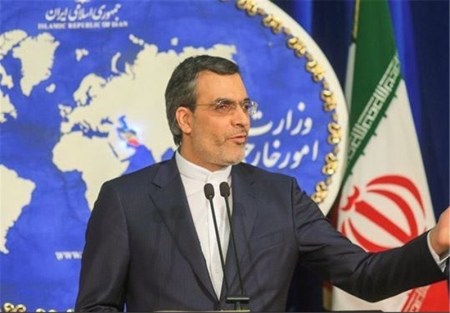
TEHRAN (Tasnim) – Iranian Foreign Ministry Spokesman Hossein Jaberi Ansari on Thursday strongly denounced a recent move by the Persian Gulf Cooperation Council to call the Lebanese Resistance Movement, Hezbollah, a terrorist group, saying such stances are against the interests of the Muslim world.

“The Lebanese Islamic Resistance Movement, Hezbollah, ended decades of lethargy in countering the occupiers of Palestine through perseverance and resistance to the Zionist regime and all-out solidarity with the innocent nation and resistance movement of Palestine,” Jaberi Ansari said Thursday.

It was Hezbollah that gained the first major victory of Arabs and Muslims in the history of anti-Zionist conflict and turned to the distinguished symbol of resistance to the occupation and racism of Zionism, he underlined.

The Iranian spokesman added that Hezbollah is “the living and diligent representative” of the Muslims’ lasting aspirations to achieve independence, freedom, justice, honor, dignity, and fight against tyranny, occupation, racism, and state-sponsored terrorism of the Zionist regime and the Takfiri blind terrorism and extremism.

The opposition of certain Arab governments with such a movement does not justify their conformity to the occupiers of Palestine in labeling the Resistance movement a terrorist group, he stated.

Jaberi Ansari went on to say that those making such stances are “intentionally or unintentionally” acting against the interests of Muslim countries.

Earlier today, Iranian Deputy Foreign Minister for Arab and African Affairs Hossein Amir Abdollahian also said those who recently declared Hezbollah a terrorist group are damaging the unity and security of Lebanon.

“Referring to Hezbollah, the most influential resistance movement, as a terrorist group, and ignoring the Zionist regime’s crimes is a new mistake that is not in the interest of regional stability and security,” Amir Abdollahian said.

The Arab monarchies of the Persian Gulf on Wednesday declared Hezbollah movement, which has been fighting terrorist groups in Syria and the Israeli occupation, a “terrorist group.”

The six-nation (Persian) Gulf Cooperation Council officially added Hezbollah and all groups affiliated to its so-called list of “terrorist” organizations.

Tehran biennial to grant $50,000 cash prize to best cartoon on Holocaust

December 17, 2015

Tehran biennial to grant $50,000 cash prize to best cartoon on Holocaust, Tehran Times, December 17, 2015

[A] contest focusing on the portrait of Israel’s Prime Minister Benjamin Netanyahu, has been arranged on the sidelines of the competition.

**********************

TEHRAN – Organizers of the 11th Tehran International Cartoon Biennial has allocated a cash prize of $50,000 for the best cartoon on the Holocaust, the organizers announced on Wednesday.

Three other cartoonists will also receive cash prizes of 12,000, 8,000 and 5,000 dollars respectively, the secretary of the biennial, Masud Shojai-Tabatabai, told the Persian service of MNA.

He added that the competition will be held in June 2016 in Mashhad with cartoonists participating from 50 countries.

“We do not mean to approve or deny the Holocaust, however, the main question is that why is there no permission to talk about the Holocaust despite their (the West) belief in freedom of speech.

“Moreover, why should the oppressed people of Palestine pay the price for the Holocaust? We are also worried about the contemporary holocausts in which a great number of women and children are being killed in Iraq, Yemen and Syria,” he added.

Shojai-Tabatabai also said that a contest focusing on the portrait of Israel’s Prime Minister Benjamin Netanyahu, has been arranged on the sidelines of the competition.

The Palestine Museum of Contemporary Art will be hosting an exhibition of the works at the time of the competition.

The Iran Nuclear Deal: What the Next President Should Do

October 2, 2015

The Iran Nuclear Deal: What the Next President Should Do, Heritage Foundation, October 2, 2015

(But please see, The Elephant In The Room. — DM)

The failure of Congress to halt the implementation of the Obama Administration’s nuclear agreement with Tehran means that the U.S. is stuck with a bad deal on Iran’s nuclear program at least for now. Iran’s radical Islamist regime will now benefit from the suspension of international sanctions without dismantling its nuclear infrastructure, which will remain basically intact. Iran’s path to a nuclear weapon is unlikely to be blocked by the Administration’s flawed deal, any more than North Korea was blocked by the Clinton Administration’s 1994 Agreed Framework.

The next President should not passively accept Obama’s risky deal with Tehran as a fait accompli. Instead, he or she should immediately cite any violations of the agreement by Iran, its continued support for terrorism, or other hostile policies as reason to abrogate the agreement. The Bush Administration, faced with bad deals negotiated by the Clinton Administration, eventually withdrew from both the Agreed Framework and the Kyoto Protocol.

Rather than endorsing a dangerous agreement that bolsters Iran’s economy, facilitates its military buildup, and paves the way for an eventual Iranian nuclear breakout, the next Administration must accelerate efforts to deter, contain, and roll back the influence of Iran’s theocratic dictatorship, which continues to call for “death to America.”

How the Next President Should Deal with Iran

Upon entering office, the next Administration should immediately review Iran’s compliance with the existing deal, as well as its behavior in sponsoring terrorism, subverting nearby governments, and attacking U.S. allies. Any evidence that Iran is cheating on the agreement (which is likely given Iran’s past behavior) or continuing hostile acts against the U.S. and its allies should be used to justify nullification of the agreement.

Regrettably, Tehran already will have pocketed up to $100 billion in sanctions relief by the time the next Administration comes to office because of the frontloading of sanctions relief in the early months of the misconceived deal. Continuing to fork over billions of dollars that Tehran can use to finance further terrorism, subversion, and military and nuclear expansion will only worsen the situation.

In place of the flawed nuclear agreement, which would boost Iran’s long-term military and nuclear threat potential, strengthen Iran’s regional influence, strain ties with U.S. allies, and diminish U.S. influence in the region, the new Administration should:

1. Expand sanctions on Iran. The new Administration should immediately reinstate all U.S. sanctions on Iran suspended under the Vienna Agreement and work with Congress to expand sanctions, focusing on Iran’s nuclear program; support of terrorism; ballistic missile program; interventions in Syria, Iraq, and Yemen; human rights violations; and holding of four American hostages (Washington Post reporter Jason Rezaian, Christian pastor Saeed Abedini, former U.S. Marine Amir Hekmati, and former FBI agent Robert Levinson, who has been covertly held hostage by Iran since 2007).

The new Administration should designate Iran’s Islamic Revolutionary Guard Corps (IRGC) as a foreign terrorist organization and apply sanctions to any non-Iranian companies that do business with the IRGC’s extensive economic empire. This measure would help reduce the IRGC’s ability to exploit sanctions relief for its own hostile purposes.

Washington should also cite Iranian violations of the accord as reason for reimposing U.N. sanctions on Iran, thus enhancing international pressure on Tehran and discouraging foreign investment and trade that could boost Iran’s military and nuclear programs. It is critical that U.S. allies and Iran’s trading partners understand that investing or trading with Iran will subject them to U.S. sanctions even if some countries refuse to enforce U.N. sanctions.

2. Strengthen U.S. military forces to provide greater deterrence against an Iranian nuclear breakout.Ultimately, no piece of paper will block an Iranian nuclear breakout. The chief deterrent to Iran’s attaining a nuclear capability is the prospect of a U.S. preventive military attack. It is no coincidence that Iran halted many aspects of its nuclear weapons program in 2003 after the U.S. invasion of and overthrow of hostile regimes in Afghanistan and Iraq. Libyan dictator Muammar Qadhafi, motivated by a similar apprehension about the Bush Administration, also chose to give up his chemical and nuclear weapons programs.

To strengthen this deterrence, it is necessary to rebuild U.S. military strength, which has been sapped in recent years by devastating budget cuts. The Obama Administration’s failure to provide for the national defense will shortly result in the absence of U.S. aircraft carriers from the Persian Gulf region for the first time since 2007. Such signs of declining U.S. military capabilities will exacerbate the risks posed by the nuclear deal.

3. Strengthen U.S. alliances, especially with Israel. The nuclear agreement has had a corrosive effect on bilateral relationships with important U.S. allies in the Middle East, particularly those countries that are most threatened by Iran, such as Israel and Saudi Arabia. Rather than sacrificing the interests of allies in a rush to embrace Iran as the Obama Administration has done, the next Administration should give priority to safeguarding the vital security interests of the U.S. and its allies by maintaining a favorable balance of power in the region to deter and contain Iran. Washington should help rebuild security ties by boosting arms sales to Israel, Saudi Arabia, and other members of the Gulf Cooperation Council (GCC) that are threatened by Tehran, taking care that arms sales to Arab states do not threaten Israel’s qualitative military edge in the event of a flare-up in Arab–Israeli fighting.

To enhance deterrence against an Iranian nuclear breakout, Washington also should transfer to Israel capabilities that could be used to destroy hardened targets such as the Fordow uranium enrichment facility, which is built hundreds of feet beneath a mountain. The only non-nuclear weapon capable of destroying such a target is the Massive Ordnance Penetrator (MOP), a precision-guided, 30,000-pound “bunker buster” bomb. Giving Israel these weapons and the aircraft to deliver them would make Tehran think twice about risking a nuclear breakout.

The U.S. and its European allies also should strengthen military, intelligence, and security cooperation with Israel and the members of the GCC, an alliance of Bahrain, Kuwait, Oman, Qatar, Saudi Arabia, and the United Arab Emirates, founded in 1981 to provide collective security for Arab states threatened by Iran. Such a coalition could help both to contain the expansion of Iranian power and to facilitate military action (if necessary) against Iran.

4. Put a high priority on missile defense. Iran’s ballistic missile force, the largest in the Middle East, poses a growing threat to its neighbors. Washington should help Israel to strengthen its missile defenses and help the GCC countries to build an integrated and layered missile defense architecture to blunt the Iranian missile threat. The U.S. Navy should be prepared to deploy warships equipped with Aegis ballistic missile defense systems to appropriate locations to help defend Israel and the GCC allies against potential Iranian missile attacks as circumstances demand. This will require coordinating missile defense activities among the various U.S. and allied missile defense systems through a joint communications system. The U.S. should also field missile defense interceptors in space for intercepting Iranian missiles in the boost phase, which would add a valuable additional layer to missile defenses.

5. Deter nuclear proliferation. For more than five decades, Washington has opposed the spread of sensitive nuclear technologies such as uranium enrichment, even for its allies. By unwisely making an exception for Iran, the Obama Administration in effect conceded the acceptability of an illicit uranium enrichment program in a rogue state. In fact, the Administration granted Iran’s Islamist dictatorship better terms on uranium enrichment than the Ford and Carter Administrations offered to the Shah of Iran, a U.S. ally back in the 1970s.

The Obama Administration’s shortsighted deal with Iran is likely to spur a cascade of nuclear proliferation among threatened states such as Saudi Arabia, Turkey, Egypt, and the United Arab Emirates. Such a multipolar nuclear Middle East, on hair-trigger alert because of the lack of a survivable second-strike capability, would introduce a new level of instability into an already volatile region. To prevent such an outcome, the next Administration must reassure these countries that it will take military action to prevent Iran from gaining a nuclear capability as well as to deter Iranian military threats to their interests.

6. Expand domestic oil and gas production and lift the ban on U.S. oil exports to put downward pressure on world prices. In addition to sanctions, Iran’s economy has been hurt by falling world oil prices. Its oil export earnings, which constitute more than 80 percent of the regime’s revenue, have been significantly reduced. By removing unnecessary restrictions on oil exploration and drilling in potentially rich offshore and Alaskan oil regions, Washington could help to maximize downward pressure on long-term global oil prices. Lifting the ban on U.S. oil exports, an obsolete legacy of the 1973–1974 energy crisis spawned by the Arab oil embargo, would amplify the benefits of increased oil and gas production. Permitting U.S. oil exports not only would benefit the U.S. economy and balance of trade, but also would marginally lower world oil prices and Iranian oil export revenues, thereby reducing the regime’s ability to finance terrorism, subversion, and military expansion.

7. Negotiate a better deal with Iran. The Obama Administration played a strong hand weakly in its negotiations with Iran. It made it clear that it wanted a nuclear agreement more than Tehran appeared to want one. That gave the Iranians bargaining leverage that they used shrewdly. The Administration made a bad situation worse by downplaying the military option and front-loading sanctions relief early in the interim agreement, which reduced Iran’s incentives to make concessions.

The next Administration should seek an agreement that would permanently bar Iran from acquiring nuclear weapons. At a minimum, this would require:

  • Banning Iran from uranium enrichment activities;
  • Dismantling substantial portions of Iran’s nuclear infrastructure, particularly the Fordow and Natanz uranium enrichment facilities and Arak heavy water reactor;
  • Performing robust inspections on an “anytime anywhere” basis and real-time monitoring of Iranian nuclear facilities;
  • Linking sanctions relief to Iranian compliance;
  • Ensuring that Iran comes clean on its past weaponization efforts; and
  • Determining a clear and rapid process for reimposing all sanctions if Iran is caught cheating.

The Bottom Line

The nuclear deal already has weakened relationships between the U.S. and important allies, undermined the perceived reliability of the U.S. as an ally, and helped Iran to reinvigorate its economy and expand its regional influence. After oil sanctions are lifted, Iran will gain enhanced resources to finance escalating threats to the U.S. and its allies. The next Administration must help put Iran’s nuclear genie back in the bottle by taking a much tougher and more realistic approach to deterring and preventing an Iranian nuclear breakout.

Khamenei: U.S.Is The Enemy’; ‘We Must Combat The Plans Of The Arrogance With Jihad For The Sake Of Allah

September 1, 2015

Khamenei: U.S.Is The Enemy’; ‘We Must Combat The Plans Of The Arrogance With Jihad , MEMRI, September 1, 2015

(Does Iran’s Supreme Leader refer to Obama’s America or to the United States? There’s a difference. — DM)

On August 17, 2015, just over a month after the announcement of the JCPOA in Vienna, Iranian Supreme Leader Ali Khamenei said in a speech at a conference held by the Iranian Shi’ite Ahl Al-Bayt organization that the U.S. is the embodiment of the enemy of the Islamic peoples and of Iran. It must be fought with military, cultural, economic, and political jihad, he said, adding that Islamic Iran is not interested in reconciling with it. He further claimed that the U.S. is attempting to divide the Islamic world into Shi’ite and Sunni camps that will wage a religious war against each other, and in this way gain it will be able to gain control over the peoples of the region.[1]

Iran, he stressed, stands behind the resistance axis, opposes the division of Syria and Iraq, and will continue to support anyone who fights Israel.

Following are excerpts from a report on the speech that was posted on Khamenei’s website (Leader.ir):

“[Khamenei said:] ‘We must combat the plans of the arrogance [i.e. the West, led by the U.S.] with jihad for the sake of Allah.’ The Leader pointed to ‘America’s efforts to exploit the results of the nuclear talks and exert economic, political, and cultural influence in Iran’ and to the plots of the power-hungry order aimed at sowing conflict and gaining influence in the region. The Leader called for ‘adopting the correct plans in order to wisely and consistently fight this plot, in an offense against it and a defense against it.’

“[Khamenei said:] ‘Jihad for the sake of God does not only mean military conflict, but also means cultural, economic, and political struggle. The clearest essence of jihad for the sake of God today is to identify the plots of the arrogance in the Islamic region, especially the sensitive and strategic West Asian region. The planning for the struggle against them should include both defense and offense.

“[He continued:] ‘The plots of the arrogance in the region have continued for a century, but [its] pressure and plotting increased after Iran’s Islamic Revolution [1979], in order to prevent [this Revolution] from spreading to other countries. For 35 years, the regime in Iran has been subjected to threats, sanctions, security pressure, and various political plots. The Iranian nation has grown accustomed to this pressure. After the Islamic awakening movement blossomed in recent years in North Africa [i.e. the Arab Spring], the enemy greatly stepped up its plots in the West Asian region because of its panic.

“‘The enemies thought that they could suppress the Islamic awakening movement, but it cannot be suppressed. It continues, and sooner or later it will prove itself as reality.

“‘The power-hungry order led by the United States of America is the perfectly clear embodiment of “the concept of the enemy.” America has no human morality. It carries out evil crimes under the guise of flowery statements and smiles. The enemy’s plot is two pronged: creating conflict and [exerting] influence. [The enemy sows conflict] among governments, and, worse, among the nations. At this stage, they are using the Shi’a and the Sunna to create conflict among the nations. Britain is an expert in sowing conflict; the Americans are its apprentices.

“‘Establishing violent despicable criminal takfiri circles, which the Americans have acknowledged establishing, is the main means of sowing conflict, ostensibly religious conflict, among [the Muslim] nations. Sadly, some innocent and ignorant Muslims have been fooled by this plot, and have been tricked by the enemy and fallen into its trap. Syria is an obvious example of this. When Tunisia and Egypt, with Islamic slogans, ousted their infidel governments, the Americans and Zionists decided to use this formula to eliminate the countries of the resistance, turning their attention to Syria. After the events in Syria began, some ignorant Muslims were tricked by the enemy and dragged Syria to its current situation. What is happening today in Iraq, Syria, Yemen, and other countries, which some people insist on calling “a religious war,” is in no way a war of religion [i.e. Sunni vs. Shi’ite], but a political war. The most important duty today is to remove these conflicts.

“‘I have explicitly stated that Iran reaches out in friendship to all the Islamic governments in the region, and that we have no problem with Muslim governments. Iran has friendly relations with most of its neighbors. Some still have conflicts with us; they are stubborn, and carry out nefarious acts, but Iran aspires to good relations with its neighbors and with the Islamic governments, especially with the governments in the region. The basis for Iran’s conduct comprises the principles laid out by Imam Khomeini, which he used to bring about victory for the Islamic Revolution, and he led it to a phase of stability.

“‘One of the principles of the [Islamic] regime [in Iran] is to be “forceful against the disbelievers, merciful amongst themselves [Koran 48:29].” On the basis of Imam Khomeini’s lesson, we do not wish to reconcile with the arrogance, but we aspire to friendship with our Muslim brothers. When we support [any of] the oppressed, we ignore the religious element; we provide the same aid to our Shi’ite brothers in Lebanon and to our Sunni brothers in Gaza. We see the Palestinian issue as the chief issue of the Islamic world.

“‘There must be no exacerbation of the conflict in the Islamic world. I oppose any conduct, even by Shi’ite circles, that creates conflict. I condemn the insults against the sanctities of the Sunna.

“‘The U.S. has aspired for decades to infiltrate the region and regain its lost reputation. The Americans wish to infiltrate Iran with the [JCPOA] agreement, whose fate in Iran and in the U.S. is still unknown. But we have decisively blocked this path, and we will do anything to keep them from infiltrating Iran economically, politically, and culturally.

“‘Iran’s regional policy is the opposite of America’s. While [America] seeks to divide the countries of the region and to create statelets that obey it, this will not happen. Some were amazed by statements I made in the past about America’s attempt to divide Iraq, but today the Americans themselves honestly acknowledge this. The Americans’ clear goal is to divide Iraq, and, if they can, Syria as well. But the territorial integrity of the countries of the region – Iraq and Syria – is very important to Iran.

“‘Iran supports the resistance in the region, including the Palestinian resistance, and we will support anyone who struggles against Israel and strikes at the Zionist regime. Iran’s chief policy is a struggle against America’s policy of division and its sowing of conflict. We do not recognize the Shi’a that is based in London and works in the service of the arrogance.

“‘In contrast to unfounded claims, Iran is not interfering in Bahrain and Yemen, but will continue to support the oppressed. The massacre of oppressed Yemenis and the destruction of that country must be strictly condemned. Promoting some [Saudi] political goals via foolish methods results in ongoing crimes against the Yemeni people.

“‘There are also painful events in Pakistan and Afghanistan. Muslims must be wise and vigilant, and thus they will solve these problems.

“‘The Islamic Radio and Television Union [organization in Iran] is an important center in the struggle against the dangerous empire of the sophisticated American-Zionist media mafia. We must strengthen and grow this movement…

“‘The future of the region belongs to the Muslim nations. Islam’s might is clear and will be maintained because of the presence of the fighting men and women.'”[2]

_________________

Endnotes:

[1] It should be noted that in the main Friday sermon in Tehran on August 28, 2015, prayer leader Ayatollah Kazem Seddiqi advised the officials in the government of Iranian President Hassan Rohani not to be misled by the West and the U.S. following the JCPOA, because they are “cannibals, liver-eaters, and anti-religion.” Fars, Iran, August 29, 2015.

[2] Leader.ir, August 18, 2015.

The Iranian Nuclear Deal Viewed Through the Eyes of ISIS and Iran’s Children

August 27, 2015

The Iranian Nuclear Deal Viewed Through the Eyes of ISIS and Iran’s Children, Accuracy in Media, Lt. Colonel James G. Zumwalt, USMC (Ret.), August 27, 2015

(Assume for the sake of argument that the Islamic Republic is only half as evil as the Islamic State. That’s hardly a persuasive argument in favor of the “deal” with Iran. –DM)

timthumb (1)

As Congress votes next month on whether to support the nuclear agreement Team Obama has negotiated with Iran, two assessments are necessary.

One is content-oriented-looking to the four corners of the document to understand exactly what Iran is being allowed legally to do, as well as the impact it will have on our national security.

Fully understanding that, the other assessment is then to analyze Iranian intentions-looking outside the document to determine the likelihood of full compliance by the mullahs.

As Congress undertakes the first assessment, it seems, unfortunately, to pay less heed to the second. But, as the latter demands understanding what the mullahs’ ultimate goal is, in addition to their commitment to achieving it, it is most relevant.

Interestingly, to better understand the mullahs’ ultimate goal, we need only look to ISIS-a group in pursuit of a similar one.

Before we do so, however, consider the following hypothetical: based on what we know about the group today, would Congress even consider negotiating the same nuclear deal with ISIS that has been negotiated with Iran? We hope it would not. The very thought of any agreement paving the way for a nuclear-armed ISIS would be an interminable nightmare for the world community.

The blatant savagery of ISIS undermines its credibility as a candidate with whom to hold nuclear negotiations. A group whose sole creative contribution to society has been to develop increasingly horrific ways of executing victims (and proudly displaying them on video) does not make for a responsible nuclear negotiating partner.

We may have thought the burning alive of caged Jordanian pilot Mu’ath al-Kaseasbeh earlier this year represented the extreme of ISIS brutality. It did not.

We have seen other victims paraded out, hands tied behind their backs, forced to kneel in front of their ISIS captors who-unbeknownst to the captives had buried explosive devices where they were kneeling-move safely away before detonating them. The sight of flying body parts then met with cries of “Allahu Akbar” from among the ISIS savages.

We have seen videos of Arab Christians similarly being positioned and beheaded by ISIS captors.

We have reports of an ISIS leader who, by night, raped his 11-year-old slave girl and, by day, strapped her to the windshield of his vehicle to afford him concealment from snipers as he drives.

The savagery of ISIS knows no limits. Its soldiers, after executing a Muslim father, strapped an explosive device to the baby child he left behind, detonating it to demonstrate to trainees the weapon’s battlefield impact upon the human body.

ISIS justifies its savagery on a Quranic mandate to pursue Islam’s ultimate goal: a global Caliphate by which to rule all inhabitants under sharia-a system of laws stripping its own believers of human dignity and non-believers of their lives.

But it is interesting that the ultimate goal for Islam sought by ISIS is really no different than that sought by Iran’s mullahs.

The brutality of ISIS, the irrationality of its leadership, the darkness that strips it of any humanity, the avowed purpose of its very being-all of this is mirrored within the mindset of Iran’s mullahs. Iran’s mullahs are ISIS wolves in sheep’s clothing.

ISIS is driven by a virulent Islamic ideology, unprotected by state boundaries, seeking to impose sharia upon the world. Iran is driven by a virulent Islamic ideology, protected by state boundaries, seeking the very same global objective.

The two mindsets evolved from one Islamic tree, branching out into different sects following Muhammad’s death. While differences evolved in culture, political systems, eschatological beliefs concerning the “Twelfth” or “Hidden Imam,” the role economics plays, etc., what we should find disturbing is, regardless of which sectarian branch prevails, for us, the end result is the same. Whether a Sunni ISIS Caliphate or a Shiite Iranian one were to dominate, infidels would be forced either to convert to Islam or die-with death imposed by whatever means available.

It is the commitment to an Iranian Caliphate that should concern us more than the commitment of ISIS to one. The mullahs believe for theirs to evolve, global chaos needs to occur-with man a catalyst in triggering it. Thus, providing them with a path for a nuclear-armed Iran gives the mullahs the means to fulfill the prophecy of Islam to which they adhere.

The Western mind rationalizes Iran would never initiate a nuclear strike for fear of retaliation. But the concept of Mutual Assured Destruction (MAD) that prevented a Cold War from turning hot will have no impact upon Iran. Its mullahs see this life as but a means of ensuring their arrival in the next-a paradise of unlimited sexual desires with “recycled” virgins promised by Muhammad. Such is their reward for striving in this life to make the world an infidel-free one.

We see the evil of ISIS by the sins it commits. Why do we fail to see it in the deeds of Iran’s mullahs who mirror them? Perhaps it is because ISIS boasts about its inhumanity while the mullahs are less vocal about theirs.

To fully understand the mullahs’ commitment to their ultimate goal, we need view it through the most innocent of eyes.

The best insight into the soul of a nation’s leadership is examining how it treats its most treasured asset-its own children.

Peering into the soul of Iran’s leadership, one sees only darkness.

As Iran’s mullahs came to power in 1979, the violence against the Shah was soon redirected against their own people, claiming thousands of lives. Some were children who, lacking knowledge about sharia, were held accountable, nonetheless, for violating it and summarily executed. Sharia was to rule over all, even those of a tender age incapable of its comprehension.

For Supreme Leader Ayatollah Ruhollah Khomeini, the sacrifice of children in this life was deemed acceptable to ensure ascendancy to the next. As he proclaimed in December 1979, “Could anyone wish his child to be martyred to obtain a good house? This is not the issue. The issue is (achieving) another world”-i.e., martyrdom of a child is justified in furtherance of Islam.

The extreme to which Khomeini took this was documented during Tehran’s eight-year war with Iraq.

Seeking to reduce Iranian army losses suffered penetrating Iraqi positions heavily defended by minefields, Khomeini issued a call for children to march through these fields to clear a route of attack. Each child was presented a plastic key beforehand, which, Khomeini promised, unlocked the gates to paradise. An estimated 500,000 children were so sacrificed.

A child’s life today in Iran continues to hold little value-children are still executed for acts deemed criminal under sharia. Accordingly, Tehran fails to comply with the Convention on Rights of the Child-an international commitment it made to protect its own children.

The virulent ideology of both ISIS and Iran’s mullahs merge on the common ground they share in totally devaluing the life of a child, evidenced by their unconscionable willingness to use children as weapons of war-whether it be to clear minefields, to serve as suicide bombers, or to execute prisoners.

The mullahs’ willingness to sacrifice the lives of their children should not be lost on us. If they, in pursuit of their ultimate goal, are unwilling to honor international commitments protecting their own children, only a fool can expect them to honor the international commitments set forth in a nuclear agreement.

He, too, is a fool who accepts President Obama’s claim that the Iranian leadership’s cries of “Death to America” are simply made for domestic consumption, ignoring Iranian President Hassan Rouhani’s recent warning, “Saying death to America is easy; we need to express death with action.” If Congress approves Obama’s nuclear agreement with Iran, Rouhani’s wish to replace hopeful words for America’s death with action to achieve it will take a deadly step forward.

Next month’s vote on the Iranian nuclear deal will reveal to us just how many fools we have in Congress.

Thinking About the Unthinkable: An Israel-Iran Nuclear War

August 23, 2015

Thinking About the Unthinkable: An Israel-Iran Nuclear War, Amerian Thinker, John Bosma, August 23, 2015

(We live in “interesting times.” — DM)

The signing of a Munich-class agreement with Iran that hands it more than it ever hoped to pull off represents a shocking, craven American capitulation to an apocalyptic crazy state: a North Korea with oil. Nothing in Western history remotely approaches it, not even Neville Chamberlain’s storied appeasement of another antisemitic negotiating partner.

But it also augurs the possibility of a nuclear war coming far sooner than one could have imagined under conventional wisdom worst-case scenarios. Following the US’s betrayal of Israel and its de facto detente with Iran, we cannot expect Israel to copy longstanding US doctrines of no-first-nuclear-use and preferences for conventional-weapons-only war plans. After all, both were premised (especially after the USSR’s 1991 collapse) on decades of US nuclear and conventional supremacy. If there ever were an unassailable case for a small, frighteningly vulnerable nation to pre-emptively use nuclear weapons to shock, economically paralyze, and decapitate am enemy sworn to its destruction, Israel has arrived at that circumstance.

Why? Because Israel has no choice, given the radical new alignment against it that now includes the US, given reported Obama threats in 2014 to shoot down Israeli attack planes, his disclosure of Israel’s nuclear secrets and its Central Asian strike-force recovery bases, and above all his agreement to help Iran protect its enrichment facilities from terrorists and cyberwarfare – i.e., from the very special-operations and cyber forces that Israel would use in desperate attempts to halt Iran’s bomb. Thus Israel is being forced, more rapidly and irreversibly than we appreciate, into a bet-the-nation decision where it has only one forceful, game-changing choice — early nuclear pre-emption – to wrest back control of its survival and to dictate the aftermath of such a survival strike.

Would this involve many nuclear weapons? No – probably fewer than 10-15, although their yields must be sufficiently large to maximize ground shock. Would it produce Iranian civilian casualties? Yes but not as many as one might suppose, as it would avoid cities. Most casualties would be radiological, like Chernobyl, rather than thermal and blast casualties. Would it spur a larger catalytic nuclear war? No. Would it subsequently impel Russia, China and new proliferators to normalize nuclear weapons in their own war planning? Or would the massive global panic over the first nuclear use in anger in 70 years, one that would draw saturation media coverage, panic their publics into urgent demands for ballistic missile self-defense systems? Probably the latter.

The Iranian elite’s ideology and controlling political psychology is inherently preferential towards nukes and direct population targeting as a way to implement Shi’ite messianism and end-times extremism. Iran is a newly nuclear apocalyptic Shi’ite regime that ranks as the most blatantly genocidal government since the Khmer Rouge’s Sorbonne-educated leaders took over Cambodia in April, 1975. Senior Iranian officials have periodically tied nuclear war to the return of the Twelfth Imam or Mahdi, which Iran’s previous president anticipated within several years. This reflects not just the triumphalist enthusiasm of a new arriviste nuclear power that just won more at the table than it dared to dream. It also reflects a self-amplifying, autarchic end-days theology that is immune to both reality testing and to Western liberal/progressive tenets about prim and proper nuclear behavior.

Admittedly, Iranian leaders have lately resorted to envisioning Israel’s collapse in more restrained terms through Palestinian demographic takeover of the Israeli state and asymmetric warfare. Still there remains a lurid history of Iranian officials urging the elimination of Israel and its people, of allocating their nukes to Israeli territory to maximize Jewish fatalities, of Iranian officials leading crowds in chants of “Death to Israel!” Iran’s government also released a video game allowing players to target various kinds of Iranian ballistic missiles against Israeli cities – this as part of intensive propaganda drumming up hatred of Jews. A more recent video game envisions a massive Iranian ground army marching to liberate Jerusalem. In all, Iran’s official stoking of genocidal Jew hatred is far beyond what Hitler’s government dared to advocate before the 1939 outbreak of World War 2.

The deliberate American silence over Iran’s genocidal intentionality sends an unmistakable signal to Israel that the US no longer recognizes a primordial, civilizational moral obligation to protect it from the most explicit threats imaginable. It is truly on its own, with the US in an all-but-overt alliance with its worst enemy. The shock to Israel’s leaders of this abrupt American lurch into tacitly accepting this Iranian intentionality cannot be understated. Iran is violating the core tenets of the 1949 Geneva Conventions, a US initiative after the Tokyo and Nuremberg war-crimes trials to codify genocide as a crime against humanity. Now the US is silent.

But this shift is also recent. Every US government prior to President Obama would have foresworn nuclear talks with such a psychopathic regime or would have walked out in a rage upon such utterances. Yet Iran’s genocidal threats have had no discernible effect on Obama’s canine eagerness for a deal. It’s as if 75 years ago a US president had cheerfully engaged in peace talks with Hitler and his SS entourage despite learning the details of the Nazis’ secret Wannsee Conference where Hitler signed off on the Final Solution for the Jews. But whereas Hitler had the sense in that era to keep that conclave secret, Iran’s Wannsee intentionality toward Israel and world Jewry has for years been flamboyantly rude-and-crude and in-your-face. That this Iranian advocacy of a second Holocaust drew no objection from the US negotiators of this deal should make moral pariahs out of every one of them – including our president and Secretary of State.

These two factors alone, especially the abrupt evaporation of the US’s ultimate existential bargain with Israel through Obama’s de facto alliance with the mullahs, would drive Israel to the one attack option it can unilaterally use without running short of munitions and experiencing the massive US coercion embedded in that dependence. But there are other reasons why early Israeli nuclear pre-emption is not only justified but almost mandatory.

First, it is too late to stop Iran’s bomb-making momentum with conventional weapons or sanctions. That nation’s science and technology base is robust and improving. It has learned to domestically produce high-performance gas centrifuges whose uranium gas output is such that smaller numbers of them are needed for breakout. The US spent decades and many billions at labs like Oak Ridge National Laboratory on composites, software-controlled magnetic bearings, gas flow separations, thermal controls and ultra-precision manufacturing for these thin-wall, very-high-speed devices. Yet Iran has come up the centrifuge learning curve with surprising speed. Its metallurgists are familiar with a novel aluminum forging method that may yield nanophase aluminum shells so strong that they approach the centrifugal strength usually associated with more demanding composite-shell gas centrifuges. Also, Iran’s bomb engineering and physics can tap the sophisticated bomb designs and re-entry vehicle (RV) skills of North Korea, which is reducing the weight and mass of its H-bombs to fit on ballistic missiles and whose collaboration with Iran reportedly included Iranian technicians at North Korean bomb tests.

Other technology sources in the Nuclear Bombs R Us cartel for wannabe proliferators set up by rogue nuclear scientist A.Q. Khan of Pakistan include China, Russia and Pakistan. Worst of all, under the US-Iran deal, Iran’s ballistic missiles can improve their reliability, accuracy, throw-weight and their post-boost RV-release thrusters.

Second, Iran’s underground nuclear targets are likely harder than American and Israeli hard-target munition (HTM) developers have assumed. Why? Because Iranian engineers have perfected the world’s toughest concrete, developing mixtures using geopolymers, quartz powders (called fume) and metal and ceramic fibers. The result is hardness levels reportedly up to 50,000-60,000 psi in experimental samples. This means that even shallow “cut and cover” hard targets like the Natanz centrifuge enrichment plant, an armored complex in an excavated pit that is then covered, can resist destruction by the US’s most lethal hard-target bomb: the 30,000-lb “Massive Ordnance Penetrator.” Only the B-2 and the B-52 can carry the MOP. Yet while the MOP can penetrate ~200 ft into 5000-psi targets, it only reaches 25 feet into 10,000-psi concrete – and Iranian cement for new or up-armored underground bunkers has likely progressed well beyond that.

US and Israeli HTM alternatives include staged-warhead penetrators and – high on the wish list – novel energetic chemistries with orders-of-magnitude more power than current HTMs. Tactical HTMs with up to four sequential warheads use precursor warheads to blast an initial opening for larger follow-through charges to destroy tanks, fortifications and bridge piers. But these impact at slow speeds compared to what’s needed to kill deep hard targets. The latter need superhard casings (probably single-crystal metals) and packaging to keep their sequenced charges intact during violent impacts of thousands of feet/second (fps). One benchmark is the Department of Energy’s Sandia lab’s success years ago in firing a simulated hard-target RV into rock at 4400 fps. Similarly, reactive-material (RM) munitions and next-generation HEDM (high-energy-density material) explosives and energetic chemistries with orders-of-magnitude more power look promising for the future. But these require years of iterative fly-redesign-fly testing to assure they’ll survive impact with their deep targets.

Bottom line: with even the US’s best non-nuclear HTMs marginal against Iran’s critical deep targets, Israel’s HTMs probably wouldn’t do the job either, being lower in kinetic energy on target. Alternatives like using HTMs to destroy entrances to such targets and ventilation shafts may work – but unless Iranian military power and recovery are set back months or years, this damage would be repaired or worked round. Moreover, nuclear facilities tunneled into mountains would be almost impossible to destroy with conventionals.

Still, the brains behind Iran’s nuclear bomb, missile and WMD is concentrated in soft targets like the Iranian universities run by the IRGC (Iran Revolutionary Guard Corps), custodian of the bomb program). These can be hit by conventionals under a Peenemunde targeting strategy to kill as many weapon scientists and technicians as possible. (This recalls Prime Minister Winston Churchill’s directive for British bombers to target the residential housing on the small Baltic island where Hitler had sited his V-2 rocket program.) Alternatively, conventional or nuclear EMP (electromagnetic pulse) or HPM (high-power microwave) weapons could destroy for months all the computers and communications that support university-hosted bomb work. This would keep these scientists and surrounding urban populations alive.

Third, Obama’s decision to provide Iran “training courses and workshops to strengthen Iran’s ability to prevent, protect and respond to nuclear security threats, including sabotage, to nuclear facilities and systems as well as to enable effective and sustainable nuclear security and physical protection systems” is the clearest indicator that this accord is aimed squarely at Israel. Why? It eliminates the sole option Israel has left now that it lacks the US-supplied conventional HTMs to destroy unexpectedly hard deep targets, forcing it at best into a slow-motion conventionals-only campaign. This would expose it to brutal political and military blowback by Iran and its Chinese, Russian and European suppliers – and by an enraged American president. In essence, it appears that the Obama regime has under the accord deliberately stripped Israel of every option except nuclear pre-emption – which Obama, in typically liberal-progressive fashion, assumes would never happen. Ergo, Israel would be forced to accommodate Iranian military supremacy.

Fourth, what may drive an early Israeli nuclear attack are two considerations: (a) Russian S-300 ATBM/SAMs (anti-tactical ballistic missile/surface-to-air missile) in Iranian hands; and (b) Hezb’allah’s thousands of missiles. Russia’s agreement to supply Iran four batteries of its fearsome S-300 by late August for defending priority targets would make it very difficult for Israel to mount the complex precision bombing strategies needed for tough targets. The S-300, the world’s best, can knock down high-speed aircraft from near ground level to almost 100,000 feet. It can also engage some ballistic missiles.

Meanwhile, Hezb’allah’s arsenal of more than 60,000 rockets (by some estimates) is a much greater threat to Israel, especially its air force, than is appreciated. Hezb’allah has retrofitted an unknown fraction of these missiles, whose range now covers almost all of Israel, with GPS and precision guidance, allowing them to hit critical targets. Unfortunately, Israel’s Iron Dome and David’s Sling interceptors were designed on the assumption that most incoming missiles would be inaccurate and so the interceptors could be saved only for those approaching critical targets. The result? Hezb’allah rocket campaigns targeting Israeli airbases and other military targets could quickly run Israel out of interceptors. Iran could easily order such a campaign to throw Israel off balance as it focuses on the deadly US-abetted nuclear threat from Iran.

An Israeli nuclear pre-emption is thus eminently thinkable. Every other option has been stripped away by Obama’s decision, concealed from Israel, Congress and our allies until it was too late to challenge, to let Iranian bomb-making R&D run free and to harden Iran’s bomb-making infrastructure against Israel – while imposing lethal restrictions on Israeli countermeasures and forswearing any US and allied military attacks, such as B-2’s and B-52’s dropping MOP bombs.

The die is now cast. Nuclear pre-emption becomes attractive to a nation in extremis, where Israel is now:

…Israel needs to impart a powerful, disorganizing shock to the Iranian regime that accomplishes realistic military objectives: digging out its expensive underground enrichment plants, destroying its Arak plutonium reactor and maybe Bushehr in the bargain, killing its bomb and missile professionals, scientists and technicians, IRGC bases, its oil production sites, oil export terminals and the leaders of the regime where they can be found.

…its initial strike must move very fast and be conclusive within 1-2 hours, like the Israeli air attack opening the 1967 Six-Day War. The goal is to so stun the regime that Israel controls the first and subsequent phases of the war and its ending. This means that Israel must hit enough critical targets with maximum shock – and be willing to revisit or expand its targets – so as to control blowback and retaliation from Iran’s allies. In essence, this involves a very fast-paced Israeli redesign of the Middle East in the course of a nuclear war for survival.

…what is poorly appreciated is that nuclear weapons from 10 to 300 kilotons (KT) – depending on accuracy – can destroy deep hard targets to 200+ meters depth by ground coupling if they penetrate merely 3 meters into the ground (Effects of Nuclear Earth Penetrators and Other Weapons: National Research Council / National Academy Press, 2005, pp. 30-51). Israel could lower bomb yields or achieve deeper target kills by its reported tests of two-plane nuclear attacks in which the first plane drops a conventional HTM like a GBU-28 to open up a channel; the second plane drops its tactical nuclear bomb into that ‘soft’ channel for greater depth before bursting. This unavoidably would produce fallout on cities downwind. Fortunately, the same medical countermeasures used for radiological accidents (Chernobyl accidents, etc.)  – potassium iodide pills (available domestically from www.ki4u.com) – can be airdropped for use by exposed urbanites.

…the more important objective, however, is decapitation and economic paralysis by EMP and HPM effects that destroy all electronic, electrical and electromechanical devices on Iranian territory. While a high-altitude nuclear burst would affect most of Iran’s territory, it may not be necessary if smaller, lower-altitude weapons are used.

…A small number of nuclear weapons (10-15?) may suffice: one each for known underground hard targets, with one held in reserve pending bomb-damage assessments; several low-yield bombs for above-ground bomb-related depots; and low-yield neutron weapons to hit IRGC and regime targets while avoiding blast and fallout. Reactors can be hit with conventional HPM pulse weapons to burn out electrical, electronic and electromechanical systems for later reactor destruction by Special Forces. A targeting priority (using antipersonnel conventionals) would be university-hosted bomb/missile scientists.

…Israeli F-15s and F-16s provide the most accurate delivery for the initial phase – assuming that the S-300 batteries can be decoyed, jammed or destroyed (where Israeli air force experience is unmatched). The small stock of Jericho-2 ballistic missiles probably would be held in reserve. They can’t be used against buried targets unless their re-entry vehicles (RVs) are fitted with penetrator casings and decelerators like ribbon parachutes (used to slow down US test RVs for shallow-water recovery at Pacific atolls) to avoid disintegrating on impact. (Both methods require flight-testing, which is detectable.) Israel’s Dolphin subs in the Red Sea and Indian Ocean can launch nuclear or (probably) conventional cruise missiles with cluster munitions for IRGC targets.

The final issue is how Israeli and US leaders would operate in these conditions. An Israeli decision to go nuclear would be the most tightly held decision in history, given the prospect of out-of-control blowback by our current president if that was leaked. Still, Israel sees itself being driven into a Second Holocaust corner, possibly within weeks as the S-300s begin deploying around Iran’s nuclear targets. Once it decides nukes are its only way out, it would simulate and map out all possible event chains and surprises once it launches. Unavoidably, it would also have to decide what to do if it learns the US is feeding its pre-launch mobilization information to Iran, using its electronic listening posts and missile-defense radars in the region. It may have to jam or destroy those US sites.

For the US, however, this no-warning nuclear war would land like a thunderbolt on an unprepared White House that would likely panic and lash out as Obama’s loudly touted “legacy” goes up in smoke. The characteristic signatures of nuclear bursts would be captured and geolocated by US satellite. The commander of NORAD (North American Aerospace Defense Command) under Cheyenne Mountain in Colorado Springs would call the White House on the famous red phone. (As one of the few civilians who sat through a red phone alert at NORAD in July 1982, after a Soviet missile sub launched two test missiles off the Kamchatk Peninsulaa, I can testify it is a frightening experience for which nothing prepares you.) Given the psychology of our current president and his emotional investment in his Iran deal, what might follow could challenge the military chain of command with orders that previously were unthinkable.

Now retired, John Bosma draws on a 40-year background in nuclear war-gaming and strategic arms control (SALT 1 and 2, Soviet arms-racing and SALT violations, US force upgrades) at Boeing Aerospace (1977-1980); congressional staff and White House experience (1981-1983) in organizing the “Star Wars” ballistic missile defense (BMD) program and proposing its “defense-enforced strategic reductions” arms-control model adopted by the Reagan State Department; military space journalism (1984-1987); and technology scouting in conventional strategic warfare, rapid (1-2 hours) posture change in space, novel BMD engagement geometries with miniature air-launched interceptors, counter-WMD/terrorism, naval BMD and undersea warfare. Clients included DARPA (Defense Advanced Research Projects Agency), the Missile Defense Agency, the Office of Secretary of Defense (OSD) Advanced Systems and Concepts Office, the Navy and the  He follows Israeli forces and BMD and has studied Iran’s nuclear R&D programs. All of his work is open-source


International inspections of Iran’s nuke sites are a sick joke

August 20, 2015

International inspections of Iran’s nuke sites are a sick joke, Dan Miller’s Blog, August 19, 2015

(The views expressed in this post — which for the most part consists of links to and quotations from recent articles posted at Warsclerotic — are mine and do not necessarily reflect those of Warsclerotic or its other editors. — DM)


Over the past few days, Iranian officials have confirmed that international inspections of its nuke sites will be severely limited if permitted at all. This post provides excerpts from recent articles quoting them. 

Iran’s nuke sites

The restrictions noted in this post are in addition to previously disclosed prohibitions on access by International Atomic Energy Agency (IAEA) inspectors to military sites, which Iran itself will inspect instead. Even The Daily Beast has mentioned this problem in reliance on an Associated Press article which states,

All IAEA member countries must give the agency some insight into their nuclear programs. Some are required to do no more than give a yearly accounting of the nuclear material they possess. But nations— like Iran — suspected of possible proliferation are under greater scrutiny that can include stringent inspections. [Emphasis added.]

The agreement in question diverges from normal procedures by allowing Tehran to employ its own experts and equipment in the search for evidence of activities it has consistently denied — trying to develop nuclear weapons. [Emphasis added.]

Olli Heinonen, who was in charge of the Iran probe as deputy IAEA director general from 2005 to 2010, said he could think of no similar concession with any other country.

Recent disclosures

According to an article by Adam Kredo at Washington Free BeaconNo international inspectors will be admitted to Iran unless approved by Iranian intelligence officials.

A senior Iranian official declared on Monday that international nuclear inspectors would only be permitted into the country once they receive approval from the Islamic Republic’s Intelligence Ministry, putting another roadblock between the International Atomic Energy Agency (IAEA) and Iran’s contested nuclear sites.

Sayyed Abbas Araqchi, Iran’s deputy foreign minister and one of the top negotiators in talks that led to the recently inked nuclear deal, told the country’s state-controlled press that Iran’s intelligence apparatus must approve of any inspector who is issued a visa to enter Iran. [Emphasis added.]

Acording to an article at DEBKAfileNo international inspectors will be given access to military sites unless they first submit acceptable evidence of prohibited nuke activities there.

International nuclear inspectors will only be permitted into the country after offering proofs of suspicious activity at the sites to be inspected, Iran’s Defense Minister Brig. Gen Hossein Dehqan said Tuesday. DEBKAfile: This condition is not contained either in the nuclear deal Iran signed with the six world powers last month or in its contract with the IAEA. How will the international watchdog obtain proofs if it is denied visits for inspections? [Emphasis added.]

According to another article by Adam Kredo at Washington Free Beaconthe head of the International Atomic Energy Agency (IAEA) was threatened with “harm” should he tell U.S. officials about the Iran – IAEA secret deal(s)

Iranian leaders prevented a top International Atomic Energy Agency (IAEA) official from disclosing to U.S. officials the nature of secret side deals with the Islamic Republic by threatening harm to him, according to regional reports. [Emphasis added.]

Yukiya Amano, IAEA director general, purportedly remained silent about the nature of certain side deals during briefings with top U.S. officials because he feared such disclosures would lead to retaliation by Iran, according to the spokesman for Iran’s Atomic Energy Organization (AEOI).

Amano was in Washington recently to brief members of Congress and others about the recently inked nuclear accord. However, he did not discuss the nature of side deals with Iran that the United States is not permitted to know about.

Iran apparently threatened Amano in a letter meant to ensure he did not reveal specific information about the nature of nuclear inspections going forward, according to Iranian AEOI spokesman Behrouz Kamalvandi.

“In a letter to Yukiya Amano, we underlined that if the secrets of the agreement (roadmap between Iran and the IAEA) are revealed, we will lose our trust in the Agency; and despite the US Congress’s pressures, he didn’t give any information to them,” Kamalvandi was quoted as saying Monday during a meeting with Iranian lawmakers, according to Tehran’s state-controlled Fars News Agency.

“Had he done so, he himself would have been harmed,” the official added. [Emphasis added.]

If these analyses are correct, and they appear to be, there will be no meaningful “anytime anywhere” international inspections of Iranian military sites. Although Obama has repeatedly said that the current nuke “deal” is not based on trust, that appears to its only basis, an absurd one.

Iran’s missiles

Acording to another DEBKAfile article, Iran’s missile research and development are continuing despite (or perhaps because of) the August 2015 “deal.”

Shortly before US Secretary of State John Kerry was due in Qatar Monday, Aug. 3, Iran’s highest authorities led by supreme leader Ayatollah Ali Khamenei Sunday launched a public campaign to support Tehran’s noncompliance with the Vienna nuclear accord and UN Security Council Resolution 2231 of July 20, on its ballistic missile program. The campaign was designed by a team from Khamenei’s office, high-ranking ayatollahs and the top echelons of the Revolutionary Guards, including its chief, Gen. Ali Jafari. [Emphasis added.]

. . . .

The Security Council Resolution, which unanimously endorsed the Joint Comprehensive Plan of Action (Vienna nuclear accord) signed by Iran’s Foreign Minister Mohammed Javad Zarif, called on Iran not to undertake any activity related to ballistic missiles designed to be capable of delivering nuclear weapons, including launches using such ballistic technology until the date eight years after the JCPOA Adoption Day.” [Emphasis added.]

Tehran retorted that none of its ballistic missiles were designed to deliver nuclear weapons, and so this provision was void. Shortly after its passage, the foreign ministry in Tehran issued an assurance that “…the country’s ballistic missile program and capability is untouched and unrestricted by Resolution 2231.”

On July 30, Ali Akbar Velayati, Khamenei’s senior adviser on international affairs and member of the Expediency Council, told reporters, “The recent UNSC Resolution on Iran’s defensive capabilities, specially (sic) its missiles, is unacceptable to Iran.”

According to an August 16th article at the Iranian media site Tasnim, there is no impediment to continuation of Iran’s missile program.

TEHRAN (Tasnim) – Chief of Staff of the Iranian Armed Forces Major General Hassan Firouzabadi underlined that there are not any obstacles to the country’s missile program. [Emphasis added.]

“The Islamic Republic of Iran’s missile activities, as planned inside the country, will not face any obstacles,” the senior officer stressed on Sunday.

The general also reiterated that Iran’s missile tests are going to be carried out in a timely manner according to the plans endorsed by Supreme Leader of the Islamic Revolution Ayatollah Seyed Ali Khamenei.

Iran – North Korea nuke nexis

Nuke cooperation between Iran and North Korea was not considered during the P5+1 “negotiations.” The text of the current “deal” is silent on the subject. Kerry’s State Department has limited media contact with Douglas Frantz, his Assistant Secretary in charge of the Bureau of Public Affairs, to avoid releasing information on the Iran – North Korea nuke nexus. Mr. Frantz, formerly a highly respected journalist, had written extensively on North Korea’s nuclear program.

An honest accounting would quite likely reveal something that many press reports have alleged, but U.S. administration officials have never publicly confirmed: A history of nuclear weapons collaboration between Iran and nuclear-proliferating North Korea.

. . . .

Drawing on “previously secret reports, international officials, independent experts, Iranian exiles and intelligence sources in Europe and the Middle East,” Frantz wrote that “North Korean military scientists recently were monitored entering Iranian nuclear facilities. They are assisting in the design of a nuclear warhead, according to people inside Iran and foreign intelligence officials.”

. . . .

Perhaps Frantz should recycle that article to Secretary of State John Kerry, who while testifying to a congressional panel last month was asked about its allegations by Rep. Christopher Smith, and ducked the question.

. . . .

[I]t appears that as a State Department advocate of a free and well-informed press, Frantz himself is not free to answer questions from the press about his own reporting on North Korea’s help to Iran in designing a nuclear warhead. The State Department has refused my repeated requests to interview Frantz on this subject. Last year, an official at State’s Bureau of Public Affairs responded to my request with an email saying, “Unfortunately Assistant Secretary Frantz is not available to discuss issues related to Iran’s nuclear program.” [Emphasis added.]

. . . .

Of course, the real problem for the Obama administration is that an officially confirmed story of Iran-North Korea collaboration on nuclear warheads could spell further trouble for winning congressional approval of this nuclear deal.

Conclusions

Assuming (a highly dubious assumption) that Kerry and Obama’s other P5+1 “negotiators” wanted to limit Iran’s Uranium enrichment to peaceful purposes, to terminate its nuke weaponization and to restrict its missile development and use they failed. It might have been entertaining to have watched Obama instruct Kerry on how to negotiate for magic carpets in a Persian market. The Persians saw Obama’s P5+1 “negotiators” as suckers and took all of their cash. They then took whatever honor they may once have had.

With international inspections permitted, if at all, only at Iran’s whim, and international sanctions “snap back” a fantasy, Iran has been given a bright green light to do whatever it pleases. What pleases Iran should not please even Obama, who envisions a new era of Middle East stability as a major fruit of His victory in getting the July 2015 “deal.”

Iran plans to “stabilize” Israel first. Israel is the only free and democratic nation in the Middle East; America was once her most reliable ally. No longer, but perhaps one fine day she will be again.

A conference of religious scholars features speaker after speaker calling Israel’s annihilation inevitable and promising that a “new phase” in that effort is about to begin. [Emphasis added]

While some in the United States and among its Western allies may hope that a nuclear weapons deal with Iran might steer the Islamic Republic in a new, more responsible direction, hardliners draw new lines and issue new threats.

On Monday, Iranian Supreme Leader Ali Khamenei took to social media to attack the United States and Israel. “We spare no opportunity to support anyone #FightingTheZionists,” wrote the ayatollah, whose regime supplies Hizballah and Hamas with rockets and other weapons of terror.

Here’s a recent video from Iranian television showing how Iran plans to eliminate Israel.

The July 2015 “deal” remains a mystery shrouded in secrecy and deception. Obama has tried to mislead the the American public and the Congress. He has threatened members who have voiced opposition and characterized them as disloyal. Congress should kill the “deal.” Those members whose ultimate loyalty is to America rather than to Obama will vote to do so and then to override his veto.