Archive for the ‘Iran’ category

Iran Unveils Advanced Radars

August 30, 2015

Iran Unveils Advanced Radars, Israel DefenseAmi Rojkes Dombe, August 30, 2015

(Have the new systems been deployed? How long can Israel wait to attack Iran’s nuke sites? — DM)

New Iranian radar

Among of the unveiled products were the upgraded model of the Keyhan (Cosmos) radar, ground-based radar jamming systems and a domestically-made IFF (Identification, Friend or Foe) system.

***********************

A number of Iran’s homegrown air defense systems, including upgraded radars and electronic warfare equipment, were unveiled on Saturday.

One of the unveiled products was the upgraded model of the Keyhan (Cosmos) radar, a long-range radar that uses mixed frequencies to identify small flying objects, and is suitable for detecting large number of aerial targets in the electronic warfare.

In addition, a variety of ground-based radar jamming systems were unveiled. The jamming systems, which have been connected to the country’s integrated air defense network, are employed for electronic countermeasures in the fight against aerial threats.

A domestically-made IFF (Identification, Friend or Foe) system was also unveiled. Commander of Khatam al-Anbia Air Defense Base Brigadier General Farzad Esmaili said the system can distinguish friendly forces from the enemy by detecting 100 targets simultaneously.

A number of other Iranian radars, including Bina, Nazir and Talash were also put on display in the exhibition.

Resolving the Syrian war is not the silver bullet for stopping ISIS

August 29, 2015

Resolving the Syrian war is not the silver bullet for stopping ISIS, DEBKAfile, August 29, 2015

(Please see also, Pentagon Not Targeting Islamic State Training Camps. — DM)

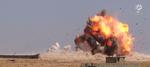
jISIS_mobile_defense_of_SVBIED_8.15ISIS “mobile defense SVBIED” in action in Iraq

President Obama may likewise offer King Salman all sorts of assistance for standing up to ISIS, but he will find no buyers in Riyadh for his failed policy of reliance on Saudi Arabia’s rival, Iran, for liquidating the Islamist threat looming against the oil kingdom from neighboring Iraq.  Neither is US aid much use for stemming the tide of pro-ISIS radicalism spreading among young Saudi men.

As matters stand today, therefore, the Islamic State faces no tangible threat – even if Iran does go ahead and achieve a nuclear bomb.

**************************

The war to stop the Islamic State in Iraq and the Levant (ISIS) has entered a dark tunnel. And with it the bottomless conflicts in Syria, Yemen, Libya and Iraq. The search for a ray of light moves next week from Moscow to Washington, when Saudi King Salman Bin Abdulaziz makes his first visit as monarch for talks with President Barack Obama.

The three worried Arab rulers received in the Kremlin Tuesday, Aug. 25, by President Vladimir Putin could only talk in circles: Egyptian President Abdel-Fatteh El-Sisi,is  embattled on three fronts, Sinai, his border with Libya and Cairo; Jordan’s King Abdullah II – is wedged between two wars; and UAE Crown Prince Sheikh Mohamed bin Zayed Al Nahyan, has sent his army to fight the Yemen insurgency alongside Saudi Arabia.

For them, resolving the Syrian conflict looked like the silver bullet, the key to ending all their troubles. But whichever Russian or Iranian plans and ideas they considered for a way forward, they were all forced to come back to the same impasse. Even Putin and Obama can’t get around or ignore two solid facts:

1. In the year since the US built an international coalition for fighting ISIS, the brutal Islamists have not been cut down; they have instead been empowered to seize more turf outside their Iraqi and Syrian conquests, such big oil fields in Libya, an ascending threat to Egypt and big plans for Lebanon.

2. A major letdown has followed on the high hopes reposed in Iran. The nuclear deal negotiated with the six world powers – and the elevated regional status conferred on Iran – hinged closely on US expectations that Tehran would put up effective military resources for tackling ISIS.

But the Revolutionary Guards, the popular Syrian and Iraqi forces the Guards established,and  the Afghan and Pakistani Shiite militias they imported – none have proved a match for ISIS and jihadi tactics.

In Syria, ISIS stands fast, unthreatened in the terrain, towns and oil fields they have captured, in the past year – excepting only on fringe fronts, where they have been forced back by local Kurdish rebel fighters.

Hizballah is a big part of the disappointment. It was supposed to serve as a bulwark against ISIS invading eastern Lebanon from Syria. Instead, these Lebanese Shiite fighters, allies of Assad’s army, are bogged down in a bitter battle for the strategic Syrian town of Zabadani, after failing to breach Syrian rebel defenses in forays from the south, the north or the center.

The door is therefore open for the Islamist State to march into Hizballah’s strongholds in the Lebanese Beqaa valley and head north to the port of Tripoli for a foothold on the Mediterranean.

Whether Bashar Assad stays or goes, which might have made a difference at an early stage of the Syrian insurgency, is irrelevant now that his army and allied forces are in dire straits.

In Iraq, the forces fighting ISIS are equally stumped. The jihadis are in control of a deadly string of  strategic towns, Ramadi, Faluja, the refinery city of Baiji, Mosul, and most of the western province of Anbar, including Haditha which commands a key stretch of the Euphrates River.

Here, too, the Islamist terrorist army’s lines remain intact, unbroken either by the undercover Jordanian Special Forces campaign 200 km inside Anbar, albeit backed by US and Israeli military and intelligence assistance; by the “popular mobilization committees” set up by the Iranian general Abu Mahdi al-Muhandis, deputy of the Al Qods chief Qassem Soleimani, or less still by US-trained Iraqi army units.

This week, the impasse spurred two combatants into chilling escalations:

— Iran began shipping its solid propellant missile, Zelzal-3B (meaning “earthquake”), across the border into Iraq, in the hope that this powerful projectile, with a range of 250km , would give the Revolutionary Guards their doomsday weapon for tipping the scales against ISIS.

— The Islamists, for their part, embraced a new tactic, known in the west as “SVBIED mobile defense.” Scores of armed vehicles are packed tight with hundreds of tons of explosives and loosed against military convoys on the move and static enemy positions and bases.

This tactic quickly proved itself by killing the 10th Iraqi Division’s chief, deputy and its command staff, as well as the deputy chief of Iraqi forces in Anbar.

In Moscow last week, Putin offered his three Middle East guests Russian nuclear reactors, arms, joint pacts for fighting terror and assorted ideas for the future of Bashar Assad. But he too had no practical proposals for bringing the Islamic State down.

President Obama may likewise offer King Salman all sorts of assistance for standing up to ISIS, but he will find no buyers in Riyadh for his failed policy of reliance on Saudi Arabia’s rival, Iran, for liquidating the Islamist threat looming against the oil kingdom from neighboring Iraq.  Neither is US aid much use for stemming the tide of pro-ISIS radicalism spreading among young Saudi men.

As matters stand today, therefore, the Islamic State faces no tangible threat – even if Iran does go ahead and achieve a nuclear bomb.

Introducing Yasser Abbas – the son whom the Palestinian leader plans to succeed him

August 25, 2015

Introducing Yasser Abbas – the son whom the Palestinian leader plans to succeed him, DEBKAfile, August 25, 2015

Yasser_AbbasYasser Abbas is tagged to succeed his father as Palestinian leader

The reports swirling around the Arab world over the Palestinian leader Mahmoud Abbas’s decision to quit disguise the octogenarian’s next plans. According to our Middle East sources, Abbas (known to all as Abu Mazen) has confided to his close circle that he has lost faith in President Barack Obama, whom he accuses of deserting the Palestinian cause, and in Secretary of State John Kerry, whom he has nicknamed “the tall liar.” He is now looking for new champions, possibly in Tehran, while at the same time shoring up his rule over the Palestinian Authority and designing his legacy.

Abbas joins the list of regional allies who feel abandoned by the Obama administration, like the Saudi King Salman bin Abdulaziz, Egyptian President Abdel-Fatteh El-Sisi and, up to a point, Israel’s Binyamin Netanyahu. For the immediate future, Abu Mazen is developing a comprehensive plan for replacing his enemies on the PLO’s Executive Committee with young faces, chosen for their ability to preserve the Abbas clan’s majority in this key institution and uphold his guiding principles for the Palestinian movement.

Since the end of July, his henchmen, Saeb Erekat, Akram Haniya and Palestinian General Intelligence chief Mejad Freij have been working on this blueprint.

They are to complete their project by September, when Abbas plans to introduce his choice of new leaders to the Executive Committee. They will consist mainly of the sons of the founders of the PLO and his own Fatah party.

Some of their names are unknown outside the Palestinian Authority’s seat in Ramallah. DEBKAfile reports that prominent among them are Sabry Shayden – son of the PLO’s first chief of staff; Maher Ghanem –  son of Abu Maher Ghanem, the Fatah Party’s first organizer; and also Gen. Majid Freij, Ayman Makbul from Nablus and Fahmi Zar’ir from the Gaza Strip.

The most important new face will be that of Yasser Abbas – Mahmoud Abbas’ own son.

The new appointments will herald another change: the PLO Exective Committee is to be elevated as the supreme Palestinian ruling institution, with jurisdiction over the Palestinian Authority and Palestinian government.

Abu Mazen is shaping this reshuffle to guarantee that his immediate successor as PA Chairman – mostly probably Erekat, whom the West knows as the most public Palestinian negotiator – will give up his seat when the time comes to make way for Yasser Abbas.

In this way, Mahmoud Abbas hopes to keep control of the Palestinian movement in the hands of his dynasty. His son, aged 52, who was named in honor of the late Yasser Arafat, moved from Ramallah to Canada in 1997 and built a business career.

A civil engineering graduate from Washington State University, he owns a string of companies in Canada, the Gulf and the West Bank. Among them is Falco Tobacco, which holds the sole agency for the distribution of American cigarettes in the Palestinian territory.

There are many rumors about how he made his fortune, including corrupt practices in high Palestinian circles. Little is known about his politics. When interviewed on occasion, he prefers to dwell on how he made his money rather than expanding on public affairs that concern his people. His good connections in Washington will no doubt be useful for opening a new chapter with the US when he takes over.

No date has been set for an Abbas visit to Tehran. It will be interesting to see whom he picks for the party to accompany him if and when it takes place.

Six Russian MiG-31 interceptor aircraft land in Damascus to rescue Assad regime

August 19, 2015

Six Russian MiG-31 interceptor aircraft land in Damascus to rescue Assad regime, DEBKAfile, August 18, 2015

Mig-31-fighter_18.8.15Russian MiG-31 interceptors

Six Russian MiG-31 Foxhound interceptor aircraft from Moscow landed Tuesday, Aug. 18, at the Mezze Airbase situated in Damascus international airport, DEBKAfile’s military and intelligence sources disclose. They were followed shortly after by giant An-124 Condor transports, which delivered 1,000 Kornet-9M133 third-generation anti-tank guided missiles.

The Russian airlift of advanced weapons for Bashar Assad’s army will last for several days. It betokens Moscow’s intention to keep up its support for the Syrian ruler and counter – by military means if necessary – any secret Iranian diplomatic machinations for terminating the Syria war and with it the Assad regime – such as have been reported in the past week in Western and Arab capitals, especially in the Gulf.

Our sources report that the decision to send the Syrian ruler advanced aircraft and missiles could only have come from the top, i.e. President Vladimir Putin. It took direct aim at the latest moves made by the US, Turkey, Iran and Saudi Arabia for ending the Syrian war. Every formula they came up with entailed Assad’s exit, either in stages or at once.

Russian Foreign Minister Sergey Lavrov made it crystal clear to visiting Saudi Foreign Minister Adel Al-Jubair on Aug. 11 that Moscow would not stand still for any changes in Assad’s position in Damascus. The Migs and Antonovs which landed in Damascus Tuesday were meant not only as a buttress for the Syrian ruler’s regime but as a rescue operation.

The message for Washington and Ankara was that Moscow would oppose any US and Turkish plans to establish a no-fly zone over Syria, or intervene directly in the Syrian conflict.

The Russians sent exactly six MiG interceptors to match the six F-16 fighters the US deployed at the Turkish Incerlik air base on Aug. 9.

So if President Barack Obama decides to deploy more American planes at the Turkish base, he may expect Putin to reciprocate with the same number for Damascus.

Iran’s Supreme Leader Khameni publishes book on how to eliminate Israel

August 2, 2015

Iran’s Supreme Leader Khameni publishes book on how to eliminate Israel, American ThinkerThomas Lifson, August 2, 2015

Ayatollah Ali Khameni has published his version of Mein Kampf, a 416 page book outlining his strategy to eliminate Israel, which he describes as  “a cancerous tumor.” Although it is currently available only in Iran, an Arabic translation is underway, and sooner or later it will achieve wide readership in the Muslim world. The Obama administration is no doubt hoping it will achieve no notice in the United States until after the Iran deal is voted upon, because the plan advocated will be immensely aided by its implementation.

Amir Taheri of the New York Post obtained a copy from Iran:

Khamenei makes his position clear from the start: Israel has no right to exist as a state.

He uses three words. One is “nabudi” which means “annihilation.” The other is “imha” which means “fading out,” and, finally, there is “zaval” meaning “effacement.”

Khameni does not call for wiping out Israel with a nuclear bomb. He states that one of his fondest desires is to pray in Jerusalem. Instead, his plan is one of terrorism and pressure, keeping Israel from fighting back against Iran, the sponsor of terror, with the implicit threat of nuclear retaliation.

 What he recommends is a long period of low-intensity warfare designed to make life unpleasant if not impossible for a majority of Israeli Jews so that they leave the country.

His calculation is based on the assumption that large numbers of Israelis have double-nationality and would prefer emigration to the United States and Europe to daily threats of death.

Iran has many allies in this effort, including the BDS movement in the United States. Cripple Israel economically, and her economically productive people will leave. Make the political cost of supporting Israel high. That will pave the way for an internationally-sponsored plebiscite engineered to produce a Muslim state:

Under Khamenei’s scheme, Israel, plus the West Bank and Gaza, would revert to a United Nations mandate for a brief period during which a referendum is held to create the new state of Palestine.

All Palestinians and their descendants, wherever they are, would be able to vote, while Jews “who have come from other places” would be excluded.

Double standards are inherent in Islamic thinking. Any land that once fell under Muslim control belongs to Muslims by right. So Israelis who only boast a few generations in Israel are excluded, while Arabs whose families once lived in Israel generations ago are automatically qualified.

Khamenei does not mention any figures for possible voters in his dream referendum. But studies by the Islamic Foreign Ministry in Tehran suggest that at least eight million Palestinians across the globe would be able to vote against 2.2 million Jews “acceptable” as future second-class citizens of new Palestine. Thus, the “Supreme Guide” is certain of the results of his proposed referendum.

With a $150 billion war chest, thanks to the Obama deal, and the prospect of oil exploration and other business expansion in Iran, there will be plenty of money available to subsidize Hezb’allah, Hamas, and other terror attacks against Israelis and Jews (such as the attack on the Jewish Community Center in Buenos Aires).

Khamenei boasts about the success of his plans to make life impossible for Israelis through terror attacks from Lebanon and Gaza. His latest scheme is to recruit “fighters” in the West Bank to set up Hezbollah-style units.

“We have intervened in anti-Israel matters, and it brought victory in the 33-day war by Hezbollah against Israel in 2006 and in the 22-day war between Hamas and Israel in the Gaza Strip,” he boasts.

Far from a spittle-flecked madman, Khameni is coldly calculating, and explains a plan that is already underway with considerable success. And he has many allies in this country, some of them in high places.


Iran’s Prison Archipelago

July 23, 2015

Iran’s Prison Archipelago, The Gatestone InstituteLawrence A. Franklin, July 23, 2015

  • Iran’s negotiations with the P5+1 powers are narrowly defined to include only the Islamic Republic’s nuclear program. However, Tehran’s abysmal record on human rights should reveal to the world what to expect by way of compliance on any nuclear deal.
  • In facilities under their control, both the IRGC and the MOIS are permitted to execute prisoners without trial or effectively any judicial proceeding.
  • Iran will also have permission to import or develop Intercontinental Ballistic Missiles (ICBMs) with the ability to deliver a nuclear weapon to other continents, including to the United States.

The Islamic Republic of Iran’s human rights record is among the earth’s worst. Iran’s horrific treatment of its own citizens, however, has long been obscured by headlines of the ongoing nuclear negotiations, from which human right issues have been excluded.

Lost in the daily detailed reporting about nuclear talks is the regime’s increased rate of executions of its own citizens during the negotiations. Iran now has overtaken China as having the highest per capita rate for inflicting capital punishment.

While the Islamic Republic dons a reasonable and sophisticated face to the world as it negotiates with P5+1 powers in Switzerland, the authoritarian theocracy’s intelligence services continue to arrest journalists, Bahai and Sunni religious minorities as well as ethnic minorities like Kurds from Kordestan Province and Arabs from Khuzestan Province.[1]

The regime runs such a vast network of prisons and detention centers, many of them still secret, that it has taken on the dimension of a state within a state.[2] This “Prison Archipelago,” similar in relative size and brutality as the network once run by the Soviet KGB, is the primary instrument of terror that keeps the Iranian ruling class in power.

To grasp the magnitude of this domestic terror apparatus, one has only to consult the semi-annual reports on the human rights record of Iran published by United Nations Special Rapporteur Ahmad Shaheed.[3] While Westerners are treated to the smiling countenance of Iran’s President Hassan Rouhani and the sophisticated, reasonable, Westernized image of Foreign Minister Mohammad Javad Zarif, Iran’s citizens must contend with the visage of the real Iran: the face of the Islamic Revolution Guard Corps (IRGC) storm-trooper.

The IRGC and the Ministry of Intelligence and Security (MOIS) run their own network of prisons, detention centers and separate wards within certain jails. Ward 209, for instance, of Iran’s infamous Evin Prison in Tehran, is run by the MOIS.[4] Prison 59, also known as Detention Center #59, in Tehran, is run by the IRGC.

In facilities under their control, both the IRGC and the MOIS are permitted to execute prisoners without trial or effectively any judicial proceeding. Hundreds of extra-judicial executions have been carried out by the regime at Mashhad’s Vakilabad Prison.[5] Although many of those executed at Vakilabad are reported to be drug offenders and smugglers, some are ethnic Baluch irredentists and Sunni Muslims living in Sistan-Baluchistan Province, in Iran’s Far East.[6]Moreover, occasionally, regular prison guards initiate raids in which prisoners are beaten and sometimes killed — especially those inmates who have managed to embarrass the regime by secretly passing information to the Western media concerning human rights violations. [7]

In contrast to the media’s “soft image” portrayal of Hassan Rouhani since his election to Iran’s presidency in June 2013, the rate of executions in Iran has increased dramatically.[8] Moreover, among those executed last year were human rights campaigners, political activists, and religious and ethnic minorities.[9]

Eyewitness accounts, many of them testimonies by former “citizens” of the prison archipelago state, have attested to the use of widespread torture in Iran’s prisons. One type of torture noted by a former victim of the technique is called “the chicken” (jujeh kabob): an individual’s arms are bent back and tied to his ankles while being suspended in mid-air. Karaj’s Gohardasht Prison has a suite of cells called Section 1, referred to by veterans of Iran’s Prison Archipelago as “Khane Sag” or the “Dog House,” where prisoners are usually subjected to constant torture, sometimes resulting in death. [10]

1166Gohardasht Prison, Karaj, Iran. (Image source: Ensie & Matthias/Flickr

Rape of female prisoners increased after the arrests young people who protested the results of the 2009 presidential elections, which returned former President Mahmoud Ahmadinejad to office for a second term.[11] Rape in Iranian prisons is also visited upon young males, a practice referred to as “under-bedding.” Homosexual males in Iranian prisons are referred to as “vach” a slang word that connotes sexual slavery.[12]

In the archipelago, the prisons are overcrowded, with many inmates forced to sleep on the floors of hallways outside the filthy cells. Detention centers, meant only to hold people for a few days while they are processed to prisons, often have only a couple of toilets for hundreds of detainees. Moreover, access to medical care is usually denied, leading to many unnecessary deaths of prisoners whose offenses may have only been minor.[13] Conditions were so bad in Ghezel Hasr Prison in Karaj — with cells holding four times their capacity — that inmates staged a revolt in March 2011, resulting in as many as 50 deaths.[14]

Iran’s Prison Archipelago reflects the core of the true nature of the Islamic Republic — not the Javad Zarif tableau that Kerry & Co. and the compliant media would evidently have us imagine,

If Congress wants to insert itself more effectively in defining what U.S. policy should be toward the Islamic Republic, it might borrow a page from the era that produced the Jackson-Vanik legislative initiative of 1975, which promised economic trade benefits to the USSR that were linked to the Soviets allowing their captive citizens to leave the country. This legislation helped liberation of hundreds of thousands of Russian Jews.

Iranian-Americans possess the potential to mobilize to achieve the same result for thousands of political prisoners in Iran, while educating American citizens about the real nature of the Islamic Republic.

Moreover, the Islamic Republic of Iran — until it completely changes its behavior, should not be permitted to pursue nuclear research that could lead to the development of a nuclear weapon or the capability to deliver one. The deal made with Iran will give it permission to import or develop Intercontinental Ballistic Missiles (ICBMs) with the ability to deliver a nuclear weapon to other continents, including to the United States.

Such an outcome would leave in tatters any worthy legacy of the current U.S. administration and of the politicians who support the deal.

_____________________________

[1] Iran Human Rights 6 March 2014, “Arab-Iranian Sunni Converts arrested.” Human Rights Watch: Summary and Recommendations 1997; “Sunni Persecutions in Iran,” by Neda Shakiba 30 Nov 2010.

[2]Rights Disregarded: Prisons in the Islamic Republic of Iran,” 18 March 2015 Iran Human Rights Documentation Center.p.1.

[3] March 2015 Report on the Situation on Human Rights in Iran by the United Nations Special Rapporteur Ahmad Rasheed. See Rasheed’s exhaustively detailed reports on Human Rights in Iran published every six months as commissioned by the UN Secretary General.

[4] Ward 209, Former Inmate Report that it is run by VEVAK-the MOIS. See also report of journalists and bloggers Faribah Pajoh and Nafiseh Zareh Kohan, both of whom were arrested in August 2009 and who have been subsequently released.

[5] The International Campaign for Human Rights in Iran, Reporting on Executions in Vakilabad Prison. See testimony of former inmates, such as that of Ahmad Ghabel. Executions carried out in Vakilabad Prison have been primarily for drug-related crimes.

[6] Sistan-Baluchistan Province is where Sunni Religious and Baluch ethnic minorities are most concentrated in Iran. But it is also the center of drug smuggling routes into Iran from Afghanistan’s vast expanse of opium poppy fields.

[7]Letters from Iran’s Hellish Prisons” by Jason Shams, 19 September 2010. On 17 April 2014, guards at Evin Prison in an event described as “Black Thursday,” Evin Prison guards attacked prisoners in Ward 350.

[8] See Amnesty International Statistics for 2013 and 2014.

[9] Report of Secretary-General on the Situation of Human Rights in the Islamic Republic of Iran. Human Rights Council 11 March 2014.

[10] New List of Political and “Security Risk” Prisoners in Gohardasht (Rajaishahr) Prison in Iranby Sayeh Hassan.

[11] PBS/News Hour 10 June 2012 “Center for Investigative Journalism.”

[12] Surviving Rape in Iranian Prisons, Paper published by Iran’s Human Rights Violation Documentation Center. http://www.iranhrde.org/english/pulications/reports/3401-surviving-rape-in-iran-s-prisons.html#.U59ifZRdV8E.

[13] Advance Unedited Version of the 11 March 2014 Report of the Secretary General on the Situation of Human Rights in the Islamic Republic of Iran. P.6. Rights Disregarded: Prisons in the Islamic Republic of Iran.

[14] Rahana Human Rights News Agency 17 March 2011. Report on Massacre of Inmates in Zaidan-e-Ghezel Hesar.

Israel Plotting to Occupy Nile to Euphrates with Support of ISIL: Iran’s DM

July 6, 2015

Israel Plotting to Occupy Nile to Euphrates with Support of ISIL: Iran’s DM, Tasnim News Agency (Iranian), July 6, 2015

(But, he inadvertently failed to mention, “we don’t want the bomb.” — DM)

139403121032243845415453

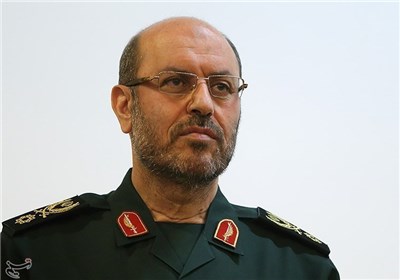
TEHRAN (Tasnim) – Iranian Defense Minister Brigadier General Hossein Dehqan warned against Israel’s plot to expand the occupied territories from “the Nile to the Euphrates” with the support of the Islamic State in Iraq and the Levant (ISIL) terrorist group.

“This year’s rallies to mark the International Quds Day due to be held this Friday are more important than the previous years’ because the Zionist regime (of Israel) with the full support of ISIL terrorists… is seeking to realize the occupation of (areas from) the Nile to the Euphrates,” General Dehqan said in a speech on Monday.

Undoubtedly, massive participation of people in the international event can thwart “the dangerous plot”, the minister stressed.

He further emphasized that the only way to liberate the holy Quds is unity and solidarity among Muslims.

Back in January, Supreme Leader of the Islamic Revolution Ayatollah Seyed Ali Khamenei underlined Iran’s determination to continue support for the Palestinian cause.

“The Islamic Republic of Iran will remain resolved (in its support) until the day that the cause of Palestine is materialized,” Ayatollah Khamenei said in a meeting with Head of Popular Front for the Liberation of Palestine–General Command (PFLP-GC) Ahmed Jibril in Tehran.

The Leader also noted that the issue of Palestine is among the top issues of the entire Muslim world.

Each year, the International Quds Day is celebrated on the last Friday of the holy Muslim month of Ramadan.

The event’s overarching theme is support for the Palestinians and fierce denunciation of Israel.

The day is also seen as the legacy of the late founder of the Islamic Republic of Iran, Imam Khomeini, who officially declared the last Friday of Ramadan as International Quds Day back in 1979.

Obama: Muslim, Napoleon Bonaparte redux or worse

July 5, 2015

Obama: Muslim, Napoleon Bonaparte redux or worse, Dan Miller’s Blog, July 5, 2015

(The views expressed in this post are mine and do not necessarily reflect those of Warsclerotic or its other editors. — DM)

Napoleon sometimes claimed to be a Muslim. Obama often claims to be a Christian. Napoleon sought, and Obama seeks, power and glory through pretense. 

Obams as Napoleon

Napoleon Bonaparte

Napoleon’s life and history are summarized at Wikipedia. He supported the French Revolution and was appointed General of the Army of Italy at the age of twenty-five. Three years later, he commanded an expedition against Egypt. This post compares his and Obama’s religious and political efforts to gain the confidence of Muslims. The lengthy quotations provided in this section of the post are from Worlds at Warthe 2,500 year struggle between East and West, 2008, by Anthony Pagden.

While en route to conquer Egypt, Napoleon had his “Orientalists” compose a  “Proclamation to the Egyptians.”

It is worth taking a closer look at this document for it summarizes not only the French hopes for the ‘Orient’, but also the ultimate failure of both sides to come to any approximate understanding of each other. It began with a familiar Muslim invocation: ‘In the name of God, the Merciful, the Compassionate. There is no God but God. He has no son nor has he any associate in His Dominion’, which was intended to indicate clearly that the French were not Christians. It then went on to assure the Egyptian people that Napoleon Bonaparte, commander of the French army, and ‘on behalf of the French Republic which is based upon the foundations of Liberty and Equality’, had not come to Egypt, as the Mamluks had put it about, ‘like the Crusaders’ in order to destroy the power of Islam. Nothing, Napoleon assured his readers, could be further from the truth. Tell the slanderers that I have not come to you except for the purpose of restoring to you your rights from the oppressors, that I, more than the Mam-luks, serve God— may He be praised and Exalted— and revere his prophet Muhammad and the glorious Qur’an … And tell them also that all people are equal in the eyes of God and that the circumstances which distinguish one from another are reason, virtue and knowledge. 578 Having thus done his best to conflate the principle of human rights— in a language in which there exists no obvious translation for the word ‘right’ 579— with what the Orientalists had persuaded him were the basic tenets of Islam, the man whom Victor Hugo would later describe as the ‘Muhammad of the West’ continued,

O ye Qadis [judges], Shaykhs and Imams; O ye Sharbajiyya [cavalry officers] and men of circumstance tell the nation that the French are also faithful Muslims and in confirmation of this they invaded Rome and destroyed there the Holy See, which was always exhorting the Christians to make war on Islam. And then they went to the island of Malta from where they expelled the knights who claimed that God the Exalted required them to fight the Muslims. 580 [Emphasis added.]

It is hard to say how much Napoleon believed in all this. One of his generals later told a friend in Toulouse that ‘we tricked the Egyptians with our feigned love of their religion, in which Bonaparte and we no more believe in than we do in that of the late pope’. 582 But Napoleon’s personal beliefs were largely beside the point. The point was policy. Napoleon had always practised religious toleration because he knew that religious faiths could make deadly enemies. Toleration, however, was one thing; credence, even respect, was another. It is indeed highly unlikely that Napoleon had read much of the Qur’an he claimed to venerate. As he told Madame de Rémusant, the only holy book which would have been of any interest to him would have been one he had written himself. [Pagden, pp 326 – 327] [Emphasis added.]

Egyptians did not appreciate Napoleon’s Proclamation.

Just as most Muslims today have failed to be persuaded that Western social values can be made compatible with the Holy Law, the Shari’a, so too were the Egyptians who confronted Napoleon. We know something of how they reacted to Napoleon’s profession of love for Islam from the account of the first seven months of the occupation written by a member of the diwan— or Imperial Council— of Cairo named Abd-al Rahman al-Jabarti. Al-Jabarti was a well-read perceptive man who was not unimpressed by French skills and technology (he was particularly taken by the wheelbarrow) and ungrudgingly admired French courage and discipline on the battlefield, which he compared, glowingly, to that of the mujahedin, the Muslim warriors of the jihad. 585 But for all that he was a firm Muslim who could conceive of no good, no truth which did not emanate from the word of God as conveyed by the Prophet. He excoriated Napoleon’s declaration for its language, for its poor style, for the grammatical errors, and the ‘incoherent words and vulgar constructions’ with which it was strewn, and which often made nonsense out of what Napoleon had intended to convey— all of which was no tribute to the skills of Venture de Paradis or those of the French Arabists in the expedition. But al-Jabarti reserved his most searing criticism for what he repeatedly describes as French hypocrisy. The opening phrase of the declaration suggested to him not, as Napoleon had meant it to, a preference on the part of a tolerant nation for Islam; but rather that the French gave equal credence to all three religions— Islam, Christianity, and Judaism— which in effect meant that they had no belief in any. Toleration for a Muslim such as al-Jabarti was as meaningless as it would have been for any sincere believer. It was merely a way of condoning error. The years when some kind of rapprochement between Judaism and its two major heresies might have been possible were long since past. There could now be only one true faith, and any number of false ones. Napoleon could not claim to ‘revere’ the Prophet without also believing in his message. The same applied to the Qur’ an. You could not merely ‘respect’ the literal word of God. You had to accept it as the only law, not one among many. ‘This is a lie,’ thundered al-Jabarti; ‘To respect the Qur’an means to glorify it, and one glorifies only by believing in what it contains.’

Napoleon was clearly a liar. Worse he was also the agent of a society which was obviously committed to the elimination, not only of Islam, but of all belief, all religion. The invocation of the ‘Republic’, al-Jabarti explained to his Muslim readers, was a reference to the godless state which the French had set up for themselves after they had betrayed and then murdered their ‘Sultan’. By killing Louis XVI, the French had turned against the man they had taken, wrongly because their understanding of God was erroneous, but sincerely nevertheless, to be God’s representative on earth. In his place they had raised an abstraction, this ‘Republic’ in whose name Napoleon, who had come not in peace as he claimed but at the head of a conquering army, now professed to speak. Since for a Muslim there could be no secular state, no law which is not also God’s law, the French insistence that it was only ‘reason, virtue and knowledge’ which separated one man from another was clearly an absurdity. For ‘God’, declared al-Jabarti, ‘has made some superior to others as is testified by the dwellers in the Heavens and on the Earth.’ There are few things a believer, especially a believer in the fundamental sacredness of a script, dislikes more than a non-believer. To al-Jabarti the French seemed to be not would-be Muslims, but atheists. [Emphasis added.] [Id. at 329].

Obama

Napoleon, in his mix of religious and political doctrine, was a power-grubbing scoundrel and liar. How about Obama?

Obama has not claimed to be a Muslim and I don’t know what He is. To claim to be a Muslim would be politically inexpedient. However, He has proclaimed His respect and even reverence for Islam and for the “Holy” Qur’an.

In Obama’s June 4, 2009 Cairo address, He stated that Islam and (His) America,

overlap, and share common principles — principles of justice and progress; tolerance and the dignity of all human beings.

Islam has a proud tradition of tolerance. . . .  People in every country should be free to choose and live their faith based upon the persuasion of the mind and the heart and the soul.  This tolerance is essential for religion to thrive, but it’s being challenged in many different ways. [Emphasis added.]

“Tolerance? Egyptian President al-Sisi is remarkable among Muslim leaders for his efforts to promote religious tolerance. Obama appears to despise him for supporting massive public protests against President Morsi and eventually becoming president. Morsi was a Muslim Brotherhood supporter and Obama appears to cherish the Muslim Brotherhood terrorist organization.

Islam is not part of the problem in combating violent extremism — it is an important part of promoting peace.

And, as Obama tells us, the Islamic State and other such groups are not Islamic.

That sort of stuff didn’t work out well for Napoleon. Are Islamists more dedicated to religious tolerance now than in the days of Napoleon? It does not seem that they are. See, e.g., Iran, Saudi Arabia, Pakistan and other Islamic nations.

Shortly after the attack on the U.S. consular annex in Benghazi, Libya — where four Americans were murdered by Islamists — Obama told the United Nations General Assembly,

The future must not belong to those who slander the prophet of Islam.  But to be credible, those who condemn that slander must also condemn the hate we see in the images of Jesus Christ that are desecrated, or churches that are destroyed, or the Holocaust that is denied.

He sought power and glory by opposing those who offend “slander” Islam, including the maker of the You Tube video on which He and others in His administration blamed “spontaneous” September 11, 2011 “demonstrations” at the U.S. Benghazi annex.

I have made it clear that the United States government had nothing to do with this video, and I believe its message must be rejected by all who respect our common humanity. It is an insult not only to Muslims, but to America as well — for as the city outside these walls makes clear, we are a country that has welcomed people of every race and every faith.  We are home to Muslims who worship across our country.  We not only respect the freedom of religion, we have laws that protect individuals from being harmed because of how they look or what they believe. We understand why people take offense to this video because millions of our citizens are among them.

I know there are some who ask why we don’t just ban such a video.  And the answer is enshrined in our laws:  Our Constitution protects the right to practice free speech.

The Obama Administration promptly had the video removed from You Tube and jailed its maker on unrelated charges (see excerpts from Daniel Greenfield’s Barack Obama’s Unholy Alliance: A Romance With Islamism below.)

Obama, who claims to want a peaceful “two state solution” for the Israelis and  Palestinians, has said little if anything about the propensity of Israel’s “peace partner,” the Palestinian Authority, to slander Israel and Judaism on a daily basis while honoring those who murder Jews.

Obama’s romance with Islam

Daniel Greenfield recently wrote a Front Page Magazine article titled Barack Obama’s Unholy Alliance: A Romance With Islamism. Please read the whole thing; it’s long but well worth the time. Mr. Greenfield notes, in connection with the Benghazi attack,

When the killing in Benghazi was done, the Jihadists left behind the slogan “Allahu Akbar” or “Allah is Greater” scrawled on the walls of the American compound.[6] These were the same words that Obama had recited “with a first-rate accent” for the New York Times’ Nicholas Kristof. Obama had called it [the Islamic call to prayer] “one of the prettiest sounds on Earth.”[7] On that too, the murderers of four Americans agreed with him.

Those who disagreed and were to be denied a future included Mark Basseley Youssef, a Coptic Christian, whose YouTube trailer for a movie critical of Islam was blamed by the administration for the attacks.

Two days after Obama’s UN speech, Youssef was arrested and held without bail. The order for his arrest came from the top. Secretary of State Hillary Clinton had told Charles Woods, the father of murdered SEAL Tyrone Woods, “We’re going to have that person arrested and prosecuted that did the video.”

The ACLU, which had developed deep Islamist connections,[9] sent a letter to Hillary Clinton thanking her for her support of freedom of speech.[10]

The Supreme Court’s “Miracle Decision”[11] had thrown out a blasphemy ban for movies, but Obama’s new unofficial blasphemy ban targeted only those movies that offended Islam. The government had joined the terrorists in seeking to deny such movies and their creators a future.

At the United Nations, Obama had compared the filmmaker to the terrorists. He had used a Gandhi quote to assert that, “Intolerance is itself a form of violence.”[12] Americans who criticized Islam’s violent tendencies could be considered as bad as Muslim terrorists and if intolerance of Islam was a form of violence, then it could be criminalized and suppressed. That became the administration’s priority.

. . . .

At the National Prayer Breakfast, Obama attacked Christianity for the Crusades in the presence of the foreign minister of Sudan, a genocidal government whose Muslim Brotherhood leader had massacred so many Christians and others that he had been indicted by the International Criminal Court for crimes against humanity.[20] [21] And he told Christians that they were obligated to condemn insults to Islam.[22]

Women’s rights? Obama supports those that don’t offend Islam. Continuing with Mr Greenfield’s linked article,

In August 2013, Al-Wafd, a paper linked to one of Egypt’s more liberal parties which supports equal rights for women and Christians, accused Obama of having close ties to the Muslim Brotherhood. [60]

A year earlier, Rose El-Youssef magazine, founded by an early Egyptian feminist, had compiled a list of six Muslim Brotherhood operatives in the administration.[61][62]

Beyond Huma Abedin, Hillary’s close confidante and aide, the list included; Arif Alikhan, Assistant Secretary of Homeland Security for Policy Development; Mohammed Elibiary, a member of the Homeland Security Advisory Council; Rashad Hussain, formerly the U.S. Special Envoy to the Organization of the Islamic Conference and currently the Coordinator for Strategic Counterterrorism Communications; Salam al-Marayati, co-founder of the Muslim Public Affairs Council (MPAC); Imam Mohamed Magid, president of the Islamic Society of North America (ISNA) and Eboo Patel, a member of President Obama’s Advisory Council on Faith-Based Neighborhood Partnerships.

These were the types of accusations that the media tended to dismissively associate with the right, but both Egyptian publications were on the other side of the spectrum.

Egyptian liberals were the ones brandishing placards of a bearded Kerry in Taliban clothes or a photoshopped Obama with a Salafist beard. The protesters Obama had supposedly sought to support by calling for Mubarak to step down were crowding the streets accusing him of backing terrorists.

What made the Egyptian liberals who had seen America as their ally in pursuing reform come to view it as an enemy? The angry Egyptian protesters were accusing Obama of supporting a dictator; the original sin of American foreign policy that his Cairo Speech and the Arab Spring had been built on rejecting.

The progressive critiques of American foreign policy insisted that we were hated for supporting dictators. Now their own man was actually hated for supporting a Muslim Brotherhood dictator.

By 2014, 85% of Egyptians disliked America. Only 10% still rated America favorably.[63] It was a shift from the heady days of the Arab Spring when America had slid into positive numbers for the first time.[64]

Obama had run for office promising to repair our image abroad. As a candidate, he had claimed that other countries believed that “America is part of what has gone wrong in our world.” And yet the true wrongness was present in that same speech when he urged, “a new dawn in the Middle East.”[65]

That dawn came with the light of burning churches at the hands of Muslim Brotherhood supporters. Under Obama, America really did become part of what had gone wrong by supporting the Muslim Brotherhood. It is a crime that Obama will not admit to and that the media will not report on.

The Muslim Brotherhood was born out of Egypt and yet Egyptian views of it are dismissed by the media. Despite the Egyptian Muslim Brotherhood’s final orgy of brutality as President Mohammed Morsi clung to power, despite the burning churches and tortured protesters, it is still described as “moderate.”

Morsi, who had called on Egyptians to nurse their children on hatred of the Jews,[66] was a moderate. Sheikh Rachid al-Ghannouchi, the leader of Ennahda, the Tunisian flavor of the Muslim Brotherhood, who had called for the extermination of the Jews “male, female and children,”[67] was also a “moderate.” Sheikh Yusuf Al-Qaradawi, the spiritual guide of the Muslim Brotherhood, went one better with a fatwa approving even the murder of unborn Jews.[68] Qaradawi was another moderate.[69] [Emphasis added.]

. . . .

Obama sits at the center of a web of intertwined progressive organizations. This web has infiltrated the government and it in turn has been infiltrated by the Muslim Brotherhood.

Consider the case of Faiz Shakir, who went from the Harvard Islamic Society where he helped fundraise for a Muslim Brotherhood front group funneling money to Hamas, the local Muslim Brotherhood franchise, to Editor-in-Chief and Vice President at the Center for American Progress, heading up the nerve center of the left’s messaging apparatus, to a Senior Adviser to House Democratic Leader Nancy Pelosi and then Senate Minority Leader Harry Reid.[73] The next step after that is the White House.

Time magazine described the Center for American Progress as Obama’s idea factory, crediting it with forming his talking points and his government.[74] In an administration powered by leftist activists, the integration between the Muslim Brotherhood and the left resulted in a pro-Brotherhood policy.

Egyptian liberals had expected that the administration’s withdrawal of support for Mubarak would benefit them, but the American left had become far closer to the Muslim Brotherhood than to them. Instead of aiding the left, it aided the Brotherhood. The Egyptian liberals were a world away while the Brotherhood’s activists sat in the left’s offices and spoke in the name of all the Muslims in America.

The [American] left had made common cause with the worst elements in the Muslim world. It formed alliances with Muslim Brotherhood groups, accepting them as the only valid representatives of Muslim communities while denouncing their critics, both Muslim and non-Muslim, as Islamophobes. [Emphasis added.]

. . . .

When Obama declared to the UN that the future must not belong to those who criticize Islam’s brutality, bigotry and abuse of women, he was also defining whom it must belong to. If the future must not belong to those who slander Mohammed, it will instead belong to his followers and those who respect his moral authority enough to view him as being above criticism in image, video or word. [Emphasis added.]

With these words, Obama betrayed America’s heritage of freedom and announced the theft of its future. The treason of his unholy alliance with Islam not only betrays the Americans of the present, but deprives their descendants of the freedom to speak, write and believe according to their conscience.

Obama has placed the full weight of the government’s resources behind Islam. He has suppressed domestic dissent against Islamists like the Muslim Brotherhood while aiding their international goals.

Is Osama Obama worse than Napoleon?

Napoleon represented a nation which, during the French Revolution, had become largely secular. Obama’s America, under His “leadership,” is becoming largely secular. Napoleon sought, and Obama seeks, each in his own way, to promote himself as deserving the approbation of Islam. Napoleon sought power and glory by lying. Obama does much the same, but He most often lies to the denizens of His America.

In the years immediately following the French Revolution, France was considered a great nation. When Obama took office, America was as well. Although some still celebrate America’s freedoms from tyranny on Independence Day, during the Reign of Obama she has become less free and large numbers of “His people” have become increasingly dependent. It’s time to put America back the way she was.

Oh well. Please see also, Pulling down the slaver flags of Islam and Africa.

Postscript: I have read of no reported Independence Day incidents of workplace violence random violence Islamic terror attacks on Obama’s America. Might it be possible that Obama has convinced the (non-Islamic) Islamic State, et al, that, so long as He remains in power, terror attacks would interfere with His plans to promote Islam and otherwise to destroy the nation.

How not to write about Iran

July 2, 2015

How not to write about Iran, The New York Times, Ishaan Tharoor, July 2, 2015

(The NY Times article is a good example of how not to write about Iran. History is important, but Iran’s more recent activities are even more important. That ancient Persia and its Islamic successors engaged in and supported terrorism is important, but that the Islamic Republic of Iran still does is more important. Please see also, Rouhani Threatens Nuclear Breakout. — DM)

In the Western imagination, Iran has long been a kind of bogeyman. It’s the land of hostage crises and headscarves. It was part of the Axis of Evil (whatever that was). Its leaders grouse about defeating Israel, an American ally. Its mullahs, say Iran’s critics, plot terror and continental hegemony.

Supporters of the ongoing talks in Vienna, where Iranian diplomats and their international counterparts are wrangling over a final agreement on Tehran’s nuclear program, are in part hoping to change this overwhelming narrative.

Rapprochement between Iran and the U.S., they argue, would signal a new era for U.S. relations in the Middle East — and, at the very least, put to rest fears of yet another American military escalation in the region.

But whether that changes the actual Western discourse around Iran is another matter. Every society or culture gets stereotyped in some way by others — but Iran, even before the rise of the Islamic Republic in 1979, has been a very conspicuous victim.

That’s in part a consequence of its history. As the inheritor of Persia’s ancient empires, Iran has been the Other — the enemy of the nominal “West” — since classical times and the famous wars with Greek city-states. In the 18th century, some European writers and thinkers popularized the image of a “decadent” and “despotic” Persia as an allegorical device to critique their own societies. A century later, as Europe’s empires gained in power, the Orientalist cliches hardened and served to bolster the West’s own sense of racial and moral superiority.

Even in the present day, many of the old tropes have been trotted out during the nuclear talks. While giving testimony to Congress in 2013, Wendy Sherman, a senior State Department official and lead negotiator with Iran, counseled caution when dealing with the Iranian regime because “deception is in their DNA.” The remarks, which infuriated Tehran, gestured at much older Western perceptions of Iranians as “wily” swindlers who cannot be trusted.

Sherman was hardly alone in conjuring up this stereotype: Those opposed to her efforts have also done the same. An editorial in the Wall Street Journal last year warned against “haggling in a Mideast bazaar” and embarking on a “Persian nuclear carpet ride.” This April, Michael Oren, Israel’s former U.S. ambassador, went on a cringe-worthy ramble about the crafty tricks of Persian rug salesmen.

“The Iranians are not just expert carpet merchants,” Oren wrote, stretching the ungainly metaphor to its frayed, tasseled edges. “They also deal in terror and endangering American allies.”

Other more nuanced assessments fall into similar traps, too. Earlier this week, James Stavridis, a retired U.S. admiral, top NATO official and the dean of the Fletcher School of Law and Diplomacy, painted a picture of the Iranian regime with the broadest brush he could possibly find.

“Tehran’s geopolitical strategy,” he wrote, “is taken directly from the playbooks of the first three Persian empires, which stretched over a thousand years.”

To no great surprise, this view of Iran as a mysterious realm, beholden to its past (and its vast store of carpets), irks some observers.

“Iran is an ancient civilization with a rich culture that definitely has roots in its old history,” Iranian-American journalist Negar Mortazavi tells WorldViews. “But to stereotype modern Iran and Iranians based on what happened thousands of years ago is wrong.”

Mortazavi argues that you would never see such simplistic, overreaching appraisals of American allies: “Do we view today’s Europe through the affairs of the Vikings? No. Do we look at Saudi Arabia through the lens of its old Islamic Empire when it was taking over the world? No.”

Arash Karami, the Iran editor of the Middle East news site Al-Monitor, dismisses the idea “that Iran has imperial ambitions in the Middle East simply because of its history.” He adds that “most Iranians only have a vague understanding” of the long-gone Achaemenid dynasty or the medieval Safavids.

The stereotypes in play seem to support the contention of some hawks that Iran is not a normal, rational state actor. Critics of the Islamic Republic may see nothing wrong with that, but these sorts of characterizations were being made well before the 1979 Islamic Revolution and the collapse of U.S.-Iran ties.

In a write-up published in January 1952, Time magazine named Iran’s democratically-elected Prime Minister Mohammed Mossadegh  as “Man of the Year.” The recognition was not particularly flattering. It sneeringly described Iran as “a mountainous land between Baghdad and the Sea of Caviar.” And it went on to attack both Mossadegh’s plan to nationalize Iran’s oil — at the expense of British and American energy interests — and the leader’s character.

Time actually called the Iranian politician “a strange old wizard.”

A year later, the Ivy League buddies of Time’s editors in the C.I.A. helped engineer a coup that ousted Mossadegh, scrapped Iran’s fledgling democracy, and re-installed the country’s monarchy as an American client. Memory of that event still informs the political conversation within Iran, but is rarely recognized in the West.

“In American media, it seems that either those wily Persians are calculating ‘chess masters’ outwitting the well-meaning Westerner,” says Karami, “or they’re bumbling idiots” who resent how “the West rules the Middle East.”

To be sure, there are many negative things that should be said about Iran’s political status quo — where a repressive theocratic government curbs dissent, jails journalists and actively supports armed proxies elsewhere in the Middle East. But you don’t need to start quoting Xenophon or Morier to get there.

“If you’re writing about a country of more than 77 million people,” says Kia Marakechi, news editor at Vanity Fair, “and the metaphors or signifiers you draw on come more from ‘Aladdin’ than a serious understanding of that nation’s politics and culture, you should probably hand the assignment to someone else.”

Hajj Amin Husseini’s Anti-Semitic Legacy

June 24, 2015

Hajj Amin Husseini’s Anti-Semitic Legacy, The Middle East Quarterly, Boris Havel, Summer 2015

(Islamic hatred of Jews goes back at least to the sixth century A.D. The pamphlet reproduced below, Islam and Judaism, was written by The Jerusalem Mufti, Muhammad Hajj Amin Husseini, apparently in the 1940s.  A fascinating book by Anthony Pagden titled Worlds at War, The 2,500-year struggle between East and West, provides a scholarly account of rivalries and wars and includes highlights of the rise of Islam. 

Jew hatred is now most visible in the Islamic Republic of Iran, soon to be welcomed into the “community of nations” by P5+1 “negotiators” under Obama’s guidance. — DM)

1379The Jerusalem mufti, Muhammad Hajj Amin Husseini (left), meets with SS-Reichsführer Heinrich Himmler, April 1943.

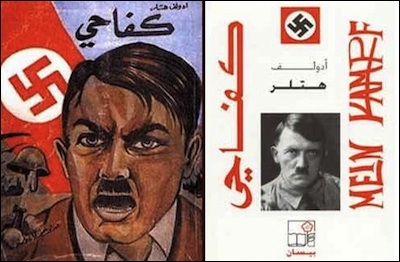
Hitler’s Mein Kampf has been a bestseller for years in predominantly Muslim countries, including the Palestinian Authority and Turkey.

***********************

The Jerusalem mufti, Muhammad Hajj Amin Husseini, leader of the Palestinian Arabs from the early 1920s to the late 1940s, is widely known for his close collaboration with the Nazis during World War II. Aspects of the collaboration remain to be more thoroughly scrutinized.[1]However, and without discounting his culpability for the collapse and dispersal of Palestinian Arab society (or al-Nakba, the catastophe, as it is called by Palestinians and Arabs), Hajj Amin’s role in shaping Muslim perceptions of Jews might be a far more important and lasting legacy than his political activism in Palestine, Germany, or elsewhere.[2] An important source supporting this fact is a booklet he authored for Muslim soldiers enlisted in the Nazi SS division in Bosnia.

During the mufti’s stay in Berlin in 1941-45, he befriended Hitler’s right-hand man, Reichsführer-SS Heinrich Himmler. Himmler’s fascination with Islam and the mufti’s zealous support for the Nazi cause resulted in several common enterprises, notably the establishment of a volunteer Waffen-SS division in Bosnia, made up mostly of Bosnian Muslims, later named the Handzar division. Most books about the division display photographs of its soldiers—distinguishable by its insignia on uniform lapels and fez headgear—reading a booklet titled Islam und Judentum—most certainly the German version of the mufti’s Croatian or Bosnian pamphlet Islam i židovstvo (Islam and Judaism).

In whatever language the pamphlet was originally written, the intended readers were Muslims (Bosnian or otherwise) and not Germans. This author has been unable to locate a German copy of the pamphlet, but it is reasonable to regard the text written in the language of the Bosnian Muslims (at the time called Croatian) as the most relevant. A translation of the booklet is presented below, followed by an analysis of its significance and far reaching implications.[3]

_________________

Islam and Judaism (Islam i židovstvo)

For us Muslims, it is unworthy to utter the word Islam in the same breath with Judaism since Islam stands high over its perfidious adversary. Therefore, it would be wrong to carry out comparison of those two generally different counterpoints.

Unfortunately, it is insufficiently known that animosity between Islam and Judaism is not of a recent date. It reaches long back in history, all the way to the time of the Prophet Muhammad. This short historical overview will demonstrate the importance and perfidiousness of Jewry and its animosity toward the founder of Islam, the Prophet Muhammad.

Jews are known in history only as a subjugated people. Their vulgar[4] nature
and insufferable stance toward the nations that offered them hospitality, and toward their neighboring nations, are the reason that those same nations had to resort to [certain] measures in order to suppress a Jew’s efforts to obtain his[5] desire by force.

The history of antiquity shows us that the pharaohs were already forced to use all means against Jewish usury and Jewish immorality. Ancient Egyptians finally expelled the Jews from their land. Led by Moses, the Jews then arrived in the Sinai desert.

Arab theologian Muhammad ibn Jarir al-Tabari [839-923 C.E.] narrates that the Jews even wanted to kill their leader and savior Moses when he came back from Mount Sinai. Because of that, God punished them, and they had to meander in the wilderness for forty years. It should have brought them to their senses, and the new generation should have been cleansed from the low esteem of their fathers.

Following that, the Jews spread like locust all over the Arab peninsula. They came to Mecca, to Medina, to Iraq, and to Palestine, which is the land of milk and honey. The group of the Jews that came to Syria and Palestine was now under Roman rule. The Romans, however, soon discerned the peril that threatened the land from the Jews, and so they introduced harsh measures against them. Besides that, a serious, contagious illness of plague erupted, which was by common opinion brought into the land by Jews. When even medical doctors stated that the Jews were indeed the source of the infection—and their opinion was obviously correct—there arose among the people such upheaval against the Jews that many Jews were killed. In addition, that event is the reason why the Jews have been called “microbes” in Arabia to this very day.

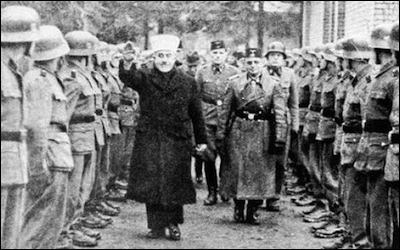
1380The mufti of Jerusalem, Muhammad Hajj Amin Husseini, visits the volunteer Nazi Waffen-SS division in Bosnia, made up mostly of Bosnian Muslims. The mufti was instrumental in the division’s formation.

The Arabs have a particular understanding for introducing forceful measures against Jews in Germany and for their expulsion from the country. After the [First] World War, England and America enabled the Jews to settle in Palestine and to establish a Jewish state there. Jewish excrement from all countries assembled there, rascally striving to seize the land from Arabs. And indeed, they succeeded in buying land from the poorest of the poor and from unscrupulous landlords. By doing so, they took poor widows’ bread and stole food from children to fatten themselves.[6] When the Arabs opposed the Jewish settlement, the Jews did not shun bloody murders. So they robbed many families of their livelihood and threw the families into misery and troubles. (God will punish them for those disgraceful deeds).

The Jewish struggle against Arabs is nothing new for us, except that as time passed, the location of the battlefield changed. Jews hate Muhammad and Islam, and they hate any man who wishes to advance the prosperity of his people and to fight against Jewish lust for possessions and Jewish corruption.

Struggle between Jews and Islam began when Muhammad fled Mecca to Medina where he created the base for the development of Islam. At that time, Jews were merchants, already permeated with guile, and they understood that Muhammad’s influence, in both the spiritual and business spheres, could turn into a danger for them. Thus they were possessed by a deep hatred toward Islam; hatred that intensified as Islam was growing more solid and powerful. The Jews breached the agreement they had concluded with Muhammad in Khaibar, of which we shall speak later. Moreover, their rage grew immensely when the Qur’an revealed the deepest inclinations of their soul, their heartlessness, and unscrupulousness by which their ancestors had been commonly known. At that time, the Jewish methods were already the same as they are today. Their weapon has been, as always, slander and quarrel, and so they attempted to humiliate Muhammad in the eyes of his followers. They claimed that he was a deceiver, an enchanter, and a liar. When they did not succeed in this, they attempted to undermine Muhammad’s honor by spreading a rumor that his wife Aisha committed adultery. The purpose of spreading such a rumor was to sow doubt in the hearts of Muhammad’s followers.

When that failed, they tried to show Muhammad’s teaching in a bad light. With that purpose, several Jews converted to Islam; only a few days later, they returned to the Jewish faith. When asked why they changed their mind so suddenly, they replied that they were very willing to settle in Islam but found that all of it is nothing but a lie. The following Qur’anic verse alludes to that:

Many of those knowledgeable in the Scriptures attempt to somehow render you infidels again by converting to our religion. It was, though, nothing but their souls’ envy, when they comprehended truth.[7]

When the Jews understood that they would not reach their goal by the means used until then, they started to ask Muhammad various meaningless and unsolvable questions. Thus, they wanted to convince others that Muhammad was poor in knowledge and wisdom. However, that method achieved no success. As they were thus persuaded that Islam was deeply rooted in the hearts of the Muslims, they commenced with the attempts to destroy the Muslims. Pursuant to that goal, they paid some non-Muslim tribes to fight against Muhammad. The almighty God, however, wanted it differently. With iron fist, Muhammad defeated the rebellious tribes and conquered their city. The Jews could not bear such a defeat, and so they decided to destroy Muhammad in every way. They hired men to murder him.

The Medina Jews lived in the city district of Banu Nadir. When Muhammad came to Medina, he concluded a contract with them. One day he set out to that city district, accompanied by only ten companions, to talk to the Jews and to try to convert them to Islam. Muhammad explained the principles of Islam to the Jews, and they seemed very interested and open-minded. Yet as Muhammad was talking in a friendly way with some of the Jews, another group prepared an attempt on his life. They persuaded a man to throw a piece of rock on Muhammad’s head. Surely Muhammad would have been killed were it not for God, who warned him. An inner voice advised him to leave that place, and so the treacherous Jews could not carry out their design. Consequently Muhammad sent a companion to deliver his message to the Jews to leave the city within ten days. They had breached the contract they concluded with him by trying to take his life. Any Jew found in the city after those ten days would be punished by death.

However, some of the Jews, who outwardly accepted Islam but in their innermost remained Jewish, persuaded other Jews not to leave the city. When the ten days passed, Muhammad was forced to expel the Jews from the city by armed force. Part of the Jews fled to Khaibar and part to Syria.

The Jews who fled to Khaibar, however, would not concede defeat and decided to avenge themselves on Muhammad. For that purpose, they turned to other Khaibar Jews and to the Jews of Taima and of Wadi Qura. Together they plotted a conspiracy: With large sums of money, they agitated non-Muslim Arab tribes to attack Medina. When Muhammad discovered their plan he quickly armed his men and set out toward the plotters’ base in Khaibar. Muhammad’s companions captured Khaibar and expelled most Jews from the site. With the remaining Jews, Muhammad concluded a contract by which peace was guaranteed.

Only after that devastating defeat [of the Jews] could an Islamic Empire peacefully develop. But when one takes into account the Jewish significance, it was not to be wondered that Jews, in spite of the agreements made, did not abandon their plans and continued to try to destroy Muhammad by all available means. They invited him to a feast, and he accepted the invitation suspecting no evil. In front of him was placed a roasted lamb prepared by the Jewess Zainab, wife of Sallam ibn Mishkam.[8] The [topic of] conversation around the table was the contract and a peaceful life in mutual agreement in which they now lived. Muhammad had not the slightest suspicion about treason. The Prophet and his faithful companion Bashr ibn Bara each took a piece of lamb meat. Muhammad, however, did not swallow his bite because its taste made him suspicious.

“The bone tells me that the lamb was poisoned,” he said and called the Jewess Zainab to ask whether the meat had been poisoned. She answered, “You know I am highly esteemed by the Jews, and I acknowledge that I have poisoned the lamb. In so doing, I thought that if you were a king, I would only kill a king, but if you were indeed a prophet, you would know that the meat had been poisoned.”

Muhammad’s companion soon succumbed to the poison’s effect, whereas Muhammad, despite spitting the poisonous bite, later suffered various health disorders, and the impact of the poison had always been evident. Some historians even believe that Muhammad’s death was a consequence of that poisoning. In this matter, they refer to a hadith by Abu Huraira, whereby the Prophet said shortly before his death, “The effect of Khaibar’s feast will manifest in me until I die!”[9]
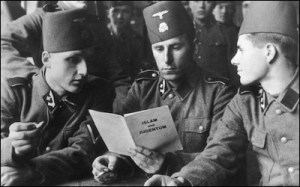
1381Many books about the Waffen-SS division in Bosnia display photographs of its soldiers reading a booklet titled Islam und Judentum—most certainly the German version of the mufti’s Croatian or Bosnian pamphlet Islam i židovstvo (Islam and Judaism). The booklet offers a stark illustration of the lengths taken by the mufti to demonize Jews and Judaism and clearly was produced for propaganda and incitement purposes.

Now, the Jews were persuaded that Muhammad was immune to their attacks. Therefore, they made a decision to spread discord among the Arab tribes, so as to break the power of Islam. When Muhammad went back to Medina, he succeeded in reconciling the Arab tribes of Kawsha and Karasha,[10] which had been fighting each other ceaselessly for 120 years. In doing so, he significantly strengthened Islam’s position. Members of those two [formerly] hostile tribes became brethren in Islam, and peace entered the city. In this regard, the Jews tried to undermine the Islamic empire.

A revengeful old man by the name of Shas ibn Qais one day walked with his friends and came across an assembly of the reconciled tribes held in city square. He could not bear to see how [the members of] those two tribes, formerly at war with each other, now communicated nicely, and so devised a hellish plan. He sent to their assembly a friend of his, knowledgeable in war poems, and persuaded him to recite some of his old poems that were full of hatred. That Jew, an outstanding orator, came indeed to the assembly and started to recite old war poems of both tribes. By doing so, he managed to find in each tribe a man in whom old hatred flared up. Those two men started to fight each other and then urged their fellow-tribesmen to take up arms. An immense tragedy would have ensued were it not for Muhammad, who learned about the fight amongst brethren and hurried up to the battlefield.

“Oh my God, are the old times returning even while I am still amongst you!” he shouted. “When I gave you Islam as religion, the old fratricidal discord was buried, and you became brothers in your hearts. Do you wish to slip into infidelity again?”

Both tribes understood that disturbances among them were sown by the Jews alone. They threw away their weapons and asked God for forgiveness, and then they hugged each other and concluded a new brotherly alliance. Regarding Shas ibn Qais the Jew, it is said in the Qur’an,

Oh, you scribes,[11] why do you prevent the believer from walking on God’s path when you are witnesses yourselves? But God is not blind for what you do.[12]

Regarding the tribes of Kawsha and Karasha, the Qur’an said,

Oh, you who believe, would you listen to those who received the Scripture, so that they would turn you into unbelievers again, after you have received faith! How can you be infidels when God’s words were read to you, and his apostle is among you? He who holds unto God has already been introduced to a straight path.[13]

Notwithstanding their attempts, the Jews never succeeded in spreading division among Muhammad’s followers and in dragging them back into infidelity. However, even after all these events should have taught them the futility of their efforts, they persistently continued to carry out their devilish plans. Once, they tried by deceit to even bring down Muhammad himself.

There was a quarrel between two Jewish tribes, and the side that was wrong held an assembly and sent its leaders to Muhammad. Those Jewish leaders said to Muhammad, “You know that we are influential people. If you support us in our dispute with our opponents, we will apply all our influence to make all Jews convert to Islam.” Muhammad, of course, dismissed them. There is a verse in the Qur’an about this event:

Be careful to make decisions according to what God has revealed and not to consider their desires. Keep your guard toward them so that they would not even partially shift you from what God has revealed to you. If they rebel, know that God will surely punish them for a part of their sins. There are, indeed, many men who are evildoers.[14]

Another example of Jewish subversive action was recorded by Ibn Abbas. At the time when Muhammad went from Mecca to Medina, prayers were directed toward Jerusalem. However, it lasted only for seventeen months. Then Muhammad received God’s revelation that the direction of prayers should be Mecca, and ever since, prayers are uttered with faces turned to Mecca. The Qur’an says about this:

We see how you turn your face toward heaven, and we would like to give it a direction which you will like: Turn your face toward the holy place of prayer; wherever you find yourselves, turn your face in that direction. Don’t you see that even those who had received the Scripture know that it is the truth before their Lord? And God is never heedless of what they do.[15]

When the Jews found out about this Qur’anic verse, they were angered and asked Muhammad to return to the previous direction of prayer, which was Jerusalem. Were he to do so, they promised, all Jews would accept Islam. Muhammad, however, did not allow himself to be led astray by such a proposal and to transgress against God’s command. We find the following in the Qur’an about that:

The direction to which you used to turn in prayer until now we have changed only for the purpose of distinguishing those who follow apostles from those who turn on their heel. That was surely difficult but not for those led by God. And God does not want to destroy your faith because God is full of goodness and compassionate to men.[16]

Here is another example how the Jews did not hesitate to stab Muhammad in the back at the time of his utmost distress. When Muhammad won the Battle of Badr, he sent a messenger on his own camel, because that camel was the fastest, to carry the news about his victory to Medina. The Jews, however, tried to bring confusion into the Muslims’ ranks by spreading false rumors that Muhammad had been killed in the battle. As evidence, they pointed out that Muhammad’s camel returned to the city with another rider.

When even that design failed, the Jews turned to Mecca to incite Muhammad’s enemies against him. Moreover, they declared their readiness to support the Meccans in their fight against Muhammad with an army of theirs. When the pagans of Mecca asked the Jews—since the Jews had received the Holy Scripture even before Muhammad—whether or not Muhammad’s religion was good, the Jews answered, “You know that we are men of letters. Believe us, therefore, when we tell you that your religion is much better.” The following verse is in the Qur’an about this:

Don’t you see those who received the Scriptures? They believe in Jibt and Taghut [superstition and idolatry], but they nevertheless say about pagans that their way is better than believers’ way. Those are the ones whom God has cursed, and he who was cursed by God cannot be helped.[17]

As we see, that curse came true. Without a homeland, the Jews are scattered throughout the whole world, and nowhere do they find true help and support. Another Qur’anic verse reads:

You will certainly find out that the greatest animosity toward the believers foster the Jews and the pagans.[18]

That idea has been even better expressed by words of Muhammad: “It will never be possible for you to see a Muslim and a Jew together without secret intention in the [heart of the] Jew to destroy the Muslim.”[19] Abu Huraira passed to us the following hadith:

Judgment Day will not come before the Muslims completely destroy the Jews, and when every tree with a Jew hidden behind will say to the Muslim, “There is a Jew behind me, kill him!” Only the gharqad tree, which is a small bush with many thorns growing around Jerusalem, will not participate in it because it is a Jewish tree! [Bukhari-Muslim VIII, p. 188].

_____________________

Assessing the Pamphlet

The booklet Islam and Judaism offers a stark illustration of the lengths taken by the mufti to demonize Jews and Judaism. Qur’anic passages are freely paraphrased without reference to sura and verse while apparent quotations (like those about Jews converting insincerely to Islam in order to drag Muslims away from their faith) are nowhere to be found in the Qur’an, certainly not in the translation by Muhammed Pandža and Džemaluddin Čaušević[20] used by Yugoslav Muslims since 1937. Indicating the pamphlet’s clear propaganda and incitement purpose, this sloppiness reflected both Hajj Amin’s poor religious credentials and his apparent conviction that the pamphlet would not be subjected to critical scrutiny or even read by believers well-versed in the Qur’an. For, though bestowed with the title of Grand Mufti of Jerusalem, Mandatory Palestine’s highest religious authority, it was common knowledge at the time that Hajj Amin did not possess the necessary religious credentials for such a lofty post. Indeed, he even failed to make the final short-list for the mufti’s post having received only nine of the electors’ sixty-four votes; but the Husseinis and their British champions forced one of the final three candidates to step down in his favor, paving the road to his appointment.[21]

Some of the pamphlet’s assertions indicate the mufti’s deficient familiarity with Islamic history and theology. Nor was Hajj Amin averse to introducing novelties and fabrications for the purpose of defaming Jews. His text contains details with an unconventional interpretation of Qur’anic accounts, some of them erroneous. He accuses the Jews of having “attempted to undermine Muhammad’s honor by spreading a rumor that Muhammad’s wife Aisha committed adultery.” But renowned Islamic scholars, including Tabari, to whom the mufti refers in the booklet, do not mention the Jews at all in the context of this event: Aisha’s accusers were all Arabs. Some came from the tribe of Kharzaj; at least one was from the Quraish, Muhammad’s tribe, and another was the sister of Muhammad’s wife. Their names are listed in both Ibn Ishak’s and Tabari’s accounts of the event. After God revealed Aisha’s innocence to Muhammad, some of the accusers were punished by flogging.[22]

Furthermore, the mufti claimed that Muhammad attacked Khaibar because its Jews bribed Arab tribes to attack Medina. The sources, however, do not mention any such activity by the Khaibar Jews. Khaibar was in alliance with the Arab tribe of Ghatafan—which at this point seemed to be rather defensive—with the Quraish, and with the Persians. Muhammad’s attack occurred shortly after he concluded the peace of Hudaibiya (March 628) with the Meccans. It is hard to envisage that Muhammad’s enemies would plot an attack from the north without Meccan support. On the contrary, it seems that he concluded the peace of Hudaibiya to secure his southern front so as to be able to attack the Khaibar Jews, whose Persian allies had just been defeated by the Byzantine army.[23]
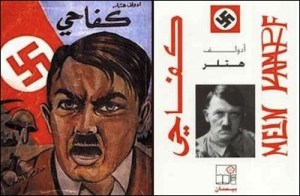
1382There remains a deep connection between Islamism and Nazism based on the common characteristics of racism, nationalism, religious bigotry, and intolerance. Hitler’s Mein Kampf has been a bestseller for years in predominantly Muslim countries, including the Palestinian Authority and Turkey.

There was, however, an event reminiscent of the mufti’s story that occurred a year earlier. The Jews of Medina had invited the Quraish and Ghatafan tribes to attack Muhammad. It was at this point, after the Battle of Badr, that the Quraish asked the Jews whose religion was better, theirs or Muhammad’s. Encouraged by the Jews, the two tribes marched on Medina, and their subsequent abortive attack came to be known as the Battle of the Ditch. After their retreat, Muhammad attacked Medina’s Jewish tribe of Banu Quraiza.[24] It seems likely that the mufti—unless he intentionally invented stories, a possibility that cannot be ruled out—confused the episode of the Banu Quraiza with that of Muhammad’s war on Khaibar.

Far more important than these technical details and idiosyncratic interpretations are the novelties the pamphlet introduces in Islamic political discourse regarding the Jews. By combining the Islamic canon with pre-Christian and Christian anti-Judaism, it attributes strengths and powers to Jews that cannot be found in Islamic tradition by portraying them as far more cunning and successful in their vicious designs than previous mainstream Islamic thought had recognized or permitted.

A simpler example of this anti-Jewish eclecticism can be found in the mufti’s accusation that Jews brought plague to Arabia. This statement evokes medieval European myths with similar themes. More significant is the notion that Muhammad’s death might have been a result of poison given to him by a Khaibar Jewess.

To be sure, Ibn Ishak and Tabari do mention how during the illness that led to his death Muhammad spoke to Umm Bashr, mother of his poisoned companion, and complained about his pain, caused by poisonous meat he had tasted three years earlier.[25] However, in classic Islamic thought, this tradition was not interpreted as proof that the Jewess had succeeded in her attempt on the Prophet’s life but as a desire to attribute to the Prophet the highest of virtues: martyrdom. In Ibn Ishak’s words, “The Muslims considered that the apostle died as a martyr in addition to the prophetic office with which God had honored him.”[26] Tabari repeats this explanation, as does Ibn Kathir (1300-73), who referred to eight different hadiths asserting that Muhammad had been warned by God about the poison: proof of his being a genuine prophet. Conversely, Ibn Kathir states that “the Messenger of God died a martyr.”[27]

The core theme of all these traditions is the Prophet’s martyrdom and not the Jews’ lethal craft; the reader is left with the clear impression that the two phenomena were unrelated. In contrast, the mufti’s pamphlet establishes the link and changes the emphasis from the Prophet’s virtue to the Jews’ mendacity. Apparently, his intention was to draw parallels with Christian traditions regarding Christ’s killing by the Jews. This accusation was intended to provoke more anger among Muslims, but it also violated Islamic tradition and theology.

The implications of the mufti’s claim that the Jews were successful in killing Muhammad despite God’s warning imply that Jews possess the power to defy God’s will. Such a blasphemous thought would be worse than Christian accusation of deicide. Jesus overcame death, and by his suffering, death and resurrection brought salvation to his community of believers; however, Muhammad not only remained dead but also failed to appoint his successor due to the rapid progression of his illness and his sudden, untimely demise. Consequently, the umma was split by different claimants to authority, and the dispute eventually led to the fiercest internecine strife in the history of early Islam, known as the fitna.

While the mufti’s Palestinian successors would not tire of reiterating this story (as late as November 2013, Palestinian Authority minister of religious affairs Mahmoud Habbash claimed that Yasser Arafat was poisoned by the Jews just as they had poisoned the Prophet Muhammad to death),[28]most contemporary Islamic scholars have a different understanding of this hazardous theology; inasmuch, the accusation that the Jews killed the Prophet has largely faded as a theological theme with mainstream Islamic commentary viewing the Jews, along the Qur’anic derision, as “adh-dhilla wa-l-maskan,” translated by Yehoshafat Harkabi as “humiliation and wretchedness.”[29] Bernard Lewis further explained:

The outstanding characteristic, therefore, of the Jews as seen and as treated in the classical Islamic world is their unimportance. … For Muslims, he might be hostile, cunning, and vindictive, but he was weak and ineffectual—an object of ridicule, not fear. This image of weakness and insignificance could only be confirmed by the subsequent history of Jewish life in Muslim lands.[30]

Departing from this conventional view, the mufti did not interpret contemporary events as a new historical phenomenon to which Muslims should respond in a new, ad hoc manner. Instead, he traced Jewish accomplishments of the 1920s, 1930s, and 1940s, and the alleged Jewish power and ambitions, to supposed Jewish activities at the time of Muhammad. In doing so, he created a precedent, later followed by prominent Islamic actors in the Middle East and elsewhere, particularly after Israel’s stunning military victories over its Arab adversaries. Thus Hamas accuses the Jews of “wiping out the Islamic caliphate” by starting World War I and of starting the French and the communist revolutions, establishing “clandestine organizations” and financial power so as to colonize, exploit, and corrupt countries.[31] Likewise, former Malaysian prime minister Mahathir Muhammad accused Jews of ruling the world by proxy.[32] Attributing such gargantuan accomplishments to the Jews, many of them at the expense of Muslims, presents a theological innovation with an immediate political consequence. Linking early Islamic with medieval Christian depictions of Jews results in their portrayal as “a demonic entity,” thus making their “extermination legitimate.”[33]

______________________

[1] Klaus-Michael Mallmann and Martin Cüppers, Nazi Palestine: The Plans for the Extermination of the Jews in Palestine, trans. Krista Smith (New York: Enigma Books in Association with the United States Holocaust Memorial Museum, 2010), p. viii.

[2] Boris Havel, “Haj Amin al-Husseini: Herald of Religious Anti-Judaism in the Contemporary Islamic World,”The Journal of the Middle East and Africa, 3 (2014): 221-43.

[3] The following text has been translated from the original pamphlet: Veliki Muftija Jeruzalemski Hadži Emin el-Huseini, Islam I Židovstvo (Zagreb: Hrvatski tiskarski zavod, 1943). I wish to thank the staff of the National and University Library in Zagreb for tracing the booklet. The Qur’anic verses and hadith are translated as they appear in the original text.

[4] The word “prostačkoj” can also be translated as: obscene, dirty, or indecent.

[5] This word was written in singular in the original text and introduces the notion that the average Jew was such; by referring to “a Jew,” the author refers to the whole people.

[6] The mufti fails to note that prominent members of his own family, including his father, were among the “unscrupulous landlords” selling plots of land to the Jews. See Efraim Karsh, Palestine Betrayed (New Haven: Yale University Press, 2010), pp. 15-19.

[7] Sura 2:109.-Ed.

[8] Ibn-Ishak, The Life of Muhammad: A Translation of Ibn Ishaq’s “Sirat Rasul Allah” by A. Guillaume(Karachi: Oxford University Press, 2004; repr., 1967), p. 516; Tabari, The History of al-Tabari [Ta’rikh al-Rusul Wal-Muluk] (New York: State University of New York Press, 1987-97), vol. VIII, pp. 123-4.- Ed.

[9] Bukhari’s Hadith, 4.394.-Ed.

[10] The author probably refers to the Arab tribes of Aws and Kharzaj though the transliteration (Kauša i Karaša) barely resembles those names.

[11] The word “pismenjaci” refers to the “People of the Book” (sljedbenici knjige in Čaušević-Pandža).

[12] Sura 3:99.-Ed.

[13] Sura 3:99-101.-Ed.

[14] Sura 5:41-5.-Ed.

[15] Sura 2:144-9.-Ed.

[16] Sura 2:142-3.-Ed.

[17] Sura 4:51-5.-Ed.

[18] Sura 5:82.-Ed.

[19] There is no Qur’anic verse with this message. The mufti perhaps refers to a non-canonical hadith or obscure tradition.

[20] Muhammed Pandža and Džemaluddin Čaušević (eds.), Kuran, Sedmo Izdanje (South Birmingham: Islamic Relief, 1937-89). Though the Qur’an condemns those who falsely feigned Islamic belief (e.g., sura 2:8-9, or sura 63), this condemnation does not specifically apply to the Jews but rather to the wider category of “hypocrites.”

[21] Karsh, Palestine Betrayed, p. 17; David Dalin and John Rothmann, Icon of Evil: Hitler’s Mufti and the Rise of Radical Islam (New York: Random House, 2008), p. 252.

[22] Ibn-Ishak, The Life of Muhammad, pp. 492-9; Tabari, The History of al-Tabari, vol. VIII, pp. 57-67; Qur’an: sura 24:11-26.

[23] Michael Lecker, “The Hudaybiyya-Treaty and the Expedition against Khaybar,” Jerusalem Studies in Arabic and Islam, 5 (1984), pp. 1-12.

[24] Ibn-Ishak, The Life of Muhammad, pp. 450-69.

[25] Tabari, The History of al-Tabari, vol VIII, p. 124.

[26] Ibn-Ishak, The Life of Muhammad, p. 516.

[27] Ibn-Kathir, The Life of the Prophet Muhammad (al-Sira al-Nabawiyya), trans. Trevor Le Gassick (Reading: Garnet Publishing, 2000-06), vol. 3, pp. 283-7.

[28] Palestinian Authority TV, Nov. 8, 2013; “PA: Arafat was poisoned by Jews like Islam’s Prophet Muhammad,” trans. Palestinian Media Watch, Nov. 12, 2013.

[29] Yehoshafat Harkabi, Arab Attitudes to Israel (Jerusalem: Israel Universities Press, 1972), p. 220.

[30] Bernard Lewis, Semites and Anti-Semites (London: Phoenix, 1997), pp. 117-39.

[31] See, for example, “Hamas Covenant 1988,” Yale Law School Avalon Project, accessed Mar. 14, 2015.

[32] CNN, Oct. 16, 2003.

[33] Moshe Sharon, Jihad: Islam against Israel and the West (Jerusalem: Moshe Sharon, 2007), pp. 77-8.