Archive for the ‘Iran scam’ category

The Tricks Obama Is Trying to Play with the Iran Announcement

April 2, 2015

The Tricks Obama Is Trying to Play with the Iran Announcement, Commentary Magazine, April 2, 2015

(When will Iran say what and to whom about Obama’s new “framework?” Will Iran cloud the results of the negotiations as cleverly as did Obama? — DM)

If you look at what happened today between the U.S. and Iran through the lens of domestic American politics, Barack Obama has made a very clever play here—because what might be called “the agreement of the framework of the possibility of a potential deal” gives him new leverage in his ongoing battle with the Senate to limit its ability to play a role in the most critical foreign-policy matter of the decade.

The “framework” codifies the Obama administration’s cave-ins but casts them as thrilling reductions in Iran’s capacities rather than what they are—a pie-in-the-sky effort to use inspections as the means by which the West can “manage” the speed with which Iran becomes a nuclear power.

Obama’s tone of triumph this afternoon was mixed with sharp reminders that the deal is actually not yet done—and that is entirely the point of this exercise from a domestic standpoint. the triumph signals his troops and apologists that the time has come for them to stand with him, praise the deal sheet and pretend it’s a deal, declare it historic, and generally act as though the world has been delivered from a dreadful confrontation by Obama and Kerry.

But since the deal is not yet done, it could still be derailed. And that is where Obama’s truly Machiavellian play here comes in: He may have found a way to put the Senate in a box and keep Democrats from melting away from him on Iran and voting not only for legislation he doesn’t want but also to override the veto he has promised.

The Senate has two provisions at the ready with which it could go ahead any time. One, called Kirk-Menendez, imposes new sanctions on Iran. Obama promised a veto of this bill should it pass, and after today, one ought to presume that it’s dead.

The other, Corker-Menendez, requires the administration to submit any deal to the Senate within 60 days of its signing. This is a key provision because, of course, what the Iranians want—and what they said today they got—was the lifting of all sanctions. The president, in his statement, vowed to lift the “nuclear” sanctions (there are others involving human rights) if the Iranians comply by the terms of the deal.

Existing sanctions legislation features waivers the president can arguably use to do that. But those sanctions were put into place specifically to make it incredibly painful for Iran to retain any nuclear-weapons capability—not as a means of acceding to Iran’s retention of a nuclear capability.

For this reason, and for the reason that the president is essentially negotiating an arms-control treaty with Iran, the Senate should approve any final deal. Obama disagrees and claims this is merely a nuclear-agreement, not a treaty, and therefore Congress has no role.

That’s a very nervy argument. It is not only disrespectful of the Senate but it misrepresents the nature of what’s being negotiated. And that’s why it’s an argument it appeared the president would lose—that senators would not only vote for Corker-Menendez but would override his veto of it.

Which is why the deal-that’s-not-yet-a-deal works in his favor. Talks are now to continue until the end of June. Obama can and will argue to Democrats that they owe it to him, to their base, and to their governing ideology to give him all the room he needs to get to June 30.

Of course, if the legislation does not pass by June 30 and Obama signs a final deal, the game is up; the Senate can’t retroactively insist in July he bring it to them for a vote.

Will there be a deal by June 30? Maybe, maybe not; maybe they’ll finish, maybe they won’t; maybe the Iranians will say they didn’t agree to this or that and blow up the whole thing; who knows. Probably the total collapse, after all this, would bring the Kirk-Menendez sanctions back to life. Which is why there will never be a total collapse—because these talks can simply go on….

Afterburner w/ Bill Whittle: Umbrella Men: Neville Chamberlain and Barack Obama

April 2, 2015

Afterburner w/ Bill Whittle: Umbrella Men: Neville Chamberlain and Barack Obama via You Tube, September 12, 2013.

(Posted in 2013 but still pertinent. Please see also, The Shadow of Munich Haunts the Iran Negotiations. — DM)


Iran, U.S. allies strike agreement on nuclear deal

April 2, 2015

Iran, U.S. allies strike agreement on nuclear deal, Associated Press via Washington Times, April 2, 2015

(??????????????? — DM)

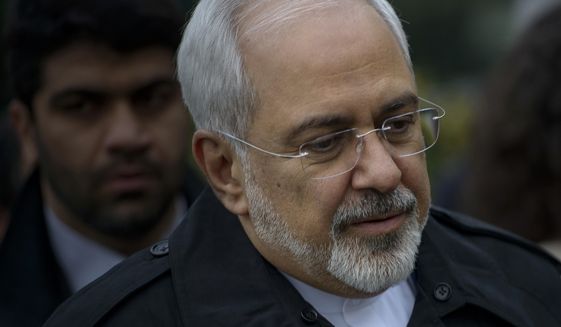
2e738e88a8f2710e720f6a7067008cce_c0-196-4500-2818_s561x327Iranian Foreign Minister Javad Zarif, walks through a courtyard at the Beau Rivage Palace Hotel during an extended round of talks, Wednesday, April 1, 2015 in Lausanne, Switzerland. Negotiations over Iran’s nuclear program appeared headed for double overtime on Wednesday.

LAUSANNE, Switzerland (AP) — Iran and and six world powers have agreed on the outlines of an understanding that would open the path to a final phase of nuclear negotiations but are in a dispute over how much to make public, officials told The Associated Press Thursday.

The officials spoke outside week-long talks that have busted through a March 31 deadline in an effort to formulate a general statement of what has been accomplished and documents setting down what the sides need to do by the end of June deadline for a deal.

Swiss officials facilitating the negotiations set a news conference for later in the day that was expected to announce the results of the talks

In the search for a comprehensive deal, the U.S. and five other countries hope to curb Iran’s nuclear technologies that it could use to make weapons. Tehran denies such ambitions but is negotiating because it wants a lifting of sanctions imposed over its nuclear program.


The Shadow of Munich Haunts the Iran Negotiations

April 2, 2015

The Shadow of Munich Haunts the Iran Negotiations, National Review Online, Victor Davis Hanson, April 2, 2015

(Hitler did tell the truth occasionally, in Mein Kampf for example. It was generally ignored until too late. “Death to America and Israel” are spouted by the Iranian Supreme Leader at every opportunity. Obama, et al, ignore it. Will Israel be Obama’s Czechoslovakia? And then what?– DM)

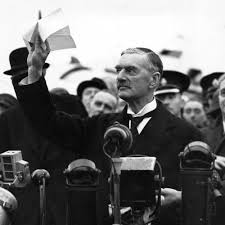
Neville Chamberlain

Our dishonor in Lausanne, as with Munich, may avoid a confrontation in the present, but our shame will guarantee a war in the near future.

*********************

Once again our leaders are needlessly appeasing a hostile state that shows them nothing but contempt.

The Western capitulation to Adolf Hitler in the 1938 Munich Agreement is cited as classic appeasement that destroyed Czechoslovakia, backfired on France and Britain, and led to World War II. All of that is true.

But there was much more that caused the Munich debacle than simple Western naiveté. The full tragedy of that ill-fated agreement should warn us on the eve of the Obama’s administration’s gullible agreement with Iran on nuclear proliferation. Fable one is the idea that most people saw right through the Munich folly. True, Europeans knew that Hitler had never once told the truth and was already murdering German citizens who were Jews, Communists, or homosexuals. But Europeans did not care all that much.

Instead, the Western world was ecstatic over the agreement. After the carnage of World War I, Europeans would do anything to avoid even a small confrontation — even if such appeasement all but ensured a far greater bloodbath than the one that began in 1914.

Another myth was that Hitler’s Wehrmacht was strong and the democracies were weak. In fact, the combined French and British militaries were far larger than Hitler’s. French Char tanks and British Spitfire fighters were as good as, or superior to, their German counterparts.

Czechoslovakia had formidable defenses and an impressive arms industry. Poland and perhaps even the Soviet Union were ready to join a coalition to stop Hitler from dissolving the Czech state.

It is also untrue that the Third Reich was united. Many of Hitler’s top generals did not want war. Yet each time Hitler successfully called the Allies’ bluff — in the Rhineland or with the annexation of Austria — the credibility of his doubters sank while his own reckless risk-taking became even more popular.

Munich was hardly a compassionate agreement. In callous fashion it immediately doomed millions of Czechs and put Poland on the target list of the Third Reich.

Munich was directly tied to the vanity of Neville Chamberlain. In the first few weeks after Munich, Chamberlain basked in adulation, posing as the humane savior of Western civilization. In contrast, loud skeptic Winston Churchill was dismissed by the media and public as an old warmonger.

Hitler failed to appreciate the magnanimity and concessions of the French and British. He later called his Munich diplomatic partners “worms.” Hitler said of the obsequious Chamberlain, “I’ll kick him downstairs and jump on his stomach in front of the photographers.”

The current negotiations with the Iranians in Lausanne, Switzerland, have all the hallmarks of the Munich negotiations.

Most Westerners accept that the Iranian government funds terrorist groups such as Hezbollah and Hamas. It has all but taken over Iraq, Lebanon, Syria, and Yemen. Yet the idea of stronger sanctions, blockades, or even force to stop Iranian efforts to get a bomb are considered scarier than Iran getting a bomb that it just possibly might not threaten to use.

The U.S. and its NATO partners are far stronger than Iran in every imaginable measure of military and economic strength. The Iranian economy is struggling, its government is corrupt, and its conventional military is obsolete. Iran’s only chance of gaining strength is to show both its own population and the world at large that stronger Western powers backed down in fear of its threats and recklessness.

Iran is not united. It is a mishmash nation in which over a third of the population is not Persian. Millions of protestors hit the streets in 2009. An Iranian journalist covering the talks defected in Switzerland — and said that U.S. officials at the talks are there mainly to speak on behalf of Iran.

By reaching an agreement with Iran, John Kerry and Barack Obama hope to salvage some sort of legacy — in the vain fashion of Chamberlain — out of a heretofore failed foreign policy.

There are more Munich parallels. The Iranian agreement will force rich Sunni nations to get their own bombs to ensure a nuclear Middle East standoff. A deal with Iran shows callous disagreed for our close ally Israel, which is serially threatened by Iran’s mullahs. The United States is distant from Iran. But our allies in the Middle East and Europe are within its missile range.

Supporters of the Obama administration deride skeptics such as Democratic senator Robert Menendez and Israeli prime minister Benjamin Netanyahu as if they were doubting old Churchills.

Finally, the Iranians, like Hitler, have only contempt for the administration that has treated them so fawningly. During the negotiations in Switzerland, the Iranians blew up a mock U.S. aircraft carrier. Their supreme leader, Ayatollah Khamenei, did his usual “death to America” shtick before adoring crowds. Our dishonor in Lausanne, as with Munich, may avoid a confrontation in the present, but our shame will guarantee a war in the near future.

Victory Against ISIS in Tikrit Will Embolden Iran

April 2, 2015

Victory Against ISIS in Tikrit Will Embolden Iran, Front Page Magazine, April 2, 2015

370x270xtikrit-450x328.png.pagespeed.ic.9xBCkeIFLH

The downside to playing on the same team as the Iranian regime, even in just this one military campaign against ISIS, is that we are helping to enable a far more dangerous power than ISIS to extend its hegemonic dominance throughout the entire region.

****************

Iraq’s defense minister Khalid al-Obeidi is claiming victory over ISIS forces in the city of Tikrit, which ISIS had captured last summer as its forces advanced across large swaths of territory in northern and western Iraq. “We have the pleasure, with all our pride, to announce the good news of a magnificent victory,” Obeidi said. The Pentagon and a spokesman for the U.S.-led coalition were a bit more cautious, noting some residual ISIS resistance. However, they too reported that significant progress had been made in wresting control of Saddam Hussein’s birthplace from ISIS’s grip.

The next strategic military objective in pushing ISIS back from the territories it controls in Iraq is to re-take Iraq’s second largest city, Mosul.

Iran supplied significant military support to the Shiite militia forces, who were a major part of the Iraqi counter-offensive on the ground. At the same time, U.S. air strikes seemed to have helped in supporting the Iraqi ground forces’ advance into Tikrit. The precise extent of any behind-the-scenes direct or indirect coordination between the U.S. and Iran is unknown at the present time. However, according to DebkaFile {March 26, 2015), “In the last two weeks of the Tikrit operation, liaison between the US and Iranian military in Iraq was routed through the office of the Iraqi Prime Minister in Baghdad.”

There is little question that without the Iranian-backed Shiite militia and substantial military support on the ground from Iran, ISIS would most likely still be in control of Tikrit today. U.S. airstrikes may have been necessary to soften ISIS’s resistance, but only ground troops with Iran’s support could dislodge them.

The downside to playing on the same team as the Iranian regime, even in just this one military campaign against ISIS, is that we are helping to enable a far more dangerous power than ISIS to extend its hegemonic dominance throughout the entire region.

As General David Petraeus, who certainly knows something about Iraq, told the Washington Post recently:

In fact, I would argue that the foremost threat to Iraq’s long-term stability and the broader regional equilibrium is not the Islamic State; rather, it is Shiite militias, many backed by — and some guided by — Iran… Longer term, Iranian-backed Shia militia could emerge as the preeminent power in the country, one that is outside the control of the government and instead answerable to Tehran.

Without downplaying ISIS’s horrific acts, its rapid-fire successes in Syria and Iraq (even with the setback in Tikrit), and its growing allegiances in Libya, Nigeria and areas further away from its home base including Afghanistan, the fact is that ISIS’s ambitions far exceed its current means for achieving them.  ISIS is proficient in using social media for recruitment, propaganda and intimidation purposes, but that can only take ISIS so far.

Iran, by contrast, has built up its military capabilities to the point that it can back up its aggressive threats in the region. And that’s even without the nuclear arms capability that President Obama seems to be willing to risk allowing Iran to achieve in order to secure his legacy with a deal.

As a result, America’s traditional Sunni allies in the region such as Saudi Arabia and other Persian Gulf states are doubting whether they can continue to count on the United States for support. And they are taking matters into their own hands, including a decision to form a multinational Arab military force to respond to Iranian aggression and other perceived threats.

As explained by Gamal Abdel Gawad Soltan, a political scientist at the American University in Cairo and quoted by the New York Times: “The U.S. is much less trusted as an ally, as an insurance policy towards the security threats facing the governments in the region, and so those governments decide to act on their own.”

These governments know their neighborhood well and see Iran as a much graver threat to regional peace and security than ISIS. Iran’s military and financial support of the Shiite Houthi rebels in taking control of major parts of Yemen was the last straw. Saudi Arabia on its own initiative decided to launch an air campaign against Houthi positions in Yemen and has not ruled out a ground attack along with the military forces of other Arab countries.

In response to the air and sea blockade of Yemen that Saudi Arabia is imposing on Yemen, Iran’s supreme leader Ayatollah Ali Khamenei decided to dispatch “two naval task forces to sail to the Red Sea,” according to DebkaFile (March 31, 2015). “The naval task forces are being sent to draw a sea shield around the Houthi forces to defend them against Saudi-Egyptian assaults. This maneuver was orchestrated by the Al Qods Brigades chief Gen. Qassem Soleimani,” DebkaFile reported.

Soleimani certainly gets around. Earlier this month he popped up in Iraq to lead the Shiite militias in their fight against ISIS. Now the man who fought on the same side as us against ISIS in Iraq is apparently coordinating Iran’s fight to hold onto the Houthis’ gains in Yemen where they forced the American and Saudi Arabian-backed president to flee.

Soleimani is “the puppet master controlling numerous Iranian surrogates in various countries,” said Jim Phillips, Middle East analyst for the Heritage Foundation. “His organization is drenched in American blood,” Phillips added. “It’s infused with an anti-American philosophy and a cooperation with him or his followers would not be on a sustainable basis. The U.S. would regret it.”

The Obama administration is now scrambling to catch up with Iran’s multi-pronged offensives, some of which are under Soleimani’s coordination. Thus, President Obama decided to support the Sunni Gulf coalition and Egypt against Iranian-backed action by the Shiite Houthi rebels to take control of Yemen.

However, the Obama administration’s reactive tactics in dealing with the crisis in Yemen are too little too late. Saudi Arabia is reportedly looking to Pakistan for help in acquiring its own nuclear arms to counter the Saudis’ well-founded suspicions that any deal negotiated by the Obama administration with Iran will not prevent Iran from becoming a nuclear armed power. And while Obama finally lifted the arms freeze he imposed against Egypt two years ago, clearing the way for the delivery of F-16 aircraft, Harpoon missiles and tanks, he also decided to end Egypt’s ability to finance purchases of American arms by drawing credits in advance based on future aid Egypt expects to receive starting in the 2018 fiscal year. Obama also wants to reduce Egypt’s flexibility in what it can purchase with the future military aid. Thus, the Egyptian government can be expected to continue on its course to find other sources for military aid and weapons including Russia, because of doubts that the U.S. will remain a reliable supplier.

The Obama administration has been willing to sacrifice the confidence of its Arab allies, not to mention the United States’ historically close alliance with Israel, in a vain effort to lure the Iranian regime into acting as a responsible party in the Middle East that can help stabilize this volatile region. Instead, Obama should listen to the expert on Iraq, General Petraeus, whose surge victory Obama undermined completely with his precipitous withdrawal of all U.S. troops from Iraq in 2011:

The current Iranian regime is not our ally in the Middle East. It is ultimately part of the problem, not the solution. The more the Iranians are seen to be dominating the region, the more it is going to inflame Sunni radicalism and fuel the rise of groups like the Islamic State…Iranian power in the Middle East is thus a double problem. It is foremost problematic because it is deeply hostile to us and our friends. But it is also dangerous because, the more it is felt, the more it sets off reactions that are also harmful to our interests — Sunni radicalism and, if we aren’t careful, the prospect of nuclear proliferation as well.

We can rejoice in the pushback of ISIS out of Tikrit. Perhaps it is a sign of more victories over ISIS to come. However, we should not delude ourselves into thinking that we have more in common with the Iranian regime in combatting ISIS in Iraq or Syria than the Iranian regime ultimately has in common with ISIS. They may be bitter enemies in the struggle over which set of fanatical jihadists should get to rule the global Islamic ummah or caliphate they both fantasize about. However, both fervently believe in the fundamental ideological goal of universal Islamic supremacy. And both are willing to sacrifice the lives of millions of people to reach that goal, no matter how long it takes them. The difference is that a nuclear-armed Iran would be much more capable of carrying out its jihadists’ apocalyptic vision than ISIS and in a much shorter period of time.

Khameni to Zarif: Don’t sign! Obama to Kerry: Make them sign! Gridlock

April 2, 2015

Khameni to Zarif: Don’t sign! Obama to Kerry: Make them sign! Gridlock, DEBKAfile, April 2, 2015

Kerry_hotel_nuclear_talks_C_1.4.15John Kerry takes a break from the Lausanne talks

Tehran is not averse to negotiating ad infinitum – so long as the talks go their way. 

So the real gridlock centered on finding a procedure that fitted the US delegation’s instructions to get some sort of a deal signed, and the Iranian group’s directive to sign nothing that could be seen as an accord. So who will give ground first?

***************

It is hard to make out exactly what the seven exhausted foreign ministers of the world powers and Iran were actually talking about in Lausanne this week – especially in the last two days, when the negotiations overran their March 31 deadline for a framework nuclear accord.

The highly-colored reports from the Swiss hotel up until Thursday, April 2, bespoke a mighty battle between the American negotiators led by Secretary of State John Kerry and Energy Secretary Ernest Moniz, and the Iranian group, headed by Foreign Minister Mohammed Javad Zarif, over four key points still at issue between them: the pace of sanctions relief, research and development projects, international inspections – including snap visits to any nuclear facilities they demanded, and, finally, the quantity of low-enriched uranium Iran may retain after the bulk of its stockpile is shipped overseas.

The drama was heightened by the sight of the American delegation marching into a tent set up in the hotel yard “to defeat eavesdropping” for a video conference with President Barack Obama in the White House. Kerry wanted to know whether to carry on the never-ending negotiations, which were looking more and more farcical as the hours ticked by without closure, or quit. This would be tantamount to the failure of the entire structure of nuclear diplomacy.

Obama directed the delegation to carry on talking with the Iranians and disregard the missed deadline as though nothing had changed.

The Secretary of State earlier appeared in an upper hotel window gazing out in the distance. Was he seeing a solution of the impasse visible to no one else?

The French Foreign Minister, Lauren Fabius, fed up with the game playing out between the Americans and the Iranians, left more than once for home. He returned Thursday saying: “We are a few meters from the finishing line, but it’s always the last meters that are the most difficult. We will try and cross them. It’s not done yet.”

Zarif told reporters: “Our friends need to decide whether they want to be with Iran based on respect or whether they want to continue based on pressure. They have tested the other one; it is high time to test this one.”

Those words carried two messages: One that the Iranians were serious when they reiterated in the past weeks that a framework accord for ending the current phase of negotiations was unacceptable, and insisted on the talks carrying straight through to a comprehensive deal by June 30.

The Iranian foreign minister’s second message was a negation of “pressure” – i.e., sanctions, in obedience to supreme leader Ayatollah Ali Khamenei’s directive to the delegation to reject the incremental easing of international sanctions and press Tehran’s demand for immediate relief.

That directive was laid down by the ayatollah on February 18, when he determined that “an agreement would be arrived at not in two stages but in one stage to be completed by the end of June 2015 and the agreement would include the removal of all sanctions on Iran.”

The writing was on the wall for all the parties to see. The current deadline crisis could have been avoided by understanding that there was no way the Iranian delegation would ever disobey the supreme leader’s dictates.

Tehran is not averse to negotiating ad infinitum – so long as the talks go their way.

So the real gridlock centered on finding a procedure that fitted the US delegation’s instructions to get some sort of a deal signed, and the Iranian group’s directive to sign nothing that could be seen as an accord. So who will give ground first?

Humor? Obama abducted by aliens

April 1, 2015

Obama abducted by aliens, Dan Miller’s Blog, April 1, 2015

(The views expressed in this article are not necessarily mine or those of Warsclerotic or its other editors. — DM)

Today, April fool’s day first, Obama was abducted by aliens from Venus who were concerned about His warlike stance toward the peaceful Islamic Republic of Iran.

Venus

Organizing for Action logo 1

Mars is the god of war, Venus is the goddess of peace. Aliens from Mars had been slightly disturbed that Obama’s efforts to give Iran nuclear weapons might fail, but had seen that her status as a nuclear power was inevitable and hence did nothing. Aliens from Venus were equally pleased with the prospects of Iranian nuclear weapons but were very concerned that Obama, by failing adequately to praise Iranian attempts to extend its hegemony over the entire Middle East and beyond, had retarded those praiseworthy efforts on behalf of true Islamic peace. Hence, they secretly abducted Him this morning as He deplaned from Air Force One following an off-the-books trip to His spiritual birth place in Manchuria.

Since Obama’s abduction and remedial training required only a few minutes He was not missed, even by His dear soul mate, Valerie Jarrett. Ms. Jarrett was, therefore, pleasantly surprised when Obama called a press conference in the Rose Garden to make an announcement, following a splendid rendition of Hail to the Chief:


Fellow world citizens, I have finally awakened from my slumbers to realize that Iran is the only country in the world capable of bringing true peace through submission in accord with the word of Allah, may His Holy name be forever praised by all. Israel claims to desire peace, but only through war. Saudi Arabia, Egypt, Jordan and other misbegotten specs of excrement on the face of our dear planet — now in peril of imminent death due to climate change to which their vile oil has contributed massively — have dared even to challenge Iran’s peaceful pursuits of peace throughout the Middle East in Iraq, Syria, Yemen and elsewhere.

Henceforth, it will be My supreme duty as your Commander in Chief to promote and otherwise to assist Iran in her glorious efforts for peace. I know in my heart that that’s the principal reason that you, My people, elected Me as your very own Supreme Leader. Accordingly, I pledge that My efforts will be unstintingly directed to the end that you desire.

May Allah bless Iran, Damn America, Israel and all other enemies of true peace, and give a blessed day to you all, inshallah.

Iran’s leaders, due to their extensive relations with the aliens who had abducted Obama, were not at all surprised but pretended that they were. Supreme Leader Khamenei personally accepted Supreme Leader Obama’s gracious words by saying that Obama had finally managed to tame the Great Satan and promised to do everything within his power to help, inshallah. He also commented favorably on Secretary Kerry’s use of “inshallah” in rebutting suggestions by defeatists that the P5+1 negotiations would collapse without giving Iran nuclear weapons.

Kerry34

Even those who had previously viewed Obama as weak and indecisive will now be forced to see Him as He truly is, a towering beacon of strength and light to a world beset with tribulation, turmoil and darkness.  His legacy as the Greatest Peace Maker, Ever, is assured, inshallah.

Smoking pot is lots better than making war!

Smoke ganja. War is for sissies!

Let’s hope it’s just April Fool’s Day nonsense.

Satrapy fishing in the Yemen

April 1, 2015

Satrapy fishing in the Yemen, Israel Hayom, Clifford D. May, April 1, 2015

Bab_el-Mandeb_strait_31.3.15

Three years ago, film-goers were treated to “Salmon Fishing in the Yemen,” which critic Kenneth Turan called a “pleasant fantasy” about the Middle East. Today, of course, Yemen is the hub of a bloody conflict, one which U.S. President Barack Obama persists in viewing with equal unreality.

Most obviously: Yemen is not, as the administration has touted, a “success” brought about by its “smart diplomacy.” Most importantly: Iran has a plan. Yemen is a vital component.

Prime Minister Benjamin Netanyahu sees that. So does Saudi King Salman (and no, I will not dwell on the pun). His foreign minister, Saud al-Faisal, last week called Iran “an aggressive state that is intervening and operating forces in the Arab world.” Iran’s nuclear weapons program, he added, represents “a threat to the Gulf and the entire world.”

A quick tour of the neighborhood: Much of Syria is already an Iranian satrapy. Hezbollah, Iran’s terrorist foreign legion, is the most powerful force in Lebanon. Iranian military advisors and Iranian-backed Shia militias increasingly call the shots in Iraq. And now Iran is aggressively supporting the Houthi rebels in Yemen.

Over the weekend, a Houthi spokesman directly threatened the Saudis. “When we decide to invade,” he said, “we won’t stop in the city of Mecca, but will continue on to Riyadh to topple the government institutions.” While that invasion may not be imminent, Iran’s strategy and objectives are now apparent.

Iran has begun what Netanyahu called a “pincer movement.” To the east of Saudi Arabia is the Persian Gulf, in and around which is the world’s largest repository of known oil and gas reserves — vital to the international economy. The Gulf’s only outlet to open waters is the 24-mile-wide Strait of Hormuz. More than a third of the petroleum traded by sea passes through this strait which Iran’s rulers have for years referred to as their “territorial waters.” On a number of occasions, U.S. ships in the strait have been harassed by Iranian vessels.

To the west of Saudi Arabia is the Red Sea. Iranian domination of Yemen would mean control of Bab-el-Mandeb, the “Gateway of Tears.” This 20-mile-wide strait separates Yemen and the Arabian Peninsula from Djibouti and Africa. Whoever controls Bab-el-Mandeb also controls marine traffic in and out of the Red Sea which has, at its northern end, Egypt’s Suez Canal.

Control of these two waterways would give Iran an economic choke hold on Europe and Asia. With Iraq, Syria, Lebanon and Yemen already under Iranian domination, other Arab nations would soon come under severe pressure to accept the suzerainty — and perhaps the hegemony — of what could legitimately be called a new Persian empire.

What about al-Qaida and the Islamic State group? The Arab nations might decide their interests are best served by supporting them (beyond the clandestine support that may have been provided in the past) so long as they continue to fight against, rather than collaborate with, Iranian imperialism. Even so, Iran’s rulers are doubtless confident that, over time, they will defeat their Sunni jihadi rivals — with Americans continuing to assist the effort.

It’s an ambitious plan. Nothing would do more to bolster it than for America and Europe to lift economic sanctions and end their opposition to Iran’s nuclear weapons program. That appears to be where the delayed and drawn-out talks are heading.

Consider: On November 24, 2013, when negotiations with Iran produced a Joint Plan of Action, Obama announced: “We have halted the progress of the Iranian nuclear program.” The interim agreement, Secretary of State John Kerry added, will ensure that Iran “cannot build a nuclear weapon.”

Last week, however, Kerry implicitly acknowledged how wrong that earlier appraisal has been. “So this is not a choice, as some think it is, between the Iran of long ago and the Iran of today,” he said. “It’s not a choice between this moment and getting them to give up their entire nuclear program, as some think. It’s not going to happen.”

Over the weekend, Amir Hossein Motaghi, an Iranian public relations aide, defected to the West. According to the Telegraph (U.K.), he revealed that American diplomats have been carrying Iran’s water. “The U.S. negotiating team are mainly there to speak on Iran’s behalf with other members of the 5+1 countries and convince them of a deal,” he said in an interview.

Summing up the current state of affairs, Lt. Gen. Michael Flynn, former chief of the Defense Intelligence Agency — a position from which he was forced to resign in 2014 because his analyses contradicted the Obama administration’s rosy narratives — told Fox’s Chris Wallace that “Iran is clearly on the march,” in response to which the White House has adopted a policy of “willful ignorance,” and that the only way to limit the damage now is to “stop all engines on this nuclear deal.”

It is unlikely that Obama and his envoys will give up their pleasant fantasies about the Islamic Republic of Iran. On the contrary, “smart diplomacy” may soon include awarding both economic and nuclear weapons to jihadi revolutionaries vowing to annihilate America’s allies and, in time, bring “Death to America!” as well. So if Iran’s supreme leader does become a 21st century emperor, he’ll have the United States to thank — and may do so in creative ways.

Those members of Congress who see this situation clearly need to speak out loudly and push back powerfully. That’s harder for Democrats than for Republicans — I get that. But if they can’t do their jobs now, they might just as well go fishing.

Critics Say Obama Gave Up Leverage Early On In Nuke Negotiations W/Iran – America’s Newsroom

March 31, 2015

Critics Say Obama Gave Up Leverage Early On In Nuke Negotiations W/Iran – America’s Newsroom via You Tube, March 31, 2015

(It’s like awaiting with trepidation the birth of a horribly mutated and probably stillborn baby, as the attending physicians proclaim their skill, patience and good intentions. — DM)


Analysis: Iranian Reactions to Operation Decisive Storm

March 31, 2015

Analysis: Iranian Reactions to Operation Decisive Storm, Long War Journal, March 30, 2015

(As P5+1 rolls along, Iranian Middle East hegemony expands. — DM)

A win for the coalition conducting Operation Decisive Storm would at most mean that Iran’s ability to co-opt local forces in the Arabian Peninsula has been challenged. But given Iran’s clear linkage of the crisis in Yemen to other theaters of conflict in the Middle East, it and its allies will retain incentives for responding asymmetrically and elsewhere, and that is something in which the Islamic Republic excels.
******************

Yemen’s Houthi rebels, who for roughly six-months have been ascendant and on the offensive, were met with airstrikes from a coalition of 10 countries on Wednesday evening. Designed to “defend and support the legitimate government of Yemen,” the airstrikes prominently feature Gulf Cooperation Council (GCC)planes, with 100 of them reportedly from the Royal Saudi Air Force (RSAF).

Despite being a local force indigenous to Yemen and of the Fiver-Zaydi branch of Shiite Islam (Iran is of the Twelver variety), the Houthis have reaped significant dividends from their new and evolving relationship with the Islamic Republic of Iran. In fact, a December 2014Reuters report confirmed “Iranian military and financial support to the Houthis before and after their takeover of Sanaa on Sept. 21” based on divergent sourcing. It is exactly this kind of involvement that Operation Decisive Storm aims to break.

In September 2014, Iran’s Armed Forces Chief of Staff, Major General Seyyed Hassan Firoozabadi, describedIran’s relationship with Ansar-Allah, the Arabic name for the Houthi movement, as follows: “we only pray for them.” This stance was later amended by Ali-Akbar Velayati, a former Foreign Minister of Iran and currently an International Affairs Advisor to Supreme Leader Ayatollah Seyyed Ali Khamenei. In an October 2014 statement, Velayati touted: “We are hopeful that Ansar-Allah has the same role in Yemen as Hezbollah has in eradicating the terrorists in Lebanon.”

A recent (March 20th) arms-shipment of roughly 185 tons “of weapons and military equipment” at the al-Saleef port in Yemen by Iran may be one way of transforming Ansar-Allah into a new Hezbollah. Additionally, as has been well-documented, Iran doesmore than “only pray” for Hezbollah. That may best explain why Hezbollah, long recognized as an Iranian proxy in Lebanon, has come out so strongly against Operation Decisive Storm. In their reported statement, Hezbollah called the operation a “Saudi-American attack on the people and army of Yemen and the infrastructure of this country.”

That then brings us to Iranian responses to Operation Decisive Storm. Firstly, before addressing the position of Iran’s political and military elite, an assessment of the operation in Iranian media outlets by journalists and analysts is in order. This allows readers to diagnose the level of A) narrative vs. fact-reporting which is present and B) how much the operation is seen through the prism of the Saudi-Iran rivalry. In that regard, as would have been expected, Fars News Agency has taken the lead, promoting a regime-centric narrative castigating the Saudis. On March 26th, Fars ran a primer with links to varying elements of the war. The piece ran the following as part of a title: “The Cries of Thousands of Yemenis in Sana’a: Yemen will be the Graveyard of Saudi Agents.” Another title in Fars, this time on March 27th, paraphrased the journalist Ali-Reza Karimi, proclaiming: “Yemen, a Bite Too Big to Swallow for the Decrepit Kings of Saudi.”

Close-behind however, was Iran’s Khabar-Online, which is allegedly close to Ali Larijani, the current conservative Speaker of Iran’s Parliament [Majlis]. An article penned by a writer named Mohammed-Reza Noroozipour on March 26th, elucidated a broad retaliatory strategy for the Houthi’s. It noted that: “The Houthi’s have currently obtained the necessary excuse for engaging in any military or retaliatory operation whether it be deep in the land of Saudi Arabia, or be it in Bab al-Mandeb, the Red Sea, or even the Strait of Hormuz.” It further noted, and perhaps eerily recommended, that “The first and most valuable target for them will be the oil-wells, oil-tankers, and mother industries.”

Elsewhere, Fars ran a piece quoting a member of the Yemeni Scholars Organizing Committee, Sheikh Ali-Khaled al-Shammari, who touted: “The Yemeni Scholars Organizing Committee invited the people of this country to carry arms and [engage in] jihad after the invasion of the Saudi regime to Yemen and the targeting of innocent Yemeni citizens.” In another piece, Hassan Zaid, the Secretary-General of the al-Haq Party, reportedly“affiliated with the Houthis,” was quoted describing the operation as having taken “place with the decision of Benyamin Netanyahu, the Prime Minister of Israel.”

Members of Iran’s analytical community, such as Sa’ad-Allah Zaraei, an Iranian Middle East Analyst, drew attention to the lack of legal cover the operation was believed to have. Zaraei stated that: “The action[s] of Saudi Arabia against the people of Yemen is an atrocious action and lacks any legal basis.” He then assessed Saudi intentions as follows: “By militarily attacking Sana’a and Sa’ada via air, the Saudis seek to suspend the tide of progress of the revolutionaries and Ansar-Allah until they can create special security conditions in Yemen based on the perspectives of [Saudi] Arabia and America.”

Zaraei further proclaimed that “pouring bullets on the heads of the Yemeni people will not have any interest for the people of [Saudi] Arabia.” Zarei additionally stressed a solution where Saudi Arabia would disengage from the conflict and allow the continuation of the political process in Yemen.

Yadollah Javani, another political analyst who focused more on Saudi Arabia, proclaimed: “This regime has fallen for the tricks of America and the Zionists, since with this action, they desire to make-up for their consecutive defeats in these years, but they will face [yet] another defeat.” Javani’s linkage of U.S. allies making up for any/all perceived shortcomings by the U.S. in the region is instructive. It further highlights long-held beliefs about regime-centric analysis in Iran – namely the inability to ascribe agency to local actors regardless of their political orientation. Javani continued to display this trend of over-linkage: “The military attack of [Saudi] Arabia against Yemen is related to the issues of West Asia, including the issue of Syria, the occupied territories, and Iraq.” Lastly, Javani linked Yemen’s resistance against a foreign aggressor to Iranian historical experiences.

Formally, the Islamic Republic’s Deputy Foreign Minister for Arab and African Affairs, Hossein Amir-Abdollahian, has discussed the issue of Yemen during his recent trip to the Russian Federation. But commentary by Abdollahian does not book-end the perspectives of Iran’s political elite on the current crisis. Mohammad-Javad Zarif, Iran’s Foreign Minister recently proclaimed that “The events in Yemen are a bitter event taking place in the region today.” Zarif called for an immediate end to the conflict, in addition to reminding the international community that Iran would spare no effort to “inhibit the crisis in Yemen.”

Members of the hawkish National Security and Foreign Policy Committee of Iran’s Parliament also weighed in on the crisis, often analyzing the conflict through the broader prism of the Saudi-Iranian Cold-War. The Committee’s Chairman, Ala al-Din Boroujerdi, hoped for a swift political resolution to Yemen’s crisis, but did not fall short of blaming Saudi Arabia: “[Saudi] Arabia’s igniting the flames of a new conflict in the region is an indicator of its inattentiveness and irresponsibility to the problems of the Islamic nation [Ummah], and the smoke of this fire will go into the very eyes of [Saudi] Arabia since war is never limited to one area,” he said. Picking up on the “smoke” analogy was Mohammad-Saleh Jokar, another member of the same Parliamentary Committee. He echoed that “the smoke of this operation will go into the eyes of the Saudis and invaders and it will create chaos in the region.”

Another member of the Parliamentary Committee, Esmaeil Kowsari, chose to broaden his criticism to the United Nations, noting “it is better if this organization is rounded-up and disbanded,” since, according to his perception, “This organization has allowed [Saudi] Arabia, with America’s guiding to attack the nation of Yemen, which has a domestic issue and within its country has developed a revolution.” Kowsari additionally re-iterated the line that the attack was not in the interests of the Saudi people, and they should “protest in relation to this issue.”

Iran’s former nominee to the United Nations (now an aide to President Hassan Rouhani) Hamid Aboutalebi, also joined the fray, attempting to refocus attention on Riyadh by pointing out seeming hypocrisy by the Kingdom: “Can [Saudi] Arabia logically explain its contradictory actions in supporting the developments in Egypt after Morsi from one side, and supporting the President of Yemen from the other?”

Thus far, in addition to Iran’s Foreign Ministry censuring the operation, Iranian Foreign Minister Mohammad-Javad Zarif has pushed back against foreign leaders like President Erdogan of Turkey, who accused Iran earlier of seeking regional supremacy. Should Iran continue to support the Houthis, even as they appear outgunned, that may translate into the loss of states like Turkey as a pseudo-ally of Iran, which is already opposed to Iran in Syria (over President Bashar al-Asad) and has formerly engaged in a sanctions-busting scheme benefiting Iran. But beyond that, despite the media-spin by Persian sources, should those partaking in Operation Decisive Storm successfully push-back the Houthis, it should not be taken as a clear loss for Iran. Indeed, while the Islamic Republic has armed and backed the Houthis, its focus remains clearly on the Levant given its steep investments in that region spanning over decades. And with nuclear negotiations reaching an apex, Iran will be inclined to pay most attention (at present) to the theaters where members of its Islamic Revolutionary Guard Corps Qods-Force (IRGC-QF) are dying.

A win for the coalition conducting Operation Decisive Storm would at most mean that Iran’s ability to co-opt local forces in the Arabian Peninsula has been challenged. But given Iran’s clear linkage of the crisis in Yemen to other theaters of conflict in the Middle East, it and its allies will retain incentives for responding asymmetrically and elsewhere, and that is something in which the Islamic Republic excels.


