Take Them At Their Word: Iran Might Destroy Us | Bill Whittle via You Tube, April 9, 2015
(The views expressed in this article are either mine or those of my guest author. They do not necessarily reflect those of Warsclerotic or its other editors. — DM)

The Most Revereddd Mohamed Allah-scimitar
This is a post by my (imaginary) guest author, the Most Reverend Mohamed Allah-scimitar, President Obama’s chief foreign policy adviser on Islamic relations with Christians and Jews. But first, some related observations:
Iran continues to reject as lies Obama’s statements about the April 2nd P5+1 nuke “deal,” and states that it “could build bomb today” but won’t because of Ayatollah Khamenei’s (non-existent) fatwa. Understandably, Israel is becoming increasingly concerned about her future existence. Obama’s claims that He has her back and that she therefore need not worry about anyone (else) who tries to “mess with Israel.” His assurances have provided scant comfort.

Here’s are the comforting(?) words of the Most Reverend Mohamed Allah-scimitar.
***********************
Lord Obama has Israel’s back almost to the same extent that He has the Obama Nation’s back and will protect her if necessary. For Israel to maintain, and even improve, her weapons minimizing destruction (WMDs) is an unacceptable insult to Him and to all for which He stands.


During Israel’s “Protective Edge” war against peaceful Palestinians in Gaza, Israel shamelessly shifted the odds disproportionately in her own favor by using the Iron Dome to thwart efforts to destroy her major cities. She provided not even one Iron Dome to the Palestinians! Since that time, she has improved the Iron Dome and developed other WMDs less dependent upon lengthy trajectory tracking of missiles and perhaps even mortar rounds. Racist to the core, she has no regard for social justice, equality and the sad plight she has imposed on the Palestinians. Indeed, they are forced to rely on funds (“tens of millions of dollars”) from Iran to help rebuild Tunnels for Peace (TFP) and resupply their stocks of Missiles for Peace (MFP).
Now that Israel claims that peaceful Iranian nuclear weapons are an existential threat, she is doubtless looking for — and probably finding — ways to escape their consequences as well. Doing so is risible because Lord Obama has explained patiently — even as He would to a backward child — that it is unnecessary. He has her back, as He always had and always will.
Nobody except Obama had dare mess with Israel! Not even Netanyahu! Hence, there is no need for Iran to recognize Israel’s speciously claimed right to continue to exist, which would require fundamental changes in Iran. For Israel to insist on it is a fundamental misjudgment.
Lord Obama is able and willing to act, if necessary, to demonstrate the firmness of His resolve. Indeed, it has already been rumored that He may dispatch His own beloved mother in law from her happy home in the White House to live with Prime Minister Netanyahu in Occupied Palestine. If so, she will be accompanied by a suitable contingent of unarmed Organizing for Action volunteers. Recognizing, however, that more may be required, Lord Obama has been negotiating with Iran to provide the unjustly impoverished Palestinians not only free electrical power but also medically useful radioactive isotopes as well as others for other peaceful purposes. Despite the petty squabbles between the Palestinian Authority and Hamas, Iran will treat them equally.
Israel should and will cease to exist but, with Lord Obama in the picture, Iran should not be a concern.
**************************
There is no P5+1 “deal” and it seems unlikely that there ever will be, no matter how many contortions Obama and Kerry attempt. A deal like the one described in Obama’s talking points would be bad enough. However, Iran has rejected His talking points, has stated that it could build nukes now if it so desired and that the only impediment is a (non-existent) fatwa issued by the Supreme Leader. The Iranian foreign minister has been quoted as saying that
Iran will begin using its latest generation IR-8 centrifuges as soon as its nuclear deal with the world powers goes into effect, Iran’s foreign minister and nuclear chief told members of parliament on Tuesday, according to Iran’s semi-official FARS news agency. [Emphasis added.]
If accurate, the report makes a mockery of the world powers’ much-hailed framework agreement with Iran, since such a move clearly breaches the US-published terms of the deal, and would dramatically accelerate Iran’s potential progress to the bomb.
Iran’s military sites are, of course, off limits to inspections according to Iran’s Defense Minister. Meanwhile, the Supreme Leader continues to lead “death to America” chants and Iranian television continues to entertain its viewers with simulations of nuclear attacks on Israel.
[T]he Islamic Republic has announced a new documentary film which will celebrate the life of Qods Force Commander Qassem Soleimani. It’s bad enough lionizing a master terrorist responsible for the deaths of hundreds of Americans in Iraq and Afghanistan. But the description of the film is even more telling: The film Commander will depict Iran’s and Soleimani’s strategic approach to destroy not only the Islamic State but also “the Zionist regime.” Importantly, the article describing the film was published after agreement on a nuclear framework between the P5+1 and Iran. [Emphasis added.]
‘Iran to publish facts document to counter American lies’, Israel Hayom, April 8, 2015
Iran could build bomb today but isn’t doing so because of ayatollah’s religious decree, not because of sanctions, Iranian FM reportedly tells parliament • “We made significant achievements in exchange for unimportant concessions,” says Iranian lawmaker.
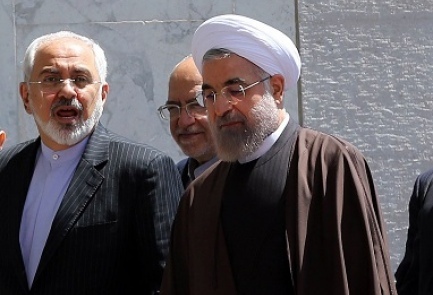 Iran’s Foreign Minister Mohammad Javad Zarif (left) with Iranian President Hassan Rouhani | Photo credit: AFP
Iran could build a nuclear bomb today if it wanted and is only refraining from doing so because of a fatwa (religious decree) issued by Ayatollah Ali Khamenei, not because of international sanctions, Iran’s Foreign Minister Mohammad Javad Zarif reportedly said on Tuesday during a closed hearing at the Iranian parliament, Majlis.
According to one of the participants, Zarif said the country’s foreign ministry would soon publish a “document of facts” about the nuclear deal with world powers.
“Zarif told us that his office hadn’t intended on releasing such a document, but reversed its decision because of the Americans’ lies,” said Iranian lawmaker Hussain Naqvi al-Hussaini.
Another Iranian parliamentarian, Gholamali Jafarzadeh Imenabadi, said Zarif told the parliament that Iran is not going to permit online cameras for inspection purposes at nuclear facilities. The reason for the decision, allegedly conveyed by Zarif, was because cameras have supposedly been used in the past to help assassinate Iranian nuclear scientists.
Also in attendance was Ali Akbar Salehi, the head of Iran’s Atomic Energy Organization, who presented the Majlis with the technical aspects of the framework deal. Salehi, who participated in the negotiations in Lausanne, reportedly told his audience that world powers consented to enter negotiations with Iran because they had no other choice.
“We made significant achievements in exchange for unimportant concessions,” said Iranian lawmaker Nozar Shafi.
Meanwhile, Zarif and Iranian President Hassan Rouhani have reportedly garnered the support of Revolutionary Guard commander Mohammad Ali Jafari, who demanded immediate sanctions relief in exchange for a deal.
Iran’s supreme leader, Khamenei, did not voice his opposition to the deal, widely interpreted as silent consent. With that, some 200 Iranian hardliners protested in Tehran against the framework deal.
Iran news report: Tehran will start using fastest centrifuges on day deal takes effect, Times of Israel, April 8, 2015
FARS agency quotes Zarif, Salehi telling MPs they’ll inject gas into IR-8 centrifuges, a breach of US-published framework terms that would make a mockery of deal.
Iran will begin using its latest generation IR-8 centrifuges as soon as its nuclear deal with the world powers goes into effect, Iran’s foreign minister and nuclear chief told members of parliament on Tuesday, according to Iran’s semi-official FARS news agency.
If accurate, the report makes a mockery of the world powers’ much-hailed framework agreement with Iran, since such a move clearly breaches the US-published terms of the deal, and would dramatically accelerate Iran’s potential progress to the bomb.
Iran has said that its IR-8 centrifuges enrich uranium 20 times faster than the IR-1 centrifuges it currently uses.
According to the FARS report, “Iran’s foreign minister and nuclear chief both told a closed-door session of the parliament on Tuesday that the country would inject UF6 gas into the latest generation of its centrifuge machines as soon as a final nuclear deal goes into effect by Tehran and the six world powers.”
It said that Foreign Minister Mohammad Javad Zarif and Atomic Energy Organization of Iran (AEOI) head Ali Akbar Salehi made the promise when they briefed legislators on the framework agreement, and claimed the move was permitted under the terms of the deal.
“The AEOI chief and the foreign minister presented hopeful remarks about nuclear technology R&D which, they said, have been agreed upon during the talks (with the six world powers), and informed that gas will be injected into IR8 (centrifuge machines) with the start of the (implementation of the) agreement,” FARS quoted Javad Karimi Qoddousi, a member of the parliament’s National Security and Foreign Policy Commission, as saying.
Qoddousi said the Iranian Foreign Ministry plans to release a fact sheet presenting Iran’s version of the framework understandings in the next few days. “Those issues that have stirred serious concern among the Iranians will be revised and released in this fact sheet,” he said.
Earlier Tuesday, Israel Radio reported that Zarif told the lawmakers that Iran was capable of producing an atomic bomb at any given moment, but will refrain from doing so due to religious Islamic injunctions against such a move.
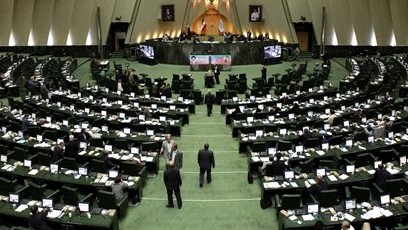 A general view of Iran’s parliament in Tehran, Aug. 28, 2013 (photo credit: AP/Ebrahim Noroozi)
Major differences have emerged between the P5+1 powers and Iran over what was agreed in the framework deal.
“Parameters” detailed by the US leave no doubt whatsoever, however, that the use of anything other than the most basic, first generation IR-1 centrifuges is barred for 10 years, and that even R&D on advanced centrifuges will be severely constrained.
“Iran will only enrich uranium at the Natanz facility, with only 5,060 IR-1 first-generation centrifuges for ten years,” the US parameters state. “Iran has agreed to only enrich uranium using its first generation (IR-1 models) centrifuges at Natanz for ten years, removing its more advanced centrifuges… Iran will not use its IR-2, IR-4, IR-5, IR-6, or IR-8 models to produce enriched uranium for at least ten years,” the US document adds. “For ten years, enrichment and enrichment research and development will be limited to ensure a breakout timeline of at least 1 year. Beyond 10 years, Iran will abide by its enrichment and enrichment R&D plan submitted to the IAEA, and pursuant to the JCPOA, under the Additional Protocol resulting in certain limitations on enrichment capacity.”
A French fact-sheet seen by The Times of Israel takes a similar position. It provides for Iran to gradually introduce the use of IR-2 and IR-4 centrifuges to enrich uranium after 12 years. It does not provide for the use of IR-8 centrifuges. The French fact sheet does specify that Iran will be allowed to continue R&D work on the advanced IR-4, IR-5, IR-6 and IR-8 centrifuges.
A document issued by the Iranian Foreign Ministry on Friday also does not assert an Iranian right to use IR-8 centrifuges. Its only reference to the IR-8 is as follows: “According to the reached solutions, Iran will continue its research and development on advanced machines and will continue the initiation and completion phases of the research and development process of IR-4, IR-5, IR-6, and IR-8 centrifuges during the 10-year period of the Comprehensive Plan for Joint Action.”
‘Obama: In future, Iran could build nuclear bomb almost immediately’
Yoni Hersch, Eli Leon, Israel Hayom Staff and News Agencies

(At what point do they breakout? Is having a fully functional nuclear device minus the ‘fuse’ considered on the verge of a breakout? If so, then merely inserting the ‘fuse’ only takes a few minutes. Think about it. – LS)
U.S. President Barack Obama: In years 13, 14 and 15 of nuclear deal with Iran, the breakout times would be shrunk almost to zero • House Speaker John Boehner: It is clear that the deal with Iran is a direct threat to global peace and security.
U.S. President Barack Obama is persisting with his effort to rally support for the framework nuclear agreement reached between six world powers and Iran last week, but on Tuesday he admitted that Iran could have the capability to build a nuclear bomb almost immediately after the first 13 years of the deal, if it is finalized.
Under the framework for a final deal, Iran would be kept at least a year away from a nuclear bomb for the first decade, Obama said, as he pressed ahead in his campaign to sell the deal to skeptics. Pushing back on criticism that the deal allows Iran to keep enriching uranium, Obama told NPR that enrichment is not the prime concern, because Iran will be capped for a decade at 300 kilograms — not enough to convert to a stockpile of weapons-grade material.
“What is a more relevant fear would be that in year 13, 14, 15, they have advanced centrifuges that enrich uranium fairly rapidly, and at that point, the breakout times would have shrunk almost down to zero,” Obama said.
Yet Obama insisted that the world would have better insight into Iran’s capabilities because of extensive inspections in the earlier years of the deal.
“The option of a future president to take action if in fact they try to obtain a nuclear weapon is undiminished,” Obama said.
In response to Obama, International Relations, Intelligence and Strategic Affairs Minister Yuval Steinitz said, “If [Obama] says we have insurance here for 10 years, I say we don’t have insurance here for even one or two years, unless the loopholes are closed, and only then could it become a more reasonable agreement.”
Republican House Speaker John Boehner also criticized Obama’s statements, saying, “President Obama himself today confirmed exactly what critics of the deal have argued: his ‘deal’ would pave the way for a nuclear-armed Iran in the near future. The Iranian regime has consistently taken a long view on its regional — indeed global — ambitions of exporting its revolution. After multiple evasions of international inspections to date, no one should believe that the proposed inspections and verification are bullet-proof. It is clear that this ‘deal’ is a direct threat to peace and security of the region and the world.”
In the NPR interview, Obama was asked about Prime Minister Benjamin Netanyahu’s demand that any final nuclear deal with Iran include an explicit Iranian commitment to Israel’s right to exist.
“Well, let me say this — it’s not that the idea of Iran recognizing Israel is unreasonable,” Obama replied. “It’s completely reasonable and that’s U.S. policy. And I’ve been very forceful in saying that our differences with Iran don’t change if we make sure that they don’t have a nuclear weapon — they’re still going to be financing Hezbollah, they’re still supporting Assad dropping barrel bombs on children, they are still sending arms to the Houthis in Yemen that have helped destabilize the country. There are obvious differences in how we are approaching fighting ISIL in Iraq, despite the fact that there’s a common enemy there.
“So there’s still going to be a whole host of differences between us and Iran, and one of the most profound ones is the vile, anti-Semitic statements that have often come out of the highest levels of the Iranian regime. But the notion that we would condition Iran not getting nuclear weapons, in a verifiable deal, on Iran recognizing Israel is really akin to saying that we won’t sign a deal unless the nature of the Iranian regime completely transforms. And that is, I think, a fundamental misjudgment.
“I want to return to this point. We want Iran not to have nuclear weapons precisely because we can’t bank on the nature of the regime changing. That’s exactly why we don’t want to have nuclear weapons. If suddenly Iran transformed itself into Germany or Sweden or France, there would be a different set of conversations about their nuclear infrastructure.
“So, you know, the key here is not to somehow expect that Iran changes — although it is something that may end up being an important by-product of this deal — but rather it is to make sure that we have a verifiable deal that takes off the table what would be a game-changer for them if in fact they possess nuclear weapons.”
Directly addressing the citizens of Israel, Obama said, “What I would say to the Israeli people is, you are right to be suspicious of Iran; there’s no reason why you should let your guard down with respect to Iran. We have to make sure that Israel has the capabilities to protect itself not only from Iran, but also proxies like Hezbollah. But ultimately, Iran is deterrable, and it is deterrable not just because of Israel’s superior military and intelligence capabilities, but also because you got a really strong ally in the United States of America.”
Meanwhile, Central Intelligence Agency Director John Brennan said Tuesday that opponents of the framework nuclear agreement with Iran are being “disingenuous” when they say the deal could still allow Iran to build nuclear weapons.
Speaking to an audience of students and faculty at Harvard University, Brennan said the framework deal was likely the most realistic one that could be reached. “The individuals who say that this deal provides a pathway for Iran to a bomb are being wholly disingenuous, in my view, if they know the facts and understand what is required for a program,” Brennan said. “I certainly am pleasantly surprised that the Iranians have agreed to so much here.”
Brennan, who has headed the CIA since 2013, said he understood that some critics of the deal were wary that even with a final nuclear deal, Iran would have still the ability “to cause more trouble” in the Middle East.
“That’s a legitimate issue, concern and argument, but that’s why I say what they shouldn’t be doing is trying to pull apart this deal … that’s as solid as you’re going to get,” Brennan said. “You’re not going to get the Iranians to just totally dismantle everything and say, ‘OK, we’re not going to pursue any type of nuclear capability from a peaceful perspective.”
Brennan claimed it was a hopeful sign that the Iranian regime had been willing to engage in eight days of talks in Switzerland, noting that Iranian President Hassan Rouhani had “much greater reasonableness.”
(Now that is complete and utter BS – LS)
Can and should Israel destroy Iran’s nuclear facilities? Dan Miller’s Blog, April 5, 2015
(The views expressed in this article are mine and do not necessarily reflect those of Warsclerotic or any of its other editors. — DM)
It has been suggested that Israel should seriously consider destroying Iranian nuclear facilities, but Israeli officials obviously haven’t said, and won’t say, if, how or when she might.

Speaking to Arutz Sheva Friday, Professor Efraim Inbar, who heads the Begin-Sadat Center for Strategic Studies, said the deal had realized Israel’s worst fears by leaving Iran’s nuclear program essentially intact.
The Islamic Republic’s nuclear program has been granted “legitimacy” by the agreement, which still allowed it to continue enriching uranium and to maintain a reactor capable of producing enriched plutonium, he said. “And that’s what worries Israel, that they (Iran) will be able within a short time frame to reach a nuclear bomb.”
“I hold the view that the only way to stop Iran in its journey to a nuclear bomb is through military means,” Inbar maintained, suggesting that “Israel needs to seriously consider striking a number of important nuclear facilities” to head off the threat.
On March 28, former U.S. Ambassador Bolton said that it should be done.
The P5+1 nuclear “deal,” proudly announced by President Obama on April 2nd, is a sham. There is no “deal,” and public announcements by Iran and Obama cast it in very different lights. According to Iran, all sanctions will be lifted immediately when an agreement is reached on or before June 30th. According to Obama, sanctions relief will be gradual and based on Iran’s compliance with invasive inspections and other conditions. Even National Public Radio (NPR) has pointed out differences. NPR observed that, according to Iran,
all sanctions relief – U.N., EU and U.S. – would be immediate. It was unequivocal. It stated that Iran under the deal was free to pursue industrial scale enrichment to fuel its own reactors – unequivocal. It stated that Iran was unhindered in its ability to conduct centrifuge R&D.
Iran has also emphasized that its intention to destroy Israel is non-negotiable, and the Obama Administration has rejected any efforts to make Iran recognize Israel’s right to exist, on the ground that
“This is an agreement that is only about the nuclear issue,” State Department spokeswoman Marie Harf told reporters on Friday night, according to Fox News. “This is an agreement that doesn’t deal with any other issues, nor should it.” [Emphasis added.]
Israeli Prime Minister Netanyahu has said that Israel’s right to exist is non-negotiable.
Iran is very unlikely to retreat from its perception of the “deal,” Obama is very likely to retreat in Iran’s favor, and Israel is very unlikely to retreat from its perceptions about Iran, the “deal” or Israel’s right to exist.
What should Israel do?
In Martin Archer’s novel Islamic War, which I reviewed here, Israel dispatched elderly, large and substantially refurbished remove controlled aircraft, full of high explosives, from Somalia to half dozen nuclear facilities operated by hostile nations. They flew circuitous routes at varying altitudes to avoid detection until it was too late to stop them. Over a period of weeks, they crashed into and destroyed their targets, amid speculation about who had done it and why. Israel was not suspected. Would that have been possible then? Now? I don’t know.
It has been reported that Saudi Arabia has given Israel clearance to use her airspace for an attack on Iran’s nuclear facilities.
Fox News reports that US Defense sources claim the Saudis are conducting tests on their air defense systems after giving Israel permission to to enter a narrow corridor to shorten the distance to attack Iran.
The testing would make sure that Saudi jets don’t get scrambled when Israel entered Saudi airspace. Once the IAF planes complete their mission and exit Saudi airspace, Saudi defenses would go back online again. [Emphasis added.]
Might Saudi Arabia, Egypt and perhaps other Gulf States go beyond not interfering with an Israeli attack to provide air support and other help? They seem to be as displeased with the “deal” as Israel is.
Assuming that Israel is not overly concerned about being identified as the attacker and is willing to act alone, she might:
Detonate one or more high-altitude atomic bombs to emit sufficient electromagnetic pulses (EMP) to fry all above-ground Iranian electronics. That would substantially disable Iranian above-ground command and control facilities as well as other communications, hence diminishing (but not eliminating) the possibility of counter-strikes by Iran and/or its proxies. Perhaps she has other, non-nuclear, means of generating EMPs; she hasn’t said.
Immediately thereafter, drop whatever suitable bombs she may have on all Iranian military and nuclear facilities. Does Israel have bunker-buster bombs? Probably not of U.S. manufacture, but that does not mean that she has not developed her own. It would be surprising if she had not.
Obama and other “leaders of the free world” would complain and the U.N. would emit fits of angry censures. However, that happens with great frequency in any event, and would be an insufficient reason for Israel to commit national suicide through inaction against Iran.
I am no “military expert” and would appreciate any comments on the suggestions I have made as well as any other suggestions anyone might care to offer.
Via Freedom is just another word, April 5, 2015
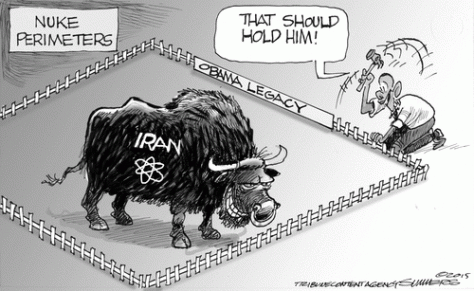
The Lausanne deal: Exercise in spin and counter-spin, DEBKAfile, April 4, 2015
 Iran’s counters US fact sheet on Lausanne deal
Hours after Washington published a “fact sheet” in Lausanne Thursday, April 2 – which enumerated “the parameters of the agreed framework” hammered out by the US world powers and Iran – Tehran countered with its own version the next day, after the lead Iranian negotiator Foreign Minister Mohammed Javad Zarif, dismissed the American accounting as “spin.”
The Iranian version departs substantially from President Barack Obama’s assurance of “a deal that meets our core objections,” and statement,: “There is no way Iran can get around it to build a bomb or produce plutonium at its Arak plan…verification mechanisms built into the agreed framework will ensure that if Iran cheats, the world will know it.”
Tehran’s version had two objects: 1) To refute Obama’s presentation of the outcome of the Lausanne talks, and 2) To show the Iranian people how successful its negotiating team had been in defending its national interest.
DEBKAfile reports that the battle of versions, fought just hours after both sides claimed victory in the diplomatic contest played out at Lausanne, makes it obvious that the gaps between the world powers and Iran are far wider than admitedt. They could not even find a common definition of what if anything was achieved in the talks: “a framework deal” in US terms; or “a package of solutions leading up to a future Comprehensive Plan of Joint Action” – in Iranian parlance.
The gaps on such key issues as enrichment, sanctions, research and development, means of verifying compliance (described by Obama as intrusive”) could no longer be papered over after Tehran issued its version. It was a short document and here are its main points:
Iran’s version of the Lausanne deal
The devil is in the equivocations
According to the US version, Iran’s preparatory work must include the de-tuning of Fordow and Arak, reducing the Natanz centrifuges down to 6,000, with 5,000 working, uranium stocks reduced from 10,000 kilos to 300 and the Additional Protocol activated.
Iran’s version:
A non-binding package
Arabs Blast “Obama’s Deal” With Iran, Gatestone Institute, Khaled Abu Toameh, April 4, 2015
“This is a dangerous agreement…[It ]provides Iran with what it needs most to pursue its wars and expansionism against the Arabs: funds.” —Salah al-Mukhtar, Ammon News”
“Iran has tried to intervene in Iraq, Lebanon and Syria and it is seeing that it’s not paying any price…There is also a feeling in Tehran that the U.S. is avoiding a military confrontation with the Iranians.”– Hassan al-Barari, Al-Sharq
The deal means that the international community has accepted Iran as a nuclear power.” — Hani ala-Jamal, al-Wafd
Many Arabs have expressed deep concern over the nuclear deal that was reached last week between Iran and the world powers, including the US.
Arab leaders and heads of state were polite enough not to voice public criticism of the agreement when President Barack Obama phoned them to inform them about it. But this has not stopped Arab politicians, political analysts and columnists reflecting government thinking in the Arab world from lashing out at what they describe as “Obama’s bad and dangerous deal with Iran.”
The Arabs, especially those living in the Gulf, see the framework agreement as a sign of US “weakness” and a green light to Iran for Iran to pursue its “expansionist” scheme in the Arab world.
“Some Arab countries are opposed to the nuclear deal because it poses a threat to their interests,” said the Egyptian daily Al-Wafd in an article entitled, “Politicians: (President Barack) Obama’s deal with Iran threatens Arab world.” http://www.alwafd.org/838527
The newspaper quoted Hani al-Jamal, an Egyptian political and regional researcher, as saying that the deal means that the international community has accepted Iran as a nuclear power. He predicted that the framework agreement would put Iran and some Arab countries such as Saudi Arabia and Egypt on a course of collision.
Al-Jamal advised the Arab countries to form a “Sunni NATO” that would guarantee Pakistan’s status as a nuclear power Arab ally in face of the “Iranian and Israeli threat.”
Jihad Odeh, an Egyptian professor of political science, said that Obama’s “achievements are designed to dismantle the Arab world. Obama wants to make historic achievements before the end of his term in office by destroying Al-Qaeda, seeking rapprochement with Cuba and reaching a nuclear agreement with Iran.”
Although Saudi Arabia, which is currently waging war on Iranian-backed Houthi militiamen in Yemen, “welcomed” the nuclear agreement, it has privately expressed concern over the deal.
Similarly, several Gulf countries that initially welcomed the agreement are beginning to voce concern over its repercussions on the region. For the past several months, the Arabs have been warning against Iran’s ongoing effort to take control over their countries.
“The US surely does not want to see a more powerful Iranian hegemony in the region, but at the same time, it does not appear to mind some kind of Iranian influence in the region,” said Nasser Ahmed Bin Gaith, a United Arab Emirates researcher. “Iran has been seeking to reclaim its previous role as the region’s police.”
Bin Gaith said that it was clear that a Western recognition of Iranian regional influence would come at the expense of the Gulf countries.
“The Gulf states should build strategic partnerships with the regional powers of Pakistan and Turkey, who share the Gulf nations’ fears of Iranian ambitions in the region,” he added.
Echoing widespread fear among Arabs of Iran’s territorial ambitions in the Middle East, political analyst Hassan al-Barari wrote in Qatar’s daily Al-Sharq against the policy of appeasement toward Tehran.
“Iran has tried to intervene in Iraq, Lebanon and Syria and it is seeing that it’s not paying any price; on the contrary, there are attempts by the big powers to reach understandings with Iran,” al-Barari pointed out. There is also a feeling in Tehran that the US is avoiding a military confrontation with the Iranians and their proxies. The Gulf countries have learned from the lessons of the past in various areas. The policy of appeasement has only led to wars. Any kind of appeasement with Iran will only lead it to ask for more and probably meddle in the internal affairs of the Arab countries and increase its arrogance.”
http://www.al-sharq.com/news/details/324014#.VR7KLjuUevV
Even Jordanians have joined the chorus of Arabs expressing fear over Iran’s growing threat to the Arab world, especially in wake of the nuclear deal with the US and the big powers.
Salah al-Mukhtar, a Jordanian columnist, wrote an article entitled, “Oh Arabs wake up, your enemy is Iran,” in which he accused the US of facilitating Tehran’s wars against the Arab countries.
http://www.ammonnews.net/article.aspx?articleno=225764
Describing Iran as “Eastern Israel,” al-Mukhtar said that the most dangerous aspect of the framework agreement is that allows Iran to continue with its “destructive wars” against the Arabs. “This is a dangerous agreement, particularly for Saudi Arabia and the opposition forces in Iraq and Syria,” the Jordanian columnist cautioned. This agreement provides Iran with what it needs most to pursue its wars and expansionism against the Arabs: funds. Lifting the sanctions is America’s way of backing the dangerous and direct wars against Arabs; the lifting of the sanctions also provides the Iranians with the funds needed to push with their Persian advancement. The US wants to drain Saudi Arabia and the Arab Gulf countries in preparation for dividing them.”
Lebanon’s English language The Daily Star newspaper also voiced skepticism over the nuclear deal. “For all the talk of this deal contributing to making the world safer, if Obama is truly concerned with his legacy, especially in the Middle East, he must now work with Iran to encourage it to become a regular member of the international community once again, and not a country which sponsors conflict, whether directly or via proxies, across the region,” the paper editorialized. “Otherwise, this deal could just leave Iran emboldened in its expansionist designs.”
http://www.dailystar.com.lb/Opinion/Editorial/2015/Apr-03/293201-a-deal-or-legacy.ashx
In addition to the Arabs, Iranian opposition figures have also come out against the nuclear deal.
Maryam Rajavi, an Iranian politician and President of the National Council of Resistance, commented that the a “statement of generalities, without spiritual leader Khamenie’s signature and official approval, does not block Tehran’s path to a nuclear bomb nor prevent its intrinsic deception.
“Continuing talks with religious fascism in Iran – as part of a policy of appeasement – will not secure the region and world from the threat of nuclear proliferation,” Rajavi warned. “Complying with UN Security Council resolutions is the only way to block the mullahs from obtaining nuclear weapons. Leniency and unwarranted concessions by the P5+1 to the least trustworthy regime in the world today only grants it more time and further aggravates the dangers it poses to the Iranian people, to the region and to the wider world.”




 anneinpt
 artaxes
 danmillerinpanama
 davidking1530
 Peter Hofman
 Joseph Wouk
 Peter
Peter Louisiana Steve

 WarSclerotic
Recent Comments